Posts Tagged ‘living and life’

This weekend I spent part of it with my dad and my sister at my dad’s place. I needed to pick up my suit for a friend’s wedding and I wanted to attend my friend’s aufruf* at his synagogue (plus who doesn’t love spending time with their family? Don’t answer that question). While I was there, I received a Hannukah gift from a friend of the family who has known me since I was a baby. I wasn’t able to get the gift until now because the gift came after I left for campus. I was surprised but happy to get the gift and I wondered what she’d gotten me this year.

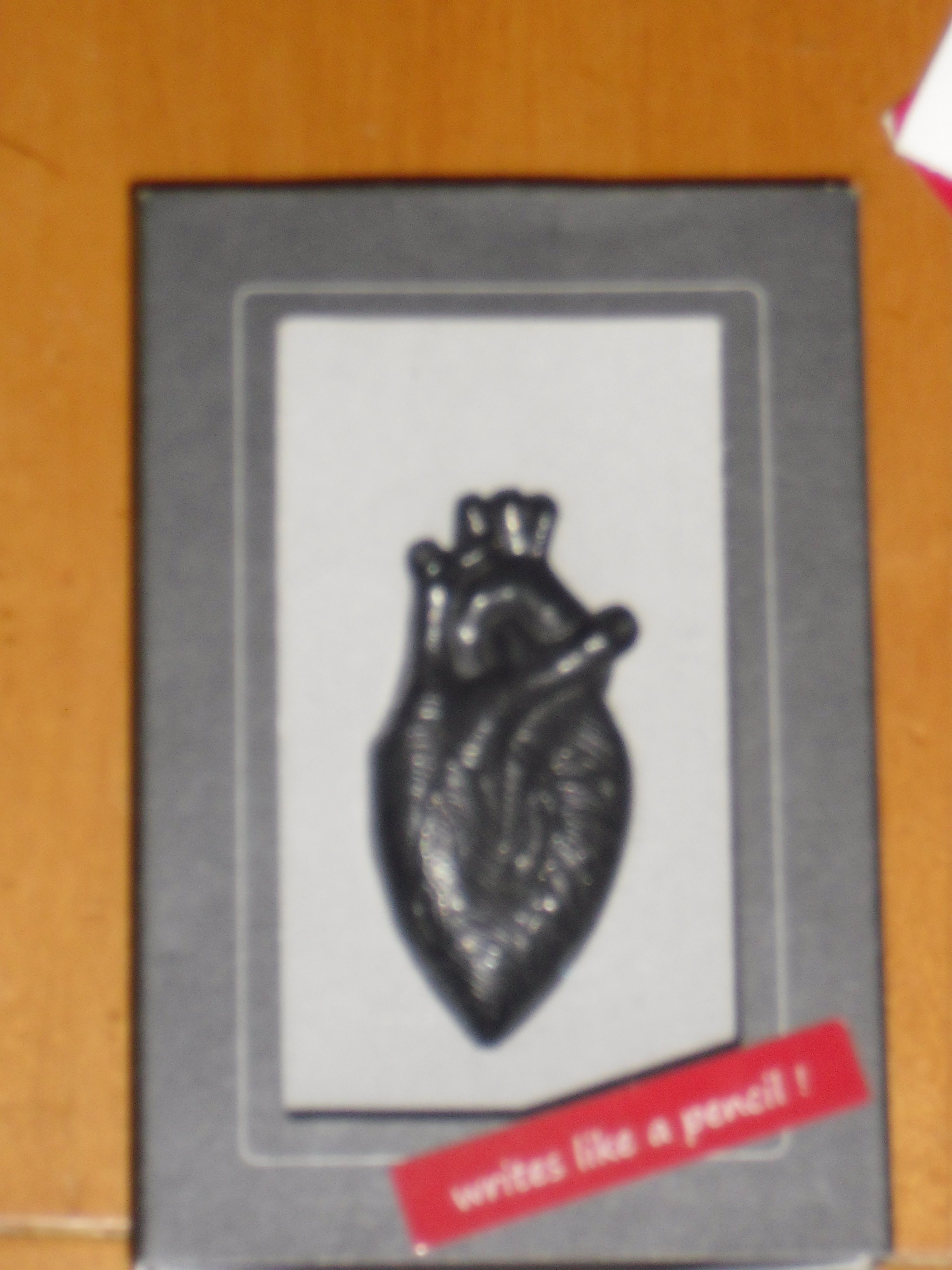
This friend, who I’ll call T, always sends a small but very interesting and unusual gift. This year was no different, and it’s by far the most interesting, unusual, and amazing gift I’ve ever gotten from her. A small human heart, made entirely of graphite. A working pencil in the shape of a heart. Take a look below.

graphite heart

I was so amazed when I saw it. It’s so amazing, it’s so macabre, it’s so…me. T knows me, God bless that woman. And I didn’t even know it was possible to carve graphite with such detail. I’m glad to get it. However, I’m not sure I can use it. In fact, I’m afraid to take it out of the box and touch it, let alone use it as an unusual pencil. Still, I think I will keep it. The heart is so my style, and best of all, it’s inspired an idea for a short story. Nothing can be bad if it inspires an idea for a story. I’m not sure what sort of story yet, but I have a feeling a similar graphite heart will be bringing something not human to life. Isn’t that terrifying?

So I’m going to add it to my list of short story ideas (about sixty story ideas so far. Where will I find the time to write them all?), and then I’m going to call up my mother while there’s still time. I need to get T’s contact information (I don’t have it, if that’s not obvious), and tell her that she got me an amazing gift.

Good night everybody!

*Aufruf: a celebration in Judaism the Shabbat before a wedding. The groom (and in some congregations, the bride) are called up to the Torah to do some special blessings and readings, and get a few special blessings in return. Often candy is thrown at the newlyweds after they have finished the blessings and the kids go to get as many sweets as they can get. Didn’t expect to get a lesson on Jewish custom today, did you?

Yesterday I visited my advisor’s office in the English department and discussed doing my senior thesis in the fall. Normally I would talk to her about this after spring semester had started, but I wanted to get a jump on things before I was busy with homework from five different classes. Plus I had the day off yesterday so I thought to myself, why not?

During the course of our meeting, I was outlining what I’d like to do for my senior thesis, mainly to write a novel. For this novel, I chose five different ideas for stories from the list of novels I keep on my flash drive and gave a brief synopsis of each one to my advisor Ruth. Around the third idea, Ruth noticed a trend with two of the stories I’d mentioned: they both involved young girls as protagonists in the story (one was a story based on Alice in Wonderland, the other involved demons). She then asked me, “Why young girls? Why are they used so much in horror?” To my surprise, I realized I hadn’t thought of it much, and at that moment I didn’t have a very good answer for why, when children are used so much in scary stories, young girls are more dominant than young boys (notable exceptions include Danny Torrance from The Shining and six out of seven protagonists in Stephen King’s IT, the two boys from Monster House, and Hansel from Hansel and Gretel).

And guess what? The question’s been bugging me since that meeting yesterday. So between writing, work, applying for scholarships, and my household chores, I thought I’d take a moment to examine why young girls are more dominant in these sorts of stories. First, we need to examine why children in general are used so much in horror stories:

1. Children are very innocent creatures. It’s the most obvious reason, but it still needs to be stated. Children are very innocent human beings. They still believe that good usually wins against evil, that bad guys get beat up and thrown in jail by superheroes and cops, and the world is a safe place where they are loved and are protected from evil, at least until they’ve been warped by some of the harsh realities of the world. In horror stories, that innocence is tested and sometimes completely broken by the events of the story, whether it be monsters under the bed, abusive parents/teachers/bullies, or whatever else you may be using as the antagonist in a story.

Even the man/child/sponge has more imagination than most adults.

2. Let’s face it, kids are more imaginative. As we grow older, we tend to think less in terms of the fantastic and more in terms of what is real and reasonable. But as children, we really believe in Santa, the boogeyman, fairies, aliens and ghosts with little doubt that they are actual, concrete beings. This means that kids are usually the first to come to the realization that something evil is at work. They don’t realize it through any leap of logic or reason, but through gut feeling and belief. This is also usually why they are more likely to survive than that one guy in every horror film who insists with fatalistic stubbornness that there’s a logical reason for everything and then when they realize something’s up, they still insist on handling it themselves as men, even if it leads to their heads getting bitten off.

3. Kids are dependent on others. Until sometime between ten or twelve, children are dependent on adults for most of their basic needs, and even when they start to become independent, they still require a good portion of help from adults. When in a horror story, most likely a child can’t recieve help from an adult because they’re less likely to be believed by adults. This means they’re basically adrift in a metaphorical sea that wants to kill them painfully and mercilessly. How they survive without the security of an adult is something that keeps the reader drawn into the story.

4. Children are also not as resourceful. Or to be more specific, it’s rare for children to have access to the knowledge or tools they need to defeat the enemy of the story. They wouldn’t know how to set up a trap for a mutant monster, or how to draw a vampire into the sunlight without being totally obvious of their intentions, or even how to set a windigo on fire with nothing but a set of matches (which they shouldn’t be playing with anyway). If the characters are adult, all they need to do is get out their smartphone and Google “How to make a molotov cocktail” or “how to set up a tripwire alarm system”. Kids wouldn’t even have a smartphone, and even if they did they probably wouldn’t know what to Google. How do they survive with nothing to really help them? That is another draw of a horror story.

Look at that face! You know that hotel gave that kid some big therapy bills.

5. Children are easily influenced. Lastly, children are easy to influence, for better or for worse. Has anyone seen Friday the 13th Part IV? Right at the very end we see just how the events of being around Jason have influenced and hurt little Tommy, who will be dealing with his issues for the next two films. A horrific event can stay with a child for a very long time, corrupt their innocence or make them aware of their own abilities. Either way, the events of the story will stay with the child likely throughout their lives. From what I hear, the Overlook Hotel certainly stuck with Danny Torrance (I haven’t read Doctor Sleep yet, though it’s on my reading list).

Okay, so we’ve established why children in general are used so much in scary stories. But still the answer of why young girls are used in the stories has still to be answered. Often, like Carol Anne from Poltergeist, they are persecuted and kidnapped by beings we can’t really understand. Or, like Samara from The Ring, they are the stuff of our nightmares. And occasionally they are both (anyone watch The Exorcist recently?).

This morning I spent some time trying to figure out and I think a lot of it has to do with socialization and the roles we assign to the female gender. In other words, what we expect from young girls and how we believe they should act, behave, and think are why young girls are so popular in horror stories.

Please note that the suggestions I’ve listed below are for fictional girls and are just based on my own reading and viewing of many different horror novels, comics, TV shows, and movies. There may be several stories featuring girls that are the exact opposite of these reasons, I just have yet to be exposed to these stories. The reasons I’ve listed do not necessarily apply to real girls either, as I’ve made clear below. Here are the reasons I was able to come up with and which back up my beliefs on gender roles making female characters popular:

1. Fictional girls are more prone to sweetness, harmony, and nonviolence. Most boys when they’re young like to get wild, scrap a bit, use their fists and compete with each other through acts of physical prowess and aggression (when my cousin was younger, you could not stop him from acting like this). Young girls though are often portrayed as preferring to be friends rather than fight. They like doing cute stuff and they don’t like to get their hands dirty or do anything too wild. The only exceptions I can think of are Beverly Marsh from IT and my sisters, but then again my sisters are from my crazy family, so go figure. So since these fictional girls are less likely to use their fists and more likely to try to harmonize, they’re at more risk for whatever evil is after them in the story.

2. Young girls have yet to enter into the realm of maturity and sexuality. A lot of criticism with horror comes with how it sexualizes its female characters (please see my article Sex and Horror for more on this topic).However young girls have yet to reach that stage where people begin to see their sexuality. There’s an innocence in this lack of sexuality that young boys don’t get from their ignorance of sexuality, though that might have something to do with the fact that, like I said, a lot of women in horror are defined by their sexuality, whereas men don’t usually receive this sort of sexualized image no matter what age they are.

3. It’s adorable when young girls cry. Because of the pre-assigned roles that differentiate between boys and girls, at some point boys are taught that crying is not a manly thing to do, so they stop crying if they want to retain whatever form of manhood a young boy can have. On the other hand, it’s considered okay for girls to cry throughout their lives. And instead of pitying these girls or questioning their maturity like we would with boys, our hearts go out to the girls and make us want to hug them. This contributes to the popularity of young girls in horror stories.

And if these points haven’t hammered home my belief on gender roles playing a major role in the popularity of young girls in horror, here’s my final point:

In the end, the princess mentality takes a toll.

4. Young girls want to be princesses. It’s no understatement that plenty of girls in our Western society want to become princesses when they grow up and have a handsome prince rescue them from evil so they can live happily ever after, and our media perpetuates this to no end  (even Once Upon a Time and Frozen couldn’t leave this cliché out of their storylines, though they both do something rather original with the trope in each their own way). In horror stories, typically it’s up to a female character to either rescue herself from her predicament or to let a strapping young man save her and then sweep her off her feet. With young girls, that choice isn’t always available, and often the writer will write the story so that we wish for someone to come and save the little girl, while holding us with baited breath to see if she will be saved by a dashing prince…in the case of horror stories, most likely an older male relative with an axe or baseball bat.

So the reason why young girls are so popular in horror stories, as I’ve listed above, is that they fulfill certain gender roles that we’ve come to expect and work nicely into not just the plot of the story, but certain preconceived notions we unconsciously have in their minds. However, not all young girls fall into these roles. Beverly Marsh from IT plays a big part in stopping the demon clown when she’s a little girl by being the more aggressive fighter of the Losers Club. Coraline from the book of the same name is able to release the souls of the eaten children and save her parents all on her own. And even creepy Samara coming out of the TV is an exception, as she doesn’t fulfill any traditional roles, not even the one about needing saving. She’s the freaking villain!

Yeah, don’t mess with her.

So I think I’ve answered the question Ruth posed to me yesterday in her office. I’m not sure it’s the best answer or the right answer, but it’s what I was able to come up with. If you have any ideas about why young female characters are so popular, examples of girls who buck the trend, or any other points relevant to the discussion, please let me know.

Also, in a somewhat related note to children and horror, I finally watched the film version of Battle Royale. It was actually much better than I expected, almost as good as the novel. However there were a couple of creative choices I disagreed with, and that’s why it’s not on equal footing with the book. I also won’t see the sequel, because apparently it’s not based on the original story, its anti-American message goes beyond criticism of America to full-on attack mode, and nearly every reviewer who’s seen it has hated it, apparently.

All for now. Write on you later, Followers of Fear.
Another semester passes by, and with it the realization of two things: one is that I have enough credit to be considered a senior now that the semester is over. The other is that I now have a year and a half left of my time at Ohio State University. Boy, way to make my time here feel finite.

Every semester is different and not just because of a set of new classes. For example, this semester I moved into an apartment with a friend about two blocks from campus, meaning we both had to take on a whole lot of different responsibilities. I also started taking five classes in a single semester, more than I’ve ever had in a single semester. At times the homework load was almost unbearable. I hope that next semester will be a bit easier, though judging by the amount of reading I’ll be doing that doesn’t look like the case.

This semester was also significant because two major events happened to me: I published my first novel Reborn City and I got accepted into a study-abroad trip to Europe for three weeks in May. The latter so far has taken up more of my attention, because I’m going to be spending all of next semester preparing for it. And I mean all of next semester: four out of five of the classes I’m taking are in preparation for what I’m going to study in Europe (by the way, the trip is about studying World War II). Still, RC has taken up a bit of attention too. I’ve had to advertise everywhere I can. I’m actually looking into putting an ad into the student newspaper if it doesn’t cost too much.

And as for my classes this semester, I took Introduction to Sociology, Introduction to Biology, Writing for English Majors, Science Fiction and Fantasy Literature, and History of the Holocaust. The latter two were my favorite classes (despite the dark subject material in the Holocaust course) and they were also the classes I did the best in, getting As on most papers and tests. All told, my grades added to a total 3.263 GPA. I’m happy with my grades (they’re all passing grades) but I’m going to aim for higher next semester. Especially since going on the trip and keeping my scholarships will require me to keep my grades up!

Well, I hope to have more good news later. Watch out for my Spring Semester 2014 Pre-Semester Report. It’ll probably be showing up in the next couple of weeks. In the meantime, I’m going to make dinner and finish Ch. 28 of Video Rage. Wish me luck.

I’m not sure there’s a single American in the country today who opened a newspaper, got on their smartphone, or connected to the Internet who doesn’t realize that today is exactly a year since the horrific tragedy at Sandy Hook Elementary School. Even now, the memories of that terrible day are resurfacing in my mind’s eye: sitting in bed, seeing that a school has been shot up by a gunman. Fatalities, fear, fingers already being pointed, conspiracy nuts shouting their insanity. But for a little while, the American people, a people so prone to heat and rage and division, were united in a way that hadn’t been seen since 9/11. We cried and memorialized the dead. There was grief for the 20 children and six adults who died, grief from people who’d never heard of Newtown until that day. There were numerous memorials and tributes, online and on TV and across the nation by everyone from children to the most powerful of politicians.

However in the days, weeks and months since Newtown, as we learned about the gunman Adam Lanza and we heard stories about the dearly departed. that unity broke up. We looked for solutions to prevent this tragedy from ever happening again. In a year full of monstrous mass shootings in Aurora, Wisconsin, and now in Newtown, advocates for stricter gun safety laws hoped that Congress would pass sensible gun control laws. And with ninety percent of Americans behind measures such as a ban on automatic rifles and expanded background checks, it looked like there might actually be some change this time. Second Amendment advocates meanwhile balked at these proposed measures, and instead said gun control laws didn’t work and called for administrators to be trained in firearm use and to hire security guards for schools. In the end, some states such as Colorado, New York, and Maryland passed their own restrictions, while President Obama passed 23 executive mandates and Congress failed to pass any laws that would truly satisfy either side.

Normally I would use a post such as this to advocate for stricter gun laws, but I’m tempted to not do so in order to keep the dead in mind on this horrible day. However, I read articles that show that the gun maker for the rifles used in the massacre actually had an increase in sales after Sandy Hook, and I feel a little sick to think anyone could profit off a tragedy such as this. Not to mention that nearly a year after Sandy Hook, there was a shooting at a school eight miles from Columbine High School, as if to remind us how little has been accomplished since then.

So I’ll speak and say, a year later, parents are gathering around dinner tables with a vacant seat. They wish to hold their kids close to them, but they can’t. And across the nations, parents and children, siblings and cousins, friends and families, lovers and colleagues, lose someone dear to them because of gun violence. In fact, approximately 30,000 people each year are lost to gun violence, the equivalent of nearly 1154 Sandy Hooks.

We need to do something about this tragedy, but is throwing more gasoline on a fire really going to help? No, it will not! We need to choke out the fire, not give it more fuel. So if you can, call or email your legislators. Support gun control groups if you can afford to. And if you own firearms of any sort, make sure it is in a safe place where it won’t hurt anyone who might accidentally stumble upon it. And I know any Second Amendment advocates will be furious with what I’ve written here, but let me tell you, I’m not advocating for taking away all guns from your homes. Even freedom of speech is regulated when that speech is used to incite violence or is used in a malicious manner. Shouldn’t guns be treated the same way?

And besides, do you really need a military grade automatic rifle? There are no zombies or enemy armies waiting to attack, you can’t go hunting with that kind of gun, and a simple handgun is enough to ward off any burglar or rapist. Just saying, is all.

I’m going to leave you with this video I found. It describes all the grief I feel for the victims of Sandy Hook, and I think it’ll resonate with you too on this most horrid day.

tqg cover

They say that 7 is a very lucky number, and I have no doubt about that right now. I just got my 7th review on my collection of short stories, The Quiet Game: Five Tales To Chill Your Bones. This review comes from A. Frankel, which stands for Amy Novak Frankel, my third cousin and a dear friend., and she gave it five stars. In a review titled A really good book from a new author, Amy says this:

“I thoroughly enjoyed each of the short stories in this book and look forward to reading more from this author.”

Well if I remember Amy, you said that you bought all my books (which is just the two), so I can’t wait to hear what you have to say about Reborn City. I spent four years bringing that to the printed page, so I’d love your opinion on it. And thanks for the review once again. I’m averaging about 4.3 out of 5 on Amazon now.

If you’re interested in reading The Quiet Game, it’s available in both e-book and print paperback from Amazon and Smashwords. I hope you enjoy reading it and whatever you think, please don’t hesitate to leave a review. I’m always happy for feedback, positive or negative.

I’m hearing a lot of comments on political news shows about how certain programs the government is doing or how certain actions being taken are being considered as slavery/apartheid/the Holocaust/genocide/etc. by certain people. I’ve just got one thing to say: quit the melodrama! Obamacare is not apartheid or slavery, abortion is not the Holocaust, shaking hands with Raul Castro is not the same as shaking hands with Adolf Hitler!

You see, there are certain groups here in America–African Americans, South African immigrants, Jews, etc.–who get really upset every time their national/ethnic/religious persecutions and injustices are used flippantly in political speech. It belittles the tragedy, makes it seems trivial. I mean, take slavery for example. It seems absurd if I compare myself to a slave if I complain about my homework every day, doesn’t it? How about being told to go to bed by your parents? Does that make you a slave? No it does not!

And actually, not only are these statements trivializing the tragedies in question, they are terribly inaccurate. Obamacare is not forcing people to work in horrid conditions and receive little or no benefits for it and are actually mistreated by overseers. Nor is Obamacare forcing people who are not enrolled in its programs to live in separate areas of towns or even of the country and putting strict legal restrictions on interactions between those enrolled and those not enrolled in the program. And unless abortion has become the state-sponsored deportation of fetuses to ghettos or work camps where they are subjected to conditions meant to either kill off or turn them into human beasts while my back was turned, I think it’s a little much to start comparing your local Planned Parenthood clinic to Auschwitz!

Of course, you’re free to disagree with me. That’s the lovely part of America: we can all have our own opinions, and as long as they don’t lead to violence, becoming socially ostracized, or aren’t a symptom of some mental illness,  we can express them as we wish and expect little or no backlash. However, I urge you to be cognizant of your words when you make a comparison between something you disagree with and a terrible tragedy or an unspeakable act. You may offend somebody with such an interpretation of events or a comparison. And if you don’t care who you offend in making these statements–my, how callous can you get!

And if my point hasn’t gotten across how gross these comparisons are, let my friend Dr. Sheldon Cooper show you how ridiculous these comparisons are.


Get the picture?

Oh, no comments that are offensive or trying to convince me that Obama is out to get Americans or whatever. I don’t want to hear it and I’ll delete those comments should they show up here. I’m just saying, be careful what comparisons you’re using, because many find them upsetting and terribly inaccurate.

It’s watching you!

Oh, blessed relief. Today I sat down, once again, to work on Chapter 24 of Video Rage, the sequel to my novel Reborn City. I’d been working on and off on the chapter for the past eight days or so, delayed by homework, exams, and the need to sit down and do something other than writing in order to relax. But today I sat down, and I finally finished it, meaning I only have a third of the novel left to write! Woo-hoo!

I’ve been enjoying my return to the world of the West Reborn Hydras. Not only has it been kind of therapeutic and relaxing to work on my novel after having to take a very long hiatus in order to focus on school, but it seems that the world of the story has expanded on its own,  become more complex and astounding than when I first created it. When I was working on Chapter 22, the characters kind of took the reins away from me and played out a scene before me similar to a cop drama, where one character was poking holes in the story of the other two and showing just how flawed their seemingly-flawless version of events really was. I didn’t even think I could write a scene like that! And when I worked on Chapter 23, new characters and new situations kept intruding into the scene I’d originally envisioned. I guess it’s true what they say, that the characters really write the story and not the authors.

Well, it makes my job easier if they write it for me. And better yet, my characters don’t ask for royalties.

But I digress. Let me update you on page and word counts (and when I say page, I mean your standard 8″ x 11.5″ MS Word paper). In total, the number of pages has risen to 197 pages, while the word count has risen to 54,703 words. That’s about the length of a very short novel, and since I have thirteen chapters left to write, it’s probably going to rise another ten to twenty-thousand words (no, don’t be intimidated. Most of the Harry Potter novels are much longer than that).

For now though, I think I’ll take a very short break from writing VR. I’ll probably write an article for Self-Published Authors Helping Other Authors, I’ll apply for several scholarships offered through my university, I’ll spend a lot of time at work so I can afford to keep a roof over my head, and if my friend Angela sends any more chapters of Snake, I’ll work on edits. And after all that, I’ll start on Chapter 25 of VR. Trust me, it’s going to be awesome. Things will really come to a head in the final seven or so chapters.

For now though, I think I’ll make dinner and settle in with some TV, a nice reward for myself after some really hard work. Until next time, my Followers of Fear.

Time once again for my Weekly Exercises, my flash fiction pieces dedicated to a) practicing my craft, b) getting feedback from readers, and c) trying to get people interested in my published work. Remember that the Weekly Exercises depend on reader feedback, so if you have a thought on what you read, please let me know. Also, if you would like to check out any of the other Weekly Exercises, you can find them here. And if you have an idea for a Weekly Exercise, give me your name and idea. You might just see your idea on this blog someday.

With the upcoming aniversary of the Pearl Harbor bombings, I dedicate this Weekly Exercise to those who died during the bombings and those who afterwards fought for our freedom here and abroad. We owe more to you than can be expressed in a single blog post.

Enjoy.

~~~

When I was a kid, my brother and I would read all these science fiction stories. Looking back on it now, they were all basically the same: the noble and indestructible warrior, the beautiful princess with barely any clothes, the quest that always ended with the hero victorious and in sexual bliss with his princess. Stupidly optimistic, but that was the 1920s for you. We were all hopeful for the future and thought nothing could cut us down.

Then there was the Depression, and then war broke out in Europe and in the Pacific. I enlisted to get away from home and do honor for my country. Or maybe what I wanted to do was get away from reality and become the hero of my own science fiction adventure. Perhaps they were the same in my mind. Either way, I joined the Marines expecting that I’d leave training an invincible warrior just waiting for the princess of my dreams and the adventure of a lifetime to come my way.

Neither did. When we got to Peleliu in 1944, it was like I was in a jungle on another planet, but I was fighting the Japanese instead of aliens or whatever, and I certainly wasn’t invincible. The heat of the jungle, the sweat of unbathed men, the rotting corpses and the buzzing flies made all of us miserable. At any second we were liable to get killed by bullet or sword or sneak attack, and that only worsened our misery, and sometimes drove us mad. Once in a foxhole my buddy got out to piss. He was shot as soon as his fly was unzipped. I saw his body later. His entire face was a bloody mess and his fly was still down, but whatever had been there had been mangled by gunfire. I could almost hear him asking me to zip his fly. All I could do was puke.

We did see a girl on the island, one of those girls from a pleasure regiment. She was Asian, but she was a real beauty and she wore a simple dress. She was the first girl I’d seen in months, and I was ready to make her feel like a princess right then and there, if only she’d tell me that things would get better. She saw me and my boys though and threw herself over a cliff. We tried to save her, but all we did was see her join some of her comrades down at the bottom of the cliff. We learned later the Japanese had brainwashed the girls to believe that Americans would do horrible things to them if they were caught by them. So much for an epic romance in an unforgiving wasteland.

As I sit thinking about this now, one of my comrades is peeing on the face of a dead Japanese soldier. He’s laughing like it’s a big joke and when he zips up his fly he walks away with a swagger. Does he think he’s done his duty for his country? How would he feel if a Japanese did that to one of our many dead? He wouldn’t act so noble or treat this like a joke. Truth is, there’s no nobility in war, there’s no adventure or romance or humor. There’s just blood and death and destruction and the knowledge that any moment all of it might come raining down on your head.

My brother tells me in his letters he’s planning to enlist once his birthday comes around. I want to tell him to stay away, but then he’ll accuse me of just trying to keep all the fun for myself. Oh well, let him enlist. He’ll see that the fun isn’t to be had here, or anywhere there’s war. It’s just one pile of shit after another, and if you’re unlucky, you die, sometimes by your own hand but usually by the hand of someone else. And if you’re lucky you ride it out, you go home, and you move onto something else. Maybe write science fiction stories that reflect the truth of life, which is that life’s harsh. That’s what I plan to do, anyway. If I don’t bite the bullet first.

The edition I got from the library. God, it was good! Blew my mind…and possibly a finger off. That explosive.

Some of you may remember from a while back I finished reading The Hunger Games trilogy and wrote a less-than-favorable review of it. It was around that time, I started to hear about a book that predated The Hunger Games and was considered by some fans to be much better than Suzanne Collins’ trilogy. And when I heard it was a Japanese novel, then I got really interested (typical me, I’m a nut for most things from Japan).

This past month I finally found the time to get the book, titled Battle Royale, from the library and sit down to read it. As I got about a hundred pages in, I started musing to myself that this was the sort of story I would like to write, well thought-out, exciting, and extremely well-written. About two-hundred pages in, I was so engrossed it was really difficult to put it down. And by three-hundred pages in I was staying up late just so I could read more! And today I finished Battle Royale, which has officially become one of my all-time favorite novels.

And of course, I had to write a review of it.

For those of you unfamiliar with the novel by Koushun Takami, the story takes place in a world where Japan is the seat of the Republic of Greater East Asia, which as far as I can tell is what would happen if Japan had come out much better from World War II as an authoritarian empire. In this Republic, junior high classes are selected randomly throughout the year to take part in survival games in which the classmates must fight each other until only one student survives. The novel tells the story of one particular class, Shiroiwa Junior High Class 3B and its 42 students, selected for the heinous Program and forced to fight each other on an isolated island in the Seto Inland Sea. The novel focuses mainly on the exploits of Shuya Nanahara, Noriko Nakagawa, and Shogo Kawada, three classmates who plan to escape the Program, despite the number of obstacles meant to keep them in the Program (not to mention classmates that are all-too willing to take part in the Program). The novel also looks at the lives of several other classmates, so that by the end of the book you feel you know at least a little bit about a majority of Class 3B.

And the twists and surprises in this story will keep you reeling until the very end. You can quote me on that and take it to the bank.

The author does a very good job managing a very large and diverse cast, giving most of the characters at least a little characterization so that those you meet seem at least well-developed, even those who only show up for one or two chapters. Takami-sensei (as he would be addressed in Japan) also manages to tell a very bleak story with engaging finesse, wasting not a single word. The action sequences are so terrifying you’ll be hearing the climax from Stravinsky’s The Firebird during the climax (at least I did), the musings on life, the government, and the meaning of the Program will pierce deeply, and the emotions of each character hit you pretty hard as you get to know these kids. And when you find out why a government would have a Program like this, you’ll think to yourself the same thing you’ll end up thinking when you read the resolution of the story: “That’s so clever! Scary, but clever!”

There was only two moments where I was dissatisfied with the story. One was I wanted to see more of a certain character that died midway through the novel. The other moment, later in the novel, was I had trouble believing that a certain character wouldn’t get treated for a potentially-fatal-if-let-untreated wound after he sustained it and the danger had temporarily passed. Why wouldn’t he get the bullet out before it killed him? There was time for it!

Other than that, I absolutely loved the story. Even the romantic subplot of the novel was woven in beautifully, and didn’t annoy me like it might’ve in a certain trilogy I could name (oh wait, I did name it! Never mind). The plot was quick-paced, terrifying, and left you with an impression that doesn’t go away.

All in all, Koushun Takami-sensei’s novel Battle Royale gets a 5 out of 5. I haven’t been able to immerse myself into the world of a novel in a long time, and after I was done, I didn’t want to leave because I’d grown to love some of these characters so much and so desperately wanted to see what would or had happened to them.

I’m going to go reserve the movie version from the library now. I doubt it’ll be as good as the book, but at the very least it should be interesting. Maybe even review-worthy (though that could also happen if the movie is incredibly terrible when compared to the book). Unless something else awesome happens tonight, I’ll blog on you later, Followers of Fear. Goodnight.

Remember George Zimmerman? The guy who shot Trayvon Martin? Guess what he’s done now: he’s threatened his girlfriend with a shotgun and threw her out of the house when she tried to dial 911. When the police searched his car, they found an AR-15, a shotgun, and three handguns. He’s been let free on a $9,000 bond, and he’s entered a plea of not guilty. And this isn’t his first brush with the law since he was let off this summer: he’s been pulled over three times for speeding and assaulted his wife (yeah, he’s still married). The only reason he wasn’t arrested with the last one was because of lack of evidence.

Now, back during the Trayvon Martin trial, those who supported Zimmerman were saying that he was defending himself, that Trayvon was high and unstable and dangerous. They ignored that he had a history of violence before the Martin incident, and they might just try to ignore this situation altogether. But I’m going to repeat what I said back then: that George Zimmerman attacked an unarmed teen and killed him, and got away with it because of lack of witnesses, including the victim who understandably couldn’t speak, and because of a law that makes no sense to me. Yeah, I don’t support Stand Your Ground laws. They basically say I can go into a public setting with a gun, start a fight with any random passerby, and shoot them if I feel threatened.

But the point is, Zimmerman’s proven that he’s more likely to instigate an incident than defend himself. This is his second assault since his acquittal. It’s only the first with enough evidence to actually go to trial. So I’m just going to be the first to say this: Zimmerman should’ve been convicted back in July, because he assaulted Trayvon and killed him. But he didn’t, and then he attacked his wife and girlfriend. Either of those assaults could’ve been avoided, just like Trayvon’s death could’ve easily been avoided, but we allowed them to happen.

I just hope that this time around, Zimmerman gets convicted, because honestly if he keeps getting off like this, his head’s only going to get bigger and he’ll think he’s invincible to prosecution and punishment. And I really don’t want to see the carnage a man like that can leave behind when he believes he’s unstoppable.

Let the trial begin!