Posts Tagged ‘reflections’

Lately I’ve been pondering something. Well actually, I’ve been pondering a lot of things, including how kissing is treated in different genre fictions and if swallowing the prize in a cereal box makes you a specially marked package (I ponder a lot of things, some of which are strange and some of which may appear in future blog posts), but this one thing in particular I’d like to explore. In a YouTube video I watched recently, the host of the video pointed out that a lot of movies start out with a protagonist walking in on their spouse having an affair, and how that is supposed to start a journey of transformation. This actually caused me to have an epiphany: a lot of fiction–not just movies–revolve around, or start off with characters being in, being caught, or thinking about having an adulterous relationship.

Like, a lot. A whole lot. Like if it’s not a main focus, then there’s a good chance an adulterous relationship will show up in a story at some point or another. I can think of four Stephen King stories that involve affairs as major plot points. One of the most popular TV shows out right now has an affair as a major plot point (*cough* Scandal *cough*). The novel Gone Girl, one of the most compelling mystery/thrillers of the past decade, has an affair as its catalyst. Adultery is freaking everywhere you read/view/listen!

So this got me thinking on three points. First, why do affairs show up so much in fiction? Second, is this a good trope, or a trope that should be done less? Perhaps even phased out? And third, how often do adulterous relationships appear in my own fiction?

Well, that first point is rather obvious (unfortunately). Adulterous relationships show up so much in fiction because they happen so much in real life (unfortunately). Of course, affairs have happened since the beginning of monogamy, but I’m not so sure they were discussed as openly as they are these days. Affairs were considered vulgar things, so the only places they were really talked about were places where it was okay to discuss that sort of thing: bars, raunchy plays (William Shakespeare was actually considered a very dirty and lowbrow for his time), and the occasional dirty poem (yes, those did exist). In polite society, they were only quietly discussed, and that kind of reflected how often adultery was discussed in fiction, and how it was treated when it was brought up.

Scandal, which revolves around an adulterous relationship (still love you, Olivia).

Nowadays though, for whatever reason, we’re a lot more comfortable discussing adultery. In fact, rather than being something discussed in hushed whispers, adultery can be a major and accepted talking point. When a celebrity or a politician, especially one who preaches family values, is caught having an affair, it gets discussed ad nauseum in checkout lines and on national TV. Websites that facilitate adultery are at the center of major scandals, and advice columns around the world regularly feature letters from people who had discovered their lover has a side lover. There are even people who think that having an affair is healthy, natural, or no big deal. It’s a thing, and it’s pervasive (unfortunately).

And as fiction tends to reflect the real world up to a certain extent–last I checked, there aren’t any real exiled queens with dragons calling her “Mother”– it makes sense that adultery would show up in a lot of fiction.

So that answers the first question. What about the second question? Is the adultery trope a good one, or is it overused to the point that we might want to use it less?

Well, that’s a tricky one. Affairs are so common (unfortunately) that it would seem weird to take them out of all fiction. It’s like war or murder; they’ve happened, and they will continue to happen, so you might as well base a story or two around them. Like it or not, adultery is a part of everyday life, so it will show up in fiction.

I think the thing to keep in mind is just to avoid certain clichés with adultery. Any mystery writer will tell you that the lover killing the victim over jealousy or an affair has been done to death (pun intended), so perhaps one should avoid using that cliché, or find a way to use it so that it actually comes as a surprise rather than being expected, like in Gone Girl. Another cliché to avoid is how finding out your lover had an affair is a signal to go on a journey of self-discovery, or to try something new and exciting. Like I said above, the cliché has been done quite a bit, and it really doesn’t make sense. Affairs can change lives, but I don’t think they are one of those events that suddenly change how you look at life or at yourself. A near death experience, or the realization that you become everything you didn’t want to be, maybe. But walking in on your spouse? I think that’s a more likely to cause a shouting match. Maybe an alcohol binge or a murder, but probably not a journey of self-discovery.

And while we’re on the subject, nearly all the affairs in that cliché I mentioned involve the wife or the girlfriend doing the cheating, which is odd because most affairs involve the husband or boyfriend. That’s not some anti-male sexism, that’s just statistics. We could balance it out a little more.

I guess the answer I’ve come to is that if you’re going to have an affair in your story, and it’s going to be a major plot points, make sure it’s not subject to tiresome clichés we’ve seen a thousand times.

And now to my final point how much does adultery show up in my own fiction? And yes, I have to make this a major point of this post. This is my blog about my writing, and all authors who share their work with others are a little narcissistic, including me. Can you blame me?

Surprisingly, not that much. I’ve thought about a number of stories I’ve written since I was ten years old, and of those, adultery shows up in maybe three or four. Only to really come to mind. One was a vampire novel I wrote in high school that was really me exploring my own sexuality before I was aware of it (see this post for more details), and the other was a recent short story. In the latter example, I only spent about a paragraph on the affair. It serves as one of the reasons why another character commits a double murder, but it’s far from the main focus, which is actually the environment of the characters. I actually have plenty of story ideas that involve adultery, but I haven’t gotten around to writing them, and they are a minority among all the other stories I’ve come up with but have been written yet.
Whether we like it or not, adultery will continue to appear in fiction for a long time to come.

I think this might be because adultery is just not an issue I want to focus on. Outside of a few shows I watch, I’m not very interested in adultery. This might be because I’m not interested in romantic relationships in general, or because they’re just other tropes that I would prefer to work with. Not only that, but adultery is rarely that scary. I am all or a writer, I prefer to write about scary things. Monsters, ghosts, the horrors that mankind is capable of, the fear of things that could happen to us if things were just a little different. Unless you’re dating a psychopath or something, adultery is not really that scary. The biggest fear is getting caught, and in most fiction, that is what happens. Not much incentive for a horror writer to focus on adultery. Or at least not this horror writer.

But who knows? Adultery could show up in more stories in the future. My style is still evolving, so anything is possible.

Adultery is sadly very common, which means it will continue to show up in fiction for generations to come. However, the way we use adultery in our fiction can be highly a versatile, and that ensures that it won’t be a trope that will get tired anytime soon. Just avoid the clichés, and if you don’t care to use adultery in your stories, don’t. For every writer who isn’t comfortable running about such a subject, there is always one who is.

What’s your take on adultery in fiction?

So I started up a binge on H.P. Lovecraft again right after the new year. I’m not sure why; maybe I was just in the mood for him, or maybe something I read made me think of good old Mr. Lovecraft and I wanted to pick him up again.Or maybe the YouTube video where I discovered Uzumaki mentioned him, and that did it. Whatever the case, I’ve noticed that the gaps between my binges are shortening with every binge. I first put him down in September 2015 after first buying my edition of his collected works, picked him up again in June 2016, put him down once more the next month and picked him up again in January 2017. I wonder when I’ll be in meeting Mr. Lovecraft again? Early summer, maybe?

Now if you don’t know who H.P. Lovecraft is (and there seems to be a lot of you who don’t), let me tell you about him. Lovecraft was a writer from New England who wrote in the early 20th century, and is considered the father of cosmic horror, a sub-genre of horror that deals with man’s inconsequential place in our universe, and that some revelations about that are so powerful, they cause you to go mad (it’s the kind of stuff that keeps you up at night if you think too much about it).

I started reading Lovecraft two years ago because I heard he was very influential on some of my favorite writers and filmmakers, and each time I delve into his work I like to write my thoughts on him (see Parts 1 and 2 here). So what did I think this time around?

Well, I have to say, the further I get into Lovecraft’s work, the easier it is to read. I’ve mentioned before that he writes like he’s living in the 1820s rather than in the 1920’s, but I think as time goes on, he learned to write in a more contemporary style while still sounding like he was a contemporary of Poe. I’m not sure that the collection I have of his work is chronological, but if it is, then I’m definitely seeing him develop into a better writer. I also think I’m getting a better grasp at what makes Lovecraft so memorable. Before, I probably would have used generalizations, such as “he’s creepy” or “vaguely disturbing.” Now, however, I’m able to point out what exactly about the story sticks in my mind and why it is successful or not successful, such as the mysterious nature of the monsters in one story or the twist at the end of the story in another.

I also think that the stories written in this period (assuming that the stories are ordered chronologically, of course) are much better than his previous works. I got to read one of his famous stories “The Call of Cthulhu,” and I found it very interesting. Not just because it contains one of Lovecraft’s most famous characters, but it has the essence of his cosmology and philosophy in that story. The idea of man as the insects of the universe, and greater beings just waiting to come back and take over is succinctly and powerfully presented through the narrator’s encounters with the titular demon-god’s cult.

Got to read the story with this guy.


I also really liked the short story “Pickman’s Model,” about an artist who draws very disturbing paintings in an old colonial home. It was well told, and I really enjoyed the twist at the end, which even I didn’t see coming.Same with “Cool Air,” a short story about a doctor living in an apartment building. I read the list at the end of that story, and I was like, “Damn! That’s actually very clever.”

If there was any story I did not like, then it was the last story I read by him this particular binge, and also the longest. “The Dream-Quest of Unknown Kadath,” a novella that felt like an acid trip ending  in a Lewis Carroll ripoff.* It was too long, silly trying to be serious, and like I said, the ending rips off Lewis Carroll in the most obvious way. I kind of wish I had skipped over this one.

All in all though, I’m really starting to gain a healthy respect for H.P. Lovecraft. He added a lot to the horror genre, even if he didn’t live to see his influence, and I can see why he’s still read today. I don’t know when I will pick up his work again, but I have a feeling I am in for a treat when I do.

In the meantime, I found out there’s a movie version of “Call of Cthulhu,” so I will try to get my hands on a copy of that. Hopefully I’ll get it soon, and when I do, you’ll hear my thoughts about it.

That’s all for now, my Followers of Fear. I hope to have a new author interview out Friday, so keep your eyes peeled for that. Until then, pleasant nightmares.

*Weirdly, it wasn’t acid he was on. LSD wasn’t invented until year after Lovecraft died, so there’s no way he could have gotten his hands on it. Or Lewis Carroll, for that matter. Which begs the question: if those two were high when they came up with their respective stories, what were they high on?

Well, I’m very excited that something I’ve been wanting to do since the New Year is about to happen. Now, some of you may remember Gynoid, a science-fiction novelette I wrote nearly a year-and-a-half ago about a guy who buys a robot that looks like a human girl, a gynoid (the female equivalent of an android), in order to become more sexually experienced. What results from this move is the basis of this story. I’ve tried getting it published in magazines, but the ones that allow larger word counts rejected it, so I put it aside.

I think I might have mentioned it before, but my New Year’s Resolution for this year is to get more people into reading my work, and one of the ways I can do this is through Wattpad, which is like the YouTube for writers. People upload their stories, and other people read them. I used the website previously, but because I couldn’t make money off of that site, and I would like to make money off my writing, I didn’t use it that much.

But I think that Wattpad could be a good platform to find new readers, and maybe a few of them might subscribe to my blog or even pick up my novels if they like what they find on Wattpad. And I really want Gynoid to be read by people, because I really like the story and what I did with it. So I’m going to be publishing Gynoid in installments on Wattpad for you guys to read!

Yes, that’s right, Gynoid is going to be published on Wattpad. You can read it for free on the website, and since many of you actually aren’t into horror (though I’ll never understand why), you can read this one, since it’s straight science fiction. I plan to publish it in parts, maybe 3 or 4, because it is a bit long and I think it’ll be easier to digest the story if it’s in parts. I also think if I tell it in parts, then it might keep people more interested. If a story or part of a story ends on a cliffhanger, people will probably want to read more, right? That’s what I hope will happen here.

And since Wattpad allows you to upload a cover with your stories and I wanted an awesome cover this time around, I sought out my good friend and fellow writer Joleene Naylor, who also made the cover for Video Rage, to help me bring the cover of my dreams to life. I took photos from CanStock Photos, which is a great resource for affordable stock images for your creative projects, and she took them, along with my instructions, to make this nifty cover.

gynoid-blogs

Isn’t that amazing? Joleene literally took the vision in my head and made it real! Usually I have to kill several people for that to happen on its own. I absolutely love this cover, and I can’t thank Joleene enough for helping me create this awesome cover. It looks really professional, and I think people will gravitate towards it in ways they haven’t to previous covers I’ve made on my own. I wish I could do what Joleene does.

Anyway, the first part will be out February 14th. I feel Valentine’s Day is a good day to put out the first part of this particular story. When it does come out, I’ll be posting links everywhere I can. And after that, I think I’ll release each part on a weekly basis until the story is wrapped up, and put each link on my Stand-Alones and Other Works page so anyone who wants to read it later can.

That’s all for now, my Followers of Fear. I hope you’re looking forward to reading this story as much as I am for you to read it and I am counting down the days till February 14th. If anything pops up in the meantime to talk about, I’ll let you know. Have a good evening, and pleasant nightmares!

Today I ordered an Uber ride from my apartment to the Drexel Theaters in the Bexley neighborhood for a special event. And there I saw something terrifying: the poster for Tommy Wiseau’s The Room. That film is horrible! I’ve seen clips of it, and it’s painful. And apparently the theater shows the film every now and then. And people apparently come to see it. That’s some dark, sadomasochistic stuff right there.

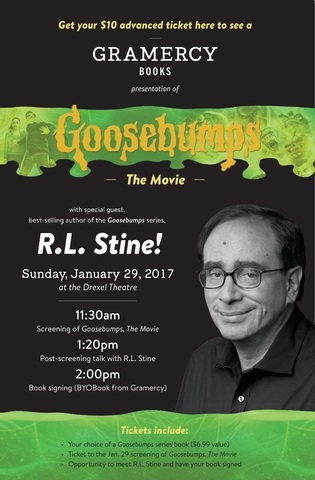
But I was really there because Gramercy Books Bexley was having a big weekend in honor of its opening, and the highlight of this opening weekend celebration was a viewing of the Goosebumps film, followed by a reading and a book signing with RL Stine himself!

Now if you don’t know who RL Stine is, what rock are you living under? Well, he’s the author of the popular Goosebumps children’s books, which are probably the most famous horror series for kids in literature. I’d read them as a kid, well before I knew I wanted to write horror, and was probably an early influence on me. So when I visited Gramercy a couple weeks ago (they’ve been open for a little while now, but they had their celebration this weekend. Kind of like a belated birthday party, I guess) and saw they were hosting RL Stine, I knew I had to buy a ticket to meet him. And I bought a couple of his books too, including some of his adult fiction (did not know the guy wrote adult fiction, but I was happy to purchase a couple books from him).

Sunday came. I enjoyed the movie (see my review of the movie from 2015), and was amazed by the mix of adults who grew up with the series and kids who were reading Goosebumps twenty-five years after the first book came out (yeah, twenty-five years. Time flies, huh?). I always thought Goosebumps was a phenomenon of the 90’s and early 2000’s, but it’s endured beyond when I stopped reading the books. Perhaps kids will be reading the Goosebumps books years and years from now, like how we read Alice in Wonderland and Anne of Green Gables over a hundred years after each book came out. I certainly wouldn’t mind reading them to any kids I might have in the future.

rl-stine-reading

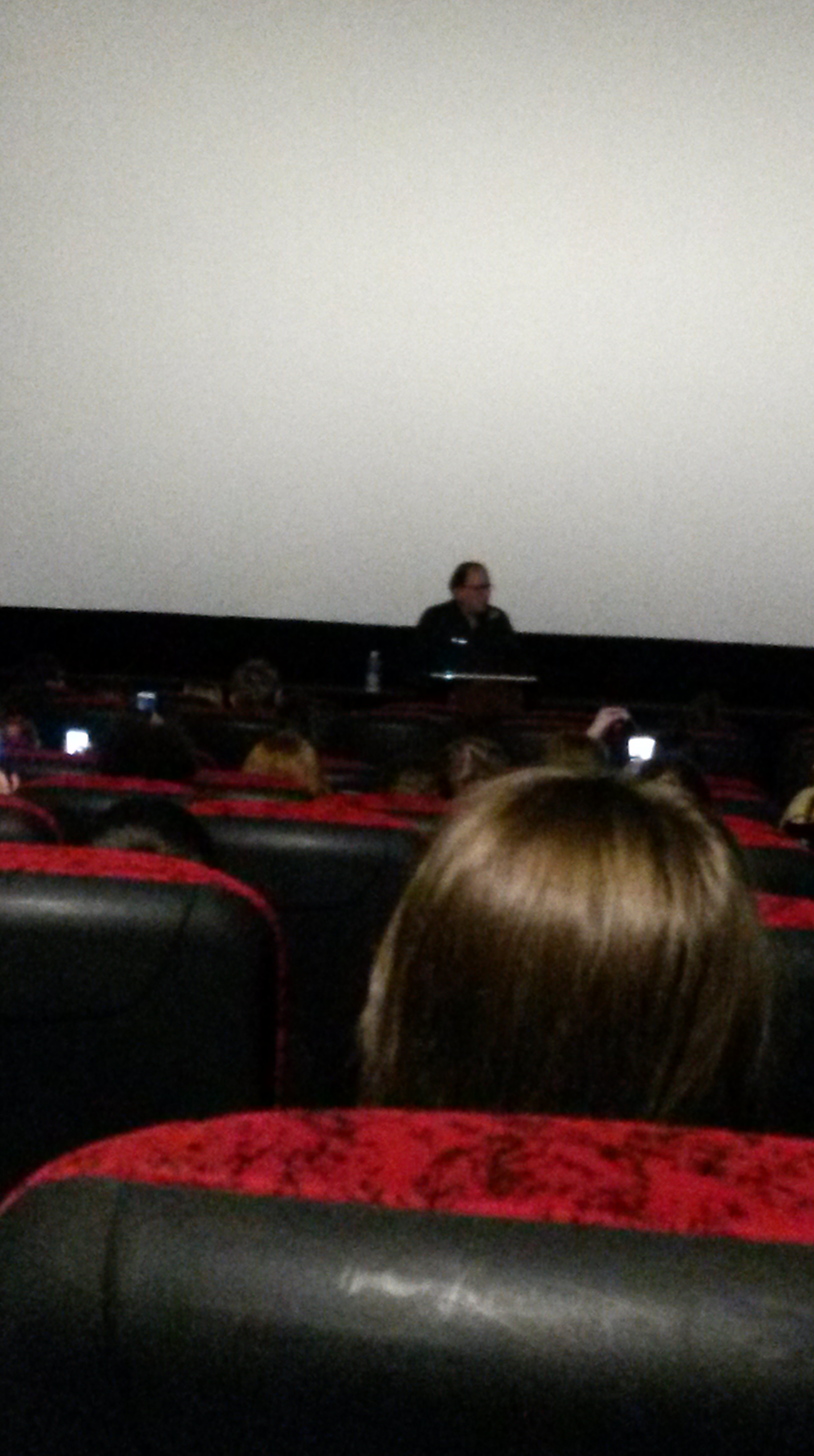
Anyway, the film ended. We waited as the staff from Gramercy set up a podium and microphone at the front of the theater. And then Mr. Stine himself ambled down the aisle, a hunched-over over man in a dark red shirt and dark khakis with large glasses and an amiable smile. He told us about how he had used to visit the Drexel Theaters to watch cartoons and old monster movies, the titles of which he said influenced how he titled his own stories. He also told us a story about how he actually might’ve seen a ghost as a kid (and which he hinted very heavily he made up for us), and then read for us some stuff from his upcoming book, Slappy Birthday to You. Hearing him read it brought me back to my childhood, I tell you.

After that, we all got in line in the theater lobby to get our books signed. The line was very long, circling around the lobby, and I managed to get into it around the circle area. After about ten minutes in line or so, I finally got to the table. And the whole time I was thinking to myself, “Don’t embarrass yourself, Rami. Don’t embarrass yourself.” His wife took my copy of Stay Out of the Basement, the book I’d decided to have Mr. Stine sign and which might’ve been the first Goosebumps story I ever read (I can’t remember very well, I think I was six when I started reading them). He asked me my name, and I said it, though I think he heard “Robbie,” given the noise of the lobby. He signed it, and then I told him what I wanted to tell him:

“I just wanted to thank you, Mr. Stine. I read your books as a kid, and now I write horror and science fiction. And I think you were an early influence of mine. I just wanted to thank you for that.”

Me with RL Stine himself.

Me with RL Stine himself.

He gave me back my book with a smile. If he said anything, I can’t remember what it was. Maybe “That’s nice,” or “You’re welcome,” or perhaps just “Uh-huh.” I think he’s heard that maybe a few times at this point in his career and that he’s used to it, but I was happy to have told him.  And I was allowed to take a photo with him afterwards, which you can see here.

I left after that, got an Uber home. Overall, I was happy. I said I’d felt like a child earlier, and in a way, I was. My inner kid was there this whole afternoon, from watching the movie to hearing and finally meeting RL Stine himself, feeling wonder and exultation at getting to meet this early influence of mine. That kid is often with me, reminding me why I write scary stories and powering the imagination needed to tell these stories. And I’m glad he came out with me today.

I sadly didn’t get Mr. Stine interested in reading my books, but that’s okay. I was just glad I didn’t embarrass myself by saying something stupid or offensive (I sometimes get a little starstruck in front of famous or powerful people, and that makes my logic circuit misfire sometimes). And it’s something to aim for, you know? I’m working on finding ways to make sure more people want to read my stories, and maybe someday one of those people will be RL Stine, along with all the other authors I look up to. I just have to keep writing and working hard and maybe someday all I dream will come true.

And I have four RL Stine books on my bookshelf in the meantime to keep me occupied. Definitely feel happy about that.

Thanks to the Drexel and Gramercy Books for making my weekend. I hope you can tell what this opportunity meant to me just by reading this post. I look forward to continuing to support you both in the years to come.

Back in late 2012, I published a post about a guy who asked me point blank if I was autistic. It was a pretty irking episode for me, and I stewed over it for about a week before I posted about it.

Now, I do have autism spectrum disorder (though at that time, my condition was called PDD-NOS, and was considered an autism-related disorder. A couple years back they put out a new diagnostic manual for this sort of thing, and now PDD-NOS and Asperger’s are just plain autism. At least now it’s easier to say and remember). I contended then and I contend now that while I am on the spectrum, it does not define me or is the most definitive trait about me. I don’t say, “I’m on the spectrum, so I can’t do this or that.” Nor do I use it as an excuse to do things I know I shouldn’t. It’s just one facet in the many that make up my life.

But, as I grow older, I see more and more how my autism has affected my life, especially since graduating high school.

I honestly didn’t know I was even on the spectrum until I was in my late teens. Though honestly, spectrum is not the best term for autism. A spectrum makes you think of a long bar where whatever the bar signifies becomes more intense as you move further along it. Really, autism is a group of characteristics that present themselves in affected individuals, and differs from person to person. Perhaps a better name would be autism characteristics disorder, but I’m not on the board of whatever organization names these things. At any rate, I apparently displayed a lot of characteristics that typify autism from day one, according to my mother (and she’s pretty reliable on this kind of stuff). Of course, she and my dad didn’t realize what the problem was until I was in preschool or so. Up until that time, they just thought the stuff in the baby manuals didn’t apply for every baby. It wasn’t until a teacher told the I was having a hard time understanding what was being said to me that they realized I might be a bit more different than they imagined.

Thus started years of therapy, which I didn’t realize the purpose of until much later in life. I knew I was receiving one-on-one attention, and that I was the only person I knew doing so. I knew I had doctor’s appointments that other kids didn’t go to. I just didn’t question it or think about it too hard. It was part of life, like watching TV or sitting on the toilet. You can think about them pretty hard, but it’s not necessary.

I also didn’t think much about the repetitive behaviors I sometimes displayed, or how when certain things changed in my environment, it could upset me and totally ruin my day. And while I got along well with people, there were times where I would do something, someone would react badly, and I wouldn’t understand the big deal.

Understand, I’m high-functioning. I can get by in society pretty decently. I just see and interact with the world a bit differently. It’s like rearranging a puzzle piece to form a new picture, with the pieces being able to fit where they’re not supposed to go, and I don’t see the difference between the intended arrangement and my arrangement. And that’s probably why I didn’t realize until my late teens, when my mother clued me in that I was on the spectrum.

Autism is often like a weird arrangement of this.

Autism is often like a weird arrangement of this.

Of course, once I got to college, it became much more prevalent in my mental awareness. I met every week with a counselor at Ohio State’s Office of Disability Services, and partly through their intervention, I had my own dorm room with attached bathroom in one of the calmer dorms on the north end of campus for two whole years (among other benefits)! When I graduated, I got my internship in Germany through a program that helped people with disabilities get internships and jobs with the federal government, and a year later that same program helped me get my current position. In my job, I often help people with disabilities receive accommodations for their disabilities so they can continue in their jobs, and use my own disability to help me empathize with the people I’m working with.

So yeah, my ASD has had a huge effect on my life, whether I realized it or not.

But it does not define me. This blog isn’t Rami Ungar the Austistic, it’s Rami Ungar the Writer. I place a lot more emphasis on the writing aspect of my life to define who I am. Judaism as well: I think my religion has done quite a bit to shape me. Not to mention anime and manga, the many books I’ve read throughout the years, my relationships with people, the things I’ve learned in school, the places I’ve been and the things I’ve seen. Those have had just as much effect on me as autism has. And that makes sense, because human beings (I admit, I am a human being, despite my best efforts to say otherwise) are multifaceted creatures. It’s rare when a single one is the defining quality.

And by the way, I don’t see my autism as a disability. I mean, it is a disability, but I don’t necessarily see it that way. Remember that puzzle metaphor? I see my ASD as an opportunity, an opportunity to see the world differently and use that viewpoint to make a difference. Whether that is through my writing, through work, or just by trying to be a decent person. And I wouldn’t give that up for anything.

I love manga and anime, but I often have trouble getting my hands on horror manga and anime that is actually scary. I’ve found plenty with ghosts, zombies, homunculi, serial killers, and death games, to name a few, but often they’re mixed with other genres to make them more palatable for non-horror fans. Other times I have heard of a scary one, but I can’t get my hands on it (still trying to get my hands on Corpse Party), and other times I just don’t know of some series that I should. So when I actually hear and find some manga or anime that is actually scary, I rejoice. Case in point, Uzumaki by Junji Ito, who is considered one of the greatest horror manga artists from Japan, and it shows in this series.

Uzumaki literally translates into “spiral,” which is the essence of the manga. The story follows Kirie Goshima, a teenage girl living in the town of Kurozou-cho. One day, her boyfriend Shuichi tells her that his father has become obsessed with spiral shapes, to the point that he is losing his grip on reality. This leads to a gruesome series of events that reveal a curse upon the town and the surrounding area, a curse involving spirals, spirals that hypnotize and entrance, spirals that terrify and excite, spirals natural and unnatural. And once the curse sets in, it doesn’t let go.

From the very beginning, Uzumaki is quite extraordinary. Ito illustrates with  incredible attention to detail, which in a horror manga  is necessary if you really want to convey a sense of terror. I mean, look at the imagery below.

Holy crap, that is both well-drawn and scary! You can see every detail, how much  work is put into each stroke of ink to make the imagery look realistic despite being an illustration. And the best part is, Ito is not concerned with aesthetic beauty. You look at most animation, and it’s meant to be pleasing to the eye. To be cool, or pretty, or adorable. Ito doesn’t concern himself with that. He’s concerned with just making you squirm, and he does that so well with his illustrations.

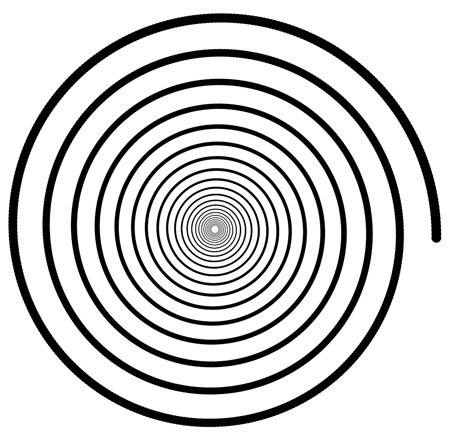
And on top of that, his storytelling abilities are great. Unlike other horror stories, the horror is based on abstract concepts. A geometric shape, the spiral, is what we’re supposed to be afraid of. You’d never think a spiral shape like the one below would be scary, but Ito uses his illustrations, storytelling, and the turn of a page to weave this frightening tale where we’re forced along to find out what happens, fining stranger and stranger things on the succeeding pages. And best of all, Ito just takes things in the most unexpected directions, inserting the spiral into strange places we normally wouldn’t see it. I won’t say what happens, but things like snails or pregnant women get matched with the spiral, and it becomes terrifying. It’s made even better that you don’t actually get a lot of explanation. With ghosts or vampires, you get a mythology on how they work and how to deal with them. In Uzumaki, Ito leaves it up to the imagination as to what’s happening. It’s very unnerving in a Lovecraftian sense to see how this town becomes part of some strange curse around a geometric shape, and never get an explanation.

Doesn't look scary at first. Wait and see.

Doesn’t look scary at first. Wait and see.

If there is one criticism I have, it’s that the people of the town don’t really come to terms with what’s going on as fast as they should. At a certain point, it becomes impossible not to face what’s happening in the town, but up until then, there are plenty of signs that something’s up, and not one of the main characters realize they have to get up and get out before it’s too late. Even the guy who’s constantly saying they should leave doesn’t. At least make an attempt!

But other than that, Uzumaki is a terrifying story of cosmic horror that takes something harmless and give it a weird, disturbing form that will surely stay with you for a while after you finish reading it. On a scale of 1 to 5, I’m giving Uzumaki a 4.8 out of 5. If you enjoy horror and don’t mind visual reading like comic books and manga, definitely check out Uzumaki. I’m glad I did, and I will try to track down the move version as soon as possible. Because after seeing these sorts of pictures, I’m curious as to how they’re translated into the cinematic world.

Until next time, my Followers of Fear. Pleasant nightmares.

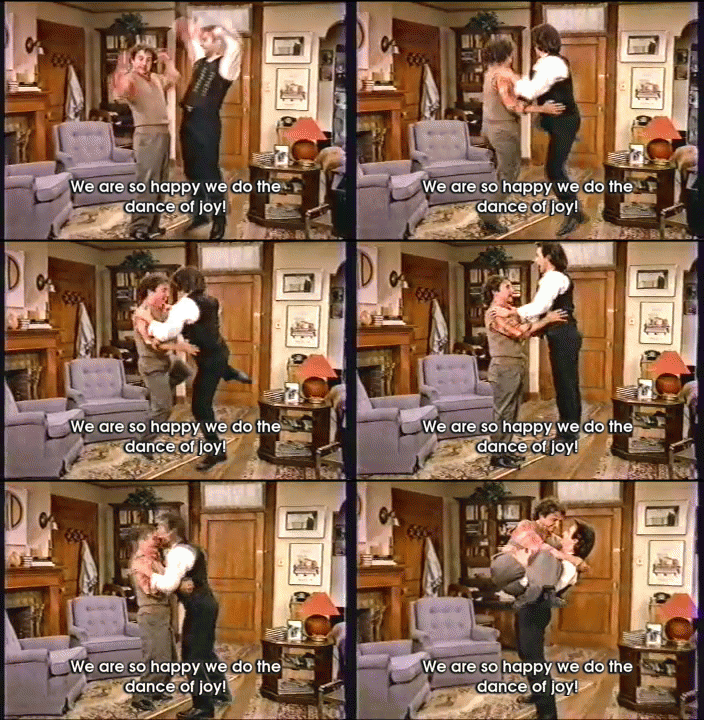
Well, here’s something I didn’t think I’d get to until it became apparent in the past couple of months that it was going to happen. Rami Ungar the Writer has reached the 50,000 views milestone! After five months, four months, and seven days, we’ve reached 50K! Followers of Fear, find a partner and do the dance of joy!

I’ve always wanted to do that.

I say this every time I reach a milestone, but I’m incredibly grateful that you guys continue to come back every time I publish a post. For the first two years or so of this blog, there were times where I wouldn’t get views on my blog for several days, and then get a bump of maybe one or two, and then that would be it for a while. Likes and comments were even rarer, and followers came in at a trickle. It made me wonder if I wasting time with a blog, trying to build an audience that way.

But somehow, I persevered. And you guys kept appearing, and a good chunk of you kept coming back. Slowly, views and likes and comments started increasing. There were even times when I’d get spikes into the hundreds or even the thousands! And then the followers started to rise, and I started calling you my Followers of Fear, and none of you seemed to care one way or another on that one, so I kept going with it. And then a couple of months ago I got to the five-thousand likes milestone, and I was like, “Holy crap, I might get another one soon!” And now it’s come to pass.

Thank you, Followers of Fear. I really appreciate the continued patronage and support. I hope you continue to support me for the next fifty-thousand years (hopefully it won’t take another five years to get there) as I work on becoming a great horror novelist.

And on that subject, there are a couple more announcements I’d like to make while I still have your attention.

Firstly, look at your search bar. You’ve probably noticed, but this site is no longer ramiungarthewriter.wordpress.com, but just ramiungarthewriter.com. Yep, I updated my blog into a full website. Why did I do this? Well, beyond the fact that web address is a bit of mouthful and shortening it makes it a bit less of a mouthful, I’m trying a bunch of new strategies and tactics to increase readership both on my blog and with my books. One of those tactics is to upgrade to a full website, which gives me a couple of distinct benefits. One is now I have an official author email address. That’s right, you can now email me! With a lot of successful authors, I’ve noticed that they have more than a few ways to be interactive with their fanbases, so now I have one more.

So if you want to email me about my books, or a blog post or something, you can write me at ramiungar@ramiungarthewriter.com. I don’t know how often I’ll check my mailbox or how quickly I’ll get back to you, but it’s something I’m devoting effort too.

On a related note, I’m also setting up an email newsletter. This, I hope, is where people who are interested will hear first about publications and contests and other things related to my writing career. I have a feeling that people are getting tired of seeing the latest short story being finished or the latest novel review, so I think I’ll put out something separate that focuses on that, and put stuff on the blog related to the intricacies of writing and of horror, as well as the occasional post about my life or my thoughts on certain subjects.

This is all part of my New Year’s Resolution, which is to be better at getting people interested in my stories and in my writing in general. Will it succeed? No idea, but at least I’m sticking with my New Year’s Resolution and keeping things simple by going for an achievable goal with achievable steps. And I’m open to other tactics that could help me accomplish this. Heck, I may even try Goodreads again, if I can get a better handle on how to work that site.

That’s all for now, my Followers of Fear. I’ve kind of rambled a bit in this post, but at least I’ve gotten a chance to talk about the good news and show some of the progress I’ve made since New Year’s. Until next time!

I’ve just published my first article of the year on the site Self-Published Authors Helping Other Authors. This time, it’s Backstory isn’t Character, and is in response to some things I’ve seen recently in various works of fiction. That problem, as you can tell from the title, is writers thinking a backstory is the same as having a character with a fully-rounded personality. Um, no it isn’t. And in this article, I discuss why that is and how to avoid it in fiction you write, so make sure to check it out if you’re interested.

In addition, I highly encourage you to check out Self-Published Authors Helping Other Authors in full. It is a great website to get advice on writing, editing, publishing and marketing effectively as an independent writer, and it is absolutely free. It’s from authors, by authors, and for authors. Check it out and see for yourself what an excellent resource it is.

Well, I’m doing that thing where authors look at the year before and be hopeful about the year to come. And I have to say, 2016 was not the easiest year to deal with. Even the people who called 2015 shitty say 2016 was worse. Many people we cared about, from celebrities to icons to just ordinary loved ones, died. The world was rocked by a number of incidents, big and small, that showed that hate and prejudice is still alive and well in many countries one would consider tolerant (let alone the openly-intolerant countries). Groups like ISIS, and events like Brexit and the American presidential election left people the world over confused and terrified about the future. Illnesses and conflicts and starvation raged, and people suffered.

And movies that were supposed to be great, like Batman v. Superman, Suicide Squad, and Ghostbusters, either were terrible or didn’t make the money they should’ve (stuff like that bums me out).

Yeah, this year has been tough. But there have been some amazing things, good things, that have happened this year. We have comedians like Trevor Noah and Jon Oliver and Samantha Bee, who are using their platforms to educate people about existing issues and even find ways to do some good. Thousands of refugees from war-torn Syria and other areas have found homes in more stable countries, and have started rebuilding their lives. Celebrities like Jennifer Lawrence and Emma Watson are using their fame to fight for issues like feminism and equal pay. Hollywood is putting out more movies and TV shows that reflect their viewers, including black-ish, Speechless, and the Fast & Furious movies, to name a few, and while there are still missteps here and there, this shows that the makers of our media care about our opinions. And we nearly had our first female president! It didn’t happen, and it would’ve been cool if it did, but it still shows how far this country has come in terms of women’s rights. And the world got Tape Face from America’s Got Talent. I swear, I could watch his video every day, he’s so clever with the visual gags!

But wait, there’s more! This from YouTube and Vine star Thomas Saunders on reasons to smile:

God, that’s a lot of good, isn’t it? I wish he would’ve added Lucifer on that TV show listing though. That show makes my day!

On a more personal level, 2016 actually went pretty well for me. Yeah, all the nasty stuff I mentioned up above bummed me out, but there were many good things this past year. For one, my mother got married to her partner of several years, which was made possible by the 2015 Supreme Court ruling allowing gay marriage nationwide. That was a blast, and something I was glad to see finally pass. My mother and stepmother are so happy together, and I’m glad they get to be together in the eyes of the law as well.

Around that time, I got offered a couple of jobs/internships! One of them was here in Columbus, and it translated into a full position that I’m still working at right now. It’s a great job, where I’m promoting diversity in my organization with an office full of good people, and getting great pay and benefits while I do it.

In addition, my job has allowed me to move out of my dad’s house and into my own apartment, and even to buy new furniture and a new laptop. I’m paying all my bills on time and still have money to save, which is huge for me! And if things continue to go as they are, who knows? I could even get a cat or save up for a dream vacation to the UK and Ireland! I would love for those to happen.

My sciatica has improved! Yes, for those of you who don’t know, I have sciatica, a condition in which a nerve in the back is squished by spinal discs, causing severe pain in one leg and the lower back. I’ve had this since some time around graduation, but over the summer and through fall and beginning of winter, I started doing some new exercises and other stuff to improve my condition. At the time I’m writing this, I feel only mild discomfort, and sometimes not even that. By next summer, I could be completely cured of it!

This got published!

This got published!

But that’s not all. I released a new book, Video Rage, back in June, and it’s finally started to get some reviews! In addition, nearly all of my books have received new reviews this yer, and more people are discovering them every day. Heck, even my coworkers are reading my books! And on the social media side of things, my blog has grown, accruing nearly 900 subscribers, and passing the five-thousand like milestone. And pretty soon, I’ll be passing the fifty-thousand views milestones. One of my posts actually went kind of viral, garnering over nine-hundred views in the first five weeks of being published, and receiving more views since then.

But there’s more! I started the final book in the Reborn City series, and as of the most recent chapter, I’m a sixth of the way through the book! I could have it released sometime next year! I’ve also written several short stories, and I’ve had some great ideas, both for stories and for strategies to make sure more people discover and read my books. I can’t wait to put some of these to work.

Look folks, this has been a tough year. But for everything I’ve said above, and stuff I haven’t said, it’s been a pretty good one too. And while a lot about 2017 looks scary, we can do a lot to make it a great year. It’ll take some work, but we can make 2017 suck less than 2016 did (I can even post about some of my ideas on how to do just that in another post if you guys want), and to achieve all that we ream.

So will I make a thousand followers? Will I publish another novel and some short stories? Will I get an agent or a contract with a publishing company? Will I get a cat or that vacation? Will we cure AIDS, or improve education, or save the environment? Will the new American president be good at his job? I can’t say with any certainty. But it’s what I hope for. And if not, I’ll do all I can to improve that situation.

Happy New Year, my Followers of Fear. May 2017 bless you and leave you with plenty of reason to smile.

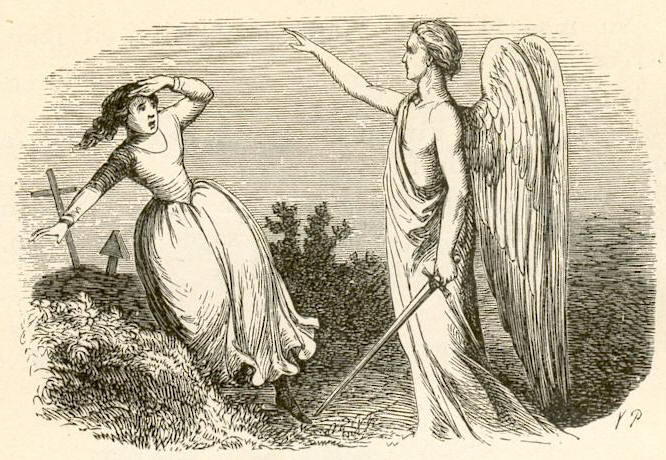
Illustration from The Red Shoes.

Illustration from The Red Shoes.

When I was growing up, every protagonist I came across in fiction–comic books and manga, novels, TV shows, movies–were people you automatically liked. They were sympathetic, they had problems you could identify with, or they found themselves in situations and something about them made you want to root for them, even if they were just good guys set up to fight the evils of the world. At that age, I probably couldn’t have imagined a protagonist who wasn’t likable.

As I got older though, I did come across protagonists who, for some reason or another, I just couldn’t like. And I realized, in some cases, that was the intention. Their creators, for whatever reason, wanted these characters to be assholes, or losers, or just so hateful you found yourself cheering a little when they failed. This had me asking: why would you want an unsympathetic protagonist? And can you actually have a good or even a successful story based around one?

I figured out answers to these questions a while back, but I’ve always wanted to blog about them. Now I’ve got the time, so I’d like to go into the strange phenomena that is the unsympathetic protagonist.*

First, why do authors sometimes write unsympathetic protagonists? It seems almost counter-intuitive: why would you want a character whom readers/viewers might hate? Well, one reason is as a moral warning. In the fairy tale The Red Shoes, the protagonist is vain and selfish, and her attitude leads her shoes being enchanted so that when she dances in them, she can’t stop until someone chops them off. I bet a lot of kids got the message loud and clear from that! Another example is from the novel The Coldest Winter Ever by Sister Souljah, in which the protagonist, the daughter of a crime boss, tries to regain her lifestyle and reputation after her father loses his empire. However, the protagonist uses mainly crime and manipulation to get what she wants, and looks down on getting a real job or an education. The result is that she ends up in jail and loses everything she ever cared about. The lesson? Crime doesn’t pay, go legit, and listen when people try to help you on the right path.

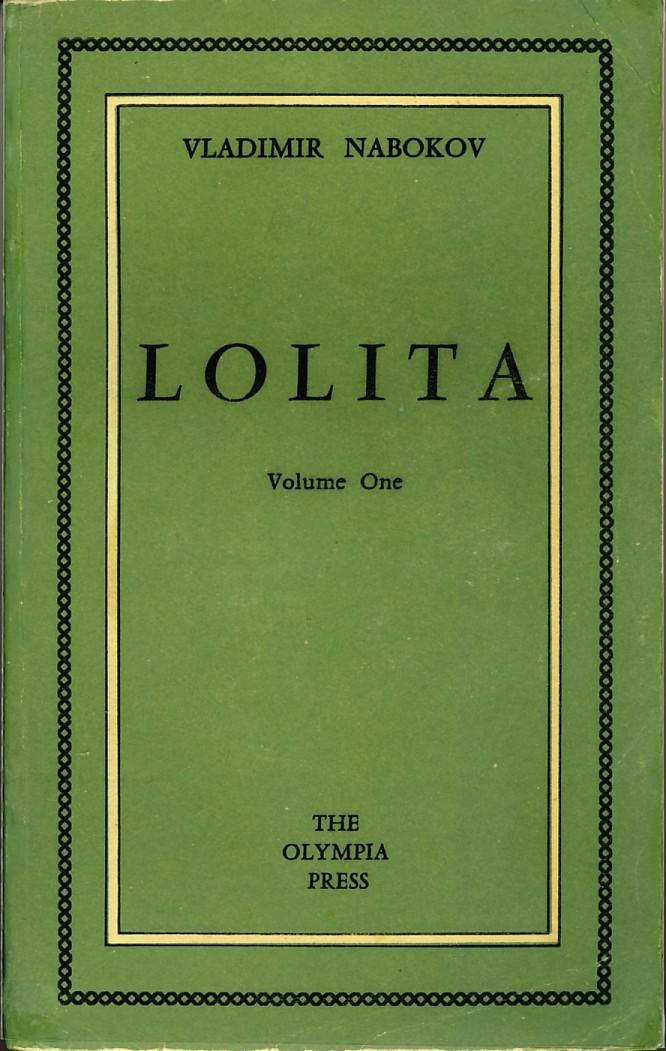
Another reason is that creators might want to explore territory previously unexplored, and characters whom you might sympathize or consider as heroes doesn’t allow that. Ever heard of Lolita? The entire story revolves around a man having a sexual/romantic relationship with a preteen girl and his attempts to control her and keep her with him forever. It’s a strange novel about desire, unreliable storytelling, and corruption (I think, anyway. I haven’t read this one yet, and given the subject matter, I’m not sure I want to), and it’s not a story we’d usually explore through the eyes of a likable protagonist.

Lolita: a great example of a book with an unlikeable protagonist.

Lolita: a great example of a book with an unlikeable protagonist.

And finally, there’s another reason: sometimes it’s just great fun! In certain stories with unsympathetic protagonists, you get a sort of excitement  that you don’t get from other stories, and this can come from the plot or the characters. In Gone Girl, for example, protagonist Nick Dunne is unlikable for any number of reasons, but you still follow along because you want to know if he really did do something to his wife, and if he’ll wiggle out of trouble whether or not he did do something. Another example we can look to is certain horror films, especially in the slasher genre, where the only mainstay is usually the villain and a lot of gory deaths. As part of that, slasher sequels often come to focus more and more on their villains, and people come back just to see these villains. Just ask anyone who enjoys a good Nightmare on Elm Street or Hellraiser film: they’re there for Freddy or the Cenobites, not for the horny teens who happen to be starring in the movie this time around.

So we’ve established why people create unlikable protagonists. The next question is, can you have a good and/or successful story with an unlikable protagonit? Well, I think that question was also answered above. The Red Shoes has been retold and revamped hundreds of times since Hans Christian Andersen first published his little morality tale. Lolita is considered one of the greatest works of modern and modern Russian literature, as well as one of the most controversial. Gone Girl was a runaway hit with a huge movie based on it. There is plenty of proof that unlikable protagonists can still be part of very good stories.

Neon Genesis Evangelion: great series, annoying lead.

Neon Genesis Evangelion: great series with an annoying lead.

Of course, this brings up another question: what makes a story with an unlikable protagonist good? Well, I often find that either the character is doing something pretty amazing, or the story or world is so amazing that even if you don’t like the character, you keep going for that story/world. Going back to Gone Girl, the protagonist is easy to dislike, but the mystery he’s wrapped up in is so intriguing that you want to find out more. That’s the example of a character doing something interesting. With an amazing story or world, I’d point to the anime Neon Genesis Evangelion: the protagonist is seriously unlikable, but the world he lives in is so cool–it involves teenagers piloting giant robots to fight aliens–that you just want to keep watching.

So you can have a story with a main character whom people may not like. As long as you give people a reason to keep reading or watching, it’s entirely possible. And who knows? Perhaps it’ll be one of the greatest stories ever written.

Just don’t do one centering around a pedophile. I think one of those is enough!

What’s your take on unlikable protagonists? Did I miss any good examples of the trope here in this post? 

*Oh, and in case anyone who’s not familiar is wondering, there is a difference between a hero and a protagonist. A hero is just that: a hero. They save lives, they fight evils, they are the ones we root for. A protagonist can be a hero and vice versa, but a protagonist is the main character, the person whom the story focuses on or from whose perspective we get the story. And as I outline in this post, that difference is bigger than one might think.