Posts Tagged ‘reflections’

When most people hear that I work, they ask me where I work. I inevitably reply, “I work part-time at the financial aid office at OSU.” What I often forget to add is, “I’m also a fiction writer in my spare time.” The reason I bring this up is because I recently read this article on the Huffington Post (which you can check out here) in which she learns that her friends don’t see her as working because she writes full-time, and reasons why writing full-time should be considered working (some of those reasons I will reiterate here).

The thing is, writing is work. Hard work. Some people envision writers as sitting on their butts with a notebook, typewriter, or a laptop and watching a story unfold before our eyes. In their minds, we might as well be playing video games or watching Netflix for all the energy we’re expending.

The reality is far from that image. Here’s my process for writing a novel, for example: I outline the story, which usually takes a couple of weeks depending on how crazy my life is. Then I do my preliminary research, which is usually done when I’m not working at the office or doing schoolwork (so summers make a great time to do research because I’m not in classes, but sometimes I’m not lucky enough to be in summer when I do research). Then I start to write. And there’s nothing more daunting than the blank page at the beginning of a project. My novels are usually upwards of eighty-thousand words, so seeing that first blank page is terrifying. I have to force myself to get the first words onto a page and from there try to get into a groove.

Usually I’m doing schoolwork and working part-time while I’m writing, so I often save my writing during the evenings, and usually during the commercial breaks when I have something on TV I really want to watch. So how much I get done is dependent on time, how distracted I am, if anything else comes up in my life, and a million other things. With this sort of schedule, writing a novel can take anywhere between six months (which was the case with Snake) to almost two years (as was the case with Reborn City). I’m in the final chapters of Laura Horn, and I’ve been working on that for over a year, taking breaks for all of life’s crazy moments.

And that’s another thing: sometimes I have to take a break from writing in order to work on school or anything else going on in my life. When that happens, it usually takes longer to get words down on the page. As was the case with RC and is the case with LH.

Your average writer.

And if I need to do some additional research? That takes a bite out of writing time too.

And after I finish a novel, it usually requires one to three more drafts before I’m ready to publish it. Even then I usually send it to someone (usually another author and a friend, though in the future I might be looking at professional beta reader/copy editor to help me with the technical stuff) to make sure I haven’t missed any plot holes or horrible typos. Then I design the interior and the cover, apply for a copyright, and set a release date.

And after the book comes out, there’s all the marketing to do. Heck, even before the book comes out, I’m advertising in every place I can so that as many people as possible will know about the book and maybe want to read it. I’m blogging, Facebooking, tweeting, updating business cards, e-mailing, slipping mentions of my new book into articles, updating my resume, telling people by word-of-mouth, and asking people who do end up buying the book that once they’re done, I’d really appreciate it if they’d write a review or do something else to let me know what they think. And that’s just the tip of the iceberg when it comes to all the marketing I have to do in order to get word of my book out there.

Because let’s face it, I don’t have a team of advertising professionals. I’m self-published, so part of the territory is that I’m doing all my advertising on my own. It isn’t easy, but it’s something I take upon myself so that my book can sell well and people will read it.

Does that sound like sitting on my butt playing video games or watching Netflix? No, it’s work. We don’t have time cards or an office cube or water coolers, and very rarely anything like a regular paycheck. But yeah, we are working. It’s as grueling a job as working in the Sales Department or on an assembly line or going to a meeting with execs from another company. Our job just allows us the perks of setting our own hours and picking our own projects.

In summary.

So I think from now I’ll be adding that writing is my other part-time job when people ask me where I work. And I hope people who read this article who aren’t writers will realize we’re not just relaxing in our living rooms or home offices (if we’re lucky enough to have those) playing solitaire or watching funny cat videos on our computers. We’re working, and we’re working hard.

Still don’t believe me? Then go ahead and write your own novel that’s halfway decent, and then tell me it’s not work. I’ll wait.

How do you feel about writing as work?

Has anyone ever mistook what you do for free time? How did you respond?

As any author can tell you, there’s no one way we get our ideas. In fact, we get our ideas from everything: stuff that goes on in our lives, the people we know, current events, books, TV shows, movies, video games, from a phrase, from a place, from something we like or something we hate, and from more things than I can list. It’s the actual spinning of the story that can be rather difficult. We have the start of an idea, but we need to build up the story around it. Who’s the protagonist, what’s going to happen, where and when is it going to happen, why is it happening, etc. And depending on the author, the idea, and where it came from or what it consists of, the story based on the idea can come either very quickly or take a while.

For me usually it doesn’t take too long to come up with a story once I have the idea. There’s one notable exception however, and that’s when the idea revolves around a character and nothing else. By this I mean a character pops into my head, maybe no more than just an image but still a character, and I want to write a story around that character. And it isn’t easy for me to come up with that idea.

Other inspirations don’t take that long. I saw the movie Schindler’s List and came up with a whole book series based around the idea of someone actually leading a rebellion against the Nazis. Remember when I went to the Sky Steele show a week back? I had an idea from something we talked about after the concert involving a supernatural crime story. And a creature featured in a fantasy TV series I watched last year inspired a story about how religion can actually kill you. All of this happened within minutes or hours of being inspired.

But starting out with an intriguing character and little to nothing else? It takes me days to come up with a story to match. In fact, of the last ten ideas for novels I’ve had, half of them were based around characters and took me days to actually come up with an idea I could write down on my list of feature-length ideas (I’m up to 145 of those, by the way. Unless I can become successful enough to write full-time, I’m not sure I’ll be able to write them all!). They all started with one or two characters, maybe a setting, but all of them took days to come up what they would be doing or what would happen to them. The most recent one, which I first started trying to brainstorm a story around on Tuesday, I finally got something today.

Sometimes, the gears in my head turn so loudly, you can hear them.

What happened was that I saw this Halloween-themed video (which I will have to post about when October rolls around) and I got a little scared by it. Not only that, but I also kind of fell in love with one of the characters in the video and decided to base an entire Halloween-based story around her. Just one question: what kind of story? Finally figured out today to base the story around ancient myths about Samhain, the holiday Halloween is based on, but up until then I could not think of a single thing to base the story around. Well I did, but none of them really worked for me. I couldn’t see myself writing something around those other story possibilities, let alone anything I thought would be good. I’m glad that I was able to finally come up with something though, or might have gone a little madder than usual.

You know, as much as I love getting ideas for stories, I hope that in the future these sort of ideas, the ones that take several days to form and usually start with a single character, pop into my head less often. And when they do, I hope it takes less time to come up with a story based around them.

What about you? What sort of ideas do you struggle to create stories around?

What do you do when you’re struggling with an idea and can’t think of anything?

tqg cover

One year. I can’t believe it’s been exactly one year since my first book, The Quiet Game: Five Tales To Chill Your Bones was released. Maybe that’s because so much has happened in that year: I finished my third year of college, went on a study abroad trip to England, France, and Germany. I began and finished Video Rage, the sequel to Reborn City, and I’m very close to finishing Laura Horn. And I also released two more books. Am I forgetting anything? Oh yeah, I moved into an apartment off-campus with a friend and I also turned 21, which causes certain members of my family endless worry about my drinking habits (though I usually only drink alcohol 1-3 times a week, and usually not that much).

Anyway, back on point. The Quiet Game emerged from an idea I had while the editing process of RC was going on. That process was going slower than I thought it would, so I thought to myself, Why not release a collection of original short stories? I ended up doing just that, writing all those stories during winter break and rewriting one of them during spring semester. I also included at the end of each story a little bit about how the story came about and what influenced me while writing it, which was fun because it gave me more ways to relate with my readers. And after many long months, I released it on July 17, 2013, not too long after the copyright process ended. And it’s been selling and scaring here and there ever since.

Besides also being my first published book, The Quiet Game is also my most popular book. I think that might be because it’s a lot shorter than the other two and it’s a lot cheaper. But that doesn’t mean people don’t like it. I’ve gotten ten reviews over the course of a year on The Quiet Game, and people have had some positive things to say:

5 wonderfully crafted tales! I purchased this as an eBook originally and put off reading it for quite a while, I really wish I hadn’t waited. Sometimes when one purchases a collection of short stories you expect some of them to be less entertaining or of lower quality than the others, but none of these disappoint. Well worth the money, especially considering after you read each story the author gives you creative insight into what inspired him to write each tale, which is really wonderful.

–Jeff D

Imagine if you will a young Stephen King penning dark scenarios inspired by his youth, and what you get is this anthology. Through this collection of short stories, Rami Ungar brings us into the world of dark urges, childhood traumas, ghosts, phantoms, and dark psychological thrillers. An inspired creation, and definitely a good intro to this indie author’s world!

–Matthew Williams, author of Whiskey Delta

All of the stories were really diverse and fun to read. I also enjoyed the authors blurbs about each stories origination and development. Keep up the good work!

–kimberly broulliard

These and other reviews have lead to The Quiet Game gaining a 4.3 rating on Amazon, which I am very happy about. It also encourages me and makes me think that this and my other books will continue to do well and that I will be able to write very good and very scary stories for years to come.

To the people who helped me create The Quiet Game, thank you so much for everything you’ve done for me. You don’t know how much I appreciate it. To the people who have already read and/or reviewed The Quiet Game, thanks for your patronage and I hope in the years to come you’ll enjoy reading my books and getting scared by them. And to those who will read The Quiet Game and my other books, I hope you enjoy them. And whatever you think of my books, please let me know in a comment or a review. Bad or good, I love feedback.

If you’d like to know more about The Quiet Game, click here for its page here on the blog, or check it out for yourself on Amazon and Smashwords. It’s available in both print paperback and e-book, though the former is only available on Amazon.

That’s all for now. If I have anything else, I’ll let you know later in the day. Have a good one, my Followers of Fear.

Today during my lunch I started watching the Fourth Doctor serial The Sontaran Experiment. Later this week or next I’ll start watching the Fifth Doctor serial Arc of Infinity, and by the end of the summer I’ll probably have watched quite a few more serials. In short, I’ve been bingeing and will continue bingeing on Classic Doctor Who for a while.

Classic Who is pretty interesting. The show lasted for 26 seasons, usually around 20 or so episodes a season, and ran from 1963-1989. They went through seven different leads, at least fifty companions, and a whole host of supporting actors, cameos, writers, directors, producers, and other crew members during that time, becoming one of sci-fi’s biggest staples and was revived twice, once in a TV movie and again in a new TV series whose eighth season (or series, as they call it in the UK) will premiere in a month and a week. This is all quite amazing, considering that Classic Who had a fairly limited budget for special effects.

And I mean fairly limited budget. Like Star Trek in its early years, and occasionally even worse than that. The first couple of years under the Third Doctor, most serials were confined to defending the Earth because of budget cuts preventing the filming of stories taking place in fantastic and strange locales. And even at the best of times, the special effects weren’t that great. Check out this clip from the Third Doctor serial The Three Doctors (also the first serial ever to feature a former Doctor return to the role). Near the end, you’ll see what I mean:

Yeah, that stuff at the end was an anti-matter monster. And apparently it teleported them somewhere. Not exactly high tech, was it? You watch enough classic episodes, you see that they had to make do with not a lot of money, which sometimes made the monsters look very homemade and laughable, or they had to be filmed in certain ways so that the kids at home wouldn’t see an actor’s two feet sticking out of a monster’s butt. Occasionally that even led to criticism of the whole story: the Third Doctor serial Invasion of the Dinosaurs was derided by viewers because the stop motion dinosaurs weren’t very good and seemed to take away from the overall story.

But that just goes to show how amazing the stories the writers told were, both then and now. What they didn’t have in terms of budget, they made up for in telling compelling tales where the Doctor had to fight in order to save the world (or worlds). Stories like the First Doctor serial The Edge of Destruction or the Fourth Doctor serial The Horror of Fang Rock are very suspenseful stories that rely on very little special effects to instead tell very character-driven horror/suspense stories, and the Seventh Doctor serial The Curse of Fenric was actually so terrifying I was a little scared! Not bad for a story whose special effects were mostly make-up and costumes.

Just a glance at that photo is enough to unnerve me!

These old stories contained much more than special effects. They had mystery, pretty funny jokes, history and science, and compelling plots that kept viewers coming back for more and more each episode. Not to mention how these episodes could confront and tackle complex social issues so that even very small children could learn from them. Dalek stories, from the original First Doctor serial The Daleks to modern-day stories are rife with Nazi Germany metaphors, which have been mentioned by various characters over the years. The Green Death dealt with environmental themes by showing what can happen when you let corporations run rampant over natural resources without enough regulation. And American viewers probably squirmed a little when they saw The Power of Kroll and saw in the conflict between the colonists and the Swampies the fight between white Americans and the Native Americans. I’m surprised the Doctor hasn’t been used as a teaching tool for different causes or issues.

And it wasn’t just the stories that drew the viewers in. The characters the writers created were pretty amazing as well. Heck, it was the writers who managed to keep the show going after First Doctor William Hartnell had to leave the show for health reasons and was replaced by Patrick Troughton. In any other show, the main character being replaced by someone who was a completely different character (but still the same person) would’ve ruined the show. It says something about the writers that they could keep the show going after such a change.

And not just the changes in Doctors. The other characters were amazing as well, helping the viewers to connect with the Doctor and see him and the events surrounding him from a human perspective (literally). Yeah, some of them were annoying (Peri Brown got on my nerves), but for the most part they were all a pretty awesome group of characters. Some of my favorites include Jo Grant, played by Katy Manning, who learned much from the Doctor and became quite a heroine in her own right during her time as his assistant. Or Ace, the last companion of the classic series and played by Sophie Aldred, a punk teen from London who nicknamed the Doctor “Professor” and was in many ways his protege. And I’d be remiss if I didn’t mention Sarah Jane Smith, played by Elisabeth Sladen, one of the longest running companions and by far the most popular. She even had her own spin-off show for a few years. God, we Whovians miss her.

Not just the stories, but the characters made this show amazing.

All in all, it’s not surprising that nearly fifty-one years after two teachers followed one of their students home and into a police box that was much bigger on the inside than on the outside, the show is still going on all these years later. Sure, ther have been hiatuses and breaks, but there’s been a fandom big enough that the show has gone on to become one of the most popular and probably the longest running sci-fi franchises in the world. And I believe the writers over the years, especially the writers in the classic series, have played a huge part in that.

Anyway, I’m certainly having fun watching the old Doctor Who serials. I just wish it was easier to get hold of them. Well, that’s all for now. I’ve got the first draft of a novel to finish up, so I’m going to get on that hopefully tonight, but first I need to reverse the polarity of the neutron flow. Wish me luck with that.

pat bertram

Today’s interview is with an author who has a lifetime of experience and some really great books too. Pat Bertram is an author with Second Wind Publishing, whose books include the thriller novels More Deaths Than One and A Spark of Heavenly Fire, as well as the non-fiction book Grief: The Great Yearning, a book about dealing with grief based on personal experiences. Pat also is an administrator and active participant in a Facebook group for suspense and thriller writers, and has two blogs, one of which she writes posts for at least once a day.

I was lucky to have a chance to ask Pat, whom I consider a friend, some questions on her life, her writing process, and what she’s up to these days.

How did you get into writing in the first place?

When I was in my mid twenties, I set out to be a writer. I quit my job, gathered up paper and pens, and sat down at the kitchen table to write. I thought writing was a type of automatic writing, that I just needed to put pen to paper and words would come. Didn’t happen. When I tried to force words on the page, I discovered I had no talent for writing, so when real life got in the way, I let go of my desire to write and turned my mind to other things. About fifteen years ago, I had some predicaments I wanted to work through, so I decided, talent or no, that I would write the story, which I did. And it was terrible! During the subsequent years, I have learned how to write, to pace a story, to write sparse but picturesque prose, but most of all, I have learned how to rewrite and edit.

How would you characterize the stories you write?

The unifying theme in all of my books is the perennial question: Who are we? More Deaths Than One suggests we are our memories. A Spark of Heavenly Fire suggests we are the sum total of our experiences and choices. Daughter Am I suggests we are our heritage. Light Bringer suggests we are  . . . ? So, perhaps my genre is “identity quest,” though I can’t see that as ever being a big draw. My only hope is to build an audience for “Pat Bertram books.”

What is your writing process?

I have no real process. When I do write, it’s usually late at night because all is quiet. I don’t set a daily goal — the words come hard for me, so I’m grateful for whatever words I manage to get on paper. Oddly, considering this is the electronic age, I still prefer to write longhand, though I am gradually doing more writing on the computer. As for the story, I know the main characters, I know the beginning of the story, I know the end of the story, and I know how I want the characters to develop, but I don’t flesh out the individual scenes until I start writing them.

You blog at least once a day, and you often talk about your personal life, both the good and the bad. What gives you the courage to share such information with your readers?

Before my life mate/soul mate died, I wrote innocuous — and fairly impersonal — posts about the books I read, the stories I was writing, general thoughts I had. After he died, I was shocked both by the true scope of grief and people’s ignorance of the process, so I made it my mission to tell the truth of what I was going through to help dispel the myth that after a couple of months, life goes on as it did before. I gained so much by opening up, that I have continued to be open as other traumas enter my life, such as my efforts to cope with both my aging father and my dysfunctional brother.

Are you working on anything at the moment?

Yes. When the members of my dancing class found out I was a writer, they suggested I write a book about them. It’s been fun —  all the characters have real life counterparts, so it has become something of a group project.

What is some advice you would give to potential writers?

Writing is not always about writing. Some authors can sit down and let the words flow and lo! There is a story! Other authors have to think about what they’re doing. So ask yourself, what story do you want to write? Why? What do your characters want? Why? How are they going to get what they want? Who is going to stop them getting what they want?

If you were stuck on a desert island and could only take three books with you, what would they be?

Three blank notebooks. And pencils, of course.


If you’d like to find out more about Pat, you can find her at her personal blog Bertram’s Blog and on Pat Bertram Introduces, where she interviews authors, publishers, and even book characters, as well as on her Facebook page.

This is a post I’ve been wanting to write for a while, but I had to find time (and enough films) to actually settle down and write an article worthy of this subject.

If you’ve seen movies like Scream or Cabin in the Woods, you realize they are not just really good scary movies, but they’re also great commentary on the horror genre itself. Scream was basically saying that, rather than restricting the creativity of film directors, the conventions of horror films, especially slashers, gave them considerable freedom to work with and explore new areas of fear, as well as being a sort of examination of slashers themselves. Cabin in the Woods gave you the impression that horror filmmakers were somewhat like slaves in the entertainment industry, having to abide by certain rules in order to please audiences or be ruined (occasionally that’s true).

These horror films below have their own lessons to teach on the genre, and I’ll try my best to convey them here (and possibly convince you, dear reader, to go and see them for yourself). Whether it’s on unique ways to tell a story, reinventing a familiar story, or even just finding a way to insert some philosophical musings into your movie, these movies all have something to share on the genre.

Urban Legend

The slashers that come after the classics of the eighties and the early nineties come in three categories: really bad sequels, movies that try to copy the classics and fail disastrously, and the ones that go above and beyond, often finding ways to redefine the slasher genre while they do it. Urban Legend is definitely part of the third category, and it shows how the slasher genre can change itself despite some critics’ claims of  “same story, different killer/kids/location/motive”. In this case, a killer begins attacking students and faculty at a remote college campus, but kills them in ways that mirror popular urban legends. Who is the killer, why are they killing like this, and what does all this have to do with one young student and her connection with the original victim? The answers will not only shock you, but it’ll make you appreciate adaptable slashers and those urban legends you all heard as kids and teens in new ways.

Devil

You know how in most horror films the audience knows there’s a supernatural explanation for why freaky stuff is happening and the characters in the film are looking for a rational explanation? In this movie, it’s different: you suspect there’s a supernatural explanation, but at the same time you look for ways it could be rationally explained. In this film based off an M. Night Shyamalan story, five people get stuck in an elevator and are murdered under mysterious circumstances while trapped inside. Who is the killer? Why are they killing? Is it a bizarre murder plot? A psychopath at work? Or maybe, as one security guard believes, it’s a mystical meeting between the damned and the Devil himself. A terrifying film, just watching how the filmmakers portray the unfolding events and make us wonder exactly what is happening is enough to give you some ideas on how to switch up your own stories. Or give you nightmares. That’s always a possibility.

Pulse

Known as Kairo in Japan, this supernatural horror film is as deeply philosophical as it is terrifying. In this movie, spirits manage to find a way into our world through the Internet, and start killing the living, though why they kill the living isn’t always clear. The movie follows several different people, particularly a young woman who is among the first to notice what is happening, and a college student who finds himself delving into the mysterious ghosts with a computer science co-ed he knows. The film besides being scary, offers great insight into our strange, modern world, which can be full of connections and isolating all at once, and why ghosts would want to return to this world in the first place. There’s an American remake of this film, but it loses some of its philosophical/psychological bite in favor of special effects and some more Western horror conventions. It’s not bad, but it’s not as good as the original. Anyway, check out both if you can. They’re both interesting takes on our Internet-obsessed society, if you ask me.

Behind the Mask: The Rise of Leslie Vernon

Our last entry is not even true horror, but horror-comedy and mockumentary. Behind the Mask follows a group of students filming a documentary in a world where famous killers like Jason Voorhees, Freddy Kreuger, and Michael Myers are as real as you or I. The subject of their documentary is a man named Leslie Vernon, a would-be killer who is in training to become a famous killer himself and is preparing for his own night of carnage.  The film switches between documentary-style footage and the more traditional horror-movie footage, breaking down the conventions of the slasher genre as well as their philosophical and Freudian psychological meanings (particularly the role of the “survival girl” motif in these films). Not only is it a great story that examines, pokes fun of, and psychoanalyzes the slasher sub-genre, it also depicts a very doomed romance that is stll rather beautiful and lovely in a weird way. Whether or not you like horror, this is definitely not a film to be missed, because what you can learn from it is great.

Have you seen any of these films? What were your thoughts on them?

What are some great horror films you think can teach people about the genre itself? What is great about them?

The entrance to the Louvre, surrounding by many fountains.

The entrance to the Louvre, surrounding by many fountains.

The other night, I was watching the classic Doctor Who serial City of Death (one of these days I will have to write an article on Classic Who from a writer’s perspective, because it deserves one), and I found myself freaking out because the serial takes place mainly in Paris, about thirty-five years before I myself was there. (Fun fact: City of Death was the first Doctor Who serial to be filmed abroad, filming between April and May of 1979. So yeah, 35 years before I would visit the city itself).

It was delightful for me to see all those sights in the actual episode, because I’d been to those places and I remembered what it was like to be there. I found myself reliving riding the Metro after a long day, trying to navigate my way back out onto the street after taking a twenty-minute train ride, because those stations can sometimes be little mazes in themselves. Or walking along the river Seine during a leisurely stroll and then sitting in a café near the Champs Elyesees and having a crepe and Orangina (I miss that brand of soda, by the way. It’s so hard to find here in the States).

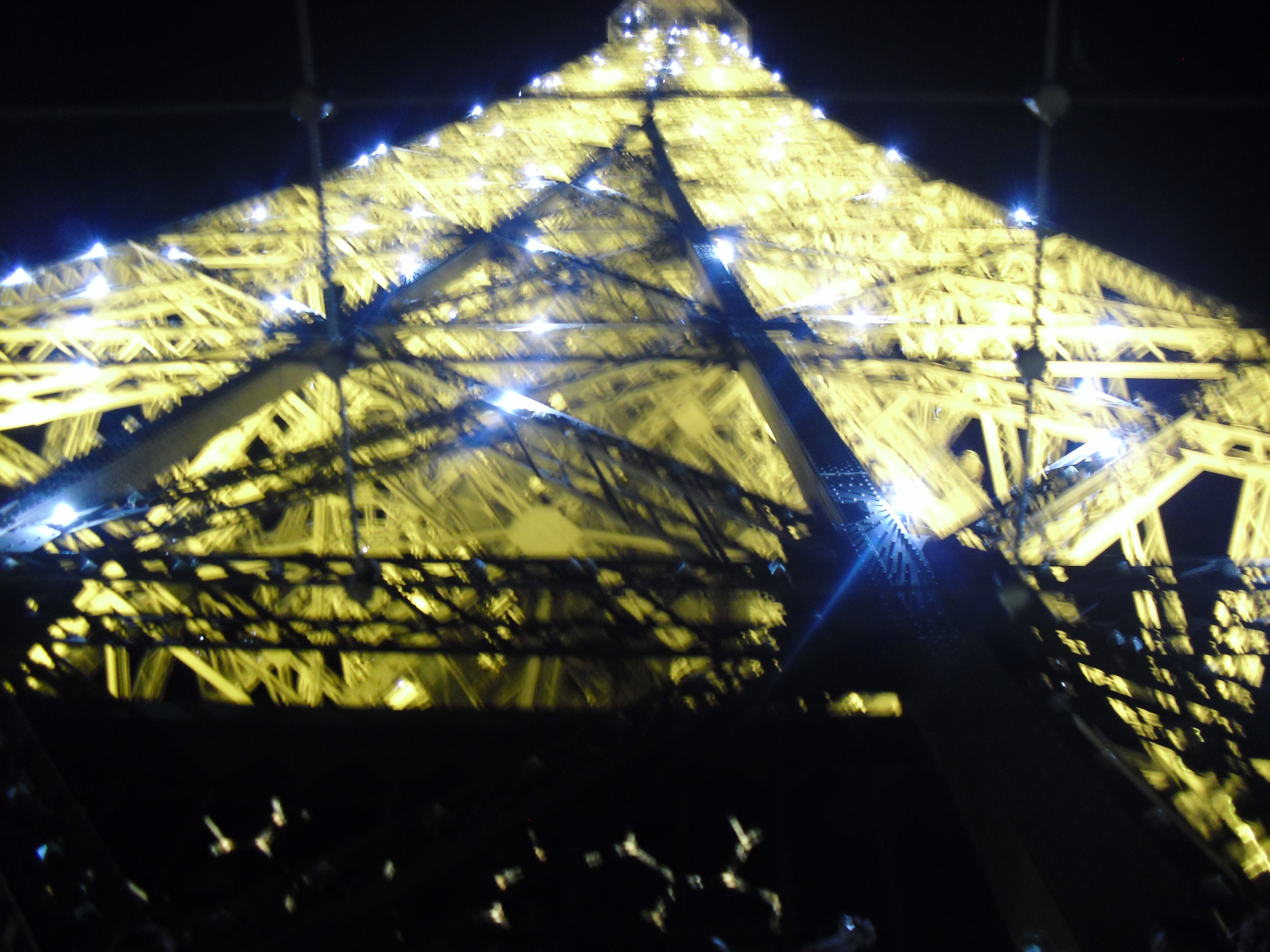
The Eiffel Tower at night.

The Eiffel Tower at night.

The serial also had scenes set at the Eiffel Tower and in the Louvre. Both those places hold a lot of memories for me. For the Eiffel Tower, it was one of the very first places I visited when I was in Paris. My friend Ramsey Hardin and I decided we go on a late-night jaunt to see the Eiffel Tower at night, and we ended up somehow climbing all the way to the second level (not the top, because that was closed that late at night). It was an amazing view. From every angle you could see Paris at night, a lovely city of lights and mystery. There are hardly any skyscrapers in Paris, mostly due to the French’s distaste for them, so we had a clear view of the city at night. The tower itself starts having a light show with flashing bulbs bright enough to give people seizures about every hour or so, and that was fun to watch. While there we also had the opportunity to talk to a family from the States who were there for a special birthday celebration (the mother’s) and a group from a technical school in Texas that were there for their own study-abroad trip. If the Tower hadn’t had to close, I’m sure we would’ve spent another hour or two there talking to people and enjoying the views.

Ramsey and I at the Eiffel Tower.

Ramsey and I at the Eiffel Tower.

The Louvre has an altogether different feeling. There is more nudity depicted in that museum than in the world’s biggest strip club, and yet there’s just as much religious iconography and scenes to rival the Vatican. And through it all is an air of strange reverence, as if everyone is aware that they are in a temple as holy as any shrine. Even as people take photos of the Mona Lisa or Madonna on the Rocks or paintings so big they take up an entire wall or ones small enough to fit on a cramped bookshelf, there’s a subdued air, as if people are paying their respects to the products of old history and culture. It’s very strange, and you can only really get a sense of it by actually going to the museum itself.

My most artistic selfie.

My most artistic selfie.

But compared to Notre Dame, the Louvre might be a funhouse. I went there after the Louvre, and it’s a very amazing place. From the moment you arrive, you are struck by the very detail of the building. The entrances have so many figures carved into them that you could spend an hour just looking at them and guessing who they are. And once inside, it is very dark and quiet, with people looking around or praying. You can’t help but feel a strange holiness to the place, a sense of godliness no matter what your religious beliefs (or lack of them) are. I even met a couple of OSU alumni there (we’re everywhere!) and they agreed with me on that. I might’v spent more time there if I didn’t have to be back to the hotel by a certain time to meet up for dinner.

See any hunchbacks behind me?

See any hunchbacks behind me?

What does all this rambling have to do with anything? Well, I guess it’s the power of memory. Although sometimes very fallible, the power of memory can transport you through time and space, landing you in a totally different age and location. Just watching that Doctor Who serial was enough to bring me all the way back to France and those five or six lovely, idyllic days of study and learning and wonder and fun, faster than even the TARDIS, even. And I was so happy to return too, because it’s an experience I’ll never be able to relive again, and the memories and photos are what keep the memories alive.

And I hope they stay alive for a long, long time.

Not literally, of course. I mean how to make one for a horror novel, movie, or TV show.

Haunted houses are such a staple of horror, tales of them dating farther back than The Fall of the House of Usher, and have continued to terrify readers and viewers alike over the years, whether they be watching The Shining or American Horror Story or even that episode of Doctor Who with the haunted house. The question is, with so many famouse haunted houses out there, both real and fictional*, how do you construct one that stands out from the crowd (and once again, I mean metaphorically)? Here are some tips that might help.

*For those of you who don’t believe in ghosts or hauntings, you can interpret this as houses in the real world that have history of or are purported to be haunted. For those of you who believe in ghosts…well, I don’t need to finish that sentence, do I?

1. A haunted house doesn’t have to be old and dilapidated. I know the standard image in our minds of a haunted house is one that’s an old manor, with shingles falling out and holes in the porch and plenty of leaks in the pipes, or sometimes a castle with no glass windows and plenty of dungeons and hidden chambers.  That’s great if you want to market it to the Addams Family, but haunted houses don’t necessarily have to look like that. They can be only a few years old, very modern-looking, and in the middle of a nice neighborhood. Heck, you can even make the house a haunted apartment building if you so desired (there was a movie that did that a few years back. Would’ve been good if it hadn’t been a direct-to-DVD sequel).

Not your average haunted house, is it?

In this one novel I plan to write, I plan on the haunted house being only about three decades old, and without any sort of dilapidation or other trademarks to make it a haunted house. What makes it terrifying is its current occupant, as well as the atmosphere that hangs over the place.

For some good examples of haunted houses that don’t fit the standard mold, try the remake of When A Stranger Calls, the first season of American Horror Story, the Buffy episode Where the Wild Things Are, and (if you really want to) The Grudge 3 for that haunted apartment building. Oh, and Ghostbusters as well, that has a haunted apartment building. Or is that a doorway? You decide for yourself.

2. You don’t always need ghosts for a haunted house. For example, you can zombies, witches, a serial killer, vampires, werewolves, just something out of the ordinary. A haunted house doesn’t become haunted because it has ghosts in it, but when something (usually malevolent) is inside. That’s why the movie Cabin in the Woods is so genius: besides breaking down and exploring/philosophizing on the tropes of the horror genre, it also shows how much variety there is to the haunted house and what can haunt it. Anything from zombies to wraiths to werewolves to evil dolls to giant bats to merman to scarecrow people and everything in between, you can use.

3. Use plenty of description when describing the house. In a horror movie, you don’t need to describe the house, because you can see it just fine. But in a novel, the author has to supply the information. What does the outside look like? Is there a distinctive style of architecture involved? Is it painted in really ugly colors that don’t compliment one another? What’s inside? Accessories, knick-knacks, the odd little mirror that’s always in the northwest corner of a house? Is there a yard? What’s in the yard? Does a colony of rabbits live in the yard? Keep all this in mind the moment you introduce your characters (and by contrast, the readers) to your haunted house.

4. Don’t go all out as soon as the door’s closed. By this I mean one should use a subtle build-up in order to properly scare the reader. You can’t just come out with a ghost or an axe murderer showing up and attacking people the moment the door is closed and the character or characters are settled in. There should be a steady build-up. First small things go awry or weird things that can easily be explained but are still creepy nonetheless. Then weirder stuff happens: you might see a form out of the corner of your eye, or you walk into a room and the furniture is all moved or ruined. There might be voices you can’t explain, or perhaps something catches on fire inexplicably. You touch a certain section of the wall, and you feel intense pleasure or pain. And then finally, there’s no denying that weird stuff is going on: the ghost has appeared, the threat is revealed, you’re going to have to deal with it or die. Using the house to do all that and more can really ramp up the suspense and terror of the story and make your haunted house terrifying and distinctive.

Don’t reveal THIS too quickly.

A great example of this ramping up of the terror is the original Amityville Horror, as well as the movie Sinister.

5. Your house should have a history. Whether the house is ten, a hundred, or several hundred years old, it should have a history, and the author should know what it is, even if they won’t reveal all of it to the reader. What is the history of the house, or the land it sits on? Does it involve an Indian burial ground? Was there a really nasty murder there? Or was there something even darker than that lurking beneath the floorboards and behind the walls? This will help you flesh out the story, the haunting, and whatever is happening in your story. Also, often times one can figure out how to defeat the antagonist of the story through its history (like Jason Voorhees and water, or Goblin from Blackwood Manor by Anne Rice). And if this history involves certain people or objects, make sure to have that worked out as well.

There are many great examples of haunted houses with history, just watch any episode of a show for investigating haunted locations. If that isn’t your thing, try movies like The Conjuring, or the TV mini-series version of The Shining (not the movie though, that was a terrible adaptation).

6. Research common signs or symptoms of hauntings. I know some of you will be like, “What’s he talking about?” Well, besides sightings of ghosts or voices being heard, people often report certain things when experiencing a haunting: inexplicable areas where it is cold, electrical devices being drained, objects being moved, and even attacks, and each can happen for very different reasons. I like to include these things in my story because they seem to give my stories an air of authenticity (if you want to call it that). You don’t have to go this route with your haunted house, but if you do and you want to do some research, ghost-hunting shows or manuals on ghost-hunting can be great resources. Also do some research on why these signs and symptoms might not be caused by a haunting, because…

7. A little bit of uncertainty goes a long way. One of the scariest things with a haunted house is not knowing. Not knowing if you’re going crazy, not knowing if there’s actually a ghost in the house, not knowing what it wants or how you’re going to stop it. It’s scary not knowing, which is why a writer should exploit it for as long as they can in a story. It’ll make your story that much better. So knowing explainable ways for a “haunting” to occur can help to add to that uncertainty. Could it be electrical fields? Could it be a spirit? Or is it just the pipes and my new medication? It’s scary just not being sure.

Ultimately, it’s how the writer writes the story that makes the story scary. But if these tips have helped make your story scarier, then I’m glad to have helped and I hope that you have fun constructing your haunted house. I bet it’ll be very terrifying.

That’s all for now, I–that’s odd. My water bottle just fell off the counter. I could have sworn I put it farther back on the counter. Wait, what was that I just saw out of the corner of my mind. I must be working too hard or watching too many movies. I–oh my God! AAAAAAAAAAAAAAAAAAAAAAAAAAH!!!!!

….

….

….

He’ll be coming for you next.

See the difference?

In 2006, author Emily Schultz published her first novel Joyland, about a teenage boy growing up in an Ontario town in 1984. This was her second published book, coming after a 2002 collection of short stories. It apparently got some really great editorial reviews from national publications, calling it a great coming-of-age novel and an exploration into teen sexuality.

About seven years later, His Royal Scariness Stephen King published a novel with the exact same name, about a college student in 1973 who gets a job at an amusement park and finds himself solving an unsolved murder (I’ll have tor find time to read it one of these days). Plenty of King fans went online to download the e-book (some may not have realized that for a while the book wasn’t available in that format, which will explain what happens next). But the funniest thing happened: several of these King fans downloaded Schultz’s book believing it was King’s book. And right until the end, some of them never realized they got a literary coming-of-age by a Canadian-American author instead of a dark, creepy whodunit from Stephen King!

And it reflected in the reviews some of these people gave Schultz’s book. Here’s one who absolutely hated it:

I have always loved Stephen King novels. However, this one was a rambling, stream of consciousness mess. I had to go back and read over the last pages again and again to try to understand what was happening. For a person who reads several books a week, this is annoying, to say the least. I will still read his next book, if there is one. He fascinates me with the way he thinks, generally. This book was not my favorite, by any means.

And here’s one who thought they’d try to counter-balance all the negative reviews from King fans:

However somebody give it a one star rating because THEY accidently purchased it thinking it was Stephen King, i’ve no idea how they did that but this review is too counter balance that one.

Here’s a prankster who thought they’d satire the whole confusion:

As soon as I learned Steven King had his sex change operation AND changed his name, I immediately rushed out and bought this book. The surgery (and hormone therapy) have really changed his appearance AND his writing. It’s amazing. It was almost like reading a completely different author.

Mrs King (Schultz), your new vagina has served you well! Nicely done!

And here’s one from someone who actually thought it was a great Stephen King novel, if you’ll believe it:

Full of suspense and mystery and real, visceral horror. Don’t be put off by the new nom de plume. King’s new pen name signifies another evolution in his career, just as he emerged from the Bachman years’ “Thinner” into the soul-baring masterpiece of “It”. Writing from a feminine perspective is admittedly experimental, but this experiment is a SUCCESS.

Now, I’m sure plenty of authors would be upset about this confusion. Ms.. Schultz has actually kind of taken advantage of the confusion and the money coming her way by creating a Tumblr blog called Spending the Stephen King Money, where she details how she’s been spending her unexpected royalties, from donation to charitable organization to IKEA shopping trips. And of course, it’s only brought more attention to her, and her book. I’m sure plenty of people will read it now just to read the story that got confused with a Stephen King novel.

In fact, there’s a certain author who plans to read the book:

Yep, King is ordering her book, and Ms. Schultz in turn is planning on reading Stephen King’s Joyland. It’s a really weird but hilarious ending to a rather strange series of events stemmingfrom a simple misunderstanding. But hey, I’m sure both authors will laugh about it when they look back on it years from now, if they aren’t laughing about it now. And who knows? Maybe they’ll collaborate torelease books around the same time with the same titles and see what happens. In fact, I kind of hoping they do!

I’m not sure how this sort of thing happens, except through serendipity. In fact, this is the first time I’ve heard of such a thing happening on such a scale that even some media organizations report it. Sure, we all have or know someone who went to get a certain book or movie or check out a certain TV show and ended up reading or watching something with a similar or identical title (that actually happened to me a couple of weeks ago). But on this massive scale? It’s almost a little hard o rap your head around. If Saturday Night Live was airing new episodes right now, this would be the subject of a Weekend Update joke.

Well, like I said above, this is a case of serendipity at work. Just a happy accident. I wish something like that would happen to me, and I’m sure plenty of people will echo the sentiment. Not only is it a funny story, the royalty checks and recognition wouldn’t be too bad either. But it’s still very unlikely, even when your book has a similar name to a bestseller (The Quiet Game and Snake aren’t the only books out there with those names, believe it or not).

But I don’t think’s that’s a bad thing. After all, it’d suck if a lot of negative reviews brought down your book’s average because of some silly confusion. And I’d prefer to get success through my own hard work, creativity, and the help of my good friends and/or readers rather than through some silly mix-up of random chance.  More satisfactory that way, anyway.

I just have to write something that will allow that sort of success. Well, hopefully that story will come soon, if it hasn’t already. We’ll just have to wait and see.

What do you think of the King/Schultz mix-up?

If this happened to you, how you would react?

I do a lot of female leads in my writing And for some time now, it’s been bothering me. Not the kind of bothering like “I’m a dude, I should write more male leads”, but the kind of bothering where you ask every four-year-old’s favorite question: why? Why do I feel such an affinity towards female leads? And why do they always seem to come into the story with some baggage or that they get baggage early on in the story?

I’ve been wondering about both points for some time, and I think I might finally have some answers. For why I prefer using female protagonists, I think it has a lot to do with my childhood. I grew up in a family with a lot of women in it. That has some upsides and some downsides, one of the upsides of which being that I had some very good examples of strong women right in my own home. My mother is a woman rabbi and became ordained in an era when there were very few women before her or with her in that role (there still aren’t many women rabbis, but there are certainly more than when my mother was ordained). And sometime after she divorced my dad, she became involved with another woman, who I’ve come to look up to as another mother. My mother’s partner is an accountant, and was there countless times when I was having trouble with math throughout middle school and high school. She was also one of the people who taught me to play sports during the few instances where I showed an interest in sports (rare instances, but thy exist).

Besides my family, some of my childhood heroes were actually heroines. Growing up, I was very big into shows with girls who could have normal lives one minute and kick monster ass the next. This primarily involved Sailor Moon and Buffy the Vampire Slayer, both of which I’m still huge fans of (by the way, Sailor Moon is getting an anime reboot next month. If you haven’t guessed, I’m kind of counting down the days till then). Besides sometimes having really creepy monsters and awesome battle scenes, these shows portrayed women as more than just screaming damsels in distress who need a man to help them. They show women able to fight back as well as have real character development and  growth. With all these influences, it’s no wonder as a writer I tend to write more female protagonists than male.

And I think that that’s a good thing, really. If you look at our contemporary media, you see several more men than women as leads, and generally the men are much more developed. Sure, there are women like Katniss Everdeen and Black Widow or Mystique, but the former seem very underdeveloped in Books 2 and 3 when you consider how she keeps going back to her romantic issues and how her life is mostly manipulated by powerful men, and the latter have yet to have their own solo films. Recently there’s been controversy over the new Assassin’s Creed game not having any female leads, and most video games still don’t have as many female playable characters as men, and those that do don’t always take the time to develop their leading ladies. To be sure, there are a new class of women (particularly women of color) emerging in the media who are portraying women in strong, positive, fully-developed roles, such as Olivia Pope in Scandal, the detectives from SVU, and even the women from Orange is the New Black. But there is still a long way to go, and the landscape is still very uneven.

Even though my work is only read by a small amount of people at this point, I like to think that with the large number of female protagonists I write (and hopefully received as well-written role models) is helping to correct the problem and give more girls what I was given at a young age, which was some great examples of strong women.

As for the whole thing with the baggage that a lot of my characters come with, I think that can be said for a lot of writers. Let’s face it, authors tend to have their characters come with baggage. Maybe they’re orphans, or they lost a loved one, or they have a dark past with family issues or drugs or something. I think that’s because we like our characters to be a little broken, in order to make them more identifiable and to make it easier for us to facilitate character growth. Honestly, I think it’d be more of a challenge to give a compelling story with development and growth to a character who doesn’t have anything worse than clinical depression or a tendency to pig out on junk food.

In any case, I’m happy to say I now have a better understanding of myself. I look forward to seeing what I can do and what I can write now that I have a better understanding of my process and the sort of characters I create.

Well, that’s all for now. I think I’ll sign off now and watch some TV. Have a good night, my Followers of Fear.