Archive for the ‘Reflections’ Category

I would like to blame thank my good friend Kat Impossible from Life and Other Disasters for tagging me in what clearly looks to be a ton of fun. It’s the Burn, Rewrite, or Reread Book Tag, which doesn’t actually involve burning but is like a book version of Kiss, Marry, Kill.

Alright, here are the instructions:

  • Randomly choose three books.
  • Choose which of these three you would burn, rewrite, or reread.
  • Do three rounds of this, and then tag someone to do the book tag as well.

Alright, here I go. Let’s see what I come up with:

ROUND ONE

Burn: Day Four by Sarah Lotz. Oh my God, what a book that promised to be good but ended up being a great waste of time. Sure, it started out okay: cruise ship stalls in the middle of the ocean, everything’s in chaos. Quick pace and lots of interesting stuff going on. But then when it slows down after the initial chaos (because things can’t always be quick-paced after a ship breaks down), it just gets boring, with little to no clear direction of where the autor wants the story to go and an ending that is just bizarre (and not a good way). It’s enough that I probably won’t ever read a book by Sarah Lotz again (and considering the reviews online, I’m better off not).

Rewrite: A Head Full of Ghosts by Paul Tremblay. If you read my review of that book, you know that I liked it but I wish it could’ve been a bit scarier. Especially since Stephen King recommended this book to me (why, Your Royal Scariness? Why did you say it was so scary? It wasn’t!). Anyway, if I could I’d rewrite this one and maybe make it a bit more on the scary side. How? I don’t know, some changes in atmosphere, a few more parts where the older sister acts like a creepy possessed girl. It’s a thought.

Reread: Battle Royale by Koushun Takami. You know what I just realized? All the books in this round I’ve listened to as audio books. Also, I’ve actually reread Battle Royale already, but that’s because it’s one of my favorite novels. The language is flowing, nearly every character in the fifty-or-so large cast gets really fleshed out, and it really makes you think on a while bunch of different levels. Plus it does in one book what the Hunger Games wishes it could do in three. So I’ll probably end up rereading (or re-listening to) Battle Royale again someday.

ROUND TWO

Burn: The Coldest Winter Ever by Sister Souljah. No offense to Sister Souljah, I admire her work, but I did not enjoy her debut novel, about the daughter of a big-time drug king who suddenly finds herself without money or connections and tries to come out on top as her world falls around her. Not only was the main character totally unsympathetic (imagine a novel narrated by an even more annoying Veruca Salt from Charlie and the Chocolate Factory, and you have Winter Santiaga), but it’s basically one big morality tale about why you should walk the straight and narrow and stay away from drugs and hustling and all that or it’ll come back to haunt you. Yeah, I think there are a few memoirs out there that told that story better.

Still, I will say that the book’s language influenced me when I was writing Reborn City and I wanted to really show the dialect of West Reborn. That’s one thing I’ll always be grateful to Sister Souljah for.

Rewrite: Destroyer of Worlds by Mark Chadbourn. This was the last book in a trilogy, the trilogy itself being the third trilogy in a trilogy of trilogies that took our modern world and placed it into a mystical universe mixing Celtic mythology with Eastern philosophy. It’s a wonderful series, but the last trilogy had its problems. Especially the last book, which felt rushed to the point that characters who should’ve gotten some character development got none at all, barely a mention in one case. I really think this book could’ve used a hundred or so more pages to really tell the story the way it should’ve been told, and if I could I might help out with that.

Reread: The Amulet of Samarkand by Jonathan Stroud. If you liked Harry Potter, you should love the Bartimaeus trilogy, which is kind of like Harry Potter but is told in three books (plus a prequel) and is slightly more grown up than HP. The story of a magician’s apprentice who summons a demon to help him get revenge on another magician and the mayhem that ensues when he and the demon get embroiled in a plot against the British government is pure fun, with a wisecracking demonic narrator and a world that is beautifully constructed and mirrors our own in interesting ways. I’ve reread the trilogy before, and I’m always entertained when I do. Check out the first book. You might just find the same gem I found as a kid.

And finally…

ROUND THREE

Burn: Wuthering Heights by Emily Bronte. Honestly, I’ve had to read this novel twice for classes, and each time I wasn’t at all surprised that Emily needed a review by her famous sister Charlotte to get this book noticed by people, because it sucks! Not only is the narration and style annoying, but the story drags, and a lot of what happens makes you scratch your head. Seriously, did the Lintons never consider calling the local sheriff when Heathcliff kidnapped his niece and tried to marry her off to his sickly son? Like I said, I’ve read it twice, and I don’t plan to read it again. It may be a classic, but it’s a classic that never should’ve been one.

Rewrite: Your Heart Belongs to Me by Dean Koontz. Koontz has written some great novels–I love the Odd Thomas series, though I’m behind on the books, and The Face would make an amazing movie, it’s that good–but this one really got me angry. It started out with promise: guy who made money off the Internet needs a heart transplant, but he’s very low on the donor list. His new doctor gets him put high up on another list, and he gets a new heart. Thing is, the person who gave up their heart for him might be coming back for it. Yeah, sounds like a ghost story, but it turned out to be some weird spy thriller tied up in a Christian morality tale. I kid you not, if Koontz had stayed with the ghost story element instead of switching things up about two-thirds in with the spy twist, I might’ve really liked this novel. And now you know how I’d rewrite it.

Reread: The Alchemist by Paulo Coelho. This is a wonderful novel about following your dreams and fulfilling your personal destiny in this grand world, as told through the eyes of young shepherd Santiago as he goes on a journey to Egypt after having a dream about finding treasure at the pyramids. I read it as a teen and it blew me away. If given the chance, I’d love to reread it again, because it’s such a beautiful story that gets you on so many different levels. If you haven’t read it, this is definitely one you should check out, especially since it’s been translated into so many different languages. Trust me, you won’t regret it.

And now, the people I tag:

Have fun! And make sure to link back to me when you post these.

That’s all for now, I’ve got a busy day ahead of me and I’m going to get to it. Wish me luck, my Followers of Fear!

I’ve been watching a lot of Supernatural on Netflix lately, and something in the most recent episode I watched got me thinking. It was stated at the beginning of the season that the main villain of the season, the demon Lilith, is breaking magical seals to raise the demon Lucifer out of Hell, and she needs to destroy sixty-six seals to do so. Based on that, I thought there were sixty-six seals in total, which seemed reasonable. According to the episode I watched yesterday though, there are over six-hundred possible seals, and Lilith needs to only destroy sixty-six to get Lucifer out of Hell.

Now I’ll admit that I’m still working my way through the season, so there may be more to these seals than what I know right now, but based on just the description I have above, that’s a pretty poor security system. You’re keeping the ultimate evil bound by six-hundred seals, but only sixty-six need to be destroyed to let him out? That’s like only needing an eleven percent passing score on a lie detector test to get access to Top Secret national security files. You’re just acting for trouble.

With that in mind, as well as my thoughts on the movie The Boy that I reviewed earlier this week,* I got to thinking. Sometimes creators do things in fiction that make absolutely no sense when the fans get to them. Obviously, there are things in fiction that are most likely impossible–the magic of Harry Potter, actual giant lizards like Godzilla, TARDISes and Time Lords (sadly)–but we forget that so we can enjoy the story. This is called suspension of belief, and it’s how we can enjoy these stories. However sometimes a creator–whether it’s a book, a movie, a comic, or a TV show–is just too hard for us to believe. When that happens, the story, and our enjoyment of the story, suffers horribly.

With that in mind, here are some things every storyteller can do to make it easier to tell a story without dong something that will make a reader/viewer say, “What the hell? That’s so stupid!”

  • Avoid the unnecessary or stupid twists. Back to The Boy again, which, if you haven’t read my review, singled out the twist that the boy Brahms was alive and a full adult as the movie’s biggest fault. I get that they were trying to distinguish the movie from others like it with a unique twist, but besides feeling kind of lame, the twist made the whole concept of the movie nonsensical (see my review for full details on that). If you plan to include a twist in your work, ask yourself a few questions before you use one, such as: is this twist necessary to make a good story? Is it predictable? Does it make the story seem silly or even make the events of the story make no sense? I’m convinced if the filmmakers of The Boy had asked these questions, they might have had a better movie on their hands.
  • What brought people to your work in the first place? I love bashing 2009’s Friday the 13th remake, because it is such a terrible film. In fact, the filmmakers even seemed to think that the movie was crap, or that they were unable to really make a great Friday the 13th film, so they packed in as much swearing, sex and nudity, drugs, alcohol, and raunchy or childish humor as possible. The result was a film that felt like it was trying to be one of those dirty teen camping trip comedies that had to remind itself every few minutes it was about a serial killer living on a lake.
    If you’re going to tell a certain type of story, keep in mind at every step what sort of story it is and don’t focus unnecessarily on elements that are only a small part of the story or even unnecessary. In the case of Friday the 13th, people watch those movies to see Jason go on a rampage. The sex and drugs and all that other stuff are just added bonuses as well as what causes Jason to target his victims, not why we pay nine dollars at the box office. And the fact that the filmmakers felt those elements were more important is why I’ll always enjoy bashing this piece of crap out of Michael Bay’s bum.
  • Could this happen in the real world? I have a lot of problems with the Hunger Games books.** One of my biggest problems is how the series ends: Katniss finds out President Coin ordered the bombing that killed her sister, so she kills Coin in revenge as Coin takes control of the nation. The new government of Panem hushes up Coin’s treachery to preserve the new order, so for all intents and purposes Katniss just assassinated the new President unprovoked. And Katniss…is portrayed as a girl gone mad with grief over the loss of her sister, she gets exiled to District 12 with weekly phone conferences with a shrink, and lives happily ever after?
    I don’t care if you’re the face of a movement, if a similar revolution occurred in America, and the face of that revolution killed the new leader, you bet that person would at least get locked up in a prison or psych ward so they couldn’t tell anyone what they’d done. Exile and getting to raise a family? Nothing bad happens to her? I don’t care if she has nightmares a lot and never tells us her kids’ names because she’s afraid of losing them, that still would never happen in real life!
    So when you’re telling your own story, ask yourself if a situation is so unbelievable, even in the wackiest of fiction, that people can’t suspend their disbelief anymore. If it is, you might want to consider tweaking it so that guys like me don’t go on a rant about it on the Internet.
  • If it needs a lengthy explanation for why it happens, you might want to rethink the why. This one comes from personal experience. When I was writing Reborn City, I had this really complicated reason as to why my protagonist Zahara Bakur had to join the Hydras. That, and another situation later in the book had really complicated reasons why those things had to happen. It wasn’t until later drafts that I realized how overly complicated those situations were and found simpler explanations for why Zahara had to join the Hydras or the other thing had to happen, explanations that were so simple but worked so perfectly I wondered why I tried to use the run-around logic that a smart reader could easily poke a hole in.
    So if you want a specific event in your story to happen for the sake of the story but the way you get it to happen is really overly-complicated, requires a lot of explanation, and from certain angles makes no sense, perhaps you should reconsider either the event or why it happens. It beats having two unnecessary pages of dialogue explaining why something needs to happen when a much simpler explanation is at hand, at any rate.
  • And finally, don’t forget what is obvious or necessary. This kind of fits into my third point, but I’m making it separate because I feel that’s the best way to present it. Anyway, in one of my fiction workshops in college, a classmate turned in a story that took place in a post-apocalyptic setting. It was a good first draft, but a major problem I had was that the protagonist apparently forgot his bow and arrow at home. I said to her, “This is a world where people dumb enough to leave their weapons at home while on a trip are likely to get killed a hundred different ways. No seasoned hunter like this guy forgets his source of food and protection.” In the same way, make sure that you avoid moves like that, where a character does something that makes no sense for someone in their position or the setting has some part of it that also makes little sense when you think about it. Trust me, it will improve the story if you avoid those problems.

In the end, the thing you want to tell is a good story. Avoiding anything that strains the credulity of your audience can be very difficult, but with trial and effort, you can get very good at it. This is also why I recommend having your stories looked at by editors or beta readers who won’t spare good advice because they’re afraid of hurting your feelings or risking your friendship. They can help you avoid these traps and improve the overall product of the story.

What tricks do you have for avoiding situations that strain the credulity of your audience?

What are some stories where they did something that really took you out of the story?

*By the way, it’s been nearly a week since I published that post, but an average of 36 people a day have been checking that post out since. I guess I’m not the only one who found that twist completely stupid.

**Especially the trilogy’s very backstory. A nation in the far-flung future had a massive civil war, and the Capitol decided that to stop future rebellions, the entire country should revolve politically, economically, and socially around an annual death game involving youth from the Districts? If Panem can genetically engineer scary monsters, they can synthesize a drug that takes out aggression and dump it into the Districts’ water supply. Problem solved, and all those seventeen-hundred and twenty people who died for the Capitol’s perverse pleasure instead grow up to be contributors to society. Yes, that is diabolical and I know I’d make a great dictator. My mother informed me of this fact when I pointed out this problem with the books.

Norman Bates, a prime example of a man with a mental illness in horror fiction.

I’ve been wanting to do a post for a while now that examines horror or literature but wasn’t my usual Reflections or Writing post. And then I read this article not too long ago on how mental illness is portrayed in anime (surprisingly anime takes a very honest and powerful take on the subject) and it got me thinking. It’s no secret that mental illness—or its more common designation, “insanity”—has been a huge part in horror fiction since the earliest days. The problem is, most of it tends to be pretty negative portrayals.

This is actually pretty sad, to say the least. Approximately one in three people worldwide will show enough symptoms to qualify as having a mental disorder at some point in their lives. In the United States alone, that number is nearly is nearly one in two. And a majority of these people are nonviolent. I should know. I’ve known various people throughout my life with some form of mental illness, both family and friends, and I have been open in the past about being on the autism spectrum myself. None of these people I know would hurt a fly, and I could never hurt anyone outside of one of my own stories.

This is quite different from horror fiction, where we have a variety of characters with all sorts of mental illness–Annie Wilkes, Norman Bates, Jason Voorhees, etc.–who are as violent and dangerous as they come. What gives?

So I’m going to do a series of posts, over the many months, about how mental illness is portrayed within horror fiction. Now, I’m not a psychologist or psychiatrist. I’m a horror novelist. And God knows I haven’t seen or read every horror story out there. Not even some of the classics. But like I said, I will try my best to go over this subject with the respect and care it deserves. I will do case studies, maybe make some recommendations, and maybe even ask the question: is the portrayal of mental illness in horror fiction good or bad.

And if one can write characters, particularly villains, with mental illnesses. And by one, I might mean me.

In the meantime, if you, my Followers of Fear, can give me any recommendations to help me write this series of posts–whether it’s films or books to check out, articles that have already gone over the subject, etc.–let me know. I could use all the help I can get for this massive undertaking.

Heck, if you’d like to write a guest post, I’d be more than willing to consider it.

That’s all for now. In addition to this series, I’ve got a bunch of posts I plan to put out over the coming days and weeks, so keep an eye out for them! Have a good week, my Followers of Fear.

Yesterday I had an appointment on Ohio State’s campus. This was my first time back on campus since I’d come back from Germany, so I decided to leave the house early and hang around on campus for a few hours before my appointment. Heck, college was one of the best times of my life (hopefully there will be many more to come), and I wanted to revisit the places and people that made that all possible.

You know the first thing that hit me when I got to campus? How much construction can make getting from point A to point B a bloody maze. Not kidding, I’d actually forgot that. I got off the bus near the north residential district of campus, and I thought it would be a quick matter of walking down the street. Little did I would have to take about three different detours due to all the construction going on in that district. And all to get to my old workplace!

The second thing I forgot was walking around campus in below-freezing weather. You’d think I’d remember that–I was a student for four years and I’ve lived in Ohio for most of my life–but no, I was still shocked by how freaking cold I was and I really hated myself for forgetting my scarf. The cold is something you can taste, a dry taste that takes the air out of your lungs and skins your throat raw. Even a few minutes is bad enough that once you get inside, you need a few minutes of doing absolutely nothing so as to regain your body warmth without losing any more energy.

But besides a horrible maze of buildings and cold that feels like it’s ripping off your skin, being back on campus was a great experience. I got to see my old coworkers and had about the same conversation twenty times, telling people about Germany and what was going on in my life. Everyone at work agreed that the Student Financial Aid office was quieter without me, and that they missed my personality.

After that I visited a few of my old professors (it was the first day of classes at OSU, so nearly all the teachers I wanted to see were around). It was great running into them again. In one case I almost literally ran into a professor: on the way to see him, I came out of the stairwell, turn the corner, and nearly walk into him as he’s going to the bathroom. He was like, “Whoa!” and then he said, “Take a seat in my office, I’ll be right there.” We had a nice conversation after he got back.

Another professor I got to see was the teacher who taught two of my classes, including my science fiction literature class (yes, I took that and a History of Witchcraft course. Be jealous of me!). I gave her a book of early twentieth century sci-fi stories I picked up in Germany as a gift, figuring she’d get way more out of it than I did even if she was retiring at the end of the semester. She also told me an interesting story: during the previous semester, she was teaching about the “7 Beauties of Science Fiction”, and how there is a similar list for fantasy. Apparently one student did a Google search online about this, and found “an author who did posts on the beauties of sci-fi, fantasy, and horror. And his name’s Rami Ungar.” My teacher was like, “I know him!” So like a ghost, I still haunt the school.

Walking on campus was an interesting experience, to say the least. While I’d been a student, I’d felt like a member of a giant mass of something big. And now, I’m an alumnus. Strangely, I felt a little weird walking among all those students. I was one of them, but I wasn’t. It was like being a big kid on a playground filled with younger children: you used to be part of that crowd, but now it’s a little weird, though I was probably the only one who saw it that way. I kept expecting someone to come up and say to me, “You’re no longer one of us.” It definitely was a new experience for me, but I think by the end of things I got a little used to it.

After that, lunch, and my appointment, I went to visit OSU Hillel, the Jewish organization on campus that I’d frequented at least once a week nearly every week for my undergraduate career, and it had barely changed since I left. Sure, there were a few new things here and there, but on the whole most of it stayed the same. Hillel’s like that, in a weird way: no matter the changing faces, it kind of stays static, as if to let people know that no matter how much time flies, OSU Hillel’s there for them.

Well, it certainly was a wonderful and interesting day for me. A real trip down memory lane, and I was glad to come back. It made me realize how much I missed OSU, not unlike how I miss Germany. And the good thing is, despite my weird feelings of being “too big” for campus, I felt like I belonged there, like this was still a home for me. I guess once a Buckeye, always a Buckeye, right? Like the blogging community or your circle of fellow authors, you know that even after a long absence you’ll be accepted back and given all the friendship and help you could possibly need. And I absolutely love that about Ohio State and its people.

And I’ll be back on campus tomorrow for another appointment. Given my impressions from yesterday, I’m likely to have just as good a time as yesterday. Until then, I’ve got things to do, so I’ll wrap it up here. Have a good day, my Followers of Fear.

Oh, and there’s only a few days left for the 2016 New Year’s Sale. You have till Thursday to get to Amazon, Createspace, or Smashwords to get a copy of any of my books at a great price. Trust me, this is not an opportunity you’ll want to miss.

Around this time of year, it’s customary for many bloggers to do a post reflecting on the last year and their hopes for the coming year. I decided to wait a few days to do mine because I posted a lot of stuff during the first couple of days of the New Year, and I didn’t want you guys to get sick of me (especially since a lot of what I posted was advertisement). And I won’t be doing the sort of post with the odd comparisons to famous venues and the listing stats, because I dislike doing those sorts of posts. Instead, I think I’ll just do what writers and bloggers do best, and write.

So, how was 2015? Well, I was surprised by how many people found 2015 to be a really bad year for them. So many people on Facebook and in daily conversation went so far to call 2015 “shitty”. Even my sister, who accomplished so much this past year, including getting her driver’s license and car and becoming a certified professional baker (so proud of her on that). This is especially odd when you think about how these people don’t live in war zones or aren’t homeless or anything, but then again we can’t always be expected to compare ourselves to those who have it worse, can we?

Personally, I feel that 2015 was a bit of a roller coaster with all sorts of ups and downs. I had a pretty mellow final semester with only three classes and a thesis to do, but at the same time I had a job search that sometimes felt like it wasn’t going anywhere. During graduation and the two-three weeks surrounding it, I felt like the prom queen, with all the attention on me, showering praise and good wishes. Not too long afterward I got to go see some of my favorite metal bands in concert, and got the chance to intern in Germany. Of course, the trip to Germany got delayed, and one set of tickets I couldn’t fully refund, so that was money wasted.

Life’s a rollercoaster, is it not?

When I finally did get to Germany, it was a great experience. I learned a lot working with the US Army, explored as much of Germany as I could in the four months I was there, and made some memories and friendships that I hope will stay with me for a long time. On the other hand, I could get very tired, and if things didn’t go as planned, that stressed me out. I didn’t get to stay, and even when you’re making a good living and have a place to stay on base, which is much cheaper than getting your own apartment, living abroad is expensive. I came back to the States with about the same amount of money in my bank account as when I left.

And finally, when I got back home, I found a lot a lot of people wanting to know how I did in Germany and what it was like. I also got a lot of support as I started up the job search again, and I finished editing one novel and made significant progress on another. And I even got a narrator for that audio book for Reborn City I’ve been trying to get off the ground! On the other hand…still jobless for the moment, and until I have some income, I can’t get an editor to look at Video Rage for one final touch-up before publication.

All in all, I felt this year reflected life in general. There are things that don’t always go your way and you could live without, but there are plenty of good things to even it out, and in the end you wouldn’t give up the experiences you’ve had for the world. That’s certainly been my experience. While I would’ve loved to not have those delays with Germany and still have some more money in my bank account, and I had hoped to be employed by this point, I am very happy that I’ve had the experiences and learned the lessons that I did this year.

As for this coming year…well, I have my hopes. I want to get a job, obviously, and without getting into specifics, I’ve had some luck with that, thanks in part to the help I’ve gotten from numerous sources. I want to publish at least one book this year, though I’m aiming for two, plus some short stories here and there. And I would definitely like to move out into my own place (preferably a one-bedroom apartment that allows pets, like cute little kitty cats).

Oh, and I would definitely like to finish editing a few more stories, make some more progress on my new collection of short stories Teenage Wasteland, and get that audio book of Reborn City released.

Will any of this happen? I can’t say, because the future is not certain. However, a lot of stuff is very likely, including the stuff listed above. And I’m hoping that along with those, a lot of other stuff happens this year. While I had a pretty good 2015, I know that on a global scale things were, to say the least, messed up. Gun violence, terrorism, refugees not given the treatment they deserve, continued abuse of the environment. There was plenty of good–gay marriage is now legal all throughout the nation, thank God–but I feel we need to see a lot more of that sort of good to outweigh the bad. Already I’ve seen what I feel is good action from the President, but it’s going to take a lot more than that before I’m satisfied.

Cheers to a fresh start.

Well, I’ve rambled on enough for one evening. I’ll finish off with a reminder that all of my books are on sale through January 14th from Amazon, Createspace, and Smashwords, and that I hope we all accomplish the goals we set ourselves this year. And I guess that includes new year’s resolutions, though I know those rarely last long. Oh well, good luck with those too I guess.

Happy 2016, my Followers of Fear!

Smile Dog, a creepypasta character.

Recently I’ve been delving into a genre of horror that’s grown up on the Internet, and I have to say some of it is quite impressive. I’m talking, of course, about creepypastas.

Now, for those of you who’ve never heard of this and think I’m talking about a Halloween treat, a creepypasta is actually kind of like an Internet campfire ghost story, scary stories designed to shock and terrify and that originate online.  They’re sometimes accompanied with images, audio or videos, usually distorted or featuring or gore or creepy imagery, in order to intensify the effect. The name “creepypasta” comes from “copypasta”, a slang term for text that is copied and pasted around the Internet multiple times.

And even if you’re not familiar with creepypastas in general, you may have heard of some. Slender Man, whom I’ve written about on this blog before, has been the subject of numerous creepypastas in the past, to the point where some creepypasta-devoted websites no longer upload new literature about ol’ Slendy. There’s also the novel Penpal, which started out as a series of creepypastas, and Candle Cove, a story that’s reportedly being adapted to television by the Syfy channel.

Slender Man has been featured in a variety of creepypasta.

Now while the length and quality of creepypastas, like every other type of fiction, vary from one to the other, there are some ways to categorize them:

  • Anecdotes: as far as I can tell, these are the most popular of the creepypasta story form. The narrator(s), often anonymous, talks about a scary legend, a new story, or something from their past. The anecdote stories are often told in the epistolary format, or in the form of a letter or journal entry, though this being an Internet phenomena they’re more often told as blog posts or Reddit threads. They’re certainly my favorite form of the genre.
  • Rituals: As the name suggests, these are things you can do to make something terrifying happen to you or someone you know. Examples include the Midnight Game or Bloody Mary (which I’ve tried on numerous occasions, and I’ve never seen any results). Sometimes these rituals have a short backstory, but they can vary, like with the Bloody Mary game. And as you can guess, these are quite fun at parties.
  • Lost Episodes: This form has kind of fallen out of favor but it has some pretty famous creepypastas. Lost episodes usually describe a missing scene or episode from a famous TV show, usually a comedy or children’s show, that depicts a character acting very strangely and violently, usually ending in that character killing themselves or the other cast members. Often times the episodes, when they are supposedly found, feature strange or distorted audio and video, and occasionally are rumored to cause violent behavior in viewers. As you can guess from the description, these are pretty formulaic and repetitive, which is why they’ve lost popularity, though some are quite well known among creepypasta devotees.

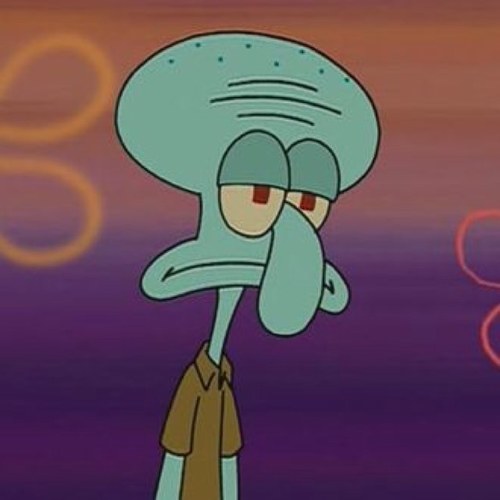
Squidward Tentacles from Spongebob Squarepants has been the subject of a Lost Episode creepypasta. You can probably guess the rest.

As I said above, there are entire websites devoted to the creepypasta genre and droves of fans, some of whom create their own stories and upload them online. What makes this genre so popular? Well, I’m still pretty new to the genre, but I think that there are several factors that may explain this popularity. One is that creepypastas tend to be a bit more extreme than mainstream horror. They’re often accompanied by scary imagery or some other strangeness, and that adds to the creep factor. There’s also the very subject matter of creepypastas: with some stories, you can take elements from them and create your own stories. Slender Man is a character who’s been featured in a variety of media, and plenty of people have made creepypasta based on him. And then there’s the virality of creepypastas: you’re encouraged, by their very nature, to keep sending them around and around the Internet. There’s a certain power in that very concept that’s exciting, and encourages creators as well as readers.

It’s especially interesting when you consider that this is a genre born on the Internet, which has the reputation of having content geared towards people with short attention spans, and also is sometimes considered the gathering place of creators who couldn’t make it in the “real world” (eye roll please?).

Personally, I think creepypastas are quite entertaining. Some of the stories are very good, very creepy, and I enjoy listening to readings of popular creepypasta by YouTube artists. I know some people find them too extreme or that they lead to violent behavior (a subject for another time, not going into it here), but I see it as no different than enjoying a Stephen King story or going to see the latest scary movie. Just a different format with different rules that I would like to learn (though not write; by the very nature of creepypasta, I wouldn’t have as much creative control or make some side income off my work. Maybe I’ll try writing in the style though for a novel someday).

If you’d like to try some creepypasta, here are some good ones I’ve come across. If you check them out, let me know what you think:

Are you a fan of creepypasta? What is it about them that you like or dislike?

What are some creepypastas that you’d recommend trying?


I’ve been wanting to do a post like this for a while now, but I only got around to it now after a friend of mine did it on her blog and I thought to myself, “Yeah, might as well get my butt in gear and do this already.”

So anyway, if you’re unfamiliar with the Bechdel test, it’s used to measure how feminist a work of fiction, usually a film or a novel, is. It was first created by cartoonist Allison Bechdel for her comic strip Dykes to Watch Out For, and has since become used in academic circles and with critics.

Here are the criteria for passing the Bechdel test:

  1. You have two female characters (sometimes having them named is a requirement, and I’ll do that here).
  2. They actually have to talk to each other.
  3. They have to talk about something other than a guy.

On that last part, I usually take it to mean talking about a guy who is in some sense romantically linked to one or both characters. After all, a lot of stories focus solely on a woman’s quest for love or marriage, and that’s it, and I feel like that’s what this test was designed for. And what if the two women are detectives and they’re talking about a suspect who’s male and how he’s difficult to bring to justice? That should be worthy of passing the Bechdel test.

Now before I begin, I want to make one thing clear: I don’t see this test as the end-all test for how feminist a work is. While some do use the Bechdel test in that capacity, I see it more as a tool to examine various works of fiction and promote discussion, rather than as the only way to get a work to be called feminist. Heck, even film organizations who use the test when rating a movie do it mostly for collecting information on gender inequality in films and to make viewers aware of that same gender inequality more than anything else.

So without further ado, here’s how my novels (I’d do the short stories as well, but there’s a lot of those, so I’ll pass) do with the Bechdel test:

  • Reborn City/Video Rage. I place these two together because they’re part of the same series. And they do pass the Bechdel test with flying colors. There are several named female characters in RC, particularly protagonists Zahara Bakur, Ilse, and Iori. And they do talk to each other about a lot of other stuff besides men, including the gang situation in West Reborn and how being a gangster is not for the faint of heart (a problem for Zahara considering she prefers peace and harmony to violence and gun fights). Similarly in VR, there are at least four or five named female characters, including the ones I mentioned above, and they also talk a lot about things other than men, including the situation they’re stuck in or the history of the war that made the world how it is in their present (our future).
  • Snake. Um…yes, but just barely. There are three or four named characters, including the female protagonist Allison Langland. However, as so much of the book focuses on the Snake’s quest to save Allison and then to keep her safe, she doesn’t have a lot of onscreen time with other female characters. There is a scene where Allison speaks with another character about events to come, but the Snake is also part of this conversation, so I guess it depends on your point-of-view on the subject. If there’s ever a sequel to this book, I may try to do better on that front while writing the story.
  • Laura Horn. Despite still working through the second draft, I can tell you LH passes the Bechdel test. There are several named female characters, including our protagonist, and that they do talk to one another about things other than men. Especially the fact that Laura’s wanted for a crime she never committed. Yeah, heavy stuff. Guys and romance actually don’t come up that much. Yeah, romantic feelings are part of the story, but by no means are they the focus, and I expect that will be the case still when I reach the final draft (whenever that is).
  • Rose. Again, this one just barely passes, and whether it does is a matter of perspective. As I’ve mentioned, Rose is about a woman held captive in the home of a man claiming to be her lover. Rose spends a lot of time on her own or with the guy whose house she’s in. She does have conversations with another female, but this female isn’t exactly human, and a few other things about this being call into question whether or not it counts. There’s also a conversation Rose has with another girl in a flashback, but I don’t know if flashbacks count either. So again, this one’s up for debate, one that might not be settled until after the book is published (whenever that is).

So the final verdict is that one half of my novels pass the Bechdel test, and the other half are a matter of opinion. Again, this test isn’t definitive by any means, and as demonstrated in the cases of Snake and Rose,  there are shortcomings to the test. However, it does feel good to know that half my work does pass the test, and the other half might. Surprisingly about half of all films don’t pass the Bechdel test, while quite a number of movies pass what is known as the reverse Bechdel test, which focuses on men (not going to bother with that, except to say that Rose is probably the only one that doesn’t pass). I like to think it says something good about my personality or writing style.

Perhaps in a few years I’ll try applying the Bechdel test to my works again and see what happens. In the meantime, I think I’ll focus on creating good stories in general. And possibly applying other tests to the stories I write (though I’m kind of afraid of what the results might be and what they say about me as a writer). We’ll see how I feel about it.

What are your thoughts on the Bechdel test? Do your works pass it? Why or why not?


You know what there are a lot of these days? Fictional universes where characters from a variety of diverse works are all brought together into a single work or series of works where they interact with one another in various ways. From HP Lovecraft’s Cthulhu Mythos, to the many different iterations of DC and Marvel comic book worlds and their film and television counterparts, to the shared elements of Anne Rice’s vampire and witch series and Stephen King’s interconnected multiverse and then some, there are a lot of these shared universes these days. Heck, there’s even theories from everyday people about how different works by certain creators are all secretly part of the same story (examples include this Pixar theory and this theory on the majority of Joss Whedon’s work).

So I’m wondering, what is the reason behind all of these interconnected story worlds? What makes storytellers and creators of all different mediums want to have such expansive universes where everything is secretly connected and you have to create a huge conspiracy layout on your wall with tape and string and stuff?

Well, I think some part of it is money. At the end of the day, most storytelling is a business (except for maybe some of what appears on YouTube), and if two characters in separate stories are making profits for a creator or their business, they may try to bring the characters together if it’s feasible and if the fans want to see it. Heck, that’s kind of the reason for most comic book crossovers and the movies based around those crossovers. Fans enjoy seeing Superman and Batman work together or Tony Stark mentor Spider-Man or whatever, so the companies give them what they want and get a profit back.

That’s not to say that all of it is money or that money’s the biggest motivator (unless you’re a Hollywood studio, of course). Another big part of it is the creators. They love their characters, and many would like to see those characters they’ve invested time and effort in come together in an awesome story. How would they play off each other? What sort of trouble would they get into with each other and how would they pull themselves out of it? And how would they grow after meeting each other? I think a lot of writers create these crossovers just so they can answer these questions. They may make multiple volumes to continue asking those questions, adding new characters or situations to continue creating exciting new stories and dynamics. It can be pretty enticing to do that with characters you love so much, and I bet audiences enjoy it as well.

In fact, I’ve imagined doing that with Snake and Laura Horn. Yeah, I have. I’ve mentioned before that I’ve wanted the story of the Snake to continue, and I’ve planned sequels not just for Snake, but for LH as well, including one where the two characters meet and get into a crazy adventure together. And I may be a few books and several years from that crossover, but it’s there if I want to write it, and eventually I will write it. It just sounds like too much fun to pass up.

snake front cover

I really have to get around to that sequel someday soon.

Another reason that creators may do crossover works is just because it makes things easier. Now, I hear you typing in the comments already “How the heck does a crossover or shared universe make things easier?” I know it seems counter-intuitive, but let me give an example: Anne Rice introduced in Queen of the Damned, the third book in her Vampire Chronicles, the Talamasca, an international organization of scholars interested in studying the paranormal. Now, try as I might I could not find any information on why, but when Rice wrote her Mayfair Witches trilogy, she brought in the Talamasca society. Why? Because at some point in the first book she details the entire family history of the Mayfair family and its dozen-plus matriarchs and I guess it made sense to just bring in the Talamasca as an explanation as to why there was an entire history of the family when the family itself isn’t very interested in its history. And it helped with the later books in certain ways to have the Talamasca. See? It was easier to bring in an existing fictional organization concerned with the paranormal than make up an entirely new reason for a third party to document an entire mystical family’s history.

I’ve also heard that’s why HP Lovecraft created the Cthulhu Mythos. He didn’t intend to create an entire cosmology, he just decided it might be easier to work with some familiar characteristics when creating all-powerful monsters, and from there it wasn’t too hard to make the jump to connecting Cthulhu to Yog-Sothoth and any of the other Old Ones. Now, I’m no Lovecraft expert, but I’d buy that explanation.

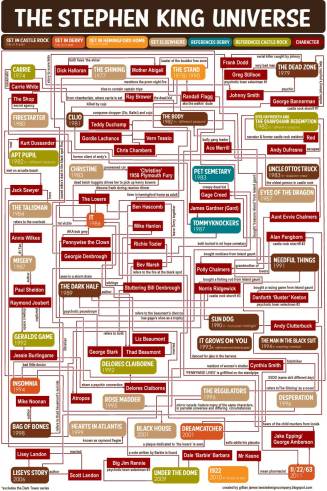
King’s references are so crazy! Check out this chart!

Of course, some authors do it because it’s fun to have a shared universe, for a variety of reasons. You can return to familiar characters and locations by doing so. You can make your readers marvel and go back to another story to say, “Hey, that matches up with so-and-so.” You can create a cosmology or a special reason why a character or characters or place or places appears in so many stories (I’ve got a character or two like that, I just haven’t been able to put them into any works yet. I tried with the human Barbie story and Evil Began in a Bar, but I couldn’t fit them into the former and I haven’t figured out how best to edit the latter yet, so…). And sometimes, it’s just fun to mess with your readers and make them wonder what the heck it all means (I’m pretty sure that’s the reason Stephen King references his other works so much, and the Dark Tower books simply grew out of a desire to create a complex story out of all that messing about).

Whatever the reason someone creates a shared universe, it’s pretty clear that there are plenty of reasons to do so, and that shared universes are here to stay. And whatever the reason behind them, as long as they’re done with love and people enjoy them, I see no reason not to keep doing them. Besides, I may have one or two I’d like to create someday.

Do you have a shared universe in your fiction? Why’d you create it? What has been the result of that?

It’s Thanksgiving in America today, when you’re supposed to be thankful for what you have in your life. Well, you should be thankful for all that year round, but especially today, because…the government made this a national holiday with that sort of connotation.

Well, in the holiday spirit, I’m going to write about all the things I’m thankful for in my life. There are quite a few, but I think I can get keep the list down to the most important ones.

My friends and family.

Whether I met them online, through school or work, or if I’m just related to them by blood or marriage, I love my friends and family. They keep me strong and help my mood stay up. Yeah, sometimes we have our disagreements. My sisters and I can get very nasty towards each other if we spend way too much time together. But it’s the people in my life that keep me less insane and are why I get up each morning. Love you guys. I’m so thankful you’re in my life.

My stories and those reading them.

Understandably, my stories are very important to me. They’re almost like my children. I’ve put so much work into them over the many years, and I always feel so happy when I get to a new stage in their writing process or when they get published. I’m so thankful that I’m able to write these wonderful stories and to work on them. It’s my passion, and I wouldn’t give it up for anything.

I’m also thankful for my readers. Whether you’re on my blog or checking out my books, you people are important to me. Every writer is a bit of a narcissist (why do you think we’re so desperate to get our work read by others?), so you guys tuning in every time I publish a post or ordering a book off Amazon just bring the biggest smile to my face. Thanks for coming at all and coming back again and again. It means so much to me.

The experiences I’ve had.

I’ve been to Germany twice. I’ve also been to England, France, and Israel in my time. I graduated from a good school with a great sports program (Go Bucks!) and I got to study fields I love. I’ve had great work experiences, with Ohio State, the building I lived in for two years, and the US Army. There’s a good likelihood that I might get that with my next job, once I find it. I have a blog with hundreds of followers and it’s growing, slowly but steadily. And of course, I’ve published a few books and I’ll hopefully publish a few more in the coming year.

There are also a bunch of bad experiences that I’d rather not remember, but they helped me grow as a person, so I’ll acknowledge them too.

To say the least, I’ve had the pleasure to see and do a ton in my short life, and I probably will get to do much more in the future. I’m thankful for my experiences, good and bad (though I could always use less of the bad). They bring quite a bit of spice to my life.

How good I’ve had it.

There are a lot of people less fortunate than me. I’ve never been persecuted because of the color of my skin, what country or region I’m from, or my religion. No one tells me what I should do with my reproductive organs like they know better than me when they don’t. I’ve never lived in a violent neighborhood or feared for my life just by walking out the door. I went to college and I’ve been able to earn a living except for short periods here and there. And there’s a growing amount of people in the US who don’t think I’m sick in the head, unholy, or after their children just because of my sexuality. And I’ve had a bunch of people in my life supporting me and showing me right from wrong and offering me their advice when I need it. I’ve had it good.

And there are people out there who cannot say the same thing as me. Plenty of people the world over suffer because of their race, their religion, their gender, their sexual orientation, their ethnicity. They’ve been hungry, or lived in war-torn areas. They’ve experienced violence in their own homes. Some, through genetics or accident, live life without the full use of their bodies or minds.

I’m aware of how privileged my life has been, and how so many people struggle through life because of some form of unfairness or another. That puts me in the unique position to try and help them. Whether it’s raising money for charity, advocating for a certain change, attending meetings, writing blog posts, or simply weaving an issue into a story, I’m making a difference. Perhaps it’s pretty small, but it’s better than nothing, right? And just because it’s easier to let other people handle the problems of the world, doesn’t mean I should.

So I’m thankful that I’ve had a good life. And I’m thankful that I know it, and that I’m in the position to make a difference. Because if I don’t, then I’m basically contributing to the decline of the world and of humanity. And I don’t want that to happen.


I’m not exactly sure who I’m supposed to be thanking on this day (God? The Founding Fathers? Whichever President who made this holiday a thing? It’s never really discussed), but I’m thankful. I can’t take for granted anything in my life, because it could be taken away at a moment’s notice. You never know what will be thrown at you. And here today, I’m making sure people know what I’m thankful for and that I don’t forget it.

Well, that’s all for now. I’ll see you all tomorrow. It’ll be Friday, and you know what that means. Goodnight, my Followers of Fear.

What are you thankful for in your life?

pray for paris

This past weekend in Paris, a city I’ve visited and which I’ve often thought about returning to, was attacked by terrorists affiliated with ISIS. They attacked six different locations throughout the City of Light, including a concert hall, the Stade de France, and two restaurants. At last count, nearly a hundred and thirty people are dead, including seven of the terrorists, and over three-hundred and fifty wounded. The terror threat is apparently still high, and the search for the remaining perpetrators are still ongoing.

And in the midst of the death and horrors, people have come together from around the world for Paris. Through the power of globalization and connection, human beings have shouted out, in tweets and status updates, in blog posts and videos, through television broadcasts and press conferences, through offers of help and condemnations of the terrorists, to stand by France as she works to bring the rest of the terrorists to justice, to take on the sickness that is ISIS, and to heal her wounds after such a horrific series of events.

Still, there’s a dark underbelly to this show of solidarity. My mother and I were discussing this underbelly in the car after dinner last night. Barely two days after the attacks, some people have been condemning Muslims and the refugees from Syria and other parts of the Middle East for the attack (despite the fact that most of the terrorists appear to be European and only one is confirmed to be from Syria). People of all sorts, from members of France’s far-right political party the National Front, including its leader Marine La Pen and US representatives, to bloggers and common people from all over the world. In the need to blame someone for this attack, some are turning to two very large, and lately very popular, scapegoats: those who follow the teachings of Muhammad, and those who left their homes with very little, if anything, just to escape violence and fear.

RC cover

My mom then turned to me and said, “Kind of reminds me of Reborn City. There are people who see a woman with a hijab and feel afraid. Zahara gave that up and even dyed her hair blond to avoid that fear.” That surprised me, but then I realized she had a point. In a small way, the world is beginning to resemble the world of Reborn City.

If you’re not familiar with RC, Islamaphobia is a big theme in the novel. The war on terror devolved into a huge, worldwide conflict, so that by the time of the story most of the world is suspicious of Muslims. Zahara Bakur and her family take measures so that they will be at the very least tolerated by a population that is suspicious of them. Still, it doesn’t always work, and there is still a lot of discrimination in that world that goes unchecked.

While the real world is not at the level that the world of RC is, there are places that have made it difficult to be a Muslim. Angola and Tajikistan actively shut down mosques all the time, and certain European countries have banned burqas and hijabs. France’s Interior Minister has discussed the possibility of shutting down mosques perceived to be preaching dangerous interpretations of Islam. Here in the States,  Donald Trump has said that if elected President he may pursue that course of action.

And because many of the Syrian refugees are Muslim and one of the terrorists was from Syria, some are reacting against refugees. Poland has already said they will not be accepting new refugees, and several US states are now refusing to take in any. Some in the US now wish to screen refugees based on a religious test.

The refugees are not the people we should be lashing out against.

You can’t judge an entire group based on the actions of a few. I don’t judge all Christians based on the actions of Westboro Baptist Church, nor do I judge all football players because a few have been charged and sometimes convicted for violent crimes. But so many people insist on judging Muslims and the Syrian refugees that way. And based on my own experience with Muslims, that isn’t right. That’s nonsensical.

Zahara’s experiences in the book reflect that. Early on she becomes aware that people don’t like her because she’s a Muslim, that they’re afraid of her for things that occurred in her parents’ and grandparents’ generations. She takes steps to be accepted by society by changing her appearance and taking part in “normal” interests and hobbies, but no matter what she tires, people see her as different. They see her as dangerous without even getting to know her. And it’s how people see her that spurs Zahara throughout RC (and its sequel, Video Rage, and probably the final book too) to show people that she is not what people think of her. To show them that she can be kind, and brave. And even good.

In the wake of Paris, we all want to fight back against the evil that caused the attacks. But the evil isn’t the refugees, nor is it Islam and its adherents. No, the evil is ISIS, al-Qaida, Boko Haram and the other terrorist organizations, wearing Islam like a Halloween costume, scary but not the real thing. The real Muslims are standing up to these fakers, standing in solidarity with Paris and showing their disdain towards these inhuman monsters hijacking a respected religion. The last thing we want to do is turn our backs on them, punish them for being who they are.

Instead, we should be thanking them for being allies we can count on for support in hard times, like Zahara is for her friends in the Hydras. Because after all, if we show them the love they deserve, they may return the favor and, like Zahara does, surprise us in all the best ways.