Archive for the ‘Review’ Category

My copy of To Kill a Mockingbird by Harper Lee.

My copy of To Kill a Mockingbird by Harper Lee.

So I recently bought my own copy of To Kill a Mockingbird, something I’ve been contemplating on doing since I listened to and reviewed Go Set a Watchman last year (more on that later). Reading the book, which I hadn’t read since eighth or ninth grade, I realized two things: one was that a lot of my memories of the Mockingbird book had been clouded and confused with the Mockingbird movie. The other was that this merited discussion. And where better to discuss it than on my blog?

I finished the book on Tuesday and watched the movie that night, but couldn’t really blog about it till now because I only have so much time, and what little I have goes by rather quickly (dammit Time, you’re still a quick bastard, aren’t you?). This article will be part review, part reflective essay, but all about what is obviously one of the best pieces of American literature ever written. So without further ado, let’s get into it.

The Book. To say the least, I’m glad I reread the book. I’m not sure if I just didn’t absorb the details as well the first time around, or if I just have a worse memory than I thought, but a lot of what made the book so wonderful hit me like it was my first time reading it. The text is beautiful, full of a smart child’s observations about events that an adult might have trouble absorbing, and all with a somewhat poetic innocence and beauty. You find yourself discovering all sorts of ironies and hypocrisies with Scout Finch, and you find yourself also wanting to explain to her these ironies and hypocrisies that, to her, are too confusing and that the adults can’t seem to explain to her very well.

And like I said earlier, I had quite a revelation about how much I confused the book and the movie. For instance, Scout’s a lot girlier in the book than in the movie. Yes, she’s still quite the tomboy in the book, but the movie emphasized that more, even to the point where she says she hates dresses. In the book, Scout doesn’t seem to outright hate dresses, she just prefers overalls. She also wants to be a good housewife when she grows up and take care of her husband, and she dreams of being a baton twirler when she’s in high school, which are something I can’t imagine Mary Badham’s Scout ever wanting to do. Yeah, these aren’t big differences, but they’re differences nonetheless.

What really surprised me though was the difference in Atticus’s character.* I’ve had this image of Atticus being like this perfect being, a giant of a man with the wisdom of Merlin and the morals of Abraham. However, this is only the movie’s version of Atticus. While Atticus is definitely a moral force, he does struggle in the book. You see it, every decision he struggles with. At times, you can feel him trying to figure out what’s the best move, whether it’s raising his children or trying to be a good lawyer and a good citizen. It was quite the surprise, but I like this version of Atticus more. A character who struggles to do the right thing is always easier to identify with and root for than a character who always does the right thing without question, and that makes the story all the more powerful.

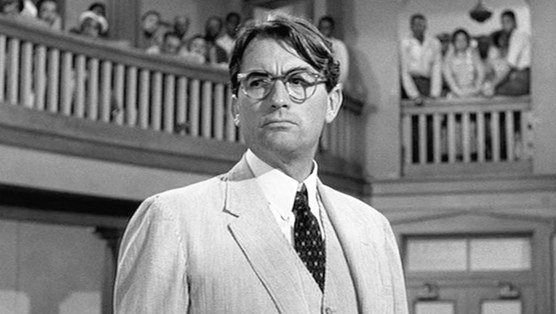
Atticus Finch in the movie, as played by Gregory Peck.

Atticus Finch in the movie, as played by Gregory Peck.

The Movie. I love how the movie started with Scout just humming and coloring. It embodies the innocence that Scout somehow manages to maintain throughout the story. The actors all do very well in their roles, though I thought that the actor who played Bob Ewell could have looked a bit more unkempt and hateful, because he looks like just a regular farmer here. The film is smart in how it sticks to the most important points of the story, namely the trial and the children’s relationship with Boo Radley, as well as the family moments that allow the audience to get to know the characters. I would’ve liked to see more of Dill Harris, as his role is really scaled down in the film, and his exit from the movie is abrupt and not commented upon. Still, it is a really wonderful film. I’m glad I watched it again, and I hope it never gets remade (though if Hollywood is desperate enough to do so, cast Zachary Quinto as Atticus. He’s a bit young for the role, but he’s just an amazing actor. He could pull it off).

Overall thoughts. This book is just as relevant today as it was when it came out in 1960. Now I know to some people, that seems like a no-brainer. After all, the book is taught in schools every day, illustrating the racial climate of both the 1930’s and 1960’s. And yes, that is true, but Mockingbird‘s themes can be applied today. Look at the Black Lives Matter movement: it’s a movement that’s fighting against racial injustice in the justice system, trying to keep black men, women, and children alive when many are accused and sometimes even killed for crimes they did not commit. And people who would readily smack down Adolf Hitler have called these protesters thugs, criminals, terrorists for wanting things to change, and to not have to feel fear while walking down the street. Exactly like Mockingbird. And all too often, you hear people make sweeping generalizations about minorities, especially minorities who are “dangerous,” or a threat to social order. This happens in Mockingbird as well, and it’s scary to see something in a novel about the past happening in my present. And it makes you question how far we’ve really come since then.

One of the best lessons from Mockingbird is that you can’t really know someone until you walk in their shoes. I don’t remember if this point was emphasized as much in my classes back in the day (and as students at an all-Jewish school, we’re all-too familiar with what it’s like to be a persecuted people), but it’s something that should be emphasized more in examinations of Mockingbird. Because it’s all too easy to be scared of someone, but it’s difficult as hell to empathize and see things from their point of view.

Whether it’s the book or the movie, really, To Kill a Mockingbird is just a powerful story. It’s beautifully written and told, the characters are timeless, and its lessons are things we can all take to heart, no matter what age it is. I’d be lucky to write something just as earth-shattering someday. Because Mockingbird isn’t just a great example of American literature. It’s an exploration in what it means to be a human being.

That’s all for now, my Followers of Fear. My next post will be at some point Saturday, so keep an eye out for it. Until next time!

*Speaking of Atticus’s character, something I just want to talk about real quick. When Watchman came out last year, there was all this controversy about Atticus being revealed as having racist leanings. Not the best thing to have in a sequel, is it? Well, I didn’t know this when I wrote my review, but apparently Watchman was not a real sequel. In actuality, it was most likely a very early draft of Mockingbird. This makes all sorts of sense to me, especially in light of my rereading Mockingbird. For instance, Watchman spends a lot of time going back and forth between events in Scout’s childhood and in her adulthood, which doesn’t happen at all in Mockingbird. A weird move for a sequel. That, and Atticus isn’t the only character who’s changed a bit: Uncle Jack Finch is portrayed as more eccentric in Watchman than in Mockingbird, which seems unusual as I’m sure Scout would have noticed his uncle’s oddness as a child. Most damning of all, though, is that the trial in Mockingbird is only barely in Watchman, and Boo Radley, who’s so essential to Mockingbird, isn’t even mentioned in Watchman! Very odd, to say the least.

And from a writer’s experience, I can tell you that stories can change dramatically between drafts. Some of my own stories have gone through great transformations from first draft to final publication (I should do an article on that!). That’s why Watchman, an early draft, is so different from Mockingbird, the final product.

So fear not, folks. Atticus isn’t really racist. An early version of him was, but I think the final version, who defended Tom Robinson and who said cheating a black man was ten times worse than a white man, isn’t a racist at all. He’s still a great idea of what we can be. He’s human, he struggles with his decisions, he’s not perfect. But he is a good man without prejudice. And that’s the version we love the most.

And Watchman? Well, it’s a pretty blatant attempt to capitalize on an already-famous book, but it’s good in its own right. Just remember its origin and don’t get too depressed over certain characterizations when you read it. That’s all I can say at this point, friends and neighbors.

I wanted to see this when it came out, but it came out after I moved, which means if I wanted to see it, I had to ride a bus about an hour one way to the nearest movie theater (and that’s just the start of the trip). Sucks, but on the bright side, the DVD came out only a couple of months after it came out in theaters, so I still get to see it relatively soon after it’s release.

So how did The Conjuring 2 stack up, both as a sequel to The Conjuring (which I gave a very good review) and as a horror film in general? I’m pleased to say, it stacks up pretty well on both counts. The film continues the story of real life ghost hunters Ed and Lorraine Warren (played again by Patrick Wilson and Vera Farmiga, the latter of whom I’ve yet to see in a bad role), giving another one of their famous cases the Hollywood treatment (because real life hauntings are never resolved this easily). This time they’re dealing with the Enfield haunting, a case in which a family living in public housing, particularly the daughters, are oppressed by some sort of demonic entity, as well as Lorraine dealing with a vision that supposedly shows her husband’s death.

Like its predecessor, The Conjuring 2 knows how to tell a scary story. Both jump scares and just creepy atmosphere-building moments are written and filmed wonderfully (there’s a scene where they’re interviewing the ghost without looking at it, and it’s just so freaky), there isn’t a lot of CGI, which I like in a horror film, and the acting feels real enough to make me believe in all of these characters. Of course, the story probably breaks quite a bit from the actual events of the Enfield haunting, but that’s to be expected in a movie version of events. They do give some film time to claims that the girls faked the hauntings (rather obviously too), but as it’s a horror film, they do explain why the girls tried to fake an obviously real haunting (in the movie, anyway). And there’s a fun reference to the Amityville haunting (how did they make that without paying copyright fees?) that I liked. There’s a lot to like in this film.

My favorite part, personally, is the villain, the Masked Nun. God, she/it is creepy. I can see why a spin-off is in the works based on that one creepy character!

Sadly, of course, there’s a few things that I didn’t care for. There’s a moment where Ed sings to the kids in the style of Elvis Presley that felt somewhat unnecessary and possibly shoehorned in, and there’s a joke not too long afterwards involving how far cameras have come in 1977 that, while funny, could’ve been cut out without any problems. Oh, and what’s with that musical montage near the beginning of the film involving footage from England in the 70s? We know this film takes place in London in the 1970s! We don’t need a montage with annoying English 70s music to hammer that home to us!

All in all though, I liked the film. It’s a good follow-up to The Conjuring, and I enjoyed every minute of it. On a scale of 1 to 5, I give it a 4.5 out of 5. Definitely go see it, and get yourself scared.

And this is probably my last post until next month. See you then!

(The following review contains some spoilers. Reader discretion is advised)

It’s finally here. After months of speculation, of no subtitle or definitive casting list, we have the new season of American Horror Story…and I had to wait a day because I don’t have a TV and I work. That sucks, but you learn to live with it. Anyway, since Hotel ended, there has been rampant speculation as to what Season 6 would be. Rumor was we were supposed to get the theme earlier this summer, but after Orlando, the show’s producers decided to hold back, and instead tease us with multiple trailers that may or may not be related to the actual story of Season 6.

But as of last night, we have a theme, and it is Roanoke! Now for those of you not familiar with American history or who haven’t seen the show’s first season in full, let me explain: Roanoke was an early American colony on the North Carolina coast in the late 16th century. One day, ships from England returned to the colony after a long absence with supplies, only to find the colony mysteriously empty, with not a person in sight. There were no signs of plague or foul play, and the only indicator of what might have happened was a single word carved into a tree trunk: Croatoan. The strange circumstances around the “Lost Colony” has led to a number of theories, both credible and crazy, as well as numerous fictional works about the disappearance.

And it looks like AHS is tackling Roanoke’s legend this year, and they’re doing it in odd fashion too. Rather than telling it like a regular story, as they’ve done in past seasons, AHS is presenting season 6 as a Discovery Channel docuseries called My Roanoke Nightmare, which tells the story of a couple who move into an old house and start to experience strange, supernatural events, both through interviews in what I assume to be a studio, and through dramatic reenactments with actors (it’s very meta). And from the looks of it, it may not be your average haunted house story. Already there are plenty of hints that there’s more to this season than meets the eye, and with showrunner Ryan Murphy promising that this season will begin to tie up the series’ sprawling mythology, you know you’re in for something interesting.

So what did I think of the first episode? Well, it’s definitely intriguing. It’s not the fright fest that the first episode of Hotel was, but I think that’s intentional. This episode is meant to be a lure, showing just enough to get us interested in the story. Which it does very well, giving us a format and a setup that is different from the norm. And near the end, you’re given quite a lot of weird stuff that hints at a very dense story for this season, which will definitely make longtime fans want more.

And speaking of more, I get the sense that, like the story, there’s more to the characters we’re seeing. As the season is modeled after a docuseries, you don’t really see the people in it. You see a version of them meant to keep people interested in the show. You’ve got the interracial couple who we’re supposed to root for, as well as a sister-in-law who has a lot of baggage, and as time goes on, I’m sure we’ll get more characters who start out as versions of people who are meant to keep our interest in the story, but, in typical AHS fashion, their characters will go in directions that nobody will expect, and it’ll be both bonkers and totally amazing.

In any case, this season will conclude in November after ten episodes, just like a real docuseries, so I have a feeling that we’ll get a pretty fast-paced season compared to the past. I’m not sure if that’s a good thing (a few slow moments to develop characters are sometimes necessary for good storytelling), but it’ll definitely be different, and in an anthology series that has surprised and terrified us year after year, that’s definitely what we, the viewers, expect.

All in all, this is a solid start for the show’s sixth season. It’s not super-scary, but it definitely is interesting and I have a feeling plenty of people will be buzzing about the possibilities right up until Episode 2. On a scale of 1 to 5, I’m giving the first episode of American Horror Story: Roanoke a 4 out of 5. Good luck, AHS. I have high hopes for you this year. Don’t let us down.

Well, that’s all for now, my Followers of Fear. I’m getting The Conjuring 2 from the library this weekend, so I’ll most likely be doing a review of that as well. Yeah, I’m not doing too well on that whole “two blog posts a month” thing, am I? Well, until then, have some pleasant nightmares!

RC cover

So I got a pleasant surprise today, in the form of another review of Reborn City on Amazon. This is the second one in two days, which practically never happens to me. Naturally, I was surprised, but also rather pleased. Come November, Reborn City will have been out for three years, and it’s nice to see that it’s getting more recognition these days. With any luck, by the time I get the third book, Full Circle, out into the world, a lot more people will have come to like the books and the characters within.

So if you’re so new that you didn’t see the post from Thursday, Reborn City is the first book in a trilogy I started in high school. The series follows a street gang called the Hydras in the western projects of the titular city, the leaders of which have strange abilities and powers, which the leaders of the city have a dark interest in. Major themes of the novel include Islamaphobia, racism and prejudice, drug addiction, gang violence, and most of all, overcoming what other people and what you think of yourself. The second book, Video Rage, came out back in June.

I think I’m going to copy and paste the majority of the previous paragraph whenever I do a Reborn City post. It saves time.

Anyway, the latest review was left by someone named Amazon Customer (how mysterious!), who gave a four-star review of the book. Here’s what he/she/they/it had to say:

It’s a neat exercise in trying to see through the eyes of someone different from oneself. It incorporated a lot of fly comic-book-esque tropes. A good beginning effort of an up an coming new author who has some cool ideas to explore.

That’s the first time I or anything connected to me have been called fly since high school! I’m so happy!

Anyway, I listed reviews that go to show how great RC on Thursday, so I think I’ll skip that. However, if you want to see those other reviews, and maybe check out the book yourself, and maybe Video Rage as well, I’ll post those links down below.

That’s all for now, my Followers of Fear. Unless something comes up that needs blogging, it’s radio silence for the next couple of days. Until next time!

Reborn City:Amazon, Createspace, Barnes & NobleiBooksSmashwords, and Kobo

Video Rage: Amazon, Kindle, CreatespaceBarnes & Noble, iBooks, Smashwords, and Kobo

RC cover

So my friend and colleague Ruth Ann Nordin (check out her blog here) emailed me at some point last night, saying that she had read Reborn City and had posted a review on Amazon. Obviously, this got me excited, as I love getting feedback from readers, and I especially like hearing it from authors I respect and admire (which reminds me: Ruth, thanks for reading RC! I hope you enjoy Video Rage when you get to it!). So I was eager to see what she posted online. As I hoped, the review had only nice things to say.

Now if you don’t know what Reborn City is, it’s the first book in a science fiction trilogy I started writing in high school. It follows the trials of a street gang called the Hydras living in the titular city, the leaders of which have strange powers. The story has a lot of themes that are relevant to today’s world, including Islamaphobia, racism, drug addiction, gang violence, and, perhaps most importantly, overcoming what you think of yourself and what others think of you. Reborn City‘s sequel, Video Rage, was released this past June, and I hope to start on the final book, Full Circle, later this year.

Now back to Ruth’s review. I was very happy to see that she gave RC a five-star review (bringing the book’s total rating to a 4.8 out of 5), and titled her review Read like a movie. Here’s what she had to say on the book (and I’m warning you now, her review does have a couple of spoilers! So be aware before proceeding):

I decided to read this book because I know the author and have enjoyed his other works. I’m not a fan of books about gangs, so I wasn’t sure if I’d enjoy this story, to be honest. But I felt an immediate connection to the main characters right away, and this compelled me to keep reading.

SPOILER ALERT: This book took an unexpected turn. About halfway into it, it became apparent that the main gang members were special, and it was the unusual interest a shady government operation was showing in them that really pulled me in. There is an awesome genetic engineering component that I love in books and movies. The gang’s backstory was one of the best I’d ever read. This is a book that didn’t disappoint the sci-fi thriller lover in me. In my opinion, this would make a great movie.

As a warning, there is a lot of cussing. The violence wasn’t all that bad (maybe a PG-13).

Funnily enough, I usually write my books like a movie in my head, so the movie comparison is pretty on the spot. Not only that, but I think a Reborn City movie would be pretty awesome. Especially if we get Tyler Posey from Teen Wolf to play male lead Rip and Samuel L. Jackson from to play main antagonist Jason Price.

If anyone here knows those guys and can get them to read the book, please do so! I’d love for them to read it, and maybe like it enough to help produce a movie version. Let’s make that happen, okay?!

Anyway, this review matches what a lot of other people have said about RC in their reviews:

This is an extremely commendable effort by a new young writer, whom I believe we will see much more of in the years ahead. Rami Ungar’s vision of a frightening dystopian future is peppered with those elements that make us all human. There are quite a few surprises in the book, and I am anxious for the next volume in the series to be released.

Marc M. Neiwirth

This is not a genre I typically delve into, but I took this book on vacation and couldn’t put it down. The plot had me turning pages at quite the clip. The characters were unique and interesting and the imagery had me creating my own visual of what Rami’s interpretation of the future looked like. For first time novelist, Rami Ungar, this was an outstanding showing of talent and commitment to his passion of writing. Looking forward to seeing what he comes up with next!

Michele Kurland

Gangland violence, superhero-like enhancements, a futuristic setting, and social commentary that stems from a semi-post-apocalyptic theme. And then there’s a story where people come together as a family to deal with mutual loss and tragedy. What’s not to like?

Matthew Williams, author of Whiskey Delta and Papa Zulu

VR CS front cover

If any of this has made you want to check out Reborn City, I’ll provide the links below, as well as for its sequel, Video Rage. And if you do end up reading the book(s), I hope you’ll let me know what you think. Positive or negative, I love and appreciate getting feedback from readers, and it makes me a better writer when you folks tell me what works and what doesn’t.

Well, tomorrow’s Friday, so you know what that means. While I prepare for that, I’m also posting the link to an interview with Awesome Book Promotions that came out yesterday. So check that out, if you so desire. It’s pretty awesome, as the title suggests.

Until next time, my Followers of Fear!

Reborn City: Amazon, Createspace, Barnes & NobleiBooksSmashwords, and Kobo

Video Rage: Amazon, Kindle, CreatespaceBarnes & Noble, iBooks, Smashwords, and Kobo

I came across this book while looking for something new and scary to read. It looked and sounded good, and it apparently had only just come out in the US, so not many people were talking about it yet. I figured I’d give HEX a try.

And it definitely didn’t prove boring.

So, what’s it about? HEX is about the small town of Black Spring, New York, which is under the curse of an apparently immortal witch named Katherine van Wyler, who wanders around town with her eyes and mouth sewn shut (nightmares right there). Anyone who lives or moves to Black Springs is trapped there by the witch, with attempts to leave longer than a week or two leaving residents feeling depressed and suicidal. With every attempt in history to get rid of Katherine meeting with tragedy, the town has isolated itself from the rest of the world, with the HEX office controlling who moves into town and what Outsiders see when they visit, as well as monitoring the witch’s movements at all times using the latest and greatest in technology. Unbeknownst to HEX and the townsfolk, however, some teens in town are trying to study the witch with the hope of breaking the curse and leaving town. The results of that meddling cause a chain reaction leading to something no one in Black Spring will ever forget.

I thought that HEX had a lot going for it. For one, Heuvelt tells the story beautifully through the POVs of four of the townsfolk: Steve Grant, a doctor and father who tries to live in a rational world despite the fact that there’s a witch in his town; his eldest son Tyler, an idealistic youth and YouTube vlogger who leads his friends to study the witch; Robert Grim, HEX’s irritable leader (whose description in the book makes me think of Mitch Pileggi of X-Files fame); and Griselda Holst, a woman with a past who practically worships Katherine as much as she fears her. They’re all very well-written characters, and you really come to sympathize with each and every one (though occasionally I wondered if Griselda might use some therapy).

Heuvelt also knows how to tell a story, taking it in directions I didn’t think the story would go, and making the surprises genuine, even if some of them, in retrospect, could be seen coming. He also manages to create this atmosphere and dread that sticks with you and makes you want to know more, punctuating it with these moments involving the witch and her magic that really gets you.

I can’t really think of anything bad about this book. Nothing about it particularly struck me as bad or as needing improvement. I could nitpick that it may be a little too perfect, or that it could’ve dealt a bit more with the social media aspect of the story, but like I said, it’d be nitpicking.

The interesting thing about HEX is that the English version is really the second version: Heuvelt is a Dutch author, and HEX was originally published in Dutch with Dutch characters and a Dutch setting back in 2013. But in the acknowledgments section at the end of the book, Heuvelt explains that he was asked to make some changes for the America edition, and he ended up doing a sort of HEX 2.0, as he called it, rewriting the novel in English (apparently he’s fluent), giving it an American setting with American characters, and even a new ending.

So of course, one would wonder after reading the English version what the Dutch version is like. Well, Heuvelt won’t tell. His only advice is to “go bribe a Dutchman” (and oh darn, mine just happened to disappear in a flash of bright light). But even if you never find out what the Dutch version is like, you can be satisfied that the English version is pretty awesome as well.

All in all, I’m giving HEX a 4.3 out of 5. It’s creepy, has a great premise and characters, and is brilliantly written. I highly recommend it to anyone looking to read something new and different and scary and happens to see this on the shelves.

That’s all for now. Remember, today’s the last day to submit questions for a Q&A in honor of my five-year blogging anniversary (details here). You’ve got till midnight, and then I’m working on that post.

Until next time, my Followers of Fear!

So this film has had some buzz around it for a while. It was made on three-million dollars, earned forty-million at the box office, and apparently scared the likes of His Royal Scariness, Stephen King. Naturally, when it hit theaters back in February, I wanted to see it, but no theaters near me were playing it. When I found out last month that it was on DVD, I immediately went to my library’s website to reserve it…only for some punk to steal my copy when it came to me (a curse upon them, preferably involving witches!). But this week I got my copy, and I sat down over dinner to see what the big deal was.

The movie follows a family of 17th-century Puritans–parents William and Katherine, teenagers Thomasin and Caleb, and twins Mercy and Jonas–as they’re banished from their Puritan settlement because apparently Will’s interpretation of the Bible is too extreme for the community (not sure how that is, but maybe I’m too Jewish to notice). They settle in a field on the edge of a vast forest, unaware that there’s a witch living in the woods.

What surprised me most about The Witch is how it differs from other horror films. It’s not a traditional film, in the sense that there’s a central evil that’s pretty obvious and the majority of the horror comes from that villainous evil. In fact, the titular witch is pretty peripheral in the story, acting more as a catalyst for the horrors of the film. I actually struggled to find the terror in the film until I realized that it wasn’t the witch that was the source of the terror (though she is pretty powerful, visceral, and primordial), but the family itself. Once the witch interferes with this family, they start to slowly implode upon themselves. It’s a really dark, psychological descent into hatred, fear, and suspicion, with the occasional intervention of the witch and a lot of heavy Bible speak. And it is scary to watch what happens to this family.

I also really liked the attention to detail. The filmmakers went to great lengths to find a remote location for the setting, and from there hand-build the house and farm, as well as the clothes the actors wore, and just about everything else. They even had museums consulting on this project, which goes to show their dedication. The authenticity, coupled with sparse lighting and the dirty feel of the place, adds to a very creepy atmosphere. And the music, usually involving a fiddle or zither, invokes 2001: A Space Odyssey in its ability to place us in the story.

Despite how scary it was and the research that went into the film, The Witch did have its problems, though. There are some scenes that felt more like they belonged in a novel, rather than in a movie, quiet moments where characters are thinking and not speaking, and we can’t read their minds.It’s in these scenes that we have trouble connecting to the characters, which is bad when this film is so reliant on its characters to begin with.

There’s also an unresolved subplot involving Caleb and his relationship to his older sister Thomasin that’s never really resolved, and I would’ve liked to see where that could’ve gone.  And like I said, it took me a while to realize what sort of horror film this was, though maybe that’s just me going in with certain expectations and being confused that they’re not being met.

And the old-fashioned dialect, plus the heavy accents and sometimes raspy voices, can make it difficult to understand what they’re saying. I had to turn on the subtitles about ten minutes in just to make sure I wasn’t missing anything.

Other than those points, though, The Witch is a terrifying descent into religious mania and terror in a dark situation, with supernatural twists and a lot of religious overtones worthy of discussion by theologians (which apparently has happened). I’m going to give this film a 3.8 out of 5, and recommend you watch this one with the lights on while you’re at it. A wonderful debut from writer and director Robert Eggers. I hope I get to see more of his work in the future.

That’s all for now, my Followers of Fear. Make sure to read about the giveaway and submit your questions and comments for the Q&A happening on August 2nd (details here). I’ll check in again very soon, believe me. In the meantime, a good night to all.

Hopefully free of supernatural beings, right?

Before I start this review, I’m going to lay some ground rules. I don’t tolerate sexism, angry nostalgia, or anything of that sort. So if you read this review and want to comment something about the actresses in this films, or you want to tell me that the new film is ruining your childhood (what sort of childhood did you have if Ghostbusters was the most important thing in it and a new film is enough to ruin everything?), then save your breath. I don’t care, and I don’t want to hear it. And if you think it’s such a bad film, then don’t go see it! Honestly, leave it alone and let it flop on its own, like the JEM film did. Either that, or watch this video, which I feel will leave you feeling vindicated.

All good? Great! Let’s begin.

So my sister and I went to see this film today, and we have to say, we thoroughly enjoyed it. We were actually worried about how it would do, but it was funny, it had great action sequences, and it even had its scary moments (mostly my sister got scared though, because my sister has a lower scare threshold than I do).

So what’s the plot? The movie follows Erin Gilbert (played by Kristen Wiig), a physics professor up for tenure who finds out a book on ghosts she co-wrote with her old friend Dr. Abby Yates (Melissa McCarthy), who manages to get her to come with her and Dr. Jillian Holtzmann (Kate McKinnon) to a haunting. The result reignites Erin’s interest in ghosts, and, after some other stuff, forms the titular team above a Chinese restaurant. They are soon joined by the dreamy but dumb Kevin (Chris Hemsworth) and MTA worker/amateur historian* Patty Tolan (Leslie Jones), and find themselves following the trail of an inventor whose devices are causing paranormal activity throughout Manhattan, with a very dark end goal in mind.

And it’s just good fun! The story is very well-written, managing to sneak in references to the original film and to the haters on the net without feeling forced or weird or cheap, but actually add to the humor. The actors are all awesome, it goes without saying. I especially love Kate McKinnon’s character, Jill Holtzmann, who is like “I’m-insane-but-adorably-harmless-and-life-is-just-so-much-fun.” I bet life in her head is just a blast. Hemsworth as a hunky buffoon was never dull. And the supporting cast is wonderful, especially Karan Soni (the taxi driver from Deadpool), who I was delighted to see in the film. And five of the cast members of the original film show up for some hilarious cameos, including Bill Murray as a supernatural skeptic and Dan Aykroyd as a taxi driver. And the special effects…well, yeah, the ghosts look CGI, but it’s a good CGI. It works for these ghosts, makes them look strange and somewhat otherworldly. And they’re much more believable than the effects from the movies in the 1980’s.

I only have a few critiques of this film. One is that the villain, played by Neil Casey, is pretty bare-bones. His motivation and background were explained in a monologue, and it’s not much. But for this movie, it works well. Another is that the last fight scene feels like the filmmakers were going for an Avengers movie getting mixed with Godzilla and adding in a moment from Big Hero 6. I would’ve preferred more humor than was already in there, but it was still very fun. And finally…well, there’s a very funny scene in the credits that looks like something out of a Michael Jackson music video. I feel that scene would’ve been better placed right before the big battle, but I guess the studio thought it detracted from the mood they were going for with the climax. Don’t get it, but whatever. I think it would’ve worked in the main movie, it would’ve gone well as part of what Ghostbusters is about.

I'm excited for some ghosts! Photo courtesy of Adi Ungar

I’m excited for some ghosts! Photo courtesy of Adi Ungar

All in all, though, I enjoyed this film. It was funny, well-written, full of great actors, and I would say it’s on par with the original film. Not better, not worse. Just about equal, a 4.4 out of 5. Definitely go see it and have yourself a few laughs. Also, stick around for an after-credits scene. Trust me, you don’t want to miss it. It has a nice reference to the original film.

*Now, before you lay into Jones’s character, let me mention that yes, she doesn’t have a doctorate, but she might as well. Remember that historians as we know them didn’t appear until the nineteenth century in Germany. Prior to that, historians were basically anyone with enough education to read, write, and interview people in order to best record historical events. Her character’s not inferior to the others, she’s a throwback to tradition. And it becomes important to the story, believe me.

So I recently got back into reading The Complete Fiction of HP Lovecraft, after about a year’s gap since I last dove into his work on my Kindle. I actually got from 15% to 32%, which for a 1112-page book is pretty good, if you ask me.

Now, if you don’t know who HP Lovecraft is, he was kind of the King of American Horror between the reigns of Edgar Allen Poe and current monarch Stephen King, though he didn’t really achieve any sort of fame or influence until after his death. When I read him last year, I found his style old and outdated, and while some of his stories were actually pretty creepy, others were just strange or boring (see my thoughts in Thoughts on Lovecraft: Part 1).

So what were my thoughts one year later, having read several more stories? Well, he still prefers to write like a contemporary of Poe, one of his main influences in writing, which I find still rather irksome (I could parody it here, but I did that well enough in Part 1, so why try and repeat it?). I’m not that big a fan of that style, as I find it stuffy and somewhat boring, so occasionally that made for an annoyance to get through.

And Lovecraft is still a proud and unrepentant racist and xenophobe. Seriously, “The Horror at Red Hook” manages to drag so many non-white ethnicities, including Kurds and Yazidis, through the mud.

And he’s the only author I’ve ever met who’s used the word “eldritch,” meaning sinister or creepy (why didn’t he just use those words?).

But other than those problems, the tales I read in this section of the book were much better than the ones I read in the last one. Sure, the short story “Azathoth,” which was the first mention of the Elder God, is actually just a fragment of a novel Lovecraft never got around to finishing, which was annoying. Imagine, I get to the end of that short piece, and I was like, “Wait, that’s it?” Thank goodness for Wikipedia, which explained to me why I shouldn’t be so angry.

And there was that story, “Imprisoned with the Pharoahs,” which got a little dense with the language and made it annoying to get through, though as a fictional account of one of Harry Houdini’s adventures, it is pretty cool in retrospect.

But other than those two, these were very good stories. They were creepy, dark, and had some pretty nice twists and turns in them. I can see why a few of them have been adapted several times into movies or radio plays and the like. “Herbert West–Reanimator” is a fun tale about one man’s growing obsession with overcoming death and extending life (very Frankenstein), and how that obsession causes a domino fall of events that shows the readers the price of obsession. “The Lurking Fear” felt like a Stephen King novel from an earlier age, filled with elements of insanity, the supernatural, and insane tastes. And “Shunned House” needs to be made into a movie by Blumhouse Productions, because it is freaking scary! It’s a vampire novel that hearkens back to the days when vampires were barely human, and is probably the best of the stories by him I’ve read so far. Imagine a movie version, with James Wan in the director’s seat! No one would see it and think of vampires with Twilight or any of that other sentimental crap out there ever again.

Eek! Rats in the walls! Now I can’t sleep.

Also, “The Rats in the Walls” is great if you want to scare anyone around a campfire. Just saying.

You know, the more I read of Lovecraft’s work, the more I see why he’s been so influential. Sure, his early stories could be rather pointless or silly, and never approached scary, with the exceptions of a few, like “The Tomb” and “The Temple.” But as time went on, as tends to happen, he got better. He figured out what worked and what didn’t. He learned how to get into our heads and make us tremble, make us wonder. He pushed the envelope for his day, introducing elements of cannibalism, satanism, gods that care nothing for us except maybe as snacks. And he did it so well.

And even now, after I’ve decided to take a break from him, I still find myself getting inspired by him. I’ve already gotten a few new novel and short story ideas from his stories, particularly “The Lurking Fear.” I have no idea when I’ll write them, but I think that when I do, they may even chill me.

So yeah, I think I’m definitely a Lovecraft fan now. Last year I wasn’t so much of a fan, but now I think I am. He’s definitely grown on me. And I think I may visit him again someday, perhaps even before the end of the year. Especially if he gives me so many good ideas. And if you like a good scary story and can handle some old-timey writing style, then I suggest you visit Mr. Lovecraft too.

Well, that’s all for now. I’ve got my own stories to work on, so I’m going to get on that. In the meantime, I hope you have a scarily good time, my Followers of Fear. Until next time!

(Again, slight spoilers on this one, so be careful going own. You may learn something you were hoping to be surprised about)

Well, we’re back. I’m listing the five greatest villains I’ve seen throughout the past year. Will your favorite appear on the list? Who will win the number one spot? And will I use a real person or one of my own villains (no on both of those)? Let’s dive in!

Also, check out #10-6 if you haven’t already.

5. The Society (Red Rising trilogy)

The society pyramid

Big thanks to Kat Impossible for introducing me to this series and getting me hooked on it.

Now, if you’re not familiar with this trilogy, let me explain the premise: imagine about 700-1000 years in our future, mankind has evolved and divided itself into colors: Blue, Green, White, Pink, Red, Obsidian, etc. And on the very top are the god-kings, the Golds, who use the system they helped create to become rich and powerful.

But even if the Golds are the ones who benefit most from this system, and even if there plenty of Golds who alone would qualify for this list (I’m looking at you, Jackal!), none of them on their own are the true villains. If you ask me, the Society as a whole–one that enslaves some of its citizens, and kills others in order for the strongest to survive and rule–is the true villain. It’s a system that takes the very essence of humanity and destroys it for the sake of economic power and prosperity, where those who are compliant can get power even if they’re not Golds or any of the other High Colors. The Society molds the monsters it creates, and the people who fight against it, all at once.

For that reason, I’m nominating an entire civilization for #5 on this list.

And if you haven’t read this series, I highly recommend you do. The characters are awesome, you never see where the story will go, and it constantly finds ways to surprise you and keep you reading. I highly recommend it for anyone who has a thing for science fiction, or just good stories in general.

4. James Patrick Marsh (American Horror Story: Hotel)

I said in my review that AHS: Hotel was my favorite season of the series so far, and March was a big part of that. Played by perennial series mainstay Evan Peters and based partially on real-life serial killer HH Holmes, March is a serial killer who builds the Hotel Cortez to be the ultimate murder palace. After his early death, he mentors other killers as a ghost, inviting people to stop in his hotel to learn the art of murder from him, and even doing a few kills here and there as well.

There are so many reasons to love him as a villain. For one, he’s just so much fun! He’s like Walt Disney turned into a murderer, full of old-fashioned charm and bravado. He’s literally the sort of person you would want to meet in a bar and have a drink with. Whenever March appears on screen, he steals the scene, and no one seems to have more fun with him than Peters himself, who looks like he’s having so much fun playing this murderous hotelier.

Another good reason to like this guy is that everything that happens in the show, you can trace back to him. Even when he was alive, a lot of his actions tended to have far-reaching effects, some of which are felt in the modern-day events of the season. I love a villain who only needs to flip a single domino and then sits back to watch the chaos unfold, and March does it with just a few words and a charming smile. His spot on this list is well-deserved.

3. Whitney Frost (Marvel’s Agent Carter)

Season 2’s villainess is definitely a unique woman, and that’s why she’s so high up on the list. An actress who moonlights as a world-class genius physicist for her husband’s company, Whitney has always been told that, as a woman, her value is in her looks, not in her brains, and is upset when her film roles start to dry up because she’s considered “old” (though if you ask me, her best days are still ahead of her). Because of that, she helps to develop, study, and eventually become one with a strange and destructive substance known as zero matter, which allows her to break down and absorb the people and objects around her. After that, she starts using zero matter to gain power, creating even more so that she can become even stronger.

What’s interesting is how she’s such a contrast from series’ lead Peggy Carter, and yet so very similar. Both are women, very pretty women, and because it’s still a male-dominated age, men continually underestimate them and think they’re better off as secretaries or housewives. However, Peggy proves herself time and time again by taking on the cases and getting the bad guys, while Whitney uses crime, her looks and brains, and zero matter as a way of gaining power in order to validate herself. She’s kind of a dark Agent Carter, in a way, and her evolution through the season and her war with Peggy Carter make for a fascinating battle of the beauties. For that, I give her #3 on this list.

2. Helmut Zemo (Captain America: Civil War)

The penultimate entry on our list is another Marvel villain, this time Baron Zemo’s film portrayal in Captain America: Civil War. Now, I know that the film version, portrayed by Daniel Bruhl, is extremely different from the comic book version. The thing is, I don’t read the comic books (too many continuities and canons to keep track of), so I really have only this version to go on.

And what a version it is. He goes to great lengths and does such elaborate things to carry out his plan. And what is his plan? Simple: to manipulate the Avengers so as to fracture them. And he does it! He breaks the Avengers apart with more fireworks than any boy band could muster, and he almost gets away with it! In fact he does, he just gets captured at the end. This probably makes him the most effective villain in the MCU, and definitely worthy of the Number Two spot on this list.

And he does it all because his family was murdered in Age of Ultron. That’s anger and dedication mixed with patience and intelligence. Seriously, the #2 spot is definitely deserved.

1. The Dread Doctors (Teen Wolf)

Teen Wolf has produced three members of this esteemed list, including last year’s #1 spot. And this year, without a doubt, goes to Season 5’s villains, the well-named Dread Doctors, who I knew as soon as I saw them were going to be somewhere high up on this list.

A group of long-lived mad scientists who have taken the supernatural powers of the world and bent them to their own purposes, they produce hybrids of humans and the various creatures that the show’s famous for. A mix of steampunk fashion, Dr. Frankenstein, Venice plague doctors, Darth Vader, and a few other things, they take teens from Beacon Hills and experiment on them. And all for a very sinister purpose.

Creepy, ephemeral, and willing to go to any lengths to reach their goals. I seriously wish I’d created the Dread Doctors before the show did (or wrote the novel about the Dread Doctors that appears in the show). They deserve the #1 spot, and if you haven’t already, I seriously think you should go online and find some footage on them. You might get some nightmares from it, but it’s definitely worth the risk.


That’s this year’s list. But tell me, what did you think? Did you enjoy the list? Any entrees you disagree with? Who do you think should’ve made the list? Let’s discuss.