Archive for the ‘Scary Stuff’ Category

snake

How far would you go for love and revenge?

If you haven’t heard yet, Snake‘s e-book is only on sale for a few more days, until July 7th. After that there won’t be any more sales for a while…no, wait. The Quiet Game‘s one-year anniversary is ten days later. Never mind.

But yeah, Snake‘s e-book will only stay $1.99 for a few more days, so if you’re interested in reading the book one author compared to a Stephen King novel, now’s the best time to check it out. All you have to do is head to Amazon, and from there it’s easy to obtain the story of how one young man is willing to become the most horrific of killers in order to save the woman he loves and bring his enemies down to their knees.

Have a great weekend, everyone. I hope to have a review out tomorrow night on the new horror movie Deliver Us From Evil, so stay tuned for it. I hear it’s going to be great.

snake

I’m going to be perfectly honest: I nearly jumped out of my chair when I saw Snake had its first review. The only reason I didn’t was because my computer was in my lap and it’s not even six months old yet. It’d be a pain in the butt to get it fixed because of some well-deserved excitement.

Anyway, back on point: Snake received its first review, from fellow author and dear friend Angela Misri, who helped with the editing and sprucing up of Snake prior to publication. She named her review If you LOVE to be scared, you should read this book, and gave Snake four stars out of five. Here’s what she had to say:

Rami Ungar makes a promise to (the reader) in all his writings: he WILL scare you, and if he does “his job is done.” Snake will scare you. I am a huge Stephen King fan, so this should give you some idea of my tolerance level for gore, death and mayhem – I was scared. Rami takes you into places you would never have believed possible, and manages to pull his hero (and eventually his heroine) out of them against all odds. If you like to be scared. If you LOVE to be scared. You should read this book.

Okay, any review with me and Stephen King, and even being scarier than him, makes it onto my list of favorite reviews of all time. And I’m glad you found it terrifying, Angela. There were times I wanted to hold back on how terrifying to make the story, and I’m glad I didn’t. And I’m glad you gave Snake such a strong recommendation. Coming from you, it is a really huge compliment.

If you would like to read Snake after reading that review, you can check it out on Amazon, both in paperback and in e-book (which until the 7th is on sale for $1.99, so now’s a great time to get it). If you do decide to get Snake and end up reading it, please let me know in a comment or in a review on Amazon what you think. Good or bad, I love feedback, and I would love to hear yours.

And while you’re at it, you should also check out Angela’s book Jewel of the Thames, which I’ve reviewed here. It’s a great mystery in the style of Sherlock Holmes (in more ways than one), and great for mystery lovers. Check out her blog for details, which I’ve left a link to above.

That’s all for now, I’m off to get some more writing done before the evening’s done. Have a good night, my Followers of Fear.

tqg cover

Ten reviews. I’ve never gotten ten reviews on a single book before. I only have three right now, but still, this is a major milestone that I’ve been hoping would happen for a long time. And today it finally happened.

The Quiet Game: Five Tales To Chill Your Bones was my first book, a collection of short stories I wrote and assembled while still working on the final draft of Reborn City. By far it’s also my bestselling book, which doesn’t surprise me considering that it’s my oldest book and I’m still very early in my writing career. It’s taken nearly a year for it to get to ten reviews, but I’m so glad that it finally did. This one comes from reader kimberly brouillard, who named her review liked this book a lot and gave The Quiet Game four stars out of five, bringing the book’s average to a 4.3 out of 5. Here’s what she had to say:

All of the stories were really diverse and fun to read. I also enjoyed the authors blurbs about each stories origination and development. Keep up the good work!

Thank you kimberly, I’m glad you enjoyed the book. And I’ve got two more if you want to read either of those, one sci-fi and one thriller. I’m also very glad to you and all those who provide feedback on my work. It’s very touching and it means a lot to me, because it shows where I’m doing well and where I could stand to improve. And this early in my career, I’m sure there’s spaces and places to improve.

If you would like to read The Quiet Game: Five Tales To Chill Your Bones, you can find it on Amazon and on Smashwords. And if you do decide to get a copy and read it, please let me know what you think in a comment or in a review. I love feedback, positive or negative, so I’ll be happy to get yours.

That’s all for tonight. I’m tired, so I’m going to get read for bed and do a little reading. Goodnight, my Followers of Fear. Have some pleasant nightmares.

Not literally, of course. I mean how to make one for a horror novel, movie, or TV show.

Haunted houses are such a staple of horror, tales of them dating farther back than The Fall of the House of Usher, and have continued to terrify readers and viewers alike over the years, whether they be watching The Shining or American Horror Story or even that episode of Doctor Who with the haunted house. The question is, with so many famouse haunted houses out there, both real and fictional*, how do you construct one that stands out from the crowd (and once again, I mean metaphorically)? Here are some tips that might help.

*For those of you who don’t believe in ghosts or hauntings, you can interpret this as houses in the real world that have history of or are purported to be haunted. For those of you who believe in ghosts…well, I don’t need to finish that sentence, do I?

1. A haunted house doesn’t have to be old and dilapidated. I know the standard image in our minds of a haunted house is one that’s an old manor, with shingles falling out and holes in the porch and plenty of leaks in the pipes, or sometimes a castle with no glass windows and plenty of dungeons and hidden chambers.  That’s great if you want to market it to the Addams Family, but haunted houses don’t necessarily have to look like that. They can be only a few years old, very modern-looking, and in the middle of a nice neighborhood. Heck, you can even make the house a haunted apartment building if you so desired (there was a movie that did that a few years back. Would’ve been good if it hadn’t been a direct-to-DVD sequel).

Not your average haunted house, is it?

In this one novel I plan to write, I plan on the haunted house being only about three decades old, and without any sort of dilapidation or other trademarks to make it a haunted house. What makes it terrifying is its current occupant, as well as the atmosphere that hangs over the place.

For some good examples of haunted houses that don’t fit the standard mold, try the remake of When A Stranger Calls, the first season of American Horror Story, the Buffy episode Where the Wild Things Are, and (if you really want to) The Grudge 3 for that haunted apartment building. Oh, and Ghostbusters as well, that has a haunted apartment building. Or is that a doorway? You decide for yourself.

2. You don’t always need ghosts for a haunted house. For example, you can zombies, witches, a serial killer, vampires, werewolves, just something out of the ordinary. A haunted house doesn’t become haunted because it has ghosts in it, but when something (usually malevolent) is inside. That’s why the movie Cabin in the Woods is so genius: besides breaking down and exploring/philosophizing on the tropes of the horror genre, it also shows how much variety there is to the haunted house and what can haunt it. Anything from zombies to wraiths to werewolves to evil dolls to giant bats to merman to scarecrow people and everything in between, you can use.

3. Use plenty of description when describing the house. In a horror movie, you don’t need to describe the house, because you can see it just fine. But in a novel, the author has to supply the information. What does the outside look like? Is there a distinctive style of architecture involved? Is it painted in really ugly colors that don’t compliment one another? What’s inside? Accessories, knick-knacks, the odd little mirror that’s always in the northwest corner of a house? Is there a yard? What’s in the yard? Does a colony of rabbits live in the yard? Keep all this in mind the moment you introduce your characters (and by contrast, the readers) to your haunted house.

4. Don’t go all out as soon as the door’s closed. By this I mean one should use a subtle build-up in order to properly scare the reader. You can’t just come out with a ghost or an axe murderer showing up and attacking people the moment the door is closed and the character or characters are settled in. There should be a steady build-up. First small things go awry or weird things that can easily be explained but are still creepy nonetheless. Then weirder stuff happens: you might see a form out of the corner of your eye, or you walk into a room and the furniture is all moved or ruined. There might be voices you can’t explain, or perhaps something catches on fire inexplicably. You touch a certain section of the wall, and you feel intense pleasure or pain. And then finally, there’s no denying that weird stuff is going on: the ghost has appeared, the threat is revealed, you’re going to have to deal with it or die. Using the house to do all that and more can really ramp up the suspense and terror of the story and make your haunted house terrifying and distinctive.

Don’t reveal THIS too quickly.

A great example of this ramping up of the terror is the original Amityville Horror, as well as the movie Sinister.

5. Your house should have a history. Whether the house is ten, a hundred, or several hundred years old, it should have a history, and the author should know what it is, even if they won’t reveal all of it to the reader. What is the history of the house, or the land it sits on? Does it involve an Indian burial ground? Was there a really nasty murder there? Or was there something even darker than that lurking beneath the floorboards and behind the walls? This will help you flesh out the story, the haunting, and whatever is happening in your story. Also, often times one can figure out how to defeat the antagonist of the story through its history (like Jason Voorhees and water, or Goblin from Blackwood Manor by Anne Rice). And if this history involves certain people or objects, make sure to have that worked out as well.

There are many great examples of haunted houses with history, just watch any episode of a show for investigating haunted locations. If that isn’t your thing, try movies like The Conjuring, or the TV mini-series version of The Shining (not the movie though, that was a terrible adaptation).

6. Research common signs or symptoms of hauntings. I know some of you will be like, “What’s he talking about?” Well, besides sightings of ghosts or voices being heard, people often report certain things when experiencing a haunting: inexplicable areas where it is cold, electrical devices being drained, objects being moved, and even attacks, and each can happen for very different reasons. I like to include these things in my story because they seem to give my stories an air of authenticity (if you want to call it that). You don’t have to go this route with your haunted house, but if you do and you want to do some research, ghost-hunting shows or manuals on ghost-hunting can be great resources. Also do some research on why these signs and symptoms might not be caused by a haunting, because…

7. A little bit of uncertainty goes a long way. One of the scariest things with a haunted house is not knowing. Not knowing if you’re going crazy, not knowing if there’s actually a ghost in the house, not knowing what it wants or how you’re going to stop it. It’s scary not knowing, which is why a writer should exploit it for as long as they can in a story. It’ll make your story that much better. So knowing explainable ways for a “haunting” to occur can help to add to that uncertainty. Could it be electrical fields? Could it be a spirit? Or is it just the pipes and my new medication? It’s scary just not being sure.

Ultimately, it’s how the writer writes the story that makes the story scary. But if these tips have helped make your story scarier, then I’m glad to have helped and I hope that you have fun constructing your haunted house. I bet it’ll be very terrifying.

That’s all for now, I–that’s odd. My water bottle just fell off the counter. I could have sworn I put it farther back on the counter. Wait, what was that I just saw out of the corner of my mind. I must be working too hard or watching too many movies. I–oh my God! AAAAAAAAAAAAAAAAAAAAAAAAAAH!!!!!

….

….

….

He’ll be coming for you next.
Two words: awesomely freaky!

Ever since I heard of this film and saw the trailer for it, I’ve been dying to get my hands on it. I mean, it’s won a lot of awards, and just watching the trailer you can tell it’s a truly terrifying movie. I’ve seen it a couple of times, and I still jump every time they do those creepy notes. (If you were unable to watch the trailer for any reason, please click here)

If you thought that was terrifying, you can see why I wanted to get this movie. Sadly, it was really hard for me to get my hands on, so I only got it tonight by downloading it off of Amazon. Suffice it to say, it was money well spent.

I Am a Ghost follows Emily, a woman in a 19th-century white dress living in a house with a strange mix of Victorian and early 20th century furniture. Slowly, you see her act out certain activities over and over. Each time, it’s a little different, a little stranger, a little freakier. And then comes in Sylvia, a psychic whom we don’t see. She is only accessible to Emily and to the viewer as a disembodied voice, a medium hired by the family who owns Emily’s house to help her move on. (We don’t see the family either, but if we did, I’d say it’s a couple of cheery kids who break into tears when freaky stuff happens, a wife who’s opened herself up to the paranormal because it threatens her family, and a father who’s reluctant to admit his house is haunted, let alone that they need a medium). From there, it is a strange, deeply psychological story that keeps you glued to the screen from strange start to terrifyingly freaky finish.

H.P. Mendoza, the writer, director, and cameraman of this film, weaves a very fascinating story, showing Emily’s chores and life through different angles as she repeats them in a dream over and over again, and then finding new ways to make them even freakier. Slowly but surely, you will find yourself drawn in like a fish on a reel, and as the film moves towards the end, we become shocked with more and more information on Emily’s life and death, which ultimately leads to an ending that will leave you terrified to the core.

Anna Ishida, the actress who plays Emily, gives a wonderful performance as a ghost stuck in time (or floating in time, considering that she’s comfortable in a house with furniture and technology from several eras, wears a 19th-century dress, and speaks like she’s from modern times). You find yourself unable to look away from her as she becomes slowly aware of why she’s been unable to move on and on how to get out. It became quite easy to identify with her early on. And Jeannie Barronga, who voices Sylvia, makes a great counselor, with a kind, maternal voice that makes you want to get on the red couch.

The script is well-written, and H.P. Mendoza has earned the comparisons to Hitchcock and Kubrick (though I have no idea who Bergman is), mixing suspense and avant-garde filming techniques in perfect harmony. And he found a gem in his make-up artist Diana Tenes, who did a wonderful job with a certain character near the end of the movie (I won’t spoil it, but I’m still reeling from what she did near the climax of the film with a certain creepy character). I’m sure in years to come, I Am a Ghost will receive plenty more awards, and a lot of analysis and interpretations, not just from filmmakers, but from academics and philosophers and filmophiles everywhere (in fact, there’s already a few on the website, but don’t read them till after you’ve seen the movie). I’d certainly love to read some of those analyses, if they ever make it into a published essay.

All in all, I Am a Ghost is a wonderful, terrifying tour de force, and well worth the time for any true fan of horror. I’m rating it a 4.5 out of 5. The only flaw, in my opinion, is that it wasn’t a little bit longer. I certainly wouldn’t have minded the movie being a little longer than it was. But the rest is just great, and I think H.P. Mendoza did an awesome job creating it. He’s definitely a director I wouldn’t mind letting adapt one of my stories or collaborate on a film together. And I don’t say that about a lot of directors.

Snake

How far will you go for love and revenge?

I never get tired of playing this video. Guess how long there’s left till Snake hits the digital bookstores?

Thank you, creepy little girl on the other end of the line. Yes, Snake will be out in seven days, exactly two years from when I began work on the novel. It also happens to be about twenty-two years from when I was born, meaning that every book sold is a birthday present.

For those who are unfamiliar with the book, Snake is a thriller novel about a young man who, in order to save his girlfriend from a powerful mafia family, becomes a serial killer called the Snake and starts hunting down members of the family in order to find her. But in the process of saving his girlfriend from the monsters holding her captive, will the Snake become a monster himself?

I’ve really been looking forward to putting Snake out, and I hope you’ll be as excited as I am come June 10th. Snake will be available in both paperback and e-book, and will be available first from Amazon before becoming available on Smashwords later on. I don’t have the price for the paperback yet (Amazon determines that, not I), but the e-book will definitely be on sale for the first couple of weeks, so it’ll be a good time to download it right after it comes out.

And guess what else? One lucky reader will be able to get a free paperback copy of Snake signed by me and sent to wherever they live in the world. The details for said contest will be made available about three days before Snake is released.

If you’d like to read more about Snake, you can check out the character interviews I released last month, or read the page for the book. Also, make sure to check out the video for the book trailer, which I’ve posted below.


That’s all for now, Followers of Fear. Expect another reminder at the three day mark (I’d do one at the five-day mark, but I don’t want to annoy my readers. That’s too much work. It’s hard enough annoying my family). Have a lovely day, everyone.

It seems that my prayers have been answered. Either that or I and the many people lobbying for this video to come have finally gotten what we desired.

Anyone who spends enough time on YouTube will probably come across the Epic Rap Battles of History videos. They are funny, have more history than the History Channel does these days, and are really well done. Several of them, such as the Adolf Hitler vs. Darth Vader series, the Doctor Who vs. Doc Brown battle, and the famous Donald Trump vs. Ebenezer Scrooge Christmas special, have become viral sensations. And in a stroke of creative genius, these guys have put out what has to be my favorite video yet: Edgar Allen Poe vs. Stephen King!

The video stars slam poet and rapper George Watsky as Mr. Poe, while Zach Sherwin (aka MC Mr. Napkins) plays his Royal Scariness King. It’s a delightful back-and-forth between the two horror greats, with Poe even rapping in trochee (the form of verse The Raven was written in) and King making references to both his and Poe’s work, as well as poking fun at a certain kid’s movie’s protagonist’s name. Plus the soundtrack is just perfect. But why just read me praise it? Check it out below:

Awesome, right? And it’s very hard to choose a winner, though I have to go with King (he’s got the best disses). Funnily enough, Mr. King himself had some different thoughts:

Mr. King, don’t put yourself down. Frankly, I thought you were sharper than Annie Wilkes’s axe. And I look forward to reading Doctor Sleep and Mr. Mercedes, once I can find the time to do it. In the meantime, can I interest you in one of my books?

Who do you think won? Why? And who would you like to see in another rap battle?

Personally I’m hoping for Walt Disney vs. Stan Lee or Freddy Kreuger vs. Jack the Ripper (yes, that is disturbing. But would you expect any less from me?).

Jones, Jones, let me borrow your bones

Jones, Jones, let me borrow your bones


Oh, I’m so excited to tell everyone about my trip down into the catacombs! As you may well know, the catacombs occupy the prime spot on my list of haunted places to visit before I become a ghost myself. And I got in this morning! It’ll make a great beginning to a new sub-category of posts, “Tales from Abroad” (I figure with all the stories I have to tell, a category was needed for it).

CIMG2795

Well, this morning I woke up early. I’d heard that the lines for the catacombs were insanely long, and I decided to get there early. So I got dressed, ate breakfast, and headed to the Metro. Right across from the exit from my stop, was the entrance to the catacombs, with a small line already forming. I rushed to it and got in before anyone else could. It was about fifty minutes before the catacombs opened at that point, and it was also the time when I made new friends: Andrew and Maria, an engineer and sketch artist from Florida whom I talked to while waiting in line. Subjects ranged from WWII history to our travels to the history of the catacombs themselves to our individual aspirations and dreams. During the tour I often saw them and we took photos of each other at various points along the tour.

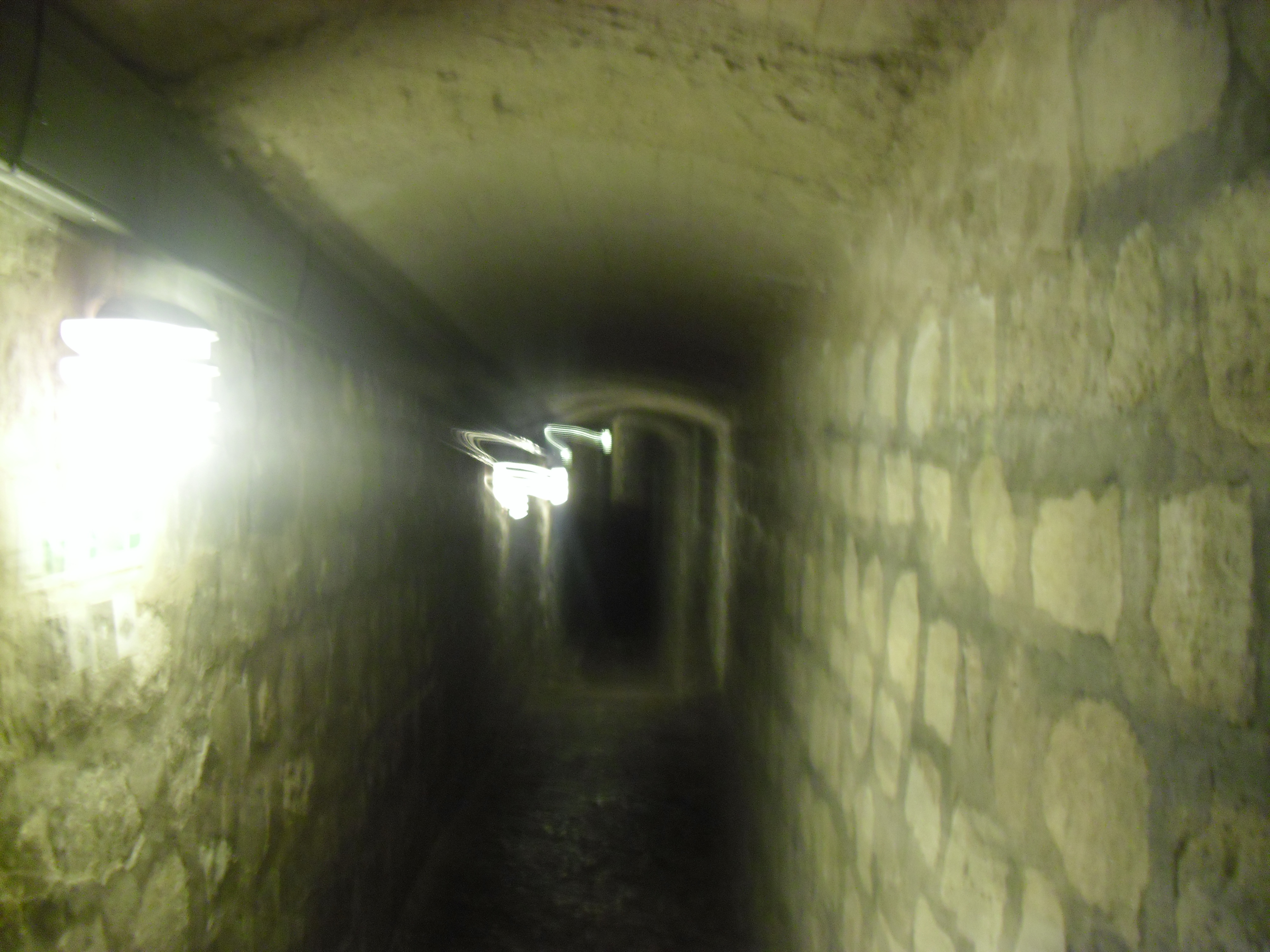
When ten o’clock hit, the doors opened and we went in. By that point the line had snaked around the block and out of sight (average wait time is around two hours apparently. So remember kids, if you’re in Paris and plan to tour the catacombs, arrive as early as I did so you can get in quickly). The tour was self-guided (audio guides cost extra, and tour guides are only available to groups), so you basically walked down a circling staircase to a first room that dealt with the history of the catacombs (originally mines and underground quarries, later the home of six million of Paris’s dead as corpses were moved from cemeteries to underground for health reasons) and the geological history of the catacombs. Later you moved into the catacombs proper, a series of passageways and tunnels (only a section available to the public; anything else, you’d have to find a cataphile, a catacomb enthusiast who can access illegal entry points and go down to explore).

Andrew and Maria in the Kingdom of the Dead.

Andrew and Maria in the Kingdom of the Dead.

It was very interesting, being down there. You could see niches where rocks were carved out or where things could be stored, as well as metal gates blocking the way to passageways not open to the public. In two places there were these amazing sculptures of beautiful building that a worker from the original catacomb project in the 18th century had carved from memory, recreating his home in the Balkans. There was a deep well that went even deeper into the ground, and a series of archways and niches set along an incline, as if to let us now we were entering sacred ground.

Can you say new author bio pic?

Can you say new author bio pic?

And then came the best part of all. Over a doorway, written in French and carved with precision was the warning, “Beware, for you are about to enter the Kingdom of the Dead”. And what a kingdom it was! The walls were lined with the bones and skulls of so many dead. And even though we were told by signs not to use flash or touch the bones, many did anyway. I won’t say whether or not I did, but I will admit that I am aware of what bones feel like when you hold them (bones from 300 years ago feel like light, brittle rocks in your hands). Some of the bones were arranged in interesting shapes, such as representations of crosses, men, or churches. Others had been arranged to help support different structures, such as around this column. Or this well, which strangely made me think of a portal to Hell rather than a catch for water. And plenty of coffins, crypts, and tombstones.

The bones went on for ages and ages. Every moment I was in a sort of heaven (so to speak). As you can guess, I am quite the lover of the macabre, so this definitely got me excited. If you look at each of the photos carefully, you’ll see me with such glee and excitement on my face.

But sadly it had to end. And end it did, with the doorway to the land of the living coming all too soon. There were a few more sights to see, including some lovely vaulted ceilings, and then we had to resurface, taking another winding staircase up. All told, I spent about an hour and a half down in the catacombs, twice the normal amount estimated for a tour, and I covered two kilometers and over 200 steps going up and down. And I would do it again if given the opportunity, because it is just a wonderful place to be. At least, for me it is.

Afterwards, I went to the gift shop (yes, they have a gift shop) and got a couple of souvenirs to remember the trip below by (there’s only so much photos can do, and for obvious reasons I couldn’t take the bones with me, even if I was the kind of guy to try to take bones with me). I got a small booklet about the catacombs for easy reference in case of a story (of which I have one or two ideas for), a sticker for my laptop, and a skull ring, something I’ve always wanted for myself as a horror author.

How you like the sticker and the bling-bling?

How you like the sticker and the bling-bling?

I’m not sure if I actually witnessed any ghosts. I certainly don’t remember seeing anything out of the ordinary, except possibly some evidence of cataphiles in a restricted section. But I certainly had a great time down there, and I’ll definitely treasure those memories of that hour and a half for as long as my memory works (though I’m not sure sometimes that it does now). It certainly has become my favorite part of Paris.

Well, that’s all for now. I’ll try to upload the rest of the photos of that night when I get the chance. In the meantime, I’ll send Andrew and Maria the photo I took of them as well as the link to this post. Have a good night, my Followers of Fear. I know I will.

BOO!

b2da2-9ddeee92a3dd2120ed55e789959dfff5

Horror stories usually have three basic types of endings. At least, in my experience they do. There are variants on the the endings, but for the most part horror stories and movies tend to fall into three broad categories: the happy ending, the temporary reprieve, and the monster’s victory. I hope that in the course of this post, I can go through all three and describe the benefits and cons of using each of these methods. This may bring a better understanding not only to other horror authors, but to myself of the stories we write and why we write them and how to improve upon them.

So without further ado, let’s begin the examination of endings in horror.

The Happy Ending. This one doesn’t need much explanation, because this ending appears in most stories. Good conquers evil, the monster is vanquished, and the hero or heroine returns home, maybe sporting some very attractive partner on their arm if they’re lucky. This is a standard ending that all authors use at least once, and it’s a good one because most audiences want a happy resolution to their stories. However, the problem with the happy ending (at least in horror), is that if it is done wrong, the reader could be given the impression that all is flowers and roses and that everyone who survived the terror is left unscathed. And fans of horror have only one response to that sort of Hollywood-sweet ending: “Bullsh*t!” Even though we enjoy realms with monsters, ghosts, and serial killers, we want some things to be realistic, and that includes having your characters somewhat scarred, even after they’ve achieved total victory over the enemy. At the very least, show how the characters are haunted by their experience, how they wish they could’ve done more or they’re sad that their lives are so messed up.

A good example of a happy ending in horror that is well done can be found at the end of the novel Misery. Protagonist Paul Sheldon has barely escaped Annie Wilkes. He hasn’t even escaped in one piece! He’s missing a foot and thumbs, he’s dealing with alcoholism and writer’s block, and he keeps seeing Annie’s ghost wherever he turns. Yet at the end he finds inspiration for a story and starts to cry, because he’s able to start writing again, that he was able to get away from Annie at all, and because of what his life has become post-captivity. That is a really well-handled happy ending for horror if ever I’ve read one.

The Temporary Reprieve. Another common ending in horror, and if you ask me the best of all three. The temporary reprieve is when the hero or heroine has defeated the monster at the end and has had a few pages or minutes of screen time to recover, maybe even celebrate and have a smoke. But then evil rears its ugly head again. The monster has returned, it’s only been stopped a short while, and it plans to continue doing horrible things no matter what happens (you don’t have to end the story with the monster reappearing, though. You can show what happens after it reappears or just end it there). This is a great way to end a horror story, because it gives the readers one last scare and leaves open the possibility of a sequel.

The problem with this ending though is pulling off another good scare (I’d also include whether or not you should do a sequel, but I’ve written about that elsewhere). You want to lull a reader into a false sense of security and get them to really be terrified at the end, and doing that relies largely on your talent and skill as a writer. If you are unable to create that twist at the end, it may come off to readers as cheesy, contrived, or unnecessary. Some good examples of horror stories that do this well are the movies Insidious and Nightmare on Elm Street.

The Monster’s Victory. Strangely for horror this one is a rarer ending, and I think that has to do with people wanting a positive resolution to their stories, even in horror (I have trouble with these endings sometimes). However the monster’s victory is still a great ending, and in the right hands can be a fantastic final note to a good horror story. In it the monster of the story has won, the protagonist has been killed or been rendered a victim, and evil will continue its reign forevermore (or until a sequel is made).

Like I said, this sort of ending does have the possibility of turning off readers, but at the same time, doing it well done will create a very positive response. I would recommend practicing it as well as looking at endings that have done the monster’s victory well. Some good examples would be the movies Sinister and The Skeleton Key. Terrifying and fun.

Now, not all horror stories fall neatly into these categories. Some are a mishmash of these endings, such as Texas Chainsaw 3D, which is arguably a combination of all three endings. And some endings don’t seem to be any of these endings: the novel Carrie has everyone in it, from insane Margaret to most of the cruel and evil teens to poor Carrie herself dying at the end of the book with a bunch of carnage in her wake. How do you categorize that sort of story?

Regardless though, these endings do crop up a lot in horror, and they provide a framework for authors to work and experiment with in their own writing. Using these sort of endings or examining them and identifying their flaws as well as their positive sides can help you identify which would work best for you or your story, or if you should try some sort of different ending that is not among the ones above. And if it produces a great story, then all that examination is worth it, don’t you think.

Lately I’ve been watching a lot of horror films I haven’t previously watched before, such as Insidious and its sequel, Cabin in the Woods, and the new film Oculus (if I were review that one, I’d give it a 4 out of 5. Psychologically disturbing, but the ending leaves something to be desired. Then again, I prefer certain endings, and the one they used wasn’t one of them). Besides finding these movies extremely relaxing (yeah, I wonder what that says about me too), horror movies, particularly the good ones, teach me a lot about terrifying people, and give me ideas of translating those methods to writing.

For example, in all of those horror movies I listed above, there are moments when something is happening or you expect something to happen and the camera is focusing on one of the characters. It’s in those moments you find yourself wondering, “What’s beyond the camera lens? What if there’s something there that’s about to attack and kill?” If there’s music playing in the background, the tension is heightened, and even if there’s no music playing in the background, the tension is still heightened. Because you can’t tell what’s beyond that camera’s borders, lurking with intent to terrify. Even worse, what you can see in front of you may not be all that it seems. For all we know, that umbrella stand next to the character’s foot may have a rotting arm inside that’ll leap out and grab him. Or the woman fixing her earrings on while looking in the mirror and talking to her daughter may not realize that her daughter isn’t actually behind her. It all adds to the tension, to the terror, and when something finally does happen, it is both a relief and scary enough to cause you to jump or cry out or even scream (I’ve done all but the last one in my time).

So how do you translate this whole thing with the camera into writing fiction? Well, I think a character’s point-of-view acts as a camera, especially when the story is being told in first-person point of view. All you have to rely on to understand the story is the character’s (minimum) five senses and their interpretation of what they’re senses tell them. And in some ways the character’s POV is more limited than a camera, because the character can only see what’s right in front of their eyes, leaving the reader to fill in those spaces where a camera would normally show  what was happening.

Behind you!


So if one can figure out how to do this sort of storytelling with a character’s POV as a camera, I think you have the makings of a very scary story.

Do you think writing can in any way be compared to film making? Are there merits to picking up techniques from movies and TV shows, and if so, what are they?