Posts Tagged ‘authors’

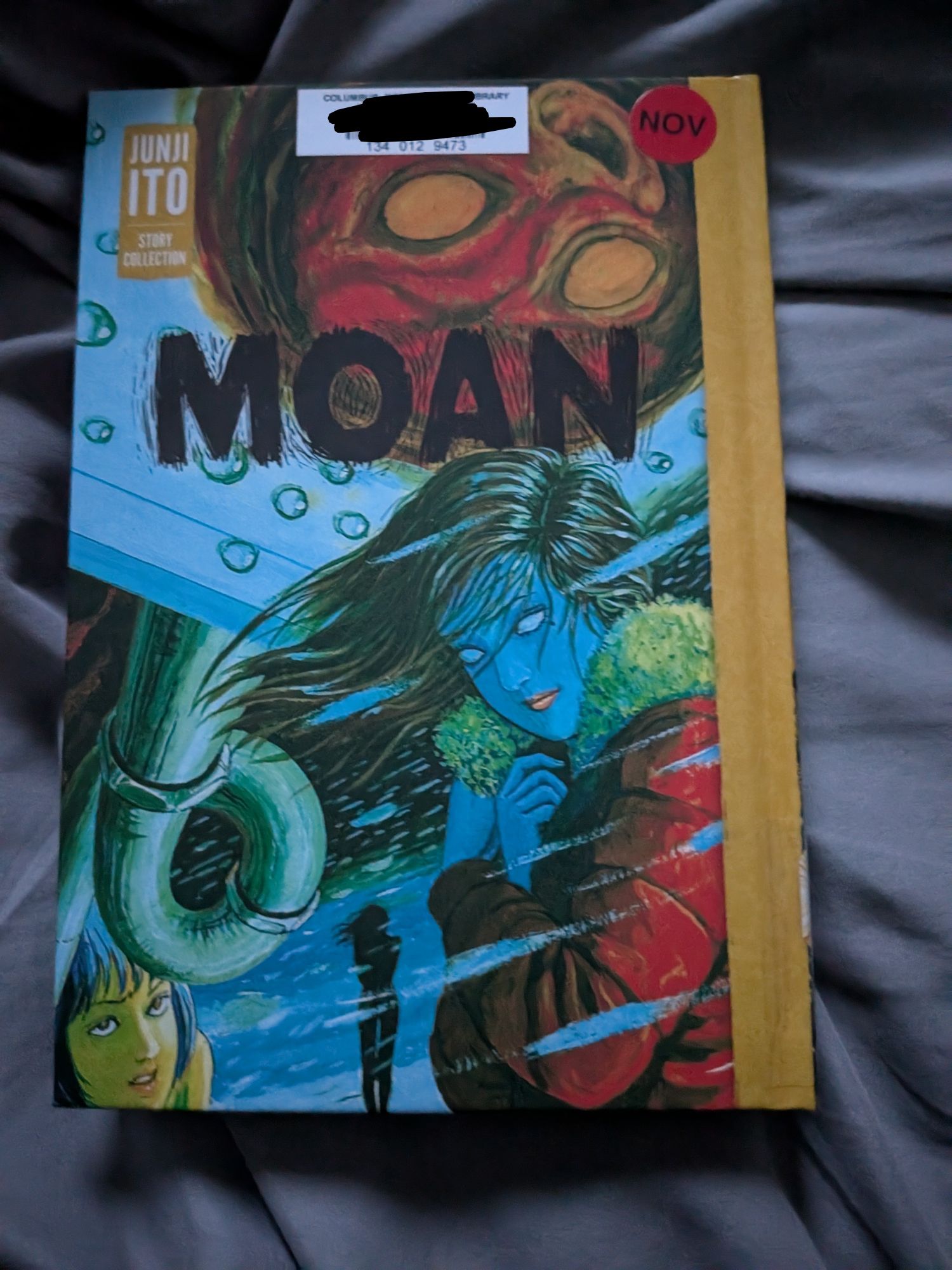
Junji Ito collections, with the exceptions of masterpieces like Remina or Uzumaki, usually rate a 3.8 out of 5 from me. There’s usually some good ones, but the bad ones can really bring down the score of the collection. And with Ito himself admitting in his last collection that as more time goes on, the more he’s scraping the bottom of the imagination barrel, I was braced for a collection full of duds.

In Moan, Ito-sensei gives us four stories of around 60 pages or so, and two shorter ones of about 10-15. And what do you know? This time around, the majority of the stories worked for me.

The first story, “Supernatural Transfer Student,” is fun and imaginative. A small town high school gets a new transfer student, who immediately joins the Supernatural Studies club, which has some possibly-real, possibly-fake psychics. Suddenly, the town is full of weird phenomena right up the club’s alley, and the new kid might be causing it. It’s visually enjoyable and escalates nicely, so I enjoyed it.

The titular story, “Moan,” is about a family whose mother is obsessed with cleanliness to the point of neurotic. When a murder occurs in their home, things start getting weird and a moaning noise comes out of the pipes. Is it the spirit of the murder victim? Or is something else going on here? There’s a sense of claustrophobia and spiraling madness in this story, and the climax is very terrifying. The story ends a bit too abruptly to me, but I attribute that to manga publishers having a limited page count (still would have liked ten more pages to give the story a proper ending). Other than that, the story is chef’s kiss levels of good.

“Blood Orb Grove” is a tale of vampirism that has an interesting twist on the lore of vampires. It’s good, but there’s a bit too much talking and needless info-dumping in the climax. Meanwhile, “Flesh-Colored Mystery” is a great and imaginative story about how much someone’s beauty standards can mess up the lives of others around them. It’s visually creepy and the themes of beauty and abuse really resonate. Perhaps the ending for this one is also a bit too abrupt, but I still enjoyed it.

The fifth story, “Near Miss,” is very short and unimaginative, and is honestly the low point of the collection. However, the last story, “Under the Ground,” makes up for it with an engaging story that has a predictable, but still very well done, twist at the end.

All in all, I really liked Junji Ito’s Moan. On a scale of 1 to 5, I’m giving it a 4.5, much higher than the usual score. There’s some great stories here, and they’re all done with Ito-sensei’s iconic art style. Hell, some like “Moan” or “Blood Orb Grove” might make for great movies, so long as they were live action (at this point, I’m convinced you can’t make a good animated Junji Ito adaptation). Just avoid the fifth story in the collection, and you won’t regret reading it.

“This book is perfect for your conservative relatives. Especially at Thanksgiving.” This is the description I got of Wake Up and Open Your Eyes by Clay McLeod Chapman, a satirical horror novel about a demonic apocalypse. With a description like that, I was intrigued. And this past Thanksgiving, I started the audio book.

To which I say, “Woo-boy? What did I get myself into?”

Wake Up and Open Your Eyes starts with Noah Fairchild, who goes from his home in Brooklyn to check on his estranged parents after his mother leaves a strange, conspiracy-filled message in his voicemail and then doesn’t pick up. When he gets down there, he finds his parents seemingly brainwashed into dementia by their conservative news shows. However, it’s actually the beginning of the apocalypse. And the demons are possessing people through their devices. And what they choose to consume through their devices.

As I said, this is a satirical horror novel, so there are plenty of funny moments that made me laugh out loud. One of the main sources of possession is a parody of Fox News, and it’s so thinly disguised, you can tell immediately which anchor is getting made fun of. In the final third of the novel, the story is actually narrated by a fictional version of a real life news anchor, only he’s a hallucination living in a character’s head to help them process these events!* And even in the apocalypse, people are posting videos to YouTube, Instagram, and TikTok, as if they need to share their most intimate moments to make them real.

However, this is a horror novel, and it gets horrifying! The demon-possessed do some seriously fucked up shit when they take over people, and a lot of it is described in excruciating detail. The amount of body horror and gross out elements even borders on extreme horror, so it can be uncomfortable at times (I just barely tolerated it).

Still, it is hard to put down. While at first I could only listen to it in small doses, over time I got so hooked, I listened whenever I could. And the ending, while some may hate it, is definitely quite fitting for such a bleak horror novel.

On a scale of 1 to 5, I’m giving Wake Up and Open Your Eyes by Clay McLeod Chapman a 4.5. It’s bleak, horrifying, and pokes plenty of fun at a nation/world/species that is willing to give up its thinking faculties and let a talking head on a screen do the thinking for you (not just conservatives; liberals and everyone else, too). If you have a strong stomach and are at all interested, give it a read. You may never be able to look at cable news, wellness gurus, or even “Baby Shark” the same ever again, but it might just be worth it.

*And can I say, I find it so bold to put real, living figures in your stories, using their real names? I’ve read a few stories like this, such as Shoeless Joe featuring JD Salinger, or a story by Jonathan Maberry where Kevin Hart and Kelly Clarkson, among others, make an appearance. And ever time, I marvel. I know it’s kind of allowed if they’re a public figure and it’s either parody or their fictional selves are acting in a way that would correlate with their real selves. But still, it’s not something I would consider doing (especially when I put real figures in my stories as a form of punishment for real life bad acts). I would be too worried about getting sued!

A yahrtzeit candle. In my faith, they’re used to memorialize those who have passed on.

I lost a friend yesterday.

I first met MG Mason, known to his friends at Matt, on Twitter. He was running something called “Horror Writers Chat” there. On Wednesdays, horror authors would meet up on Matt’s account. Matt would then ask us a series of four or five questions over the course of an hour. These questions would be about horror, writing, our current WIPs, our favorite books or movies, and our thoughts on the craft. And at the end of it, we could post about our current publications and upcoming releases.

Obviously, it was a lot of fun, and I got quite into it. I even hosted it once. And when Twitter became a hellscape of toxic masculinity and far-right ideology, I moved over to BlueSky with Matt to continue with Horror Writers Chat. I wanted to continue enjoying Horror Writers Chat.

But more than that, I wanted to continue being part of this community. Through Horror Writers Chat, I was making so many new acquaintances and colleagues. So many new friends to talk about horror and writing with! Most of all, I was becoming friends with Matt, who I found a sort of mentor-like figure. Well, how could I not? He had basically created this community, and we were all thankful for it.

But he was more than just the Moses of our little community. He was demisexual and demiromantic, and openly talked about his struggles as someone who only feels attraction to people when he gets close to them. He also talked about his struggles with life and mental health, and about his home and living in England. As someone who is aromantic and also struggles with life and mental health on occasion, I could relate. And I enjoyed hearing about his life in England.

And of course, Matt was a horror writer. He found enjoyment and comfort in scary tales, as well as in writing them. So, obviously, we bonded over that.

The posts that let us know Matt had passed on.

Truly, Matt was a good man. He was friendly, easy to talk to, and willing to listen when you had a disagreement or misunderstanding with him. And as I said, he struggled with things, as do we all. But he had such a big heart.

He also read many of our books, including one or two of mine. When he listened to the audio book of The Pure World Comes, he honestly thought the narrator was Jenna Coleman, AKA Clara Oswald from Doctor Who! When I told Nikki Delgado, the actual narrator, that, she was flattered. And I was glad that he really enjoyed the book.

And, of course, I read his work. In fact, last month, I read his book Residents of the James Hotel, and I just bought one of his other works, The Small Bronze Carriage on the Mantelpiece, today. The former was really good, and I’m looking forward to reading the latter.

I’m talking about Matt today because he passed away this past week. A few months he revealed that he was battling cancer and that it looked to be terminal. We were all devastated to hear that, and we sent him our well-wishes, hoping he could get better. And while he didn’t respond to all of our messages, he did continue to interact online with us when he could. But yesterday, he passed away.

Honestly, I’m devastated. Matt became such a big part of many lives, and his creations, especially Horror Writers Chat, have had such an effect on people. In the past twenty-four hours, I’ve read so many posts from so many people who are mourning Matt. I’ve posted online too, but it doesn’t feel like enough. For the effect Matt has had on so many people, I feel so many more people should know his books and his story.

So, I’m writing this post. I wanted to let more people know about Matt, about his works and his effect on people. I’m hoping people will want to learn about him and his stories after reading it.

And so, if you’re looking to check out a great author, check out MG Mason’s work. I really enjoyed Residents of the James Hotel, and I’m sure to enjoy The Bronze Carriage on the Mantelpiece, but he has ten other stories available besides those. Plenty to choose from, if you ask me. I’ll include a link to Matt’s Amazon page below for those who are interested.

Thank you for reading this post. Losing author friends is never easy, but losing Matt hit me very hard, and I wanted to do something to memorialize him. And Matt, I hope wherever you are, you’re at peace. We’ll be keeping your memory alive through Horror Writers Chat and through reading your works. Thank you for everything you did for the horror writing community.

I first read IT by Stephen King when I was eleven or twelve: the same age as the characters in the flashbacks. And while I had been reading The Vampire Chronicles and most of Anne Rice’s books up till that point, I didn’t exactly classify it as horror (Anne Rice herself preferred the term “Gothic saga”). So, for me, IT was my first jump into horror since outgrowing Goosebumps.

And it expanded my world. Not only did the novel terrify me, but it showed me just what great, mature horror storytelling looked like. From the terrifying and insidious nature of Pennywise and It’s many forms, to how the novel took the time to let us get to know characters both major and minor. I was entranced and enthralled, even as I was terrified, diving deep into the book every opportunity I could get and learning as much as I could.

By the time I finished the book that summer, I knew what sort of stories I wanted to write in the future.

Without IT, I would not be the writer I am today. Or the person. I might not even be blogging to you right now, now that I think about it!

I bring this all up because, if you weren’t aware, there’s a TV show airing on HBO Max called Welcome to Derry. Taking place in the same universe as the movies, the show goes into events during the 1962 cycle, which was the cycle before the first movie. And unlike the movies, which focused on a core group of characters first during their early teenage years and then during their adult years, Welcome to Derry focuses on a wide variety of characters, including school kids, military personnel at the local Air Force base, and the nearby Native American population.

It’s very Stranger Things in its character development and methods of storytelling. And since the creators of Stranger Things were heavily influenced by IT, among other things, I guess it’s coming full circle?

Well, it feels full circle to me, because while watching the show, I feel like I’m getting a reintroduction to the horror genre. Just like I did when I was a preteen and dove into King’s book. It feels like I’m getting lessons in how to do creative and powerful scares, storytelling with large casts, and character development every time I sit down to watch the show.

Which, while being told through a visual medium instead of a literary one, I’m grateful for. While I’ve made strides in becoming a horror author, I still feel like I have a long way to go before I can be at the same level as the authors I admire and regularly read. And while I learn something about good storytelling every time I enjoy a good book, show, or movie, I feel I’m getting a Master Class in the subject from this show.

Hell, I think in the short story I wrote most recently, some of what I gleaned from Welcome to Derry made it into the story. I wasn’t originally going to apply what I learned, but it occurred to me while I was writing, and I was like, “Oh. That’s good. That’s very good. Let’s try it.” And while I haven’t heard back from the alpha reader yet (I only sent them the story last night, after all), I feel like adding those elements gave the story an extra bit of excitement and terror.

So, with only four episodes of the show left (I have my doubts they’ll do a second season, though I would likely welcome one), I’m looking forward to seeing what happens next. And to seeing what I can glean for use in my own storytelling.

In the meantime, I’m going to get to work on some of that storytelling. I have stories to edit and send to the beta readers, after all. Wish me luck!

And in the meantime, good night and pleasant nightmares.
Me writing and editing under the influences of good storytelling teachers.

The first time I read Stephen King’s The Shining, I think I was thirteen or fourteen. And while I was reading at the adult level, I didn’t always understand all the deep stuff that was being thrown my way. I think I understood Danny’s point-of-view the easiest. Sure, he wrestled with concepts usually grasped by brains more developed than a kindergartener’s, but he was still the youngest of the characters, and the one closest to me in age.

As for Jack and Wendy…well, they were adults. And at the age I first read the book, anyone past college age, especially any with parents, were ancient. Hell, some people just past high school age were ancient to me! So, when I saw the movie after I read the book (and I’m in the camp that hates the movie, like King himself does), I saw Jack Nicholson and Shelley Duvall playing Jack and Wendy Torrance, respectively, and was like, “Yeah, they seem the appropriate age.”

Then, in 2018 or 2019, I read it again. And not only did I understand all the difficult concepts way easier than I had last time, but I was shocked by something I hadn’t noticed before. And that was Jack and Wendy’s ages. Based on hints in the book, I realized they were around my age, in their mid-to-late 20s. In fact, at one point in the book, Jack hints that he’s only 29 or 30. And at the end of the book, Dick Halloran notices that Wendy no longer has any of the young girl he met in September the previous year, but is all woman. Which is something you might think when describing a woman moving out of her 20s (especially after an experience like the Overlook).

Like I said, I was shocked. As I said before, when I first read the book, Jack and Wendy seemed ancient to me just by being parents. So understanding that they were around my age, and had yet done so much more, like having a kid, was more than a bit of a surprise. Plus, the fact that Jack Nicholson, who was clearly in his 40s when he filmed The Shining, threw me for a loop. I mean, he already looks insane, but you also cast a guy who was so much older than the other characters? Boggles my mind.

Jack Nicholson may have been iconic as the character, but he’s at least a decade older than the character in the book.

And last month, I started the audio book of The Shining as part of my Halloween reading. And I’m 32 now, though I would say everything since 2020–COVID, elections, wars, etc.–has aged me mentally in some ways. Anyway, I just finished it yesterday, and I think I love the book more now than I did the first two times. I mean, I loved it plenty the first two times, but I think with age and getting hopefully wiser with it, my love has deepened. I understand the characters and appreciate how well-written the book is better.

And speaking of the characters, my reaction this time around to Jack and Wendy was much milder. Mostly me thinking, “Poor kids,” whenever they experienced something tough (which is pretty much everything from after their wedding to around the time Jack got possessed). Remember, these past five years have aged me mentally in some ways.

Also, Jack Torrance nearly got tenure in his teaching position before he lost it, and he wasn’t even thirty yet? I don’t know if that was more common in the mid-70s than it is now, but given the average age these days to get tenure, I’m impressed.

Anyway, every time I read The Shining, I get something new out of it. It’s like my relationship with the book, especially with its characters and themes, changes with every read. I wonder how old I will be the next time I decide to check into the Overlook, and what reaction I’ll have when I do. Maybe I’ll post about it after I find out!

What are your thoughts on the book? Has your relationship or reaction to The Shining changed over time? Let’s discuss.

That’s all for now, my Followers of Fear. I’m planning on starting a new short story tomorrow, so I better log off and get some rest. So, until next time, good night, pleasant nightmares, and–who let that bloated ghost lady into my bathtub?! I’ll have you know, only ghosts I invite in with me are allowed in there!

Alma Katsu’s become one of those authors for me that, when I hear they have something new coming out, I immediately want to scoop up a copy and read it. And when I heard that, for the first time, she was releasing a horror novel set in our modern era, I was intrigued. When Fiend finally came out, I immediately went to the library to grab my copy (support your local libraries, kids!) and started reading as soon as I could.

That was about a week ago. I finished the book today. And now, I’m reporting my thoughts.

Set in our modern times and with some flashbacks to the past (which, based on the characters’ ages and context clues, I assume is somewhere between 2004-2015), Fiend follows the Berishas, a powerful family hailing from Albania that rules over a wide business empire. Specifically, it follows the youngest generation of the Berishas: Dardan, an anxious young man being groomed to run the family empire; Maris, who rebels against her father’s patriarchal views and wants to rule while also wanting to please him; and Nora, a wildcard who’s more than she seems. They are well aware that their family, ruled over by the tyrannical Zef, is rumored to be aided by a demon that keeps them rich and untouchable. But after a particular incident, the dominoes start falling. Dominoes that will change the family, and possibly bring down the dynasty, forever.

So, while this book has been marketed or compared to “Succession with a demon” (not sure how accurate that is, having never seen Succession, though I know the basic pitch), I would compare it more with 2015’s The Witch. The focus is on these characters, showing an intimate portrait of a family that is breaking down due to isolation, clashing egos, and external pressures closing in. The demon itself, like the witch in the movie, is just one of the catalysts that hastens the breakdown of the family.

And the way Fiend is written, it is hard to put down or look away. I was breezing through each chapter, just wanting to find out what happened next and how each of these fascinating, unhappy, often terrible people would hurt each other next. We spend the most time with Maris, and you can see Alma Katsu having a ball writing her and showing her trying to achieve what she thinks she wants. After her, we spend the most time with Dardan, who is desperately struggling under the weight of his destiny but too scared to find a way out of it.

My two criticisms are this: one, I would have liked to have spent more time with Nora. As I said, she’s a wildcard who’s more than she seems, and I would’ve liked to get further below the surface than what we got with her. I get why she’s the sibling we spend the least amount of time with, but I still wanted to know her. And two, I honestly wanted to see more interactions with Olga, the Berisha matriarch. She’s mentioned more often than seen, and I think it would have been fascinating to see how she’s weathered being part of this screwy family for most of her adult life.

But beyond that, Fiend is an excellent family drama/horror story. On a scale of 1 to 5, I’m giving it a 4.5. An enthralling deep dive into the world of corporate intrigue and what can occur from generations of abuse and trauma (plus a little demonic magic). If this sounds like it might be up your alley, grab a copy and get ready for one hell of a ride.

It’s no secret that disability has had a troubled portrayal in our media. There’s inspiration porn in the news, which tries to make able-bodied people feel “inspired” to achieve their goals at the expense of making the disabled seem pitiful and hopeless. People with dwarfism are often equated with fantasy settings or fantastical elements. And, of course, there’s horror. Horror’s history with disability has been, to say the least, fraught.

Look, I love this genre. That’s obvious. But it’s no secret that, when the genre was coalescing, a lot of horror came from stereotypes of minorities, and the disabled were no exception. Most often, disability was used as a shorthand for sinister or evil. The original Phantom of the Opera was a manipulative groomer, and his later portrayals have added plenty of murder. From Psycho to Split, people with DID are often portrayed as dangerous and even magical. And most of the famous slashers have some form of disability! It’s not the focus of the characters, but it’s definitely there.

That being said, it hasn’t always been bad. The 1932 film Freaks was actually pretty progressive for its time, with many of its disabled characters getting humanizing portrayals. American Horror Story‘s fourth season, Freak Show, was heavily inspired and influenced this film. A Quiet Place and its sequels have been very disability-positive.

The problem is, sometimes even the positive portrayals are problematic. I still cringe over the characters of Duddits from Stephen King’s Dreamcatcher, and the autistic kid in 2018’s Predator somehow being an important factor in human (and Predator) evolution felt…well-intentioned but missed the mark. And just earlier this year, I read a recent book by an author I like which included a character with mental disabilities who was kind of psychic/magical, a secondary antagonist with a cleft palate, and a main antagonist with an eyepatch!

That’s why I’m glad that, as both the community and the genre evolves, more disabled writers join it and include disabled characters like themselves in their stories. I’m among those writers. The Shape of Evil‘s three main characters all have various disabilities, and in two short stories I wrote recently, the major characters all have disabilities as well. The stories themselves are still not published, but I’m working to get The Shape of Evil out there, and the other two stories will hopefully find homes soon after I edit them.

And as those stories, as well as other stories by disabled writers, get published, perhaps there will be ripple effects. The fiction we consume can have a noticeable effect on our perception of the world. Perhaps with portrayals that are just not more positive, but also realistic, we can make the world a nicer place for the disabled.

And given that 1 in 5 people have or will get a disability, but most of the US is still not accessible and laws aren’t always disabled-friendly, that would be nice.

Guess what? I have some new events I’ll be attending in the coming months! And, as is my sacred duty, I will tell you about them in case you’re in a position to attend any of them.

First, I’ll be at CryptidCon in Chardon, OH, on October 11, 2025! This new convention is going to be part of the Ohio Viking Festival, and will include authors, cryptozoologists, and more among all the Vikings and axe throwing and strong mead. The festival, and thus CryptidCon, will be from 12 PM – 6 PM, and I’ll be doing Tarot readings and signing books. You can find out more here.

Then, the Columbus Metropolitan Library is hosting HWA Ohio for Scary Saturday again! It will be taking place on October 25, 2025 from 12 PM – 3:30 PM at the Main Library in downtown Columbus. This year, we’ll be having a panel with our members, doing readings, and playing a game of Monster Mash (basically, we have lively debates about which famous monsters would win in a head-to-head fight). In-between activities, we’ll be selling books and feasting on Halloween candy. You can find out more here.

Right afterward, the Book Loft in Columbus will be hosting several of our authors on October 28th, 2025 at 6 PM. We’ll be at the Book Loft itself, which is a famous, historic bookstore in a 19th century building that twists and turns every which way. I won’t be doing readings or anything, but I will be there, probably in costume, hanging out and having a good time. You can find more info here.

Finally, we have the Columbus Witches Ball at the Ohio Brewing Company on November 1st, 2025 from 1 PM – 11 PM. In between dancing, rituals, and yes, pub food, I’ll be selling books and doing Tarot readings. If my last trip there in 2022 is anything to go by, I’m going to have one heck of a good time. You can find out more and grab tickets here.

Except that’s not all! I’ve got events already set up for 2026!

And I am going to tell you what they are.

First, I’ll be heading back to Akronomicon on February 7th, 2026 at the Emidio & Sons Banquet Center in Akron, OH. I had such a fun time at this horror convention last year, that I am coming back next year. And they got some cool guests last year, so I’m excited to see what the guest list for next year is! I’ll have more details as we get closer.

And afterwards, I’ll be at StokerCon again! This time, it’s going to be back in Pittsburgh at the Westin Hotel on June 4-7. This is an amazing event, where horror creators of all stripes get together to talk horror, network, collaborate, and have a scary good time. You can still get tickets here.

That’s all for now, my Followers of Fear. I’ll be sure to put out reminders for all these events right before they happen, and I’ll let you know if there are any more I get signed up for.

In the meantime, spooky season is coming up. If you’re looking for something to read for it, or you’d like to support me, or both, you can always check out my books. From plant/human hybrids and strange gods to Mafia-hunting serial killers and carnivorous horses, I have something for every horror fan (including some free stuff). I’ll include a link to my Books page below.

And if you like what you read, please leave a review online somewhere. Positive or negative, I love reader feedback, and they help me and your fellow readers in the long run.

Until next time, good night, pleasant nightmares, and 68 days till Halloween.

A couple of weeks ago, my friend and colleague Ruth Ann Nordin wrote about why she enjoys horror and romance stories (you can read her full post here). Midway through her post, she mentioned how she doesn’t like open endings or where things are left up to the reader’s interpretation. After reading her post, I commented on her post, “Ironically enough, a lot of horror stories have open endings, which only helps accentuate the feelings of horror and dread.”

I’ve been thinking about that conversation since then, and now I want to write about ambiguity in fiction. Especially in horror. And how that, as frustrating as it can be to some readers, that ambiguity can be helpful to stories at times.

Now, I’m not writing this to trash anyone who doesn’t like open endings or stories that leave unanswered questions. People have different preferences, and that’s okay. And honestly, at one point, I felt the same way…until someone pointed out that I’ve written stories like that in the past. I’m just writing about the open endings and the unanswered questions sometimes help a story more than wrapping everything up in a neat little bow.

So, why would writers create open endings? Or leave questions unanswered? Well, barring cases where extenuating circumstances keep the creator from tying up all the loose ends (*cough* Disney canceled The Owl House way too early *cough*), there could be a variety of reasons. In horror, it could be for a very simple reason: doing so makes the story that much scarier.

Great film. Lots of unanswered questions…until the sequels, at least.

Let’s take Hell House LLC. This horror film, while not in my top six, is a favorite of mine. The film is a found-footage mockumentary revolving around a horrific tragedy at a haunted attraction, and what happened to the team behind the attraction. While, over the course of events in this movie, what caused the tragedy in the first place is explained, a lot of things are left unanswered. Things are further explained in the sequels, but if you only see the original film, the things that are left unexplained lend this air of mystery to the story. And the fact that, at least for that film, we’re left to question what we don’t know, can be terrifying.

Another great example: Perfect Blue, one of my top six horror films and one of my favorites ever. I’ve discussed it here before, but if you’re unfamiliar, it’s an anime film about a celebrity who is hunted by a violent stalker, leading her to spiral into paranoia and madness. While the first third is straightforward, and the final third wraps things up nicely, the second third does a damned fine job of making it hard to tell what’s real and what’s delusion. You really feel the protagonist’s terror as she tries to figure out what’s real and what’s not, only to be swept along and finally stop fighting against the current.

Speaking of paranoia and madness, cosmic horror, especially Lovecraftian horror, thrives on ambiguity. The Great Old Ones and other ancient beings often have forms that are undefined by the writers. The most we can say is, “it’s so scary, even thinking about what it looks like is too terrifying! Also, it’s so unlike anything I know, my mind is having trouble defining any particular portion. That being said, it’s so scary, I can’t write it down to tell you about it.”

Even my Cthulhu statue is only an approximation of his true form!

Even Cthulhu, who is the most well-known and most defined of the Great Old Ones, is somewhat undefined. Technically speaking, his whole man/dragon/octopus thing is what people are able to recall he looked like. He’s still somewhat difficult to describe.

And that’s scary. We fear the unknown, and when we can’t fully define what we’re dealing with, it’s frightening.

So, yeah, ambiguity can be frustrating. But it does have its uses. And in the horror genre, it can help us horror writers do what we do best: scare people silly. Hell, at times, it helps the stories become that much more notable. And if a story can be made better by a bit of ambiguity, then a little bit of frustration is well worth the cost.

That’s all for now, my Followers of Fear. I’m off to make dinner and figure out what I’m doing with the rest of my evening. Until next time, good night, pleasant nightmares, and 82 days till Halloween. Thankfully, there’s nothing ambiguous about that!

Is it already August? The summer is going by quickly! Soon we’ll be getting ready for Halloween and figuring out what to put on our spooky season reading lists. Good thing there happens to be a new-ish collection of horror novelettes for you to consider adding.

So, if you’re new here and are unfamiliar, “Symphony for Walpurgis” is my latest book, a collection of nine novelettes (stories that are longer than short stories but much shorter than novels), four previously published and five original. They range from stories of cryptids and giant bats (“Famous,” “Disillusionment and Trauma Sometimes Go Hand-in-Hand”), to malevolent spirits (“The House on Lafayette Square,” “The Parasite Man”) and even a Jewish exorcism (again, “The House on Lafayette Square”). It came out on May 1st, AKA Walpurgis Night, when witches hold their get-togethers, which means it’s officially three months old.

And I’m very happy with the response so far. Everyone who’s bought a copy and gotten back to me has told me that they’ve enjoyed what they’ve read, and have even enthusiastically recommended it to other readers. Plus, at both the Big Ohio Book Con and the Columbus Book Festival, I sold out of copies on the first day of both events and came close to doing so on the second days. Clearly, people are liking the book!

But don’t take my word for it. Read some of the reviews:

Dipping my toes once again into the world of indie horror. And this, a rare read of single author short story collections.

All these stories are so very different, but they’re linked (in my mind anyway) by one common theme… that is, all these stories start out a certain way, but a turn of events during the narrative delivers a quite different story.

None of these stories are especially weak, but I have some stand out favourites: The House of Lafayette Square, Mother of Spiders, The Little Goddess of Horror, and Natural Predators. Even those I weren’t so keen on were solid, just a matter of personal taste.

Not my first outing reading this author, and it certainly won’t be my last.

MG Mason, author of “The Residents of the James Hotel,” Goodreads

Bravo! This might just be Rami Ungar’s best work yet. Offering tales of unearthly retribution, dark mysteries, vampires re-imagined and blood curdling entities, Symphony is a gloriously ghoulish anthology with something for almost every kind of horror fan.

I absolutely adored the introduction; it creates a spooky atmosphere straight away and is so much fun, putting you in exactly the right mood for the horrors ahead. Each story is creative and the characters are so vivid and well crafted– Rami has done an incredible job of filling every page with witty prose, clever descriptions and emotions which pulled me right into the characters’ minds. Mother of Spiders was my favourite tale, and definitely one of the most nightmarish.

Only two stories had plots which I wasn’t so keen on, but even then the writing was still engaging enough to make them enjoyable reads. 100% recommend!

Louise Conway, Goodreads

From the fiendish imagination of Rami Ungar, Symphony for Walpurgis presents nine stories, each with its own wildly imaginative tale to tell. The author’s acknowledged favorite, The Parasite Man, will make your skin crawl. In contrast, the warmth and psychological insight of The House on Lafayette Square made it this reviewer’s favorite above all. An underlying theme, returned to across several stories but never repetitively, is the revenge of the mistreated, wreaking havoc on a world they never made

Ann O’Mara Heyward, author of “Tourtiere: A Culinary Horror Story,” Goodreads

Rather enthusiastic, wouldn’t you say? And so far, I’ve been lucky enough to only have one review that’s not five stars. And even that one was four stars!

And with this sort of response in just the first three months, I’m hopeful for more of the same over the next three. Since before Symphony was released, I’ve been working hard with specific goals for this book, including some milestones I want to hit in the first year. I’m not sure I’ll hit those milestones, but I’ll work like hell to make them happen. And with spooky season creeping up on us, I think now is a good time to strike.

And if this post has made you at all interested in reading Symphony, I’ll include links below. It’s currently available in paperback and ebook, and if things continue to go well, an audio version might not be out of the question. Until that happens, you can buy a copy using any of the links below.

And if you like what you read, please leave a review online. Positive or negative, I love reader feedback, and it helps me out in the long run. Plus, reviews help other readers find books and figure out whether or not they want to read them. So you’d be helping both me and your fellow horror fans by letting your thoughts be known!

That’s all for now, my Followers of Fear. I’ll be back very soon with another post (believe me on that promise). So, until next time, good night, happy reading, and remember, we’re only 91 days away from Halloween. You better be getting ready to have some pleasant nightmares this fall!