Posts Tagged ‘authors’

You know, you often get great horror films. You get great science-horror films. And every now and then, you get a great horror film that makes you think, like Get Out or As Above, So Below. But I’ve never seen a science-horror film that’s not only good, but made you want to speculate so much about its deeper meanings and the questions it raises.

Based on the novel by Jeff VanderMeer,* Annihilation focuses on Natalie Portman as a biologist who goes on an expedition with four other women into “The Shimmer,” a place where everything is mutating and changing and no previous expedition has come back alive, after her husband returns from there gravely ill and seriously changed. Once inside, they will be tested in ways they cannot even imagine, and discover something horrifying.

This was an absolutely amazing movie. For one thing, the main cast (which is all women but not treated like a huge deal at all by the film, which I love) are all absolutely amazing. They really make you believe they are these characters, even if they aren’t given that much development. Gina Rodriguez, who plays Anya Thorensen, was especially great, and seeing her transformation through the movie is worth the ticket price alone.

Visually, this film is a feast. There’s so much to look at and take in, but it never really feels overwhelming. Sometimes the imagery is beautiful, sometimes it is baffling, and sometimes it’s creepy, but you’re never going to look away because you want to take it all in. And as for atmosphere, this film does a really good job of just building up an air of strangeness. So much of what’s in the Shimmer is unreal and surreal. It’s unknown to everyone, and the characters have to guess most of the time as to the meaning of things. And that’s what they’re doing: guessing. Very little is confirmed, and so much is unknown. So you kind of feel their fear and paranoia as they start to wonder what is real, what is happening, how it could be happening.

But what I love most about this film is how intelligent it is, and how it makes you wonder. As I said, very little is confirmed with this film. A lot of what we see, we the audience have to draw our own conclusions and decide what is happening, or what the deeper meaning is. Or if there is a deeper meaning. Or if what we’re seeing is actually real. It’s so strange, but at the same time so thought-provoking. And it’s been a while since a film made me wonder this much, made me want to examine it more.

If I’m going to ding the film on anything, it’s the CGI. Except for the film’s climax, the CGI doesn’t work well. It’s not awful, but I feel it would work better in a video game instead of in a live-action film. I would’ve preferred if they’d tried for a more animatronic approach, like with the Jurassic Park films.

On a scale of 1 to 5, I’m giving Annihilation a 4.5 out of 5.  A visual thrill-ride of the strange and otherworldly, fronted by a great cast. Definitely check it out and get lost in a world of the hallucinatory and engaging.

*By the way, I tried listening to this book on audio. But the narrator’s voice made me sleepy, so only so much of the novel actually made it into my brain. From what I remember though, the novel and movie differ on a lot. But in a good way.

I did not finish watching the Netflix show 13 Reasons Why, owing to how depressing it was (I like dark stuff, but that show just took the joy out of living!). But in recent weeks, one scene from that show, a surprisingly not-sad scene, has been coming back to me. In a flashback, the main character Clay is critiquing another kid’s essay, and notices the latter uses the word “unique” several times. When the other kid asks why that’s an issue, Clay says that if everything is unique, it means nothing is unique. And on the surface I agreed with that sentiment, but I didn’t realize how it applied to my own writing until almost a year later.

As many of you know, I recently finished a fourth draft of my college thesis Rose, and that I had the novel beta read by a couple of people, including my colleague and good friend Joleene Naylor. One of the things she pointed out was a problem throughout the novel, and which I’ve been trying to avoid in subsequent stories, is repeating words, especially adjectives. Apparently I’ve been using the word “unique” several times in a single chapter or paragraph, though “unique” wasn’t usually the word I used.

Actually, it tended to look something like this (not an actual line from the novel, but I think you’ll get the idea):

Rose stood in place, refusing to show her fear. Angrily, Paris placed the book on the table.

See how I used “place” twice? A better way to write this might have been:

Rose held her ground, refusing to show her fear. Angrily, Paris placed the book on the table.

See the difference? And I had to do this throughout the fourth draft, identifying where I repeated words in close proximity to one another, and then coming up with a better way to say it.

And I feel like this is a really common issue that writers have to deal with at some point, or possibly at several points, in their careers. Despite our reputations for loving really big words (verbose, callipygian, penultimate, etc), when it comes to fiction, we tend to just use everyday words. After all, we’re normally writing for everyday people, not for a small niche of scholars or people associated with a small religious movement. So if a simple word, like “unique” or “place,” fits the bill for telling the story, we’re likely going to use it. And we’ll use it again and again, if it’s the first word that comes to mind.

But as the above points show, you have to vary what words you use in order to tell a story and not distract the reader. And that’s something I’m trying to learn how to do as a writer. You know, along with learning how to write good short stories. And writing good stories in general. Again, I leave that up to the feedback of my readers. But this is getting a lot of emphasis as well. Because as great as a story is, the language it’s told through can determine how successful it may be. Imagine if Harry Potter had been published and it read like a sixth grader had written it. I guarantee it wouldn’t be the phenomenon it is today and I might not have been inspired to be a writer (unless JK Rowling was in the sixth grade when it was published. Then she’d be the Mozart of literature).

So while I may never actually need to know twelve different ways to say “unique,” hopefully in the future I can avoid making mistakes like the ones above. And if I do (because let’s face it, no author is perfect), I hope I have a good group of editors and beta readers around me to point out those mistakes.

And if you’re an author who makes this mistake, the only way I can think of to avoid it is to do what you’re already doing: think about the words you use. Just do it a bit harder when it comes to the individual words themselves. At least, that’s what I’ve been doing. And I think it’s been working.

That’s all for now, my Followers of Fear. Expect another post from me (or maybe even two) very soon. Until next time, pleasant nightmares.

I’ve mentioned plenty of times before on this blog how much I love manga and anime. I’ve even written before how writers should check it out for a boost to their creativity. Well today, I’d like to talk about my favorite manga series, Red River by Chie Shinohara, which ran in Japan from 1995 to 2002. I absolutely love this series, and have since I discovered it prior to entering college seven years ago (and for numerous reasons, it took me nearly that long to get each volume and read it). I’m actually rereading it now, and I’m still in love with the story.

With the awesomeness of this series, it’s one I actually don’t see a lot of people talking about, so I thought I’d do a review to spread the word a bit. I don’t know if this post will get a lot of reads, or if the review will get a lot of people interested in reading the manga, but you never know. So without further ado, let me tell you about Red River:

The manga follows Yuri Suzuki, a Japanese teenager who finds herself pulled through time and space to the Hittite Empire in ancient Anatolia (modern-day Turkey). She’s been brought there because Nakia, the current queen and the emperor’s third wife, needs to make sure her son, who’s rather low in the succession order, attains the throne and a special sacrifice is needed. Yuri is meant to be that sacrifice, and narrowly avoids being killed thanks to the intervention of Prince Kail, the third Hittite prince. Together, they try to find a way to get Yuri home, while also circumnavigating not only Nakia’s schemes for power, but the schemes of others who would do them and the Hittite Empire harm, and at the same time finding something in each other they couldn’t find in anyone else.

This is a story of the same stripe as Game of Thrones: struggles for power in a grand empire, magic, history, battles with swords and chariots, romance, an exotic setting and a rich culture, and some great characters whom you grow to love and root for (and somehow remember a lot more easily despite the Mesopotamian/Biblical names).  And the characters are the best part:

First off, there’s Yuri, our heroine. I love this sort of character. While she starts off as a damsel-in-distress, she grows throughout the story, showing strong nerve, cleverness, and a desire to do what’s right, which allows her to save herself from difficult situations and gain several followers along the way. Prince Kail, based on the historical Mursili II, initially comes off as a playboy prince, but over time reveals a young man with the weight of the empire on his shoulders. He’s a brilliant politician and tactician, occasionally rash and impulsive, but above all loyal to those he loves and will go out of their way to help them if he can. And Queen Nakia is the villain Cersei Lannister aspires to be: while she’s beautiful, she doesn’t rely on her looks. Instead she uses a combination of magic, political power, brains, and manipulation to accomplish her goals. She doesn’t necessarily even need Yuri’s death to accomplish those goals, it’s just Plan A. And believe me, if she sees an opportunity, she’ll develop a Plan B, C and D.

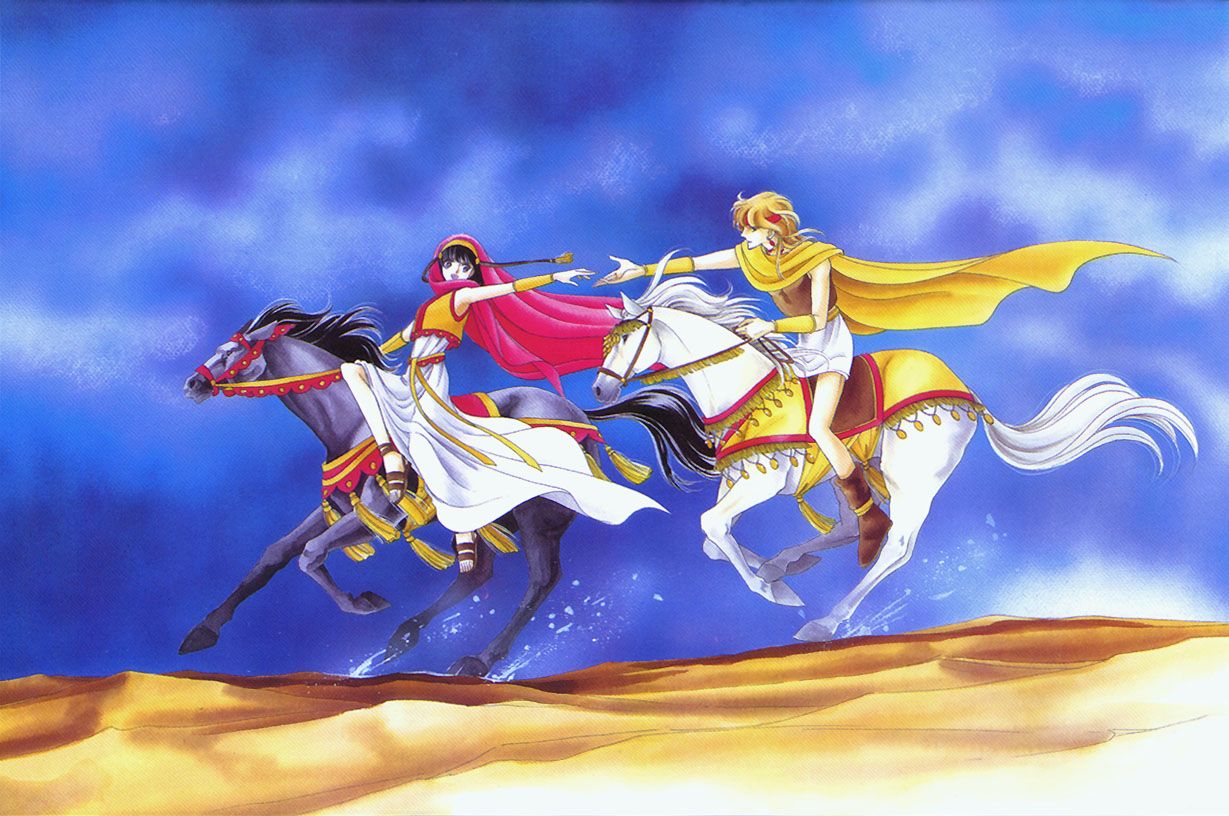
A full-color shot from Red River.

The storytelling is also phenomenal, taking actual historic events and people and weaving them seamlessly into a story that also manages to balance intrigue and romance very well. In addition to Nakia, there are other enemies, usually enemy states and their leaders, who attempt to conquer the Hittite Empire or just to the characters themselves. Throughout the series, suspense is kept high with a variety of plots against the characters, as well as numerous twists that keep readers on their toes. And the romance is never too sappy or idealistic, but often shows how the leads have to struggle not only to make their relationship work, but also to make it legal in the eyes of the Hittite Empire (politics, am I right?).

And finally, there’s the art style. It’s meant to be quite appealing to readers, with characters having proportions similar to what they might have in the real world. There’s also plenty of attention to detail when it comes to locations and attire, which one would expect for a series like this. It all comes together in a visually pleasing package, which is what manga artists go for, so good on that.

Sadly, Red River never had an anime produced, but the manga is available in the United States and Canada (I think, anyway). If you want a story that encompasses ancient Middle Eastern history while filled with intrigue, magic, and romance, this may be the story for you. Check it out, and dive into what could definitely be called a whole new world.

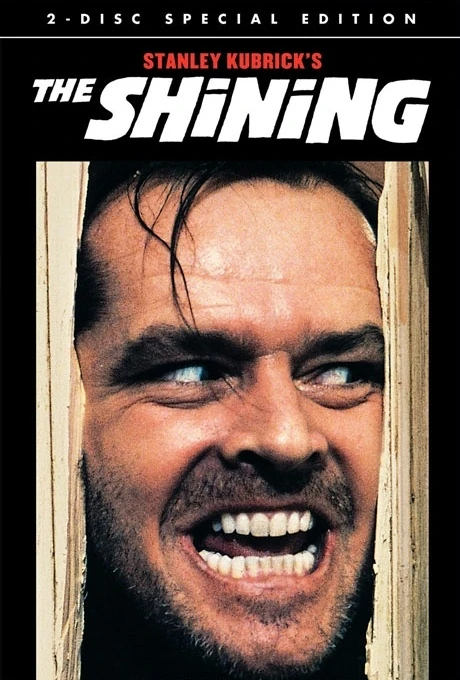
The Shining is considered one of the greatest horror films ever made, based on one Stephen King’s greatest novels. It’s still widely enjoyed today, has been very influential on a number of films and filmmakers, and has led to numerous theories about its deeper meanings, ranging anywhere from the Holocaust or Native American genocides to faking the moon landing. Yet when it was released, audiences and critics didn’t care for the film. Variety actually called it “a disappointment,” and Stephen King himself hates this film with a passion. Director Stanley Kubrick himself has garnered controversy for overworking and even abusing cast and crew during the production of this film.

I disliked this film immensely after I saw it in middle school, which was right after I read the novel. But I’ve since learned a lot about the film’s production and influence. And given the reasons I hated the film (see below), I’m wondering if my opinion needs a change. Let’s find out.

WHAT IT’S ABOUT: The Shining follows the Torrance family, who have come to the historic Overlook Hotel to be its winter caretakers. Isolated and cut off from the world, the Hotel’s supernatural side comes out to play, leading to a horrifying descent into madness and murder.

WHY I DIDN’T LIKE IT: It strayed too far from the source material. Not kidding, I hated the film simply because of how much changed from book to movie, to the point it drove out all my other reactions to the film (I can be a real purist sometimes). I actually preferred the 1997 television miniseries based on the movie because it was more faithful to the book,* and no other reason.

WHY I’M REWATCHING IT: Well, you hear so much about how great the film is, and you learn a bit about its production and legacy, and you realize how much a movie differs from its source material isn’t always a bad thing. Kind of warrants rewatching it.

THOUGHTS: That was a rather unsettling slow-burner, wasn’t it?

I’ll give the film this, it knows how to set up a creepy atmosphere with great visuals and sound. For one thing, the hotel is so distinct that it’s a character all onto itself. But it’s the way that Kubrick films the hotel and the characters in it that’s great. The whole film is shot with a wide-angle lens, which means we always see the characters alone in these vast spaces. On top of that, when close-ups are done, the wide-angle lens distorts the characters’ faces, giving the film a sense of surrealism and unreality. Add in the soundtrack, which sounds more like several clashing soundtracks playing at once. Heartbeats, eerie chanting, electronic music, symphonic pieces, all playing at once. It is creepy as hell.

I also like the reveals of scares. The camera always focus on the characters’ reactions to a scare before they show the scare. We see Wendy’s reaction to what Jack has been writing before we actually see it. We see Danny’s reaction to the little girls before the little girls are actually shown. That’s not something normally done in horror.

And finally, the film takes its time setting up the horror. It doesn’t rush in to showing us the gruesome haunting nature of the Overlook, but gives us time to see how isolated the characters are before introducing elements to show how their insanity is growing/the hotel is alive. It’s pretty effective.

However, I did have some issues with the movie. For one, the actors and the characters they portray. I didn’t care for either, really. Jack Nicholson is pretty good at playing a madman, but in my experience, that’s all his performances, and there’s not much transition between normal Jack Torrance to insane Jack Torrance. Shelley Duvall as Wendy…I don’t know what it was, but I just got annoyed with her every time she was on screen. And Danny Lloyd as Danny (ha!) was passable, but let’s face it, the character in the movie isn’t as fleshed out or as deep as he is in the movie. You could change the actor out, and it wouldn’t make that much difference, because Danny in the movie is very flat.

On top of that, I wasn’t ever that scared by the film. True, seeing Jack go after his wife and son with an ax is pretty threatening, but he doesn’t actually hurt them or get close to doing so. And while the film is good at keeping that creepy atmosphere going, it never truly escalates to the point where I feel myself shift from terror.

And like I said, the novel is phenomenal. Was it really that necessary to make so many changes from the source material? Also, what’s with that photo in the last shot? Was Jack reincarnated from a previous caretaker? Did he travel through time? I don’t get it! Explain movie! Explain!

FINAL JUDGMENT: I have a feeling this opinion is going to rile some people. On a scale of 1 to 5, I’m giving The Shining a 3.5. It’s creepy and visually creative, but the actors/characters aren’t that great, and the lack of terror, unexplained final shot, and important changes from the source material are issues that detract from my viewing.

Sad to say, it’s just not a film for me.


Well, at least I got that film out of the way. And with The Shining watched, I only have two films to go. Though I have a feeling this next one might be painful to watch…

Until next time, Followers of Fear, pleasant nightmares.

*And now I may have to get that miniseries again just to get a fresh opinion (Rewatch series 2?). And I’ll have to rewatch Room 237, the documentary on The Shining movie and people’s interpretations of it. And maybe reread the book? It’s been at least a decade, so I don’t remember it that well. And I should really get to reading Doctor Sleep, the sequel to The Shining. Especially since a movie version’s on the way.

I have a lot of work ahead of me.

I’ve mentioned it before, but short stories are often hard for me. And one aspect of writing those that I often have trouble with is the very first part of any short story. Openings. They give me grief.

With novels, I have a lot of room to maneuver around. After all, even a short novel is around sixty-thousand words (and mine are never that short). With all those words, I can take a lot of time and space just setting up the scenario of the story. Take my novel Rose, for example: if we count Chapter One as the opening, that’s sixteen pages and nearly five-thousand words just devoted to setting up the story. And I’m very used to writing this way. I like long, expansive stories. I grew up on a diet of Harry Potter, and in my teens delved into the novels of Anne Rice, Stephen King, and Dan Brown. No one could accuse those guys of being short.

But if I’m writing a short story, the highest word count to still count as a short story is ten-thousand. And if I want to get published in most magazines, the limit is usually around six-thousand. So while I’m used to opening a story with about five-thousand words, or half the length of the longest short story, I now have to try to contain my openings into a much shorter length.

The struggle is real.

Because of this need for brevity, one of the things I sometimes end up doing when I write a short story, at least in the beginning, is to use a lot of exposition. And in some stories, exposition is good. It helps fill in essential information. But in other cases, exposition is just…bad. Instead of actually presenting the story,  the author is just explaining things. Telling you stuff. It’d be like if instead of actually showing Harry Potter growing up, learning about his heritage, and going to Hogwarts, it’d be like JK Rowling wrote, “There was a boy named Harry Potter. One day he found out he was a wizard, his parents died saving him from an evil wizard, who disappeared and gave him a scar in a process, and then he went off to wizard school.”

I often worry that when I do exposition in short stories, it’s the latter kind. Which probably means it is the latter kind. That may be cynicism on my part, but when you’re still inexperienced at something, you’re prone to making mistakes. So perhaps I really am using exposition, and in all the wrong ways too.

Luckily, there are a few things I’m trying to remedy that. One is that I’m keeping in mind something important: I’m writing first drafts. And first drafts are always terrible. Even if they contain intriguing stories, they’re rife with issues that require lots of fixing. This is why we writers edit, multiple times if necessary, before we publish. Heck, Rose had to go through four drafts before I felt it was ready to be sent out to a publisher. And likely if a publisher does like it, they’ll probably have me do a fifth or even a sixth draft before they’re ready to publish.

So if I feel an opening needs work, I can edit it in the next draft, and remove any bad exposition or other problems with the opening I spot.

Hopefully I can improve this part of short stories.

And sometimes, I don’t even need to wait (and this is my second method, by the way). Sometimes a way to fix a short story’s opening comes to you just while you’re writing it. On Friday, I started a new short story that I think has potential. I think I got four hundred words in before I stopped, but then I was like, “Is this really the opening I want?” And as I thought about it, it wasn’t. But how to fix it? And yesterday at some point–I think it was right before I saw Winchester–a way to change the opening occurred to me.  I think this is the right way to open the story without going into exposition. So the next time I work on the story, I’m going go back and rewrite the opening, see if this produces better results. And if it doesn’t, there’s always something new to try. Or I can go back to my original opening. After all, it’s a first draft. I can make as many adjustments as needed.

And finally, I’m reading a lot more short stories than I’m used to. I learned how to write novels partly from reading novels, so reading short stories should help me get an idea on how to write them. I’ve already listened to two anthologies on audio book, and I just started reading the Stephen King collection Night Shift on Friday. So far, they’ve been very helpful, but I’ll need to read a lot more to get a better sense of short story writing.

And finally, I just need more practice. After all, you become a writer by writing in the first place, and continuing to write no matter what. With any luck, more practice with short stories will lead to better ones. Hopefully, anyway.

I’m still trying to be a better short story writer, and openings are still hard for me. But with practice and exposure to good ones, I can hopefully make some progress on that. And who knows? Maybe even produce some stories that a magazine will be proud to publish. Anything’s possible, right?


That’s all for now, my Followers of Fear. I’ve been looking at a screen for most of the day, so I’m going to take a break and read something. Until next time, pleasant nightmares!

Well, it’s been a year since I last had a Lovecraft binge (see Parts 1, 2, and 3 for my previous binges). And while I didn’t read any actual Lovecraft stories in the year (holy cow, that long?) since my last binge, he was certainly never far from my mind. I read a lot of fiction influenced or modeled after his work, including the Lovecraft/YA novel Awoken* (read my review here), shopped around my own Lovecraft-themed story The Red Bursts (still working on that), and wrote an article about why there’s not more adaptations or even a cinematic universe based on his work. No, surprise, after all that I was ready for another dive into his work. And boy, did I enjoy the eldritch swim.

So if you’re not familiar with HP Lovecraft (and I’d bet good money that you’re not), he was an early 20th-century author whose ideas and stories proved very influential on storytellers like Stephen King, Guillermo del Toro, and Allan Moore, among others. He’s considered the father of cosmic horror, the idea that humans are basically ants in our universe, that there are beings and truths so great and terrible that even glimpsing them can cause madness and death. It’s pretty bleak stuff, if you think about too much about it (which I have).

So this time around, I read “The Case of Charles Dexter Ward,” Lovecraft’s only finished novel, “The Colour Out of Space,” “The Dunwich Horror,” “History of the Neconomicon” and “The Whisperer in Darkness,” as well as several fragments, one letter excerpt, and one parody story, but I won’t go over those. And I got to say, these were definitely some of the most enjoyable of Lovecraft’s stories. They were consistently creepy and kept me engrossed in the story, as well as with the most accessible language (dude liked to pretend he was a contemporary of Poe, rather than a contemporary of Ernest Hemingway). Or am I just used to his style now?

The interesting thing about these highlighted stories is, they also mark Lovecraft’s shift from pure horror to science-horror. Sure, he’s done that before–“Herbert West: Reanimator” is the story of two men trying to discover the key to bringing back the dead using science, a theme also explored in “Charles Dexter Ward,” but more thriller and magical than science-fiction–but here there was definitely a more sci-fi element in his work. “The Colour Out of Space” and “The Whisperer in Darkness” both involved aliens, with the former involving a sort of alien infection and the latter involving aliens that have been visiting Earth for centuries.

Why did Lovecraft make this shift? Well, around the time these stories were written–late 1920’s and early 1930’s–was also the birth of science fiction as a proper genre. Pulp magazines like Amazing Stories and Astounding Stories were huge sellers, and since pulp rags like these were where Lovecraft normally published his work, he would’ve been aware of the young genre and its exploration of humanity’s possibilities through space exploration, technology, and aliens. It’s no surprise that he’d take elements from those stories and give them a freaky twist. And lo and behold, it led to Lovecraft writing some of my favorite works by him (especially “Colour Out of Space.” God, that was freaky, considering that what happened in that story could maybe happen in real life).

Honestly, I’m glad I decided to check out HP Lovecraft two-and-a-half years ago. Sure, his early works can be hit-and-miss, but as time went on, he got better. And by this point in his bibliography, he was very good at writing stories that stayed in your mind. It’s a shame he didn’t achieve more of a following during this time, because maybe then we’d have more works by him (sadly, he died in 1937 at barely forty years of age), and he’d be more well-known today.

And while I’m done with my latest binge, I’m looking forward to my next one, whenever that is. Especially if the stories from this point on are as good as the ones I read this time around. And seeing as At the Mountain of Madness is the next story in my collection, I’d say that’s a definite possibility.

Have you read these stories or others by Lovecraft? What are your thoughts on them?

*Funny story about Awoken: so I follow this woman named Lindsay Ellis on YouTube (check out her channel here) who does a lot of videos on our media and culture. Yesterday she uploaded a video about whether or not the hate over the Twilight franchise was warranted. During said video, she mentions she and friend/frequent collaborator Antonella “Nella” Inserra wrote Awoken as a parody of Twilight, only with Lovecraft characters instead of vampires. My mouth hit the floor. I had no idea that the novel was a parody of Twilight, let alone written by those two women under a pen name. Though now that I think about it, it explains quite a bit.

I reached out to both women on YouTube and Twitter, letting them know that I read the novel, my ignorance of its authorship, how much I actually liked it, and that I reviewed it on this blog. They asked for a link, and I sent it to them. Since then, I’ve gotten hundreds of views from their readers/viewers on that one review, and the number of reads is still growing. Wow. Didn’t expect that. Pretty cool. Probably won’t last a week, but it’s still cool.

Also, I learned about Poe’s Rule: if you write a parody of something, unless you ad a healthy dose of comedy, people will think it’s serious fiction in a particular style. Which is apparently what happened to me, as these readers are telling me. Good to know.

Well, I didn’t expect this to happen today. I figured it would happen at some point this week, but I never expected to get through the last three chapters so fast (especially since one of those three is thirty-three pages long). But yeah, I finished the fourth draft of Rose, the one edited with beta reader feedback! And all in a single month. Damn. I’m kind of proud of that rate of progress.

So if you’re among the many new Followers of Fear who are hopping onto this blog recently (hi! How are you? Are you enjoying my ramblings and opinions?) and you have no idea what Rose is, it’s a novel I started writing in college as my thesis project. The story is about a woman wakes up with amnesia and starts turning into a plant creature (and that’s just Chapter One). I did two drafts of it during my senior year of college, left it alone for a year, tried to pick it up again after I got my job, found progress very slow and dropped it, picked it up again this past summer with a new plan of going about editing the story, got through the third draft in four months, had some great beta readers look at the book and give me their feedback, and then somehow edited the book in a month (still gotta toot my horn on that one).

And you know what? This has been the most challenging story I’ve ever had to work on. I know I’ve said that before, but it’s the truth. Throughout the writing and editing process, this story has mutated more than the titular character does (because how else are you going to describe what she’s going through?)! Even during the very first draft, the story went through major changes. I initially had a different direction entirely for the story, which involved a lot more elements of Japanese folklore than appears in the novel (already heavily influenced by Japanese folklore), and involved some apocalyptic elements too. Thankfully, my thesis advisor helped me see how unfocused that direction would’ve been, and how much more intimate and scarier it would be if I went in another direction. This ended up being the route the story took, and if my beta readers can be believed, it’s a good thing I did, because the novel works the way it is now.

But honestly, that’s just the tip of the iceberg. So much changed with each draft, sometimes during the editing of a draft. Elements were added, subtracted, moved about, propped up and knocked down every day as the writing and editing needed. I added an entirely new plot element to the third draft to both add some length to the story and to foreshadow something that would be revealed later about one of the character. In the fourth draft, I changed the location of one minor element just so it wouldn’t seem unnecessary. I even wrote a whole new chapter for the third draft because I I needed it to do some necessary revelations about the antagonist.

Hopefully this happens to Rose very soon.

I keep thinking of those weird metal amalgams where if you add the right sort of current to it, you can change its structure (I’m pretty sure that’s a thing). Rose is very much like that: ever-changing with each new iteration, and hopefully becoming better each and every time.

Now that I’ve made that deep metaphor, I think I’ll talk about page and word counts, because I like talking about that. And while the shift from second to third draft was pretty dramatic, owing to the fact that I added about forty-thousand words of material to the story, third to fourth wasn’t that dramatic. If anything, it’s a bit smaller: the third draft was 266 pages (8.5″ x 11″, 12-point font, Times New Roman, double-spaced) and 84,677 words. The fourth draft was 264 pages and 84,390 words. A total drop of two pages and 287 words. I honestly thought it’d be a bit more, but I guess I was wrong.

So what’s next for Rose? Well, after four drafts and great feedback from my beta readers, I’m going to try looking for a publisher. I’ve been doing my research and I’ve got a few leads that I think could pan out, so hopefully I’ll have news within the year to share. And in the meantime, there are a couple of short stories, one novelette, and a blog post for Self-Published Authors Helping Other Authors I’ve been waiting to work on till I was done with the fourth draft, so I’ll likely start on those tomorrow. Hopefully I can get them all done before any publisher takes an axe to my door in their eagerness to publish me (I wish!).

Well, Followers of Fear, that’s all for now. It’s getting late, I’m tired, and I’ve got a big day tomorrow. I’ll let you know how things are going as they happen. Until next time, pleasant nightmares!

I’m far from perfect. And there are lots of areas I can be better (especially my impulse control when it comes to sweets). However, this post will be focused on the writing aspects I can improve upon.

There are a couple of reasons why I want to talk about that here. One is that for personal things I want to improve upon (damn you, sweet tooth! Damn you to hell!), I only talk about those sort of things here when it’s really important. Like if I’m really struggling with my choices in life, or if I want to talk about being on the spectrum. And at the moment, there’s nothing in my life I feel like talking about here at the moment. Second, this is a blog for a writer, so it makes sense that if I’m going to talk about improving stuff, it’ll be about improving my writing. And finally, while a lot of people I know in real life and even a few people online treat me as THE writing expert, especially when it comes to fiction writing, I’m far from an expert. If I were an expert, I’m pretty sure I’d have several bestsellers out by now, a few of them would have been made into movies already, and I’d be writing full-time in a nice three-bedroom, one-and-a-half bath house (I have goals that I aim for).

Point is, as a writer there are areas I’d like to improve in, so I thought I’d list some of those and ask for your feedback. Many of you who follow this blog are writers, and have much more experience than I do. Perhaps you’ve dealt with some of the issues I’ve dealt with, and have some tips on how to deal with them. Anything’s possible, right?

1. I’m addicted to adverbs and gerunds. Now if you don’t remember most of the fancy terms from grammar class, adverbs are words that end in “ly” (wildly, musically, horribly) and gerunds are words ending in “ing” (ending, writing, killing). And I overuse them in my writing (see? Did it right there). One of the biggest criticisms I got from Rose, truth be told, is that I overuse them. In fact, I almost used “actually” instead of “truth be told” in that last sentence. And in the one before this, I started writing “nearly” before I switched to “almost.” And in that last one, “I switched” started as “switching.” And before that–oh, you get the idea!

A couple of years ago, I wrote a post about how I had a similar problem with semicolons. I overused them, especially when they weren’t needed. Once I recognized the problem, I was able to correct it. But I have a feeling correcting these issues won’t come so naturally (see?). For one thing, while the semicolon issue was about fixing incorrect uses of punctuation, what I’m doing here isn’t technically wrong. These are speech patterns used everyday, you just don’t see them in a lot of fiction to the extent I use them. At least, not really good fiction. So one thing I’d like to do is know when to use adverbs and gerunds, and when not to use them.

2. Passive vs. active voice. I have a lot of trouble telling those two apart. Which is bad, because editors and publishers tend to prefer active voices in fiction, and I somehow always end up writing in passive voice. What’s the difference? Is there a video I need to watch or something that explains this? Help!

3. Writing snappier action. This is something I’ve taken steps to improve, but it’s still a work in progress. I tend to write these long sentences that illustrate a character taking a certain action. Example: “She stood, walked to the kitchen, and placed the glass in the dishwasher.” It’s a good sentence, but for fiction, this is better: “She put the glass in the dishwasher.” Boom! And if I’ve already established that the character is on the couch, it works even better. It shows the same amount of action with less words.

I’m trying to implement this sort of snappy action into my stories. Editors and publishers seem to like it, and when there are limits to how many words a submitted story can have, it’s helpful in reducing the word count. Still, it’s going to take some work. This, like the adverbs and gerunds and possibly the passive voice thing, are deeply ingrained habits.

No reason to add this photo. I just want to show you my new author profile pic.

4. Short story writing. I’ve written novels or works meant to be novels for most of my life. That’s what I mostly read, so that’s what I mostly wrote. I’ve learned how to write short stories and read plenty of them since high school and college, but I’m still not as good at them as I am at novels. Which is sad, because I’ve had many, many ideas for short stories and novelettes over the years. And since I’ve spent most of my time on novels, I’ve written only a few short stories, and not many of those have been published.

What I want to do is write more short stories and novelettes, get better at writing them, and get a few of those published. Is it necessary, especially since I prefer novels? No, but a lot of authors I like do great short fiction, so I’d like to do great short fiction too. Good news is, I’ve been reading a lot of anthologies lately, and I should have a bit of time after I finish the fourth draft of Rose. That should give me time to practice.

5. Not listening to my anxieties. All writers deal with anxieties, especially with how their work will be received. Sometimes I let them have too much control of my mind, and I start freaking out Just yesterday, I got panicky over whether certain characters in Rose might be called tacky stereotypes. After a lot of discussion online with friends and colleagues, I don’t believe they are, but the worry ate at me for a while.

The important thing for me is just to be a bit more confident in myself, and the stories I write. And I should work on techniques to combat those anxieties when they try to tear at me. Because at the end of the day, I’ve still written some decent fiction. And I won’t let doubt or fear keep me from improving it and making it into possibly publishable fiction.


Well, those are the things I want to improve on with my writing. What are your suggestions on fixing those issues? Let me know in the comments below.

That’s all for now, my Followers of Fear. I’ve only six chapters of Rose left to edit, so I’ll hopefully get started on the next one tonight. Until next time, pleasant nightmares!

Go to any slasher movie. I guarantee someone will do something stupid. And I also guarantee there’s a reason behind why they did it.

So yesterday I was doing some edits on Rose* and one of the points in the beta reader notes stood out to me. In that particular point, my friend/colleague/beta reader Joleene Naylor pointed out that it was taking the titular character Rose a lot longer to figure something out about the scene that Joleene had figured out much earlier. My immediate first thought was, “Well, it’s horror. Everyone’s a bit slower in horror.” And that thought really stuck with me. Yeah, the characters in horror aren’t always the brightest bulbs in the closet, are they? People in slasher films take too long to realize there’s a killer hunting them around a lake notorious for murders and disappearances, the family stays in their haunted house and might even pretend things are normal even if it’s obvious there’s demonic possession at work, dumb teenagers run upstairs when they should run out the door. They either realize something well after the audience has realized something, or they make really dumb decisions. And it’s such a well-known trope, it gets parodied quite a bit in our media, like in this Geico commercial.

This got me thinking: is this intentional on the part of horror writers? If so, why?

Well, I thought about this throughout the day (couldn’t write this before because I had to go to bed and then to work), and I think that what’s happening is intentional. However, I don’t think the intention is to make the characters stupid idiots.

First, let’s consider something: we’re the audience, and the characters are characters. In our daily lives we’re not keyed up, checking to see if horror-movie circumstances everywhere we go (and if we are, we’re usually recommended to see a doctor about that). It’s only when we sit down for a horror story that we start looking for signs of horror, because that’s what our brains are trained to do. Similarly, unless they’re enjoying a horror story or think they’re in one, characters won’t typically see all the signs of something evil around them unless that evil chooses to make itself known.

There’s also the fact that authors have to tell a story, and often the stories they tell have to be of a certain length. For example, I classify a novel as sixty-thousand words or more, so I have to figure out how to keep a novel going for that long. One of the ways to do that is to make the characters figure things out much slower than the audience, either by only giving them clues slowly or later in the story, or by actually making it so they can’t connect the dots until it’s convenient for the story. And considering that part of the appeal of horror, the thrill of the mystery and the unknown as well as our reactions to it once exposed, this is a sound strategy.

Okay, so making characters slow on the uptake is part imitating people in the real world, part storytelling tool. But what about stupid decisions?

Well, that’s actually pretty easy to answer: they’re under stress. When a character is being chased by a killer or trying to get away from a ghost, they’re under unimaginable pressures. So unless they’ve been trained to think under pressure, like in the Army, they’re not going to make a rational decision. They’re going to make split-second decisions that they hope will ensure their survival, and because it’s a horror story, they’ll likely make the wrong decision. Unless the author says otherwise, of course.

And even if they’re not in a stressful, life-or-death situation, the need for survival can cause us to do very stupid things sometimes, as well as our characters. Polly Chalmers, one of the protagonists of Stephen King’s Needful Things, keeps a charm around her neck, despite suspecting that there’s something alive in it and it’s twisting her personality somehow, because the thing is easing the debilitating pain of her arthritis. In other words, fulfilling a need to help her live.

Sometimes a character acts a certain way either because they’re imitating real people, or the author needs them to be that way.

So it’s not that characters in horror stories are dumb or slow. They’re victims of imitating people in the real world as well as the author’s discretion in storytelling. And we the audience, free of those issues, are able to pick up on things they can’t or won’t for a little while longer.

Of course, we will continue to call characters stupid and wonder how they could not do the smart thing. That just comes with the territory. But perhaps the next time we sit down for a scary movie, we’ll also consider what the characters are going through, as well as what the storytellers behind them decided was best for the characters and their story.

That’s all for now, my Followers of Fear. Hope this gave you plenty to think about. I had fun just thinking of it. Until next time, pleasant nightmares.

*Speaking of which, the editing on Rose is going very well. Yesterday I got through four chapters, bringing me halfway through the fourth draft. At the rate I’m going, I could be done before the end of the month. And after that, hopefully it’s a short wait till I find a publisher. God-willing, anyway.

Hello, Followers of Fear, and welcome to our first author interview of the year. Today we have a previous guest who has been my friend for a number of years. She’s written several books and has even visited my house when I was still living with my dad, the first author friend/blog friend to ever do so. And today, she’s here to talk about the two books she published in 2017, Unfinished and Madame ZeeZee’s Nightmare (I’ve requested my local library to order copies, and I’m still waiting to hear back). Ladies and gentlemen, please welcome Pat Bertram!

RU: Welcome back, Pat. It’s good to have you here again. Now as I mentioned above, you published two books in 2017, Unfinished and Madame ZeeZee’s Nightmare. Please tell us what they’re about.

PB: Madame ZeeZee’s Nightmare is about fun, dance, and murder! When Pat’s adult dance classmates discover she is a published author, the women suggest she write a mystery featuring the studio and its aging students. One sweet older lady laughingly volunteers to be the victim, and the others offer suggestions to jazz up the story. Pat starts writing, and then . . . the dying begins.

Unfinished is about buried secrets and a woman finding herself when she finds herself alone. While sorting through her deceased husband’s effects, Amanda is shocked to discover a gun and the photo of an unknown girl who resembles their daughter. After dedicating her life to David and his vocation as a pastor, the evidence that her devout husband kept secrets devastates Amanda. But Amanda has secrets of her own. . .

RU: You weren’t writing fiction for quite a while. What made you get back into it?

PB: I don’t like leaving things unfinished, and besides, both Madame ZeeZee’s Nightmare and Unfinished deserved to be written. So I just . . . wrote.

RU: I love it when a story makes you want to write it. So tell us, what was the inspiration for the two novels?

PB: That’s easy. The inspiration for Madame ZeeZee’s Nightmare came from my dance class. It was their idea, and they provided the fodder for the characters. Inspiration for Unfinished came from my life. Too often, I have read novels where the spouse dies, and after a few perfunctory tears, the one left behind continues as if nothing ever happened. Grief does not work that way. It’s not so much that we go through grief, but that grief goes through us, and I wanted to show the truth, both about the changes such an upheaval brings and the courage it takes to accept those changes.

RU: Now, Madame ZeeZee’s was based on you and your dance class and classmates. How much of them and of you made it into the novel?

Madame ZeeZee’s Nightmare by Pat Bertram

PB: Many of my dance class mates — and the teacher! — made it into the novel. For the sake of reader’s sanity, a couple of times, I combined two or three women into one character. (Too many non-essential characters in a book confuse me as a reader, and I can only assume others are the same). And, though he isn’t a classmate, a fellow I know by the name of Rami Ungar made it into the book. As for me — well, Pat is Pat. At least, I think she is. I know one thing — if I ever decide to write a series, I will use Pat as the main character. It was incredibly easy writing myself as a character — I didn’t have to create characteristics, either positive or negative, and the character arc came naturally.

RU: I love that we’re both characters in your book! And your characterization of me is a lot nicer than what most people give me when they write me into a story.

What about Unfinished? Did you or anyone else you know make it into that book as characters?

PB: I seem to write only about me anymore. Although I gave that poor woman a different name and a different life, she was definitely me. At least everything she felt, I felt.

RU: What were your biggest challenges writing these novels and how did you overcome them?

PB: The biggest challenge is always me. Some writers can sit down at a keyboard and the story flows from their fingertips as if it wants to be written. In my case, I have to drag every word from somewhere deep in my brain, and sometimes the effort is more than I want to make.

For Madame ZeeZee’s Nightmare, when I got tired of trying to figure things out or to search for the proper words, I went to class and asked the appropriate “character” what she wanted me to do. It’s amazing how simple that makes everything! Other times, I used something that happened in class to push me along.

For Unfinished, I had to persevere. Make the determination to finish the book and just do it. It was hard, though, dredging up all those feelings.

RU: Are you working on anything now?

Unfinished by Pat Bertram

PB: I am finishing a fifty-day blog challenge, to blog every day for fifty days. And I have a sort of apocalyptic novel I am decidedly NOT working on. I have a mental block against the poor thing because I was working on it when Jeff (my life mate/soul mate) died, but one of these days, I will get my head in gear and find the determination to work on it.

RU: And finally, what are your writing goals for 2018?

PB: I intend to keep up the daily blogging, at least a while longer. In May, I plan to take a road/camping/hiking trip along the Pacific coast (or near the coast anyway), and I hope that experience will bring me insights for fabulous blog posts. As for fiction — well, real life has me in its clutches. Hopefully, I will be able to free myself one day and get back into the alternate reality of fiction.

RU: Well, thank you for joining us Pat. It’s always a pleasure to speak with you.

If you would like to check out Unfinished, Madame ZeeZee’s Nightmare, or any of Pat’s other books, you can check out her Amazon page. I also highly encourage you to check out her website, her blog, and her Facebook. Trust me, she’s someone full of strength and insight, and you can benefit from knowing her.

And if you have a book coming out in the near future, hit me up on my Interviews page, and we’ll make some magic happen. Have a great evening, Followers of Fear. Until next time (probably Saturday), pleasant nightmares!