Posts Tagged ‘ideas’

See the difference?

In 2006, author Emily Schultz published her first novel Joyland, about a teenage boy growing up in an Ontario town in 1984. This was her second published book, coming after a 2002 collection of short stories. It apparently got some really great editorial reviews from national publications, calling it a great coming-of-age novel and an exploration into teen sexuality.

About seven years later, His Royal Scariness Stephen King published a novel with the exact same name, about a college student in 1973 who gets a job at an amusement park and finds himself solving an unsolved murder (I’ll have tor find time to read it one of these days). Plenty of King fans went online to download the e-book (some may not have realized that for a while the book wasn’t available in that format, which will explain what happens next). But the funniest thing happened: several of these King fans downloaded Schultz’s book believing it was King’s book. And right until the end, some of them never realized they got a literary coming-of-age by a Canadian-American author instead of a dark, creepy whodunit from Stephen King!

And it reflected in the reviews some of these people gave Schultz’s book. Here’s one who absolutely hated it:

I have always loved Stephen King novels. However, this one was a rambling, stream of consciousness mess. I had to go back and read over the last pages again and again to try to understand what was happening. For a person who reads several books a week, this is annoying, to say the least. I will still read his next book, if there is one. He fascinates me with the way he thinks, generally. This book was not my favorite, by any means.

And here’s one who thought they’d try to counter-balance all the negative reviews from King fans:

However somebody give it a one star rating because THEY accidently purchased it thinking it was Stephen King, i’ve no idea how they did that but this review is too counter balance that one.

Here’s a prankster who thought they’d satire the whole confusion:

As soon as I learned Steven King had his sex change operation AND changed his name, I immediately rushed out and bought this book. The surgery (and hormone therapy) have really changed his appearance AND his writing. It’s amazing. It was almost like reading a completely different author.

Mrs King (Schultz), your new vagina has served you well! Nicely done!

And here’s one from someone who actually thought it was a great Stephen King novel, if you’ll believe it:

Full of suspense and mystery and real, visceral horror. Don’t be put off by the new nom de plume. King’s new pen name signifies another evolution in his career, just as he emerged from the Bachman years’ “Thinner” into the soul-baring masterpiece of “It”. Writing from a feminine perspective is admittedly experimental, but this experiment is a SUCCESS.

Now, I’m sure plenty of authors would be upset about this confusion. Ms.. Schultz has actually kind of taken advantage of the confusion and the money coming her way by creating a Tumblr blog called Spending the Stephen King Money, where she details how she’s been spending her unexpected royalties, from donation to charitable organization to IKEA shopping trips. And of course, it’s only brought more attention to her, and her book. I’m sure plenty of people will read it now just to read the story that got confused with a Stephen King novel.

In fact, there’s a certain author who plans to read the book:

Yep, King is ordering her book, and Ms. Schultz in turn is planning on reading Stephen King’s Joyland. It’s a really weird but hilarious ending to a rather strange series of events stemmingfrom a simple misunderstanding. But hey, I’m sure both authors will laugh about it when they look back on it years from now, if they aren’t laughing about it now. And who knows? Maybe they’ll collaborate torelease books around the same time with the same titles and see what happens. In fact, I kind of hoping they do!

I’m not sure how this sort of thing happens, except through serendipity. In fact, this is the first time I’ve heard of such a thing happening on such a scale that even some media organizations report it. Sure, we all have or know someone who went to get a certain book or movie or check out a certain TV show and ended up reading or watching something with a similar or identical title (that actually happened to me a couple of weeks ago). But on this massive scale? It’s almost a little hard o rap your head around. If Saturday Night Live was airing new episodes right now, this would be the subject of a Weekend Update joke.

Well, like I said above, this is a case of serendipity at work. Just a happy accident. I wish something like that would happen to me, and I’m sure plenty of people will echo the sentiment. Not only is it a funny story, the royalty checks and recognition wouldn’t be too bad either. But it’s still very unlikely, even when your book has a similar name to a bestseller (The Quiet Game and Snake aren’t the only books out there with those names, believe it or not).

But I don’t think’s that’s a bad thing. After all, it’d suck if a lot of negative reviews brought down your book’s average because of some silly confusion. And I’d prefer to get success through my own hard work, creativity, and the help of my good friends and/or readers rather than through some silly mix-up of random chance.  More satisfactory that way, anyway.

I just have to write something that will allow that sort of success. Well, hopefully that story will come soon, if it hasn’t already. We’ll just have to wait and see.

What do you think of the King/Schultz mix-up?

If this happened to you, how you would react?
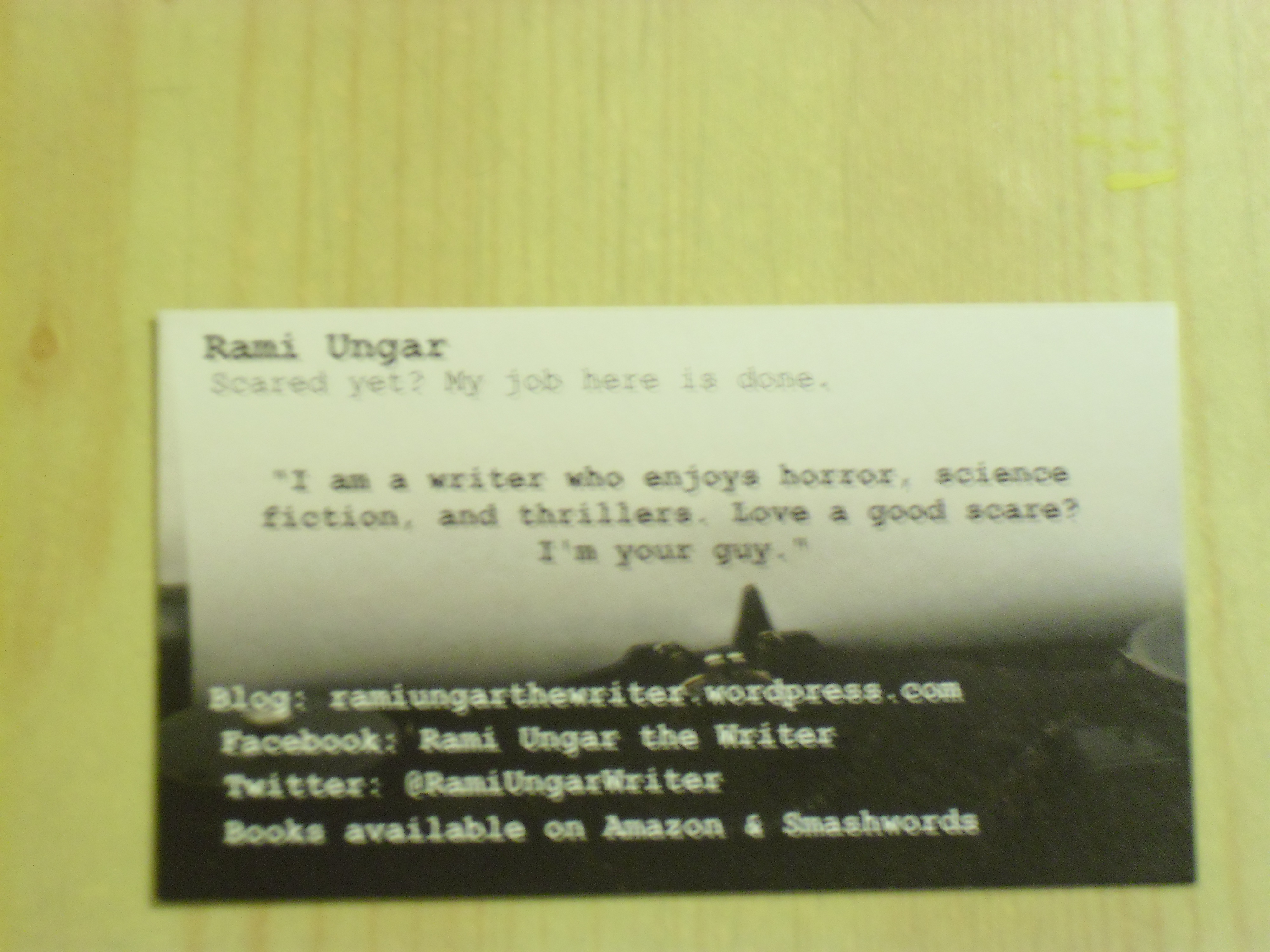
A while back my stepmother recommended that I get business cards as a possible way to help further my writing career and possibly get some new readers. I’d considered getting business cards before, but the busyness of life (among other things) had kept me from actually designing and ordering some. That very evening though, I went online, designed some cards, and ordered them. And yesterday they arrived in the mail for me, all 250 of them.

I’m sorry if these photos of them are a little blurry. I’m using my digital camera, and it’s a few years old. Anyway, here’s the front of the card.

business card 1

And here’s the back.

business card 2

Now if you couldn’t make out the writing on the card, the front has my name, the slogan of my blog (“Scared yet? My job here is done.”), a little about the stories I tend to write, and the social media sites I use, as well as where my books are available. The back has the names of my books in order of most recently published. And as you can clearly see, the design is a typewriter.

I hope that these cards will help spread word about my writing. I get a lot of people who say they want to or will read my books, but then they end up forgetting. It’s understandable, my books are not exactly top priority in the lives of the people I meet, and sometimes people forget my name, how to spell it, the names of my books, and/or how to spell those. I’m hoping these cards will act as physical reminders that will get people to actually check out my books and social media sites. They may also help me perhaps find new people to work and collaborate with and possibly open up some doors for me. I can hope, anyway.

At the very least, I’ve already given out a few to people interested in reading my work, so I guess it’s up to them now to decide whether or not to actually use the card and find my work. I’ll keep my fingers crossed and see what happens.

I plan on writing an article about business cards for Self-Published Authors Helping Other Authors when I get the chance. In the meantime though, I’ve still got a few chapters of Laura horn to get through, so I’ll work on that first. Wish me luck as I try to finish one or two chapters this evening.

What do you think of my new business cards?

Do you use business cards to help with your writing work? What are they like? Do you think they’re helpful?

I do a lot of female leads in my writing And for some time now, it’s been bothering me. Not the kind of bothering like “I’m a dude, I should write more male leads”, but the kind of bothering where you ask every four-year-old’s favorite question: why? Why do I feel such an affinity towards female leads? And why do they always seem to come into the story with some baggage or that they get baggage early on in the story?

I’ve been wondering about both points for some time, and I think I might finally have some answers. For why I prefer using female protagonists, I think it has a lot to do with my childhood. I grew up in a family with a lot of women in it. That has some upsides and some downsides, one of the upsides of which being that I had some very good examples of strong women right in my own home. My mother is a woman rabbi and became ordained in an era when there were very few women before her or with her in that role (there still aren’t many women rabbis, but there are certainly more than when my mother was ordained). And sometime after she divorced my dad, she became involved with another woman, who I’ve come to look up to as another mother. My mother’s partner is an accountant, and was there countless times when I was having trouble with math throughout middle school and high school. She was also one of the people who taught me to play sports during the few instances where I showed an interest in sports (rare instances, but thy exist).

Besides my family, some of my childhood heroes were actually heroines. Growing up, I was very big into shows with girls who could have normal lives one minute and kick monster ass the next. This primarily involved Sailor Moon and Buffy the Vampire Slayer, both of which I’m still huge fans of (by the way, Sailor Moon is getting an anime reboot next month. If you haven’t guessed, I’m kind of counting down the days till then). Besides sometimes having really creepy monsters and awesome battle scenes, these shows portrayed women as more than just screaming damsels in distress who need a man to help them. They show women able to fight back as well as have real character development and  growth. With all these influences, it’s no wonder as a writer I tend to write more female protagonists than male.

And I think that that’s a good thing, really. If you look at our contemporary media, you see several more men than women as leads, and generally the men are much more developed. Sure, there are women like Katniss Everdeen and Black Widow or Mystique, but the former seem very underdeveloped in Books 2 and 3 when you consider how she keeps going back to her romantic issues and how her life is mostly manipulated by powerful men, and the latter have yet to have their own solo films. Recently there’s been controversy over the new Assassin’s Creed game not having any female leads, and most video games still don’t have as many female playable characters as men, and those that do don’t always take the time to develop their leading ladies. To be sure, there are a new class of women (particularly women of color) emerging in the media who are portraying women in strong, positive, fully-developed roles, such as Olivia Pope in Scandal, the detectives from SVU, and even the women from Orange is the New Black. But there is still a long way to go, and the landscape is still very uneven.

Even though my work is only read by a small amount of people at this point, I like to think that with the large number of female protagonists I write (and hopefully received as well-written role models) is helping to correct the problem and give more girls what I was given at a young age, which was some great examples of strong women.

As for the whole thing with the baggage that a lot of my characters come with, I think that can be said for a lot of writers. Let’s face it, authors tend to have their characters come with baggage. Maybe they’re orphans, or they lost a loved one, or they have a dark past with family issues or drugs or something. I think that’s because we like our characters to be a little broken, in order to make them more identifiable and to make it easier for us to facilitate character growth. Honestly, I think it’d be more of a challenge to give a compelling story with development and growth to a character who doesn’t have anything worse than clinical depression or a tendency to pig out on junk food.

In any case, I’m happy to say I now have a better understanding of myself. I look forward to seeing what I can do and what I can write now that I have a better understanding of my process and the sort of characters I create.

Well, that’s all for now. I think I’ll sign off now and watch some TV. Have a good night, my Followers of Fear.

It’s been a while since I’ve done a post reflecting on the craft of writing (outside of Self-Published Authors Helping Other Authors, I mean), so I thought it’d be good to do one. And I figure a good one would be to write on things people say about writing that annoy writers to no end when they say them. You may have even heard some people say these things on writing and, whether you treat writing as a craft, a business, an art, a passion, or a calling, you’re bound to at leas give the speakers an eye-roll. Occasionally you may even call out the absurdity of what they’re saying, because to your ears it’s all so ridiculous.

And why did I decide to pursue this particular topic? Maybe because not too long ago someone said one of these to me and I just got so annoyed with it.

I want to write, but I hate reading. That’s like saying you want to be a chef but you hate eating gourmet food. It’s just not something that’s done. Writers read because it’s how we developed a love of literature, it’s where we study the work of others in order to better understand and improve our own work, and it’s just plain fun for us. So saying you hate reading is basically saying you’re not going to write because you’re not willing to do what’s absolutely essential to becoming a writer. I’d understand if you said you have trouble finding the time to read (we all do, even part-time workers like me), but hating reading is just inexcusable for any serious writer.

I’ll write when I’m retired. This is actually the one I heard recently, when I asked an acquaintance who has a very unconventional and interesting career to write about his experiences. Just because you suddenly aren’t obligated to go to work from 9 to 5 on weekdays doesn’t mean things are magically going to fall into place and you’ll have the time, energy, and will to write. If that were the case, I’d have retired right out of high school! Plus, who’s to say that in retirement you won’t just become busier? It’s happened, I’m sure.

I can write better stuff than the crap they’re publishing these days. First off, I hope you’re not including my work in that grouping. Second, you think you can write better? Pony up! And if you decide to actually try to write something better than what’s out there, be warned: while you may feel that everything you’ve written is more real and heartfelt than what you find at the library, not everyone may agree. Agents, editors, publishers, and readers can be very particular about what they think is a good story, and they may not always agree that you’re better than the other crap writers out there. Often times, what’s popular enough for you to read and decide it’s crap is popular for a reason, so just know what you’re competing against.

I have a story all in my head. Commas and all. I just have to find the time to write it. Okay, let me call the writing fairy to give you a sabbatical to write. Most writers carve out the time to write from their personal time. We don’t expect the time to find us, we actively make time. I’ve written when I could be taking a nap. One of my friends who recently published her first book wrote in notebooks on the buses to and from work. There are writers who get up an hour before everyone else in the house and stay up an hour later just so they can jot down 500 words or so and feel like they’ve made progress. So don’t expect to find the time or let it magically appear: go and make time!

Writing’s not something you can make money off of. Usually no, writing is not something you can make thousands of dollars off of. The writers who are able to write full-time are lucky. Most have day-jobs because writing alone will not pay the bills. I certainly have not made enough money off my work to take up writing full-time. However, most writers don’t get into the business for the money. We get into it because it’s a passion, something we really enjoy, and the money comes secondary to all that. Sure it’s nice, and we wouldn’t mind some income from our writing, but it’s not the main reason why we sit at our desks or on the couch punching out word after word after word. If it was, I would’ve given up writing a long time ago and would’ve gone into law.

I have this idea for a story about… I’m going to stop you write there. Normally I’m interested in hearing about other people’s stories, but I have a question: do you have any intention of writing it? If you don’t, it probably wouldn’t be good for hear it. I might just run away with it and use it for the basis of my own potential bestseller. Well, I wouldn’t, but there might be some unscrupulous fellows who would.

There are too many writers out there already. I can’t make an impression. Every writer worries about this, but most don’t let it keep them from trying. And you never know: you could end up being the next JK Rowling, F. Scott Fitzgerald, or William Shakespeare. But first you have to put yourself out there. Besides, if I was worried about impressions, I would’ve given up writing a long time ago and gone into–oh you know what I’m going to say!

I’m good, so I don’t need to edit. Even the greatest authors needed to edit! I don’t know a single author who doesn’t need to edit. We all make mistakes that others will point out, we all have flaws in our stories that will turn readers off. That’s why editors exist: they catch these problems before the book makes it to publication. Otherwise you have all that crap online that has little to no editing and that brings a bad name to self-publishers. So even if it’s sometimes a little expensive, you might want to shell out a little money for a copy-editor or a beta reader to take a look at your work, because it’ll improve your work vastly and you will benefit from it. Heck, I think the only writer out there who doesn’t need an editor is God…wait. There are some ambiguous phrases in the Bible that make no sense, and some that have garnered a lot of controversy. Plus the tobacco and marijuana plants: were they really necessary for the world? Yep, all writers need editors.

What are some things people have said to you about writing that you think si utterly ridiculous? What would you say to them?

It seems that my prayers have been answered. Either that or I and the many people lobbying for this video to come have finally gotten what we desired.

Anyone who spends enough time on YouTube will probably come across the Epic Rap Battles of History videos. They are funny, have more history than the History Channel does these days, and are really well done. Several of them, such as the Adolf Hitler vs. Darth Vader series, the Doctor Who vs. Doc Brown battle, and the famous Donald Trump vs. Ebenezer Scrooge Christmas special, have become viral sensations. And in a stroke of creative genius, these guys have put out what has to be my favorite video yet: Edgar Allen Poe vs. Stephen King!

The video stars slam poet and rapper George Watsky as Mr. Poe, while Zach Sherwin (aka MC Mr. Napkins) plays his Royal Scariness King. It’s a delightful back-and-forth between the two horror greats, with Poe even rapping in trochee (the form of verse The Raven was written in) and King making references to both his and Poe’s work, as well as poking fun at a certain kid’s movie’s protagonist’s name. Plus the soundtrack is just perfect. But why just read me praise it? Check it out below:

Awesome, right? And it’s very hard to choose a winner, though I have to go with King (he’s got the best disses). Funnily enough, Mr. King himself had some different thoughts:

Mr. King, don’t put yourself down. Frankly, I thought you were sharper than Annie Wilkes’s axe. And I look forward to reading Doctor Sleep and Mr. Mercedes, once I can find the time to do it. In the meantime, can I interest you in one of my books?

Who do you think won? Why? And who would you like to see in another rap battle?

Personally I’m hoping for Walt Disney vs. Stan Lee or Freddy Kreuger vs. Jack the Ripper (yes, that is disturbing. But would you expect any less from me?).

Diversity is a big thing these days. We need more diverse student bodies, more diverse workforces, and above all, more diverse casts in movies, books, and TV shows. And I don’t consider that a bad thing. On the contrary, diversity is a good thing, because it represents our diverse population and the many wonderful people on it.

However, I take issue when writers stick in a single minority character or one female character into the main cast and say, “Diversity element added”. Because that’s not diversity. That’s just being lazy. You see, a really diverse cast doesn’t just have a couple of characters you don’t usually see in these sort of stories. A really diverse cast has fully developed characters that grow and evolve over the course of the story, and they all come from many different backgrounds.

Take the main cast of Captain America 2: The Winter Soldier (I would’ve done Reborn City instead, but I have a strange feeling that more people have seen Captain America 2 than have read RC. Just a feeling, but it’s a strong one). In that movie, the four main characters have great depth, they do some growing in the movie, and we see sides to them that have not been revealed previously. Three of them also happen to be the exact opposite of the usual superhero protagonist, namely a white guy on the front lines. Black Widow is a woman and Falcon and Nick Fury are both black, but neither of those traits define them or are the main points to make them interesting.

Okay, the main points that make them interesting is their fighting abilities, cool gadgets, and the awesome things they can do, but that’s beside the point! There’s more to them than the fighting and what’s on the surface. They are all given a chance to grow in this film, and we really get a chance to know them. Natasha and Steve Rogers develop a relationship over the course of the film that swings between best friends and a sibling love for each other, while San Wilson becomes the one person who can relate to Rogers because of their shared experience. And Nick Fury, besides revealing information about himself that might have been a surprise to many fans, also had to question the organization he lead. Specifically, is it doing more harm than good? And is it worth it to keep SHIELD around?

All these characters are different from what might be or have been considered normal for superhero films, but that’s not what makes them great. What makes them great is that they have depth, they have growth, and whoever wrote the film didn’t feel that just because they were black or female that was character development enough!

So with the upcoming Batman vs. Superman film, they’ve apparently already cast Wonder Woman (who is obviously female) and Cyborg (who is black). I don’t know what sort of role they’ll have in this film (or in any sequels which will inevitably pop up), but I do hope that their characters are given as much time to develop and grow and reveal their hidden sides in the movies as the other characters. There’s a huge literature from which the writers can draw wonderful storylines from. I’d really like to see what they do.

And if they only focus on Wonder Woman’s being a woman or don’t give Cyborg enough treatment as a character, it’ll diminish my enjoyment of the film that much more.

So thanks for listening to my rant on the need for real diversity in our popular media. I’ve got a flight in a few hours, so I’ll write again when I can (though when that’ll be I have no idea). Have a lovely day, my Followers of Fear.

Jones, Jones, let me borrow your bones

Jones, Jones, let me borrow your bones


Oh, I’m so excited to tell everyone about my trip down into the catacombs! As you may well know, the catacombs occupy the prime spot on my list of haunted places to visit before I become a ghost myself. And I got in this morning! It’ll make a great beginning to a new sub-category of posts, “Tales from Abroad” (I figure with all the stories I have to tell, a category was needed for it).

CIMG2795

Well, this morning I woke up early. I’d heard that the lines for the catacombs were insanely long, and I decided to get there early. So I got dressed, ate breakfast, and headed to the Metro. Right across from the exit from my stop, was the entrance to the catacombs, with a small line already forming. I rushed to it and got in before anyone else could. It was about fifty minutes before the catacombs opened at that point, and it was also the time when I made new friends: Andrew and Maria, an engineer and sketch artist from Florida whom I talked to while waiting in line. Subjects ranged from WWII history to our travels to the history of the catacombs themselves to our individual aspirations and dreams. During the tour I often saw them and we took photos of each other at various points along the tour.

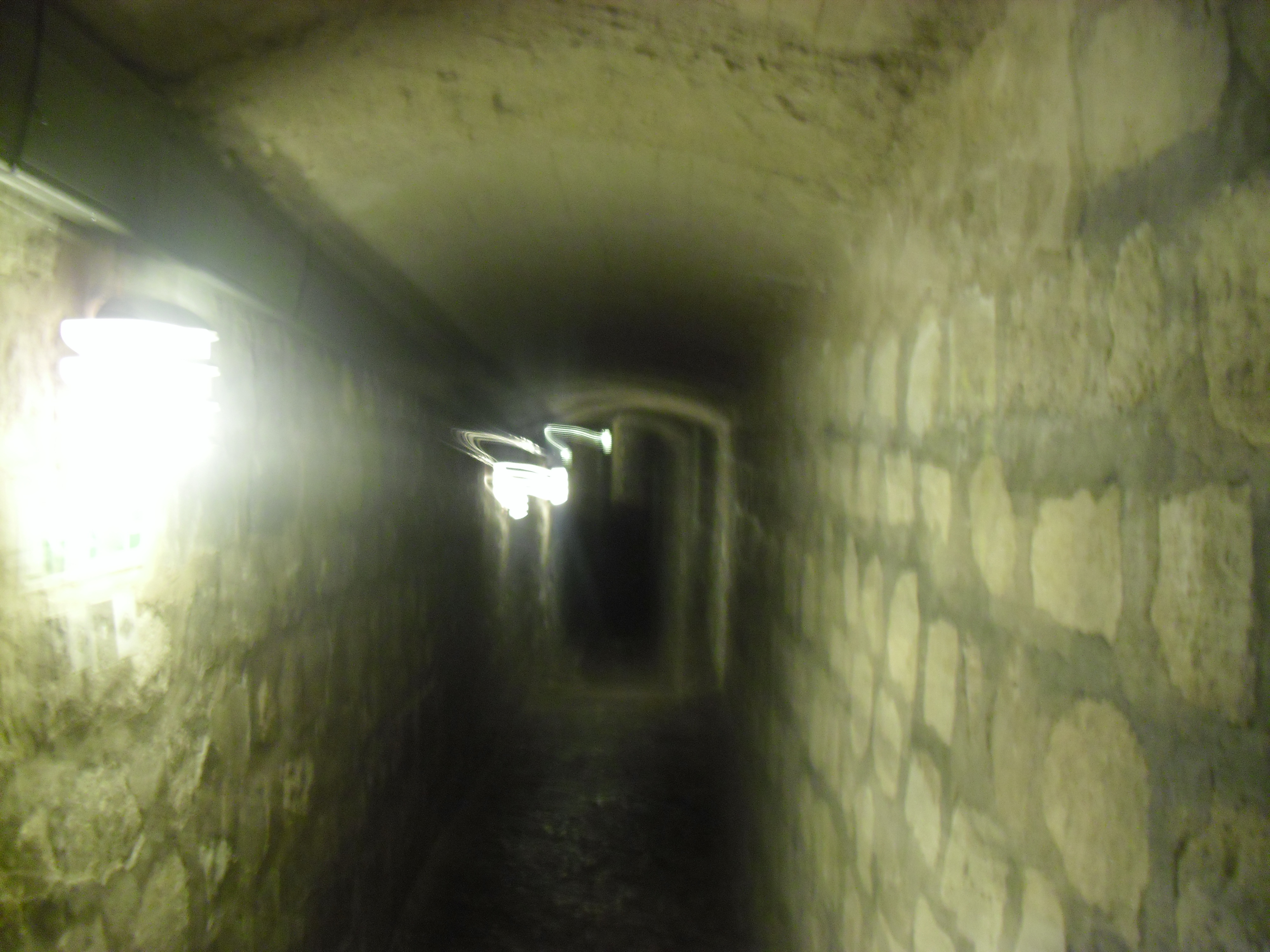
When ten o’clock hit, the doors opened and we went in. By that point the line had snaked around the block and out of sight (average wait time is around two hours apparently. So remember kids, if you’re in Paris and plan to tour the catacombs, arrive as early as I did so you can get in quickly). The tour was self-guided (audio guides cost extra, and tour guides are only available to groups), so you basically walked down a circling staircase to a first room that dealt with the history of the catacombs (originally mines and underground quarries, later the home of six million of Paris’s dead as corpses were moved from cemeteries to underground for health reasons) and the geological history of the catacombs. Later you moved into the catacombs proper, a series of passageways and tunnels (only a section available to the public; anything else, you’d have to find a cataphile, a catacomb enthusiast who can access illegal entry points and go down to explore).

Andrew and Maria in the Kingdom of the Dead.

Andrew and Maria in the Kingdom of the Dead.

It was very interesting, being down there. You could see niches where rocks were carved out or where things could be stored, as well as metal gates blocking the way to passageways not open to the public. In two places there were these amazing sculptures of beautiful building that a worker from the original catacomb project in the 18th century had carved from memory, recreating his home in the Balkans. There was a deep well that went even deeper into the ground, and a series of archways and niches set along an incline, as if to let us now we were entering sacred ground.

Can you say new author bio pic?

Can you say new author bio pic?

And then came the best part of all. Over a doorway, written in French and carved with precision was the warning, “Beware, for you are about to enter the Kingdom of the Dead”. And what a kingdom it was! The walls were lined with the bones and skulls of so many dead. And even though we were told by signs not to use flash or touch the bones, many did anyway. I won’t say whether or not I did, but I will admit that I am aware of what bones feel like when you hold them (bones from 300 years ago feel like light, brittle rocks in your hands). Some of the bones were arranged in interesting shapes, such as representations of crosses, men, or churches. Others had been arranged to help support different structures, such as around this column. Or this well, which strangely made me think of a portal to Hell rather than a catch for water. And plenty of coffins, crypts, and tombstones.

The bones went on for ages and ages. Every moment I was in a sort of heaven (so to speak). As you can guess, I am quite the lover of the macabre, so this definitely got me excited. If you look at each of the photos carefully, you’ll see me with such glee and excitement on my face.

But sadly it had to end. And end it did, with the doorway to the land of the living coming all too soon. There were a few more sights to see, including some lovely vaulted ceilings, and then we had to resurface, taking another winding staircase up. All told, I spent about an hour and a half down in the catacombs, twice the normal amount estimated for a tour, and I covered two kilometers and over 200 steps going up and down. And I would do it again if given the opportunity, because it is just a wonderful place to be. At least, for me it is.

Afterwards, I went to the gift shop (yes, they have a gift shop) and got a couple of souvenirs to remember the trip below by (there’s only so much photos can do, and for obvious reasons I couldn’t take the bones with me, even if I was the kind of guy to try to take bones with me). I got a small booklet about the catacombs for easy reference in case of a story (of which I have one or two ideas for), a sticker for my laptop, and a skull ring, something I’ve always wanted for myself as a horror author.

How you like the sticker and the bling-bling?

How you like the sticker and the bling-bling?

I’m not sure if I actually witnessed any ghosts. I certainly don’t remember seeing anything out of the ordinary, except possibly some evidence of cataphiles in a restricted section. But I certainly had a great time down there, and I’ll definitely treasure those memories of that hour and a half for as long as my memory works (though I’m not sure sometimes that it does now). It certainly has become my favorite part of Paris.

Well, that’s all for now. I’ll try to upload the rest of the photos of that night when I get the chance. In the meantime, I’ll send Andrew and Maria the photo I took of them as well as the link to this post. Have a good night, my Followers of Fear. I know I will.

BOO!

You know, I said I wasn’t going to do much writing while I was abroad. Well, I may have been a little naughty and wrote a short story in about six days or so. Wasn’t planning on it, it just sort of happened that way.

You see, I had this idea while in London for a short story (and I’ve had so many ideas for stories while abroad, but that’s a discussion for another post), and on the ferry from Portsmouth to Normandy, I had a lot of time on my hands, about four hours worth. Most people were sleeping or working at the last minute on assignments. I didn’t feel like doing either, and there was Wi-Fi, perfect for searches on random facts for a story.

So, I finished writing and editing an essay for an anthology I’d heard about, and then I started on “The Murderer’s Legacy” (that’s the working title, anyway. I may change it when I edit it). It’s about a man living in a magical version of Victorian England who is accused of murdering his wife and is about to receive the worst punishment imaginable. The story follows his attempts to figure out who actually killed his wife and why as he is lead off to his punishment.

I got about two-thousand words in on Monday, when I started the story (like I said, I had a lot of time on my hands). I might’ve finished the story sooner, but as I was writing it the story sort of evolved on me. At first the magical elements were minimal, but then they started becoming a bit more widespread. And then I started having my main character try to figure out who might be the real murderer, and I added more dialogue, and even up until the last minute, I was making changes to the story that I’d never intended to put there.

Well, I guess Stephen King would approve. He said in his nonfiction book On Writing that one should write a story as one unearths an artifact, starting with one small piece revealing itself and then dusting and picking away to find what else is there (that’s what he advises, more or less). But still, at nearly fifty-eight hundred words, I had no idea I would unearth so much!

Anyway, I hope that when I get the chance in a few weeks (or months), I’ll be able to do a really good job of editing this story. Despite being a lot longer than most magazines like to accept, I like to think it has potential. And I want to see what more I unearth when I go through the editing phase, maybe see if I can make my main character a bit more of a bastard, someone you’d want to hate, as well as add more explanation into the world the characters inhabit and go into some of the more principle characters themselves. And hey, maybe I can add a whole new scene to the beginning.

Though if I do that last one, I may need to do a lot of rewriting and editing. Well, if the story calls for it. And it’s not like I haven’t done that before with a story.

Well, it’s late here in Bayeux, and I better head off to bed. Big day tomorrow and all that. I’ll try and write some more if I can. As they say here in France, bon nuit, my Followers of Fear.

I can’t believe it’s already upon me. I mean, I’m just about all packed up, I’ve written numerous posts about it here and elsewhere, and I’ve got my passport and plane tickets and everything else (I think. I always forget something. Hopefully that won’t happen this trip, and if it does hopefully it’ll be something easily replaceable).  I’m still coming to grips with the fact that it’ll be happening. I feel like I’m in a novel, about to go through a wardrobe or be taken by cyclone or get in a blue police box and travel to some fantastical place only glimpsed in dreams, a place where history comes alive and romance is possible (I wish) and new adventures await at each and every corner.

But it is happening. My dad will pick me up later today and take me to his place for an overnight so he can drive me to the airport in the morning. I’ll stay in Toronto the latter half of that day waiting for my flight, and then I’ll take a red-eye to arrive early morning in London* to meet up with some of my fellow study-abroad goers and one of our teachers, where we’ll take a bus to our hotel and…well, from there it’s pretty open. Anyway, it’s happening, as hard as it is to believe. I’ll be in Europe till the 29th, and I’ll be experiencing everything and anything while I’m there.

*If God forbid my plane disappears over the Atlantic and CNN devotes all its time and energy to making a big deal out of very little information, I swear I will come back as a ghost and haunt the people in charge of CNN until they actually start acting like a news channel. I was already planning on becoming a ghost, but now I have something to haunt!

You know, it’s hard to put my finger on what exactly I’m looking most forward to. Is it visiting these museums, or places where battles or atrocities actually happened? Is it seeing Titus Andronicus at the Globe Theatre, or visiting the Paris catacombs? Is it taking a million photos and coming up with a thousand ideas for novels and short stories? I have no idea. I’m looking forward to just about all of it.

Well, I’ll be coming back with plenty of stories to tell, I’m sure. I’ll probably make several posts about the trip too. However, you can get these stories sooner by checking in regularly to my OSU-provided blog, which I will update in each new city we stay in (we’re going to be in London, Bayeux, Paris, and Berlin, by the way). And if for some reason that link isn’t working, you can find the blog at u [dot] osu [dot] edu [slash] ungar [dot] 19. I promise, there will be plenty of photos and stories there for me to share with you.

And don’t worry, I’ll be posting some other stuff on this blog while I’m away. After all, Snake‘s coming out in a month and five days. I’ve got to advertise for that (and I plan to, as only Rami Ungar can). And of course, if you’re really desperate to read something by me while I’m gone, or more likely you’re looking for something new to read, Reborn City‘s e-book is available for $0.99 throughout the month of May. You can check it out on Amazon and Smashwords any time this month, and get a great discount when buying it. And if you love it or hate it, please don’t hesitate to leave a comment or write a review letting me know. I love feedback, no matter what sort it is.

All for now. I’m going to go through my apartment and make sure I’m not forgetting anything important that I have to take with me. It’d suck if I forgot something important, wouldn’t it? Have a great day, my Followers of Fear.

b2da2-9ddeee92a3dd2120ed55e789959dfff5

Horror stories usually have three basic types of endings. At least, in my experience they do. There are variants on the the endings, but for the most part horror stories and movies tend to fall into three broad categories: the happy ending, the temporary reprieve, and the monster’s victory. I hope that in the course of this post, I can go through all three and describe the benefits and cons of using each of these methods. This may bring a better understanding not only to other horror authors, but to myself of the stories we write and why we write them and how to improve upon them.

So without further ado, let’s begin the examination of endings in horror.

The Happy Ending. This one doesn’t need much explanation, because this ending appears in most stories. Good conquers evil, the monster is vanquished, and the hero or heroine returns home, maybe sporting some very attractive partner on their arm if they’re lucky. This is a standard ending that all authors use at least once, and it’s a good one because most audiences want a happy resolution to their stories. However, the problem with the happy ending (at least in horror), is that if it is done wrong, the reader could be given the impression that all is flowers and roses and that everyone who survived the terror is left unscathed. And fans of horror have only one response to that sort of Hollywood-sweet ending: “Bullsh*t!” Even though we enjoy realms with monsters, ghosts, and serial killers, we want some things to be realistic, and that includes having your characters somewhat scarred, even after they’ve achieved total victory over the enemy. At the very least, show how the characters are haunted by their experience, how they wish they could’ve done more or they’re sad that their lives are so messed up.

A good example of a happy ending in horror that is well done can be found at the end of the novel Misery. Protagonist Paul Sheldon has barely escaped Annie Wilkes. He hasn’t even escaped in one piece! He’s missing a foot and thumbs, he’s dealing with alcoholism and writer’s block, and he keeps seeing Annie’s ghost wherever he turns. Yet at the end he finds inspiration for a story and starts to cry, because he’s able to start writing again, that he was able to get away from Annie at all, and because of what his life has become post-captivity. That is a really well-handled happy ending for horror if ever I’ve read one.

The Temporary Reprieve. Another common ending in horror, and if you ask me the best of all three. The temporary reprieve is when the hero or heroine has defeated the monster at the end and has had a few pages or minutes of screen time to recover, maybe even celebrate and have a smoke. But then evil rears its ugly head again. The monster has returned, it’s only been stopped a short while, and it plans to continue doing horrible things no matter what happens (you don’t have to end the story with the monster reappearing, though. You can show what happens after it reappears or just end it there). This is a great way to end a horror story, because it gives the readers one last scare and leaves open the possibility of a sequel.

The problem with this ending though is pulling off another good scare (I’d also include whether or not you should do a sequel, but I’ve written about that elsewhere). You want to lull a reader into a false sense of security and get them to really be terrified at the end, and doing that relies largely on your talent and skill as a writer. If you are unable to create that twist at the end, it may come off to readers as cheesy, contrived, or unnecessary. Some good examples of horror stories that do this well are the movies Insidious and Nightmare on Elm Street.

The Monster’s Victory. Strangely for horror this one is a rarer ending, and I think that has to do with people wanting a positive resolution to their stories, even in horror (I have trouble with these endings sometimes). However the monster’s victory is still a great ending, and in the right hands can be a fantastic final note to a good horror story. In it the monster of the story has won, the protagonist has been killed or been rendered a victim, and evil will continue its reign forevermore (or until a sequel is made).

Like I said, this sort of ending does have the possibility of turning off readers, but at the same time, doing it well done will create a very positive response. I would recommend practicing it as well as looking at endings that have done the monster’s victory well. Some good examples would be the movies Sinister and The Skeleton Key. Terrifying and fun.

Now, not all horror stories fall neatly into these categories. Some are a mishmash of these endings, such as Texas Chainsaw 3D, which is arguably a combination of all three endings. And some endings don’t seem to be any of these endings: the novel Carrie has everyone in it, from insane Margaret to most of the cruel and evil teens to poor Carrie herself dying at the end of the book with a bunch of carnage in her wake. How do you categorize that sort of story?

Regardless though, these endings do crop up a lot in horror, and they provide a framework for authors to work and experiment with in their own writing. Using these sort of endings or examining them and identifying their flaws as well as their positive sides can help you identify which would work best for you or your story, or if you should try some sort of different ending that is not among the ones above. And if it produces a great story, then all that examination is worth it, don’t you think.