Posts Tagged ‘literature’

Long ago, when college was still a faraway possibility in my preteen mind, I got my first exposure to college writing courses via Stephen King’s IT, which my mother had bought for me during a family vacation to visit our relatives in Delaware. My first Stephen King book and still one of my favorites, I remember during one of the early chapters one of the protagonists Bill Denbrough, who in his adult years is a successful horror novelist, flashbacks to a honors’ creative writing class he took.

To say the least, the class he took scared me almost as much as the clown: it was a bunch of hippies talking about everything wrong with society sexually, culturally, racially, politically, economically, etc. The professor was a weed-smoker who saw fiction as inseparable from politics and revolution. Suggest that if writing stories for the sake of writing stories in this class, as Bill did, and everyone would turn and see you as a sexist death merchant or something. He later dropped the class (smart move) and did more than fine on his own.

For twelve-year-old me, I sincerely hoped that I wouldn’t find this sort of experience when I got to college. I did tell myself that Bill’s college years took place in the middle of the Vietnam War, and everyone was a little politics crazy then. But for a twelve-year-old, you don’t really understand what college is except maybe images of grassy lawns and old buildings and people between adolescence and adulthood going to classes during the day and going to wild frat parties at night. And of course there was that slightly hippie reputation, you can’t shake that off no matter what you do.

About seven years later, I enroll in my first creative writing class. And no, they’re not a bunch of hippies looking to protest the wrongs of the world and turn any guy wanting to write a simple horror story into a pariah. Our teacher was a grad student who swore like a sailor despite emphasizing a Southern upbringing, and she tasked us to write one short story that was literary that could incorporate genre themes. That was one of my first lessons in avoiding giant plot holes, because the first draft of my story, a girl freed from being a sex slave, had some issues. My second draft was a bit better, but only so much. Still, learned a bit from that, and the students were a cool group. Some were English majors, others were looking to fill credit requirements for other majors. We wrote, we critiqued each other’s work, it was fun.

The second creative writing class I took was an advanced course, and was taught by this professor who was such a great guy. He told us flat that he wanted only literary stories, that he thought genre was often unimaginative, and that he hated James Patterson. But he always had a smile on his face, and he always brought a little wind-up toy to amuse us. I got a lot of training in characterization and looking for new angles and perspectives from that class. One of the short stories I turned in was part of the finished collection of works for The Quiet Game, “Addict”. That class definitely helped bring it up to scratch.

My final, and possibly my favorite, creative writing class was last semester, with a professor who retired at the end of our class. Every week we would read an average of two or three short stories from our peers, as well as stories gathered in a course packet (some of those left a deep impression on me). Another advanced creative writing class, each of the students here had a lot of experience and brought a lot to the table. At times I felt I had trouble measuring up, that’s how good they were. But I worked hard, and in addition to the lessons I was getting from writing my thesis, I was growing as a writer, learning all sorts of things on relating to the audience, on storytelling and how not to rush it or stuff too much into ten-thousand words. It was excellent, and I know that class is definitely going to stick with me the most, because I was never bored and I got so much out of it.

In a month and four days (yes, I’m keeping count), I’ll be walking down the aisle in Ohio Stadium in a cap and gown and receive my diploma. If someone were to ask me right before I go up to get my diploma if I became a writer because of my time at Ohio State, I would say “Yes” and point to these classes. They did wonders for my writing, and I’m so glad I took them. And while the likelihood will be that I won’t be taking any formal classes again for a number of years, I know that as I go on and get plenty of informal training, these classes will stick with me through life.

So if you’re reading one of my stories some day in the future and suddenly you’re afraid and want to bolt the door, you can go ahead and blame my classes for that.

Did you take creative writing courses when you were in college? Did they help you at all?

What’s one lesson from those classes that has stuck to you even up till today?

By the way, remember my Secrets of Ohio State University article and its sequel? Well, there’s a third secret I wanted to share, but I didn’t want to make a whole article about it. So instead, I’ll just share it here: there’s an urban legend on campus that if you’re hit by one of the school’s buses you’ll receive various benefits as compensation, including free tuition for a semester. I’ve never heard anyone test this theory, but once I got hit by a car passing through campus while I was on the way to a psychology exam. The person who hit me, as far as I’m aware, wasn’t affiliated with Ohio State. But not too long after the incident, I got a small refund from OSU. Coincidence? Or maybe some form of restitution? The world may never know.

“I love a happy ending.”

You hear that a lot. People go to the movies or read books or watch TV shows or plays and they tell you that the happy ending is the best part. Some people won’t even check something out–movie, play, book, whatever–unless they know there’s a happy ending in the story, as if their whole enjoyment of this creative work hinges upon how it ends and nothing else.

But what is a happy ending? What is the definition of a happy ending? If you think about it, it’s not as easy a question to answer as it seems. It can actually vary between genres. In romance, a happy ending is that after many trials and tribulations the hero and heroine finally end up together, madly in love, and the villain, if there is one, either realizes the errors of their ways and repents for it or they suffer for the misery they’ve caused. In fantasy, usually the quest the characters set out upon is accomplished, though sometimes that has its own consequences (the hero dies or, like Frodo in LOTR, has been too affected by the events of the story to truly be happy). And in horror, happy endings aren’t easily achieved. If you’re lucky, you’ll survive and have most of your psyche intact. Anything else is up in the air.

And in some cases, happy endings don’t come at all. Take about a third of Shakespeare’s plays, or movies like Oculus, or the movie Godfather (everyone gets brought low in that film). How about stories where the enemy is defeated but someone dies tragically (Moulin Rouge). Or maybe, as in one of my favorite indie horror film I Am A Ghost, you are left with more questions than answers.

I think happy endings are actually pretty subjective and hard to define. Does everyone but the bad guy win? Do the lovers end up together? Does nobody come away with traumatic experiences? I think it’s easier to look for a satisfactory ending than a happy ending. A satisfactory ending is a conclusion that resonates with you, that you feel is the natural conclusion of this long story you’ve been reading/watching and brings out an emotional response in you that doesn’t involve disappointment. It makes you say, “I like how this ends.” And it’s much less likely to make you burst out crying because you’re so happy that all has turned out well.

How do you feel about happy endings or satisfactory endings?

What’s your definition of either?

Last year Angela released her first book, Jewel of the Thames, about a young woman named Portia Adams who moves into 221B Baker Street and begins solving mysteries happening in London (see our first interview and my review of JotT). Now she’s back, and she’s here to discuss her new book, the sequel to JotT, Thrice Burned and the growing fanbase around her character Portia.

RU: Welcome back to the program, Angela. Now, in Jewel of the Thames, Portia moves into 221 Baker Street, establishes a reputation for herself, and learns some very interesting things about her family history. What can we expect in Thrice Burned?

AM: Portia spends most of Thrice Burned struggling with the idea of becoming a real detective. Up until now, her cases have been small potatoes, brought to her by Brian, or friends or in the case of the missing child on a train, just the luck of being in the right place at the right time. With the full knowledge of her heritage just weeks old in her mind, Portia is truly at a juncture in her young life. Should she follow the easy route and take her law degree, fading into relative obscurity as one of the many barristers walking the streets of London? Or should she step up and take the road-less-travelled and take up the shingle to Baker Street, becoming the latest consulting detective in London? At the same time, other choices are being thrown her way when she meets Gavin Whitaker, a man who stimulates her brain in a way no one else ever has. Annie Coleson inserts herself into Portia’s life and suddenly, she has a persistent new friend (whether she wants one or not). So, in addition to the usual mysteries to solve, Thrice Burned focuses on decisions that need to be made for your young heroine to become the detective we all know she will be.

RU: Has Portia’s character changed at all between the books?

AM: Wow. Yes, it has, dramatically so. Where in Toronto she was essentially an introverted shut-in who did her best to fade into the background, since arriving in London Portia has made friends and developed a rather dramatic habit of getting into trouble. She’s still a very focused girl with introverted tendencies, but she’s starting to recognize when those tendencies move her towards depression and is trying to get a handle on it. She’s started documenting her moods, trying to avoid the extremes that her grandfather Sherlock Holmes experienced and while she doesn’t exactly embrace the lifestyle Mrs. Jones is determined to introduce her to, she does start to see its value and the value of the new friends in her life.

“Thrice Burned” by Angela Misri. Available March 24th


RU:  How do you come up with the cases for your books?

AM: This hasn’t changed through three books of writing about Portia. For me, it always starts with the crime – I have an idea for a crime and work outwards from there. In the case of Thrice Burned, I had a cool idea about some unexplained fires in London that could be linked back to a firefighter. In the case of my latest casebook that I’m working on for book four, I had an idea about unexploded mines from the first world war being set off at London train stations. I have a video from my series that explains my methodology (such as it is).

[Editor’s note: Angela has a series of web videos on YouTube called One Fictitious Moment about writing fiction. You can watch the particular video she’s referring to here.]

RU: Portia’s been gaining quite a fan base. She’s gotten some fan art and even appeared in a Wikipedia entry. How does that make you feel?

AM: Incredibly blessed. I still find it surreal to meet fans who know all about my characters and talk about them like they’re real people (which in my head, they are of course!).

RU: How many more volumes of Portia’s adventures can we expect? And what’s next for you personally?

AM: Well, I have at least one more book with Fierce Ink Press (coming out March 2016) but I am well into writing book 4 in the series. I don’t know to be honest. I think as long as I enjoy writing them, I will continue to do that and hopefully find someone who will publish them! In my head I really want to make it to the Second World War in the books, because Brian is going to go off to fight, and Portia is going to have to get involved with the war as well (though I’m not positive as to how yet). What do you think? Keep going or wrap it up at three books?

RU:  I’d like to see some more of Portia. And speaking of which, you were in London recently. Was that mostly research or pleasure?

A little of both to be honest! I haven’t been in London since I started writing this series, so I really wanted to put my eyes on some of the locations I describe in Jewel and Thrice Burned. I visited Trafalgar Square, Old Scotland Yard, Regents Park, Kings Cross station and of course Baker Street. It was kind of a dream come true to take a picture of my first book at 221B Baker Street!

RU: Jealous! Finally, what are you reading right now that you’d recommend to others?

AM: I just started Moriarty by Anthony Horowitz and on the recommendation of a friend I’m also reading The Grammar Devotional by Mignon Fogarty.

Thrice-Burned comes out March 24th, and will be available from Amazon and Indigo.com. Angela will also be attending 221B Con in Atlanta this April as a special guest speaker. And make sure to check out her blog, A Portia Adams Adventure.

And if you’re an author interested in getting interviewed for an upcoming release, head over to my interview page and leave me a comment. We’ll arrange for something to happen soon.

The other day on my Facebook page I wrote a post about how I was doing some editing that day and I then…compared it to plucking a chicken after you’ve slaughtered it. Yeah, hearing it in my head it sounds really weird. But you’ve got to hear me out, it’s got merit as a metaphor. It even got a like or two after I posted it.

Then again, that like might’ve come from my dad, so…

Anyway, let me explain my reasoning for comparing editing to plucking a freshly-dead chicken (still sounds weird in my head). An author writes a book, edits it so that when the reader gets it it’s not full of boring speech, grammatical errors, plot holes, etc., and then turns it into a neat little consumable package that readers can pick up in stores or on Amazon for their own perusal. Similarly, a farmer will raise a chicken from the moment it hatches, feed it, make sure it grows, and once it’s ready, kills it, prepares it, and then sends it in a neat little consumable package so that grocers can eat it at home.

See my metaphor? So now that the first draft has grown to full size and been slaughtered with a butcher’s knife been written, I’m in the process of editing it. And if editing four other books has taught me anything, editing is a lot like plucking a chicken and getting rid of all the other bits you don’t want to eat. Yeah, every word, every description and every flourish of the pen (or keyboard) seem absolutely necessary when you’re writing the first draft. But then you give yourself a little bit of time to distance yourself from this book you’ve just finished and then you see that there are parts that need work. Some things could be phrased much differently, others could be shortened or expanded upon. And a lot of the work you slaved over, you just decide to get rid of it. Why? Because on reflection you find that it’s extraneous or doesn’t make sense to you anymore. So you nix it.

See, that metaphor does work! At least, I feel it works, especially in my case. I put in all these big words and beautiful flourishes and lots of explanatory stuff, and on the second draft I realize (or my beta reader points out) that a lot of it is weighing the book down. Sometimes you have to pluck them out if you’re going to make the story ready for sale in your local supermarket in bookstores and on Amazon.

What metaphor do you use for editing?

Oh by the way, Rose is coming along great. I’m a little bit over a third of the way through my novel-that-doubles-as-a-thesis and will start a new chapter after this post. And can I just say, I forgot how scary and unpredictable my antagonist can be. He can be very strange, and you never know what’ll set him off. I’m definitely trying to emphasize that in the second draft. I think people will like him very much when they meet him. Or they will fear him. I seriously hope they fear him.

I’ve mentioned this a couple of times, but I’ve rewritten a number of stories, especially short stories, over the course of my writing career. It’s annoying to a certain degree, to have to start from scratch while writing the same story over and over again. It’s easier to just edit a single story, but when things need to be changed to such a degree that rewriting the story is either simpler or the same as editing the story.

I’ve rewritten What Happened Saturday Night more than once (especially the last third of it), still have to rewrite Evil Began in a Bar (as soon as I figure out how to go about it) and I’m in the process of doing a major revision of Miranda’s Tempest that was inspired by one of my History of Witchcraft classes. Plus I plan to rewrite Laura Horn as soon as I have a moment. And you remember when I had to writ a new outline of Rose because the story was getting way too crazy for my advisor Manny (finally asked if I could name him here on my blog) and he told me to rethink where it was going? That was basically an outline rewrite. And it was after I had to rewrite the first four chapters because they were too light and campy for a horror novel.

Oy vey! That’s a lot of rewrites!

Still, as much as I hate having to do it, I know that a rewrite is ultimately beneficial. It makes the story much, much better. The difference between the first draft of What Happened Saturday Night, “Frauwolf” and the second draft was immense. And the third and fourth drafts showed even greater improvement. The Murderer’s Legacy improved a great deal once it became Miranda’s Tempest, though it still had its flaws. And now I’m doing another version of Miranda’s Tempest, though I’ve renamed it Strong’s Trial due to the new content and theme. It resembles Harry Potter a bit, though I think it’ll end up much removed from that. The rewrites of Rose have vastly improved it and I’m sure when I get to rewriting Laura Horn it’ll be much, much better.

And a lot of great works have been rewritten before publication. The Book Thief was apparently written 200 times before being published, and that’s a famous work. And I hear every script that gets turned into a movie in Hollywood goes through several rewrites before finally going into production. So perhaps my constant rewriting of my stories might make for a famous story someday. We’ll see someday.

Well, that’s all for now. I’m going to spend some time relaxing this evening before going to bed. I’ve done a lot of (re)writing today, so I’m going to take a break and try to relax. I’m setting up an account on my roommate’s PS4 and I’m going to play my first survival-horror game, Outlast. I’ve heard good things about it. Should be very exciting (and if I don’t like it, I’ll rewrite it!). Wish me luck!

Some writers like to compare themselves to gods of the worlds they create, prodding their characters this way and that as the write their stories. I’m one of those writers, as blasphemous as it sounds (even more blasphemous when you consider that my parents are rabbis). But in a strange way, it’s true. I come up with an outline for my stories, I start writing, my characters take over to some degree and make their own choices, but at the end of it all they get to where I wanted them to go.

Sounds like God, doesn’t it? My characters, my creations, have free will of a sort in my world, but in the end the story usually works the way I want it to go because this world is mine and I have ultimate say. Evil has a purpose in my world, and so does reward and punishment (in a way). There’s an ultimate plan or idea of where things will go because I will it to be so, but you have to see the whole picture in order to understand the plan.

And I’m going to stop right there before I get a ton of people angry at me.

But if I’m the god of my worlds and my characters, what does that make me? What kind of god am I? I specialize in horror. It’s a dark genre, where anyone can die at any second, where monsters exist, and if you’re lucky enough to live, you might wish you’d died. It’s the genre that revels in the darkest of humanity as well as the best, brings doubt as well as faith, and above all, scares. I’m the god of such worlds, I adore making them up in my mind and then bringing them to life on the page.

What does that say about me? What does that say about any writer that wants to put their characters through torment or hardship? What does it say about God, that His world which He (or She, I’m equal opportunity) authored is so full of darkness?

Well, this isn’t a philosophy or theology post. But it brings up some good questions in those areas. Imagine if the characters we write were real people and the pain we put them through was real to them. Would we want to keep writing anything where they felt pain? Writers often feel like these characters are family to them, like children. If these were our real children, would we want to keep doing these sort of things to them? Would we ever write a story with conflict in it?

And could we continue to worship God with this sort of definition of Him?

The thing is, we’re not God. And our characters are most likely not real. But if they were, we’d probably go about writing sad or tragic stories. Like God, we have a plan, and the characters who we killed off, if we have any amount of mercy in us, we’d give the dead an afterlife to live in, so that killing them off wouldn’t hurt us as much. Because you know what? We have stories to tell, and maybe they’re not happy all the time, but they’re ours and that’s what we write.

And I do feel my characters are real to some degree. But that doesn’t mean I won’t write. After all, their stories deserve to be told.

A picture from the Ohio State Fair, which was a big influence on my own “State Fair”.

Well, it took me a day longer than I wanted it to, but I got it done. This is my final short story for winter break, and I got it done. This one’s called State Fair, and it’s about a ghost haunting a state fairgrounds who becomes infatuated with a girl he sees one day. It’s different than some of my other short stories, very literary but also very ghostly. I also think that this short story’s first draft is much better than my usual first draft, and I wish I could have submitted this one to my creative writing class to critique. I think they would’ve liked this very much.

From the moment I had the initial idea for this short story, I knew this one was different, that it was special. It’s probably why I decided to work on it over winter break. I also got to integrate many of the lessons I got from last semester and from some books I’ve been reading recently with this story, which I think might have contributed to the quality I feel this first draft has (though I still can’t keep a short story under forty-five hundred, it seems).

I’m still deciding what to do with this short story. My ultimate goal for State Fair is to submit it to a contest on campus for short stories. The deadline’s in mid-February, so I have a little time to edit and maybe get another person to take a look and give me some feedback. I got an honorable mention for my submission last year, so I think that this year I’ve got a pretty good chance with State Fair. Whatever the case, I’ll keep everyone posted and let you know how it goes.

In the meantime, I’m watching my beloved Ohio State Buckeyes take on the Oregon Ducks, and I want to see how this game ends. Tomorrow I get back to working on my thesis Rose, with the hope of getting that done by late February. I’ll keep everyone updated on what i’m doing and how things are going. Wish me luck and have a goodnight, my Followers of Fear.

A while back I posted on character tropes and cliches that needed to be retired from literature. Some of my Followers of Fear thought that maybe the trope of “The Chosen One” could stand to be retired. I’ve been thinking about this since I wrote that post, and I thought I’d discuss it in contrast to what I call “Someone Who Grows Into a Hero.” If I had another name for that character trope, something a bit shorter, I would use it. Maybe I’ll think of one in the course of this post. Or maybe you’ll give me one (please?).

So, let’s talk tropes. The Chosen One is, in essence, a character who is basically chosen by some higher power–God, Fate, some powerful wizard, the President, the Force, that kooky neighbor down the street, etc.–to take on some great evil and defeat it. Sometimes this choosing takes place pretty early in life, sometimes years or ages before the Chosen One’s birth. A good example is Harry Potter being chosen to defeat Lord Voldemort (funnily enough, I’ve been listening to Harry Potter audiobooks while I’ve been working lately. Already on Book 3. You can always get something new from these books no matter your age, I find). It’s been used hundreds and hundreds of times throughout history, since possibly before the Greeks and Romans started telling stories involving oracles.

Now, this trope has a good reason for being used so much. The character who is the Chosen One–usually the protagonist–is usually a good person, selfless, kind, somewhat charismatic. They’re often presented with insurmountable odds, but through their own ingenuity, goodness, and the help of their allies they overcome and become victorious. We want to be that person, who is good and destined to be great as well, to save everyone and to have the best group of friends around them. To be a messianic or godlike figure.

However, there are some problems with this trope. For one, it’s been used so much that we know it by heart. Harry Potter, Eragon, Mila Kunis’s character in Jupiter Ascending, Gregor the Overlander, Emma Swan, Anakin Skywalker/Darth Vader (with Luke’s help, I guess), Neo, Buffy, Po the Panda, Thomas from The Maze Runner and many, many more. These characters are everywhere. And they seem to all have similar personal stories. They grow up in simple circumstances–programmer, abused nephew, farmer, teenage girl, etc.–but are thrust into extraordinary circumstances that change their lives and center events on them. They’re told they’re special, that there are things that only they can do. At first they might be reluctant, or not have the confidence to do what they are told to do. But as time goes on and they somehow make it through the most dire circumstances, they become confident and settled in their roles, and they do end up destroying the ultimate evil (except if you’re the Slayer, in which case it never ends) once all is said and done.

trelawney 1

These sort of stories also say something about how the universe works, namely fate vs. free will. In some circumstances, the way these stories work is that no matter what, the Chosen One is to win against the ultimate evil. So personal choice isn’t a factor. The universe must work to get the Chosen One to win. Remember when I said I was listening to the HP audiobooks? In the 2nd, when Harry stabs the diary, and I remember this clearly, Harry doesn’t think when he sees the fang and the diary. He just acts. Perhaps the universe intervened so that Harry could someday take on the full mantle of his destiny? And in the case of Buffy, no matter how much she tries, the duties of a Slayer force her back into the world of darkness and away from anything resembling a normal life. The universe (or the writers) seem to have no care for Buffy’s choices, apparently.

So the problems of this trope is not only that it’s overused, but that it’s predictable, and that it takes the freedom of choice out of the equation to a great extent, sometimes even totally. There are ways to change up the trope, but it’s rarely done. Katniss Everdeen could be considered a slight variation on the theme, as she kind of stumbled into the role of Chosen One by an act of defiance, but from that point on her life is controlled by others. Heck, even Peeta manipulates her by forcing her into the relationship and pregnancy ruses. Still, I’ve been open about my disdain for the Hunger Games trilogy, so I’ll say it’s not the best example. I’m trying to think up a better one, even if I write it myself, so I’ll let you know if I think of (or write) something.

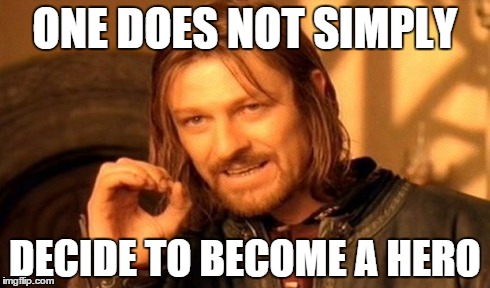
The other trope is the Accidental Hero trope (I did find another title for this trope). This is one I like a bit more, because you can do so much more with it and there’s a growing number of examples of this kind of character. This is a character who, rather than by fate, is made a hero through circumstances and their own choices. They may not be hero material, they may not want to be heroes, they may rather go home, but they rise to become heroes by their own merits. For example, Nathaniel from the Bartimaeus books wasn’t chosen to be a hero, and never set out to be a hero. In the first book, he was seeking revenge for personal reasons, the second book he did it because of his job and because of political reasons. In the third book he does it after a lot of self examination and because he’s scared of the demon uprising.

one does not simply 1

Another example is Teen Wolf (the awesome TV series, not the very bad 80’s movie). Scott McCall became a werewolf by accident, and because of the threats to his family, friends and his town, he has to rise to become a hero and save the day. No fate, no gods, no prophecies. He becomes a hero (and later a very special form of werewolf) because his personality, the events in his town, and his love for the people close to him mold him into a hero.

And there are many more examples. Chuck from the titular series never asked for the Intersect, and he wasn’t supposed to have it. It could’ve been taken out ages ago. But he chose to keep it, use it for his friends, and save the people he cared about. Through that he becomes a spy and a hero. In Doctor Who, the Doctor only wanted to travel and see the universe. He is a hero of his own choice. Lelouch Lamperouge from the anime Code Geass received his powers through luck, and later chose to use them for his own ends and to get his revenge (more antihero I guess, but whatever). It’s a trope with a lot of wriggle room in it, and even better, it’s still underused, unlike the Chosen One trope. So perhaps many more authors should write less Chosen One stories and more Accidental Hero stories.

Of course, there’s no way that this post will cause less Chosen One stories to be written. For better or worse, that trope is popular and will stick around for a long while. Still, I’m hoping for more Accidental Hero stories. I figure most of my stories will feature them. Reborn City and Snake‘s protagonists become heroes (or in the latter’s case, antiheroes) through choice and circumstance. Heck, I might try and find ways to subvert the Chosen One trope while writing Accidental Heroes. We’ll see what I can do.

Which trope do you prefer? What’s your favorite example?

What is a way that one could change either trope so that either one could be a bit more original?

As I mentioned in my last post, I was taking a break from Rose to write, edit, and rewrite some short stories. I started by doing the fourth draft of What Happened Saturday Night, which has gone through quite a number of changes since its first draft. I have to say, this might be the best draft I’ve done so far. It took it a long time to get to where it is now, but I think my classmates would have enjoyed this draft much more than some of the other drafts I’ve turned in this semester. That’s the hope, at least.

In any case, I managed to keep this story about a young girl becoming a werewolf at the same time she discovers her sexuality on the two main characters and on their interpersonal struggles. I also got to explore the sensation of being a wild beast on the hunt, and I think I got the ending just right. I may do some more edits on it before I send it off to someone to critique or to a magazine (haven’t decided which I should do first yet),  especially with a small part of the climax, but I’m hoping that this might be the last time I have to do serious editing to the story.

I hope to submit this one to an LGBT literature magazine, of which there are apparently many, and some of the ones I looked at seem to specialize in a wide range of genres and formats. Maybe an editor from one of them will take a look at What Happened Saturday Night and think it’s the perfect match for their magazine. We can only hope, right?

Well, I’m going to do some reading as research for the rewrite of The Murderer’s Legacy, which I’m thinking of renaming to fit with the new direction I want the story to go in. We’ll see what happens. In the meantime, have a Happy New Year, my Followers of Fear and stay safe out there. Don’t party too hard. That’s my job!

I’m not sure how I did it. I’m not sure I care to know how I did it. I just know that I finished the third draft of “What Happened Saturday Night”, formerly known as “Frauwolf”. And boy, what a writing marathon that was! I just didn’t stop writing.

After hearing the criticisms of my classmates, I went through the story, adjusting the first half or so (the half they really liked) and then completely rewrote everything past page 7 or so (the half they disliked). Throughout the editing and rewriting I tried to keep in mind that, even though this was a werewolf story, it was also a story about two people who really care about each other. A story about human interaction, in other words. And isn’t that all literature? It’s about how humans interact with each other and/or their environment. Even in ghost stories, it’s about human interaction, about confronting our fear of mortality and the afterlife.

I’d do well to remember that for future stories, and not try to create an amazing, complicated universe before working on the human aspect. Perhaps now that I’ve written it down I will.

Anyway, I also played around with some of the already apparent symbolism in the story–using a werewolf as a metaphor for awakening to sexuality, I wonder how many others have used that one? Probably a few–as well as switching the story to present tense. I actually had originally planned to do the second draft in present tense, seeing as Rose is written that way as well, but at some point I slipped back into my standard past tense. Well, it’s closer to what I’d planned, and the ending works better now than it did in the second draft, so I’m hoping my teacher approves.

And speaking of endings, when I was typing out the last words of the story, my iTunes started playing “Va, pensiero”, an Italian opera piece as sung by Russell Watson. It’s such a beautiful piece, and it seemed to fit the ending of the story so well.  I think that’s a good sign for this draft.

Anyway, I sent it off to my teacher. She’ll review it and let me know what she thinks. Hopefully I’ll get some good feedback on this story. Because of the LGBT themes, I figure I could send it to a magazine that specializes in that sort of literature. I’ve already found a few that might be good fits. Fingers crossed that they like what I send them.

Well, I’m tired, it’s very late, and I’ve got more work to do tomorrow (still got a thesis to get through, after all). I’ll see you guys in the morning.  Goodnight my Followers of Fear. Don’t let the werewolves bite.