Posts Tagged ‘living and life’

Andy Weir. E.L. James. Christopher Paolini. What do these three names have in common? If you guessed successful novelists, you’re close. They’re all successful novelists who were originally self-published, their stories caught on, and they eventually began to catch on and one day they woke up with millions of people reading their books, movies in the works and great things in their future.

I’m not sure I’m going to get the millions of people and the movies in my lifetime, but just hearing the success stories of these authors gives me plenty of reason to hope that this could happen to me some day. Self-published writers are having success stories everyday. I even heard of a teen in England whose fanfiction about her and a bad boy version of one of the members of One Direction became a smash hit and got a publishing deal (yeah, I didn’t know that sort of thing was possible either until I heard of it). It’s quite incredible how people can become successes over time in a field that used to be despised by establishment writers.

How do these writers get their successes anyway? Well, it’s different for each one. Andy Weir published through his blog, and it attracted a bunch of readers who wanted to read The Martian in Kindle form. E.L. James published her Fifty Shades trilogy as an e-book and used the emerging field of e-readers as well as word of mouth among erotica fans to gain a following. Christopher Paolini toured around the United States, visiting schools and libraries and dressing up like a man from the Middle Ages to get books into the hands of kids and teens, until the son of author Carl Hiassen found Eragon, loved it, and brought it to his dad’s publisher’s attention. And, if that story about the 1D fanfiction is true, then I think she posted it on WattPad, which is kind of like the YouTube of writers (and which, along with Goodreads, I need to use more often).

One thing that these all have in common, the authors made it easy for interested readers to get their hands on their work. And their work was really good (though from what I hear Fifty Shades is very poorly written), which made people want to read more and keep coming back for more. Thus it sometimes snowballs until…success, I guess.

Now does this happen for all authors? Obviously not, or we’d all be reading books by people whose works may be anything from really good to just plain dreadful. But it could happen to any author who puts in the right amount of dedication to their writing and marketing and who has a little bit of luck on their side.

God knows I’m working hard on all of those when I’m not working or looking for jobs. I’ve had sales that have been very successful and gotten my books into the hands and Kindles of plenty of new readers. And I’m working on an audio book of Reborn City, which is probably my most popular novel right now, so that could open up a whole new field for me: those who like a good story on long car trips or while jogging. And I’ve got a story or two I think would do great as serials published on WattPad and on Kindle, though I’m not sure when I’ll get around to writing them.

And of course, I tell people. I let them know about the books I’ve got out and if they’re interested I give them my cards so that they know where to find them (I’ve already gotten two or three people at work to promise me they’ll get copies of at least one of my books as soon as possible). And I’m always looking for new ways to get readers interested, and usually they work.

So maybe someday I can be, if not the next Stephen King, then maybe the next Christopher Paolini or Andy Weir. Selling enough books to write full time, expanding my media so that more people are exposed to me and maybe find a new favorite author. Anything’s possible. I just got to keep writing, keep working hard, and above all never lose hope.

It’s Friday again, so you know what that means: it’s #FirstLineFriday! On Fridays, I title one post #FirstLineFriday, hashtag and all, and I post the first or first two lines of a potential story, story-in-progress, or published work. It’s something I picked up from a writer’s group I belong to on Facebook, and I’m hoping to spread it through the blogosphere (I already know one author who’s trying it as frequently as she can).

This weeks entry comes from the second novel of a potential trilogy I plan to write some day soon (if I can ever get that far, between everything going on in my life):

As I get older, it seems humanity finds more ways to be afraid of, hate, and hurt itself. If I still believed in God, I’d thank Him that I’m a recluse, but of course I don’t believe in Him and with good reason too.

Thoughts? Errors? Critiques? Let me know, I’m happy to discuss.

All for now, my Followers of Fear. This weekend I plan on working on a short story and looking for whatever job comes after this internship. Wish me luck on both and have a great weekend!

*Warning: this post contains spoilers on a recent novel. Read with caution.*

I heard something very interesting yesterday that I, as a writer, a Jew, and a scholar on the Holocaust have to comment on. When you read that title and saw the words “Nazi Romance”, what popped through your mind? Probably nothing good if you haven’t heard yet, and probably a ton of controversy and maybe some simmering anger if you have heard yet. In case you’re among those who haven’t heard, let me explain:

The controversy centers around a Christian romance novel called For Such a Time by a woman named Kate Breslin that came out last year. The novel has received nods for awards and positive reviews in that time, including a few from the Romance Writers of America. However, a lot of people are taking offense at the subject matter: it’s a retelling of the Biblical story of the Book of Esther set in a Nazi concentration camp with a Jewish woman with Gentile looks and a Nazi commandant as the heroes. Long story short, the commandant thinks this blonde beauty can’t be Jewish and puts her to work in a supervisory role in the camp under a false name. Thus begins a strange, tension-filled romance that some have likened to sexual harassment coupled with Stockholm Syndrome (sounds a bit like my thesis Rose) that ends with the two heroes getting together despite all obstacles and, because this is a Christian romance novel, the heroine converts to Christianity (not like my thesis Rose at all).

Now I have not read the novel–I only found out about this yesterday, I’m not interested in reading a romance novel, let alone one trying to get me to look at Jesus in a new light, and even if I was by the time I finished it the Internet’s short attention span might have moved onto something else–but you can see why this sort of story might cause some upset feelings. The major criticism is that the novel co-opts one of the greatest tragedies in modern history, and the biggest tragedy in modern Jewish history, so as to advance a particular religious aim.

At the same time, some have come out in favor of the book. Anne Rice actually defended the novel, saying that writers should be able to experiment and that the almost extreme outcry rising on the Internet around this novel is akin to censorship and a lynch mob. The organization Romance Writers of America has said something very similar in response to For Such a Time getting two nods for major awards they hand out.

Now, I don’t like Internet confrontation. But like I said, I’m a writer, a Jew, and a scholar on the Holocaust, so I feel some need to weigh in on this subject. First off, I understand the point of view about experimentation vs. censorship. In several stories I’ve written over the years, including Rose, I’ve pushed boundaries of my own comfort zone and maybe the comfort zones of my readers in order to create a better story. Writers should be able to do just that, experiment and push boundaries in the name of creating a great story. To regulate what writers work on or threaten them if they write something someone finds offensive, which is made all too much easier by the anonymity of the Internet, does smell of censorship and makes me think of extremist vigilante justice using a new medium to intimidate people. Almost like a lynch mob, in fact.

Can you really make fiction–let alone romantic Christian fiction–out of a subject like this?

However, I do see why people are outraged over this book. Like I said, the Holocaust was a tragedy. Of the estimated 12 million victims of the Nazi genocide, around half were Jews. To take what was a horrific and defining moment for modern Jewry and use it as a backstory for a romance meant to draw readers close to Jesus is very insensitive to victims and survivors of the Holocaust who lost their lives because of their heritage, as well as those who carry that heritage today. The conversion to Christianity at the end is also very disturbing, because many Jews were forced to convert before, during, and after the war for survival and it sometimes caused trouble for them later in life. To portray it as an act of love…to say the least it seems unsettling.

Ultimately, I feel the best way to view For Such a Time by Kate Breslin is to view it as a teachable moment. While writers should be able to write and experiment as they wish, they should also be cognizant that writing about some subjects (like the Holocaust) requires more sensitivity and caution than others. When dealing with a subject such as this, it’s important not just to know your facts, but how people–particularly those affected directly by said subject–feel about it. That way when you write about it, you are writing it in a way that, while it may not please everyone, it will not cause the sort of outrage this novel has caused.

This was what I did with Reborn City when I wrote it. I’m as far away from the gangster lifestyle as possible, so I did my research to make sure I represented gangsters in a way that would do the lifestyle justice . So far, I haven’t had any complaints.

Thankfully Breslin has already issued an apology, saying she wrote it with the best of intentions and she’s very sorry for any offense or pain she caused to the Jewish people. And while others may not forgive her, I think I can. I think she’s learned form this experience. And when she puts out her next book, perhaps it’ll get the attention that every author wants their book to have, rather than the nasty kind her first received.

What’s your take on this subject? Is Ms. Breslin out of line or was she just trying to write a good story?

Should authors be more sensitive when experimenting with their stories? And is the uproar over this book overblown or justified?

Let’s discuss.

I’ve often compared being an author to being the God of a fictional realm. And to some degree that is true, but it doesn’t mean we’re almighty. Often times the story you start writing won’t turn out to be that story. It’ll change or need to be changed. The personalities of the characters will act and react in ways that you didn’t think they would, or you find yourself not liking where the story goes. No matter what you do, this story isn’t going to go the way you imagined. And when that happens, you need to rethink the story a bit.

It’s kind of like one of those dance routines on a dance show (I used to watch So You Think You Can Dance). Often with those dance routines, they’re trying to tell a story. In this metaphor, you and your story are working together, using words and images as dance moves to entrance the reader and get them to watch the whole routine, aka read the whole story. But of course no routine starts out perfect and along the way there needs to be changes. And sometimes those changes need to be rather dramatic if the entire routine is going to work. Maybe its a few moves that need to be changed, other times the costumes need to be changed, and every now and then the song needs to be changed as well. Otherwise this story just won’t work.

Now some of you may be thinking, “He’s treating the story like a living person.” Well, why not? If the Bible is the living Word of God, and if the Constitution is a living document, why can’t a story being written in a notebook (paper or digital kind) be alive either? Many authors know what I’m talking about, they feel that the story is a being working with them as it gets laid down on paper, that it is having as much say as what’s put down and what’s not. Rather than resist it and insist that the story obey its Creator, it’s better oftentimes to just listen to the story and see what it says.

I had this situation occur to me on the short story I’m working on now. I finished the outline thinking it was going to turn out great. Unfortunately after ten-thousand words I started to realize that this story was not what I wanted. I mean on the outline the story was still good, but while writing it out I just couldn’t get into it. At the same time, I could hear the story in my mind, speaking to me. It said I shouldn’t give up on it (like I would do that, this is a good story in concept) but that I should explore a new angle for it.

So I took a break. I thought about it. And I found a new angle to tell the story with. I wrote out an outline today and got a couple pages in without any trouble. It’s a good start, though how well that goes for the rest of the story depends on a number of things. Like how I feel about the story. And how the story feels about the direction we’re going in.

Writing a story, like making a movie or performing a play or producing an album, is a collaboration, and all involved need to be in sync in order to make the story truly work. Sometimes that means acknowledging that, maybe even if only subconsciously in your mind, your story is alive and you need to work with it, not just on it. The results that occur when you do are truly spectacular.

Do you ever feel like your collaborating with another person when you’re working on a story?

What’s that like for you?

Oh, and an update on the audio book of Reborn City: I have posted it on ACX, the company I wrote an article about last year. I’ve also contacted a few narrators I’ve found on the site who I think may be able to give that right touch of magic for RC. Hopefully at least one will respond within the next few days, and then we can get to work on producing some audio book magic. Exciting right?

Of course if you want to get some RC action now, you can check out its page here and then find links to where it’s available. Enjoy!

It’s that time of the week again, Friday. You know what that means! It’s #FirstLineFriday! On Friday, I post the first or first two lines of a potential work, a work-in-progress, or a published work here on the blog, titling the post #FirstLineFriday (like just now). It’s actually a lot of fun, and I’m hoping that other bloggers will get into it as well and make it a habit.

Today’s entry comes from a novel I might potentially write someday. Remember that short story I was struggling with for over a year before I decided it’d be best if I turned it into a novel someday? Well, here’s what that novel would open with if I were writing it today:

If you are reading this, then it probably means I’m dead. Not an unexpected fate for someone from Whitechapel at the time I knew it, but considering how abnormal my life became after I joined the staff of Strong Manor, my death was probably just as abnormal.

I bet at least a couple of people here see the word “Whitechapel” and are thinking of just one person. Well, I’ll give you this much: you’re on the right track.

But what are your thoughts? Sound interesting? Are there grammatical errors or something I should correct? Let me know.

Well, the weekend’s coming up, and I’ll be resting at home this time around. Hope to get out a few blog posts, work on that audio book, finish a story, and upload a bunch of photos online. And get my laundry done too. Can’t wait to see how I do.

Have a good weekend, my Followers of Fear!

The building where Kristallnacht was planned.

The building where Kristallnacht was planned.

I’m telling you, I had quite the day yesterday. Besides spending half the day traveling between my apartment in Wiesbaden and the train station in Munich, I mean. That was just a pain in the butt, as well as a strain on my wallet (I will not be traveling for the next few weeks because of it most likely).

Well, let’s skip over the long, mostly uneventful train rides, and get right into my day in Munich. I got there a bit before noon despite several delays along the way and managed to grab a bite to eat and some extra water before meeting up with Taff Simon, my tour guide. Taff, a Welsh archaeologist who works on WWII-related sites when not in the midst of giving people tours (and whom I highly recommend for a tour if you’re interested in WWII stuff), was the best tour guide. Since we both were well-versed in Nazi history, he didn’t have to spend a lot of time filling me in on basic Nazi history. Instead, he took me to various locations around the city that had Nazi history attached to them.

For example, our very first stop was the place where Kristallnacht was thought up. Yeah, that place still exists, it’s an old, church-like building with two arched tunnels built into it for through-traffic. Kristallnacht was thought up during a dinner party for the fifteenth anniversary of the Beer Hall Putsch being held inside. To this day there are memorials in one of the tunnels commemorating what had happened.

The coffee shop where Hitler would come up with his speeches. The Devil's Column is in the back.

The coffee shop where Hitler would come up with his speeches. The Devil’s Column is in the back.

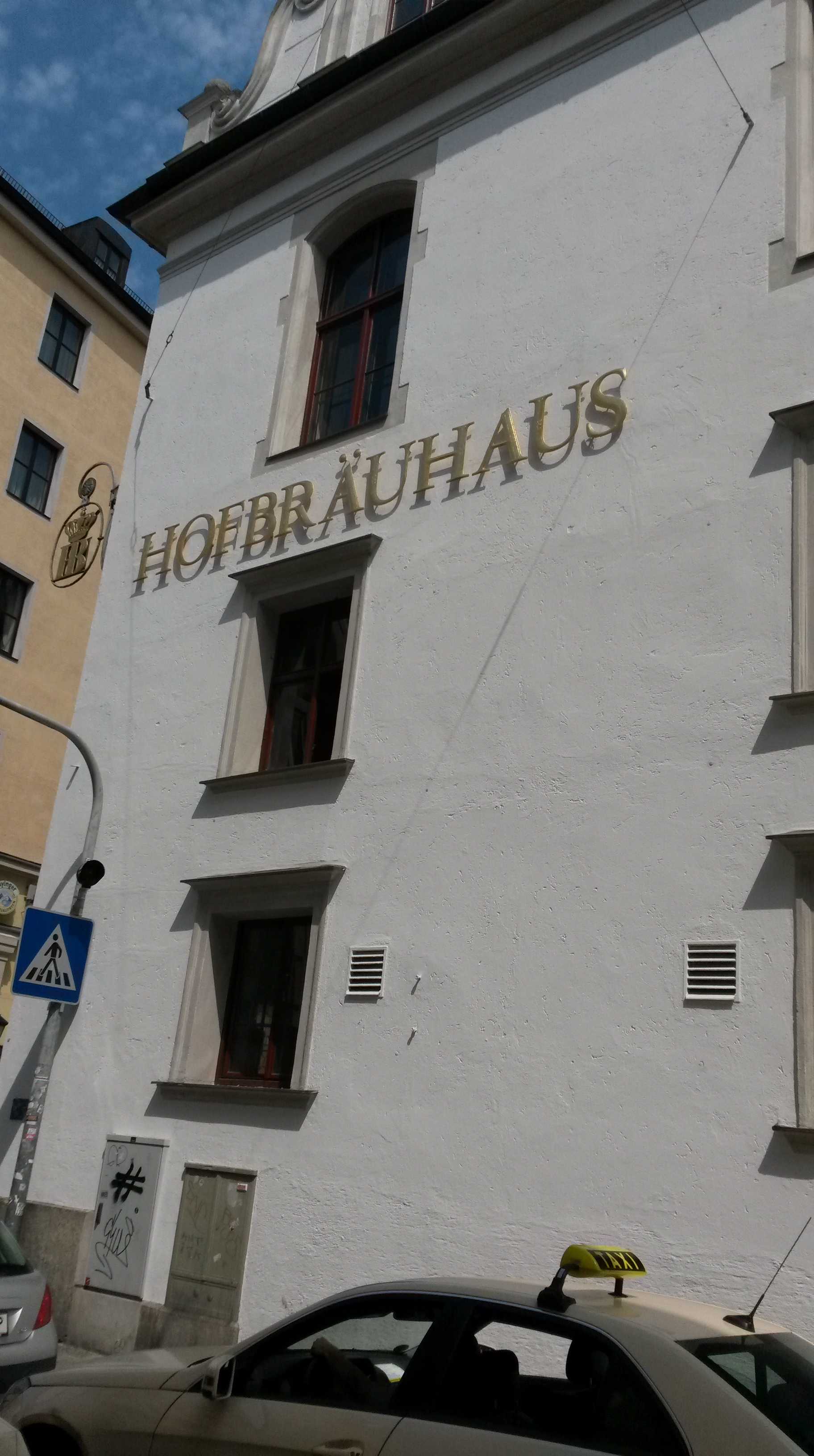
I also got to see the places where the German Worker’s Party, the forerunner of the Nazi Party, met, as well as the meeting place of the Thule Society and the building where the SS was founded. We also visited the spot where the Beer Hall Putsch was stopped by police and an alleyway that was used to avoid the memorial that would later be set up there and became pretty famous consequently. We also visited a few beer gardens that had some history with the Nazis (though no one likes to admit it), including the Hofbraushaus, where Hitler would often give speeches after writing them in a coffeehouse down the street (to this day, the column in that shop he’d sit next to while preparing his speeches is known as The Devil’s Column).

20150808_124604

The Hofbrauhaus, where Hitler gave some of his speeches in Munich.

Really, one of the big things you take away from this tour of Munich is that Nazism really was born here. This was the city where the German Worker’s Party grew and evolved into its more terrifying form that we know so well today, where major events shaping the party took place, where the Thule met and where the SS was born. You even see pieces of that history today, not just in memorials but in buildings and architecture, in pieces of art, and just in the stories told about certain places. It’s quite fascinating.

Taff also took me to the University District of Munich, and brought me to the place where the White Rose, a small resistance group that operated during the early forties, would distribute leaflets hoping to get their fellow students and intelligentsia to resist the Nazis. To this day there are stone copies of their leaflets embedded in the courtyard in front of the medical school and memorials to the group within for their heroism and martyrdom.

He also took me around that area of town, showing me a building where the Nazis used to hold offices and where Hitler signed the 1937 “peace accords”, a square with Greco-Roman buildings set up where rallies were held, the remains of a temple decided to the people who died on the night of the Putsch, and quite a few others. Believe me, when he showed me the building where the Gestapo used to be headquartered, I had a bit of a chill.

One of the stone leaflets in memory of the White Rose.

One of the stone leaflets in memory of the White Rose.

By the end of the tour we ended up back where we started, in the square near the building where Kristallnacht had been planned. As I was hot and nursing a small headache by that time, I thanked Taff for showing me all that I described above and more and asked him to send me information of any future tours he might be doing (including one about some rather gruesome witch hunts and other nastiness that had happened in the city). Taff also directed me to the Hugendubel, a five-floor bookstore that had several books on Nazism and Munich’s history within its walls. I bought a very large tome and headed home after that, feeling like I had definitely made the most of my weekend.

All in all, it was a very exciting and edifying tour. I took somewhere between sixty and seventy-five photos in total, most of which I deemed good enough to send to myself (uploading them to Facebook, Twitter, and Instagram is going to be a pain in the ass). I also got to see locations I didn’t know existed, let alone were still standing, and I felt like I was getting to step right into history thanks to Taff’s expertise and storytelling. And I got to see the city of Munich, which in itself is just wonderful.

The old headquarters of the Gestapo. Actually took a step back in fear when I found out what it was. You can guess why.

The old headquarters of the Gestapo. Actually took a step back in fear when I found out what it was. You can guess why.

And I even got some help with my writing here. As you can imagine, I’ve got plenty of ideas for stories that involve World War II and the Holocaust, including a book series I plan to write someday that I think could be my Dark Tower series (though probably not as complicated). Going to Munich yesterday certainly helped to give me a sense of what living back then was like and helped flesh out the setting for those stories, and I even had an idea for a new short story based on the info Taff told me.

It was just a wonderful trip and I’m glad I went. I’lm definitely going to try to do another post or two about my day in Munich, one showing some more of the photos I took and one about some of the really cool souvenirs I got from the city (trust me, that’s worth doing another post about).

Well, that’s all for now. I’m going to get off the computer and get some other work done. I hope you have a wonderful rest of your day, my Followers of Fear.

And if any of you are ever in Munich and want to go on a tour like I did, I highly recommend giving Taff Simon a call. He’s a great guy, he knows what he’s talking about, and you’ll definitely come away feeling it was worth the trip.Here’s the link to his website if you’re interested.

Well my Followers of Fear, I have to get up extra early if I’m going to get to Munich on time tomorrow, so I have to make this super quick. I just want to let everyone know some very big things they can look forward to in the coming months. So if you’re wearing hats, hold onto them. Or don’t, but be aware that a wind might blow them away while you’re not holding onto them.

Reborn City will become an audio book

Yeah, it’s happening. After a lot of deliberation, asking a ton of people (including all of you a couple of posts ago), and listening to Battle Royale on my phone at work (my favorite novel these days, read my review here), I’ve decided to produce an audio book of Reborn City, which is probably my most popular work among my current published books. In truth, I’ve wanted to do an audio book for a while, but I think now is the best time to start working on one. And with ACX being such a great company to do it with, I think I can trust them to help me make this a reality.

Now of course this’ll take some time to do, so I wouldn’t get your hopes up that this’ll be out by the holidays. I may not even start work on it till I get back to the States. But it will happen eventually, and if the audio book is successful, I will produce Snake and The Quiet Game as audio books as well, as well as any future novel or short story collection.

So get ready for some awesome sci-fi gangster action during long car rides, because this is going to happen.

I’m putting together a new short story collection

This is something I’ve been wanting to do for a while and it did seem for some time that I was going to put out one known as The Dead and the Dying (which still might happen someday, who knows?). But now I’ve actively begun to put together a new collection of short stories and novelettes I’m calling Teenage Wasteland. And you don’t need to be a detective to guess what the theme of this collection is: teens in horror stories!

Even if you’re only just mildly acquainted with horror,you’re probably aware that horror stories often feature teenagers as protagonists (or as easy victims). And I have a lot of stories, both published or otherwise, that have teenagers in them. I think a collection featuring teenagers in horror situations would be very interesting and fun to assemble, so I’m going to work hard to make that happen. Already I have four stories, and I hope to get between eight and thirteen stories in this collection, each featuring protagonists between the ages of twelve and nineteen. And as this collection is assembled, I’ll post updates on my progress, so keep an eye out for Teenage Wasteland, coming soon!

And yes, it’s like the song. I’ve always been rather partial to that song. But as long as I don’t put “by The Who” or quote lyrics in any of the stories, I can’t get in trouble, right? Right?!


Well, that’s all for now. I’ve had a pretty good week, which was needed after the disaster that was last week. I even made a new friend today (Oh good for you! You made a friend! thinks everyone as they unintentionally do an impression of my mother). And tomorrow I’m heading to Munich, so I’ve got to head to bed so I can be ready for that. With that, good night and pleasant nightmares, my Followers of Fear. See you on Sunday, when I tell you all about my time in one of Germany’s most famous cities.

It’s Friday, so you know what that means: it’s #FirstLineFriday! And it’s our tenth #FirstLineFriday in a row, to boot. Wow, hard to believe ten weeks have gone by (five of them here in Germany, I think). Thanks everyone for reading these posts and giving your feedback on them. It’s really appreciated.

For those of you who don’t know, #FirstLineFriday is something that originated in a writers group on Facebook that I’m trying to spread through the blogosphere. What you do is you label a post #FirstLineFriday, then you post the first or first two lines of a potential work, work-in-progress, or published work and ask for feedback from your readers. This week’s entry comes from the short story that I mentioned a couple posts back, the one that’s quickly turning into a novelette. Here’s how I start it off:

Let me just start out by saying that besides computer programs and exam essays, I’ve never been very good at writing, so my apologies if my attempt at memoir narrative sucks.

Funnily enough as I was writing this, I was thinking to myself, “Exact opposite of me.”

But what do you guys think? Critiques? Errors? Let me know.

That’s all for now, my Followers of Fear. Tomorrow I’m finally going to Munich, which means I’ll probably be out all day and won’t come back to blog about my experiences till Sunday. I hope the wait isn’t agonizing for you until then.

Until next time, have a pleasant weekend!

Doing something a little different today. I actually want your opinion, Followers of Fear. Do you remember an article I wrote for Self-Published Authors Helping Other Authors a while back about ACX, a company that produces audio books for authors (if you don’t or you’ve never read it, click here to get caught up)? Since then, I’ve been considering on and off producing an audio book based on one of my books, probably one of the novels.

The question is, would anyone be interested in getting an audio book based on one of my stories? If they did, which one? And for how much would they be willing to buy it?

So I thought I’d ask my readers these same questions. If you feel comfortable, please leave a comment below telling me the following:

  • Would you be willing to listen to a Rami Ungar audio book?
  • Which book would you prefer produced as an audio book, Reborn City or Snake?
  • How much would you be willing to pay for said audio book?

Anyway, thanks for your help, my Followers of Fear. I’m looking forward to hearing your resposnes and making a decision based on them. Until next time!

If you’ve known me for a while, I’m big on trying to correct injustices and inequalities. Racism is a big one for me, and when I hear people say “Racism’s dead” or “It’s not as big a deal as people make it out to be”, I’m among those pointing out why those folks are so wrong. In my own fiction I try to create casts that are very diverse, using characters with different sexual orientations, religions, genders, gender identities, ages, and races, among others.

Which brings me to why I’m writing this post. The past couple of days I’ve been working on a new short story that will probably turn into a novelette, based on how many words I’ve written so far. In it, four of the main characters are white, while one of them is black (and in a relationship with another male character, but I digress). While writing the first scene in the story, I was trying to point out the that Fred, my black character, is black. Why? Because I worry that unless I point it out, they’re going to assume he’s white.

Realizing that I was thinking this made me stop and think about my other works. Why do I take the time to point out a character’s race? Do I do the same thing for my white characters? And why do I assume that they’ll think I’m white in the first place?

On that last question, my roommate here in Germany, who has a background in psychology, was able to provide the answer to this question of mine one morning while waiting for the bus: “Most people tend to transfer their own qualities to others, including characters in stories.” That makes sense to me, and I’ve got a personal anecdote to back it up (I know anecdotes don’t count as scientific data, but bear with me): when I was 17 I spent five weeks in Israel and at one point we passed by a bookstore with some books in English. Having already read through the two books I’d brought with me (no surprise there), I went in, browsed the titles, and bought I, Alex Cross by James Patterson. This was my first Alex Cross book, but sixteenth in the series overall, and at first I didn’t find any indications to clue me into the fact that the protagonist was black. It wasn’t till midway through the book that I realized from the conversation between Cross and his grandma that they were black! Had to really adjust my image of the guy in my head right there, as well as several other characters.

Funny what reading out of order and a few misconceptions can do.

But in this line of thinking, wouldn’t this mean I assume all my readers are white? Well, I know for a fact that’s not the case: while I still have a relatively small readership (both in terms of books and blogging), they come from a variety of backgrounds. Some I know personally and off the Internet, and can attest is that they’re not white. What I worry about is that they’re going to transfer my race, which is white, to my characters. And it’s not a crazy concept: if you had never read or seen Harry Potter and heard about it and then saw a picture of JK Rowling, what would you assume the protagonist’s race was? I’d say you’d guess white.

And in a strange way, I’m helping my readers come to these assumptions. Unless I’m noting how pale a characters’s skin is, I generally don’t do anything to indicate a character is white. In Snake, where a majority of the characters were white, I did very little in terms of description when it came to skin color, and yet I’m pretty sure everyone who read the book was able to figure out my characters’ races just fine. The same in Reborn City: except for noting that Ilse has very pale skin, my white characters didn’t get any indications to clue the readers into their whiteness, while every character of another race did get indicators.

So why is there this collaboration between my readers and I? And do other authors do this?

For the second question, I’d say yes. I’ve seen plenty of other authors do this, including idols of mine like JK Rowling and Stephen King. And for the first, I think it might have something to do not just with the transference thing my roommate mentioned, but also with the society I live in. Think about it: while America may have a black president now and there are more people-of-color in the media than ever before, it’s still a very white-centric society. Because of this, I think that means, along with transference, I don’t feel the need to give indicators for white characters because in America, whiteness is still considered “the norm”, and my readers won’t imagine my characters a different color unless told otherwise because they’ve been conditioned to feel that whiteness is still “the norm.”

And I’m sure that if I were of a different race in a different country or culture, the same concept would apply. If I were Middle Eastern writing in Israel, probably all my characters would be Israeli Jews or Palestinians and I’d give indicators for tourists or Ethiopian or Russian Jews. If I lived in China and was Chinese, I’d probably only give indicators for non-Chinese Asians or Americans or something along those lines.

So to wrap this whole post up, the way my mind works, plus the way my readers’ minds work and the society we were raised in all collaborate in this strange need I have to mark my characters so as not to give my readers a false impression. Funny how that works. Even weirder that it makes sense to me as I write about it, and that I’m not sure whether or not I feel anything about it other than it being strange. Maybe that’s just how one should feel about something like this. Not liking or disliking it, but accepting it as one of those weird facts of life.

Well, I’ve gone on and on about this subject for a while now. Now I’d like your opinion on it. Do you think what I’m doing with non-white characters here is strange? Why or why not? And do you ever do the same thing in your writing? Why? Let me know, I’d love to hear your thoughts, Followers of Fear.