Posts Tagged ‘novel’

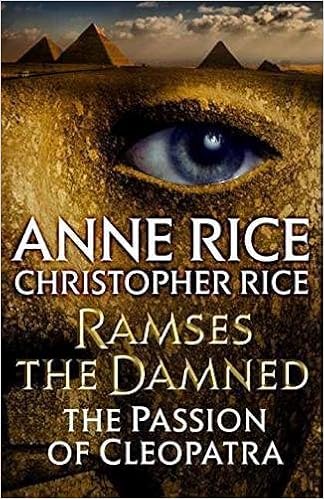
I haven’t read the original Ramses the Damned novel since I was bar mitzvah age, but I remembered enough of the details (and remembered more during the reading of the book) to be very excited upon learning earlier this year that Anne Rice had written a sequel twenty-eight years after the original with her son, author Christopher Rice (whose books I need to put on my reading list one of these days). And now that I’ve read the Rices’ first collaboration, what do I think?

Well, you know how George Miller revisited the Mad Max franchise with Fury Road several years after the last entry, with a new cast and crew to help shape his vision, and the results were pretty awesome? It’s kind of like that.

 Ramses the Damned: The Passion of Cleopatra revisit Ramses and Julie Stratford shortly after the events of the last novel, preparing for their engagement party and their lives as globe-trotting immortals. However, news that Cleopatra is still alive reaches their ears, and there’s a chance she still holds a grudge against them. And as if that weren’t enough, new forces threaten the immortal couple, including an ancient queen whose very existence will turn the immortals’ world upside down.

Honestly, I could not tell this was a collaborative work. This may be because I’m unfamiliar with Christopher Rice’s work, but it’s more than likely he’s very good at imitating his mother’s style. Whatever the reason, the novel has a great story and moves along at a nice pace. The expansion of this fictional world to include new elements and characters didn’t feel forced or weird, and the twists and dramatic moments really allowed you to feel the surprise and attention when they occurred. You can’t complain about that.

And let’s talk about the new characters, because they were great! Bektaten’s addition to the cast was a real shake up, as was her companions Enamon and Aktamu (I hope I didn’t butcher those names trying to spell them). There’s a gravitas to them that leaps off the page and commands respect not just from characters, but from readers. It’s as if their many centuries have allowed them to transcend many human flaws and become something more. Imagine what they could be like in our modern world! It’d be truly something to see.

But of course my favorite new character (and possibly my new favorite character) is the aptly named Sybil Parker, an American author whose dreams cause her to be roped into this strange and magical world.* From the moment she appears on the page, she is just so interesting to follow, as her part in the story is so full of mystery and a bit of intrigue. And her arc, going from this timid homebody to this brave young woman who doesn’t bat an eye at immortals, was masterfully written. 

I don’t have any real problems to point out with this story. Possibly a bit more of Elliot Savarell would have been nice, but that is probably nitpicking on my part.

All in all, Ramses the Damned: The Passion of Cleopatra is a great return for a story we had thought finished long ago. On a scale of 1 to 5, I give the novel a 4.8. Pick it up, and get wrapped up in the story (been waiting a week to make that pun, and it was worth it).

But tell me, what did you think of this novel? What immortal creatures will we get from Anne (and possibly Christopher) Rice next year (I’m hoping angels)? And which Christopher Rice novel should I put on my reading list? Let’s discuss.

*Sounds like my dream life right there. Well, hopefully the former will be achieved someday soon.

“The Power of Friendship!” as symbolized in Yu-Gi-Oh’s famous hand smiley face.

So yesterday I watched a YouTube video about a common trope in fiction (you can check it out HERE), which is (say it in your heads with a big, echo-y voice) “The Power of Friendship!” Now, if you aren’t familiar with the trope and you didn’t have time to watch the video, “The Power of Friendship” is a trope in which the bonds of friends is so powerful, it becomes a power in and of itself, capable of cosmic-like acts such as giving heroes power ups, stopping psychic mind readings, snapping people out of brainwashed states, and occasionally even defying gods. This power shows up in a ton of popular media, including a ton of anime and manga (the Fairy Tail series  practically is nicknamed “The Power of Friendship” manga).

Now the video I linked to goes into much more detail about the various intricacies of this trope (go watch it if you do have the time, the channel that produced it is awesome), but I wanted to focus on one particular aspect of “The Power of Friendship” trope that the video didn’t go into: how it surfaces in the horror genre. Or rather, how it doesn’t surface in the horror genre. At least, not all that much.

So if you didn’t watch the video (and you’re missing out!), the trope works like this: you have friends, and those friends can help you out of a bad situation, whether that be isolation or a powerful demon overlord is about to destroy the Earth and your power alone is not enough to destroy the demon’s power. It can be a metaphorical power to help a character out during a bad patch, like the former situation, or it can be a literal power and the equivalent of taking one of those mushrooms in a Mario game, like the latter situation. Thus, “The Power of Friendship!” And you can kind of see why it shows up so much: we all wish we have that power, or believe our relationships are that powerful.

But horror doesn’t feature this power as much as other genres, and there’s a reason for that. Horror is horror. It incorporates the darker aspects of the world around us and sometimes amplifies them for maximum effect. And in real life, friendships aren’t as powerful and as lovely as in fiction. In the stories, friendship is powerful and unyielding. It can overcome all sorts of obstacles, and the more you try to destroy it, the more it bounces back and kicks bad guys in the ass. But in reality, friendships grow, cool, and break all the time. It can take only a little bit to destroy a friendship, and a lot to repair it once it’s broken. Horror writers not only recognize that, but incorporate that into their stories. And it’s such a well-known fact about life, writers don’t draw attention to it, because it’s so well known among readers.

That’s not to say that “The Power of Friendship!” doesn’t show up in horror fiction at all. For example, Stephen King’s It pretty much says that the friendship of the seven main characters is what allows them to fight the malevolent entity in their town.* It just doesn’t say it as loudly as other media does, and also tells the reader that the characters’ friendship, while powerful, can be broken or is less effective if they aren’t all in sync or allow their fear to divide them. This is what leads to that one infamous scene in the novel, and is also shown in the new movie after the first fight with It.

Weirdly enough, the power of love or family is shown more than the power of friendship in horror, and I’m not quite sure why. Perhaps it’s because love and family, unlike friendship, has a more powerful evolutionary purpose, and therefore is given more power in fiction in general. If you’re willing to do more to save your perfect partner for creating offspring or the lives of your offspring, it’s going to show up more in stories than the grouping of creatures of the same species to ensure survival.** Hell, a lot more of my stories revolve around romance and family than friendship. One of my stories even involves a friendship gone bad, but that’s about it.

If “The Power of Friendship!” can be portrayed as it was in It, you can include it in horror stories more effectively.

That doesn’t mean we can’t include “The Power of Friendship” in horror stories. It can be used, but it’s more effective if used as it was in It: not overstated and a bit more realistic.  Showing a friendship form, grow, and overcome obstacles in a story, without drawing too much attention to it and showing how fragile the friendship can be under certain pressures, will work fine for the horror audience. If you go for overblown storytelling and basically say, “The Power of Friendship can overcome anything,” it will take the audience out of the story. Let the friendship’s strength demonstrate itself, rather than shoving it in through dialogue or just outright stating it. In other words, show, don’t tell.

While still not that common a trope in horror, “The Power of Friendship” can be part of horror. It may require being handled differently than in other genres, and with a bit more realism (weird for “realism” to show up in horror, but there you go), but it’s not impossible. You just need the right touch, and “The Power of Friendship” can best even shapeshifting entities that take the form of clowns.

That’s all, Followers of Fear. I’m in a bit of a blogging mood right now, so expect more posts from me soon. Until then, pleasant nightmares!

*There’s also some sort of power up thanks to a turtle from another universe, but let’s not get into it, shall we.

**Best explanation I can come up with given my aromantic nature and already jaded worldview.

Recently, someone familiar with my writing compared some aspects of my story with anime. This, for me, was a huge compliment, because I am a hee-yuge fan of anime and manga. I’ve read and watched more series than I can count, and I consider some of the stories I’ve read over the years as having a very beneficial influence on my writing style, allowing for better storytelling and characterization. And I believe wholeheartedly that anime and manga can up the game of other fiction writers out there, even experienced ones with plenty of novels or short stories under their belts.

“But wait,” I hear my readers saying, “how can silly Japanese cartoons up my writing game?” Well, my dear Followers of Fear, just like Harry Potter is more than just children’s fantasy stories, and just like I’m more than a dude who enjoys scaring people silly (I actually have a growing doll/figurine collection and enjoy the ballet and the theater), don’t let first impressions about the media get in the way of looking a bit deeper. Anime and manga have so much more to them than meets the eye:

1. It’s an art form. We see literature as important creative works that are a reflection of and an influence on society. So is painting and illustration. But for some reason, the combination of the two mediums are never treated as highly, even when they lead to huge box office and critical success with movie adaptations. And in my opinion, that’s just wrong. Creating decent literature or decent art is extremely difficult, no matter the genre or what is being portrayed. Imagine what must go into doing both well at the same time! If one is good but the other is bad, the series, comic book or animation, will suffer, so these artists are basically combining the two art forms in order to create something appealing to audiences. That is worthy of respect (especially when you consider that manga and anime don’t always get to rely on characters that have lasted 80+ years and have established fanbases).

That being said…

2. There are a multitude of stories to choose from. Despite often going into very deep subject matter, comic books and animation have this reputation for being more family or child-oriented than adult-oriented. And although comic books have been recognized for their serious and mature themes and content, for the most part it’s hard to find animation that, even when aimed at adults, isn’t comedy or relies a lot on comedy. I can only think of one or two off the top of my head.

Anime and manga, on the other hand, span a wide multitude of genres and age ranges. Yes, some are comedic or have lots of comedy elements, but there are plenty of stories that are extremely serious or even plain portrayals of normal lives. Death Note (not the crappy American version) goes deeply into questions of whether the ends justify the means, especially in terms of curing societal ills, all while presented as a psychological cat-and-mouse thriller. Great Detective Conan (or Case Closed, as it’s known in the US), has nearly a thousand chapters/episodes focusing on a kid solving murders a la Sherlock Holmes observation and deduction. With the Light tells the story of a family raising a child with autism. Tell me if any of that sounds like silly cartoons for children.

And that’s just the tip of a very big iceberg. There are all sorts of stories out there, romantic to comedic to scary to inspirational to musical to educational to even some where you wonder who was mad or indecent enough to make them (I’m looking at Makura no Danshi for the former and Kodomo no Jikan for the latter. Google at your own risk). If you can think of it, there’s a chance there’s an anime or manga based around it.

So if you’re looking for inspiration for a new story, try the Japanese. Chances are, there’s a story that could inspire your next work.

3. Characterization. In Western stories, characters are often pretty much defined from the moment you meet them as good or bad guys. Within a few minutes, you not only have a pretty good idea of where they align, but how you feel about them: love, hate, support, fear, root for them to get the girl. This doesn’t usually change, except perhaps if they’re a twist villain revealed in the third act. Rarely do you see a character whom you aren’t sure whether to love or hate, whether they’re good or bad. A character who straddles the fence, in other words, and you’re never sure where they stand until near the end.

If a medium can make me wear this sweatshirt 25 years after a show’s premiere, shouldn’t you at least consider checking it out?

Anime and manga, however, do this very well. They’re very good at telling stories about characters whom you’re not sure how to feel about them, because they’re able to take the time with these characters and show various sides of them over the course of the episodes or chapters. Sasuke Uchiha from Naruto is a prime example: at various points he’s a hero, a villain, a tragic antihero, etc. And you’re never sure whether to hate him or cry for him or what (generally I don’t like him, but that’s just me). And even when a character isn’t given this treatment, they’re often given great character development. Often characters are all good with a few flaws, or all evil with a few good qualities, but anime tends to branch out. You’ve got protagonists who are defined by their anxieties, or heroes who do horrible things but are doing it for good reasons you even sympathize with.  It ranges quite a bit, and it’s done quite well.

4. And finally, it’s entertaining. We all write stories for a variety of reasons, but at the core of it, we want to engage and show people a character worth following, a story worth getting into. And anime and manga do that a majority of the time. Sure, some stories do fail in that regard (looking at you, Clannad), but the vast majority have been tales that have endured the test of time and continue to pull in new audiences. Pokemon is twenty years old and Sailor Moon is twenty-five, but they still continue to entertain and even produce new content. Clearly, there’s something about these mediums that pull people from around the world in far past childhood.

And any medium that can have that sort of influence is worth checking out, if you ask me. Even if it’s not normally up your alley.


And that’s just a few of the reasons writers should check out anime (there may be a Part 2 someday). But tell me, were there any reasons I missed? What series do you find entertaining or influential? Or do you need a recommendation on where to enter the medium? Let’s discuss in the comments below.

Until next time, my Followers of Fear, pleasant nightmares.

At the time this post is being published, it is the American holiday of Thanksgiving. Despite the holiday’s questionable origins (a discussion not for this blog), this is a holiday for being thankful for all you have. And while a lot of us are surprised by how fast this year has gone by (seriously, how the hell is it already late November?), for many of us it has been a stellar year. I know that’s the case for me. I’ve got plenty to be thankful for this year.

And if it’s not too much trouble, I’ll run down some of those things I’m grateful for (I swear, this won’t be too long, and I’ll try not to turn it into bragging):

  • I’ve published two stories, the sci-fi novelette Gynoid and the fantasy romance short story What Happened Saturday Night, on Wattpad, and both were very well received. I also wrote half of the novel Full Circle, edited the entirety of Rose (and will probably edit it again, as soon as I have feedback from both my beta readers), made good progress on a new story, and had more ideas for other stories than I could ever write.
  • While I work on my writing, I also have a good job that allows me to do really rewarding work with a great team. That job also has great pay and benefits, so I can afford to pay my rent and my bills, never go hungry, and even put away some cash into savings. And every now and then, I can even afford a little splurge for things like wall art, a new addition to my doll/figurine collection, or even awesome shows (heck, sometimes the job gets me discount to awesome entertainment in town).
  • Speaking of rent, I have a great apartment in a good area near where I work. I can afford to live on my own, and do what I want within my apartment, so I don’t have to worry about anyone seeing me at my kookiest. And since I’ve lived here for nearly a year and a half, I’ve had time to settle in and make it my happy place, a great place to relax, be creative and occasionally entertain friends (Joleene Naylor knows what I’m talking about).
  • My health has improved greatly since the New Year. I’ve been eating healthier, cutting back on the sweets, and so have lost about thirty extra pounds. My back problems have also improved, thanks to the ongoing treatments of a really good chiropractor and my improved diet. I feel better than I have in ages, and as long as I keep things up, I’ll continue to get better (though I doubt I’ll ever be fit enough to be a prima ballerina or a bodybuilder).
  • I don’t have a driver’s license, but I’ve made incredible progress towards getting one. And with a bit more practice, especially with maneuverability and parking, I could have my license within the next year (though whether a car comes with that is another issue entirely).
  • I live close to my family, and we’re all on good terms for the most part (though I would not want to live with any of them again if I can help it). I also have plenty of friends, and I’m glad to have their love and friendship everyday. I know that if I need them, they will give me their support, and help me through another day.
  • Finally, I have you, my Followers of Fear. Over the six-plus years I’ve been blogging, you’ve stood by me, seen me at some of my best and worst moments, and posted your thoughts and encouragement, and even bought some of my published work. And over this past year, Rami Ungar the Writer has grown significantly, to the point where I’m less than fifty followers away from hitting the thousand follower milestone. It gives me such joy to write for and interact with you guys every day, and I hope I can continue to do so for ages to come.

Of course, this is just a fraction of the many things I’m thankful for, but I’m thankful for them all nonetheless. And I’m glad I’m aware of them and thankful for them, because I can think of a number of people who are just as lucky as me, or even luckier, and yet are miserable. They’re not satisfied with what they have and they constantly want more.

My mother and me when we went to see Swan Lake this past weekend. Not only was it an incredible show, but I got to experience it with someone I dearly love and who gets me on so many levels. I’m incredibly thankful for her and our relationship together. Also, I’m looking at the button on my phone camera, in case you’re wondering where my eyes are looking.


Now, there’s nothing wrong with wanting more than what you have. I want to expand my readership, write more stories, and get more of them published. Heck, I wouldn’t mind being able to write full-time if I could. But some people, they just don’t appreciate what they have. They could have a loving family, a big house (or several), a nice car (or several), and enough money for vacations abroad and fancy gadgets and whatever. But they aren’t happy. They want more. More stuff, more sexual partners, more fame and prestige. A friend once told me he talked to a man who was depressed because he didn’t receive as big a Christmas bonus as someone else in their office, even though he felt they did the same work and the same amount of work. Both bonuses were in the five-figure range, which boggled the both of us. How could anyone be in a position where that sort of money is given as a Christmas bonus and NOT be happy?

And that’s why I’m thankful for one more thing: I’m thankful that I can recognize what I have. Some people can only recognize what they don’t have, and that bites deeply into their happiness. They may feel good when they get a promotion or they bed someone deeply attractive or they get that new house on the Italian coast, but it’s only a temporary drug high, and the crash they feel after the high wears off just leaves them as empty as before. It’s not a true happiness, not at all.

And that’s why I’m grateful for one more thing: that I’m capable of recognizing all that I have and that I’m grateful for. Yeah, I’m not rich or famous (though I could be someday), but I’m glad for everything I have. I worked hard to get it, and I know it could be taken away all in an instant with one bad day. So when something new comes into my life–a new follower, some good news on the writing front, the chance to do something fun with friends or family, or even a new doll for my collection–that drug high will go away, but a good feeling will remain. I’m grateful for it all, and I hope I remain that way for the rest of my life.

So this Thanksgiving, my Followers of Fear, let’s all be grateful for what we have, and express that gratitude as best we can. Because we could have nothing at all, or we could have plenty and not realize it. I prefer to have some stuff, and be glad that I do have them. And if you ask me, that’s a good way to go about things.

Happy Thanksgiving, and until next time, pleasant nightmares.

Me being thankful for all that i have. And thank you, Sailor Moon, for constantly giving me so much to work with, from entertainment to story ideas to illustrative GIFs.

Voice. Sometimes, I feel this can be the hardest thing to create in a story, especially when you’re writing in first person. You, as the writer, have to create this unique person, someone with a personality, desires, fears, likes, and pet peeves. And then you have to give them a unique speaking voice, including vocabulary and word choice, syntax, grammar, accent, and all that can be really difficult. A lot of us have that distinct writer’s voice* in our heads that is always arranging our sentences on the page (or on the blog post) in a way that reads like what we consider good literature.

And it’s even more hindered when you consider where our writer voices come from. You see, I have this hypothesis that every writer’s storytelling voice is born when they read a great story and the narration resonates with them on a deeper level. This could be their own voice reading their first chapter book as a child, a parent reading to them a fantasy novel by their bedside and making the story come alive, or an audio book narrator with a great speaking voice behind the words. No matter how many other stories we may read or listen to later in life with their own amazing narrative styles–the childlike humor and observations of Alice in Wonderland, Stephen King’s odd characters and descriptions, or the three women from The Help and how they each view their situation from vastly different backgrounds and dispositions–it will always be this original narrator who contributed the base DNA for your writer’s voice, and whom a part of you will always spend a good amount of time both trying to emulate in power and break away from so you don’t sound like a copycat.

For me, I always go to Jim Dale’s narration of the Harry Potter audio books. Harry Potter was a big part of my childhood, and caused me to start writing in the first place. My first attempt at writing was something like a Harry Potter gender-bend fanfiction. And Jim Dale made the text come alive, in ways the movies and the books alone couldn’t. Whenever I wrote, in the back of my mind, I was comparing and contrasting to Jim Dale’s work. And while I’ve managed to develop my own voice, it’s still a fight that goes on in the back of my head up to this day.

So basically, I’m fighting Jim Dale in my head while trying to create an original narrator’s voice on the page.It’s an image perfect for a Family Guy cutaway gag.

Struggling against this guy in my head every time I write.

So what can you do when you’re trying to create a distinct voice for your narrator or narrators? What do you do when you want to make Skeeter sound different from Abilene and Abilene from Minnie, or Cormoran Strike from Harry Potter, or Lestat from Louis? And can I come up with any other characters for comparison? The answer to the latter question is yes I can, but I’ll stick to the former if you don’t mind too much.

As many of you know, I’ve been working on a new story while I wait to hear back from my beta readers. And as I mentioned in a previous post, I’m taking a more organic approach by writing this story without much planning and seeing what evolves from that. And weirdly, that approach has allowed me to tap more fully into my narrator’s head. I’m not exactly sure why, but I think it might have something to do with the plotting vs. pantsing thing I talked about in that previous post. When I’m plotting, I think out every detail of the story, not leaving much room for change or experimentation. Thus, the narrator’s voice becomes secondary to telling the story I want to tell, in the way I want it to be told, and the narrator’s voice ends up as something close to default writer’s voice.

But while I’m pantsing it (or plantsing it, as my friend Kat Impossible informs me), that particular mental clamp isn’t in place. Thus, without having to worry about getting my story from Point A to Points B, C, D, E and F (I’m not even sure if I have a Point F at this point), I can focus more on my narrator and develop her voice. I’ve actually discovered through, just by letting my character be herself and make her observations about the world, she’s a pretty frank and kind of funny. At one point, after saying “her heart fluttered,” she says she sounds like a romance novel, which she hates reading, and her friends consider that a horror “on par with the bombing of Pearl Harbor.” I wrote that in, and I ended up laughing!

I might have to pants/plants my stories more often in the future.

But what if you already write by pantsing or plantsing, or plotting is the only style that works for you? Well, I might have a few suggestions:

  1. Write out the traits of your narrator. If your narrator is a character in the story,  then obviously they have a personality (unless this is an 80’s movie, in which case they’re bland and white). Think about them and what their role is a story. What do they want? What do they stand to lose if they fail? What’s in their past? Who do they hang out with? Figuring this out can give an insight into the character and therefore to the voice that they give.
  2. Have a conversation with the narrator. I forget where I got this, but it’s a good one to use. Grab some paper and a pen, and have a conversation with your character. Ask them questions, and then write down what you’d imagine their responses to be. It seems a little mental, but it’s pretty effective, and can be used for other issues in a story (motivation, plot holes, etc).
  3. Spend time narrating scenes in your head. I’m the kind of guy who spends a lot of time planning the story in my head before I write it (the consequence of having a full-time job and only one me to write). Consequently, there are scenes I’ve written and rewritten several times over in my head. During that time, a character’s personality, worries, beliefs, and of course their voice will emerge through several mental revisions. By the time you get the actual writing, you already have the narrator’s voice down pat.

Voice is always difficult to get right for any narrator, but there are a variety of ways to help you get that voice. Whether it’s writing something differently than usual, or having an imaginary conversation, you can discover your narrator and their voice. And from there, you can make your story that much better.

What do you think of finding a narrator’s voice? Do you have any tips for doing so?

*The writer’s voice, by the way, is very different from our speaking voices. I’m never this eloquent in real life. I actually stammer a bit, my mind racing to get the best sentence out while my mouth is already saying the words. It’s quite annoying, and sadly the only time I’m not plagued with it is probably when I’m telling a joke (usually a stupid one). Oh, wouldn’t it be nice if we could speak like we write blog posts or stories? It might make a few things easier.

Reborn City, Book 1 of the Reborn City series.

I almost totally forgot this was happening today. I’ve been attending a training this week for work, so that’s been occupying most of my thoughts, and on top of that, yesterday was Halloween, so I totally forgot that anything else was happening this week. Lo and behold though, one look at my Facebook memories today showed me otherwise, and reminded me that today is the four-year anniversary of the publication of my first novel, Reborn City.

Now if you don’t know what Reborn City is, it’s a science fiction novel I wrote back in high school, and which I published back in my third year of college. The novel follows the Hydras, a street gang in a dystopian future whose leaders have incredible powers, and the shadowy government corporation that shows a great interest in the gang. A sequel, Video Rage, came out last year, and the third and final book in the series, Full Circle, is in the works.

Of the stories I’ve published, Reborn City is probably the one that’s gotten the best response from readers, even if it doesn’t have as many reviews as The Quiet Game. A lot of people have gravitated to the world of the story, and to the struggles of the characters, as well as to the intrigue and action that takes place within. But don’t take my word for it. Here are some of the top reviews:

This is an extremely commendable effort by a new young writer, whom I believe we will see much more of in the years ahead. Rami Ungar’s vision of a frightening dystopian future is peppered with those elements that make us all human. There are quite a few surprises in the book, and I am anxious for the next volume in the series to be released.

–Marc M. Neiwirth

This is not a genre I typically delve into, but I took this book on vacation and couldn’t put it down. The plot had me turning pages at quite the clip. The characters were unique and interesting and the imagery had me creating my own visual of what Rami’s interpretation of the future looked like. For first time novelist, Rami Ungar, this was an outstanding showing of talent and commitment to his passion of writing. Looking forward to seeing what he comes up with next!

–Michele

As a reader who does not read books in this genre, I must admit that I could not put down the book. I attribute this to the talent of the author. I am looking forward to reading the next books published by Ungar. I recommend this book to readers who enjoy action with features of supernatural powers and sci-fi.
–ENJ
These and other reviews are the reason why RC has a 4.6 out of 5 rating on Amazon (Video Rage has also gotten some good reviews, but I won’t post them here).

Video Rage, Book 2 of the Reborn City series.

If that short description of Reborn City and the reviews made you want to read the book, I’ll include the links to check it out down below, as well as links to Video Rage. You can also click this month’s featured novel, which happens to be Reborn City, to get taken directly to its Amazon page. And if you end up getting a copy and reading it, please let me know what you think in a review. Positive or negative, I love feedback and I would love to hear (as well as probably post) yours.
Feedback also makes me a better writer in the long run, so you’d be doing me a couple of solids as well.
And if you’re wondering how Full Circle is coming along, please know that I haven’t forgotten about it. I’m just taking a break to work on some horror stories, as well as to make sure Rose eventually gets published. As more news materializes, I will let you know.
Until next time, my Followers of Fear. Pleasant nightmares, and HYDRAS!!! (That makes so much more sense if you read the book).

Someone is going to read this title and be very confused as to its meaning. Most likely, my parents. Or any juvenile who thinks pulling down a classmate’s pants is the height of comedy.

So, if you are wondering what the hell that title is about, it refers to two different styles of writing stories. Plotting is when writers plan out every part of the story. Everything, from beginning to middle to end, is planned and…well, plotted. Obviously, not everything is done according to a plan. A lot of stuff, like the wording in the story, is decided upon while writing. But the major elements–plot, characters, grisly character deaths involving giant monsters ripping deceitful high schoolers in half (no wait, that’s just me)–are decided upon before the story is even begun.

Pantsing is the exact opposite of that. Writers write by the seat of their pants and just make it up as they go along. There is some planning involved (for more on that, read this article by my friend/colleague Ruth Ann Nordin), mainly what sort of story arc you want to go through, what sort of characters there are, and perhaps some scenes you hope to include in the story, but for the moment it’s pretty much whatever comes out of your fingers at the moment you’re writing. The dialogue, action, and the descriptions are created spontaneously.

Plenty of writers have their own preferences. Stephen King is definitely more of a pantser: in his memoir On Writing, he compares writing stories to unearthing an artifact from some ancient civilization, revealing a little more with every dig of the shovel and brush, never knowing what you’ll uncover. JK Rowling, on the other hand, is probably a plotter. After all, she spent years putting together the seven books of the Harry Potter series, laying groundwork and hints of what is to come.  And you don’t just come up with stuff like Hallows and Horcruxes like that on the spot. No, she had those planned for ages and ages.

Personally, I’m a plotter. I usually have every scene planned out, especially with novels, where I tend to outline the story, and then do several drafts of the outline, before I get to the actual story. I’m not sure why. It might be I’m a bit of a control freak who takes being the “God of his fictional universe” a little too seriously. Or I just learned to write like that, and it’s done me well so far. Either way, it’s what I’ve done since I was a child, and it’s worked for me.

Writing by the seat of these, LOL

So why the hell am I talking about this? Because for the first time in I don’t know how long, I’m actually writing a story and pantsing it!

I mentioned in the post I wrote after I finished editing Rose that I was going to work on a couple of shorter works for a while. The first of these stories involves a bunch of people being trapped within a relatively small space, and this is going to be the meat of the story. In a confined space, tensions can get high, and the scenario of the story will probably raise those tensions a lot higher. So, I decided that it might be better to write this story by the seat of my pants, rather than plot the whole darn thing.

I figure that, rather than planning out that entire part of the story, I might instead plan only a few scenes and some plot points that I hope will come up in the story, and see what happens. I feel that will be more organic than just planning out who will lash out at whom when and what that leads to. The conflict will feel more real that way, not just to readers, but to the characters themselves, and to me too. If the conflict in a story feels fake, no one will buy it, and the story will suffer because the reader will disengage. Hopefully I can avoid it by changing things up.

I’m also kind of hoping I can experiment a little with humor in my stories. As I said in a previous post, I don’t include humor in most of my stories, and one of the reasons I think that might be is because I’m a plotter, so I keep in mind how dark my stories are from beginning to end and don’t insert humor because of how dark they are. I’m wondering if writing by the seat of my pants will give me more room to insert my style of humor, which is very situational, and make it not as forced as it might be under other circumstances.

It’s not a big reason why I’m trying pantsing with this story, but it’d be a perk if it happened.

So I’m trying to pants my way through this story, with only a few scenes planned, only eight characters fleshed out, and just a general idea of what I want to happen with this story. I have no idea what will happen, if this will be something I’ll do more often, or if the work I produce by pantsing will be any good. However, like every good writer, I have to be brave enough to keep pushing boundaries and to try new things. At least some of those new things have to work. Am I right?


That’s all for now, my Followers of Fear. I’ve got a few more blog posts I want to put out this week before I start on this story I’ve mentioned and fall into a proverbial rabbit hole, so I’m going to be putting those out one after the other this week (and maybe next). Hopefully by the time those are done, you won’t be sick of me.

Until next time, pleasant nightmares!

From left to right: Joleene, Charles and I in my apartment stairwell.

Last night I had two wonderful visitors come to visit me at my apartment: my friend and fellow writer Joleene Naylor, whom you’ve probably seen around the blog quite a bit, especially in the comments, and her husband Charles, who were passing through Central Ohio on a trip to West Virginia, and made a point to stop by.

I’ve been blogging and Facebooking and tweeting for over six years, so I’ve had plenty of time to make friends with numerous other writers, Joleene among them. Unfortunately, the distance between me and all these other writers often means we’re confined to online interaction. So when an opportunity to visit comes up, I get really excited (and a little nervous) and look forward to meeting them. And last night, I finally got to meet Joleene in person.

Joleene and Charles arrived in my apartment building sometime after eight last night, after having to navigate through a ton of construction on the interstate (don’t you hate it when that happens?). I greeted Joleene with a hug (normally I ask whether or not we should hug or shake hands, but here it felt natural), and shook hands with Charles, whom I’ve occasionally seen tagged on Facebook but never actually seen in photos or in comments before (apparently he’s one of those people who manage to get by without being connected to the Internet most of the day!). I took them inside and served them a homemade dinner of tilapia, garlic bread, and carrots (I like to pull out all the stop when I have guests over if I’m able to. Also, that was my first time making garlic bread, and it turned out very well). We sat down, and started talking and eating.

It was a very enjoyable time. Charles, whom I was worried I wouldn’t get along with, turned out to be very charming and funny. He talked about his job as a welder, as well as his previous experiences working in nursing homes, where he would learn about the cultures of some of the residents and occasionally play hilarious pranks on the nurses. I also learned that prior to living in Iowa, which is where Joleene and Charles were coming from, they lived in Missouri, where I was born and lived till I was two. I don’t remember much about my birth state, so I asked them to tell me about things I could do there besides visit the Arch in St. Louis. Did you know there’s a Titanic Museum in Branson, which is about four hours from St. Louis? Now that sounds like a place I’d like to go!

Of course, we also talked quite a bit about writing (how couldn’t we?). Joleene’s one of my beta readers for Rose, so we talked about what I hoped from the novel and what I hoped she’d find that would help me improve it. We also talked about our own individual writing experiences, including how we both got into writing in the first place (apparently we both link our starts to Harry Potter! What a coincidence), and a funny story involving how Joleene met a fan of hers through Pokemon GO. Joleene and Charles also tried to help me come up with a title for a story I’m developing, and while we didn’t figure one out, it was interesting to talk about this story I’m working on, and what might work as a title.

The bottle of wine Joleene and Charles gave me. I wonder what Purple Cow tastes like.

All in all, it was a great evening, and I was very sad to see them go after we’d finished dessert (pumpkin rolls, so deliciously deadly). I walked them out to the car, giving them some Buckeye candies as a souvenir of passing through Columbus (if you haven’t had them, I recommend them. They’re chocolate and peanut butter treats shaped to look like Buckeye nuts, a symbol of Ohio and Ohio State, and just plain awesome). In return, Joleene and Charles gave me a bottle of wine from a winery in Dubuque. Believe it or not, the wine is called Purple Cow! I’m not sure what that’s supposed to taste like, but the first opportunity I have, I’ll get some friends together and we’ll find out.

Joleene and Charles left then, after I gave some recommendations on which motels to avoid, and they sped off into the night. I returned to my apartment with my new bottle of wine, feeling like I’d had a wonderful evening and hoping I got to experience it again someday.

When relationships start online, you often worry that meeting in person can ruin things. However, Joleene, Charles and I had a wonderful time, which I think proves that people can just get along if they want to. You find common things to talk about, you tell a few jokes, and maybe add in a little bit of good food and wine, and amazing things happen. I’m really glad I finally got to meet them offline, and that we didn’t need to check our phones in order to feel normal or relaxed. And I hope I get to do it again someday.

If you’d like to check Joleene’s blog, click HERE! If you’d like to read about the other time I met one of my author friends offline, click HERE! And I hope you had a good time reading about my visit from Joleene and Charles.

Until next time, my Followers of Fear. Pleasant nightmares.


It’s always satisfying to finish a manuscript. No matter the length, it’s satisfying to know that you’ve put in so much time, sweat, blood and creativity into writing a story and that it’s finished, that you were able to get over your fears before starting, keep going, and see it to the end. And after attempting a third draft a little year ago, failing miserably, and taking a year to work up the courage to try again, it’s especially satisfying. Hell, I even bought fancy honey-wine to celebrate this momentous evening.

Now if you’re unfamiliar, Rose is a novel I originally wrote as my college thesis. It follows an amnesiac woman named Rose whose body starts to go through incredible, terrible, magical changes. The only source of information on her condition is a man who claims to be her boyfriend, but he’s got some terrible secrets and isn’t all he claims to be. It’s a dark and bizarre story, with themes of dependence and abuse, perception and memory, in a story influenced by Stephen King’s Misery and Japanese mythology.

It’s also been the most challenging story I’ve worked with. I had to scrap my first attempt to write it because I made the story too bizarre, sprawling and complex, then go back and make it a bit simpler and contained. Then I had to write an entire first draft, then a second draft within a few months. Then I had an internship in Germany and a job search, followed by an attempt at the third draft. That draft, as I said before, was a complete and utter disaster due to the lack of routine I had at the time. I took it up again back in late June, after I needed a break from sci-fi and Full Circle and, with a routine, I managed to get through the draft in about four months, incorporating the suggestions from my thesis advisors to great effect while I was at it.

And I’m very proud of this draft. Every time I’ve worked on this story, it’s changed significantly. Plot points, emotional connections, characterizations, they’ve all gone through some incredible rewrites. With this particular draft, I feel like I’ve been editing the work of a different author, giving his work a much-needed makeover. I even added an original chapter to the manuscript, which also took the top spot as the longest chapter in the novel (I spent two week with Dragon Speech-to-Text software writing that chapter so it wouldn’t take a month or longer). And while this story is far from “done” (my high school English teacher said that stories are never “perfect,” because that’s impossible. But they can be “done,” where you can’t do anything more to improve it. It’s just “done”), it’s definitely in a much better shape than it was at the end of the second draft. It’s a draft I’d actually be proud to show other people.

Now before I show you what’s up next for Rose, indulge me in my bad habit of looking at page and word counts. Which with this novel is actually necessary: my advisor told me to double the word count of the novel when I did the third draft (I’m pretty sure it’s double the word count now, not add ten or twenty-thousand words). So how did I do with that? Well, at the end of the second draft in spring of 2015, the page count was (with 8.5″ x 11″ pages, double-spaced, Times New Roman 12-point font) 164 pages. With the third draft, the page count is 266 pages, an increase of 102 pages. With the word count, the second draft was a whopping total of 48,914, a respectable novella-length story. In the third draft, I got the word count up to 84,677, a good-size novel,  just a bit shorter than Harry Potter and the Chamber of Secrets. And I like to think that every new word was necessary. I really had the chance to delve deeper into the characters, as well as the events that made them who they are. All in all, I think it’s a more fleshed-out novel.

Of course, critics, readers, and editors are free to disagree with me. We’re a democracy, we’re allowed to do that, even if others don’t like that.

And that brings me to what’s next for Rose and for me. And I have a few ideas on that:

  1. No return to Full Circle just yet. I’m still not ready to return to the world of Reborn City and finish the trilogy. Yes, the first draft needs ending, but I need a bit more time and a bit more horror before I do any more sci-fi. And since I don’t exactly a legion of fans breaking down my door to know when the story will be out, I think I can afford to take some time (George RR Martin wishes he was me in that respect).
  2. Beta readers and submissions. I have a couple of beta readers who have agreed to take on Rose, read it and give me some feedback (I’m sending the manuscript to them right after I’m done with this post, as well as backing up my flash drive so I don’t lose the novel). The plan is to take their feedback and incorporate it into the novel if I feel it works for the story. And after that, I’ll start submitting Rose to publishing houses and agents that specialize in horror. Hopefully it’ll find a home soon, and I can get it published. After that…well, I’ll see when I get there.
  3. Some shorter works. I have a list of short stories and novelettes that I keep so I don’t forget any of the fabulous ideas I have. It’s currently 57 pages long and closing in on 800 ideas. I figure I should at least get through some of those, as only a few of them are crossed off with at least having a first draft written out. I already have another list of stories I’d like to work on in particular, and I’ve picked my first from that list. I might even get started on it in the next week, after I do a bit of research for it. And maybe after a few of these stories are written, they’ll get published. Fingers crossed, right?

And that’s where things stand right now. I hope you continue to stay with me as I move onto the next stage of this novel’s evolution, and maybe write the next stage of my writing career. Until my next post, goodnight Followers of Fear, and pleasant nightmares.

I read the novel Gerald’s Game earlier this year just in preparation for this movie. I heard what it was about (see my summary below), and I was like, “Shit, I gotta read this.” And I did, and I found it really intense. It was filled with some of the usual Stephen King cliches, those quirky sentences and weird things he likes to do, but my God, it was intense. Nothing I couldn’t handle, but still very intense. I could understand why my mother found it so difficult to read she had to skip to the end just so she could sleep at night.

This evening, after a long training trip for work and after hearing that this Netflix Original was really good according to early reviews, I sat down in my hotel room to watch the film. And I can say without hesitation, this was an amazing psychological thriller, scarier than It, even. And unlike It, I would not recommend my mother see this one.

Gerald’s Game follows Jessie Burlingame, a housewife played by a convincing Carla Gugino, who goes with her husband Gerald, played by Bruce Greenwood, to their lakeside cabin for a weekend away. However when a kinky sex game goes wrong, leaving Gerald dead and Jessie handcuffed to the bed, struggling to survive as the stress causes her mind to unwind and her worst nightmares to come to life.

So like I said, this film is great, with Conjuring-level frights at certain points. The filmmakers used camera angles, light, colors, and especially sound to highlight the horror of the situation. The sound is noteworthy, because it’s used so sparingly once the movie really gets started. After Gerald dies, Jesse starts screaming, and there’s background music, but the shot changes to outside, and all we hear is birdsong and some muffled screaming. This highlights all the more how this could actually happen in the real world. It’s beautiful.

I also like some of the changes made from book to movie. The writers and directors managed to translate what some might correctly term as an unfilmable story very well to the screen by changing some of the weirder elements of the story, namely all the voices in Jessie’s head brought out by the stress with their own distinctive personalities, into just three personalities: a more ballsy version of herself, Gerald, and her father. They also switched from having Jessie being in nothing but panties to wearing a slip, saving this film from being just titillating torture porn. And they actually manage to get in some slightly funny moments to make sure the story doesn’t get too dark (or maybe I’m laughing at weird stuff to relieve myself of tension).

But the best part is definitely the climax. My God, did that scene make me cringe! That could not have been easy to film (on so many levels), but it pays off so well. I actually cringed in my seat and let out exclamations of disgust and horror after seeing that scene.

There were only a few things I didn’t care for. In one scene, Jessie’s narrating a dream she had at one point as a child, and I feel like that would’ve been better shown than told (I sound like a high school English class typing that, but I don’t care, it’s true). There’s also a lot of dialogue in the film that, while it would fit in a King novel, never would fit in real life, let alone in a movie. And while the way the story is wrapped up kind of works in the novel, I feel like it might’ve been done better if it was done differently in the movie. It’s not bad, it’s actually decent, but it could’ve been done differently and possibly much better.

Also, that ending forgot about the dog. Just saying.

All in all though, this is a fantastic movie, a psychological thriller that scares, grosses out, and even manages to integrate themes of misogyny and the effects of sexual abuse into the story without feeling forced. Heck, it’s even got some dark humor at times…if you see it as humor. I could honestly see this film getting some academic examinations in the future just based on how well it’s done. It’s that good a film.

On a scale of 1 to 5, I’m giving Gerald’s Game a well-deserved 4.7 out of 5. Unless you’re my mother, go to Netflix, eat some popcorn, and go to bed with your arms close to your chest because you’re afraid you’ll wake up with your arms cuffed to the bedposts. I know I will, especially that last part.

Goodnight Followers of Fear, and pleasant nightmares!