Posts Tagged ‘novel’

I’ve been meaning to write this post all day, but it’s been kind of a crazy day, so I haven’t rally had the chance until now. I better take advantage of this opportunity while I still have the chance.

Last night I sat down to work on Chapter Thirty-Five of Video Rage, the sequel to Reborn City. I’d started the chapter earlier in the week, but because I’d been sick and because of the new year I’d only gotten a little over a page written. I’d planned to sit down and write before Elementary came on, and then do some more writing during the commercial breaks, but at around nine-thirty the power went out all around my neighborhood. In the space of a second the only light in my apartment was my laptop computer.

Now for those not too familiar with Ohio, we get some crazy weather year round (last year during a power outage a friend’s grandmother actually got snow on her roof. It was in July, and she has the photo to prove it). And this week we’ve been seeing below-freezing temperatures and several inches of snow. So when the power went off, my apartment started getting pretty cold. After confirming that the rest of the neighborhood was out of power and placing a phone call to the power company (where I learned that the outage would most likely be repaired by half-past midnight), I shut myself off in the apartment, got out some flashlights, and booted up the computer to continue writing VR Ch. 35.

Normally when I write, I’m beset by a number of distractions, the Internet being the chief one. However the lack of power took out the Internet, took out the TV, took out the lights, and took out most of the distractions. So besides answering the phone or getting up for the bathroom or to blow my nose and get a cough drop (still a little sick even now), I was basically distraction-free.

And boy did I write! With nothing really to keep me from writing, I just wrote the scene down! There were some tear-jerking moments when the characters questioned why they were even fighting for their lives, followed by a moment when my leading lady really hit them with a pep talk. There was a final battle, and it resolved with a deus ex machina that perhaps wasn’t the best deus ex machina ever written, but I think for this story it worked out very well.

At around ten to midnight the power in my apartment came back on, and I was able to take a hot shower and go to bed feeling warm. However I also ended the evening with a lot of work out of the way and the goal to finishing Video Rage that much closer to attaining. I’m really glad I was able to have that opportunity to write uninterrupted, even if I had to wear an extra sweatshirt and my snuggie to do it. And when I finish Video Rage (hopefully sometime this weekend), I’ll be able to look back on that night and see it as a bit of a turning point in the process to finishing up the novel.

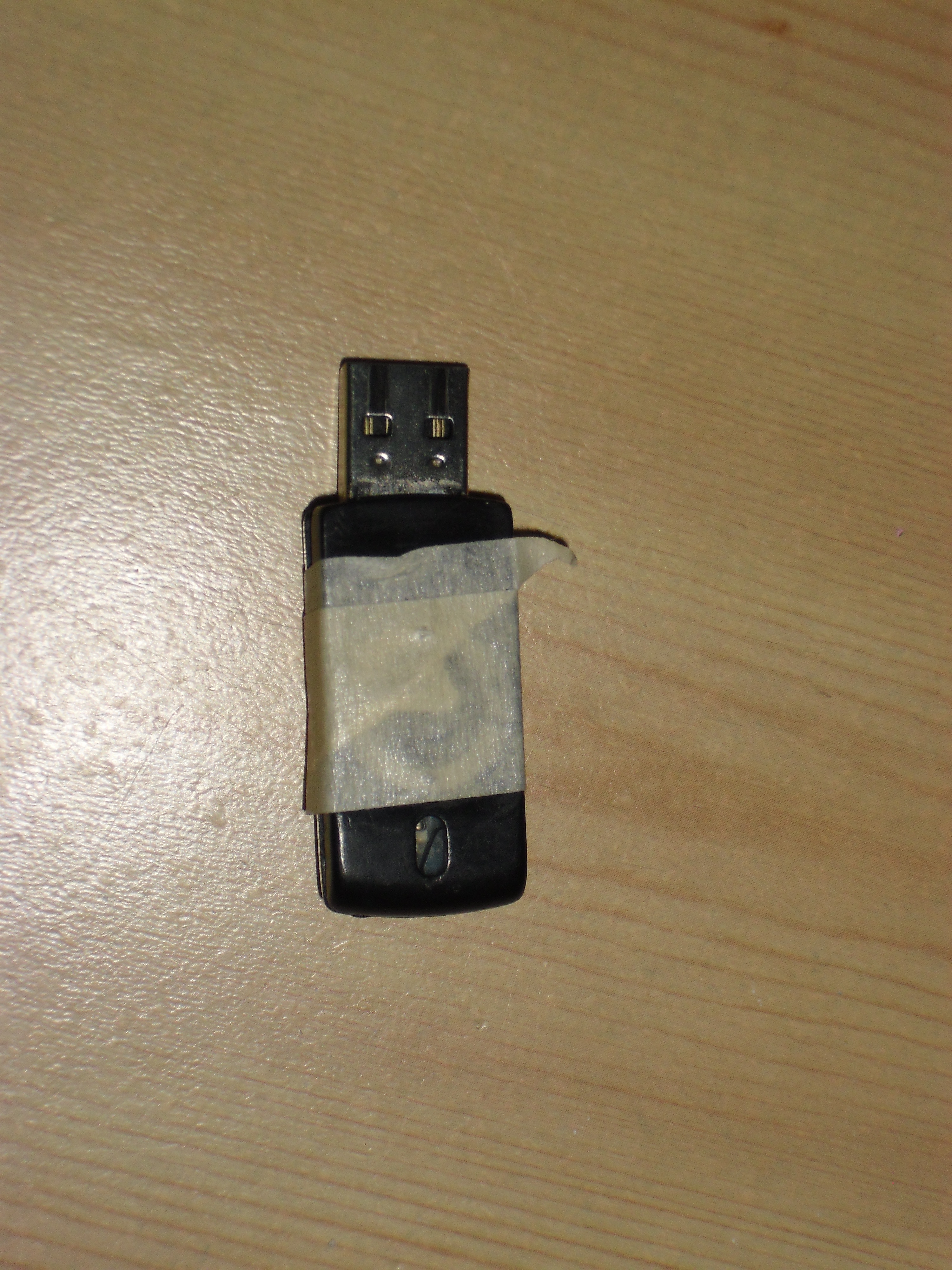
However, there’s a bit of a sad note to this story: last night while I was working, I dropped my USB drive and its casing broke. Luckily I was able to fix it quickly with some tape and none of the files saved on the drive went missing or were damaged, but I knew then that the drive was near the end of its life. The drive was already several years old: I’d gotten it in high school, and back then it had a silver casing around it to protect it, as well as fabric and another metal ring so that you could hang it from a key ring. The fabric broke eventually, and then after nearly four and a half years of surviving everything and anything, the silver casing fell off, and not too long after the last one, the casing broke.

My old flash drive in its last moments. In lieu of flowers, please send money to a charity of your choice (though I wouldn't mind if you supported my Buckeyethon fundraising efforts).

My old flash drive in its last moments. In lieu of flowers, please send money to a charity of your choice (though I wouldn’t mind if you supported my Buckeyethon fundraising efforts).

So while I’m kind of sad to have to give up the drive, I know it’s time to let it go. I already bought a replacement and I’ve transferred the files, so I can let it go knowing all the hard work and all the years of use weren’t in vain. So good-bye, old USB drive that lasted through so many years and even a trip through the washing machine (not kidding, it went through the washer and after some time in rice worked like a charm). You shall be fondly remembered.

I’m going to end this post here, Followers of Fear. I just want to say that wherever you are right now, you’re warm and your power’s working. I’ll let you know if I finish Video Rage by the time I go back to classes on Monday. Wish me luck!

Happy New Year!

As always, WordPress sent me an email letting me know how my blog did this past year. This year, my blog was viewed enough times to fill the Sydney Opera House about four times. That’s great…but I wish I was good enough to fill the Sydney Opera House just once! Honestly, where do they get these statistics?

But I digress. The point is, another year has come and gone. And to quote Dickens, “It was the best of times, it was the worst of times.” That sums up just about every year I know, but it’s pretty accurate. A lot happened this year to me, including two of my books getting published; I moved into an apartment with a friend and learned some more of the tribulations of the adult world; I was accepted into the study abroad trip I’ve been aiming for; I started my third year of college; I began writing and then administrating for Self-Published Authors Helping Other Authors; and a whole lot more that I won’t put on my blog but were important nonetheless.

All in all, a crazy year. Sometimes all that was going on threatened to bury me, while at other times I felt like I could do anything. I had my highs and my lows, like anyone else. But I managed to get through them and I came out stronger for it.

Reborn City

And now for my new year’s resolutions: I resolve to be a better writer. I resolve to get more people interested in my work and even in reading it. I resolve to finish Video Rage (probably happen in the next week or so), get back to Laura Horn and finish that up (shouldn’t be too hard, considering how quickly I tended to write the chapters), finish the final draft of Snake (hopefully sometime in the next couple of months) and publish it by the end of the year (I hope), write a whole ton of original short stories and publish some of them (fingers crossed on that one), start whatever novel will end up being my senior thesis in the fall and maybe a few other projects. I resolve to improve my craft and to help others improve their craft in my own small way. I resolve to grow this blog and Self-Published Authors Helping Others Authors. I resolve to fulfill my dreams of being a successful novelist.

I resolve to be a better person. I resolve to work on my personal flaws and try to improve. I resolve to be a good student, a good scholar of English and History, a good roommate, and a good worker. I resolve to be good to my friends and family and love them as much as they love me. I resolve to go to Europe for my study abroad trip this summer and learn as much as I can on World War II and the Holocaust. I resolve to keep my grades up. I resolve that my conduct in life is exemplary.

With any luck, you’ll be reading about a guy called the Snake soon.

I resolve to read a lot of books, see a lot of movies, and binge on too much TV. I resolve to keep my bank account in order. I resolve to eat healthy and stay healthy. I resolve to…are you still reading this list? If you are, you have the patience of a monk.

All in all, I plan to make 2014 better than 2013. So this year, my Followers of Fear, I wish you luck and I hope we get to share a ton of great experiences together. Happy New Year!

My roommate got me into watching Chuck on his Netflix, so I didn’t get as much writing done in the past few days as I would’ve liked. So I’m going to take this opportunity to discuss something I’ve noticed lately before the clock strikes twelve and a new year begins.

Sometimes I look at the rough draft of Video Rage I have in front of me. I look over what I’ve written, I nod at the points that I think are good, I edit something when I see that I’ve made an error or a mistake. And then I ask myself, “Did I really write this? It seems so much better than my work has been in the past.” And that’s not me praising my own work (though I’m happy to do that most days of the week). It’s me wondering who’s actually writing this story.

Let me try to explain this without sounding like I’m trying to toot my own horn. The other day I was writing a scene for Video Rage where a very important world leader points out several flaws in the story the antagonists over at the Parthenon Company have been telling about the West Reborn Hydras. I’m looking over the chapter and I think to myself, “Are you sure you wrote this, Rami? It’s a lot better than  scenes you’ve written before, it reads like a sci-fi version of a scene from Scandal, and it’s almost good enough to be of that quality.” And looking over the entire novel so far, I’m noting a quality in the writing that puts it a level above its predecessor Reborn City. I especially notice these differences in portions where I expand upon the world of RC, in scenes dealing with the interpersonal relationships between the characters, and in those moments when I add items or elements on the spur of the moment that vastly change how I see the scene playing out.

And it’s not just in VR. Two nights ago I had an idea for a short story. I’m writing the idea down so I don’t forget it, and I’m noting how I’d like to write it, how I’m going to be drawing on elements or techniques I noticed in some of the short stories I read this past semester, how the man focus of the short story is going to focus on the inadequacy of the male lead. And as I finish writing the idea down, it hits me that the idea is a lot simpler but also a lot better a short story than anything I’ve ever written before.

I’ve always written short stories like novels, except I’ve got to figure out how to tell the story in less than 10,000 words, so it better be a brief story. Not the best method for writing short stories, is it? In fact, I’ve realized that for ages, but I didn’t know any other way to write them, so I’ve been writing them that way for years. The way this short story goes is very different though. If I had to describe it, it’d be taking an idea, telling a simple story based on it, and centering the focus on the reactions of one character to events around him, drawing on the numerous short stories I read this past semester and the techniques that those authors used to tell those stories.

Trying to explain it here, I know I’m not doing the best job of it. But that’s the closest I can come to. And I know that if I can figure out how to write this short story and others like it, I might be able to step my game up a little and become a much better writer.

And as I write this, I wonder if I’m getting closer to the writer I want to be. One who is able to tell a deep, meaningful story, one which draws the reader in, holds them in terror and in awe, makes them feel for the characters a deep attachment, and causes them to think about the story long after they’ve finished reading it. I’m still a long way from that author I’d like to be, but I’d like to believe that I’m making some headway to that goal based on the maturation  I’ve observed in my writing.

Well, I guess editors and reviewers to come will tell me so if I’ve made any headway to that goal. In the meantime, I’ve got three chapters of Video Rage left, and I’m going to try to finish them before school starts up on Monday. Wish me luck.

Oh, and before I forget, I want to wish all you Followers of Fear a Happy New Year. Your continued support makes it possible for me to keep writing, blogging, and publishing, and it’s your continued support that makes it a bit easier for me as I work to achieve my dreams and become a successful horror author. I wish you all a great year in 2014 and I hope everything goes your way with all your goals and projects.

See you next year!

I was just informed that JK Rowling, author of the Harry Potter books (as if I need to elaborate on who she is, but whatever) is writing a screenplay for a spin-off movie of the Harry Potter series based on the fictional Hogwarts textbook Fantastic Beasts and Where to Find Them, with the possibility of many sequels. Not only that, but she’s okayed a play to premiere in London’s West End that will explore Harry’s early days with the Dursleys. This, plus the amount of involvement Rowling has in the development of the website Pottermore and various other projects and books related to the Potterverse, points to one thing: Rowling, who wanted to get away from Harry Potter, has come back to him to turn him into an even bigger franchise than he is now.

Now here’s my question: why? Is it because the lackluster response to The Casual Vacancy and the early reveal that Rowling was the real author behind The Cuckoo’s Calling called attention back to the boy wizard who’s name is synonymous with Rowling’s? Did she make a bad bet in stocks and she needs the money? Does she actually want to revisit this magical world (it’s a great world, don’t get me wrong, but I got the sense at some point that she wanted to move on with her career)? Or, God forbid, is she actually selling out for the money?

I guess I’m a little peeved about all this. I love Harry Potter. JK Rowling was the one who got me into writing stories in the first place, HP left an indelible mark on my writing style, I’m a proud member of Slytherin (according to the Pottermore sorting quiz for houses), and I geeked out as much as anyone when the last book and films came out. But perhaps what’s really getting me is that Rowling’s turning her beloved franchise into one of the mega-franchises we keep seeing cropping up all over the place today.

This is something along the lines of what some franchises are going for. I say TOO MUCH!

Everywhere you look, Hollywood producers are looking to make the next mega-franchise, the next Star Trek/Star Wars/Doctor Who/Avengers, something with a main body of work that’s accompanied by tons of additional work of varying canonical status but brings in a ton of money no matter what. Once Upon a Time has its own accompanying novel and a spin-off TV show, The Avengers has a TV show to go with it now, Terminator is doing a reboot/prequel/sequel film with a TV series to go with it, and now Harry Potter has jumped on the bandwagon! As if 8 films, several video games and board games, memorabilia and a theme park, almost all of which came into being because of the films and not the original books, weren’t enough! Now Rowling’s got to go and add in all this prequel and spin-off stuff.

Look, I’m not saying franchises are bad, and I’m definitely not saying we should do away with mega-franchises. I’m a total Sith Lord and Whovian, among other things. But some works are just fine without having a million different products that make up the Expanded Universe and a million more products in merchandising! The seven HP novels and the supplemental books that JK Rowling wrote for charity purposes were wonderful. Isn’t it enough just to have those and all the crap that came with and after the movies? Why do we need all this supplemental stuff that will give us an initial thrill but in the end won’t really add to the Pottermania experience?

If Reborn City or any of my other works were to get famous (and I try to have faith in that, especially with RC. After all, it’s a dystopian science fiction novel with heavy YA themes. I hear that’s popular these days), I would be choosy as to how I continue these stories, especially in other formats. Snake and Laura Horn both have sequels planned for them, while RC is the first in a trilogy. Several other ideas I have for stories have the potential to become franchises. Will I make them into that though? Probably not; sure, some of my stories like RC have the potential to have their worlds explored in other stories and formats. Doesn’t mean I’m going to do that, or let someone else do that. Sometimes it’s just best to leave a story as it is, and not constantly expand upon it, especially if it’s with the intent of making a huge profit.

Yeah, don't expect an expanded universe with 12 different trilogies, a Silmarillion, and a spin-off book series, TV show, or comic book series. Probably won't happen.

Yeah, don’t expect an expanded universe with 12 different trilogies, a Silmarillion, and a spin-off book series, TV show, or comic book series. Probably won’t happen.

At least, that’s my take on the subject.

Thanks for reading my rant. If I post anything else in the coming days, I promise it won’t be as full of ranting as this post was. Have a good night, Followers of Fear.


(The following post may contain spoilers for several movies, TV shows, and books. However, these movies, TV shows, and books all came out several years ago. Some before I was even born. So if you read ahead and you haven’t seen any of these movies, TV shows, and books despite their availability…well, you’ve been warned)

As a horror writer, I use a number of techniques to keep the terror in a story at its most present and powerful in order to keep the reader enthralled in the story. At the same time, there are a number of ways I could very easily lose that terror element. This post is dedicated to one of them: revealing the villain and everything about them too soon.

Let’s take the movie Friday the 13th for example (the original, not the crappy remake from 2009). In that movie, we don’t find out the identity of the killer until near the very end of the movie, when it is revealed to be Mrs. Voorhees, Jason’s infamous mother. And even after she is revealed to the audience, we don’t know much about her or her motivation until she tries to kill protagonist Alice. Then we know why she’s killing everyone, but by then we’re too terrified to really process that fact. We’re just like, “The old crone’s got a knife! Run!”

Another example is the original Amityville Horror, which did not reveal the nature of the house and its hauntings until later films. So when you see the first film, you are thrust into this maze of nightmarish strangeness that keeps you terrified wondering two things: 1) what the hell is going on? And 2) what the hell is going to happen next?

An even better example than these two is The Blair Witch Project, in which the antagonist is never really revealed. All you get is spooky noises and some weird happenings around the three main characters. This lends the film a very intense element of fear of the unknown, which would be replicated in Paranormal Activity, Slender, Entity, and several other films that utilize found footage as a storytelling technique.

Some films however reveal their villain way too early, and thus cannot utilize fear of the unknown in their stories. Sometimes this can ruin a movie to the point where it’s no longer scary or fun to watch and you end up thinking to yourself “Why am I still watching this?” One example is 28 Days Later. Now I know there are a lot of fans of the movie out there, but one of my biggest problems with it is that the villains were revealed very quickly and that I felt I knew everything about them before the movie was even ten minutes in. From that point on, slow pacing made it hard for me to stay interested and I ended up stopping the movie after an hour.

Another film that suffered from lack of suspense and fear of the unknown is most of the sequels to Nightmare on Elm Street. In the first film, we’re really terrified. We don’t know why these kids are dying, who’s killing them, how they’re being killed. All we know is there’s an evil man killing these kids in their sleep, and that somehow translates over to the real world in a very bloody fashion. The sequels though feature the same villain and he’s killing in the same fashion. Loses a lot of its scare when you know exactly what’s going to happen, you’re just there to see how it happens, if they can scare you when they do it, and what joke Freddy will make right before he kills his victims.

Of course, revealing your villain or too much about them isn’t always a recipe for failure. In Stephen King’s Misery, we meet antagonist Annie Wilkes very early on in the story, yet she’s able to terrify and disgust and chill us very easily. Of course, that might be Stephen King’s magnificent, if somewhat strange, storytelling at play, but it is possible to reveal your villain early on, even let us know all there is to know about them, and still tell a scary story. You just have to be prepared to find some element to replace that mystery and fear of the unknown (and for God’s sake, I hope it isn’t excessive sex or over-the-top gore).

What do you think of using fear of the unknown in horror stories? What are some other examples or exceptions you can think of where keeping the villain hidden until the right time or revealing them too early made or ruined a scary story?

Normally I don’t wade into censorship debates, but this story caught my eye and I thought it would make for interesting discussion. Now, a lot of authors, especially self-published authors, have noticed that in the past couple of years there’s been an explosion in demand for erotica titles, and many self-published authors are making a lot of money by writing these works, which sometimes involve violent encounters between the characters. And lately there’s been a rising trend in what is known as cryptozoological erotica, which is sexual encounters between humans and legendary beasts such as Bigfoot and others (I know, right?). The example used in the story I’ve linked to is Virginia Wade’s Bigfoot series, which has been downloaded and read by enough people to make me wonder whether I should at least dabble in the erotica genre.

However, authors of these and other erotic works have been finding their works taken off the digital bookshelves by Amazon and other sites as of late:

In October, the online news site The Kernel published an incendiary story called “An Epidemic of Filth,” claiming that online bookstores like Amazon, Barnes & Noble, WHSmith, and others were selling self-published ebooks that featured “rape fantasies, incest porn and graphic descriptions of bestiality and child abuse.” The story ignited a media firestorm in the U.K, with major news outlets like the Daily Mail, The Guardian, and the BBC reporting on the “sales of sick ebooks.” Some U.K.-based ebook retailers responded with public apologies, and WHSmith went so far as to shut down its website altogether, releasing a statement saying that it would reopen “once all self-published eBooks have been removed and we are totally sure that there are no offending titles available.” The response in the U.S. was somewhat more muted, but most of the retailers mentioned in the piece, including Amazon and Barnes & Noble, began quietly pulling hundreds of titles from their online shelves — an event Kobo coo Michael Tamblyn referred to last month as “erotica-gate.” 

The crackdown was meant to target the obvious offenders — ebooks like “Daddy’s Birthday Gang Bang” and others that fetishized incest and rape — but in their fervor to course-correct, the online bookstores started deleting, according to The Digital Reader blog, “not just the questionable erotica but [also]…. any e-books that might even hint at violating cultural norms.” That included crypto-porn. Wade’s sexy Sasquatch, not unlike the elusive hominid beast of legend, vanished without a trace.

Now, there’s been a lot of talk about censorship such as this over the past couple of months. Authors of a lot of works that have been taken down have accused Amazon of not taking a good look at their works and using very vague criteria such as the titles of the books to judge whether or not they are offensive. Amazon’s wording of its policy as to what constitutes “offensive” doesn’t seem to help its case: “What we deem offensive is probably what you would expect.” Giving that people generally have different expectations on what is considered offensive, there’s been a lot of cries that Amazon is only answering to the expectations of a certain segment of its customers. And by having to modify titles or edit their work to be acceptable to these vague standards, they are losing customers and revenue. As one author complained:

Author Emerald Ice (a pen name) — who lives in southern Illinois with her husband, a Catholic high school teacher — is less concerned about offending Amazon browsers than being overlooked by potential paying customers. The first three books in her Alien Sex Slave Series — “Alien Love Slave,” “The Sex Arena,” and “Alien Sex Cove”— were runaway hits, she says. At least until Amazon pulled them from distribution and requested changes, once again citing content guidelines. That’s how “Alien Sex Slave” became “Sidney’s Alien Escapades.” “I hate it,” she admits of the new title. “I came up with it because I was in a panic about the books disappearing.” Her sales have since plummeted, and she isn’t surprised. “If I was a reader searching for hot alien sex books, I wouldn’t look twice at something called ‘Sidney’s Alien Escapades.'”

On the other hand, Amazon and other bookstores like it are private businesses. They can decide what items to have on their shelves and what items they want nothing to do with, especially if a large enough percent of their customers threaten to boycott the site if they hold items deemed “offensive” by whatever criteria these people use. So if Amazon deems a work or works unacceptable and uses no other reason than it threatens their own revenues, then that’s their choice, and there’s not much an author can do to fight back (unless you start a humungous letter writing campaign with a lot of your close author friends and a ton of fans, but that might be difficult to pull off).

Now, my own views on censorship is if a creative work isn’t blatantly encouraging hatred, violence, or other despicable deeds or beliefs, then it should at least be considered as a work allowed to be sold, distributed and enjoyed like any other work. And as much as I don’t like to speak badly about Amazon (mostly because it’s where most of my sales and reviews come from),  I have to admit that they should take a deeper look at their work in order to decide what is offensive and maybe revise their content policy to something that’s not so vague. At the same time, I should advise authors to be careful that the work they write might not be accidentally encouraging rape, incest, or other objectionable acts or could be misconstrued as encouraging those acts. I’m not trying to stifle your creative work, but it might avoid some grief later on if you make sure that someone can’t point to a particular passage of your work and show that it is terribly objectionable.

If you have anything to add to the discussion, please let me know. What do you think constitutes as an “objectionable work”? And do you think what Amazon and other booksellers is doing is justified, or are they overstepping their bounds or being unfair in their attempts to filter out unacceptable works?

Also, that comment I made about dabbling in erotica, in case any of you were wondering: I don’t know how I’d feel about writing an erotica story. If I did though, I’d be honest about it if I decided to publish it, even if I published it under a pen name. Anne Rice did that, and if she can do it, why can’t I? Besides the fact that she’s a huge force in the world of writing and I’m still trying to claw my way up, I mean.

Yesterday I visited my advisor’s office in the English department and discussed doing my senior thesis in the fall. Normally I would talk to her about this after spring semester had started, but I wanted to get a jump on things before I was busy with homework from five different classes. Plus I had the day off yesterday so I thought to myself, why not?

During the course of our meeting, I was outlining what I’d like to do for my senior thesis, mainly to write a novel. For this novel, I chose five different ideas for stories from the list of novels I keep on my flash drive and gave a brief synopsis of each one to my advisor Ruth. Around the third idea, Ruth noticed a trend with two of the stories I’d mentioned: they both involved young girls as protagonists in the story (one was a story based on Alice in Wonderland, the other involved demons). She then asked me, “Why young girls? Why are they used so much in horror?” To my surprise, I realized I hadn’t thought of it much, and at that moment I didn’t have a very good answer for why, when children are used so much in scary stories, young girls are more dominant than young boys (notable exceptions include Danny Torrance from The Shining and six out of seven protagonists in Stephen King’s IT, the two boys from Monster House, and Hansel from Hansel and Gretel).

And guess what? The question’s been bugging me since that meeting yesterday. So between writing, work, applying for scholarships, and my household chores, I thought I’d take a moment to examine why young girls are more dominant in these sorts of stories. First, we need to examine why children in general are used so much in horror stories:

1. Children are very innocent creatures. It’s the most obvious reason, but it still needs to be stated. Children are very innocent human beings. They still believe that good usually wins against evil, that bad guys get beat up and thrown in jail by superheroes and cops, and the world is a safe place where they are loved and are protected from evil, at least until they’ve been warped by some of the harsh realities of the world. In horror stories, that innocence is tested and sometimes completely broken by the events of the story, whether it be monsters under the bed, abusive parents/teachers/bullies, or whatever else you may be using as the antagonist in a story.

Even the man/child/sponge has more imagination than most adults.

2. Let’s face it, kids are more imaginative. As we grow older, we tend to think less in terms of the fantastic and more in terms of what is real and reasonable. But as children, we really believe in Santa, the boogeyman, fairies, aliens and ghosts with little doubt that they are actual, concrete beings. This means that kids are usually the first to come to the realization that something evil is at work. They don’t realize it through any leap of logic or reason, but through gut feeling and belief. This is also usually why they are more likely to survive than that one guy in every horror film who insists with fatalistic stubbornness that there’s a logical reason for everything and then when they realize something’s up, they still insist on handling it themselves as men, even if it leads to their heads getting bitten off.

3. Kids are dependent on others. Until sometime between ten or twelve, children are dependent on adults for most of their basic needs, and even when they start to become independent, they still require a good portion of help from adults. When in a horror story, most likely a child can’t recieve help from an adult because they’re less likely to be believed by adults. This means they’re basically adrift in a metaphorical sea that wants to kill them painfully and mercilessly. How they survive without the security of an adult is something that keeps the reader drawn into the story.

4. Children are also not as resourceful. Or to be more specific, it’s rare for children to have access to the knowledge or tools they need to defeat the enemy of the story. They wouldn’t know how to set up a trap for a mutant monster, or how to draw a vampire into the sunlight without being totally obvious of their intentions, or even how to set a windigo on fire with nothing but a set of matches (which they shouldn’t be playing with anyway). If the characters are adult, all they need to do is get out their smartphone and Google “How to make a molotov cocktail” or “how to set up a tripwire alarm system”. Kids wouldn’t even have a smartphone, and even if they did they probably wouldn’t know what to Google. How do they survive with nothing to really help them? That is another draw of a horror story.

Look at that face! You know that hotel gave that kid some big therapy bills.

5. Children are easily influenced. Lastly, children are easy to influence, for better or for worse. Has anyone seen Friday the 13th Part IV? Right at the very end we see just how the events of being around Jason have influenced and hurt little Tommy, who will be dealing with his issues for the next two films. A horrific event can stay with a child for a very long time, corrupt their innocence or make them aware of their own abilities. Either way, the events of the story will stay with the child likely throughout their lives. From what I hear, the Overlook Hotel certainly stuck with Danny Torrance (I haven’t read Doctor Sleep yet, though it’s on my reading list).

Okay, so we’ve established why children in general are used so much in scary stories. But still the answer of why young girls are used in the stories has still to be answered. Often, like Carol Anne from Poltergeist, they are persecuted and kidnapped by beings we can’t really understand. Or, like Samara from The Ring, they are the stuff of our nightmares. And occasionally they are both (anyone watch The Exorcist recently?).

This morning I spent some time trying to figure out and I think a lot of it has to do with socialization and the roles we assign to the female gender. In other words, what we expect from young girls and how we believe they should act, behave, and think are why young girls are so popular in horror stories.

Please note that the suggestions I’ve listed below are for fictional girls and are just based on my own reading and viewing of many different horror novels, comics, TV shows, and movies. There may be several stories featuring girls that are the exact opposite of these reasons, I just have yet to be exposed to these stories. The reasons I’ve listed do not necessarily apply to real girls either, as I’ve made clear below. Here are the reasons I was able to come up with and which back up my beliefs on gender roles making female characters popular:

1. Fictional girls are more prone to sweetness, harmony, and nonviolence. Most boys when they’re young like to get wild, scrap a bit, use their fists and compete with each other through acts of physical prowess and aggression (when my cousin was younger, you could not stop him from acting like this). Young girls though are often portrayed as preferring to be friends rather than fight. They like doing cute stuff and they don’t like to get their hands dirty or do anything too wild. The only exceptions I can think of are Beverly Marsh from IT and my sisters, but then again my sisters are from my crazy family, so go figure. So since these fictional girls are less likely to use their fists and more likely to try to harmonize, they’re at more risk for whatever evil is after them in the story.

2. Young girls have yet to enter into the realm of maturity and sexuality. A lot of criticism with horror comes with how it sexualizes its female characters (please see my article Sex and Horror for more on this topic).However young girls have yet to reach that stage where people begin to see their sexuality. There’s an innocence in this lack of sexuality that young boys don’t get from their ignorance of sexuality, though that might have something to do with the fact that, like I said, a lot of women in horror are defined by their sexuality, whereas men don’t usually receive this sort of sexualized image no matter what age they are.

3. It’s adorable when young girls cry. Because of the pre-assigned roles that differentiate between boys and girls, at some point boys are taught that crying is not a manly thing to do, so they stop crying if they want to retain whatever form of manhood a young boy can have. On the other hand, it’s considered okay for girls to cry throughout their lives. And instead of pitying these girls or questioning their maturity like we would with boys, our hearts go out to the girls and make us want to hug them. This contributes to the popularity of young girls in horror stories.

And if these points haven’t hammered home my belief on gender roles playing a major role in the popularity of young girls in horror, here’s my final point:

In the end, the princess mentality takes a toll.

4. Young girls want to be princesses. It’s no understatement that plenty of girls in our Western society want to become princesses when they grow up and have a handsome prince rescue them from evil so they can live happily ever after, and our media perpetuates this to no end  (even Once Upon a Time and Frozen couldn’t leave this cliché out of their storylines, though they both do something rather original with the trope in each their own way). In horror stories, typically it’s up to a female character to either rescue herself from her predicament or to let a strapping young man save her and then sweep her off her feet. With young girls, that choice isn’t always available, and often the writer will write the story so that we wish for someone to come and save the little girl, while holding us with baited breath to see if she will be saved by a dashing prince…in the case of horror stories, most likely an older male relative with an axe or baseball bat.

So the reason why young girls are so popular in horror stories, as I’ve listed above, is that they fulfill certain gender roles that we’ve come to expect and work nicely into not just the plot of the story, but certain preconceived notions we unconsciously have in their minds. However, not all young girls fall into these roles. Beverly Marsh from IT plays a big part in stopping the demon clown when she’s a little girl by being the more aggressive fighter of the Losers Club. Coraline from the book of the same name is able to release the souls of the eaten children and save her parents all on her own. And even creepy Samara coming out of the TV is an exception, as she doesn’t fulfill any traditional roles, not even the one about needing saving. She’s the freaking villain!

Yeah, don’t mess with her.

So I think I’ve answered the question Ruth posed to me yesterday in her office. I’m not sure it’s the best answer or the right answer, but it’s what I was able to come up with. If you have any ideas about why young female characters are so popular, examples of girls who buck the trend, or any other points relevant to the discussion, please let me know.

Also, in a somewhat related note to children and horror, I finally watched the film version of Battle Royale. It was actually much better than I expected, almost as good as the novel. However there were a couple of creative choices I disagreed with, and that’s why it’s not on equal footing with the book. I also won’t see the sequel, because apparently it’s not based on the original story, its anti-American message goes beyond criticism of America to full-on attack mode, and nearly every reviewer who’s seen it has hated it, apparently.

All for now. Write on you later, Followers of Fear.

Another semester passes by, and with it the realization of two things: one is that I have enough credit to be considered a senior now that the semester is over. The other is that I now have a year and a half left of my time at Ohio State University. Boy, way to make my time here feel finite.

Every semester is different and not just because of a set of new classes. For example, this semester I moved into an apartment with a friend about two blocks from campus, meaning we both had to take on a whole lot of different responsibilities. I also started taking five classes in a single semester, more than I’ve ever had in a single semester. At times the homework load was almost unbearable. I hope that next semester will be a bit easier, though judging by the amount of reading I’ll be doing that doesn’t look like the case.

This semester was also significant because two major events happened to me: I published my first novel Reborn City and I got accepted into a study-abroad trip to Europe for three weeks in May. The latter so far has taken up more of my attention, because I’m going to be spending all of next semester preparing for it. And I mean all of next semester: four out of five of the classes I’m taking are in preparation for what I’m going to study in Europe (by the way, the trip is about studying World War II). Still, RC has taken up a bit of attention too. I’ve had to advertise everywhere I can. I’m actually looking into putting an ad into the student newspaper if it doesn’t cost too much.

And as for my classes this semester, I took Introduction to Sociology, Introduction to Biology, Writing for English Majors, Science Fiction and Fantasy Literature, and History of the Holocaust. The latter two were my favorite classes (despite the dark subject material in the Holocaust course) and they were also the classes I did the best in, getting As on most papers and tests. All told, my grades added to a total 3.263 GPA. I’m happy with my grades (they’re all passing grades) but I’m going to aim for higher next semester. Especially since going on the trip and keeping my scholarships will require me to keep my grades up!

Well, I hope to have more good news later. Watch out for my Spring Semester 2014 Pre-Semester Report. It’ll probably be showing up in the next couple of weeks. In the meantime, I’m going to make dinner and finish Ch. 28 of Video Rage. Wish me luck.

One thing I struggled with early on in my attempts to become a professional writer was time, or more accurately, keeping tack of it. In my earliest stories, whether it be about lycanthropic pirates or a Harry Potter-esque story of witches, keeping track of how much time has passed was not high on my to-do list. I was more concerned with making a novel that would sell millions of copies, win me legions of adoring fans, and regularly get adapted into blockbuster hits. Why should I pay attention to how quickly a year can pass or how it’s noon on one page and then sunset on the next when I have to decide who I want to play my female protagonist and if she’s going to be my girlfriend?

But I got older, and around the time I started writing my earliest vampire stories, I started to become more aware of the passage of time in those stories. I think it first occurred to me that it seemed weird that my characters were still in school around late June. From then on I tried to keep the passage of time consistent in the stories I wrote, and as I got much older and realized there were too many vampire novels out there at the moment for me to make a name for myself with those sorts of stories, I started to put dates and even the passage of hours in my outlines, which would later end up in the early drafts of the stories I wrote.

And no one else is more aware of time than the guys and gals who write the Doctor’s adventures.

If you examine other authors who are extemely popular, you’ll notice how they try to keep the reader as well as themselves aware of the passage of time without annoying the reader with it. For example, JK Rowling structured her entire Harry Potter series around the school year in Britain. Stephen King’s It switches between 1958 and 1985 and King makes sure to note how June passes on into July and July into August during the 1958 sections. And Jean Auel’s famous Children of Earth series is very particular of marking the passing of seasons and years.

All in all, I think keeping tack of the passage of time in my stories has very much improved them, and in some of these stories  I need to be cognizant of how much time has passed in order to tell the story correctly. For example, my WIP Laura Horn takes place during the week leading up to the 2017 Presidential Inauguration. I went online to find advance calendar dates for that January, and only then did I write out the plot in my outline for the story. In addition, I have several ideas for stories that need to be very time conscientious while writing them. One takes place during World War II, meaning I’ll have to be very careful of the dates of certain events in order to tell the story correctly. And I have a science-fantasy story involving time travel that will require me to be very careful about the dates I use, should I ever get around to writing it.

The only thing I wish I was better at was keeping track of dates by making a timeline. However, doing a timeline at the outline stage isn’t always helpful because so much can change between the outline stage and in the actual writing of the story. Perhaps I can find some sort of middle ground in future stories. I might ask my writing group on Facebook if they have any tips on doing timelines.

And speaking of Facebook, I just want to remind people that I have a Facbook page and a Twitter feed, where I post on stuff that I don’t always post about on my blog. If you’re interested in checking either out, please do so.

How important is marking the passage of time in your stories? What do you do to keep track of time?

It’s watching you!

Oh, blessed relief. Today I sat down, once again, to work on Chapter 24 of Video Rage, the sequel to my novel Reborn City. I’d been working on and off on the chapter for the past eight days or so, delayed by homework, exams, and the need to sit down and do something other than writing in order to relax. But today I sat down, and I finally finished it, meaning I only have a third of the novel left to write! Woo-hoo!

I’ve been enjoying my return to the world of the West Reborn Hydras. Not only has it been kind of therapeutic and relaxing to work on my novel after having to take a very long hiatus in order to focus on school, but it seems that the world of the story has expanded on its own,  become more complex and astounding than when I first created it. When I was working on Chapter 22, the characters kind of took the reins away from me and played out a scene before me similar to a cop drama, where one character was poking holes in the story of the other two and showing just how flawed their seemingly-flawless version of events really was. I didn’t even think I could write a scene like that! And when I worked on Chapter 23, new characters and new situations kept intruding into the scene I’d originally envisioned. I guess it’s true what they say, that the characters really write the story and not the authors.

Well, it makes my job easier if they write it for me. And better yet, my characters don’t ask for royalties.

But I digress. Let me update you on page and word counts (and when I say page, I mean your standard 8″ x 11.5″ MS Word paper). In total, the number of pages has risen to 197 pages, while the word count has risen to 54,703 words. That’s about the length of a very short novel, and since I have thirteen chapters left to write, it’s probably going to rise another ten to twenty-thousand words (no, don’t be intimidated. Most of the Harry Potter novels are much longer than that).

For now though, I think I’ll take a very short break from writing VR. I’ll probably write an article for Self-Published Authors Helping Other Authors, I’ll apply for several scholarships offered through my university, I’ll spend a lot of time at work so I can afford to keep a roof over my head, and if my friend Angela sends any more chapters of Snake, I’ll work on edits. And after all that, I’ll start on Chapter 25 of VR. Trust me, it’s going to be awesome. Things will really come to a head in the final seven or so chapters.

For now though, I think I’ll make dinner and settle in with some TV, a nice reward for myself after some really hard work. Until next time, my Followers of Fear.