Posts Tagged ‘novelette’

Well, I didn’t expect this to happen today. I figured it would happen at some point this week, but I never expected to get through the last three chapters so fast (especially since one of those three is thirty-three pages long). But yeah, I finished the fourth draft of Rose, the one edited with beta reader feedback! And all in a single month. Damn. I’m kind of proud of that rate of progress.

So if you’re among the many new Followers of Fear who are hopping onto this blog recently (hi! How are you? Are you enjoying my ramblings and opinions?) and you have no idea what Rose is, it’s a novel I started writing in college as my thesis project. The story is about a woman wakes up with amnesia and starts turning into a plant creature (and that’s just Chapter One). I did two drafts of it during my senior year of college, left it alone for a year, tried to pick it up again after I got my job, found progress very slow and dropped it, picked it up again this past summer with a new plan of going about editing the story, got through the third draft in four months, had some great beta readers look at the book and give me their feedback, and then somehow edited the book in a month (still gotta toot my horn on that one).

And you know what? This has been the most challenging story I’ve ever had to work on. I know I’ve said that before, but it’s the truth. Throughout the writing and editing process, this story has mutated more than the titular character does (because how else are you going to describe what she’s going through?)! Even during the very first draft, the story went through major changes. I initially had a different direction entirely for the story, which involved a lot more elements of Japanese folklore than appears in the novel (already heavily influenced by Japanese folklore), and involved some apocalyptic elements too. Thankfully, my thesis advisor helped me see how unfocused that direction would’ve been, and how much more intimate and scarier it would be if I went in another direction. This ended up being the route the story took, and if my beta readers can be believed, it’s a good thing I did, because the novel works the way it is now.

But honestly, that’s just the tip of the iceberg. So much changed with each draft, sometimes during the editing of a draft. Elements were added, subtracted, moved about, propped up and knocked down every day as the writing and editing needed. I added an entirely new plot element to the third draft to both add some length to the story and to foreshadow something that would be revealed later about one of the character. In the fourth draft, I changed the location of one minor element just so it wouldn’t seem unnecessary. I even wrote a whole new chapter for the third draft because I I needed it to do some necessary revelations about the antagonist.

Hopefully this happens to Rose very soon.

I keep thinking of those weird metal amalgams where if you add the right sort of current to it, you can change its structure (I’m pretty sure that’s a thing). Rose is very much like that: ever-changing with each new iteration, and hopefully becoming better each and every time.

Now that I’ve made that deep metaphor, I think I’ll talk about page and word counts, because I like talking about that. And while the shift from second to third draft was pretty dramatic, owing to the fact that I added about forty-thousand words of material to the story, third to fourth wasn’t that dramatic. If anything, it’s a bit smaller: the third draft was 266 pages (8.5″ x 11″, 12-point font, Times New Roman, double-spaced) and 84,677 words. The fourth draft was 264 pages and 84,390 words. A total drop of two pages and 287 words. I honestly thought it’d be a bit more, but I guess I was wrong.

So what’s next for Rose? Well, after four drafts and great feedback from my beta readers, I’m going to try looking for a publisher. I’ve been doing my research and I’ve got a few leads that I think could pan out, so hopefully I’ll have news within the year to share. And in the meantime, there are a couple of short stories, one novelette, and a blog post for Self-Published Authors Helping Other Authors I’ve been waiting to work on till I was done with the fourth draft, so I’ll likely start on those tomorrow. Hopefully I can get them all done before any publisher takes an axe to my door in their eagerness to publish me (I wish!).

Well, Followers of Fear, that’s all for now. It’s getting late, I’m tired, and I’ve got a big day tomorrow. I’ll let you know how things are going as they happen. Until next time, pleasant nightmares!
Voice. Sometimes, I feel this can be the hardest thing to create in a story, especially when you’re writing in first person. You, as the writer, have to create this unique person, someone with a personality, desires, fears, likes, and pet peeves. And then you have to give them a unique speaking voice, including vocabulary and word choice, syntax, grammar, accent, and all that can be really difficult. A lot of us have that distinct writer’s voice* in our heads that is always arranging our sentences on the page (or on the blog post) in a way that reads like what we consider good literature.

And it’s even more hindered when you consider where our writer voices come from. You see, I have this hypothesis that every writer’s storytelling voice is born when they read a great story and the narration resonates with them on a deeper level. This could be their own voice reading their first chapter book as a child, a parent reading to them a fantasy novel by their bedside and making the story come alive, or an audio book narrator with a great speaking voice behind the words. No matter how many other stories we may read or listen to later in life with their own amazing narrative styles–the childlike humor and observations of Alice in Wonderland, Stephen King’s odd characters and descriptions, or the three women from The Help and how they each view their situation from vastly different backgrounds and dispositions–it will always be this original narrator who contributed the base DNA for your writer’s voice, and whom a part of you will always spend a good amount of time both trying to emulate in power and break away from so you don’t sound like a copycat.

For me, I always go to Jim Dale’s narration of the Harry Potter audio books. Harry Potter was a big part of my childhood, and caused me to start writing in the first place. My first attempt at writing was something like a Harry Potter gender-bend fanfiction. And Jim Dale made the text come alive, in ways the movies and the books alone couldn’t. Whenever I wrote, in the back of my mind, I was comparing and contrasting to Jim Dale’s work. And while I’ve managed to develop my own voice, it’s still a fight that goes on in the back of my head up to this day.

So basically, I’m fighting Jim Dale in my head while trying to create an original narrator’s voice on the page.It’s an image perfect for a Family Guy cutaway gag.

Struggling against this guy in my head every time I write.

So what can you do when you’re trying to create a distinct voice for your narrator or narrators? What do you do when you want to make Skeeter sound different from Abilene and Abilene from Minnie, or Cormoran Strike from Harry Potter, or Lestat from Louis? And can I come up with any other characters for comparison? The answer to the latter question is yes I can, but I’ll stick to the former if you don’t mind too much.

As many of you know, I’ve been working on a new story while I wait to hear back from my beta readers. And as I mentioned in a previous post, I’m taking a more organic approach by writing this story without much planning and seeing what evolves from that. And weirdly, that approach has allowed me to tap more fully into my narrator’s head. I’m not exactly sure why, but I think it might have something to do with the plotting vs. pantsing thing I talked about in that previous post. When I’m plotting, I think out every detail of the story, not leaving much room for change or experimentation. Thus, the narrator’s voice becomes secondary to telling the story I want to tell, in the way I want it to be told, and the narrator’s voice ends up as something close to default writer’s voice.

But while I’m pantsing it (or plantsing it, as my friend Kat Impossible informs me), that particular mental clamp isn’t in place. Thus, without having to worry about getting my story from Point A to Points B, C, D, E and F (I’m not even sure if I have a Point F at this point), I can focus more on my narrator and develop her voice. I’ve actually discovered through, just by letting my character be herself and make her observations about the world, she’s a pretty frank and kind of funny. At one point, after saying “her heart fluttered,” she says she sounds like a romance novel, which she hates reading, and her friends consider that a horror “on par with the bombing of Pearl Harbor.” I wrote that in, and I ended up laughing!

I might have to pants/plants my stories more often in the future.

But what if you already write by pantsing or plantsing, or plotting is the only style that works for you? Well, I might have a few suggestions:

  1. Write out the traits of your narrator. If your narrator is a character in the story,  then obviously they have a personality (unless this is an 80’s movie, in which case they’re bland and white). Think about them and what their role is a story. What do they want? What do they stand to lose if they fail? What’s in their past? Who do they hang out with? Figuring this out can give an insight into the character and therefore to the voice that they give.
  2. Have a conversation with the narrator. I forget where I got this, but it’s a good one to use. Grab some paper and a pen, and have a conversation with your character. Ask them questions, and then write down what you’d imagine their responses to be. It seems a little mental, but it’s pretty effective, and can be used for other issues in a story (motivation, plot holes, etc).
  3. Spend time narrating scenes in your head. I’m the kind of guy who spends a lot of time planning the story in my head before I write it (the consequence of having a full-time job and only one me to write). Consequently, there are scenes I’ve written and rewritten several times over in my head. During that time, a character’s personality, worries, beliefs, and of course their voice will emerge through several mental revisions. By the time you get the actual writing, you already have the narrator’s voice down pat.

Voice is always difficult to get right for any narrator, but there are a variety of ways to help you get that voice. Whether it’s writing something differently than usual, or having an imaginary conversation, you can discover your narrator and their voice. And from there, you can make your story that much better.

What do you think of finding a narrator’s voice? Do you have any tips for doing so?

*The writer’s voice, by the way, is very different from our speaking voices. I’m never this eloquent in real life. I actually stammer a bit, my mind racing to get the best sentence out while my mouth is already saying the words. It’s quite annoying, and sadly the only time I’m not plagued with it is probably when I’m telling a joke (usually a stupid one). Oh, wouldn’t it be nice if we could speak like we write blog posts or stories? It might make a few things easier.

Someone is going to read this title and be very confused as to its meaning. Most likely, my parents. Or any juvenile who thinks pulling down a classmate’s pants is the height of comedy.

So, if you are wondering what the hell that title is about, it refers to two different styles of writing stories. Plotting is when writers plan out every part of the story. Everything, from beginning to middle to end, is planned and…well, plotted. Obviously, not everything is done according to a plan. A lot of stuff, like the wording in the story, is decided upon while writing. But the major elements–plot, characters, grisly character deaths involving giant monsters ripping deceitful high schoolers in half (no wait, that’s just me)–are decided upon before the story is even begun.

Pantsing is the exact opposite of that. Writers write by the seat of their pants and just make it up as they go along. There is some planning involved (for more on that, read this article by my friend/colleague Ruth Ann Nordin), mainly what sort of story arc you want to go through, what sort of characters there are, and perhaps some scenes you hope to include in the story, but for the moment it’s pretty much whatever comes out of your fingers at the moment you’re writing. The dialogue, action, and the descriptions are created spontaneously.

Plenty of writers have their own preferences. Stephen King is definitely more of a pantser: in his memoir On Writing, he compares writing stories to unearthing an artifact from some ancient civilization, revealing a little more with every dig of the shovel and brush, never knowing what you’ll uncover. JK Rowling, on the other hand, is probably a plotter. After all, she spent years putting together the seven books of the Harry Potter series, laying groundwork and hints of what is to come.  And you don’t just come up with stuff like Hallows and Horcruxes like that on the spot. No, she had those planned for ages and ages.

Personally, I’m a plotter. I usually have every scene planned out, especially with novels, where I tend to outline the story, and then do several drafts of the outline, before I get to the actual story. I’m not sure why. It might be I’m a bit of a control freak who takes being the “God of his fictional universe” a little too seriously. Or I just learned to write like that, and it’s done me well so far. Either way, it’s what I’ve done since I was a child, and it’s worked for me.

Writing by the seat of these, LOL

So why the hell am I talking about this? Because for the first time in I don’t know how long, I’m actually writing a story and pantsing it!

I mentioned in the post I wrote after I finished editing Rose that I was going to work on a couple of shorter works for a while. The first of these stories involves a bunch of people being trapped within a relatively small space, and this is going to be the meat of the story. In a confined space, tensions can get high, and the scenario of the story will probably raise those tensions a lot higher. So, I decided that it might be better to write this story by the seat of my pants, rather than plot the whole darn thing.

I figure that, rather than planning out that entire part of the story, I might instead plan only a few scenes and some plot points that I hope will come up in the story, and see what happens. I feel that will be more organic than just planning out who will lash out at whom when and what that leads to. The conflict will feel more real that way, not just to readers, but to the characters themselves, and to me too. If the conflict in a story feels fake, no one will buy it, and the story will suffer because the reader will disengage. Hopefully I can avoid it by changing things up.

I’m also kind of hoping I can experiment a little with humor in my stories. As I said in a previous post, I don’t include humor in most of my stories, and one of the reasons I think that might be is because I’m a plotter, so I keep in mind how dark my stories are from beginning to end and don’t insert humor because of how dark they are. I’m wondering if writing by the seat of my pants will give me more room to insert my style of humor, which is very situational, and make it not as forced as it might be under other circumstances.

It’s not a big reason why I’m trying pantsing with this story, but it’d be a perk if it happened.

So I’m trying to pants my way through this story, with only a few scenes planned, only eight characters fleshed out, and just a general idea of what I want to happen with this story. I have no idea what will happen, if this will be something I’ll do more often, or if the work I produce by pantsing will be any good. However, like every good writer, I have to be brave enough to keep pushing boundaries and to try new things. At least some of those new things have to work. Am I right?


That’s all for now, my Followers of Fear. I’ve got a few more blog posts I want to put out this week before I start on this story I’ve mentioned and fall into a proverbial rabbit hole, so I’m going to be putting those out one after the other this week (and maybe next). Hopefully by the time those are done, you won’t be sick of me.

Until next time, pleasant nightmares!
 

It’s always satisfying to finish a manuscript. No matter the length, it’s satisfying to know that you’ve put in so much time, sweat, blood and creativity into writing a story and that it’s finished, that you were able to get over your fears before starting, keep going, and see it to the end. And after attempting a third draft a little year ago, failing miserably, and taking a year to work up the courage to try again, it’s especially satisfying. Hell, I even bought fancy honey-wine to celebrate this momentous evening.

Now if you’re unfamiliar, Rose is a novel I originally wrote as my college thesis. It follows an amnesiac woman named Rose whose body starts to go through incredible, terrible, magical changes. The only source of information on her condition is a man who claims to be her boyfriend, but he’s got some terrible secrets and isn’t all he claims to be. It’s a dark and bizarre story, with themes of dependence and abuse, perception and memory, in a story influenced by Stephen King’s Misery and Japanese mythology.

It’s also been the most challenging story I’ve worked with. I had to scrap my first attempt to write it because I made the story too bizarre, sprawling and complex, then go back and make it a bit simpler and contained. Then I had to write an entire first draft, then a second draft within a few months. Then I had an internship in Germany and a job search, followed by an attempt at the third draft. That draft, as I said before, was a complete and utter disaster due to the lack of routine I had at the time. I took it up again back in late June, after I needed a break from sci-fi and Full Circle and, with a routine, I managed to get through the draft in about four months, incorporating the suggestions from my thesis advisors to great effect while I was at it.

And I’m very proud of this draft. Every time I’ve worked on this story, it’s changed significantly. Plot points, emotional connections, characterizations, they’ve all gone through some incredible rewrites. With this particular draft, I feel like I’ve been editing the work of a different author, giving his work a much-needed makeover. I even added an original chapter to the manuscript, which also took the top spot as the longest chapter in the novel (I spent two week with Dragon Speech-to-Text software writing that chapter so it wouldn’t take a month or longer). And while this story is far from “done” (my high school English teacher said that stories are never “perfect,” because that’s impossible. But they can be “done,” where you can’t do anything more to improve it. It’s just “done”), it’s definitely in a much better shape than it was at the end of the second draft. It’s a draft I’d actually be proud to show other people.

Now before I show you what’s up next for Rose, indulge me in my bad habit of looking at page and word counts. Which with this novel is actually necessary: my advisor told me to double the word count of the novel when I did the third draft (I’m pretty sure it’s double the word count now, not add ten or twenty-thousand words). So how did I do with that? Well, at the end of the second draft in spring of 2015, the page count was (with 8.5″ x 11″ pages, double-spaced, Times New Roman 12-point font) 164 pages. With the third draft, the page count is 266 pages, an increase of 102 pages. With the word count, the second draft was a whopping total of 48,914, a respectable novella-length story. In the third draft, I got the word count up to 84,677, a good-size novel,  just a bit shorter than Harry Potter and the Chamber of Secrets. And I like to think that every new word was necessary. I really had the chance to delve deeper into the characters, as well as the events that made them who they are. All in all, I think it’s a more fleshed-out novel.

Of course, critics, readers, and editors are free to disagree with me. We’re a democracy, we’re allowed to do that, even if others don’t like that.

And that brings me to what’s next for Rose and for me. And I have a few ideas on that:

  1. No return to Full Circle just yet. I’m still not ready to return to the world of Reborn City and finish the trilogy. Yes, the first draft needs ending, but I need a bit more time and a bit more horror before I do any more sci-fi. And since I don’t exactly a legion of fans breaking down my door to know when the story will be out, I think I can afford to take some time (George RR Martin wishes he was me in that respect).
  2. Beta readers and submissions. I have a couple of beta readers who have agreed to take on Rose, read it and give me some feedback (I’m sending the manuscript to them right after I’m done with this post, as well as backing up my flash drive so I don’t lose the novel). The plan is to take their feedback and incorporate it into the novel if I feel it works for the story. And after that, I’ll start submitting Rose to publishing houses and agents that specialize in horror. Hopefully it’ll find a home soon, and I can get it published. After that…well, I’ll see when I get there.
  3. Some shorter works. I have a list of short stories and novelettes that I keep so I don’t forget any of the fabulous ideas I have. It’s currently 57 pages long and closing in on 800 ideas. I figure I should at least get through some of those, as only a few of them are crossed off with at least having a first draft written out. I already have another list of stories I’d like to work on in particular, and I’ve picked my first from that list. I might even get started on it in the next week, after I do a bit of research for it. And maybe after a few of these stories are written, they’ll get published. Fingers crossed, right?

And that’s where things stand right now. I hope you continue to stay with me as I move onto the next stage of this novel’s evolution, and maybe write the next stage of my writing career. Until my next post, goodnight Followers of Fear, and pleasant nightmares.

gynoid-blogs

Well here it is. The final part of Gynoid is finally available. I hope you like it.

So if you’re new here or something, Gynoid is a science-fiction romance story I decided to publish, which is kind of like the YouTube for writers. I’ve been publishing it in parts since Valentine’s Day, and today I publish the final part. And in case you need a reminder, here’s the blurb I’ve been working with:

When Toby Crimson orders a gynoid, a robot designed to look and act like a human girl, he knows he shouldn’t be doing it in the first place. Gynoids are for perverts and losers, after all. But Toby has told a lie, and he needs the gynoid, named Ariel, to keep that lie up. What he never expects is to actually like Ariel being around. Or that Ariel is going to change his life. Whether he likes it or not.

I’m happy to say that so far, people have been reading and responding well to the story (though apparently some have tried the links through Facebook and have had trouble, which is sad to hear). I’m hoping that with the final part I’m able to deliver a satisfying ending to all readers. And with that in mind, I would like to once more thank Ruth Ann Nordin for helping me edit this, and to Joleene Naylor for helping me create the cover. I could not have done it without your help. Also, definitely check out their blogs. Plenty of good stuff there.

The links to read each part of the story are below, as usual. I hope you’ll take the time to read it, and let me know what you think. Positive or negative, I love feedback, and I would love to hear yours. Until next time, my Followers of Fear!

Part 1:  https://www.wattpad.com/372168643-gynoid-part-1

Part 2:  https://www.wattpad.com/375071150-gynoid-part-2

Part 3:  https://www.wattpad.com/378178810-gynoid-part-3

gynoid-blogs

So last week I published Part 1 of Gynoid, a science-fiction novelette I wrote two years ago. I published it on Wattpad, which if you don’t know is kind of like the YouTube for writers and where I’ve had some success before. So far, the first part has done very well for a writer with my following, getting several views and even a vote (I think that’s the equivalent of a like on YouTube). Not bad.

Now, if you don’t know what Gynoid is about, here’s the blurb I’ve been using for it:

When Toby Crimson orders a gynoid, a robot designed to look and act like a human girl, he knows he shouldn’t be doing it in the first place. Gynoids are for perverts and losers, after all. But Toby has told a lie, and he needs the gynoid, named Ariel, to keep that lie up. What he never expects is to actually like Ariel being around. Or that Ariel is going to change his life. Whether he likes it or not.

I hope that sounds interesting to you.

So I’m including the links for both Part 1 and Part 2 below. I’m hoping that as more of the story becomes available, more people will read it and like it. And if enough people like it…who knows? Maybe I’ll release it as an e-book exclusive or something. You never know.

Anyway, I hope you like reading Gynoid, and I would appreciate it if you would give me your thoughts on the story, either on Wattpad or in the comments below. You know me, I love feedback and I would love to hear yours.

Until next time, my Followers of Fear!

Gynoid: Part 1: https://www.wattpad.com/372168643-gynoid-part-1

Gynoid: Part 2: https://www.wattpad.com/375071150-gynoid-part-2

gynoid-blogs

Happy Valentine’s Day, my Followers of Fear. Today’s a day about being with your special one, of showing them you care, and of spending a ton of money on flowers or chocolates or lingerie. And what better way to celebrate this most romantic day by reading a free science-fiction love story?

Okay, there are probably a hundred other way to celebrate Valentine’s Day, but I’m hoping you’ll make time to read this new story by yours truly, Gynoid. This is a story I wrote back in 2015 and which I’ve been wanting to publish since then. And now it’s available. Well, the first part is, anyway. It was really hard figuring out where to divide this story for the first part, actually. Every time there’s a scene break, I feel like people are going to want to read more. Still, I managed to find a good place to end Part 1, and Parts 2 and 3 just sort of revealed themselves to me. Love it when that happens.

Now, if you would like to have a description of what Gynoid’s about, here’s the blurb I wrote:

When Toby Crimson orders a gynoid, a robot designed to look and act like a human girl, he knows he shouldn’t be doing it in the first place. Gynoids are for perverts and losers, after all. But Toby has told a lie, and he needs the gynoid, named Ariel, to keep that lie up. What he never expects is to actually like Ariel being around. Or that Ariel is going to change his life. Whether he likes it or not.

I hope that whets your literary appetite. And did I mention it’s free and not scary?

Anyway, I’ll be publishing Part 2 on the 21st, and Part 3 on the 28th. All of them will be on Wattpad, which is a free site to peruse and free to join. I’ll make sure to post the links for those as well then they come out. In the meantime, the link for Part 1 is down below. Go ahead and have a read. And when you do, come back here and let me know what you think. Positive or negative, I love reader feedback, and I would especially love to hear yours.

Until next time. Enjoy!

Gynoid – Part 1: https://www.wattpad.com/372168643-gynoid-part-1

Well, I’m very excited that something I’ve been wanting to do since the New Year is about to happen. Now, some of you may remember Gynoid, a science-fiction novelette I wrote nearly a year-and-a-half ago about a guy who buys a robot that looks like a human girl, a gynoid (the female equivalent of an android), in order to become more sexually experienced. What results from this move is the basis of this story. I’ve tried getting it published in magazines, but the ones that allow larger word counts rejected it, so I put it aside.

I think I might have mentioned it before, but my New Year’s Resolution for this year is to get more people into reading my work, and one of the ways I can do this is through Wattpad, which is like the YouTube for writers. People upload their stories, and other people read them. I used the website previously, but because I couldn’t make money off of that site, and I would like to make money off my writing, I didn’t use it that much.

But I think that Wattpad could be a good platform to find new readers, and maybe a few of them might subscribe to my blog or even pick up my novels if they like what they find on Wattpad. And I really want Gynoid to be read by people, because I really like the story and what I did with it. So I’m going to be publishing Gynoid in installments on Wattpad for you guys to read!

Yes, that’s right, Gynoid is going to be published on Wattpad. You can read it for free on the website, and since many of you actually aren’t into horror (though I’ll never understand why), you can read this one, since it’s straight science fiction. I plan to publish it in parts, maybe 3 or 4, because it is a bit long and I think it’ll be easier to digest the story if it’s in parts. I also think if I tell it in parts, then it might keep people more interested. If a story or part of a story ends on a cliffhanger, people will probably want to read more, right? That’s what I hope will happen here.

And since Wattpad allows you to upload a cover with your stories and I wanted an awesome cover this time around, I sought out my good friend and fellow writer Joleene Naylor, who also made the cover for Video Rage, to help me bring the cover of my dreams to life. I took photos from CanStock Photos, which is a great resource for affordable stock images for your creative projects, and she took them, along with my instructions, to make this nifty cover.

gynoid-blogs

Isn’t that amazing? Joleene literally took the vision in my head and made it real! Usually I have to kill several people for that to happen on its own. I absolutely love this cover, and I can’t thank Joleene enough for helping me create this awesome cover. It looks really professional, and I think people will gravitate towards it in ways they haven’t to previous covers I’ve made on my own. I wish I could do what Joleene does.

Anyway, the first part will be out February 14th. I feel Valentine’s Day is a good day to put out the first part of this particular story. When it does come out, I’ll be posting links everywhere I can. And after that, I think I’ll release each part on a weekly basis until the story is wrapped up, and put each link on my Stand-Alones and Other Works page so anyone who wants to read it later can.

That’s all for now, my Followers of Fear. I hope you’re looking forward to reading this story as much as I am for you to read it and I am counting down the days till February 14th. If anything pops up in the meantime to talk about, I’ll let you know. Have a good evening, and pleasant nightmares!

Hey, Followers of Fear! Long time no see! I’ve been busy trying to get a short story done before November 1st. And tonight, I managed to do it. Car Chasers is a short story that centers around a Fast & Furious-esque race held in a forest where ghosts chase the racers. Yeah, it’s a pretty out there concept, isn’t it? And I think it might make a great movie, even without Vin Diesel in a starring role.

I liked writing this story for a number of reasons. Along with a fun concept, it focused on a particular incident with these races, told through the point of view of an unreliable narrator. Normally, the unreliable narrators I encounter in fiction are jackasses (the main characters of Gone Girl and Patrick Bateman from American Psycho, for example), but the narrator in this story is actually telling it trying to put a good spin on a friend of his, which is different from my normal experience. I also put a few people I know in the story in varying capacities (you’re welcome, Pat Bertram and Melissa Mendel), and named the bad guy of this story after a certain person I dislike a lot right now. Yeah, I’m sadistic that way. It’s fun.

So when can you read this story? Well, it’s a first draft, and it’s going to need a lot of work. For one thing, there are some places in the story that could be fixed or trimmed down. As the story is a bit over ten-thousand words, and therefore technically a novelette, I might want to really trim it down if I want to get it into a magazine. If that doesn’t happen, I can see this in my upcoming collection of short stories, Teenage Wasteland. The characters are at the right age, so it’s a good choice for the collection.

In the meantime though, November is just around the corner. And for novelists, that means one thing: National Novel Writing Month. I’ve got the final Reborn City novel to write, and after that, I’m devoting all my time to getting that novel and Teenage Wasteland out as soon as possible.

Well, that’s all for now, my Followers of Fear. I’ll see you guys with a couple of posts on November 1st, when I’ll be doing another “First Day, First Paragraph” Tag, and talking about Reborn City and the final novel, Full Circle. Have a happy Halloween, guys. See you soon!

So I recently got back into reading The Complete Fiction of HP Lovecraft, after about a year’s gap since I last dove into his work on my Kindle. I actually got from 15% to 32%, which for a 1112-page book is pretty good, if you ask me.

Now, if you don’t know who HP Lovecraft is, he was kind of the King of American Horror between the reigns of Edgar Allen Poe and current monarch Stephen King, though he didn’t really achieve any sort of fame or influence until after his death. When I read him last year, I found his style old and outdated, and while some of his stories were actually pretty creepy, others were just strange or boring (see my thoughts in Thoughts on Lovecraft: Part 1).

So what were my thoughts one year later, having read several more stories? Well, he still prefers to write like a contemporary of Poe, one of his main influences in writing, which I find still rather irksome (I could parody it here, but I did that well enough in Part 1, so why try and repeat it?). I’m not that big a fan of that style, as I find it stuffy and somewhat boring, so occasionally that made for an annoyance to get through.

And Lovecraft is still a proud and unrepentant racist and xenophobe. Seriously, “The Horror at Red Hook” manages to drag so many non-white ethnicities, including Kurds and Yazidis, through the mud.

And he’s the only author I’ve ever met who’s used the word “eldritch,” meaning sinister or creepy (why didn’t he just use those words?).

But other than those problems, the tales I read in this section of the book were much better than the ones I read in the last one. Sure, the short story “Azathoth,” which was the first mention of the Elder God, is actually just a fragment of a novel Lovecraft never got around to finishing, which was annoying. Imagine, I get to the end of that short piece, and I was like, “Wait, that’s it?” Thank goodness for Wikipedia, which explained to me why I shouldn’t be so angry.

And there was that story, “Imprisoned with the Pharoahs,” which got a little dense with the language and made it annoying to get through, though as a fictional account of one of Harry Houdini’s adventures, it is pretty cool in retrospect.

But other than those two, these were very good stories. They were creepy, dark, and had some pretty nice twists and turns in them. I can see why a few of them have been adapted several times into movies or radio plays and the like. “Herbert West–Reanimator” is a fun tale about one man’s growing obsession with overcoming death and extending life (very Frankenstein), and how that obsession causes a domino fall of events that shows the readers the price of obsession. “The Lurking Fear” felt like a Stephen King novel from an earlier age, filled with elements of insanity, the supernatural, and insane tastes. And “Shunned House” needs to be made into a movie by Blumhouse Productions, because it is freaking scary! It’s a vampire novel that hearkens back to the days when vampires were barely human, and is probably the best of the stories by him I’ve read so far. Imagine a movie version, with James Wan in the director’s seat! No one would see it and think of vampires with Twilight or any of that other sentimental crap out there ever again.

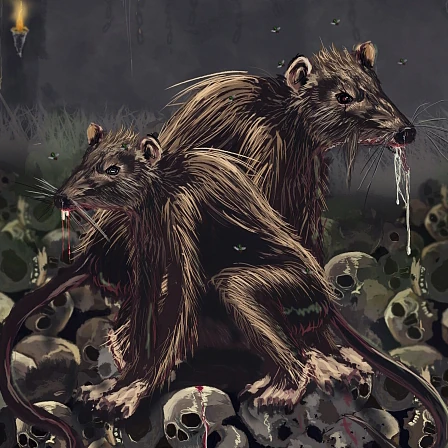
Eek! Rats in the walls! Now I can’t sleep.

Also, “The Rats in the Walls” is great if you want to scare anyone around a campfire. Just saying.

You know, the more I read of Lovecraft’s work, the more I see why he’s been so influential. Sure, his early stories could be rather pointless or silly, and never approached scary, with the exceptions of a few, like “The Tomb” and “The Temple.” But as time went on, as tends to happen, he got better. He figured out what worked and what didn’t. He learned how to get into our heads and make us tremble, make us wonder. He pushed the envelope for his day, introducing elements of cannibalism, satanism, gods that care nothing for us except maybe as snacks. And he did it so well.

And even now, after I’ve decided to take a break from him, I still find myself getting inspired by him. I’ve already gotten a few new novel and short story ideas from his stories, particularly “The Lurking Fear.” I have no idea when I’ll write them, but I think that when I do, they may even chill me.

So yeah, I think I’m definitely a Lovecraft fan now. Last year I wasn’t so much of a fan, but now I think I am. He’s definitely grown on me. And I think I may visit him again someday, perhaps even before the end of the year. Especially if he gives me so many good ideas. And if you like a good scary story and can handle some old-timey writing style, then I suggest you visit Mr. Lovecraft too.

Well, that’s all for now. I’ve got my own stories to work on, so I’m going to get on that. In the meantime, I hope you have a scarily good time, my Followers of Fear. Until next time!