Posts Tagged ‘proper decisions’

I went to a certain event on campus this evening, but I arrived not realizing that while the event is advertised as happening at a certain time, it only really starts much later (a part of me actually knew that, but the part of me that’s a total freak for being on time or missing something won out in the end). The library being nearby, I decided to pop in and check my email before I decided to go home or not. When I logged onto WordPress though, I saw a notification that I had a comment. I checked, and it was from a post I’d commented on a while back.

The post itself had been from a woman who was relating her experiences being sexually assaulted in the work environment, and how several other women she’d worked with had been in the same situation, and the owners of her workplace had tried to sweep it under the rug for the sake of business and for the attackers’ families’ sakes! Naturally, I was upset when I read that post. Sexual assault is a horrific thing that happens to so many people, mainly women but men as well. And what’s just as upsetting to me is not only the act of rape itself, but those who try to cover it up or downplay it or make it seem likes it not a big deal. This sort of conduct not only adds insult to injury to the victims, but it also sends a message, that rape is okay, that the attacker can go on doing whatever because it’s not a big deal, that if we make it into a big deal than it is then innocent people will get hurt and besides, it’s only one measly person who had a bad experience, right?

So I commented on the post. Since so many women had been attacked at this place, I suggested that maybe they band together and bring to the workplace a class-action suit or something, because sexual assault and covering up for it is illegal and a disgusting act to boot. That comment got a few likes during the preceding week or two after I’d read it, but the post got a lot more! Comments, likes, new stories coming out, stories of tragedy and stories of support. One newspaper even did a story on the place, so I’m assuming that got something rolling. At the very least, that place is seeing a lot less business than it had prior to so many women coming out.

Of course, not all of the people commenting have been supportive. The comment I got was from some woman with a generic sounding name. She basically said that while sexual assault was a crime, so was lying about it. That’s it. Lying about sexual assault was a crime.

Now, I’ve seen this sort of behavior before, and I know not to comment lest I end up getting attacked. Heck, I wrote an article on this very subject a while back, so I didn’t want to be a hypocrite by getting confrontational. But I was curious. Maybe because it was supposed to be a woman who commented, maybe it was the subject matter, maybe it was because I was kind of bored and I didn’t want to walk back to my apartment just yet. But I wanted to know who this person was.

So I clicked on the article to familiarize myself with it again. I also viewed my comment in full, as well as the reply comment. And then I started looking through the comment feed, seeing if anyone else had gotten any comments from this person. Sure enough, there were more than a few comments from this person on other people’s comments and they all had a similar message:

  1. Rape doesn’t happen
  2. The women who say they were attacked at this place weren’t attacked. Whatever happened there, they wanted it.
  3. Any woman who says that they were attacked is lying for attention or some other cockamamie reason and they’re the ones being sexist and cruel by calling supposedly innocent men rapists.

Very curious now, I clicked on the person’s username to see their blog. All I got was a bland background. No blog posts at all. Not even a post saying, “Hi, this is my first post. I’m hoping for good things while I write about so-and-so a subject. Please support me and follow me.” I checked the About page as well. Not a single thing.

At this point, any doubt I have has flown out the window. And while I’m not certain if this is someone who’s personally connected to the case and the workplace in question, or just someone who generally feels that they’re being assaulted as a man (yes, I say a man, because based on the language used by this person they’re probably male) by feminists with too much power and really without hacking skills, of which I’m lacking, there’s no real way to find out. But it does tell me something. That whoever this is feels threatened by women who speak out and feminists in general and will go to great lengths to stop it.

As if there weren’t enough obstacles making it seem like a bad idea to victims to speak out. On university campuses, some of which have really bad sexual assault rates, college administrators have mishandled assault cases, expelling or blaming victims and protecting rapists with light or no sentences at all. U Va recently got into trouble for this, and even my dear Ohio State has gotten into a lot of trouble over this. In the justice system, the system that’s supposed to protect us, there are cops, judges, and many more who will say that rape isn’t a big deal or victimhood is a status to be desired or that the victim knew what they were getting into, or that rape has to be “legitimate”. Some of this is even said by politicians at the highest levels of government. And when women speak out, they can face ridicule or disbelief by strangers, acquaintances, or even their friends and family. If their case gets to court, they risk being attacked by lawyers on the stand and disbelieved by juries. There’s a chance the rapist goes free and they have to live with that every day.

In other words, there’s a great fear, and a legitimate fear too, that speaking out will only make things worse.

And it’s the people like my wayward commenter, someone who seems determined to shut up victims and women in general, who are making the situation worse. There seems to be a great terror among certain sections of the population that giving women any sort of equality or power is akin to castrating all men and forcing them to live in a dystopian society where men are slaves to power-hungry lesbian dominatrices. That is simply not true. Feminists (of which I am one) only want women to have the same economic, social, and political rights as men, without taking away men’s rights. But there are those who believe it, and will go to great lengths to make sure women are afraid to speak out or seek equality.

Last month, feminist media critic Anita Sarkeesian was sent a threatening letter by a man who claimed that feminists had ruined his life and that if she spoke at Utah State University, he would commit a mass shooting at the event. Because of Utah’s ultra-relaxed gun atmosphere, Ms. Sarkeesian had to cancel the event lest she risk her life and the lives of others. What does Ms. Sarkeesian talk about? Her latest videos, articles, and appearances tend to talk about how women are objectified in video games and seen less as actual people and more as sex objects or devices that (often violently) advance the game’s story.

Violence is a common threat from people who don’t want women speaking out. And while the actual incidences of violence are low, these threats, plus the threat of ridicule, of becoming a punchline in a joke, of being called a money-grubbing slut or a power-hungry feminazi man-hater, makes it much more difficult for many women to speak out. No one wants that sort of attention on them, and for victims of assault, it’s even harder to come out when facing all that.

So what is there to do about it? Well, I’m doing it right now: I’m fighting back. I’m writing an article that exposes what is happening and pushes back against it. And I’m letting people who have been attacked and that are afraid to come out that I’ve got their back. Yes, I’m a man, but that doesn’t mean I don’t believe women should be equal in society. Far from it. I’m willing to fight alongside the many women out there who demand to be treated equally and with respect in the world towards men.

So know this, folks. If you’re a woman and/or you’ve been assaulted, know that I support you and I’m there for you. And for those who still think that men are under threat by these women, I’m so sorry you feel this way, but it’s not true and some day I hope you come to this realization.

Thank you, and goodnight, Followers of Fear and everyone else.

It’s expected in the coming weeks that the grand jury will hand down a decision on whether or not to indict Darren Wilson in the death of Michael Brown. Protesters have threatened to riot if Wilson isn’t indicted, the governor has declared a state of emergency, and police are getting ready for what many see as a second, bigger powder keg after the first one went off back in August. And around the country, in living rooms and coffee shops, in workplaces and on news talk shows, people are asking what caused this and what will happen next.

I’ll keep my own personal views on what should happen to Wilson to myself, lest everything else I try to say in this piece gets forgotten because of one opinion. I will state that I think it’s tragic that a young man who had his whole life ahead of him and was planning to go college and maybe own his own business someday was taken too soon, and that his legacy has to be another awful bullet point in the United States’ long, troubled history with race.

And make no mistake, there is a racial element to this. I know some will say that we shouldn’t be talking about race, that we’re living in a post-racial society, that race is a sociological construct of the mind rather than a biological certainty, and that therefore race should not be brought up. I’ve said it many times before, and I’ll keep saying it: social construct or not, many people treat race as a biological reality, and racism is still a pervasive problem in the United States. In fact, I’ve often compared racism to cancer, and the way you deal with cancer isn’t to avoid it or pretend it doesn’t exist. The way you deal with cancer is to take a multi-pronged approach to cure it, and one of those approaches is to talk about racism.

And for those who continue to insist that race shouldn’t be part of the discussion because we live in a so-called “post-racial” society, here are some facts:

  • In November 2012, students of the University of Mississippi rioted upon learning that Barack Obama was reelected. Several racial slurs were heard shouted out during the riot.
  • In February 2012, a young man in Florida was profiled by a self-appointed neighborhood watchman, who then followed the young man despite being told by police not to pursue, and engaged the young man in a scuffle that ultimately ended with the young man’s life being taken. The young man, Trayvon Martin, was black.
  • There are over 900 documented hate groups in the United States according to a report released by the Southern Poverty Law Center last year. Most of them are primarily focused on race and racial differences.

Still want to argue that racism doesn’t exist? Racism is still very prevalent in the United States, and the fact that so many want to deny its existence or say that discussing race and racism in America makes you racist really disturb me. (The latter claim actually is the most ridiculous, especially since it goes against the very definition of racism, and real racists wouldn’t benefit from discussions on race as a societal problem unless it involved doing horrible things to other races. In fact, when economist Ben Stein went on Fox News the other day and called Obama the “most racist president” ever, I wanted to throw a dictionary and a history book at the guy. If you’re going to call a President racist, it’d be better to refer to possibly Andrew Johnson, Woodrow Wilson, or Franklin Roosevelt for starters.)

I think we owe today’s racism to some of the things that happened during Reconstruction, in part. Slavery itself definitely plays a role, but I want to focus on Reconstruction because during this time, President Andrew Johnson encouraged the return of defeated Confederate states to self-rule and to take part in federal government. The people who ended up seizing control were mostly plantation owners and businessmen, some of whom had been involved in the Confederate government, and had benefited from slavery. They used their power to pass sweeping legislation depriving freed slaves of rights, and used terror in the form of the KKK to prevent push back. There was also some propaganda directed to poorer whites who were told that giving freed slaves power was bad for them. The federal government, including Johnson, didn’t do much to prevent this (Johnson also didn’t support the Civil Rights Bill or the 13th Amendment, which is why I mentioned him above in my examples of racist presidents).

This set a painful pattern in motion that would last for nearly 100 years. The legislatures continued to have people in it who would keep up the status quo, African Americans and whites who sympathized with them were kept in place through lynching, the KKK, and other forms of terror, and efforts on state and federal levels to stop it faced uphill battles. It wasn’t until WWII, when African-Americans were determined to achieve victory at home and abroad after their rough treatment during WWI, that things began to change for the better.

Why do I go into all this, and at the risk of getting a bunch of people shouting at me in the comments about how I know nothing or I’m oversimplifying it or something along those lines? Because there are a lot of painful episodes, going back further than I have covered, that have happened and continue to happen long after MLK and the Civil Rights Acts, and we need to examine the whole picture in order to understand what is happening now. Racism existed then, and although they’re in new forms, racism exists today. So we need to confront the past and examine the present if we’re to better the future.

And now that I’ve led you through this long, somewhat rambling post, I have to ask: how do you think racism can be combated? What approaches should we take to stop racism and make it less prevalent in future generations?

*By the way, I know that some of the arguments here can also be applied to other forms of prejudice and discrimination towards other minorities, women, religions, ethnic groups, socioeconomic levels, and sexual orientations. For simplicity’s sake, I’ve only focused on race here, but I do cover other problems in other posts and in some of my fiction as well.

It’s been a while since I updated everyone on my novel-that-also-doubles-as-my senior-thesis Rose, but I have the opportunity to do so now. Especially since I can’t do my job search without updating my resume, and I’m waiting to hear back from a couple of people on whether I can use them as references.

Well, if you’ll remember my post on my first thesis meeting, you know I ended up switching to first person and rewriting some of the early chapters to make them darker. Well, this past Wednesday there was another meeting with my advisor and the other student I’m working with (I keep meaning to ask if I can use their real names, but I keep forgetting. Oh well, I think I’ll stick to M, my advisor, and P, the other student I’m working with). They had a lot of suggestions for me:

  • Probably a hold over from writing Reborn City and Video Rage, but I have a tendency to explain the stranger elements of the story. Works great for science fiction, but terrible for horror. So I’m trying not to explain the stranger aspects and let the story tell it through what happens.
  • There are a few comedy elements that I’m trying to cut out. We’ll see how that goes.
  • There are some things I will need to change for the first couple chapters, but that’ll wait for the second draft.
  • Most importantly, I’ve switched to narrating in present tense.

That last one is a big one for me. In a previous post, I mentioned that I probably shouldn’t narrate in present tense because I’m not very good or familiar with it and because I have the tendency to switch back into past tense. I explained that to M, but he insisted that I at least try it. His reasoning was that since I’ve been narrating the story in past tense with a first person narrator this whole time, it’s pretty much assumed that things will turn out for the best (probably true). Putting the story in first person would probably serve to add a little mystery and uncertainty to the story.

So I thought, might as well give it a shot. I’d switched from third to first person already, and that had brought about a definite improvement, though I have to work harder to make sure that Rose’s constant state of terror doesn’t start to sound boring. On the other hand, I was already comfortable with writing in the first person. One of my early attempts at writing a novel was in the first person, and for a story written in my early-to-mid teens I did a pretty good job. Writing in the present tense was something I’d hardly ever done before.

So I rewrote parts of Chapter Three to start with, the parts that needed some holes to be plugged so that the story could continue to flow.Then I wrote Chapter Four, and over the past twenty-four hours or so I wrote Chapter Five. Both of those chapters and the parts of Chapter Three I rewrote were written in present tense. And it is weird for me. I don’t know many other authors who write that way, so I don’t have an example to refer back to. I’m basically feeling it out as I go.

But I somehow managed to do it. And it’s been a rather dramatic shift, like the DNA of the story has been altered. I keep thinking back to that scene from the first Sam Raimi Spider-Man film, when Peter Parker’s DNA gets rewritten by spider-DNA, causing his whole self to change. It’s that dramatic a shift, like the whole thing has changed in a very important way while still remaining the same basic story. I don’t think I’ve ever seen anything like it before.

Well, I’ll keep writing it in first-person present tense, hopefully gaining a knack for writing stories like this along the way (it could be useful for a future story). I just hope that when we meet again on Halloween, I don’t have to do another major change to the story. Writing this thing’s been hard enough as it is with just a busy schedule. Writing in unfamiliar styles and with so many new rules or ideas to incorporate certainly makes the job a bit tougher.

Well, it’s late, so I’m going to bed. Hopefully I’ll start Chapter Six tomorrow after classes and homework. Wish me luck, my Followers of Fear.

It’s been a while, but I just posted an article on Self-Published Authors Helping Other Authors. This latest article is about following up on submissions to magazines after a lot of time has passed and you haven’t heard anything from them. I thought this would be a good article since my last one was about submitting to magazines in general. I’m hoping for those whose stories are stuck in a wait pile, this will prove very helpful and that they’ll be able to use the advice I give to maybe get their stories read and even published.

If you get the chance, please check out the article. And if you are so inclined, check out the rest of the site. Self-Published Authors Helping Other Authors is a great resource for indie authors and even traditionally-published authors on how to write, edit, publish, and market in a cost efficient manner. I’ve found it very helpful, and I’m sure everyone else can too.

Well, I published my two or three articles. Now I’m going to work on a short story till bed. You all have a good night, my Followers of Fear. And if I get the chance, I’ll post something else tomorrow. Hopefully something spooky.

It’s October. The month where my powers of evil are at their greatest. Don’t be too terrified, the chances that I’ll terrorize your city on the 31st are actually pretty slim. Unless you live in Canada, because I’m planning on creating some Samhain mayhem up there this year. Honestly, you Canadians have had it too good for too long. You need a little tragedy and horror for once.

Where was I?

Oh yeah, it’s October. Many of you are thinking of your Halloween costumes. Personally, I’m thinking of the Eleventh Doctor, a gas-mask zombie, or Hannibal Lecter. Of course, there’s a lot of other choices out there. And if you plan to get creative with your costume, well, the sky’s the limit. You can literally dress any way you want.

Doesn’t mean you should though. Last year, I read several disturbing articles or saw several upsetting photos of what people chose to wear for Halloween, including:

  • Two guys going as George Zimmerman and Trayvon Martin, complete with bloody hoodie. Can you say, horrible and not funny?
  • A couple of people in Australia donned KKK robes for a Halloween party. If this were Spain and they were actual priests, I might accept it, but anywhere else…it’s more than a little insensitive.
  • A mom in Virginia sent her son in KKK robes to school, trying to pass it off as “a family tradition”. Lady, no one believes that for a second. And if it is a family tradition, then that’s one sick family (I feel sorry for the kid. Unless he’s already been brainwashed and knew what the robes were, he probably thought he was a ghost).
  • Julianne Hough went as a character from Orange is the New Black, and put on blackface to do it. I’m only going to say two words to this one: oy gevalt.

So many things wrong with this picture.

Listen people, I love Halloween. I love dressing up as something scary when I can afford a new costume and going around being scary without people thinking I’m weirder than I actually am. But there’s a limit to what you can wear without hurting people and an idea we have for a costume may seem funny and original, but it might not turn out that way in the end.

So while we still have 26 days till Halloween, I’m asking people who are planning on creating their own costumes to examine your ideas and make sure they won’t cause offense or seriously upset someone. And I know some people get offended just by the very concept of Halloween, but I don’t mean them. I’m talking about the people who are thinking of going as an Ebola victim, dressing up as Michael Brown and the cop who shot him, or perhaps as a stereotypical Islamic terrorist or Jew (I’m looking at you, Macklemore. That was not cool!).

Often we don’t consider how our actions can affect people. Sadly, it’s still common for people, including many young people who are raised in a “tolerant” atmosphere to say “That’s so gay” or insult someone by calling them a faggot. Saying that may seem small, but in reality they can cause serious psychological harm, because implied in their utterance is that being gay or thought of as gay is bad. For an actual LGBT person such as myself, hearing this is hurtful and makes me feel like less of a person. Such words and actions are known as microaggressions, and they can have as much of a psychological impact on a person as being mugged or some other traumatic incident if they continue consistently over time.

Now imagine that harm in the form of a Halloween costume, out on the streets where so many people can see it, where it can be photographed and uploaded onto social media for the whole world to see forever and ever.

Kind of makes you think, doesn’t it? So please be considerate of others when you decide a costume. You can be scary or funny or cute or even sexy, if you’d like. But if your costume idea has the potential to cause distress, offense, or insult to someone of a different religion, race, ethnicity, gender, sexual orientation, or even socioeconomic status, perhaps it’s better to come up with a different costume.

I’ve come to this decision after only a little deliberation but with a heavy heart. Ever since I entered college, and maybe for a few months before, I liked watching new TV live, rather than watching it the next day or as reruns. I didn’t watch a lot of new TV live growing up, mostly because it was on late and I had to get my sleep for school or whatever else was going on the next day for me. When I got to college, I found it simple even with a full schedule of classes and work to fit in TV in the evenings and watch shows I liked. And if perchance I missed them, most were on Hulu or other websites the next day.

That’s changing this semester. Because in addition to five classes–all of which hand out homework, and a lot of it, usually–I’m writing a novel for a thesis, which takes up a considerable amount of time. Add in shifts at work four days a week, and my time is filled up with work, work, and…did I mention work?

So as much as I love all my shows (and I love a lot of them, believe me), I’m drastically reducing how much TV I watch so I can get through my workload with more ease and less pressure. I don’t want to, but I have to make my studies a priority in all circumstances, so it’s something I have to do if I want to keep my grades up and not get piled under a mountain of homework.

And on the bright side I have DVR, so I’ll be able to hopefully catch up on most of my shows over winter break or whenever I’m actually free from assignments, whichever comes first. Hopefully nobody spoils my shows in the meantime, which would give me cause to put a curse on them. And I’m quite capable of doing that too.

He’s screaming about my TV reduction plan AND my curse threat.

In the meantime, the only shows I’ll keep up with are The Daily Show with Jon Stewart (I can watch it during breakfast), Sailor Moon Crystal (airs every other Saturday or so, and yes they rebooted Sailor Moon. Believe me, that franchise is never going away), Doctor Who (you know why I’ll be watching that), and Saturday Night Live (you can guess why on that as well).

I’m also going to have to cut back on the movies I watch. Which makes me sad, there are so many good horror movies coming out this October! I don’t want to wait until they’re on DVD!

Whatever happened to the days when life was simple? Oh yeah, that’s right. They never existed.

Well, that’s enough of me griping. Just know that I’m staying focused on my main priorities, I’ll leave the entertainment for another day, and I’ll try and continue to blog at least once or twice a week.

In the meantime, I’m heading to bed. It’s late, and I’ve got a full day tomorrow. Goodnight, my Followers of Fear. Pleasant nightmares.

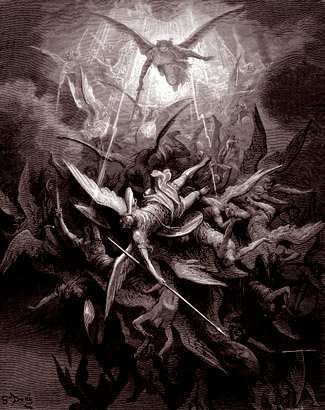
0471a-fallenangels

I would’ve written this post earlier in the day, but…well, you probably can guess.

Anyway, today was my first critique day in my creative writing workshop. There were three others in the class getting their short stories critiqued, and mine was the third. And it was one of the best critiques I’ve ever had, because they pointed out numerous problems with “Evil Began in a Bar” and gave some really good suggestions on how to improve it. Yeah, the best way to judge a critique is not on how much they praise or hate a story, but on what the critics say that will help you better the story.

As I said, my classmates felt there was a lot that could be improved upon with “Evil Began in a Bar”, which is a retelling of the story of the Fall a la Milton (or a la Ungar, I guess) Some of the big ones were:

  • The tone seemed to shift wildly between dark and comical, serious and light.
  • They couldn’t tell whether this was a dystopia story or a religious fantasy.
  • People unfamiliar with the story of the Fall might be confused by this.

I think I’ve mentioned this before, but short stories are not my greatest strength. I’m much better at novels.

Still, there’s a bright side to this. After hearing from my classmates and talking to my teacher after class (in which she agreed with me on my predilection for novels: “You seem to be very expansive in your writing”), I got a better idea of what I can do to modify this story. And like a lot of short stories I seem to be working with lately, this one is going to be rewritten entirely during the second phase. I’m fine with it, really. At this point I’m becoming very used to it, and I like where I could go with this short story on the second draft. I just hope I can keep it under five-thousand words, or it’ll be more difficult to get it published in a magazine.

But before I do any revisions, I’m going to work on the next short story I’m going to write for my creative writing class. That one’s due on the Wednesday before Halloween, so you know I’m going to be bringing the terror. And as the hint I gave a while back indicates, this time it’s going to be a werewolf story. Though if I’m able to pull it off, it’ll be a very unusual werewolf story.

Here’s what’s coming next from creepy ol’ me.

And after the werewolf story…well, I may resubmit “Evil Began in a Bar” for the third time around, when I submit a revision. I guess it’ll depend on how my classmates react to the werewolf story, and how much work I have going on then, among other things. In any case, wish me luck with this and all the other projects I’ve got going on at the moment. It’s because of your support that I’m able to keep working even when stressed out.

Oh, and before I forget, this evening starts Rosh Hashanah, the Jewish New Year. According to the Jewish calendar, the Earth is now 5775 years old. So for everyone out there, I hope you have a happy and healthy new year, and I hope you’re inscribed in the Book of Life for the coming year. Also, if I did anything to upset or offend you this past year, I hope you’ll forgive me, because I’ve already forgiven you.

Have a good night, my Followers of Fear!

I know it’s been a while since I last blogged. Five days in fact. Man, I must be busy. And I would’ve blogged about this yesterday, but…well, I had biology and creative writing homework. Yeah, school’s basically taking over my life more than it usually does. God help me.

Anyway, yesterday afternoon was my first meeting with my thesis adviser. It was me, him, and another student who is also working on a novel. The idea is that we all collaborate to help each other out with these projects (of course, my adviser isn’t asking us for advice if he’s working on his own novel, but that’s beside the point). Since I’d already sent them both the first two chapters of my thesis project Rose, they had read what I’d written and had some feedback.

Let me tell you, it was very illuminating. The biggest thing about my work is that I’m always looking for holes to plug up, but they found some holes I’d missed, proving to me that I should not go into the field of repairing ships or they’d sink. What they told me was that the opening of chapter one was a little too lighthearted for a horror novel, and suggested a way to make it more of a dark, creepy story like I’d originally intended. They also gave me some suggestions on how to make our stalker much creepier and also recommended maybe I try switching to first person (and seeing as Rose is all about the main character’s point of view, that might be an idea I’ll keep).

So now I have until Friday to come up with some new material and send it to the both of them, and then we all meet up a week afterwards. I’m going to start with a little experiment to help refine the stalker’s character, and then I’m going to basically start rewriting Chapter One of Rose. The original opening, like I said, was a bit too lighthearted, so going back and redoing it should create the atmosphere I’m going for. And it’s not as if I haven’t rewritten an entire short story before on the suggestions of  my peers. What is Chapter One anyway, besides a short story that can be continued by several succeeding, interconnected short stories?

Obviously a bad analogy, but you get the idea.

Anyway, I’ve got to get to work, so wish me luck on the writing/editing front. And by the way, I turned in my short story Evil Began in a Bar on Wednesday to my creative writing class, so my classmates will be coming back to class Wednesday with feedback. I’ll be blogging about it then, but I’m hoping for good things.

Have a great day, my Followers of Fear.

I’m a feminist. I believe that women should be given equal treatment to men financially, politically, and socially. I believe this won’t disenfranchise men, but instead make women equal partners to men. In fact, men such as myself can be ardent feminists, and there are plenty of them out there. I also believe that there are people who dislike feminism because of ignorance or prejudice. And I believe that those who actively work to dissuade people from identifying feminism or tear down some of the movement’s tenets and beliefs are doing a lot more harm than good. Normally I ignore what is said, but occasionally something is so blatantly wrong or harmful to women that I have to speak up.

So when I read what Rush Limbaugh said today and then heard it for myself, I couldn’t keep quiet. Normally I ignore what Mr. Limbaugh says. Since the Sandra Fluke debacle two years ago, I’ve actually been surprised that he’s still on the air, let alone that he hasn’t learned from his mistakes or maybe hired someone to edit what he plans to say before he says it. But today might be the worst thing he’s said since he talked about Ms. Fluke.

I couldn’t embed the audio of the clip in question onto this post (if you’d like to hear it yourself, you can check out the Huffington Post article where I first read about it), so I’m talking about it here. In short, Mr. Limbaugh said that he finds the idea of “No” means “No” ridiculous.  He says:

How many of you guys in your own experience with women have learned that ‘no’ means ‘yes’ if you know how to spot it?…It used to be used as a cliche.

So under this definition of consent, when a woman says “no”, it really means “yes” under certain circumstances (and I bet to a guy like Mr. Limbaugh, there are few, if any, circumstances where “no” actually means “no”). A guy just has to “spot” it. I’m just wondering, how exactly do you spot the signs that a woman is actually saying “yes” underneath the resounding “no”? Enlighten me.

And if you think about it, this definition could extend not just to women. Perhaps a young child is actually saying yes to being touched inappropriately, even if they’re being touched by a parent or other relative. And according to Mr. Limbaugh’s definition of consent, if a gay man comes onto him or any other man and the second man says no, the gay man is allowed to go on if they believe “the signs” are there telling them to go on.* It’s uncomfortable to think about, but it could happen.

*I’m not actually insinuating that anyone does or should do this, be they straight or gay men, relatives of a child, or anything else. I’m just trying to put this in the context that Mr. Limbaugh outlines and make sense of the implications.

Also notice how Mr. Limbaugh asks for the opinions of the male listeners of his show, but not the female listeners. Why doesn’t Mr. Limbaugh ask about the female listeners’ experiences? I’m sure some of them have quite the stories to tell. According to the website of the Rape, Abuse, And Incest National Network, about 1 in 6 women are the victims of an attempted or completed rape in their lifetimes. 1 in 33 men suffer the same sort of attacks, and 15% of children under the age of 12 are vulnerable to rape or sexual assault. Victims of sexual assault are three times more likely to suffer from depression, four times more likely to suffer from PTSD and/or consider suicide, and 13 and 26 times more likely to abuse alcohol or drugs, respectively. A third of them get pregnant from their ordeals. How many of these women said “no” and that was ignored or interpreted as meaning “yes”? And how many of them listen to the Rush Limbaugh Show?

Mr. Limbaugh also quotes from the student handbook at Ohio State University** on what constitutes consent. Well, actually he isn’t quoting, exactly. Only a small bit of what he says is actually from the Student Code of Conduct (which you can read here). I have no idea where he’s getting this stuff about the thirteen-year-olds consenting to sex. But beyond all that, the point Mr. Limbaugh is trying to make is that all these requirements for having consent is too much and actually getting in the way of romance and seduction. I don’t have the most experience in this, but if you ask me, when two consenting partners are very much in love, care deeply about the other, and want to make each other happy, then all this stuff Mr. Limbaugh believes gets in the way of romance and seduction becomes unnecessary. The couple know each other well enough to know what is safe, what is crossing a boundary, and how to make sure both of them have an enjoyable sexual experience.

And for couples who aren’t at that point yet, perhaps they don’t need to ask permission to do every single thing. But it is common sense to discuss with your partner what you consider safe sexual territory, and to pay attention to what your partner is telling you, verbally or non-verbally. If your partner says no, doesn’t matter if you or your partner are male, female, or some other third gender. No means no, under ALL circumstances.

Mr. Limbaugh makes it seem like you have to go through a maze to have sex, but I don’t think that’s actually the case.

**For future reference, would you please not use my alma mater in your program? It’s not a very good example at the moment, anyway: sad as I am to admit, OSU’s marching band is under investigation for fostering an atmosphere of sexual assault, and there are other investigations occurring as well, last I checked. I still love this school and I’m not proud of what’s happened here, but you can’t fight your demons if you don’t admit to them, so I’m putting them out there.

So Mr. Limbaugh may feel that there are exceptions to the No rule and all those requirements for consent are a bit too much for your average man looking for sex. But with sexual assault so prevalent in our nation, I feel having these things pointed out to us is a good thing. Not only does it make us aware of a problem that needs to be combated, but following these rules helps to make our country safer for all, and helps to eliminate a very terrible problem.

Mr. Limbaugh does make one very good point, and that is we need to change how we teach our boys. I agree, but I think we need to change how we teach our girls too, and maybe how we approach sex in general. Men should be taught that there is nothing wrong with wanting to have sex, provided you are educated about both the benefits and the consequences of sex, particularly unsafe, forced or alternative forms of sex. And girls should be taught about their bodies, all that comes with sex, and that there is nothing they should be ashamed of when it comes to their bodies or their sexuality, no mater what anyone says. And above all, it should be stressed that no one owns your body but you, and you should decide what can and cannot be done with it.

Mr. Limbaugh, I hope what you’ve said today gets talked about by a variety of people. I hope that you make the newsrounds for your comments, because what you said is hurtful and shameful and trivializes a major problem. And perhaps after what you’ve said, there can be some constructive change to stop this ongoing epidemic of sexual assault in our nation. I would very much like to say that.

And Mr. Limbaugh, perhaps after this latest incdent, you might take steps to avoid saying such hurtful and despicable things on your program. And if that’s not possible, then maybe it’d be better for a lot of people (and I say this with all the sensitivity I can muster in such a situation) if you would kindly shut up.

Some of you are probably reading the title of this post and are wondering, Since when is there a purpose to any sort of violence? Very true, but I’m talking about violence in speculative fiction and when it is useful and when it is just excessive.

Granted, I might not be the best person to speak on this subject. If any of you have read or are reading Snake, you are well aware that the main character is very influenced by slasher films and the Russian mafia, so violence abounds. However, in my other books I try to hold back on the violence. Why? Partly because I’m just terrible with writing fight scenes. I actually try to avoid them when I can, which is okay because in horror it’s often more about the atmosphere and character interaction than about describing a punch or a gun fight.

But the other reason is that, when I’m writing and I think about including a very violent scene in my story, I think about whether it can advance a story’s plot.

Let me explain. In Video Rage, the sequel to Reborn City that I’m currently editing when I have the chance (my time is so filled up these days), there comes a scene about midway through the book where some of the characters get into an argument and one of them ends up punching the other in the face. The actual punch occupies about maybe two or three paragraphs, but the result s of it is felt throughout the rest of the novel. Both characters in this little altercation have to reassess their relationship. One has to decide if they want to continue to be friends with someone who punched them, especially since they really cared about this person and the hurt feelings and pride hurt more than the being punched. As for the one doing the punching, he is horrified about what he did in a moment of anger. He has to take a hard look at himself and really decide whether he might need to change his actions and perhaps do some growing up.

Another example is in Rose, my work-in-progress/thesis project. As I’ve mentioned in previous posts, Rose is dealing with a young woman trapped by magic with the stalker who resurrected her. And when she tries to get away from him, he often gets violent and dangerous. While providing some very terrifying scenes, these moments also force Rose into a dark place. She becomes frightened, and, like many abused women, starts walking on eggshells because she’s afraid of arousing his rage. Over the course of the story, Rose finds herself driven into a darker and darker place spiritually because of all she suffers. At least until certain events allow her to seek a change.

So in a way, while I detest violence and I try not to use it when I can, in certain ways like the ones above violence can advance the story and allow for character development. Of course there are many other tools that allow for character development and propelling the plot forward: romantic relationships, deceit and treachery, other non-violent events in the characters’ lives that allow them to move forward in the story. But I think of all those, violence requires a delicacy that is much harder to handle than other methods (and not to mention romance can be a bit overused). You have to use it in just the right way or your readers will be overwhelmed and turned off from reading anymore. One slap or punch or explosion too many and it can really change things, and not for the better. So for the author, it’s up to them to figure out what is the right level of violence and how best to wield it in their story. And hopefully through practice one can figure out just that.

So am I good at wielding the violence? You’d have to find that out yourself or ask one of my other readers. An author can often the worst judge at their work. But I think I do okay at it. At any rate, I haven’t had any complaints about the levels of violence in my stories or how they’re used. In fact, I’ve been told that they’re rather scary, which pleases me to no end.

How do you use violence in your stories? Do you have any advice regarding including or not including violence in your stories?