Writers deal with a lot of tenses, and I don’t mean the ones associated when we hunch over our computers so we can better bang out stories.* No, I mean tenses like past tense and present tense, the tenses authors use to tell a story. Like first and third person POV, the use of either can vary from story to story (future tense and second person POV are rare, for reasons I’m sure people reading this blog can understand). And although I feel like I know plenty on the subject of using tenses sometimes, occasionally I find I still have something to learn.
Earlier today, I received an email from a magazine I submitted a short story to a couple months back. They rejected it. Which, honestly, I wasn’t broken up about. I figured out there were changes to this particular story while it was in consideration at the publication, so I thought this was for the best. However, they did include some notes on what worked and didn’t work with the story. Among those was one that really struck me.
They said that narrating in past tense, while giving the narration strength, also made it clear that the story took place in the past, and therefore made the story overall weaker, as it kind of gave away the ending. Namely, that the protagonist survives.
Now sometimes in a horror story, that’s fine. Part of the thrill is seeing how things turn out when you already have some idea of the ending. Interview with the Vampire is framed just as its title suggests, a vampire getting interviewed about his life. Jack Ketchum’s The Girl Next Door is told by the narrator when he’s an adult remembering his childhood traumas (still the scariest novel I’ve ever read). And Salem’s Lot by Stephen King begins with two of the main cast in Mexico after escaping the town, then rewinds to the beginning of the events, and then afterwards shows those two characters burning the town down.
But apparently, with this story, that should not have been the case, as it took away some of the tension. And a horror story without tension is like a hamburger without a bun. It’s missing something essential.
Food metaphors aside, this shows an issue not only with the story, but a lesson I can learn from. With stories, it often seems instinctual, at least to me, about what tense to write in. Perhaps in future, I should weigh options and think about what the pros and cons of writing a story in past versus present tense. Perhaps then I’ll be able to write my stories and make them more effective in scaring the pants out of people.
And that goes especially with the story I got the rejection for today. I feel like this one could be one of my best if I can polish it a bit more and maybe get some more feedback on it. We’ll just have to wait and see what happens when I try changing the tense (and maybe the POV. I feel like that could also be an effective strategy for this story).
At least I know there’s still room for me to improve and become a better writer. I hear perfection gets boring pretty quickly.
Well, that’s all for now, my Followers of Fear. I’m off to do battle with some exorcists who believe I’m an ancient entity here to usher in the end of the world (they’re right on one count, at least), and then do some writing. Thankfully with this story I’m working on now, I’m sure I have the right tense and POV for what I’m trying to do. That should make things easier further down the line.
Until next time, pleasant nightmares!
*In all seriousness though, take care of your backs, fellow writers. That will come back to haunt you if you don’t practice better posture. Believe me, I know. Brought to you by a writer giving a shit.
As much as we make jokes about it, young adult fiction, or YA, is a massive and popular genre. Over ten-thousand YA books were released in 2012, read by both the targeted demographic, teens, and by an increasing number of adults. And among horror, there are writers who specialize in YA horror. But that leaves a question: when is a horror story a YA horror story? Does it have to star a teen or teens? Or is there something more to it?
I ask this because I have a project for National Novel Writing Month in November where nearly the whole cast are teenagers. And while I have nothing against YA or those who write/enjoy it (the amount of anime and manga I consume is primarily aimed at teens, which says something), it’s not a label I think this story should be given.
If you ask most authors and fans (and believe me, I have), YA fiction is usually defined as having teen protagonists and including themes prevalent around the teen years: first love, friendship, identity, and growing up. By that definition, many horror novels could be considered YA, even though they’ve traditionally been aimed at adults. A good example is Carrie by Stephen King. It fits both requirements–teens are prominent in the novel, and themes such as bullying and inclusion, first love, and becoming an adult are all present in the novel.
I even asked in one of my Facebook groups if other authors considered Carrie YA. I got over fifty responses in the course of a week, and it was divided almost evenly down the line. And while the opinion was split, many people admitted they or their children read it as teenagers. I myself read Carrie as a teen. So is it YA fiction then, like the Cirque du Freak books and last year’s bestseller The Sawkill Girls? And are other novels with teens in the lead role to be considered YA?
Well, here’s the thing: the above definition doesn’t include something very important that has to come into consideration. What is that? Marketing. Who is the book being marketed to? Marketing has always played a part in categorizing what is called YA and what isn’t. In fact, the demographic of YA fiction (it’s not a genre, no matter how much we think of it as one), was first defined by librarians in the early half of the 20th century who wanted to know which books were being read by the newly-defined teen demographic and why. It was later picked up by publishers when they realized how they could increase their sales by marketing certain stories to the 12-18 age group.*
So while Carrie has always been popular among teens, it was and has always been marketed at adults, as have all of King’s books. And that’s because King wrote it for adults, not for teens. Meanwhile, books like the Cirque du Freak series were always aimed at the teen demographic, from early writing stages to their eventual publication and marketing.
And that’s what we need to answer my earlier question: if my NaNoWriMo project has a teen cast and incorporates certain themes relevant to teens, is it YA? While I’m sure, if it gets published, some will categorize it as YA horror, I write for an adult audience. Everything from what I include in the story (including possible sex scenes) to just the word choices and the explorations of characters’ thoughts and feelings is through an adult lens. YA, it is not.
So while a story may include teens prominently in the cast and feature themes and content relevant to teenagers, unless it’s written and later marketed for teens, it can’t necessarily be called YA fiction. Many may still slap the label “YA” on a story given its content, and they have every right to do so, if they feel that story fits their definition of YA fiction. But the intention of the story’s author will be the ultimate decisive requirement, whether in horror or any other genre.
Well, that’s all for now, my Followers of Fear. Thanks for reading this little piece I wrote just to get my thoughts out on this subject before I started writing in November. But tell me, what are you thoughts on the subject? What makes a story, horror or otherwise, YA? Let’s discuss.
Until next time, pleasant nightmares.
And look, I went an entire post without once mentioning Rose. I consider that an accomplishment–oh dammit!
*Thank you Lindsay Ellis for helping me research this article with a great YouTube video.
Last night, I did some writing. And while that statement on its own might not be the most groundbreaking thing I’ve ever written on this blog, it was important for me. As you know, since early June, I’ve been consumed with the editing, publishing and marketing of Rose, as well as editing some other stories (but I won’t go into that right now). In fact, I’m still working on that last bit! I’ve been doing a lot every day to make sure people are reading the book. Just today, I’ve probably sent about ten emails related to the novel!*
Add in my day job, taking care of myself, sleeping and making sure I’m relaxed enough in the evenings not to go on a killing spree the next day, and I’ve had very little time to devote to new projects. I tried a week or two ago to do some work on a new short story, but it didn’t go as well as I would have hoped. I blame that on the story being existential horror, and I’m in too bright a state of mind these days to write that sort of horror well.
But last night, I was able to get back into the swing of things and get a significant number of words down on paper on a novelette I’ve been wanting to rewrite since 2015 but haven’t done since then (yeah, I can go for years without working on a story if I think I need more time before I work on it again). And I think part of the reason I was able to get so much of the story written in a single sitting, other than a glass of beer, was that I was able to put myself back in the mood to write after such a long hiatus.
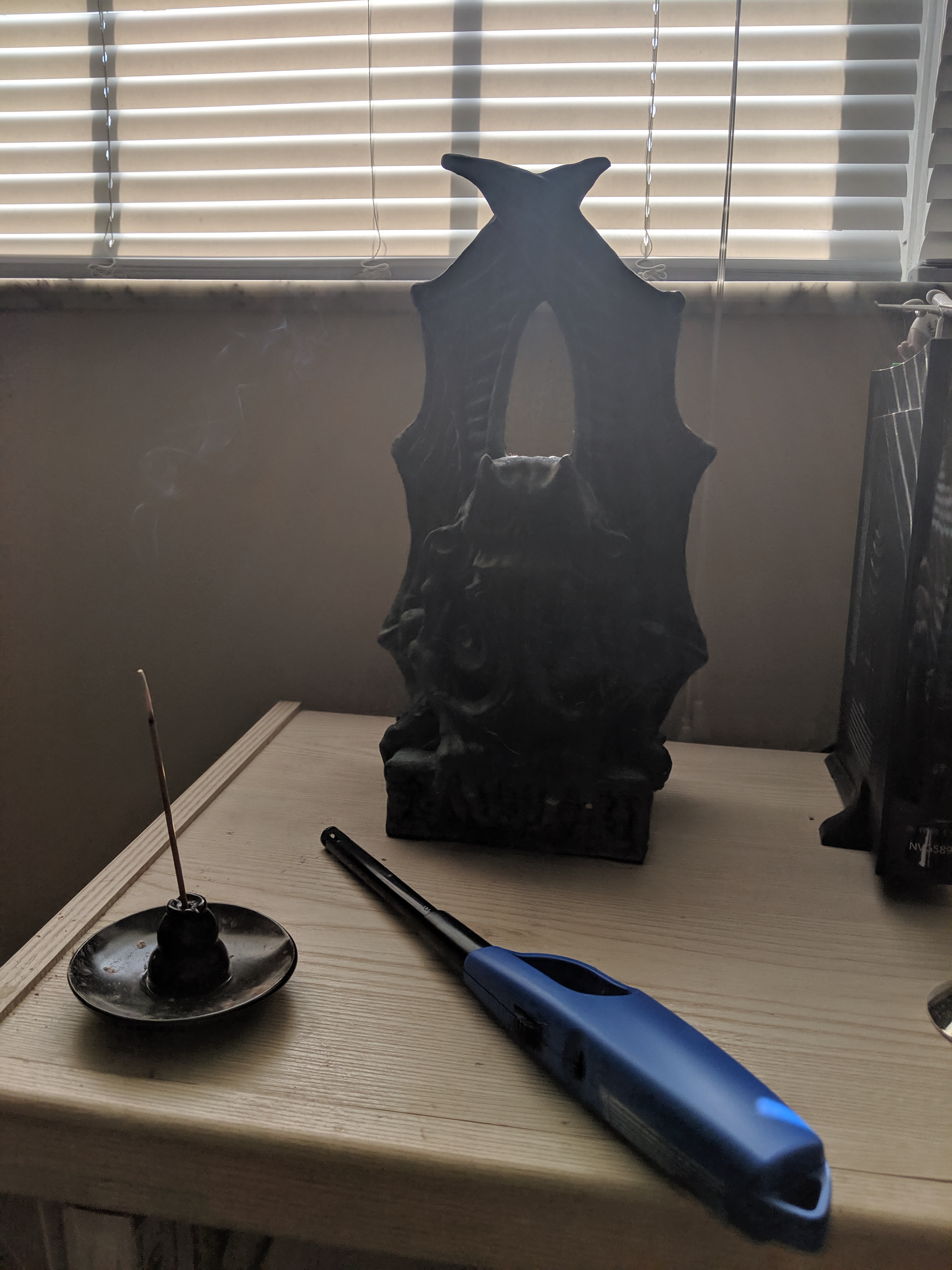
The first thing I did while writing last night was make sure my writing space–aka my desk and where I take most of my meals–had everything I normally used to write. I had my laptop in front of me, with the story and the outline for it in front of me. I had something to drink–usually tea with honey but last night beer–and some mints nearby, as well as whatever music I’m in the mood for playing on iTunes (these days, it’s classical). And I had some incense burning by the Cthulhu statue. That helped me really get me in the mood for writing, because those are all things I associate with and use while writing. Just having them all there, especially after such a long break from doing any real writing, made a huge difference.
There’s a perverse pleasure in lighting incense in front of a Cthulhu statue that makes you want to write horror, don’t you think?
Another thing that really helped was that I had the right story to work on. I think this story, which I expect to end up being a novelette between ten and twenty-thousand words, was perfect because it was simple and easy to work on. I won’t go into details at this point about it’s plot (though I will tell you this YouTube video I’ve linked to is a hint as to the subject matter), but it’s not a complicated story. It’s not dealing with any deep themes like the fragility of the human mind, or requires extensive research. It’s just a simple story about a supernatural force affecting the lives of a bunch of teenagers.
But that’s the beauty of it. By not giving myself a really challenging story, I’m easing myself back into writing. I’m getting back the motivation to write after so long away. And it works. Because the last thing you need after getting one of the most challenging stories you’ve ever written published and then doing everything to market it is something just as hard or maybe even more so, right? No, you need an easy story to get back into it.
With both of these factors working for me, I was able to get a ton of writing done, and maybe even get some more done this week. And after that? I don’t know. I have a few ideas. But at least I know I’ll have an easier time writing now that I’ve eased myself back into it.
Anyway, that’s all for now, my Followers of Fear. I’ll probably have a new post about effective horror writing out in the next week or so, so keep an eye out for it. Until then, pleasant nightmares!
*And speaking of Rose, I think all that marketing work is…well, working. Amazon finally got both pages for the ebook and paperback linked, and the page lists the novel as a 4.5 out of 5 based on six reviews. In addition, Amazon Canada has the book rated as a 5-star and Amazon UK has it rated as a 4-star (both based on only one review each, but it’s a start. They also list the American reviews, but don’t list them for whatever reason). And on Goodreads, Rose is rocking a rating of 4.2 out of 5 based on 5 ratings and 4 reviews, and has nearly thirty people listed as having the book on their TBR list.
Not trying to brag, I’m just stating this is really good news and possibly bodes at more good things to come. Fingers crossed!
One of these days I’m going to get my own Annabelle doll. Not a Raggedy Ann like the real Annabelle doll, and certainly not the actual cursed doll (there’s not enough room in my home for two powerful demonic entities). No, I mean I’m going to get one of the collectible dolls based on the one in these movies. That would be a great addition to my ever-growing doll collection.
Also, did I mention I plan to name a major character in my project for National Novel Writing Month after this doll? Well, now I did.
Annabelle Comes Home follows Judy Warren, Ed and Lorraine’s young daughter; Mary Ellen, Judy’s babysitter; and Daniela, Mary Ellen’s best friend. Judy’s home alone one night, and Mary Ellen’s sitting, which Daniela, who is grieving the loss of her father, uses as an excuse to come over and explore the Warrens’ haunted collection of dangerous objects to try to contact her father. However, she lets Annabelle out of her case by accident, and the doll awakens all the evil in the collection, trapping the girls in the house for the most fateful night of their lives.
From a storytelling perspective, Annabelle 3 was decent. Nothing extraordinary, but it does a good job. The writers give Judy Warren her first major role in the series as a girl trying to come to terms with her parents’ work as well as her own paranormal gifts, and Daniela is given some depth as more than the rebellious friend who’s just looking for something fun to do (aka look through a collection of cursed possessions). There are some really tense moments, and the practical effects allow for some creepy and creative visuals.
And I loved Bob, the sweet boy-next-door interested in Mary Ellen and who goes by the nickname “Bob’s Got Balls.” He gets caught up in the horror and ends up stealing the show at times. Can we get a movie around him trying to be a cross between the Warrens and van Helsing? Maybe with Judy as his sidekick? You can make a whole series of horror/action films out of those two!
Sadly, I had a few issues with Annabelle Comes Home. The biggest is that, after seven (eight including La Llorona) films, the jumpscares in the Conjuring Universe are getting old. We know what to expect, and it’s getting repetitive. After one particular jumpscare, people started laughing in the theater! I’ve been saying since The Nun, they need to done down on the jumpscares and try to switch things up. If the series is to continue past The Conjuring 3 next year, it may need to try some new things or all the projects in development are going to get shelved (and there are a few of those).
I also had issues with one of the spirits featured in the film (who I’ve heard might be the villain in The Conjuring 3). It was animated with a lot of CGI, which was not that scary. In fact, the first time we see it looked kind of ridiculous. Look, I know CGI was probably easier to create it, but there were twenty different ways to make that thing scary, and I would’ve liked to see them.
And finally, there’s the friendly ghost in the film (yeah, there’s one). Given how little it was in the film, was it even necessary to include it? You could’ve given it one more minute of screen time, made the appearance worth it.
On a scale of 1 to 5, I’m giving Annabelle Comes Home a 3. Not the best of the franchise, but not the worst. Fans of the franchise will love it, but others may need something with a bit more meat to it, if you get my meaning. But hey, at least it’s not The Curse of La Llorona. Anyway, let’s hope next year’s Conjuring 3 does better.
Short post today, folks. Yeah, I know it’s not about Rose, but hopefully I’ll have something on that very soon. In the meantime, I was lucky enough to be a featured guest on Kendall Reviews, a website dedicating to reviewing and promoting works of horror and the horror genre. A while back, they were soliciting authors to submit essays on why they write horror, with the goal of having at least one essay a week to publish. You know me, I wrote one as soon as I could get on the computer, and I sent it in, requesting that they only publish it when I had a release date for Rose.
Well, given today is the 20th of June, and Rose is supposed to come out tomorrow, you can guess how that request went. Anyway, that essay, Why Do I Write Horror?, is live now, and if you’ve ever been curious as to why I write horror (and trust me, it’s a lot more complex than you’d think), you can read it by clicking this link.
Thanks again to Gavin Kendall and the team at Kendall Reviews for featuring me. I’m happy to have contributed to your site and I hope we get to work again together someday. Maybe they’ll review Rose?
That’s all for now. Until next time, my Followers of Fear, pleasant nightmares!
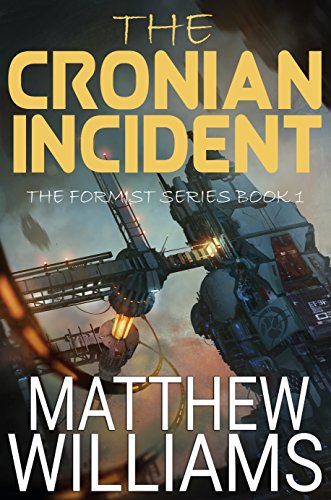
My friend Matt Williams, who introduced me to Castrum Press nearly eighteen months ago as a prospective client, has published two books with Castrum. One of them, The Cronian Incident, has recently been released as an audio book. I’d previously read the book when it was released, so I was curious as to what it would be like as an audio book. Would my opinion of the book change because I read it with my ears instead of my eyes? Would the narrator totally ruin the story?
I started listening on the ride home from Mansfield on June 2nd, and finished it up today. And I have to say, I have some thoughts. Not on The Cronian Incident, though if you like hard science fiction and you enjoy a little mystery as well, I recommend it. No, on the experience of listening to a friend’s book on audio.
I’ve long held the opinion that authors have two or three different voices. There’s the one we use in our day-to-day conversations; the ones we use in our social media and blog posts; and our writing voices, the ones we use for storytelling. Our blogging voices may share similarities with our speaking voices, but our writing voices are another animal entirely. That voice is separating itself from us, the writers, to note details, describe point-of-views, and philosophize through the eyes of various characters. It’s storytelling, in other words, and that may have nothing to do to whichever writer that voice belongs to.
So here I am. I’m used to Matt’s blogging and social media voice. We often talk on Messenger and occasionally on each other’s blog posts. And his writing voice sounds nothing like that voice. It sounds instead like a lot of the sci-fi novels I read in high school and college, building this world for me involving space travel and cybernetic implants and robotic doctors and so much else. There’s a diverse vocabulary, incorporating more words than used in daily conversation. The characters see things differently than Matt might in a similar situation. It’s a bit of a change. One I’ve done more than a few times (comes with having so many writer friends) but still a change.
And then there’s the audio book. You recognize the scenes and the words, but it’s a voice different than what you read the book with. It’s someone independent of the author, your friend, telling you the story anew, giving their own takes on how the characters sound, deciding whether a specific passage should sound tense or humorous, etc. It’s kind of like if, in a creative writing class, your best friend shares their work with the class, and then instead of your friend’s voice, Neil Gaiman’s voice slipped out! It’s a bit of a shocker.
The good thing is, it’s a shocker you can get used to. Most of the shock comes from knowing the author, so once you get used to having someone other than your friend (unless your friend narrated their own audio book, that is), it’s an enjoyable experience. You can dive in and become immersed in the story. And that, ladies and gentlemen, is what every writer wants to happen when people read their books.
But tell me, have you ever listened to an audio book based on a friend’s novel? What was it like? Let’s discuss.
Oh, and if you’re wondering if Rose will ever make it into audio book format, let’s just say my publisher and I have talked a bit about it, but it’s waaay too early to even get excited about it. Let’s just focus on making sure the paperback/ebook release goes well before we start planning anything else.
That’s all for now, my Followers of Fear. If this post got you curious about The Cronian Incident, you can find it on Amazon and Audible. And remember, Rose comes out this Friday, June 21st. I’ll hopefully be posting preorder link tomorrow, so keep an eye out for that post. And until next time, pleasant nightmares!
I’ve been meaning to write this post for about a week, but I had to upload some videos onto YouTube, and then I was writing a short story, and editing a novella, and life got crazy. Anyway, no time like the present, so let’s talk about something I did last weekend that I’ve wanted to do for almost a year. That’s right, I did a public ghost hunt!
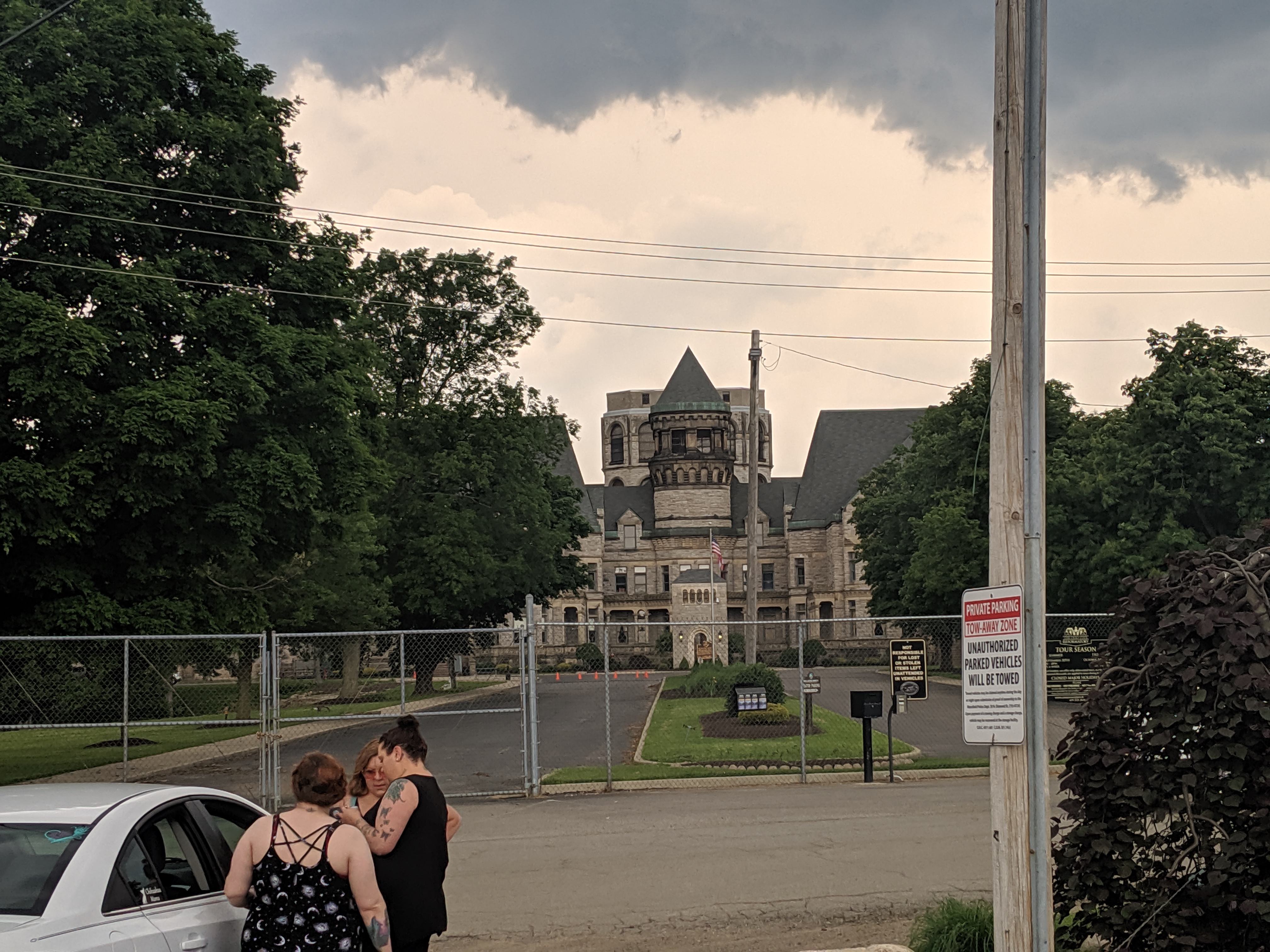
Those of you who’ve been reading this blog for a while may remember I wrote about visiting the Ohio State Reformatory, filming location of the Shawshank Redemption and all-around haunted location open to the public (you can read the original post here). I got a lot of paranormal evidence off video with my dowsing rods and was eager to visit again. I’d also known about the public ghost hunts they conduct during the summer months for a while. My vacation was coming up, so I thought, “Let’s do it!”
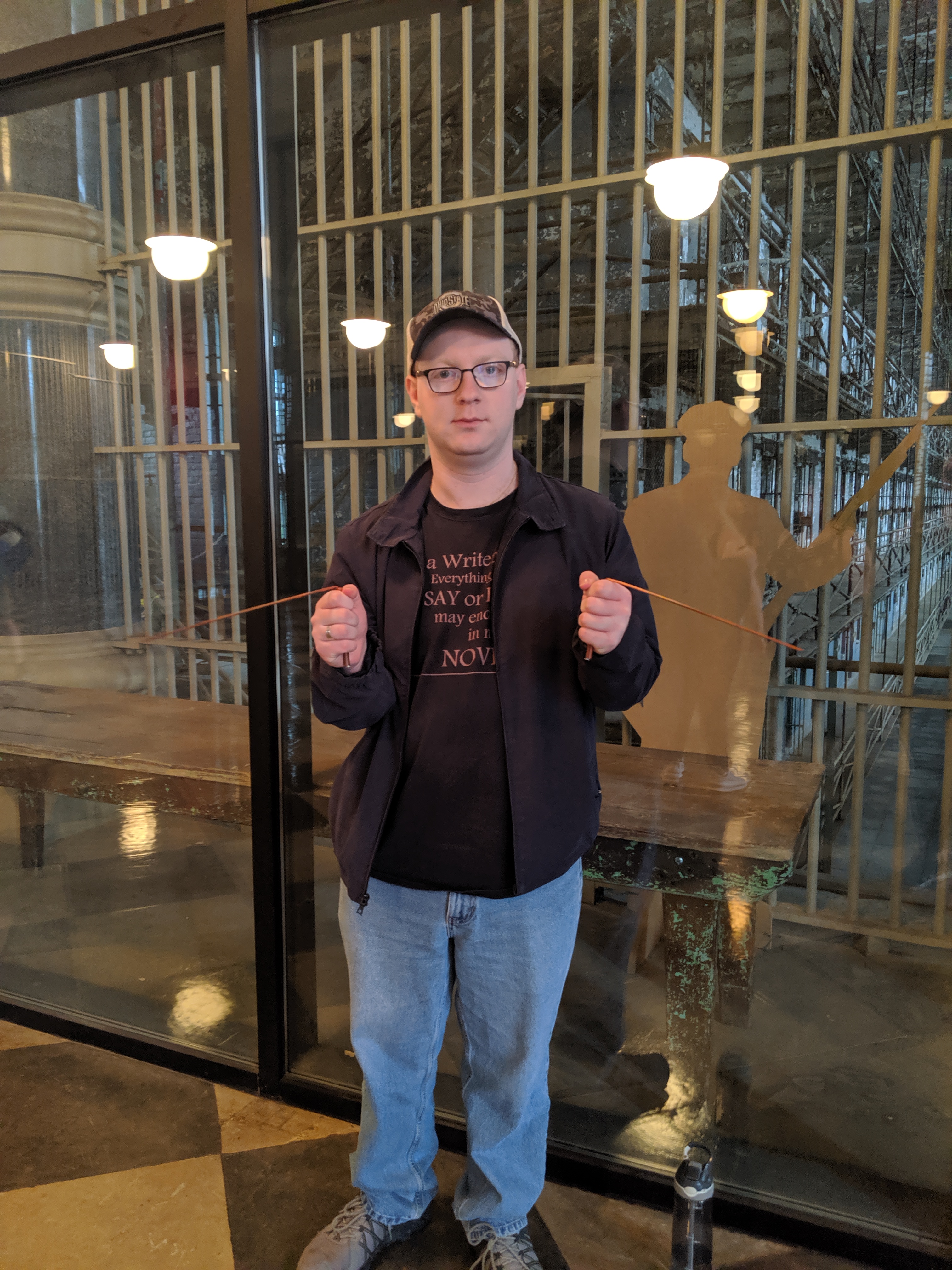
I’m not going to recount the whole evening (we were there from 6 PM on June 1st to 3 AM on June 2nd), or we’ll be there the whole day. However, I can hit you with the highlights. I arrived at the prison a little before six and waited with a couple of other early arrivals for the gate to open. Once it did, we trundled in and checked in at the front entrance. Once that was taken care of, I was led to a big gathering room where you could see the east and west cell blocks through glass windows on either side. Since the fun wasn’t set to begin until 7 when everyone was checked in, I spent time talking to other people and did an initial dowsing test, which led to this video.
Yeah, so already the place was active. And as my questions proved, this wasn’t just me manipulating the rods or anything. Something invisible and intelligent was manipulating them!
After everyone was checked in and the schedule and safety procedures were outlined, we were split into three groups. My group was full of people who just wanted a quick overview of the hot spots in the prison and how to use some of the ghost-hunting tools the prison rents out during the public ghost hunts. After that, I went with one of the staff members, Doug, to check out first James Lockhart’s cell and then solitary confinement, where the ghost of Officer Hanger hangs out. My idea was that I got such good results last time from those locations, I wanted to see if they could be replicated.
Replicated, they were. And if you watch the Lockhart video, you’ll notice at one point my cell phone’s camera refocuses for a split second. Did it perhaps sense Lockhart and was trying to focus on him? Lord knows I wasn’t the one who needed refocusing on.
After that, I went back to the “base camp” between cell blocks to grab dinner, and I ended up making a few friends: Dave and Danette, a couple on a road trip from New York to Florida, and Greg and Kathy, regular ghost hunters who volunteer a lot at these ghost hunts. I ended up spending the rest of the night with them. We got on pretty well, and I had a lot of fun going to the different spots in the prison to find evidence: the west end showers, the “Jesus Room” (that’s a thing, though it’s not on the usual tour route), the library, the “toilet room” (it has a lot of toilets on a shelf for some reason), the attic, the administration block, and the warden’s quarters.
Sadly, we only got so much evidence. For some reason, it was a pretty quiet night, at least according to the veterans like Greg and Kathy (and that was despite a thunderstorm going on outside. You’d think that would be perfect for both atmosphere and energizing spirits). However, there were some moments where we did experience something. Off the toilet room, for example, we ran into Mr. Salts, a former guard who prisoners had to see before being allowed to visit the hospital wing. He would feed Epsom salt to inmates he suspected of faking being ill to get out of work. Here’s the video of that (sorry if the angle is weird. Next time, I’ll hopefully have a legit ghost-hunting camera and spare batteries too).
So if you didn’t watch the whole video, while we were talking, Greg got swatted on the head by something we couldn’t see, possibly Mr. Salts. And then David tapped my head as a joke.
The other area we experienced something weird was the attic off the chapel (also not on the normal tour route). There, while standing in the dark, several of us noticed some strange, dull-green lights moving about. A couple of times, I thought I saw a misty-like figure. And during this, someone or something threw a rock at us from behind (and there was no one back there!). It was crazy!
After that, the rest of the night went by pretty quickly. Dave, Danette and I went around the warden’s quarters with an app on Danette’s phone that was supposed to catch ghost energy and translate it into words (reliability of said app, we all admitted, was questionable at best) before heading back to base camp to turn in our rented equipment and check out. I promised to get in touch with my friends, and then we left the building. Most people drove off, while I stayed an extra minute to burn some sage so nothing followed me back to the bed and breakfast I was staying at (ain’t nobody have time for that!).
All in all, it was a fun and amazing experience. I got to see places in the prison and sides to it that most people on the day tours never get to see, and I got to witness some really cool stuff. And you can’t discount making new friends. That’s always wonderful.
Chilling right before going on a ghost hunt!
The one criticism I have for the ghost hunt is that it may have had too many people and was kind of disorganized. There were maybe seventy people there that night, and they were free to travel just about anywhere they wanted, sometimes making a ton of noise as they went. It’s difficult to hear ghost voices or catch phenomena when you have to wonder, “Is that a spirit trying to manifest, or is someone waving a flashlight in the chapel and we’re seeing it here in the back of the attic?” A smaller number of people and a little more organization so as to minimize cross-contamination would’ve been nice.
All in all though, I would gladly go again if I get the chance. It was a lot of fun, and I got to ghost hunt firsthand, rather than just watching it on TV or pulling out the dowsing rods in a place where ghosts are known to hang out. And who knows? Maybe I’ll get to investigate some other places. Greg and Kathy mentioned going to Trans-Allegheny Lunatic Asylum in Kentucky. I could see myself having a blast there, so if I can…who knows?
And if you have the chance, I highly recommend doing a public ghost hunt at the Ohio State Reformatory. You never know what you’ll come across.
In the meantime, this is just a reminder that you have till tonight at 11:59:59 PM to sign up to be an advanced reader for my upcoming fantasy-horror novel Rose from Castrum Press. The novel follows a young woman who starts turning into a plant creature (and that’s just the start of her problems). If you are interested, please send an email to ramiungar@ramiungarthewriter.com. All I ask is you read the book and consider posting a review after it’s released. Thanks, and I look forward to hearing from you.
That’s all for now, my Followers of Fear. Until next time, pleasant nightmares!
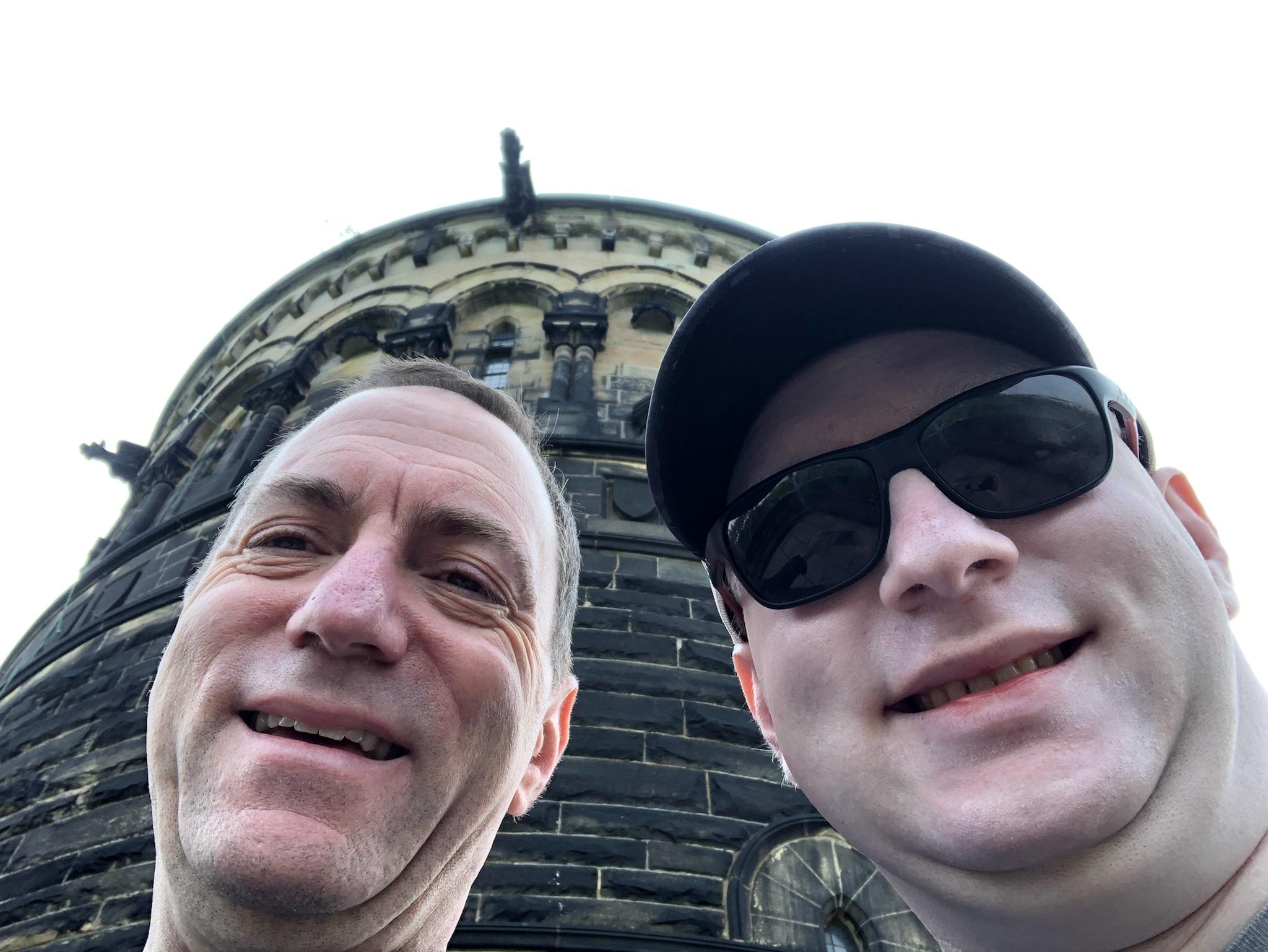
My dad and I on the balcony of the Garfield Memorial.
So this past week I was in Cleveland visiting family, including my dad, and getting to see a bit more of Cleveland than I ever have before (when you have a car, planning your own leisure activities during your vacation is sooo much easier). Among other things, I got to visit the Rock and Roll Hall of Fame, get the best shave I’ve ever had, and visit a huge indoor marketplace. But the one thing I wanted to talk about in this post was something my dad did with me Friday morning: we visited Lake View Cemetery.
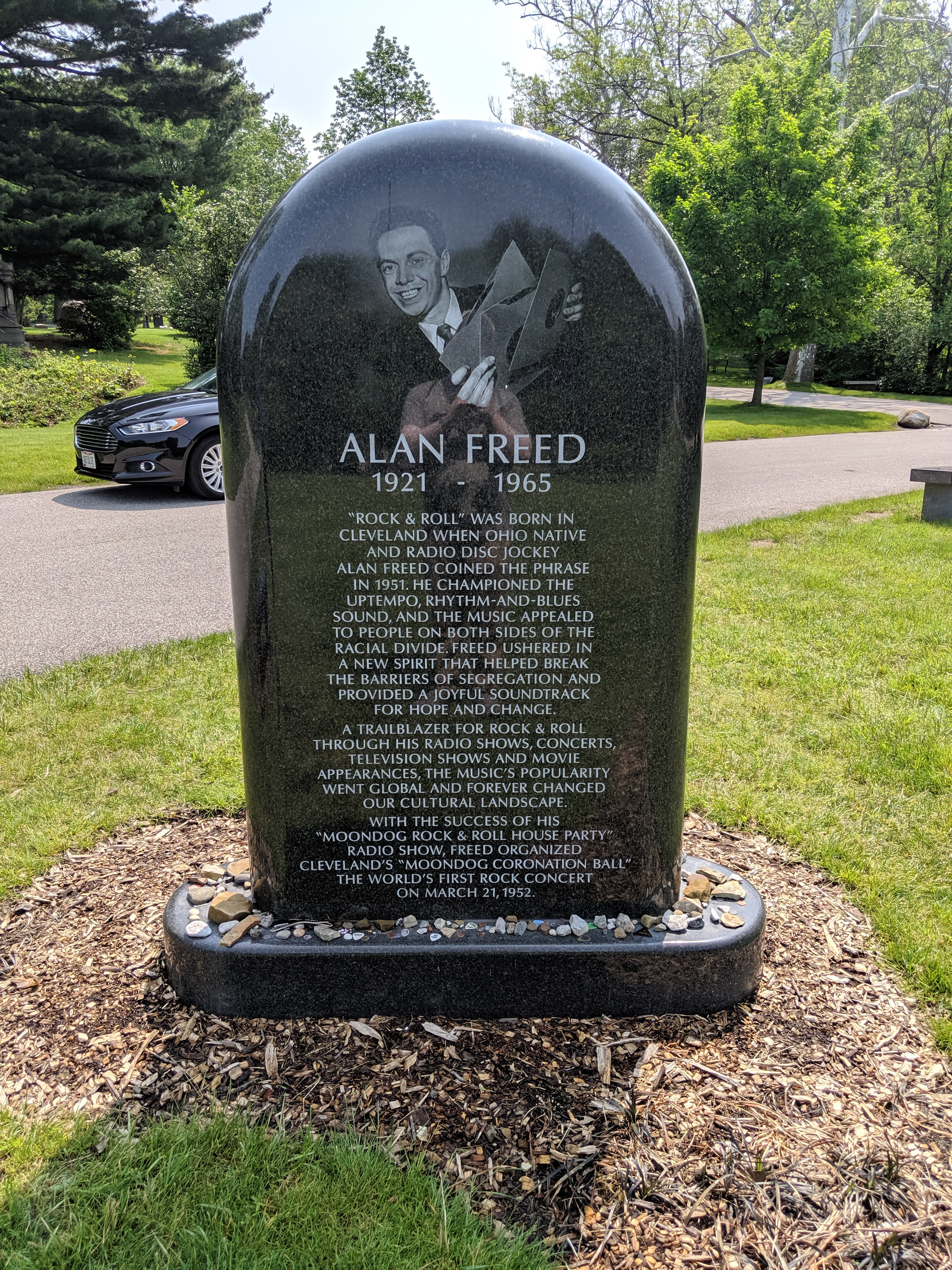
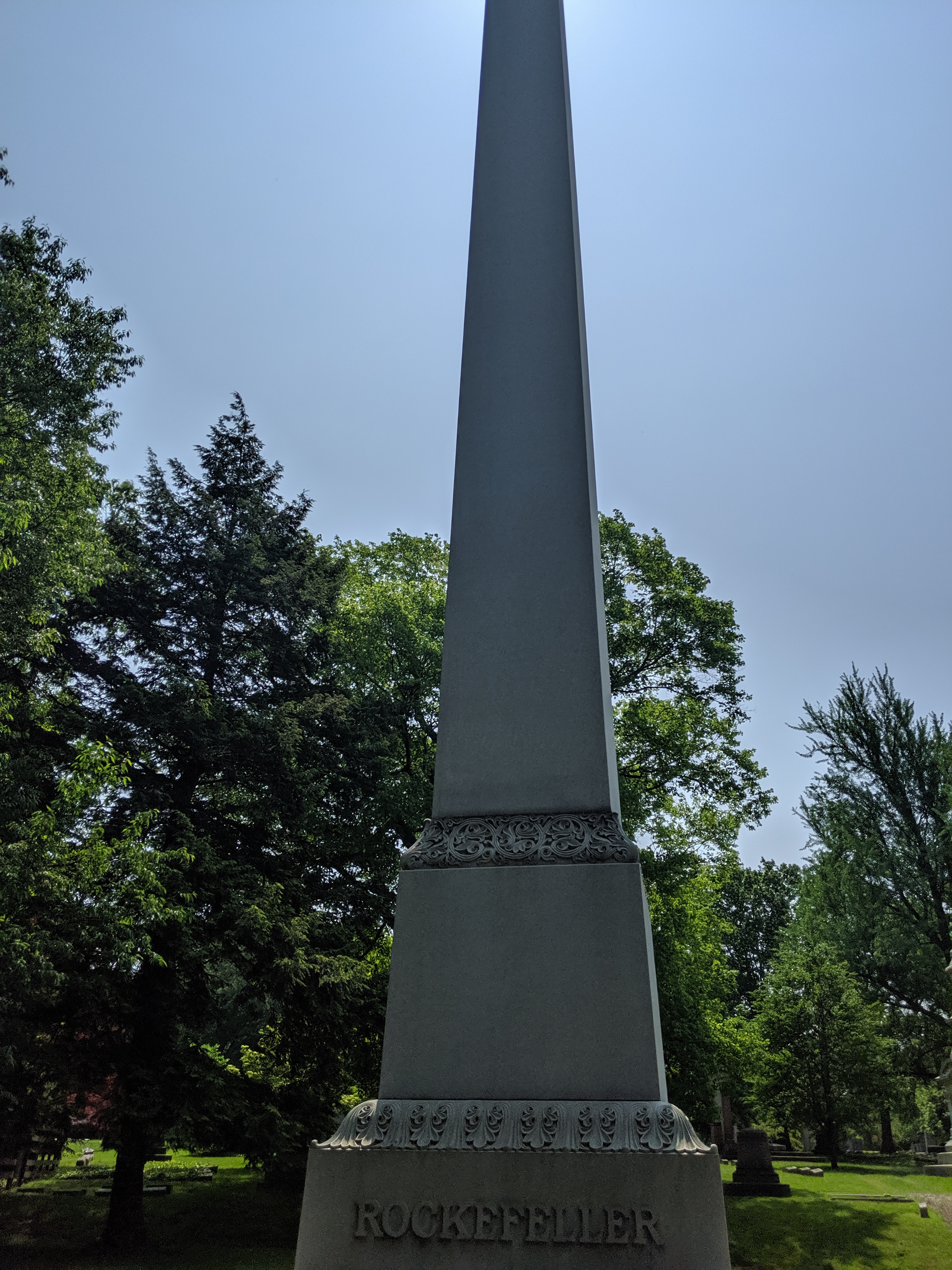
Now if you don’t know, Lake View Cemetery is a large, ornate cemetery modeled after the great cemeteries of Victorian England and France. It’s known as “Cleveland’s Outdoor Museum,” and is home to some very prominent individuals, including Eliot Ness, Alan Freed (who coined the term “rock and roll”), John D. Rockefeller, and President James Garfield, who has the most ornate mausoleum not just of any resident there, but of any American president. Amazing considering he only served for about 200 days.
Me being me, I’d been looking forward to seeing this place since I first heard about it. And of course, me being me, I brought my reliable dowsing rods with me, because they are so good at striking up conversations with the dead.
Our first stop was the Garfield Memorial, but even before we reached that place, I could tell this was a different sort of cemetery than any I’ve visited in the past. For one, it was so pretty. Cemeteries used to take the place of public parks in places that didn’t or couldn’t have public parks for whatever reason, and as I said, this cemetery was based on the kinds popular from a hundred and fifty years ago. So you had wide, sloping hills and fields of green, a lake with benches and geese and swans in and around it, and majestic lanes to walk upon (or walk your dog, as I saw one woman doing with her husky). Also, there were so many different kinds of headstones and grave markers! Look at some of the photos below.
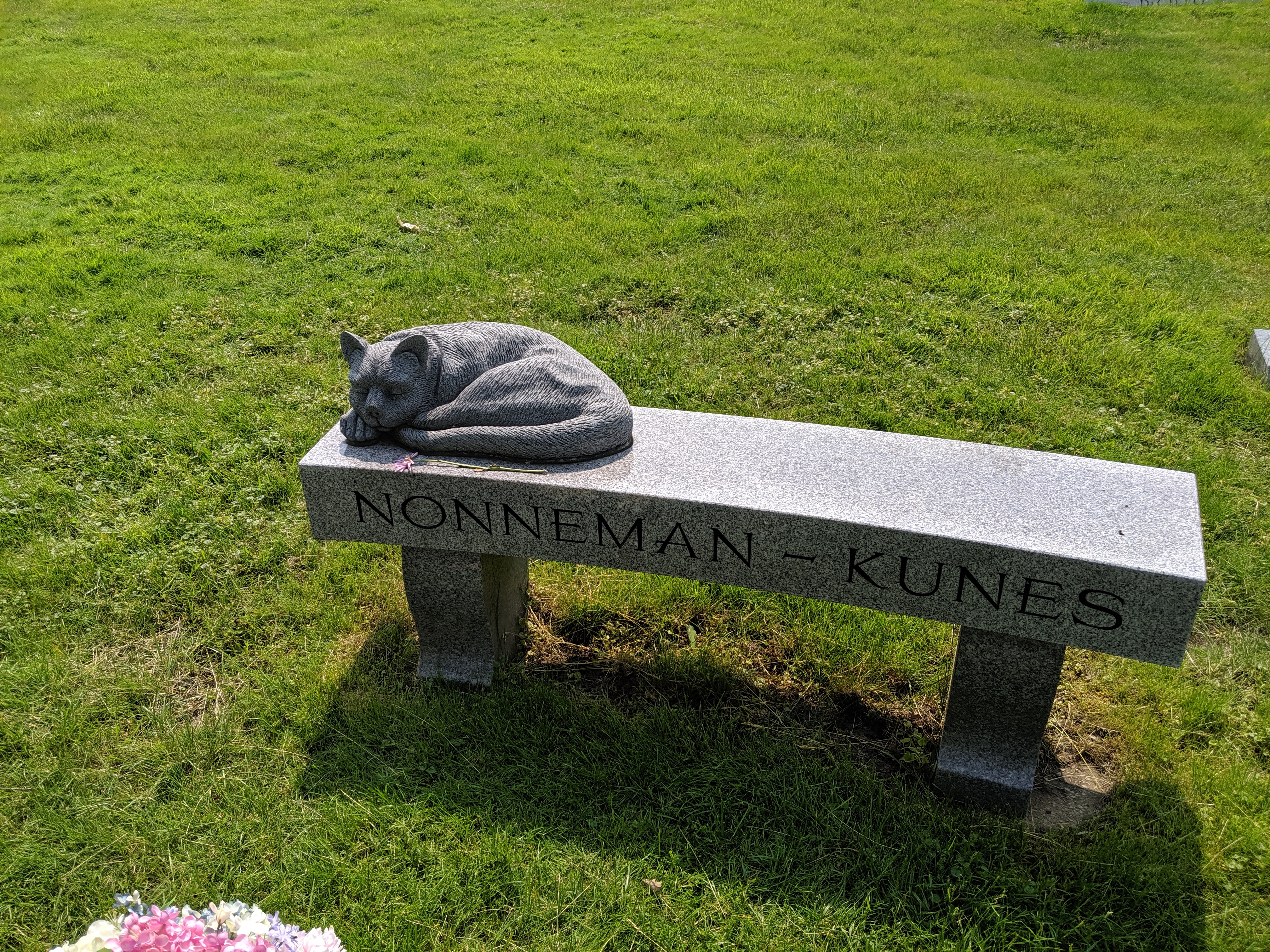
I don’t ktow these people, but I love their tastes. Good kitty!
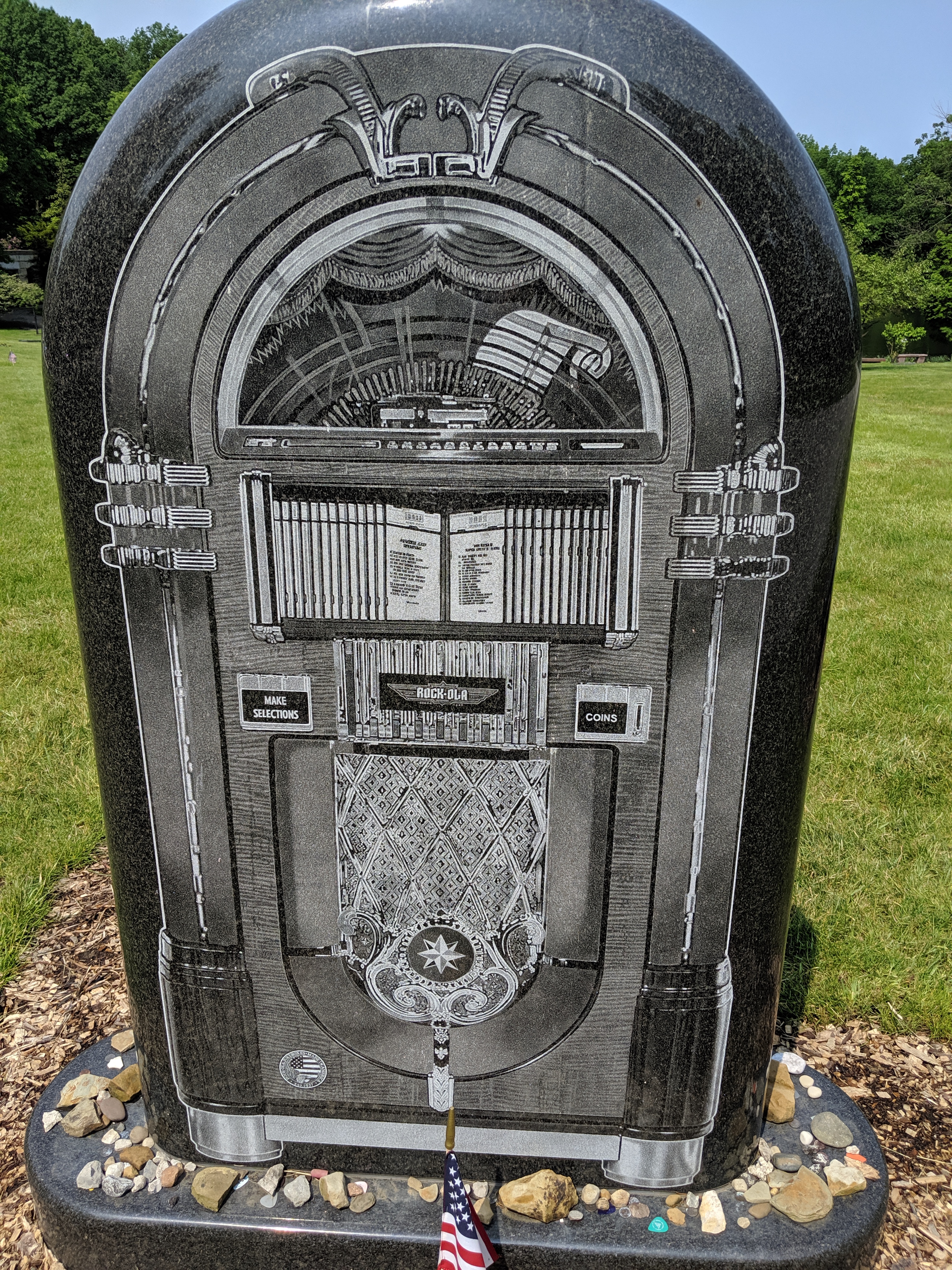
Alan Freed’s gravestone, front side.
Alan Freed’s gravestone, back side.
The Rockefeller Obelisk, or most of it. It’s a big monument.
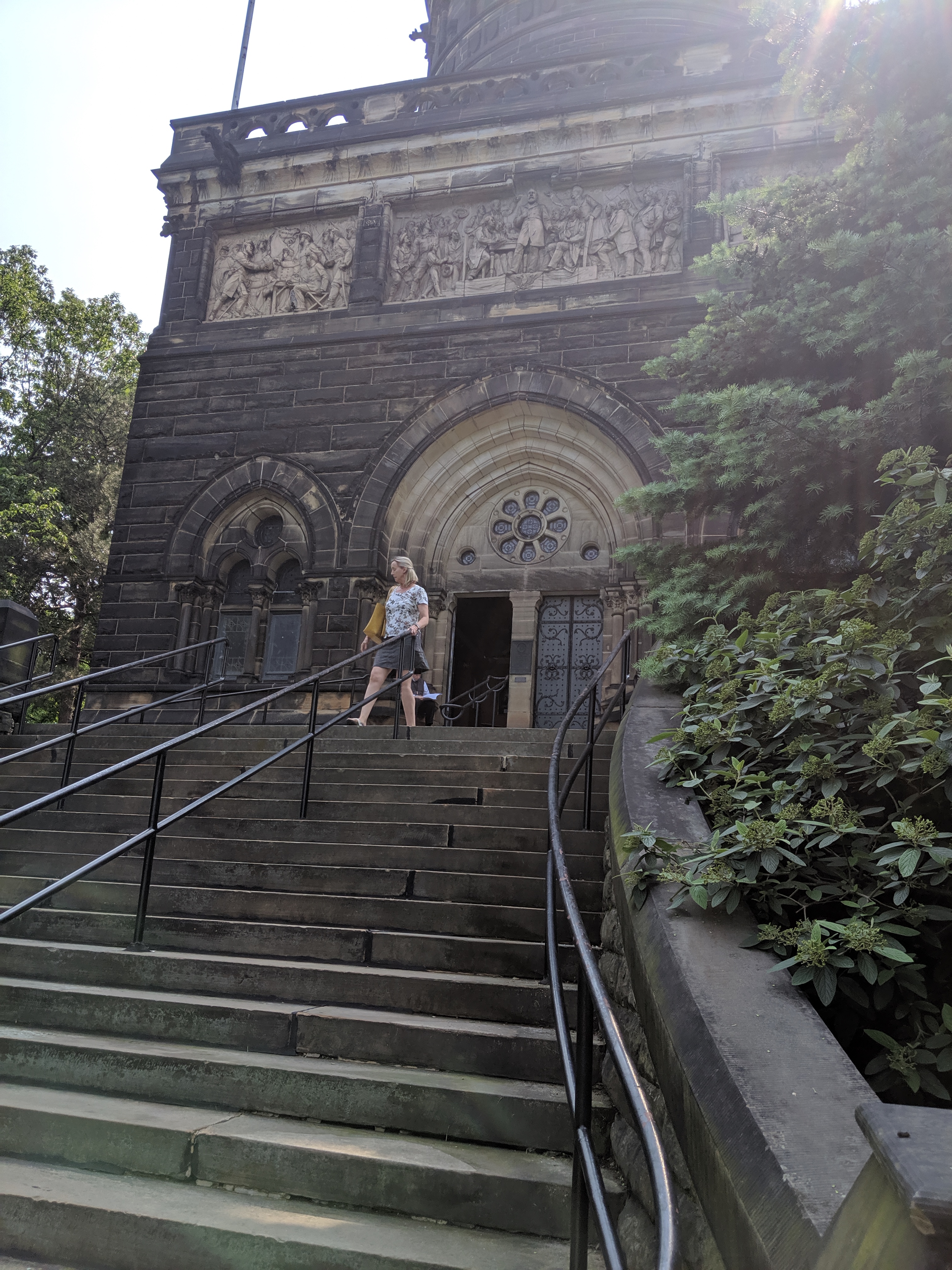
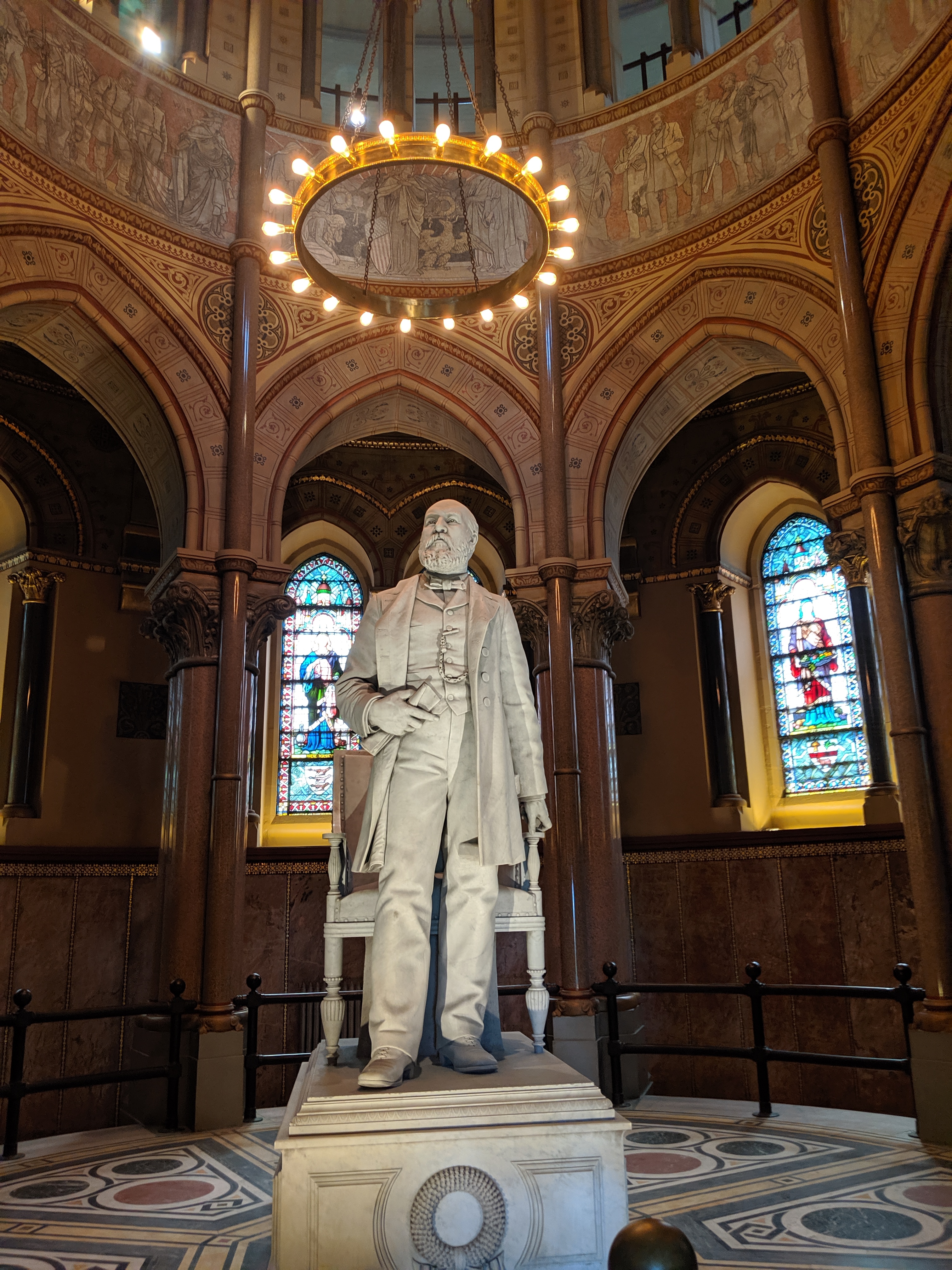
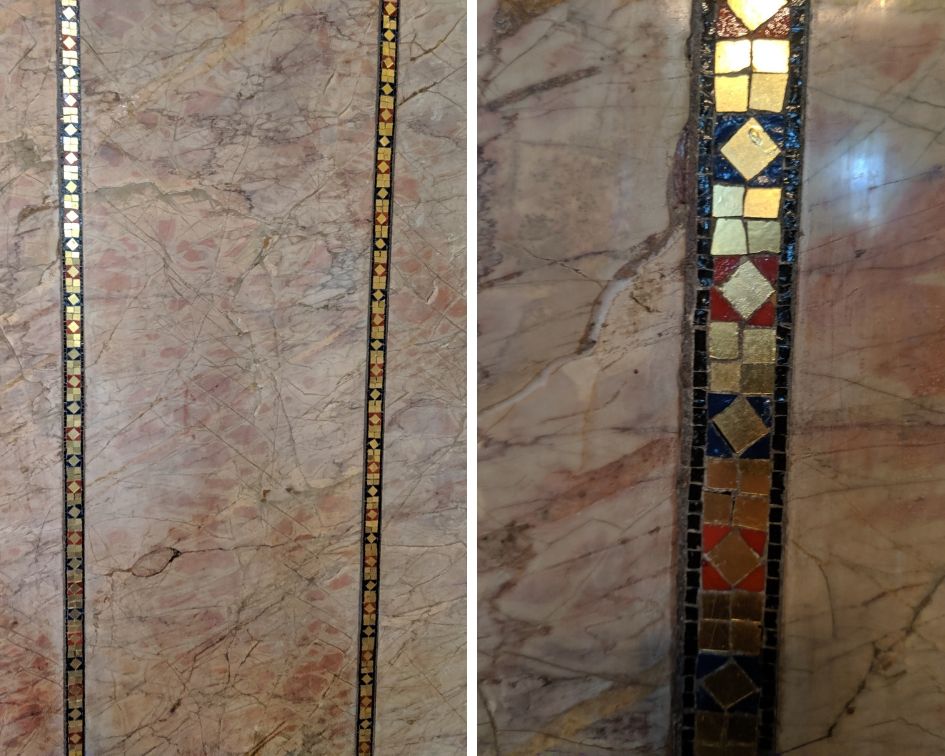
As I said, our first stop was to the Garfield Memorial, this huge, ornate structure that was even more amazing once you got inside. A docent there told us how money was raised for the memorial after the president’s death and some of the features of the construction and artwork on display. For example, the glass in the walls were all inserted by hand, and the murals on the wall include goddesses representing the thirteen original colonies, plus Ohio and War and Peace, and the leaves set into the floor are supposed to guide you around the room, showing Garfield’s humble beginnings in Ohio and how he came up to become the President, a real American success story.
The front exterior of the Garfield Memorial.
The glass designs on the wall, from afar and up close. Imagine the work that went into all that!
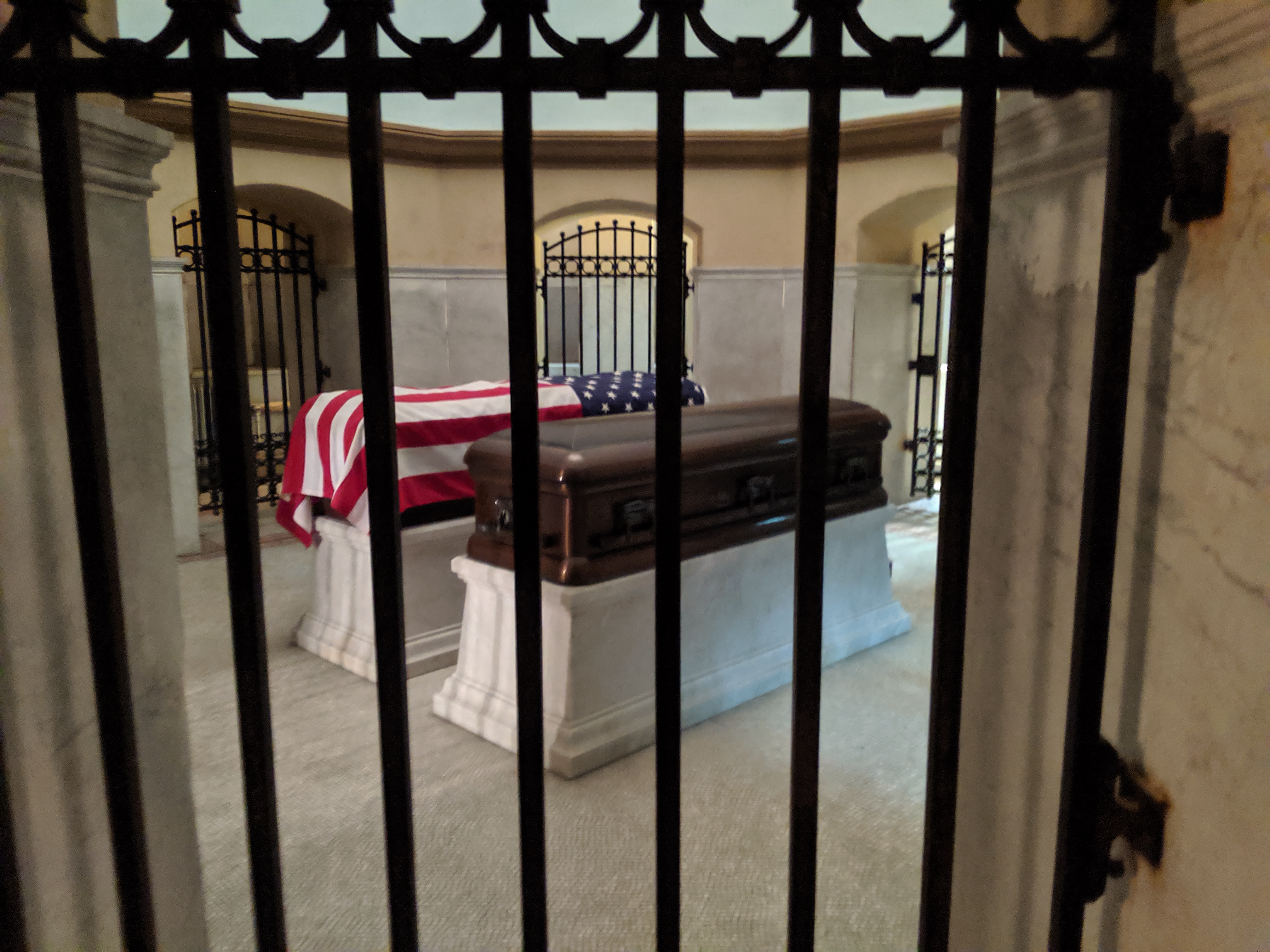
Later we went downstairs to the crypt, where I got out my dowsing rods. Unfortunately, my dad forgot to hit record on my phone, so we didn’t have a recording of that conversation, but I did get into contact with James Garfield’s ghost. Apparently, while his family is buried with him, none of their spirits are with him, and he’s pretty lonely. I felt bad for him, and considering how many other spirits are in the cemetery, I had to wonder why he didn’t have many people on either side of the veil to speak to. The docent later told us that after his assassination, a friend of Garfield did engage a medium to speak to his spirit, and other psychics have been by the grave.
The Garfield crypt. It was a lot mores shadowy when I was there.
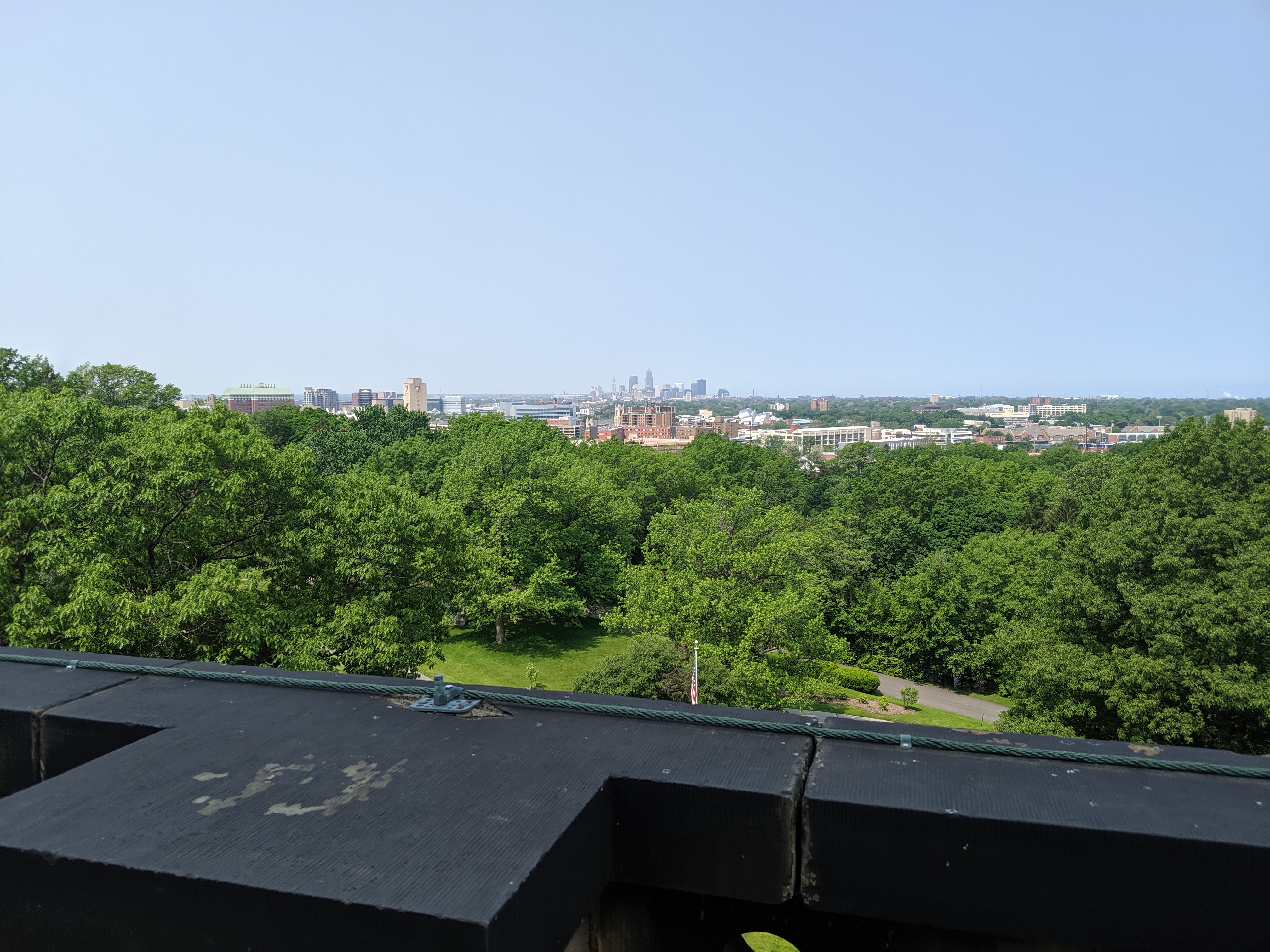
The balcony from the Garfield Memorial. You can just see Lake Erie in this photo.
After a quick trip up to the balcony, where we had a view of Lake Erie (hence the name “Lake View”), we checked out some of the other graves around the cemetery. One of those graves was John Rockefeller, and that was a conversation we did get on video. Check it out below.
Now, that was amazing. How many people can say they’ve had a conversation with John D. Rockefeller? And apparently death is treating him well. Not surprising, when you consider he’s got a scenic place to live in death and lots of people to talk to. And he may go visit Garfield, for all we know.
We left soon after that. We tried to visit the Wade Chapel, this beautiful structure with this Tiffany glass decoration, but there was a funeral going on there, and we didn’t want to disturb the grieving family, who seemed like they were going to stick around a while. But in all honesty, I really enjoyed myself. This trip played to all my interests, and I got to do it with my dad, who I don’t see often anymore and whom I enjoy doing most things with.
And Lake View Cemetery is just a beautiful place to go. If you haven’t gone and have the chance, I highly recommend you take a trip there. I’ll definitely try to go again the next time I’m in Cleveland and have a few more conversations while I’m there.
Have you ever been to Lake View Cemetery? Did you have any encounters there? What was it like?
And in the meantime, this is a reminder that anyone interested in being an advanced reader for my upcoming fantasy-horror novel “Rose” has till June 7th–this Friday–to sign up. The novel follows a young woman who turns into a plant creature (and that’s just the start of her problems). If you’re interested, please send an email to ramiungar@ramiungarthewriter.com. All I ask is you read the book and consider posting a review after the release. Thanks, and I look forward to hearing from you.
That’s all for now, my Followers of Fear. I hope to have a few more posts out this week, including a review and some more of my recent experiences. Until next time, pleasant nightmares!
What if the Superman origin story had a dark, horror-movie style twist? That’s the conceit of Brightburn, a movie produced by the director of the Guardians of the Galaxy films and the upcoming Suicide Squad film, written by his brothers Mark and Brian, and directed by David Yarovesky, who directed the pretty-good horror film The Hive. And from the trailers, it looked like it could be really good, or just plain bad. Either way, I put my butt in the seat and waited to see how it would go.
Brightburn follows the Breyers family, consisting of farmer Kyle, wife and artist Tori, and adopted son Brandon. Around his twelfth birthday, Brandon starts exhibiting supernatural powers and psychopathic behaviors. When he starts to hurt classmates and people around town start dying or going missing, Tori and Kyle reveal to their son his extraterrestrial origins, and he reveals to them his dark purpose in coming to Earth.
*sigh* You know, I can forgive them for copying Superman’s basic power-set in this film. I can also forgive them for not mentioning him at all (probably did that out of legal reasons). But I can’t forgive them for making a bad film that puts all its best bits in the trailers!
I kid you not, everything that was supposed to make this film exciting and scary was revealed in the trailer. The woman who got glass in her eye, the guy in the car seeing Brandon flying on the road, the girl’s hand getting broken, the plane crash. Those should’ve been surprises, but we all saw them in the trailers, and that takes out all of the suspense and horror of the actual movie. Except for a few moments, I watched the film thinking to myself, “That’s predictable. That’s predictable. Oh, how could I have not seen that coming? Oh wait, I did! In the previews!”
What do you have left when you take all those elements out? Just your below-average evil child horror film, like Prodigy from earlier this year (which I didn’t review because it was so much like every other evil child film out there). Parents get a kid, usually not their own. Kid grows up mostly fine, but then starts exhibiting scary behavior. Kid turns out to be evil, either because they were born seriously messed up or because of some supernatural reason, one parent ends up dead, the other either successfully kills the kid or is killed while trying because a bystander was nearby and didn’t know the truth.
Seen it. Done it. Took it to dinner. Had a good time afterwards. Ordered them an Uber. Point is, done to death.
There were only two things I liked about Brightburn. One was the mask the kid Brandon wore, which looks like a crocheted cross between an insect head and Cthulhu’s face. The other is Elizabeth Banks as mother Tori. You really see her love for this strange boy, and how much she tries to hold onto that little boy despite all he’s done.
But other than that, Brightburn is sadly unoriginal despite marketing itself as original. And I’m convinced the filmmakers knew that, and that’s why they put all the highlights in the trailers, to get butts in seats. On a scale of 1 to 5, I’m giving this one a 1.5. Avoid, unless you like wasting two hours of your time. I hope to God I never write anything as unoriginal as this.
Speaking of which, I’m still looking for advanced readers for my upcoming fantasy-horror novel from Castrum Press, Rose. The story follows a young woman who turns into a plant creature (and that’s just the start of her problems). Anyone who’s interested should send me an email at ramiungar@ramiungarthewriter.com before June 7th. All I ask is that you read the book and then consider posting a review after release. Thanks, and I look forward to hearing from you.
Until next time, my Followers of Fear, pleasant nightmares!
I’ve been meaning to write this post for over a week. But as you know from my last post, this past week has been predictably crazy for me.
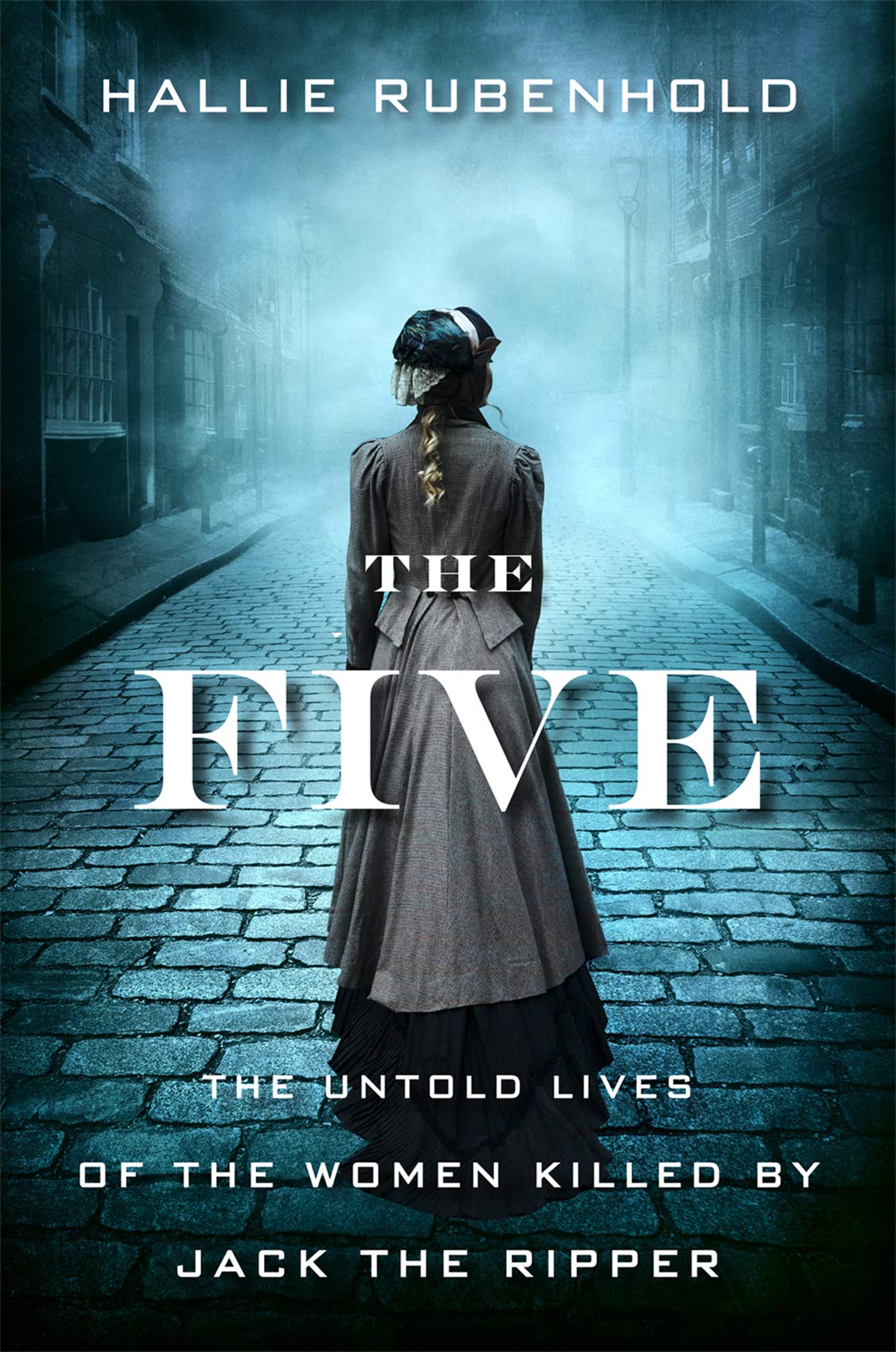
I heard about Hallie Rubenhold’s The Five and was immediately interested. The book retraces the lives of the five victims of Jack the Ripper: Polly Nichols, Annie Chapman, Elisabeth Stride, Catherine Eddowes, and Mary Jane Kelly and proposes to shed a new light on them. I’m no Ripperologist (someone who studies the Ripper murders), not even an amateur one, but I’ve done a fair amount of reading on the subject and am always interested if someone has discovered something new about the case. And the lives of the five women who made the Ripper famous finally being told? I’m in.
I dove in as soon as I got my copy from the library…and the resulting read blew my mind. You see, for over a hundred and thirty years, the consensus–the one thing that every Ripperologist agrees on–is that the victims were confirmed prostitutes. But is that really the case? Diving into historical records and her understanding of the nineteenth century’s social beliefs around women and barely mentioning the Ripper at all, Ms. Rubenhold provides a convincing case to support that we may have been looking at the “Canonical Five”–and thus the Ripper–all wrong. In fact, only the final victim, Mary Jane Kelly, was confirmed to make a living through prostitution, and there’s evidence she may have been trafficked at some point.
In fact, Polly Nichols was a wife and mother whose family gained lodging in public housing reserved for families with high moral standing; Annie Chapman was upper-middle class with an upwardly-mobile husband; Elisabeth Stride was a Swedish immigrant from a religious background who ran a coffeehouse with her husband; and Catherine Eddowes was educated for most of her younger life and often made life choices on what would allow her the most freedom. Mary Jane Kelly, we don’t know, as many of the details she gave of her life were contradictory and possibly fabricated, but she could’ve come from a respectable background, as she started out as a high-end courtesan, and they don’t let just anyone into those circles.
How did these women end up as prostitutes in the popular mind?
Well, in the eyes of nineteenth-century society, any woman who wasn’t, by all appearances anyway, a successful wife and mother with the temperance of the saint, a clean and happy household, and only had a sexual side when her husband desired sex, she was a failure as a woman. She was “broken.” Which often was equated as a “fallen woman,” which was often equated with prostitution. Often, women in these positions had to take up with men who were either not their husbands or had common-law marriages, which was also considered a sort of prostitution.
And for a number of these women, circumstances in their lives forced them to leave families and husbands and often take lives on the streets, without husbands or homes, which meant in society’s eyes they were fallen, and therefore likely prostitutes. The newspapers at the time, more concerned with selling than telling the truth, did little or nothing to dissuade that notion, even when friends and acquaintances for the victims came forward and swore in inquests the victims did not resort to prostitution. Thus a belief, and the theory shaped around it, was formed.
This is significant for a number of reasons. From the perspective of history and Ripperology, it totally changes everything we know. Ms. Rubenhold presents a good case that the Canonical Five were actually incapacitated or sleeping and not in any state of mind to fend off an attacker, rather than attacked while soliciting. This changes the entire MO of the Ripper, the field of study around the murders, and over a century’s worth of media on the subject (though some of the latter we can still find entertaining, as long as we remind ourselves how much of it is fiction).
But more importantly, this is a feminist triumph in history. For a hundred and thirty years, The Five have been dismissed and looked over except in the context of their deaths and whoever killed them. Even my copy of The Complete Jack the Ripper doesn’t go into much detail on their lives. But this book and its author, through hard work and looking over every scrap of documentation available out there, reminds us these women were just women, more often at mercy to forces beyond their control and the double-standard Victorian women faced than willful participants in the world’s oldest profession. At least three suffered from alcoholism. One got pregnant out of wedlock and developed syphilis, and was demonized for it. They did everything they could to stay out of the workhouses, which could forever ruin someone who was forced to enter them. They tried to find love and happiness. They tried to get by in an age and place where women on their own had it very hard.
Imagine if AA had been available to the Five and sobriety was understood to be not a choice but hard work. Imagine if, instead of being demonized for leaving their husbands or getting pregnant/diseases out of wedlock, the authorities looked at the men in their lives. Imagine if they were allowed to pursue lives they wanted, rather than what was expected of them, and not shamed for not fulfilling expectations.
This is especially relevant in today’s age. Despite a lot of progress, women still have their sexuality used against them socially and legally. Since I finished reading The Five, I’ve seen several articles and tweets about men getting little or no jail time for rape, simply because there was only one victim and they were unlikely to reoffend. Here in my home state of Ohio, a minor who was raped and impregnated can’t get an abortion because of a new restrictive abortion law. Clearly, on some level, society still feels women should be punished for being anything other than the ideal wife and mother, and it’s their own fault if they’re not.
This is why you should be reading Hallie Rubenhold’s The Five: not only does it present convincing new evidence on a century-old case and force us to reevaluate everything we knew, but it’s a call to remind us just how much has stayed the same since 1888, and what we can do to improve that in the future. And in the future, if I ever write my own Ripper-themed story, I’ll call back to The Five as I write the story, and keep in mind the lives of these women.
So please, check out The Five‘s page on Amazon, and consider reading it. You’ll find it a revelation as much as I did.




 Rami Ungar The Writer