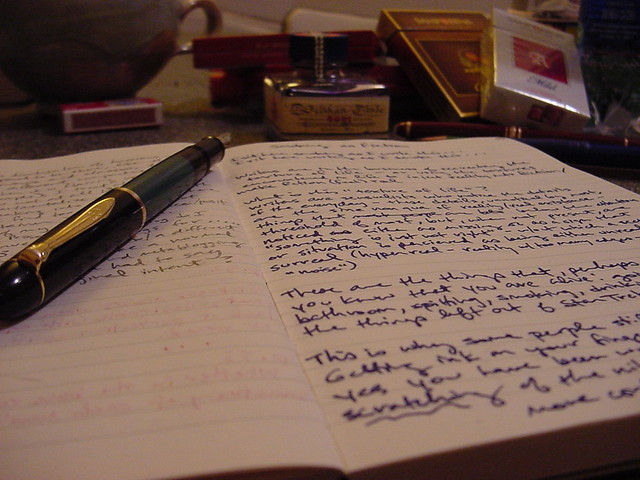
You may also know this story by its original title, Frauwolf. It’s still the same story as well, about a girl who’s a werewolf and who is in a relationship with another girl. And its second draft got critiqued in my creative writing class.
Luckily this time I won’t have to rewrite the whole damn story again, or I might seriously turn into a werewolf myself and go on a rampage (boy, wouldn’t that make for an interesting horror movie). My classmates found this draft much easier to read and felt that the first half was awesome, that the language was superb and that the emotions between the two main characters felt real. Most of all they were glad I’d changed the story from a crazy fast-paced psycho-drama that left little time to linger on the actual story and made it more about the characters themselves.
The thing they didn’t like is that near the end of the story I add a new character, who happens to be a psychopath, and it just takes the story in a bad direction. Well, in my defense I had only so many days to finish the new draft and I was pressed for time, so when I got stuck I went with what first came to mind.
In any case, I only have about half a short story to rewrite rather than a full short story, and I have to turn in a third draft by next Wednesday. God help me, because I have an eight-page Shakespeare paper due the day before and I still have three and a half pages left. Plus I’m still figuring out where to go with this short story of mine. Boy, is my life crazy!
Well, I’m going to turn in. I’ve had a long day, I’m exhausted, and I need my rest if I’m going to tackle either of these tomorrow. Wish me luck Followers of Fear, because I have a feeling I’m going to need all the luck I can get. Goodnight, everybody.
There are various phrases and maxims that authors just dread hearing. “Nobody wants to read that sort of thing.” “Where do you get your ideas?” “Adverbs are your enemy.” That sort of thing. Here’s one that’s been espoused by creative writing teachers, how-to books, and maybe even your parents since writers have tried to teach would-be writers how to write:
“Write what you know.”
By this, they typically mean draw on your personal experience in life to write your stories. Anything you learned from steady research or anything you made up in your head, please leave at the door before opening up your notebook/turning on your computer/sitting down in front of the typewriter. Please keep this in the realm of experience and what is possible rather than what you imagine. If it’s not based on your actual knowledge and life, then you should stay away from it.
Most writers hear that and want to barf. A few do.
There are variety of reasons why no one wants to subscribe to this rule. Some see their lives as too boring or unworthy for writing about. Others feel that their own lives are too small and they don’t want to restrict themselves to just their own subjective experiences. And many (myself included) are attracted to things that can’t be personally experienced (usually, anyway), so they find that rule way too restricting to actually be usable.
I remember back in elementary school or junior high, my dad, my sisters and I were driving home from somewhere or other, and somehow the topic of discussion got onto the sort of stories I write. My dad suggested that I try, instead of vampires and cavemen and Frankenstein monsters and pirates I try writing a story about my own personal life. My reply was something along the lines of, “So you’re saying I should write a story about a Jewish kid who has rabbis for parents and has three annoying sisters?”
My dad’s reply was, “Um, yeah. Maybe.”
I think in that car ride I swore that I would never write based on what I know if it meant writing that sort of story. Let’s face it, it’s just not in my DNA. I can’t write those coming-of-age stories about a kid learning to be an adult in a community of religious Jews or about a man working his way up the corporate ladder at the expense of his humanity and marriage. Not unless those stories involve ghosts, demons, monsters, or serial killers. Otherwise it’s just boring for me, and no writer wants to write a boring story, one they personally can’t get into.
I also swore that I wouldn’t take writing advice from my dad again, though I broke that promise when he ended up giving me pretty good advice, such as “don’t be afraid to open yourself to new experiences” and “maybe you should look into writing and publishing short stories.” Now there’s some good advice for writers!
Seriously doubt these books were written with the rule “write what you know.”
I also did end up writing about stuff I know, but not in the way a high-and-mighty literary writing instructor might think. Probably not in the way my dad thought either. I certainly don’t write stories about college seniors living with a roommate and trying to get the grades and make ends meet. But I do include what I know in other ways.
For example, in a recent story that I wrote, the protagonist and narrator, in addition to having to deal with being a werewolf, also has to deal with the fact that she has feelings for her best friend, who is a girl. When I was coming to the realization of my own sexuality, I felt the same sort of fear and anxiety my narrator feels in the story, and I had a number of the same questions, such as “Would people accept me as I am?” “Am I really this way?” “How many things could go wrong if I came out of the closet?” Just because it was an element of a werewolf story did not make it any less meaningful or not based on my life.
Another example is one based on something my dad told me once (this is becoming a dad-centric post, isn’t it? Abba, I hope you appreciate all these mentions). He once told me that a great-aunt of his was well known for having dreams where she encountered the dearly departed. This inspired a novel involving a large family of Jews of many generations and their own dealings with the supernatural. I base this work on that story my dad told me as well as my own experiences with the supernatural (and I’ve had some freaky ones, to be sure).
Yes, I have experience with this.
In short, for me writing what I know is taking things I know about or have experience with and making them part of a larger story, often with fantastic or terrifying elements. It’s what works for me, and it’s what I love doing.
Of course, this is my version of how this works. For others, it may be different. There may be writers who write entirely based on what they know and what they’ve experienced, and there may be others who write absolutely nothing based on their real lives (I have a feeling that many fantasy writers are like this). It’s a bit of a spectrum, if you think about it in a certain way.
But like I said, every author is different, and no rule works for every author. “Writing what you know” is a prime example of that. It works for some people, and it doesn’t work for many. It all depends on the author, what they like working on, and how much they want to put their own lives in their stories, among other things. I’m the kind of guy who will take elements of my life or my own knowledge and put it into the stories as part of a larger whole rather than as the entire basis for a story. And that’s just how I work. For others, it’s quite different, but I think that’s good. Because no two writers are the same, and that means that no writer is going to produce the same kind of story.
To me, that’s really exciting.
Do you use any elements from your own life in your stories?
Back in 2011 and 2012, I did two reviews on different book series that I’d come to enjoy. I was still in the middle of them, but I was pretty much hooked on them, enough that while I hadn’t finished either series at that point, I wrote reviews on both of them. Sadly though, the reviews didn’t really do either series justice. I was still figuring out the components of a good review at that point in my blogging career, so that probably explains why they weren’t as good as they could be.
In any case, I read the last book of one series earlier this year and last night I finished the last book of the other. In honor of these achievements, and because I haven’t done a proper review since August, I thought I’d do a double review on both of these series.
So, let’s begin!
Kieli by Yukako Kabei
Volume 1 of “Kieli”. I swear, the series blew my mind when I first started reading it.
Everyone loves a unique story, something that has never been seen before on the printed page. We felt that way with Alice in Wonderland, Lord of the Rings, and so many other famous stories. Kieli does just that. A light novel series* out of Japan, Kieli mixes just about every genre possible: paranormal, science fiction, steampunk, fantasy, romance, Western, and then some! All while telling a very compelling and heart-wrenching story.
From a young age, Kieli has been able to see ghosts, but she doesn’t tell anyone lest her theocratic society think her a heretic. One day she meets an immortal soldier named Harvey, who is delivering a haunted radio to a battle site so that the ghost haunting the radio can finally be at peace. Thus starts their adventures together, as Kieli joins Harvey on his quest and ends up helping him fight off ghosts, Church soldiers, other immortal soldiers and a plethora of other antagonists. At the same time, Kieli starts learning about her past and about what it means to grow up and be an adult.
While at times it may frustrate readers that Kieli has a hard time separating her own identity from being with Harvey, it’s a compelling story. The characters are troubled and have to learn to sort out their own problems as well as the antagonists facing them, and the mix of genres is done almost seamlessly without looking too weird or contrived, and the relationship between the two main characters feels real. You’ll want to keep reading all the way through the final book, which nearly made me come to tears.
All in all, I give Kieli a 4.5 out of 5. This was a series that made me want to create fantastic worlds like the one depicted int he series, and I wanted to create characters that felt just as vibrant and complicated as Kieli or Harvey. Maybe thanks to Kieli, someday I will.
Book Girl by Mizuki Nomura
The Japanese cover for the first entry in the “Book Girl” series, “Book Girl and the Suicidal Mime”.
Another Japanese light novel series, Book Girl is told from the point of view of Konoha Inoue, a troubled high schooler who actually published a massively popular novel under a pseudonym in junior high. However his success came at the great cost, and he swears never to write again.
That is, until he meets Tohko Amano, a girl who literally eats the stories told in books to survive. After Konoha sees Tohko “eating” a story, she forces him to join the literature club and write stories for her as snacks. That’s only the start of his problems though, because a lot of strange stuff tends to happen around Konoha, including missing students and attempted murders. Against his will, Konoha is often dragged into solving these mysteries by Tohko, who often finds a literary equivalent to the mystery being investigated (such as Wuthering Heights or The Phantom of the Opera, in some cases).
While Kieli made me want to create worlds, Book Girl made me want to tell incredible stories with wonderful language. Nomura is able to weave words together in order to make you feel like you really know the characters, especially Konoha, and become really attached to them, as well as attached to finding out how the mystery is solved, as well as how Konoha confronts his past and learns to stand on his own two feet again. It’s a great series if you happen to love mysteries as well.
For telling a compelling story with wonderful clarity, emotion and language, I give the Book Girl series a 4.8 out of 5. I really will end up missing this series now that I’ve finished it, but hopefully I took enough away from it so as to improve my own stories.
We can hope, right?
Well, that’s all for now. I’ve got some homework to do before I go over to my mother’s house, so I’m going to get to work on that. Happy Thanksgiving, my Followers of Fear. This year, I’m thankful for you guys.
*A light novel is a form of literature that was born in Japan and grew out of the pulp magazine industry. Light novels are usually around the length of a novella (40,000-50,000 words), have dense publishing schedules, are often serialized in anthology magazines before being published as cheap paperbacks, and usually include illustrations, about one per chapter usually. The format is very popular in Japan and popular series have been adapted into numerous formats several times over. There’s also a growing market in the English-speaking world for light novels, and many companies have begun licensing and translating these series for new audiences. I’m hooked on the genre myself.
I went to a certain event on campus this evening, but I arrived not realizing that while the event is advertised as happening at a certain time, it only really starts much later (a part of me actually knew that, but the part of me that’s a total freak for being on time or missing something won out in the end). The library being nearby, I decided to pop in and check my email before I decided to go home or not. When I logged onto WordPress though, I saw a notification that I had a comment. I checked, and it was from a post I’d commented on a while back.
The post itself had been from a woman who was relating her experiences being sexually assaulted in the work environment, and how several other women she’d worked with had been in the same situation, and the owners of her workplace had tried to sweep it under the rug for the sake of business and for the attackers’ families’ sakes! Naturally, I was upset when I read that post. Sexual assault is a horrific thing that happens to so many people, mainly women but men as well. And what’s just as upsetting to me is not only the act of rape itself, but those who try to cover it up or downplay it or make it seem likes it not a big deal. This sort of conduct not only adds insult to injury to the victims, but it also sends a message, that rape is okay, that the attacker can go on doing whatever because it’s not a big deal, that if we make it into a big deal than it is then innocent people will get hurt and besides, it’s only one measly person who had a bad experience, right?
So I commented on the post. Since so many women had been attacked at this place, I suggested that maybe they band together and bring to the workplace a class-action suit or something, because sexual assault and covering up for it is illegal and a disgusting act to boot. That comment got a few likes during the preceding week or two after I’d read it, but the post got a lot more! Comments, likes, new stories coming out, stories of tragedy and stories of support. One newspaper even did a story on the place, so I’m assuming that got something rolling. At the very least, that place is seeing a lot less business than it had prior to so many women coming out.
Of course, not all of the people commenting have been supportive. The comment I got was from some woman with a generic sounding name. She basically said that while sexual assault was a crime, so was lying about it. That’s it. Lying about sexual assault was a crime.
Now, I’ve seen this sort of behavior before, and I know not to comment lest I end up getting attacked. Heck, I wrote an article on this very subject a while back, so I didn’t want to be a hypocrite by getting confrontational. But I was curious. Maybe because it was supposed to be a woman who commented, maybe it was the subject matter, maybe it was because I was kind of bored and I didn’t want to walk back to my apartment just yet. But I wanted to know who this person was.
So I clicked on the article to familiarize myself with it again. I also viewed my comment in full, as well as the reply comment. And then I started looking through the comment feed, seeing if anyone else had gotten any comments from this person. Sure enough, there were more than a few comments from this person on other people’s comments and they all had a similar message:
Rape doesn’t happen
The women who say they were attacked at this place weren’t attacked. Whatever happened there, they wanted it.
Any woman who says that they were attacked is lying for attention or some other cockamamie reason and they’re the ones being sexist and cruel by calling supposedly innocent men rapists.
Very curious now, I clicked on the person’s username to see their blog. All I got was a bland background. No blog posts at all. Not even a post saying, “Hi, this is my first post. I’m hoping for good things while I write about so-and-so a subject. Please support me and follow me.” I checked the About page as well. Not a single thing.
At this point, any doubt I have has flown out the window. And while I’m not certain if this is someone who’s personally connected to the case and the workplace in question, or just someone who generally feels that they’re being assaulted as a man (yes, I say a man, because based on the language used by this person they’re probably male) by feminists with too much power and really without hacking skills, of which I’m lacking, there’s no real way to find out. But it does tell me something. That whoever this is feels threatened by women who speak out and feminists in general and will go to great lengths to stop it.
As if there weren’t enough obstacles making it seem like a bad idea to victims to speak out. On university campuses, some of which have really bad sexual assault rates, college administrators have mishandled assault cases, expelling or blaming victims and protecting rapists with light or no sentences at all. U Va recently got into trouble for this, and even my dear Ohio State has gotten into a lot of trouble over this. In the justice system, the system that’s supposed to protect us, there are cops, judges, and many more who will say that rape isn’t a big deal or victimhood is a status to be desired or that the victim knew what they were getting into, or that rape has to be “legitimate”. Some of this is even said by politicians at the highest levels of government. And when women speak out, they can face ridicule or disbelief by strangers, acquaintances, or even their friends and family. If their case gets to court, they risk being attacked by lawyers on the stand and disbelieved by juries. There’s a chance the rapist goes free and they have to live with that every day.
In other words, there’s a great fear, and a legitimate fear too, that speaking out will only make things worse.
And it’s the people like my wayward commenter, someone who seems determined to shut up victims and women in general, who are making the situation worse. There seems to be a great terror among certain sections of the population that giving women any sort of equality or power is akin to castrating all men and forcing them to live in a dystopian society where men are slaves to power-hungry lesbian dominatrices. That is simply not true. Feminists (of which I am one) only want women to have the same economic, social, and political rights as men, without taking away men’s rights. But there are those who believe it, and will go to great lengths to make sure women are afraid to speak out or seek equality.
Last month, feminist media critic Anita Sarkeesian was sent a threatening letter by a man who claimed that feminists had ruined his life and that if she spoke at Utah State University, he would commit a mass shooting at the event. Because of Utah’s ultra-relaxed gun atmosphere, Ms. Sarkeesian had to cancel the event lest she risk her life and the lives of others. What does Ms. Sarkeesian talk about? Her latest videos, articles, and appearances tend to talk about how women are objectified in video games and seen less as actual people and more as sex objects or devices that (often violently) advance the game’s story.
Violence is a common threat from people who don’t want women speaking out. And while the actual incidences of violence are low, these threats, plus the threat of ridicule, of becoming a punchline in a joke, of being called a money-grubbing slut or a power-hungry feminazi man-hater, makes it much more difficult for many women to speak out. No one wants that sort of attention on them, and for victims of assault, it’s even harder to come out when facing all that.
So what is there to do about it? Well, I’m doing it right now: I’m fighting back. I’m writing an article that exposes what is happening and pushes back against it. And I’m letting people who have been attacked and that are afraid to come out that I’ve got their back. Yes, I’m a man, but that doesn’t mean I don’t believe women should be equal in society. Far from it. I’m willing to fight alongside the many women out there who demand to be treated equally and with respect in the world towards men.
So know this, folks. If you’re a woman and/or you’ve been assaulted, know that I support you and I’m there for you. And for those who still think that men are under threat by these women, I’m so sorry you feel this way, but it’s not true and some day I hope you come to this realization.
Thank you, and goodnight, Followers of Fear and everyone else.
Well, I finally got an email from my thesis advisor M on what he thought about my new thesis outline. Here’s what he had to say:
Very full chapter outline. You’ve sure thought it through. At this point, it looks solid. It’s going to be about execution, of course. But I say go ahead with your plan and keep writing.
He also signed it M. That’s kind of funny, considering that I keep forgetting to ask him if I can call him by something other than “M” on my blog.
But back on point, the new outline reduces the story by about six chapters from twenty-seven to twenty-one, making the story much simpler and allowing me to focus on the two main characters. And since I’m now eight chapters in, I’m now officially a little over a third of the way through the story! Woo-hoo! Only thirteen more to go!
As with my previous novels, I’ve counted out how many pages and words I’ve written so far. At the moment, Rose is about sixty pages in (that’s 8.5″ x 11″ pages), with an average of seven and a half pages per chapter. And at this moment, the word count is 17,546 words, with about 2,193 per chapter. So we’re around the length of a novelette at this point. At the rate I’m going though, it’s likely to be novel length (sixty-thousand words or higher) before long.
So next up is to, like M said, execute what I’ve written in the outline on the actual page. My next step is to slowly make the story much stranger than it already is (if you’re new here, Rose is about a woman who is resurrected through magic by her stalker, and that’s just the start of her problems), while also exploring the relationship between Rose and the antagonist. Hopefully by the end of this story it’ll be a very scary, very strange story that’ll be both moving and terrifying.
Well, I hope to start on Chapter Nine before long. I’ve got some homework to do, and I’m in the middle of editing something right now, so that might slow me down a little bit, but I’m hoping that I’ll be able to catch up before the end of the month. By New Year’s I’d like to have at least gotten started on Chapter Fourteen. We’ll see what I do.
Wish me luck, my Followers of Fear. I’ve got a busy schedule these days, so I need all the luck I can get! I’m sure a lot of you can relate.
It’s the truth: authors want their families to read their work.
Whether it’s our first book or our thirtieth or higher. Whether we’ve just published a blog post we wrote during our lunch break yesterday or a short story we’ve been working months on appearing in a prestigious magazine. There’s one thing all us authors want when this sort of thing happens: we want our folks to pay attention to it. Hell, we want our folks to buy at least one copy, drop everything else to read it, and then call us up to comment on it, tell us how much they loved it or hated it, and then go on Amazon or whatever site they got it from and write a (hopefully) three star or higher review.
This isn’t just narcissism on our part (though I’m sure that plays a big role in it). Authors like vindication, it’s one of the reasons we write and publish. And praise from our families on something we toil away at for hours and hours at a time is at the same time both something we kind of expect and something we desperately want. It’s a big deal for authors, no matter what the relationships between us and our families, that they take a look at our work and let us know what they think (and hopefully they actually like it and aren’t just saying it’s the most awesome thing ever to make us happy).
Sadly, that’s not always going to happen. My folks love me and I love them. Sure, occasionally we get on each other’s nerves and more than once I’ve fantasized about Daleks chasing them down the street (or was that my TA who keeps assigning extra work for our recitation class?). But yeah, we care pretty deeply about each other. Still, I know there are certain members of my family who won’t read my books, or won’t read them immediately. And I have to accept that.
The latter is pretty easy to explain: my folks are busy. Everyone above the age of 18 in my immediate family has a job of some sort. Plus my sister has schoolwork, my parents all have kids to still take care of, and bills to pay, and pets to take care of, and chores to do…basically, a lot on their plates. Eventually they get around to it, but until then I just have to be patient. Do I like it? No. But I know I can’t do anything to change it, so I wait and I let those members of my family get around to it in their own time. Eventually they get it done.
For the former, it’s another matter entirely. Some of them just aren’t big readers. It isn’t how they relax in the evenings. And I won’t even pick that fight, so why even bother getting them to read it if I know it’s a losing battle? Others like to read, but they don’t enjoy anything with monsters. Or ghosts. Or murder. Or blood. Or missing limbs. Or the occasional hot and heavy sex scene. Or darkness. Or scares. In other words, what I write is the exact opposite of what they look for in a story. Well, you can try with these people, but I can’t guarantee it’ll work. For some, unless you’re writing comedy, romance, or a highfalutin coming-of-age literary novel, they just won’t read it.
Though if you still want a specific family member or friend to read your work, by all means go ahead and try. You can try by emphasizing to them the aspects of the story they would most likely enjoy (this worked with a friend of mine when I highlighted the romantic aspect of Snake). It’s better than cutting a deal with them or guilt-tripping them (though I think the latter worked for me one time).
And if that doesn’t work, don’t be too glum about it. There are always people out there willing to read your work. You just have to work hard and try to connect to them, wherever they may be. That’s part of the reason why I blog and post on Facebook and tweet and all that: because I know that by doing so it has the potential to open all sorts of doors. Maybe even allow me to find some people who would enjoy my work. You never know.
Does your family read your work?
How do you get your folks to read your work when it doesn’t necessarily appeal to them?
Oh, and if you’re wondering about the meme photos and where I got them, I made them. Yeah, I made them. I found this website that allows you to create your very own memes. It’s amazing! Now I can put hilarious memes in my stories whenever I want.
Oh dear. Maybe that’s not such a good thing after all…
It’s expected in the coming weeks that the grand jury will hand down a decision on whether or not to indict Darren Wilson in the death of Michael Brown. Protesters have threatened to riot if Wilson isn’t indicted, the governor has declared a state of emergency, and police are getting ready for what many see as a second, bigger powder keg after the first one went off back in August. And around the country, in living rooms and coffee shops, in workplaces and on news talk shows, people are asking what caused this and what will happen next.
I’ll keep my own personal views on what should happen to Wilson to myself, lest everything else I try to say in this piece gets forgotten because of one opinion. I will state that I think it’s tragic that a young man who had his whole life ahead of him and was planning to go college and maybe own his own business someday was taken too soon, and that his legacy has to be another awful bullet point in the United States’ long, troubled history with race.
And make no mistake, there is a racial element to this. I know some will say that we shouldn’t be talking about race, that we’re living in a post-racial society, that race is a sociological construct of the mind rather than a biological certainty, and that therefore race should not be brought up. I’ve said it many times before, and I’ll keep saying it: social construct or not, many people treat race as a biological reality, and racism is still a pervasive problem in the United States. In fact, I’ve often compared racism to cancer, and the way you deal with cancer isn’t to avoid it or pretend it doesn’t exist. The way you deal with cancer is to take a multi-pronged approach to cure it, and one of those approaches is to talk about racism.
And for those who continue to insist that race shouldn’t be part of the discussion because we live in a so-called “post-racial” society, here are some facts:
In November 2012, students of the University of Mississippi rioted upon learning that Barack Obama was reelected. Several racial slurs were heard shouted out during the riot.
In February 2012, a young man in Florida was profiled by a self-appointed neighborhood watchman, who then followed the young man despite being told by police not to pursue, and engaged the young man in a scuffle that ultimately ended with the young man’s life being taken. The young man, Trayvon Martin, was black.
There are over 900 documented hate groups in the United States according to a report released by the Southern Poverty Law Center last year. Most of them are primarily focused on race and racial differences.
Still want to argue that racism doesn’t exist? Racism is still very prevalent in the United States, and the fact that so many want to deny its existence or say that discussing race and racism in America makes you racist really disturb me. (The latter claim actually is the most ridiculous, especially since it goes against the very definition of racism, and real racists wouldn’t benefit from discussions on race as a societal problem unless it involved doing horrible things to other races. In fact, when economist Ben Stein went on Fox News the other day and called Obama the “most racist president” ever, I wanted to throw a dictionary and a history book at the guy. If you’re going to call a President racist, it’d be better to refer to possibly Andrew Johnson, Woodrow Wilson, or Franklin Roosevelt for starters.)
I think we owe today’s racism to some of the things that happened during Reconstruction, in part. Slavery itself definitely plays a role, but I want to focus on Reconstruction because during this time, President Andrew Johnson encouraged the return of defeated Confederate states to self-rule and to take part in federal government. The people who ended up seizing control were mostly plantation owners and businessmen, some of whom had been involved in the Confederate government, and had benefited from slavery. They used their power to pass sweeping legislation depriving freed slaves of rights, and used terror in the form of the KKK to prevent push back. There was also some propaganda directed to poorer whites who were told that giving freed slaves power was bad for them. The federal government, including Johnson, didn’t do much to prevent this (Johnson also didn’t support the Civil Rights Bill or the 13th Amendment, which is why I mentioned him above in my examples of racist presidents).
This set a painful pattern in motion that would last for nearly 100 years. The legislatures continued to have people in it who would keep up the status quo, African Americans and whites who sympathized with them were kept in place through lynching, the KKK, and other forms of terror, and efforts on state and federal levels to stop it faced uphill battles. It wasn’t until WWII, when African-Americans were determined to achieve victory at home and abroad after their rough treatment during WWI, that things began to change for the better.
Why do I go into all this, and at the risk of getting a bunch of people shouting at me in the comments about how I know nothing or I’m oversimplifying it or something along those lines? Because there are a lot of painful episodes, going back further than I have covered, that have happened and continue to happen long after MLK and the Civil Rights Acts, and we need to examine the whole picture in order to understand what is happening now. Racism existed then, and although they’re in new forms, racism exists today. So we need to confront the past and examine the present if we’re to better the future.
And now that I’ve led you through this long, somewhat rambling post, I have to ask: how do you think racism can be combated? What approaches should we take to stop racism and make it less prevalent in future generations?
*By the way, I know that some of the arguments here can also be applied to other forms of prejudice and discrimination towards other minorities, women, religions, ethnic groups, socioeconomic levels, and sexual orientations. For simplicity’s sake, I’ve only focused on race here, but I do cover other problems in other posts and in some of my fiction as well.
I’ve been advertising my novel Reborn City a lot lately (and doubtless I’ll be doing some of that here too), but I thought this was interesting enough that it deserved a blog post.
Near the end of RC, I introduced hoverbikes, motorcycles that, instead of wheels, hover in the air much like the hoverboards seen in Back to the Future Parts II and III. The way they hover is through magnetic plates that act against the magnetic forces in the earth, allowing them to hover. The thing is, neither hoverboards or hoverbikes exist, so for now they’re still just science fiction.
Or are they?
Last month, tech company Arx Pax unveiled its own hoverboard, which does apparently hover a few inches off the ground. They are currently funding research and construction through a Kickstarter campaign which at this time has surpassed its original goal of two-hundred fifty-thousand dollars and made over four-hundred thirty-six thousand dollars. Backers have the option of getting their own Developers Kit or “White Box”, which allows them to create their own hover devices. Check out their campaign video.
Pretty amazing, isn’t it? Apparently the science behind it also revolves around magnetic forces, though not the same kind that the hoverbikes in Reborn City use. What the Hendo Hoverboard does is manipulate magnetic fields, which creates flux, or changing magnetic fields. In conductive surfaces like metals, it creates current, and according to a law known as Lenz’s Law, the current will create its own magnetic field which will act in opposition to the original flux. With enough flux, the magnetic fields will repel each other and, in the case of the Hendo Hoverboard, cause it to levitate (thanks to the Nerdist channel for explaining this to me. Click here for their video explaining the concept of the Hendo Hoverboard).
Now, the Hendo Hoverboard does have its limitations. It can only work on certain circumstances, it’s loud, and it has a short battery life. But part of the hopes of its creators, as expressed in the video above, is that people who buy a Developer Kit will be able to make breakthroughs and develop the technology further. With technology progressing in amazing new ways each and every day, and with people in high school developing amazing new programs or devices (like this kid who developed his own smart gun) we could be seeing new developments in this field within the next decade or so, enough that Wikipedia might stop calling hoverborads a”fictional device”.
And since Reborn City takes place in the year 2056, or about 41 years from when those first developer kits get shipped, there’s plenty of time to fine-tune the technology and find new applications for it, including in creating hoverbikes. Perhaps even utilizing the design that I made for the ones in Reborn City.
Below I’m including an excerpt from RC featuring the first appearance of the hoverbikes, which will also feature in the sequel Video Rage. If you’re interested in checking out RC, it’s on sale through Friday on Amazon and Smashwords, and there’s still a giveaway to participate in for a free copy. Hope you like what you read, Followers of Fear. And I’ll try to stop myself from talking anymore about RC till Friday, but I make no promises. HYDRAS!
When they were all safely inside, Harvey closed the door and pointed to a row of crates sitting under a single, unlit light bulb. The crates, five in all, were large and rectangular, and were marked with big red letters that read HEAVY BULK OBJECT.
“D’ya guys want help openin’ ‘em up?” asked Harvey.
“I got it.” said Rip. Extending his claws, he went to the crate closest to him and cut through the nails holding one of the sides to the rest of the crate. The wooden side fell with a loud clatter, revealing the hoverbike inside. It looked like a regular motorcycle, except it seemed more box-like and instead of wheels had two half-circle panels at each end. The entire thing had been painted black, even the handles and panels.
“Huh.” said Rip. “I thought it’d be mo’ showy.”
“Them rich kids prob’bly wanted to do the paint job,” said Fox. “Give it their own gang colors an’ shit.”
Iori scoffed. “Never say ‘gang’ an’ ‘rich kids’ in the same sentence.”
With Harvey’s help, Rip lifted the hoverbike up and out of the crate. The key, a small plastic rod with an electronic laser identification tag at the end, was wrapped around one of the handles with a small metal chain. Unwrapping the chain from the handle and setting the key in the ignition, Rip tried to start up the engine.
There was a loud rumbling sound from within and the hoverbike rose a foot and a half into the air, bobbing slightly where it stopped. From beneath the panels there was a faint blue glow, probably from the magnets, Zahara guessed. Everyone around Zahara gasped and stared at the hoverbike.
“Wow.” said Ilse. “’Kind of ‘em to put the gas in ‘fore we needed ‘em.”
“Y’all mind if I test it out fo’ ya guys?” asked Harvey.
“Be our guest.” said Rip, gesturing to the bike.
Harvey swung his foot over the hoverbike and sat in the seat. It dipped slightly but other than that did not react to the new weight that had been added to it.
Harvey sat there for a second, looking like he was trying to get his excitement under control. “Alright.” he said. “Now how the fuck d’ya drive this thing—?” Harvey twisted the throttle and the hoverbike sped forward. He lost his grip and fell off the bike, landing in Rip’s arms with a loud grunt. Both of them fell to the ground, neither really hurt but both looking shaken. A few yards away the hoverbike had come to a stop, hovering serenely as if nothing had happened.
“Shit.” said Harvey.
“That bastard’s gonna take some practice.” Rico observed, looking at the bike.
Zahara was still staring at it, not really listening to the others. She had seen what Harvey had done and thought that if he had just twisted the throttle slowly and hadn’t tried to move too quickly, he wouldn’t have fallen off the bike.
I have to try it out. she thought, feeling like she was being drawn to it. I just have to know if I’m right. Before she realized it, Zahara was striding towards the bike and swinging her leg over the seat.
“Zahara?” said Alto, and Zahara knew without looking that all the others were watching her. “What’re ya doin’?
“Babe, are ya crazy?” said Ilse. “Ya can’t just get on the bike an’ expect t’ get it right on the first try when we haven’t even tested it out—!”
But she ignored them. Bending over the handlebars, she twisted the throttle slowly. The bike sped forward, going at a pace that was slower than what had it had been going when Harvey had gotten on but still pretty fast. Feeling the air whipping around her, Zahara timed a turn and spun to the left as the wall neared. Navigating the maze of boxes and crates, she reappeared in front of the Hydras, braking with ease.
Only when she looked at the others and saw their mouths hanging open did she realize what she had done: she had ridden a hoverbike without any previous practice and made it look easy. She looked at all of them, then at the bike, then back to the rest of them again.
Finally Miguel closed his mouth and said, “Well, whaddya know? The chica’s a gangsta after all.”
“Yeah.” said Owl. “The riding-a-hoverbike-like-it’s-easy-as-pie type of gangsta.”
“Wow Zahara.” said Ilse, and Zahara felt herself glowing with pride and accomplishment.
So last night, it’s very late and I’m exhausted. I’m getting ready for bed when an idea for a short story comes to me all of a sudden. I go to write it down in the notebook I carry around with me, so that in the morning I can write it down in the morning on the list I keep on my flash drive for stories. But just as I’m about to write it down, a thought occurs to me: Haven’t I had this idea before? As I think about it, I recall an idea, very vaguely, of a short story idea that sounds very similar to the one I just came up with, but I can’t remember that well.
I don’t feel like booting up my laptop and logging in just so I can look up something on my flash drive and then shutting down again. So I scribble myself a note reminding me to see if I already had this idea and I go to bed. The next morning (or I guess this morning) I see the note, get on my laptop, and pull up my list of short story ideas (now up to 367 ideas since the last time I added an entry. God help me find the time to write them all). I type in some relevant key words into the “Find” feature, and sure enough, entry number 108 matches the idea I had last night. The only differences were the genders were switched on the characters.
At that point, I felt a little silly. I know it’s common for authors to have similar ideas across all their works (Joss Whedon has powerful organizations whose very purpose allows them to wield strong influence in nearly every sphere of society, HP Lovecraft has those slithery Cthullu creatures, William Shakespeare had more than a few manipulative villains who seemed honest on the surface but were vile beasts underneath it all). Heck, a lot of my ideas involve female protagonists who rise to the occasion after travailing over several obstacles. I just never expected to happen across the same idea like that.
At least I can take comfort in the knowledge that this has probably happened before.
As for the idea that I had last night…well, maybe I’ll keep it, maybe I won’t. I know there’s room for variation, but the question is, do I want to do it if it sounds so similar to my previous idea, and should I do it when it seems so similar?
If you ever find two short stories of mine and they have similar plots behind them, as well as characters, settings, and whatever else, you’ll know the answer I came to.
Have you ever had an idea that was very similar to a previous idea? How did you deal with it?
Today in my creative writing class it was my turn to get critiqued. And as you may recall, my short story was about a woman who turned into a werewolf. Or as she preferred because of her gender, frauwolf, which became the title of the story.Unlike other stories, I thought this first draft was a piece of crap. And it was, too. But it was the only draft I could finish, so it was the draft I ended up sticking with. And last week I bought sugar cookies to bribe my classmates with, so that when they tore my story into little pieces they would be nice about it.
Well, the bribe didn’t work. Apparently cookies that are about 90% sugar don’t work on college students, because only half of them got eaten, and mostly by the students with sweet tooths. But they were nice while they tore my story apart, I’ll give them that.
Anyway, the biggest problems with “Frauwolf” seem to be that I throw way too much in and that the readers felt yanked along by all that was happening. Well, that’s not surprising, considering it’s me writing this story. I like to write novels, especially long, expansive novels that may in fact involve into series. So I tried to add a huge amount of stuff into 5,000 words and the result was a story that was rushed along so as to get to everything happening in the story. The result is an overly-complicated and insane story that deviates from what I originally intended (as you read two posts ago, that was the problem I had with Rose).
My classmates also had some trouble with the relationship portrayed in the story. They couldn’t get why my main character’s girlfriend still stuck around with her, among other things. Well, I guess that makes sense. I don’t delve that deep into the foundation of the relationship. For the next draft, I think I will do that thoug.
And speaking of next draft, I’ve got one more story to turn in this semester, and it has to be a revision of a previous story. I’m thinking I’ll work on this one, maybe change the setting and the story line and see what comes of it. Besides, I’m not nearly satisfied with this story as I should be, so I’ll put off editing my other short story, “Evil Began in a Bar”, until another time. Besides, my critique gave me some great ideas of where to go with this story, so I really want to see what I can do with them. I might even write something worth publishing.
I’ll let you know what comes of all this editing, and what my classmates say at my final critique. In the meantime, I’ve got to get dinner ready before my evening class, so that’s all for now. Have a great day, my Followers of Fear.