Posts Tagged ‘reflections’

It’s Week 8 of the semester, which means it’s time I update you on how I’ve been doing so far in the semester. So if you haven’t heard the news so far, I’m extremely busy. I’ve got five classes and a thesis I’m working on, and a part-time job on top of that. I’ve got barely any time for blogging, and I’ve completely cut out television. And if I didn’t manage to find time most evenings right before bed, I’d think pleasure reading was some sort of drug the young people are on these days (though from what I hear that’s not the case at all).

Anyway, I’ve somehow managed to keep my grades up, though I’ll definitely try harder for the next exam in my History of War class, I’m not satisfied with the grade I got on the first one. My History of Pre-Modern East Asia course is going well, though the recitation class is a pain in the butt, even if it is somewhat helpful. Shakespeare is pretty interesting. The teacher is a fun character, and I’ve enjoyed reading Taming of the Shrew and The Merchant of Venice (we start Othello tomorrow as well as take our midterm). And remember that Biology course where we mainly watched movies about human anatomy? It’s like what I expected and then it’s not: most of the films we’ve watched deal with a lot of aspects of human health, so we’ve watched documentaries on our healthcare system and vaccines, a biopic on Louis Pasteur, and films on mental conditions like autism, addiction, and schizophrenia, among others. I think this week we watch a film about an English professor with cancer, but I’m not sure.

My creative writing class has been where I’ve learned the most, probably. I think I’ve made it clear that short stories are not my forte, but I’ve gotten some ideas on how to improve my short stories and my work in general. Already I’ve posted on some of the advice I’ve gotten from my classmates for one of my other short stories, and I’m looking forward to what they say about my next short story when I turn it in two weeks from now.

I’m also learning a lot from working on my thesis. My advisor, the other guy who’s also working on a thesis, and I don’t always have a lot of opportunities to meet up due to everyone having busy schedules and just the craziness of life, but I’ve found our sessions so far illuminating. While work on Rose has been slow due to the short story I’ve been working on for class, I’ve gotten some good advice on how to improve it, including making sure that the tone and atmosphere of the novel is consistent throughout. When it’s finished, I feel like it will have already have been edited a little bit due to the feedback I’ve gotten in the sessions we’ve had together.

Well, that’s all for now. I’ve got work to do, so I’m going to do it. I’ll update everyone again on how my semester is going when it’s over, so have a good 8-10 weeks until then. Until then, Followers of Fear. Wish me luck with the rest of the semester!

I just finished the second short story I’ll be submitting to my creative writing class. This one is titled “Frauwolf”, and it’s about a woman who turns into a werewolf–or as she prefers, frauwolf, meaning “woman wolf”. Werewolf mean “man wolf”, so my character thought she’d coin a term for the ladies out there. Anyway, she turns into a werewolf, but at a certain point she can’t tell whether she’s actually changing into a wolf creature or if she’s nuts, and I write it so I make it hard for even the reader to figure it out either.

This story’s also significant because the main character and her partner are both women, and it’s been a long while since I’ve written any characters that were LGBT (I originally intended to make 011 from Reborn City gay, but I didn’t think it fit with the story I was trying to create, so I mase him just creepy and sadistic and possibly asexual). I’m wondering if having two women in love will influence how anyone sees or likes this story. As far as I’m aware, non-hetero couples are still not very prominent in horror fiction, and it’s common for those that are to die pretty early on or be shunted to the side where they won’t make that much impact in the story. Perhaps having them at the forefront will make a difference.

This particular short story was probably one of the hardest I’ve ever had to work with ever. I had to go back three times to the beginning and start over because I didn’t like the way the story was going. Thus, about two or three weeks that could have been devoted to my thesis were devoted to this particular short story. Finally on the fourth try I came out with a version I happened to like.

Still, considering how I’m more suited for writing novels, I doubt “Frauwolf” will come away from critique day without a lot of comments and plenty of edits to make. I say, bring it on. I’m pretty sure there’s plenty of stuff I could do to improve the story, and if I decide to try to publish it in a magazine or something, plenty of the story I could cut out and rewrite to be shorter. And considering how much I love this story’s concept, I’m really hoping to find ways to improve it.

In any case, I’m putting this story away until it’s actually time to deal with it. I’ve still got a thesis to work on and I’ve taken too long of a break from it to get this thing done. If I finish my homework early (and that happens a lot on Tuesdays, for some reason), I’ll get right on the next chapter. Wish me luck, because I’ve got a meeting with my advisor on Wednesday and I don’t want to tell him I have nothing new to send him!

Well, I’m exhausted, so I’m going to rest and relax till bed. You have a good night, my Followers of Fear. Sweet nightmares to you all.

It’s October. The month where my powers of evil are at their greatest. Don’t be too terrified, the chances that I’ll terrorize your city on the 31st are actually pretty slim. Unless you live in Canada, because I’m planning on creating some Samhain mayhem up there this year. Honestly, you Canadians have had it too good for too long. You need a little tragedy and horror for once.

Where was I?

Oh yeah, it’s October. Many of you are thinking of your Halloween costumes. Personally, I’m thinking of the Eleventh Doctor, a gas-mask zombie, or Hannibal Lecter. Of course, there’s a lot of other choices out there. And if you plan to get creative with your costume, well, the sky’s the limit. You can literally dress any way you want.

Doesn’t mean you should though. Last year, I read several disturbing articles or saw several upsetting photos of what people chose to wear for Halloween, including:

  • Two guys going as George Zimmerman and Trayvon Martin, complete with bloody hoodie. Can you say, horrible and not funny?
  • A couple of people in Australia donned KKK robes for a Halloween party. If this were Spain and they were actual priests, I might accept it, but anywhere else…it’s more than a little insensitive.
  • A mom in Virginia sent her son in KKK robes to school, trying to pass it off as “a family tradition”. Lady, no one believes that for a second. And if it is a family tradition, then that’s one sick family (I feel sorry for the kid. Unless he’s already been brainwashed and knew what the robes were, he probably thought he was a ghost).
  • Julianne Hough went as a character from Orange is the New Black, and put on blackface to do it. I’m only going to say two words to this one: oy gevalt.

So many things wrong with this picture.

Listen people, I love Halloween. I love dressing up as something scary when I can afford a new costume and going around being scary without people thinking I’m weirder than I actually am. But there’s a limit to what you can wear without hurting people and an idea we have for a costume may seem funny and original, but it might not turn out that way in the end.

So while we still have 26 days till Halloween, I’m asking people who are planning on creating their own costumes to examine your ideas and make sure they won’t cause offense or seriously upset someone. And I know some people get offended just by the very concept of Halloween, but I don’t mean them. I’m talking about the people who are thinking of going as an Ebola victim, dressing up as Michael Brown and the cop who shot him, or perhaps as a stereotypical Islamic terrorist or Jew (I’m looking at you, Macklemore. That was not cool!).

Often we don’t consider how our actions can affect people. Sadly, it’s still common for people, including many young people who are raised in a “tolerant” atmosphere to say “That’s so gay” or insult someone by calling them a faggot. Saying that may seem small, but in reality they can cause serious psychological harm, because implied in their utterance is that being gay or thought of as gay is bad. For an actual LGBT person such as myself, hearing this is hurtful and makes me feel like less of a person. Such words and actions are known as microaggressions, and they can have as much of a psychological impact on a person as being mugged or some other traumatic incident if they continue consistently over time.

Now imagine that harm in the form of a Halloween costume, out on the streets where so many people can see it, where it can be photographed and uploaded onto social media for the whole world to see forever and ever.

Kind of makes you think, doesn’t it? So please be considerate of others when you decide a costume. You can be scary or funny or cute or even sexy, if you’d like. But if your costume idea has the potential to cause distress, offense, or insult to someone of a different religion, race, ethnicity, gender, sexual orientation, or even socioeconomic status, perhaps it’s better to come up with a different costume.

I started my own Facebook page back in September 2013, and I logged onto Twitter for the first time nine months earlier in January of that year. I didn’t know if either of those accounts would amount to anything at the time I started them. That was partially because I’m wary of social media in general, even if I use them in my everyday life. I’d also been told by plenty of fellow authors that while Facebook and Twitter can be great marketing tools and maybe increase your following, they won’t necessarily increase your book sales by very much, if at all. I’d seen the same thing in my blog: while I’ve had a steady growth of followers over three years and a tremendous amount of views since last year, it didn’t necessarily mean that everyone reading my blog posts was going out to buy my books.

Still, I thought it was worth a try. Plenty of people had bred huge followings on both media platforms. And if they could do it, why couldn’t I?

So I started posting on my Facebook page and sending out tweets (though I kind of neglected the latter for a while save for links to my blog posts). Do I have a huge following on either yet? Not really. My Facebook page only has 126 likes at this point, and each post usually only gets a small fraction of any of those followers. And blog posts tend to get lower views than regular Facebook posts. Same with Twitter, though the amount of likes seem to fluctuate a lot. Last night I had 71 Twitter followers, then this morning it was 75, and now it’s 74.

And I’m not sure how many people check out my books through these pages, let alone buy or download copies.

Still, that doesn’t mean my forays into social media marketing have been utter disasters. I’ve found the online pages of friends of mine, and we’ve subscribed to each other’s pages/tweets/whatever. Occasionally we’ve even helped each other out, retweeting each other tweets or sharing articles that really speak to us. It’s a great opportunity to support one another and help each other out. And once or twice people I’ve had some pretty important people check out what I’m doing online thanks to Twitter: a director of a movie I reviewed once retweeted the review, and ACX, the company whom I wrote an article about a while back, not only retweeted the article, but now follows me on Twitter. To which I say, “AWESOME!”


So while I don’t have hundreds of thousands of followers through either platform, let alone that many sales, I think I’ve had a pretty successful run on both of them. I get to interact with friends, the occasional important company or filmmaker, and I’ve actually grown to like tweeting really unusual but funny stuff on Twitter. Like this:

https://twitter.com/RamiUngarWriter/status/514890936934215680

That one actually got a few Favorites and one Retweet.

In any case, I’m really happy with the followings I have been able to build, and while I wouldn’t mind bigger ones, I’m glad that I have people interested in what I have to say to begin with. And who knows? I’m early in my career. I could still build those followings with some hard work and plenty of optimism. We’ll just have to wait and see.

Though don’t expect me to get an Instagram (I don’t have the right kind of phone for it). Or a Pinterest. Or a Tumblr. Or a Flickr, Foursquare, Tinder, or…is there any others I’m missing? Never mind. I’m not sure I want to know.

Well, that’s all for now. I’m going to have a late lunch and then work on a short story for my creative writing class. Have a good day, my Followers of Fear.


0471a-fallenangels

I would’ve written this post earlier in the day, but…well, you probably can guess.

Anyway, today was my first critique day in my creative writing workshop. There were three others in the class getting their short stories critiqued, and mine was the third. And it was one of the best critiques I’ve ever had, because they pointed out numerous problems with “Evil Began in a Bar” and gave some really good suggestions on how to improve it. Yeah, the best way to judge a critique is not on how much they praise or hate a story, but on what the critics say that will help you better the story.

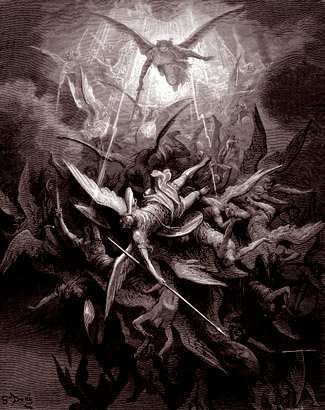
As I said, my classmates felt there was a lot that could be improved upon with “Evil Began in a Bar”, which is a retelling of the story of the Fall a la Milton (or a la Ungar, I guess) Some of the big ones were:

  • The tone seemed to shift wildly between dark and comical, serious and light.
  • They couldn’t tell whether this was a dystopia story or a religious fantasy.
  • People unfamiliar with the story of the Fall might be confused by this.

I think I’ve mentioned this before, but short stories are not my greatest strength. I’m much better at novels.

Still, there’s a bright side to this. After hearing from my classmates and talking to my teacher after class (in which she agreed with me on my predilection for novels: “You seem to be very expansive in your writing”), I got a better idea of what I can do to modify this story. And like a lot of short stories I seem to be working with lately, this one is going to be rewritten entirely during the second phase. I’m fine with it, really. At this point I’m becoming very used to it, and I like where I could go with this short story on the second draft. I just hope I can keep it under five-thousand words, or it’ll be more difficult to get it published in a magazine.

But before I do any revisions, I’m going to work on the next short story I’m going to write for my creative writing class. That one’s due on the Wednesday before Halloween, so you know I’m going to be bringing the terror. And as the hint I gave a while back indicates, this time it’s going to be a werewolf story. Though if I’m able to pull it off, it’ll be a very unusual werewolf story.

Here’s what’s coming next from creepy ol’ me.

And after the werewolf story…well, I may resubmit “Evil Began in a Bar” for the third time around, when I submit a revision. I guess it’ll depend on how my classmates react to the werewolf story, and how much work I have going on then, among other things. In any case, wish me luck with this and all the other projects I’ve got going on at the moment. It’s because of your support that I’m able to keep working even when stressed out.

Oh, and before I forget, this evening starts Rosh Hashanah, the Jewish New Year. According to the Jewish calendar, the Earth is now 5775 years old. So for everyone out there, I hope you have a happy and healthy new year, and I hope you’re inscribed in the Book of Life for the coming year. Also, if I did anything to upset or offend you this past year, I hope you’ll forgive me, because I’ve already forgiven you.

Have a good night, my Followers of Fear!

I know it’s been a while since I last blogged. Five days in fact. Man, I must be busy. And I would’ve blogged about this yesterday, but…well, I had biology and creative writing homework. Yeah, school’s basically taking over my life more than it usually does. God help me.

Anyway, yesterday afternoon was my first meeting with my thesis adviser. It was me, him, and another student who is also working on a novel. The idea is that we all collaborate to help each other out with these projects (of course, my adviser isn’t asking us for advice if he’s working on his own novel, but that’s beside the point). Since I’d already sent them both the first two chapters of my thesis project Rose, they had read what I’d written and had some feedback.

Let me tell you, it was very illuminating. The biggest thing about my work is that I’m always looking for holes to plug up, but they found some holes I’d missed, proving to me that I should not go into the field of repairing ships or they’d sink. What they told me was that the opening of chapter one was a little too lighthearted for a horror novel, and suggested a way to make it more of a dark, creepy story like I’d originally intended. They also gave me some suggestions on how to make our stalker much creepier and also recommended maybe I try switching to first person (and seeing as Rose is all about the main character’s point of view, that might be an idea I’ll keep).

So now I have until Friday to come up with some new material and send it to the both of them, and then we all meet up a week afterwards. I’m going to start with a little experiment to help refine the stalker’s character, and then I’m going to basically start rewriting Chapter One of Rose. The original opening, like I said, was a bit too lighthearted, so going back and redoing it should create the atmosphere I’m going for. And it’s not as if I haven’t rewritten an entire short story before on the suggestions of  my peers. What is Chapter One anyway, besides a short story that can be continued by several succeeding, interconnected short stories?

Obviously a bad analogy, but you get the idea.

Anyway, I’ve got to get to work, so wish me luck on the writing/editing front. And by the way, I turned in my short story Evil Began in a Bar on Wednesday to my creative writing class, so my classmates will be coming back to class Wednesday with feedback. I’ll be blogging about it then, but I’m hoping for good things.

Have a great day, my Followers of Fear.

I’m a feminist. I believe that women should be given equal treatment to men financially, politically, and socially. I believe this won’t disenfranchise men, but instead make women equal partners to men. In fact, men such as myself can be ardent feminists, and there are plenty of them out there. I also believe that there are people who dislike feminism because of ignorance or prejudice. And I believe that those who actively work to dissuade people from identifying feminism or tear down some of the movement’s tenets and beliefs are doing a lot more harm than good. Normally I ignore what is said, but occasionally something is so blatantly wrong or harmful to women that I have to speak up.

So when I read what Rush Limbaugh said today and then heard it for myself, I couldn’t keep quiet. Normally I ignore what Mr. Limbaugh says. Since the Sandra Fluke debacle two years ago, I’ve actually been surprised that he’s still on the air, let alone that he hasn’t learned from his mistakes or maybe hired someone to edit what he plans to say before he says it. But today might be the worst thing he’s said since he talked about Ms. Fluke.

I couldn’t embed the audio of the clip in question onto this post (if you’d like to hear it yourself, you can check out the Huffington Post article where I first read about it), so I’m talking about it here. In short, Mr. Limbaugh said that he finds the idea of “No” means “No” ridiculous.  He says:

How many of you guys in your own experience with women have learned that ‘no’ means ‘yes’ if you know how to spot it?…It used to be used as a cliche.

So under this definition of consent, when a woman says “no”, it really means “yes” under certain circumstances (and I bet to a guy like Mr. Limbaugh, there are few, if any, circumstances where “no” actually means “no”). A guy just has to “spot” it. I’m just wondering, how exactly do you spot the signs that a woman is actually saying “yes” underneath the resounding “no”? Enlighten me.

And if you think about it, this definition could extend not just to women. Perhaps a young child is actually saying yes to being touched inappropriately, even if they’re being touched by a parent or other relative. And according to Mr. Limbaugh’s definition of consent, if a gay man comes onto him or any other man and the second man says no, the gay man is allowed to go on if they believe “the signs” are there telling them to go on.* It’s uncomfortable to think about, but it could happen.

*I’m not actually insinuating that anyone does or should do this, be they straight or gay men, relatives of a child, or anything else. I’m just trying to put this in the context that Mr. Limbaugh outlines and make sense of the implications.

Also notice how Mr. Limbaugh asks for the opinions of the male listeners of his show, but not the female listeners. Why doesn’t Mr. Limbaugh ask about the female listeners’ experiences? I’m sure some of them have quite the stories to tell. According to the website of the Rape, Abuse, And Incest National Network, about 1 in 6 women are the victims of an attempted or completed rape in their lifetimes. 1 in 33 men suffer the same sort of attacks, and 15% of children under the age of 12 are vulnerable to rape or sexual assault. Victims of sexual assault are three times more likely to suffer from depression, four times more likely to suffer from PTSD and/or consider suicide, and 13 and 26 times more likely to abuse alcohol or drugs, respectively. A third of them get pregnant from their ordeals. How many of these women said “no” and that was ignored or interpreted as meaning “yes”? And how many of them listen to the Rush Limbaugh Show?

Mr. Limbaugh also quotes from the student handbook at Ohio State University** on what constitutes consent. Well, actually he isn’t quoting, exactly. Only a small bit of what he says is actually from the Student Code of Conduct (which you can read here). I have no idea where he’s getting this stuff about the thirteen-year-olds consenting to sex. But beyond all that, the point Mr. Limbaugh is trying to make is that all these requirements for having consent is too much and actually getting in the way of romance and seduction. I don’t have the most experience in this, but if you ask me, when two consenting partners are very much in love, care deeply about the other, and want to make each other happy, then all this stuff Mr. Limbaugh believes gets in the way of romance and seduction becomes unnecessary. The couple know each other well enough to know what is safe, what is crossing a boundary, and how to make sure both of them have an enjoyable sexual experience.

And for couples who aren’t at that point yet, perhaps they don’t need to ask permission to do every single thing. But it is common sense to discuss with your partner what you consider safe sexual territory, and to pay attention to what your partner is telling you, verbally or non-verbally. If your partner says no, doesn’t matter if you or your partner are male, female, or some other third gender. No means no, under ALL circumstances.

Mr. Limbaugh makes it seem like you have to go through a maze to have sex, but I don’t think that’s actually the case.

**For future reference, would you please not use my alma mater in your program? It’s not a very good example at the moment, anyway: sad as I am to admit, OSU’s marching band is under investigation for fostering an atmosphere of sexual assault, and there are other investigations occurring as well, last I checked. I still love this school and I’m not proud of what’s happened here, but you can’t fight your demons if you don’t admit to them, so I’m putting them out there.

So Mr. Limbaugh may feel that there are exceptions to the No rule and all those requirements for consent are a bit too much for your average man looking for sex. But with sexual assault so prevalent in our nation, I feel having these things pointed out to us is a good thing. Not only does it make us aware of a problem that needs to be combated, but following these rules helps to make our country safer for all, and helps to eliminate a very terrible problem.

Mr. Limbaugh does make one very good point, and that is we need to change how we teach our boys. I agree, but I think we need to change how we teach our girls too, and maybe how we approach sex in general. Men should be taught that there is nothing wrong with wanting to have sex, provided you are educated about both the benefits and the consequences of sex, particularly unsafe, forced or alternative forms of sex. And girls should be taught about their bodies, all that comes with sex, and that there is nothing they should be ashamed of when it comes to their bodies or their sexuality, no mater what anyone says. And above all, it should be stressed that no one owns your body but you, and you should decide what can and cannot be done with it.

Mr. Limbaugh, I hope what you’ve said today gets talked about by a variety of people. I hope that you make the newsrounds for your comments, because what you said is hurtful and shameful and trivializes a major problem. And perhaps after what you’ve said, there can be some constructive change to stop this ongoing epidemic of sexual assault in our nation. I would very much like to say that.

And Mr. Limbaugh, perhaps after this latest incdent, you might take steps to avoid saying such hurtful and despicable things on your program. And if that’s not possible, then maybe it’d be better for a lot of people (and I say this with all the sensitivity I can muster in such a situation) if you would kindly shut up.

Some of you are probably reading the title of this post and are wondering, Since when is there a purpose to any sort of violence? Very true, but I’m talking about violence in speculative fiction and when it is useful and when it is just excessive.

Granted, I might not be the best person to speak on this subject. If any of you have read or are reading Snake, you are well aware that the main character is very influenced by slasher films and the Russian mafia, so violence abounds. However, in my other books I try to hold back on the violence. Why? Partly because I’m just terrible with writing fight scenes. I actually try to avoid them when I can, which is okay because in horror it’s often more about the atmosphere and character interaction than about describing a punch or a gun fight.

But the other reason is that, when I’m writing and I think about including a very violent scene in my story, I think about whether it can advance a story’s plot.

Let me explain. In Video Rage, the sequel to Reborn City that I’m currently editing when I have the chance (my time is so filled up these days), there comes a scene about midway through the book where some of the characters get into an argument and one of them ends up punching the other in the face. The actual punch occupies about maybe two or three paragraphs, but the result s of it is felt throughout the rest of the novel. Both characters in this little altercation have to reassess their relationship. One has to decide if they want to continue to be friends with someone who punched them, especially since they really cared about this person and the hurt feelings and pride hurt more than the being punched. As for the one doing the punching, he is horrified about what he did in a moment of anger. He has to take a hard look at himself and really decide whether he might need to change his actions and perhaps do some growing up.

Another example is in Rose, my work-in-progress/thesis project. As I’ve mentioned in previous posts, Rose is dealing with a young woman trapped by magic with the stalker who resurrected her. And when she tries to get away from him, he often gets violent and dangerous. While providing some very terrifying scenes, these moments also force Rose into a dark place. She becomes frightened, and, like many abused women, starts walking on eggshells because she’s afraid of arousing his rage. Over the course of the story, Rose finds herself driven into a darker and darker place spiritually because of all she suffers. At least until certain events allow her to seek a change.

So in a way, while I detest violence and I try not to use it when I can, in certain ways like the ones above violence can advance the story and allow for character development. Of course there are many other tools that allow for character development and propelling the plot forward: romantic relationships, deceit and treachery, other non-violent events in the characters’ lives that allow them to move forward in the story. But I think of all those, violence requires a delicacy that is much harder to handle than other methods (and not to mention romance can be a bit overused). You have to use it in just the right way or your readers will be overwhelmed and turned off from reading anymore. One slap or punch or explosion too many and it can really change things, and not for the better. So for the author, it’s up to them to figure out what is the right level of violence and how best to wield it in their story. And hopefully through practice one can figure out just that.

So am I good at wielding the violence? You’d have to find that out yourself or ask one of my other readers. An author can often the worst judge at their work. But I think I do okay at it. At any rate, I haven’t had any complaints about the levels of violence in my stories or how they’re used. In fact, I’ve been told that they’re rather scary, which pleases me to no end.

How do you use violence in your stories? Do you have any advice regarding including or not including violence in your stories?

If you live in the English-speaking world and you pay any attention to scary stories, serial killers, or England, you’ve probably heard of Jack the Ripper, whose legend has become so great that sometimes it’s hard to tell what’s fact and what is fiction (and it blends more often than you think). If for some reason you’ve been living under a rock, here’s a quick overview of Jack the Ripper (even if you’re familiar with the Ripper legends, you might want to read this for a little refresher):

Jack the Ripper was the name given to a supposed killer who operated in the impoverished neighborhoods of Whitechapel and the surrounding areas in 1888 London. It is believed he killed and severely mutilated the abdomens of five women, all prostitutes, as well as possibly killing several more women. The killer gained his now-famous name when a letter, now called the “Dear Boss” letter, was sent to the Central News Agency of London, signed “Jack the Ripper” (whether the actual killer sent this letter and others is up for debate). The press  sensationalized the murders and anything even remotely linked to hte murders, and hundreds of people sent in letters claiming to be the killer (some people are really hungry for fame and attention). However, Jack the Ripper was never caught, and his identity has become one of the greatest mysteries of our modern era.

Almost immediately after the murders, Jack the Ripper became a household name and legend, appearing in numerous works of fiction over the years and becoming a sort of boogeyman for the masses. For numerous years, anything having to do with the Ripper would terrify Londoners and call out the police to investigate. And even today, authors (and more than one or two killers) have been inspired by the Ripper murders. In fact, it seems that at least one book a year is released offering a new story or fresh insight into the identity of Jack. People who dedicate themselves to trying to solve the Ripper mystery are known colloquially as Ripperologists.

One such Ripperologist, businessman and “armchair historian” Russell Edwards, claims in his book Naming Jack the Ripper to have finally figured out the killer’s identity through…DNA evidence?

Mr. Edwards book, claiming to have “definitively” identified the Ripper through DNA evidence

Apparently Edwards owns a piece of evidence from the original murders: the bloodstained shawl of Catherine Eddowes, one of the “canonical” Ripper victims, which he bought at auction a couple of years ago. According to his book, he was able to extract usable DNA from the shawl and have it analyzed by a professor in molecular biology at Liverpool John Mores University. Said professor managed to extract not just blood, but semen from the shawl and isolate DNA from his samples. The blood was eventually matched to Eddowes through a descendant of hers, while the semen was matched to Aaron Kosminski, a man suspected at the time of possibly being the Ripper, through one of his direct descendants.

On the surface, this could be credible. Kosminski, a married Plish Jew who emigrated to London with his family to escape the pogroms in Tsarist Russia. He lived in the area where the murders took place, and he was committed to Colney Hatch Lunatic Asylum in 1891 for paranoid schizophrenia, later transferring to another asylum where he died in 1899. However, there is good reason to suspect he might not have been the killer.

Aaron Kosminski, one of the main suspects of the Jack the Ripper murders.

Setting aside how amazing it is to get any workable DNA off a 130-year-old shawl and that the DNA results still haven’t been peer-reviewed by any scientific journal, Catherine Eddowes was a prostitute, so it wouldn’t have been unusual for her to have some semen on her, especially if it was from a man who happened to live in the neighborhood she worked in. And there’s also no evidence to suggest that Kominski killed her or anyone else. We lack a working timeline or any forensic evidence to possibly implicate Kominski or anyone else.  And Kominski himself, although mentally disturbed, was mostly harmless: except for two incidents while incarcerated in the asylums he lived in, Kosminski was mostly harmless. Indeed, some believe he may have been confused for Nathan Kaminsky, also known as David Cohen, another Polish Jew who was himself sent to Colney Hatch in 1888 a month after the last Ripper victim and was said to be violent and antisocial during his short stay in the asylum (he died in 1889).

The truth is, while this DNA evidence may tell us that Kosminski availed himself of Eddowes’ services prior to her death (as did  probably several other men who could all possibly be the killer), we are no closer to identifying Jack the Ripper than we were 130 years ago. Such is the case with famous serial killers who, due to time or design, have left little or no evidence behind of their murders. And that’s even if there is a killer to begin with (some have argued that some of the “canonical” Ripper victims may have actually been the work of other killers, and that maybe only three of the murders, if any, are related).

But you know what? Maybe that’s okay. A good chunk of the appeal from Jack the Ripper is that he’s unknown, that he could be a polish Jew, a surgeon, or even a member of the Royal House. And that means that there’s room for many more generations of Ripperologists and fans to come up with their own theories and stories about who Jack the Ripper is, why he killed, whom he killed at all, and where he ended up. And maybe someday someone will truly, beyond the shadow of a doubt, solve the identity of the Ripper.

Until that day, he’ll stay among the many famous serial killers whose identities are unknown, such as the Zodiac Killer, the Alphabet murderer, the killer of the Black Dahlia, the Servant Girl Murderer, the Axeman of New Orleans–God, how messed up is it that I know all this?

[Thanks to the Huffington Post for most of the information for this article as well as quick references on Wikipedia.]

I was having a comment conversation the other day with another blogger Caitlin Kelly, a freelance journalist from New York who at the moment is teaching at the Pratt Institute. Her post, which you can read here (and I highly recommend you do), was about how the effect of all the horrors going on in the world and being reported to us by the media. I mentioned in my comments that after digesting all the real horrors, it’s not uncommon for me to immerse myself in fictional horrors. Caitlin replied that one of her students, who “has seen his fair share of horrors”, also prefers the genre of horror. I said that for some people, horror acts as a kind of therapy.

Now, some of you who are reading this will probably be thinking “Horror? As a kind of therapy? We’re still talking about the genre where serial killers can be heroes, what trait your character embodies can determine whether you’re killed or traumatized, and fans debate on how good a movie is based on use of suspense, special effects, and gore, right?” Yes, we are still talking about that genre, but just bear with me.

Look at a news feed, particularly one devoted to global events or major issues facing Americans today. This is probably what you’ll see:

  • ISIS murdering Shiites, Yazidis, journalists, and anyone else that they don’t like.
  • Ukraine fighting both its own people and Russian insurgents.
  • Hamas attacking Israel and Israel firing back (and it’s only a matter of time before that starts up again, mark my words).
  • Several cases where police have shot and killed unarmed black men, with the most recent and famous case in Ferguson, Missouri.
  • Congress’s constant squabbling and bickering
  • An immigration crisis that continues unabated
  • Ebola spreading throughout West Africa and father beyond
  • Kristen Gillibrand, a well-respected senator and possible 2016 presidential candidate, being sexually harassed by older, male senators
  • The suicide of Robin Williams and the hurtful responses from people and groups such as Westboro Baptist Church, Pat Robertson, Rush Limbaugh, and Gene Simmons (my article on that is here)
  • CeeLo Green making horrific remarks on the subject of rape on his Twitter account
  • Justin Beiber is in trouble with the law again.

Depressing to read, isn’t it? What’s worse is that this is only the tip of the iceberg. All over the world, people are facing discrimination, violence, poverty, illness, corruption, greed, incompetence, and just about every other horror under the sun. And these problems are huge, multifaceted, and difficult to resolve. In fact, there are many people who may have multiple opinions on how to resolve just one of these issues. And assuming that the people in positions of power are able to come to an agreement and implement some sort of solution, there’s no guarantee that the issue in question will be fully resolved or not or will leave lingering micro-issues that will eventually grow and become major issues in their own rights.

“It’s true, I got defeated by some snot-nosed brats. I don’t like talking about it, though.”

There’s that. And then there’s the stories told within a horror novel or the latest scary movie. Let’s take Stephen King’s IT, for instance. The antagonist is a shape-shifting demon that can take on the form of your greatest fear and prefers the form of a clown. Well, that looks tricky to defeat, but it isn’t as hard to pin down or as multifaceted as an insurgency group or a virus or children brought to this country illegally fleeing violence and poverty. And guess who defeats It? Seven kids. They face their fears, band together, and defeat the monster in its own lair as kids, and then most of them come back as adults to finish the job. And after they’ve fought It for the second time, It’s dead. It isn’t coming back in any form ever again. Sure, at the end of the book the characters start to lose their memories of their war with It, but the story ends on a happy note.

In this way, horror stories–fictional horror stories–can act as therapeutic. We see very real versions of hell unfolding at home and abroad, and then we dive into a story where the characters are fighting their own hell. And we know deep down it’s fiction, but we don’t care. We sympathize and empathize with the characters. Occasionally we even recognize ourselves and our own brutal, tortured pasts in one or two particular character. And we see them defeating demons, exorcising ghosts, kicking serial killer butt, solving murders, and sometimes even bringing back the dead! Sure, plenty of people die in these stories and a good number of them end up traumatized by their experiences. But they usually defeat the enemy, they come out of the conflict stronger, and they sometimes even find romance.

What a horror novel can do for us.

And that fills us with hope. We think to ourselves, “Sure it’s fictional, but I see myself in these characters and the problems they face. So if they can take on ultimate evil and defeat it, what can I do?” In essence, horror takes the feelings of depression and jaded cynicism out of us and fill us with possibility and optimism. Weird, I know. These are stories that aim to scare us and fill our dreams with terror. But horror can do that and lift up your spirits too.

Horror is certainly one of the things that can lift up my spirits when I’m feeling down.

Has horror ever made you feel better after you’ve been feeling down? What happened? Why do you think you felt better afterwards?