Posts Tagged ‘Stephen King’

It’s a question every creator wrestles with from time to time. Writers are no exception. We wonder if anything we write is worth reading by anyone other than our family and close friends (who, most likely, will tell you they loved it because that’s what family and close friends do). We wonder if we’re just wasting our time sitting at the computer or in front of our typewriters or in our notebooks, trying to tell stories that range from the mundane to the fantastical and mundane.

In short, we ask ourselves, “Do my ideas suck?”

This may surprise you (I am Mr. Smiles and Jokes and Weird References to Demons and Monsters, after all), but I ask myself this question a lot. I often wonder if I’ll write anything that more than a few people will read in my lifetime, let alone afterwards. It’s a question I’ve been asking myself a lot more lately as I’m in the midst of rewriting a lot of Rose. Although I tell myself that I came up with these changes myself, and that both I and my publisher think they’ll do a lot to help the story and make it a better read, in the back of my head I’ve got this little voice whispering dissent and telling me that what I’m writing won’t amount to much.

And you know what? Sometimes I’m tempted to believe that voice. I mean, thousands upon thousands of novels are published every year, but very few of them gain the attention we wish them to have. Quite a few even get critically panned. It often seems like the field is too big and too difficult to really make a difference in. So why should we try?

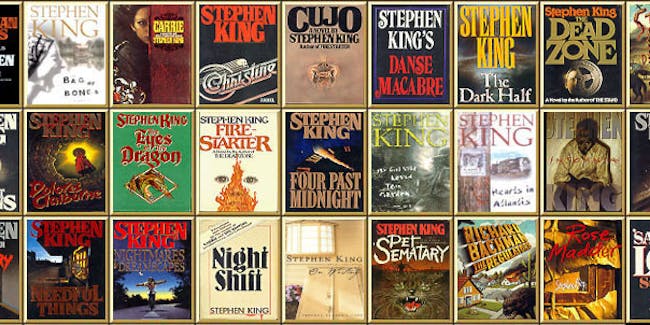
But then there are a couple of things I keep in my mind that can, if not shut up that voice, then at least turn the volume down on it. Both of them, not surprisingly, involve Stephen King. The first has to do with his debut novel, Carrie. Did you know when King first started writing Carrie, he actually threw the first few pages into the trash because he was convinced it was trash and would come to nothing. He only kept at it because his wife fished the pages out of the trash, read over them, and said they were good and that he should keep at it. The novel was later published and as we all know, became a huge hit, inspiring two excellent movies (though I prefer the 2013 version), a meh TV movie, and a musical that I wish would get a proper revival and a North American tour. All from a story that King was ready to throw in the trash.

The second story is another King work, Thinner, which he wrote under his Richard Bachman pen name. If you were to give the story an elevator pitch (see my article on elevator pitches for more on that subject) it would probably be something along the lines of “A man is cursed to become thinner and thinner.” And just from hearing that, you might laugh. That sounds like a comedy involving some prissy housewife who thinks if she doesn’t stay a certain weight, her husband will cheat on her and then she starts magically losing weight. It doesn’t sound like a scary novel.

Thinner by Richard Bachman (aka Stephen King); silly sounding concept, great payoff.

But from what I hear (I haven’t read any of the Richard Bachman books yet, though I know I should), it’s a pretty creepy story, one that inspired a movie (quality of the movie is debatable). All from a very simple idea of what happens when weight loss goes really, really bad. It sounds stupid, but it turns into an effective horror story.

And I could come up with tons of examples of this (did you know HP Lovecraft thought The Call of Cthulhu was only so-so? And now it’s one of his most famous works). But they all boil down to one thing: our ideas don’t always suck. In fact, they may only suck in our minds. To others, they may be great, mind-blowing, or even influential. And sure, not all of our stories will turn out to be great, but the vast majority of them, with enough work and a little bit of luck, can become awesome.

And I’m reminded of that every time someone expresses interest in reading Rose. People hear what it’s about, and they want to know more, or for me to tell them as soon as the book is out. If these people really do end up reading Rose, liking it and even letting people know they like it, then who knows? I might be able to shut up that little voice once in my head, at least for a little while.

So if you’re worried that you’re only writing crap, don’t pay your little voice any attention. Just keep writing and polishing and seeing where your story goes. Who knows? You may end up putting out something really amazing, and you’ll be glad you stuck with it for so long.

It’s hard to believe that a number of things are happening today (believe me, I’m still pinching myself). But among those things, one of them is something I’d like to bring up here, and that’s today is the fourth anniversary of the publication of my second novel, Snake, the cover of which is over there.

Now if you’re unfamiliar with Snake, let me tell you about it. I was between books in the Reborn City series, and I wanted to write something a bit closer to my native horror instead of some more sci-fi. I’d had an idea a while back, partially inspired by the movie Taken and slasher films of the 1980’s, and spent about six months writing it in 2013. The result was Snake, which was published June 10th, 2014.

Here is the blurb on the back cover of the novel:

How far will you go for love and revenge? When a young man’s girlfriend is kidnapped by the powerful Camerlengo Family, he becomes the Snake, a serial killer who takes his methods from the worst of the Russian mafia. Tracking down members of the Camerlengo Family one by one for clues, the Snake will go to any lengths to see the love of his life again…even if it means becoming a worse monster than any of the monsters he is hunting.

I was pretty nervous about this novel when it came out. While it was one of the easiest for me to write, it was also one of the most violent stories I’d ever written, and I had no idea what people would think when they read it. Also,– I was still a college student, fresh off my first trip to Europe, and had only just become legally able to drink in the United States, so I was wondering if people would notice how inexperienced a person I was with the story.

To my delight though, people who read the book tended to enjoy it. At the moment, it has seven reviews on Amazon, with the average rating a very nice 4.4 out of 5. Here’s what some of them had to say:

I really enjoyed this book. When I selected “dark” for the mood, it was almost a toss up with suspenseful. You knew early on who the mafia killer was, but the question of how he was going to find his girlfriend and rescue her was suspenseful. I ended up choosing “dark” because of the level of violence our main character used in getting to the girlfriend. But he was a complex character. Even though he definitely had the dark side to him, there was a surprisingly good side to him, too. You don’t really see this until later on in the book. So early on, you might think this is an unredeemable character. But one of the most intriguing characters are those who aren’t what they initially seem, and for this reason, I enjoyed this character. The pacing was just right. It wasn’t rushed, and in no way did I ever feel it dragged, which is awesome for a book that was over 500 pages in paperback.

This book is violent, and it contains sexual situations. Some of it can be cringeworthy. So I wouldn’t suggest this for young readers. I’d recommend this only to adults. If it was a movie, it would be a strong R. There’s also swearing. These things don’t bother me as a reader, but I know it bothers some, which is why I mention it. But if you don’t mind these elements, I think you will enjoy this book. It’s a great thriller.

–Ruth Ann Nordin, author of Marriage by Contract

A very good read. The mixture of horror and suspense were on point. I now want to read more of Ramis great books.

–Sherri

Rami Ungar makes a promise to (the reader) in all his writings: he WILL scare you, and if he does “his job is done.” Snake will scare you. I am a huge Stephen King fan, so this should give you some idea of my tolerance level for gore, death and mayhem – I was scared. Rami takes you into places you would never have believed possible, and manages to pull his hero (and eventually his heroine) out of them against all odds. If you like to be scared. If you LOVE to be scared. You should read this book.

–Angela Misri, author of Jewel of the Thames

Being compared to Stephen King always makes me giddy.

Anyway, this novel still has a special place in my heart. It was a real form of experimentation for me in terms of writing with violence, writing thriller fiction, and writing a sex scene (that didn’t get cut out of the final draft), among other things. And I’m still open to returning to that story and writing a sequel someday. Maybe two, depending on a number of factors.

And if you’d lie to check out Snake and maybe see if it’s up your alley, I’ll include the links to check it out below. And if you do decide to get a copy and read it, please let me know what you think. Positive or negative, I love receiving feedback from readers, and if you leave a review on Amazon or another site, it helps me in the long run by letting other people know what you think and helping them decide whether or not to check out the book.

That’s all for now, my Followers of Fear. I have a big day ahead of me, so I’ll talk to you all later. Until next time, pleasant nightmares.

Available from AmazonCreatespace, Barnes & Noble, iBooksSmashwords, and Kobo

Before I give you the news I hope you’re all eager to hear–the latest on my novel Rose, which is to be published by Castrum Press–I want to first share something I was told recently. Now, I’m not sure if this is true and I haven’t been able to find any corroborating evidence, but according to someone I talked to online, in the first draft of Carrie by Stephen King, Carrie actually grew horns and sent bolts of electricity from her eyes at some point in the story. This was later dropped during the revision process of the novel.

Okay first off, I kind of want to see that version of Carrie, not just in book form but in movie form as well (I still maintain that the 2013 film is the superior adaptation, and you know the horns and lightning bolts would’ve looked awesome in that film). Second, it shows that even King’s works, including one of his greatest, require extensive revisions. And that made me feel a whole lot better about the revisions I have to do for my own story.

Now, if you’re unfamiliar with Rose, it’s a novel I’ve been working on since my senior year of college, when I wrote it as my thesis project. It follows a young woman who finds herself turning into a plant creature (and that’s just the start of her problems).

I’ve mentioned before that my publisher asked me to do nix the many flashback sequences in Rose, essentially throwing out one-third of the book, and another third that was dependent on that first third. Although I was understandably more than a little disappointed about that, and it even brought my mood down quite a bit at times, I decided to try and find a new direction for the story that didn’t rely so heavily on flashbacks. Somehow, after a lot of head-scratching and extensive use of a method of brainstorming I’ve been wanting to try for a while (I’ll write an article about it for Self-Published Authors Helping Other Authors soon enough), I managed to find a new direction and plot for Rose that I thought made for a good supernatural thriller.

I sent a new outline for the story to my publisher, and just today they got back to me. I was really worried that they might not like the new direction, but the tone of the email was really enthusiastic. They just asked me to keep in mind some things about chapter length and a few other things, and wished me luck.

I can’t tell you what reading that feedback did for my confidence. The closest I can get to is by saying that it felt like a weight had been lifted off of my shoulders.

And since I’m on vacation for the first third of June (not going anywhere, I’m just having a relaxing stay-cation at home), now is the perfect time for me to get back to work on Rose. I plan on getting through at least the first seven chapters of the novel, and then start on the new material for the novel. All that, along with more than a few blog posts I’ve been wanting/meaning to write for a while, and of course the normal stuff one does while on vacation (sleep, watch TV & movies, read, hang out with family and friends, run errands, have tea and scones with a succubus you’ve been seeing on another plane of reality, etc.), should keep me pleasantly occupied during my vacation.

So as you can see, Rose is still coming along. It may take some time, but I still think we can get the book out before it starts to turn chilly again (though in my state, that can happen even in summer). And I think when I get it done and on the shelves, it’ll surprise more than a few people. Especially those who’ve read earlier versions of the story.

That’s all until morning, my Followers of Fear (got another post I need to work on after I’ve gotten my much-needed sleep). Until then, pleasant nightmares. I’ll see you soon.

My copy of “The Creepypasta Collection,” as edited by MrCreepyPasta

A couple of years ago while I was in Germany, I became acquainted with a growing genre of horror known as creepypasta. Creepypasta, for those of you who are unfamiliar, are horror stories, images, videos, music and games that originate on the Internet and are meant to be spread around as memes. Sort of like viral Internet-born campfire ghost stories (see my original post from 2015 if you’d like a more in-depth explanation).

While I had to end my acquaintance with the genre rather abruptly (job searching and then landing a busy full-time job, as well as trying to write my own stories, doesn’t leave that much time for perusing the Internet for horror stories), I never forgot about this strange world of creators making and sharing these scary stories, sharing characters and creating entire mythologies out of some of them (Slender Man, anyone?). So when I found out there was actually a couple of anthologies of creepypasta available in book format, which meant I could read them on my lunch break, I decided to get a copy and dive in to see back in.

What did I find?

Well, like every anthology I’ve ever read, there were some stories that spoke to me more than others. A few I didn’t find that scary at all, but others definitely filled me with that feeling I get from good horror, and even set my imagination alight at times. There are writers in that anthology who would and have done well writing commercial fiction (in fact, some of the contributors listed in the back of the book have published or self-published stories). My favorites in the collection were “When Dusk Falls on Hadley Township” by TW Grim, which reminded me of a Stephen King short story; “Smile.Montana” by Aaron Shotwell, featuring the infamous creepypasta character Smile Dog; “Bedtime” by Michael Whitehouse, a classic of creepypasta fiction that really got my imagination going; and my top favorite, “She Beneath the Tree” by Michael Marks, a Lovecraftian tale that I loved from start to finish.

So yeah, if you’re curious, you should give the collection a read. 4.5 out of 5. As the cover promises, these are stories you can’t unread. And I’m not sure you’d want to.

But I found more than just stories in this collection. I also noticed some things about the genre, especially the pieces in the anthology, that showed me just how different they were from more “mainstream” horror stories. For one thing, the narration in the stories struck me as being more…realist in nature. Not like Realist fiction, which is set entirely around stories that happen in the real world, but like they really believed that the things they depicted in their stories could actually happen. In a lot of horror fiction, even by the greatest writers out there, you get the sense that, except for maybe stories involving serial killers, the authors don’t really believe that what they’re writing about could happen. But creepypasta writers seem to feel the opposite. I got the sense, even with some of the more supernatural or strange stories, that the authors really believed that what was happening in their stories could happen in the real world, and treated it as such. And this shown through especially with the first-person narrators.

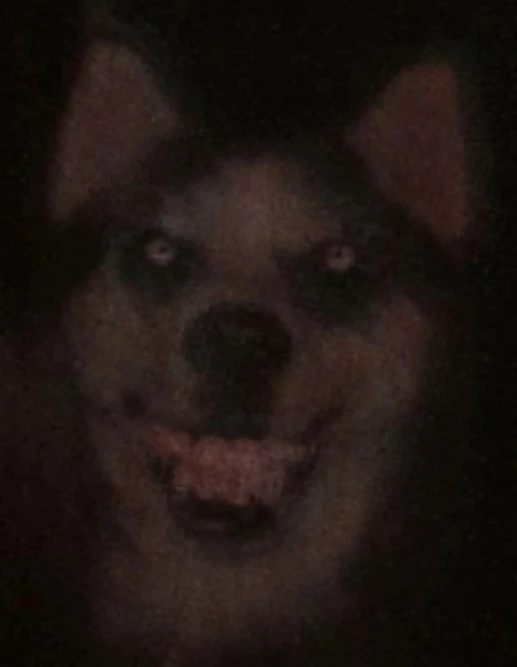
When something like Smile Dog can be treated as if it’s real, you know you’re reading something different.

This is something I really admire in creepypasta, because it just gives these stories another layer and gives them the power to really make you wonder if some of what happens in these creepypastas could happen. Some of my own stories are based on my own beliefs of what could be out there, and I like to think that gives them this quality of strange realism to them. Seeing that quality brought out so well with these stories is a great guide for me personally as a writer, so I’m glad I exposed myself to them.

Another thing about this anthology is that it made me realize something: the creators of creepypasta are not too different from self-published and hybrid authors. The latter try to recreate the quality and success of books published by traditional presses without having to go through all the hoops that come with the traditional method and presses. They’re trying a new way to achieve an old goal. And a major component of this is through the Internet to reach readers and advertise. Basically, to spread the word.

Similarly, creepypasta creators are trying to recreate something as well. When I called creepypasta viral Internet-born campfire ghost stories, that was a really apt description. They’re recreating the feeling of telling scary stories around a campfire, and spread it farther than any campfire could. And their chosen medium, the Internet, is perfect for that. Spoken word can be used on the Internet, but so can the written word, images, video, music and so much more. They use the Internet to advertise terror as well as any self-published/hybrid author can to advertise their books. Is it any wonder that one can so transition easily into the other?

Overall, I’m glad I took this dive back into the world of creepypasta. It opened my eyes to things that I’d never realized before, gave me ideas for stories, and caused my respect for creepypasta creators to grow immensely. And while I may never write true creepypasta, I can see creepypasta-esque stories or ideas infiltrating my future work. Just like creepypasta, you never know until it happens. And by then, it’s likely too late.

That’s all for now, my Followers of Fear. I’d love to talk a bit more on the subject, but a hole in the fabric of reality has appeared in the fabric of my carpet, so that either means something really pleasant, or something really bad. I’m going to go find out.

Until next time, pleasant nightmares!

I talk a lot about my writing career. Not just on this blog, but everywhere else: when I was at school, at social events, at wherever I happen to be worshiping (usually it’s at a synagogue, but occasionally I’m at other places), when I’m hanging out, and of course, at work. I’ve mentioned to more than a few people at work that not only am I a writer, but I’ve told them that Rose is getting published by a publishing company. The vast majority of people I’ve talked to about it have been very excited to read it, even if horror is not their normal genre (though I think Rose would be more classified as a supernatural thriller at this point). It really boosts my mood when people say that, and makes me want to be an even better writer.

Today, a coworker from another office and I passed in the hallway at work. She asked me about updates on Rose, and I told her that my publisher was hopefully going to get back to me this week about some revision suggestions I’d made. She got that “how cool!” look on her face and told me to keep her informed. She then dropped this on me: she’d been telling her kids about me, as I was proof of success for “following your dreams.”

Well, this really got my thinking. I mean, I’m flattered and all, but do I really deserve to be called an example of following your dreams? To my coworker, I probably am. After all, to non-writers, getting the book accepted by a publisher counts as living the dream. But to me, I haven’t accomplished my dreams yet.

That’s not modesty on my part, I’m just not sure I can say I’ve reached my dreams. At least not at this point. My dream has changed over the years, from being the next JK Rowling to the next Stephen King to just being able to make a living off of writing and maybe writing full-time, which is where my dream is that today. And I’m not there yet by any means. I still work a 40-hours a week job to pay my bills (sometimes longer if I have to stay late to finish up certain projects). And while Castrum Press wanting to publish Rose is a big step in the right direction, the book still has to come out.

I guess what I’m saying is that I’m still following those dreams. I’m still working to make it so that I’m in bookstores, to get lots of people to actually want and look forward to reading my books. And I say “books,” because it’s probably going to take several books, if I’m very lucky, to be able to write full-time. It’s rare for authors to be able to write-full time, and even rarer just after the first book. If I somehow manage to make that happen, then hooray. But at the moment, that’s still several years in the future.

I guess I’m still chasing my dreams. Right now, I’m on the right track, and I’m an example of how hard work, lots of revision and rejection, a bit of backbone, and a Plan B if you don’t happen to be one of those overnight success stories (aka employment) can pay off a little. But of successfully chasing your dreams? Well, we’ll see where I end up in the next few years. Fingers crossed it’s a better place than where I am now, even if I’m still not writing full-time.

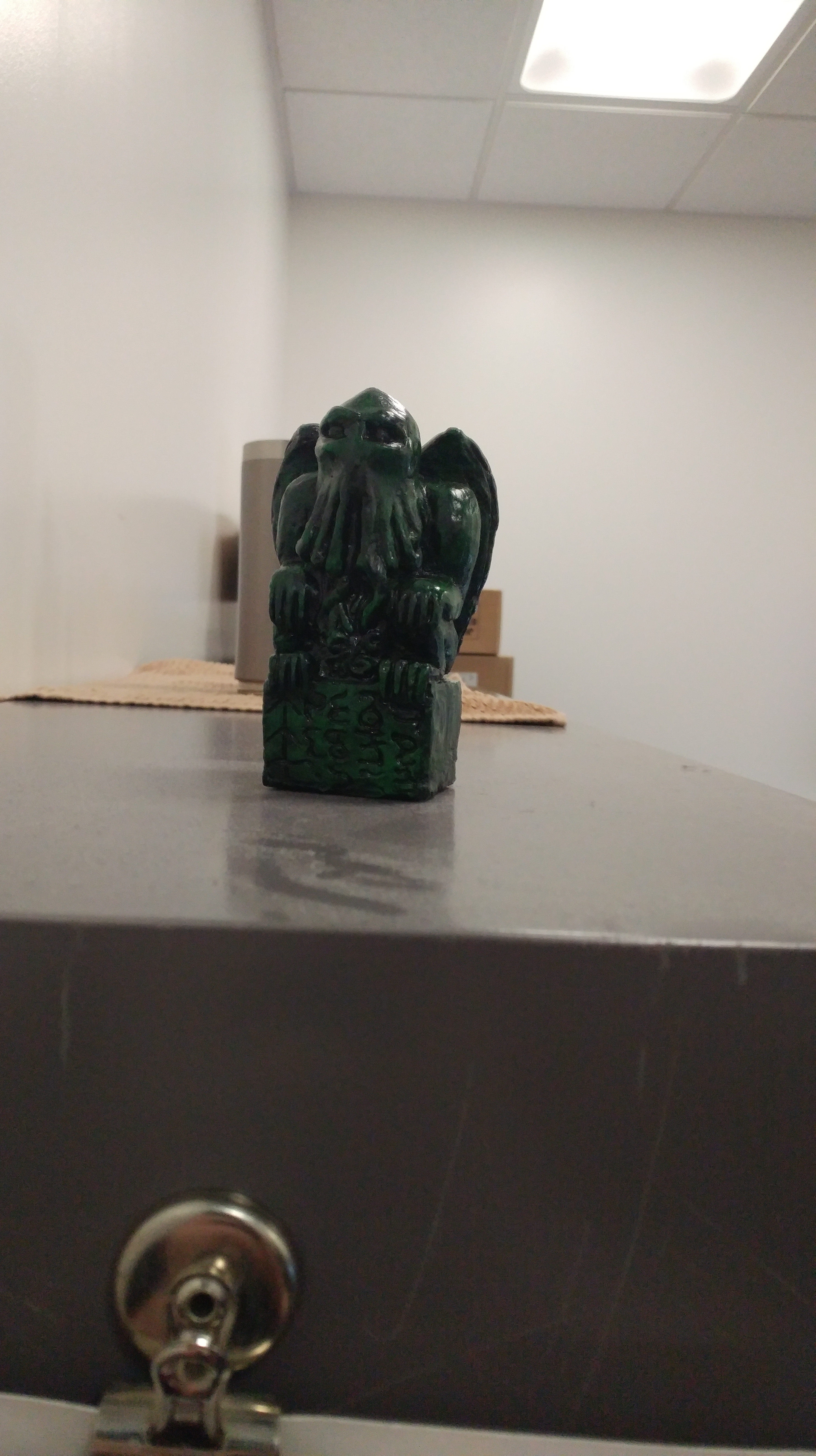
On an unrelated note, you remember how in my last post, I talked about getting a statue of Cthulhu? Well, my boss took a look at it this morning and okayed me to keep it in the office. To which I say, “Yay! Now I can really start turning my workspace into a den of horrors!” But seriously, it’s nice to really be able to personalize my workspace in such a way. Before now, it really didn’t have that much to say, “Oh, this is totally Rami’s desk. You can just tell by looking at it.” There’s a lot of rules to how one can decorate their workspace at my job, so being able to just have Cthulhu there is a big deal for me. Perhaps in the future, I can also put some other cool stuff around my desk to really help me feel at home while I work.

Until then, I’m cool with just Cthulhu. Besides, he looks so cool there, doesn’t he? I think he does, anyway.

That’s all for now, my Followers of Fear. Thanks for letting me ramble on about this stuff. Until next time, pleasant nightmares!

I try to be a regular blogger, one or two posts a week. But since Saturday, I haven’t really had anything to talk about. Which is crazy, because I usually always have something to talk about. And sometimes, people like to read what I have to say.

But there’s just nothing these past couple of days I’ve wanted to get out there. There’s been no development with Rose or any of my other stories worth mentioning. I haven’t seen or read anything to review lately. I haven’t come up with anything involving the art of writing or the art of horror. There’s nothing big in my life that I feel like making announcements about. And there’s no issue or current event I feel angry enough to speak about (and before you mention “Cockygate,” I’m getting to that).

There were things I thought I might blog about. I finished rereading The Shining, the first time I’ve read it since my teens, but I didn’t feel like I had enough material to make a full post like I did with To Kill a Mockingbird. The same with a post about feedback from readers and magazines; I started it, but in the end, the words just wouldn’t come to me. Cockygate is still ongoing, but there hasn’t been enough new developments that I want to write a post. I have a post for Self-Published Authors Helping Other Authors, but I’m saving that until after I’ve spoken with my publisher about some proposed edits for Rose. And I’m waiting on a few other things to happen before I do some other posts I’ve been thinking of writing.

I could do an entire post about how one of my favorite shows Lucifer was canceled (yes, that happened, and I’m very upset about it!). But that feels too clickbait-y for me, especially after devoting an entire post to Cockygate. That being said, it would do me and an entire fandom a huge favor if you could help us keep the hashtag #SaveLucifer trending on social media. As of the time I’m writing this post, it’s a trending topic on Twitter, with over three-hundred twenty-seven thousand tweets. Believe me, we don’t want this show to go anywhere, so please help us out.

But other than that, I really have nothing special to say at the moment. I’m as quiet as a mouse.

Except…

Except that I can assure you I am still working on stories. Rose is coming along slowly but surely, and I have other stories in the wings. I certainly haven’t run out of ideas for stories or blog posts. And I am as devoted and energetic towards these projects as I’ve always been.

So even if I drop off the blogosphere from time to time, know this: I will come back, and it’ll be with plenty of good news to share. So stay tuned.

Until next time, my Followers of Fear, have a good weekend and pleasant nightmares.

I’ve been reading a lot of articles about how Hollywood is coming to see big horror films are, and that they are looking into making more. It’s even been compared to the explosion of superhero films that came about after the Dark Knight trilogy and Iron Man showed how popular and profitable superhero films could be. Since I am a horror fan in addition to a horror writer, I thought I’d weigh in on the subject.

First off, this explosion in horror is not exactly out of the blue. Studios have been making horror films since the early days of film, and they keep making them every year. There’s obviously always been an interest and a profit to be made in horror. It’s just lately we’ve had a slew of horror films that have shown studios and audiences that horror can be extremely profitable, mainstream, and even deeply thematic. We actually first started seeing this trend years ago with films like the Paranormal Activity series, which kicked off a huge fad of found-footage horror films, and with Blumhouse Productions, which proved you can make horror films cheaply and still have critical and box office success. This is especially so with their Conjuring film series, which in itself is a cinematic universe.

But late 2016 and 2017 brought on a slew of horror films that really brought these points home. Split, with its surprise ending technically making it a superhero film, and Get Out, with its commentary on race on par with some Oscar-nominated films, brought horror into the mainstream in new ways. Later in 2017, Annabelle: Creation and It proved massively successful beyond anyone’s wildest dreams, and in 2018, films like A Quiet Place are raking in the dough and proving how powerful horror can be in creating terrifying atmospheres and emotional narratives.

And this is just scratching the surface: Stephen King stories are being optioned at record rates (where’s my adaptation of The Library Policeman?); some of Netflix’s biggest recent original films have been horror movies; and studios are developing more horror movies than ever before. It: Chapter Two starts filming this summer, and a new Halloween film is getting released this year. So while I may say yes, horror is kind of the new superhero film, it’s not because they suddenly became profitable. The potential has always been there, it just took some very specific successes with deeper cultural resonance to really bring that potential to the attention of studio heads.

Remember, don’t do what The Mummy did. Not if you want your horror movie to actually be successful, let alone spawn a franchise.

So yes, the horror genre may be the new superhero film, with every studio wanting its own successful films, film series, or film universe. But to steal a superhero film quote, “With great power comes great responsibility.” So while I have no pretensions that studio heads or directors or writers or whatever will see this post, let alone take its message to heart, I thought I’d offer some advice advice on getting into this horror boom. After all, as a horror fan and a creator, I want the horror boom to continue. The more good horror out there, the better. So here are some of my ideas for ways to make sure the boom doesn’t fizzle out:

  • Focus on telling a good scary story. This seems obvious, but some companies get so caught up in having a successful film or franchise, they forget to make a good horror film. Remember last year’s The Mummy? That film was convoluted, packed to the brim, and not at all scary. Not a good start for a film that was supposed to be the launching point for an entire cinematic horror universe. Which was the problem: Universal was so concerned with getting their franchise off the ground, they forgot what let Iron Man get the MCU off the ground: a good film in and of itself. If Iron Man had not led to the MCU, it still would’ve been an excellent superhero film. The Mummy should’ve been made that way, but unfortunately, it wasn’t, and now the Dark Universe is sunk.
    So remember kids, focus on a good story first, franchise a distant second. At least said franchise is up and running, of course.
  • Take chances on new/indie directors and stories. A lot of great horror films have come from the indie scene and/or from new/emerging directors. It Follows and Babadook were both very successful horror films from directors with less than three films under their belts, and the former was from the indie scene. Get Out was from Jordan Peele, who had never done a horror film before in his life.
    And all these stories are original plots. In an age where every other movie is a sequel, remake, or some variation on a familiar story or trend, adding something new to the horror canon has the ability to draw in a diverse audience, rather than just the smaller audience of devoted fans and some possible new ones.
    So take a few risks. It could lead to some big returns.
  • Adapt more than just Stephen King. Yeah, I’m happy for the many Stephen King adaptations being made (Library Policeman movie, please?). But there is such a thing as too much of a good thing. Even his Royal Scariness: I got sick of him back in high school because I read too much King and had to take a break for a few years. I still make sure to space out my dives into his stories nowadays. And if that could happen to me with his books, imagine what it could do to audiences with too many of his movies.
    The point is, there are a number of horror writers out there whose works should be adapted. Scott Thomas’s Kill Creek is one of the best novels I’ve read so far this year; Ania Ahlborn’s Within These Walls would make a great Blumhouse movie; Junji Ito has plenty of stories that could make great films; and as I noted in a previous post, HP Lovecraft is in the public domain and would make for great cinema. It’s something to consider.
    And before you ask, “What about your works, Rami?” I would be flattered if someone showed interest in adapting one of my stories. However, I don’t think that’s a possibility at this stage of my career, so I’m not going to get my hopes up. Still, I’d be flattered.

Horror is finally being given the attention it deserves from Hollywood, and I couldn’t be happier for it. However, it’s going to take a lot of work, and a lot of good stories, for horror to continue to thrive. I hope that filmmakers old and new are up to the task.

In my last update on Rose, I mentioned that I was probably going to do a whole lot of revisions and possibly a ton of rewriting, owing to the fact that the flashbacks were deemed unnecessary to the story and I had to throw them out or modify them. Well, I am rewriting a good chunk of the novel. It’s not what I’d hoped for, but sometimes you have to do what you have to do. And while I’m still trying to figure out the final third of the novel, I have figured out the second third for the most part, as well as other things that I plan to include in the story. And one of those things I plan to use is something I call mini-anecdotes.*

Mini-anecdotes are something I’ve noticed a lot in fiction, particularly fiction aimed for adults. They’re not like flashbacks or mini-flashbacks, but they’re related. A mini-anecdote is when a character briefly thinks of a past experience, usually something that can be associated with the current moment in the story. It’s not a flashback, as it’s not going into the character’s past in order to show them something. It’s more like a quick summary of a flashback. A good example would be in The Shining (which I’m rereading now), when Jack is doing handyman work around the hotel’s playground and park, and thinks back to the park he went to with his dad growing up. This not only gives us a bit more on Jack’s past and who he is as a person, but also gives us a brief illustration about his relationship with his dad, which we learn further about in the novel.

Other great examples of mini-anecdotes can be found throughout the Harry Potter books. In the first book, we learn how Harry’s life has been strange since he was small: ending up on the school roof, his hair growing back overnight, a sweater shrinking as his aunt is trying to force it on him. This isn’t a full flashback, but it gives us a very good idea of what Harry’s life has been like up until Dudley’s eleventh birthday, as well as what he’s like based on his reactions to the strange things around him. And in the third book, we get a brief glimpse of Harry’s relationship with his Aunt Marge, how she also mistreats him and spoils Dudley, and once let her dog chase Harry up a tree while laughing at his misfortune. It’s an illustrative moment on how awful Marge is and gives us an idea of what we can expect from her during her appearance in the story.

Now, I’ve only just started identifying mini-anecdotes in fiction, so I’m not an expert at using them yet. Just as you can”t really be a great writer even if you’ve read hundreds of novels, you can’t immediately use mini-anecdotes even if you’ve seen them in hundreds of books. However, I think I’ve identified a few things that might make using them in Rose a bit easier:

  • They’re brief. Seems rather self-explanatory, but it needs to be stated. Mini-anecdotes are usually only a couple of sentences or paragraphs at most. The longest may be only two pages at most, but they don’t go on for several pages. That, ladies and gentlemen, is a flashback, and as I stated in a previous post, flashbacks can be difficult to use effectively.
  • Little dialogue or details. Mini-anecdotes tend to be very bare bones. They may have a few lines of dialogue, but no long speeches. And certainly not enough detail like the shape of a building or all the thoughts going through a character’s head. It’s more summary, telling vs. showing, than anything else. Going into anything more would be going into flashback, most likely. And as I said, those have strings attached.
  • They’re connected to the present. Like Harry’s early experiences with magic or his aunt, these mini-anecdotes have to connect to the story’s present, either to illustrate a point, give us further insight into a character, or just to help us connect to them more. Having one for the sake of having one will do you no favors. After all, you wouldn’t want to have a romantic scene that suddenly goes into a character’s dislike of geese, do you?

While these won’t help a writer (let alone me) use mini-anecdotes well, they can be a starting point for their use. And if we as writers can learn to use them well, then we can use them to make our stories better and more memorable to readers. And in the end, isn’t that part of the reason we write in the first place?

Do you use mini-anecdotes in your stories? What tips do you have for writing them?

*At least that’s what I call them. I don’t know if there’s a technical term for them. If there is, please let me know in the comments below.

I’m not sure if I’ve ever mentioned this, but Rose has a lot of flashback sequences and other dips into the past within the story, especially in the last two-thirds. I did this for a number of reasons: exploring the characters’s pasts; making them more complex; and just an opportunity to write some sequences to add to the horror element of the story. And there are a lot of horrifying things in those sequences, things that I can’t go into without revealing too many plot details, but they did make my beta readers gasp and stare at the page wide-eyed. They were horrifying moments in the story.

Not to mention, I think that flashbacks can be scary if done right. A good example of this is Gerald’s Game by Stephen King: while the protagonist’s current situation is scary enough, going into her past midway through the story and seeing how her father abused her as a kid was horrifying in its own right. Another good example would be the movie Oculus: that film flashes between the present and the past throughout its runtime, and it’s freaky no matter what year it is (see my Rewatch Review of that film).

Well, it looks like I didn’t do the flashbacks right for Rose. In the notes on the fourth draft from my publisher, they mentioned that all those flashbacks are just bad stuff happening to those characters, and while that stuff is horrifying, it’s not scary. I’ve had a lot of back and forth with them on this, and after a lot of thought, I can see where they’re coming from. After all, while in the real world “horrifying” can be a synonym for “scary,” especially in relation to current events, in fiction that’s not necessarily the case. Think about it this way: Harry Potter is horribly mistreated by his relatives, and what he goes through is horrifying. But if you ask any normal Potterhead what person or creature from the books they would be scared to face, the Dursleys wouldn’t rate very high on that list. The dementors, Voldemort and his Death Eaters, or the basilisk, sure. But the Dursleys? Considering most Potterheads are Muggle in biology and can’t perform magic, anyone who had to face them would probably be invited into Privet Drive and served tea and cookies in front of the TV!

So while showing how many terrible things happened in the characters’ pasts may be horrifying, it might not be scary. And considering how much experience my publisher has and how well-received their books are (have you checked out The Cronian Incident by Matthew Williams yet?), I’m taking this piece of feedback to heart.

I won’t lie, though, I’m a little disappointed, and I’ve been wondering where I went wrong. Or maybe to phrase it better, I’m wondering how I might have done the flashbacks better.

Well, in the case of Gerald’s Game, whose flashback is most similar to mine, they only do one big flashback sequence, not several. That way, it doesn’t become a repetitive cliche or trick. That, and its connection with the current events of the story: the protagonist’s abuse by her father is very much connected to her current predicament, on psychological and symbolic levels as well as literal levels. And with Oculus, the horror behind the story–a cursed/haunted mirror–is scary no matter when it happens. Spinning a tale of two siblings who experience the mirror both as children and adults, and then going back and forth between those two experiences, makes for some great psychological/supernatural horror.

And maybe that’s the thing: connection. In both those examples, the flashbacks, no matter how they’re staged, have very strong connections to what’s happening in the story’s present. Of the ones in Rose, while they do have connections to the characters’ pasts, only one of them has a direct correlation to the current events of the story. And that one’s told to us by the antagonist rather than shown in flashback. And that’s why the flashbacks in this story didn’t work as well as they could have.

So what’s next? Since so much of the novel is in flashback, I may have to do a whole lot more revising. Hell, I may even have to rewrite a good chunk of the novel. Which isn’t something I’m unfamiliar with: as many of you may recall, I had to go back and start over on the first draft back in college because the first attempt went in a direction that didn’t help the story.

Still, it’s a little annoying, and I haven’t figured out exactly what I’m going to do for these changes (though I have ideas). Hopefully, whatever I come up with, it’ll come out for the novel’s betterment, and bring it one step closer to publication.

Fingers crossed.

I’ve been thinking a lot about what’ll happen after Rose comes out. Specifically, what sort of stories I’ll work on once I’m done with Rose.

I know that’s a crazy thing to think about at this point. I’m still doing revisions on Rose for the publisher, and likely they’ll have me do more revisions before we get to publication, and then there’s the publication, and then a whole ton of marketing and other work just to make sure the book is read and sold and reviewed and whatnot. Thinking about future projects should be the last thing on my mind.

But of course, being “logical” has never been one of my strong suits, and dreaming about the future has been what’s helped me get to this point anyway. So why not wax on about what might happen after Rose?

Well, there are a number of short stories I’ve been thinking about working on. I very much want to edit Hannah, the ghost story I wrote back in January, and I want to write a few stories that have been circulating in my head for a while. I also want to eventually get back to the novelette I was working on that was giving me so many challenges, and see if I can get a bit further in that, if not finish it up entirely. It may end up becoming one of those stories where I revisit it every now and then to see if time has given me a clearer vision of how to improve and/or finish it (I’ve got a few of those). And I’d like a few months to spend on all of those, just to see what I can come up with, and if any of it is publishable.

And of course, I’ve been thinking about what sort of novel I’d like to write next, when I’m ready to write a novel. Probably, that won’t be immediately: Rose has challenged me in ways I’ve never been challenged by a story, and I want some time to refresh my mind before I make a commitment to a project that I could end up working on for years and years. But I have some ideas on what sort of novel I’d like to write next, when I am ready to make that sort of commitment.

For one thing, it won’t be a sequel to Rose. I could write one, and I have ideas I could develop into a sequel for Rose, but I don’t want to return to the world of Rose just yet. Especially when I can’t guarantee I can make the story better or on par with the original so soon after finishing the original.

For another, I’m not yet ready to return to the world of Reborn City. Yeah, I know there are a couple of big fans of that trilogy who want the final book, Full Circle, already (I know a few of you are probably out there), but I’m just not ready to get back to that yet.

And finally, I want to do something that’s different. Think of it like houses: I don’t want to try selling Castrum on a house that’s basically the same one they bought, just on a different block and with a different coat of paint. I want to sell them a house that’s just as good as the first one, but an entirely different design, while still retaining the Rami Ungar architecture (is this metaphor getting too weird/complicated, or does it still work?).

All these books are different from one another. I want to do the same with my books as well.

I mean, look at Stephen King: he followed Carrie (a psychic girl who gets revenge on her psychotic religious mother and the bullies at her high school) with Salem’s Lot (vampires invade a small Maine town, and a writer and his allies have to stop them), and then went on to write The Shining (a family that includes a psychic four-year-old becomes the winter caretakers at an isolated hotel haunted by something dark and evil) before creating The Stand (a super-disease causes most of Earth’s population to die off, leaving the survivors to engage in an apocalyptic war between the forces of good and evil). None of those are carbon copies of the other, so I want to do something very distinct from Rose.

And I have a few novels I can choose from. I have more ideas than I know what to do with, so I have plenty of options, but there are a few stories I can think of that would make great projects. There’s one in particular I’d like to work on when the time comes, but it’ll depend on a number of factors, including if I have to pitch something to the publisher (I’m not sure if that’s something I have to do, but it’s something I’ve thought about).

Still, there’s plenty of time to think about all that. I just know that when the time does come to think about all that, I’ll have plenty of ideas to work with and consider. Hopefully whatever I choose, it’ll make for some good reading.

In the meantime, I’m off to work on Rose for a little bit. Here’s hoping I can make some good progress before I have to hit the hay tonight. Until next time, my Followers of Fear, pleasant nightmares!