Posts Tagged ‘writing’

tqg cover

Another review has come in at Amazon for my collection of short stories, The Quiet Game: Five Tales To Chill Your Bones. This one comes from Jeff D., who is a fellow Ohio State student, a coworker, and a friend of mine. He finally got around to reading The Quiet Game, and he wrote a review on Amazon tonight, which he gave five stars (Thank you Jeff D., if you’re reading this!). The review, which he titled 5/5, read as such:

5 wonderfully crafted tales! I purchased this as an eBook originally and put off reading it for quite a while, I really wish I hadn’t waited. Sometimes when one purchases a collection of short stories you expect some of them to be less entertaining or of lower quality than the others, but none of these disappoint. Well worth the money, especially considering after you read each story the author gives you creative insight into what inspired him to write each tale, which is really wonderful.

Jeff D., this is probably one of the best reviews I’ve ever received! I’m glad you think they’re all extraordinary stories. And best yet, Jeff D. says he’s going to buy a print copy of Reborn City when his next paycheck comes in. Oh, I can’t wait to sign that copy!

If you’re interested in checking out The Quiet Game, it’s available on Amazon and on Smashwords in both print paperback and e-book formats. And whatever you think, please let me know by leaving a review. Good reviews, bad reviews, I don’t care. I love getting feedback from readers. And if you like The Quiet Game, check out Reborn City, also available from Amazon and Smashwords.

This weekend I spent part of it with my dad and my sister at my dad’s place. I needed to pick up my suit for a friend’s wedding and I wanted to attend my friend’s aufruf* at his synagogue (plus who doesn’t love spending time with their family? Don’t answer that question). While I was there, I received a Hannukah gift from a friend of the family who has known me since I was a baby. I wasn’t able to get the gift until now because the gift came after I left for campus. I was surprised but happy to get the gift and I wondered what she’d gotten me this year.

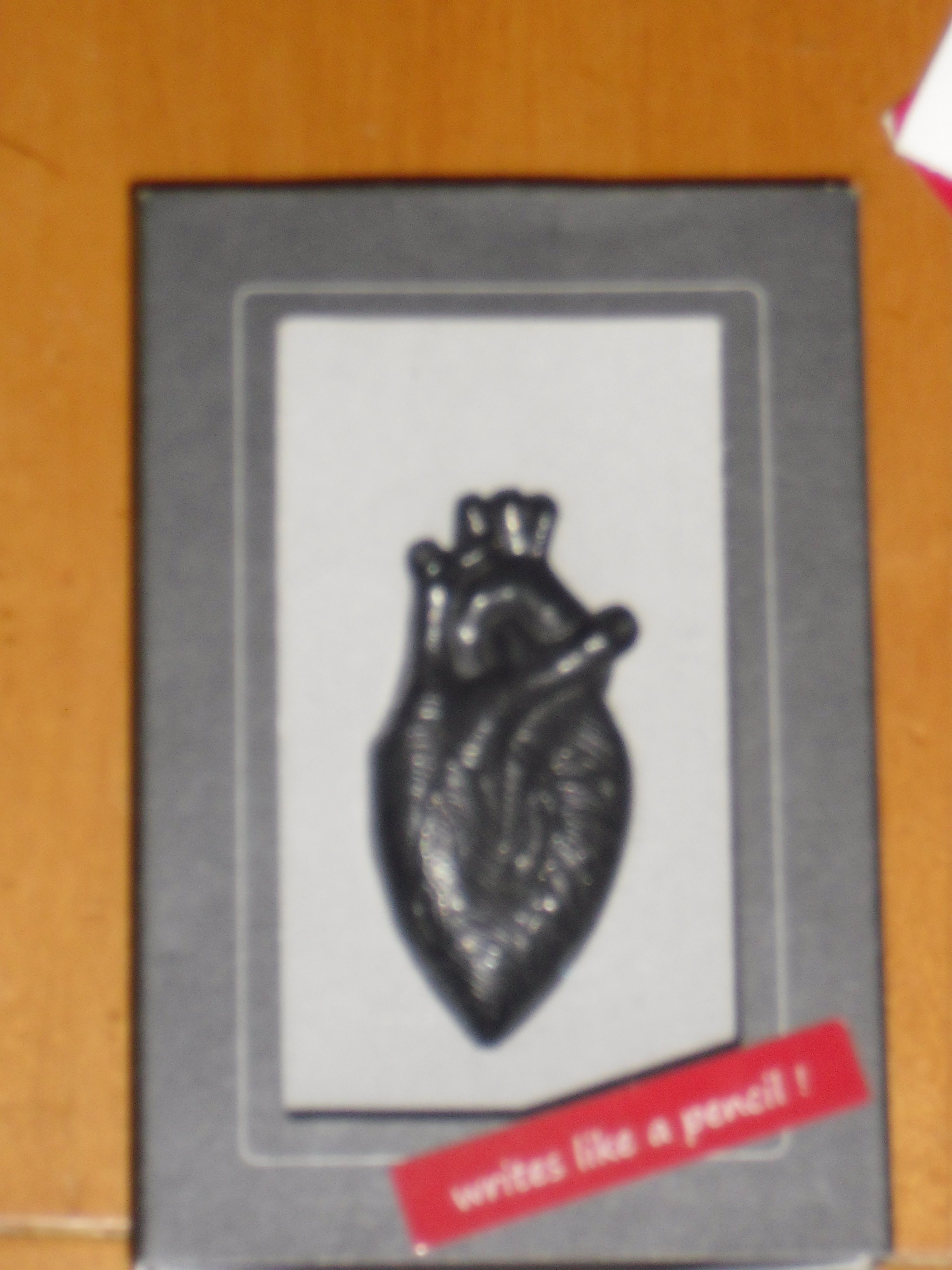
This friend, who I’ll call T, always sends a small but very interesting and unusual gift. This year was no different, and it’s by far the most interesting, unusual, and amazing gift I’ve ever gotten from her. A small human heart, made entirely of graphite. A working pencil in the shape of a heart. Take a look below.

graphite heart

I was so amazed when I saw it. It’s so amazing, it’s so macabre, it’s so…me. T knows me, God bless that woman. And I didn’t even know it was possible to carve graphite with such detail. I’m glad to get it. However, I’m not sure I can use it. In fact, I’m afraid to take it out of the box and touch it, let alone use it as an unusual pencil. Still, I think I will keep it. The heart is so my style, and best of all, it’s inspired an idea for a short story. Nothing can be bad if it inspires an idea for a story. I’m not sure what sort of story yet, but I have a feeling a similar graphite heart will be bringing something not human to life. Isn’t that terrifying?

So I’m going to add it to my list of short story ideas (about sixty story ideas so far. Where will I find the time to write them all?), and then I’m going to call up my mother while there’s still time. I need to get T’s contact information (I don’t have it, if that’s not obvious), and tell her that she got me an amazing gift.

Good night everybody!

*Aufruf: a celebration in Judaism the Shabbat before a wedding. The groom (and in some congregations, the bride) are called up to the Torah to do some special blessings and readings, and get a few special blessings in return. Often candy is thrown at the newlyweds after they have finished the blessings and the kids go to get as many sweets as they can get. Didn’t expect to get a lesson on Jewish custom today, did you?

Yesterday I visited my advisor’s office in the English department and discussed doing my senior thesis in the fall. Normally I would talk to her about this after spring semester had started, but I wanted to get a jump on things before I was busy with homework from five different classes. Plus I had the day off yesterday so I thought to myself, why not?

During the course of our meeting, I was outlining what I’d like to do for my senior thesis, mainly to write a novel. For this novel, I chose five different ideas for stories from the list of novels I keep on my flash drive and gave a brief synopsis of each one to my advisor Ruth. Around the third idea, Ruth noticed a trend with two of the stories I’d mentioned: they both involved young girls as protagonists in the story (one was a story based on Alice in Wonderland, the other involved demons). She then asked me, “Why young girls? Why are they used so much in horror?” To my surprise, I realized I hadn’t thought of it much, and at that moment I didn’t have a very good answer for why, when children are used so much in scary stories, young girls are more dominant than young boys (notable exceptions include Danny Torrance from The Shining and six out of seven protagonists in Stephen King’s IT, the two boys from Monster House, and Hansel from Hansel and Gretel).

And guess what? The question’s been bugging me since that meeting yesterday. So between writing, work, applying for scholarships, and my household chores, I thought I’d take a moment to examine why young girls are more dominant in these sorts of stories. First, we need to examine why children in general are used so much in horror stories:

1. Children are very innocent creatures. It’s the most obvious reason, but it still needs to be stated. Children are very innocent human beings. They still believe that good usually wins against evil, that bad guys get beat up and thrown in jail by superheroes and cops, and the world is a safe place where they are loved and are protected from evil, at least until they’ve been warped by some of the harsh realities of the world. In horror stories, that innocence is tested and sometimes completely broken by the events of the story, whether it be monsters under the bed, abusive parents/teachers/bullies, or whatever else you may be using as the antagonist in a story.

Even the man/child/sponge has more imagination than most adults.

2. Let’s face it, kids are more imaginative. As we grow older, we tend to think less in terms of the fantastic and more in terms of what is real and reasonable. But as children, we really believe in Santa, the boogeyman, fairies, aliens and ghosts with little doubt that they are actual, concrete beings. This means that kids are usually the first to come to the realization that something evil is at work. They don’t realize it through any leap of logic or reason, but through gut feeling and belief. This is also usually why they are more likely to survive than that one guy in every horror film who insists with fatalistic stubbornness that there’s a logical reason for everything and then when they realize something’s up, they still insist on handling it themselves as men, even if it leads to their heads getting bitten off.

3. Kids are dependent on others. Until sometime between ten or twelve, children are dependent on adults for most of their basic needs, and even when they start to become independent, they still require a good portion of help from adults. When in a horror story, most likely a child can’t recieve help from an adult because they’re less likely to be believed by adults. This means they’re basically adrift in a metaphorical sea that wants to kill them painfully and mercilessly. How they survive without the security of an adult is something that keeps the reader drawn into the story.

4. Children are also not as resourceful. Or to be more specific, it’s rare for children to have access to the knowledge or tools they need to defeat the enemy of the story. They wouldn’t know how to set up a trap for a mutant monster, or how to draw a vampire into the sunlight without being totally obvious of their intentions, or even how to set a windigo on fire with nothing but a set of matches (which they shouldn’t be playing with anyway). If the characters are adult, all they need to do is get out their smartphone and Google “How to make a molotov cocktail” or “how to set up a tripwire alarm system”. Kids wouldn’t even have a smartphone, and even if they did they probably wouldn’t know what to Google. How do they survive with nothing to really help them? That is another draw of a horror story.

Look at that face! You know that hotel gave that kid some big therapy bills.

5. Children are easily influenced. Lastly, children are easy to influence, for better or for worse. Has anyone seen Friday the 13th Part IV? Right at the very end we see just how the events of being around Jason have influenced and hurt little Tommy, who will be dealing with his issues for the next two films. A horrific event can stay with a child for a very long time, corrupt their innocence or make them aware of their own abilities. Either way, the events of the story will stay with the child likely throughout their lives. From what I hear, the Overlook Hotel certainly stuck with Danny Torrance (I haven’t read Doctor Sleep yet, though it’s on my reading list).

Okay, so we’ve established why children in general are used so much in scary stories. But still the answer of why young girls are used in the stories has still to be answered. Often, like Carol Anne from Poltergeist, they are persecuted and kidnapped by beings we can’t really understand. Or, like Samara from The Ring, they are the stuff of our nightmares. And occasionally they are both (anyone watch The Exorcist recently?).

This morning I spent some time trying to figure out and I think a lot of it has to do with socialization and the roles we assign to the female gender. In other words, what we expect from young girls and how we believe they should act, behave, and think are why young girls are so popular in horror stories.

Please note that the suggestions I’ve listed below are for fictional girls and are just based on my own reading and viewing of many different horror novels, comics, TV shows, and movies. There may be several stories featuring girls that are the exact opposite of these reasons, I just have yet to be exposed to these stories. The reasons I’ve listed do not necessarily apply to real girls either, as I’ve made clear below. Here are the reasons I was able to come up with and which back up my beliefs on gender roles making female characters popular:

1. Fictional girls are more prone to sweetness, harmony, and nonviolence. Most boys when they’re young like to get wild, scrap a bit, use their fists and compete with each other through acts of physical prowess and aggression (when my cousin was younger, you could not stop him from acting like this). Young girls though are often portrayed as preferring to be friends rather than fight. They like doing cute stuff and they don’t like to get their hands dirty or do anything too wild. The only exceptions I can think of are Beverly Marsh from IT and my sisters, but then again my sisters are from my crazy family, so go figure. So since these fictional girls are less likely to use their fists and more likely to try to harmonize, they’re at more risk for whatever evil is after them in the story.

2. Young girls have yet to enter into the realm of maturity and sexuality. A lot of criticism with horror comes with how it sexualizes its female characters (please see my article Sex and Horror for more on this topic).However young girls have yet to reach that stage where people begin to see their sexuality. There’s an innocence in this lack of sexuality that young boys don’t get from their ignorance of sexuality, though that might have something to do with the fact that, like I said, a lot of women in horror are defined by their sexuality, whereas men don’t usually receive this sort of sexualized image no matter what age they are.

3. It’s adorable when young girls cry. Because of the pre-assigned roles that differentiate between boys and girls, at some point boys are taught that crying is not a manly thing to do, so they stop crying if they want to retain whatever form of manhood a young boy can have. On the other hand, it’s considered okay for girls to cry throughout their lives. And instead of pitying these girls or questioning their maturity like we would with boys, our hearts go out to the girls and make us want to hug them. This contributes to the popularity of young girls in horror stories.

And if these points haven’t hammered home my belief on gender roles playing a major role in the popularity of young girls in horror, here’s my final point:

In the end, the princess mentality takes a toll.

4. Young girls want to be princesses. It’s no understatement that plenty of girls in our Western society want to become princesses when they grow up and have a handsome prince rescue them from evil so they can live happily ever after, and our media perpetuates this to no end  (even Once Upon a Time and Frozen couldn’t leave this cliché out of their storylines, though they both do something rather original with the trope in each their own way). In horror stories, typically it’s up to a female character to either rescue herself from her predicament or to let a strapping young man save her and then sweep her off her feet. With young girls, that choice isn’t always available, and often the writer will write the story so that we wish for someone to come and save the little girl, while holding us with baited breath to see if she will be saved by a dashing prince…in the case of horror stories, most likely an older male relative with an axe or baseball bat.

So the reason why young girls are so popular in horror stories, as I’ve listed above, is that they fulfill certain gender roles that we’ve come to expect and work nicely into not just the plot of the story, but certain preconceived notions we unconsciously have in their minds. However, not all young girls fall into these roles. Beverly Marsh from IT plays a big part in stopping the demon clown when she’s a little girl by being the more aggressive fighter of the Losers Club. Coraline from the book of the same name is able to release the souls of the eaten children and save her parents all on her own. And even creepy Samara coming out of the TV is an exception, as she doesn’t fulfill any traditional roles, not even the one about needing saving. She’s the freaking villain!

Yeah, don’t mess with her.

So I think I’ve answered the question Ruth posed to me yesterday in her office. I’m not sure it’s the best answer or the right answer, but it’s what I was able to come up with. If you have any ideas about why young female characters are so popular, examples of girls who buck the trend, or any other points relevant to the discussion, please let me know.

Also, in a somewhat related note to children and horror, I finally watched the film version of Battle Royale. It was actually much better than I expected, almost as good as the novel. However there were a couple of creative choices I disagreed with, and that’s why it’s not on equal footing with the book. I also won’t see the sequel, because apparently it’s not based on the original story, its anti-American message goes beyond criticism of America to full-on attack mode, and nearly every reviewer who’s seen it has hated it, apparently.

All for now. Write on you later, Followers of Fear.

I’ve written another article for Self-Published Authors Helping Other Authors, and once again I’m sharing it with you guys here. The post is called Creating A Great Antagonist, and as you can tell from the title, it’s about creating great antagonists for stories of all kinds (though in the article I kind of focus on high fantasy stories).

If you have a moment, please go check it out. And if you’re a self-published author or you’re interested in self-publishing, please check out and subscribe to the blog. There’s a mountain of good advice on self-publishing, written by authors such as myself and others such as Ruth Ann Nordin, Joleene Naylor, Janet Syas Nitsick, and Stephanie Beman.

I hope you enjoy reading, and if you have any thoughts leave us a comment. We’re always happy for feedback.

Another semester passes by, and with it the realization of two things: one is that I have enough credit to be considered a senior now that the semester is over. The other is that I now have a year and a half left of my time at Ohio State University. Boy, way to make my time here feel finite.

Every semester is different and not just because of a set of new classes. For example, this semester I moved into an apartment with a friend about two blocks from campus, meaning we both had to take on a whole lot of different responsibilities. I also started taking five classes in a single semester, more than I’ve ever had in a single semester. At times the homework load was almost unbearable. I hope that next semester will be a bit easier, though judging by the amount of reading I’ll be doing that doesn’t look like the case.

This semester was also significant because two major events happened to me: I published my first novel Reborn City and I got accepted into a study-abroad trip to Europe for three weeks in May. The latter so far has taken up more of my attention, because I’m going to be spending all of next semester preparing for it. And I mean all of next semester: four out of five of the classes I’m taking are in preparation for what I’m going to study in Europe (by the way, the trip is about studying World War II). Still, RC has taken up a bit of attention too. I’ve had to advertise everywhere I can. I’m actually looking into putting an ad into the student newspaper if it doesn’t cost too much.

And as for my classes this semester, I took Introduction to Sociology, Introduction to Biology, Writing for English Majors, Science Fiction and Fantasy Literature, and History of the Holocaust. The latter two were my favorite classes (despite the dark subject material in the Holocaust course) and they were also the classes I did the best in, getting As on most papers and tests. All told, my grades added to a total 3.263 GPA. I’m happy with my grades (they’re all passing grades) but I’m going to aim for higher next semester. Especially since going on the trip and keeping my scholarships will require me to keep my grades up!

Well, I hope to have more good news later. Watch out for my Spring Semester 2014 Pre-Semester Report. It’ll probably be showing up in the next couple of weeks. In the meantime, I’m going to make dinner and finish Ch. 28 of Video Rage. Wish me luck.

tqg cover

They say that 7 is a very lucky number, and I have no doubt about that right now. I just got my 7th review on my collection of short stories, The Quiet Game: Five Tales To Chill Your Bones. This review comes from A. Frankel, which stands for Amy Novak Frankel, my third cousin and a dear friend., and she gave it five stars. In a review titled A really good book from a new author, Amy says this:

“I thoroughly enjoyed each of the short stories in this book and look forward to reading more from this author.”

Well if I remember Amy, you said that you bought all my books (which is just the two), so I can’t wait to hear what you have to say about Reborn City. I spent four years bringing that to the printed page, so I’d love your opinion on it. And thanks for the review once again. I’m averaging about 4.3 out of 5 on Amazon now.

If you’re interested in reading The Quiet Game, it’s available in both e-book and print paperback from Amazon and Smashwords. I hope you enjoy reading it and whatever you think, please don’t hesitate to leave a review. I’m always happy for feedback, positive or negative.

One thing I struggled with early on in my attempts to become a professional writer was time, or more accurately, keeping tack of it. In my earliest stories, whether it be about lycanthropic pirates or a Harry Potter-esque story of witches, keeping track of how much time has passed was not high on my to-do list. I was more concerned with making a novel that would sell millions of copies, win me legions of adoring fans, and regularly get adapted into blockbuster hits. Why should I pay attention to how quickly a year can pass or how it’s noon on one page and then sunset on the next when I have to decide who I want to play my female protagonist and if she’s going to be my girlfriend?

But I got older, and around the time I started writing my earliest vampire stories, I started to become more aware of the passage of time in those stories. I think it first occurred to me that it seemed weird that my characters were still in school around late June. From then on I tried to keep the passage of time consistent in the stories I wrote, and as I got much older and realized there were too many vampire novels out there at the moment for me to make a name for myself with those sorts of stories, I started to put dates and even the passage of hours in my outlines, which would later end up in the early drafts of the stories I wrote.

And no one else is more aware of time than the guys and gals who write the Doctor’s adventures.

If you examine other authors who are extemely popular, you’ll notice how they try to keep the reader as well as themselves aware of the passage of time without annoying the reader with it. For example, JK Rowling structured her entire Harry Potter series around the school year in Britain. Stephen King’s It switches between 1958 and 1985 and King makes sure to note how June passes on into July and July into August during the 1958 sections. And Jean Auel’s famous Children of Earth series is very particular of marking the passing of seasons and years.

All in all, I think keeping tack of the passage of time in my stories has very much improved them, and in some of these stories  I need to be cognizant of how much time has passed in order to tell the story correctly. For example, my WIP Laura Horn takes place during the week leading up to the 2017 Presidential Inauguration. I went online to find advance calendar dates for that January, and only then did I write out the plot in my outline for the story. In addition, I have several ideas for stories that need to be very time conscientious while writing them. One takes place during World War II, meaning I’ll have to be very careful of the dates of certain events in order to tell the story correctly. And I have a science-fantasy story involving time travel that will require me to be very careful about the dates I use, should I ever get around to writing it.

The only thing I wish I was better at was keeping track of dates by making a timeline. However, doing a timeline at the outline stage isn’t always helpful because so much can change between the outline stage and in the actual writing of the story. Perhaps I can find some sort of middle ground in future stories. I might ask my writing group on Facebook if they have any tips on doing timelines.

And speaking of Facebook, I just want to remind people that I have a Facbook page and a Twitter feed, where I post on stuff that I don’t always post about on my blog. If you’re interested in checking either out, please do so.

How important is marking the passage of time in your stories? What do you do to keep track of time?

It’s watching you!

Oh, blessed relief. Today I sat down, once again, to work on Chapter 24 of Video Rage, the sequel to my novel Reborn City. I’d been working on and off on the chapter for the past eight days or so, delayed by homework, exams, and the need to sit down and do something other than writing in order to relax. But today I sat down, and I finally finished it, meaning I only have a third of the novel left to write! Woo-hoo!

I’ve been enjoying my return to the world of the West Reborn Hydras. Not only has it been kind of therapeutic and relaxing to work on my novel after having to take a very long hiatus in order to focus on school, but it seems that the world of the story has expanded on its own,  become more complex and astounding than when I first created it. When I was working on Chapter 22, the characters kind of took the reins away from me and played out a scene before me similar to a cop drama, where one character was poking holes in the story of the other two and showing just how flawed their seemingly-flawless version of events really was. I didn’t even think I could write a scene like that! And when I worked on Chapter 23, new characters and new situations kept intruding into the scene I’d originally envisioned. I guess it’s true what they say, that the characters really write the story and not the authors.

Well, it makes my job easier if they write it for me. And better yet, my characters don’t ask for royalties.

But I digress. Let me update you on page and word counts (and when I say page, I mean your standard 8″ x 11.5″ MS Word paper). In total, the number of pages has risen to 197 pages, while the word count has risen to 54,703 words. That’s about the length of a very short novel, and since I have thirteen chapters left to write, it’s probably going to rise another ten to twenty-thousand words (no, don’t be intimidated. Most of the Harry Potter novels are much longer than that).

For now though, I think I’ll take a very short break from writing VR. I’ll probably write an article for Self-Published Authors Helping Other Authors, I’ll apply for several scholarships offered through my university, I’ll spend a lot of time at work so I can afford to keep a roof over my head, and if my friend Angela sends any more chapters of Snake, I’ll work on edits. And after all that, I’ll start on Chapter 25 of VR. Trust me, it’s going to be awesome. Things will really come to a head in the final seven or so chapters.

For now though, I think I’ll make dinner and settle in with some TV, a nice reward for myself after some really hard work. Until next time, my Followers of Fear.

Today I woke up to a wonderful surprise: I’d gotten two new reviews on Amazon, one for each of my books. Both come from the same reviewer, username Enji, which makes me happy as I’m glad that anyone would read both of my books and also review them. But then again, I know who Enji is offline and I know she’s supportive of me and my writing, so that might explain it.

tqg cover

First, let’s start with The Quiet Game: Five Tales To Chill Your Bones, which now has six reviews. Enji gave it five stars and titled the review Loved the Uniqueness of Each Story. Here’s what she had to say:

“I liked that each story was unusual. I think that the book was appropriately named. I prefer chilled bones rather than scared out of my whits since I am a bit of a chicken.”

Chicken or not, I’m glad you plucked up the courage to read the book Enji and I’m glad you enjoyed them. Also, I still get to maintain a 4.0 average on Amazon, so I’m all the happier that you read it.

Reborn City

Next, Reborn City, which now has two reviews. Enji also gave RC five stars (moving its average to a 4.5 out of 5) and titled her review Fantastic (which is the catchphrase of my favorite Doctor). Here’s what Enji wrote:

“As a reader who does not read books in this genre, I must admit that I could not put down the book. I attribute this to the talent of the author. I am looking forward to reading the next books published by Ungar. I recommend this book to readers who enjoy action with  features of supernatural powers and sci-fi.”

Oh Enji, I think I’m blushing a little. And I’m happy to hear you couldn’t put it down. It’s always great to hear that from people who read your work. And I hope to have another book out soon, I just don’t have a definite date yet. But thanks for reviewing Enji. It means a lot to me.

If you’re interested at all in reading The Quiet Game or Reborn City, or you want to give either of them to a friend, or you just want to support me because you’re extremely nice, both books are available on Amazon and Smashwords in print paperback and e-book formats. And if you like or hate what you read, please let me know. I don’t mind feedback, positive or negative (though I haven’t gotten much negative feedback yet).

I have some work to do, so I’ll be signing off now. Thanks for reading, and I hope to post again later. Have a lovely weekend, Followers of Fear.

Time once again for my Weekly Exercises, my flash fiction pieces dedicated to a) practicing my craft, b) getting feedback from readers, and c) trying to get people interested in my published work. Remember that the Weekly Exercises depend on reader feedback, so if you have a thought on what you read, please let me know. Also, if you would like to check out any of the other Weekly Exercises, you can find them here. And if you have an idea for a Weekly Exercise, give me your name and idea. You might just see your idea on this blog someday.

With the upcoming aniversary of the Pearl Harbor bombings, I dedicate this Weekly Exercise to those who died during the bombings and those who afterwards fought for our freedom here and abroad. We owe more to you than can be expressed in a single blog post.

Enjoy.

~~~

When I was a kid, my brother and I would read all these science fiction stories. Looking back on it now, they were all basically the same: the noble and indestructible warrior, the beautiful princess with barely any clothes, the quest that always ended with the hero victorious and in sexual bliss with his princess. Stupidly optimistic, but that was the 1920s for you. We were all hopeful for the future and thought nothing could cut us down.

Then there was the Depression, and then war broke out in Europe and in the Pacific. I enlisted to get away from home and do honor for my country. Or maybe what I wanted to do was get away from reality and become the hero of my own science fiction adventure. Perhaps they were the same in my mind. Either way, I joined the Marines expecting that I’d leave training an invincible warrior just waiting for the princess of my dreams and the adventure of a lifetime to come my way.

Neither did. When we got to Peleliu in 1944, it was like I was in a jungle on another planet, but I was fighting the Japanese instead of aliens or whatever, and I certainly wasn’t invincible. The heat of the jungle, the sweat of unbathed men, the rotting corpses and the buzzing flies made all of us miserable. At any second we were liable to get killed by bullet or sword or sneak attack, and that only worsened our misery, and sometimes drove us mad. Once in a foxhole my buddy got out to piss. He was shot as soon as his fly was unzipped. I saw his body later. His entire face was a bloody mess and his fly was still down, but whatever had been there had been mangled by gunfire. I could almost hear him asking me to zip his fly. All I could do was puke.

We did see a girl on the island, one of those girls from a pleasure regiment. She was Asian, but she was a real beauty and she wore a simple dress. She was the first girl I’d seen in months, and I was ready to make her feel like a princess right then and there, if only she’d tell me that things would get better. She saw me and my boys though and threw herself over a cliff. We tried to save her, but all we did was see her join some of her comrades down at the bottom of the cliff. We learned later the Japanese had brainwashed the girls to believe that Americans would do horrible things to them if they were caught by them. So much for an epic romance in an unforgiving wasteland.

As I sit thinking about this now, one of my comrades is peeing on the face of a dead Japanese soldier. He’s laughing like it’s a big joke and when he zips up his fly he walks away with a swagger. Does he think he’s done his duty for his country? How would he feel if a Japanese did that to one of our many dead? He wouldn’t act so noble or treat this like a joke. Truth is, there’s no nobility in war, there’s no adventure or romance or humor. There’s just blood and death and destruction and the knowledge that any moment all of it might come raining down on your head.

My brother tells me in his letters he’s planning to enlist once his birthday comes around. I want to tell him to stay away, but then he’ll accuse me of just trying to keep all the fun for myself. Oh well, let him enlist. He’ll see that the fun isn’t to be had here, or anywhere there’s war. It’s just one pile of shit after another, and if you’re unlucky, you die, sometimes by your own hand but usually by the hand of someone else. And if you’re lucky you ride it out, you go home, and you move onto something else. Maybe write science fiction stories that reflect the truth of life, which is that life’s harsh. That’s what I plan to do, anyway. If I don’t bite the bullet first.