Archive for the ‘Reflections’ Category

I’m not going to lie, 2017 was a tough year in a number of ways. In some ways, it even rivals 2016, which everyone agrees was kind of a shit year, pardon my language. We dealt with really horrible terrorist incidents, learned that some of our most beloved figures in entertainment and other industries were secretly monsters, and saw terrible devastation from hurricanes that left communities without good food, water or electricity. This and a whole lot more affected so many lives, and definitely not in a good way.

However, there were a lot of good things about 2017 too. Many of the things I described above caused people to come together and fight. Not too long after the bombing at Ariana Grande’s concert in Manchester, she and several high profile artists put on a charity concert to raise over ten million pounds for the families of the victims. After the shooting in Las Vegas this October, thousands rushed to donate blood at the Red Cross, with lines reportedly snaking around city blocks and lasting up to six hours, and millions were raised for the families of the victims! Plus in response to the shooting, Massachusetts banned bump fire stocks, which were used in the attack, and several bills were introduced into Congress to hopefully prevent attacks like this from happening again.

Throughout the year, men and women came together to protest sexism and the treatment of women in America and abroad, with marches throughout the year. The revelations of Harvey Weinstein led to dozens of women and men to open up about their experiences with sexual assault and harassment, catalyzing the #MeToo movement and leading to the ousting of several serial abusers from a variety of industries for their crimes which, up till now, they could get away with, and started a conversation that is continuing today about how to combat sexual assault by powerful people who use the system to get away with it. Heck, voters in Alabama came together to keep a man who has been accused of assaulting multiple teen girls from becoming a Senator despite widespread support for him. That’s huge!

A Red Cross station post-Las Vegas shooting.

And while Puerto Rico and other areas of the world are still recovering from natural and man-made disasters, a lot is being done online and offline to help. Thousands are still sending money, supplies, and even solar power equipment (looking at you, Elon Musk) to help Puerto Rico out of the rubble. Despite the United States pulling out of the Paris climate agreement, many corporations, cities, and even states have said they will continue to abide by the agreement’s guidelines in order to combat global warming, which likely contributed to the many hurricanes we saw this year. And plenty of people each day are pressing for relief to peoples in trouble, both at home and abroad, from their leaders. It’s amazing to see that happen.

I could go on (I really want to speak about the entertainment industry’s positive contributions this year), but I fear this post will go on too long if I do, and there’s quite a bit I’d like to talk about. I’ll just summarize by saying that there was a lot of positive things that happened this year. And while the bad stuff does sometimes seem to overshadow the good, it’s important to recognize the good and cheer ourselves for what we accomplished, as well as what we can accomplish in the coming year. Which seems to be plenty, if we put our minds to it.

On a more personal note…

2017 was a pretty good year for me. Yes, the things I listed above, good and bad, may have affected me at times (they affect everybody, don’t they?), but in terms of my own personal life, I had a very good year. A lot of positive things happened to me , and if you don’t mind, I’ll just highlight some of the big ones:

  • My health seriously improved this year. I lost about thirty pounds of unneeded weight, which means I’ve had to take fewer sick days and I’m less likely to develop certain diseases. My back pain has also lessened tremendously, thanks partly to weight loss and to seeing a chiropractor. I can now move as I used to pre-back pain, and while I’m still working on improving my back and my health, the fact that I’ve accomplished this much already is a great motivator for me.
  • This was a good year for writing for me. I got halfway through the first draft of Full Circle (still on break from that until I feel ready to tackle it again), finally pushed out a new draft of Rose, and even wrote and edited some short stories. I also published two short stories, the science romance novelette Gynoid, and the LGBT fantasy romance story What Happened Saturday Night. Not only that, but over sixty new people started following this blog, putting me within striking distance of the thousand-follower milestone! For me, that is huge, and I can’t thank you guys enough for making that happen.
  • As many of you know, I work for a supply organization in a role that involves getting disabled employees accommodations and organizing events to highlight the diversity in our workforce. As of December, I’ve been with the organization for eighteen months, and it’s been great. I’m doing work that helps people with a great team around me, and I get great pay and benefits too. What’s not to love?
  • I went on the best vacation ever to Massachusetts with my dad back in July, and it culminated with a night at the famously haunted Lizzie Borden Bed & Breakfast. I cannot even begin to tell you what a big deal that was for me.
  • All the movies I was super-excited to see this year were awesome, as I’d hoped. Especially the new version of It. That was the It we deserved.

And those are just a few of the highlights of 2017 for me. Yeah, it was a good year. And I hope 2018 goes just as well or even better. Especially if any of these happen:

  • More good news on the writing front, particularly with a fourth draft and maybe the publication of Rose, as well as several new stories and hitting the thousand-follower mile marker.
  • Continued improved health.
  • Continuing to do well at work.
  • Maybe a bit of travel, and definitely a bit of fun, whether that be going to shows or seeing friends.

And that much more.

So guys, I want to wish you a Happy New Year, and to remind you that, as hard as 2017 is, it’s 2018, and there are endless opportunities to have a better year. You just have to be brave enough to try and make a change.

And again, thank you all for being my Followers of Fear and reading my work. I’ve grown so much over the past couple of years, and you guys have been there for every accomplishment and lesson I’ve experienced. I hope you’ll continue to support me for this year too as I try to accomplish all my dreams and scare people silly.

Until next time, pleasant nightmares.

You know, I’ve written a lot about my identity on this blog. Or rather, because every person is highly multifaceted and puts themselves under several labels (even when they eschew all labels), my identities: writer; horror fan; bisexual man; autistic individual and disability advocate; total nerd; Ohio State Buckeye; feminist; liberal; possible entity from another dimension; and many more. But there’s one identity I’m only realizing now that, while I’ve mentioned it more than a few times on this blog, I’ve never really gone into detail about it in relation to my life and my writing. Not in six-plus years of blogging (believe me, I checked).

Considering that I was not only raised Jewish, but raised Jewish by two rabbi parents, went to synagogue nearly every weekend for years, went to Jewish day school from fourth grade through high school, attended youth groups and summer camps, was a frequent attendee at the Ohio State Hillel, and a whole bunch of other things than is listed in this run-on sentence, that is weird. And I’m not entirely sure why I haven’t really ever gone into detail about it. Maybe I thought I’d covered it in one of my 1300+ blog posts at some point, or maybe I just thought it wasn’t important enough to cover at any point. I have no idea.

Well, I guess better now than never (especially since this is my blog and you’re all hostages to whatever I feel like writing each day). How does Judaism affect my life and my writing?

Well for my life, it affects a lot. I’m more spiritual than religious, like many millennials, but I still practice certain rituals. I keep kosher and eat vegetarian when I’m out. I bring in Shabbat every week, and light candles on Hanukkah (you like the picture of my menorah? I’ve had it since I was a kid). I have a mezuzah on my door frame that marks my apartment as Jewish, and the only jewelry I wear is Jewish in theme (Jew-elry, if you will). I don’t attend services at my synagogue that much (I tend to sleep in on Saturdays because the week drains me. Sue me), but I pray often and keep in touch with friends through social media and hanging out. I’ve been to and support Israel, though at times the words and actions of its government concerns me. I pay attention to how my people are portrayed in the news and popular culture (I get seriously annoyed by how most Jews on TV and movies are like, “We’re like the rest of you, we just say some funny words and talk about our health issues a lot.” Seriously, we’re more diverse than that!), and get really psyched when I find stuff on it that educate people about our beliefs:

No need to post that video. I just like spreading it around. Especially since so many people know what Christmas is but so few outside the Tribe know what Hanukkah is.

So Judaism does affect my life. Does it affect my writing?

Well, yes and no. I don’t write what’s known as typical “Jewish literature,” which in my experience is usually about Jewish characters dealing with persecution from non-Jews or dealing with their Jewish faith and identities. I know my dad wished I would write those sorts of stories when I was younger, probably because he was afraid I’d be the next Ted Bundy if I kept reading and writing Stephen King-style horror, but that sort of story never interested me (thankfully, he’s come to like my fiction as is). I do feature Jewish characters in my work on occasion (my Lovecraftian short story “The Red Bursts,” which I’m trying to get published, features a gay Jewish couple who are active in their synagogue), but their religious background isn’t usually a big part of the story. Their are stories I’ve written or plan to write where Jewish characters are featured prominently, and where their background can be emphasized, but like I said, they’re not a huge focus in my fiction as a whole. I like telling a scary story first and foremost.

But my Jewish identity does feature throughout my fiction in a different way. Like every author, I insert my worldview, my morals and beliefs into my stories, and a good lot of that is shaped by Judaism, especially this phrase by one of Judaism’s greatest scholars: “Love thy neighbor. All the rest is commentary.” It’s why I like to use diverse casts in my stories, not just Jewish characters. People unlike me are my neighbors as well as those like me, so I give them all a fair shot in my stories. And this is just one of many ways I emphasize my faith in my writing (I’d go into it a bit deeper, but this article is getting long).

So yeah, my faith is still very important to me. And it even shows up a little in my stories. It may not show up overtly in my stories, but it does show up in the subtext. And for my particular style, that works pretty well. It might even get me somewhere as a writer someday. One can only hope.

That’s all for now, Followers of Fear. Until next time, pleasant nightmares.
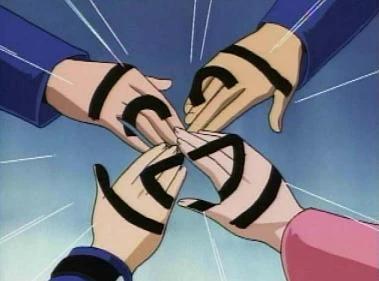
“The Power of Friendship!” as symbolized in Yu-Gi-Oh’s famous hand smiley face.

So yesterday I watched a YouTube video about a common trope in fiction (you can check it out HERE), which is (say it in your heads with a big, echo-y voice) “The Power of Friendship!” Now, if you aren’t familiar with the trope and you didn’t have time to watch the video, “The Power of Friendship” is a trope in which the bonds of friends is so powerful, it becomes a power in and of itself, capable of cosmic-like acts such as giving heroes power ups, stopping psychic mind readings, snapping people out of brainwashed states, and occasionally even defying gods. This power shows up in a ton of popular media, including a ton of anime and manga (the Fairy Tail series  practically is nicknamed “The Power of Friendship” manga).

Now the video I linked to goes into much more detail about the various intricacies of this trope (go watch it if you do have the time, the channel that produced it is awesome), but I wanted to focus on one particular aspect of “The Power of Friendship” trope that the video didn’t go into: how it surfaces in the horror genre. Or rather, how it doesn’t surface in the horror genre. At least, not all that much.

So if you didn’t watch the video (and you’re missing out!), the trope works like this: you have friends, and those friends can help you out of a bad situation, whether that be isolation or a powerful demon overlord is about to destroy the Earth and your power alone is not enough to destroy the demon’s power. It can be a metaphorical power to help a character out during a bad patch, like the former situation, or it can be a literal power and the equivalent of taking one of those mushrooms in a Mario game, like the latter situation. Thus, “The Power of Friendship!” And you can kind of see why it shows up so much: we all wish we have that power, or believe our relationships are that powerful.

But horror doesn’t feature this power as much as other genres, and there’s a reason for that. Horror is horror. It incorporates the darker aspects of the world around us and sometimes amplifies them for maximum effect. And in real life, friendships aren’t as powerful and as lovely as in fiction. In the stories, friendship is powerful and unyielding. It can overcome all sorts of obstacles, and the more you try to destroy it, the more it bounces back and kicks bad guys in the ass. But in reality, friendships grow, cool, and break all the time. It can take only a little bit to destroy a friendship, and a lot to repair it once it’s broken. Horror writers not only recognize that, but incorporate that into their stories. And it’s such a well-known fact about life, writers don’t draw attention to it, because it’s so well known among readers.

That’s not to say that “The Power of Friendship!” doesn’t show up in horror fiction at all. For example, Stephen King’s It pretty much says that the friendship of the seven main characters is what allows them to fight the malevolent entity in their town.* It just doesn’t say it as loudly as other media does, and also tells the reader that the characters’ friendship, while powerful, can be broken or is less effective if they aren’t all in sync or allow their fear to divide them. This is what leads to that one infamous scene in the novel, and is also shown in the new movie after the first fight with It.

Weirdly enough, the power of love or family is shown more than the power of friendship in horror, and I’m not quite sure why. Perhaps it’s because love and family, unlike friendship, has a more powerful evolutionary purpose, and therefore is given more power in fiction in general. If you’re willing to do more to save your perfect partner for creating offspring or the lives of your offspring, it’s going to show up more in stories than the grouping of creatures of the same species to ensure survival.** Hell, a lot more of my stories revolve around romance and family than friendship. One of my stories even involves a friendship gone bad, but that’s about it.

If “The Power of Friendship!” can be portrayed as it was in It, you can include it in horror stories more effectively.

That doesn’t mean we can’t include “The Power of Friendship” in horror stories. It can be used, but it’s more effective if used as it was in It: not overstated and a bit more realistic.  Showing a friendship form, grow, and overcome obstacles in a story, without drawing too much attention to it and showing how fragile the friendship can be under certain pressures, will work fine for the horror audience. If you go for overblown storytelling and basically say, “The Power of Friendship can overcome anything,” it will take the audience out of the story. Let the friendship’s strength demonstrate itself, rather than shoving it in through dialogue or just outright stating it. In other words, show, don’t tell.

While still not that common a trope in horror, “The Power of Friendship” can be part of horror. It may require being handled differently than in other genres, and with a bit more realism (weird for “realism” to show up in horror, but there you go), but it’s not impossible. You just need the right touch, and “The Power of Friendship” can best even shapeshifting entities that take the form of clowns.

That’s all, Followers of Fear. I’m in a bit of a blogging mood right now, so expect more posts from me soon. Until then, pleasant nightmares!

*There’s also some sort of power up thanks to a turtle from another universe, but let’s not get into it, shall we.

**Best explanation I can come up with given my aromantic nature and already jaded worldview.

At the time this post is being published, it is the American holiday of Thanksgiving. Despite the holiday’s questionable origins (a discussion not for this blog), this is a holiday for being thankful for all you have. And while a lot of us are surprised by how fast this year has gone by (seriously, how the hell is it already late November?), for many of us it has been a stellar year. I know that’s the case for me. I’ve got plenty to be thankful for this year.

And if it’s not too much trouble, I’ll run down some of those things I’m grateful for (I swear, this won’t be too long, and I’ll try not to turn it into bragging):

  • I’ve published two stories, the sci-fi novelette Gynoid and the fantasy romance short story What Happened Saturday Night, on Wattpad, and both were very well received. I also wrote half of the novel Full Circle, edited the entirety of Rose (and will probably edit it again, as soon as I have feedback from both my beta readers), made good progress on a new story, and had more ideas for other stories than I could ever write.
  • While I work on my writing, I also have a good job that allows me to do really rewarding work with a great team. That job also has great pay and benefits, so I can afford to pay my rent and my bills, never go hungry, and even put away some cash into savings. And every now and then, I can even afford a little splurge for things like wall art, a new addition to my doll/figurine collection, or even awesome shows (heck, sometimes the job gets me discount to awesome entertainment in town).
  • Speaking of rent, I have a great apartment in a good area near where I work. I can afford to live on my own, and do what I want within my apartment, so I don’t have to worry about anyone seeing me at my kookiest. And since I’ve lived here for nearly a year and a half, I’ve had time to settle in and make it my happy place, a great place to relax, be creative and occasionally entertain friends (Joleene Naylor knows what I’m talking about).
  • My health has improved greatly since the New Year. I’ve been eating healthier, cutting back on the sweets, and so have lost about thirty extra pounds. My back problems have also improved, thanks to the ongoing treatments of a really good chiropractor and my improved diet. I feel better than I have in ages, and as long as I keep things up, I’ll continue to get better (though I doubt I’ll ever be fit enough to be a prima ballerina or a bodybuilder).
  • I don’t have a driver’s license, but I’ve made incredible progress towards getting one. And with a bit more practice, especially with maneuverability and parking, I could have my license within the next year (though whether a car comes with that is another issue entirely).
  • I live close to my family, and we’re all on good terms for the most part (though I would not want to live with any of them again if I can help it). I also have plenty of friends, and I’m glad to have their love and friendship everyday. I know that if I need them, they will give me their support, and help me through another day.
  • Finally, I have you, my Followers of Fear. Over the six-plus years I’ve been blogging, you’ve stood by me, seen me at some of my best and worst moments, and posted your thoughts and encouragement, and even bought some of my published work. And over this past year, Rami Ungar the Writer has grown significantly, to the point where I’m less than fifty followers away from hitting the thousand follower milestone. It gives me such joy to write for and interact with you guys every day, and I hope I can continue to do so for ages to come.

Of course, this is just a fraction of the many things I’m thankful for, but I’m thankful for them all nonetheless. And I’m glad I’m aware of them and thankful for them, because I can think of a number of people who are just as lucky as me, or even luckier, and yet are miserable. They’re not satisfied with what they have and they constantly want more.

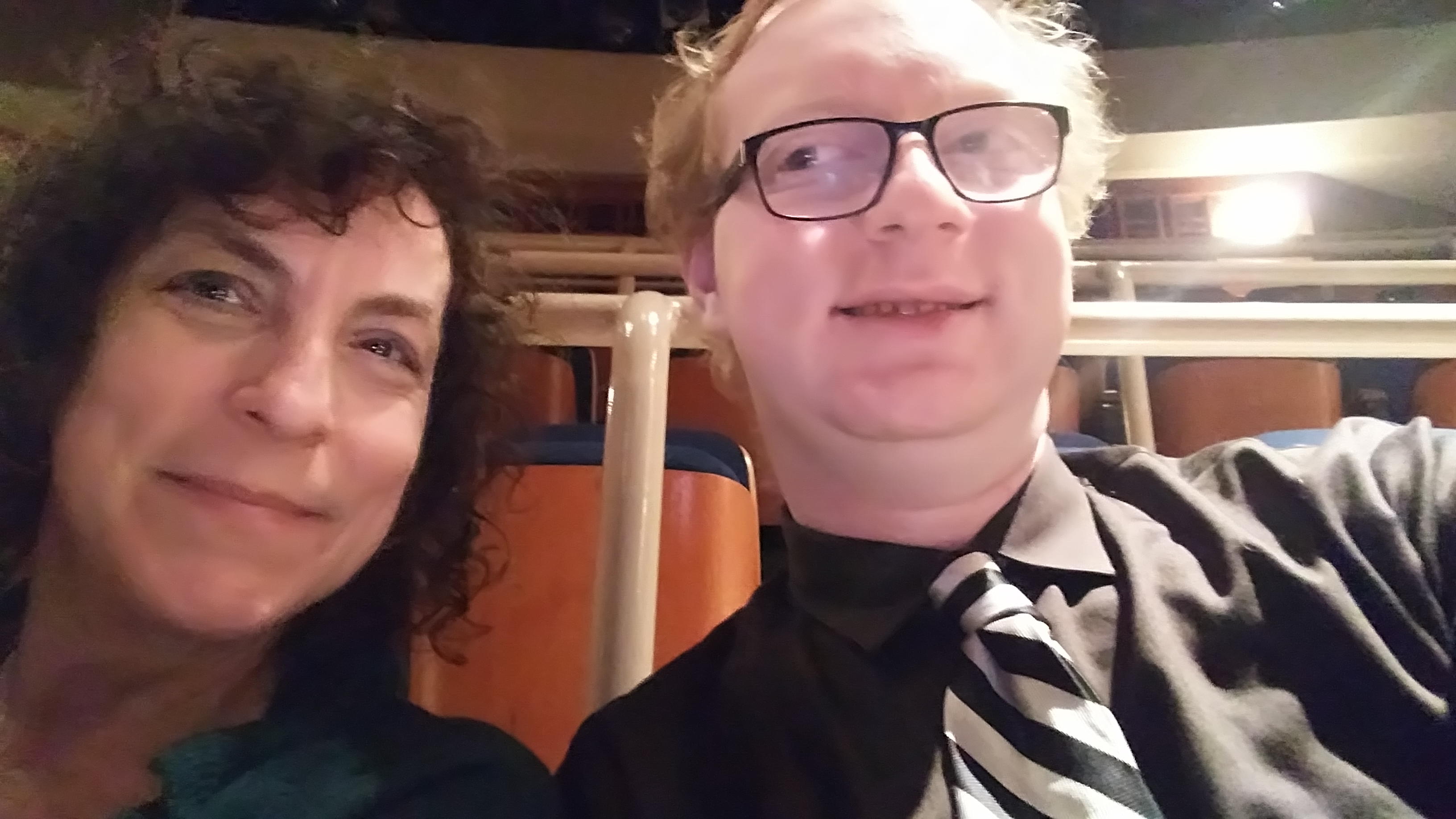
My mother and me when we went to see Swan Lake this past weekend. Not only was it an incredible show, but I got to experience it with someone I dearly love and who gets me on so many levels. I’m incredibly thankful for her and our relationship together. Also, I’m looking at the button on my phone camera, in case you’re wondering where my eyes are looking.


Now, there’s nothing wrong with wanting more than what you have. I want to expand my readership, write more stories, and get more of them published. Heck, I wouldn’t mind being able to write full-time if I could. But some people, they just don’t appreciate what they have. They could have a loving family, a big house (or several), a nice car (or several), and enough money for vacations abroad and fancy gadgets and whatever. But they aren’t happy. They want more. More stuff, more sexual partners, more fame and prestige. A friend once told me he talked to a man who was depressed because he didn’t receive as big a Christmas bonus as someone else in their office, even though he felt they did the same work and the same amount of work. Both bonuses were in the five-figure range, which boggled the both of us. How could anyone be in a position where that sort of money is given as a Christmas bonus and NOT be happy?

And that’s why I’m thankful for one more thing: I’m thankful that I can recognize what I have. Some people can only recognize what they don’t have, and that bites deeply into their happiness. They may feel good when they get a promotion or they bed someone deeply attractive or they get that new house on the Italian coast, but it’s only a temporary drug high, and the crash they feel after the high wears off just leaves them as empty as before. It’s not a true happiness, not at all.

And that’s why I’m grateful for one more thing: that I’m capable of recognizing all that I have and that I’m grateful for. Yeah, I’m not rich or famous (though I could be someday), but I’m glad for everything I have. I worked hard to get it, and I know it could be taken away all in an instant with one bad day. So when something new comes into my life–a new follower, some good news on the writing front, the chance to do something fun with friends or family, or even a new doll for my collection–that drug high will go away, but a good feeling will remain. I’m grateful for it all, and I hope I remain that way for the rest of my life.

So this Thanksgiving, my Followers of Fear, let’s all be grateful for what we have, and express that gratitude as best we can. Because we could have nothing at all, or we could have plenty and not realize it. I prefer to have some stuff, and be glad that I do have them. And if you ask me, that’s a good way to go about things.

Happy Thanksgiving, and until next time, pleasant nightmares.

Me being thankful for all that i have. And thank you, Sailor Moon, for constantly giving me so much to work with, from entertainment to story ideas to illustrative GIFs.

Voice. Sometimes, I feel this can be the hardest thing to create in a story, especially when you’re writing in first person. You, as the writer, have to create this unique person, someone with a personality, desires, fears, likes, and pet peeves. And then you have to give them a unique speaking voice, including vocabulary and word choice, syntax, grammar, accent, and all that can be really difficult. A lot of us have that distinct writer’s voice* in our heads that is always arranging our sentences on the page (or on the blog post) in a way that reads like what we consider good literature.

And it’s even more hindered when you consider where our writer voices come from. You see, I have this hypothesis that every writer’s storytelling voice is born when they read a great story and the narration resonates with them on a deeper level. This could be their own voice reading their first chapter book as a child, a parent reading to them a fantasy novel by their bedside and making the story come alive, or an audio book narrator with a great speaking voice behind the words. No matter how many other stories we may read or listen to later in life with their own amazing narrative styles–the childlike humor and observations of Alice in Wonderland, Stephen King’s odd characters and descriptions, or the three women from The Help and how they each view their situation from vastly different backgrounds and dispositions–it will always be this original narrator who contributed the base DNA for your writer’s voice, and whom a part of you will always spend a good amount of time both trying to emulate in power and break away from so you don’t sound like a copycat.

For me, I always go to Jim Dale’s narration of the Harry Potter audio books. Harry Potter was a big part of my childhood, and caused me to start writing in the first place. My first attempt at writing was something like a Harry Potter gender-bend fanfiction. And Jim Dale made the text come alive, in ways the movies and the books alone couldn’t. Whenever I wrote, in the back of my mind, I was comparing and contrasting to Jim Dale’s work. And while I’ve managed to develop my own voice, it’s still a fight that goes on in the back of my head up to this day.

So basically, I’m fighting Jim Dale in my head while trying to create an original narrator’s voice on the page.It’s an image perfect for a Family Guy cutaway gag.

Struggling against this guy in my head every time I write.

So what can you do when you’re trying to create a distinct voice for your narrator or narrators? What do you do when you want to make Skeeter sound different from Abilene and Abilene from Minnie, or Cormoran Strike from Harry Potter, or Lestat from Louis? And can I come up with any other characters for comparison? The answer to the latter question is yes I can, but I’ll stick to the former if you don’t mind too much.

As many of you know, I’ve been working on a new story while I wait to hear back from my beta readers. And as I mentioned in a previous post, I’m taking a more organic approach by writing this story without much planning and seeing what evolves from that. And weirdly, that approach has allowed me to tap more fully into my narrator’s head. I’m not exactly sure why, but I think it might have something to do with the plotting vs. pantsing thing I talked about in that previous post. When I’m plotting, I think out every detail of the story, not leaving much room for change or experimentation. Thus, the narrator’s voice becomes secondary to telling the story I want to tell, in the way I want it to be told, and the narrator’s voice ends up as something close to default writer’s voice.

But while I’m pantsing it (or plantsing it, as my friend Kat Impossible informs me), that particular mental clamp isn’t in place. Thus, without having to worry about getting my story from Point A to Points B, C, D, E and F (I’m not even sure if I have a Point F at this point), I can focus more on my narrator and develop her voice. I’ve actually discovered through, just by letting my character be herself and make her observations about the world, she’s a pretty frank and kind of funny. At one point, after saying “her heart fluttered,” she says she sounds like a romance novel, which she hates reading, and her friends consider that a horror “on par with the bombing of Pearl Harbor.” I wrote that in, and I ended up laughing!

I might have to pants/plants my stories more often in the future.

But what if you already write by pantsing or plantsing, or plotting is the only style that works for you? Well, I might have a few suggestions:

  1. Write out the traits of your narrator. If your narrator is a character in the story,  then obviously they have a personality (unless this is an 80’s movie, in which case they’re bland and white). Think about them and what their role is a story. What do they want? What do they stand to lose if they fail? What’s in their past? Who do they hang out with? Figuring this out can give an insight into the character and therefore to the voice that they give.
  2. Have a conversation with the narrator. I forget where I got this, but it’s a good one to use. Grab some paper and a pen, and have a conversation with your character. Ask them questions, and then write down what you’d imagine their responses to be. It seems a little mental, but it’s pretty effective, and can be used for other issues in a story (motivation, plot holes, etc).
  3. Spend time narrating scenes in your head. I’m the kind of guy who spends a lot of time planning the story in my head before I write it (the consequence of having a full-time job and only one me to write). Consequently, there are scenes I’ve written and rewritten several times over in my head. During that time, a character’s personality, worries, beliefs, and of course their voice will emerge through several mental revisions. By the time you get the actual writing, you already have the narrator’s voice down pat.

Voice is always difficult to get right for any narrator, but there are a variety of ways to help you get that voice. Whether it’s writing something differently than usual, or having an imaginary conversation, you can discover your narrator and their voice. And from there, you can make your story that much better.

What do you think of finding a narrator’s voice? Do you have any tips for doing so?

*The writer’s voice, by the way, is very different from our speaking voices. I’m never this eloquent in real life. I actually stammer a bit, my mind racing to get the best sentence out while my mouth is already saying the words. It’s quite annoying, and sadly the only time I’m not plagued with it is probably when I’m telling a joke (usually a stupid one). Oh, wouldn’t it be nice if we could speak like we write blog posts or stories? It might make a few things easier.

My boy, HP Lovecraft

So today as I was heating up dinner, a thought passed through my head that sometimes passes through there (along with, “Oh, that would make a great story,” “I’m hungry,” and “These miserable mortals must be destroyed! Rise up and cleanse the Earth of them!”). The thought was, “I wish there were more HP Lovecraft adaptations. He’s got a lot of material to work from.” This thought was followed, rather unexpectedly, by “Why wasn’t there an HP Lovecraft cinematic universe? You’d think it’d be perfect for film studios. The stories literally take place a multiverse, possibly the very first multiverse!”

Now, if you’re wondering who HP Lovecraft is, you’re not alone. He’s criminally under-known (a word I just made, so copyright). What’s important to know is that he was a writer from the early half of the 20th century who wrote horror stories based around powerful cosmic entities and truths from beyond the stars whose exposure to humans can cause insanity, destruction and death. This is called cosmic horror, and Lovecraft practically invented it. And while you might’ve never heard of HP Lovecraft or cosmic horror (though I talk about him often enough on this blog), you’ve probably seen the wide results of his influence. Ever wonder where the ideas for the Demogorgon or the Shadow Monster and the Upside-Down from Stranger Things come from? Those all are at least partly inspired by Lovecraft’s creations. The weirder, more interdimensional aspects of the works of Stephen King, such as the last two-hundred pages of It or the Dark Tower series? Lovecraft helped inspire them, especially his Dream Cycle stories in relation to the Dark Tower books. And that thing with a mouth full of teeth coming out of my hotel room toilet? That’s actually a demon crocodile, where the hell did that come from?

Point is, Lovecraft has influenced a lot of horror fiction, and even some things not normally considered horror, such as Marvel comics villains. Now excuse me, I’ve got to take care of that demon crocodile.

Still here? Good. Well, you’d think that with such a bibliography and legacy, you’d think Lovecraft would have several adaptations, right? Maybe even a cinematic universe, considering he has one of the earliest multiverses in fiction? Wrong, actually. There are actually only a handful of direct HP Lovecraft adaptations, the most well-known being Re-Animator, and the story that’s based on is kind of in its own separate mini-universe (kind of like Deadpool in the X-Men movies). But wait. If his ideas and the works they influence are so ubiquitous that we’re getting major Netflix shows and box-office record-breaking movies based on them, why aren’t his works being made into more movies? And why isn’t there a cinematic universe, when there’s a gold mine right there for it?

Thank Lovecraft for this guy.

Well, there are a few reasons for that. One of the reasons is that movie adaptations, and especially cinematic universes, are made from properties that filmmakers feel will make them money (now there kind of’s an evil god to rival Cthulhu, am I right?). In the past, movies based off of HP Lovecraft stories have only done moderately well at the box office, mostly as cheesy B-movies, and that’s on a good day. Even Re-Animator only earned around two-million, and its budget was just about half that. So if a major film studio were to make a major adaptation of a Lovecraft story, they’d have to believe that a Lovecraft story could bring in a major profit. And if past adaptations are any indication, it’s not a risk studios are willing to make (let alone a cinematic universe*).

Another issue is that, to be frank, Lovecraft stories don’t always translate very well to cinema. They’re often centered around one person’s experience, and the events surrounding that person aren’t always told in a structure that lends well to movie storytelling. Hell, some of them don’t even work with literature storytelling (*cough* Dream-Quest of Unknown Kadath *cough*).  If you were to adapt some of these stories, you’d have to do a lot of work just to make some of them look good as a screenplay. And even when doing comic book adaptations sometimes involves tweaking entire story arcs just because of copyrights and other aspects, not everyone is willing to do that.

And finally, HP Lovecraft is under-known. Well-known properties, even if there’s no reason to think they’ll be money-makers, are more likely to be adapted than something that few people have heard of. William Shakespeare movies usually don’t make tons of money unless major stars are attached to it, but some of his plays are so well-known and loved that they have multiple adaptations and there’s a good chance more will come in the future (I’d like a Titus Andronicus adaptation, please). But if a work is lesser known, or its appeal is too esoteric, it’s likelihood to get adapted is pretty low.

And all these factors are in the way of more Lovecraft adaptations.

Great adaptation of Lovecraft’s best-known story, The Call of Cthulhu.

Still, that doesn’t mean there haven’t been Lovecraft adaptations in recent years. And not all of them have been cheesy B-films. The HP Lovecraft Historical Society (yes, that’s a thing) has previously made great adaptations of The Call of Cthulhu (which I own and reviewed HERE) and The Whisperer in Darkness that were made to look like they were filmed in Lovecraft’s time. Guillermo del Toro nearly made a big-budget adaptation of At the Mountain of Madness, one of Lovecraft’s better-known works, and there’s a chance he may try to make it again someday. And with Lovecraft’s appeal staying steady and possibly even growing, there’s a chance other studios, including independent ones, will make their own adaptations. One article I read even said that a lot of international indie studios are not only making Lovecraft films, but showing them at film studios.

And even if Lovecraft films aren’t being directly adapted, as I’ve said, his ideas are appearing all over the place. I’ve already mentioned the works of Stephen King and Stranger Things, and those are only the tip of a large iceberg. The Hellboy films all feature Lovecraftian monsters, as do a number of major video games like Amnesia: The Dark Descent and Bloodborne. And I recently saw a film heavily influenced by Lovecraft called The Void, and while I had some issues with it, it definitely had its points, including great atmosphere and practical effects. Stuff like this will only keep Lovecraft in the public consciousness and maybe someday lead to further adaptations of his work.

So maybe HP Lovecraft won’t have a cinematic universe anytime soon. But he’s clearly got staying power, and that means there’s always a chance we could see more films by him as time goes by. Some of them may even come from major studios and perhaps even be great successes. As nearly everyone says, you never know what the future holds. Maybe even an adaptation of Shunned House? Please?

What do you think of HP Lovecraft adaptations? What would you like to see adapted? Let’s discuss.

That’s all for now, my Followers of Fear. The demon crocodile (whom I’ve named Alathla) and I are off to cause terror in a major metropolis area. Until next time, pleasant nightmares!

*Though from what I hear, cinematic universes are on the way out the door, thanks to the massive mistakes studios like WB and Universal have made with the DCEU and Dark Universes. So…never mind?

I’ve just released my latest article on Self-Published Authors Helping Other Authors. This time around, it’s What is a Mary Sue, and When Can You Actually Apply the Term to a Character (damn, that’s a mouthful). It’s an essay on the Mary Sue character trope, which is honestly one you want to avoid at all costs if you can help it. And in discussing the character, I hope I teach people to do just that. If you’re an author and you get a chance, take a look and see if you’ve ever written a Mary Sue character. Even if you haven’t or don’t write fiction at all, you may find the article illuminating.

And if you like what you see, consider reading the rest of the blog. Self-Published Authors Helping Other Authors is a great site for all authors, no matter their background or experience, to learn tips on writing, editing, publishing, and marketing on their own. Written by myself and other dedicated contributors, you’ll surely find it helpful for all sorts of projects. Believe me, I know from personal experience.

That’s all for now, my Followers of Fear. I hope to have another article or two out this week, so keep an eye out for them. Until next time, pleasant nightmares.

Those of you who’ve followed me for a while know that I am on the autism spectrum, and that I’ve had opportunities to speak about it a couple of times, including a widely-circulated video which I posted back in March. I was able to get my job partially because of my autism, and a lot of the work I do involves working with, accommodating, and advocating for people with disabilities in the workplace, including but certainly not limited to autism. I don’t go around everywhere broadcasting my diagnosis, but it does come up on occasion.

One of those recent occasions was for my organization’s newsletter. I was asked to write a short essay, about a page long, about having a disability, about the program that helped me get a job in my organization, and what that’s been like. That article was published recently, along with a couple of other testimonials, and it’s been getting around. A lot of people have been coming up to me and thanking me for being so open with my story.

Today, I got an email from someone in my organization who had read the article, and had contacted me asking for advice. His adult nephew had been diagnosed with autism a couple of years ago, well past the point where intervention can be at its most effective. And in the  years since his diagnosis, his life has not gotten easier. I won’t go into details, but it was heartbreaking to read the man’s email and to hear about his nephew’s suffering.

At the end of the email, he asked what could be done for his nephew, and if maybe the program that helped me get my job could help his nephew.

What do you say to something like that? What sort of comfort can you give when there’s already so much pain?

I don’t know if I ever meant to be an advocate for people with disabilities. But over time, that role has kind of been molded around me. A good part of this has been because of my job. As I said, I have to advocate for people with disabilities in the workplace. To that end, I’ve learned how to market to people who are able-bodied why they should hire more people with disabilities. I can tell them that people with disabilities have a much lower turnover rate than the general population, 8% compared to 45%, that getting them accommodations rarely gets anywhere near the $500 mark, and then back all that up by talking about my own satisfaction with my position, and how the only accommodation I’ve needed for my ASD was permission to listen to my iPod or audiobooks while doing certain tasks. I’ve also been asked to do essays, like I did for the newsletter, and the video I recorded back in March. And sometimes it just comes up, like when explaining how I got my internship in Germany (yeah, my ASD played a part in that), or using it to illustrate a point in conversation, or a hundred different scenarios.

One way or another, it seems like I was meant to be an advocate, especially at this point in my life, when I’m doing so well at work, living on my own, and even as a writer.

But as a giver of advice? I’m not sure I expected that. And I get why it’s happening. Autism is a scary diagnosis for anyone to get, as well as for the loved ones of those diagnosed. It’s a disorder that varies widely from person to person, it can never be cured, the cause is still unknown,* the number of people being diagnosed with it has grown exponentially with improved diagnostic tools. Depending on what traits are present or what other disorders are present with autism can also affect everything from therapy to school choices to possibilities in adulthood. And when the diagnosis is made in adulthood, as happened with the young man whose uncle emailed me, it can be a sort of terrifying that no horror story can tap into. With all that in mind, hearing from someone who not only has the same diagnosis, but is successful in the real world, can be a soothing balm for the mind and soul.

I just wish I had all the answers. Or that I was more confident in the answers I have to give.

But if I’m going to give any sort of advice, it’s that we shouldn’t deny or try to hide our diagnoses. We shouldn’t try to be “normal,” because normal doesn’t exist, especially not for us. We process the world so differently than everyone else, but that doesn’t mean we have to be ashamed or afraid. I’m able to succeed and do the things I do every day because I process differently. So embrace your different. It may be called a disability, but it can be an asset too. Some of the greatest innovators and creators the world has ever known have been on the spectrum. And once we learn to work with the issues we have, we can learn to become those great innovators and creators.

And don’t be afraid to look for or ask for help. Even if you’re diagnosed later in life, there’s still plenty of resources for you. Many states, including my beloved Ohio, have programs that offer help and direction for people with disabilities and families, whether they be children or well into adulthood. Many schools have or are adding programs to ensure the disabled can take full advantage of their educations. More and more employers are recognizing the importance of hiring people with disabilities, and what they can contribute. We’re not being left alone like a ship in a storm. There is help.

Living my life strong, no matter what my diagnosis is.

And it’s important to be open about your diagnosis, especially with your friends, family, coworkers and teachers. Keeping it a secret has never helped anyone get by. It’s better to be open, so that those around us are better equipped to work with us, and join us on our journey as we work our way through life. I know it’s scary, and you don’t want to be any different than anyone else. But remember, there’s no normal. We’re all different, and many of us wear it on our sleeves. Might as well display this different too, if only to make life a little easier.

I hope you find this helpful. I hope the man who emailed me today found my advice helpful. And if you or someone you know has autism, I hope that no matter what, you or your loved one is able to hold their head up high and know this: you are great the way you are.

*And if you’re about to comment saying some bull about vaccines, let me tell you a story, since anti-vaxxers seem to value testimony more rather than scientific consensus: my mother has told me a few times that I was different from the day I was born, well before I received my first vaccine. I was nothing like the baby books predicted I’d be, and it wasn’t until my younger sister was born that she saw any of that stuff. I trust her word, so that means vaccines had nothing to do with the way I am. And if you still insist that vaccines had something to do with the way I am, you may be calling my mother a liar, and them’s fighting words.

Someone is going to read this title and be very confused as to its meaning. Most likely, my parents. Or any juvenile who thinks pulling down a classmate’s pants is the height of comedy.

So, if you are wondering what the hell that title is about, it refers to two different styles of writing stories. Plotting is when writers plan out every part of the story. Everything, from beginning to middle to end, is planned and…well, plotted. Obviously, not everything is done according to a plan. A lot of stuff, like the wording in the story, is decided upon while writing. But the major elements–plot, characters, grisly character deaths involving giant monsters ripping deceitful high schoolers in half (no wait, that’s just me)–are decided upon before the story is even begun.

Pantsing is the exact opposite of that. Writers write by the seat of their pants and just make it up as they go along. There is some planning involved (for more on that, read this article by my friend/colleague Ruth Ann Nordin), mainly what sort of story arc you want to go through, what sort of characters there are, and perhaps some scenes you hope to include in the story, but for the moment it’s pretty much whatever comes out of your fingers at the moment you’re writing. The dialogue, action, and the descriptions are created spontaneously.

Plenty of writers have their own preferences. Stephen King is definitely more of a pantser: in his memoir On Writing, he compares writing stories to unearthing an artifact from some ancient civilization, revealing a little more with every dig of the shovel and brush, never knowing what you’ll uncover. JK Rowling, on the other hand, is probably a plotter. After all, she spent years putting together the seven books of the Harry Potter series, laying groundwork and hints of what is to come.  And you don’t just come up with stuff like Hallows and Horcruxes like that on the spot. No, she had those planned for ages and ages.

Personally, I’m a plotter. I usually have every scene planned out, especially with novels, where I tend to outline the story, and then do several drafts of the outline, before I get to the actual story. I’m not sure why. It might be I’m a bit of a control freak who takes being the “God of his fictional universe” a little too seriously. Or I just learned to write like that, and it’s done me well so far. Either way, it’s what I’ve done since I was a child, and it’s worked for me.

Writing by the seat of these, LOL

So why the hell am I talking about this? Because for the first time in I don’t know how long, I’m actually writing a story and pantsing it!

I mentioned in the post I wrote after I finished editing Rose that I was going to work on a couple of shorter works for a while. The first of these stories involves a bunch of people being trapped within a relatively small space, and this is going to be the meat of the story. In a confined space, tensions can get high, and the scenario of the story will probably raise those tensions a lot higher. So, I decided that it might be better to write this story by the seat of my pants, rather than plot the whole darn thing.

I figure that, rather than planning out that entire part of the story, I might instead plan only a few scenes and some plot points that I hope will come up in the story, and see what happens. I feel that will be more organic than just planning out who will lash out at whom when and what that leads to. The conflict will feel more real that way, not just to readers, but to the characters themselves, and to me too. If the conflict in a story feels fake, no one will buy it, and the story will suffer because the reader will disengage. Hopefully I can avoid it by changing things up.

I’m also kind of hoping I can experiment a little with humor in my stories. As I said in a previous post, I don’t include humor in most of my stories, and one of the reasons I think that might be is because I’m a plotter, so I keep in mind how dark my stories are from beginning to end and don’t insert humor because of how dark they are. I’m wondering if writing by the seat of my pants will give me more room to insert my style of humor, which is very situational, and make it not as forced as it might be under other circumstances.

It’s not a big reason why I’m trying pantsing with this story, but it’d be a perk if it happened.

So I’m trying to pants my way through this story, with only a few scenes planned, only eight characters fleshed out, and just a general idea of what I want to happen with this story. I have no idea what will happen, if this will be something I’ll do more often, or if the work I produce by pantsing will be any good. However, like every good writer, I have to be brave enough to keep pushing boundaries and to try new things. At least some of those new things have to work. Am I right?


That’s all for now, my Followers of Fear. I’ve got a few more blog posts I want to put out this week before I start on this story I’ve mentioned and fall into a proverbial rabbit hole, so I’m going to be putting those out one after the other this week (and maybe next). Hopefully by the time those are done, you won’t be sick of me.

Until next time, pleasant nightmares!

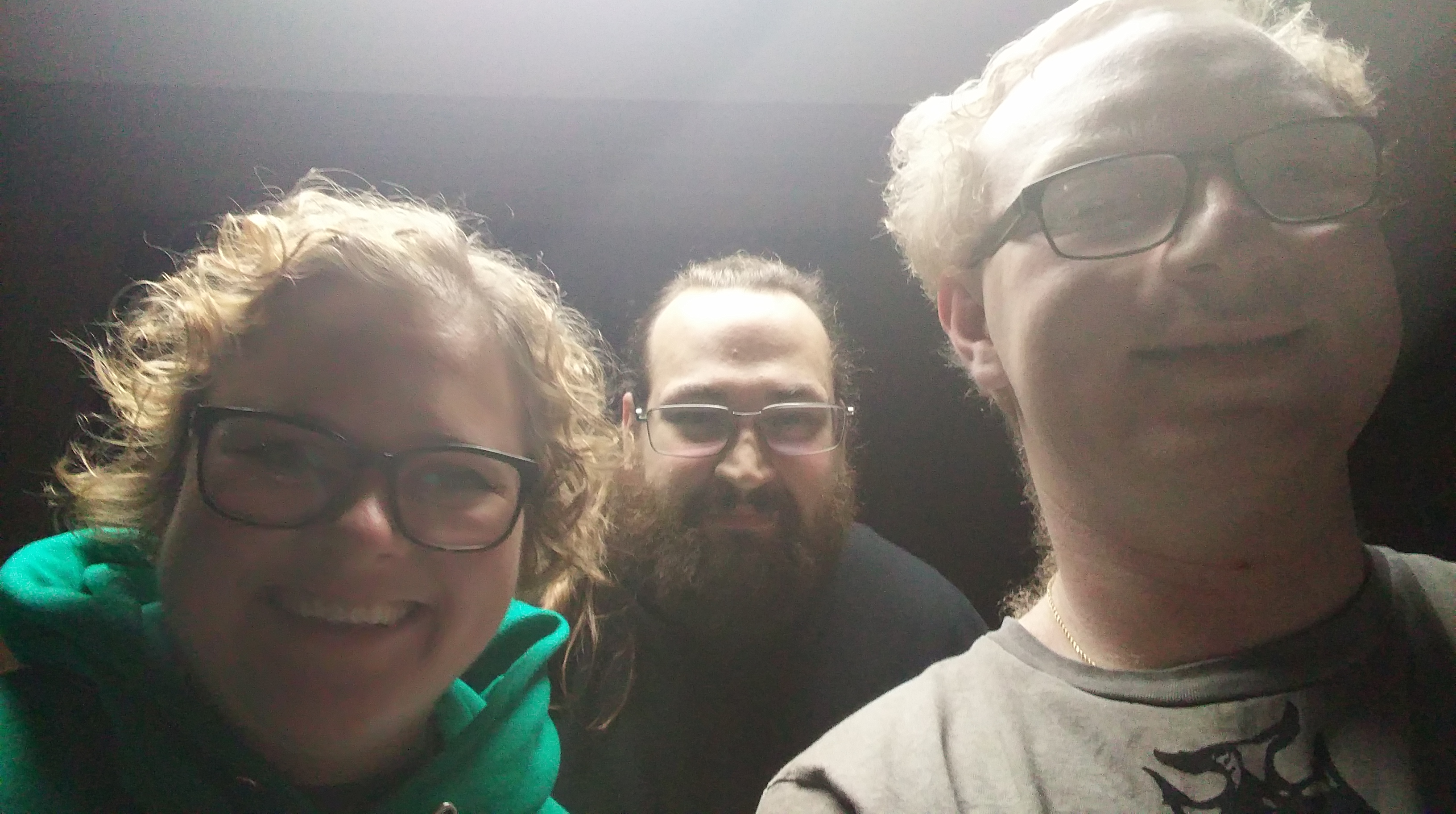
From left to right: Joleene, Charles and I in my apartment stairwell.

Last night I had two wonderful visitors come to visit me at my apartment: my friend and fellow writer Joleene Naylor, whom you’ve probably seen around the blog quite a bit, especially in the comments, and her husband Charles, who were passing through Central Ohio on a trip to West Virginia, and made a point to stop by.

I’ve been blogging and Facebooking and tweeting for over six years, so I’ve had plenty of time to make friends with numerous other writers, Joleene among them. Unfortunately, the distance between me and all these other writers often means we’re confined to online interaction. So when an opportunity to visit comes up, I get really excited (and a little nervous) and look forward to meeting them. And last night, I finally got to meet Joleene in person.

Joleene and Charles arrived in my apartment building sometime after eight last night, after having to navigate through a ton of construction on the interstate (don’t you hate it when that happens?). I greeted Joleene with a hug (normally I ask whether or not we should hug or shake hands, but here it felt natural), and shook hands with Charles, whom I’ve occasionally seen tagged on Facebook but never actually seen in photos or in comments before (apparently he’s one of those people who manage to get by without being connected to the Internet most of the day!). I took them inside and served them a homemade dinner of tilapia, garlic bread, and carrots (I like to pull out all the stop when I have guests over if I’m able to. Also, that was my first time making garlic bread, and it turned out very well). We sat down, and started talking and eating.

It was a very enjoyable time. Charles, whom I was worried I wouldn’t get along with, turned out to be very charming and funny. He talked about his job as a welder, as well as his previous experiences working in nursing homes, where he would learn about the cultures of some of the residents and occasionally play hilarious pranks on the nurses. I also learned that prior to living in Iowa, which is where Joleene and Charles were coming from, they lived in Missouri, where I was born and lived till I was two. I don’t remember much about my birth state, so I asked them to tell me about things I could do there besides visit the Arch in St. Louis. Did you know there’s a Titanic Museum in Branson, which is about four hours from St. Louis? Now that sounds like a place I’d like to go!

Of course, we also talked quite a bit about writing (how couldn’t we?). Joleene’s one of my beta readers for Rose, so we talked about what I hoped from the novel and what I hoped she’d find that would help me improve it. We also talked about our own individual writing experiences, including how we both got into writing in the first place (apparently we both link our starts to Harry Potter! What a coincidence), and a funny story involving how Joleene met a fan of hers through Pokemon GO. Joleene and Charles also tried to help me come up with a title for a story I’m developing, and while we didn’t figure one out, it was interesting to talk about this story I’m working on, and what might work as a title.

The bottle of wine Joleene and Charles gave me. I wonder what Purple Cow tastes like.

All in all, it was a great evening, and I was very sad to see them go after we’d finished dessert (pumpkin rolls, so deliciously deadly). I walked them out to the car, giving them some Buckeye candies as a souvenir of passing through Columbus (if you haven’t had them, I recommend them. They’re chocolate and peanut butter treats shaped to look like Buckeye nuts, a symbol of Ohio and Ohio State, and just plain awesome). In return, Joleene and Charles gave me a bottle of wine from a winery in Dubuque. Believe it or not, the wine is called Purple Cow! I’m not sure what that’s supposed to taste like, but the first opportunity I have, I’ll get some friends together and we’ll find out.

Joleene and Charles left then, after I gave some recommendations on which motels to avoid, and they sped off into the night. I returned to my apartment with my new bottle of wine, feeling like I’d had a wonderful evening and hoping I got to experience it again someday.

When relationships start online, you often worry that meeting in person can ruin things. However, Joleene, Charles and I had a wonderful time, which I think proves that people can just get along if they want to. You find common things to talk about, you tell a few jokes, and maybe add in a little bit of good food and wine, and amazing things happen. I’m really glad I finally got to meet them offline, and that we didn’t need to check our phones in order to feel normal or relaxed. And I hope I get to do it again someday.

If you’d like to check Joleene’s blog, click HERE! If you’d like to read about the other time I met one of my author friends offline, click HERE! And I hope you had a good time reading about my visit from Joleene and Charles.

Until next time, my Followers of Fear. Pleasant nightmares.