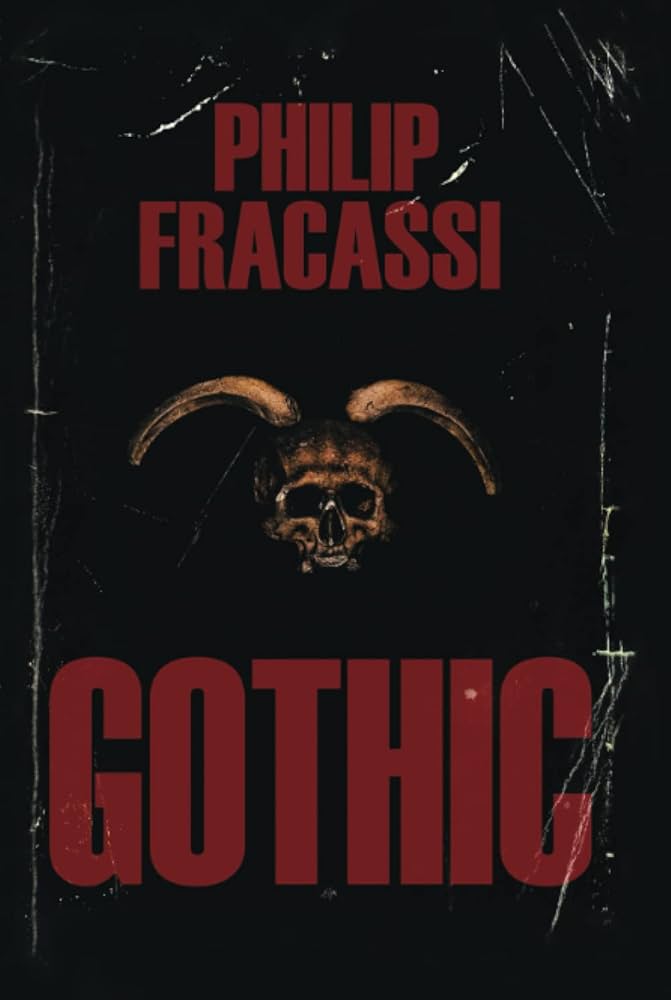
I’ve been hearing about Philip Fracassi here and there for a little while now and was curious to try one of his stories. One or two of his books have even made it onto my TBR list. This one became available to me on Audible, so I snapped it up. And today, while cooking dinner, I finished the audio version of Gothic. Obviously, I have to share my thoughts.
Gothic follows Tyson Parks, a middle-aged horror author who was a big seller in the 90s but hasn’t turned out a hit since and needs one to stay afloat. It doesn’t help that he pitched one book to a publisher and turned in something entirely different to his agent. However, when his wife gets him a new writing desk for his birthday, one with a black stone top and lots of terrifying designs in the wood, he finds himself inspired to write something dark and violent. However, this inspiration, and the source of it, turns him dark and violent as well. And that’s because the desk isn’t just a desk. It’s something old and evil. And it has a terrible purpose in mind for Tyson.
I liked Fracassi’s writing style. He goes into the trials and troubles of a writer, especially one with bills, with both realism and a strong sense of humor. Not to mention, the story itself is dark and intriguing, moving along at a steady clip as you watch Tyson’s descent and how those he loves are pulled along for the ride. Honestly, there were some parts that made me cringe when I read them, they were just so brutal.
And the source of the horror, the writing desk, is a pretty cool concept. Yeah, at first glance it sounds like Christine gone silly, but the damn thing’s scary in more than just looks. Especially as it begins to exert a stronger and stronger influence on Tyson. And in the last fifth or so, elements of In the Mouth of Madness are incorporated, which I enjoyed.
That being said, I was disappointed by the ending. I thought it felt rushed, like Fracassi was trying to meet the same deadline as his character, and he just slapped on an ending that wouldn’t require another ten to twenty thousand words. Part of me wonders if the intention is to give this story a sequel where some of the plot threads are wrapped up and the desk’s influence can be further explored, but I don’t know if that was the intention.
On a scale of 1 to 5, I’m giving Gothic by Philip Fracassi an even 4. With plenty of pain and horror, it’s an entertaining read and worth taking a look at.
Just don’t read it near any antique desks. And if you do, make sure you have the desk’s history and you’re sure it’s not dangerous before you do.
So, I’m reading Every Woman Knows This: A Horror Collection by Laurel Hightower, a collection of horror short stories I won in a Twitter giveaway. Not very fast, because I get through print books so much more slowly these days than I used to, but I’m making my way through it. And I am in awe that some of these short stories appear to be shorter than five thousand words. Hell, some of the earlier stories in the collection appear less than four thousand.
And I’m sitting there, reading the stories, and I’m like, “How does she do that and make them still so damn good?”
I actually posted that question on my personal Facebook and my Twitter feed. Laurel responded to the Facebook post (we’re friends there), thanking me for posting about the book and being glad that I’m enjoying it. Did not share her secrets with me, though.
I wish she had, because I would love to be able to write stories that short and still be effective. After all, I grew up on Harry Potter and the Bartimaeus Trilogy, followed by books like Interview with the Vampire and IT. The shortest of those books is seventy-seven thousand words. By the time I started regularly reading and writing short stories, my brain was already primed for sprawling plots with deep twists, multiple layers of themes and secrets, and complex character relationships that are explored through multiple pages, chapters and books.
Taking all that out and trying to tell an entire story in less than seventy-five hundred words (what the Horror Writer Association says is the maximum word count for a short story) was a huge switch for me. And honestly, I’ve had varying success. Occasionally, I manage to get a story less than seventy-five hundred words, and sometimes those stories get published, but more often short for me is a novelette between 7,500 and 17,500 words. Not as long as a novel, not by far, but allows me more room to work with those plot elements I like.
Still, I do try to come up with and write those shorter stories, what Stephen King calls “a quick kiss in the dark from a stranger.”* Yeah, it’s difficult to do, but most publications are looking for stories of that range, and I want to get my work into them. And, I like the challenge. It’s another hill for me to climb on my journey as an author. And, occasionally, something I write in this vein is really good.
That being said, if it looks like a short story is destined to be a novelette, or even a novella or novel, I will let it be the length it’s going to be. No sense trying to maim a good story so it can fit somewhere, right?
But I still try. And I’ve gleaned some things in my attempts, like instead of big plots or huge happenings, you focus on small instances or events that may happen to one or two people. Rather than the big moments, like the destruction of It in the sewers of Derry or the fallout of four writers visiting a haunted house on Kansas during Halloween for a publicity stunt (Kill Creek by Scott Thomas, if you don’t know), I should focus on maybe a ghost at the Ohio State Reformatory trying to get information on what happened after he died, or a young man dealing with something evil that’s appeared intermittently in his life. Those might manage to become the kisses given in the dark by a stranger.
Actually, one of those was a kiss in the dark, and some of you may remember it. It’s “Is Anyone There,” which was published last year in That Which Cannot Be Undone, and got mentioned in several reviews as a highlight of the anthology. So maybe I might be closer to my goals than I think.
Just don’t kiss me in the dark. I’m more likely to punch you for that than enjoy it or put it into a story.
What are your tips for writing short stories, Followers of Fear? Do you struggle with keeping them under 7,000 or 5,000 words? Let’s discuss.
Also, be sure to check out Every Woman Knows This by Laurel Hightower. So far, it’s a great collection, and I hope I’ve learned some things by the time I’m done.
*Which, by the way, is a weird idea, isn’t it? You walk down an alley or into a room and it’s really dark and suddenly someone plants one on your mouth before disappearing? Actually, the scenario with the room is the plot of an Anton Chekhov short story, and the character who gets the kiss does have an impression left on him. So, I guess it’s a good metaphor.
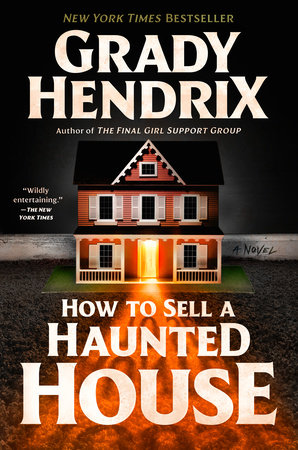
Two posts in one day. My Followers of Fear, you either did something very good in your past life or very bad. Either way, I finished Grady Hendrix’s latest novel on audio book today, so I’m going to review it here.
How to Sell a Haunted House follows Louise Joyner, a mother of a five-year-old who has a complicated relationship with her family. When her parents die unexpectedly, she flies from San Francisco to Charleston to take care of their estate and put them to rest. However, things are complicated by her younger brother Mark, whose lifestyle and choices puts him in conflict with Louise from day one. As the two argue like children and try to get the estate settled, they soon find that something malevolent is alive within their childhood home. And unless they get their shit together, it may claim not just the both of them, but Louise’s little girl.
The amazing thing about Grady Hendrix is that he can take a concept that sounds ridiculous on paper and write a whole novel out of it that’s both darkly comic and quite terrifying. From an IKEA knockoff built on the grounds of a former prison, to a teenage girl becoming possessed in 1980s-saturated Charleston, he just makes it work. And it’s no different here. Honestly, I found myself laughing quite a bit listening to Mark and Louise act like me and my sisters at our worst times ten. And as you get further in and see just how dysfunctional this family is, you find yourself glad you’re not part of the same family.*
And when you figure out who/what is going to be the main antagonist of the story, you find yourself laughing…only to see how terrifying said antagonist is. And as you see episodes from Louise and Mark’s childhoods and adulthoods that formed them as people, you see elements as these moments come back to literally haunt them in their parents’ homes. It’s freaky, and there were actually times I found myself wincing or shuddering as I listened to these moments.
And underneath all the darkness and comedy, you get some great themes about the effects of generational trauma on family and family dynamics, about learning to deal with death (and explain it to children), and what family actually is. It’s heavy stuff.
I do have some problems with the book, however. I did see a certain twist regarding the antagonist very early on, and I’m sure I’m not the only one. I also thought the resolution of the climax could have been a bit darker and might have ended too sweetly. And I would have liked to see Mark and Louise explore and resolve their issues a bit more. I feel like during the last third of the book, a lot of stuff was skipped over so the novel could reach its end.
But all in all, How to Sell a Haunted House is another awesome release from Grady Hendrix, whom I’m sure will only continue to grow in stature as a storyteller. On a scale of 1 to 5, I award his latest outing a 4.2 out of 5. It’s funny, creepy, and an all-around thrilling story. Grab a copy, settle down, and get ready to either feel grateful for your own family or feel like you’re reading about your relatives (it’s either one or the other, for better or for worse).
That’s all for now, my Followers of Fear. Until next time (which will be sometime before the week is done), good night and pleasant nightmares.
*I actually texted my own sisters to let them know how much I loved them and was glad we got along despite our childhood rivalries and disagreements. They were touched, as well as concerned about me because I was sending that text. Anyway, that’s how I reacted to this family’s malfunction.
I’ve been asked this before numerous times in one way or another. “What advice do you have for new writers?” Well, there’s one thing that always comes to mind. And the past couple of years, the thing I’ve come back to, time and time again, is this: “You need to carve out the time to right.”
Yeah, that’s the advice. A lot of people want to write, but they say they don’t have the time to write, or that they can’t find the time, or there’s just not enough time in the day. I often reply, “Well, you’re going to have to carve out the time. If you’re serious about writing that story. There’s no time fairy who’s just going to grant you time to write.”
Sounds kind of caustic, and it is. But it’s also true. For one thing, I’ve never seen a single fairy, let alone one that grants time to would-be writers. For another, the time to write just doesn’t find you. It doesn’t drop out of the sky and into your lap. And yeah, there is only 24 hours in a day, with hopefully only 8 of them devoted to a day job and the other 16 sleeping and personal stuff.
Fact of the matter is, if you don’t make time, even just half an hour, to write, you won’t ever get the time to write.
I mean, if you want to cut out sleeping, you’ll find that time, but from a health standpoint you’ll really suffer.
But I understand why people say they don’t have the time. Finding that time can be hellishly difficult. Besides day jobs and sleep, people need to do chores around the home, take care of family obligations, and finding time to relax after a long day.
Still, you can find time. Plenty of others have done it before. Even when he was raising three kids under the sage of six and was living out of a trailer, Stephen King found time to write 2500 words a day. That’s how he wrote Carrie, which later launched him into the stratosphere. And my friend/colleague Angela Misri wrote every day on the bus to and from work in moleskine notebooks. That’s how she wrote her Portia Adams books, and they’ve been pretty successful.
As for me, I write in the evenings between dinner and bed (though on weekends or days off I try to write during that free time as well). I’ve been doing that for years, and it’s how I’ve written some of my best work. Yeah, it helps that I’m only responsible for myself, don’t have kids, and writing helps me destress. But I still carve out that time most nights to get work done, because I want to get those stories done and out there. I want to write for the rest of my life. So I carve out that time.
And if you really want to tell those stories and get them out into the world, you’ll find the time. It may take some changes to your schedules, or maybe some changes in your life, but if you’re serious, you’ll be able to find the time. Like I said, plenty of people have before and plenty of people in the future. That includes me, and that includes you.
How do you find time to write? Did you make changes to your life or schedule to do it? Has it helped? Let’s discuss in the comments below.
That’s all for now, my Followers of Fear. Just wanted to get something out to you sooner rather than later, and this seemed like a good subject to post about.
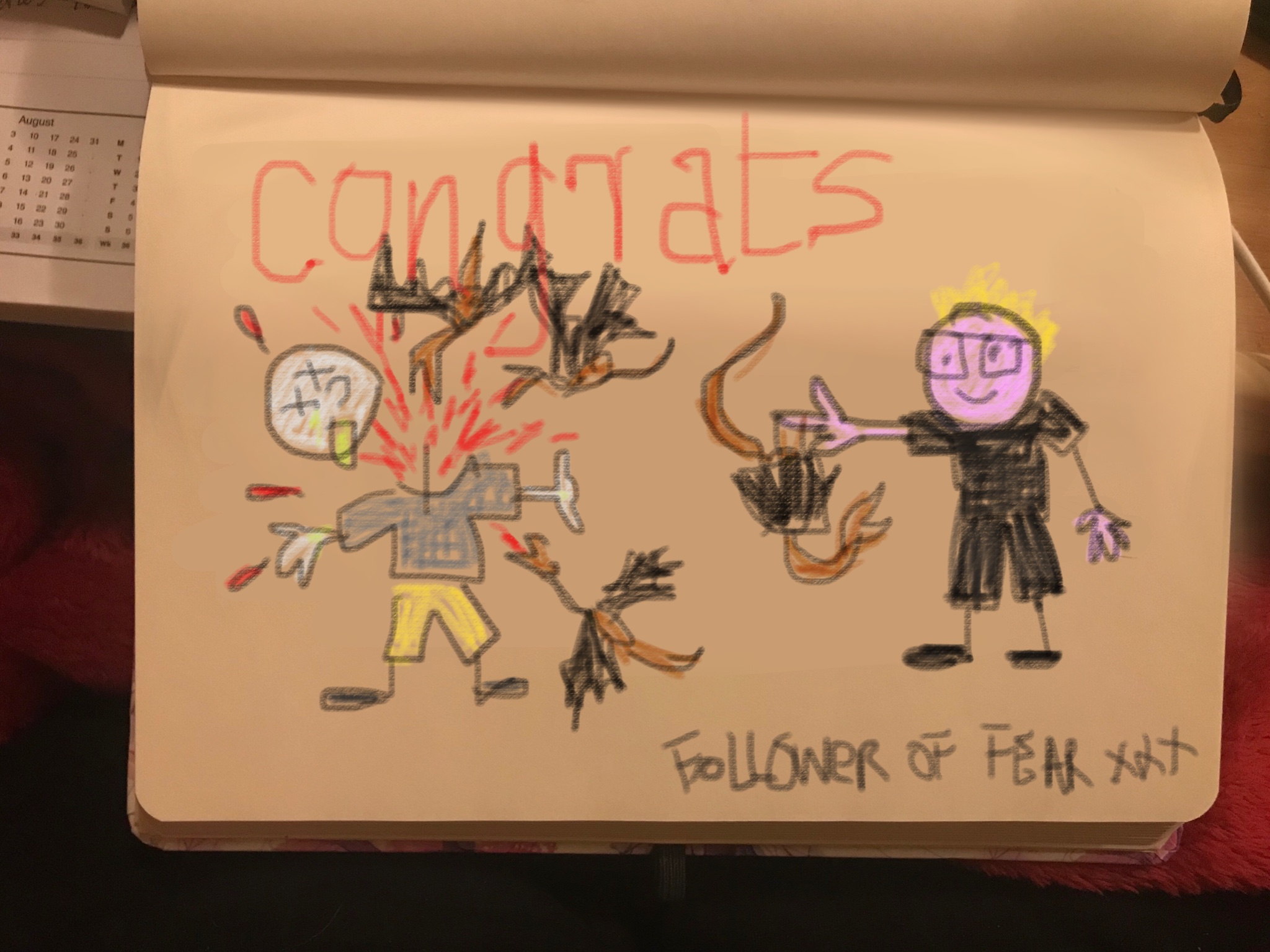
Until next time, good night, pleasant nightmares, and–oh look, a fairy! Oh, you want to join my Army of Nightmares and help me accomplish my goals? Okay, let’s go! To the dragon bats!
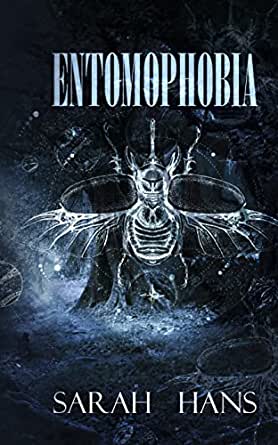
Some of you may remember my interview with Sarah Hans last year about her debut novel, Entomophobia (click here if you’d like to read it). I was interested enough that I bought my own copy (Sarah gladly signed it for me) and I began reading it recently. And while I don’t have a lot of time to read these days, I was able to get through it quite quickly. So, what did I think? Let’s find out.
Entomophobia follows Meri, a woman who has just left her abusive husband and is trying to get her life back together. However, it seems life is conspiring against her at every turn: her aloof mother is unsupportive; the judge ruled that her soon-to-be ex-husband will have primary custody of her daughter, Magda; and, after having to steal supplies for an art show she’s part of, she gets cursed by a tiny man with insectile features. The curse is changing her, forcing her to face her darkest fears. And if she doesn’t do something quick, she’s going to lose what little she has.
One of the biggest strengths of this novel is Meri. She’s a fully realized character, sympathetic yet flawed. Within a few chapters, I felt like I really knew her, and that made it easy to empathize with her pain and fear and the woes of her life. There’s also a strong supporting cast, especially in the character of her mother, whom I wanted to strangle at times.
Another of the book’s strengths is the human-based horror. We see a lot of characters being cruel, uncaring, or just plain awful. This is obvious in Meri’s ex-husband Adam, who is a huge piece of shit, but also in her mother, in random teens in a bad neighborhood, and even in her ex-boyfriend Dan, though he does mean well at times. Whether they realize how their actions effect others or not, it’s horrifying to see just how much they don’t give a shit at times about the damage they cause.
The body and supernatural horror isn’t anything to sneeze at, either. A lot of scenes in this book will make your skin crawl as you read them, and the description of some of the characters, especially the less-human ones, really bring them to mind and make it easy to imagine what they might look like.
I do have some gripes, however. I did feel like the book could have been longer. As I said at the beginning of the review, it’s a short book, and I feel like it could have been a bit longer. Perhaps some scenes could have been drawn out more or added in, especially ones involving the curse or Meri’s phobia. I would have been good with some expansion.
On a scale of 1 to 5, I’m giving Entomophobia a straight 4. It’s a quick, creepy read with a great cast and an engaging story that I recommend.
On a sad note, you might have trouble finding copies. As mentioned in my interview, Entomophobia’s publisher closed and was only printing new copies through the end of 2022. So right now, I have a kinda-rare first edition.
The good news is, Sarah tells me Dragon’s Roost Press will be re-releasing the book sometime this year, possibly this summer. So if you’re interested in getting Entomophobia when it’s available again, check out Sarah’s Twitter and you’ll find out with the rest of us when the book is available again.
That’s all for now, my Followers of Fear. I’m off to read some more before heading to bed (I’d rather do some more writing, but I know if I start now, I’ll never get to bed at a decent time). Until next time, good night and pleasant nightmares!
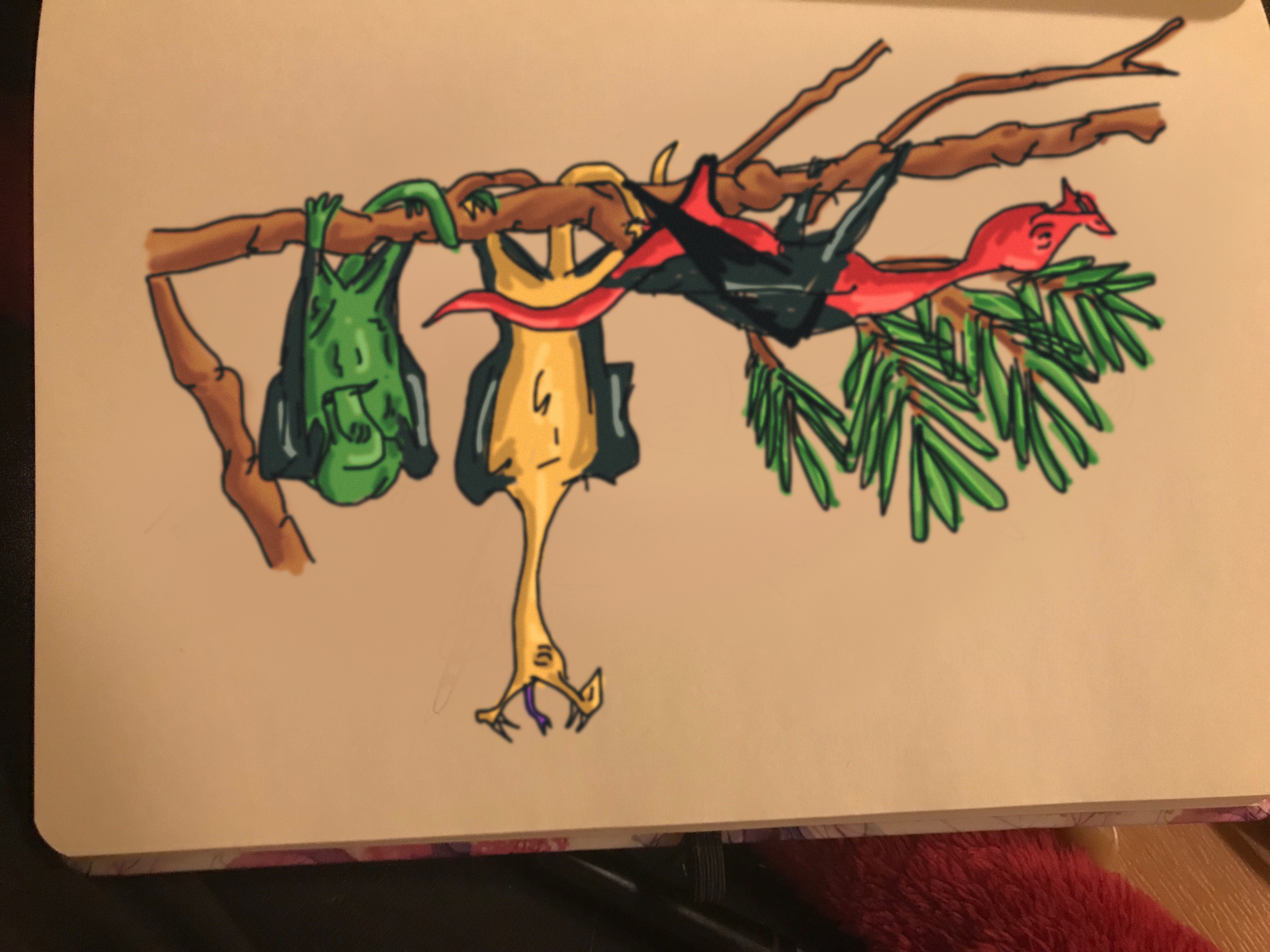
Back in 2021, I got my first author fan art. Iseult Murphy, my friend and colleague, created a couple of pictures based on a made-up creature I mentioned in a tweet, the dragon bats. You can see them below.
Pretty cool, especially since they didn’t belong to any story. At least, not then. The fan art inspired me to write a novelette, “Disillusionment and Trauma Sometimes Go Hand-in-Hand.” That story was published in Ink Stains: A Dark Fiction Literary Anthology in October 2022.
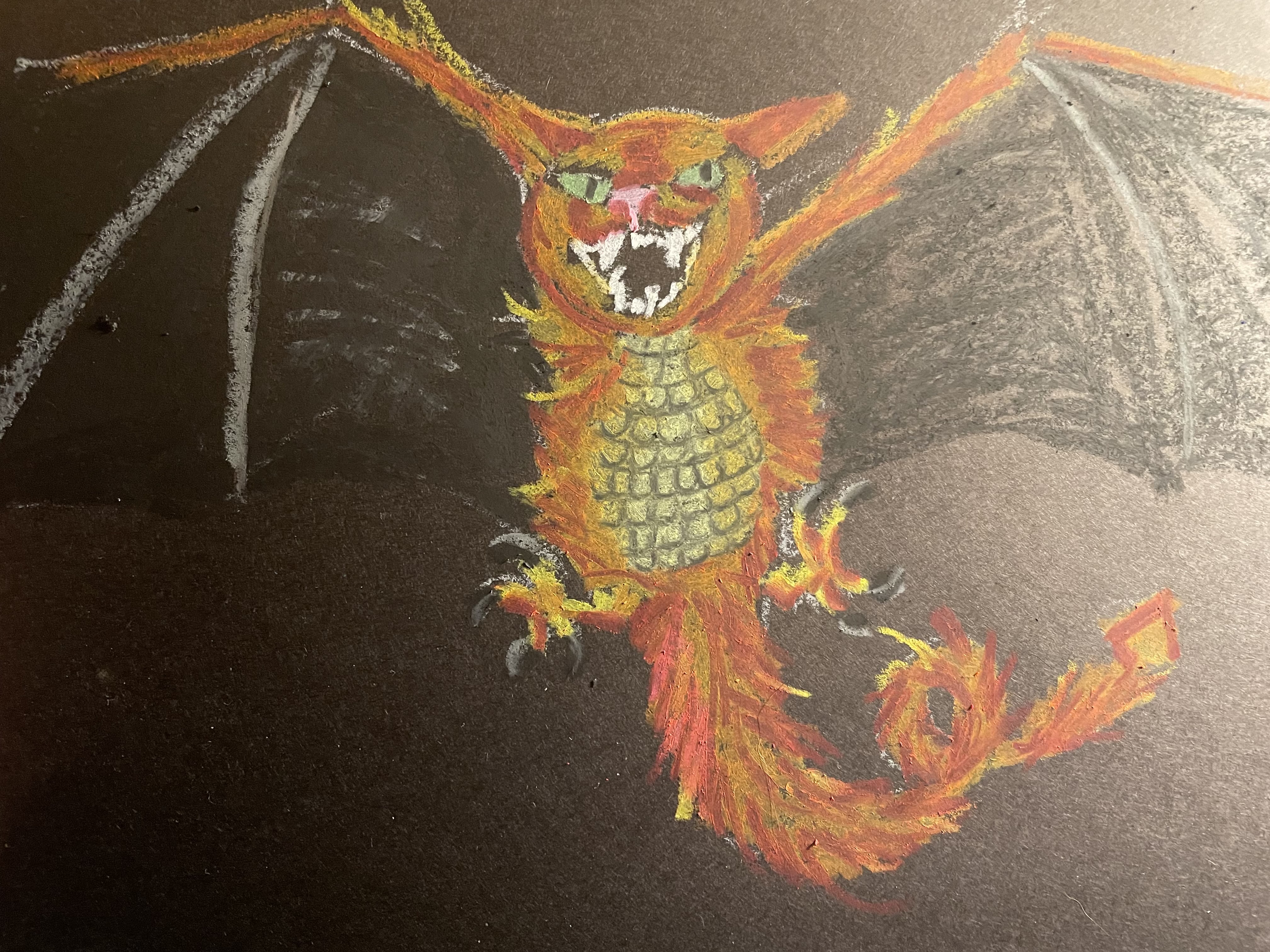
And this past month, Iseult created some more fan art, which she’s sent me. The first is a story-accurate picture of the dragon bats, down to the orange fur and cat-like faces. Even their scaly, armored bellies are featured! Now imagine if one of these were real, and as big as a large dog! Now imagine hundreds of them, flying around and feeding upon you. Did I mention they may be venomous? A single bite can be deadly!
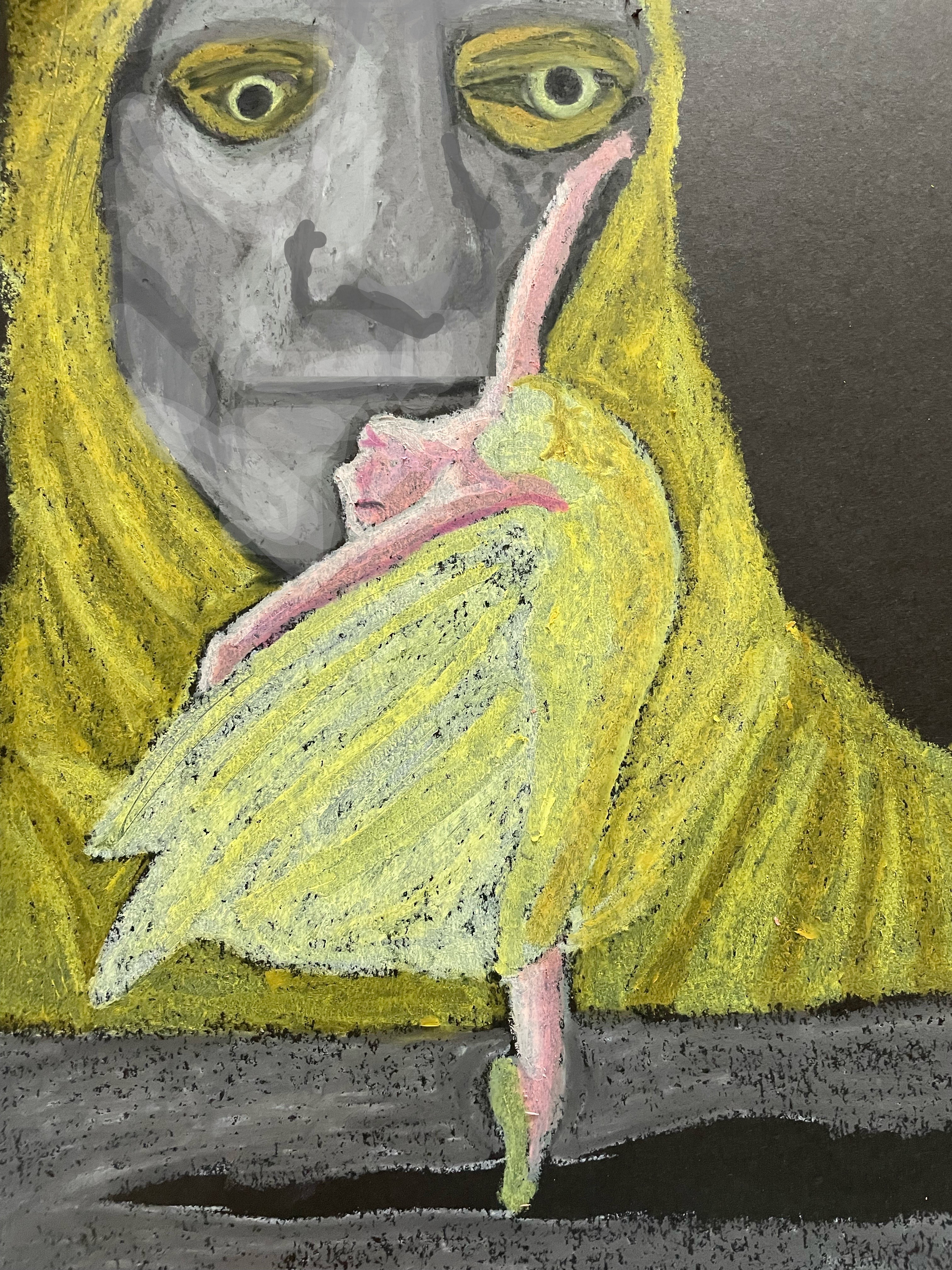
But that’s not the only piece of art Iseult sent me. Yesterday, she sent me this picture based on my story “The Dedication of the High Priestess.” That story is a fusion of ballet horror with the cosmic horror entity The King in Yellow. Check it out:
DAAAAMN! That is beautiful! The dancing figure of Anastasia in yellow, her shadow underneath her, and the giant form of her master, the King in Yellow, watching over her as she dances. It’s just an amazing piece of art. Also, was that painted with oil pastels? Because it looks like it, but I’m no art expert. Iseult, please let me know.
Whatever it’s made with, I LOVE this picture. I’ve said it before, but I feel like “Dedication of the High Priestess” is one of my favorite and best stories. And fan art is one of the sincerest forms of flattery you can give a creative, as well as showing your love and appreciation for that creative and their work. And from this, I really felt the love Iseult has for this story. So, I printed out a copy of this picture, bought a frame for it, and am now trying to find a good place to hang it up.
Anyway, I wanted to post this fan art for you all to see. Iseult’s art needs to be appreciated by more people, so I made sure to put it on my social media and on my blog.
And I hope to receive more fan art in the future. Not just from Iseult, though I would be happy to see more of her work. I hope, as I continue to publish more stories and reach more readers, I’ll see more fan art based on my work. And, as long as it’s manageable to do so, I may even post more fan art to this blog and to my social media.
Perhaps there will be more fan art once Hannah and Other Stories releases later this year. I can see the stories Queen Alice and Fuselli’s Horses getting some fan art.
In the meantime, I have plenty of stories that are worth reading. You don’t have to create fan art from them if you don’t want to. I just want you to read them. And maybe let me know what you think. And you should also check out Iseult Murphy’s stories, which you can find links to on her blog. I recommend 7 Days in Hell and 7 Weeks in Hell.
That’s all for now, my Followers of Fear. I’m off to work on a new short story while trying to figure out where to hang Iseult’s picture. Until next time, good night and pleasant nightmares.
For those of you who don’t know, “squicky” refers to something that is very disturbing, disgusting, and/or unpleasant. In horror, it usually refers to something out of what Stephen King calls “the gross-out factor” of horror, with lots of blood and gore and bodily fluids. Occasionally squicky scenes (or at least most of the ones I’ve encountered) also have some sexual element, though not the kind that would indicate any form of healthy sex. Squicky scenes are the ones that make readers think, “Good Lord, what’s wrong with this author?” And they make the author’s parents go, “what kind of freak did we raise that they could come up with this?”
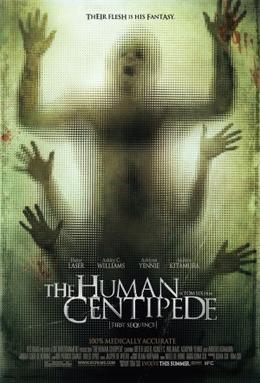
On a personal level, I can go either way with squickiness. Sometimes, like with the Evil Dead remake in 2013, I find that’s part of the charm of the movie. And I’m looking forward to watching Terrifier 2 because its squickiness reportedly caused people to vomit and faint in the theaters (though hopefully not at the same time). But when it comes to stories like Human Centipede and its sequels, where the very concept is squicky, I run the opposite way.*
That being said, I find myself writing squicky scenes more and more in my work. There’s a scene like that in my Backrooms story “It Changes You,” and one of the stories in my upcoming collection Hannah and Other Stories has plenty of squick in it. And there’s a particular story I hope to start writing soon that will have you shuddering from the squick! It’s going to be a blast.
Why am I writing these scenes? Well, part of it is because I’ve seen other authors in the books I read writing them and that has inspired/urged me to try writing them as well. Another is that, in my continual quest to improve as a writer, I’m trying to push myself to step more and more out of my comfort zone and try things that I wouldn’t normally write. And a third part is that, when done right, those scenes make the story scarier and make the story stand out to readers.
That being said, writing those scenes isn’t easy. I’m usually thinking three things when working on a squick moment: is this too much? Is this not enough? And am I using the right words to bring out the full squicky nature of the scene? Since some of these stories haven’t released yet, I can’t be certain. You’re trying to balance several elements like word choice, time spent on a particular moment, translating that horrifying moment from your brain to the page, and how it fits into the story as a whole, among others. A single misstep and people might call you “shocking for shock’s sake” or “exploitative.”
That being said, people are going to call you that anyway. Besides Human Centipede, other films like the Saw movies or Texas Chainsaw Massacre are full of squicky moments and features. I know authors whose books are filled with squick. And you’ll find that each one has both detractors and fans. It just depends on the person, what they’re capable of stomaching, and what personally draws them to the story.
As for advice on writing squicky scenes, I don’t have much, unfortunately. Like I said, I don’t write them too often. But I do think that, unless your main thought when writing a story is, “I want readers to be shocked and grossed out and wincing with every paragraph,” only use squick when it works for the story. If it adds something to the story, great, keep it. If it doesn’t, then perhaps think about whether you should include such a scene.
This entire film is squicky and I want nothing to do with it.
Also, and while it may be stomach churning, read what others have done with squick and try to pick up what makes their takes effective. Once you do that, you can hopefully get some practice in and start creating scenes and stories that, over time, will produce the same effect those scenes produce in other readers and in you.
All that being said, if squick isn’t your thing, don’t push yourself to include it. The thing about horror, there’s a niche for everyone. You prefer things to be gory and gross and shocking, there’s something for you. You like ghosts and psychological stuff? There’s something there for you. You like cosmic beings whose very appearance causes insanity? Yep, there’s something for you.
Anyway, I just wanted to talk about these scenes I’m writing and my thoughts on them. I hope that when some of these stories with their squick-inducing moments release, they’ll be quite effective and add plenty to the story. Now, if you need me, I’m off to watch some scary movies.
Until next time, my Followers of Fear, good night and pleasant nightmares.
Do you enjoy squicky scenes? Do you write them often? What advice do you have for writing and including them in your horror?
*Seriously, you could not pay me to watch those films. Anyone tries, I will smack them into next week and make my escape in the meantime. I’m already screwed up enough, thank you very much! Don’t need to be twisted any further.
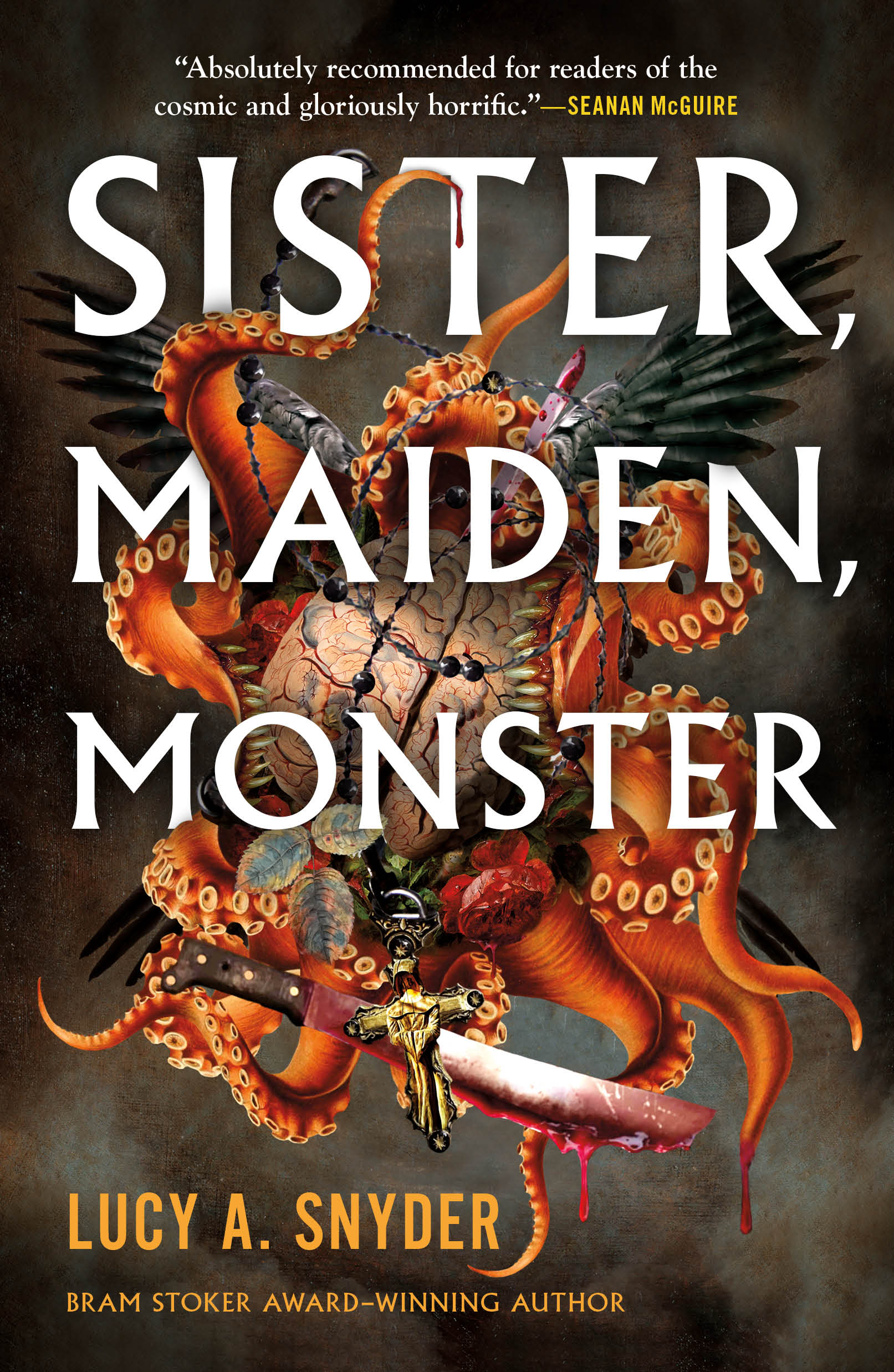
Before we start, I would like to thank Lucy A. Snyder and the team at Tor Nightfire for providing me with an ARC copy to read (and a special thank you to Lucy for the awesome galley copy she gave me a few months back).
Set a few years after our current COVID-19 pandemic, Sister, Maiden, Monster follows three separate women as their lives are affected by a terrible new disease raging across the planet. Known as polymorphic viral gastroencephalitis, or PVG, the disease is like the stomach flu from hell. For those who are lucky, it kills them very quickly. For the rest, it changes them, making them unable to eat most sources of nutrients. They have to get their nutrition through rather macabre means. And that’s only the start of the apocalypse that’s going to come.
So, it looks like there’s still an appetite for pandemic fiction, even after a real pandemic. At least, if the release of Sister, Maiden, Monster, the airing of “The Last of Us,” and one or two of my own stories, among other works, areanything to go by. And everyone telling those stories are making sure the hypothetical future pandemics are even more terrible than COVID-19 was. Which, honestly, I gotta respect.
Alright, onto the story. Sister, Maiden, Monster was great. I really enjoyed it. For one thing, the three main characters are really well-developed, which is great in such a character-driven story. There’s Erin, who’s seeing her life implode and strange new desires growing inside her after becoming infected; Savannah, a prostitute and dominatrix who discovers she has a talent for causing death in the name of new masters; and Mareva, a sickly woman who has been chosen for a terrible purpose. I really got to know these characters and get inside their minds. Which, by the way, was not always the most pleasant ride, believe me.
Speaking of which, Lucy Snyder does not shy away from showing what Stephen King calls the “gross-out” factor of horror. There are bloods, brains, gore, and plenty more body horror to make more squeamish readers feel faint. Add in the isolation and paranoia of living through another pandemic, this one worse than the one preceding it, as well as some good and delicious cosmic horror, and it makes for a rather scary read.
I did think that the time spent with each narrator was unbalanced. Somewhere between a third and half the book is from Erin’s perspective, and while I get why, I would have liked to see more from the other two narrators. Especially Savannah. That lady is wild and a lot of fun to read, even if you would be horrified by her if she were real.
I also noticed that something that appeared later in the book and which I loved seeing was foreshadowed earlier in the story, but I felt it could have been foreshadowed a bit more. Hell, I nearly forgot about the foreshadowing until the reveal, so that says something.
All in all, Sister, Maiden, Monster is a great, body horror-filled ride and I’m glad I got to be among the first to read it. On a scale of 1 to 5, I’m giving it a 4.3. The book releases this Tuesday, February 21st, so go preorder a copy, settle down when you get yours, and get ready to see the horror of the pandemic go through a terrifying metamorphosis.
Until next time, my Followers of Fear, good night and pleasant nightmares.
So, you’ve probably heard of Winnie the Pooh: Blood and Honey. If you haven’t, let me give you some background, because it’s important to talk about. So, Winnie the Pooh predates Disney and was originally some stories written by AA Milne. Some of those stories became public domain back in 2021, so now anyone can make a story about Pooh Bear so long as they don’t use anything exclusive to the Disney version. A British filmmaker took advantage of that to make a horror film based on the characters, Winnie the Pooh: Blood and Honey. And ever since its announcement, this film has gotten a ton of buzz, so even if it’s terrible, it’s likely going to make bank.
I’m actually going to see it at the one night screening at my theater. I can’t wait.
Unfortunately, not all of the buzz is positive. Recently, one of the actresses in the film, Danielle Roland, said the cast and crew got a lot of hate for being part of the film. Rhys Frake-Waterfield, who directed and co-produced the movie, even got emails saying he should die. You can read the original article here.
Now, I can understand if people are upset about this film being made, let alone the phenomenon it’s become. Winnie the Pooh is a popular character and childhood icon for many people around the world. Seeing him and Piglet used in a horror film might be upsetting. But death threats? That’s going way too far! You’re threatening to kill someone over a fictional character! Might as well threaten to kill someone over the Easter Bunny!
And here’s the thing: no one is forcing any of these people to watch the film. It’s not like men with guns are going to go into people’s homes and kidnap them to the movie theater for the one-night screening, or force them to put it on their various streaming platforms to watch in their living rooms. If you don’t want to go see it, don’t see it. Even better, pretend it doesn’t exist! You can continue to enjoy your childhood bear without having to acknowledge the one that’s going to be taking an axe to a bunch of college students next month.
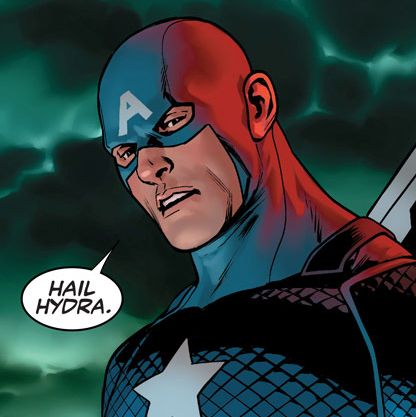
Unfortunately, death threats like this, as well as over-the-top reactions to fictional media of any sort, have become more and more commonplace over the year. Or maybe they’re being reported by news outlets more. Either way, it’s bizarre to read about. When I was in college, I read about people threatening to ruin Charlaine Harris’s career or kill themselves depending on what she wrote into one of her Sookie Stackhouse books. After college, when Marvel had a storyline in the comics where Captain America was revealed to be a Hydra agent, I read articles about people threatening Marvel’s writers for this storyline. One person alleging to be a Marine even said he was going to abandon all his values because of Cap’s betrayal and even become a killer (I seriously hope that was hyperbole). In 2020, when The Last of Us Part II released, people review-bombed the game based on leaked plot points. Part of this was fueled by homophobia (several of the characters in the game are openly LGBT), but a lot of this was due to fans hating the supposed direction of the game. Not only that, but one of the actresses for the game received death threats for playing a villain.
People got way too upset over this one scene.
And now people are threatening to kill folks associated with this new horror film because it’s about a beloved childhood character.
I don’t care about the circumstances or the reasons why. I don’t even care if the people making the threats are serious. I’m more concerned that anyone thinks reacting like this is appropriate. No matter why, you shouldn’t threaten people’s lives like that.
Let me share you a story from my high school days. Back then, I worked for my gym teacher selling tickets to volleyball and basketball games at the door. When I wasn’t taking tickets, I did homework, ate dinner from the snack bar, and read. It was a good gig. One day, however, I was steamed because I had just finished a Dean Koontz novel and absolutely hated its resolution. After the game, I was picked up by my stepmom, who proceeded to drive me home. And as I’m complaining about the book’s ending, my anger radiating off me like heat from a space heater, my stepmom turned around and said, “Rami, it’s fiction! It’s not real! Don’t get so upset about it!”
Well, that shut me up. And it turned out to be very helpful for me, because it made me realize something: as much as I love stories and characters, none of it is real. The absence of these characters and stories from the world wouldn’t change much, let alone their presence. And among all the things to get mad about in the world, a book resolution or how a character is portrayed isn’t one of them.
Since then, as wrapped up in fiction as I get sometimes, I don’t allow myself to get emotionally out of hand because I don’t like the direction. Yes, I’ll share my thoughts on it, but I’m not going to threaten people over it! And if I really dislike it, I just won’t have anything to do with it. My stress levels stay down and everybody stays happy.
And I wish more people would react that way. Or maybe not react at all. If they did, I guarantee we would all be much happier.
(WARNING: The following post discusses some recent movies that not everyone has seen yet. I’ve tried to avoid spoilers, but if you’d rather see these movies without knowing anything, then stop reading now and come back later. You’ve been warned.)
It’s no secret that I’m an eccentric, and I channel that eccentricity into my fiction all the time. I mean, my most popular novel is about a young woman who’s turned into a plant/human hybrid. If that’s not an example of weird fiction, then I’m a high school girl in an anime. And I’m not!
Skinamarink’s poster displayed outside my usual movie theater.
With all that expertise, I can say with certainty that there is plenty of room in fiction, especially in horror fiction, for weird. The novel House of Leaves by Mark Z. Danielewski, is a prime example of this. It’s a story about a documentary about a recounting of one family’s experience living in a home that has a giant labyrinth hidden inside it. The novel is full of footnotes, some of which have footnotes, as well as pages with only a few lines of text, or the text laid out in an odd manner, forcing the reader to hold the book at weird angles. From what I’m told, it makes for an experience both agoraphobic and claustrophobic.*
No wonder that book has an enduring relevance among horror readers, despite the author and some readers seeing it more as a love story than a horror story.
All that being said, there is both a good way to make a story weird and a bad way to make a story weird. Especially in the horror genre.
Some of you may have heard of the new Canadian horror movie Skinamarink. The movie revolves around two children who wake up one night to find that their father, as well as the doors and windows to their home, have mysteriously vanished. There’s been a lot of talk about the film online, with some loving it and others reviling it. I went to see it on Friday, knowing that one way or another, I would get a weird experience.
Well, I did get that weird experience. It’s filmed in a way meant to evoke a child’s perspective and reflect their nightmares, with the majority of shots focused on hallways, things high overhead or on the television in the den. Anything but the characters themselves. The entire film is also filtered to look like a home movie from the 80s or 90s, and the use of effects is minimal and mostly reliant on practical effects. A lot of the dialogue is told in whispers, so subtitles are used throughout the film. There’s no music, and plenty of surreal moments throughout the film, especially near the end.
That being said, everyone in my theater, including me, hated it. I even spoke to someone who was in the theater with me afterwards, and he told me he fell asleep during the film. I can see why: except for a few effective jumpscares, there was nothing to actually unsettle the viewer or keep them tense or focused, let alone scare them.
Since seeing the film, I’ve been characterizing it like someone took the cursed videotape from The Ring and tried to make it into a feature film, but took out what made that video so scary in the first place.
Now, I’m not saying anyone who enjoyed Skinamarink or found it scary is wrong or bad. The wonderful thing about horror is how subjective it is and how there are many different niches to suit every fan. Nor am I shitting on the director for the choices he made. I reserve that for the Friday the 13th remake and its creators, because that film is trash that gets everything good about the franchise wrong. Most of the people involved in it should get a good kick in the pants!
No, what I’m saying is that the weird is emphasized at the expense of the horror. Online, Skinamarink is characterized as “an experimental horror film” and that feels like an apt way of putting things. From the way the film is shot, to the use of subtitles and the story (flimsy as it is), you can tell that it’s all been an experiment by the director to conjure up a unique viewing experience. And in that respect, his experiment was a success. However, in terms of creating an effective horror film, the experiment was a bust.
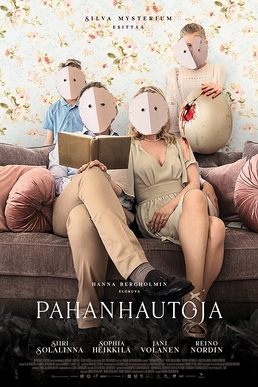
Hatching is, in my humble opinion, a great example of weird horror done well.
Now, compare that to another recent horror film, Finland’s Pahanhautoja, or Hatching. The film follows a girl who finds an egg in the forest and incubates it, only to end up the caretaker of a large bird/dinosaur monster that she calls Alli. Yeah, that’s weird, especially when you see the ugly-ass creature, which is brought to life mainly with practical effects and puppetry. But it also helps to tell a story about a very repressed girl who is struggling as part of a toxic family dynamic and being ruled by a narcissistic, social media-obsessed mother. Rather than overtaking the story, the weird aspects help drive the story and explore its deeper themes.
And that’s where the big difference between Skinamarink and Hatching is. The former’s weird aspects overtake the film and drown out the horror, while the latter’s weird aspects help out the horror and the story in order to be told more effectively.
To summarize, when telling a story of the weird variety, it’s important to remember that you’re telling a story first and foremost. Thus, while you can add as many weird elements as you want, if they overwhelm the story you’re trying to tell, you risk alienating rather than engaging your audience. And that’s something every storyteller wants to avoid. Including eccentrics like me.
*It’s on my TBR list, but that list is long and I only have so much reading time. Thus, it’s going to have to wait a while till I get to it.
Just a reminder, my Followers of Fear: this coming weekend I’ll be at ConFusion at the Sheration Detroit Novi in Detrot, Michigan. This is a big science fiction and fantasy convention that’ll be held from Friday, January 20th to Sunday, January 22nd. I’ll be there selling books and doing Tarot readings, so if you’re in the area, feel free to stop by and say hi. I’d be more than happy to see you.



 Rami Ungar The Writer