Posts Tagged ‘authors’

I’ve had quite a few songs stuck in my head lately, most of them from the 1980’s: “If I Could Turn Back Time” by Cher and “Love Walks In” by Van Halen are frequent guests in my head. I’ve also had “Come Sail Away” by Styx and most of the soundtrack of Wicked playing in my head. No reason to tell you that. I just wanted to see if I could get any of those songs stuck in your head. I’m evil that way. You’re welcome.

Onto Day Three of the Ten Day Book Challenge, as nominated by my cousin Matthew. Let’s go over the rules one more time, shall we?

  • Thank whoever nominated you with big, bold print. If they have a blog, link to the post where you got tagged there.
  • Explain the rules.
  • Post the cover of a book that was influential on you or that you love dearly.
  • Explain why (because I don’t see the point of just posting a picture of a book cover without an explanation. That goes for Facebook as well as blogs).
  • Tag someone else to do the challenge, and let them know they’ve been tagged.

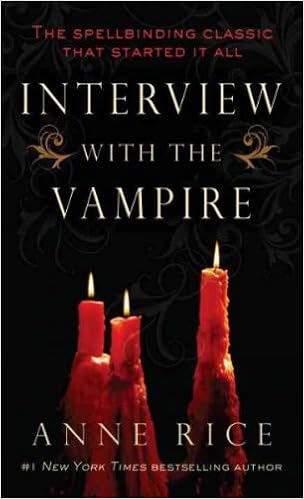
So for today’s book, I thought I’d talk about another important book in my development as a writer, Interview with the Vampire by Anne Rice.

Interview was another revelation in the power of words for me. I already knew how words could bring worlds and the people in them to life, but this book (and its sequels) not only painted them into being, but their thoughts and their outlooks on life. It was psychological storytelling before I even knew what psychological storytelling was. Interview, in particular. The novel follows Louis, a young man in the midst of depression and grief, become a vampire and then reluctantly going through his immortality, encountering companionship, pain and loss over the centuries.

Not to mention, these were vampires well before they were sparkly and insipid. They were human, in their way, but they were also dark creatures. And they’re still hugely popular today, whereas Twilight has come and gone. Hell, Anne Rice is still writing books in the series, with its thirteenth book on the way out in November. And now there’s a TV series in development based on the books over at Hulu! I can’t wait to see it. That says something not only of the characters and the author, but of the power of the stories being told. Of the words bringing them to life.

And if you haven’t encountered Anne Rice’s vampires, give yourself the Dark Gift (so to speak) and check them out.

And now to tag someone. Today I’m tagging my friend Ruth Ann Nordin. Hope you’re able to do this, Ruth. I look forward to seeing what books you choose if you are able to do this.

Ugh, this challenge is just about killing me! I’m not sure I can survive the last eight days! Someone put me out of my misery!

[goes off to make a cup of tea. Drinks tea]

Okay, I’m better. Let’s get this ball rolling. On to Day Two of the Ten Day Book Challenge! Brought to you by my cousin Matthew, who is the biggest Game of Thrones fan I know (books and TV show). And once again, let’s go over the rules:

  • Thank whoever nominated you with big, bold print. If they have a blog, link to the post where you got tagged there.
  • Explain the rules.
  • Post the cover of a book that was influential on you or that you love dearly.
  • Explain why (because I don’t see the point of just posting a picture of a book cover without an explanation. That goes for Facebook as well as blogs).
  • Tag someone else to do the challenge, and let them know they’ve been tagged.

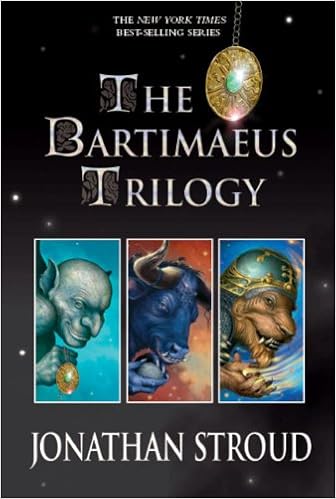
Now that that’s out of the way, let’s talk my choice of book. Or to be more precise, choice of books, as I’m talking about a trilogy. Kind of cheating, but this is just an Internet meme. Who the hell cares? Anyway, allow me to present to you The Bartimaeus trilogy by Jonathan Stroud, consisting of The Amulet of Samarkand, The Golem’s Eye, and Ptolemy’s Gate.

This was one of the first series I read after my years-long Harry Potter binge-fest. And man, did it pack a wallop! Imagine a world where magicians summon demons and have often used that ability to rule over the masses, founding some of the world’s greatest empires. At the time the books take place, London is the center of the world, with magicians ruling over a common class with few rights. The story focuses on Nathaniel, a magician’s apprentice who summons the sardonic djinni Bartimaeus to help him get revenge on another magician. This starts off a chain of events that sees Nathaniel go on the journey of a lifetime, all coinciding with London going through a time of civil upheaval unlike anything the city’s ever seen before.

This book series was the perfect choice for me after the HP books: it was immersive and had some similar concepts, but enough to make it very different. And I’m not just talking about the mechanism of the magic (though that in itself is very different). The main characters are often complicated, not exactly good but not exactly evil either. They’re very much the products of their environment, and while that makes them at times very unsympathetic, it also makes them fun to follow. The series also deals with some really deep themes, and doesn’t wait till the second book to deal with them like Harry Potter does: classism, prejudice, freedom versus security, dictatorship versus rule by the people, the master-servant relationship, the consequences of child neglect and abandonment, and the rise and fall of empires, among others.

Add in great storytelling and a narrator full of wit and sarcasm in the form of the djinni Bartimaeus, you’ve got yourself a fun and exciting urban fantasy series.

Sadly, not as many people know about this series as others, which I think is a shame because it really should be more popular. Hell, there was even a movie adaptation of the first book in the works at some point, but it never happened. Hopefully a mention here might get people interested in reading it and perhaps increase interest in it. Maybe. Who knows? Weirder things have happened.

Well, that’s it for today’s post. I nominate my good friend Joleene Naylor for this challenge. Enjoy Joleene, and I can’t wait to see what your choices are.

So on Facebook, this thing’s been going around my friend circles where you post one picture of the cover of a book that you love or found influential, no explanation, and then tag someone else to do the same. You do this for ten days in a row, posting a different book cover and tagging a different person each day. I knew that eventually I’d get tagged, so I wasn’t surprised when my cousin Matthew tagged me for his second day. However, because I never follow anyone else’s drumbeat, I decided to do this on my blog and talk about why I love the books so much. Who knows? It may get some people to pick it up and read it.

So with any viral Internet tag/challenge/meme/award/whatever, you have a set of rules. Here are mine for this challenge:

  • Thank whoever nominated you with big, bold print. If they have a blog, link to the post where you got tagged there. He doesn’t have a blog, as far as I’m aware, but thanks Matthew! I appreciate it!
  • Explain the rules.
  • Post the cover of a book that was influential on you or that you love dearly.
  • Explain why (because I don’t see the point of just posting a picture of a book cover without an explanation. That goes for Facebook as well as blogs).
  • Tag someone else to do the challenge, and let them know they’ve been tagged.

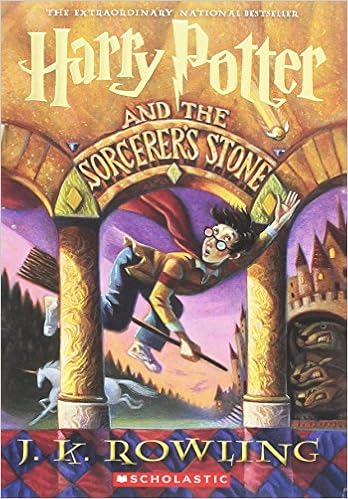
So there we go. We have rules, so let’s start the Ten Day Book Challenge. And with Day One, the choice of book is obvious: it’s Harry Potter and the Sorcerer’s Stone.

It’s fair to say that without Harry Potter, I wouldn’t be a writer. When I saw the first film it blew my mind, but the first book, which I think I read afterwards…I don’t know how to describe it, truth be told. Not just the world of Harry Potter, but the words within truly immersed me in the story. I don’t think before then I knew how words could be used like that. The words were the real magic, because they made places and creatures and people and concepts with rules come to life out of nothing. Like God, in a way. And I worshiped JK Rowling for years like a god, rereading the available four books at the time obsessively. But not only that, but I tried to write like JK Rowling. My first attempt at a novel was a Harry Potter-esque story with a female lead.* And even when I stopped working on that story, I still relied on Harry Potter and the works of JK Rowling to give me a basis on how to write.

It sometimes amazes me how far from Harry Potter ripoffs I’ve come since then. In fact, there’s almost no resemblance between my stories and Harry Potter! Still, without JK Rowling’s initial influence, I might be doing something very different today. And I have no idea what that “something very different” might be.

Ooh, there’s a horror story right there!

Anyway, I’m tagging my friend and fellow author Matthew Williams of Stories by Williams. Good luck, Matt! I hope you have fun with this (as well as time for it, what with a new book out and all).

That’s all for now, my Followers of Fear! I’m going to start prepping for tomorrow’s post…as well as possibly Days Three through Ten. Something tells me I’m going to need the prep.

*For more on my early writing projects, click here for an article on that subject.

Last year I had the pleasure of reading The Cronian Incident, a science fiction novel by my good friend and fellow writer, Matthew Williams. I found it a very engaging and deep sci-fi novel, and I was glad to hear that Matt had a sequel in the works. Last week, Matt released the follow-up to The Cronian Incident, The Jovian Manifesto, and I got my copy courtesy of Matt and the publisher, Castrum Press (my publisher too!). In order to celebrate the new book’s release, I thought I’d bring Matt back on for an interview.

So without further ado, let’s begin!

Rami Ungar: Welcome back to my blog, Matt! Tell the folks around here who don’t know you who you are and what you do.

Matthew Williams: Well, my name is Matt Williams, I am a resident of Vancouver Island in beautiful British Columbia, Canada. I live with my wife and cat, and I am a writer for Universe Today. In my spare time, I write (obviously), teach Taekwon-Do and generally enjoy the place where we live.

RU: Tell us about your two books in the Formist series, The Cronian Incident and The Jovian Manifesto.

MW: Both novels are set in the late 23rd century, at a time when the human race has expanded to colonize almost every body in the Solar System. In the Inner Worlds – Venus, Earth and Mars – life is characterized by advancement, augmentation and post-humanity. In the Outer Worlds, on the moons of Jupiter, Saturn and Uranus, are the people who have chosen to live a simpler existence, one that respects the line between humanity and machinery.

The story begins with the kidnapping of a high-profile man from Mars who belongs to the Formist faction (hence the name). These are the people who are dedicated to terraforming Mars so that their citizens can finally achieve the dream of living on the surface without pressurized domes or radiation shields. The Formists hire a special investigator to solve the kidnapping, a former member of Interpol named Jeremiah Ward who’s serving out a prison sentence in a penal colony on Mercury.

In investigating the disappearance of the Formists’ associate, Ward will uncover a plot that is centuries in the making. In the end, he will have to make the ultimate choice between doing what is right, and what may keep him alive.

RU: What’s different about writing The Jovian Manifesto, both in terms of content and just in writing the story?

The Cronian Incident, Book 1 in the Formist series.

MW: For starters, TJM is the second installment in what is planned to be a trilogy. As such, it has a darker tone than the first book. There’s also much more action, which was an absolute must for me! After taking the time to build the setting in Book I, I wanted the protagonists to be thrown into the thick of it. Of course, this book also introduces a few new main characters and a few new settings. This gave me a chance to tell new stories and create some new worlds, which is always fun.

RU: TJM features a female-led cast, something we’re seeing a lot more in various media. Was that intentional on your part?

MW: Not originally, no. In the first book, most of the story is told from a single POV – Jeremiah Ward’s. I wanted the second book to be told from multiple points of view and had several characters in mind when plotting it out. As it turned out, all of the new characters were strong, motivated and independently-minded women. When this was pointed out to me – by my friend and colleague, Rami Ungar, no less! – I was quite pleased. I had not embarked on this book looking to make the cast female-led, but I was happy it worked out that way. I’ve often worried that as a male writer, I would default to writing male leads, or find that writing female characters was more difficult. It pleased me to see that this was not the case.

RU: This is your second book with Castrum Press, and you also have a short story featured in their anthology, Future Days. What’s it been like working with Castrum?

MW: It’s been excellent, really. As a recently-established publishing house led by experienced writers, they know the particular struggles that new writers face. It’s also very clear that they are interested in promoting new talent, which is something you don’t see a lot of these days in the publishing industry. Also, it gives me a chance to entrust my work to people who have been part of the industry and know what it takes to succeed in it. That’s very reassuring to a newly-established writer, and something that independent authors don’t get to enjoy.

RU: Science fiction is often described as a lens towards what the future could be, as well as what our society looks like now. Do you agree with that sentiment? And what do you think the Formist series says about humanity?

The Jovian Manifesto, Book 2 of the Formist series.

MW: Absolutely. Science fiction has always been about predicting what the future will look like, but that always comes down to how the world looks today. In that respect, science fiction books are an extension of the present-day world and are intended to convey messages about the direction it is taking. As for my own work, I believe they reveal that regardless of the time period, or the level of development we will have reached, humanity will always be facing the same basic challenges. How do we ensure our survival and our future? How do we erase the dividing lines and learn to live together? How do we ensure that our most cherished values also survive?

RU: What are your plans for the future at the moment? More books in the Formist series, perhaps?

MW: Oh yes! I hope to write a third installment for this series and very much want to explore the universe I have created further. This could involve some origin stories, since some of the characters I have created have interesting pasts that would require a whole book to explain. I also hope to write additional trilogies that take place farther down the road. But of course, that all depends on how the Formist series shapes up. And of course, I have several other ideas I would like to see in print.

RU: What are some stories, science-fiction or otherwise, that you are reading now and would recommend?

MW: I recently finished The Dispossessed and The Left Hand of Darkness by Ursula K. Le Guin, both of which I would strongly recommend. I also finished Halting State and Rule 34 by Charles Stross, Fire Upon the Deep by Vernor Vinge, and House of Suns by Alastair Reynolds. I recommend all of these books to people who are fans of classic science fiction, space opera and near-future speculative fiction.

RU: Rule 34? I thought that was just an Internet meme. Should I ask or…? Moving on: if you could pick a fictional universe to live in, which one would it be and what would you do there?

MW: Good question, and one which I really haven’t pondered much. I suppose if I had to choose, I would live in the universe dreamed up by the late and great Frank Herbert – i.e. Dune. I figure I could help with the terraforming of Arrakis given all the research I’ve done on the subject. I have always wanted to try The Spice too, and I figure I would be able to look out for myself since I know how the series goes. Plus, I would absolutely want to see what travelling through folded space feels like!

RU: Final question: Look out! A sandworm out of the Dune universe is about to attack! What do you do?

MW: Ooh, that’s a tough one to answer! Deploy a thumper, stand back, and get your hooks ready, because we’re going for a ride!

RU: I’ll pretend I know what that means, because I’ve been bad and haven’t read the Dune books yet. Thanks for being with us, Matt! I hope both books do very well!

That’s the end of the interview, folks. If you would like to keep up with Matthew Williams, you can check out his blog, Stories by Williams. You can also check out his writings through his Amazon page and through his Universe Today page. And of course, you can check out his Facebook and Twitter pages. And I highly recommend you check out his books, The Cronian Incident and The Jovian Manifesto. I found the former to be a great example of hard science fiction, and I can’t wait to start on the latter.

And if you have a new book out and want an interview, check out my Interviews page and leave me a comment. We’ll see if we can’t make some magic happen.

That’s all for now, my Followers of Fear. I’ll hopefully see you very soon with more to talk about. Until then, pleasant nightmares!

Whenever I write through the perspective of a particular character in a story, it’s never simply just using my good-ol’-Rami-Ungar-style of narration and pretending to see things through the eyes of said character. I wish it were that simple. Characters, despite being the product of an author’s imagination, tend to feel like independent entities who are telling me their stories (if any psychologists or philosophers can explain that to me, I’d love to hear your two cents). Still, transmitting the story from my head, where the story’s presented as a movie with narration mixed in, to the page requires me to figure out how that voice manifests on the page.

Sometimes that’s easy to figure out. Sometimes it’s not.

The past couple of stories I’ve worked on–Mother of the King, The Night Hitler Came to London, and this novelette I’m working on currently–have been challenging when it comes to figuring out the narrators’ voices. This probably has something to do with the fact that the POV characters in these stories have lives that are very different from mine. For the first two, the POV characters have both been British, which I am not. I’ve been relying on all the British novels, TV shows and movies I’ve consumed over the years, trying to make them seem British, rather than Americans throwing around British colloquialisms like “bloody hell” or “tosser.” And in the case of The Night Hitler Came to London, the two main characters are growing up during the London Blitz, so trying to tap into the mindset living during that particular moment of history isn’t the easiest.

Then again, my country has been at war in some way or another since 2001. So perhaps it’s a bit easier than I give it credit.

And this current story I’m working on…whoo boy! I’m back to working on a novelette I started between two previous drafts of Rose, and the main character is a young housewife from the American South during the 1960s. That’s already pretty alien to my own experience, so it’s a challenge to make her sound like a real person without resorting to a stereotypical Southern accent. I’ve made some progress on that in this latest attempt on the story and I think I’ve figured it out, but I’m sure there will be challenges in the future, I may have to work on her a bit more before I try to publish this story anywhere.

And I’m probably not the only author who struggles with this. Because of how different their lives are from ours, or just how differently their minds work, there will be characters whose heads we struggle to get into and whose voices we struggle to translate to the page. With that in mind, I have a few tips on how an author can figure this out:

  • Look at their background. While every individual is different and background doesn’t determine everything, it can have a huge influence on how a person–and a character–turns out. How they were raised, socioeconomic status, education, religion, nationality, ethnicity, language, who they hung out with, how they were treated by teachers, how they did in sports, what they saw on the Internet. All this makes us. If we can figure all out of this, it can help us get in our characters’ heads and figure out their voices.
  • How do you want them to come off? How do you want your audience to perceive your character? If funny, make sure their observations are full of jokes and witticisms. Narcissistic? Everything comes back to them and makes them look good. Do they feel persecuted? Everything and everyone they come into contact with should reinforce that belief, even if to us we see innocence in these interactions. If you know how your character should come off to readers, you’ll have an easier time writing them.
  • Have an inner dialogue. This is something I did for my character in my current WIP. I go into this in more detail in my article on Self-Published Authors Helping Other Authors, The Inner Dialogue: A Method For Figuring Out Your Stories, so I highly recommend you check it out. If you don’t have time to read it, this is just having a conversation with your inner writer. You can also do this with your character. After all, characters are independent entities after a sort, so you can learn a lot by “hearing” them “speak.”

Some characters are easier than others to understand and translate to the page. But when they are, you shouldn’t give up. There are plenty of ways to figure them out. And when you do, that’ll make all the hard work all the more gratifying.

Have you worked with characters whose voices were hard to find? What did you do figure out their voices?

My latest article on Self-Published Authors Helping Other Authors, “What Do You Wear to an Author Event?” has just gone live on the site. As these self-evident titles of mine show, this one is about what authors should wear to a reading, book signing, or if you somehow end up on national television (which hopefully doesn’t involve urine released during a nervous mood). It’s a question I’ve had to wrestle with recently with Rose’s eventual publication on the horizon. Someone suggested to me I might want to consider dressing up a bit more now that I was at a new stage of my career, and of course I wondered if that was necessary.

The answer will shock you.

Please go and check out the article if you have a moment. And if you have the time, check out the rest of the site. Self-Published Authors Helping Other Authors is an excellent site with helpful and introspective articles from self-published and hybrid authors on how to write, edit, publish and market efficiently and effectively. No matter your genre, experience and background, you’ll find an article with information that you’ll find truly helpful. Believe me, I should know. I’m not just a contributor, I’m a reader.

That’s all for now, my Followers of Fear. I’ve got stories to work on, so I’m going to get on those. Until next time, pleasant nightmares!

The other day, I was talking with someone about what sort of tattoo I’d get if I were the type to get one.* This is a topic I’ve thought of a lot in my twenty-five years, and I think I’ve figured out what I would get. As I explained to my friend, it would be a representation of the horror genre, how the various causes of horror in fiction–like demonic entities, the prospect of death, and of course human beings, among others–have a detrimental effect on us. “It’s corruption of the innocent,” I explained. “The very essence of horror.”

And then I realized something: corruption of the innocence is an essential part, if not the essence, of horror. And it can be found in every horror story, if you think about it. I knew it was part of Gothic horror, as I mentioned it in my post about what makes Gothic horror. But beyond that subgenre? Hadn’t even considered it.

I could have hit myself for not realizing that sooner. It was staring me right in the face, goddammit!

As I said above, I mentioned how corruption of the innocent is an element of Gothic fiction, and we see this in Gothic stories like The Shining. Danny sees the world go from a mostly-nice place where bad luck sometimes causes disaster for good people to a dark place where entities like The Overlook exist and kill people or drive them mad. Said entity also tries to corrupt Danny’s shine, to make that beautiful psychic power part of its own dark self.

Innocence corrupted.

However, this concept is found in other horror stories. HP Lovecraft incorporated it into his work quite often. In The Call of Cthulhu, his most famous work, the narrator starts out as being very sure that the world is a concrete place of science and rationality. However, after going through his late uncle’s effects, he realizes that there’s something awful in this world, a worldwide cult devoted to the bloody worship of an awful god that will one day rise to retake the Earth. And not only did this cult kill the narrator’s uncle, its agents will likely kill the narrator, driven close to madness with fear, before long.

Innocence corrupted.

This story is a great example of corruption of the innocent at work without being part of the Gothic genre.

And sometimes the innocence being ruined here isn’t your traditional childlike innocence. Sometimes it’s as simple as just having your worldview changed. Two early Stephen King stories, “The Mangler” and “Battleground,” revolve around hardened men discovering the world can involve the supernatural or just plain weird (in this case, a possessed dry-cleaning machine and toy soldiers that come to life to kill you). As I said, nothing dramatic. Just a shift in viewpoint.

Innocence corrupted.

Even when it’s so ubiquitous though, I don’t think corruption of the innocent is the essence of horror, as I characterized above. Or at least, the only essence of horror. After all, we can’t forget about fear, which is what horror plays on and seeks to create. Without that fear, you just don’t have a good horror story. Perhaps then, like fear or a powerful antagonist, corruption of the innocent is something necessary to writing horror. Without it, the genre would be missing something that cannot be done without.

So while not exactly the full essence of horror, corruption of the innocent is important to the genre. You could even say it’s wrapped up in the essence of horror. And I’m glad I finally realized after such a long time that it was.

Hopefully it makes writing decent horror stories easier.

What do you think of corruption of the innocent as part of horror? Do you think I’m onto something?

Do you think I should get a tattoo? Would you like to see this design of mine realized? Do you know how any artists who could help me create it?

*For the record, I’m tempted, but my religious beliefs aren’t fond of me getting one. And I’m not sure I want something so permanent on my body, anyway. Especially if I have to pay a ton of money for what I’m looking for. Still fun to think about, though.

Also, I want it on my back. Best place to get it, in my personal opinion.

My friend Kat Impossible of Life and Other Disasters tagged me (and anyone with an interest) for this Harry Potter-themed tag. Seeing as Harry Potter is the reason I became a writer, and Harry’s 38th birthday is today (that’s right, he’d be 38 years old if he were a real person. Let that sink in for a moment), I figured it only made sense to do it and spread the word. Thus, here we are.

So Alohamora, on we go. Let’s get this thing started.

What is your blood status?

On the one hand, I get why this question is here. But on the other hand, it feels so wrong to ask a question based on how “pure” your blood is. We all know that pure-blood families just destroy all records of the members who intermarry. And how are they so sure none of their relatives intermarried with Muggles prior to blood-status becoming such a thing (Salazaar Slytherin was considered an outlier in his day, after all)?

Anyway, Kat had two tests to determine this (click here and here to try them out). I got pure-blood on the first one and half-blood on the second. I flipped a coin, and got heads, which is pure-blood. I guess my theory that my mother’s side of the family is related to Moaning Myrtle wasn’t so spot on after all (yeah, that’s a thing).

What wand chose you?

According to Pottermore, my wand is ten and three-fourth inches, laurel wood, unicorn core, and very flexible and swishy. According to the site, that means my wand’s magical performance is consistent and decent, hates laziness, and very adaptable to my needs. I have to say, I kind of like that.

Did you take a cat, an owl or a toad with you?

Cat, of course. As cool as owls are, I’m not very fond of birds, and besides, the school has plenty of owls. And we all know that toads are boring and that only losers get them. So obviously, we go for cats…which in the Wizarding World, tend to be more intelligent and great judges of characters than other cats, so I guess that works very well for me.

Now what to name my magical kitty? A difficult question if ever I’ve heard one. I guess it depends on what kitty I get.

Where did the Sorting Hat put you?

Slytherin, according to Pottermore. I was shocked when I first found out, but I guess it makes sense. I mean, one of my nicknames is the Pale Dark Lord, and I have to be at least a little bit evil and ambitious to write horror like I do. Of course, when I told my mom, who is a huge Potterhead, she nearly disowned me right there and then over the phone. And my sisters were almost afraid to associate with me. But they’ve come around since then. My mom even bought me a Slytherin shirt when she went to Harry Potter World in Florida a few years ago. It’s one of my favorite shirts ever. And last year in Boston, I bought a Slytherin tie from an HP-themed shop. I love wearing it to work and when people there notice it.

What house did you want to be put in?

Gryffindor, I think. Everyone wants to be in Harry’s house, after all. And if not that, Ravenclaw, because I read a lot and like to think of myself as intelligent. However, I’m glad I went to Slytherin in the end. Like I said, it makes a whole ton of sense. And besides, I do a great Draco Malfoy impression when I take off my glasses.

What are your favorite and least favorite lessons?


Ooh, tough choices considering I’ve only heard Harry’s experiences with his classes to judge by. Though if I had to guess, I probably would enjoy Potions the most. Unlike Chemistry, where you had to understand how molecules and acids and bases interact, Potions is very much like cooking, except without food. And to use a bad joke, I can be a wizard in the kitchen sometimes (my friend and colleague Joleene Naylor can attest to that). So I think I’d excel at that. I might even take up potion-making as a hobby.

As for least favorite, I’d have to go with Arithmancy. Math-based magic does not sound like a lot of fun, and math has never been my favorite subject to begin with. I’m actually surprised that Hermione likes it, as in both real life and in the Wizarding World, it’s used to predict the future. Then again, numbers and patterns are used by economists and college professors all the time to predict economic trends and presidential elections, so I guess Hermione likes it because it actually produces results, unlike standard Divination.

What is your Patronus?

I’m a dolphin, apparently (which also means that’s what I’d turn into if I were an Animagus). Makes sense, as I’m a very fun-loving and excitable person. Though I’m not very fond of swimming, truth be told.

What does your boggart look like?

Rejection by people I love. I have this ongoing anxiety that something I say or do might cause people to hate me and not want to associate with me. A boggart turning into people I know saying they want nothing more to do with me and pointing out all my flaws would be a nightmare. As for what I’d turn it into, I think I’d have it turn into a performance the musical The Book of Mormon. That musical is hysterical, and forcing the boggart to become that would be such fun (see this video from the Tonys a few years ago just to get an idea of how funny this boggart would be).

Either that, or Tom Ellis playing Lucifer, because I can’t be scared of that devil. I’d just melt into his arms…

I’m sorry, I was drooling for a second. What were we talking about?

Do you partake in any magical hobbies or school sports?

Probably. As I said earlier, I’d probably enjoy making Potions, so I would definitely be part of the Potions Club. I’m not much of a sports player, so I don’t think I’d be on a Quidditch team, but I might enjoy flying for fun (in fact, is there a club for that?). Surprisingly, I don’t know if I would be a writer if I were a wizard. Except for the Tales of Beedle the Bard, a comic book about a mad Muggle, and everything by Gilderoy Lockhart (burn!), there’s not much evidence of fiction existing in the Wizarding World. There are plenty of non-fiction books mentioned in the series, but very little fiction.

Perhaps I might still be a writer, though. I’d just adjust my stories to be horror stories set in the Wizarding World, possibly dealing with entities that ordinary wizards can’t handle or Dark Wizards. But again, I don’t know. I guess it would depend on what forces shape my life while I’m at Hogwarts and then what happens afterward.

Where would you spend your spare time?

The library or the Slytherin common room. I love books, after all, and the library is a great place to read and study. And who doesn’t hang out in a common room? Oh, and wherever I could go to brew a potion. I have a feeling I’ll be using my cauldron quite a bit, so I’ll need a place where I can work without having to worry about the smell of cooking magic liquids.

What would you most likely get detention for?

Given what I got detention for in high school, either having late homework assignments or being too talkative. That last one has gotten me into trouble more than once in the past, though I’m better at controlling it nowadays.

What career do you want after graduating Hogwarts?

Well, if there is a Wizarding tradition of fiction, I could see myself going into that. Though seeing as writing probably doesn’t make that much money, even in the Wizarding World, I could see myself becoming either a Ministry official, or a Potioneer. Both of those would probably suit me very well.

I TAG…

Anyone who wants to do this tag! I mean, it is a lot of fun, so why shouldn’t you? Just make sure to link back to me when you do.

Well, that’s all for now, my Followers of Fear. I hope you had as much fun reading this as I did writing this. Until next time, pleasant nightmares and GO SLYTHERIN!!!

Well, here we are. The latest Five Nights at Freddy’s novel, The Fourth Closet, was released late last month. I’ve spent the past week reading it, wondering if this is the last novel, if this book contains answers to the events of the previous books and the franchise’s lore as a whole, and wondering just how this volume compares to the previous two books. Since I finished it yesterday, I’ve been dying to share my thoughts on it (and all without being shoved into an animatronic suit, I might add). So now that we’re here, let’s dive into what is likely the last FNAF novel (thought considering this novel was co-written by franchise creator Scott Cawthon, who knows if it’s truly the last?).

So for those of you who don’t know, Five Nights at Freddy’s is a video game franchise about security guards having to deal with haunted animatronics that try to kill you during your shift at a pizza place (or in the case of the fourth game, someone’s bedroom). Yeah, I know it sounds ridiculous, but it has proven immensely successful, spawning several sequels and spin-offs, three novels, a movie in development at Blumhouse Productions (which I wish would go into production already), and thousands of fan-made tribute games. Some of the reasons for the game’s success is its simple yet intense gameplay, as well as its deep and mysterious lore (supposedly the events of the game were caused by a serial killer and the ghosts of his victims, but figuring out what exactly went down and when is a challenge).

I’ve reviewed the first two books, The Silver Eyes and The Twisted Ones, and while I wouldn’t count them among my favorite horror novels, I have found them intriguing enough and similar to slasher movies in book form. And I found Twisted Ones to have improved and fixed many of the issues of Silver Eyes, making for a better novel, so I hoped The Fourth Closet would also improve. Did it? Let’s see.

Fourth Closet takes place about six months after the events of Twisted Ones, and tells the story mainly from the POV of the other main characters, especially series’ protagonist Charlie’s love interest John. At the end of Twisted Ones, Charlie had seemingly died, but in this new volume, we see Charlie returned alive two days later. Or did she? While everyone else is convinced this Charlie is their Charlie, John isn’t so sure. And when kids start disappearing in town again, like they did during the tenure of the original Freddy Fazbear’s Pizzeria, John must gather the gang together again to investigate. But will searching for the truth lead to answers, or will it lead to horrors that the characters never anticipated?

So to start, this novel does show improvement over the previous two. The story and mystery is well-told, and the violence, which there is plenty of, is written to be easy to picture in our heads. I also found a number of surprises in the course of the story that were really surprises, rather than predictable twists, and elevated the story. And of course, we got to see a number of famous animatronics from the franchise, including a few of my favorites. I never mind seeing those guys. And finally, the story ends in a way that I can be satisfied with, especially if Cawthon is intending on writing a trilogy.

Of course, this novel does have some issues, as the others did. For one, the main cast is still flat as boards. Yeah, we get some insight into their thought processes in this book, but it doesn’t really allow us to get to know them as characters. That, and there’s a big reveal about Charlie that isn’t as well-written as it could have been. So while I kind of understand what the reveal is, I’m also a little confused and could use some more information to explain things. I know, Cawthon likes to let fans guess and spin theories with this franchise, but doing the same thing in a novel can seriously backfire on you (believe me, I learned that during one of the drafts of Rose). And trust me, it backfired here.

But on the whole this novel is a decent story, and shows its writers’ desire to learn from past mistakes in order to make sure any addition to the franchise is worth it. On the whole, I’m giving Five Nights at Freddy’s: The Fourth Closet a 3.4 on a scale of 1 to 5. If you recall, I gave the first and second books ratings of 2.6 and 3, respectively, for an average of 3 out of 5 for the trilogy. Average as a whole, but considering the source material  is a video game franchise and that the creator isn’t used to writing prose fiction, average is great. After all, under other creators, it could very well turn into the literary equivalent of the Super Mario Bros. movie. And nobody wants that!

I’ll admit I’m a few days late to this, so perhaps the news has already gotten around and this post is unnecessary. But for those of you who haven’t heard, it seems that the saga that has been called Cockygate has reached its resolution. And you know what? It’s really good news.

Now if you haven’t heard, Cockygate got started around late April/early May in response to the actions of Faleena Hopkins (or as I prefer to call her, Lady Voldemort). Hopkins, a romance writer who wrote the “Cocker Brothers” series, tried to get a trademark on the word “cocky” when used in book or series titles. Now this word has, not surprisingly, been used in book titles well before Hopkins applied for her trademark, but that didn’t stop her from applying for it, and then going after independent authors that can’t afford lawsuits to either take the word “cocky” out of their book titles or take them off Amazon (seriously difficult either way you look at it) or they could face legal action.

And you wonder why I call her Lady Voldemort.

Two things happened after news of this broke: several authors and companies tried to copy Hopkins, and the majority of the author community rose up against her, with the hashtags #cockygate and #ByeFaleena (get it?) going viral within days. The Romance Writers Association started looking into legal action. Kevin Kneupper, a novelist and retired lawyer, came out of retirement to fight Hopkins on this and force her and others imitating her to back down. He was joined by romance writer Tara Crescent and Jennifer Watson, a promoter for the CockTales anthology, whom Lady Voldemort had named in a lawsuit.

And so for about three months, this thing has been going on, with lots of authors wondering if, in a world where you can trademark any single word in a title, if it’s even worth it to write.* There have also been a slew of stories published with the word “cocky” in the titles in protest, and they’ve done quite well for themselves. And of course, everyone’s been watching the courts to see how this will play out.

Well, for the past few weeks, there’s been talk of both Hopkins either accepting a settlement or getting her butt handed to her by a judge. And this past week,  we got news. Hopkins agreed to an unspecified settlement and has withdrawn her trademark on the word “cocky.” If you go to the US Trademark and Patent Office’s website, it’ll say “invalidation pending” on Hopkins’s trademark.

Make no mistake, this is a victory for authors to be able to title their stories whatever they want without fear of legal repercussions. There are still plenty of imitators trying to get their own trademarks through, but Hopkins is the original, and this victory sends a message to her imitators and her opponents. So while there are still legal hurdles to get through with the former, us in the latter know that with enough people caring, we can overcome these monsters and get our stories out there without fear of being sued for using a simple word.

And as an author who could’ve easily been affected by this (seriously, type into Amazon the words “Snake” or “Rose.” If someone did this to me, I could be in trouble), I’d like to thank Mr. Kneupper and all the authors, lawyers, Twitter activists, and readers who lent their time and energy to putting up this fight against Lady Voldemort. You did the creative community a huge favor, and I hope we can always count on your love and strength when we need to fight assholery like what we’ve experienced this summer.

And to Ms. Hopkins herself, I hope she’s happy. The terms of the settlement aren’t known, but whatever they are, I hope she’s satisfied. Because this saga has led to her reputation being shredded. She set herself up as a bully and manipulative monster who went after authors without money or legal mettle. And during these three months, she’s only dug herself further into a hole, calling people who use stock photos after she does “copycats” (WTF?) and alleging people who call her fans and supporters stupid are equating them with having autism (um, excuse me?). Now she’s become a byword for a monster, a nasty character who tries to take advantage of other writers, of being greedy and willing to use underhanded tactics to get ahead.

And while I try not to wish bad things upon people I disagree with, I really hope that Lady Voldemort’s writing career goes like the GIF below from now on.

Thanks for reading, Followers of Fear. Hopefully this is the last time I ever have to mention Cockygate or Lady Voldemort ever again (though if I have to, I will). In the meantime, I wish you a good weekend and warn you to expect more from me this weekend.

Until then, pleasant nightmares!

*I mean, imagine if instead of proper titles like “Harry Potter” or “Star Wars” getting trademarks, someone could trademark a word like “the.” Just “the” in any title, and it holds water. You run into all sorts of trouble from the get-go!