Posts Tagged ‘celebrities’

I talk a lot about my writing career. Not just on this blog, but everywhere else: when I was at school, at social events, at wherever I happen to be worshiping (usually it’s at a synagogue, but occasionally I’m at other places), when I’m hanging out, and of course, at work. I’ve mentioned to more than a few people at work that not only am I a writer, but I’ve told them that Rose is getting published by a publishing company. The vast majority of people I’ve talked to about it have been very excited to read it, even if horror is not their normal genre (though I think Rose would be more classified as a supernatural thriller at this point). It really boosts my mood when people say that, and makes me want to be an even better writer.

Today, a coworker from another office and I passed in the hallway at work. She asked me about updates on Rose, and I told her that my publisher was hopefully going to get back to me this week about some revision suggestions I’d made. She got that “how cool!” look on her face and told me to keep her informed. She then dropped this on me: she’d been telling her kids about me, as I was proof of success for “following your dreams.”

Well, this really got my thinking. I mean, I’m flattered and all, but do I really deserve to be called an example of following your dreams? To my coworker, I probably am. After all, to non-writers, getting the book accepted by a publisher counts as living the dream. But to me, I haven’t accomplished my dreams yet.

That’s not modesty on my part, I’m just not sure I can say I’ve reached my dreams. At least not at this point. My dream has changed over the years, from being the next JK Rowling to the next Stephen King to just being able to make a living off of writing and maybe writing full-time, which is where my dream is that today. And I’m not there yet by any means. I still work a 40-hours a week job to pay my bills (sometimes longer if I have to stay late to finish up certain projects). And while Castrum Press wanting to publish Rose is a big step in the right direction, the book still has to come out.

I guess what I’m saying is that I’m still following those dreams. I’m still working to make it so that I’m in bookstores, to get lots of people to actually want and look forward to reading my books. And I say “books,” because it’s probably going to take several books, if I’m very lucky, to be able to write full-time. It’s rare for authors to be able to write-full time, and even rarer just after the first book. If I somehow manage to make that happen, then hooray. But at the moment, that’s still several years in the future.

I guess I’m still chasing my dreams. Right now, I’m on the right track, and I’m an example of how hard work, lots of revision and rejection, a bit of backbone, and a Plan B if you don’t happen to be one of those overnight success stories (aka employment) can pay off a little. But of successfully chasing your dreams? Well, we’ll see where I end up in the next few years. Fingers crossed it’s a better place than where I am now, even if I’m still not writing full-time.
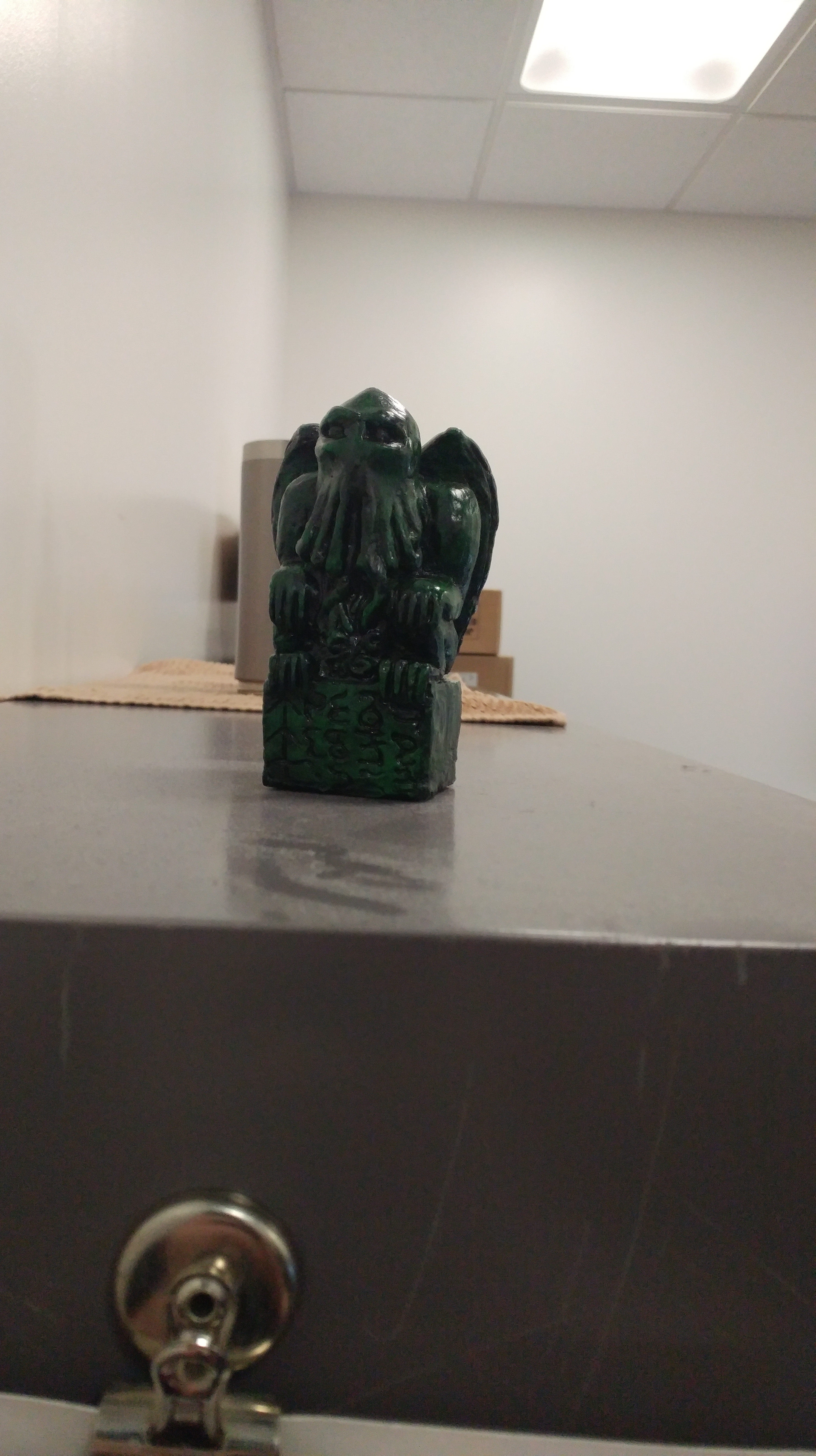
On an unrelated note, you remember how in my last post, I talked about getting a statue of Cthulhu? Well, my boss took a look at it this morning and okayed me to keep it in the office. To which I say, “Yay! Now I can really start turning my workspace into a den of horrors!” But seriously, it’s nice to really be able to personalize my workspace in such a way. Before now, it really didn’t have that much to say, “Oh, this is totally Rami’s desk. You can just tell by looking at it.” There’s a lot of rules to how one can decorate their workspace at my job, so being able to just have Cthulhu there is a big deal for me. Perhaps in the future, I can also put some other cool stuff around my desk to really help me feel at home while I work.

Until then, I’m cool with just Cthulhu. Besides, he looks so cool there, doesn’t he? I think he does, anyway.

That’s all for now, my Followers of Fear. Thanks for letting me ramble on about this stuff. Until next time, pleasant nightmares!

Whenever Blumhouse is involved in a movie, I usually get interested, as they tend to produce high-quality horror films. When I heard about this film, I got interested both because it had an interesting concept behind it, and because I like Tyler Posey (Teen Wolf fan for life!). So even though it got negative early reviews, I decided to check it out anyway, and convinced a friend of mine to see it with me.

I have a lot to say about this film. Let me try to keep this brief.

Truth or Dare follows a group of college students who go to Mexico for their final spring break. While there, they meet a mysterious man who invites them up to an old Spanish mission for drinks and some good, ol’ fashioned truth or dare. However, when they leave Mexico, they find the game has followed them, and it’s now much nastier: you either play the game, no matter what horrific secrets you might have to share, or what terrible deeds you must commit, or you will die. And the game won’t end till all the players are dead.

Now on the surface, I should have liked this movie. In addition to an interesting concept, the film is incredibly well-written. The story isn’t only compelling, but surprisingly, without plot holes. With very simple tricks, they plug up most of the plot holes that would come up in a horror film, let alone one surrounding a game mainly played by children and horny teenagers. Not only that, but the way the film has these characters expose their deepest secrets is so good at making you feel sympathetic, you almost feel their pain. And when they have to undertake some of the dares, you actually get a little afraid for them.

Not only that, but most of these characters are well-written and multidimensional. Most characters in horror films are ridiculously flat, and especially in ones based around games (*cough* Ouija *cough*). But Truth or Dare actually makes these characters more than flat or stereotypes. They have trouble, they have hidden depths, which is only made more clear when characters are forced to reveal dark secrets. This is especially true with the character of Markie, who at first glance is a happy-go-lucky strawberry-blonde, but in actuality is struggling in a number of ways.

It’s helped by the fact that the actors in these films are all really good. I can’t say any one of them gave a bad performance.

But the film has one big issue: its atmosphere. In horror, atmosphere is essential. And this film  doesn’t really have one, at least not one that lasts. Several times, the film does create some tense moments (keep an eye out for the roof scene), and there are a number of great jump scares. But after the tense moment or the jump scare, I found myself winding back down to normal. And in a horror film, you should be kept at a slight tension at every moment. There should be something in the back of your mind that says, “Oh my God, I’m scared, my heart rate is going to increase a little.” And I never felt that way during this film.

And that really brings down the film as a whole.

Still, if it weren’t for that problem, this film would be terrifying. On a scale of 1 to 5, I give Truth or Dare a 3.5 out of 5. Despite its lack of atmosphere, I honestly recommend seeing it. It probably won’t leave you scared stiff, but it’ll keep your interest and won’t leave you angry at the actors or the directors like other films I could name (*cough* The Friday the 13th remake is a piece of trash, and I would love to chase Michael Bay around Camp Crystal Lake for that ass-terrible excuse of a film. *cough*). Give it a watch, if you feel so inclined, and decide for yourself.

Go on. I dare you.

Whenever you hear a movie getting a ton of hype, especially a horror movie, you tend to be a bit skeptical. And when you hear that Platinum Dunes, Michael Bay’s production company for horror movies, is involved, you’re even more skeptical. I mean, have you seen Ouija? Or that crappy, way-too-sexual middle finger to a franchise that was the Friday the 13th reboot (I’m sorry, but I’ll never forgive Michael Bay for that film. Did not understand what made Jason Voorhees or the Friday the 13th films great at all).

I’m glad to report that this film was not only very good, but actually scared me a bit. And I credit that to how much its director, John Krasinski, who also starred in the film with his real-life wife Emily Blunt and co-wrote the script (rather than a certain director who thinks explosions, boobs, and unsteady camera movements make good cinema).

A Quiet Place follows a family–a father (Krasinski), a mother (Blunt), their deaf daughter (actually deaf actress Millicent Simmonds), and hearing son (Noah Jupe)–living in the first years of a post-apocalyptic world where a predatory race of creatures that hunt through sound have exterminated most of the human race. The family tries to survive each day without making a sound, speaking only with sign language and going to extreme lengths to muffle or suppress every noise (which makes you very aware of how much noise we make in our everyday lives). Which is getting more and more complicated because the mother is heavily pregnant (you can understand why that might be an issue). The film chronicles one particularly nasty night, when the mother goes into labor, and what happens afterwards.

This film is a great horror film. For one thing, the emphasis on sound in this film, both in terms of the lack of ordinary sounds like speech, electronics, and whatnot, the sounds we do hear, from nature to the monsters’ roars and growls, to the music, help to create this creepy, unearthly atmosphere. This helps in suspenseful moments, where characters have to be very careful not to make a sound or they’ll get killed, as it heightens the terror you feel. Hell, I was afraid to make a sound during those moments, and I was in the audience! Coupled with a some well-timed jump scares, you get a really scary film.

I also really liked the monsters in this film. Even in broad daylight, the monsters aren’t very easy to make out through most of the film, keeping them mysterious and making their deadliness all the scarier. And when we finally do see them, they are still really terrifying to look at, even if they may look like the monsters from a certain popular science-fiction/horror franchise (those who’ve seen the movie know what I’m talking about). And I love how not much about the monsters is revealed in the film. You learn enough to understand how they hunt and why they’ve been so successful in hunting down humanity, but you never really learn where they came from or how they appeared on Earth. And that, like the Xenomorphs from the Alien franchise before Prometheus, just makes them all the scarier.

But the best part of this film are the relationships between the family members. With little to no spoken dialogue, you really get to see how this life has been wearing on them, how little mistakes and arguments, along with the constant need for survival, have given each character their own struggles and fears, and how all that creates tensions between them. Seeing them work together, fight, and try to overcome this life is not only enthralling, but contains a great metaphor for the struggles of a family–any family–during difficult times.

That all being said, the lack of sound and action at times does make it hard to stay invested or pay attention to the story. I also thought that the ending could’ve been darker, which would’ve made it a much more memorable and powerful film. At least in my mind.

All in all, I’m giving A Quiet Place a 4.3 out of 5. This is a scary film that will draw you in not just with its premise and atmosphere, but with its intelligence and depth. Take a look and see why silence is truly golden.

You know, you often get great horror films. You get great science-horror films. And every now and then, you get a great horror film that makes you think, like Get Out or As Above, So Below. But I’ve never seen a science-horror film that’s not only good, but made you want to speculate so much about its deeper meanings and the questions it raises.

Based on the novel by Jeff VanderMeer,* Annihilation focuses on Natalie Portman as a biologist who goes on an expedition with four other women into “The Shimmer,” a place where everything is mutating and changing and no previous expedition has come back alive, after her husband returns from there gravely ill and seriously changed. Once inside, they will be tested in ways they cannot even imagine, and discover something horrifying.

This was an absolutely amazing movie. For one thing, the main cast (which is all women but not treated like a huge deal at all by the film, which I love) are all absolutely amazing. They really make you believe they are these characters, even if they aren’t given that much development. Gina Rodriguez, who plays Anya Thorensen, was especially great, and seeing her transformation through the movie is worth the ticket price alone.

Visually, this film is a feast. There’s so much to look at and take in, but it never really feels overwhelming. Sometimes the imagery is beautiful, sometimes it is baffling, and sometimes it’s creepy, but you’re never going to look away because you want to take it all in. And as for atmosphere, this film does a really good job of just building up an air of strangeness. So much of what’s in the Shimmer is unreal and surreal. It’s unknown to everyone, and the characters have to guess most of the time as to the meaning of things. And that’s what they’re doing: guessing. Very little is confirmed, and so much is unknown. So you kind of feel their fear and paranoia as they start to wonder what is real, what is happening, how it could be happening.

But what I love most about this film is how intelligent it is, and how it makes you wonder. As I said, very little is confirmed with this film. A lot of what we see, we the audience have to draw our own conclusions and decide what is happening, or what the deeper meaning is. Or if there is a deeper meaning. Or if what we’re seeing is actually real. It’s so strange, but at the same time so thought-provoking. And it’s been a while since a film made me wonder this much, made me want to examine it more.

If I’m going to ding the film on anything, it’s the CGI. Except for the film’s climax, the CGI doesn’t work well. It’s not awful, but I feel it would work better in a video game instead of in a live-action film. I would’ve preferred if they’d tried for a more animatronic approach, like with the Jurassic Park films.

On a scale of 1 to 5, I’m giving Annihilation a 4.5 out of 5.  A visual thrill-ride of the strange and otherworldly, fronted by a great cast. Definitely check it out and get lost in a world of the hallucinatory and engaging.

*By the way, I tried listening to this book on audio. But the narrator’s voice made me sleepy, so only so much of the novel actually made it into my brain. From what I remember though, the novel and movie differ on a lot. But in a good way.

I did not finish watching the Netflix show 13 Reasons Why, owing to how depressing it was (I like dark stuff, but that show just took the joy out of living!). But in recent weeks, one scene from that show, a surprisingly not-sad scene, has been coming back to me. In a flashback, the main character Clay is critiquing another kid’s essay, and notices the latter uses the word “unique” several times. When the other kid asks why that’s an issue, Clay says that if everything is unique, it means nothing is unique. And on the surface I agreed with that sentiment, but I didn’t realize how it applied to my own writing until almost a year later.

As many of you know, I recently finished a fourth draft of my college thesis Rose, and that I had the novel beta read by a couple of people, including my colleague and good friend Joleene Naylor. One of the things she pointed out was a problem throughout the novel, and which I’ve been trying to avoid in subsequent stories, is repeating words, especially adjectives. Apparently I’ve been using the word “unique” several times in a single chapter or paragraph, though “unique” wasn’t usually the word I used.

Actually, it tended to look something like this (not an actual line from the novel, but I think you’ll get the idea):

Rose stood in place, refusing to show her fear. Angrily, Paris placed the book on the table.

See how I used “place” twice? A better way to write this might have been:

Rose held her ground, refusing to show her fear. Angrily, Paris placed the book on the table.

See the difference? And I had to do this throughout the fourth draft, identifying where I repeated words in close proximity to one another, and then coming up with a better way to say it.

And I feel like this is a really common issue that writers have to deal with at some point, or possibly at several points, in their careers. Despite our reputations for loving really big words (verbose, callipygian, penultimate, etc), when it comes to fiction, we tend to just use everyday words. After all, we’re normally writing for everyday people, not for a small niche of scholars or people associated with a small religious movement. So if a simple word, like “unique” or “place,” fits the bill for telling the story, we’re likely going to use it. And we’ll use it again and again, if it’s the first word that comes to mind.

But as the above points show, you have to vary what words you use in order to tell a story and not distract the reader. And that’s something I’m trying to learn how to do as a writer. You know, along with learning how to write good short stories. And writing good stories in general. Again, I leave that up to the feedback of my readers. But this is getting a lot of emphasis as well. Because as great as a story is, the language it’s told through can determine how successful it may be. Imagine if Harry Potter had been published and it read like a sixth grader had written it. I guarantee it wouldn’t be the phenomenon it is today and I might not have been inspired to be a writer (unless JK Rowling was in the sixth grade when it was published. Then she’d be the Mozart of literature).

So while I may never actually need to know twelve different ways to say “unique,” hopefully in the future I can avoid making mistakes like the ones above. And if I do (because let’s face it, no author is perfect), I hope I have a good group of editors and beta readers around me to point out those mistakes.

And if you’re an author who makes this mistake, the only way I can think of to avoid it is to do what you’re already doing: think about the words you use. Just do it a bit harder when it comes to the individual words themselves. At least, that’s what I’ve been doing. And I think it’s been working.

That’s all for now, my Followers of Fear. Expect another post from me (or maybe even two) very soon. Until next time, pleasant nightmares.

The great thing about three-day weekends is that there’s plenty of opportunities for catching a few flicks. So far I’ve watched Black Panther (really good, 4.2 out of 5), Halloween III: Season of the Witch (surprisingly decent, 3.5 out of 5), and this morning I caught the ninth entry in my Rewatch Review series, Mama. I honestly thought this film would be painful to watch, but…you know what, let’s get into the review.

WHAT’S IT ABOUT: Mama is about Victoria and Lilly, two young sisters who disappear after their father goes on a murder spree after the 2008 market crash. They show up several years later after living in the woods all this time and are sent to live with their uncle Lucas and his girlfriend Annabel. Pretty soon they start experiencing weird things and find out that the girls weren’t exactly alone in those woods. Someone, or something, was there with them. And it’s come back to civilization too.

WHY I DIDN’T LIKE IT: You know, I honestly don’t remember. I just remember not liking it when I saw it back in college.

WHY I REWATCHED IT: The director, Andy Muschietti, produced 2017’s It, and that rocked. What the hell did I miss in Mama that made studio heads select him to be the director after Cary Fukunaga signed off?

THOUGHTS: Apparently I missed quite a bit. Mama‘s a great horror film.

For one thing, the actors put their all into their characters, and it works. You really see the arc of Annabel, played by Jessica Chastain, going from a carefree rocker girl who doesn’t want to be a mom at all bonding with the girls and growing into the role of a mother. And watching the girls adjust to civilization is fascinating for each one. And seeing these three very different and clashing people come together as a family is heartwarming, but in a way that doesn’t take away from the horror of the film (*cough* unlike Before I Wake *cough*).

Not only that, but the film does know how to set up a creepy atmosphere while also using jumpscares. I found myself hopping in my seat more than a few times. And as the film goes on, it manages to up the creepiness without showing too much of the titular Mama, who for a horror movie villain is actually kind of sympathetic once you get her backstory. It was genuinely scary.

Of course, the film isn’t without its problems. At times, while Mama’s design is creepy*, the CGI used to make her can be a bit distracting at times. And the music in the final scene kind of makes this really heartbreaking scene kind of melodramatic and sappy. I’m sure the idea was to heighten the sad emotions, but it backfires for me.

And hoo boy, that movie was loud. I turned down the volume and I was sure my neighbors would knock on my door and ask me to turn it down!

JUDGMENT: I honestly don’t know why I disliked the film anymore, and I can see why Muschietti was tapped to direct It.

Mama is a terrifying but heartwarming horror movie with a great premise and wonderful characters played by accomplished actors. On a scale of 1 to 5, I give this film a 4.5 out of 5. I’m so glad my opinion changed on this one.


Well, that’s nine films rewatched. My last one might take some time to find, as it’s not usually available in the States. Still, I’m looking forward to it, and I hope you are too. Until next time, pleasant nightmares, my Followers of Fear.

*And is probably the inspiration of the look for the abstract painting woman from It. Not kidding, look at those two side by side. They’re basically the same character with a different style…so there’s a King/Muschietti shared cinematic universe now? It’d make sense, this movie does feel like it would fit as a Stephen King adaptation.

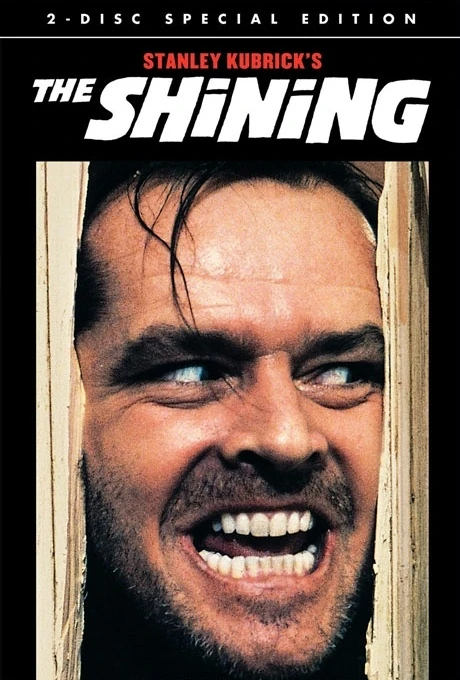
The Shining is considered one of the greatest horror films ever made, based on one Stephen King’s greatest novels. It’s still widely enjoyed today, has been very influential on a number of films and filmmakers, and has led to numerous theories about its deeper meanings, ranging anywhere from the Holocaust or Native American genocides to faking the moon landing. Yet when it was released, audiences and critics didn’t care for the film. Variety actually called it “a disappointment,” and Stephen King himself hates this film with a passion. Director Stanley Kubrick himself has garnered controversy for overworking and even abusing cast and crew during the production of this film.

I disliked this film immensely after I saw it in middle school, which was right after I read the novel. But I’ve since learned a lot about the film’s production and influence. And given the reasons I hated the film (see below), I’m wondering if my opinion needs a change. Let’s find out.

WHAT IT’S ABOUT: The Shining follows the Torrance family, who have come to the historic Overlook Hotel to be its winter caretakers. Isolated and cut off from the world, the Hotel’s supernatural side comes out to play, leading to a horrifying descent into madness and murder.

WHY I DIDN’T LIKE IT: It strayed too far from the source material. Not kidding, I hated the film simply because of how much changed from book to movie, to the point it drove out all my other reactions to the film (I can be a real purist sometimes). I actually preferred the 1997 television miniseries based on the movie because it was more faithful to the book,* and no other reason.

WHY I’M REWATCHING IT: Well, you hear so much about how great the film is, and you learn a bit about its production and legacy, and you realize how much a movie differs from its source material isn’t always a bad thing. Kind of warrants rewatching it.

THOUGHTS: That was a rather unsettling slow-burner, wasn’t it?

I’ll give the film this, it knows how to set up a creepy atmosphere with great visuals and sound. For one thing, the hotel is so distinct that it’s a character all onto itself. But it’s the way that Kubrick films the hotel and the characters in it that’s great. The whole film is shot with a wide-angle lens, which means we always see the characters alone in these vast spaces. On top of that, when close-ups are done, the wide-angle lens distorts the characters’ faces, giving the film a sense of surrealism and unreality. Add in the soundtrack, which sounds more like several clashing soundtracks playing at once. Heartbeats, eerie chanting, electronic music, symphonic pieces, all playing at once. It is creepy as hell.

I also like the reveals of scares. The camera always focus on the characters’ reactions to a scare before they show the scare. We see Wendy’s reaction to what Jack has been writing before we actually see it. We see Danny’s reaction to the little girls before the little girls are actually shown. That’s not something normally done in horror.

And finally, the film takes its time setting up the horror. It doesn’t rush in to showing us the gruesome haunting nature of the Overlook, but gives us time to see how isolated the characters are before introducing elements to show how their insanity is growing/the hotel is alive. It’s pretty effective.

However, I did have some issues with the movie. For one, the actors and the characters they portray. I didn’t care for either, really. Jack Nicholson is pretty good at playing a madman, but in my experience, that’s all his performances, and there’s not much transition between normal Jack Torrance to insane Jack Torrance. Shelley Duvall as Wendy…I don’t know what it was, but I just got annoyed with her every time she was on screen. And Danny Lloyd as Danny (ha!) was passable, but let’s face it, the character in the movie isn’t as fleshed out or as deep as he is in the movie. You could change the actor out, and it wouldn’t make that much difference, because Danny in the movie is very flat.

On top of that, I wasn’t ever that scared by the film. True, seeing Jack go after his wife and son with an ax is pretty threatening, but he doesn’t actually hurt them or get close to doing so. And while the film is good at keeping that creepy atmosphere going, it never truly escalates to the point where I feel myself shift from terror.

And like I said, the novel is phenomenal. Was it really that necessary to make so many changes from the source material? Also, what’s with that photo in the last shot? Was Jack reincarnated from a previous caretaker? Did he travel through time? I don’t get it! Explain movie! Explain!

FINAL JUDGMENT: I have a feeling this opinion is going to rile some people. On a scale of 1 to 5, I’m giving The Shining a 3.5. It’s creepy and visually creative, but the actors/characters aren’t that great, and the lack of terror, unexplained final shot, and important changes from the source material are issues that detract from my viewing.

Sad to say, it’s just not a film for me.


Well, at least I got that film out of the way. And with The Shining watched, I only have two films to go. Though I have a feeling this next one might be painful to watch…

Until next time, Followers of Fear, pleasant nightmares.

*And now I may have to get that miniseries again just to get a fresh opinion (Rewatch series 2?). And I’ll have to rewatch Room 237, the documentary on The Shining movie and people’s interpretations of it. And maybe reread the book? It’s been at least a decade, so I don’t remember it that well. And I should really get to reading Doctor Sleep, the sequel to The Shining. Especially since a movie version’s on the way.

I have a lot of work ahead of me.

I’ve mentioned it before, but short stories are often hard for me. And one aspect of writing those that I often have trouble with is the very first part of any short story. Openings. They give me grief.

With novels, I have a lot of room to maneuver around. After all, even a short novel is around sixty-thousand words (and mine are never that short). With all those words, I can take a lot of time and space just setting up the scenario of the story. Take my novel Rose, for example: if we count Chapter One as the opening, that’s sixteen pages and nearly five-thousand words just devoted to setting up the story. And I’m very used to writing this way. I like long, expansive stories. I grew up on a diet of Harry Potter, and in my teens delved into the novels of Anne Rice, Stephen King, and Dan Brown. No one could accuse those guys of being short.

But if I’m writing a short story, the highest word count to still count as a short story is ten-thousand. And if I want to get published in most magazines, the limit is usually around six-thousand. So while I’m used to opening a story with about five-thousand words, or half the length of the longest short story, I now have to try to contain my openings into a much shorter length.

The struggle is real.

Because of this need for brevity, one of the things I sometimes end up doing when I write a short story, at least in the beginning, is to use a lot of exposition. And in some stories, exposition is good. It helps fill in essential information. But in other cases, exposition is just…bad. Instead of actually presenting the story,  the author is just explaining things. Telling you stuff. It’d be like if instead of actually showing Harry Potter growing up, learning about his heritage, and going to Hogwarts, it’d be like JK Rowling wrote, “There was a boy named Harry Potter. One day he found out he was a wizard, his parents died saving him from an evil wizard, who disappeared and gave him a scar in a process, and then he went off to wizard school.”

I often worry that when I do exposition in short stories, it’s the latter kind. Which probably means it is the latter kind. That may be cynicism on my part, but when you’re still inexperienced at something, you’re prone to making mistakes. So perhaps I really am using exposition, and in all the wrong ways too.

Luckily, there are a few things I’m trying to remedy that. One is that I’m keeping in mind something important: I’m writing first drafts. And first drafts are always terrible. Even if they contain intriguing stories, they’re rife with issues that require lots of fixing. This is why we writers edit, multiple times if necessary, before we publish. Heck, Rose had to go through four drafts before I felt it was ready to be sent out to a publisher. And likely if a publisher does like it, they’ll probably have me do a fifth or even a sixth draft before they’re ready to publish.

So if I feel an opening needs work, I can edit it in the next draft, and remove any bad exposition or other problems with the opening I spot.

Hopefully I can improve this part of short stories.

And sometimes, I don’t even need to wait (and this is my second method, by the way). Sometimes a way to fix a short story’s opening comes to you just while you’re writing it. On Friday, I started a new short story that I think has potential. I think I got four hundred words in before I stopped, but then I was like, “Is this really the opening I want?” And as I thought about it, it wasn’t. But how to fix it? And yesterday at some point–I think it was right before I saw Winchester–a way to change the opening occurred to me.  I think this is the right way to open the story without going into exposition. So the next time I work on the story, I’m going go back and rewrite the opening, see if this produces better results. And if it doesn’t, there’s always something new to try. Or I can go back to my original opening. After all, it’s a first draft. I can make as many adjustments as needed.

And finally, I’m reading a lot more short stories than I’m used to. I learned how to write novels partly from reading novels, so reading short stories should help me get an idea on how to write them. I’ve already listened to two anthologies on audio book, and I just started reading the Stephen King collection Night Shift on Friday. So far, they’ve been very helpful, but I’ll need to read a lot more to get a better sense of short story writing.

And finally, I just need more practice. After all, you become a writer by writing in the first place, and continuing to write no matter what. With any luck, more practice with short stories will lead to better ones. Hopefully, anyway.

I’m still trying to be a better short story writer, and openings are still hard for me. But with practice and exposure to good ones, I can hopefully make some progress on that. And who knows? Maybe even produce some stories that a magazine will be proud to publish. Anything’s possible, right?


That’s all for now, my Followers of Fear. I’ve been looking at a screen for most of the day, so I’m going to take a break and read something. Until next time, pleasant nightmares!

A bit of background before I start this review: in case you didn’t know, or you’ve never read my third list of haunted locations I want to visit, the Winchester Mansion, known today as the Winchester Mystery House, is quite real. It was first started in 1884, but was continually worked on and added onto, around the clock, for nearly forty years. Sarah Winchester, the widow of the owner of the Winchester Rifle Company, believed that the spirits of those killed by her husband’s company’s rifles were after her family and had previously killed her husband and infant daughter. On the advice of a medium, she moved out to California and started building a house that doubled as a maze, meant to confuse the spirits who were after her family. She kept adding onto the house until her death, after which work completely ceased. The house is now a national landmark, and is reputedly haunted to the brim. It is this house, its mistress, and its hauntings that this movie is based on.

Everyone got that? Good.

Winchester follows Jason Clarke as a troubled psychiatrist who is sent by the Winchester Rifle Company to evaluate Mrs. Winchester’s mental state to see if she’s still fit to be a majority shareholder. Mrs. Winchester, played by Helen Mirren, allows the psychiatrist into her home at the same time as a powerful and angry spirit arrives. Together, they must confront this spirit before it kills every member of the Winchester family, and then some.

I went with a friend to see this film. I don’t know what my friend was expecting, but I was hoping, based on the trailer and what the film is based on, that it would be decent at least. At the end, we both agreed it wasn’t that.

Winchester suffers from a number of issues. One of the biggest issues is script. The film’s story is underwhelming, bogged down in exposition and with a villain who, while in concept sounds cool, in execution seems kind of boring. The villain actually reminds me of people’s reactions to Helmut Zemo in Captain America: Civil War. This is a character that’s supposed to be powerful and menacing, but for a lot of audience members (not me, though), the character’s film treatment was not intimidating and lacked menace. For me, Winchester’s villain was like that.

Another issue is the scares. There are a few good jumpscares and creepy imagery, but other than that, the movie isn’t that scary. It tries to build atmosphere, but it doesn’t go as far as it could to build an atmosphere. In other films, we’d see ghost children running in the background, shadows threatening to attack a character before someone walks in and interrupts. Stuff in other films that works very effectively. If we had more of that, the film might actually be a little scary.

I also didn’t care for Jason Clarke’s performance. He’s never been my favorite actor, but this time he was just terrible. Half the time he just mumbled his lines. After the film I just looked at my friend and I was like, “Would it have killed him to speak up?”

But the biggest thing going against the film, at least in my opinion, is the house itself. Or rather, the lack of the house. The actual Winchester Mystery House is a gargantuan structure: four stories, 161 rooms, two bathrooms, seventeen chimneys, two basements, three elevators. Stairs going nowhere, doors that open onto sheer drops, skylights and windows, etc. Even fake bathrooms. An entire maze of a house. But we wouldn’t know it, based on how little we see. A few key hallways and rooms, and some stairs for the arthritic, but barely anything else. If you never saw one set of stairs or a few key exterior shots, you would never know that the house was as huge and confusing as it is. I know the film didn’t have a huge budget, but come on! If you’re going to make a film about a giant maze-house, utilize the maze-house! You could probably make for a more exciting climax if you did that!

Did the film have any good points? Well, Helen Mirren as Sarah Winchester was actually kind of badass. She’s portrayed as this strong woman who works through her grief by battling the supernatural every day, and she doesn’t care what you think of that. It’s pretty cool. That, and the costumes and rooms, what rooms we see, anyway, look true to the time and are absolutely beautiful.

But that’s it. It’s not exactly awful, but it’s not very good either. It’s just below average.

On a scale of 1 to 5, I’m giving Winchester a 1.5. There’s a lot of potential in the concept, but this film definitely did not live up to it, producing an unremarkable period piece trying to be a good horror film. So if you’re looking to be scared, I suggest skipping this one entirely. It’s all bark, and absolutely no bite.

Well, it’s been a year since I last had a Lovecraft binge (see Parts 1, 2, and 3 for my previous binges). And while I didn’t read any actual Lovecraft stories in the year (holy cow, that long?) since my last binge, he was certainly never far from my mind. I read a lot of fiction influenced or modeled after his work, including the Lovecraft/YA novel Awoken* (read my review here), shopped around my own Lovecraft-themed story The Red Bursts (still working on that), and wrote an article about why there’s not more adaptations or even a cinematic universe based on his work. No, surprise, after all that I was ready for another dive into his work. And boy, did I enjoy the eldritch swim.

So if you’re not familiar with HP Lovecraft (and I’d bet good money that you’re not), he was an early 20th-century author whose ideas and stories proved very influential on storytellers like Stephen King, Guillermo del Toro, and Allan Moore, among others. He’s considered the father of cosmic horror, the idea that humans are basically ants in our universe, that there are beings and truths so great and terrible that even glimpsing them can cause madness and death. It’s pretty bleak stuff, if you think about too much about it (which I have).

So this time around, I read “The Case of Charles Dexter Ward,” Lovecraft’s only finished novel, “The Colour Out of Space,” “The Dunwich Horror,” “History of the Neconomicon” and “The Whisperer in Darkness,” as well as several fragments, one letter excerpt, and one parody story, but I won’t go over those. And I got to say, these were definitely some of the most enjoyable of Lovecraft’s stories. They were consistently creepy and kept me engrossed in the story, as well as with the most accessible language (dude liked to pretend he was a contemporary of Poe, rather than a contemporary of Ernest Hemingway). Or am I just used to his style now?

The interesting thing about these highlighted stories is, they also mark Lovecraft’s shift from pure horror to science-horror. Sure, he’s done that before–“Herbert West: Reanimator” is the story of two men trying to discover the key to bringing back the dead using science, a theme also explored in “Charles Dexter Ward,” but more thriller and magical than science-fiction–but here there was definitely a more sci-fi element in his work. “The Colour Out of Space” and “The Whisperer in Darkness” both involved aliens, with the former involving a sort of alien infection and the latter involving aliens that have been visiting Earth for centuries.

Why did Lovecraft make this shift? Well, around the time these stories were written–late 1920’s and early 1930’s–was also the birth of science fiction as a proper genre. Pulp magazines like Amazing Stories and Astounding Stories were huge sellers, and since pulp rags like these were where Lovecraft normally published his work, he would’ve been aware of the young genre and its exploration of humanity’s possibilities through space exploration, technology, and aliens. It’s no surprise that he’d take elements from those stories and give them a freaky twist. And lo and behold, it led to Lovecraft writing some of my favorite works by him (especially “Colour Out of Space.” God, that was freaky, considering that what happened in that story could maybe happen in real life).

Honestly, I’m glad I decided to check out HP Lovecraft two-and-a-half years ago. Sure, his early works can be hit-and-miss, but as time went on, he got better. And by this point in his bibliography, he was very good at writing stories that stayed in your mind. It’s a shame he didn’t achieve more of a following during this time, because maybe then we’d have more works by him (sadly, he died in 1937 at barely forty years of age), and he’d be more well-known today.

And while I’m done with my latest binge, I’m looking forward to my next one, whenever that is. Especially if the stories from this point on are as good as the ones I read this time around. And seeing as At the Mountain of Madness is the next story in my collection, I’d say that’s a definite possibility.

Have you read these stories or others by Lovecraft? What are your thoughts on them?

*Funny story about Awoken: so I follow this woman named Lindsay Ellis on YouTube (check out her channel here) who does a lot of videos on our media and culture. Yesterday she uploaded a video about whether or not the hate over the Twilight franchise was warranted. During said video, she mentions she and friend/frequent collaborator Antonella “Nella” Inserra wrote Awoken as a parody of Twilight, only with Lovecraft characters instead of vampires. My mouth hit the floor. I had no idea that the novel was a parody of Twilight, let alone written by those two women under a pen name. Though now that I think about it, it explains quite a bit.

I reached out to both women on YouTube and Twitter, letting them know that I read the novel, my ignorance of its authorship, how much I actually liked it, and that I reviewed it on this blog. They asked for a link, and I sent it to them. Since then, I’ve gotten hundreds of views from their readers/viewers on that one review, and the number of reads is still growing. Wow. Didn’t expect that. Pretty cool. Probably won’t last a week, but it’s still cool.

Also, I learned about Poe’s Rule: if you write a parody of something, unless you ad a healthy dose of comedy, people will think it’s serious fiction in a particular style. Which is apparently what happened to me, as these readers are telling me. Good to know.