Posts Tagged ‘Harry Potter’

My friend Kat Impossible of Life and Other Disasters tagged me (and anyone with an interest) for this Harry Potter-themed tag. Seeing as Harry Potter is the reason I became a writer, and Harry’s 38th birthday is today (that’s right, he’d be 38 years old if he were a real person. Let that sink in for a moment), I figured it only made sense to do it and spread the word. Thus, here we are.

So Alohamora, on we go. Let’s get this thing started.

What is your blood status?

On the one hand, I get why this question is here. But on the other hand, it feels so wrong to ask a question based on how “pure” your blood is. We all know that pure-blood families just destroy all records of the members who intermarry. And how are they so sure none of their relatives intermarried with Muggles prior to blood-status becoming such a thing (Salazaar Slytherin was considered an outlier in his day, after all)?

Anyway, Kat had two tests to determine this (click here and here to try them out). I got pure-blood on the first one and half-blood on the second. I flipped a coin, and got heads, which is pure-blood. I guess my theory that my mother’s side of the family is related to Moaning Myrtle wasn’t so spot on after all (yeah, that’s a thing).

What wand chose you?

According to Pottermore, my wand is ten and three-fourth inches, laurel wood, unicorn core, and very flexible and swishy. According to the site, that means my wand’s magical performance is consistent and decent, hates laziness, and very adaptable to my needs. I have to say, I kind of like that.

Did you take a cat, an owl or a toad with you?

Cat, of course. As cool as owls are, I’m not very fond of birds, and besides, the school has plenty of owls. And we all know that toads are boring and that only losers get them. So obviously, we go for cats…which in the Wizarding World, tend to be more intelligent and great judges of characters than other cats, so I guess that works very well for me.

Now what to name my magical kitty? A difficult question if ever I’ve heard one. I guess it depends on what kitty I get.

Where did the Sorting Hat put you?
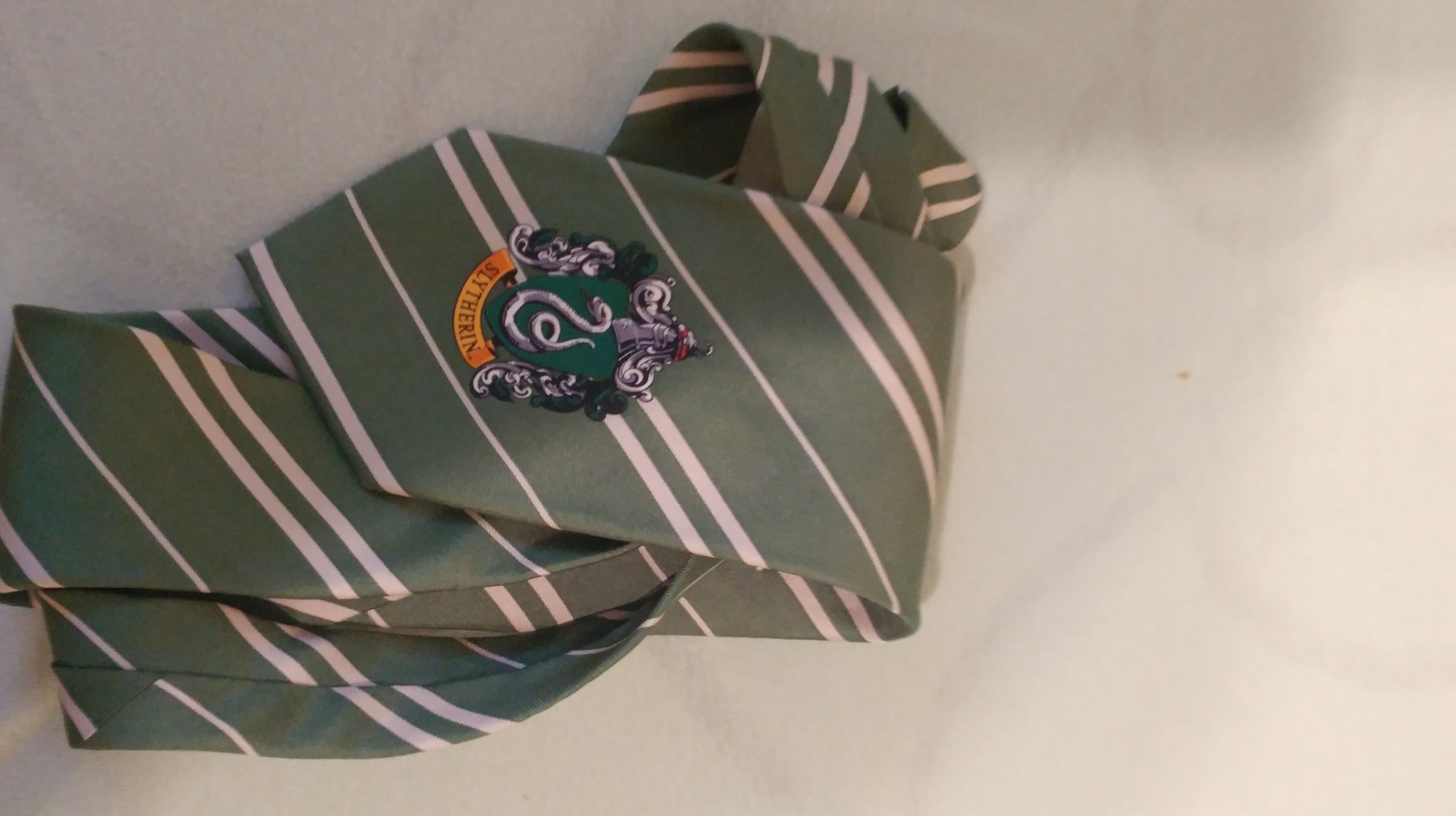
Slytherin, according to Pottermore. I was shocked when I first found out, but I guess it makes sense. I mean, one of my nicknames is the Pale Dark Lord, and I have to be at least a little bit evil and ambitious to write horror like I do. Of course, when I told my mom, who is a huge Potterhead, she nearly disowned me right there and then over the phone. And my sisters were almost afraid to associate with me. But they’ve come around since then. My mom even bought me a Slytherin shirt when she went to Harry Potter World in Florida a few years ago. It’s one of my favorite shirts ever. And last year in Boston, I bought a Slytherin tie from an HP-themed shop. I love wearing it to work and when people there notice it.

What house did you want to be put in?

Gryffindor, I think. Everyone wants to be in Harry’s house, after all. And if not that, Ravenclaw, because I read a lot and like to think of myself as intelligent. However, I’m glad I went to Slytherin in the end. Like I said, it makes a whole ton of sense. And besides, I do a great Draco Malfoy impression when I take off my glasses.

What are your favorite and least favorite lessons?


Ooh, tough choices considering I’ve only heard Harry’s experiences with his classes to judge by. Though if I had to guess, I probably would enjoy Potions the most. Unlike Chemistry, where you had to understand how molecules and acids and bases interact, Potions is very much like cooking, except without food. And to use a bad joke, I can be a wizard in the kitchen sometimes (my friend and colleague Joleene Naylor can attest to that). So I think I’d excel at that. I might even take up potion-making as a hobby.

As for least favorite, I’d have to go with Arithmancy. Math-based magic does not sound like a lot of fun, and math has never been my favorite subject to begin with. I’m actually surprised that Hermione likes it, as in both real life and in the Wizarding World, it’s used to predict the future. Then again, numbers and patterns are used by economists and college professors all the time to predict economic trends and presidential elections, so I guess Hermione likes it because it actually produces results, unlike standard Divination.
What is your Patronus?

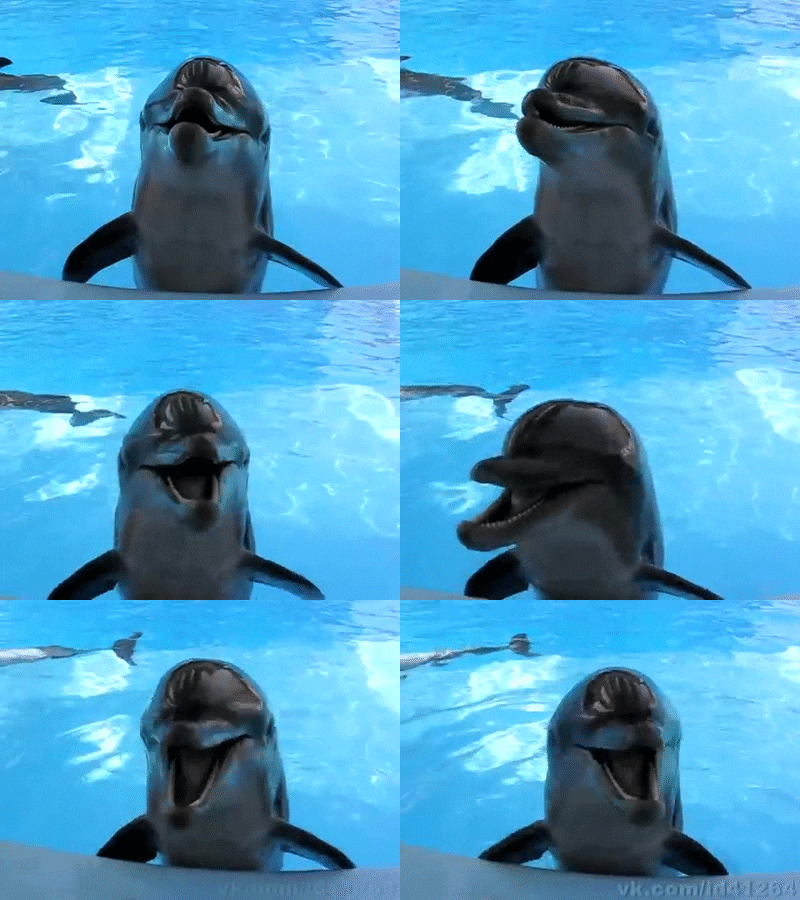
I’m a dolphin, apparently (which also means that’s what I’d turn into if I were an Animagus). Makes sense, as I’m a very fun-loving and excitable person. Though I’m not very fond of swimming, truth be told.
What does your boggart look like?

Rejection by people I love. I have this ongoing anxiety that something I say or do might cause people to hate me and not want to associate with me. A boggart turning into people I know saying they want nothing more to do with me and pointing out all my flaws would be a nightmare. As for what I’d turn it into, I think I’d have it turn into a performance the musical The Book of Mormon. That musical is hysterical, and forcing the boggart to become that would be such fun (see this video from the Tonys a few years ago just to get an idea of how funny this boggart would be).

Either that, or Tom Ellis playing Lucifer, because I can’t be scared of that devil. I’d just melt into his arms…

I’m sorry, I was drooling for a second. What were we talking about?

Do you partake in any magical hobbies or school sports?

Probably. As I said earlier, I’d probably enjoy making Potions, so I would definitely be part of the Potions Club. I’m not much of a sports player, so I don’t think I’d be on a Quidditch team, but I might enjoy flying for fun (in fact, is there a club for that?). Surprisingly, I don’t know if I would be a writer if I were a wizard. Except for the Tales of Beedle the Bard, a comic book about a mad Muggle, and everything by Gilderoy Lockhart (burn!), there’s not much evidence of fiction existing in the Wizarding World. There are plenty of non-fiction books mentioned in the series, but very little fiction.

Perhaps I might still be a writer, though. I’d just adjust my stories to be horror stories set in the Wizarding World, possibly dealing with entities that ordinary wizards can’t handle or Dark Wizards. But again, I don’t know. I guess it would depend on what forces shape my life while I’m at Hogwarts and then what happens afterward.

Where would you spend your spare time?

The library or the Slytherin common room. I love books, after all, and the library is a great place to read and study. And who doesn’t hang out in a common room? Oh, and wherever I could go to brew a potion. I have a feeling I’ll be using my cauldron quite a bit, so I’ll need a place where I can work without having to worry about the smell of cooking magic liquids.

What would you most likely get detention for?

Given what I got detention for in high school, either having late homework assignments or being too talkative. That last one has gotten me into trouble more than once in the past, though I’m better at controlling it nowadays.

What career do you want after graduating Hogwarts?

Well, if there is a Wizarding tradition of fiction, I could see myself going into that. Though seeing as writing probably doesn’t make that much money, even in the Wizarding World, I could see myself becoming either a Ministry official, or a Potioneer. Both of those would probably suit me very well.

I TAG…

Anyone who wants to do this tag! I mean, it is a lot of fun, so why shouldn’t you? Just make sure to link back to me when you do.

Well, that’s all for now, my Followers of Fear. I hope you had as much fun reading this as I did writing this. Until next time, pleasant nightmares and GO SLYTHERIN!!!
I’m sure that a lot of people are going to be confused by that title, and probably find it funny. Unfortunately, this is a serious topic that requires some discussion, so I thought I’d take a couple minutes to spread the word on what’s been going on.

Recently, it’s come to light that a romance writer named Faleena Hopkins placed a trademark on the word “cocky” (as in…you know), and has allegedly been sending cease and desist letters to authors who use the word “cocky” in their book titles. Of which there are many, and according to the letters, this is a form of copyright infringement, and authors should change the names of their stories or face the consequences. From what’s been going around, most of the authors who have received these letters are not big enough to actually take on a legal battle with other authors, rather than any big names in the romance field.

This is some grade-A bull. You can’t just copyright a single word and tell people they can’t use it in their book titles. You can copyright a specific word or words using a specific font (like nobody can use the word “Potter” with the Harry Potter-title lightning bolt script or the words “Star” or “Wars” with the Star Wars script without incurring the wrath of JK Rowling or Lucasfilm’s representatives), which is normal business practice. However, you can’t just copyright a single word, no matter the font, font size, or context, and say anyone who uses it in a story’s title is committing plagiarism or copyright infringement. Which is why nobody can sue me for naming my novel Snake, or why when Rose comes out, nobody can sue me for naming it that way.

And you know who else agrees with me? Lots of other authors, apparently. When I saw this trending on Twitter, I got curious and found plenty of other writers who were willing to explain to me what was going on and point me to links which went further into detail about this issue, which has been dubbed Cockygate, and who have also made the hashtags #cockygate and #ByeFaleena (get it?) trending topics. Thanks to them, I was able to find this article from Pajiba, as well as this video from author Bianca Sommerland, one of the first to break the story open. And the consensus seems to be the same as my opinion of this situation: it’s grade-A bull, and kind of sounds like bullying or blackmail.

I mean, imagine if this was allowed to happen. We could copyright all sorts of words, and anyone using those words would owe me money. I mean, imagine if I trademarked the word “the.” So many people would owe me money, it would be ridiculous! I’d have good friends and big names who would be liable to legal action for a commonly-used word. It’s ridiculous.

And apparently the Romance Writers’ Association is getting involved now, because they’ve been consulting with an IP lawyer and are asking anyone who’s received one of these cease and desist letters to send information and screenshots to Carol Ritter, their Deputy Executive Director (carol.ritter@rwa.org). That’s how seriously this is being taken.

Hopkins herself, who in the past has also claimed that anyone who uses stock photos (so everybody, basically) after she uses them is copying her (say what?), has taken to social media to defend herself. She hasn’t denied that she’s trademarked “cocky,” but has said that she’s done it because some of her readers have downloaded ebooks with the word “cocky” in the title thinking it’s related to her Cocky Brothers series, only to find out it’s someone else’s book. She’s also called those calling her out as “bullies.” First off, you can return downloaded ebooks and purchase the right one. And I’m sure the majority of your readers are generally intelligent people. They can figure that out for themselves. And second, if you really are doing something shady, then the people who object to it aren’t bullies. They’re legitimately upset.

In a way, this reminds me of Lani Sarem, the author who tried to game the New York Times bestseller list and fell hard (you can read my articles on Self-Published Authors Helping Other Authors about that little incident by clicking here and here). She too engaged in something that rang of dishonesty in order to ensure the success of her work. People online found out and started investigating and spreading the word, leading to her book being removed from the NYT bestseller list, and her name becoming something of a joke. We’re seeing something similar here, only what Ms. Hopkins is allegedly doing is even worse, because it affects the most vulnerable authors out there by threatening them with legal action.

As this is still the early stages of this controversy, we’re bound to see further developments. And whatever happens, I hope a message is sent far and wide. We authors are usually a supportive bunch. But if we find out one of our own is doing something awful for the sake of money or fame, we will not take that sitting down. We will push back, and the offenders will not like that. After all, the pen is mightier than the sword, is it not?

Please contact Carol Ritter at carol.ritter@rwa.org if you or someone you know has received one of these cease and desist letters. You don’t have to live in fear of legal action. You can take the power back.

In my last update on Rose, I mentioned that I was probably going to do a whole lot of revisions and possibly a ton of rewriting, owing to the fact that the flashbacks were deemed unnecessary to the story and I had to throw them out or modify them. Well, I am rewriting a good chunk of the novel. It’s not what I’d hoped for, but sometimes you have to do what you have to do. And while I’m still trying to figure out the final third of the novel, I have figured out the second third for the most part, as well as other things that I plan to include in the story. And one of those things I plan to use is something I call mini-anecdotes.*

Mini-anecdotes are something I’ve noticed a lot in fiction, particularly fiction aimed for adults. They’re not like flashbacks or mini-flashbacks, but they’re related. A mini-anecdote is when a character briefly thinks of a past experience, usually something that can be associated with the current moment in the story. It’s not a flashback, as it’s not going into the character’s past in order to show them something. It’s more like a quick summary of a flashback. A good example would be in The Shining (which I’m rereading now), when Jack is doing handyman work around the hotel’s playground and park, and thinks back to the park he went to with his dad growing up. This not only gives us a bit more on Jack’s past and who he is as a person, but also gives us a brief illustration about his relationship with his dad, which we learn further about in the novel.

Other great examples of mini-anecdotes can be found throughout the Harry Potter books. In the first book, we learn how Harry’s life has been strange since he was small: ending up on the school roof, his hair growing back overnight, a sweater shrinking as his aunt is trying to force it on him. This isn’t a full flashback, but it gives us a very good idea of what Harry’s life has been like up until Dudley’s eleventh birthday, as well as what he’s like based on his reactions to the strange things around him. And in the third book, we get a brief glimpse of Harry’s relationship with his Aunt Marge, how she also mistreats him and spoils Dudley, and once let her dog chase Harry up a tree while laughing at his misfortune. It’s an illustrative moment on how awful Marge is and gives us an idea of what we can expect from her during her appearance in the story.

Now, I’ve only just started identifying mini-anecdotes in fiction, so I’m not an expert at using them yet. Just as you can”t really be a great writer even if you’ve read hundreds of novels, you can’t immediately use mini-anecdotes even if you’ve seen them in hundreds of books. However, I think I’ve identified a few things that might make using them in Rose a bit easier:

  • They’re brief. Seems rather self-explanatory, but it needs to be stated. Mini-anecdotes are usually only a couple of sentences or paragraphs at most. The longest may be only two pages at most, but they don’t go on for several pages. That, ladies and gentlemen, is a flashback, and as I stated in a previous post, flashbacks can be difficult to use effectively.
  • Little dialogue or details. Mini-anecdotes tend to be very bare bones. They may have a few lines of dialogue, but no long speeches. And certainly not enough detail like the shape of a building or all the thoughts going through a character’s head. It’s more summary, telling vs. showing, than anything else. Going into anything more would be going into flashback, most likely. And as I said, those have strings attached.
  • They’re connected to the present. Like Harry’s early experiences with magic or his aunt, these mini-anecdotes have to connect to the story’s present, either to illustrate a point, give us further insight into a character, or just to help us connect to them more. Having one for the sake of having one will do you no favors. After all, you wouldn’t want to have a romantic scene that suddenly goes into a character’s dislike of geese, do you?

While these won’t help a writer (let alone me) use mini-anecdotes well, they can be a starting point for their use. And if we as writers can learn to use them well, then we can use them to make our stories better and more memorable to readers. And in the end, isn’t that part of the reason we write in the first place?

Do you use mini-anecdotes in your stories? What tips do you have for writing them?

*At least that’s what I call them. I don’t know if there’s a technical term for them. If there is, please let me know in the comments below.

A portrait of King Arthur by Charles Ernest Butler. Probably not what he looked like at all.

So this is a bit outside my normal wheelhouse, but I decided to write a post about it because I’m all fired up about the subject (and really, isn’t that the reason we write anything anywhere?).

Recently, I’ve become very interested in King Arthur. Specifically, I wanted to know whether or not he was real, and how this whole story of him, Merlin, Lancelot and Guinevere, his sister/lover Morgan le Fay and his nephew/bastard son Mordred came to be. I mean, do we really believe a guy who didn’t know he was the bastard son of the previous king was taught by a magician, pulled a sword from a stone, had an idyllic kingdom stretching across Europe for a few years, only for it to be undone by his affair with his sister and his wife’s affair with one of his knights, to be gospel historical fact? I wanted to know the truth, and I wanted to know it as in-depth as possible.

This new obsession of mine started after one of the YouTube channels I follow, Overly Sarcastic Productions, produced a video about Arthur lore, and how that got built up over the past fifteen-hundred years (click here to watch the video, as well as here for their follow-up on some of Arthur’s lesser-known knights). These laid the groundwork for me to get interested in the subject, and to want to find out a bit more. From there, I downloaded a lecture  series from The Great Courses company (college level lecture series you can listen to while you work or drive. Definitely check them out, they’re very informative) on Arthur, narrated by Professor Dorsey Armstrong of Purdue University, and an expert on the subject of Arthuriana.

If you don’t have time to watch either video or to listen to Professor Armstrong’s lecture series (though you should at least spend a half hour on that first video), let me do my best to put it really simply: probably ninety-five percent of what you think you know about King Arthur is complete and utter fiction. There’s some evidence to suggest that during the late 5th and early 6th century, the invasion of the Saxons in England was stopped and in some places reversed, keeping the peace for a few generations, and that someone probably lead a war effort that caused that peace.

This figure was probably the basis of Arthur. The name Arthur, by the way, doesn’t appear until after this time period, but then becomes quite widespread among Bretons. This possibly means that the name “Arthur” wasn’t this figure’s real name, but maybe an acronym, abbreviation, or nickname based on a Celtic or Latin name. A number of figures listed in history annals from around or after that time have been pointed to as possibly the inspiration for Arthur, but documentation from that time is scarce, so no one really knows if any of these figures were Arthur or given that name as a title or nickname.

So, Arthur was possibly real. We’re not sure, because there’s only so much evidence. He could be as made up as Harry Potter, and was a folklore character adapted by the Bretons for their current predicament.

Pages from the Historia regum Britanniae, the first King Arthur bestseller ever written.

At the very least, the legend of Arthur cemented itself and grew over time. From a local warlord to king of all the Bretons, and then other elements started getting added on, such as Merlin, who was probably based on a mad bard who lived a couple of centuries after the Arthur figure. Eventually, a man by the name of Geoffrey of Monmouth wrote this huge book called Historia regum Brittaniae, a pseudo-history of Britain that dealt quite a bit with Arthur. It was spread across the European continent, where other writers from as far as Italy, Scandinavia, and Russia started adding their own spins on Arthur’s story and adding their own elements. These elements include Lancelot, who was the invention of a French writer, Excalibur and the Holy Grail, and Mordred being Arthur’s incestuous offspring. And as years passed, storytellers just kept adding elements and remixing the already-available tales until we have all the Arthur stories available today.

It’s like what might happen if, a thousand years from now, George Washington was known as Walsh; his historicity was debated; he was credited not only with defeating the British but conquering the entire continental United States; had Superman’s powers; and was taught by Mark Twain, who’s been combined with Nikola Tesla and has lightning powers.

Yeah, kind of crazy. Also a huge simplification, but it’s a blog post. What do you expect of me?

Like I said, anyone can add to the Arthur canon. Doesn’t mean it’ll be good.

Anyway, it’s just mind-blowing how great an influence one man who may or may not have existed and probably only ruled a small area of land if he did exist has had on Western society. Most likely, if you’ve lived anywhere English culture has reached, you’ve heard something about Arthur. You just probably never realized that there was so much debate around him or there’s no real canon about him, because so much about him is in flux from storyteller to storyteller.

It’s also very inspiring, in a way. You can write almost any sort of story about Arthur, and it can be considered part of the canon (whether or not it’s any good though, is left up to the storytellers and their audiences). The possibilities are kind of endless, as long as you keep an open mind. I’ve already had an idea for a short story involving the historical Arthur figure and the subsequent works written about him. I plan to write it at some point this year and then submit it to my publisher, Castrum Press, for one of their anthologies (they’re doing some anthologies, BTW. Check them out here if you’re interested. All are welcome to submit). Hopefully it gets accepted, and maybe some people will like it. We’ll see.

Whatever you know or believe about Arthur, it’s undeniable that he’s had an influence on the world. His legend is constantly growing, morphing, and mutating. And all from one man, a man we don’t even know if he was real or not. It’s definitely a mind-boggling, cool, and inspiring subject, and I’m so glad I decided to dive into it.

I hope, if anything, this post makes you curious enough to dive in too.

I’m not sure if I’ve ever mentioned this, but Rose has a lot of flashback sequences and other dips into the past within the story, especially in the last two-thirds. I did this for a number of reasons: exploring the characters’s pasts; making them more complex; and just an opportunity to write some sequences to add to the horror element of the story. And there are a lot of horrifying things in those sequences, things that I can’t go into without revealing too many plot details, but they did make my beta readers gasp and stare at the page wide-eyed. They were horrifying moments in the story.

Not to mention, I think that flashbacks can be scary if done right. A good example of this is Gerald’s Game by Stephen King: while the protagonist’s current situation is scary enough, going into her past midway through the story and seeing how her father abused her as a kid was horrifying in its own right. Another good example would be the movie Oculus: that film flashes between the present and the past throughout its runtime, and it’s freaky no matter what year it is (see my Rewatch Review of that film).

Well, it looks like I didn’t do the flashbacks right for Rose. In the notes on the fourth draft from my publisher, they mentioned that all those flashbacks are just bad stuff happening to those characters, and while that stuff is horrifying, it’s not scary. I’ve had a lot of back and forth with them on this, and after a lot of thought, I can see where they’re coming from. After all, while in the real world “horrifying” can be a synonym for “scary,” especially in relation to current events, in fiction that’s not necessarily the case. Think about it this way: Harry Potter is horribly mistreated by his relatives, and what he goes through is horrifying. But if you ask any normal Potterhead what person or creature from the books they would be scared to face, the Dursleys wouldn’t rate very high on that list. The dementors, Voldemort and his Death Eaters, or the basilisk, sure. But the Dursleys? Considering most Potterheads are Muggle in biology and can’t perform magic, anyone who had to face them would probably be invited into Privet Drive and served tea and cookies in front of the TV!

So while showing how many terrible things happened in the characters’ pasts may be horrifying, it might not be scary. And considering how much experience my publisher has and how well-received their books are (have you checked out The Cronian Incident by Matthew Williams yet?), I’m taking this piece of feedback to heart.

I won’t lie, though, I’m a little disappointed, and I’ve been wondering where I went wrong. Or maybe to phrase it better, I’m wondering how I might have done the flashbacks better.

Well, in the case of Gerald’s Game, whose flashback is most similar to mine, they only do one big flashback sequence, not several. That way, it doesn’t become a repetitive cliche or trick. That, and its connection with the current events of the story: the protagonist’s abuse by her father is very much connected to her current predicament, on psychological and symbolic levels as well as literal levels. And with Oculus, the horror behind the story–a cursed/haunted mirror–is scary no matter when it happens. Spinning a tale of two siblings who experience the mirror both as children and adults, and then going back and forth between those two experiences, makes for some great psychological/supernatural horror.

And maybe that’s the thing: connection. In both those examples, the flashbacks, no matter how they’re staged, have very strong connections to what’s happening in the story’s present. Of the ones in Rose, while they do have connections to the characters’ pasts, only one of them has a direct correlation to the current events of the story. And that one’s told to us by the antagonist rather than shown in flashback. And that’s why the flashbacks in this story didn’t work as well as they could have.

So what’s next? Since so much of the novel is in flashback, I may have to do a whole lot more revising. Hell, I may even have to rewrite a good chunk of the novel. Which isn’t something I’m unfamiliar with: as many of you may recall, I had to go back and start over on the first draft back in college because the first attempt went in a direction that didn’t help the story.

Still, it’s a little annoying, and I haven’t figured out exactly what I’m going to do for these changes (though I have ideas). Hopefully, whatever I come up with, it’ll come out for the novel’s betterment, and bring it one step closer to publication.

Fingers crossed.

I have not been blogging much in the last week or so, though I’ve read just about every blog post that shows up in my inbox. This is partly because I haven’t had anything I’ve felt passionate enough to blog about and because of time constraints, but it’s mostly because of the story I’ve been working on lately. You see, this story is challenging me as a writer, and the challenge has me engrossed, more so than a test engrosses Hermione Granger around exam time (oh Harry Potter, you always give me something when I ask). It’s so engrossing, that it’s taking up all my creative energies, leaving me unable to blog or even come up with new ideas for stories (though I already have more ideas than I know what to do with, so that’s not a huge problem).

Some of you may remember that I started working on a story I thought might become a novelette or novella in between drafts of Rose back in October or November. After finishing the short story Do-Over the other day, I started working on this story again, and as I said, it’s been challenging. On a number of levels, actually: for one thing, there’s an anthology I’ve heard about that’s looking for stories of a certain word length, so I’m trying to write this story to keep it within the anthology’s word limits. Yeah, I know I should let the story be whatever length it’s meant to be, but after expanding Rose to twice its word length last year because it was suggested I do just that, I feel like I can aim for a certain word count and still get a good story out of it.

Another reason it’s challenging is because of the narrator. Like Rose, I’m telling this story through the eyes of a first-person narrator, which means I’m reliant on her as a narrator to tell the story and to create a good horror ambiance. But at the same time, she’s got a history, a personality, and observations that she’s putting into her story. It’s less like I’m writing the story and I’m channeling my narrator as she’s telling the story, though I do have the power to go in and make changes as needed. And creating that horror ambiance while balancing my narrator’s voice and what she feels is necessary to put into her story, such as her interactions with her husband, isn’t that easy.

Did I mention that this story also takes place over thirty years before I was born, in a state I’ve only visited once? Well, it does, so in addition to being a horror story, it’s also historical fiction, and I’m working hard to recreate an age and place I’ve never experienced, with all the fashions, technology, and attitudes in place. It’s a lot of work, to say the least.

And on top of that, you have all the normal challenges of storytelling: making a story interesting, pacing, showing vs. telling, dialogue, word choice, et cetera, et cetera. I’ve got my work cut out for me.

But honestly, I think it’s all worth it. Because in my experience, if a novel challenges the writer, it’s going to be a better story in the end. Look at Rose: that novel challenged me every time I worked on it. The first draft alone, I had to go back to the very beginning and start over again because I had to totally reroute the path the story was taking. During the third draft, I added forty-thousand words, a whole new plot line, and even a character or two just to make the story not only longer, but better. And in the end, I created one hell of a story that I feel has a great chance of publication. Hopefully with this story I can get a similar outcome.

Stories can be challenging to write sometimes. It may be difficult to get the words on the page, but in the end, with a lot of work, I think it can lead to a really compelling story. And I’m looking forward to seeing if, after a lot of blood, sweat and tears, I can wrangle out a good story here.

I did not finish watching the Netflix show 13 Reasons Why, owing to how depressing it was (I like dark stuff, but that show just took the joy out of living!). But in recent weeks, one scene from that show, a surprisingly not-sad scene, has been coming back to me. In a flashback, the main character Clay is critiquing another kid’s essay, and notices the latter uses the word “unique” several times. When the other kid asks why that’s an issue, Clay says that if everything is unique, it means nothing is unique. And on the surface I agreed with that sentiment, but I didn’t realize how it applied to my own writing until almost a year later.

As many of you know, I recently finished a fourth draft of my college thesis Rose, and that I had the novel beta read by a couple of people, including my colleague and good friend Joleene Naylor. One of the things she pointed out was a problem throughout the novel, and which I’ve been trying to avoid in subsequent stories, is repeating words, especially adjectives. Apparently I’ve been using the word “unique” several times in a single chapter or paragraph, though “unique” wasn’t usually the word I used.

Actually, it tended to look something like this (not an actual line from the novel, but I think you’ll get the idea):

Rose stood in place, refusing to show her fear. Angrily, Paris placed the book on the table.

See how I used “place” twice? A better way to write this might have been:

Rose held her ground, refusing to show her fear. Angrily, Paris placed the book on the table.

See the difference? And I had to do this throughout the fourth draft, identifying where I repeated words in close proximity to one another, and then coming up with a better way to say it.

And I feel like this is a really common issue that writers have to deal with at some point, or possibly at several points, in their careers. Despite our reputations for loving really big words (verbose, callipygian, penultimate, etc), when it comes to fiction, we tend to just use everyday words. After all, we’re normally writing for everyday people, not for a small niche of scholars or people associated with a small religious movement. So if a simple word, like “unique” or “place,” fits the bill for telling the story, we’re likely going to use it. And we’ll use it again and again, if it’s the first word that comes to mind.

But as the above points show, you have to vary what words you use in order to tell a story and not distract the reader. And that’s something I’m trying to learn how to do as a writer. You know, along with learning how to write good short stories. And writing good stories in general. Again, I leave that up to the feedback of my readers. But this is getting a lot of emphasis as well. Because as great as a story is, the language it’s told through can determine how successful it may be. Imagine if Harry Potter had been published and it read like a sixth grader had written it. I guarantee it wouldn’t be the phenomenon it is today and I might not have been inspired to be a writer (unless JK Rowling was in the sixth grade when it was published. Then she’d be the Mozart of literature).

So while I may never actually need to know twelve different ways to say “unique,” hopefully in the future I can avoid making mistakes like the ones above. And if I do (because let’s face it, no author is perfect), I hope I have a good group of editors and beta readers around me to point out those mistakes.

And if you’re an author who makes this mistake, the only way I can think of to avoid it is to do what you’re already doing: think about the words you use. Just do it a bit harder when it comes to the individual words themselves. At least, that’s what I’ve been doing. And I think it’s been working.

That’s all for now, my Followers of Fear. Expect another post from me (or maybe even two) very soon. Until next time, pleasant nightmares.

I’ve mentioned it before, but short stories are often hard for me. And one aspect of writing those that I often have trouble with is the very first part of any short story. Openings. They give me grief.

With novels, I have a lot of room to maneuver around. After all, even a short novel is around sixty-thousand words (and mine are never that short). With all those words, I can take a lot of time and space just setting up the scenario of the story. Take my novel Rose, for example: if we count Chapter One as the opening, that’s sixteen pages and nearly five-thousand words just devoted to setting up the story. And I’m very used to writing this way. I like long, expansive stories. I grew up on a diet of Harry Potter, and in my teens delved into the novels of Anne Rice, Stephen King, and Dan Brown. No one could accuse those guys of being short.

But if I’m writing a short story, the highest word count to still count as a short story is ten-thousand. And if I want to get published in most magazines, the limit is usually around six-thousand. So while I’m used to opening a story with about five-thousand words, or half the length of the longest short story, I now have to try to contain my openings into a much shorter length.

The struggle is real.

Because of this need for brevity, one of the things I sometimes end up doing when I write a short story, at least in the beginning, is to use a lot of exposition. And in some stories, exposition is good. It helps fill in essential information. But in other cases, exposition is just…bad. Instead of actually presenting the story,  the author is just explaining things. Telling you stuff. It’d be like if instead of actually showing Harry Potter growing up, learning about his heritage, and going to Hogwarts, it’d be like JK Rowling wrote, “There was a boy named Harry Potter. One day he found out he was a wizard, his parents died saving him from an evil wizard, who disappeared and gave him a scar in a process, and then he went off to wizard school.”

I often worry that when I do exposition in short stories, it’s the latter kind. Which probably means it is the latter kind. That may be cynicism on my part, but when you’re still inexperienced at something, you’re prone to making mistakes. So perhaps I really am using exposition, and in all the wrong ways too.

Luckily, there are a few things I’m trying to remedy that. One is that I’m keeping in mind something important: I’m writing first drafts. And first drafts are always terrible. Even if they contain intriguing stories, they’re rife with issues that require lots of fixing. This is why we writers edit, multiple times if necessary, before we publish. Heck, Rose had to go through four drafts before I felt it was ready to be sent out to a publisher. And likely if a publisher does like it, they’ll probably have me do a fifth or even a sixth draft before they’re ready to publish.

So if I feel an opening needs work, I can edit it in the next draft, and remove any bad exposition or other problems with the opening I spot.

Hopefully I can improve this part of short stories.

And sometimes, I don’t even need to wait (and this is my second method, by the way). Sometimes a way to fix a short story’s opening comes to you just while you’re writing it. On Friday, I started a new short story that I think has potential. I think I got four hundred words in before I stopped, but then I was like, “Is this really the opening I want?” And as I thought about it, it wasn’t. But how to fix it? And yesterday at some point–I think it was right before I saw Winchester–a way to change the opening occurred to me.  I think this is the right way to open the story without going into exposition. So the next time I work on the story, I’m going go back and rewrite the opening, see if this produces better results. And if it doesn’t, there’s always something new to try. Or I can go back to my original opening. After all, it’s a first draft. I can make as many adjustments as needed.

And finally, I’m reading a lot more short stories than I’m used to. I learned how to write novels partly from reading novels, so reading short stories should help me get an idea on how to write them. I’ve already listened to two anthologies on audio book, and I just started reading the Stephen King collection Night Shift on Friday. So far, they’ve been very helpful, but I’ll need to read a lot more to get a better sense of short story writing.

And finally, I just need more practice. After all, you become a writer by writing in the first place, and continuing to write no matter what. With any luck, more practice with short stories will lead to better ones. Hopefully, anyway.

I’m still trying to be a better short story writer, and openings are still hard for me. But with practice and exposure to good ones, I can hopefully make some progress on that. And who knows? Maybe even produce some stories that a magazine will be proud to publish. Anything’s possible, right?


That’s all for now, my Followers of Fear. I’ve been looking at a screen for most of the day, so I’m going to take a break and read something. Until next time, pleasant nightmares!

So good news, folks: as of around 6 PM today, I’ve received feedback from both of my beta readers for Rose, which means I can start the fourth draft of the novel! Why is the fourth draft so significant, you may be asking. Well, this is the last draft I plan to do until I get an agent and/or publisher! And I think that is significant enough to write a blog post (which would’ve been written earlier this evening, but I was at my dad’s for Hanukkah dinner).

Now if you have no idea what Rose is, it’s a novel I wrote as my thesis in college, which I started working on again earlier this year and finished editing back in October. The story follows a young woman with amnesia whose body starts going through incredible, magical changes. The only person she can rely on for help and information about these changes and about herself is a young man who says he’s her boyfriend, but he’s keeping things from her, and things are not at all what they seem.

Yeah, it is not a fun story. Not by a long shot. But I think it’s a good story, made even better after the most recent draft, which fixed a few issues with the story and doubled the word count (don’t less that scare you, it’s shorter than the second Harry Potter book).

Of course, before you start submitting it to publishers or agents, you want to make sure your novel is actually good. Not just good in your opinion, but in others’ opinions, and that’s where beta readers come in. They take a look at stories you write, and let you know what works, what doesn’t, and give you feedback on what can be made better.

One of my beta readers for Rose was my dear friend, Joleene Naylor.  She read the novel in about a month, and got back to me with a ton of notes, as well as plenty of feedback. Overall, she enjoyed the novel. She thought my characters and their development was deep and reminded her of anime characters, which are often complex and never completely good nor completely evil, but often a mix of both (you can now tell who inspired that post about why writers should check out anime). That made the characters within Rose not only multilayered, but often very surprising. For one particular character, Joleene hated him at first, but then she found out some things about him and actually became kind of sympathetic towards him. Then she learned some more things about that character, and her feelings changed again. It’s very hard to do that in fiction, to have your emotions about characters change that rapidly, and Joleene liked that.

However, she did have some thought about a few things, including grammar and word usage, and she thought some things could be fixed, changed, or worked around in order to make the novel that much better. Her feedback makes a lot of sense to me, so I’m going to be incorporating a lot of it into the story.

My other beta reader got back to me earlier today, and I was very glad to see his feedback. Who is this beta reader? Believe it or not, he’s my chiropractor. As many of you know, I have back problems, so I’ve been seeing Dr. Black since June to remedy them (and the progress has been amazing!). You see someone so much, you get to talking, and it turns out Dr. Black is a huge horror fan, so obviously we got to talking about Stephen King, HP Lovecraft, and my writing. When I was getting close to finishing Rose, he offered to read it as a horror fan, and I said I’d like that.

This is what a beta reader or two can lead to: a published novel.

Now, Dr. Black is not a writer, but a reader. However, it is important to have the feedback of readers, as they are who we write for. And Dr. Black did give his reader approval. He thought the novel kept his attention throughout, and that he especially enjoyed the flashbacks in the novel. I’m glad he told me that, because those were parts I actually worried about. Flashbacks are difficult to do, and different readers and writers react to them in different ways. I’m glad Dr. Black enjoyed them, and what they added to the story.

He also mentioned one issue he had in the story while reading one chapter, which I hadn’t realized was a problem, so I’ll make sure to fix that up so that the end result won’t have that same problem.

So I have both of my beta readers’ feedback, and I can start on the fourth draft. To be honest, I’m really glad I finally have all that feedback. I haven’t really been in a writing mood lately, waiting on getting that much-needed feedback. Sure, having my laptop in the shop for over a week didn’t help, but even when I had it, I just wanted to work on Rose (even if I was working on a great story in the meantime. A story I’ll have to put on hold for now, but whatever. I’ll get it done eventually). When you put this much work into a novel, and you think it has so much potential, you really want to see that potential fulfilled, I guess.

And now that I’ve gotten my feedback, I’ll put out a couple of blog posts I’ve been meaning to write for a while, and then I’ll get to work. I doubt it’ll take very long to get through this time, so hopefully that means I’ll have some good news soon.

Thanks to Joleene and Dr. Black for their valuable feedback. It means so much to me that you took the time to do this for me.

And thanks for keeping in touch with me, my Followers of Fear, and following my progress of this novel. I hope that if it comes out, that you decide to pick up a copy and that you enjoy it. Until next time, pleasant nightmares and Happy Hanukkah!

Voice. Sometimes, I feel this can be the hardest thing to create in a story, especially when you’re writing in first person. You, as the writer, have to create this unique person, someone with a personality, desires, fears, likes, and pet peeves. And then you have to give them a unique speaking voice, including vocabulary and word choice, syntax, grammar, accent, and all that can be really difficult. A lot of us have that distinct writer’s voice* in our heads that is always arranging our sentences on the page (or on the blog post) in a way that reads like what we consider good literature.

And it’s even more hindered when you consider where our writer voices come from. You see, I have this hypothesis that every writer’s storytelling voice is born when they read a great story and the narration resonates with them on a deeper level. This could be their own voice reading their first chapter book as a child, a parent reading to them a fantasy novel by their bedside and making the story come alive, or an audio book narrator with a great speaking voice behind the words. No matter how many other stories we may read or listen to later in life with their own amazing narrative styles–the childlike humor and observations of Alice in Wonderland, Stephen King’s odd characters and descriptions, or the three women from The Help and how they each view their situation from vastly different backgrounds and dispositions–it will always be this original narrator who contributed the base DNA for your writer’s voice, and whom a part of you will always spend a good amount of time both trying to emulate in power and break away from so you don’t sound like a copycat.

For me, I always go to Jim Dale’s narration of the Harry Potter audio books. Harry Potter was a big part of my childhood, and caused me to start writing in the first place. My first attempt at writing was something like a Harry Potter gender-bend fanfiction. And Jim Dale made the text come alive, in ways the movies and the books alone couldn’t. Whenever I wrote, in the back of my mind, I was comparing and contrasting to Jim Dale’s work. And while I’ve managed to develop my own voice, it’s still a fight that goes on in the back of my head up to this day.

So basically, I’m fighting Jim Dale in my head while trying to create an original narrator’s voice on the page.It’s an image perfect for a Family Guy cutaway gag.

Struggling against this guy in my head every time I write.

So what can you do when you’re trying to create a distinct voice for your narrator or narrators? What do you do when you want to make Skeeter sound different from Abilene and Abilene from Minnie, or Cormoran Strike from Harry Potter, or Lestat from Louis? And can I come up with any other characters for comparison? The answer to the latter question is yes I can, but I’ll stick to the former if you don’t mind too much.

As many of you know, I’ve been working on a new story while I wait to hear back from my beta readers. And as I mentioned in a previous post, I’m taking a more organic approach by writing this story without much planning and seeing what evolves from that. And weirdly, that approach has allowed me to tap more fully into my narrator’s head. I’m not exactly sure why, but I think it might have something to do with the plotting vs. pantsing thing I talked about in that previous post. When I’m plotting, I think out every detail of the story, not leaving much room for change or experimentation. Thus, the narrator’s voice becomes secondary to telling the story I want to tell, in the way I want it to be told, and the narrator’s voice ends up as something close to default writer’s voice.

But while I’m pantsing it (or plantsing it, as my friend Kat Impossible informs me), that particular mental clamp isn’t in place. Thus, without having to worry about getting my story from Point A to Points B, C, D, E and F (I’m not even sure if I have a Point F at this point), I can focus more on my narrator and develop her voice. I’ve actually discovered through, just by letting my character be herself and make her observations about the world, she’s a pretty frank and kind of funny. At one point, after saying “her heart fluttered,” she says she sounds like a romance novel, which she hates reading, and her friends consider that a horror “on par with the bombing of Pearl Harbor.” I wrote that in, and I ended up laughing!

I might have to pants/plants my stories more often in the future.

But what if you already write by pantsing or plantsing, or plotting is the only style that works for you? Well, I might have a few suggestions:

  1. Write out the traits of your narrator. If your narrator is a character in the story,  then obviously they have a personality (unless this is an 80’s movie, in which case they’re bland and white). Think about them and what their role is a story. What do they want? What do they stand to lose if they fail? What’s in their past? Who do they hang out with? Figuring this out can give an insight into the character and therefore to the voice that they give.
  2. Have a conversation with the narrator. I forget where I got this, but it’s a good one to use. Grab some paper and a pen, and have a conversation with your character. Ask them questions, and then write down what you’d imagine their responses to be. It seems a little mental, but it’s pretty effective, and can be used for other issues in a story (motivation, plot holes, etc).
  3. Spend time narrating scenes in your head. I’m the kind of guy who spends a lot of time planning the story in my head before I write it (the consequence of having a full-time job and only one me to write). Consequently, there are scenes I’ve written and rewritten several times over in my head. During that time, a character’s personality, worries, beliefs, and of course their voice will emerge through several mental revisions. By the time you get the actual writing, you already have the narrator’s voice down pat.

Voice is always difficult to get right for any narrator, but there are a variety of ways to help you get that voice. Whether it’s writing something differently than usual, or having an imaginary conversation, you can discover your narrator and their voice. And from there, you can make your story that much better.

What do you think of finding a narrator’s voice? Do you have any tips for doing so?

*The writer’s voice, by the way, is very different from our speaking voices. I’m never this eloquent in real life. I actually stammer a bit, my mind racing to get the best sentence out while my mouth is already saying the words. It’s quite annoying, and sadly the only time I’m not plagued with it is probably when I’m telling a joke (usually a stupid one). Oh, wouldn’t it be nice if we could speak like we write blog posts or stories? It might make a few things easier.