Posts Tagged ‘ideas’

Now before I start this review, I need to do a little background: Five Nights at Freddy’s is a video game series created by game designer Scott Cawthon that follows a security guard trying to survive a week at a haunted pizzeria filled with killer animatronics (yes, that’s what it’s about; read here for a fuller explanation on the game and its popularity). The game has proven extremely popular, spawning three sequels, an upcoming RPG game, a movie that I’m excited about, and was a large part of YouTube’s annual Rewind video this year.

The game’s popularity is due in part to simple gameplay paired with a surprisingly challenging game, terrifying visuals and sounds combining to create a tense atmosphere, and a lore that tons of people have been trying to make sense of and put in a timeline since probably the very first game (seriously, search “FNAF theories” on Google. I’ll wait). And these people were excited to hear that Cawthon had teamed up with a writer to produce a novel based on the games, hoping that it would lead to an explanation.

Unfortunately for them, that’s not the case. While the book is kind of canon according to the creator, it’s kind of like an alternate universe’s version of the story of the games, a retelling of the story in the form of the novel with most of the elements of the games.  It doesn’t actually explain the lore of the games.

That being said, I decided to check the book out anyway. I like the series, I wanted to know if this could be a clue to what the movie could be about, and I like a good scary story. With that in mind, I downloaded it onto my Kindle, and read it all in three days.

So with that background out of the way, what did I think of Five Nights at Freddy’s: The Silver Eyes? Well, I thought it was an average horror story at best. Not too say that it was totally bad, it had some things about it that I liked. I just felt that it didn’t have as much effort put into it as could’ve been put in.

So what’s the book about? FNAF: The Silver Eyes follows Charlie, a young woman who’s father was the owner of the original Freddy Fazbear’s Pizzeria, and who’s returning to her hometown with her childhood friends to confront their pasts with the restaurant. Along the way they find the restaurant, and go in, leading to all sorts of chaos as they awaken the evil sleeping within.

I did like how the author sets up scenes, and the characters other than Charlie have enough personality to them to work for a slasher-style novel. The flashbacks are handled pretty well, and there are ideas here in the story that I liked. The climax is exciting enough, and despite what some theorists and even Cawthon the creator says, I felt like the book answered a lot of questions that I had about the games’ lore and mythology. Those are positive things, in my book (pun totally not intended).

I expected more from a story based around these characters.

However, there was a lot that I didn’t like. For one thing, I don’t get why the teens kept going back to the restaurant. I mean, they went enough that everyone could see it and relive their childhood memories, but why did they go back after that? I didn’t really get it. Not to mention that a lot of elements from the games weren’t present in the book: the animatronics don’t really come to life until much later in the story, which I found weird considering that they’re active from Night 1 in each game, and that the Puppet character from the second game, which a lot of fans of the games love, was noticeably absent from the story. And even if I wasn’t familiar with the games and didn’t have theories about it, the way the story’s told makes certain things obvious (from the moment we meet one character, we just know he’s a bad guy), which took some excitement and scares out of the story. Plus the conclusion felt sort of half-done, like they’d left something out in the final draft. That definitely brought down my enjoyment of the story a little.

There was also some sloppy editing in the story that, as a novelist, I disliked. Indentations at the beginning of paragraphs or even for entire paragraphs vary from paragraph to paragraph, certain scenes or settings aren’t written very well, and at times I found myself aghast at certain things the story left out: for example, at one point a character says he can see the moon, but another character next to him can’t. Why? Is there something in the way? Is it a height issue? It’s never explained. And not too long afterwards, one character hears a music box and tells the others to be quiet. One character says he then hears it too, but we don’t get clued into if the other characters hear it too. Now those are small details, but they are important for good storytelling, and I could not believe those parts weren’t cleaned up during editing.

All in all, I’m giving Five Nights at Freddy’s: The Silver Eyes a 2.6 out of 5. I feel like if maybe Scott Cawthon and Kira Breed-Wrisley, the author he worked with, had maybe spent more time on the story, maybe called in an editor and some beta readers for feedback, the story could’ve been a great horror novel as well as an explanation of the events of the games. As it is, it’s good for demystifying the lore, but if you want more than that you probably won’t get it.

I just hope this isn’t the basis of the movie’s script, because then the movie’s going to suck.

It’s Friday again, so you know what that means. It’s #FirstLineFriday! And since today is Christmas, I wonder if I should a Christmas edition #FirstLineFriday or be a typical Jew and say, “Bah, humbug.” Hmm…okay, I’ll do a Christmas edition. Just as long as I still get visited by three ghosts.

Alright, for those of you who don’t know the rules of #FirstLineFriday, here they are:

  • You write a post on your own blog titled #FirstLineFriday, hashtag and all.
  • You explain the rules like I’m doing now.
  • You post the first one or two lines of a potential story, a story-in-progress, or a completed or published story.
  • You ask your readers for feedback.

Like I said, I’m doing a Christmas edition. Speaking of which, can you imagine a Christmas story from me? A Jewish horror writer? God, that story would probably not just be scary, it would probably make you rethink the holiday a little.

Well, I do have an idea for a Christmas-themed novelette written down somewhere, and here’s what the opening would probably be like. Enjoy:

Rob swore that if Chrissy didn’t calm down and shut up, he was going to smack her hard enough to knock her into the New Year. And he didn’t give a damn who saw him do it.

Thoughts? Errors? Let’s discuss.

Well, that’s all for now. For all my Christian readers, I wish you a Merry Christmas. For the rest of us…at least we get a really awesome Christmas Special from Doctor Who every year, right? And the movie theaters and Chinese restaurants are open (yeah, that’s a Jewish stereotype that’s actually true), so at least we’re not stuck in the house. Oh, and it’s still very pretty around this time of year, so that’s a plus. See? There’s always a silver lining.

Anyway, have a good weekend my Followers of Fear. I hope to have some good news out this Sunday, so be on the lookout for that. Also be on the lookout for Krampus, I hear he’s punishing bad kids this year.

Until next time!

It’s Friday again, so you know what that means. It’s #FirstLineFriday! Also known as “that blogging trend Rami Ungar’s trying to start with mixed results.” Here are the rules:

  1. You write a post titled #FirstLineFriday (hashtag and all)
  2. You explain the rules like I’m doing now
  3. You post the first one or two lines of a potential story, story-in-progress, or completed or published work.
  4. Finally, you ask your readers for feedback.

This week’s entry comes from another story I came up with in high school, and it has some influences from both Stephen King and some slasher movies from the 80’s. Enjoy:

She had to hide, and quickly too. Mitch was coming, and he sounded angry.

Thoughts? Comments? Let’s discuss.

That’s all for now. I’m glad the weekend is here, especially since that means Star Wars has finally arrived. I’m going to see the movie Tuesday during a matinee performance. Should be good (but if anyone spoils the film for me, I will make them regret it). Have a good weekend, my Followers of Fear!

I’ve been wanting to see this movie for months, and this evening I got the chance. Let me tell you, it was everything I’d hoped it would be.

Now, if you’re unfamiliar with the Krampus story, let me do some background: Krampus is a being whose origin dates back to ancient pagan beliefs, and he’s particularly well-known in central and northern Europe. While St. Nicholas is supposed to reward good children, Krampus would punish the bad children. Normally portrayed as a big, hairy demon with horns, he would leave coal, hit the bad kids with birch twigs, and/or drag the kids to wherever Krampus hangs out the rest of the year, depending on who you ask. On December 6th each year, plenty of cities and towns have Krampus Night, where people dress up as Krampus and have a parade chasing people around the town (sounds like fun).

In this movie, Krampus is summoned when a family loses the Christmas spirit, and proceeds to abduct each one of them to take them to the underworld. And let me tell you, from the very beginning, when you see an entire superstore torn apart by shoppers desperate for Christmas gifts, to the twist ending, Krampus is just excellent. It’s so well-written, with the writers (one of whom is the director and also directed the Halloween cult classic Trick ‘r Treat) taking us through a comedy film that manages to do all the horror tropes but remain funny throughout without being too obvious or self-referential. There’s never a dull moment, keeping your attention glued to the screen no matter what’s happening. The actors are also great, with most of them seeming like they’re either being themselves or playing around rather than doing any real acting, and just adds to the fun of the movie.

My favorite part of the film is the visuals, Krampus goes all out to make this the most visually interesting film ever. Except for the CGI gingerbread monsters (yes, there’s that in this movie), the monsters are all done with make-up and animatronics and actors. To say the least, they are terrifying, but what’s really interesting is that so many of them look like they’re pretending to be people in costumes instead of actual monsters. I’m not sure if that’s part of the humor or if that’s some sort of commentary on the Christmas season, but I like it. And I still would probably hide from these monsters if they showed up at my door on Christmas (thank God I’m Jewish).

Another thing I loved about Krampus is how it finds so many ways to make fun of the Christmas season. From the opening sequence’s critique of the commercialization of the holiday to the family’s interaction’s with each other to showcase how little time we actually devote to being nice and generous around these holidays, this movie finds all sorts of way to point out what’s wrong with the Christmas season. And maybe it’s because as a Jew I find the Christmas hype a little annoying at times, but I just love every second of it. And if you’ve ever been annoyed with how people treat Christmas or act around this time of year, you will love it too.

The one critique I would give this film is that when we finally get a good look at Krampus, he’s actually not that intimidating. He looks like someone took a Father Christmas costume, stuck on horns, lots of fur and chains, and added really bad teeth to the mask, looking more like that old rat Nicodemus from The Secret of NIMH than an actual demon. And maybe that’s because the other monsters are just so scary that the filmmakers decided to make Krampus look a little comical, but I would’ve preferred it they actually made him a bit more terrifying.

Overall though, this is a very fun movie. Is it something that’ll become a staple at Christmastime? Maybe not, but I think that the film has enough going for it that we’ll find good reason to revisit it every December. Especially if we want to remind ourselves how not to act around Christmas, or if we want to imagine certain politicians we dislike getting a visit from Krampus (I can think of about three or four right now).

On a scale of 1 to 5, I’m giving Krampus a 4.6. It’s funny, memorable, and reminds you what this season is really all about. Go check it out and have a good laugh.

I’ve been wanting to do a post like this for a while now, but I only got around to it now after a friend of mine did it on her blog and I thought to myself, “Yeah, might as well get my butt in gear and do this already.”

So anyway, if you’re unfamiliar with the Bechdel test, it’s used to measure how feminist a work of fiction, usually a film or a novel, is. It was first created by cartoonist Allison Bechdel for her comic strip Dykes to Watch Out For, and has since become used in academic circles and with critics.

Here are the criteria for passing the Bechdel test:

  1. You have two female characters (sometimes having them named is a requirement, and I’ll do that here).
  2. They actually have to talk to each other.
  3. They have to talk about something other than a guy.

On that last part, I usually take it to mean talking about a guy who is in some sense romantically linked to one or both characters. After all, a lot of stories focus solely on a woman’s quest for love or marriage, and that’s it, and I feel like that’s what this test was designed for. And what if the two women are detectives and they’re talking about a suspect who’s male and how he’s difficult to bring to justice? That should be worthy of passing the Bechdel test.

Now before I begin, I want to make one thing clear: I don’t see this test as the end-all test for how feminist a work is. While some do use the Bechdel test in that capacity, I see it more as a tool to examine various works of fiction and promote discussion, rather than as the only way to get a work to be called feminist. Heck, even film organizations who use the test when rating a movie do it mostly for collecting information on gender inequality in films and to make viewers aware of that same gender inequality more than anything else.

So without further ado, here’s how my novels (I’d do the short stories as well, but there’s a lot of those, so I’ll pass) do with the Bechdel test:

  • Reborn City/Video Rage. I place these two together because they’re part of the same series. And they do pass the Bechdel test with flying colors. There are several named female characters in RC, particularly protagonists Zahara Bakur, Ilse, and Iori. And they do talk to each other about a lot of other stuff besides men, including the gang situation in West Reborn and how being a gangster is not for the faint of heart (a problem for Zahara considering she prefers peace and harmony to violence and gun fights). Similarly in VR, there are at least four or five named female characters, including the ones I mentioned above, and they also talk a lot about things other than men, including the situation they’re stuck in or the history of the war that made the world how it is in their present (our future).
  • Snake. Um…yes, but just barely. There are three or four named characters, including the female protagonist Allison Langland. However, as so much of the book focuses on the Snake’s quest to save Allison and then to keep her safe, she doesn’t have a lot of onscreen time with other female characters. There is a scene where Allison speaks with another character about events to come, but the Snake is also part of this conversation, so I guess it depends on your point-of-view on the subject. If there’s ever a sequel to this book, I may try to do better on that front while writing the story.
  • Laura Horn. Despite still working through the second draft, I can tell you LH passes the Bechdel test. There are several named female characters, including our protagonist, and that they do talk to one another about things other than men. Especially the fact that Laura’s wanted for a crime she never committed. Yeah, heavy stuff. Guys and romance actually don’t come up that much. Yeah, romantic feelings are part of the story, but by no means are they the focus, and I expect that will be the case still when I reach the final draft (whenever that is).
  • Rose. Again, this one just barely passes, and whether it does is a matter of perspective. As I’ve mentioned, Rose is about a woman held captive in the home of a man claiming to be her lover. Rose spends a lot of time on her own or with the guy whose house she’s in. She does have conversations with another female, but this female isn’t exactly human, and a few other things about this being call into question whether or not it counts. There’s also a conversation Rose has with another girl in a flashback, but I don’t know if flashbacks count either. So again, this one’s up for debate, one that might not be settled until after the book is published (whenever that is).

So the final verdict is that one half of my novels pass the Bechdel test, and the other half are a matter of opinion. Again, this test isn’t definitive by any means, and as demonstrated in the cases of Snake and Rose,  there are shortcomings to the test. However, it does feel good to know that half my work does pass the test, and the other half might. Surprisingly about half of all films don’t pass the Bechdel test, while quite a number of movies pass what is known as the reverse Bechdel test, which focuses on men (not going to bother with that, except to say that Rose is probably the only one that doesn’t pass). I like to think it says something good about my personality or writing style.

Perhaps in a few years I’ll try applying the Bechdel test to my works again and see what happens. In the meantime, I think I’ll focus on creating good stories in general. And possibly applying other tests to the stories I write (though I’m kind of afraid of what the results might be and what they say about me as a writer). We’ll see how I feel about it.

What are your thoughts on the Bechdel test? Do your works pass it? Why or why not?

It’s Friday again, so you know what that means. It’s #FirstLineFriday. And God, am I glad the weekend’s about to start. Honestly, this week has been a little stressful. But hopefully good things will happen over the weekend and I’ll be re-energized come Monday.

Anyway, onto the rules of #FirstLineFriday:

  1. Title a post #FirstLineFriday (hashtag included)
  2. Explain the rules
  3. Share the first one or two lines of a potential work, a work-in-progress, or a completed or published story.
  4. Finally, ask your readers for feedback.

This week’s entry is from a novel idea I had all the way back in high school, and is one I think people would really enjoy reading. If they can deal with whatever the main villain is. Anyway, enjoy:

A drunk man stumbled his way out of Chinatown, unaware that he would soon be famous across all of San Francisco.

Thoughts? Problems? Tell me in the comments below.

Well, that’s all for now. I’ve got some stuff to take care of before the day is done, so I’m going to get on that. Until then, you have a great day, my Followers of Fear. I know that I will, if this afternoon goes as well as I hope.


You know what there are a lot of these days? Fictional universes where characters from a variety of diverse works are all brought together into a single work or series of works where they interact with one another in various ways. From HP Lovecraft’s Cthulhu Mythos, to the many different iterations of DC and Marvel comic book worlds and their film and television counterparts, to the shared elements of Anne Rice’s vampire and witch series and Stephen King’s interconnected multiverse and then some, there are a lot of these shared universes these days. Heck, there’s even theories from everyday people about how different works by certain creators are all secretly part of the same story (examples include this Pixar theory and this theory on the majority of Joss Whedon’s work).

So I’m wondering, what is the reason behind all of these interconnected story worlds? What makes storytellers and creators of all different mediums want to have such expansive universes where everything is secretly connected and you have to create a huge conspiracy layout on your wall with tape and string and stuff?

Well, I think some part of it is money. At the end of the day, most storytelling is a business (except for maybe some of what appears on YouTube), and if two characters in separate stories are making profits for a creator or their business, they may try to bring the characters together if it’s feasible and if the fans want to see it. Heck, that’s kind of the reason for most comic book crossovers and the movies based around those crossovers. Fans enjoy seeing Superman and Batman work together or Tony Stark mentor Spider-Man or whatever, so the companies give them what they want and get a profit back.

That’s not to say that all of it is money or that money’s the biggest motivator (unless you’re a Hollywood studio, of course). Another big part of it is the creators. They love their characters, and many would like to see those characters they’ve invested time and effort in come together in an awesome story. How would they play off each other? What sort of trouble would they get into with each other and how would they pull themselves out of it? And how would they grow after meeting each other? I think a lot of writers create these crossovers just so they can answer these questions. They may make multiple volumes to continue asking those questions, adding new characters or situations to continue creating exciting new stories and dynamics. It can be pretty enticing to do that with characters you love so much, and I bet audiences enjoy it as well.

In fact, I’ve imagined doing that with Snake and Laura Horn. Yeah, I have. I’ve mentioned before that I’ve wanted the story of the Snake to continue, and I’ve planned sequels not just for Snake, but for LH as well, including one where the two characters meet and get into a crazy adventure together. And I may be a few books and several years from that crossover, but it’s there if I want to write it, and eventually I will write it. It just sounds like too much fun to pass up.

snake front cover

I really have to get around to that sequel someday soon.

Another reason that creators may do crossover works is just because it makes things easier. Now, I hear you typing in the comments already “How the heck does a crossover or shared universe make things easier?” I know it seems counter-intuitive, but let me give an example: Anne Rice introduced in Queen of the Damned, the third book in her Vampire Chronicles, the Talamasca, an international organization of scholars interested in studying the paranormal. Now, try as I might I could not find any information on why, but when Rice wrote her Mayfair Witches trilogy, she brought in the Talamasca society. Why? Because at some point in the first book she details the entire family history of the Mayfair family and its dozen-plus matriarchs and I guess it made sense to just bring in the Talamasca as an explanation as to why there was an entire history of the family when the family itself isn’t very interested in its history. And it helped with the later books in certain ways to have the Talamasca. See? It was easier to bring in an existing fictional organization concerned with the paranormal than make up an entirely new reason for a third party to document an entire mystical family’s history.

I’ve also heard that’s why HP Lovecraft created the Cthulhu Mythos. He didn’t intend to create an entire cosmology, he just decided it might be easier to work with some familiar characteristics when creating all-powerful monsters, and from there it wasn’t too hard to make the jump to connecting Cthulhu to Yog-Sothoth and any of the other Old Ones. Now, I’m no Lovecraft expert, but I’d buy that explanation.

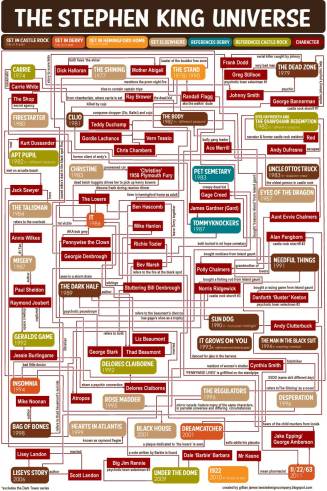
King’s references are so crazy! Check out this chart!

Of course, some authors do it because it’s fun to have a shared universe, for a variety of reasons. You can return to familiar characters and locations by doing so. You can make your readers marvel and go back to another story to say, “Hey, that matches up with so-and-so.” You can create a cosmology or a special reason why a character or characters or place or places appears in so many stories (I’ve got a character or two like that, I just haven’t been able to put them into any works yet. I tried with the human Barbie story and Evil Began in a Bar, but I couldn’t fit them into the former and I haven’t figured out how best to edit the latter yet, so…). And sometimes, it’s just fun to mess with your readers and make them wonder what the heck it all means (I’m pretty sure that’s the reason Stephen King references his other works so much, and the Dark Tower books simply grew out of a desire to create a complex story out of all that messing about).

Whatever the reason someone creates a shared universe, it’s pretty clear that there are plenty of reasons to do so, and that shared universes are here to stay. And whatever the reason behind them, as long as they’re done with love and people enjoy them, I see no reason not to keep doing them. Besides, I may have one or two I’d like to create someday.

Do you have a shared universe in your fiction? Why’d you create it? What has been the result of that?

It’s Friday again, so you know what that means. It’s #FirstLineFriday! Also known as one of the highlight of my weeks. Especially if people like what I put out.

Okay, here are the rules, as usual, for #FirstLineFriday: you write a blog post with the title #FirstLineFriday, hashtag and all, and then you repeat the rules. Then you post the first one or two lines of a possible work, a work-in-progress, or a completed or published work. Final step is to ask your readers for feedback. It’s great fun.

This week’s opening comes from a novel I had the idea for yesterday while walking home and listening to the Needful Things audio book by Stephen King (that was a trippy and creepy book, I tell you). It’s the sort of story that has a really strange mystery to it. I hope when I get around to writing it, I’ve figured out the mystery a bit more. Enjoy:

Any writer, engineer, or psychologist who’s good at their job will tell you that a story, Rube Goldberg machine, or the mind is made up many different and complex parts. Looking back, I think I was stuck in twisted versions of the first two and in danger of losing my own mind, as un-complex as that was at fourteen.

Thoughts? Too long? Suggestions? Let me know in the comments below.

That’s all for now. I’ll try to post a few posts over the weekend. I’ve got a special one planned for Saturday night, believe me.

Have a great weekend, my Followers of Fear!

It’s Friday again, so you know what that means. It’s #FirstLineFriday! And since yesterday a good number of Americans stuffed themselves full of turkey, I’ve got a special Thanksgiving edition for you all! Woo-hoo! I would also make it a Black Friday edition, but that’s just a horrible practice that’s unfair to both customers (apparently the sales on Black Friday are no more special than sales at any other point in the year) and to employees (you can guess why).

As always, here are the rules of #FirstLineFriday: on Friday you write up a post titled #FirstLineFriday (hashtag and all), and then you write out the rules. Then you post the first one or two lines of a potential story, story-in-progress, or a completed or published short story. Finally you ask your readers for feedback. It’s a lot of fun, and I enjoy hearing what people have to say about it.

Here’s this week’s entry. It’s from an idea I had for a bloody and very strange story that I came up with the other day. I hope I get the chance to write it out someday soon. Enjoy:

Jake scooped out three slices of pie and some whip cream. The pie and cream were the only parts of Thanksgiving dinner that hadn’t gotten blood on them.

Thoughts? Problems? Let me know in the comments below.

That’s all for now. I’m house-sitting till Wednesday while my dad and his wife are on their fifth wedding anniversary trip (congrats, you two!). I think I might throw a wild party while they’re gone. Or maybe I’ll behave myself, edit and write, and watch Doctor Who. We’ll see what I’m in the mood for.

Happy Thanksgiving and have a great weekend, my Followers of Fear!

About a week or two ago my friend Angela Misri posted on my Facebook timeline about a short story contest that Stephen King would be part of. Apparently people could submit short stories under four-thousand words and His Royal Scariness would pick the winner. Unfortunately the contest was only open to UK residents, which upset Angela and me a great deal (I knew I should’ve been born a British lord, but for some reason I decided that being the son of two rabbis was a better deal). However, if I could enter the contest, and it allowed short stories under six-thousand words, this probably would’ve been the short story I submitted.

After extensive editing, of course.

“The Playroom” is a very weird short story about a woman who steals from a mob boss whose casino she works in, and the terrifying results of that little action. I’d go into further detail on what those results are, but then I’d be giving away too much of the story. I will say how it came to be though: I woke up one night, a few days before I decided to take a break from Laura Horn, I think, and this little mini-movie started playing in my head. I don’t know what caused it–I’m pretty sure it didn’t have anything to do with anything I might have been dreaming prior to waking up–but there it was, fully formed in my head, and oh-so strange. I immediately wrote it down and decided to write it as soon as possible.

Which, as I said a moment ago, was when I decided to take a break from Laura Horn. How convenient that all turned out to be.

Anyway,this is definitely one of the weirder short stories I’ve written. And when I say something is weird by my standards, that’s saying something. And you definitely get that weird sense just by reading it, I think. As you go on and you feel yourself falling deeper into a rabbit hole, you definitely wonder where this is going to go. And when you actually find out where it goes…well, I wouldn’t want to give too much away. The first title of this short story gave away so much that I dare not speak it here. The second title was so cliched I couldn’t help but change it (“The Secret Room”–what horror writer doesn’t have a story titled that?). So now I’ve got “The Playroom”. Intriguing, doesn’t give away much, and somehow conveys this isn’t your average horror story.

At least, that’s what I hope is what it says. I’m biased, so what do I know?

Anyway, I think with a bit of editing, this story could actually go from just under fifty-six hundred words to under five-thousand or maybe even under four-thousand without sacrificing quality. As you know, I’ve had trouble keeping my short stories brief without sacrificing quality in the past, so I’d be very excited if I could get this one that short without any problems. There are probably a few sections that could be cut from this story. Or I might keep it as long as it is. With a bit of work, there may be a magazine or two who would like to publish this even if it is longer than what some magazines like to publish.

Before I do that though, I have a novel to finish editing. I think I’ll get right on that in the morning.

So good night, my Followers of Fear, and pleasant nightmares. I know I plan to have a few.