Posts Tagged ‘living and life’

So I finished that outline for that new novel I plan to write for NaNoWriMo later this year. First draft of the outline, anyway. I probably will revisit it again before November, make some more tweaks and possibly add a scene or two. It’s a ghost story, and since ghost stories tend to involve the protagonist or protagonists being affected on a very personal level by the spirits involved, often by exacerbating personal problems as well as actually haunting the people involved (ghosts and ghost stories are very intimate that way, I’ve noticed), I’ll want to make sure that that’s done right in this story before I write it.

Now that that’s taken care of, I’m finally getting around to working on Rose, the novel I wrote as a thesis for my senior year of college. If you’re unfamiliar with that novel, it’s about a woman with amnesia who finds herself trapped in the home of a man who says he’s her boyfriend, her body going through astounding changes which this man says was to save her life. I started writing it in September 2014, went back a couple weeks later to rework the entire story because the direction I was going in at first just wasn’t right for the story I wanted to tell, and finished the first draft in January 2015. Not too long afterwards I did a second draft that I finished around April, and I haven’t touched it since.

So yeah, it’s been nearly a year since I worked on that novel. But between working and living in Germany, writing some original short stories and editing Video Rage twice and giving Laura Horn a much-needed second draft, can you blame me?

Okay, I might have also been a bit hesitant to approach Rose again. During my thesis defense at the end of my senior year, my advisor told me that if I were to get Rose up to the level worthy of getting it published, I would have to do quite a lot of work on it. And not just grammar and spelling, though that was mostly okay. I had to work in new scenes, space out some others, rework a couple of characters, and change a bunch of stuff in the beginning of the book. Add to that the normal work of editing, and I’ve got one hell of a third draft ahead of me. It’s a bit intimidating, almost like starting a new novel and facing a blank page asking for sixty-thousand plus words.

Yeah, the horror writer’s scared of his own creation. Make fun of him and the irony. Go ahead, get it out of your system.

But you know what? I think I’m up for the task. I took Laura Horn, which I was sure would need an entire rewrite, and the worst that it came to was a few tossed chapters and one major plot point subtly changed to better reflect actual circumstances. If I can tackle that (and LH was a much longer book, by the way), I think I can tackle Rose.

And not only that, but with this being the third draft, I think once this is one I can send it to n editor for a final look-over before I get ready to publish the book. So if we’re lucky, I could have Rose ready for publication by the end of the year. Wouldn’t that be great?

So I’m going to get two articles out of the way, and then I’m going to get straight onto Rose (unless I get the notes back on VR, in which case editing that takes precedence). Wish me luck, my Followers of Fear. I’m going to be very busy these next couple of months (though that is kind of my life in general).

It’s Friday again, so you know what that means. It’s #FirstLineFriday! And it’s my mother’s birthday today. And tomorrow she and her partner/fiancee of several years will finally get married. Yeah, all that’s happening this weekend. I would go into more detail on that, but that’s not what this blog is about.

But enough about that. Let’s get to why we’re here. For those of you unfamiliar, here’s the rules for this weekly blogging ritual. On Fridays, you:

  1. You create a blog post on your own blog entitled “#FirstLineFriday”, hashtag and all.
  2. You explain the rules like how I’m doing.
  3. You post the first one or two lines of a potential story, a story-in-progress, or a completed or published story.
  4. You ask your readers for feedback and encourage them to try and do #FirstLineFriday.

This week’s entry, surprisingly, doesn’t come from a story or a story idea. It’s from an idea fragment, which is basically when you have something–an image, a character, a concept, etc.–which could be part of a story but doesn’t have a story to go with. This would be like if JK Rowling had the idea for a boy wizard named Harry Potter but hadn’t yet thought up Hogwarts or Harry’s struggle with Voldemort. Great basis for a story, but where do you go from there without the magic school or the villain? It takes a bit of thought to make the fragments into full on ideas, and then actually write them. Unfortunately for me, I’ve had a lot of idea fragments swirling around my head lately, and I’ve been unable to think of a story for them yet, usually because I’m trying to think of something somewhat original that doesn’t sound like a similar story or hasn’t been done to death for the fragment. As you can probably tell, that can be difficult at times.

DAMN YOU, WORLD WHERE NOTHING UNDER THE SUN IS ORIGINAL! DAMN YOU!!!! I’m sorry, I’m just very passionate about trying to come up with stories that people feel isn’t like an already well-known story. Can you tell?

Anyway, here’s an opening that could go to this one idea fragment, assuming I actually got it to coalesce into a full-fledged story idea. Enjoy:

The little girl biked home, her blonde braids flying out behind her. She had no idea she was trying to outrun a storm that she was the herald of.

Thoughts? Errors? Let me know in the comments below.

And while you’re at it, why not try #FirstLineFriday yourself? It’s a lot of fun, and it’s great practice for writers wanting to try different openings.

In fact, I’m going to see if I can get someone into it by tagging them. I pick…Kat Impossible! Kat, you’ve been tagged. You have to participate in one #FirstLineFriday! Have fun with it!

Well, that’s all for now. I’m going to be working on a couple of articles this weekend in between the wedding and everything else, so keep an eye out for them. Have a good one, my Followers of Fear!

So I’ve been working on the outline for a new novel that I plan to write for National Novel Writing Month in November (I know, it’s early for that, but I need to work on something original because I’ve been doing nonstop editing since last NaNoWriMo, and if I don’t work on something new before I work on Rose I’m going to scream). And while I’ve been working on it, building the story chapter by chapter, I had the feeling that there was something missing from the story.

About two nights ago, I hit across what was missing. It was personal problems! Good horror stories often deal with issues that the characters are dealing with both internally and in their own lives! In great horror stories like Cujo and the novel I read and reviewed the other day, the main characters are trying to keep their families alive in some state and not lose their livelihoods in addition to trying to survive rabid dogs or a haunted house. In the TV series Supernatural (which I’ve been binging on lately, it’s so good!), in addition to dealing with evil entities and the oncoming Apocalypse, the protagonists Sam and Dean Winchester have to deal with the fact that they’re brothers, with all the issues that family can have when living and working in proximity, and then some.

And I don’t do enough of that exploring–or indicate that I will be doing that sort of exploring–in the outline for this new project. Which is actually a very big issue if I think about it.

There are several reasons why this is. One is having these personal issues helps the audience identify with the characters. Everybody has problems, and seeing people with relatable issues in their life–recent loss, money troubles, relationship issues, addiction, etc.–even if they’re just characters in a story, make people feel for them. In American Horror Story: Asylum, the character of Lana Winters is thrown into Briarcliff as a patient because she’s a lesbian. We of the present day know she was born that way and there’s nothing wrong with her, but back then, the LGBT community was seen by many as immoral or insane, and faced all sorts of discrimination. This immediately makes her a lot more sympathetic to us than if she was just a regular ambitious reporter, and helps draw us into the story as well as makes us identify with the characters.

Another reason creators explore these deep, personal issues in horror fiction, even when you’ve got everything from ghosts to serial killers to aliens to vampires and everything in-between, is that it keeps the characters interesting and the audience interested. Going back to Supernatural, what would the show be like if each episode was about the Winchester brothers facing a new monster and defeating it, plus a few quips? Well sure, it’d be entertaining for a while, but with no change in that formula things would’ve gotten stale probably ten seasons ago. Part of the draw is seeing these two very-different brothers go through ups and downs in their relationships, figuring out right and wrong in a world full of grey areas and just trying to be good people and good to each other at the end of the day, in addition to stopping the end of the world and all the things that go bump in the night.

And third, we writers like to explore these characters, their problems and traumas, and how the characters deal with them over the course of the story. Some good examples of this come from my own work. If you’ve read Reborn City, you know that protgonist Zahara Bakur doesn’t really start out as heroine material. She’s as far from a Wonder Woman as you cn get. But through the story, I explore both the problems she deals with as a Muslim gangster in an environment that isn’t very nice to Muslims and Zahara’s doubts and fears. And I love doing that, I love watching characters like Zahara grow from someone whom you’d never expect to be a hero to someone whom you’d willingly follow into a tricky situation.

So yeah, exploring personal problems with our characters, whatever those problems are, is definitely something we authors do a lot of. And I need to do it more with this new project I’m working on, even if I’m not picking it up again until September or October. Actually,I’m a little surprised I’m not doing more exploration. There’s a whole big problem with the protagonist’s relationship with another character–let’s just say they shouldn’t be an item for a very good reason–and I’m so not exploiting that enough. I really have to explore how this relationship could mess with the characters while at the same time something evil is attacking the town.

In fact, I’m going to get on that right now. Wish me luck, my Followers of Fear. Hopefully by the time I’m done going over this outline, it’ll be as good as it needs to be for November.

“Within These Walls” by Ania Ahlborn

I’m honestly surprised I haven’t heard of Ania Ahlborn before. I got a recommendation from Audible a couple of months ago to try one of her books, and I ended up getting the paperback version after I finished A Storm of Swords. I’m glad I did, because Within These Walls is one of the scariest books I’ve ever read, on par with the likes of Stephen King.

Within These Walls follows Lucas Graham, a true-crime writer whose career has reached its peak and has since spiraled down into the dust. He gets a letter in the mail from Jeffrey Halcomb, an incarcerated cult leader whose followers killed themselves back in the 1980’s, offering to give Graham his previously-unheard story if Graham promises to live in the house that Halcomb’s followers killed themselves in. With his marriage on the rocks and no other options, Graham and his teenage daughter pack up and head out to the house in Washington, where they find that Halcomb’s promises to his followers of eternal life might be more than just talk.

It’s going to be hard to summarize all that I loved about this book, but I will try. First, it’s hard to put down. The story twists and turns, making you guess where Ahlborn is taking her book every moment. I also liked how she could capture the voices of each of her different POV characters. Lucas comes across as both desperate and obsessed, consumed by the promise of Halcomb’s story and what it could do for his life. Flashbacks told through the eyes of Audra Snow, one of Halcomb’s followrs, really break your heart as you see her fall under Halcomb’s spell. But best of all are the chapters told through the eyes of Jeanie, Graham’s teenage daughter. Teenage logic and thought processes are contradictory, ruled by emotional swings, and not always bound by the rules of the real world, and Ahlborn captures that so well with Jeanie. It actually taught me a couple of things about writing for that age group, something I’ll hopefully keep with me in future stories.

But really, the best part is the scares. Every scare is perfectly done, like something out of a horror movie. In fact, this would be a great movie. Why isn’t this a movie yet? From the initial move-in to the house, to the powerful, climactic end, every spooky scare will chill you and make you worry for the characters and for your sleep. It’s just wonderful.

The one problem I had was that I would’ve liked Graham to maybe investigate some of the house’s history as well as Jeffrey Halcomb and his followers. There’s documents in between a few chapters that go over the house’s history, among other things, but I think it would’ve been interesting if Graham had read some of those and had been affected by them. But it’s a small point, so whatever. I still enjoyed the book.

All in all, Within These Walls a 4.8 out of 5. It’s scary, it’s exciting right till the end, and I will definitely be checking out Ahlborn’s work in the future. If you like a good horror novel, this might be the one for you.

Oh by the way, after I finished this book, I watched a movie over dinner called The Veil about a cult with strange, supernatural happenings, which I only found out after I started watching it. And both the book and the movie were probably inspired by Jim Jones and the Jonestown Massacre, which I read up on this afternoon after I heard the new Outlast horror game was inspired by the happenings at Jonestown. That’s like four Jonestown-related things in one day. I seriously hope that’s a coincidence and not God giving me a sign for what I should do with the rest of my life.

It’s Friday again, so you know what that means. It’s #FirstLineFriday!

If you’re new here and don’t know what #FirstLineFriday is, let me start by telling you that it’s a fun weekly ritual to take up (and it’s a lot less costly than animal or human sacrifice. Also requires less clean up). So here’s how it works. On Fridays, you:

  1. Create a blog post with the title #FirstLineFriday, hashtag and all.
  2. Explain the rules like I’m doing.
  3. Post the first one or two lines of a potential work, work-in-progress, or completed or published story.
  4. Finally, ask your readers for feedback and encourage them to try it on their own blogs.

This week’s entry comes from an idea I had a few weeks back for a novel that might be classified as science-horror. I’m not sure, it’s got some elements that could be classified as horror, but at the same time part of the conflict of the story involves a science-fiction plot device, so it kind of straddles the two. I’m not making any sense, am I? Well, whatever. Here are the lines that would start this story. Enjoy:

Catherine had been working at the Warner-Marigold Motel for three years, and she was on track for a promotion in the next year or so. Of course, that might only be because she was the only one on the cleaning staff who was willing to clean Room A16, known among the staff as the Suicide Room.

Thoughts? Errors? Let me know in the comments below.

And while you’re at it, why not do #FirstLineFriday on your blog? It’s great fun, and for writers it’s not only good practice, but it’s a great way to test different openings for various stories. I’ve certainly enjoyed doing it, and I started doing this on my blog nearly a year ago.

That’s all for now. If I have somethig to blog about, I’ll let you know. In the meantime, I’ll see you guys around. Have a great weekend, my Followers of Fear. I know I will.

About three years ago, I wrote a post on in media res, a plot device often utilized across various media of fiction. I’d like to revisit the subject, because I’ve had some thoughts on this particular writing tool since then and I wanted to write about them. And since I’m running this blog, talk about it I shall!

So if you’re not familiar with in media res (Latin for “into the middle things”), it’s a plot device in literature where the story opens in the middle of the action, rather than beginning with exposition. Background information is usually filled in through dialogue, flashbacks, or having a nonlinear narrative. An example of a story that starts in media res is Raiders of the Lost Ark: you don’t get a Star Wars screen crawl, or an opening narration, but you just hop into Indy heading into a temple to get a famous statue. Another great example of the usage of the plot device is A Game of Thrones by George RR Martin. No history on the Seven Kingdoms, just getting plopped into a patrol with three brothers of the Night’s Watch, and some Others attacking them.

I’v used this device in a lot of my works. Reborn City starts out with Zahara and her family going out to dinner, with backstory and world-building reserved for Chapter 2. Snake begins in a church, with information being dropped through exposition and flashbacks throughout the book. My short story Travelers of the Loneliest Roads literally starts on the road, and a lot of works that I’m working to get out to you, dear Followers, start out this way.

Overall, I feel it’s a good way to start a story. In fact, it might be my favorite way to start a story. Rather than doing a bunch of backstory, like “Forty years from now, the war on terror spirals into a chaotic Third World War that leads to a bunch of new countries and city-states. In one city-state, Reborn City, which is ruled by the Parthenon Company, there’s a powerful gang called the Hydras. Now onto the story of Zahara Bakur,” we start with Zahara and the events that lead her to becoming a Hydra.

However, in media res has to be done delicately. I realized this as I was editing a short story of mine last night.The story started out with the protagonist running for her life, then flashed back rather quickly to how she ended up running for her life, and then went back to her running her life. I was like, “Why did I think this was a good idea in the first draft?” I actually had to go back and rearrange the story so that everything goes into chronological order. The story moves much better now (though I may nix that beginning part and have it start in the meat of the story. We’ll see after the second draft’s done).

So with that in mind, I thought I’d list some tips to starting a story in media res and doing it well, with the hope other writers might avoid some of my mistakes with this plot device:

  • Make it easy to slide in for the reader. When I first read A Game of Thrones, I had to go over the first chapter twice just to make sure I understood what was happening. After a bit of examination, I understood what was happening a bit better, though I still was a bit confused. Not a good way to introduce me to Westeros, but the rest of the novel made up for that.
    Point is, when starting a story in media res, make sure that all readers, whether they’re expecting one thing or another thing or nothing at all, that they can dive into the story without wondering what the heck they’re reading or if they missed something. You don’t need to be overly-simplistic with your language or story, you just have to make it easy to follow so that readers have a good idea what is happening while they’re reading.
  • Don’t move too quickly into the information. Remember that short story I just mentioned? I had a quick beginning, and then I dived right into a flashback. Made no sense on a second look. Wait for a moment where it won’t throw people off, and then try and make the segue into the flashback make sense.
  • Whatever’s happening has to hook the reader. By definition, in media res starts a story in the middle of the action, so you want to make sure that the first line is catchy. It doesn’t have to start with running for your life, gunfights, or anything like that, but it has to be somewhat catchy. This could be something as ordinary as a girl walking into a classroom with soda in her hair (my own short story, Tigress Lizzy), as long as it’s interesting to read. How you do that depends on language and skill as much as what is happening in the story, though with practice you can get very good at it.

However you want to begin a story, the point is to hook your readers so that they’ll read the rest of the book. In media res is just one way to do that, but it’s a fun way to do it. And with time and experience, you can get better at it. You might even learn a thing or two in mid-edits.

How do you feel about in media res? What tips do you have for doing it well?

Angela Misri

Angela Misri

Twice already I’ve had the great fortune to talk to my friend Angela Misri about her detective character Portia Adams, and the books she’s written with her. I’ve also had the pleasure of reading and reviewing both books, and I have to say, Angela knows how to tell a compelling mystery story in the tradition of Sherlock Holmes.

Which is why I’m glad to welcome her back and talk to her about the third Portia Adams book, No Matter How Improbable, which I’m sure will be as excellent as the first two books.

RU: Welcome back, Angela. It’s good to see you here again. Now, in the first book, Jewel of the Thames, Portia comes to London, starts a new life, and realizes her heritage. In the second book, Thrice Burned, Portia makes a big decision about her life and her career, as well as facing new challenges in her life. What can we expect for her in the third book, No Matter How Improbable?

AM: Where the first and second books were very much about discovery and building confidence, book three has a central theme of loss. Loss of friends, loss of family, loss of the comfort of anonymity. This book will force Portia to develop as a person amongst all the other humans around her. She no longer doubts herself as a detective, but she finds herself doubting her relationships, which for a highly intelligent introvert can be debilitating.

RU: I bet. And speaking of Portia, characters often change between books. How has Portia changed between Books 2 and 3?

AM: I would say that she has grown to have more confidence in her abilities, she’s more grounded and she knows what she wants to do with her life. She is also starting to see the value of friendship and relationships, something she never had as a child.

RU: Moving onto the mystery bits of the book, can you give us a hint of what sort of cases Portia will be handling?

AM: Ha! I can indeed! One of the casebooks will involve an Italian Princess (hence the beautifully designed book cover by Emma Dolan), one will harken back to a story from the original Sherlock Holmes canon and the last casebook will cause Portia to lose not one, but two of her close friends. How’s that for a hint?

RU: It seems that Portia’s growing more popular every day. Can you tell us about some memorable fan experiences and the growing fan base around the character?

AM: I have been very lucky in my fans who show up again and again for each book event, and bring their friends, and take my books to their classes and do book reports, and so many other things. It’s hard to pick one interaction, but I recently got an email from a woman in Texas asking for a signed copy of Jewel of the Thames for her daughter’s birthday. She said her daughter read it cover-to-cover and it’s her favourite book. I wrote back suggesting I instead send her a birthday card containing a signed bookplate sticker that she could just put in her daughter’s book (to save them a bit of money). She wrote back to say she needed a new copy of Jewel because her daughter had ‘worn out’ her copy. That is such an incredible compliment to an author.

RU: Will there be a fourth book, and when can we expect it?

AM: There will indeed be a fourth book, but I’m currently negotiating the contract, so I am not sure when it will be out. I can tell you that the first casebook in the fourth book comes back to Portia’s roots – it’s set in 1932 Toronto, Canada.

"No Matter How Improbable" by Angela Misri

“No Matter How Improbable” by Angela Misri

RU: Ooh, I love those sorts of stories. They tend to dredge up so many memories! So with Portia’s growing popularity, can we expect a Portia Adams TV or movie adaptation? Anything like that coming out anytime soon?

AM: My agent continues to look for those opportunities, but nothing yet – keep your fingers crossed!

RU: What are you working on besides Portia Adams these days?

AM: I have a zombie book and a contemporary detective novel (not YA) too that I am working on. I also have a chapter in an upcoming Sherlockian anthology that I just sent in to the editors.

RU: Are there any subjects or characters you hesitate or refuse to write about in your stories?

AM: I’m not big on sex scenes in books (either that I am reading or writing) and I will never write a rape scene because I think it’s too disturbing. I also will probably never write about the death of a child because as a mother, I can’t imagine putting those words on a page.

RU: What do you do when you’re not writing?

AM: I’m a digital journalist, so I freelance articles, build websites and digital strategies for clients and I teach at various universities in Toronto.

RU: Is it difficult balancing time between being a full-time writer and a full-time human being these days?

AM: No more so than any other kind of balancing – no stage of my life has had just ONE thing in it. From student to mother to writer, I’ve always balanced my main focus with other things I needed to do. I will say that it took me nearly 6 months to establish a routine as a writer that worked for me.

RU: Finally, let’s assume you got the chance to collaborate with any writer of your choosing on a story or a series. Who would you pick? (And if you say me, I will squeal like a teenage girl at a One Direction concert.)

AM: You, of course Rami, if I had the ability to write horror like you do, I would pitch you an idea so fast your head would spin. Or if we could collaborate on a story where I write the basic mystery and you write the horror… I don’t know, I think it could be neat.

I’d probably pick the same person you’d pick – Stephen King. Or Mark Gatiss in my case, but I’d probably be way too intimidated to string a sentence together. Thanks for asking!

RU: AAAAAAAAAAAAAAAAAAAAH! *cough* Excuse me. Well, thank you for joining me Angela, and I hope to see you back here soon.

No Matter How Improbable will be available for purchase in Canada on March 22. For all those outside of Canada, please email the author herself for a copy. Also check out my interviews for Jewel of the Thames and Thrice Burned to get links for those books. If you’d like more from Angela, you can visit her website, A Portia Adams Adventure. Trust me, it’s well worth checking out.

And if you’re an author wanting to do an interview, check out my Interviews page and leave a comment. We can discuss it there.

Have a good one, my Followers of Fear!

5a3e9db116168bd2d61f13037216dc667ed9a2b1

Yesterday I went to meet with some folks who I know through MAX, a program that helps and supports young professionals in my area. MAX has regular meet ups and events throughout the week, and on Fridays we meet at the local Starbucks to have coffee (or in my case, hot chocolate) and talk. This week’s meeting was especially interesting though, because someone brought a copy of The Quiet Game.

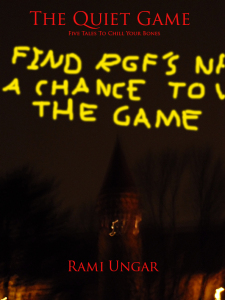
Now if you’re unfamiliar, The Quiet Game was the first book I ever published, a collection of five original short stories I wrote in late 2012 and early 2013. The woman who runs the MAX program, Angela, has been reading some of my work and brought the copy of The Quiet Game she borrowed from my sister (she’s part of MAX too). She also brought her laptop, because Angela wanted to leave a review on Amazon but had never done one before and she wanted me to show her how.

After solving some Wi-Fi problems (honestly, for a major coffee shop chain, Starbucks has some really terrible wireless service), I showed Angela how to leave a review, which she did right there and then in the coffee shop, giving The Quiet Game a five star review. Here’s what she had to say:

Addict is insanely AWESOME! The use of 2nd person language convicts the reader. One second you are relaxing with a short story, the next moment you are engaging in explicit sexual addiction… whoa!
Rami has a way of writing perspectives that is wise beyond his years…

“Addict” is a short story about a man with sex addiction trying to go clean. It’s told in the second person, so that’s why you’re the one who’s engaging in explicit sexual addiction.

I also noticed during this time that I had a review from September that I’d totally missed (how did that happen?) from someone named SavoirNoir, who gave The Quiet Game four stars and titled her review Decent collection of tales. Here’s what this reviewer had to say:

This is a serviceable set of stories. The best one is not the titular title story. I only really have two issues with the collection. One of them is the notes after the story. I never really liked the self-indulgence of the writer explaining afterwards. To be fair, that could be just me.

The best story in my opinion is the Lady Orgres Den. That one had great tension.

This reviewer is talking about “In The Lady Ogre’s Den”, about an autistic boy’s terrifying stay in a hospital after an accident. And speaking of that story, Angela, the very same woman who’d brought my sister’s copy to Starbucks with her, asked me to do a reading right there and then for the entire group.

Well, you know me. I love an audience and I love opportunities to get more people to read my work, so I agreed and ending up reading “In The Lady Ogre’s Den” to them. So for about the next twenty minutes or so, I read them the story. And you know what? Most of them listened. They were actually rapt with attention, making comments or praising my writing style or how I get into the mind of an autistic child. I don’t know if any of them will end up getting the book or any of the other books I’ve written, but by the end of it they were very impressed.

Which is my goal, of course. As you know, the subtitle of this blog is “Scared yet? My job here is done.” I also put that on my business cards, because it’s the truth. I want people to be scared and entertained, to enjoy my work and be enchanted and thrilled while reading it. Getting feedback like that is very gratifying for me, and while my throat was dry from non-stop talking by the end of the reading, I was very glad I’d agreed to Angela’s request and been able to pull these folks into a story for a little while.

And if reading this post made you want to check out The Quiet Game, by all means please do so. It’s a fun, creepy collection of stories, and it’s short too, so if you don’t want a long book this might be up your alley. You can get it both in paperback and in e-book by check it out on Amazon, Createspace, Barnes & Noble, and Smashwords. And if you enjoyed reading the book, please let me know what you think. Positive or negative, I love feedback, and I would love to hear yours.

That’s all for now. I might take a few days off to just do stuff other than blogging. However, if anything worth reporting comes up, you can expect me to let you guys know as soon as possible. Have a good day, my Followers of Fear!

I was going to wait a little longer to announce this, but I’ve already announced it on Facebook and Twitter, so I’d be a bit of an ass if I didn’t let you guys know. As you can tell from the title of this post, after about five months of job searching and wondering how long this period of unemployment will last, I’ve finally been given a new job!

To be more specific, it’s another three-month internship with the United States Armed Forces. Instead of the Army though, I’ll be working with the Air Force. Instead of the Equal Employment Opportunity office, I’ll be working in their legal office doing customer support work (more on that later if it’s allowed), and I’ll be working at Wright-Patterson Air Force Base here in my home state of Ohio, rather than halfway across the world. Not that I wouldn’t love to travel to Europe again, but I think it’ll cost a bit less money to go and live near work this time (especially without having to buy really expensive plane tickets! Those were a real drain on my bank account).

To be honest, I wasn’t sure whether or not I should take this internship when it was offered to me. Five months into a job search, and I was still holding out for a permanent, full-time job. But I asked for a day to think about it, and after talking about it with some people and thinking about it, I realized that while I had job history, I only had so much history and job skills, and that could be a huge barrier in getting me a permanent job. Doing this internship would change that, it would give me a few more skills and some income while I was at it. And while I worked, I could continue the job search without having to worry about my finances drying up (and maybe get out of my dad’s house while I’m at it). So I decided to take it, and I’ve been on a high ever since.

And honestly, I needed this high*. These months of unemployment have been some of the worse in my life, and they only got worse as they went on. There were days I sat on my bed at home, looking for jobs and filling out applications, hoping against hope for a phone call or an email and feeling lower than the earth when none came. Plus there was the occasional friction between me and the folks, which happens when several people are living in one house and at least one or two wish they or others were living elsewhere. Add in the bank account slowly losing income every month, the feeling of being useless if you’re not bringing in money, and a few other things (possibly the winter blues?), and you’ve got a slight case of situation-based depression.

Now that I’ve accepted a job, I’m definitely not going to be feeling that down anymore. We’re aiming for an April 1st start date (since I previously worked for the Armed Forces, the background check and everything else should be much quicker than last year), so in the meantime I’m going to be looking for a place to sublease or do a rent by the month thing, as well as doing whatever else I can to make sure I have a wonderful and productive time in my new position. Hopefully by the time I show up for work, it will all fall into place and I’ll have a blast being there.

In the meantime, I’d like to thank everyone who helped me get this far. My family and friends, and all my supporters online and in-person for making me feel loved and making sure I never gave up. Jewish Family Services of Columbus for their invaluable support and advice they gave me while I searched, and their MAX program for Young Professionals for giving me excuses to socialize and get out of the house. The Big Guy Upstairs, because I like to think that He has a Hand in all the good stuff that happens in my life. And…well, you know. Thanks. I could not have done this without all of you.

That’s all for now, my Followers of Fear. It’s getting late, so I’ll be signing off now. Expect another post from me in the next day or two, I’ve got more stuff to post about here that I’m eager to share with you. Until then, have a great weekend!

* This is not encouragement to do drugs. Rami Ungar does not endorse the use of any sort of narcotic substance. Even marijuana. That stuff will mess with you in seriously bad ways.

It’s Friday again, so you know what that means. It’s #FirstLineFriday!

Now if you don’t know what #FirstLineFriday is, let me break it down for you. On Fridays you:

  1. Write a post on your blog called #FirstLineFirday, hashtag and all
  2. Explain the rules like I’m doing now
  3. Post the first one or two lines of a potential story, a story-in-progress, or a completed or published story
  4. Ask your readers for feedback and encourage them to do their own #FirstLineFriday on their own blog.

This week’s entry comes from a short story idea I’ve been hanging on for a while now, but haven’t written yet. It’s got a very interesting premise, if you ask me, and part of that premise is explained in the first couple of lines. Enjoy:

Some famous guy once said, “I think, therefore I am.” To that, I would like to add, “I imagine, therefore I can become.”

Thoughts? Errors? Let’s discuss in the comments below.

And if you enjoyed reading #FirstLineFriday, why not try writing #FirstLineFriday? Trust me everyone, it’s a lot of fun coming up with the beginning lines of a story each week. Sometimes it can actually get ideas flowing in your head and help you come up with new stories. So why not try it?

That’s all for now. If I have anything else to talk about this weekend, I’ll be posting it here. See you later, Followers of Fear!