Posts Tagged ‘publishing’

I try to be a regular blogger, one or two posts a week. But since Saturday, I haven’t really had anything to talk about. Which is crazy, because I usually always have something to talk about. And sometimes, people like to read what I have to say.

But there’s just nothing these past couple of days I’ve wanted to get out there. There’s been no development with Rose or any of my other stories worth mentioning. I haven’t seen or read anything to review lately. I haven’t come up with anything involving the art of writing or the art of horror. There’s nothing big in my life that I feel like making announcements about. And there’s no issue or current event I feel angry enough to speak about (and before you mention “Cockygate,” I’m getting to that).

There were things I thought I might blog about. I finished rereading The Shining, the first time I’ve read it since my teens, but I didn’t feel like I had enough material to make a full post like I did with To Kill a Mockingbird. The same with a post about feedback from readers and magazines; I started it, but in the end, the words just wouldn’t come to me. Cockygate is still ongoing, but there hasn’t been enough new developments that I want to write a post. I have a post for Self-Published Authors Helping Other Authors, but I’m saving that until after I’ve spoken with my publisher about some proposed edits for Rose. And I’m waiting on a few other things to happen before I do some other posts I’ve been thinking of writing.

I could do an entire post about how one of my favorite shows Lucifer was canceled (yes, that happened, and I’m very upset about it!). But that feels too clickbait-y for me, especially after devoting an entire post to Cockygate. That being said, it would do me and an entire fandom a huge favor if you could help us keep the hashtag #SaveLucifer trending on social media. As of the time I’m writing this post, it’s a trending topic on Twitter, with over three-hundred twenty-seven thousand tweets. Believe me, we don’t want this show to go anywhere, so please help us out.

But other than that, I really have nothing special to say at the moment. I’m as quiet as a mouse.

Except…

Except that I can assure you I am still working on stories. Rose is coming along slowly but surely, and I have other stories in the wings. I certainly haven’t run out of ideas for stories or blog posts. And I am as devoted and energetic towards these projects as I’ve always been.

So even if I drop off the blogosphere from time to time, know this: I will come back, and it’ll be with plenty of good news to share. So stay tuned.

Until next time, my Followers of Fear, have a good weekend and pleasant nightmares.

I’m sure that a lot of people are going to be confused by that title, and probably find it funny. Unfortunately, this is a serious topic that requires some discussion, so I thought I’d take a couple minutes to spread the word on what’s been going on.

Recently, it’s come to light that a romance writer named Faleena Hopkins placed a trademark on the word “cocky” (as in…you know), and has allegedly been sending cease and desist letters to authors who use the word “cocky” in their book titles. Of which there are many, and according to the letters, this is a form of copyright infringement, and authors should change the names of their stories or face the consequences. From what’s been going around, most of the authors who have received these letters are not big enough to actually take on a legal battle with other authors, rather than any big names in the romance field.

This is some grade-A bull. You can’t just copyright a single word and tell people they can’t use it in their book titles. You can copyright a specific word or words using a specific font (like nobody can use the word “Potter” with the Harry Potter-title lightning bolt script or the words “Star” or “Wars” with the Star Wars script without incurring the wrath of JK Rowling or Lucasfilm’s representatives), which is normal business practice. However, you can’t just copyright a single word, no matter the font, font size, or context, and say anyone who uses it in a story’s title is committing plagiarism or copyright infringement. Which is why nobody can sue me for naming my novel Snake, or why when Rose comes out, nobody can sue me for naming it that way.

And you know who else agrees with me? Lots of other authors, apparently. When I saw this trending on Twitter, I got curious and found plenty of other writers who were willing to explain to me what was going on and point me to links which went further into detail about this issue, which has been dubbed Cockygate, and who have also made the hashtags #cockygate and #ByeFaleena (get it?) trending topics. Thanks to them, I was able to find this article from Pajiba, as well as this video from author Bianca Sommerland, one of the first to break the story open. And the consensus seems to be the same as my opinion of this situation: it’s grade-A bull, and kind of sounds like bullying or blackmail.

I mean, imagine if this was allowed to happen. We could copyright all sorts of words, and anyone using those words would owe me money. I mean, imagine if I trademarked the word “the.” So many people would owe me money, it would be ridiculous! I’d have good friends and big names who would be liable to legal action for a commonly-used word. It’s ridiculous.

And apparently the Romance Writers’ Association is getting involved now, because they’ve been consulting with an IP lawyer and are asking anyone who’s received one of these cease and desist letters to send information and screenshots to Carol Ritter, their Deputy Executive Director (carol.ritter@rwa.org). That’s how seriously this is being taken.

Hopkins herself, who in the past has also claimed that anyone who uses stock photos (so everybody, basically) after she uses them is copying her (say what?), has taken to social media to defend herself. She hasn’t denied that she’s trademarked “cocky,” but has said that she’s done it because some of her readers have downloaded ebooks with the word “cocky” in the title thinking it’s related to her Cocky Brothers series, only to find out it’s someone else’s book. She’s also called those calling her out as “bullies.” First off, you can return downloaded ebooks and purchase the right one. And I’m sure the majority of your readers are generally intelligent people. They can figure that out for themselves. And second, if you really are doing something shady, then the people who object to it aren’t bullies. They’re legitimately upset.

In a way, this reminds me of Lani Sarem, the author who tried to game the New York Times bestseller list and fell hard (you can read my articles on Self-Published Authors Helping Other Authors about that little incident by clicking here and here). She too engaged in something that rang of dishonesty in order to ensure the success of her work. People online found out and started investigating and spreading the word, leading to her book being removed from the NYT bestseller list, and her name becoming something of a joke. We’re seeing something similar here, only what Ms. Hopkins is allegedly doing is even worse, because it affects the most vulnerable authors out there by threatening them with legal action.

As this is still the early stages of this controversy, we’re bound to see further developments. And whatever happens, I hope a message is sent far and wide. We authors are usually a supportive bunch. But if we find out one of our own is doing something awful for the sake of money or fame, we will not take that sitting down. We will push back, and the offenders will not like that. After all, the pen is mightier than the sword, is it not?

Please contact Carol Ritter at carol.ritter@rwa.org if you or someone you know has received one of these cease and desist letters. You don’t have to live in fear of legal action. You can take the power back.

A portrait of King Arthur by Charles Ernest Butler. Probably not what he looked like at all.

So this is a bit outside my normal wheelhouse, but I decided to write a post about it because I’m all fired up about the subject (and really, isn’t that the reason we write anything anywhere?).

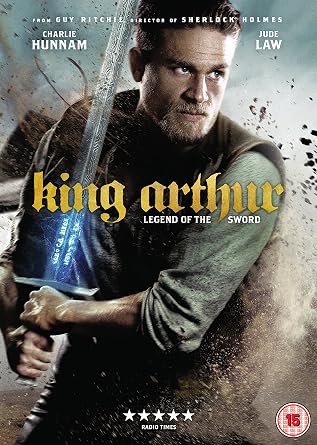
Recently, I’ve become very interested in King Arthur. Specifically, I wanted to know whether or not he was real, and how this whole story of him, Merlin, Lancelot and Guinevere, his sister/lover Morgan le Fay and his nephew/bastard son Mordred came to be. I mean, do we really believe a guy who didn’t know he was the bastard son of the previous king was taught by a magician, pulled a sword from a stone, had an idyllic kingdom stretching across Europe for a few years, only for it to be undone by his affair with his sister and his wife’s affair with one of his knights, to be gospel historical fact? I wanted to know the truth, and I wanted to know it as in-depth as possible.

This new obsession of mine started after one of the YouTube channels I follow, Overly Sarcastic Productions, produced a video about Arthur lore, and how that got built up over the past fifteen-hundred years (click here to watch the video, as well as here for their follow-up on some of Arthur’s lesser-known knights). These laid the groundwork for me to get interested in the subject, and to want to find out a bit more. From there, I downloaded a lecture  series from The Great Courses company (college level lecture series you can listen to while you work or drive. Definitely check them out, they’re very informative) on Arthur, narrated by Professor Dorsey Armstrong of Purdue University, and an expert on the subject of Arthuriana.

If you don’t have time to watch either video or to listen to Professor Armstrong’s lecture series (though you should at least spend a half hour on that first video), let me do my best to put it really simply: probably ninety-five percent of what you think you know about King Arthur is complete and utter fiction. There’s some evidence to suggest that during the late 5th and early 6th century, the invasion of the Saxons in England was stopped and in some places reversed, keeping the peace for a few generations, and that someone probably lead a war effort that caused that peace.

This figure was probably the basis of Arthur. The name Arthur, by the way, doesn’t appear until after this time period, but then becomes quite widespread among Bretons. This possibly means that the name “Arthur” wasn’t this figure’s real name, but maybe an acronym, abbreviation, or nickname based on a Celtic or Latin name. A number of figures listed in history annals from around or after that time have been pointed to as possibly the inspiration for Arthur, but documentation from that time is scarce, so no one really knows if any of these figures were Arthur or given that name as a title or nickname.

So, Arthur was possibly real. We’re not sure, because there’s only so much evidence. He could be as made up as Harry Potter, and was a folklore character adapted by the Bretons for their current predicament.

Pages from the Historia regum Britanniae, the first King Arthur bestseller ever written.

At the very least, the legend of Arthur cemented itself and grew over time. From a local warlord to king of all the Bretons, and then other elements started getting added on, such as Merlin, who was probably based on a mad bard who lived a couple of centuries after the Arthur figure. Eventually, a man by the name of Geoffrey of Monmouth wrote this huge book called Historia regum Brittaniae, a pseudo-history of Britain that dealt quite a bit with Arthur. It was spread across the European continent, where other writers from as far as Italy, Scandinavia, and Russia started adding their own spins on Arthur’s story and adding their own elements. These elements include Lancelot, who was the invention of a French writer, Excalibur and the Holy Grail, and Mordred being Arthur’s incestuous offspring. And as years passed, storytellers just kept adding elements and remixing the already-available tales until we have all the Arthur stories available today.

It’s like what might happen if, a thousand years from now, George Washington was known as Walsh; his historicity was debated; he was credited not only with defeating the British but conquering the entire continental United States; had Superman’s powers; and was taught by Mark Twain, who’s been combined with Nikola Tesla and has lightning powers.

Yeah, kind of crazy. Also a huge simplification, but it’s a blog post. What do you expect of me?

Like I said, anyone can add to the Arthur canon. Doesn’t mean it’ll be good.

Anyway, it’s just mind-blowing how great an influence one man who may or may not have existed and probably only ruled a small area of land if he did exist has had on Western society. Most likely, if you’ve lived anywhere English culture has reached, you’ve heard something about Arthur. You just probably never realized that there was so much debate around him or there’s no real canon about him, because so much about him is in flux from storyteller to storyteller.

It’s also very inspiring, in a way. You can write almost any sort of story about Arthur, and it can be considered part of the canon (whether or not it’s any good though, is left up to the storytellers and their audiences). The possibilities are kind of endless, as long as you keep an open mind. I’ve already had an idea for a short story involving the historical Arthur figure and the subsequent works written about him. I plan to write it at some point this year and then submit it to my publisher, Castrum Press, for one of their anthologies (they’re doing some anthologies, BTW. Check them out here if you’re interested. All are welcome to submit). Hopefully it gets accepted, and maybe some people will like it. We’ll see.

Whatever you know or believe about Arthur, it’s undeniable that he’s had an influence on the world. His legend is constantly growing, morphing, and mutating. And all from one man, a man we don’t even know if he was real or not. It’s definitely a mind-boggling, cool, and inspiring subject, and I’m so glad I decided to dive into it.

I hope, if anything, this post makes you curious enough to dive in too.

I’m not sure if I’ve ever mentioned this, but Rose has a lot of flashback sequences and other dips into the past within the story, especially in the last two-thirds. I did this for a number of reasons: exploring the characters’s pasts; making them more complex; and just an opportunity to write some sequences to add to the horror element of the story. And there are a lot of horrifying things in those sequences, things that I can’t go into without revealing too many plot details, but they did make my beta readers gasp and stare at the page wide-eyed. They were horrifying moments in the story.

Not to mention, I think that flashbacks can be scary if done right. A good example of this is Gerald’s Game by Stephen King: while the protagonist’s current situation is scary enough, going into her past midway through the story and seeing how her father abused her as a kid was horrifying in its own right. Another good example would be the movie Oculus: that film flashes between the present and the past throughout its runtime, and it’s freaky no matter what year it is (see my Rewatch Review of that film).

Well, it looks like I didn’t do the flashbacks right for Rose. In the notes on the fourth draft from my publisher, they mentioned that all those flashbacks are just bad stuff happening to those characters, and while that stuff is horrifying, it’s not scary. I’ve had a lot of back and forth with them on this, and after a lot of thought, I can see where they’re coming from. After all, while in the real world “horrifying” can be a synonym for “scary,” especially in relation to current events, in fiction that’s not necessarily the case. Think about it this way: Harry Potter is horribly mistreated by his relatives, and what he goes through is horrifying. But if you ask any normal Potterhead what person or creature from the books they would be scared to face, the Dursleys wouldn’t rate very high on that list. The dementors, Voldemort and his Death Eaters, or the basilisk, sure. But the Dursleys? Considering most Potterheads are Muggle in biology and can’t perform magic, anyone who had to face them would probably be invited into Privet Drive and served tea and cookies in front of the TV!

So while showing how many terrible things happened in the characters’ pasts may be horrifying, it might not be scary. And considering how much experience my publisher has and how well-received their books are (have you checked out The Cronian Incident by Matthew Williams yet?), I’m taking this piece of feedback to heart.

I won’t lie, though, I’m a little disappointed, and I’ve been wondering where I went wrong. Or maybe to phrase it better, I’m wondering how I might have done the flashbacks better.

Well, in the case of Gerald’s Game, whose flashback is most similar to mine, they only do one big flashback sequence, not several. That way, it doesn’t become a repetitive cliche or trick. That, and its connection with the current events of the story: the protagonist’s abuse by her father is very much connected to her current predicament, on psychological and symbolic levels as well as literal levels. And with Oculus, the horror behind the story–a cursed/haunted mirror–is scary no matter when it happens. Spinning a tale of two siblings who experience the mirror both as children and adults, and then going back and forth between those two experiences, makes for some great psychological/supernatural horror.

And maybe that’s the thing: connection. In both those examples, the flashbacks, no matter how they’re staged, have very strong connections to what’s happening in the story’s present. Of the ones in Rose, while they do have connections to the characters’ pasts, only one of them has a direct correlation to the current events of the story. And that one’s told to us by the antagonist rather than shown in flashback. And that’s why the flashbacks in this story didn’t work as well as they could have.

So what’s next? Since so much of the novel is in flashback, I may have to do a whole lot more revising. Hell, I may even have to rewrite a good chunk of the novel. Which isn’t something I’m unfamiliar with: as many of you may recall, I had to go back and start over on the first draft back in college because the first attempt went in a direction that didn’t help the story.

Still, it’s a little annoying, and I haven’t figured out exactly what I’m going to do for these changes (though I have ideas). Hopefully, whatever I come up with, it’ll come out for the novel’s betterment, and bring it one step closer to publication.

Fingers crossed.

I’ve been thinking a lot about what’ll happen after Rose comes out. Specifically, what sort of stories I’ll work on once I’m done with Rose.

I know that’s a crazy thing to think about at this point. I’m still doing revisions on Rose for the publisher, and likely they’ll have me do more revisions before we get to publication, and then there’s the publication, and then a whole ton of marketing and other work just to make sure the book is read and sold and reviewed and whatnot. Thinking about future projects should be the last thing on my mind.

But of course, being “logical” has never been one of my strong suits, and dreaming about the future has been what’s helped me get to this point anyway. So why not wax on about what might happen after Rose?

Well, there are a number of short stories I’ve been thinking about working on. I very much want to edit Hannah, the ghost story I wrote back in January, and I want to write a few stories that have been circulating in my head for a while. I also want to eventually get back to the novelette I was working on that was giving me so many challenges, and see if I can get a bit further in that, if not finish it up entirely. It may end up becoming one of those stories where I revisit it every now and then to see if time has given me a clearer vision of how to improve and/or finish it (I’ve got a few of those). And I’d like a few months to spend on all of those, just to see what I can come up with, and if any of it is publishable.

And of course, I’ve been thinking about what sort of novel I’d like to write next, when I’m ready to write a novel. Probably, that won’t be immediately: Rose has challenged me in ways I’ve never been challenged by a story, and I want some time to refresh my mind before I make a commitment to a project that I could end up working on for years and years. But I have some ideas on what sort of novel I’d like to write next, when I am ready to make that sort of commitment.

For one thing, it won’t be a sequel to Rose. I could write one, and I have ideas I could develop into a sequel for Rose, but I don’t want to return to the world of Rose just yet. Especially when I can’t guarantee I can make the story better or on par with the original so soon after finishing the original.

For another, I’m not yet ready to return to the world of Reborn City. Yeah, I know there are a couple of big fans of that trilogy who want the final book, Full Circle, already (I know a few of you are probably out there), but I’m just not ready to get back to that yet.

And finally, I want to do something that’s different. Think of it like houses: I don’t want to try selling Castrum on a house that’s basically the same one they bought, just on a different block and with a different coat of paint. I want to sell them a house that’s just as good as the first one, but an entirely different design, while still retaining the Rami Ungar architecture (is this metaphor getting too weird/complicated, or does it still work?).

All these books are different from one another. I want to do the same with my books as well.

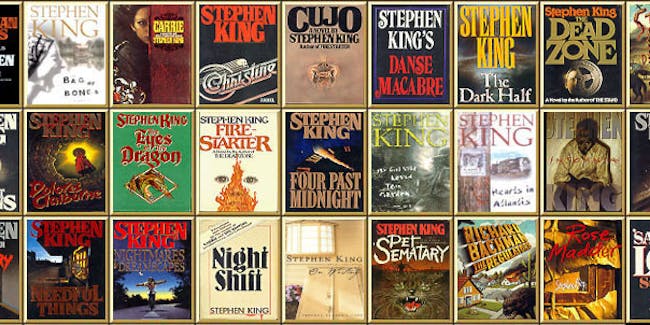
I mean, look at Stephen King: he followed Carrie (a psychic girl who gets revenge on her psychotic religious mother and the bullies at her high school) with Salem’s Lot (vampires invade a small Maine town, and a writer and his allies have to stop them), and then went on to write The Shining (a family that includes a psychic four-year-old becomes the winter caretakers at an isolated hotel haunted by something dark and evil) before creating The Stand (a super-disease causes most of Earth’s population to die off, leaving the survivors to engage in an apocalyptic war between the forces of good and evil). None of those are carbon copies of the other, so I want to do something very distinct from Rose.

And I have a few novels I can choose from. I have more ideas than I know what to do with, so I have plenty of options, but there are a few stories I can think of that would make great projects. There’s one in particular I’d like to work on when the time comes, but it’ll depend on a number of factors, including if I have to pitch something to the publisher (I’m not sure if that’s something I have to do, but it’s something I’ve thought about).

Still, there’s plenty of time to think about all that. I just know that when the time does come to think about all that, I’ll have plenty of ideas to work with and consider. Hopefully whatever I choose, it’ll make for some good reading.

In the meantime, I’m off to work on Rose for a little bit. Here’s hoping I can make some good progress before I have to hit the hay tonight. Until next time, my Followers of Fear, pleasant nightmares!

Last week I had a dream that started pleasantly and ended up being kind of nightmarish: it involved me and a friend of mine from high school navigating an area with lots of rivers and creeks on surfboards. We were looking for a mythical golden treasure trove that many had searched for and failed. We’d heard the treasure we were looking for was cursed, but we went searching for it anyway, because nothing bad has ever come from seeking and finding cursed objects. Somehow we found the treasure where so many others had failed, split it up between us, and go home. However, soon after that, weird stuff starts happening: things move on their own, the faces on the coins change shape, and that’s just the start of our problems. Well before it gets really bad though, my friend and I realize that we have to return the treasure to where we found it.

At some point, someone in the dream says I could write a story about what’s happened to us. To which I replied, “Someone already did. It’s called Pirates of the Caribbean.”

After we agree to take the treasure back, I woke up. It didn’t take me long to figure out the main message of the dream (besides the fact that I can point out when my situation resembles a famous film in my dreams). You see, the night before I’d taken a swipe at starting the fifth draft of Rose, based on my publisher Castrum’s comments and suggestions. I got about a page in, and I hit a metaphorical roadblock. I couldn’t figure out how to advance. So I ended up going to bed not sure how to move further in editing this novel while at the same time integrating my publisher’s suggestions (many of which I agree with and think could elevate the quality of the novel).

That dream was my subconscious giving me a rather creative presentation of my doubts and anxieties regarding the editing and publishing process for Rose: that signing with a publisher was a really bad idea, that there’s nothing I’ll be able to do to make this novel publishable, that even if I somehow get it released, it’ll suck and anybody who reads it will leave bad reviews. A dark side to achieving my dream and finding a publisher, represented expertly by cursed gold.*

And then on Saturday, I tried again. And it went extremely well. I got thirteen out of sixteen pages in that chapter done. Yesterday, I got the last three pages done, plus all eleven of the next chapter (and while taking in a double feature on the Blu-Ray Player in the afternoon). And then today, I got another chapter done within a couple of hours. That’s an average of a chapter a day! Take that, conscious and subconscious fears involving working with a publishing process.

Obviously, these are still early stages of the fifth draft, and I’m going to encounter moments where I’m not sure what to write or how to integrate a suggestion from the publisher. Luckily though, my publisher has been great about answering any questions I have (thank God they don’t see me as a pushy American) and offering feedback to my ideas on how to integrate their suggestions. And with these last three chapters, I’ve been able to move forward mostly on my own. And with time, I’m sure I can get through the rest without trouble, and well before May 16th. I just have to keep being creative and persevere.

Obviously, doubts about what I’m doing and where I’m going will plague me throughout my writing career from here on out. I’ve passed a new turning point in my career, and it’s a whole new playing field from here on out. But the next time I feel those worries start to get to me, I’ll remember the dream about the cursed gold, and the productive weekend that followed. And I’ll just keep editing through my doubts.

And while I still have your attention, I’d like to give a shout out to my good friend and fellow novelist at Castrum, Matt Williams. He just finished writing his novel The Jovian Incident, Book Two of the Formist series, and will hopefully have it out later this year. I can’t wait to read it, as I really enjoyed the first book, The Cronian Incident, which currently holds a 4.7 out of 5 on Amazon based on 12 reviews. If you would like to read some hard-boiled detective fiction in a futuristic universe, this series may be the one you’re looking for. Check it out and leave Matt a review while you’re at it.

Until next time, my Followers of Fear, pleasant nightmares (hopefully none that resemble popular contemporary movies, though).

*Still not sure why I was using a surfboard to navigate rivers and creeks (obviously a reference to the various paths we authors take to finding a publisher), as well as why that particular friend was with me (I love the guy and it always seems like no time has passed at all when we see each other, but he’s not a fiction writer, so I can’t think of why he would be in the dream).

Last Monday, I announced that my novel, Rose, is getting published by Castrum Press. And amidst all the excitement and a little extra alcohol (because of course I’ve been celebrating), there has been a lot of correspondence between me and the publisher (and how cool is it that I can say that now?). Some of what we’ve talked about is how the publishing process works, what each of us can do in terms of marketing, etc. But one of the big things we’ve talked about in the past week is the fifth draft. And trust me, there’s going to be a fifth draft. Because as nice as the fourth draft was, it’s still got a few problems here and there that can be cleaned up.

I’ll be honest with you guys: as excited as I am about all this, I’m a little terrified. Okay, maybe a lot terrified. Before last Monday, this dream of being an author with a publisher was just that: a dream. And as much as we want our dreams to be accomplished, when they’re still dreams, there’s only so much damage that can be done to them. But once they’re brought into reality, like when a publisher wants to release your book, then there’s all sorts of damage that can be inflicted: negative reviews and/or poor sales, the process to publication can be beset with difficulties, etc. (I don’t think that those things will happen, but my overactive mind tends to consider every horrible possibility out there).

On Friday, my publisher and I agreed to catch up again in mid-May to see how my edits are going. After that, we’ll see where we go for there. And I’m scared that when they see what I’ve done there, they’ll feel I haven’t lived up to their expectations and rescind the publication deal. Again, I’m pretty sure this is more my fear than an actual possibility, but like I said, I have to consider all possibilities. And that one has gotten kind of big in my head.

Of course, me being me, I take what’s scaring me and turn it into a fuel for my confidence, motivation to produce good work, and a means to scare others (I believe psychologists call this sublimation). I even gave myself a pep talk a few minutes ago in front of the mirror, using a scary voice to convince myself how powerful I am and that I can accomplish what I set my mind too. And it worked very well. Weird what I can do when I tell myself that I am the Devil, Azathoth, Nyarlathotep, and Death all rolled into one, and that I can be my generation’s Stephen King while sounding like I’m possessed. Yes, I do that. Don’t judge me.

So I’ll get started on a fifth draft of Rose very soon, finishing up a couple of tasks before I do so. I’ll also be leaving for the library in a little bit to print out some of the editors’ notes. Hopefully I can take enough from those notes to better the manuscript before the deadline in mid-May. Fingers crossed.

As always, I’ll keep you guys informed of any developments that occur. Until next time, my Followers of Fear, pleasant nightmares! (I know it’s not even two in the afternoon yet. But that’s never stopped some people from having nightmares during the day.)

Well, looks like I’m not the only one who’s having a dream come true. And I’m very excited about this interview. She’s a rather unique voice I’ve come to know recently.

I first met Rabbi Leiah Moser back in December, when I ran across one of her posts on her blog, Dag Gadol (Hebrew for “big fish”). Her post was about why, as a rabbi, she was writing a fantasy novel. I read through it, and I found that not only did she have some good points, but there was something about this blog and its writer’s voice I found compelling. As I read further, I found out that not only was she a Member of the Tribe, a rabbi, and a writer, but a member of the LGBT community. And here’s me, not just a writer, a Member of the Tribe and of the LGBT community, but the son of two rabbis, one of whom is also LGBT. I think the first line of my first comment on her blog was something like, “An LGBT female rabbi who writes fiction. Where has this blog been my whole blogging life?” Thus started our acquaintanceship.

Recently, Rabbi Moser announced that her YA fantasy novel, Magical Princess Harriet, had been published and was live on Amazon. Me being me, I offered to give her an interview here on my blog. Thus are we here today to here about Rabbi Moser and Magical Princess Harriet. Enjoy!

Rami Ungar: Welcome to my blog, Rabbi Moser. Tell us a bit about yourself and how you got into writing.

Rabbi Moser: I think I’ve wanted to write a fantasy novel since I was in the sixth grade, but the road to actually achieving that ambition has been a long and convoluted one. Throughout my teenage years and into adulthood I tried my hand at writing fiction from time to time, but never managed to actually finish anything to my satisfaction, partially I think because I still hadn’t managed to get the whole identity thing nailed down. Trying to write without really knowing who you are is like trying to run on loose sand — the ground keeps shifting beneath you and you never seem to make any progress. After a while I kind of gave up on the dream of being a writer. I tried to find other dreams to pursue, but in a lot of ways I was just drifting.

Then while I was living in Japan I had this really intense religious experience. It’s kind of hard to explain, but the practical upshot was that afterwards I had this absolutely unshakeable conviction that God was real and that I needed to be Jewish. When I got back to the United States I found a synagogue and began attending, and after a while converted to Judaism. Later on, I decided I wanted to deepen my Jewish learning so I could do more work in the Jewish community, and that’s how I ended up moving out to Philadelphia to go to rabbinical school.

Rabbinical school was amazing, but before too long I was running into the same problem there that I’d had with my writing, namely that to do this kind of work you really have to bring your authentic self, whereas I’d been doing my best to hide from my authentic self ever since I was in middle school. After a great deal of soul searching I decided to come out as transgender and start my process of transitioning, and that, of all times, was when I finally realized that I had an idea for a book that I wanted to write. It was really that closely connected — converted to Judaism, came out as trans, and then the idea for Magical Princess Harriet popped up out of nowhere begging to be written.

If anything what I’ve learned from all this is that in this life things sometimes have to happen in a certain order and I am in no way the one who gets to decide what that order is. As they say in Yiddish, a mensch tracht un got lacht (a person plans and God laughs).
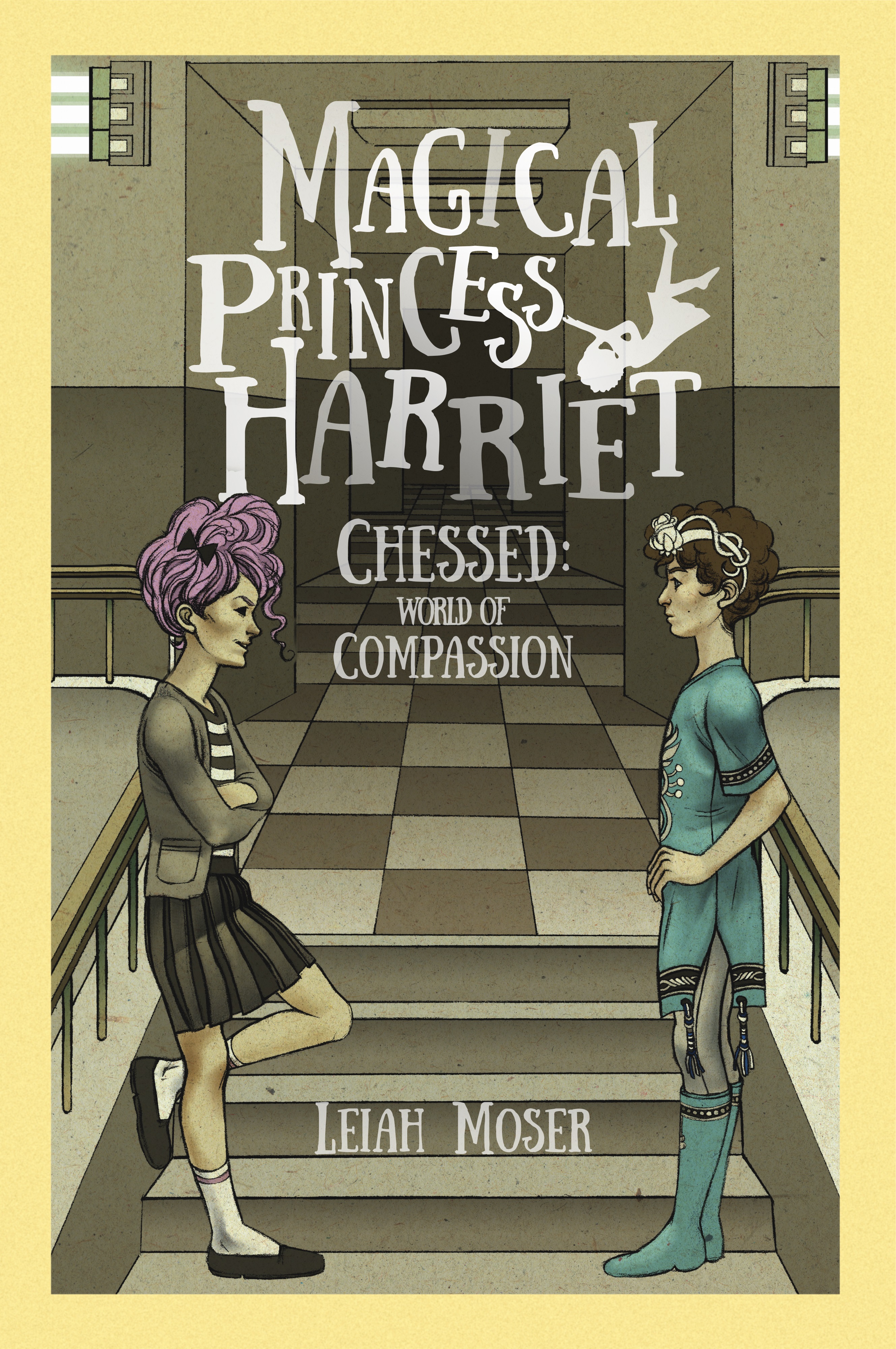
The cover of Magical Princess Harriet.

RU: Reminds me of the old country. So tell us about your new book, Magical Princess Harriet. I’ve heard some good things.

RM: Magical Princess Harriet is a young adult fantasy novel that draws its inspiration in roughly equal amounts from the “magical girl” genre of anime, Jewish mysticism, and my own strong feelings about LGBT inclusion and neurodiversity in Judaism. It’s about a young trans girl named Harriet Baumgartner who is doing her best to avoid having to think about the persistent feeling she has that she’s not supposed to be a boy, when a pushy angel named Nuriel shows up and tells her that she’s a magical princess now and that it’s her job to protect her town from the forces of darkness. (A quick side note: You have no idea how difficult it is to figure out how to talk about a book in which the main character changes their name and pronouns a third of the way in without misgendering them. Of all the challenges I’ve faced in figuring out how to explain this book to people, that has been the most difficult!)

RU: Tell us about some of the characters, and why we might like (or if applicable, hate) them.

RM: Harriet I’ve talked about a little already, so let me talk about her friend Frances.

Frances and Harriet have been best friends for years, ever since they met in Hebrew school. When Frances was six years old she was diagnosed with Autism Spectrum Disorder (ASD), and ever since she’s been pushing back against peoples’ tendency to regard her as stupid or crazy because she sometimes has trouble speaking. Obsessed with architecture, she has an inherent talent for understanding spatial relationships, which serves the kids well in the labyrinthine corridors of Arbory Middle School where the ordinary laws of space and geometry tend to break down.

The girl on the cover with the lavender hair and the dark holes where her eyes ought to be is Kasadya. She looks like that because she’s one of the nephilim, a group of creatures who got their start as angels unwilling to devote their existences to service. As a nephil-girl, she has the power to influence human minds, and she has used this ability to turn the middle school into her own private domain… well, private except for her brother Azrael, that is, but as far as she’s concerned she is the one in charge. Kasadya likes to think of herself as an epic villain from a TV show or comic book, and she’s been waiting for a hero to come along to challenge her. When Harriet shows up, glowing like a disco ball, it occurs to Kasadya that she might fit the bill — much to Harriet’s chagrin.

RU: What was the inspiration for MPH? Did any of your own life experiences make their way into or influence your writing of the story?

RM: I think all of my life experiences made it into the book in one way or another. This was an intensely personal project for me.

RU: MPH had an illustrator, Magdalena Zwierzchowska. How did you two meet and what was it like working with her on the book?

RM: When I got to the point where I was thinking seriously about publishing this book for real I knew I wanted to find an illustrator. I’ve always been a very visual person myself, and know how helpful illustrations can be in solidifying one’s sense of the world an author is presenting. How we met was fairly prosaic — I posted an ad on DeviantArt indicating that I was looking for someone to illustrate this book, and she was one of nine or ten people who responded. I was totally charmed by her work, by the gorgeous, surreal creepiness of it, and so she got the job.

Working with her was easy in some ways, difficult in others. She was extremely professional and always willing to listen to my input and feedback regarding how the characters and setting elements should look. The tough part was figuring out how to translate the images I had in my head into concrete instructions she could use. In the end I was very pleased with how it all turned out. I think it has a very unique look.
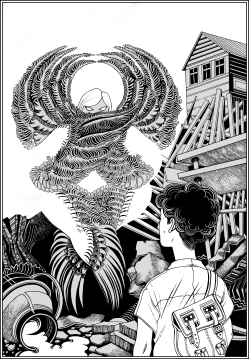
An illustration of a seraph by Magdalena Zweirczkowska.

RU: You address several issues in the pages of MPH: autism spectrum disorder, Jewish identity, gender identity, intersectionality, etc. Was it hard to talk about those subjects in the book?

RM: Yes. Not because I normally find it difficult to talk about these topics (on the contrary, most of the time I can’t shut up about them!) but because I didn’t want to address them in a way that would come across as preachy. That may sound a bit weird, coming from someone whose job literally involves preaching, but I was writing with the assumption that these were things my target audience, middle schoolers and teens, are dealing with every day, and the awareness of that fact demanded that I approach what I was doing with a self-critical eye.

RU: MPH is a crowdfunded, self-published book. What made you decide not only to self-publish, but to crowdfund your story?

RM: While it is theoretically possible that I could have found a publisher for a book like this, my hopes were not high. That has nothing to do with the quality of the book, mind you, but rather its subject matter. MPH in many ways defies categorization. I mean, Jewish fantasy is not exactly a well-represented subgenre, is it? Add on top of that the transgender element and… well, I felt like I might be able to find a publisher for a Jewish fantasy book, and I might be able to find a publisher for a queer fantasy book, but a queer, Jewish fantasy book with a transgender protagonist? That’s where I wasn’t so sure.

Also, I’ll admit, there was a part of the decision that was about actively wanting to do it myself. I’ve always been fascinated with every aspect of the publishing process, and with print-on-demand and online sales venues making it so easy to self-publish these days, it seemed like a waste to write the book and then turn it over to someone else to produce. I probably bit off more than I could chew, and I had to spend a lot of time learning about things like layout and formatting for print, but in the end I’m really happy with the way it turned out.

RU: What has the reception for MPH been like so far (from congregants, friends and family, random Internet people, etc.)?

RM: It’s still early days, but so far all the feedback I’ve been getting has been very positive. The first question of everyone who’s actually finished the book has been, “When is the next one coming out?”, so that’s pretty great to hear. My one thing is that because my Kickstarter backers are obviously all adults, I haven’t yet received any feedback from the young people who are the primary audience of the book. I’m really looking forward to that.

RU: Are you working on anything new? And what are your plans for the future?

RM: Right now I’m mainly focusing on getting the word out about Magical Princess Harriet, but I have plans for at least two more books in the series. After that… well, who knows? It all depends on what kind of response I get, I guess. I really loved writing this book, and now that I know I can, I feel like there’s very little stopping me from writing another, and another, and…

RU: What advice would you give another writer, regardless of background or experience?

RM: Write! But that’s ridiculously obvious and patronizing, so I take it back. Here’s the best piece of advice I can give: Take the time to figure out who you are and to learn how to be okay with that. Writing can be this incredibly daunting thing because those ideas and feelings on the page you just handed to someone else to read are basically you. It’s hard not to get intimidated by that and start pulling back, to restrain the words, force them into a mold that’s more about what you think others are expecting than it is about what you have to write. Edit your writing, not yourself.

And also: It is ridiculously easy to publish a book these days. Give it a try, you’ll see what I mean.

RU: Final question: if you were stuck on a desert island for a little while and could only take three books with you, which ones would you picks?

RM: Ack! That’s so hard! Assuming that “three books” refers to three actual bound volumes and that bringing an entire set would be cheating, I have to go with:

  • Volume 2 of my portable Talmud set (the one with massechet Chagigah)
  • 1Q84 by Haruki Murakami
  • A copy of The Star of Redemption by Franz Rosenzweig, because then I might be able to actually finish the darn thing.

RU: Thanks for being on the show, Rabbi Moser. We all hope the book does well.

If you’re interested in checking out Magical Princess Harriet, you can check it out on Amazon. And I highly recommend checking out her website Dag Gadol. Trust me, it’s a great site and I always enjoy seeing new posts in my inbox.

And if you would like to have an interview for your new book, hit me up on my Interviews page or email me at ramiungar@ramiungarthewriter.com, and we’ll see if we can make some magic happen.
I’m really not sure where to start with this one. I mean, how do you tell people about the realization of your childhood dream in one blog post, let alone be coherent? I feel like going in fifty different directions with this post, that’s how excited I am!

Well, I guess I’ll start at the beginning. Or what I think makes a good beginning, anyway: back in March of last year, my friend and fellow novelist Matt Williams (check out his blog HERE) announced that his novel, The Cronian Incident (which I recommend if you’re into science fiction and detective stories, by the way)  had been accepted for publication by Castrum Press, a company based out of Belfast in North Ireland which, in the year since Matt’s been accepted, has gained a bit of a reputation for publishing great speculative fiction and treating its authors very well. Later that year I did an interview with Matt and then received an eARC copy of Incident from Castrum to read and review. After hearing how Matt liked the company and seeing how well his book was doing, I asked if he’d make an introduction for me to the company’s editor. He said yes.

I talked with Castrum’s owner, Paul, and he asked to see some of Rose. This was after the third draft had been finished, if I remember correctly. I sent him the first ten pages, letting him know I planned to do one more draft after the beta readers were done with the manuscript. He sent back some notes and asked to see more of the book when it was done. One draft later, I sent him the fourth draft of Rose, hoping against hope that they’d like it enough to publish it.

Cut to last Friday, and I receive an email when I get home from work. It was Castrum: they wanted to discuss publishing Rose. After jumping up and down like a kangaroo and screaming high enough to break glass, I replied saying I’d be happy to work with them. Paul sent a contract yesterday, and after having some of my questions answered, I signed the contract and sent it back to him this afternoon, with the realization that my dream has been accomplished. A novel of mine is getting published by a company.

To which there’s only one thing to say:

By the way, if you’re unfamiliar with Rose, this is a novel I first wrote as my college thesis during senior year. It follows a young, amnesiac woman who starts turning into a plant woman. And that’s just the events of Chapter One. And trust me, it’s a full-on horror novel from there, complete with psychological and supernatural terrors galore. I tried editing it again in 2016 and couldn’t make it work, tried again in 2017, and after that things kind of just snowballed from there. And now it’s getting published.

Obviously, I’m feeling a number of emotions right now. Excitement about the publication process and seeing Rose out in print, nervousness about how it will be received by the book-reading public, satisfaction that this dream has been achieved, hope for the future, and a feeling of goodwill about things to come. Especially that last one. Since at some point during the third draft of Rose, I had a feeling that things were about to change, that something big was about to start. And since the New Year, I’ve had this very strong feeling that not only was 2018 going to go slower than 2017 did, but that 2018 was going to be my year. And so far, it seems I was right on both counts. And I hope I can continue to be right on both counts.

Rose will appear in this medium very soon.

There’s so many people to thank for this wonderful event. Firstly, my friend Matt Williams for connecting me to the company, my beta readers Joleene Naylor and Dr. Black (my chiropractor, believe it or not), as well as Paul Camper, Maura Heaphy, and Manny Martinez for looking at the book back in college, and of course to Castrum for taking a chance on this indie author from Ohio. But most of all, I’d like to thank you, my Followers of Fear. For nearly seven years, you’ve stood by me and supported me through my various writing endeavors, my college experience, finding and getting a job, my ups and my downs, and so much more. You’ve all supported me and helped me get this far, and I can’t thank you enough for that. I hope you continue to support me (and maybe even read Rose when it comes out) as I continue down this road and try to make sure Rose is a huge success.

So what happens next? Well, I’ll work with Castrum to produce a fifth and hopefully final draft of the novel. We’ll get to talking about cover art and at some point we’ll set a release date (I’m hoping before Halloween, but we’ll see). And of course, I’ll make sure to let you know of any major developments.

Until next time, my Followers of Fear, I wish you pleasant nightmares (I’ll, of course, be having nothing but pleasant dreams)!

I have not been blogging much in the last week or so, though I’ve read just about every blog post that shows up in my inbox. This is partly because I haven’t had anything I’ve felt passionate enough to blog about and because of time constraints, but it’s mostly because of the story I’ve been working on lately. You see, this story is challenging me as a writer, and the challenge has me engrossed, more so than a test engrosses Hermione Granger around exam time (oh Harry Potter, you always give me something when I ask). It’s so engrossing, that it’s taking up all my creative energies, leaving me unable to blog or even come up with new ideas for stories (though I already have more ideas than I know what to do with, so that’s not a huge problem).

Some of you may remember that I started working on a story I thought might become a novelette or novella in between drafts of Rose back in October or November. After finishing the short story Do-Over the other day, I started working on this story again, and as I said, it’s been challenging. On a number of levels, actually: for one thing, there’s an anthology I’ve heard about that’s looking for stories of a certain word length, so I’m trying to write this story to keep it within the anthology’s word limits. Yeah, I know I should let the story be whatever length it’s meant to be, but after expanding Rose to twice its word length last year because it was suggested I do just that, I feel like I can aim for a certain word count and still get a good story out of it.

Another reason it’s challenging is because of the narrator. Like Rose, I’m telling this story through the eyes of a first-person narrator, which means I’m reliant on her as a narrator to tell the story and to create a good horror ambiance. But at the same time, she’s got a history, a personality, and observations that she’s putting into her story. It’s less like I’m writing the story and I’m channeling my narrator as she’s telling the story, though I do have the power to go in and make changes as needed. And creating that horror ambiance while balancing my narrator’s voice and what she feels is necessary to put into her story, such as her interactions with her husband, isn’t that easy.

Did I mention that this story also takes place over thirty years before I was born, in a state I’ve only visited once? Well, it does, so in addition to being a horror story, it’s also historical fiction, and I’m working hard to recreate an age and place I’ve never experienced, with all the fashions, technology, and attitudes in place. It’s a lot of work, to say the least.

And on top of that, you have all the normal challenges of storytelling: making a story interesting, pacing, showing vs. telling, dialogue, word choice, et cetera, et cetera. I’ve got my work cut out for me.

But honestly, I think it’s all worth it. Because in my experience, if a novel challenges the writer, it’s going to be a better story in the end. Look at Rose: that novel challenged me every time I worked on it. The first draft alone, I had to go back to the very beginning and start over again because I had to totally reroute the path the story was taking. During the third draft, I added forty-thousand words, a whole new plot line, and even a character or two just to make the story not only longer, but better. And in the end, I created one hell of a story that I feel has a great chance of publication. Hopefully with this story I can get a similar outcome.

Stories can be challenging to write sometimes. It may be difficult to get the words on the page, but in the end, with a lot of work, I think it can lead to a really compelling story. And I’m looking forward to seeing if, after a lot of blood, sweat and tears, I can wrangle out a good story here.