Posts Tagged ‘review’

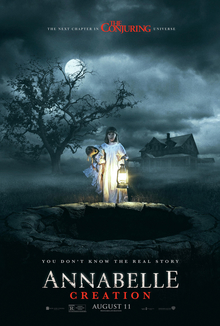
A lot of people hated Annabelle when it came out in 2014 as a spin-off of The Conjuring. I didn’t review it on this blog back then because I saw it about three or four weeks after it came out, but I thought it was a decent scary movie. Not as good as The Conjuring, but still very good. So when I heard that the sequel to Annabelle being made was actually going to be a prequel, I was intrigued, hopeful, and confused (wasn’t Annabelle the origin story?). Today, I went to the theater to see for myself if the fourth entry in The Conjuring film series was going to be good, or the start of the inevitable horror film series decline (you know it’s inevitable).

This might actually be the most solid entry since the original Conjuring film, and it’s a lot better than the first Annabelle.

Annabelle: Creation introduces us to the Mullins, a dollmaker and his wife who lose their little girl in an accident. Years later, the Mullins open their home to a girls’ orphanage, only for an ancient and malevolent evil with connections to the Mullins’ little girl to target one of the young girls, and through her, the whole household.

This film scared me pretty badly, using atmosphere, jumpscares, practical effects, and minimal CGI to create a powerful scare factor. There were a number of moments where I was just holding myself, thinking to myself, “NOPE!” or “GTFO,”* which just shows how frightened I was. If you can make me think “NOPE!” and make me want to run (or the characters), you’ve done a good job with your scary movie.

The direction of the film was strong and skillful, the writing for the most part was effective and didn’t have that many issues. This was an almost entirely female cast, and they were all very convincing. I especially loved the interaction between characters Janice and Linda, who have a very sisterly bond between the two of them, to the point that they don’t want to be adopted unless it’s together. It was so adorable, you just wanted to give them that home they wished for! I also liked the character of Sister Charlotte, the nun who takes care of and teaches these girls. Nuns in film, at least in my experience, are either matronly and motherly, or weak and wilting, but Sister Charlotte was strong and decisive, willing to risk her life and even do some things that would make others hesitate when she realizes what’s going on and has to defend her girls.

Me having some fun before the film.

There’s not much else to say on the plus side. The sets and costumes are convincing of their period, there are fun references to both the doll Annabelle’s actual form (a Raggedy Ann doll, if you didn’t know), as well as to the other films in the universe and even a hint of what we might expect in the upcoming film The Nun (coming out in 2018), based off that creepy nun-demon in The Conjuring 2. And they do connect this film to Annabelle, which does explain a lot.

There are some issues, of course, (and here I get a little SPOILER-y). And I don’t just mean the normal ones when watching a horror film (why doesn’t anyone else in this house hear the screaming? Why aren’t they running further away from the house? etc.). I would’ve liked to see more interaction between Linda and Janice, because they were so cute, and because that would’ve made the moment where one of them figures out something’s wrong with the other that much more convincing. I also didn’t care for the moments when they took the demons out of the shadows and showed them full-face, because it looks a little hokey. I would’ve preferred that they showed more of a creepy scarecrow, if truth be told.

And ironically, the way it connects to the original Annabelle leaves a few more questions that we’ll never get answers to.

But, in total, Annabelle: Creation is a great horror film, delivering on its promise of scary dolls making us crap our pants. On a scale of 1 to 5, I’m giving it a 4.6. Go see it, and make sure you bring someone (or a stuffed animal) to hug when you get terrified. Believe me, you may need it.

*GTFO = Get the fuck out. It’s what every person thinks while watching a horror film and seeing when something awful is about to happen in a particular location.

So yesterday I’m having a conversation with the receptionist at my doctor’s office while I wait for my appointment, and we get onto the subject of the stories I’m working on (because if you know me, after a while that WILL come up). I tell her about my WIP Rose, and what that’s about, as well as some of the themes in the story. When she hears that it deals with some pretty heavy themes like abuse, her response was, “Wow, I didn’t know horror could be so deep.”

And that’s a common response from non-fans, not just of horror but of speculative fiction in general. People who are on the outside of this genre tend to look in and see only a stereotypical surface: swords and wizards and weird humanoid species who make weird oaths with the names of oddly named gods for fantasy; funny costumes, silly effects, and incomprehensible in-universe technical jargon for sci-fi; and of course, people screaming and dying in gross ways for horror. And to be fair, a lot of these stereotypes do have examples in the genres that are just that, especially the slasher genre for horror. Whether they emerged as a result of the stereotypes or they were the influence that created the stereotypes, I’m not sure.

But, as any fan can attest to, any one of these genres can delve deep into very complex ideas and themes. And that includes horror, which is what I’ll be focusing on in this post (sorry sci-fi and fantasy. I love you, but you’re not my normal bailiwick). In fact, horror does this quite a bit, it’s just usually more subtext than overt. The reason behind this, obviously, is because horror’s main purpose is to scare, so having exploration of ideas take the forefront of the story over the actual scares and plot actually takes away from the latter, which causes the story as a whole to suffer. In novels, you can sometimes devote a few paragraphs or even a couple pages to that, but it still cannot be the main component of the story.

And because it’s often more subtext, the heavy bits are often overlooked by non-fans and even some fans, who are more likely to focus on how scary/creepy/unnerving the story was. This happens especially in movies and TV shows, which as visual mediums are very good at conveying the scare with their subtext.

A text full of great subtext.

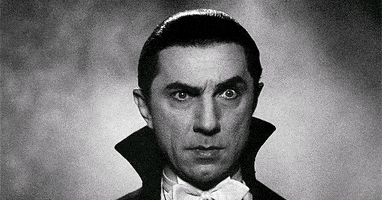
However, even if it’s not obvious, the heavy themes and ideas are still present in the story if you look for them. A good example would be Dracula by Bram Stoker: on the surface, you have a Gothic vampire story. But go a little deeper, you see a commentary and criticism on Victorian ideas and fears. Dracula himself can be seen as a sort of twisted Jesus Christ, offering immortality through the drinking of his blood and the taking of the blood of others; the vampires themselves can be interpreted as corrupting sexuality turning good people, particularly women, into carnal monsters; and the vampires coming to England as a nod to English xenophobia, with Dracula and his kind, who speak and act strangely and must sleep in the soil of their native lands, representing the influx of foreigners to England during the later Victorian era and how they may not be suited to English society, according to some Victorians.

A story that’s more than just scares.

And this can be found throughout horror stories, particularly in novels where there is room to explore these heavy themes. A lot of times, you can see these themes embodied in some way in the supernatural forces that may threaten the character(s). Stephen King does this very well in many of his stories: while explicitly stated that the events of The Shining are supernatural in origin, on another level it’s a great story of a family breaking down due to stress, isolation, alcoholism, and old tensions arising, with the hotel simply being a stage for things to play out rather than a true supernatural entity. Likewise, It is a story about a supernatural force, but that same force is also a representation of childhood fears, what we fear in the dark as well as fear of growing up. And that’s just the tip of the iceberg of this great novel.

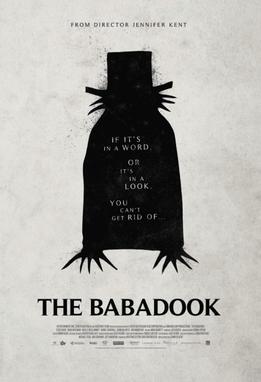
You also see this in movies, with a great example being The Babadook. While the titular monster could be real, it could also be a form of shared delusion between a mother and her son, trying to work through their individual and collective issues. There are a number of articles that look at the film from a psychological perspective, and the arguments they make put the story in a whole new light from first viewing. The Babadook is a story laced with deeper meaning, if you just look beyond the surface.

So as we can see, horror is more than just people screaming and dying in gruesome ways. Like any story, it can have a deeper meaning, going into the psychology of characters, the beliefs of society, philosophies on life, death, love and so much more. You just have to pull back a veil and take a closer look, and you’ll see what’s always been there.

I’m going to start this post by stating for the record that I have not read any of the Dark Tower books, or the audiobooks, or the graphic novels. I’m coming at this as an outside fan, someone who likes Stephen King a lot but has yet to try his fantasy series because, as even King puts it, it’s an acquired taste.* I also realize that this is a movie, so they’re going to have to make many adjustments between getting the story from the page to the screen. I’m okay with that, because I’m pretty sure a straight adaptation would be longer than Titanic (and that’s three hours long!). And I somehow managed to keep away from reviews from other sources, so I went into the theater with a clear mind in order to judge this film on my own terms.

That being said, I liked this film.

The Dark Tower follows Jake Chambers, a teenager from New York who is having dreams about this strange world, a man dressed in black who is trying to destroy a gigantic tower, and a man called the gunslinger who hunts him. While the rest of his family and even some of his friends think he’s crazy, Jake manages to find a gateway to the mythical Mid-World, and becomes an important piece in the battle between Roland the gunslinger and Walter O’Dim the Man in Black, as well as an important piece in the battle to keep all of reality from becoming destroyed.

So like I said, this film worked for me. The visuals were very beautiful, giving us this huge world with strange features and breathtaking views. The actors were all great, especially the main three, Idris Elba as Roland, Matthew McConaughey as Walter, and Tom Taylor as Jake Chambers. My favorite was McConaughey, his take on Walter was terrifying. You could sense the psychopathy in this character, the indifference to death and love of destruction. It’s really creepy. Elba was also commanding as Roland, making you feel this intensity, and Taylor as Jake was a believable character who finds himself in this strange world and is trying to make the best of it.

*shudder* Scary dude.

Also, shout out to Fran Kranz as a bad guy. Did not know he was in the film, so it was so cool to see the guy who played Topher in Dollhouse there.

I also thought the fight scenes were choreographed very well. They didn’t look silly or hard to make out, and the camera work wasn’t shaky or anything. And for a series well-known for being complicated and bizarre, I actually felt like it was easy to follow. Sure, some things didn’t make sense or weren’t explained, but I was able to follow it for the most part.

That being said, there were two things that I didn’t like: one was there was this minor character called Timmy, who is supposed to be a friend of Jake’s, and he’s in the film for maybe three minutes and really doesn’t serve a purpose. If you took him out of the story, the film wouldn’t be missing anything. I also thought that the story was kind of by-the-numbers. There wasn’t any sort of point where I was surprised by what happened, or the filmmakers threw me for a loop. Was I thrilled? Yes. Did I was like, “Oh hey, I didn’t see that coming”? No.

But all in all, I think this is the best adaptation of The Dark Tower series we’re going to get without being overly complicated or bogged down in details. I know it’s not going to please everyone, especially hardcore fans, but it was a good film for me, and I would be interested to see a sequel and/or the television series in development based on the movie.

On a scale of 1 to 5, I’m giving The Dark Tower a 4.4 out of 5. Go see it, and find yourself reciting the Gunslinger’s Creed for the rest of the day.

*And if the books anything like their probable inspiration, HP Lovecraft’s Dream Cycle, particularly The Dream-Quest of Unknown Kadath, I’m willing to wait.

Happy Birthday to the blog,
Happy Birthday to the blog.
Happy Birthday to Rami Ungar the Writer,
Happy Birthday to the blog.

Six years.

I’m supposed to say that it went by super-fast, but it feels like it actually has been six years (though the past eight months or so have gone by in a flash). I think it’s how much my life has changed that really sells me on the fact that six years have gone by. When I first started out on this blog, it was at a library computer station. I was eighteen years old, had yet to start college, and I was sure this blog would bring me lots of readers for my first published book when that finally happened. My only regular readers back then were my parents, and I think they read mostly to be supportive (and to make sure I didn’t post anything on my blog that would get me in trouble later in life).

Today I’m twenty-four, I’m working in a good job and living in my own apartment. I’ve got four books out, and while I’m still not a world-famous writer, I’m taking steps so that someday I can be a full-time writer. Maybe. My readers come from all over the United States, as well as from Canada, Europe, and farther away. They’re writers and readers and horror fans and just people who, for one reason or another, like what I have to say on this or that subject. We have conversations in the comments, and some of these people become good friends with me. Once or twice, we even meet in real life (or make plans to but can’t due to issues of customs).

And you know what? This all happened because of you. Yes you, whoever you are, reading this blog post. Yes, I supply the content, but every time someone has tuned in and read a post, offered a like or their thoughts, and when they decide to follow me so as to get future posts, they keep me writing and interacting with this community.So thanks, my Followers of Fear. I really appreciate you being here for me, through thick and thin, highs and lows, reviews and political rants (dammit, admitting the United States isn’t perfect is not un-patriotic! It’s a desire to make this nation better). I hope you’ll stay with me for all that comes in the next year, whatever that happens to be.

Speaking of which, what do I want from the next year? Blogging and writing-wise, anyway.

Well, I would like to reach a thousand followers, and that might actually happen this year. I’m within a hundred followers of that, so I think it could happen. I’d also like to write some more good posts and have good discussions with the many friends and acquaintances I’ve met through this platform. I’d also like to get a few more stories written, edited, and published. I especially hope I’ll finish Rose and maybe get it represented by an agent. Will that happen? Well, if people’s reactions to the story’s idea and my college advisers’ feedback is any indication, that could very well happen. Hard work and a bit of luck can do wonders, after all.

Well, that’s all for now. There’s a Stephen King movie coming out this weekend, so expect a review very soon, my Followers of Fear. And until then, pleasant nightmares!

I’ve been keen to read this novel since Stephen King tweeted about it months ago, saying this novel, which apparently is the first work of an already-established author published under a pen name, was the first great thriller of 2017.* By the time it came out on July 11th, I was one of the first people to get a copy at the library. And while I don’t always agree with King on what makes a good story (see my review for A Head Full of Ghosts by Paul Tremblay), I have to say, he was right that this is a great thriller novel, possibly the first great one of 2017 (I haven’t read most of the others that came out this year, so who am I to judge?).

Final Girls follows Quincy Carpenter, the lone survivor of the Pine Cottage Massacre, in which a man she only refers to as Him killed all her friends while on a camping trip and she was the only survivor. This has made Quincy part of an exclusive club known as the Final Girls, women who have survived horror-movie style massacres and, like the girls in those movies, are the only ones to survive. The other two are Lisa Milner, the survivor of a sorority house murder spree in Indiana, and Samantha Boyd, who escaped and killed a killer known as the Sack Man at a motel in Florida. Quincy, who has no memory of the events at Pine Cottage, wants nothing but to keep up her baking blog, maybe marry her defense attorney boyfriend someday, and have some definition of normal.

That is, until Lisa Milner dies under mysterious circumstances in Indiana, and Samantha Boyd shows up at Quincy’s apartment in New York to talk. Suddenly Quincy’s life is thrown into a maelstrom as Sam’s presence threatens not just to unearth the memories from that fateful night, but change her world forever.

Immediately, you feel like this is two stories in one, a standard slasher and a mystery/thriller. On the slasher hand, you get to read Quincy’s recollections of Pine Cottage, which are told in third-person POV and past tense. And on the other hand, you get the events of Quincy’s current life, which are told in first-person POV and present tense, which is a mystery/thriller mixed with the story of two completely opposite people trying to bond over an incredible and dark situation. And both stories are peppered with references to horror movies, especially the best of the slasher genre. There are some obvious ones: Quincy’s last name is a reference to director John Carpenter of the Halloween series, while Lisa Milner’s massacre is an obvious reference to Black Christmas. But there are other, subtler references.  The mystery elements definitely remind me of the Scream movies and the TV series, which utilize mystery to offset themselves from tried-and-done-to-death slasher stories, as well as elements that make me think of Urban Legend. And that’s just the tip of the iceberg, there are probably references I don’t recognize from movies/comics/shows/books I haven’t seen or read yet.

I also really enjoyed the characters. Quincy felt incredibly real to me: rather than being a character who’s always good and delicate or always damaged and dealing with her issues, she’s actually a pretty good balance of both. She’s clearly made some progress in trying to move on and have a new normal, but she also has issues that she doesn’t want to address, even takes some joy in, and those occasionally threaten the balance she’s trying to maintain in her life. It’s very refreshing to see such a realistic character like that. I also found Samantha Boyd (or Sam, as she prefers), to be very real. She’s a girl whose life is one defined by horrors, and who’s trying, in her own way, to reach out to the one person left in the world who knows what it’s like to have felt horrors like hers. The way she does it isn’t exactly smooth, but it does feel like someone with her background might use to reach out and find some mutual catharsis.

But the best part of the story is definitely how twisty it is. Even when we go back to Quincy’s past, it is anything but a standard slasher, going in directions you don’t see coming. Just today, while reading the last 70 or so pages, I kept marveling at surprise after surprise after surprise. And that’s pretty much how it is for most of the book, especially in the latter half of it. I think even some veteran mystery/thriller fans will find themselves surprised at the twists in store here in Final Girls.

If there’s one thing that might have been a drawback for this novel, I felt that the moments that Quincy and Sam were trying to bond were a little slow at times, but that may be nitpicking on my part. They were still well-written parts, and they showed both how much these girls wanted to be friends and how much they rubbed against each other as people.

On a scale of 1 to 5, I’m giving Final Girls a well-earned 4.6. From one page to the next, you never know what to expect, and it will only leave you wanting more. Go ahead, pick it up, and find you have a hard time putting it down.

* This tweet and hints about the author’s identity make me think it might be Stephen King’s son Joe Hill doing his own Richard Bachman turn, but that’s just my guess.

Since we’re still over a month out until the new adaptation of It and the new season of American Horror Story (which apparently will be featuring clowns in its Cult-themed season this year) hit screens, I thought I’d take the time to watch and review a movie I’ve been wanting to see for a while: Eli Roth’s Clown.

This movie actually has something of an interesting history: back in 2010, director Jon Watts and writer Christopher D. Ford uploaded a trailer to YouTube saying that Eli Roth was producing the film, even though he wasn’t involved with the film (I assume this was meant as a joke). Roth was impressed by the concept of the film and their ballsiness, so he offered to help them produce an actual film. However, when this film came out, it did poorly at the box office. Since then, I’ve heard both good things and bad things, making me curious as to its true worth. And when it popped up on my Netflix feed, I knew I had to watch it and see for myself what this film was made of.

Clown follows the McCoy family, real estate agent Kent, wife Meg and son Jack. When the party clown they ordered for Jack’s birthday is double-booked and can’t make it, Kent finds an old clown costume in one of his vacant houses and dresses up as a clown himself. However, he finds himself unable to take off the costume afterwards. In fact, it’s starting to become attached to him, literally. As Kent’s body and mind starts to go through unimaginable changes, Meg must find a way to save her husband from becoming a legendary demon with a hunger for children.

This film was awesome in so many ways.

First off, the costume and Kent’s evolution into the demon. The make-up and costume here is phenomenal, slowly showing Kent turning into this terrifying monster that puts Twisty and Bill Skarsgaard’s version of Pennywise to shame in how scary his look is. The transformation is gradual, but with every change, you see not just how creepy the clown demon is, but also the battle for Kent’s mind playing in his head. From an extra line, a darker color, a colored contact lens, everything in this costume is used to maximum effect.

I also liked how the story at first seems formulaic, but actually takes some routes that keep you guessing about what will happen next and actually surprising you at times. The story also takes some risks in terms of body horror and at some of the stuff that it’s willing to show us, which is a welcome change. It actually makes for a much more terrifying experience. It’s almost like the filmmakers were saying, “We know it’s a movie, but we know real life isn’t nice. Therefore, we’re going to introduce a terrifying concept into the real world and see that concept play out with real world results.”

One interesting thing I noticed was the characters, and how they were written. They’re not that deep or well rounded-out, but the story and the direction allows the characters to feel real. Rather than using dialogue and exposition to explain character traits or relationships between characters, the actors show the audience those aspects. Just from Meg’s interactions with her father and the things he does, you get the sort of feelings he has for his son-in-law. From seeing Herbert Karlsson’s actions during the film, you get an interesting twist on the expert-on-a-monster trope in horror films that doesn’t need to be told to the audience. It’s just there for us to absorb! It’s a brilliant decision to approach characterization like this on the part of the filmmakers, and I kind of wish we’d see that in more horror films.

Not even the scariest image.

The only problems I really had with this film is that it may have dragged at points, and that there’s this one short scene involving Meg and a patient from her dental clinic that I just found slightly contrived. Actually, very contrived, even if it did show how Kent’s transformation is kind of transforming his wife Meg into someone else.

Like I said, this film was awesome. So why didn’t it do well? If I had to guess, I’d say bad marketing. I heard about this film the first time in college with a trailer. I thought it looked cool and I would like to see it when it came out. But that was the last I heard of it, and it dropped off my radar. Occasionally over the next three or four years, I heard whispers, but I somehow got to thinking that Clown was either being delayed or only available outside of the United States. So when it showed up on Netflix, I was honestly very surprised. I was like, “Wait, that’s out now?”

Too many good films are under-advertised.

Well, with any luck this review might get a few more people interested. On a scale of 1 to 5, I give Clown a 4.8 out of 5. It’s creepy, it’s a fun concept, and it’ll leave an impression on you. Sadly, it didn’t get the advertising it deserved, but I can see this becoming a cult hit and a Halloween favorite ten or twenty years down the line. Definitely sit down and watch the film, and prepare for some clown-filled nightmares.

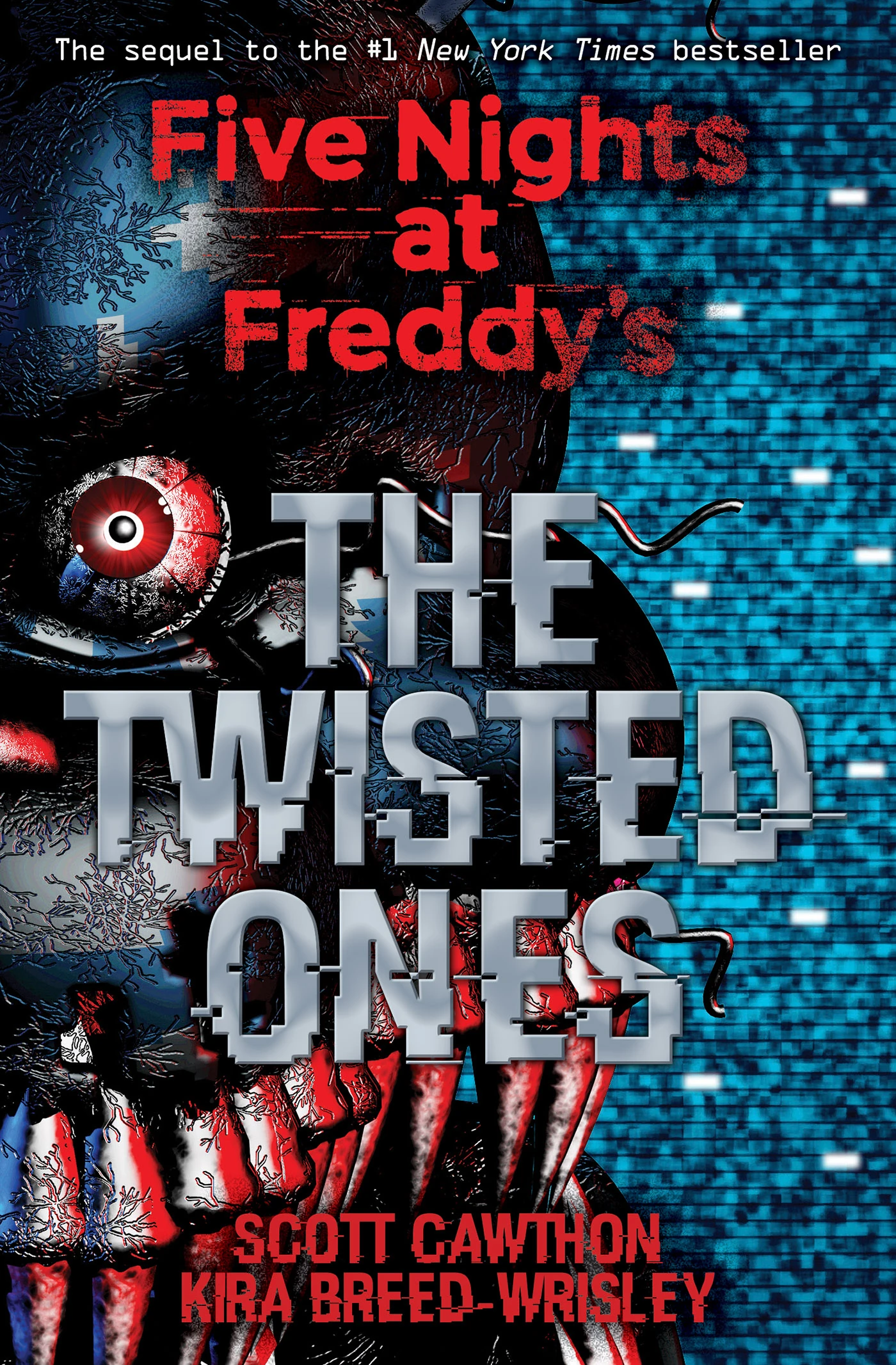
You may have heard me speak of the Five Nights at Freddy’s video game franchise about a haunted pizzeria filled with killer animatronics before on this blog (if you’re unfamiliar with what that is and want a quick lesson to know what I’m talking about, click HERE), including the novel released about two years ago, Five Nights at Freddy’s: The Silver Eyes, that’s part of the franchise’s lore (click HERE for my review of that novel). I find the franchise itself fascinating, though I did not care for the novel that was produced from it, finding it cliched and predictable, as well as poorly edited. So when I heard that a sequel to the novel, Five Nights at Freddy’s: The Twisted Ones, was coming out, I was skeptical. Could this be an improvement? Or would it just be terrible? I decided to get a copy and find out.

And if you’re a huge fan of the franchise or whatever, don’t expect me to delve deeply into the lore and try to figure out the exact mythology of the game. I’ll leave that to the people on the Game Theorists channel on YouTube. No, I’m going to evaluate the novel as a novel: how it was written, if it was scary, how good the plot and the characters are, and what could’ve been fixed or improved. Why? Because that’s what I do here.

So, FNAF: The Twisted Ones takes place not too long after the events of the first novel. Charlie, the protagonist of The Silver Eyes,  is at college learning about robotics and trying to sort out all the things that have happened in her past. However, a series of murders that can only have been caused by the sentient animatronic suits from Freddy Fazbear’s Pizzeria draws Charlie, as well as her friend Jessica, old flame John, and hometown sheriff Clay into a bizarre nightmare, with more mysteries to uncover and an old enemy out for blood.

Was it any better than the first book?

Well, it did have some improvements. For one thing, The Twisted Ones is edited much better than The Silver Eyes. You can tell that franchise creator Scott Cawthon and writer Kira Breed-Wrisley took their time making sure the grammar, spelling and punctuation was up to scratch, as well as ensuring that the indentation wasn’t all over the place. There was also way more animatronic action, something that was sorely missing from the first book. And I have to admit, the plot was somewhat unpredictable, with the final third–especially the climax–being actually a bit of a whirlwind in how it gripped and held onto you. And there were new elements introduced into the story that actually did shed a little light on the franchise (I won’t go into them here, but observant readers should be able to put the pieces together).

However, there were a number of things I didn’t like about the book. For one, these characters feel even flatter than they did in the first book. In the first, they were just given enough characterization to carry along a slasher movie, but those characters that have come back feel even less like actual people. The exception might be Charlie, but most of her character is fretting over the events of her past rather than getting to know her and see her grow as a character. Speaking of characters, I also found the character of Arty totally unnecessary. He’s introduced as this classmate/friend of Charlie’s and a possible rival to John, but he’s only in about two percent of the story, and he doesn’t contribute anything. If you took him out of the story, it seriously wouldn’t make a difference. I wonder why he was even in the story in the first place.

I also found Charlie’s obsession with her past and her brother coming across as melodramatic. You can have a character affected by a horrible experience that exposes a lot about their past, but here it felt almost corny in how over-the-top the emphasis was. Please, can we scale back on that? Surely there’s more to this character than “Oh, my past is so tragic! I’ll live my life around my dark and horrible past!”

The next book. Hopefully it’s good.

But the biggest thing that I didn’t like was that during one scene about two-thirds of the way through the book, the scene is set in Charlie’s dorm room. A few paragraphs later, however, they’re in the car, and it’s such a sudden transition. How sudden, you ask? Imagine in a Marvel movie, Nick Fury and Captain America are talking in a hangar bay in one frame, and in the next they’re in an open field, but none of the characters notice the change. It’s that sudden, and it’s very sloppy.

Still, The Twisted Ones is a better novel than The Silver Eyes. On a scale of 1 to 5, I’m giving this book a 3.0, an improvement of 0.4. The characters aren’t that interesting and there are problems with the book, but I honestly prefer it. Though you can’t get me to love this series, and I honestly would like Cawthon to stick to video games. Just being honest.

Speaking of which, Cawthon is releasing a new book late next month titled The Freddy Files, which is supposed to go over game mechanics and even answer the complex lore of the series. I might read that, but I honestly don’t know if I want to. Not only that, but I’m pretty sure Cawthon’s going to release a third book in the franchise at some point. Like I said, I wish he wouldn’t, but with any luck, he’ll take another year and a half to release his next book, enough time to improve his next literary venture by another 0.4 or more.

Anything’s possible, especially when killer animatronics are involved.

I actually almost missed this milestone. I was going to bed Saturday evening, and I was like, “Wait a minute, that’s Monday! Note to self: write a blog post in the morning after cleaning the bathroom.” And now that the bathroom is squeaky clean (as well as the kitchen, which also needed a touch up), I’m taking the time to talk about this milestone and ask myself, “Has it really been four years? Blimey, it feels longer.”

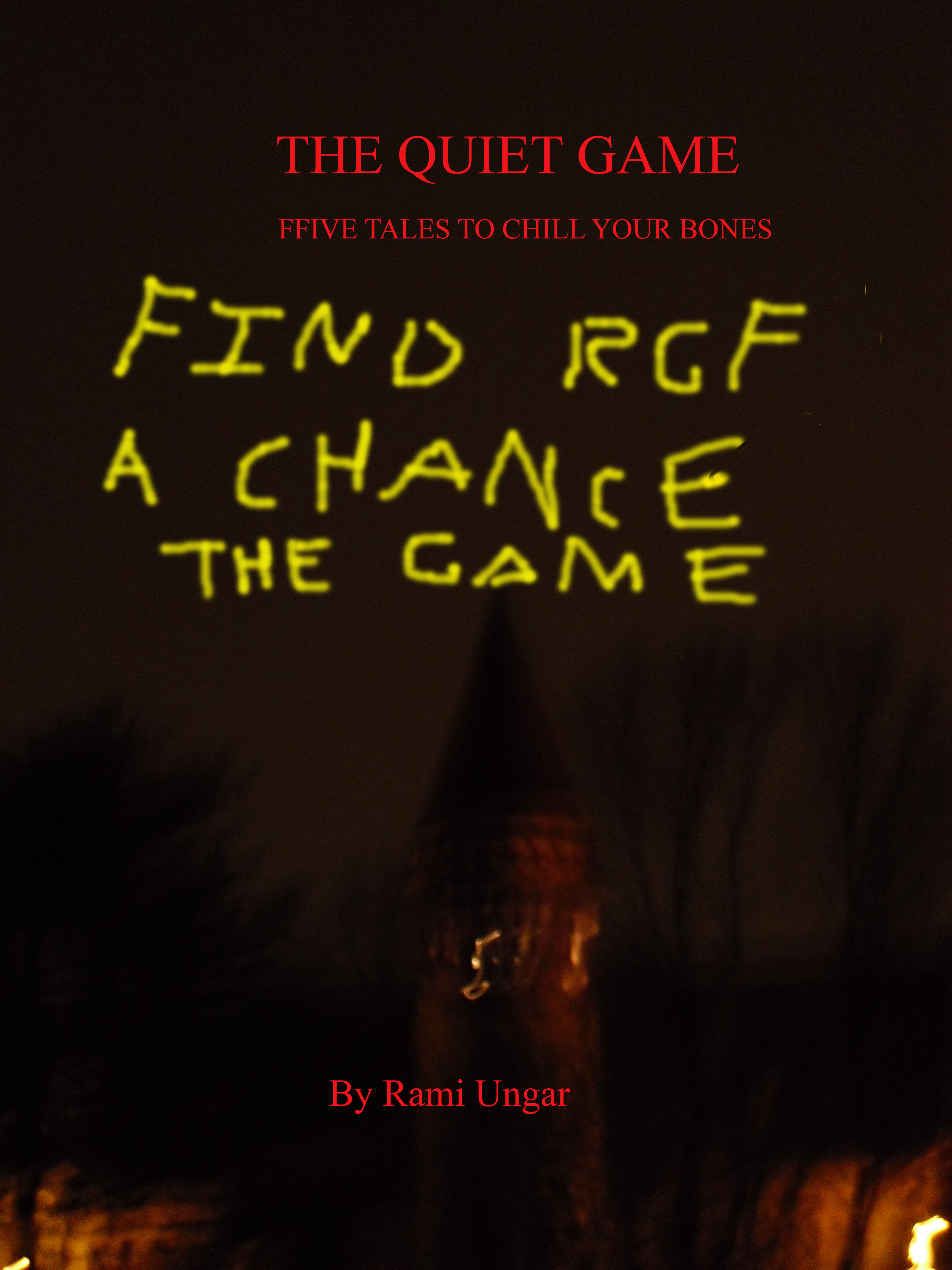
So if you don’t know what the hell I’m talking about, here goes: about five years ago, during my sophomore year of college, I started putting together a collection of short stories. I was still editing Reborn City at the time, and I wanted to have something to work on while the editing process of that took its time, as well as something to release and test the waters of self-publishing. A short story collection felt like a good idea. So I wrote five scary stories in about a couple of months, edited them and had other writers/horror fans look at them, and designed a cover. On July 17th, 2013, I published The Quiet Game: Five Tales to Chill Your Bones on Amazon and Smashwords, later putting them on Barnes & Noble, iBooks, and Kobo.

The five stories in the book are: Addict, about a man dealing with trying to kick his sex addiction; I’m Going to be the Next James Bond, about a bunch of kids who go to an abandoned hospital to hunt for ghosts; In the Lady Ogre’s Den, about an autistic child’s stay in a hospital; The Quiet Game, about a Catholic school that finds itself cut off from the world and deaf all of a sudden; and Samson Weiss’s Curse, about a senator being stalked by a spirit known as a dybbuk.

This has been by far my most commercially successful book, not only because it’s been out the longest, but because it’s a very quick read, and costs less than my other books do, e-book and paperback. People who might not necessarily want a long read see this little collection of short stories, and that it’s received positive reviews, and they’re like, “Okay, let’s check it out.” For the most part, people love it. So for someone still growing an audience, that’s a pretty good achievement.

Speaking of reviews, this is also my most reviewed work. I think that the reasons for that are the same ones for why this has been my most commercial work to date. And as I said previously, it’s had some pretty good reviews, with a score of 4.1 on Amazon based on 14 reviews. Here’s what people have been saying about the book:

5 wonderfully crafted tales! I purchased this as an eBook originally and put off reading it for quite a while, I really wish I hadn’t waited. Sometimes when one purchases a collection of short stories you expect some of them to be less entertaining or of lower quality than the others, but none of these disappoint. Well worth the money, especially considering after you read each story the author gives you creative insight into what inspired him to write each tale, which is really wonderful.

–Jeff D.

This is not my genre, but since I know the author [:-)], I read the stories. Each one was very unique and created its own atmosphere and mood. My favorite story was the Quiet Game but I found the ending a little confusing since I didn’t really know the literary reference at the end; what I loved was the world created in the story and the message it conveyed. I look forward to the author’s improving his craft, and I will certainly read more.

–Gefilte63

Imagine if you will a young Stephen King penning dark scenarios inspired by his youth, and what you get is this anthology. Through this collection of short stories, Rami Ungar brings us into the world of dark urges, childhood traumas, ghosts, phantoms, and dark psychological thrillers. An inspired creation, and definitely a good intro to this indie author’s world!

–Matt Williams, author of “The Cronian Incident”

I especially like that last one calling me a young Stephen King. Always love being compared to him.

If any of this makes you want to read The Quiet Game or check out more reviews, I’ll include the links for the book below. An if you do end up reading the book, please make sure to leave a review. Positive or negative, I love feedback, and it helps me out in the long run.

That’s all for now, my Followers of Fear. I may have a new review out tonight, so keep an eye out for that. Until then, have a good one.

The Quiet Game: Amazon, Createspace, Barnes & Noble, iBooksSmashwords, and Kobo

I found out about this novel on Facebook, which was billed as a Lovecraft/Cthulhu Mythos-meets-YA sort of story, and wondered how that would work. When the opportunity came, I downloaded it onto my Kindle and started reading. And my, I have to say, I was pleasantly surprised by how much I enjoyed it.

Awoken follows Andromeda “Andi” Slate, an average teenager who isn’t to thrilled about living in Portsmouth, New Hampshire but deals with it with the help of her good friends. One night, she has a dream about seeing a giant tentacled monster and being rescued by a handsome youth. The next day, she and her friends get their hands on an infamous book of eldritch magic known as the Necronomicon, and do some reading from it. Within a day, a new teacher arrives at Andi’s school, as well as a strange new student who looks like the handsome youth she dreamed about. What happens next will not only change her life, but will decide the fate of the universe.

So if the handsome youth bit didn’t clue you in at all, yeah, there’s a pretty big romance aspect to this story, bigger than what I’m used to reading (especially in a Lovecraft-themed story). However, it’s a romance story between a human girl and a Great Old One (basically an ancient demon-god, if you don’t speak Lovecraft), one trying to balance the desire for the end of the world with his newborn desire for a human girl! I’ve never seen that before!* Romance isn’t something you normally associate with the Great Old Ones, who are notorious for seeing humans only as snacks (when they see them at all). It’s so weird, it kept me interested even though I don’t usually go for romance! Definitely one of the good points of the story.

So what were the other good points? Well, I liked Andi for the most part. Besides one or two problems, she was a very likable character, even when in the middle of an annoying teenage mood. The story was also very well-written, with very few typos and a distinct voice for Andi that kept me wanting to keep reading. I also liked how Elinsen made the works of Lovecraft accessible for her audience, who probably wouldn’t be big fans of Lovecraft and his Victorian-era speech patterns, though she manages to slip some of those words in, like cliquant and voltaic. Despite a few changes here and there, the Cthulhu Mythos is pretty much intact and treated with reverence, and the usual tropes that Lovecraft fans enjoy are there: cults, ancient beings, the idea that certain truths cause madness, Azathoth threatening to wake up, etc. The author also manages to slip in references to HP Lovecraft and his works (Portsmouth is secretly Innsmouth, Andi fears water, a reference to a racist writer from Rhode Island, Cthulhu’s relationships with the opposite godly sex, a cat, etc.), as well as references to Stephen King and even one reference to Supernatural that made me laugh out loud.

However, I did have some problems with the story. A major one was the male lead Riley (name based on a famous underwater city), and his relationship with Andi. Look, I know that in romance the asshole with a secret heart of gold is a popular trope (I’ve seen it in a few manga), but Riley is super-unlikable. And yeah, he’s secretly a terrible god who sees most humans as ants, but I can’t help but hate him as a protagonist. And his relationship with Andi is so abusive for a good chunk of the book. It’s supposed to come off that he’s protective of her, but doing things like commanding Andi to do things and intimidating her with his mood shifts just scream abusive creeper. What’s even worse is that Andi, once she falls for the guy, can’t extricate herself from him. It’s like an unhealthy obsession, to the point where she’d rather die or go completely mad rather than live without him (and that’s not teenage histrionics, she really feels that way at one point). It’s almost like she’s the ultimate worshipper for a Great Old One, and I just want to tell her that even taking out the god part, her relationship isn’t normal or healthy! How crazy is that?

I also wanted more from the main antagonist. We only see what she does in the name of her apocalypse, but I could’ve used more from her. Who was she really? Why did she do what she did? How did she become a worshipper of the Great Old Ones? I would have loved to see that explored a bit more in the story, and sadly we didn’t get that.

Ultimately though, Awoken is a different take on the Cthulhu Mythos, and I enjoyed myself despite the issues I had with the story. On a scale of 1 to 5, I give the novel a 3.2. If there was a sequel, I’d consider reading it (though four years after publication and no updates from the author on her social media since October 2013, I’d say that’s not going to happen). If this sounds like your sort of thing, take a dip into the madness and see for yourself.

Now if you need me, I’ll be playing Hide n Seek Across the Dimensions with Nyarlathotep. Hail Cthulhu, and I’ll see you around.

*Please be aware, I haven’t read all of Lovecraft’s bibliography, so if this does happen somewhere in his stories, I haven’t gotten to it yet. So don’t spoil it for me, okay?

Well, we’re back to count down my top five villains of the past year. And what really surprised me about the top five was that while #10-6 came from ll sorts of different franchises and series, the top five came from only two franchises/series. That’s right, this year only two properties hold sway over the top five. And you can contribute that to a number of things, but I think with these franchises, they’ve been running a very long time and the writers and directors and other behind-the-scenes folks who run these franchises want to keep them running a very long time So what do they do? They come up with compelling storylines with great villains to set up against great heroes.

So what are they? Let’s find out. Remember, no villain of my creation is on this list, and no actual person is on this list either. It’s all fictional. And as always, SPOILERS!

#5: Kaecillius (Doctor Strange)

You know, this is the third time a Mads Mikkelsen character has appeared on this list (his portrayal of Hannibal Lecter were in the top five back in 2013 and 2014). Not surprising, considering that he’s not only a great actor, but he’s given great characters. Kaecillius is a former student of the Ancient One who finds out things about his master he doesn’t like and who falls under the sway of the demon-god Dormammu. His goal is to allow Dormammu’s Dark Dimension into this world, thus absorbing our universe into his. Why does he want to do this?

Well, the answer is much more sympathetic than you might expect: Kaecillius sees the world as an endless cycle of suffering and death, and wants to free the world of it, which he feels integrating our world into the Dark Dimension can do. And this is actually an admirable goal, to free the world of suffering and death. It’s the very notion that Buddhism, one of the world’s major religions, is founded upon! It’s just that Kaecillius believes wholeheartedly that by making us one with the Dark Dimension is the way to do that (believe me, it’s not), and that’s what makes him a villain. Add in his gravitas, stoic manner, and occasional one-liners, and you’ve got yourself an A-class villain with some aspects you can actually sympathize with.

#4: Lucifer (Supernatural)

Over the past two years, I’ve really become a huge fan of Supernatural, and over the past year, I’ve taken in the ten most recent seasons. And even when he’s not the main villain of a season, guess who’s a powerful influence over the series as a whole? Yep, Lucifer, the Devil himself. He’s powerful enough that even when he’s locked in a cage in Hell, he’s still capable of manipulating and directing events on Earth, which is how brothers Sam and Dean Winchester became wrapped up in monster hunting. And when he’s out of the cage, God help you. He could be following the script of the Apocalypse, or he could be making it up as he goes along, he doesn’t care. As long as he’s able to make a few quips, make someone’s life literal torture, and even kill a few people, he’s happy. The destruction he caused in Season 12 alone, and the events he set in motion with some of his actions, earn him a spot in the top five (though because most of his horrors are caused by his daddy issues, he’s a bit lower than he could be).

#3: Amara/The Darkness (Supernatural)

What’s scarier than one of God’s angelic sons? Why, God’s older sister, and the embodiment of destruction! Introduced in late Season 10 and the main villain of Season 11, The Darkness is a primordial force that God and the Archangels locked away so that the universe could exist. Freed at the end of Season 10, she possesses a baby named Amara and soon becomes a full-grown woman with a simple goal: to find her brother and settle some long overdue family business with him. That, and maybe entice Dean Winchester, with whom she shares a special connection, to join her at her side.

What puts her higher than Lucifer on this list? Well, she’s much more powerful, for one thing. And in a way, she actually caused Lucifer’s fall from grace. In her way, she’s the true cause of many of the horrors in Supernatural. Not to mention that she somehow makes fish out of water moments scary: having never lived in the human world, she’s uneducated about a lot of what goes on there, and it shows. And even when we’re laughing at how inept she is as a human, we know that she’s going to do something horrible soon. And then she does it.

If that’s not deserving of the Number 3 spot, then I’m Harry Potter (and I’m not).

#2: A.I.D.A. (Marvel’s Agents of SHIELD)

This time from the MCU’s TV universe, we have A.I.D.A, a cyborg originally designed by her creator Holden Radcliffe as a literal shield for SHIELD agents, and later a major part of Radcliffe’s plan to create a world free of suffering and death for humans…which she later subverts in order to gain freedom from her rigid programming and become a full human with emotions. And superpowers.

Honestly, watching A.I.D.A.’s arc from naive robot woman to calculating assistant, to calculating supervillainness, to a powerful human woman with strong powers and emotions like storms, was one of the most fascinating things in this season. It kept you on the edge of your seat, wondering what she was going to do next as she pursued her goals of humanity, freedom, and even the love of one of the main cast! That, and her ruthlessness in accomplishing those goals, whether she was doing so under programming driven by twisted logic or spurred on by her newfound feelings, made the story all the more gripping. She’s definitely one of the show’s best villains, and deserving of the second-highest spot on this list.

#1: The Leviathans (Supernatural)

The Leviathans were a thing introduced in Season 7 five years ago, but I just met them this past fall. And my God, were they the best villains on the show! Primordial beings that are older than most of the angels, they were God’s first creations in His new universe. Ultimately, they proved too hungry to be controlled and God put them away in Purgatory lest they eat the universe to bits. Released back into our world at the beginning of Season 7, they quickly possess humans in order to inhabit physical form again, with one goal in mind: feed. At first they’re just looking for a quick fix in the short term to get their sustenance, but as time goes on and their king possesses the body and memories of billionaire businessman Dick Roman, they start organizing. What’s their grand plan? Simply to feed.

There’s something kind of scary of an old and powerful race of beings whose sole goal is to satisfy their hunger, and the best way to do that is to feed on humanity. And they do it with businesslike precision, coming up with this whole five-year plan for turning America into their personal McDonald’s (I’m assuming the rest of the world would follow in time). It’s this precision, along with their difficulty in being killed, that made them stand out to me as villains not only on Supernatural, but through the whole year. Lucifer and Amara may be looking for revenge on their mutual family member, but when it comes to beasts that just want to feed, they just can’t be beat.


So that’s this year’s list, my Followers of Fear. But tell me, who were your favorite villains this past year? Do you have any critiques of my choices? Let’s discuss in the comments below.

And expect another blog post from me either later today or at some point tomorrow, my Followers of Fear. I’ve got a new review, and I hope you’ll want to read it.