Posts Tagged ‘Stephen King’

Long ago, when college was still a faraway possibility in my preteen mind, I got my first exposure to college writing courses via Stephen King’s IT, which my mother had bought for me during a family vacation to visit our relatives in Delaware. My first Stephen King book and still one of my favorites, I remember during one of the early chapters one of the protagonists Bill Denbrough, who in his adult years is a successful horror novelist, flashbacks to a honors’ creative writing class he took.

To say the least, the class he took scared me almost as much as the clown: it was a bunch of hippies talking about everything wrong with society sexually, culturally, racially, politically, economically, etc. The professor was a weed-smoker who saw fiction as inseparable from politics and revolution. Suggest that if writing stories for the sake of writing stories in this class, as Bill did, and everyone would turn and see you as a sexist death merchant or something. He later dropped the class (smart move) and did more than fine on his own.

For twelve-year-old me, I sincerely hoped that I wouldn’t find this sort of experience when I got to college. I did tell myself that Bill’s college years took place in the middle of the Vietnam War, and everyone was a little politics crazy then. But for a twelve-year-old, you don’t really understand what college is except maybe images of grassy lawns and old buildings and people between adolescence and adulthood going to classes during the day and going to wild frat parties at night. And of course there was that slightly hippie reputation, you can’t shake that off no matter what you do.

About seven years later, I enroll in my first creative writing class. And no, they’re not a bunch of hippies looking to protest the wrongs of the world and turn any guy wanting to write a simple horror story into a pariah. Our teacher was a grad student who swore like a sailor despite emphasizing a Southern upbringing, and she tasked us to write one short story that was literary that could incorporate genre themes. That was one of my first lessons in avoiding giant plot holes, because the first draft of my story, a girl freed from being a sex slave, had some issues. My second draft was a bit better, but only so much. Still, learned a bit from that, and the students were a cool group. Some were English majors, others were looking to fill credit requirements for other majors. We wrote, we critiqued each other’s work, it was fun.

The second creative writing class I took was an advanced course, and was taught by this professor who was such a great guy. He told us flat that he wanted only literary stories, that he thought genre was often unimaginative, and that he hated James Patterson. But he always had a smile on his face, and he always brought a little wind-up toy to amuse us. I got a lot of training in characterization and looking for new angles and perspectives from that class. One of the short stories I turned in was part of the finished collection of works for The Quiet Game, “Addict”. That class definitely helped bring it up to scratch.

My final, and possibly my favorite, creative writing class was last semester, with a professor who retired at the end of our class. Every week we would read an average of two or three short stories from our peers, as well as stories gathered in a course packet (some of those left a deep impression on me). Another advanced creative writing class, each of the students here had a lot of experience and brought a lot to the table. At times I felt I had trouble measuring up, that’s how good they were. But I worked hard, and in addition to the lessons I was getting from writing my thesis, I was growing as a writer, learning all sorts of things on relating to the audience, on storytelling and how not to rush it or stuff too much into ten-thousand words. It was excellent, and I know that class is definitely going to stick with me the most, because I was never bored and I got so much out of it.

In a month and four days (yes, I’m keeping count), I’ll be walking down the aisle in Ohio Stadium in a cap and gown and receive my diploma. If someone were to ask me right before I go up to get my diploma if I became a writer because of my time at Ohio State, I would say “Yes” and point to these classes. They did wonders for my writing, and I’m so glad I took them. And while the likelihood will be that I won’t be taking any formal classes again for a number of years, I know that as I go on and get plenty of informal training, these classes will stick with me through life.

So if you’re reading one of my stories some day in the future and suddenly you’re afraid and want to bolt the door, you can go ahead and blame my classes for that.

Did you take creative writing courses when you were in college? Did they help you at all?

What’s one lesson from those classes that has stuck to you even up till today?

By the way, remember my Secrets of Ohio State University article and its sequel? Well, there’s a third secret I wanted to share, but I didn’t want to make a whole article about it. So instead, I’ll just share it here: there’s an urban legend on campus that if you’re hit by one of the school’s buses you’ll receive various benefits as compensation, including free tuition for a semester. I’ve never heard anyone test this theory, but once I got hit by a car passing through campus while I was on the way to a psychology exam. The person who hit me, as far as I’m aware, wasn’t affiliated with Ohio State. But not too long after the incident, I got a small refund from OSU. Coincidence? Or maybe some form of restitution? The world may never know.

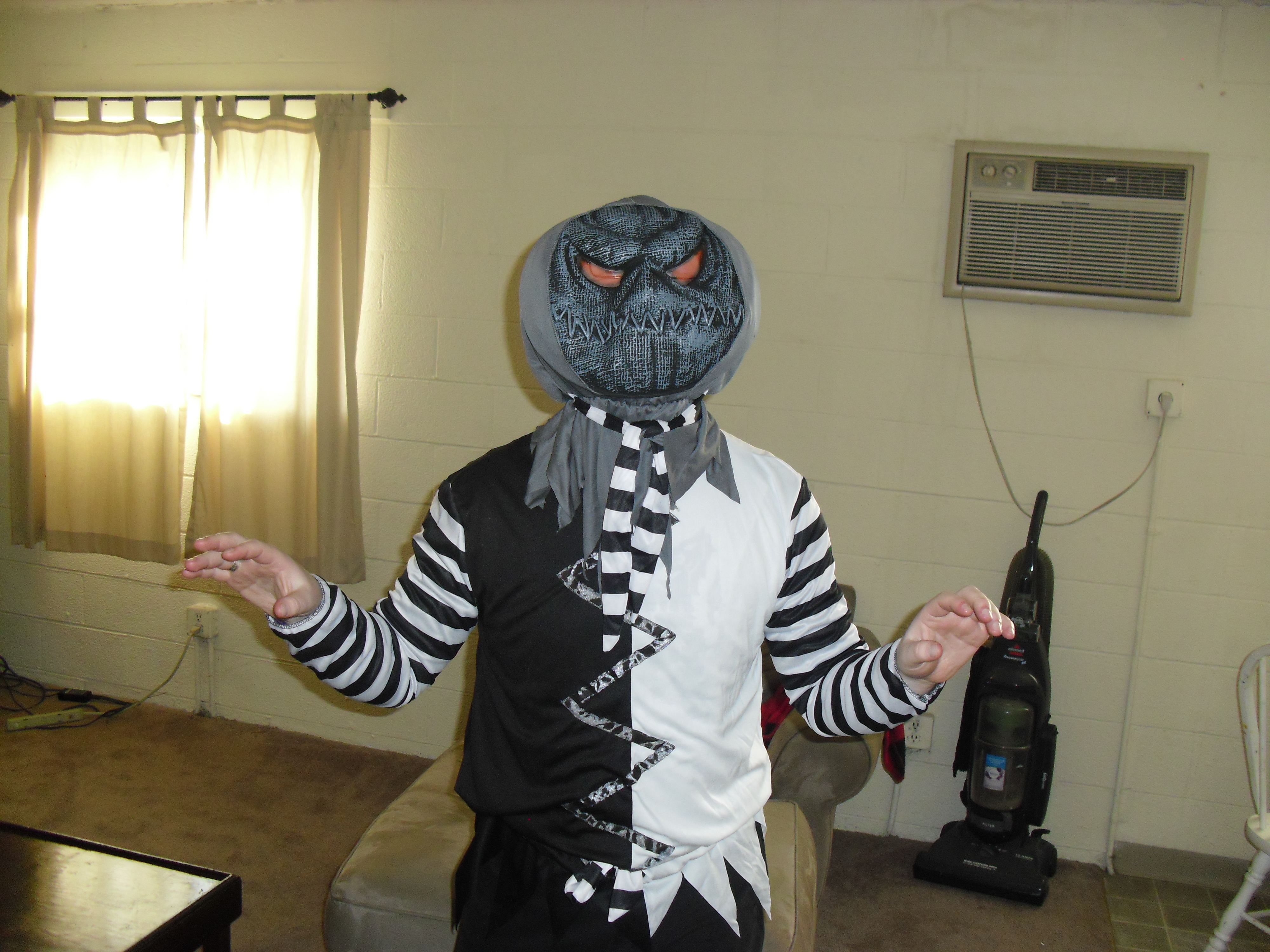
Good morning, my Followers of Fear. It’s Halloween, the day of the year when my powers are at their greatest, and I am at my most terrifying. In fact, I woke up this morning and I wasn’t me. I looked like…well, if you scroll down below you’ll see what I woke up as.

In the meantime, I thought I’d share some videos with you guys in honor of the holiday. Nothing too scary, I promise you, just some fun Halloween-themed videos like the title of this post promises. Unless of course you’re very easily scared, in which case I can’t guarantee how you’ll react, but I hope it’s a hilarious reaction and someone films you when it happens.

Our first video has been on the blog before. It’s a great video, it’s got wonderful rhythm and rhymes, and it’s got two very influential writers featured in it. It’s Stephen King vs. Edgar Allen Poe in their Epic Rap Battles of History video! It’s the only one of ERB’s videos I have on my iPod as well. You can see why I have it on this list.

Our second video is something I discovered this past summer. Jack’s Halloween Treats is a lite version of the movie Trick ‘r Treat. Of course, because it’s YouTube there’s nothing too terrible, and it’s even got a moral theme. Also, I like this artist’s work (she even did a very interesting take on Frozen‘s “Let it Go” not too long ago) and the video gave me an idea for a Halloween-themed novel that I hope to write someday soon.


Up next on the menu is independent artist and YouTube star Alex Boye. I love this guy, he does some very interesting stuff, like taking traditional songs and remixing them with an African beat. As far as I know though, this song is his original work, and it’s for a very good cause. I hope you like the song and the video. I certainly did.

Number four is a recent upload to the YouTube scene. Lady Killers is a take on how sexy versions of our favorite monsters may not actually be that sexy, but could just be very terrifying. It’s kind of funny, not really that sexy, and sort of scary too.


Our final video is like our first. No particular reason why, except maybe I like the video, and I thought that it’d be good to end this post with the similar kind of video to the first one. This is not Epic Rap Battles though: it’s Animeme Rap Battles. Check out Slender-Man vs. The Unwanted House Guest.

Well, I hope you enjoyed this post and the videos in it. Whatever you’re doing for Halloween, I hope you have an excellent time and please let me know what you’re going as. Have a spooky good time, my Followers of Fear. RAWR!

How do I look this morning, my dears?

How do I look this morning, my dears?

Oh, and sorry if any ads keep you by about fifteen seconds or so from watching the videos. Can’t control that, as much as I try.

I was having a comment conversation the other day with another blogger Caitlin Kelly, a freelance journalist from New York who at the moment is teaching at the Pratt Institute. Her post, which you can read here (and I highly recommend you do), was about how the effect of all the horrors going on in the world and being reported to us by the media. I mentioned in my comments that after digesting all the real horrors, it’s not uncommon for me to immerse myself in fictional horrors. Caitlin replied that one of her students, who “has seen his fair share of horrors”, also prefers the genre of horror. I said that for some people, horror acts as a kind of therapy.

Now, some of you who are reading this will probably be thinking “Horror? As a kind of therapy? We’re still talking about the genre where serial killers can be heroes, what trait your character embodies can determine whether you’re killed or traumatized, and fans debate on how good a movie is based on use of suspense, special effects, and gore, right?” Yes, we are still talking about that genre, but just bear with me.

Look at a news feed, particularly one devoted to global events or major issues facing Americans today. This is probably what you’ll see:

  • ISIS murdering Shiites, Yazidis, journalists, and anyone else that they don’t like.
  • Ukraine fighting both its own people and Russian insurgents.
  • Hamas attacking Israel and Israel firing back (and it’s only a matter of time before that starts up again, mark my words).
  • Several cases where police have shot and killed unarmed black men, with the most recent and famous case in Ferguson, Missouri.
  • Congress’s constant squabbling and bickering
  • An immigration crisis that continues unabated
  • Ebola spreading throughout West Africa and father beyond
  • Kristen Gillibrand, a well-respected senator and possible 2016 presidential candidate, being sexually harassed by older, male senators
  • The suicide of Robin Williams and the hurtful responses from people and groups such as Westboro Baptist Church, Pat Robertson, Rush Limbaugh, and Gene Simmons (my article on that is here)
  • CeeLo Green making horrific remarks on the subject of rape on his Twitter account
  • Justin Beiber is in trouble with the law again.

Depressing to read, isn’t it? What’s worse is that this is only the tip of the iceberg. All over the world, people are facing discrimination, violence, poverty, illness, corruption, greed, incompetence, and just about every other horror under the sun. And these problems are huge, multifaceted, and difficult to resolve. In fact, there are many people who may have multiple opinions on how to resolve just one of these issues. And assuming that the people in positions of power are able to come to an agreement and implement some sort of solution, there’s no guarantee that the issue in question will be fully resolved or not or will leave lingering micro-issues that will eventually grow and become major issues in their own rights.

“It’s true, I got defeated by some snot-nosed brats. I don’t like talking about it, though.”

There’s that. And then there’s the stories told within a horror novel or the latest scary movie. Let’s take Stephen King’s IT, for instance. The antagonist is a shape-shifting demon that can take on the form of your greatest fear and prefers the form of a clown. Well, that looks tricky to defeat, but it isn’t as hard to pin down or as multifaceted as an insurgency group or a virus or children brought to this country illegally fleeing violence and poverty. And guess who defeats It? Seven kids. They face their fears, band together, and defeat the monster in its own lair as kids, and then most of them come back as adults to finish the job. And after they’ve fought It for the second time, It’s dead. It isn’t coming back in any form ever again. Sure, at the end of the book the characters start to lose their memories of their war with It, but the story ends on a happy note.

In this way, horror stories–fictional horror stories–can act as therapeutic. We see very real versions of hell unfolding at home and abroad, and then we dive into a story where the characters are fighting their own hell. And we know deep down it’s fiction, but we don’t care. We sympathize and empathize with the characters. Occasionally we even recognize ourselves and our own brutal, tortured pasts in one or two particular character. And we see them defeating demons, exorcising ghosts, kicking serial killer butt, solving murders, and sometimes even bringing back the dead! Sure, plenty of people die in these stories and a good number of them end up traumatized by their experiences. But they usually defeat the enemy, they come out of the conflict stronger, and they sometimes even find romance.

What a horror novel can do for us.

And that fills us with hope. We think to ourselves, “Sure it’s fictional, but I see myself in these characters and the problems they face. So if they can take on ultimate evil and defeat it, what can I do?” In essence, horror takes the feelings of depression and jaded cynicism out of us and fill us with possibility and optimism. Weird, I know. These are stories that aim to scare us and fill our dreams with terror. But horror can do that and lift up your spirits too.

Horror is certainly one of the things that can lift up my spirits when I’m feeling down.

Has horror ever made you feel better after you’ve been feeling down? What happened? Why do you think you felt better afterwards?

What an eerie path to take.

Every author has a different metaphor for what it’s like writing a novel or creating a story or even outlining a story. Stephen King said in his memoir On Writing that he approaches writing like an archaeologist uncovers an artifact, finding the top of it sticking out of the dirt and then carefully chipping and dusting away to uncover the rest of it. I guess that means His Royal Creepiness likes to come up with the story as he writes it and doesn’t plan too far ahead, but whether or not he does, he’s almost always brilliant with it.

Another author, I forget who but I’m pretty sure they were Freshly Pressed for writing an article on this, once compared writing to putting together a sandwich. You have a bunch of different ingredients, and it’s up to you as the chef of this particular sandwich to make it into a delicious meal that people will want to savor and discuss for hours to come. Like I said, I can’t remember who this author was, so I can’t tell you whether or not they were brilliant at it, but they certainly can create a compelling metaphor.

And there are plenty of other metaphors that one author could apply to the writing of a novel: mixing an interesting cocktail; building a house; decorating a room; putting together a collage; building a Rube Goldberg device (I love those things!) and then some, on and on, etc. Each author probably has their own metaphor that relates to their own process.

How some people see writing a novel: building one of these.

I thought about this a lot while I was writing the outline for my thesis Rose, especially since during the early stages of writing the outline I had a lot of trouble figuring out where to go with the story after the first chapter or two. And after a lot of thought, a bi of frustration, and finally typing out a sixteen-page outline complete with short character bios, I finally figured it out. To me, writing is like sending my characters down a path in a heavily wooded forest, and letting them find the way to the end.

I think this has a lot to do with the many philosophers, musicians, and others who have said “Life is a road/path/journey”. For me, I’m seeing the path my characters are traveling on as they move through the story, meeting each obstacle, struggling against their own darkness and striving to be better people. And sometimes, this metaphor takes on a much more…I guess literal tone. For example, those of you who’ve read my novel Snake know it takes place in and around New York City (for those of you who haven’t, now you know). In a strange way, I see the path the Snake takes, not just the one in the woods but how he travels from location to location and scene to scene. I see what he does to get from Point A and Victim 1 to Point B and Victim 2, and from there to Point C and Victim 3 and so on and so forth, whether he’s driving a stolen car or walking through a dark neighborhood or using a disguise to figure out what his next move will be. (Right now, someone is reading this post and hears this description of Snake and is either deciding the book’s not for them or they’re strangely intrigued and want to find out more. I hope it’s the latter).

This “path” metaphor gets even more literal in some of my other works. In Video Rage, the sequel to Reborn City which I’ve begun editing, most of the novel is spent on the open road, so those characters of mine aren’t just on a path with many twists and turns in a metaphorical sense. They’re really on that road!

Which to take to get a better story?

Whether in a metaphorical or a literal sense though, writing like my characters are on a road or a path helps me visualize where my characters and the story are going and where I ulitmately want them to go. During the writing of the outline for Rose, there were several paths that the story could have gone on, and in the early parts I couldn’t figure out where to go. Some of those paths I tried, and I ended up not liking the direction the story would’ve gone down if I went down those paths. Thankfully I ended up taking the right path around the third or fourth attempt, and things got a lot easier from there on out. I’m looking forward to seeing what people think of the path I took with this story, and the others I’ve written.

What do you think of this metaphor for writing?

What metaphor do you like to use? What are some others that you’ve heard that you agree with?

Part of my research for my thesis/new novel Rose was that I had to look into the life of a sociology grad student, because my protagonist Rose Taggert is one. Well, was one. I mentioned when I first announced what I was working on that Rose died and was resurrected by her stalker, didn’t I?

Anyway, since my knowledge of sociology was limited to the introductory course I took last year, I decided to contact the sociology department at Ohio State to see if they could maybe help me. After first heading to their main office, and then getting redirected to their undergraduate advising office, I talked over email with one of the advisers, who then told me to email their graduate adviser Kelly Hopkins (boy, was that a little roundabout). After a couple of emails to determine when was a good time to meet, we finally agreed to meet at nine this morning, and I made the trip onto campus. Once back in the same office I started in, I was taken to Ms. Hopkins room (no idea if she’s married, so I’ll just go with “Ms.” for now), where she was all too happy to give me an explanation of what the sociology grad program was like after I explained to her about my protagonist Rose.

We spoke for a little under a half hour, Ms. Hopkins doing most of the talking while I asked a question here and there. Turns out that sociology grads at Ohio State spend their first two years earning their Masters degrees, after which they take very intense candidacy exams to enter the PhD program. At that point they start taking specialized courses for PhD students, as well as taking specialized courses for their area of specialization and working on their dissertation. The grad students spend a lot of time together in classes and in their offices together, usually becoming lifelong friends by the time they graduate. They also develop close relationship with their faculty advisers, and many of them have the chance to teach during their tenure as grads.

Based on this information, I was able to get a clearer picture of who Rose will be and what her grad life was like prior to the events of the novel. She’s probably in her third year of grad school, so she’s about six months into the PhD program. She is specializing in criminology and community studies, particularly studies involving gun violence, and was probably either a GTA working underneath a professor in an introductory course or already a PhD student teaching a class of her own when she met the student who would become her stalker, depending on how long ago I end up wanting them to meet and the latter becoming fixated on her.

I’m glad I was able to meet with Ms. Hopkins and speak with her today. I know Rose’s life as a grad student isn’t the most important part of the novel, but it’s one I wanted to seem authentic to readers. Besides, it’d be a little bit embarrassing if a sociologist or sociology student read Rose when it came out and was like, “What the heck sort of program is this girl in?” Always glad to have the details right.

I also learned something interesting from Ms. Hopkins: when I told her that my work was heavily influenced by Stephen King, she mentioned that she had a friend who was a make-up artist for horror movies and had worked on a few Stephen King adaptations of King’s work, including The Shining, and knew King personally. Apparently King’s a very nice, sweet guy in person (doesn’t surprise me; we horror authors usually are, though at one point I thought I needed to be a little bit creepier in order to be a better author). I ended up handing Ms. Hopkins two of my business cards so that she could pass them onto her friend (and maybe even King. Do I dare dream of it?). Hopefully at least one of them will go online and check out my work.

Well, that’s all for now. I’m going to do some more work on my thesis outline later today. At this point I think I might be done by the end of the week, with about thirty or so chapters. I’m still not sure where eactly this novel is going, but so far I like what I’ve come up with and I think my adviser might as well. I’ll keep you guys updated.

Have a great day, everyone!

snake

How far would you go for love and revenge?

If you haven’t heard yet, Snake‘s e-book is only on sale for a few more days, until July 7th. After that there won’t be any more sales for a while…no, wait. The Quiet Game‘s one-year anniversary is ten days later. Never mind.

But yeah, Snake‘s e-book will only stay $1.99 for a few more days, so if you’re interested in reading the book one author compared to a Stephen King novel, now’s the best time to check it out. All you have to do is head to Amazon, and from there it’s easy to obtain the story of how one young man is willing to become the most horrific of killers in order to save the woman he loves and bring his enemies down to their knees.

Have a great weekend, everyone. I hope to have a review out tomorrow night on the new horror movie Deliver Us From Evil, so stay tuned for it. I hear it’s going to be great.

See the difference?

In 2006, author Emily Schultz published her first novel Joyland, about a teenage boy growing up in an Ontario town in 1984. This was her second published book, coming after a 2002 collection of short stories. It apparently got some really great editorial reviews from national publications, calling it a great coming-of-age novel and an exploration into teen sexuality.

About seven years later, His Royal Scariness Stephen King published a novel with the exact same name, about a college student in 1973 who gets a job at an amusement park and finds himself solving an unsolved murder (I’ll have tor find time to read it one of these days). Plenty of King fans went online to download the e-book (some may not have realized that for a while the book wasn’t available in that format, which will explain what happens next). But the funniest thing happened: several of these King fans downloaded Schultz’s book believing it was King’s book. And right until the end, some of them never realized they got a literary coming-of-age by a Canadian-American author instead of a dark, creepy whodunit from Stephen King!

And it reflected in the reviews some of these people gave Schultz’s book. Here’s one who absolutely hated it:

I have always loved Stephen King novels. However, this one was a rambling, stream of consciousness mess. I had to go back and read over the last pages again and again to try to understand what was happening. For a person who reads several books a week, this is annoying, to say the least. I will still read his next book, if there is one. He fascinates me with the way he thinks, generally. This book was not my favorite, by any means.

And here’s one who thought they’d try to counter-balance all the negative reviews from King fans:

However somebody give it a one star rating because THEY accidently purchased it thinking it was Stephen King, i’ve no idea how they did that but this review is too counter balance that one.

Here’s a prankster who thought they’d satire the whole confusion:

As soon as I learned Steven King had his sex change operation AND changed his name, I immediately rushed out and bought this book. The surgery (and hormone therapy) have really changed his appearance AND his writing. It’s amazing. It was almost like reading a completely different author.

Mrs King (Schultz), your new vagina has served you well! Nicely done!

And here’s one from someone who actually thought it was a great Stephen King novel, if you’ll believe it:

Full of suspense and mystery and real, visceral horror. Don’t be put off by the new nom de plume. King’s new pen name signifies another evolution in his career, just as he emerged from the Bachman years’ “Thinner” into the soul-baring masterpiece of “It”. Writing from a feminine perspective is admittedly experimental, but this experiment is a SUCCESS.

Now, I’m sure plenty of authors would be upset about this confusion. Ms.. Schultz has actually kind of taken advantage of the confusion and the money coming her way by creating a Tumblr blog called Spending the Stephen King Money, where she details how she’s been spending her unexpected royalties, from donation to charitable organization to IKEA shopping trips. And of course, it’s only brought more attention to her, and her book. I’m sure plenty of people will read it now just to read the story that got confused with a Stephen King novel.

In fact, there’s a certain author who plans to read the book:

Yep, King is ordering her book, and Ms. Schultz in turn is planning on reading Stephen King’s Joyland. It’s a really weird but hilarious ending to a rather strange series of events stemmingfrom a simple misunderstanding. But hey, I’m sure both authors will laugh about it when they look back on it years from now, if they aren’t laughing about it now. And who knows? Maybe they’ll collaborate torelease books around the same time with the same titles and see what happens. In fact, I kind of hoping they do!

I’m not sure how this sort of thing happens, except through serendipity. In fact, this is the first time I’ve heard of such a thing happening on such a scale that even some media organizations report it. Sure, we all have or know someone who went to get a certain book or movie or check out a certain TV show and ended up reading or watching something with a similar or identical title (that actually happened to me a couple of weeks ago). But on this massive scale? It’s almost a little hard o rap your head around. If Saturday Night Live was airing new episodes right now, this would be the subject of a Weekend Update joke.

Well, like I said above, this is a case of serendipity at work. Just a happy accident. I wish something like that would happen to me, and I’m sure plenty of people will echo the sentiment. Not only is it a funny story, the royalty checks and recognition wouldn’t be too bad either. But it’s still very unlikely, even when your book has a similar name to a bestseller (The Quiet Game and Snake aren’t the only books out there with those names, believe it or not).

But I don’t think’s that’s a bad thing. After all, it’d suck if a lot of negative reviews brought down your book’s average because of some silly confusion. And I’d prefer to get success through my own hard work, creativity, and the help of my good friends and/or readers rather than through some silly mix-up of random chance.  More satisfactory that way, anyway.

I just have to write something that will allow that sort of success. Well, hopefully that story will come soon, if it hasn’t already. We’ll just have to wait and see.

What do you think of the King/Schultz mix-up?

If this happened to you, how you would react?

It seems that my prayers have been answered. Either that or I and the many people lobbying for this video to come have finally gotten what we desired.

Anyone who spends enough time on YouTube will probably come across the Epic Rap Battles of History videos. They are funny, have more history than the History Channel does these days, and are really well done. Several of them, such as the Adolf Hitler vs. Darth Vader series, the Doctor Who vs. Doc Brown battle, and the famous Donald Trump vs. Ebenezer Scrooge Christmas special, have become viral sensations. And in a stroke of creative genius, these guys have put out what has to be my favorite video yet: Edgar Allen Poe vs. Stephen King!

The video stars slam poet and rapper George Watsky as Mr. Poe, while Zach Sherwin (aka MC Mr. Napkins) plays his Royal Scariness King. It’s a delightful back-and-forth between the two horror greats, with Poe even rapping in trochee (the form of verse The Raven was written in) and King making references to both his and Poe’s work, as well as poking fun at a certain kid’s movie’s protagonist’s name. Plus the soundtrack is just perfect. But why just read me praise it? Check it out below:

Awesome, right? And it’s very hard to choose a winner, though I have to go with King (he’s got the best disses). Funnily enough, Mr. King himself had some different thoughts:

Mr. King, don’t put yourself down. Frankly, I thought you were sharper than Annie Wilkes’s axe. And I look forward to reading Doctor Sleep and Mr. Mercedes, once I can find the time to do it. In the meantime, can I interest you in one of my books?

Who do you think won? Why? And who would you like to see in another rap battle?

Personally I’m hoping for Walt Disney vs. Stan Lee or Freddy Kreuger vs. Jack the Ripper (yes, that is disturbing. But would you expect any less from me?).

The Stand, by Stephen King, adopted into a comic book form by Marvel Studios

I’ve always been a huge fan of Stephen King. You could say I want to inherit that throne someday, be a successor to the current King of Horror (that’s the goal at least; first stop, publishing a novel). And I’ve always loved The Stand. In addition to being one of King’s longest works, in my opinion it’s one of his best. You think you know the familiar old story: virus breaks out, kills off 99% of the population, the survivors struggle. However, Kiing weaves into it from very early on themes of war and the battle between good and evil, with survivors taking sides as a Cold-War-threatening-to-heat-up appears on the stage that is the now-dead USA. It’s an amazing story, and I recommend you all read it, especially the extended edition, which has all the stuff King was forced to cut out of the original edition due to budget costs. I also liked the TV miniseries adaptation, even if the ending was very different from the novel. The cast was phenomenal, especially the guy who played the villain Randall Flagg. So when I heard that Marvel was making a comic book version, I scooped it up without hesitation. And I was not disappointed: combining lines from the actual text with art and action, the comic book version was thrilling, especially its more dark, world-ending scenes filled with corpses and broken buildings. I thought the artwork made some of the character’s hairstyles look a little too frizzy for my tastes, but I still very much enjoyed it. It’s too bad they couldn’t put more of the original story into the comic book, but I’m sure that they had only a few hundred pages to work with and had to be choosy. Either way, I think they did a good job of adapting an amazing story. After reading the final volume today, I had to write a review of it. I give this work, a 4.6 out of 10. Good job Marvel, now how about an adaptation of It? Just leave out that one scene where the characters make love in the sewers and I’m sure we’ll be fine.