Author Archive

Guillermo del Toro’s films are very much like Tim Burton’s films: there’s a distinctive feel and style to them that sets them apart from other films. A tendency towards the strange and the dark, creatures not oft experienced by man nor treated that much in modern fiction, etc. And such is the case with his latest venture, The Shape of Water, which del Toro says was inspired by when he saw Creature from the Black Lagoon as a kid and was disappointed that it wasn’t a romance between the Creature and Julie Adams.

I have to say, all these decades later, the concept has aged well.

The Shape of Water follows Elisa, a mute custodian at a government facility in Baltimore in 1962. One day, the facility receives an amphibian-man creature from South America, which is kept in a room that Elisa cleans. The two start interacting and romancing, leading to a plot to save the creature from the facility and those who would do him harm.

There’s a lot going for this film. For one thing, it’s beautiful. Everything from the sets to the costumes looks right out of the late 50’s, early 60’s, the lighting is used in different ways to highlight moods and atmosphere, and there are even throwbacks to classic films from that period, including a short musical number that I feel like was inspired by the ones American Horror Story does every couple of seasons. The acting is also pretty stellar: Sally Hawkins as Elisa is wonderfully expressive through facial expressions, body language, and sign language. Octavia Spencer (can that woman do no wrong?) and Richard Jenkins as Zelda and Giles, Elisa’s friends, are full of pathos and charm. And Michael Shannon as the antagonist Strickland, while feeling like a hammy caricature at times, is entertaining to watch on screen.

And oh my God, the make-up on the Amphibian Man (which is his listed name in the movie, I checked). That is award-winning stuff. It looks so real, and as far as I know, mainly CGI-free. That’s really impressive.

All that being said, there were a couple of issues I had with the film. For one, once you kind of understand what sort of film you’re watching, you can kind of guess the plot. It’s been done before, though not with Amphibian Men. So if you can guess the story archetype, you probably will guess where the story is going to go.

There’s also this theme of tolerance and the difficulties of otherness that pervades the film, which you would expect. There’s the Amphibian Man, which isn’t even human. Elisa is mute, Zelda is black, and Giles is gay. Obviously, the filmmakers are going to bring this up. And I’m not opposed to that, I love stories that explore the difficulties of being on the outside for no other reason than being who you are. The problem is, the theme is handled differently from scene to scene. In some scenes, like a scene midway through the movie at a diner, it’s handled very well. But at other times, the handling feels kind of clumsy, which kind of brings down the impact of the theme.

Regardless, this is a wonderful film. If you’re going in for a science-fiction/horror story, you won’t get that. But if you go in for a visually appealing and well-done love story with some sci-fi elements, you’ll end up getting your money’s worth at the theater.

On a scale of 1 to 5, I give The Shape of Water a 3.8. Take a dip into a strange new world, and see for yourself if there’s something to love here.

Now if only del Toro could do an adaptation of At the Mountains of Madness, which he tried to do a few years ago (but only after I’ve read that particular HP Lovecraft story). That would be awesome.

Ever since I stayed overnight and experienced paranormal activity at the Lizzie Borden Bed & Breakfast back in July, I’ve kind of become a bit obsessed with the case and the hauntings that occurred because of the murders. The latest manifestation of that obsession is reading the latest fictional retelling of the events (of which there are several, believe me), See What I Have Done by Sarah Schmidt, who says she was inspired to write it after recurring dreams of Lizzie’s spirit visiting her. I first came across a review of this in Entertainment Weekly, and as soon as I saw it, I knew I had to read it.

See is a fictionalized account of the story of Lizzie Borden, who in 1892 was accused of murdering her stepmother and father with an ax and was acquitted due to lack of evidence and investigator bungling. The story is told from the perspectives of Lizzie herself, her elder sister Emma, their live-in maid Bridget, and a violent drifter named Benjamin, all of whom tell what they were up to on a hot, fateful day in August 1892 in Fall River, Massachusetts.

I have to say, See is not the usual sort of historical fiction I read when I delve into that genre.

Firstly, the four narrators are each given a unique personality and desires, so that it doesn’t entirely sound like just one person narrating four different people. Lizzie is a spoiled youngest child with a hell of a lot of quirks (to say the least); Emma is an older sister who has become constricted by her responsibility as Lizzie’s older sister and as a Borden and wants to run to a new life; Bridget is overworked, and is trying to leave for her homeland of Ireland, despite Mrs. Borden’s attempts to keep her; and Benjamin is a man who sees the whole world as his enemy, and can’t wait to take a swing at the world. Working with one first-person narrator and making them unique is hard enough, so it’s great that for a debut novel, Schmidt distinguishes them so well.

I also liked how flawlessly she manages to weave these four narratives, especially Lizzie, Bridget and Benjamin’s narratives, together on the day preceding and the day of the murders. Telling overlapping storylines, where several characters are in the same place and experiencing things at the same time, has always struck me as a monumental task which requires skills I’m not sure I have yet (if it’s actually easier than I think, let me know in the comments below). Schmidt did it like a pro, to which I applaud her.

But my favorite part is the descriptions Schmidt has her characters use. I’ve never seen descriptions like what she uses. She turns nouns like “termites” or “critters” into verbs (is there a word for that?), and…you know what, let me quote from the first page:

I breathed in kerosene air, licked the thickness from my teeth…My heart beat nightmares, gallop, gallop, as I looked at Father again…Pear skin crisped in my mouth…

How different was that? I have never heard any of these things described this way in fiction, and it’s kind of refreshing to hear. And Schmidt does this throughout the book, particularly with food. She goes all out to describe the food and the sensations of eating in a variety of ways. You really have to read it to believe it.

Now was there anything I disliked? A few things. I was kind of hoping going in that this would be a thriller of sorts that revealed an interesting take on an old theory or even better, a new scenario for the still-unsolved murders. What I got was more of a dissection of the Borden family, showing through several different eyes how grating these people have become on each other, and how it might have been a factor in the murders. And while the portrait painted is beautiful and quite telling of both the author’s vision of and what the family might’ve really been like, I thought the ending where the killer is revealed rang a bit hollow. Like I said, I wanted a new scenario or an interesting take on one of the standard theories for the case, and the way it was eventually portrayed fell a little flat for me.

And as much as I liked the unique descriptions in the book, some of them are used repetitively throughout the novel. I can’t count how many times things, especially fingers, are described as sticky, or how many times heat “itches” at someone. To quote some of my editors, variety in words and phrases throughout a story is important.

And what was up with the dislike for Lizzie and Emma’s uncle John? I get why Abby and Andrew Borden dislike him, he’s probably a bad reminder of Lizzie and Emma’s deceased mother, but why do Emma and Bridget dislike him so much but Lizzie adores him? There’s a lot there that I would’ve liked explained.

But all in all, See What I Have Done is an excellent debut for a new novelist. Putting a score on this book on a scale of 1 to 5 was difficult, but my head kept coming back to a 3.8. Engaging, atmospheric, and full of wonderful prose. Check it out, and ax yourself if you’re ready to dive into Lizzie’s madness.

And yes, I intentionally made that pun. And I stand by it. Goodnight, everybody!

I’m halfway through this series I’ve been doing of rewatching and reevaluting horror films I previously disliked to see if I missed something. And for those of you who are keeping score, I found I now love Perfect Blue, hate The Strangers more than I did the first time, don’t really have a different opinion on The Witch, and feel underwhelmed by The Texas Chainsaw Massacre. And I’ve just finished watching my fifth entry, Oculus. What did I think? Let’s find out.

WHAT’S IT ABOUT: Oculus follows Kaylie and Tim Russell, a pair of siblings who witnessed their parents murdered by the spirit in a mirror as children. They return to their childhood home ten years after those events with the mirror in tow, Kaylie determined to prove that the mirror is haunted, Tim believing he hallucinated everything he experienced as a child. Weaving between past and present, Kaylie and Tim unearth dark memories, old wounds, and eventually, must decide if they are facing they’re own insanity, or an old and intelligent evil.

WHY I DIDN’T LIKE IT: Simple: the ending. I really liked these siblings, and without going into spoilers (though I could be forgiven for them, this film has been out for four years), I didn’t like how the ending treated them. Plain and simple, it just poisoned the film for me.

WHY I REWATCHED IT: An online critic I follow on YouTube did a video a while back of the Top 11 New Halloween Classics, and Oculus got #7. That alone was enough to get me interested in a rewatch. And when I did this series, Oculus was definitely on the list.

Thoughts: How did I hate this movie? It was awesome!

Now, I won’t go into full review mode, but this movie is almost entirely flawless. The concept alone is pretty ingenious, but it’s done in a way that puts you right in there with the characters. You’re seeing their memories as they remember them, at the moment they’re remembering them. And you’re experiencing what they’re experiencing the moment they’re experiencing it. It leaves you not only wondering what is real and what isn’t, but also makes you feel the paranoia and terror of the characters, who by the way are played amazingly by their actors. Especially Karen Gilliam as Kaylie Russell (we love you, Amy Pond!).

I also like how the film isn’t afraid to use a bit of body horror. There were definitely moments where I had to look away because I was so freaked out by what I was seeing, and these moments are never excessive in terms of gore or number of uses.

Add in some great camera work, ambiguity, and CGI that really deposits itself within the uncanny valley, and you got yourself a creepy horror film.

And as for that ending, it’s been four years, and I’ve done some just like it in that time. It’s honestly a good way to close out a horror story, especially if you care about these characters. It makes the ending that much more gut-wrenching. To sum it up, I now approve of the ending.

Judgment: This is definitely a masterpiece in horror filmmaking. On a scale of 1 to 5, I’m giving Oculus a well-deserved 5. Check it out, and see the horror through the looking-glass.

That’s all for now, my Followers of Fear. The next one in this series should be entertaining, at least. And if it’s not, at least the sequels are supposed to be betterthan the original. I’m talking Evil Dead.

Until next time, Happy Holidays and pleasant nightmares one and all.

You know, I’ve written a lot about my identity on this blog. Or rather, because every person is highly multifaceted and puts themselves under several labels (even when they eschew all labels), my identities: writer; horror fan; bisexual man; autistic individual and disability advocate; total nerd; Ohio State Buckeye; feminist; liberal; possible entity from another dimension; and many more. But there’s one identity I’m only realizing now that, while I’ve mentioned it more than a few times on this blog, I’ve never really gone into detail about it in relation to my life and my writing. Not in six-plus years of blogging (believe me, I checked).

Considering that I was not only raised Jewish, but raised Jewish by two rabbi parents, went to synagogue nearly every weekend for years, went to Jewish day school from fourth grade through high school, attended youth groups and summer camps, was a frequent attendee at the Ohio State Hillel, and a whole bunch of other things than is listed in this run-on sentence, that is weird. And I’m not entirely sure why I haven’t really ever gone into detail about it. Maybe I thought I’d covered it in one of my 1300+ blog posts at some point, or maybe I just thought it wasn’t important enough to cover at any point. I have no idea.

Well, I guess better now than never (especially since this is my blog and you’re all hostages to whatever I feel like writing each day). How does Judaism affect my life and my writing?

Well for my life, it affects a lot. I’m more spiritual than religious, like many millennials, but I still practice certain rituals. I keep kosher and eat vegetarian when I’m out. I bring in Shabbat every week, and light candles on Hanukkah (you like the picture of my menorah? I’ve had it since I was a kid). I have a mezuzah on my door frame that marks my apartment as Jewish, and the only jewelry I wear is Jewish in theme (Jew-elry, if you will). I don’t attend services at my synagogue that much (I tend to sleep in on Saturdays because the week drains me. Sue me), but I pray often and keep in touch with friends through social media and hanging out. I’ve been to and support Israel, though at times the words and actions of its government concerns me. I pay attention to how my people are portrayed in the news and popular culture (I get seriously annoyed by how most Jews on TV and movies are like, “We’re like the rest of you, we just say some funny words and talk about our health issues a lot.” Seriously, we’re more diverse than that!), and get really psyched when I find stuff on it that educate people about our beliefs:

No need to post that video. I just like spreading it around. Especially since so many people know what Christmas is but so few outside the Tribe know what Hanukkah is.

So Judaism does affect my life. Does it affect my writing?

Well, yes and no. I don’t write what’s known as typical “Jewish literature,” which in my experience is usually about Jewish characters dealing with persecution from non-Jews or dealing with their Jewish faith and identities. I know my dad wished I would write those sorts of stories when I was younger, probably because he was afraid I’d be the next Ted Bundy if I kept reading and writing Stephen King-style horror, but that sort of story never interested me (thankfully, he’s come to like my fiction as is). I do feature Jewish characters in my work on occasion (my Lovecraftian short story “The Red Bursts,” which I’m trying to get published, features a gay Jewish couple who are active in their synagogue), but their religious background isn’t usually a big part of the story. Their are stories I’ve written or plan to write where Jewish characters are featured prominently, and where their background can be emphasized, but like I said, they’re not a huge focus in my fiction as a whole. I like telling a scary story first and foremost.

But my Jewish identity does feature throughout my fiction in a different way. Like every author, I insert my worldview, my morals and beliefs into my stories, and a good lot of that is shaped by Judaism, especially this phrase by one of Judaism’s greatest scholars: “Love thy neighbor. All the rest is commentary.” It’s why I like to use diverse casts in my stories, not just Jewish characters. People unlike me are my neighbors as well as those like me, so I give them all a fair shot in my stories. And this is just one of many ways I emphasize my faith in my writing (I’d go into it a bit deeper, but this article is getting long).

So yeah, my faith is still very important to me. And it even shows up a little in my stories. It may not show up overtly in my stories, but it does show up in the subtext. And for my particular style, that works pretty well. It might even get me somewhere as a writer someday. One can only hope.

That’s all for now, Followers of Fear. Until next time, pleasant nightmares.

My latest article from Self-Published Authors Helping Other Authors, How to Write an Interlude, has just gone live on the site. I don’t see a lot of discussion on this topic, so I thought I’d write an article on the subject (it beat writing another article about Lani CSarem and her con job, anyway). Click on the link, and learn all about writing interlude chapters in your novels.

And while you’re at it, why not check out the rest of the site? Self-Published Authors Helping Other Authors is a wonderful site that is written by authors for authors to help them write, edit, publish, and market, no matter their background, budget, or story. It’s great, it’s free, and it’s quite edifying. Believe me, I’m not just a contributor, I’m a client (so to speak).

That’s all for now, my Followers of Fear. I hope you enjoy the article, and I hope to have another post on this blog out very soon. Until next time, pleasant nightmares.

So good news, folks: as of around 6 PM today, I’ve received feedback from both of my beta readers for Rose, which means I can start the fourth draft of the novel! Why is the fourth draft so significant, you may be asking. Well, this is the last draft I plan to do until I get an agent and/or publisher! And I think that is significant enough to write a blog post (which would’ve been written earlier this evening, but I was at my dad’s for Hanukkah dinner).

Now if you have no idea what Rose is, it’s a novel I wrote as my thesis in college, which I started working on again earlier this year and finished editing back in October. The story follows a young woman with amnesia whose body starts going through incredible, magical changes. The only person she can rely on for help and information about these changes and about herself is a young man who says he’s her boyfriend, but he’s keeping things from her, and things are not at all what they seem.

Yeah, it is not a fun story. Not by a long shot. But I think it’s a good story, made even better after the most recent draft, which fixed a few issues with the story and doubled the word count (don’t less that scare you, it’s shorter than the second Harry Potter book).

Of course, before you start submitting it to publishers or agents, you want to make sure your novel is actually good. Not just good in your opinion, but in others’ opinions, and that’s where beta readers come in. They take a look at stories you write, and let you know what works, what doesn’t, and give you feedback on what can be made better.

One of my beta readers for Rose was my dear friend, Joleene Naylor.  She read the novel in about a month, and got back to me with a ton of notes, as well as plenty of feedback. Overall, she enjoyed the novel. She thought my characters and their development was deep and reminded her of anime characters, which are often complex and never completely good nor completely evil, but often a mix of both (you can now tell who inspired that post about why writers should check out anime). That made the characters within Rose not only multilayered, but often very surprising. For one particular character, Joleene hated him at first, but then she found out some things about him and actually became kind of sympathetic towards him. Then she learned some more things about that character, and her feelings changed again. It’s very hard to do that in fiction, to have your emotions about characters change that rapidly, and Joleene liked that.

However, she did have some thought about a few things, including grammar and word usage, and she thought some things could be fixed, changed, or worked around in order to make the novel that much better. Her feedback makes a lot of sense to me, so I’m going to be incorporating a lot of it into the story.

My other beta reader got back to me earlier today, and I was very glad to see his feedback. Who is this beta reader? Believe it or not, he’s my chiropractor. As many of you know, I have back problems, so I’ve been seeing Dr. Black since June to remedy them (and the progress has been amazing!). You see someone so much, you get to talking, and it turns out Dr. Black is a huge horror fan, so obviously we got to talking about Stephen King, HP Lovecraft, and my writing. When I was getting close to finishing Rose, he offered to read it as a horror fan, and I said I’d like that.

This is what a beta reader or two can lead to: a published novel.

Now, Dr. Black is not a writer, but a reader. However, it is important to have the feedback of readers, as they are who we write for. And Dr. Black did give his reader approval. He thought the novel kept his attention throughout, and that he especially enjoyed the flashbacks in the novel. I’m glad he told me that, because those were parts I actually worried about. Flashbacks are difficult to do, and different readers and writers react to them in different ways. I’m glad Dr. Black enjoyed them, and what they added to the story.

He also mentioned one issue he had in the story while reading one chapter, which I hadn’t realized was a problem, so I’ll make sure to fix that up so that the end result won’t have that same problem.

So I have both of my beta readers’ feedback, and I can start on the fourth draft. To be honest, I’m really glad I finally have all that feedback. I haven’t really been in a writing mood lately, waiting on getting that much-needed feedback. Sure, having my laptop in the shop for over a week didn’t help, but even when I had it, I just wanted to work on Rose (even if I was working on a great story in the meantime. A story I’ll have to put on hold for now, but whatever. I’ll get it done eventually). When you put this much work into a novel, and you think it has so much potential, you really want to see that potential fulfilled, I guess.

And now that I’ve gotten my feedback, I’ll put out a couple of blog posts I’ve been meaning to write for a while, and then I’ll get to work. I doubt it’ll take very long to get through this time, so hopefully that means I’ll have some good news soon.

Thanks to Joleene and Dr. Black for their valuable feedback. It means so much to me that you took the time to do this for me.

And thanks for keeping in touch with me, my Followers of Fear, and following my progress of this novel. I hope that if it comes out, that you decide to pick up a copy and that you enjoy it. Until next time, pleasant nightmares and Happy Hanukkah!

Today I’m doing something different, and showcasing one of my favorite things: collect dolls and figurines! I’ve mentioned it maybe two or three times on my blog, but I have a growing collection of these, coming in a variety of styles and themes, and from a number of franchises. Why am I showing this off, when this is a blog about a horror author? Read on, I might get into that later in this post.

First off, plenty of anime figurines. As many of you know, I’m a huge anime and manga fan, so it’s no surprise I have figurines based on anime characters:

From left to right: Homura Akemi from Madoka Magica; a cutesy chibi Christmas version of Asuka from Neon Genesis Evangelion; and Madoka Kaname, also from Madoka Magica.

Hatsune Miku, a famous Japanese music persona; Nina Wang from My-Otome; and Asuna from Sword Art Online.

Asuka from Neon Genesis Evangelion, outitted in a Gothic Lolita style (this one partially inspired a novel).

Except for the Nina Wang figurine, which I bought on Amazon, all of these figures were purchased at Akiba Arcade, a local place that caters to the Japanese game, manga, and anime fans in Columbus (which are many). They have a ton of Japanese games and merchandise, and I visit as often as I can. Yeah, they can cost a lot (most of these cost between $40 and $60), but they’re well worth it.

Of course, not everything I have that is Japanese in origin is anime/manga-related. For example:

This is a maneki-neko, or a lucky cat statue. In Japan, these babies are supposed to bring good luck, especially financial luck. I don’t know if it has, but I’ve noticed my life has improved bit by bit over time, so maybe it’s having an effect?

Of course, not everything I have is Japanese. True, a lot of it is, but not everything. Like these:

Ninth Doctor Funko Pop doll

Sailor Moon and Luna Funko Pop dolls.

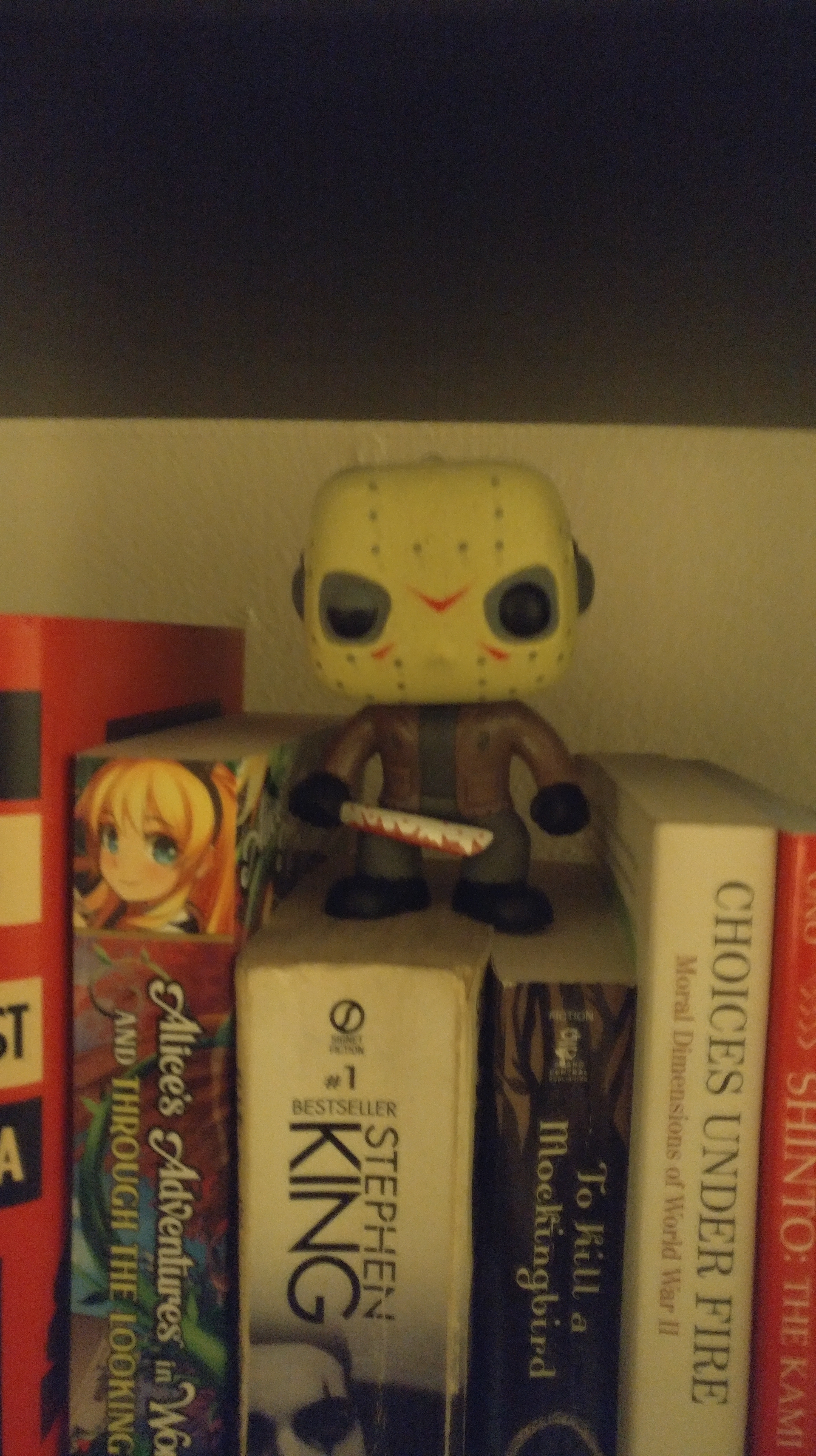
Jason Voorhees Funko Pop doll

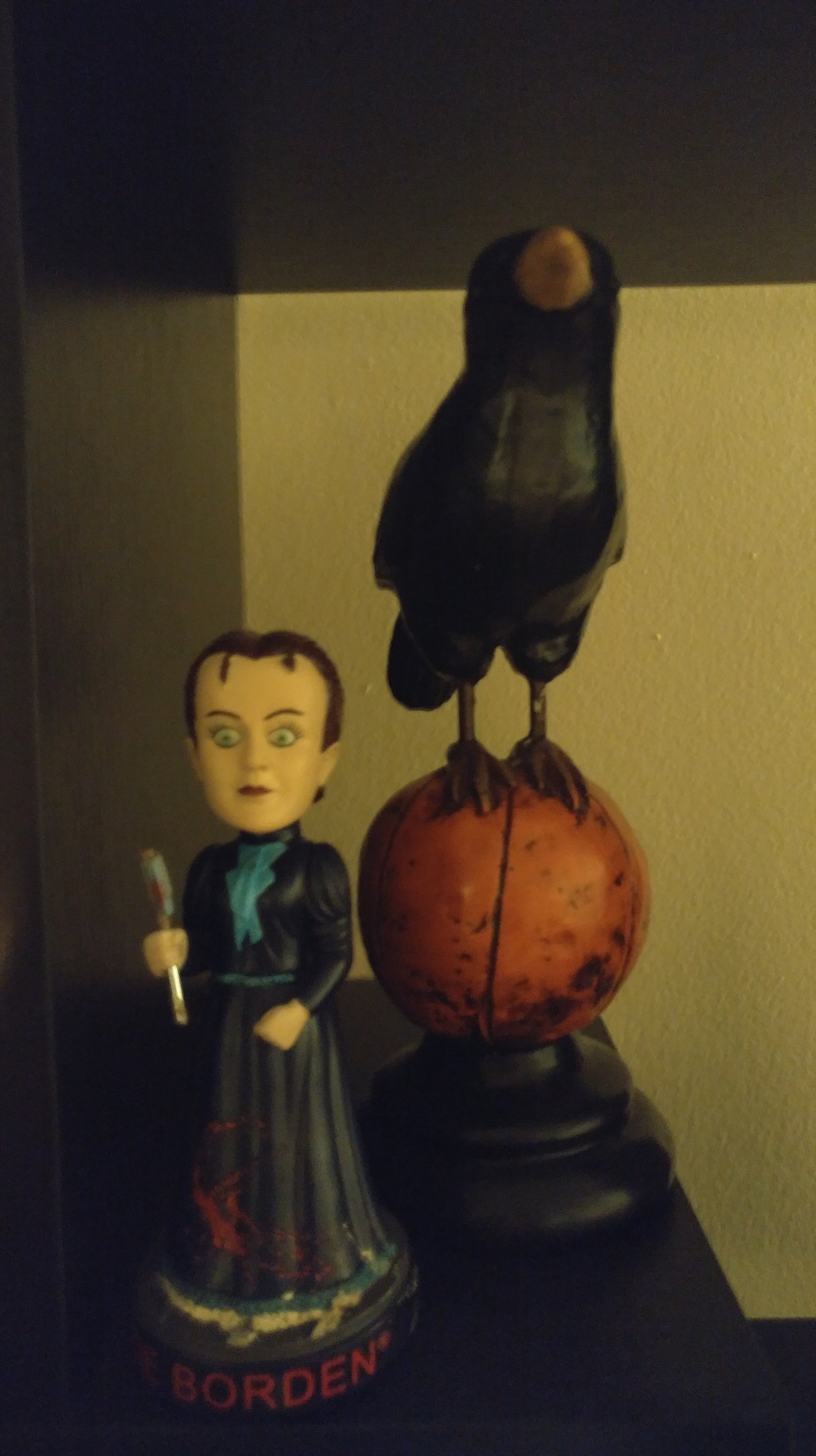
Lizzie Borden bobblehead doll and a raven statue. Nevermore! Thwack!

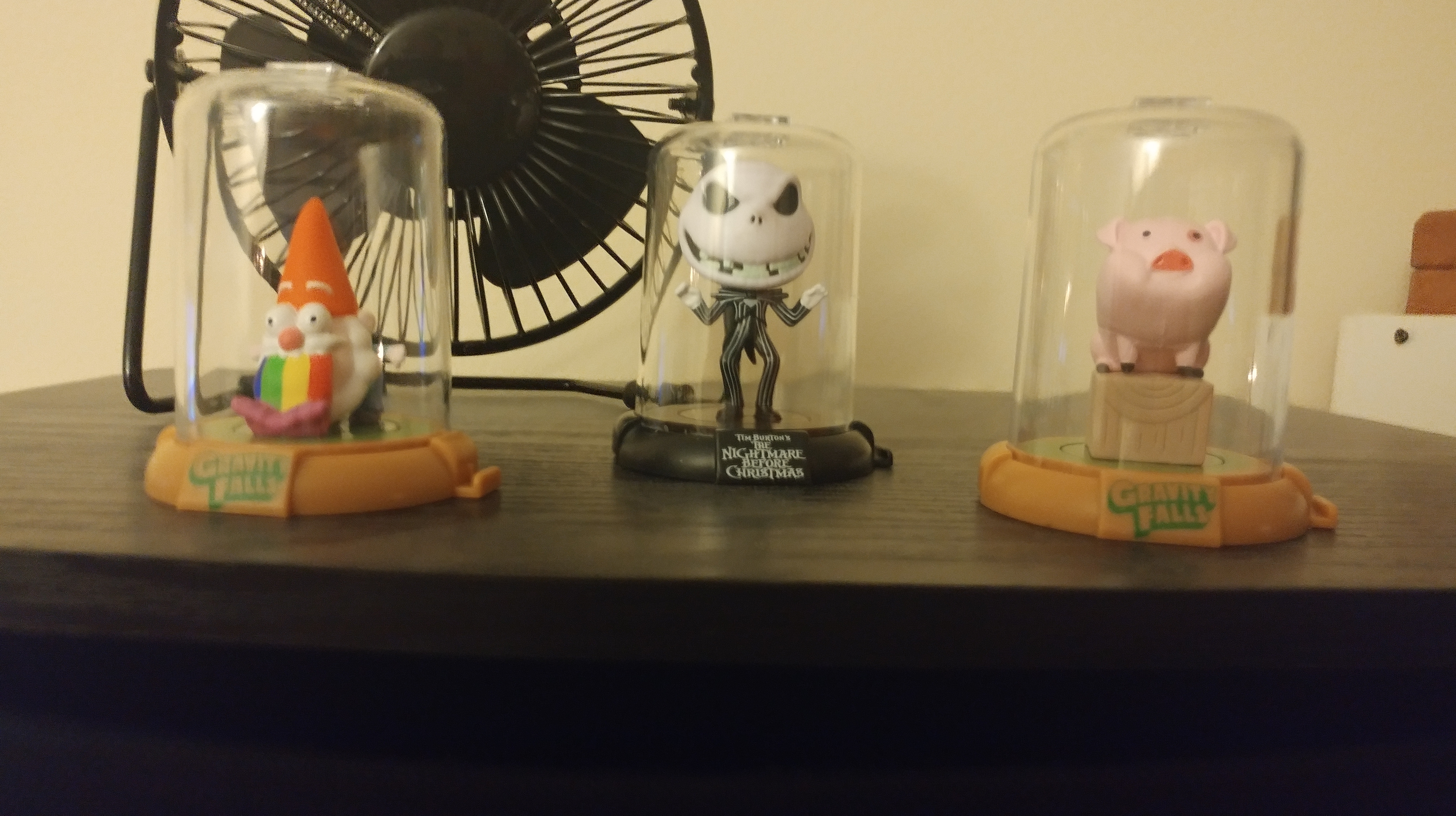
The barfing gnome from Gravity Falls; a Grinning Jak from The Nighmare Before Christmas; and Waddles the Pig from Gravity Falls

Yeah, the Sailor Moon one is technically Japanese, but Funko is American, so it evens out. And you’ll notice, a lot of these are related to franchises or pop culture properties I’m a fan of. The exceptions in this group is the Lizzie Borden bobble head doll and the raven. The former is related to an amazing experience I had earlier this year, while the latter is just a fun Halloween decoration that I have out all year because for me, every day is Halloween. Not to mention, they’re creepy.

And now for some of my most recent acquisitions:


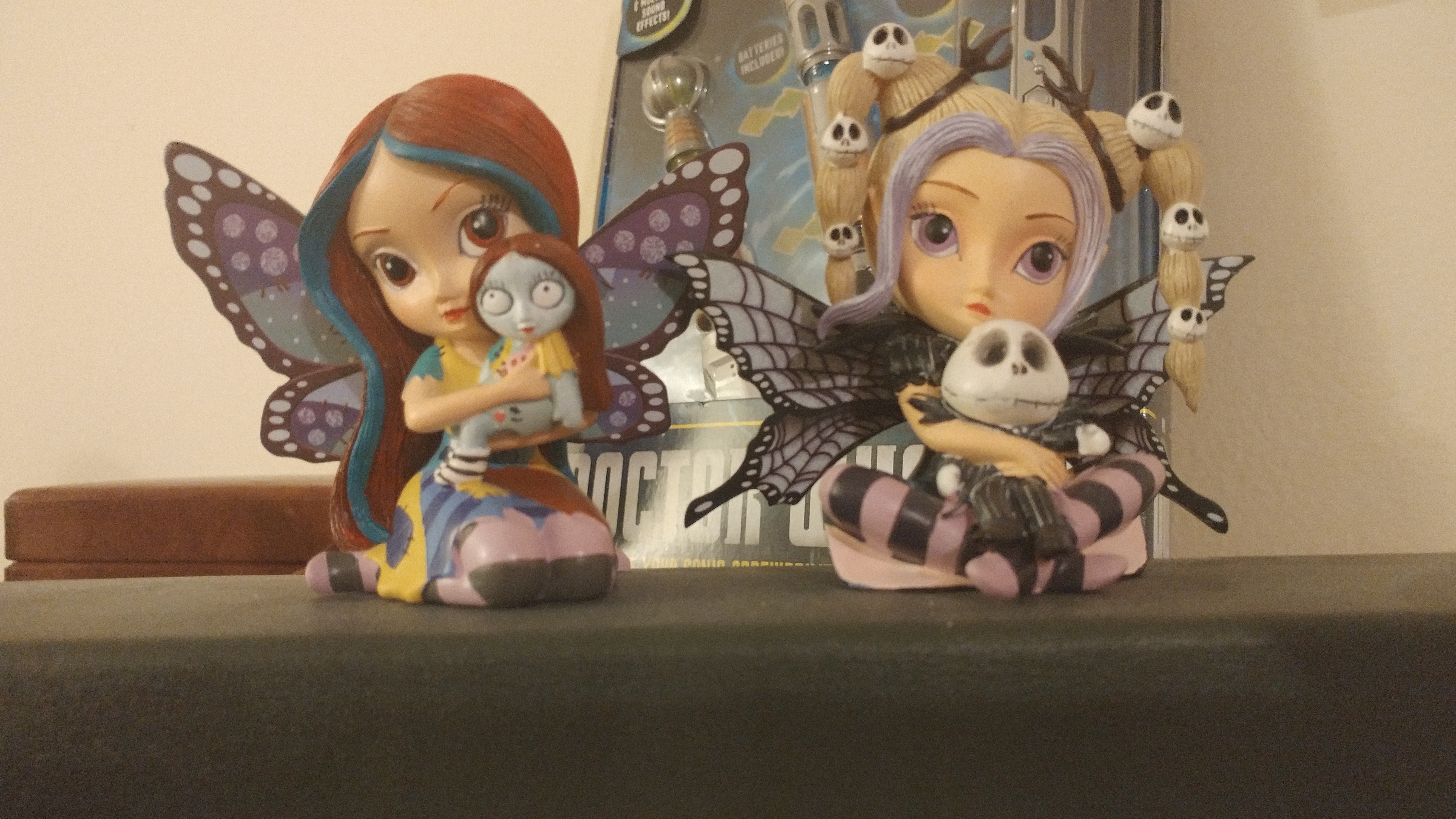
These are Sally and Jack, and they’re pixified versions of the Sally and Jack characters from The Nightmare Before Christmas. In fact, you can see them holding doll versions of their namesakes in their arms. These are first-edition figurines made by the Hamilton Collection. There are two more figurines in the series, and I hope to collect those two in time. For now though, I’m really happy with these two. Thy’re very pretty, based on a truly awesome movie, and I just love to see them when I walk in the door each day.

And finally, here’s the oldest figurine I own.

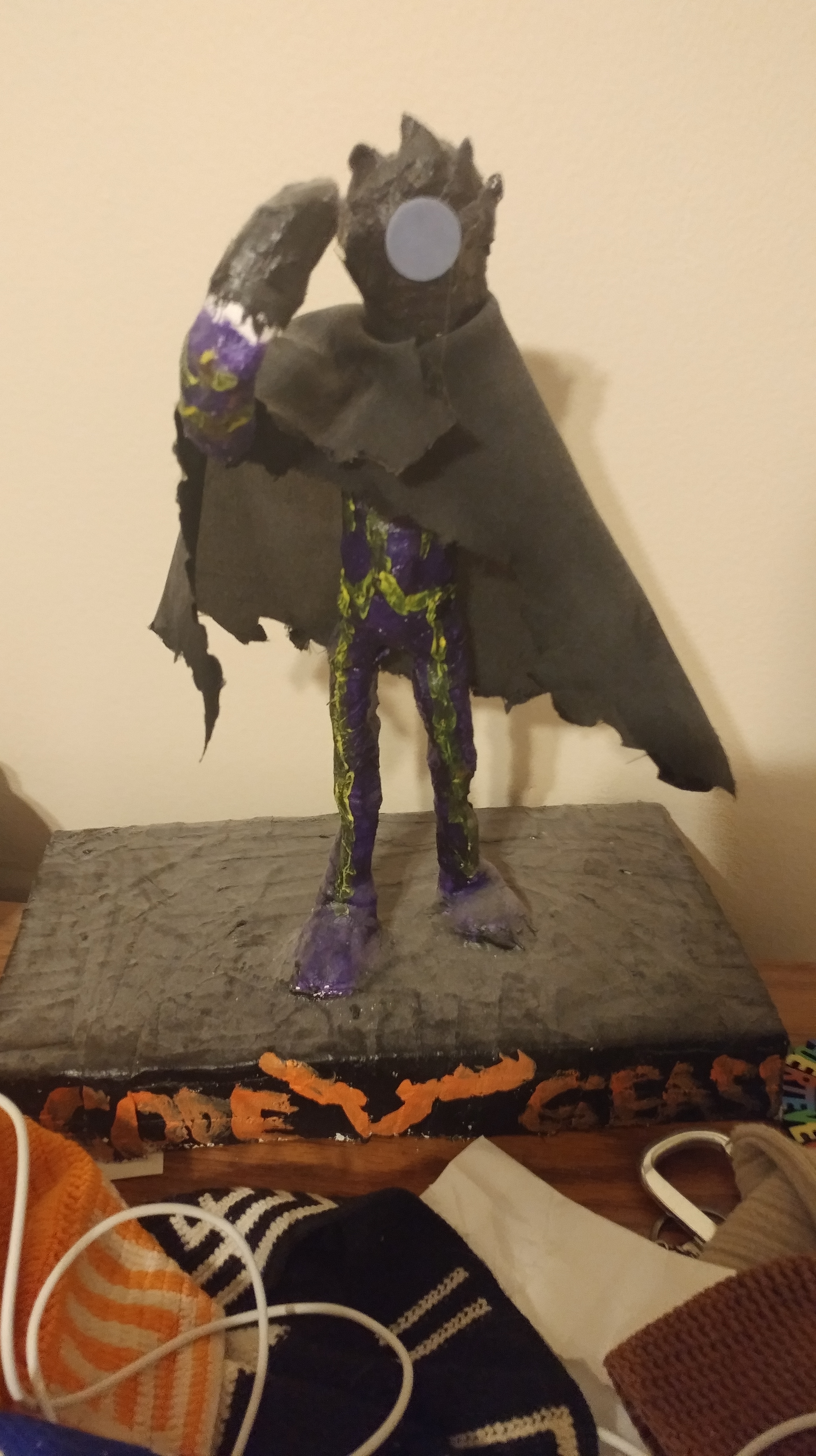
This is Zero from the anime Code Geass, which is still one of my favorite animes ever. I made it in art class back in high school, because I couldn’t afford figurines or dolls at that time, and not for several years afterwards. Zero was my way of saying that one day, I would be able to own these sort of things I’d always wanted. And I think I can say I’ve accomplished that goal.

And my collection is growing every day. I’m probably going to get the other two figurines in The Nightmare Before Christmas series from Hamilton, as well as many more figurines from various anime (including an actual Zero figure), and maybe even some of the more traditional kinds of dolls, the ones that wouldn’t look out of place in Victorian England, among others. I’m saving up for them, and for a cabinet to put them all in so they don’t get dusty. And when that happens, maybe I’ll post about those new editions too. We’ll see.

That’s all, Followers of Fear. Just wanted to post about my weird hobbies and show you all how proud I am of them. Until next time, pleasant nightmares.

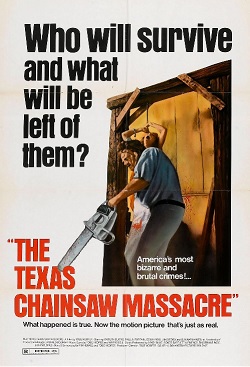
Going with a classic this time around, as well as one of the most polarizing films in horror. Some love it, some hate it. I hated it at first, but I think it’s time I see if my opinion needs to change. After all, this was one of the earliest slashers and is considered a staple of horror movies. Maybe it’ll give me a jump.

WHAT’S IT ABOUT: A pair of siblings and their friends go to the former’s ancestral home to make sure their grandfather’s grave wasn’t a victim of recent grave-robbing in Texas. They later come across a house filled with a cannibalistic family, including the chainsaw-wielding Leatherface.

WHY I DIDN’T LIKE IT: In high school, I had heard this movie hyped so much among horror fans. When I finally could get Rated R movies on my own library card, I was disappointed. I didn’t jump, or feel any atmosphere. I wasn’t scared. It just felt over-hyped.

WHY I REWATCHED IT: You learn more about its production and legacy, you see some remakes and one sequel. You wonder if you missed something. Hence a rewatch.

THOUGHTS: I didn’t care for it.

Yeah, I was more aware of the film’s importance in the horror genre, but I still didn’t find myself enjoying it. It took the film forever to actually get going and become interesting. And even then, it was cheap to the point of noticeable (I refer you to the meat hook scene), there were lots of awkward close-up shots of girls freaking out, and more shouting and screaming than was probably necessary…from the villains. When damsels in distress scream, it’s fine with me, it’s kind of expected. But villains being so loud and annoying…yeah, I don’t care for it.

Yeah, it was quite the shocker in 1974, and that was the point. The film was meant to shock the 70’s movie-going audience. And it did, which lead to it becoming so famous and getting so many sequels and remakes. But to me, who is used to more gore and shock and terror from later slashers, it just feels tame and boring.

JUDGMENT: 1.5 out of 5. Watch it to see what it did for horror, but honestly, once you’re past a certain age and seen enough horror films, you’re just not going to get scared.

Don’t kill me in the comments for hating my opinion. It is what it is.


Next time around, I’ll be taking a look at a film that has become a staple for Halloween, but I had one particular problem with it that ruined the experience for me. It’s time to rewatch Oculus.

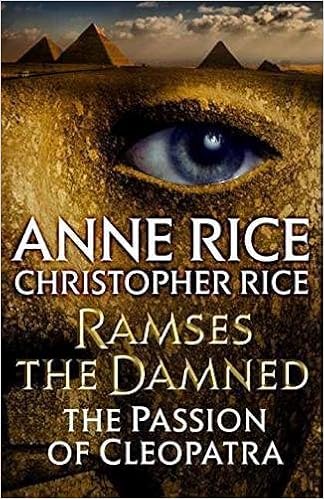
I haven’t read the original Ramses the Damned novel since I was bar mitzvah age, but I remembered enough of the details (and remembered more during the reading of the book) to be very excited upon learning earlier this year that Anne Rice had written a sequel twenty-eight years after the original with her son, author Christopher Rice (whose books I need to put on my reading list one of these days). And now that I’ve read the Rices’ first collaboration, what do I think?

Well, you know how George Miller revisited the Mad Max franchise with Fury Road several years after the last entry, with a new cast and crew to help shape his vision, and the results were pretty awesome? It’s kind of like that.

 Ramses the Damned: The Passion of Cleopatra revisit Ramses and Julie Stratford shortly after the events of the last novel, preparing for their engagement party and their lives as globe-trotting immortals. However, news that Cleopatra is still alive reaches their ears, and there’s a chance she still holds a grudge against them. And as if that weren’t enough, new forces threaten the immortal couple, including an ancient queen whose very existence will turn the immortals’ world upside down.

Honestly, I could not tell this was a collaborative work. This may be because I’m unfamiliar with Christopher Rice’s work, but it’s more than likely he’s very good at imitating his mother’s style. Whatever the reason, the novel has a great story and moves along at a nice pace. The expansion of this fictional world to include new elements and characters didn’t feel forced or weird, and the twists and dramatic moments really allowed you to feel the surprise and attention when they occurred. You can’t complain about that.

And let’s talk about the new characters, because they were great! Bektaten’s addition to the cast was a real shake up, as was her companions Enamon and Aktamu (I hope I didn’t butcher those names trying to spell them). There’s a gravitas to them that leaps off the page and commands respect not just from characters, but from readers. It’s as if their many centuries have allowed them to transcend many human flaws and become something more. Imagine what they could be like in our modern world! It’d be truly something to see.

But of course my favorite new character (and possibly my new favorite character) is the aptly named Sybil Parker, an American author whose dreams cause her to be roped into this strange and magical world.* From the moment she appears on the page, she is just so interesting to follow, as her part in the story is so full of mystery and a bit of intrigue. And her arc, going from this timid homebody to this brave young woman who doesn’t bat an eye at immortals, was masterfully written. 

I don’t have any real problems to point out with this story. Possibly a bit more of Elliot Savarell would have been nice, but that is probably nitpicking on my part.

All in all, Ramses the Damned: The Passion of Cleopatra is a great return for a story we had thought finished long ago. On a scale of 1 to 5, I give the novel a 4.8. Pick it up, and get wrapped up in the story (been waiting a week to make that pun, and it was worth it).

But tell me, what did you think of this novel? What immortal creatures will we get from Anne (and possibly Christopher) Rice next year (I’m hoping angels)? And which Christopher Rice novel should I put on my reading list? Let’s discuss.

*Sounds like my dream life right there. Well, hopefully the former will be achieved someday soon.

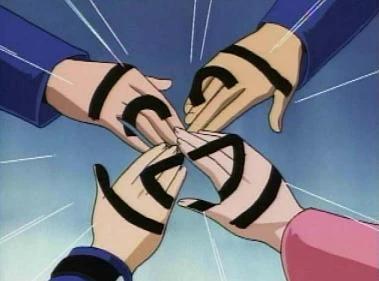
“The Power of Friendship!” as symbolized in Yu-Gi-Oh’s famous hand smiley face.

So yesterday I watched a YouTube video about a common trope in fiction (you can check it out HERE), which is (say it in your heads with a big, echo-y voice) “The Power of Friendship!” Now, if you aren’t familiar with the trope and you didn’t have time to watch the video, “The Power of Friendship” is a trope in which the bonds of friends is so powerful, it becomes a power in and of itself, capable of cosmic-like acts such as giving heroes power ups, stopping psychic mind readings, snapping people out of brainwashed states, and occasionally even defying gods. This power shows up in a ton of popular media, including a ton of anime and manga (the Fairy Tail series  practically is nicknamed “The Power of Friendship” manga).

Now the video I linked to goes into much more detail about the various intricacies of this trope (go watch it if you do have the time, the channel that produced it is awesome), but I wanted to focus on one particular aspect of “The Power of Friendship” trope that the video didn’t go into: how it surfaces in the horror genre. Or rather, how it doesn’t surface in the horror genre. At least, not all that much.

So if you didn’t watch the video (and you’re missing out!), the trope works like this: you have friends, and those friends can help you out of a bad situation, whether that be isolation or a powerful demon overlord is about to destroy the Earth and your power alone is not enough to destroy the demon’s power. It can be a metaphorical power to help a character out during a bad patch, like the former situation, or it can be a literal power and the equivalent of taking one of those mushrooms in a Mario game, like the latter situation. Thus, “The Power of Friendship!” And you can kind of see why it shows up so much: we all wish we have that power, or believe our relationships are that powerful.

But horror doesn’t feature this power as much as other genres, and there’s a reason for that. Horror is horror. It incorporates the darker aspects of the world around us and sometimes amplifies them for maximum effect. And in real life, friendships aren’t as powerful and as lovely as in fiction. In the stories, friendship is powerful and unyielding. It can overcome all sorts of obstacles, and the more you try to destroy it, the more it bounces back and kicks bad guys in the ass. But in reality, friendships grow, cool, and break all the time. It can take only a little bit to destroy a friendship, and a lot to repair it once it’s broken. Horror writers not only recognize that, but incorporate that into their stories. And it’s such a well-known fact about life, writers don’t draw attention to it, because it’s so well known among readers.

That’s not to say that “The Power of Friendship!” doesn’t show up in horror fiction at all. For example, Stephen King’s It pretty much says that the friendship of the seven main characters is what allows them to fight the malevolent entity in their town.* It just doesn’t say it as loudly as other media does, and also tells the reader that the characters’ friendship, while powerful, can be broken or is less effective if they aren’t all in sync or allow their fear to divide them. This is what leads to that one infamous scene in the novel, and is also shown in the new movie after the first fight with It.

Weirdly enough, the power of love or family is shown more than the power of friendship in horror, and I’m not quite sure why. Perhaps it’s because love and family, unlike friendship, has a more powerful evolutionary purpose, and therefore is given more power in fiction in general. If you’re willing to do more to save your perfect partner for creating offspring or the lives of your offspring, it’s going to show up more in stories than the grouping of creatures of the same species to ensure survival.** Hell, a lot more of my stories revolve around romance and family than friendship. One of my stories even involves a friendship gone bad, but that’s about it.

If “The Power of Friendship!” can be portrayed as it was in It, you can include it in horror stories more effectively.

That doesn’t mean we can’t include “The Power of Friendship” in horror stories. It can be used, but it’s more effective if used as it was in It: not overstated and a bit more realistic.  Showing a friendship form, grow, and overcome obstacles in a story, without drawing too much attention to it and showing how fragile the friendship can be under certain pressures, will work fine for the horror audience. If you go for overblown storytelling and basically say, “The Power of Friendship can overcome anything,” it will take the audience out of the story. Let the friendship’s strength demonstrate itself, rather than shoving it in through dialogue or just outright stating it. In other words, show, don’t tell.

While still not that common a trope in horror, “The Power of Friendship” can be part of horror. It may require being handled differently than in other genres, and with a bit more realism (weird for “realism” to show up in horror, but there you go), but it’s not impossible. You just need the right touch, and “The Power of Friendship” can best even shapeshifting entities that take the form of clowns.

That’s all, Followers of Fear. I’m in a bit of a blogging mood right now, so expect more posts from me soon. Until then, pleasant nightmares!

*There’s also some sort of power up thanks to a turtle from another universe, but let’s not get into it, shall we.

**Best explanation I can come up with given my aromantic nature and already jaded worldview.