It seems easy these days to get caught up in all the horrors and tragedies going on lately and feeling hopeless and depressed over it. Right now in the Middle East, two wars are going on, each a continuation fo a longstanding conflict that is older than most of the readers on this blog. Go up north, and you’ll see a huge superpower that is making aggressive moves at its neighbors in order to reassert itself as a once feared and respected empire. And then come home to the United States, where the federal government resembles more of a daycare full of squabbling children than a functioning body of elected officials. We’ve got continuing problems with immigration, gun violence, police abuse, the wage gap, and more problems than I care to put in this post, all with no end in sight. Add to that the recent deaths of so many people, some of whom died before their times and under tragic circumstances, and it feels easy to give into despair.

But it’s in these times that we must look to the good and remember all that we have to be thankful for. Sure, my home country of the USA is far from perfect, especially on the federal level, but it is a country with plenty of opportunities. I’ve been able to take advantage of those opportunities, getting a quality education that I’ll finish up this coming May with my college graduation (any further education will be several years down the road if I decide to pursue it), and while receiving this education, I was able to receive counseling that allowed me to learn how to interact with people and get along (a subject which confused me growing up and still confounds me sometimes). And if that was not enough, I’ve been able to pursue my passions and publish three books, with another one recently finished, another one in the editing stages, and a sixth planned for this school year. Am I making lots of money each month? No, but that doesn’t stop me from working hard and making my dreams come true.

I’m also blessed to have a loving, if somewhat kooky family, great friends, and the near-guarantee that they won’t be suddenly taken away from me (it could happen, but it’s not likely). I also have a steady job that allows me to pay my bills and afford the things I need to get by, and I have taken part in programs that will help me find a job after graduation.

And I’ve been lucky enough to travel to other countries, Israel the summer before my senior year of high school and England, France, and Germany this past May. And there’s a chance (slight, but there), that I could go abroad again in the coming years, God willing.

And that’s not all. There are stories appearing in the world every day that makes life seem magical. A man in Florida graduated from college with a 4.0 GPA in business, all while battling cancer he’d had since he was 18. A dog whose hair was so overgrown you couldn’t tell which end was the front got her hair cut off and is now getting adopted. And my friend Matt Williams tells me that scientists have developed a new method for finding people more predisposed to commit suicide, so maybe someday we can make suicide a less common problem in the world. Even with the dark stuff, there’s still room for the light.

Look around you. What are you thankful for? What’s good in your life? Your friends and family? Your job or school? Is there someone or something that makes you forget all the bad and feel at peace? Did something come in for you at the library or in the mail that you’ve been waiting for a long time? Is it a book by me, by any chance? If it is, you might have just made my day.

When you think about it, you can find plenty more reasons to be happy than to be sad. So keep strong and never stop hoping and looking for a better tomorrow. I know life isn’t always easy. For some, it’s a constant hell. But we’re human beings, and while we’re capable of great horrors, we’re also capable of great good, and of being able to find the silver lining in any grey cloud.

So if events around the world have you stressed out, take a moment to reflect on the good. You may just find your stress and sadness floating away.

I’ll eave you with this video by the immensely talented singer Alex Boye. From the moment I saw it, I knew it was an incredible video with the power to help so, so many people. Check it out for yourself. You might just ind yourself perking up a little. I know I do when I watch this video. Especially shots with the special guest star of the video. You might recognize him. He’s quite the famous anchorman.

Most of you have read my reviews (and if you haven’t had the pleasure, I’ll probably be doing a review soon, because there are some awesome horror films coming out this month). Since I’ve done so many of them, and occasionally they’ve gotten a lot of views, I decided to do a post for Self-Published Authors Helping Other Authors on Writing Reviews.

I’m hoping this post will be helpful to the many authors who would like to try writing reviews themselves. Those things can have so much influence over a person’s decision to buy a movie ticket or place a reservation at their local library for a new book. And I had fun breaking down the process I use for writing reviews and making it into a helpful article.

If you have the chance, please check out the article. And if you’re a self-published author or are thinking of pursuing self-publishing, please check out the rest of the website. There are plenty of articles written by independent authors for independent authors to make all aspects of self-publishing easy and cost efficient.

That’s all for now. If I have time later today, I’ll write another blog post. Until then, I’m busy editing Video Rage. Have a great day, my Followers of Fear.

Last week, I marked three years of blogging on WordPress, and decided to hold a sale: all e-books of Snake, Reborn City and The Quiet Game: Five Tales To Chill Your Bones cost only $0.99 to download from Amazon or Smashwords. Today is the last day to download those books, so if you’re looking for something new to read and have an e-reader and you don’t mind a little terror or some violence, now’s a good time to check out my books.

And if you decide to check out my books and you find the time to read them, please take the time to let me know what you think of them. You can leave a comment on a related post, or you can write a review on the book’s page on Amazon or Smashwords (whichever you downloaded the book from). Positive or negative, it doesn’t matter, I love getting feedback on my books. So please, let me know.

That’s all for now. I’ve got a big day ahead of me, so I’m going to get right to it. Have a wonderful weekend, my Followers of Fear.

What an eerie path to take.

Every author has a different metaphor for what it’s like writing a novel or creating a story or even outlining a story. Stephen King said in his memoir On Writing that he approaches writing like an archaeologist uncovers an artifact, finding the top of it sticking out of the dirt and then carefully chipping and dusting away to uncover the rest of it. I guess that means His Royal Creepiness likes to come up with the story as he writes it and doesn’t plan too far ahead, but whether or not he does, he’s almost always brilliant with it.

Another author, I forget who but I’m pretty sure they were Freshly Pressed for writing an article on this, once compared writing to putting together a sandwich. You have a bunch of different ingredients, and it’s up to you as the chef of this particular sandwich to make it into a delicious meal that people will want to savor and discuss for hours to come. Like I said, I can’t remember who this author was, so I can’t tell you whether or not they were brilliant at it, but they certainly can create a compelling metaphor.

And there are plenty of other metaphors that one author could apply to the writing of a novel: mixing an interesting cocktail; building a house; decorating a room; putting together a collage; building a Rube Goldberg device (I love those things!) and then some, on and on, etc. Each author probably has their own metaphor that relates to their own process.

How some people see writing a novel: building one of these.

I thought about this a lot while I was writing the outline for my thesis Rose, especially since during the early stages of writing the outline I had a lot of trouble figuring out where to go with the story after the first chapter or two. And after a lot of thought, a bi of frustration, and finally typing out a sixteen-page outline complete with short character bios, I finally figured it out. To me, writing is like sending my characters down a path in a heavily wooded forest, and letting them find the way to the end.

I think this has a lot to do with the many philosophers, musicians, and others who have said “Life is a road/path/journey”. For me, I’m seeing the path my characters are traveling on as they move through the story, meeting each obstacle, struggling against their own darkness and striving to be better people. And sometimes, this metaphor takes on a much more…I guess literal tone. For example, those of you who’ve read my novel Snake know it takes place in and around New York City (for those of you who haven’t, now you know). In a strange way, I see the path the Snake takes, not just the one in the woods but how he travels from location to location and scene to scene. I see what he does to get from Point A and Victim 1 to Point B and Victim 2, and from there to Point C and Victim 3 and so on and so forth, whether he’s driving a stolen car or walking through a dark neighborhood or using a disguise to figure out what his next move will be. (Right now, someone is reading this post and hears this description of Snake and is either deciding the book’s not for them or they’re strangely intrigued and want to find out more. I hope it’s the latter).

This “path” metaphor gets even more literal in some of my other works. In Video Rage, the sequel to Reborn City which I’ve begun editing, most of the novel is spent on the open road, so those characters of mine aren’t just on a path with many twists and turns in a metaphorical sense. They’re really on that road!

Which to take to get a better story?

Whether in a metaphorical or a literal sense though, writing like my characters are on a road or a path helps me visualize where my characters and the story are going and where I ulitmately want them to go. During the writing of the outline for Rose, there were several paths that the story could have gone on, and in the early parts I couldn’t figure out where to go. Some of those paths I tried, and I ended up not liking the direction the story would’ve gone down if I went down those paths. Thankfully I ended up taking the right path around the third or fourth attempt, and things got a lot easier from there on out. I’m looking forward to seeing what people think of the path I took with this story, and the others I’ve written.

What do you think of this metaphor for writing?

What metaphor do you like to use? What are some others that you’ve heard that you agree with?

Or at least the first draft is. There’s always a chance that my adviser will make me rewrite certain parts of it, but I hope to keep it like it is.

Anyway, late last night I went about finishing the outline, and somehow I managed to do it before it was too far past midnight. This outline gave me more problems than outlines usually do, because up until I started writing the outline I had only a few scenes planned out, so I had to come up with the rest as I was writing. Once or twice I had to actually go back and erase what I’d written before because I didn’t like which direction the story was going. Around the third attempt though I managed to get this story going in the right direction and from there it was just a matter of figuring out where I wanted to go, what would be the logical step to get there, and what sort of events could happen without stretching the limit of credulity.

In the end, I think this story will turn out very well. It’s about twenty-eight chapters, and will probably be around the normal length for one of my books, between eighty-five thousand and one-hundred thousand words. I often wrote the outline looking for plot holes and trying to find good ways to plug them up (I hope I succeeded). And I hope I create an interesting and somewhat scary story about a woman who dies but is resurrected by her stalker through magic and finds herself trapped in his house with not only him, but very malevolent supernatural forces. Thank goodness I have an adviser who will be helping me out with that part. He’s a published writer himself, so odds are he’ll have a few lessons to help me.

And while I’m waiting for my research books to arrive in the mail and for the new semester to start (three weeks from today, by the way), I think I’ll edit Video Rage. God knows it’s about time, and I have time to do it now before things get really crazy! In fact, I’ll start it today! But first I need to run an errand, then I need to vacuum the apartment, then I need to run the dishwasher, then I need to have lunch before I go to work, then I have work, and later tonight I’m supposed to be at a friend’s birthday party…life’s crazy sometimes.

Anyway, that’s all for now. I’ll keep you updated on Rose, Video Rage, and other projects as time goes on and I have news to give. Have a great day, my Followers of Fear.

Part of my research for my thesis/new novel Rose was that I had to look into the life of a sociology grad student, because my protagonist Rose Taggert is one. Well, was one. I mentioned when I first announced what I was working on that Rose died and was resurrected by her stalker, didn’t I?

Anyway, since my knowledge of sociology was limited to the introductory course I took last year, I decided to contact the sociology department at Ohio State to see if they could maybe help me. After first heading to their main office, and then getting redirected to their undergraduate advising office, I talked over email with one of the advisers, who then told me to email their graduate adviser Kelly Hopkins (boy, was that a little roundabout). After a couple of emails to determine when was a good time to meet, we finally agreed to meet at nine this morning, and I made the trip onto campus. Once back in the same office I started in, I was taken to Ms. Hopkins room (no idea if she’s married, so I’ll just go with “Ms.” for now), where she was all too happy to give me an explanation of what the sociology grad program was like after I explained to her about my protagonist Rose.

We spoke for a little under a half hour, Ms. Hopkins doing most of the talking while I asked a question here and there. Turns out that sociology grads at Ohio State spend their first two years earning their Masters degrees, after which they take very intense candidacy exams to enter the PhD program. At that point they start taking specialized courses for PhD students, as well as taking specialized courses for their area of specialization and working on their dissertation. The grad students spend a lot of time together in classes and in their offices together, usually becoming lifelong friends by the time they graduate. They also develop close relationship with their faculty advisers, and many of them have the chance to teach during their tenure as grads.

Based on this information, I was able to get a clearer picture of who Rose will be and what her grad life was like prior to the events of the novel. She’s probably in her third year of grad school, so she’s about six months into the PhD program. She is specializing in criminology and community studies, particularly studies involving gun violence, and was probably either a GTA working underneath a professor in an introductory course or already a PhD student teaching a class of her own when she met the student who would become her stalker, depending on how long ago I end up wanting them to meet and the latter becoming fixated on her.

I’m glad I was able to meet with Ms. Hopkins and speak with her today. I know Rose’s life as a grad student isn’t the most important part of the novel, but it’s one I wanted to seem authentic to readers. Besides, it’d be a little bit embarrassing if a sociologist or sociology student read Rose when it came out and was like, “What the heck sort of program is this girl in?” Always glad to have the details right.

I also learned something interesting from Ms. Hopkins: when I told her that my work was heavily influenced by Stephen King, she mentioned that she had a friend who was a make-up artist for horror movies and had worked on a few Stephen King adaptations of King’s work, including The Shining, and knew King personally. Apparently King’s a very nice, sweet guy in person (doesn’t surprise me; we horror authors usually are, though at one point I thought I needed to be a little bit creepier in order to be a better author). I ended up handing Ms. Hopkins two of my business cards so that she could pass them onto her friend (and maybe even King. Do I dare dream of it?). Hopefully at least one of them will go online and check out my work.

Well, that’s all for now. I’m going to do some more work on my thesis outline later today. At this point I think I might be done by the end of the week, with about thirty or so chapters. I’m still not sure where eactly this novel is going, but so far I like what I’ve come up with and I think my adviser might as well. I’ll keep you guys updated.

Have a great day, everyone!

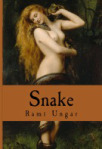
snake

How far would you go for love and revenge?

Last night while I was out seeing Guardians of the Galaxy (which was a great film, by the way), a new review of Snake was posted on Amazon. I’m very excited and happy for this review, because reviews let me know what the readers think of the book and gives me feedback on where I can improve with the next book.

Today’s review comes from Gefilte63, which means it’s from my dad. Now before you roll your eyes and think to yourself, “Obviously he gave his son a glowing review”, I think you’ll find my dad can be quite the book critic (and critic of a bunch of other things, but I’ll save that for my stand-up comedy act). His four-star review, which he entitled A great story, a real page turner, goes like this.

This novel is a much easier read than the author’s last effort. It is a great story that keeps you wanting to see what happens next; it reads like an action/thriller movie.
Areas for improvement would include better editing. At times there is too much conversation where it isn’t necessary. Also a few plausibility issues but overall a great read!

Okay, remember when I said reviews give me feedback on where I can improve? Well, apparently I need to do a better editing job next time around. And apparently there are plausibility issues (I’m thinking he’s talking about parts in the latter half of the book), so I’ll try and make sure that’s less of a problem in the future (though if I could point out, sometimes a lot of things in life are implausible but are reality nonetheless. I mean, have you seen our gun situation?).

Anyway, I would like to thank my dad, Rabbi Michael Ungar, for taking the time out of your busy schedule to not only read Snake but to write a review for it. I hope in the future you continue to read, enjoy, and review my books.

If you would like to learn more about Snake, you can check out the page for Snake or you can check it out on Amazon and Createspace. And by the way, this week until August 9th, all e-books of my work, Snake included, are only $0.99 when you download them. So now’s a great time to check them out!

And I’ll be seeing about getting my books onto other formats like NOOK and iTunes soon, so stay posted for information about that.

Well, that’s all for now. I’ve got some work to take care of, so I’m going to get on that. Have a good day, my Followers of Fear!

Before you read anything else, just check out this video below.

Now that you’re either laughing yourself silly or wondering what the hell that was,I want to say something important. Three years ago, in a library down the road from where my mom lived, I decided, after much thought, to go on WordPress on create a blog. I didn’t know what would happen. Heck, I didn’t even really know what I was doing! My whole first post, and the first few that came after it, had lower case titles! I had no idea what the difference was between a page or a post, and I did not have categories for the first few posts. It took me even longer to figure out what tags were and why they were so important.

But I learned. I kept blogging. At some point within the first few weeks, I started gaining followers. Just one or two, but they stuck around. I gained more followers. I blogged more and more regularly, finding excuses to publish posts. I tried not to get discouraged when days or weeks would go by and I’d have only one or two views in that entire period. I made more friends, got several new followers, published three books, started writing for Self-Published Authors Helping Other Authors, went abroad, wrote two more books that need to be edited as soon as possible, began work on a thesis, and survived three years of college. And these days, I average at least nine views a day, which makes me plenty happy (I love knowing people are checking out my work)!

You want to know something? I still have no f**king idea what makes a good blog post. I’m not kidding. Every time I think to myself “People are going to want to read this” , or “This could get Freshly Pressed with the right tags” or even “This probably won’t be one of my more popular posts”, more often than not I get surprised. Just the other day two of my posts got more views than I expected. I was like, “Say what?”

Anyway…

A lot has changed in three years. Not just me, though I’ve definitely grown a bit and maybe have gotten some nicer glasses. Basically I’ve grown a nice following. At the time I’m writing this, I’ve got 24.459 views, 1,922 comments, at least 1500-1800 likes (they stopped notifying me of likes after I passed 1337, but I guess-timate it’s around the range I quoted), and 645 followers. I also have 121 followers on my Facebook page and 66 followers on my Twitter feed. I’m very happy that all this has happened (especially the Facebook page and Twitter feed, I’m really surprised that anyone are into those).

So in honor of this great occasion, I’m announcing a week-long sale. From August 2nd to August 9th, all my e-books on Amazon and Smashwords are available for $0.99 to download. So if you’d like to read my books at a discount rate, now is the opportunity to do it. Just type my name into either website, and you’ll find my work. And if you do decide to read any of my books, please let me know what you think once you finish them. A comment or a review, positive or negative, I’d love to know what you think. Just as long as you’re not trolling me or anything. I’d hate that.

And if you see a different price than what I quoted online, check back later. The websites can act funny sometimes.

That’s all for now. I’ve got work to do, so I’m going to do it. Have a great day, my Followers of Fear!

Every now and then I look to do a post musing on the mechanics or subtleties of writing fiction, and today is one of those days. And as you can tell from the title of this post, I want to talk about unreliable narrators, those strange voices in the books we read (and occasionally in the films and TV shows we watch) whom we can’t always trust.

According to that awesome source of usually-factual info that is Wikipedia, an unreliable narrator is a narrator, usually in some medium of fiction or another, whose veracity has been called into question. Usually this happens very early in the story, where the narrator may make a plainly false or delusional claim, or it may happen elsewhere in the story, perhaps near the end where a twist in the story turns everything we thought we knew upside down or slowly through hints that are given to us in the narration. Stories with unreliable narrators can feature a single narrator, or multiple narrators giving their own versions of events, or even a supporting or side character who tells a story in such a way that we question whether or not they’]re being entirely truthful about what happened.

A great example of an unreliable narrator is Patrick Bateman from the novel American Psycho. As a man suffering from psychoses and the occasional hallucinations, Bateman makes a great unreliable narrator. Other examples include Nell from Wuthering Heights, most of the characters from the Japanese movie Rashomon, and Ted Mosby from How I Met Your Mother (according to show creator Craig Thomas, anyway). Oh, and any story that has children narrating it could possibly have unreliable narrators, because kids sometimes remember things incorrectly.

(If you want to think about it though, every one is an unreliable narrator, because no matter how they see events, they are biased, they may mis-remember details, and they may cover things up in order to make themselves look good or to hide their own guilt. But let’s not get too philosophical about this. Otherwise we’ll be here all evening)

One of the characters in my thesis project, the antagonist, is an unreliable narrator. Because of his mental problems and his infatuation with protagonist Rose, he sees things through a very certain light, so when he tells a story it is often through that lens, which probably won’t reflect reality too well. As I’ve never written a story from the point of view of an unreliable narrator, so exploring the device through this character should be interesting. (Or have I used unreliable narrators before? Technically, any time I tell a story from the protagonist’s first-person point of view, it could be construed as unreliable, but i’m not sure if it counts. Oh darn it! Now I’m an unreliable narrator of my own writing career!)

But why are unreliable narrators used so much? And why do they appeal to readers and writers alike? It’s a very difficult question, and I’m not sure I have an answer. Perhaps for writers, it’s the chance to tell a warped version of events. When we tell a story, especially through the lens of an omniscient or almost-omniscient third-person narrator, it’s almost expected that the story being told is what actually happens, one-hundred-and-ten percent factual. Even when the story is limited to the viewpoint of a single character, that third-person narrator’s portrayal of events is assumed to be accurate. Heck, even when we read a novel told in the first-person, we tend to see the depiction of what happens as true. Especially if we like the character.

An unreliable narrator allows the writer to break from that, to tell a story that might not be accurate, and that the reader and maybe even the writer will have to guess how true the story is or how much we can trust the narrator to tell the truth. In fact, maybe that’s what the reader gets from these sort of storytellers: they have to figure out how trustworthy the storyteller is, or where the line between truth and the storyteller’s own delusions or beliefs is laid down. It’s like solving a mystery or a puzzle, in a way, and the only way to really solve it is to read on until you finish the story. And even then, you might not be able to tell how reliable the narrator is (which is why there are e-forums to discuss these issues).

In any case, I’m going to enjoy exploring the antagonist’s own unreliable stories and seeing how much we can or should believe him. It’ll make for an interesting discussion point when talking about my thesis with my adviser during the next semester.

What do you think of unreliable narrators?

Have you ever used them in your own writing? How did it go?

This morning I woke up to a very interesting article, about a female volleyball player who was being criticized for “being too beautiful to play”. Sabina Altynbekova of the the women’s under-19 volleyball team of Khazakstan, has come under fire recently because her looks are too distracting. At a tournament in Taiwan, fans becae infatuated with her, and caused an Internet sensation that’s spread to the rest of the globe, with videos of her doing the simplest things gaining hundreds of thousands of views. As her coach, Nurlan Sadikov*, said to the press, “It is impossible to work like this. The crowd behaves like there is only one player in the championship.”

Sabina Altynbekova before a game.

*Just in case you can’t figure it out from the name, Sadikov is male.

If the photo I’ve attached to this post doesn’t make it obvious, Ms. Altynbekova is a very beautiful young lady. in fact, if I were standing right in front of her right now and I thought I had even a sliver of a chance, I’d ask her out. However, what irritates me isn’t that she’s pretty. It’s that she’s being criticized for it.

For years, female athletes have been held to a much different standard to their male counterparts. Males athletes have to be able to stay athletic and be good at the games they play. At the same time, the female players are expected to be athletic, good at their sport of choice, and feminine. In intervies, men are asked about what they do to stay good at the game, where they see themselves and their teams going this year, and what they hope to do if and when they retire. Heck they might even get a question about politics or religion. The women get asked about how they stay fit or what they look like in a bikini or if they have boyfriends or plans to marry and have kids.

And when a man has huge legions of screaming fans, regardless of sex, it’s considered a plus, that they’re the epitome of manhood and that’s just something that comes with the game. Apparently when women like Ms. Altynbekova have that problem, it’s considered a distraction and takes awa from the game and the players. To a female athlete, her status as woman means she must be held to a different standard. She must be pretty, but not too pretty, good at the game but not too good and let it not be suggested that how good she is should be the thing we focus on, lest we give women the idea they are just as good as their male compatriots. Otherwise, she is neither an athlete nor a woman.

Even a guy who is unable to care about sports outside of Buckeye football like me finds this treatment appalling. And you know what else? This attitude isn’t anything new. In fact, one could even say this attitude that the sports industry has towards women–that they are inferior, and only as good as their ovaries and what they must do to get men and children–has been going on since the ancient Greeks, when women were barred from the Olympics and all participating were required to play naked to make sure this was an all-boys club.

It’s no coincidence these figures are male.

And this is just the tip of the problem. There is all sorts of denigration of women in the sports industry, from constant jokes about women’s sports teams being wastes of times unless someone flashes a side boob or that they should waitress instead to the emphasis that women can never be as good as men at sports (considering my stepmom taught me how to play soccer and softball in our backyard, I’ll disagree on that one), and moreover, they shouldn’t.

Occasionally this spills over to the realms of domestic abuse. In May, Ravens’ running back plead not guilty to aggravated assault after being arrested for beating his fiancee and dragging her unconscious body out of an elevator by the armpits three months previously. What did the NFL do about this? They gave him a two game suspension from playing football. You read that right. He’s not allowed to play for the Ravens for two games.

Stephen A. Smith, whose comments have caused a huge storm among viewers.

The suspension, as expected, has caused a flurry of controversy. Unfortunately, some of that controversy has been less than helpful. Stephen Smith, a commentator from ESPN’s “First Take”, said last Friday on the show that women should be aware of “the elements of provocation”, basically saying that women are partly to cause for the abuse they suffer, which is what their abusers would want them to believe. He apologized for it on Monday, saying that it was the most “egregious error of his career”, but the fact is, when he said that women were partly to blame for their abuse, he said it to millions of men across the nation. Some of whom may see it as justification for their own abusive ways and would have shrugged off the apology as something Smith’s bosses or the liberal media or whatever wanted him to say.

At least Keith Olbermann over on ESPN2 had the right idea of it. As he said on a recent segment of his show:

“By some tiny amount each one of those things lowers the level of basic human respect for women in sports. And sooner or later, there are so many tiny amounts that the level of basic human respect is gone altogether…Eventually after all the b-words and ho comments and penis remarks and nudity demands and waitress jokes, the most powerful national sports league in the world can then get away with suspending a wife-beater for just two games.”

Olbermann speaks the truth. And luckily there are ways to fight against this sexist attitude in the sports industry, and in other places as well where sexism pervades. First, we can stop with the comments that put women down, saying that they’re inferior or bad athletes or that they focus on being pretty. At the same time, we should focus on not giving power to the myth that men, in order to be men, have to be strong, dominant, and sometimes even violent. This idea turns men into monsters, not men, and we should work to stop it.

And the best way to do that is to walk the walk and not just talk the talk. One of the ways we can show that is to be an example to other men and women. Show that you are not that kind of guy by being respectful to women, by outright saying that these harmful jokes and stereotypes aren’t funny or okay and also teach those who can be changed and taught the right way to go about things. It’s not much, but it’s a start.

What do you think of these problems in the sports industries and other places? What do you recommend to fix them?