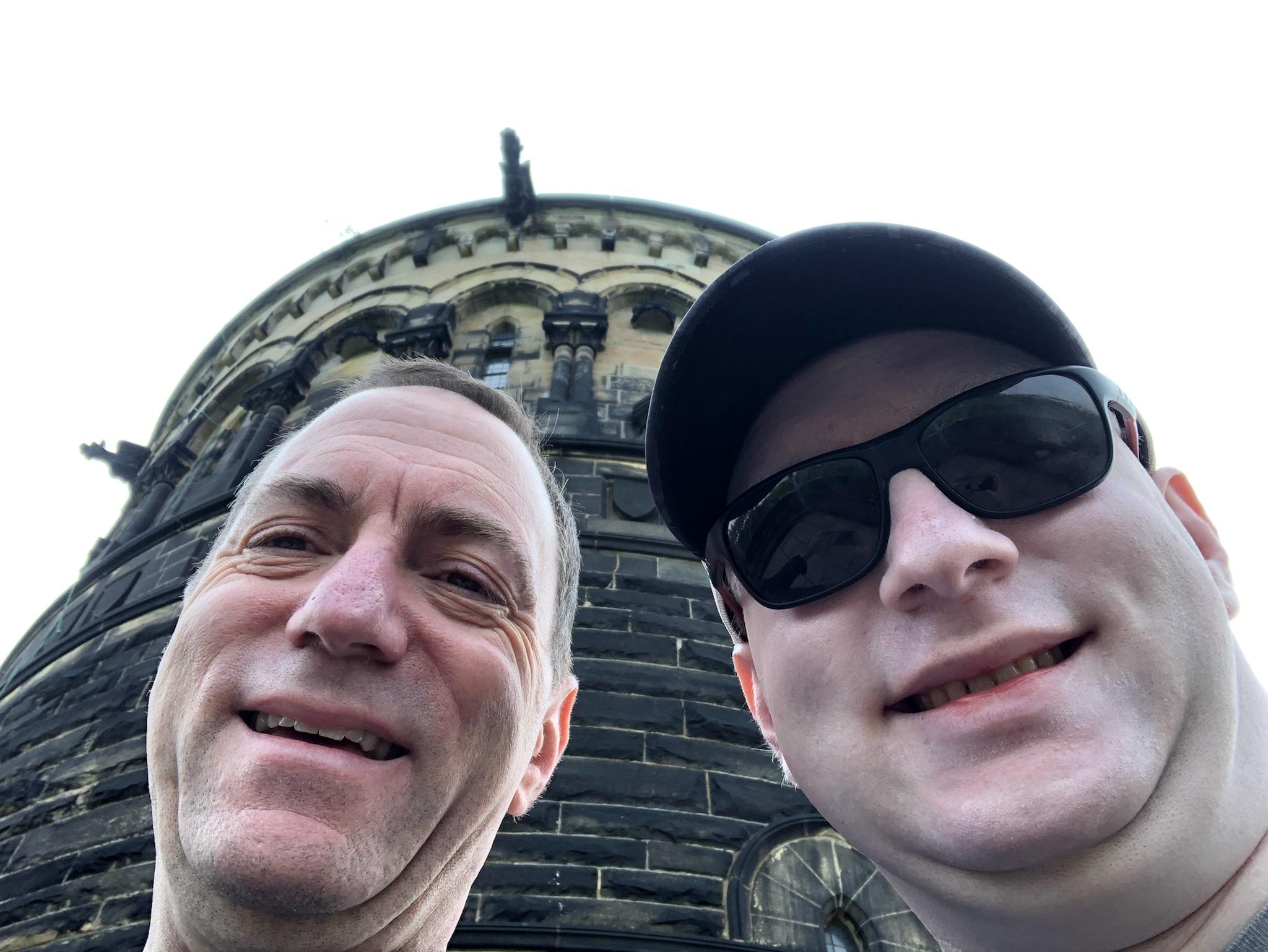
My dad and I on the balcony of the Garfield Memorial.

So this past week I was in Cleveland visiting family, including my dad, and getting to see a bit more of Cleveland than I ever have before (when you have a car, planning your own leisure activities during your vacation is sooo much easier). Among other things, I got to visit the Rock and Roll Hall of Fame, get the best shave I’ve ever had, and visit a huge indoor marketplace. But the one thing I wanted to talk about in this post was something my dad did with me Friday morning: we visited Lake View Cemetery.

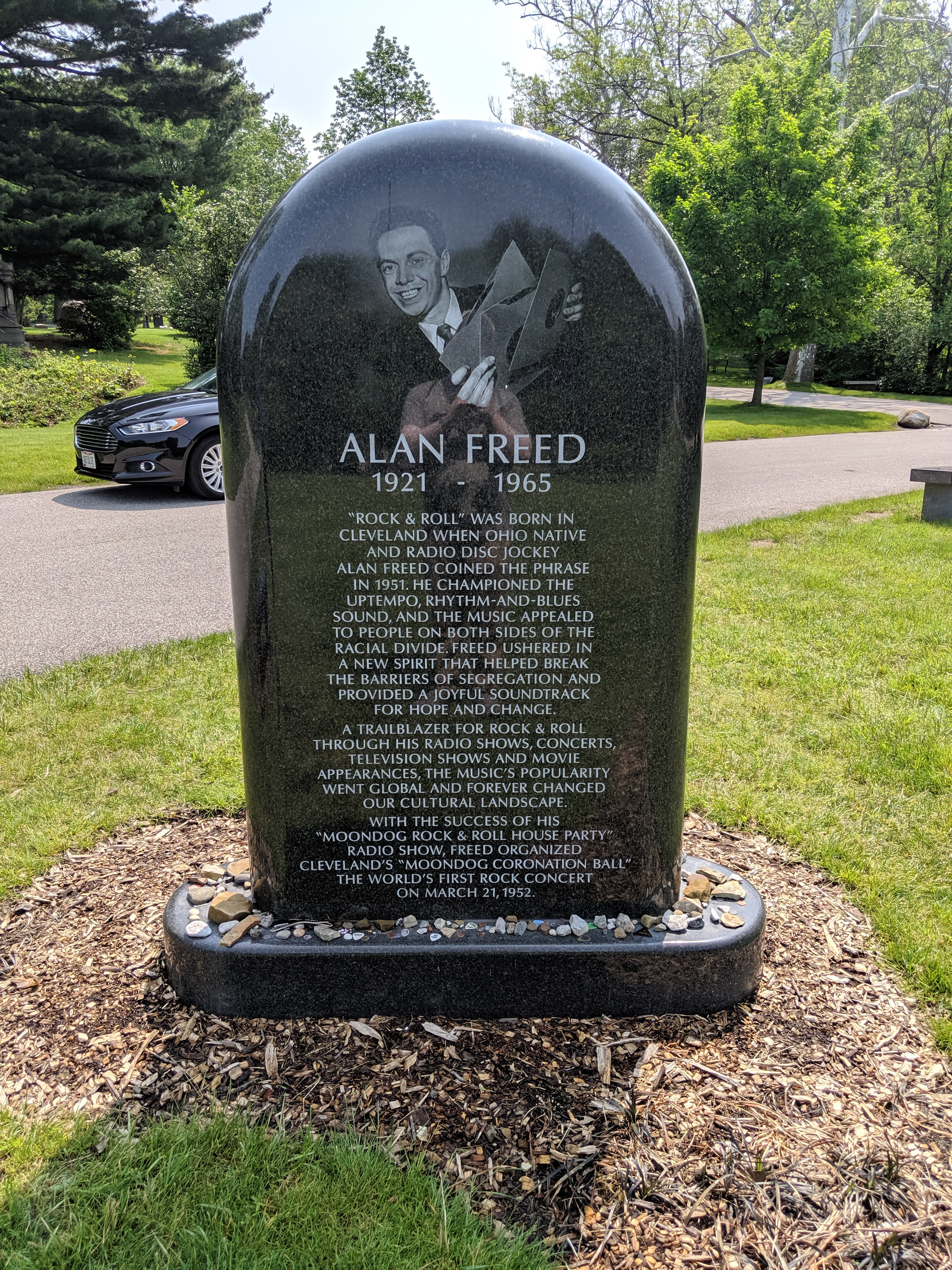
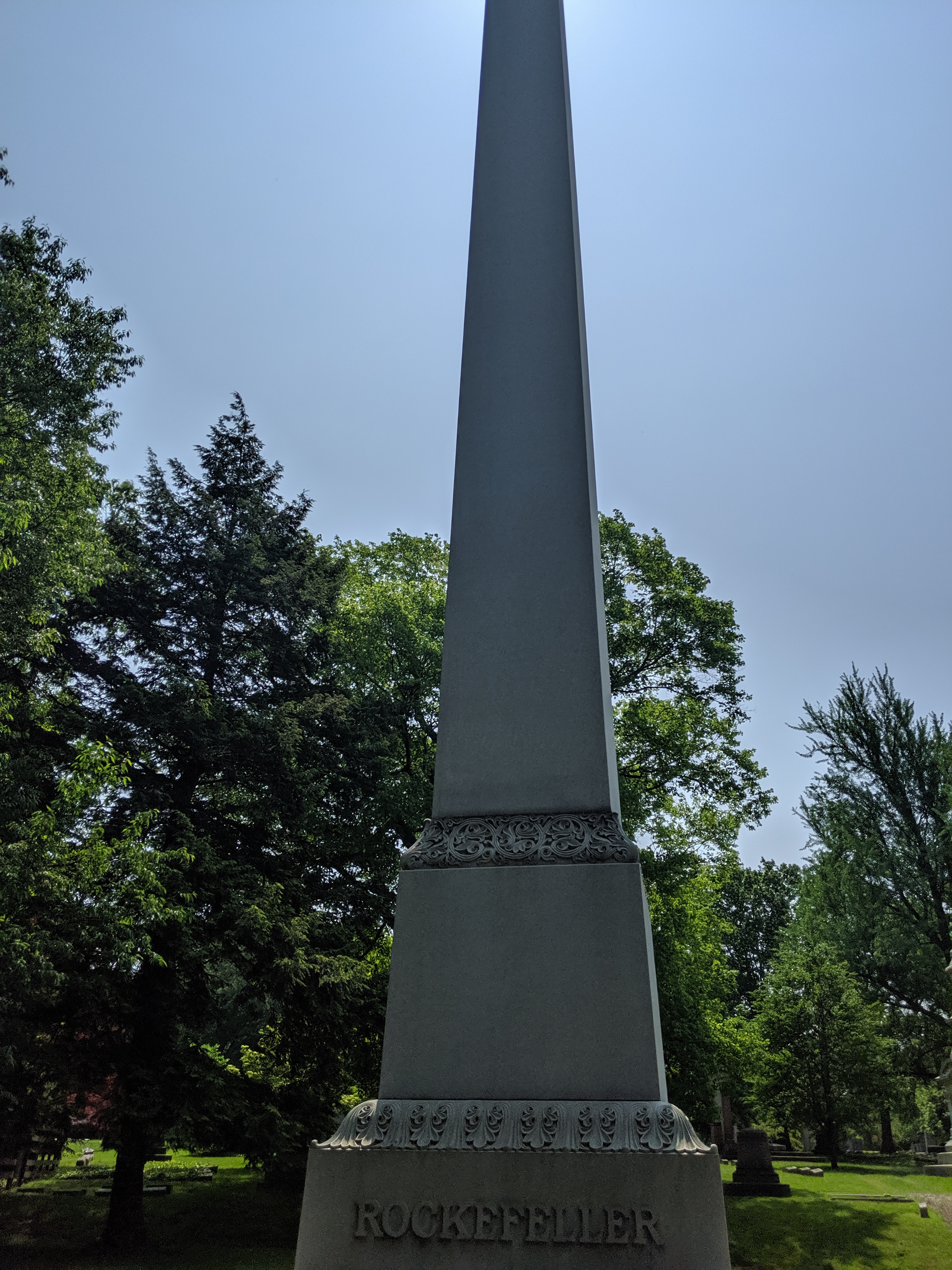
Now if you don’t know, Lake View Cemetery is a large, ornate cemetery modeled after the great cemeteries of Victorian England and France. It’s known as “Cleveland’s Outdoor Museum,” and is home to some very prominent individuals, including Eliot Ness, Alan Freed (who coined the term “rock and roll”), John D. Rockefeller, and President James Garfield, who has the most ornate mausoleum not just of any resident there, but of any American president. Amazing considering he only served for about 200 days.

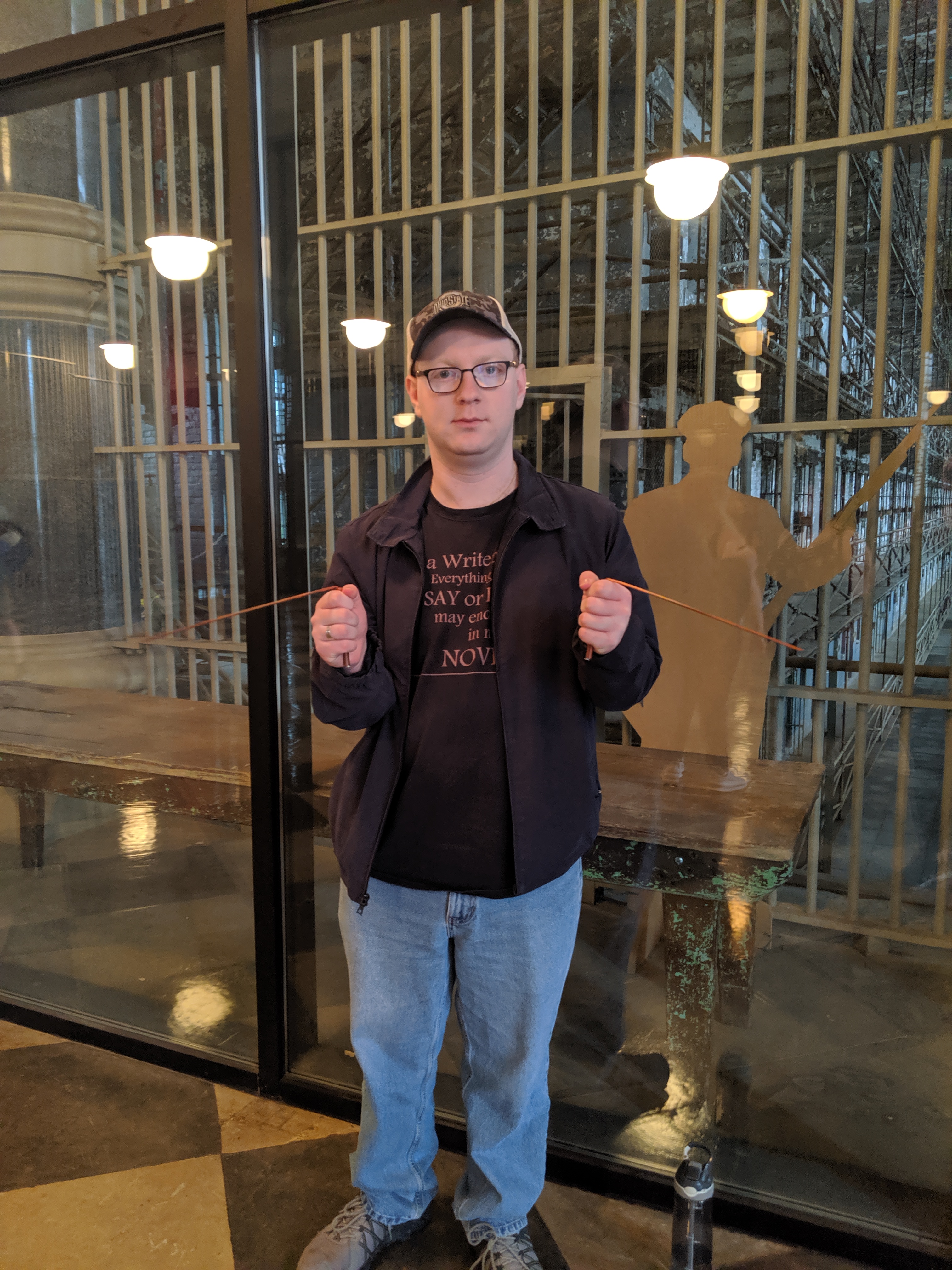
Me being me, I’d been looking forward to seeing this place since I first heard about it. And of course, me being me, I brought my reliable dowsing rods with me, because they are so good at striking up conversations with the dead.

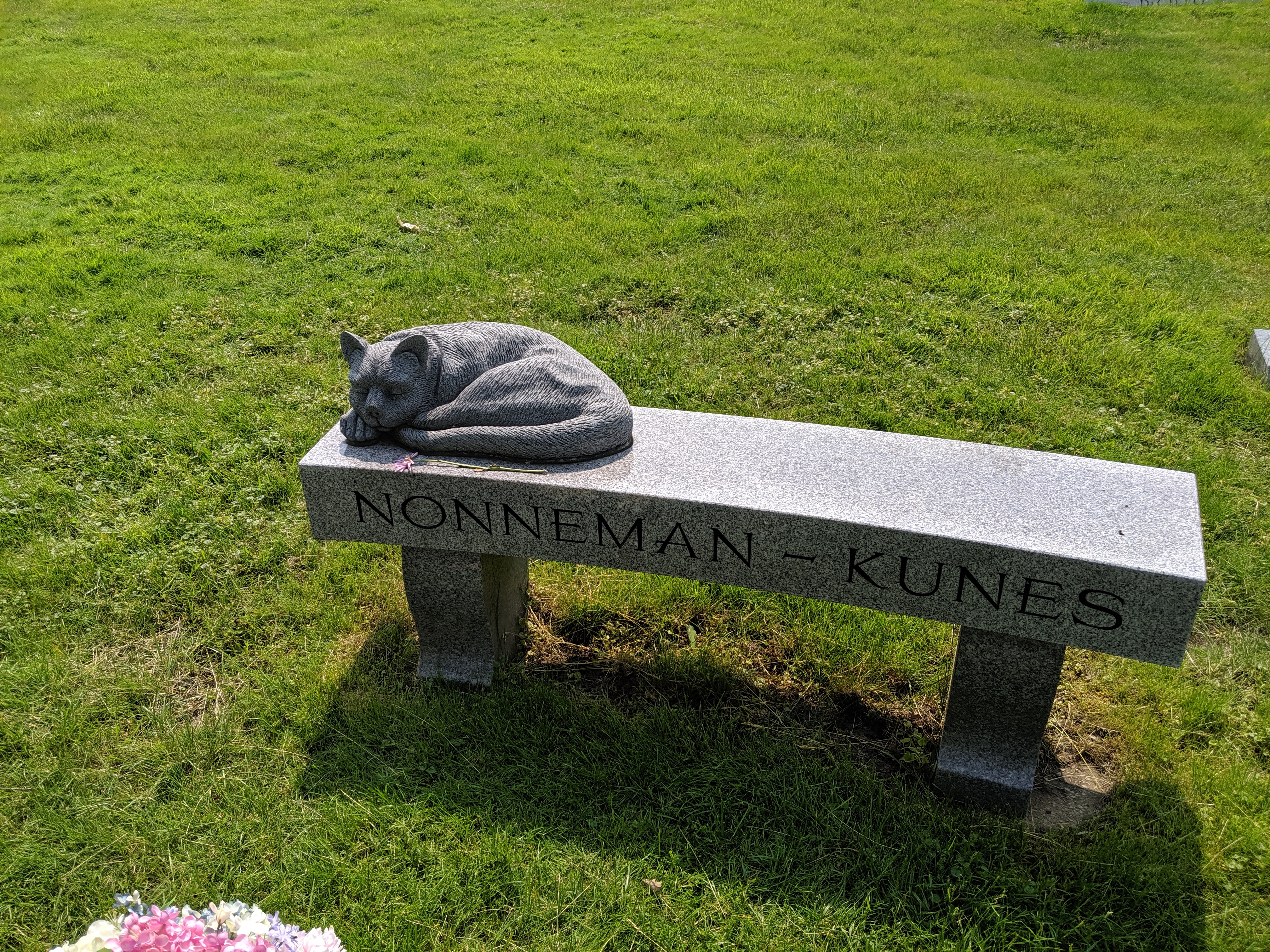
Our first stop was the Garfield Memorial, but even before we reached that place, I could tell this was a different sort of cemetery than any I’ve visited in the past. For one, it was so pretty. Cemeteries used to take the place of public parks in places that didn’t or couldn’t have public parks for whatever reason, and as I said, this cemetery was based on the kinds popular from a hundred and fifty years ago. So you had wide, sloping hills and fields of green, a lake with benches and geese and swans in and around it, and majestic lanes to walk upon (or walk your dog, as I saw one woman doing with her husky). Also, there were so many different kinds of headstones and grave markers! Look at some of the photos below.

I don’t ktow these people, but I love their tastes. Good kitty!

Alan Freed’s gravestone, front side.

Alan Freed’s gravestone, back side.

The Rockefeller Obelisk, or most of it. It’s a big monument.

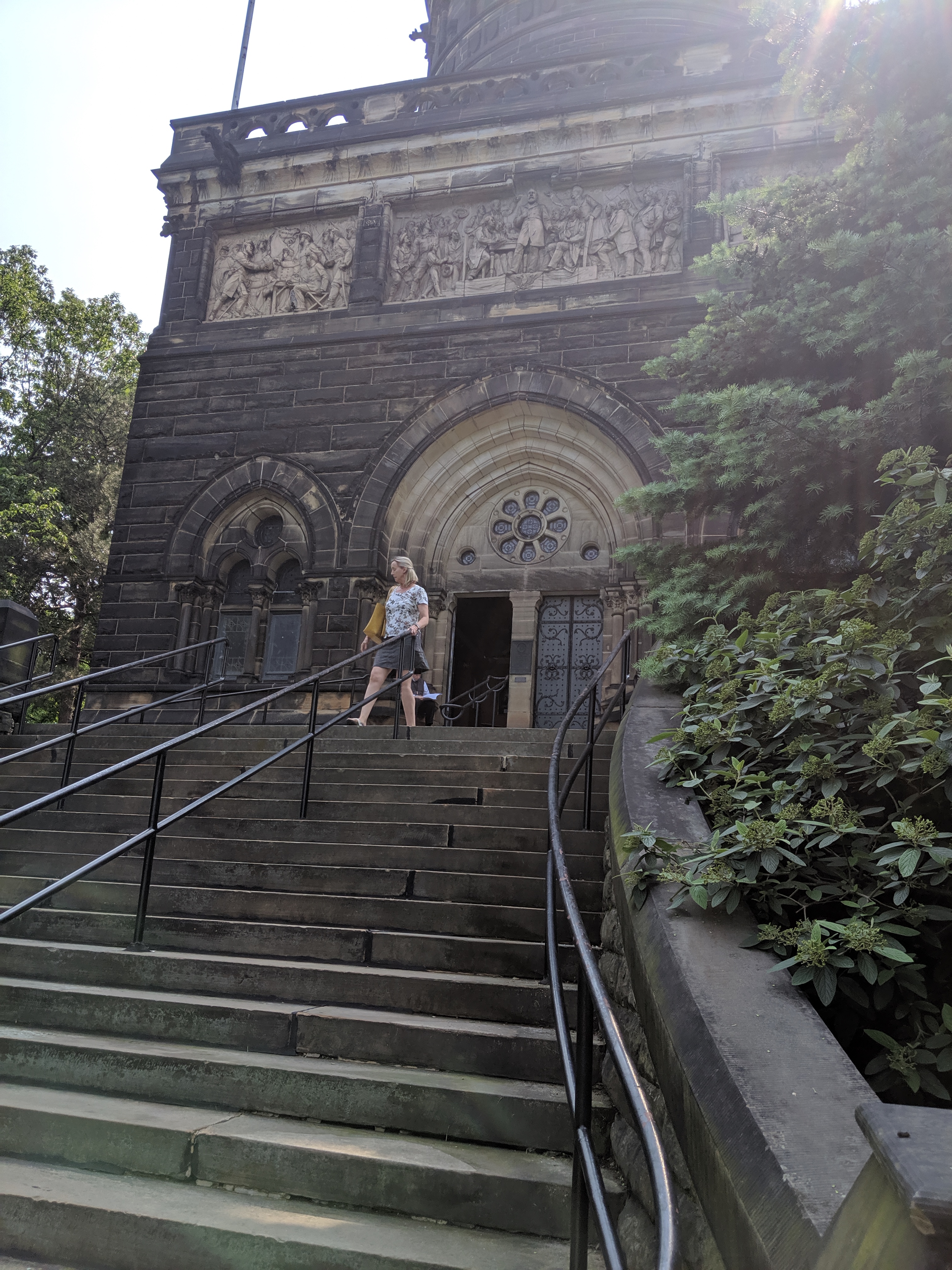
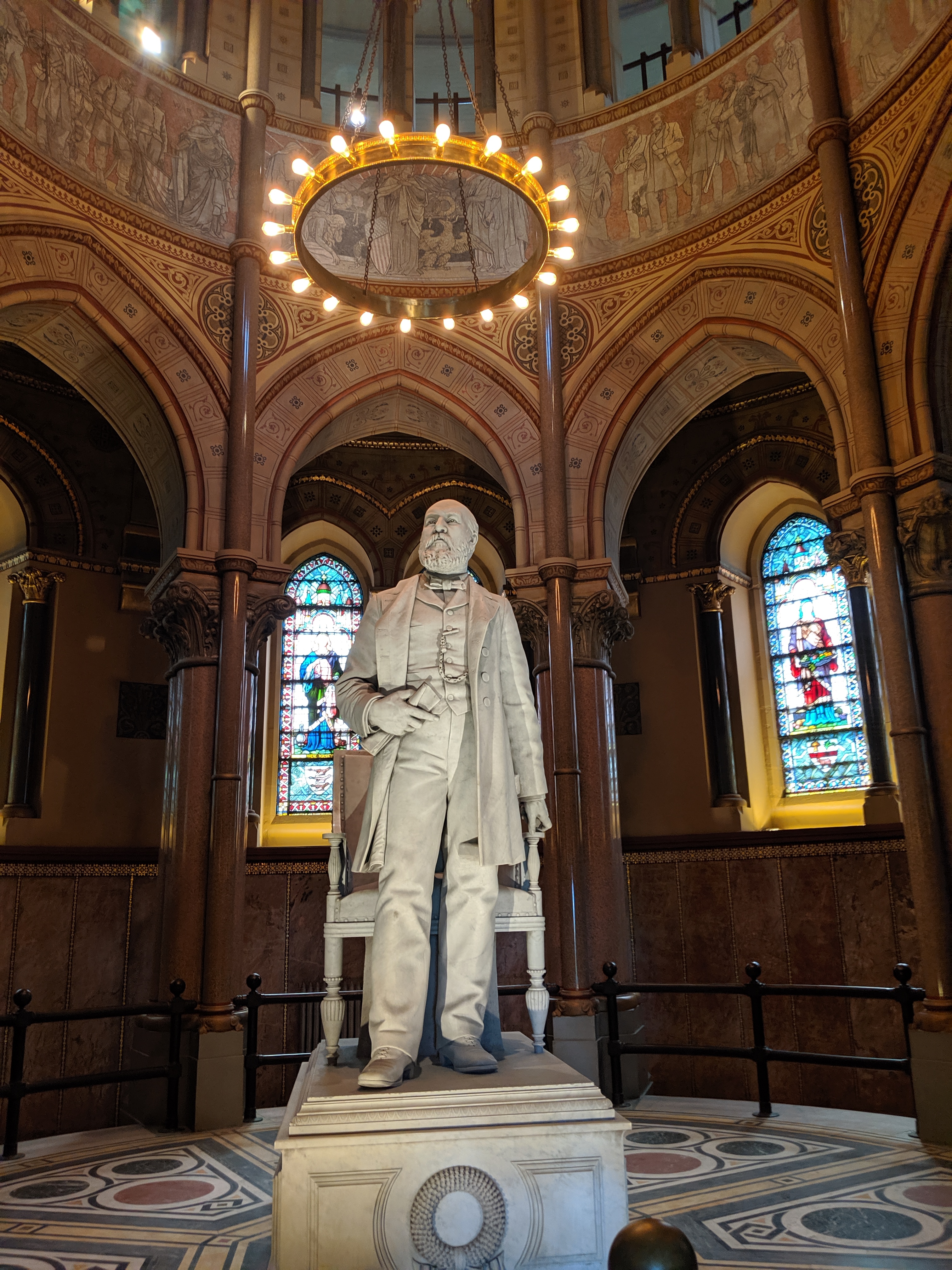
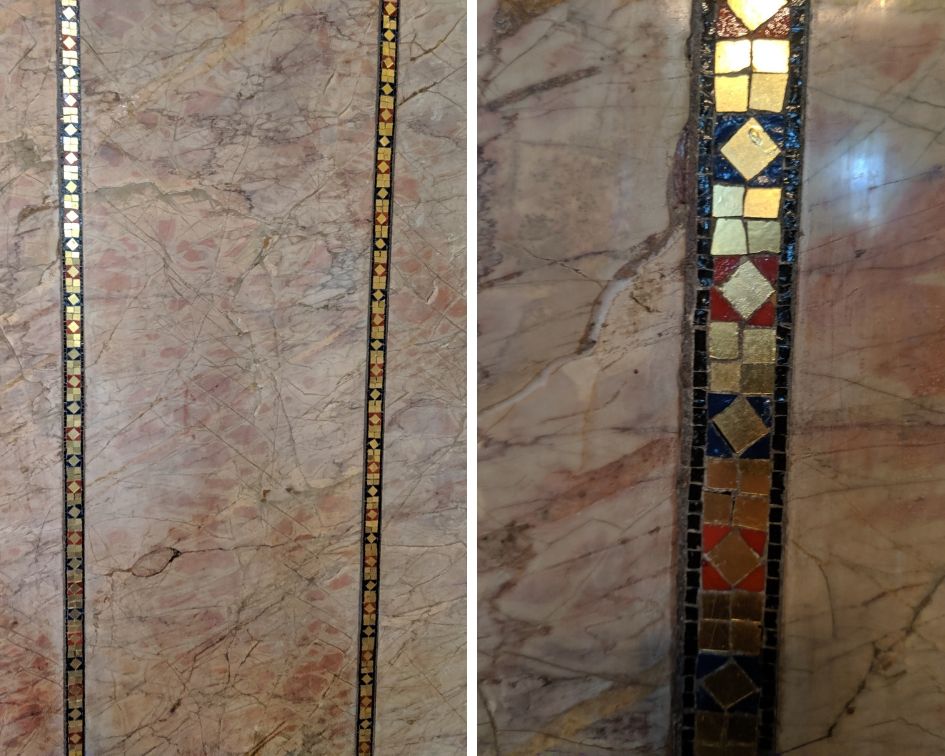
As I said, our first stop was to the Garfield Memorial, this huge, ornate structure that was even more amazing once you got inside. A docent there told us how money was raised for the memorial after the president’s death and some of the features of the construction and artwork on display. For example, the glass in the walls were all inserted by hand, and the murals on the wall include goddesses representing the thirteen original colonies, plus Ohio and War and Peace, and the leaves set into the floor are supposed to guide you around the room, showing Garfield’s humble beginnings in Ohio and how he came up to become the President, a real American success story.

The front exterior of the Garfield Memorial.


The glass designs on the wall, from afar and up close. Imagine the work that went into all that!

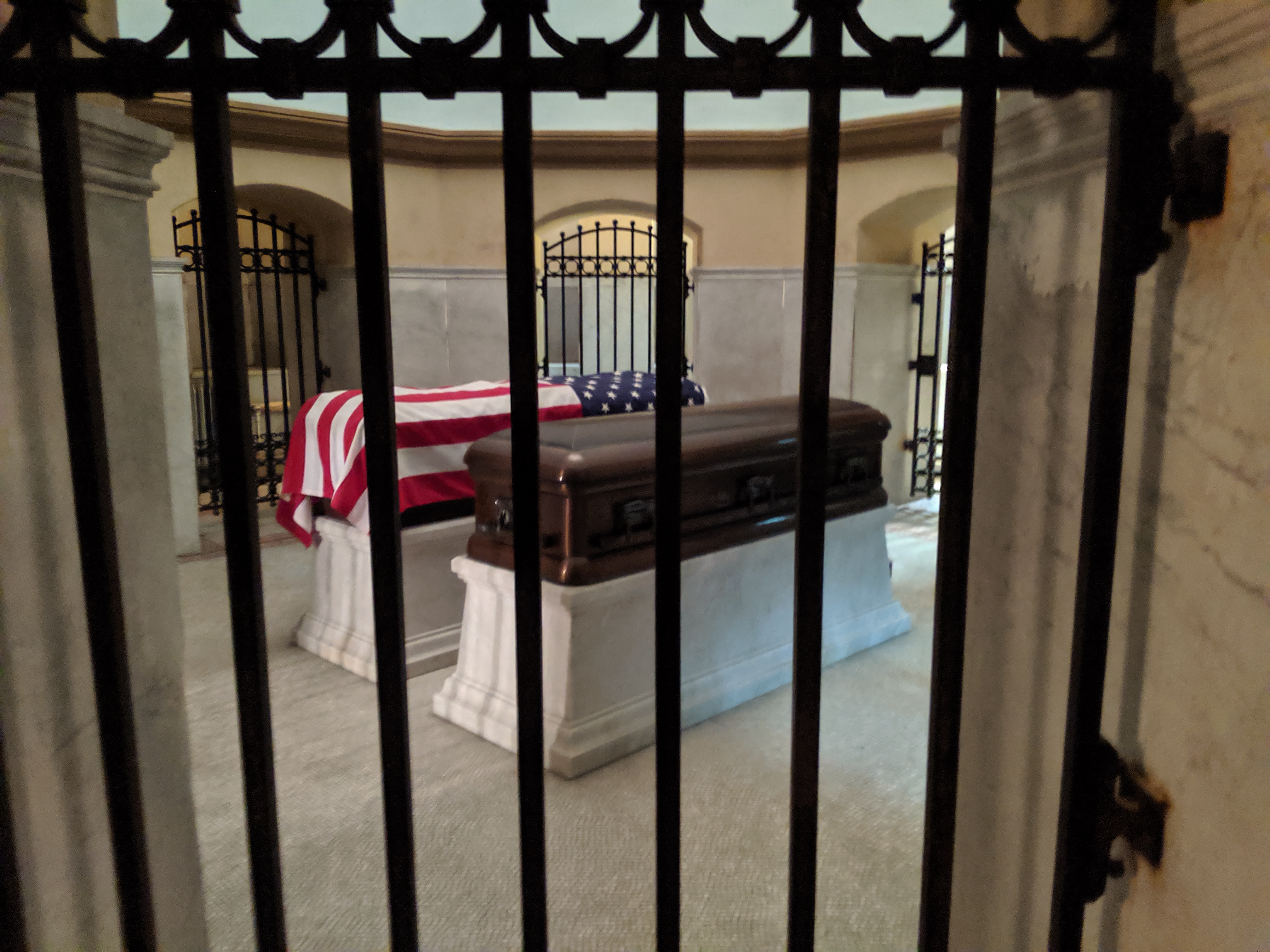
Later we went downstairs to the crypt, where I got out my dowsing rods. Unfortunately, my dad forgot to hit record on my phone, so we didn’t have a recording of that conversation, but I did get into contact with James Garfield’s ghost. Apparently, while his family is buried with him, none of their spirits are with him, and he’s pretty lonely. I felt bad for him, and considering how many other spirits are in the cemetery, I had to wonder why he didn’t have many people on either side of the veil to speak to. The docent later told us that after his assassination, a friend of Garfield did engage a medium to speak to his spirit, and other psychics have been by the grave.

The Garfield crypt. It was a lot mores shadowy when I was there.

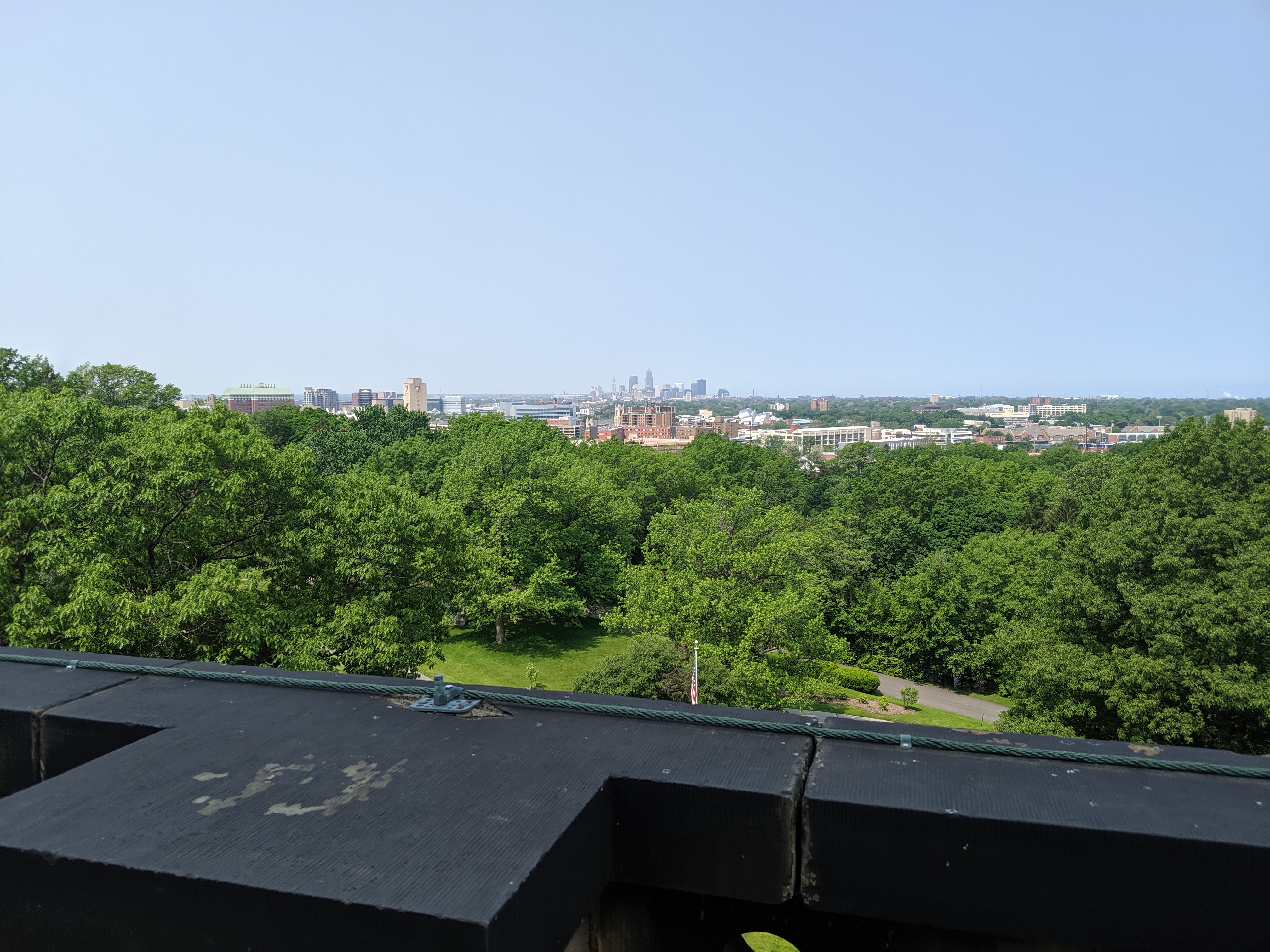
The balcony from the Garfield Memorial. You can just see Lake Erie in this photo.

After a quick trip up to the balcony, where we had a view of Lake Erie (hence the name “Lake View”), we checked out some of the other graves around the cemetery. One of those graves was John Rockefeller, and that was a conversation we did get on video. Check it out below.

Now, that was amazing. How many people can say they’ve had a conversation with John D. Rockefeller? And apparently death is treating him well. Not surprising, when you consider he’s got a scenic place to live in death and lots of people to talk to. And he may go visit Garfield, for all we know.

We left soon after that. We tried to visit the Wade Chapel, this beautiful structure with this Tiffany glass decoration, but there was a funeral going on there, and we didn’t want to disturb the grieving family, who seemed like they were going to stick around a while. But in all honesty, I really enjoyed myself. This trip played to all my interests, and I got to do it with my dad, who I don’t see often anymore and whom I enjoy doing most things with.

And Lake View Cemetery is just a beautiful place to go. If you haven’t gone and have the chance, I highly recommend you take a trip there. I’ll definitely try to go again the next time I’m in Cleveland and have a few more conversations while I’m there.

Have you ever been to Lake View Cemetery? Did you have any encounters there? What was it like?

And in the meantime, this is a reminder that anyone interested in being an advanced reader for my upcoming fantasy-horror novel “Rose” has till June 7th–this Friday–to sign up. The novel follows a young woman who turns into a plant creature (and that’s just the start of her problems). If you’re interested, please send an email to ramiungar@ramiungarthewriter.com. All I ask is you read the book and consider posting a review after the release. Thanks, and I look forward to hearing from you.

That’s all for now, my Followers of Fear. I hope to have a few more posts out this week, including a review and some more of my recent experiences. Until next time, pleasant nightmares!

I know that the majority of people who read this post will NOT be in central Ohio (and that is a damn shame, in my opinion), but I have to post it anyway. The Ohio Chapter of the Horror Writers Association, which I am a proud member of, will be having a reading at Kafe Kerouac, one of the coolest places in the University District in Columbus, this Saturday night at 6:30 PM. There will be scary stories to tell, chances to meet some great authors, new reads and friends to discover and meet, and a few drinks to have while you’re at it.

Did I mention they serve alcohol at this place? Well, they do. It’s not a reason to go in and of itself, but it’s icing on the proverbial cake.

Anyway, by this point Rose will likely be edited, so this could be the very first reading for the final version of the novel. If you’re able to, I highly encourage you to make it out and hear it. And if you can’t, I’ll try to get it filmed for YouTube. After all, I want as many people as possible to check out my novel as possible, and I’ll do whatever it takes to make that happen. Hope to see you there!

And in the meantime, Friday, June 7th is the last day to sign up to be an advanced reader for Rose, the story of a young woman who turns into a plant creature (and that’s just the start of her problems). If you or someone you know would like to sign up, send me an email at ramiungar@ramiungartherwiter.com. All I ask is you read the book and consider posting a review after the novel is released. Thanks, and I look forward to hearing from you.

That’s all for now, my Followers of Fear. I’ve got a ton of posts to catch up on, so I’ll hopefully have those up at some point soon (though between editing and everything else, who knows when I’ll have the time?). Until then, pleasant nightmares!

Are you annoyed with me mentioning Rose yet? You’re not? Well, that’s a first. They’ve already told me to curtail talking about it at work. I guess it’s a good thing I’m on vacation, then. Now I can crow about it from the rooftops!

So if you have no idea what I’m talking about for whatever reason, my fantasy-horror novel Rose is set to be published three weeks from today, on June 21st, 2019, by Castrum Press. Here’s the description I’ve been using lately (subject to change depending on feedback from my publisher):

When Rose Taggert wakes up in a greenhouse, the past two years missing from her memory, she has no idea what is in store for her. Her body changes, transfigured into a new, plant-like form by Paris Kuyper, a student and her self-proclaimed lover who used an ancient family grimoire to save Rose’s life. While Rose is at first willing to trust Paris and work with him to recover her memories and the supposed love they shared, it soon becomes clear her lover is not all he seems. In a short time, she decides to put love and memories aside in favor of survival.

But a rose may be defenseless when a storm surrounds it. And Rose may only be able to stand for so long against the forces swirling around her.

I love that word, “grimoire.” There’s a power in it. I should use it more often, but it’s so hard to insert into daily conversation!

Anywho, things should move pretty quickly from here. Starting Sunday or Monday, I’ll be neck-deep in the final edits for the novel. The final cover art and font will also likely be finalized pretty soon, and links on Amazon and other sites will also go up for anyone who wants to preorder a copy. And of course, this marketing machine I’ve set up will be working. If I’m lucky, word will spread far and wide enough to get enough people interested in Rose.

And I’d be very happy if people did read and enjoy the book. I’ve been working on this thing since it was a college thesis, and in the nearly five years since I first started writing the book, it’s gone through so many changes and revisions. To see all that hard work pay off would be a dream come true.

And in the meantime, if you’d be interested in getting an advanced electronic copy of Rose, then we’ll be taking advanced readers up until June 7th. Just send me an email at ramiungar@ramiungarthewriter.com, and I’ll add your name to the list. All I ask in return is that you read the book and consider posting a review after the release date. Thanks, and I look forward to hearing from you.

That’s all for now, my Followers of Fear. Hopefully my next post on the book involves cover art. Until next time, pleasant nightmares!

Erin McGraw, author of Joy

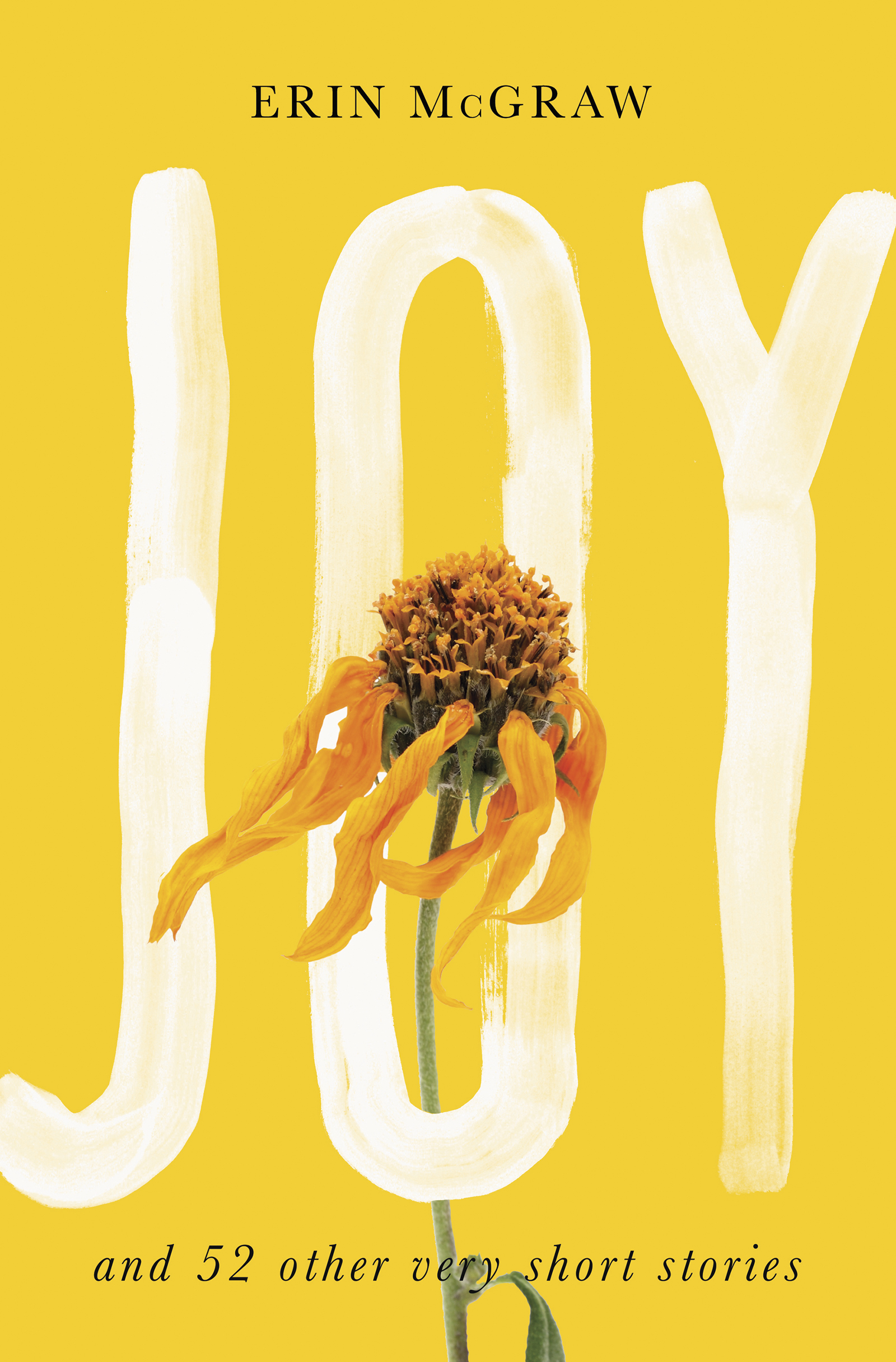
I’ve had the good fortune to learn from a variety of different authors. And sometimes they’ve had the bad fortune–I mean, they’ve been kind enough to teach me in person instead of through the medium of a book. Recently, I had the good fortune to go and listen to one of my professors, Dr. Erin McGraw, do a reading of her new book Joy (which is also my next read, by the way) at the bookstore near me. We got to talking afterwards, and I asked if she wouldn’t mind letting me interview her.

This is the resulting interview. Ladies, gentlemen, and non-binary people of manners, let me introduce Erin McGraw!

Rami Ungar: Welcome to the show, Erin. Please tell us something about yourself and your published works.

Erin McGraw: I’ve written seven books of fiction, three novels and four story collections.  Whenever I’m writing stories, I’m convinced that novels are easier.  When I’m bogged down in a novel, I long to be writing stories.

RU: Your latest book is Joy, a collection of 53 short stories. Please tell us how the project came about and what sort of stories are inside the collection.

EM: Joy happened largely by accident.  I had just retired and finished two novels back to back, and I was tired.  I thought I was writing tiny little stories—3-4 pages—just to keep in practice until I could figure out what my next book was going to be.  It took embarrassingly long to realize that these tiny little stories were the next book.

The stories are dramatic monologues, meaning that the main character steps out of their life to directly address the reader, explaining why they’re doing what they’re doing.  Since these are people acting as their own defense attorneys, they often lie.  That’s what makes things interesting.

RU: Obviously, there are a number of different voices within Joy. Did you do any sort of research for any of the voices you wrote?

EM: I researched almost all of them to some degree.  The ones that come from actual people, like Ava Gardner or Patsy Cline’s dresser, required that I read books to get the facts and background right, but even a story from the point of view of a nameless songwriter wannabe required that I look up some of the facts of the songwriting business, to make sure I got my guy right.  It only takes a paragraph or so before I start feeling responsibility toward my characters, and I want to treat them with respect.

RU: Were there any voices you tried to write but couldn’t? What were the reasons?

EM: I tried for a year and a half to write a story about a man who searched out his spirit animal on the internet.  People do this all the time, I reasoned; it should be easy.  And funny.  But the story stubbornly refused to get funny or easy, and eventually I parked it in my ever-growing “Undead” file, where I put things that I can’t get right but still seem like good ideas.  Maybe I’ll get this one right someday.

It’s funny, right?  Going to the internet to find your spirit animal?

RU: I think so. I mean, it’s trusting an algorithm created by interns and programmers to tell you something profound about yourself. Says something about the people who use it, I’m sure.
Anyway, you also taught for a number of years at Ohio State University. Were any of the stories in Joy based on your teaching experiences?

EM: Not any teaching experiences, no, but a lot of the stories exist, at least in my mind, in central Ohio.  I lived in Columbus for 15 years, and 10 years before that in Cincinnati, so I spent a lot of time thinking about Ohio and pondering its aggrieved status as a fly-over state.  Recent politics have changed that some, which I think is a good thing.

Joy by Erin McGraw

RU: What’s next for you? Are you working on any projects now?

EM: I’ve got a few more very short stories; I think they’re the leftover energy from finishing Joy.  A new project has floated to the front of my mind, but I’m superstitious about talking about things too early.  If it happens, it will be another book with a lot of voices.  I like to hear people talk.  It gives me a break from my own company.

RU: What are you reading these days?

EU: I’ve been on a tear for two years reading about the socio-economic divide in the U.S., and I’m still reading those.  Also books about the development of a recognizable U.S. cuisine, a subject of ongoing interest to me.  Also a superb book about climbing vines.  Don’t laugh.  It’s good.

RU: What is advice you would give to other writers, regardless of background or experience?

EM: The advice I was given by my teacher, John L’Heureux, regarding character:  Complicate the motive.  Simplify the action.

RU: I’ll have to meditate on that one a bit. Final question: if you were stuck on a desert island for a little while and could only take three books with you, which would you take?

Since they would have to be books I could bear to read over and over, the first would be Eliot’s Four Quartets.  Then King Lear, which I’ve never known well enough.  Then the collected Emily Dickinson.  She wrote enough to hold me for quite a while, in case the rescue ship gets held up.

RU: Ah, King Lear. That was an interesting read. Anyway, thanks for joining us, Erin. I hope you’ll join us again someday soon.

If you would like to check out and maybe get signed copies of Joy, you can click on this link. I’ll be checking it out myself very soon. And if you would like to know more about Erin McGraw and her work, check out her website here.

If you would like to see some of the other interviews I’ve been lucky enough to do, click on my Interviews page to check those authors out. And if you yourself are an author with a book you’d like to promote, send me an email at ramiungar@ramiungarthewriter.com

That’s all for now, my Followers of Fear. Until next time, pleasant nightmares!
What if the Superman origin story had a dark, horror-movie style twist? That’s the conceit of Brightburn, a movie produced by the director of the Guardians of the Galaxy films and the upcoming Suicide Squad film, written by his brothers Mark and Brian, and directed by David Yarovesky, who directed the pretty-good horror film The Hive. And from the trailers, it looked like it could be really good, or just plain bad. Either way, I put my butt in the seat and waited to see how it would go.

Brightburn follows the Breyers family, consisting of farmer Kyle, wife and artist Tori, and adopted son Brandon. Around his twelfth birthday, Brandon starts exhibiting supernatural powers and psychopathic behaviors. When he starts to hurt classmates and people around town start dying or going missing, Tori and Kyle reveal to their son his extraterrestrial origins, and he reveals to them his dark purpose in coming to Earth.

*sigh* You know, I can forgive them for copying Superman’s basic power-set in this film. I can also forgive them for not mentioning him at all (probably did that out of legal reasons). But I can’t forgive them for making a bad film that puts all its best bits in the trailers!

I kid you not, everything that was supposed to make this film exciting and scary was revealed in the trailer. The woman who got glass in her eye, the guy in the car seeing Brandon flying on the road, the girl’s hand getting broken, the plane crash. Those should’ve been surprises, but we all saw them in the trailers, and that takes out all of the suspense and horror of the actual movie. Except for a few moments, I watched the film thinking to myself, “That’s predictable. That’s predictable. Oh, how could I have not seen that coming? Oh wait, I did! In the previews!”

What do you have left when you take all those elements out? Just your below-average evil child horror film, like Prodigy from earlier this year (which I didn’t review because it was so much like every other evil child film out there). Parents get a kid, usually not their own. Kid grows up mostly fine, but then starts exhibiting scary behavior. Kid turns out to be evil, either because they were born seriously messed up or because of some supernatural reason, one parent ends up dead, the other either successfully kills the kid or is killed while trying because a bystander was nearby and didn’t know the truth.

Seen it. Done it. Took it to dinner. Had a good time afterwards. Ordered them an Uber. Point is, done to death.

There were only two things I liked about Brightburn. One was the mask the kid Brandon wore, which looks like a crocheted cross between an insect head and Cthulhu’s face. The other is Elizabeth Banks as mother Tori. You really see her love for this strange boy, and how much she tries to hold onto that little boy despite all he’s done.

But other than that, Brightburn is sadly unoriginal despite marketing itself as original. And I’m convinced the filmmakers knew that, and that’s why they put all the highlights in the trailers, to get butts in seats. On a scale of 1 to 5, I’m giving this one a 1.5. Avoid, unless you like wasting two hours of your time. I hope to God I never write anything as unoriginal as this.

Speaking of which, I’m still looking for advanced readers for my upcoming fantasy-horror novel from Castrum Press, Rose. The story follows a young woman who turns into a plant creature (and that’s just the start of her problems). Anyone who’s interested should send me an email at ramiungar@ramiungarthewriter.com before June 7th. All I ask is that you read the book and then consider posting a review after release. Thanks, and I look forward to hearing from you.

Until next time, my Followers of Fear, pleasant nightmares!

So today after work, I stopped by the grocery store to pick up a few things. As I was leaving, I spotted one of my teachers from elementary school and her husband getting out of their car to do a little shopping of their own. We recognized each other right away, and while I’ve grown from the scrawny kid I was, she hasn’t seemed to age a day in the fifteen years since I last saw her, and neither has her husband. Normally I would attribute that to witchcraft, but given that they’re Orthodox Jews, I think it’s far more likely they’re using the not at all diabolical but still very impressive power of Kabbalah.

Why do I tell you this story when the subject of this post is Rose? Well, it feels like the basis of a story, and honestly, I felt like sharing it. Do I need better reasons?

But back on subject: Rose will be published in a month from today, on Friday, June 21st. And since my last post on Saturday, I’ve had some updates. My publisher Castrum Press and I have been going back and forth a lot, discussing the editing process and the things we still need to do to get the book out on time.

First, there’s the final edits. According to Castrum, I should be getting the first round of final edits probably near the end of next week. From there, it’ll be a race against time to get the edits done before too long so we can reach the target date for the release. Luckily, I’ll be on vacation during that time, and all my traveling during that vacation time will be wrapping up around that time, so it works out for me. I’ll still have to put my nose to the grindstone so I can get those edits done, but I think I’ll be able to make the deadline. I might not be able to hang out with family and friends during that time, but I’ll make it.

It beats disappointing potential readers and having to order new business cards with amended release dates, anyway (the costs of those pile up if you have to change them frequently, you know!).

In the meantime, I’ve been working on some other stuff that doesn’t get considered until we’re this far along in the process. Last night, I wrote a dedication for the book, an acknowledgements section, and a preliminary blurb for the back cover. That last part may get changed around a bit between now and release day, but I think what I wrote last night gives a good idea of what the novel is about while withholding enough information to get people to actually read.

Here’s what I sent my publisher:

When Rose Taggert wakes up in a greenhouse, the past two years missing from her memory, she has no idea what is in store for her. Her body changes, transfigured into a new, plant-like form by Paris Kuyper, a student and her self-proclaimed lover who used an ancient family grimoire to save Rose’s life. While Rose is at first willing to trust Paris and work with him to recover her memories and the supposed love they shared, it soon becomes clear her lover is not all he seems. In a short time, she decides to put love and memories aside in favor of survival.

But a rose may be defenseless when a storm surrounds it. And Rose may only be able to stand for so long against the forces swirling around her.

Like I said, this may change a lot over the next month, but I think it’s not a bad start.

As for other updates, I’ll be keeping those under wraps for a while. But I think I’ve got enough brewing in my proverbial cauldron that at the very least, I can guarantee that A LOT of people will hear about Rose and may consider giving it a read.

Speaking of which, as I said in my last post, I’m still looking for advanced readers for Rose. If you’d like to receive an early, electronic copy of the novel from my publisher prior to release, all you have to do is send an email to ramiungar@ramiungarthewriter.com. All I ask in return is that you read the book and consider posting a review after it’s released. Thanks, and I look forward to hearing from you.

That’s all for now, my Followers of Fear. I hope to have more updates soon, maybe even a shot of the cover. Until next time, pleasant nightmares!

I was going to wait until I got an update from my publisher* or until Tuesday, one month from when Rose is released, but I got impatient.

So as you probably know by now, my upcoming fantasy-horror novel Rose is on target to be published June 21st, 2019 by Castrum Press. The story follows a young woman who turns into a plant creature (and that’s just the start of her problems). Yes, that trippy subject is what the novel’s about. Yes, I sold that to a publisher. And yes, it is coming out in a little over a month.

Obviously, I’m over the moon with excitement. I’m also dealing with a lot of nervousness and a touch of anxiety, but I’m working a multi-pronged approached to make sure the novel is a success. One of those prongs is through advanced readers, people who receive electronic copies prior to the book’s official release with the hopes they’ll read it, like it, and maybe help spread the word by telling friends or writing reviews online (encouraged, but not required).

And you know what? I’m still looking for more advanced readers.

I’ve managed to build up a pretty big list of advanced readers, but I could always use a few more. So from now until June 7th, if you or someone you know would like to get on the advanced reader list, all you have to do is send an email to ramiungar@ramiungarthewriter.com. Once I have that, I’ll add your name to the list and then we just have to wait. Once I know the advanced copies are being sent out, I’ll notify you via email to give you a heads-up.

Thanks, and I look forward to hearing from you all.

That’s all for now, my Followers of Fear. I should have more updates on Rose as we get closer and closer to the release date. You may even get a little annoyed with me talking about the book so much (but can you blame me?). But of course, it’s all in the name of making sure plenty of people get to read the book, so why not?

Until next time (which, for all I know, might be anytime between today and Tuesday), happy reading and pleasant nightmares!

*Speaking of which, Castrum Press has just released a new anthology, Alien Days, featuring a variety of authors writing about what our first contact with extraterrestrials might be like. A terrifying subject, even if it’s not horror. Please make sure to check it out on Amazon. I’ll be downloading a copy very soon, and I can’t wait.

I’ve been meaning to write this post for over a week. But as you know from my last post, this past week has been predictably crazy for me.

I heard about Hallie Rubenhold’s The Five and was immediately interested. The book retraces the lives of the five victims of Jack the Ripper: Polly Nichols, Annie Chapman, Elisabeth Stride, Catherine Eddowes, and Mary Jane Kelly and proposes to shed a new light on them. I’m no Ripperologist (someone who studies the Ripper murders), not even an amateur one, but I’ve done a fair amount of reading on the subject and am always interested if someone has discovered something new about the case. And the lives of the five women who made the Ripper famous finally being told? I’m in.

I dove in as soon as I got my copy from the library…and the resulting read blew my mind. You see, for over a hundred and thirty years, the consensus–the one thing that every Ripperologist agrees on–is that the victims were confirmed prostitutes. But is that really the case? Diving into historical records and her understanding of the nineteenth century’s social beliefs around women and barely mentioning the Ripper at all, Ms. Rubenhold provides a convincing case to support that we may have been looking at the “Canonical Five”–and thus the Ripper–all wrong.  In fact, only the final victim, Mary Jane Kelly, was confirmed to make a living through prostitution, and there’s evidence she may have been trafficked at some point.

In fact, Polly Nichols was a wife and mother whose family gained lodging in public housing reserved for families with high moral standing; Annie Chapman was upper-middle class with an upwardly-mobile husband; Elisabeth Stride was a Swedish immigrant from a religious background who ran a coffeehouse with her husband; and Catherine Eddowes was educated for most of her younger life and often made life choices on what would allow her the most freedom. Mary Jane Kelly, we don’t know, as many of the details she gave of her life were contradictory and possibly fabricated, but she could’ve come from a respectable background, as she started out as a high-end courtesan, and they don’t let just anyone into those circles.

How did these women end up as prostitutes in the popular mind?

Well, in the eyes of nineteenth-century society, any woman who wasn’t, by all appearances anyway, a successful wife and mother with the temperance of the saint, a clean and happy household, and only had a sexual side when her husband desired sex, she was a failure as a woman. She was “broken.” Which often was equated as a “fallen woman,” which was often equated with prostitution. Often, women in these positions had to take up with men who were either not their husbands or had common-law marriages, which was also considered a sort of prostitution.

And for a number of these women, circumstances in their lives forced them to leave families and husbands and often take lives on the streets, without husbands or homes, which meant in society’s eyes they were fallen, and therefore likely prostitutes. The newspapers at the time, more concerned with selling than telling the truth, did little or nothing to dissuade that notion, even when friends and acquaintances for the victims came forward and swore in inquests the victims did not resort to prostitution. Thus a belief, and the theory shaped around it, was formed.

This is significant for a number of reasons. From the perspective of history and Ripperology, it totally changes everything we know. Ms. Rubenhold presents a good case that the Canonical Five were actually incapacitated or sleeping and not in any state of mind to fend off an attacker, rather than attacked while soliciting. This changes the entire MO of the Ripper, the field of study around the murders, and over a century’s worth of media on the subject (though some of the latter we can still find entertaining, as long as we remind ourselves how much of it is fiction).

But more importantly, this is a feminist triumph in history. For a hundred and thirty years, The Five have been dismissed and looked over except in the context of their deaths and whoever killed them. Even my copy of The Complete Jack the Ripper doesn’t go into much detail on their lives. But this book and its author, through hard work and looking over every scrap of documentation available out there, reminds us these women were just women, more often at mercy to forces beyond their control and the double-standard Victorian women faced than willful participants in the world’s oldest profession. At least three suffered from alcoholism. One got pregnant out of wedlock and developed syphilis, and was demonized for it. They did everything they could to stay out of the workhouses, which could forever ruin someone who was forced to enter them. They tried to find love and happiness. They tried to get by in an age and place where women on their own had it very hard.

Imagine if AA had been available to the Five and sobriety was understood to be not a choice but hard work. Imagine if, instead of being demonized for leaving their husbands or getting pregnant/diseases out of wedlock, the authorities looked at the men in their lives. Imagine if they were allowed to pursue lives they wanted, rather than what was expected of them, and not shamed for not fulfilling expectations.

This is especially relevant in today’s age. Despite a lot of progress, women still have their sexuality used against them socially and legally. Since I finished reading The Five, I’ve seen several articles and tweets about men getting little or no jail time for rape, simply because there was only one victim and they were unlikely to reoffend. Here in my home state of Ohio, a minor who was raped and impregnated can’t get an abortion because of a new restrictive abortion law. Clearly, on some level, society still feels women should be punished for being anything other than the ideal wife and mother, and it’s their own fault if they’re not.

This is why you should be reading Hallie Rubenhold’s The Five: not only does it present convincing new evidence on a century-old case and force us to reevaluate everything we knew, but it’s a call to remind us just how much has stayed the same since 1888, and what we can do to improve that in the future. And in the future, if I ever write my own Ripper-themed story, I’ll call back to The Five as I write the story, and keep in mind the lives of these women.

So please, check out The Five‘s page on Amazon, and consider reading it. You’ll find it a revelation as much as I did.

I’ve been waiting all day–since yesterday, when Castrum made known to me their intentions–to announce this. Through a long work day, social media posts and devouring a pizza to celebrate/get out of cooking tonight, I’ve been waiting for the moment where I can make this announcement. After fifteen months of edits and quiet planning and not-so-quiet planning, my novel Rose, being released by Castrum Press, has a release date.

Now, if you’re new here and you don’t know what Rose is, first off, hello! Welcome to the Followers of Fear! Second, Rose is a fantasy-horror novel that follows a young woman who starts turning into a plant creature (and that’s just the start of her problems). I wrote the first draft as a thesis project for college. Four years after finishing the first draft, the book is finally getting ready to be released. After so many changes and numerous rewrites, it’s finally coming out.

But Rami, I hear you all thinking, when is it coming out?

Well, Castrum has quoted to me a target date for June 21st, 2019. At any rate, we’re going to try to get the book out right around then, with the advanced copies being sent a couple of weeks prior. So yeah, it’ll be a little over a month and a half till Rose hits the digital and (hopefully) physical bookstores. And between now and then, I’ll be doing marketing work and doing final edits for the manuscript. At some point in the next couple of weeks the cover art will be finalized, and we’ll put everything together in an awesome little package.

Honestly, I’m both excited and nervous, and my anxiety is trying to bite and tell me all the things that could go wrong. I’m keeping it in its place and letting it know those things won’t happen in all likelihood, and just trying to remind myself all the big things ahead to get excited for. A dream I’ve held for almost twenty years is finally coming to fruition. There’s only one thing to do, and that’s to alternate between celebrating and working hard to ensure it goes well.

With that in mind, Castrum says the last date to get on the advanced readers list is June 7th. So if you’d like to get an early electronic copy of Rose before anyone else, send your email now to ramiungar@ramiungarthewriter.com. In exchange, all I ask is you read the book and then consider posting a review after the book comes out. Thanks, and I look forward to hearing from you.

That’s all for now, Followers of Fear. I’m off to start a Rube Goldberg machine of marketing. Thanks again for supporting me through these many years of work. It’s been a crazy ride, but I’m about to reach a huge goal I’ve longed dreamed of. And I don’t think I could’ve gotten this far without you. I hope when Rose comes out, you’ll all consider checking it out.

Until next time, pleasant nightmares!
The other day I watched the movie As Above, So Below (which I highly recommend, by the way. Underrated horror movie). For those of you who haven’t seen it, As Above, So Below is a found footage film that follows an archaeologist and her crew into the bowels of the Paris catacombs to find a mythical treasure. As they make their way down, however, they end up finding a passage that leads straight into Hell. And Hell in this movie isn’t a fiery pit. It’s so much, much more.

As well as terrifying me again and making me remember why I liked this film to begin with, As Above, So Below also made me consider that our portrayal of Hell has changed immensely over the years. If you look throughout the media we create, you’re going to find more than just the traditional fire-and-brimstone images of Hell, but as many as there are writers out there looking for unique twists on old concepts and stories. And that in and of itself is pretty interesting. I mean, how many different versions are there? And why are they showing up so much, especially today?

Well, Hell has always been a concept in human theology. While some early religions–Mesopotamian, Greek, and traditional Judaism–have a general afterlife for all the dead, usually a gloomy place with maybe some nicer perks for those who behaved themselves in life, others had very defined afterlives for sinners and saints. Hinduism and Buddhism have multiple afterlives where various treatments or punishments may be applied to your soul prior to reincarnation. The ancient Egyptians were the earliest to use a lake of fire. The Ainu of Japan, meanwhile, saw Hell as a wet place underground, and the Serer people of Senegal saw Hell as rejection by ancestor spirits, forcing you to become a wandering ghost.

And that’s just a small survey of the various kinds of Hell in religious beliefs.*

The most iconic version, of course, is the underground lake of fire ruled over by Satan from mainstream Christianity, which was adapted from the Egyptian concept and then spread as Christianity took root in the Roman Empire and then was spread by missionaries. But even that has had variations over the years. Some have involved just a cave full of flames, while others have involved individual sections where demons perform different punishments in cauldrons full of boiling water and fire. Some involved a dumb, animalistic Satan, and others portray him as a calculating, powerful evil.

In the Renaissance, we received some of our most famous variations of Hell. Dante Alighieri wrote Inferno, where he travels with the spirit of the poet Virgil through Hell’s nine circles, with each circle containing different punishments for different sins. John Milton featured a Hell featuring a great castle, Pandemonium, created by Satan and the fallen angels to be their seat of power in Hell.

Lucifer’s version of Hell, featuring customized punishments for every person there. It’s a great and adaptable concept.

Further variations have appeared since those landmark works. Jean-Paul Sartre’s famous play, No Exit, describes Hell as other people. Luis Brunel further took this theme along in his movie The Exterminating Angel, where guests at a dinner party hate each other but are unable to leave. Stephen King has defined Hell has endless repetition, and has added that to many of his stories. Some creators have shown Hell as a city or a distorted version of our own world. The Hellraiser movies have shown Hell as a place mixing BDSM with your own sins and life choices. As Above, So Below portrays Hell as a series of tunnels in the Paris catacombs that configures itself, adding elements and figures to fully terrify and punish any who are forced to enter it, going so far to become an alchemical/spiritual puzzle to test the main characters. And increasingly, we see Hell as setting itself up for each individual sinner. The TV show Lucifer utilizes this very effectively, especially in Season 3’s episode “Off the Record,” in which a man is forced to replay the last two years of his life over and over in Hell, because his obsession with the titular character caused him to commit murder.**

But what does all this really mean? Well, at the heart of all these portrayals is the idea of torment. Whether you realize or not you’re in it, Hell is meant to fill you with despair. That may be through pain, psychological torture, or terror. It can vary depending on the needs of the storyteller or the person being tormented, but the point is, it can change for any purpose. And that is why we’re seeing so many variations of Hell in our media.

And I’m sure with the passage of time, we’ll see even more portrayals, matching new ideas and situations we face in our lives, giving us all new reasons to be afraid. I find that kind of exciting. Hell, don’t you?

What are some versions of Hell you’ve come across or created? Why do you think it was so effective or terrible?

*There are also faiths that don’t have any belief or reject beliefs about a punishment-themed afterlife, but I think we’ll skip over those for this article.

**By the way, so excited for Lucifer season 4! Thank you Netflix, for saving one of the best shows on TV right now. I’m working my way through rewatching the show and can’t wait to see what’s been served up. #LuciferSaved