Posts Tagged ‘disability advocacy’

It’s no secret that disability has had a troubled portrayal in our media. There’s inspiration porn in the news, which tries to make able-bodied people feel “inspired” to achieve their goals at the expense of making the disabled seem pitiful and hopeless. People with dwarfism are often equated with fantasy settings or fantastical elements. And, of course, there’s horror. Horror’s history with disability has been, to say the least, fraught.

Look, I love this genre. That’s obvious. But it’s no secret that, when the genre was coalescing, a lot of horror came from stereotypes of minorities, and the disabled were no exception. Most often, disability was used as a shorthand for sinister or evil. The original Phantom of the Opera was a manipulative groomer, and his later portrayals have added plenty of murder. From Psycho to Split, people with DID are often portrayed as dangerous and even magical. And most of the famous slashers have some form of disability! It’s not the focus of the characters, but it’s definitely there.

That being said, it hasn’t always been bad. The 1932 film Freaks was actually pretty progressive for its time, with many of its disabled characters getting humanizing portrayals. American Horror Story‘s fourth season, Freak Show, was heavily inspired and influenced this film. A Quiet Place and its sequels have been very disability-positive.

The problem is, sometimes even the positive portrayals are problematic. I still cringe over the characters of Duddits from Stephen King’s Dreamcatcher, and the autistic kid in 2018’s Predator somehow being an important factor in human (and Predator) evolution felt…well-intentioned but missed the mark. And just earlier this year, I read a recent book by an author I like which included a character with mental disabilities who was kind of psychic/magical, a secondary antagonist with a cleft palate, and a main antagonist with an eyepatch!

That’s why I’m glad that, as both the community and the genre evolves, more disabled writers join it and include disabled characters like themselves in their stories. I’m among those writers. The Shape of Evil‘s three main characters all have various disabilities, and in two short stories I wrote recently, the major characters all have disabilities as well. The stories themselves are still not published, but I’m working to get The Shape of Evil out there, and the other two stories will hopefully find homes soon after I edit them.

And as those stories, as well as other stories by disabled writers, get published, perhaps there will be ripple effects. The fiction we consume can have a noticeable effect on our perception of the world. Perhaps with portrayals that are just not more positive, but also realistic, we can make the world a nicer place for the disabled.

And given that 1 in 5 people have or will get a disability, but most of the US is still not accessible and laws aren’t always disabled-friendly, that would be nice.

The NaNoWriMo logo

It’s a damn shame when something that’s supposed to be pro-writers turns out to be exactly the opposite.

Now, for those of you who don’t know, National Novel Writing Month, or NaNoWriMo for short, is both an annual event and a non-profit organization. The former takes place in November every year, during which participating authors try to write a fifty-thousand word novel in 30 days (that’s about 1,667 words per day if you’re curious). If you actually manage to write that many words, you get bragging rights and a printable certificate (it’s a self-challenge, so that should be enough. Besides, previous attempts at “prize packages” have not gone well). The non-profit of the same name runs the annual event, as well as connects writers in the same area and other services and programs.

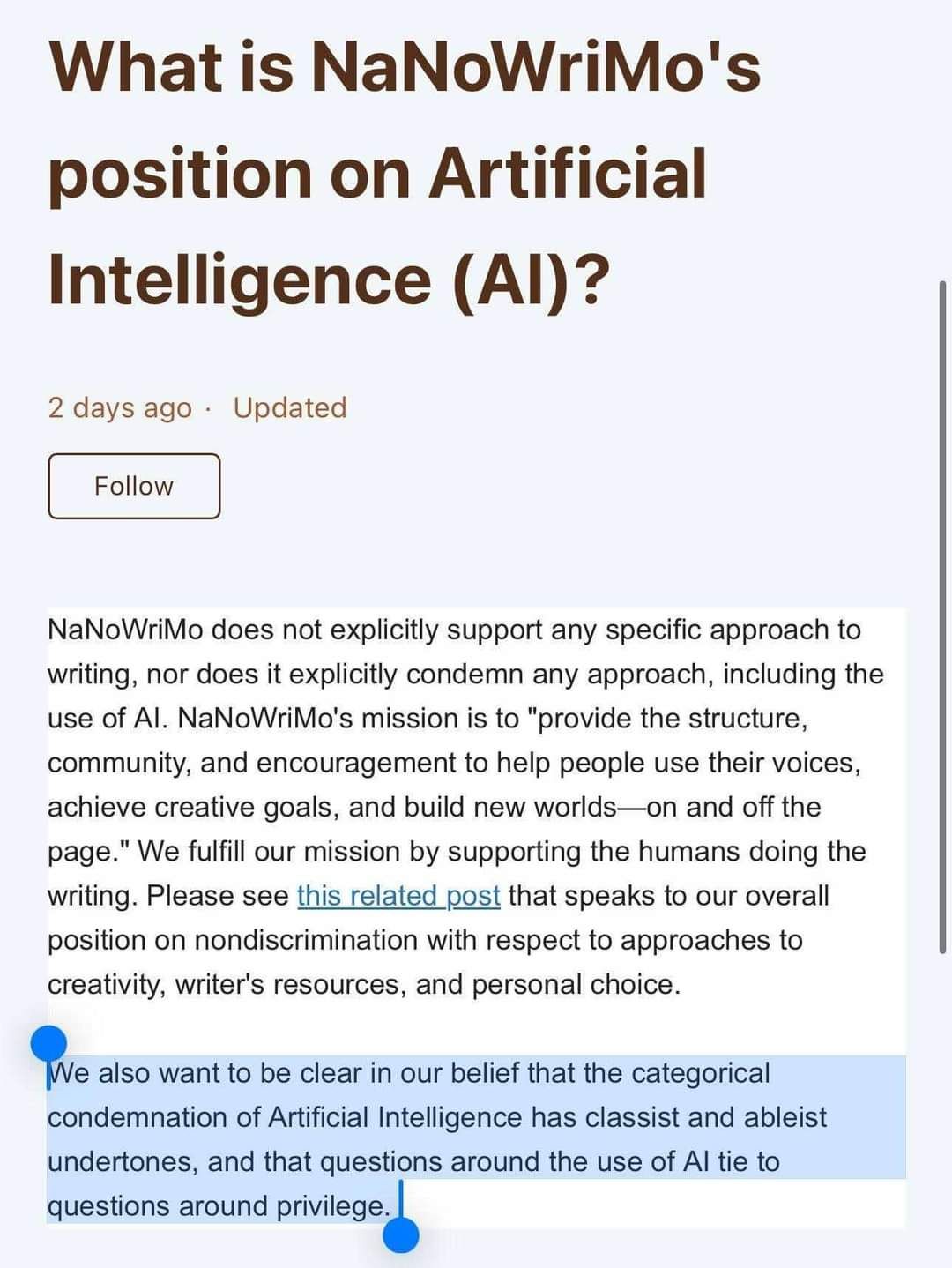
Sounds great, right? And for a while, it was. In fact, I even participated while writing the first draft of my novel Snake, and hoped to do so again someday. However, the organization’s statement on AI writing, which I’ve included as a photo below, has now made that impossible.

So, to summarize, not only is NaNoWriMo going to allow people to use AI to write their novels for them, but they claim that people who condemn use of AI writing are classist and ableist.

Um, excuse me?

I’m going to quickly respond to that last part first, as it’s outrageous. It’s not classist to ask writers, who span the whole range of socioeconomic backgrounds, to write a novel themselves. You know, like they’ve been doing for hundreds of years? Besides, AI use isn’t restricted to any particular class, let alone those living in poverty. If it was, and writing the whole novel yourself was restricted to those above the poverty line, then it would be classist.

And ableist? I have disabilities! I’ve managed to publish five books and write many more stories despite that! And so have many other authors, such as Octavia Butler (dyslexia), Fyodor Dostoyevsky (epilepsy), Flannery O’Connor (Lupus), as well as many writers who I consider not just colleagues, but friends. If anything, saying a disabled person can’t write a novel without the use of AI is what’s ableist!

But let’s get back to the fact that NaNoWriMo is willing to accept AI writing. I’m going to let you in on a little secret: AI writing isn’t even writing! AI writing is a computer program studying hundreds or even thousands of pieces of work, often without the original authors’ permission or even knowledge, looking for patterns, and then putting out something that has patterns like the ones found in the works studied. The results are usually full of contradictions, unimaginative characters, little mystery (because how could a program grasp mystery or secret-keeping for later payoff), and a lack of love.

Because that’s what AI writing really is. A cold calculation by a computer program based on analysis of so-called patterns gleaned from stolen works, rather than a labor of love by an author who wanted to share their stories with people who enjoy similar stories.

And the people calling themselves writers who are using AI, like the guy on Threads who said I was jealous that he was going to reach fifty-thousand words in one day (he’s been blocked)? They’re not writing. At best, they’re checking the finished project to fix the algorithm’s mistake. Other than that, they’re probably playing video games or making sandwiches or otherwise finding other ways to not write!

And that’s the saddest thing about this. NaNoWriMo started out as a fun challenge, and the organization was meant to help authors reach their dreams. Both were to encourage authors to push themselves and see what they could do in a month’s time. In short, it was to encourage writing. For NaNoWriMo to embrace AI writing and enable this laziness, rather than supporting the writers who insist on genuine hard work and practice, is a slap in the face to real writers everywhere.

I’m not saying it all has to be handwritten, but it should actually be, you know, written!

So, what can you do, both as a writer and a reader? Well, I’ve heard some people say they want to form a new organization and event, but whether or not that leads to anything, we’ll have to see. In the meantime, the most popular reaction seems to be people are boycotting both the NaNoWriMo event and the non-profit. Personally, in addition to the boycott, I would encourage authors to continue writing one word at the time. You know, actual writing?*

I would also encourage you to support other authors, especially lesser known ones, who continue to put real effort into writing, and leaving reviews, as well as refusing to support the works of authors who use AI, or the organizations who support them. Together, we can work to ensure writing and storytelling isn’t corrupted by algorithms, piracy, and laziness.

*And it doesn’t need to be fifty-thousand words in a month. Great work takes time, so take all the time you need.


That’s all for now, my Followers of Fear. If you would like to help this non-AI using writer, especially with spooky season just starting, I’ll include a button below to lead you to my catalog. From plant/human hybrids and strange gods to Mafia-hunting serial killers and carnivorous horses, I got something for every horror fan. And if you like what you read, please leave a review so I know what you thought.

And until next time, my Followers of Fear, good night, pleasant nightmares, and only 58 days till Halloween!

The Disability Pride flag. It’s lovely, but I’m not sure if it’s something I can display for myself just yet.

Last week, I was informed that July is Disability Pride Month. It’s an opportunity for those with disabilities–blind, deaf, psychiatric, mobility, etc.–to show that while they may have different bodies and minds, it’s not the end of the world. Hell, in some cases, it’s not even a problem. Instead, it helps build the character of the disabled and in some cases, they feel it makes them stronger. The only one with a problem might be society, which is still very ableist in its makeup.

I am on the spectrum and have ADHD (among other things), and I like the idea of Disability Pride Month. You should never feel less or be put down by your fellow humans just because you were born different. And some disabilities have become, rather than a hindrance, become the basis for communities with strong membership and even organizing. The Deaf community is one prominent example.

However, at the moment, I’m still figuring out how I feel about my own disabilities, let alone if I have pride in them.

That’s not saying I have low self-esteem or feel lesser because I have disabilities. It’s just that I’m still figuring out how I feel about being on the spectrum and having ADHD. On the one hand, it’s cool being “neurospicy,” as some people call it, and my unusual brain probably played a huge role in becoming a writer. Not to mention that I was able to get some accommodations in college and even found a steady, paying job because I am a person with disabilities.

But on the flip side, I’ve become more aware as I’ve gotten older how difficult it can be to interact with other people. Unlike fictional characters, whose minds I can get into and who are simple to understand, real people are complex and hard to read. I’m constantly on guard with my behavior, even with people who know that I have some social difficulties, in case something I say or do causes offense. Sometimes irreparable offense.

It’s gotten to the point where I don’t know if I’m being my genuine self, or if I’m “masking,” as it’s known.

And last month, I listened to this lecture series on Audible about being neuroatypical, and it kind of blew my mind. Not only did a lot of the situations brought up in the series resemble things from my own life, but I learned how drastically autism and ADHD treatment has changed over the years and how much it still has to change. Did you know that for both conditions, therapy used to center around controlling and forcing people to act “normal,” however you want to define it? And there are still places that operate that way, occasionally using horrific practices like restraint or electroshock therapy to change behavior. It’s awful.

I received therapy for my behavior as a kid. I don’t remember what kind it was. I just went to it because my parents said that’s where I had to go on certain days at certain times and didn’t really think much of it one way or another. I don’t have any bad memories, but I am curious as to what approach they took with me. And if it contributed in any way to my own worries about interacting with people.

So yeah, I’m not sure how to feel about my disabilities. Is it true that there are benefits to being neurospicy, especially in the creative and out-of-the-box thinking departments? Absolutely. But when around people, it’s hard to figure out how much of myself to be and how much I need to mask. And is there even a difference between my true self and my masked self? At least when in company?

I might not get those answers for a very long time, if ever. Especially not when the world is still super hard to navigate.

Still, at least I have people around me and get me. Parents, siblings, dear friends, fellow horror writers and enthusiasts, Followers of Fear, and even coworkers. They let me be myself once in a while, and usually tell me if I cross a line and I didn’t realize it. They even forgive me when that happens. They make navigating that much easier.

Now if only things could become a lot easier! Maybe then I’d figure out if I’m proud of what makes me neurospicy.


Just a reminder, Followers of Fear: this coming weekend, July 13 and 14, is the Columbus Book Festival. It’s taking place at the Main Branch of the Columbus Metropolitan Library and nearby Topiary Park in downtown Columbus, Ohio. Authors of all stripes, as well as artists and others, will be there to help match you to your next favorite read. I’ll be there with my fellow members of HWA Ohio, so please stop by if you can.

And if you can’t, but you’re interested in supporting me (or maybe just want to read something scary), check out my catalog. From plant/human hybrids and strange gods to Mafia-hunting serial killers and carnivorous horses, I got something for every horror fan, including free stories. And if you end up reading something of mine, please leave me a review so I know what you think. I’ll leave a link to the Books page below.

Until next time, my Followers of Fear, good night and pleasant nightmares. I’ll see you around real soon.

Consider this an early Autism Awareness Month post (doesn’t officially start till next Saturday).

As many of you know, and many of you may not know, I’m on the autism spectrum. Have been my whole life.* And honestly, while it has made some things somewhat more difficult to me, I really don’t consider it a disability. Well, it is, but it doesn’t disable me. It’s just made me fight harder and learn new ways to work my way through this strange world of ours.

Anyway, onto the meat of this post: recently, my dad sent me a video of a TED talk, featuring a woman named Rosie King speaking about her own autism and how it’s affected her life. Positively affected her life, by the way. If you can, I highly encourage you to watch the video, which I’ve embedded below, before reading the post. It’s only six minutes long and will really resonate with you.

When I saw this video, I was what the young people call shook. Honestly, it felt like Ms. King, who’s only five years younger than me, was talking about my own life. For one thing, I do feel like I have thousands of worlds in my head. Or thousands of stories, some of which take place in the same worlds as each other (I love shared universes in fiction). My imagination is constantly coming up with new stories, which is one reason I write. If I didn’t, they would stay in my head, constantly shifting and changing until I no longer knew what they were.

And I get what she says about having so much energy and needing to scream or move around or whatever. I used to need to pace to calm down. And I’ve been in situations where nobody wanted to be my friend because I was so different, though eventually some came to understand who I was and be my friend. A few are even on the spectrum like me.

And I am far from Rain Man (never seen it, but I’ve heard enough to know). I’m no math whiz beyond my finances, and I need someone else to do my taxes. I do understand a lot of science, but I’m no specialist. And as anyone can tell you, I’m quite verbal and love a good hug. Social situations can prove challenging, especially if I don’t understand some cue or another. But once it’s explained to me what line I’ve crossed or what the issue is, I usually learn from it.

But the thing that resonates with me the most is the part about “being normal” and saying “you’re so normal” as a compliment. As Ms. King says, “What is normal?” Just a setting on the dryer, if you ask me. None of us fit into a box, but some of us just spill out of the box and spread out in several directions much more easily. It’s because people do spread out that way that we as a species advance, from the sciences and technology to literature and culture.

And while I don’t know how much of a role my ASD has played in making me the person I am, as well as the creative I am, I can’t deny that it has played a role. And like Ms. King, I wouldn’t give it up for anything. Not when it has brought me so much good in my life.

So, I guess in conclusion, if someone’s different in some way, don’t try to change them, or make them fit in a box. So long as nobody is getting hurt and being who they are makes them happy, I see no reason to try to change them. Hell, I’m happy just the way I am. The only thing people tried to change in me is giving me the tools to make my way through this world while still being me. And that was enough.

Until next time, my Followers of Fear, good night and pleasant nightmares.

*And no, it wasn’t caused by vaccines. I was neurodivergent well before that, my mother says so, and you wouldn’t want to call her a liar. Them’s fighting words.

October is usually associated with Halloween, and obviously I’m doing everything I can to make sure you don’t forget that. But it is also National Disability Employment Awareness Month, when the United States recognizes how peoples with disabilities have contributed to the country and to our various industries over the years. This year especially, we are marking both the 75th anniversary of NDEAM, as it’s often abbreviated, and the 30th anniversary of the Americans with Disabilities Act (ADA) becoming a law.

And it’s good we have this month, because there are so many people with disabilities throughout the world and history who have contributed to our society. Harriet Tubman led dozens of slaves to freedom and acted as an armed scout and nurse for the Union Army, suffered from neurological issues due to a childhood traumatic brain injury; Franklin Roosevelt became President of the United States and led the US through some of its toughest crises, all while dealing with the aftereffects of polio from a childhood condition; Albert Einstein had a learning disability; and author Flannery O’Connor wrote enduring fiction while suffering from lupus.

Not to mention there’s a growing list of entertainers and athletes with disabilities inspiring us everyday. Magic Johnson, the basketball player, has dyslexia; Gaten Matarazzo and Millie Bobby Brown from Stranger Things have cleidocranial dysplasia and deafness in one ear, respectively; and Elton John has fought bulimia and epilepsy for years. And more amazing people with disabilities are emerging every day. Check out this video of a dance company, half of whose members have disabilities.

I point out all these people because, as Ms. Hamamoto points out in the video above, one in five people have a disability of some sort. Yet, despite the passage of the ADA and the many opportunities this law opened up for Americans with disabilities, this country isn’t always very inclusive. In fact, opportunities and services available for people with disabilities can vary greatly from place to place.

This astonishes me, because becoming disabled is something that can happen to anyone regardless of sex, race, nationality, class, religion, political leanings, ethnicity or age. In fact, the likelihood of getting a disability grows as you get older. It can happen because of genetics, because of an accident, a side effect of an illness, or other causes. Lately, I’ve heard of people who get over COVID-19, but have side effects such as still being unable to taste or suffering from multiple headaches a week. These can, and likely will, be considered disabilities in the years to come.

And many members of the American military come back or discharge with disabilities. These can range from physical, such as war injuries, to mental or psychological, such as PTSD.

You might not even realize that someone near you has a disability. The majority of them are invisible. You may only see their struggles, if anything.

And yet, so many people don’t want to think about the disabled. Services for the disabled can be underfunded. Many homes aren’t always built with the disabled in mind. Education in general is often not given the funding it needs, and when it comes to budget cuts, special education is often on the chopping block. And there’s so little education on disability in general, that people may hold a stigma regarding disability for years: that disability is contagious; that they’re useless; that they brought it upon themselves; that the best thing to do with disability is to ignore it or hide it away or treat it as an annoyance.

As a person with several disabilities–some congenital, others acquired in adulthood–I’m aware of how lucky I’ve been. I’m gainfully employed at an organization where close to twenty percent of the workforce has some form of disability (as well as accommodations for them). And throughout my life, I’ve been able to receive services that help me with my disabilities. So I feel it is important to not only make disability more visible, but also to advocate and help out when I can.

Which is why I’d like to close out this post with some links to help my fellow peoples with disabilities. The Department of Labor’s Office of Disability Employment Policy (ODEP) has numerous resources for the disabled, and many states have programs or offices for the disabled, such as Opportunities for Ohioans with Disabilities in my state. If you are or know a college student or recent graduate with disabilities, then might I recommend the Workforce Recruitment Program, or WRP, a great program that pairs students and graduates with disabilities with internships in the federal government, and which sometimes turn into jobs (please use Firefox when operating on the site). And the Job Accommodation Network, or JAN, has numerous listings of individual disabilities and what accommodations exist out there. My office uses this site all the time, and we find it quite helpful.

And these are just a small sample of resources for the disabled, a group that should never be discounted or forgotten. Because not only can you become disabled at any time in your life, but because no matter the disability, you matter. You contribute. You make the world a better place. And if people forget that, then it’s up to you and to the rest of us to remind them.

What resources for people with disabilities are you aware of? What has your disability experience been like?

As many of you are aware, I am a member of the disabled community, having autism, ADHD, anxiety, and more things than I can name. What many of you might not be aware is that October is National Disability Employment Awareness Month (NDEAM for short) in the United States. And this year’s theme (which I think is decided by the Department of Labor) is, “The Right Talent, Right Now.”

And at work today, we had an observance of NDEAM which included a panel of employees with disabilities and a video showing the audition of this year’s winner of America’s Got Talent, Kodie Lee, who is blind and autistic. You can watch the video down below.

I am crying, and so are you. You can’t help it.

And what this video demonstrates is that, despite certain issues and centuries worth of stigma, people with disabilities do have plenty to contribute to the world. In fact, they contribute every day. At my workplace, my main job duties involve helping employees with disabilities get accommodations so they can continue their jobs. This doesn’t just include disabilities from genetics and brain chemistry, like mine, but people who gain health problems like back issues or vision problems as they grow older, among others. And despite their disabilities–or sometimes because–they do amazing things at their workstations. They just need a few accommodations and an accepting environment to do so.

And you know what? This isn’t a new phenomena: people with disabilities have been contributing to the world for years. Beethoven, like Kodie Lee, made the world a better place with his music. Isaac Newton and Albert Einstein changed our understanding of the universe in their lifetimes. Harriet Tubman had a head injury that caused headaches, seizures and hypersomnia. John F. Kennedy may have had Addison’s or a similar condition.

Despite all these famous examples though, there are still a lot of barriers to people with disabilities getting work and living full lives. A recent article from Phys.org showed that many blind people face unemployment or underemployment, even though they can be just as capable as able-bodied people of doing job-related tasks. And it wouldn’t surprise me to see similar numbers to that quoted in the article from other groups in the disabled community.

So let me take a moment to address anyone in a position to hire someone with disabilities: we are capable of basic tasks. Hell, sometimes we do very complex tasks too, like write programs or design skyscrapers or perform surgeries or defend clients in court. I’ve even been known to write a decent story from time to time, and that’s not the easiest task. All we need to do our jobs is a few accommodations, which usually don’t cost that much, and an accepting atmosphere.

And remember, this is a group anyone can join at any time. Including maybe you, if you’re not already there. Life has a way of making that possible. So in a way, by encouraging hiring peoples with disabilities, you’re not only helping them, you’re helping yourself.

As well as your employer by ensuring they get the most talented people from the most diverse workforce. Let’s not forget that.

So this October, while we’re all enjoying the season of fear and screams, let’s also remember that there is an entire pool of untapped talent out there. One that has been subjected to and overcome stigmas multiple times to prove us wrong. So why not let them show you what they’re made of?

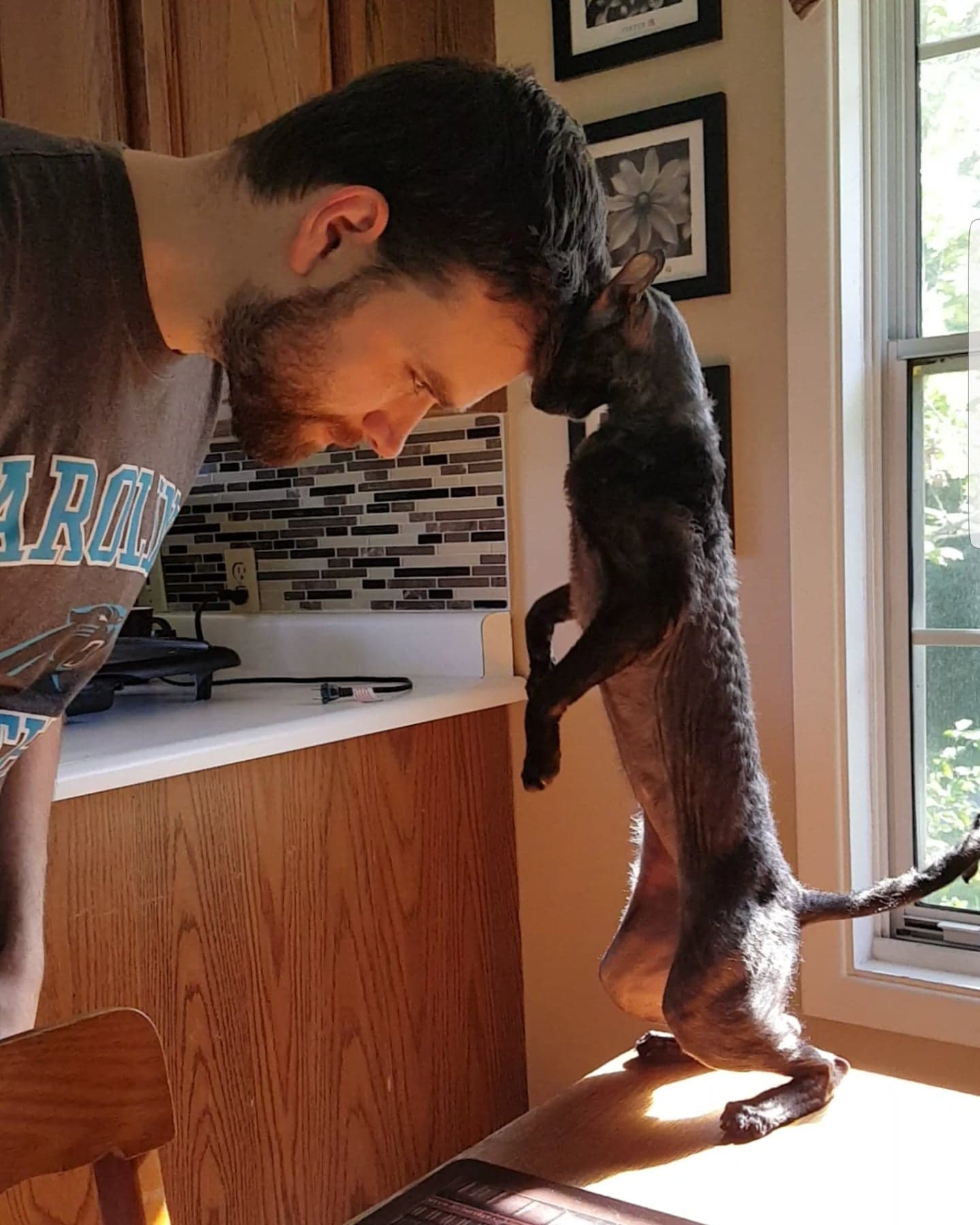
Author Jason Stokes in an adorable photo with one of his cats.

It’s been a while, but I have a new author interview to share with everyone. This one is with an author with an extraordinary story, both in terms of the novel he’s published and his own life experiences. Allow me to introduce Jason Stokes, author of the new novel Watcher.

Rami Ungar: Welcome to the show, Jason. Please tell us about yourself and about Watcher.

Jason Stokes: My name is Jason Stokes. I am a writer and artist currently living in the mountains of western North Carolina.

Watcher is about a young woman diagnosed with Multiple Sclerosis who witnesses a horrific crime via hacked webcams. Due to her own lifestyle, she is forced to make a decision between preserving her own safety and seeking justice for a woman she’s never met. In the process she finds herself against the most powerful citizens in her city and untangling a web of corruption that involves nearly everyone she meets.

RU: You wrote Watcher while taking care of your life, who has MS, and who gave a lot of input on the story. Can you tell us what that was like?

JS: It felt like it was time for a character that had the same struggles I’ve seen her go through and exposed the way caretakers in chronically ill lives support those they care about. I wanted her to have a hero she could relate to. She was invaluable, answering questions about how she would handle specific situations, helping me walk in her shoes and uncovering things I had never thought of.

RU: Did the idea for the novel evolve out of your wife’s diagnosis? Or did it influence an already-existing idea?

JS: I had an idea but It was all wrong. It was overdone and I wasn’t feeling excited by it. When I asked myself, how would she (my wife) handle this? It started to come together. I saw a story that had more depth and stakes that were higher than your average mystery/suspense story. When she (the MC)  wakes up every morning she is already at a disadvantage and it doesn’t get any easier from there.

RU: You founded the company, Gestalt Media, that published Watcher. Why go that route?

JS: Ultimately I’m a control freak but I also want to have a role in bringing forward original projects. I wanted full control over my own work and knew the stigma of self-publishing but I also know several creators and I wanted to help bring their projects to fruition. I’m currently working with an artist/writer to publish a series of offbeat comics sometime this year.

RU: On Twitter, you spoke about how a local bookstore refused to carry Watcher. Can you tell us why and how that made you feel?

JS: The store in question refused to carry Watcher because the main character has MS but I (the author) do not. Their stance is not unique. It is a trend among publishers and retail stores to insist on own voices and to refuse books by those outside of the represented  community. I felt that as my wife’s caretaker for the last six years, I have lived this as much as anyone aside from her. I wrote it with extreme care and respect and sought her input through the entire process. The fact is, there are people whose stories deserve to be told that may not be able to for whatever reason put it into words. As authors it is our responsibility to interpret and share the world. We often take ourselves out of the equation. If it’s done with respect, care and attention to the group being represented that should be enough.

I don’t think the store itself is wrong for their viewpoint. It’s their choice but I disagree with the narrow lane it provides for future literature. As I’ve said, it’s a good intent with misguided execution.

RU: I know this is tough to ask, but how are you and your wife doing these days?

JS: As well as we can. It’s a brutal disease and every day is a little worse than the last but we stay in good spirits. She’s a fighter, a true inspiration and I’m proud to stand beside her on this journey. As long as research continues we have something to look forward to. Anything can happen.
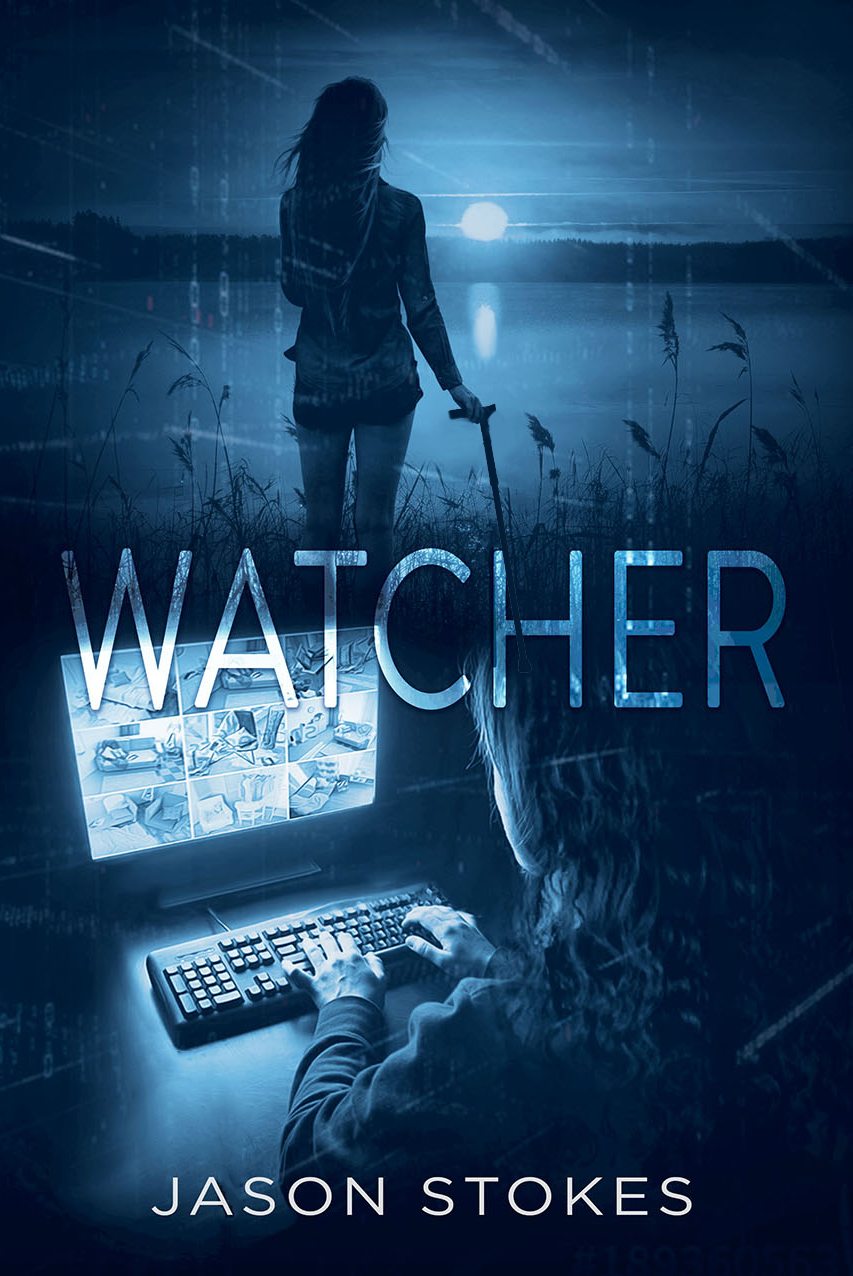
The cover for “Watcher” by Jason Stokes.

RU: That’s good. Can you tell us what your writing process is like, if you have one?

JS: I subscribe heavily to the tenets of the Snowflake theory outlined by Randy Ingermanson. Generally I will come up with a character or a situation I find appealing. Something that isn’t often seen or a new angle. Then I’ll place it in a world and find a central scene, something that brings the story to life. From there I’ll build out starting with a two or three sentence synopsis, then a few paragraphs, then a list of scenes, until the whole things appears.

RU: Are you working on anything now or have any future plans as far as writing goes?

JS: Too many things! There’s never a shortage of ideas and projects begging for time. I have another novel coming in time for Halloween. Ghost Story is the beginning of a series involving a protagonist that can see the dead on a road trip to discover more about his exceptionally unusual past.

RU: What advice would you have for other writers, no matter their background or level of experience?

JS: I’m going to quote Chuck Wendig ‘Finish your sh*t.’ You have to finish. As scary as it is. As difficult as it can seem. The real journey begins when you write ‘the end.’

RU: And finally, if you were stuck on a desert island for a while and could only bring three books with you, which ones would you take?

JS: Well, I think it would be only prudent to include the Worst Case Scenario Survival Guide. Alternately the Boyscouts of America field book if it was available. Next I’d bring along Robinson Crusoe for obvious reasons and Jurassic Park because it is the single most entertaining novel I’ve ever read.

RU: Thank you for being on the show, Jason, and the best of luck to you and your wife, both with Watcher and in life.

If you would like to check out Watcher (I’ve already sent a request into my local library to order a couple copies), you can get it for Kindle and in paperback from Amazon. If you’re interested in more of Jason Stokes, check him out on Twitter. I highly recommend you consider doing both.

And if you would like to be interviewed for an upcoming or recent release, either check out my Interviews page or send an email to ramiungar@ramiungarthewriter.com, and we’ll see if we can’t make some magic happen.

That’s all for now, my Followers of Fear. Until next time, pleasant nightmares!

It’s Thanksgiving Day here in the States, a day to be thankful for what we’re given (as well as gloss over some of the darker aspects of our nation’s early history). And as cliche and cringe-inducing as it is, I thought I’d take a moment to post about what I’m thankful for this year. Why? Eh, it just felt like something I ought to write about.

And with that established, what do I have to be thankful for? Well, plenty. 2018 has been a fucking good year for me. Yes, you read that right. 2018 has been a fucking good year for me. On a number of levels and in several areas of my life, it’s been good for me:

Writing. Obviously, things have been great on the writing front. Back in March, my novel Rose was accepted by Castrum Press for publication, which is a pretty big deal. Not only that, they pointed out the issues with the novel that gave me insight in how to fix it in rewrites. Right now Castrum’s probably looking over the manuscript, figuring out what else needs to be improved before we publish the book.

Not only that, but my short story “Car Chasers” was accepted for publication in the anthology The Binge-Watching Cure II from Claren Books, which will likely be out sometime in early 2019; I ended up writing another novel, River of Wrath, and I still get a kick out of all the craziness that came with writing it;* I’ve managed to increase the input so that I get a minimum of thousand words out rather than just a minimum two hundred and fifty; and I passed a thousand followers on my blog.

This is going very well for me lately.

Plus I’ve written a whole bunch of new stories and edited a few more over the course of the year. Hopefully some of them will get published someday. I’m really proud of them, an I would love for you to read some of them.

Work. My day job can be pretty demanding and stressful, but it’s very rewarding. In case you weren’t aware, I work for a supply organization in a sort-of HR position that involves helping employees with disabilities get accommodations so they can continue working, as well as helping to run programs that emphasize the different ethnic/specialty groups in the organization. A lot of people my age have trouble finding jobs, so I’m incredibly thankful that my work helps so many people and that I’m paid enough so I can keep afloat and put something away in savings. Hell, I got a really nice raise earlier this year, which has been really helpful for reasons I’ll get into.

And while I’m working there, I think I’ll continue to soar in the position. Last month, I led the effort to put on a program for National Disability Employment Awareness Month that was very well-received, and I’m being trained on a whole bunch of new tasks. Who knows? Perhaps I’ll soon earn the privilege to work from home once a week by this time next year, among other things.

Life. Ooh boy, life’s been good lately. My back issues have improved immensely this year, to the point that I don’t feel pain every day any more, and when I do it’s usually a dull ache. And of course, you may have heard that I recently got my driver’s license and my own car, which has been a Godsend in my life. Yeah, it’s another bill or two, but thankfully I can afford it. That, and a whole bunch of other things that I won’t get into (they’re a little too personal) have made my life frankly wonderful.

My car, the Unholy Roller. So glad to have a set of wheels of my own.

The people in my life. Including you. While I like living on my own and having my own space, I’m lucky to have a good group of people in my life. Friends to hang out with, family I can go to for advice and hugs, coworkers who help me out when I have a question and even make sure I get home okay when I get sick at work (that happened just the other day). And I’m thankful for all the people who follow me and my work and even read my stories when they’re published. Having so many people encouraging me every day and showing an interest in what I write is a big deal for me. So thank you, Followers of Fear. I’m thankful for you being part of my journey through life.


That’s all for now, My Followers of Fear. I’m sure I’ll have another post out before too long, but for now I’ve got to go get some cooking done for tonight. Whether or not you’re celebrating, Happy Thanksgiving my Followers of Fear, and pleasant nightmares.

*Not kidding, I never thought it’d be longer than twenty or thirty thousand words, but it ended up being sixty thousand! But the real crazy part is that I started that novel on October 29th, 2017 and finished it a year and a day later on October 30th, 2018. The novel takes place on October 30th and 31st, 1961. And I finished it at 3 AM, the Devil’s Hour, which is fitting as it’s a novel partially inspired by Dante’s Inferno. You can’t make this shit up!

So that lovely and occasionally terrifying thing known as the Internet has informed me that April is Autism Awareness Month, and as someone who is on the spectrum, I felt I should contribute something.

The only question is, what should I contribute? I haven’t had any experiences like when I was asked to give advice on how to help someone’s autistic relative; I haven’t been prompted to record a video or anything like the one below, detailing a specific issue involving disability (by the way, that video recently passed the one-year anniversary of when it was uploaded, and also passed five-hundred views soon afterwards. I find that pretty cool); I haven’t had any revelations about my relationship with my autism; and no one’s asked me point-blank if I’m autistic recently. What’s there to talk about? What can I say that not only needs to be said, but I feel strongly speaking my mind about?


Well, I guess one subject I can broach is how autism affects adults, especially in terms of job searching and job security.

A lot of people associate autism with children. When they associate it with adults, I think the popular image is low-functioning adults who are being taken care of by their parents or at facilities. And while there is a segment of the adult autistic population that do need that sort of care, the popular image ignores the segment of the population who don’t require full-time care from facilities or parents, those who can and seek to live independently. And they face their own unique challenges and issues.

Now, I”m just going off my own experience and the experiences of others who have or are related to people with ASD, but the fact that we’re either experiencing or hearing about this says something.

I’ve mentioned before how, between October 2015 and about March or April 2016, I was on the worst job search I’ve ever experienced. Every day I would send out resumes and applications, only to either not hear anything back or to be passed over after being interviewed. One reason this may have happened is because I was open to my potential employers about the fact that I have ASD, and that it sometimes made social situations awkward. I have no proof, but it’s possible that knowing my diagnosis may have scared them off. People have this association with people with disabilities in general that we’re unable to do anything. And even if we’re skilled at something (sciences, writing, mathematics, painting, music, whatever), our needs are too much for them to handle as employers.

The reality, I assure you, is much different. At work, part of my job is being a disability advocate, and I can attest that people with disabilities not only do things, they do them very well. Not only that, but employers who treat disabled employees well find that not only are these employees hard-working and loyal, but several times less likely to turn over than the general population. Not only that, but accommodations for their disability usually aren’t burdensome: a quiet or obstacle-free workspace, or flexible schedules, or leave for medical appointments. And when it does cost money for accommodations, it’s usually not expensive. Seriously, I help handle accommodations at work. I rarely see the cost get anywhere near five-hundred dollars.  My own accommodations cost the organization nothing: I just listen to my iPod or audio books while I work (I pay for any new music or audio books) and I have a chair designed to ease my back pain (we already had the chair to begin with, so it didn’t cost any money to give it to me).

But still, a lot of employers are wary of employing the disabled, especially folks with ASD. They have this idea of a Rain Man-type character, someone who may excel at one very special skill, but needs all sorts of help in every other area of life and can’t do anything but certain tasks. For many autistic adults, this simply isn’t the case. Each of us may present our diagnosis differently, but it doesn’t affect each and every one of us that badly, and we are suited for a variety of tasks.

I’m lucky that I was able to get a job in an office where everyone is kind and gets that I’m not always the savviest person socially, in an organization that emphasizes disability hiring, accommodation, and inclusion. But not many people like me are that lucky. They have trouble finding jobs because employers see their disabilities as a huge barrier. I’ve heard from friends who’ve had this experience, as well as from others. And not just with jobs: I’ve heard from people who have told me that they or their relatives had had trouble finding services that help them cope with their ASD once they reach adulthood or when they’re diagnosed in adulthood. There’s plenty of help for minors, but for adults, it can be a challenge.

So this Autism Awareness Month, I’m writing a post urging people not only to support autism awareness, research, and therapy, but also to rethink how we approach adults with autism (and disabilities in general). The majority of us aren’t helpless individuals. We’re hardworking and want to be part of society. You just have to give us the opportunity, whether that be funding for programs that offer counseling, education, and job training to autistic adults, or actually giving a job to someone with autism. Quite possibly, you’ll be amazed at what you receive in return.

Thank you for reading, and have a good month of April.