Posts Tagged ‘entertainment’

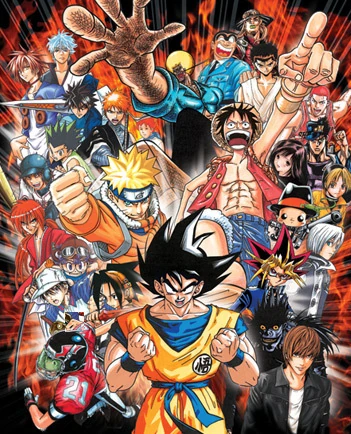
Last week I read an article where Adam Winguard, the director of the disaster that is Netflix’s adaptation of the Death Note franchise, had to quit Twitter because he was receiving so much hate mail and even death threats over his adaptation. And yesterday, the admins of a YouTube channel dedicated to reviewing and discussing anime and manga received death threats for posting a positive review of the movie.

Let that sink in for a moment. A whole bunch of people are sending people hate mail and threatening to kill them over the Internet for either making or liking what many consider a bad movie. And I’d bet one of my anime figurines the majority of these angry people are fans of the Death Note anime and manga who are incensed that the director cast white actors in the movie and the numerous changes from the source material, as well as just making a really bad film, or that anyone would like the film.

Now, all three complaints are legitimate: the casting of white actors as what were originally non-white characters is a serious problem that Hollywood and the public are continuing to grapple with even now. The many changes from the source material were not only unnecessary, but actually made the film more of a mess than a wonder. And it was a really bad film (check my review here for my own thoughts on the subject).

But there is absolutely no excuse or reason–ABSOLUTELY NO EXCUSE OR REASON–to send hate mail or threaten someone’s life. Especially not for their creative work, no matter what decisions they make or the quality of it. And those who think nothing of doing it have some serious issues that need addressing.

Unfortunately, this isn’t the first time fans of a franchise or a character or something along those lines have gone a little bonkers. I was ranting about this issue of fans going crazy back in 2013, when people were leaving intentionally bad reviews of Charlaine Harris’s last Sookie Stackhouse book because it was the last book, and threatening harm to themselves and others if their favorite couples didn’t end up together (and possibly followed through after a copy leaked in Germany). Later that year, people were sending tons of mail to Warner Bros. and trying to get the White House to intervene in the casting of the Fifty Shades of Grey movie (not sure what they expected to happen with that one).

Seriously, was this worth the hate campaign? I actually enjoyed the movie.

Since then we’ve seen negative reactions to the idea of the Ghostbusters reboot, and then the female-led cast, which was so hateful everyone involved in the movie felt the need to comment and even make a joke about it in the movie. We’ve also seen people react negatively to Captain America becoming an agent of Hydra in the comics, with some people threatening the writers behind this move. One man claiming to be a Marine even said that he would abandon his moral code and become a stone-cold killer because of the change (seriously, did any of these nincompoops think that maybe this was a mind-controlled Cap, or one from another dimension, which apparently is the case?). We’ve probably all seen articles about angry males attacking women online for attempting to be part of the video gaming community and industry. And there are more of these than I’m probably aware of, with this Death Note thing just being the latest.

What’s causing people to become so angry and violent over fictional characters and worlds? Well, it might actually be nothing new. As long as there have been creative works and their creators, there have been people who have gotten passionate about them, sometimes a little too passionate (*cough* John Hinckley Jr. and Ricardo Lopez *cough*). And sometimes people even feel that their love of a property gives them some sort of ownership over said property, and therefore they have a legitimate voice in any decisions over said work. And with the Internet as both means to reach like-minded individuals and platform to voice their vitriol without worry of censure, some of these overly-passionate fans can gather en masse and make their anger heard, warranted or not. Sometimes, a few of them even feel emboldened to make threats of violence.

And I get it. I hated the Death Note movie too. I can think of several ways the Star Wars prequels or some episodes of Doctor Who could’ve been better (I actually nearly threw a shoe at the TV once because I really disliked an episode). And God, was I upset when shows I really liked, such as Dracula or Sleepy Hollow, got canceled. I would have loved to find the people responsible for all these mistakes and given them a piece of my mind.

But therein lies the problem: none of these fans have any actual ownership or say in the decisions revolving around these stories, and at the end of the day, it’s the creators themselves who get to make those decisions. And we should let them. After all, they are spending valuable time and energy to bring us these stories we love so much. It’s essentially a gift from them to us, the readers and viewers. And while not all these creative variations are welcome (*cough* first three DCEU movies *cough*), some of these creative risks have led to some the greatest pieces of storytelling ever made. Remember there was a time when the Winter Soldier wasn’t a thing, let alone a former friend of Captain America gone evil. When Heath Ledger was cast as the Joker, people swore it was the worst casting decision that could be made, and yet Ledger’s Joker is arguably one of the best Jokers ever brought to life. And let’s be real, William Shakespeare ripped off and made changes to most of the stories he’s famous for! And look at him!

A decision that turned out to be right after all.

And this is not just for variations in already established characters and stories. Creators should be able to experiment with stories and characters. Otherwise, would we have Doctor Who? Harry Potter? Death Note the manga? Stephen King’s IT?

So what should you do if a story you like or an adaptation of a story goes in a direction you dislike? Well, there are two possible decisions that you could go that won’t make you look like a tool (trust me, as both fanboy and creator, they work). One is to do what I did with Death Note: calmly point out what was wrong with it or what you disliked. You don’t have to be angry to get your point across. I’ve found calmly discussing what you disliked about something does more than shouting. And besides, being rude or angry or telling someone to die never convinced anyone to your point of view or made them change their ways.

The other is to just not take part at all. After Jodie Whitaker was announced as the 13th Doctor, many fans reacted by simply deciding not to watch the show anymore. I even have a friend who decided to do that, and while I disagree with their view, I respect how adult their reactions were. (Thought to be fair, after all those years of Moffat tropes, it might’ve been easier to leave than to work up anger over a casting decision). So if you don’t like what the creators are doing, just leave. Don’t ruin the experience for everyone else who may want to try out the new direction.

And if you’re a parent with kids who may get overly passionate about fictional works, maybe have a conversation with them about how to respond to this sort of thing. It might save someone a lot of headaches later on.

While I doubt this problem will go away anytime soon–if anything, it might get worse over time–we can at least approach it in a healthy manner, rather than with further fear and anger, as well as to find healthy alternatives to anger and/or death threats. Either that, or we never get any sort of new stories ever. And I really don’t want to see that.


That’s all the ranting for now. The next week and a half will be crazy for me, so I have no idea how much, if at all, I’ll be able to post until October 1st. I’ll try and get something out next week, though if I don’t, please don’t hold it against me or send death threats.

Until next time, Followers of Fear. Pleasant nightmares!

So back in the beginning of the year, I took a number of steps to improve visibility on my blog, maybe grow my audience, and  become a better writer in general (jury’s still out on whether or not that’s working). One of those was to get a special email account through WordPress, one exclusively for this site and for use as an author. Studies show that professional looking email addresses are taken much more seriously than ones that look like awesomesoccerdude83 [at] website [dot] com. And while I love my personal email account, it’s not exactly the kind of email address that’s conducive for looking professional. And if I’m going to try and get an agent or publisher, might as well look a bit more professional. Even if my idea of high fashion involves a Sailor Moon-themed sweatshirt (don’t ask for photos. I just got that sweatshirt, and I’m waiting for the right weather to wear it).

For some reason though, I have to log out of my Google Mail account (which I only use to make sure I have access to a YouTube account. Priorities!) and then log into the other account. I can’t access both at the same time. And sometime after I got the account, I forgot the password. And then I didn’t pursue getting a new password for a while. Mainly because to get it back, Google wanted the last password I could remember. Which I couldn’t remember.

There’s a GIF for this situation. Which should I use?

That’s it. Thank you Hermione. I should’ve written the password down in the first place. You’re always and forever awesome.

But two months ago, I tried to get a new password. And that started the email equivalent of broken telephone. One person would answer my email to the WordPress help team asking for an explanation. I’d explain and send the email back. A second person would answer back and ask more questions. I’d answer those questions. A third person answered and gave me the exact wrong thing for my problem. Yeah, after a while of this, I just gave up and stopped.

And then two weeks ago, I decided to give it another try. No reason, I just thought if I got the email account, I might as well use it. I sent WordPress another message, this time wording it so that even a chipmunk would understand what I wanted. A week later, I got the link to change my password. And I wrote down the password, hiding the note in a secret location.

So finally, I have my author email account back! And I’ve set a reminder on my phone so I can check the account at least once a week. And I plan to be using it as much as possible for all author-y things. For submitting stories, querying agents and publishers, and even communicating with fans (I’m sure some of you exist) and friends.

So what’s this mysterious email address? Glad you asked. Here it is:

ramiungar@ramiungarthewriter.com

Simple and easy to remember, right? I’ll be posting it on my About Me page, so if you can’t find this particular post or your memory is as bad as mine, you’ll still be able to contact me.

So if you’re a friend or Follower of Fear, I look forward to emailing you from this new address.

If you’re an agent or publisher, I’m always willing to talk to you about business propositions.

If you’re a stalker and imagine showing up at my home, possibly with a knife, please seek professional help for that. You can live a happy life without being in close proximity to me and/or my corpse 24/7!

If you’re planning on sending me nude photos, please don’t. Those can ruin lives when uploaded to the Internet. And depending on your age, sending and/or receiving them can send us both to prison.

If you’re a troll or con artist looking to use me for your own sick purposes, please refrain from doing so. And if you still insist on sending me emails meant to make me angry or take my money, then…YOUR MOTHER IS A ***** ***** ****ING **** **** LORUM IPSUM ****** AGMINTUM VEVEUM ****** **** ***** ***** TRUGULA ***** **** ***** *** HIPPOPOTAMUS ***** ***** REPUBLICAN ***** ***** **** ***** AND DANIEL RADCLIFFE *** **** **** ***** WITH A BUCKET OF ***** **** **** **** AND A CASTLE FAR AWAY WHERE NO ONE CAN HEAR YOU *** **** **** **** SOUP ***** **** **** WITH A BUCKET OF **** *** ***** MICKEY MOUSE **** *** AND A STICK OF DYNAMITE *** ***** *** MAGICAL *** **** ***** *** ***** ALAKAZAM!!!!

Points to whoever can correctly guess what the hell I’m referencing with that long profanity.

Well, that’s all, my Followers of Fear. I’ll check the email account next week, and maybe even see an email from you guys. Until then or the next blog post, pleasant nightmares!

I’ve literally been waiting seven years for this movie, since I first heard rumors of a remake. I got hopeful when Cary Fukunaga was brought on board to direct and when he started casting, felt my spirits plummet when he left, felt concern when Andy Muschetti replaced him (I did not care for his film Mama), felt a little hopeful again when I saw the first photos of Bill Skarsgard as Pennywise, and felt really hopeful and excited when the first trailer came out. I waited for months and months, possibly building the film up more in my head than I should. When the time came, I invited friends to come see It with me. And finally, the day came. I showed up early to make sure my friends and I got good seats. And then the show began.

I can say with zero hesitation that this is the It film we deserve.

So if you’ve been living under a rock since 1986, It is a Stephen King novel about a small town haunted by a monster that takes the form of a clown, and the seven brave souls who fight it, first as children and later as adults. There was a TV miniseries done back in the 1990’s that was absolutely terrible (how do you take a King novel and put it on ABC primetime? That’s like trying to take a rabid wolf and pretend it’s a puppy dog!), and now we have a feature film, focusing on the children’s portion of the story. And it tops the miniseries in every way possible.

Now, I’m not going to say this is the scariest film I’ve seen. I actually found Annabelle: Creation to be much scarier in terms of jump scares and atmosphere than It was. However, that doesn’t mean It‘s not a scary film. It did have some scares. The problem is, I’m so well-versed with the source material, I could guess where they would do jump scares or anything like that, and it’s difficult to get scared when you know what’s likely to happen next. However, there were a lot of other people who found the film terrifying, so one should consider my reaction an outsider.

And I did get scared at points. More on that below.

My ticket.

I also liked how this was a much more faithful adaptation. Besides taking place in the 1980’s rather than in the 1950’s, this movie sticks pretty closely to the novel. But more than that, it sticks to the spirit of the story, delving into the darkness the TV miniseries couldn’t because of the channel it was on. The film’s not afraid to go as dark as possible (without risking the R rating, of course), showing actual lost limbs and hinting at sexual abuse, among other things.

But while the film is more faithful to the book, that’s not to say there’s no deviation beyond a change in decade, and this is where the story gets scary for me. Especially during the final third of the film, they change a few things in order to make the story flow better, and I think that’s when I find the film not only the scariest, but the most effective. Not only that, but the film uses Dutch angles, lighting and music quite effectively to emphasize dark or creepy or weird scenes, highlighting the strangeness and horror of the story. Whoever had the bright idea for that knew what they were doing.

The film also had its funny moments, and they weren’t distracting at all. I like it when a horror film is able to do that.

I also loved the actors. Bill Skarsgard as Pennywise the Dancing Clown kicks Tim Curry to the curb! Whereas Curry played the character much more comically, here Pennywise is creepy as It should be. Not only is Pennywise’s whole look here freaky as hell, but paired with Bill Skarsgard mastery of a menacing manner, and a slight lisp, and you can’t helped but be freaked by Pennywise. Even when he’s dancing (and yes, Pennywise actually dances in this film, something we haven’t seen in the book or the miniseries), he’s scary. Best Pennywise ever, and I want to dress up as him for Halloween, if not this year then the next.

Me being silly after the film with friends.


The kids are also great. Every single one of them is masterful in making you believe they are these characters, who are given time to grow and develop throughout the film’s two-hour run time. My personal favorite was probably Beverly, played by Sophia Lillis. She was such a great character, one of the strongest of the Losers Club but also one of the most vulnerable due to her home situation, and I loved that about her (as well as how kick-ass she can get). I also liked Finn Wolfhard of Stranger Things fame, who captured Richie Tozier’s dirty mouth and stupid humor just perfectly. And Jack Dylan Glazer did a great job of capturing Eddie as a hypochondriac who grows into a much braver child. And oh God, Nicholas Hamilton as Henry Bowers was such a scary guy!

Honestly, the whole cast was great, and I could go on with how much I loved them.

My Losers Club for the day. Thanks guys!

There were a couple of things I didn’t like, sadly. For one, the CGI was actually more distracting than scary, and a few more practical effects might’ve been better. I also thought that the filmmakers could’ve pushed the envelope in the third act at a part where the characters are trying to find Pennywise, though as it is that part is very good. And finally, I thought one scene would’ve been better with dramatic music than a song by The Cure (I know this takes place in the 1980’s, but do we really need a montage?).

All in all though, I’m very glad we got the version of It that we did. Faithful, well-told, heartfelt, with great characters and wonderful scares. On a scale of 1 to 5, I’m giving Andy Muschetti’s 2017 adaptation a 4. Go check it out, start floating down here, and pray the sequel is just as good.

I know, I usually try to get these reviews out a day after the movie or show premieres, especially with American Horror Story, because I have to stream it the next day (I don’t need another bill). Unfortunately, the past couple of days I’ve been busy with personal stuff and I didn’t really have time to deal with watching and writing reviews. The only thing I’ve seen for it was a review on Twitter by someone I follow, stating that the season opening was intriguing, but not outright scary.

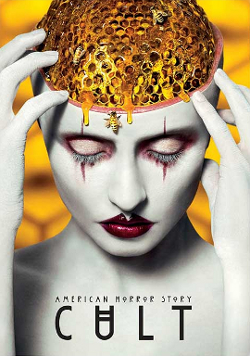
Well, I finally had some time to watch and review the episode, so let’s get into it. American Horror Story: Cult begins with news footage from Donald Trump and Hillary Clinton’s campaigns, starting from when the Donald started running and ending with his election as President. From there, the story follows two very different characters: Allie (played by Sarah Paulson), a woman with an anxiety disorder whose phobias, including clowns and even objects full of holes, come back in full force after Trump’s election. The other is Kai (played by Evan Peters), a purple-haired Trump supporter who has some bizarre beliefs, including that Trump’s election is the beginning of a revolution. From the look of things, their lives are going to be intertwined in strange ways.

As the Twitter reviewer said, Cult‘s first episode is less scary than intriguing. There’s a lot of focus on how the election affects everyone. Allie, being married to and having a child with another woman, is understandably scared that her family will be torn apart under the new administration, and that activates her other phobias, to the point that it’s affecting her marriage and her son negatively. Kai, on the opposite end of the spectrum, feels empowered to speak his views loud and proud, even if not everyone is interested in hearing them. The characters are exaggerated  amalgamations of reactions from both sides of the aisle, but they do get to a lot of what many Americans felt post-election.

Speaking of which, there’s an interesting scene during the first half of the episode where Allie walks into a store, and starts up a conversation with someone, only to find out they’re a Trump supporter, even though at first glance, they didn’t seem like the stereotypical Trump supporter. I had an experience like that at a drug store during the primaries, where I made a comment about the Trump campaign, and a store clerk said he might vote for Trump. And like Allie, I felt a little perturbed afterwards, because I didn’t really care for some of Trump’s policies, and I thought someone working a minimum wage job wouldn’t either. But then you got to remind yourself that the Trump campaign drew people from a number of walks of life, which lead to his election. This scene portrays that well, to the point where I felt a little deja vu.

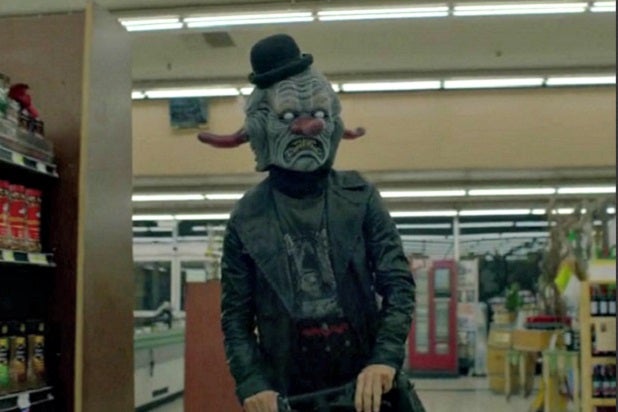
But as for scares, it’s pretty lacking. The design of the clowns is very freaky (especially when you’re not sure if they’re real or hallucinations), and Kai is freaky all on his own, but it’s not going to scare anyone used to horror scenery. If it were more like the opening of the fifth season, where every ten minutes there was a bloody, out-of-left-field scare or death. Here, it’s just not that impactful, they’re more concerned with setting up the story. And while that has worked in other seasons and in the first episode of The Defenders, here it just doesn’t work. After all, this is American Horror Story, and the setup needs to be balanced with that horror we were promised.

It makes me hope that in the next ten episodes it’ll really ramp up on the scares and make for a fun season. And it makes me hopeful that Colton Haynes’s character gets a lot of screentime (I love him whenever I see him in anything).

On a scale of 1 to 5, I’m giving the first episode of AHS: Cult a 3.2 out 5. Good setup with believable characters and excellent tapping into America’s fractured post-election psyche, but definitely a lot more horror is needed.

That’s all for now, my Followers of Fear. Join me Saturday at some point when I review another scary thing with clowns, IT. Prepare to float!

Wow, thought it would take at least a couple more nights for this happen. And again, it’s like an hour before I’m supposed to go to bed! Ooh boy. At least if I’m tired tomorrow morning getting into work, I’ll have a good excuse as to why it happened.

For those of you who don’t know, Rose is a novel I wrote as senior thesis in college, and which has had quite the crazy time just getting edited (click HERE to read my last post on Rose for more background on this crazy time). The story follows an amnesiac girl who wakes up one day and finds herself suddenly turning into a plant creature (and that’s just the start of her problems). It’s as bizarre as it sounds, but also very dark. Not as comical as it might sound if I were to tell you about it at a party.

As I’ve said before, the last time I tried editing this story, it took me months just to get through a couple of chapters. Now, it’s been just over three weeks since I last posted an update on Rose, and I’m two-thirds of the way through the story. The latest chapter, I managed to get done in one sitting, in only an hour and a half, with a cup of tea on my bedside table and a New Age spiritualism lecture on YouTube to keep me focused on the writing. Consider my normal writing/editing speed, I consider that a really big deal. May the last seven chapters be as easy to edit as this chapter.

Though to be honest, I’m really enjoying the editing process. The story feels new to me, like I’m discovering the characters and twists for the first time as a reader. And going over it, seeing where the descriptions can be expanded or the language brushed up and improved is a pretty satisfying experience. It’s going to be really interesting to see what happens in the last seven chapters, which contain some of the biggest revelations of the story, and most of the scenes I’m looking forward to expanding/making better.

If I’m lucky, I’ll even be able to make good on my thesis advisor’s suggestion to add about ten to twenty-thousand words to the novel (or did he say  double the novel? I forget so much in my young age).

Speaking of which, time for me to annoy you with page and word counts. At this point in the second draft, the number of pages in the novel (8.5″ x 11″ paper, 12-point Times New Roman font, double-spaced) was a total of 103, with the word count measuring up to 32,765. In the third draft, I’ve expanded the story to this point to 137 pages, and 42,768 words. That’s an increase of 34 pages, and 10,003 words. I think I’m doing quite well. The second draft was only a couple thousand words longer than where the third draft is now, so once I expand it, I could get it beyond sixty-thousand or maybe even seventy-thousand words. That would be pretty incredible, wouldn’t it?

Well, I’ve probably taken up probably enough of your time and/or phone data. I’m going to head to bed and savor this milestone as I sleep. Goodnight Followers of Fear. Pleasant nightmares!

Death Note is a franchise I’ve been aware of since high school, and despite some issues I have with the source material (*cough* the second half of the manga *cough*), I’ve always looked at it fondly. It’s clever, has some really memorable characters and scenes, and the themes present in the story are always relevant. When I first heard of plans of an American version of the story, I thought it had some potential, which is why I was disappointed when it fell into development hell. But when director Adam Winguard and Netflix finally started to put the film into production, and despite the troubling news I heard leading up to the film’s release,* I still had hope.

Imagine how I feel now when I find the final result is not what I’d hoped for.

So for those of you who don’t know, Death Note is originally a manga about a Japanese high schooler named Light Yagami who discovers a notebook that kills anyone whose name is written in it. With the help of a death god named Ryuk, Light starts a killing spree of the world’s criminals to end all crime and to become a new god named Kira. He is opposed by L, a mysterious detective who has solved several high-profile crimes in the past, creating a cat-and-mouse game that could determine the fate of the world. The story has been adopted into anime, TV shows, novels, and even a couple of Japanese movies. Winguard’s version is the latest addition to the franchise, and unfortunately, it’s like that one relative whom you invite to family gatherings because he’s family, but you’re not happy about it because he’s an embarrassment to the whole family.

The biggest problem I have with this film is the many changes from the source material. Now, I’m open to some changes, like what the Japanese films did. Those were changes that strengthened the story instead of taking away from it. However, the majority of the changes here were unhelpful. Light Yagami, a handsome, charismatic and intelligent young man motivated by a sense of justice and boredom becomes Light Turner, an outsider who’s only a few degrees away from shooting up a high school, whose intelligence is only hinted at, and who screams like he has no confidence. Misa Amane, a blonde and bubbly airhead whom you actually feel sympathy for, becomes Mia Sutton, a cheerleader with no personality or backstory and too much enthusiasm for killing criminals. Lakeith Stanfield is actually pretty good as L for a while, but then in the last third goes completely off the rails.

Something went very wrong with this transition.

There are a whole bunch of other changes that I didn’t care for. The purpose of the Death Note and the reason why Ryuk drops the Death Note is changed, the default method of death for the Death Note isn’t in this adaptation, Mia isn’t given a good reason to want to use the Death Note like Misa Amane has, so her enthusiasm for using it feels strange, and the way L and his assistant Watari interact feels a little creepy rather than the working relationship they had before, and the list goes on and on. In fact, some of these changes open up plot holes in the story. For example, the change in the way L identifies the first victim of Kira, rather than making some sense like it does in the manga, leaves open some questions in this adaptation. Also, why does L have a false name but Watari is actually his real name, with no last name?

I also did not care for Margaret Qualley’s acting in this film, which felt emotionless and uninvested. It seems like she was trying to channel Kristen Stewart’s Twilight performance, which given all I’ve heard of that performance, explains a lot, but it’s obvious it’s not what we’re looking for in this movie. Also, who’s idea was it to make her look like an Emma Roberts impersonator in every shot?

Ryuk, played by William Dafoe, is definitely one of the better parts of the movie.

There were a couple of things I did like about the film, however. Ryuk looks absolutely terrifying, as he should, and is kept sinister throughout the film, thanks in part to William Dafoe’s phenomenal performance as the voice of the character (that man can do villains like no other). Mia is treated more as a partner in this film rather than as a pawn, which I’m sure many Misa fans, including myself, have always wanted to see (what can I say? You feel for her, despite her flaws and the blood on her hands). And if it weren’t for how bad the rest of the film is, the climax and its twist would actually be pretty impressive.

However, the rest of the film outweighs everything else, forcing me to give Adam Winguard’s Death Note a 1.1 out of 5, possibly the lowest score I’ve ever given anything on this blog. This is just the latest example of how NOT to adapt a beloved manga and anime, with way too many changes from the source material and bad choices on the part the people behind it, and a horrible introduction for newcomers to the world of Death Note.

Trust me, this is a much better movie than what we got.

If this left a bad taste in your mouth and you’re still willing to give this franchise a change, I highly suggest you check out the original manga or anime (the latter also on Netflix), or check out the Japanese films based on those. Unlike the Netflix film, any of these will show you how exciting and clever the original source material, as well as how memorable and even likeable, the characters really are. Believe me, there’s a reason why this story is the phenomenon it is. It’s just the Netflix movie isn’t part of it.

Hopefully in the future, if we have any other American adaptations of anime or manga, they won’t be anything like this.

*To be clear, I will not be getting into the whole issue of the races of the cast. Yes, whitewashing is a problem, and the casting decisions made in regards to this film are extremely problematic, but it’s not one I want to explore here. Why? Because it’s an extremely complicated issue and not something I usually get into in a movie review. I’m judging this movie as a movie, and I’m judging the actors for their performances, not for their racial or ethnic heritage. If you don’t like that, I’m sorry, but that’s just how I do things here. And if you want to voice your anger about this, don’t voice it at me. Voice it at Hollywood, because that’s how you can possibly make some positive change, instead of sending it my way while some corporate VP thinks Zac Efron would make a great Kaneda in a live-action American Akira remake or something (that’s an example, not an actual thing as far as I know).

Today, we have a new interview that I’m very excited to share with you, because it features someone very special. Matthew Williams is one of the oldest friends I have in the blogosphere (by length of relationship, not age), as well as something of an inspiration and mentor for me. A science-fiction writer out of British Columbia, Canada, he’s created quite a few stories over the years, as well as written a number of science articles for Universe Today.

And today, I’m bringing him onto this show to discuss a very special book, The Cronian Incident, being published by Castrum Press next month. Let’s get this party started!

Rami Ungar: Welcome to the show, Matt. Tell us a little about yourself, both as a person and a writer.

Matthew Williams: My name is Matt Williams. I was born in Ottawa, moved to the West Coast in 2006, and have lived on Vancouver Island with my wife and family ever since. I studied history and the social sciences in University and was a high school and elementary teacher for about ten years. I quit teaching in 2015 to pursue writing full-time and am now a regular contributor to Universe Today and the Curator of their Guide to Space section. In my spare time, I write science fiction that’s focused on hard science and the human condition.

RU: Why does science and science fiction appeal to you so much?

MW: A good question. On the one hand, I spent my formative years watching some of the best science fiction movies and series’ of all time – Star Wars, Star Trek, Battlestar Galactica, Babylon 5, etc. I was always drawn to SF because as a child, I was always a daydreamer, the kind of kid who would rather be thinking about fictitious universes than paying attention in class! As I grew older, I began to contemplate creating my own SF, the kinds of things I knew fans like me would enjoy.

I was also drawn to science from a very young age. In addition to having a starter chemistry set, I loved circuit boards and broken electronics, which I would take apart and play with for hours on end. As Arthur C. Clarke once said, “Any sufficiently advanced technology is indistinguishable from magic.” To me, these things were magic! That fascination has not diminished by time. The more I’ve come to know about science, technology, and the complex relationship we humans have with them, the more fascinated I have become.

RU: Tell us about your new book, The Cronian Incident, and how you came up with it.

MW: The Cronian Incident takes place in the late 23rd century, where humanity has colonized the Solar System. On every planet, moon, asteroid, and in rotating cylinders at the Sun’s Lagrange Points, human settlements have been established. Whereas people in the Inner Solar System (known as Extros) live lives characterized by post-scarcity, clinical immortality, and endless augmentation, people in the Outer Solar System (Retros) live a simpler life. For generations, this situation has been the norm. But as the story begins, we find that some people have plans which could threaten to upset the delicate balance.

The inspiration came largely from my professional writing. For years, I have been doing articles about the planets of the Solar System for Universe Today. After finishing an article about the planet Mercury, I began talking to a friend about how humans could live there someday. Before long, I felt the seed of an idea being planted in my mind! I then went about planning a story that would realistically address how humans would go about living on all the planets of the Solar System.

For years, I had also been contemplating the idea of how changes here on Earth would drive human colonization of space. I eventually came up with an idea for a Solar System that was divided between people who embraced the development of AI, nanotechnology and biotechnology (and all the revolutionary changes that will follow) and those who chose to stick to a more traditional way of life.

Not long ago, I decided to marry these two sources of inspiration together. And from that, The Cronian Incident was born!

RU: What sort of research and work went into writing the book?

MW: The research was actually pretty incidental. For years, I’ve been studying climate change, technological change, and all the predictions that are constantly being made about the future. And my day job, as a writer for Universe Today, involved a tremendous amount of research into space exploration, planetary science, physics and astronomy. It wasn’t long before the things I was researching and writing about started to give me ideas! After a while, I came up with one I was particularly fond of and began committing it to paper.

RU: How do you approach writing sci-fi? Is there a particular sub-genre or style you prefer?

MW: My preference is towards speculative and hard science fiction. As long as I can remember, I was fascinated by those stories that made predictions about the future that were based on hard science. Granted, most of these predictions do not come true. But it’s the very act of predicting where we are going based on what we are currently experiencing that makes it all worthwhile.

RU: Do you see yourself writing further stories in the universe of The Cronian Incident?

MW: Indeed! In fact, I am currently working on the sequel and the publisher and I hope to have it ready for release in a few months. The book was never meant to be a standalone, and I plan to take this fictional universe (known as the Formist Series) as far as I possibly can.

RU: You used to be exclusively a self-published author, but now you’re working with a publishing house. What made you decide to become what is known as a hybrid author?

MW: In truth, I always wanted to follow the traditional publishing route. However, I had decided that rather than wait to be discovered, I would promote myself. And the interesting thing was that it was precisely the strategies that I was pursuing as an independent that landed me an offer from a publishing house.

In today’s world, a writer needs to promote their writing and their ideas using social media and all other digital means at their disposal. And publishers – the good ones at least! – make sure to peruse these sites in order to find aspiring writers they think have promise.

RU: What’s on the horizon for you at this point?

MW: Well, there’s the work I’m putting in on The Cronian Incident’s sequel. That will certainly eat up plenty of my time for now! And once the two books are out, I hope to attend book signings, science fiction cons, and other events. Basically, I would like to connect with the readers and see what they have to say about the Formist Series.

Beyond that, I hope to expand the Formist Series further. And of course, I have many other ideas I want to work on and eventually bring to light, ranging from near-future stories to a few space opera ideas. And of course, there’s my day job and writing about space news. That’s something I hope to do for many years to come!

RU: If you had to give advice to any writer, regardless of experience or background, what would you tell them?

If ever I find myself in the position to give advice, I like to share the five main lessons I have learned over the years. Many of these were passed on to me by other writers of note, or just people I have come to respect a great deal. And some is stuff I learned on my own

  1. Do what you love, the money will follow – It sounds cliché, but if you love what you’re doing, it won’t feel like work. And in the end, all the hard work and sacrifice you put in are sure to pay off!
  2. In the meantime, keep your day-job – Whatever you’ve been doing to pay the bills, keep doing it until you know for a fact that you can commit to your writing full-time.
  3. Don’t wait to be discovered – You don’t need to limit yourself to shopping out manuscripts to publishers and waiting six months just to hear back. Utilize new media – blog, tweet, post, share, link, reblog, and share – to let the world know you are a writer and what you have to offer.
  4. Find your voice – When committing to writing, make sure you do your homework first and find out who (if anyone) has written something similar. Also, it pays to know the difference between different subgenres and styles of writing, so you can find the one that works best for you.
  5. Be patient – as my father would tell me, “It takes 20 years to become an overnight success”. No matter what you are doing, it will take time for it to get off the ground. Don’t expect instant results or even to succeed on the first try.

RU: Finally, if you were stuck on a desert island for a while and could only take three books with you, which would you take?

MW: Ouch, tough one! But I guess I would have to choose 1984, Neuromancer, The Diamond Age, Accelerando and Finnegan’s Wake. The first four are masterpieces of science fiction that had a profound influence on me. While the last book is not a science fiction novel, it is a classic of western literature. And I think that if I were trapped on a desert island, I might just have the time and mental energy to figure it out!

RU: That actually sounds more like five, but I’ll let it pass this time. Thanks for being on the show, Matt! I hope the book does well.

If you would like to check out The Cronian Incident, due out September 15th, you can pre-order it from Amazon. And if you would like to know more about Matthew Williams, you can check him out on his blog, Stories by Williams, as well as Facebook, Twitter, and Goodreads. He’s a great guy, so give his stuff a look.

And if you are an author and would like to be interviewed, check out my Interviews page and we’ll make some magic happen.

That’s all for now. Until next time, my Followers of Fear!


Authors, who are usually as human as the rest of us, are as prone to mistakes and insecurity as the rest of us. That said, sometimes authors worry about creative decisions when it comes to their stories. We’ll look at a scene, or a character, or even a whole plot, and think to ourselves, “Is that the right thing to do here? Should maybe we change it?”

We end up second-guessing ourselves.

Actually, some pretty famous names have second-guessed their creative decisions in the past. JK Rowling went back on her decision to have Hermione end up with Ron in Harry Potter, and that Harry might’ve been a better match for her, which still has the fandom in a tizzy (personally, I still ship Harry and Cho and wonder what could’ve happened if they’d actually gone to the Yule Ball together). Stephen King has expressed regret of ever writing the novel Rage, which has been connected with several incidents of gun violence (I’d still like to read it someday). And Anne Rice has actually said she’s not proud of the crossover novels she’s written with her vampires and witches.

And they’re just a few among many.

I’ve been having this problem at a lot of points in Rose, including last night. I’d just finished editing the latest chapter (only nine more to go!), adding over a thousand words of material while I’m at it, and I find myself thinking, “Wow, there’s a lot of just high-tension moments here. Very little time where the readers and the protagonist can just take a moment and breathe. This whole chapter, it’s just boom! Boom! Boom! One thing after another. I wonder if that’s maybe too much excitement in the story. Maybe I should add some more quiet moments, where we can explore the characters?” And then I find myself arguing back that plenty of great horror movies and novels, such as Annabelle: Creation and Gerald’s Game, that are like this, where there’s very little breathing room and just one thing after another of scares and high-tension scenes. And there are scenes that are “quieter:” they are usually exploring the protagonist’s past, which is a mystery to even her. They’re not moments like in It, where the main characters are just building a dam or something, but they’re slightly calmer and do develop the characters a bit more when they happen.

This argument went back and forth in my head even after I went to sleep, making for some interesting dreams.

But it’s not just this whole “are things too exciting?” issue that’s got me second-guessing. I think I’ve mentioned before that there are scenes in Rose that I would like to expand. Most of these are in the final third of the book, and one particular scene, a flashback scene, has me wondering if I’m making the right decision in what I want to do with it. On the one hand, there are about a hundred ways I can push the envelope with it, and I’ve already set up in previous chapters clues that point to the importance of this scene. But at the same time, if I were to push the envelope on this scene in some ways, it might be indulging in certain cliches I prefer to use sparingly at best. Also, I worry that if I were to go in those directions, it might actually take away from the main reason for this scene rather than reinforce it for the audience. It’s something I’ve been worrying about since well before I started this draft of the novel.

So yeah, authors do a lot of second-guessing. And it can cause a lot of headaches, anxiety, confusion, and the occasional burst of anger. Is there any solution for when this happens?

Not really. Yeah, I usually have solutions for stuff like this, but I think it varies on situations and stories and authors. I think every author will second-guess themselves at several points in their careers, sometimes during the writing, sometimes before, a few times after. And sometimes solutions will present themselves. While writing this post, I’ve figured out one of the problems I’ve been second-guessing in this post, which I honestly didn’t expect.

Honestly, I guess the best advice I can give is to try one way. If you don’t like it, try another if the opportunity is available. If you’re still unsure, let beta readers give you some much needed feedback. That’s what they’re there for.

Honestly, I’m probably going to encounter this issue throughout my writing career. I’m second-guessing some possible routes for a novel I haven’t even written yet, if you can believe it. And if you’re a writer, you’ll probably going to deal with it too throughout your career. All I can say is, you may argue with yourself plenty. You may have to try more than one way to write the same story so as to see what works. But eventually, hopefully, you’ll work through it, and come up with something great.

And if not, there’s always a chance that people will still like who the characters end up with (I hear Harry and Ginny are great spouses and parents. Especially if you don’t read/see the play. Also, Ron and Hermione’s storyline actually mirrors a lot of anime couples, so I guess if it works in those shows, why not?).

What are your experiences with second guessing? Any tips for fixing this problem?

As promised last week, I’m pleased to announce that What Happened Saturday Night has been published on Wattpad. I’ve been working on this story, on and off, since my final year of college, so I’m really glad to finally have it out there for you guys to read. Plus, check out this amazing artwork by friend, author, and ardent Follower of Fear Joleene Naylor (if you haven’t checked her out, why haven’t you yet? What’s wrong with you? CLICK HERE ALREADY!!!)! It gets right to what this story represents. And what does this story represent? Read the description:

High school is hard enough. But Louise is different from other teens her age. For one thing, she has feelings for her best friend Nicola. Feelings she knows she shouldn’t be having.

Another thing: she’s going through changes, but these aren’t the sort of changes teen girls normally go through. Louise is a werewolf. And her biggest fear is what might happen if an episode like what happened on Saturday night happens in front of Nicola.

I’ve been told it’s a touching story about coming to terms with yourself, in more ways than one.

Based on the results of Gynoid (which, if you haven’t read yet, here’s Part 1, Part 2, and Part 3), I’m hoping that even more people will respond to What Happened Saturday Night (or WHSN, as I’m going to call it from now on). I’ve put the same amount of work into both stories, so hopefully all that will pay off like it did with the former story. And they contain similar themes and elements, so that will probably help.

I also think people will be drawn to it because it’s a coming out story. As an out of the closet bisexual man, I know how scary that is. I know what it’s like to feel weird in your own body because of the way you feel, because of whom you’re attracted to. I think there should be more stories that not only explore that issue, but help normalize it to some degree. What I mean is, coming out should not be scary. It might be my delusions of grandeur, but if WHSN can help do that for some readers, then I’ll be glad that I published it.

If you would like to check out WHSN, follow this link for a read. And if you like it (or don’t), let me know what you think. Positive or negative, I love reader feedback, and it helps me in the log run to make me a better writer.

Until next time, my Followers of Fear!

So last night I got a message from my friend and fellow writer Joleene Naylor (check out her blog HERE) messaged me on Facebook to let me know she’d left a review for my first book, the short story collection The Quiet Game: Five Tales to Chill Your Bones, on Amazon. Immediately I thanked her and told her I’d write a post about it as soon as possible. I managed to do the first thing pretty easily, but I wasn’t able to get to the second part because I had a busy evening in front of me.

I’m happy to say that I’m finally getting around to the latter, and I’m very grateful to Joleene for not only taking the time to read my book, but also to review it. Reviews are important to authors, as they provide valuable feedback to them on their work, and help attract new readers. The more reviews an author has on a particular work, the more people are likely to find and read that particular work. And if they review said work, the cycle continues. So in a way, a review is like telling an author you want them to be successful, and then contributing to that success in a small way.

So if you’re unfamiliar with The Quiet Game, it’s a short collection of horror stories I wrote and published back in 2013, being my first published book. It contains five original short stories, with each being about a different subject. Since it was the first book published, it’s also been one of the most popular, and definitely the most widely-reviewed. Here’s what the blurb says on the back of the book:

In his publishing debut, Rami Ungar brings us five terrifying stories of darkness in magic. You can experience the strange visions of a man battling sex addiction in “Addict”. Or feel the wrath of an enraged dybbuk in “Samson Weiss’s Curse”. Face your fears in Gene Adkin’s Murder House in “I’m Going To Be The Next James Bond” and then journey with a young autistic “In The Lady Ogre’s Den”. But most of all, prepare to play the most insidious game of all: The Quiet Game.

Joleene gave The Quiet Game a five-star review, entitled Five fun horror stories (that’s a compliment right there). Here’s what she had to say on it:

A collection of five varied stories that get stronger as the collection builds, with the final being my favorite. Though I fancy myself able to “solve” the stories before the reveals, there were several surprises here, especially the reveal in the Quiet Game and I’m Going to be the Next James Bond. I also liked that Rami pulled no punches with his characters. In one instance, an anti-semite for instances uses words that would be hard for any author to write -though are necessary to his character. There are other examples sprinkled throughout the stories that show Rami’s commitment to telling the story in the way it needs to be told. A good collection for a stormy night!

Joleene’s review matches up with others The Quiet Game has received:

5 wonderfully crafted tales! I purchased this as an eBook originally and put off reading it for quite a while, I really wish I hadn’t waited. Sometimes when one purchases a collection of short stories you expect some of them to be less entertaining or of lower quality than the others, but none of these disappoint. Well worth the money, especially considering after you read each story the author gives you creative insight into what inspired him to write each tale, which is really wonderful.

–Jeff D.

I liked that each story was unusual. I think that the book was appropriately named. I prefer chilled bones rather than scared out of my whits since I am a bit of a chicken.

–ENJ

Imagine if you will a young Stephen King penning dark scenarios inspired by his youth, and what you get is this anthology. Through this collection of short stories, Rami Ungar brings us into the world of dark urges, childhood traumas, ghosts, phantoms, and dark psychological thrillers. An inspired creation, and definitely a good intro to this indie author’s world!

–Matthew Williams, author of The Cronian Incident

If you would like to check out all of The Quiet Game‘s reviews, or if you would like to pick up a copy yourself, I’ll include the links to check it out below. And if you do decide to read the book,, make sure to leave me a review.

And if you haven’t checked out my good friend Joleene Naylor, then what are you doing with yourself? Head over to her blog and check out her stuff, as well as her books!

That’s all till next time, my Followers of Fear. As you saw in my last post, I’ve got something big coming out next week, so make sure to tune back in then. Until that time, happy reading and pleasant nightmares!

The Quiet Game: Available on Amazon, Createspace, Barnes & Noble, iBooksSmashwords, and Kobo.