Posts Tagged ‘living and life’

snake

I’m going to be perfectly honest: I nearly jumped out of my chair when I saw Snake had its first review. The only reason I didn’t was because my computer was in my lap and it’s not even six months old yet. It’d be a pain in the butt to get it fixed because of some well-deserved excitement.

Anyway, back on point: Snake received its first review, from fellow author and dear friend Angela Misri, who helped with the editing and sprucing up of Snake prior to publication. She named her review If you LOVE to be scared, you should read this book, and gave Snake four stars out of five. Here’s what she had to say:

Rami Ungar makes a promise to (the reader) in all his writings: he WILL scare you, and if he does “his job is done.” Snake will scare you. I am a huge Stephen King fan, so this should give you some idea of my tolerance level for gore, death and mayhem – I was scared. Rami takes you into places you would never have believed possible, and manages to pull his hero (and eventually his heroine) out of them against all odds. If you like to be scared. If you LOVE to be scared. You should read this book.

Okay, any review with me and Stephen King, and even being scarier than him, makes it onto my list of favorite reviews of all time. And I’m glad you found it terrifying, Angela. There were times I wanted to hold back on how terrifying to make the story, and I’m glad I didn’t. And I’m glad you gave Snake such a strong recommendation. Coming from you, it is a really huge compliment.

If you would like to read Snake after reading that review, you can check it out on Amazon, both in paperback and in e-book (which until the 7th is on sale for $1.99, so now’s a great time to get it). If you do decide to get Snake and end up reading it, please let me know in a comment or in a review on Amazon what you think. Good or bad, I love feedback, and I would love to hear yours.

And while you’re at it, you should also check out Angela’s book Jewel of the Thames, which I’ve reviewed here. It’s a great mystery in the style of Sherlock Holmes (in more ways than one), and great for mystery lovers. Check out her blog for details, which I’ve left a link to above.

That’s all for now, I’m off to get some more writing done before the evening’s done. Have a good night, my Followers of Fear.

tqg cover

Ten reviews. I’ve never gotten ten reviews on a single book before. I only have three right now, but still, this is a major milestone that I’ve been hoping would happen for a long time. And today it finally happened.

The Quiet Game: Five Tales To Chill Your Bones was my first book, a collection of short stories I wrote and assembled while still working on the final draft of Reborn City. By far it’s also my bestselling book, which doesn’t surprise me considering that it’s my oldest book and I’m still very early in my writing career. It’s taken nearly a year for it to get to ten reviews, but I’m so glad that it finally did. This one comes from reader kimberly brouillard, who named her review liked this book a lot and gave The Quiet Game four stars out of five, bringing the book’s average to a 4.3 out of 5. Here’s what she had to say:

All of the stories were really diverse and fun to read. I also enjoyed the authors blurbs about each stories origination and development. Keep up the good work!

Thank you kimberly, I’m glad you enjoyed the book. And I’ve got two more if you want to read either of those, one sci-fi and one thriller. I’m also very glad to you and all those who provide feedback on my work. It’s very touching and it means a lot to me, because it shows where I’m doing well and where I could stand to improve. And this early in my career, I’m sure there’s spaces and places to improve.

If you would like to read The Quiet Game: Five Tales To Chill Your Bones, you can find it on Amazon and on Smashwords. And if you do decide to get a copy and read it, please let me know what you think in a comment or in a review. I love feedback, positive or negative, so I’ll be happy to get yours.

That’s all for tonight. I’m tired, so I’m going to get read for bed and do a little reading. Goodnight, my Followers of Fear. Have some pleasant nightmares.

Not literally, of course. I mean how to make one for a horror novel, movie, or TV show.

Haunted houses are such a staple of horror, tales of them dating farther back than The Fall of the House of Usher, and have continued to terrify readers and viewers alike over the years, whether they be watching The Shining or American Horror Story or even that episode of Doctor Who with the haunted house. The question is, with so many famouse haunted houses out there, both real and fictional*, how do you construct one that stands out from the crowd (and once again, I mean metaphorically)? Here are some tips that might help.

*For those of you who don’t believe in ghosts or hauntings, you can interpret this as houses in the real world that have history of or are purported to be haunted. For those of you who believe in ghosts…well, I don’t need to finish that sentence, do I?

1. A haunted house doesn’t have to be old and dilapidated. I know the standard image in our minds of a haunted house is one that’s an old manor, with shingles falling out and holes in the porch and plenty of leaks in the pipes, or sometimes a castle with no glass windows and plenty of dungeons and hidden chambers.  That’s great if you want to market it to the Addams Family, but haunted houses don’t necessarily have to look like that. They can be only a few years old, very modern-looking, and in the middle of a nice neighborhood. Heck, you can even make the house a haunted apartment building if you so desired (there was a movie that did that a few years back. Would’ve been good if it hadn’t been a direct-to-DVD sequel).

Not your average haunted house, is it?

In this one novel I plan to write, I plan on the haunted house being only about three decades old, and without any sort of dilapidation or other trademarks to make it a haunted house. What makes it terrifying is its current occupant, as well as the atmosphere that hangs over the place.

For some good examples of haunted houses that don’t fit the standard mold, try the remake of When A Stranger Calls, the first season of American Horror Story, the Buffy episode Where the Wild Things Are, and (if you really want to) The Grudge 3 for that haunted apartment building. Oh, and Ghostbusters as well, that has a haunted apartment building. Or is that a doorway? You decide for yourself.

2. You don’t always need ghosts for a haunted house. For example, you can zombies, witches, a serial killer, vampires, werewolves, just something out of the ordinary. A haunted house doesn’t become haunted because it has ghosts in it, but when something (usually malevolent) is inside. That’s why the movie Cabin in the Woods is so genius: besides breaking down and exploring/philosophizing on the tropes of the horror genre, it also shows how much variety there is to the haunted house and what can haunt it. Anything from zombies to wraiths to werewolves to evil dolls to giant bats to merman to scarecrow people and everything in between, you can use.

3. Use plenty of description when describing the house. In a horror movie, you don’t need to describe the house, because you can see it just fine. But in a novel, the author has to supply the information. What does the outside look like? Is there a distinctive style of architecture involved? Is it painted in really ugly colors that don’t compliment one another? What’s inside? Accessories, knick-knacks, the odd little mirror that’s always in the northwest corner of a house? Is there a yard? What’s in the yard? Does a colony of rabbits live in the yard? Keep all this in mind the moment you introduce your characters (and by contrast, the readers) to your haunted house.

4. Don’t go all out as soon as the door’s closed. By this I mean one should use a subtle build-up in order to properly scare the reader. You can’t just come out with a ghost or an axe murderer showing up and attacking people the moment the door is closed and the character or characters are settled in. There should be a steady build-up. First small things go awry or weird things that can easily be explained but are still creepy nonetheless. Then weirder stuff happens: you might see a form out of the corner of your eye, or you walk into a room and the furniture is all moved or ruined. There might be voices you can’t explain, or perhaps something catches on fire inexplicably. You touch a certain section of the wall, and you feel intense pleasure or pain. And then finally, there’s no denying that weird stuff is going on: the ghost has appeared, the threat is revealed, you’re going to have to deal with it or die. Using the house to do all that and more can really ramp up the suspense and terror of the story and make your haunted house terrifying and distinctive.

Don’t reveal THIS too quickly.

A great example of this ramping up of the terror is the original Amityville Horror, as well as the movie Sinister.

5. Your house should have a history. Whether the house is ten, a hundred, or several hundred years old, it should have a history, and the author should know what it is, even if they won’t reveal all of it to the reader. What is the history of the house, or the land it sits on? Does it involve an Indian burial ground? Was there a really nasty murder there? Or was there something even darker than that lurking beneath the floorboards and behind the walls? This will help you flesh out the story, the haunting, and whatever is happening in your story. Also, often times one can figure out how to defeat the antagonist of the story through its history (like Jason Voorhees and water, or Goblin from Blackwood Manor by Anne Rice). And if this history involves certain people or objects, make sure to have that worked out as well.

There are many great examples of haunted houses with history, just watch any episode of a show for investigating haunted locations. If that isn’t your thing, try movies like The Conjuring, or the TV mini-series version of The Shining (not the movie though, that was a terrible adaptation).

6. Research common signs or symptoms of hauntings. I know some of you will be like, “What’s he talking about?” Well, besides sightings of ghosts or voices being heard, people often report certain things when experiencing a haunting: inexplicable areas where it is cold, electrical devices being drained, objects being moved, and even attacks, and each can happen for very different reasons. I like to include these things in my story because they seem to give my stories an air of authenticity (if you want to call it that). You don’t have to go this route with your haunted house, but if you do and you want to do some research, ghost-hunting shows or manuals on ghost-hunting can be great resources. Also do some research on why these signs and symptoms might not be caused by a haunting, because…

7. A little bit of uncertainty goes a long way. One of the scariest things with a haunted house is not knowing. Not knowing if you’re going crazy, not knowing if there’s actually a ghost in the house, not knowing what it wants or how you’re going to stop it. It’s scary not knowing, which is why a writer should exploit it for as long as they can in a story. It’ll make your story that much better. So knowing explainable ways for a “haunting” to occur can help to add to that uncertainty. Could it be electrical fields? Could it be a spirit? Or is it just the pipes and my new medication? It’s scary just not being sure.

Ultimately, it’s how the writer writes the story that makes the story scary. But if these tips have helped make your story scarier, then I’m glad to have helped and I hope that you have fun constructing your haunted house. I bet it’ll be very terrifying.

That’s all for now, I–that’s odd. My water bottle just fell off the counter. I could have sworn I put it farther back on the counter. Wait, what was that I just saw out of the corner of my mind. I must be working too hard or watching too many movies. I–oh my God! AAAAAAAAAAAAAAAAAAAAAAAAAAH!!!!!

….

….

….

He’ll be coming for you next.

See the difference?

In 2006, author Emily Schultz published her first novel Joyland, about a teenage boy growing up in an Ontario town in 1984. This was her second published book, coming after a 2002 collection of short stories. It apparently got some really great editorial reviews from national publications, calling it a great coming-of-age novel and an exploration into teen sexuality.

About seven years later, His Royal Scariness Stephen King published a novel with the exact same name, about a college student in 1973 who gets a job at an amusement park and finds himself solving an unsolved murder (I’ll have tor find time to read it one of these days). Plenty of King fans went online to download the e-book (some may not have realized that for a while the book wasn’t available in that format, which will explain what happens next). But the funniest thing happened: several of these King fans downloaded Schultz’s book believing it was King’s book. And right until the end, some of them never realized they got a literary coming-of-age by a Canadian-American author instead of a dark, creepy whodunit from Stephen King!

And it reflected in the reviews some of these people gave Schultz’s book. Here’s one who absolutely hated it:

I have always loved Stephen King novels. However, this one was a rambling, stream of consciousness mess. I had to go back and read over the last pages again and again to try to understand what was happening. For a person who reads several books a week, this is annoying, to say the least. I will still read his next book, if there is one. He fascinates me with the way he thinks, generally. This book was not my favorite, by any means.

And here’s one who thought they’d try to counter-balance all the negative reviews from King fans:

However somebody give it a one star rating because THEY accidently purchased it thinking it was Stephen King, i’ve no idea how they did that but this review is too counter balance that one.

Here’s a prankster who thought they’d satire the whole confusion:

As soon as I learned Steven King had his sex change operation AND changed his name, I immediately rushed out and bought this book. The surgery (and hormone therapy) have really changed his appearance AND his writing. It’s amazing. It was almost like reading a completely different author.

Mrs King (Schultz), your new vagina has served you well! Nicely done!

And here’s one from someone who actually thought it was a great Stephen King novel, if you’ll believe it:

Full of suspense and mystery and real, visceral horror. Don’t be put off by the new nom de plume. King’s new pen name signifies another evolution in his career, just as he emerged from the Bachman years’ “Thinner” into the soul-baring masterpiece of “It”. Writing from a feminine perspective is admittedly experimental, but this experiment is a SUCCESS.

Now, I’m sure plenty of authors would be upset about this confusion. Ms.. Schultz has actually kind of taken advantage of the confusion and the money coming her way by creating a Tumblr blog called Spending the Stephen King Money, where she details how she’s been spending her unexpected royalties, from donation to charitable organization to IKEA shopping trips. And of course, it’s only brought more attention to her, and her book. I’m sure plenty of people will read it now just to read the story that got confused with a Stephen King novel.

In fact, there’s a certain author who plans to read the book:

Yep, King is ordering her book, and Ms. Schultz in turn is planning on reading Stephen King’s Joyland. It’s a really weird but hilarious ending to a rather strange series of events stemmingfrom a simple misunderstanding. But hey, I’m sure both authors will laugh about it when they look back on it years from now, if they aren’t laughing about it now. And who knows? Maybe they’ll collaborate torelease books around the same time with the same titles and see what happens. In fact, I kind of hoping they do!

I’m not sure how this sort of thing happens, except through serendipity. In fact, this is the first time I’ve heard of such a thing happening on such a scale that even some media organizations report it. Sure, we all have or know someone who went to get a certain book or movie or check out a certain TV show and ended up reading or watching something with a similar or identical title (that actually happened to me a couple of weeks ago). But on this massive scale? It’s almost a little hard o rap your head around. If Saturday Night Live was airing new episodes right now, this would be the subject of a Weekend Update joke.

Well, like I said above, this is a case of serendipity at work. Just a happy accident. I wish something like that would happen to me, and I’m sure plenty of people will echo the sentiment. Not only is it a funny story, the royalty checks and recognition wouldn’t be too bad either. But it’s still very unlikely, even when your book has a similar name to a bestseller (The Quiet Game and Snake aren’t the only books out there with those names, believe it or not).

But I don’t think’s that’s a bad thing. After all, it’d suck if a lot of negative reviews brought down your book’s average because of some silly confusion. And I’d prefer to get success through my own hard work, creativity, and the help of my good friends and/or readers rather than through some silly mix-up of random chance.  More satisfactory that way, anyway.

I just have to write something that will allow that sort of success. Well, hopefully that story will come soon, if it hasn’t already. We’ll just have to wait and see.

What do you think of the King/Schultz mix-up?

If this happened to you, how you would react?

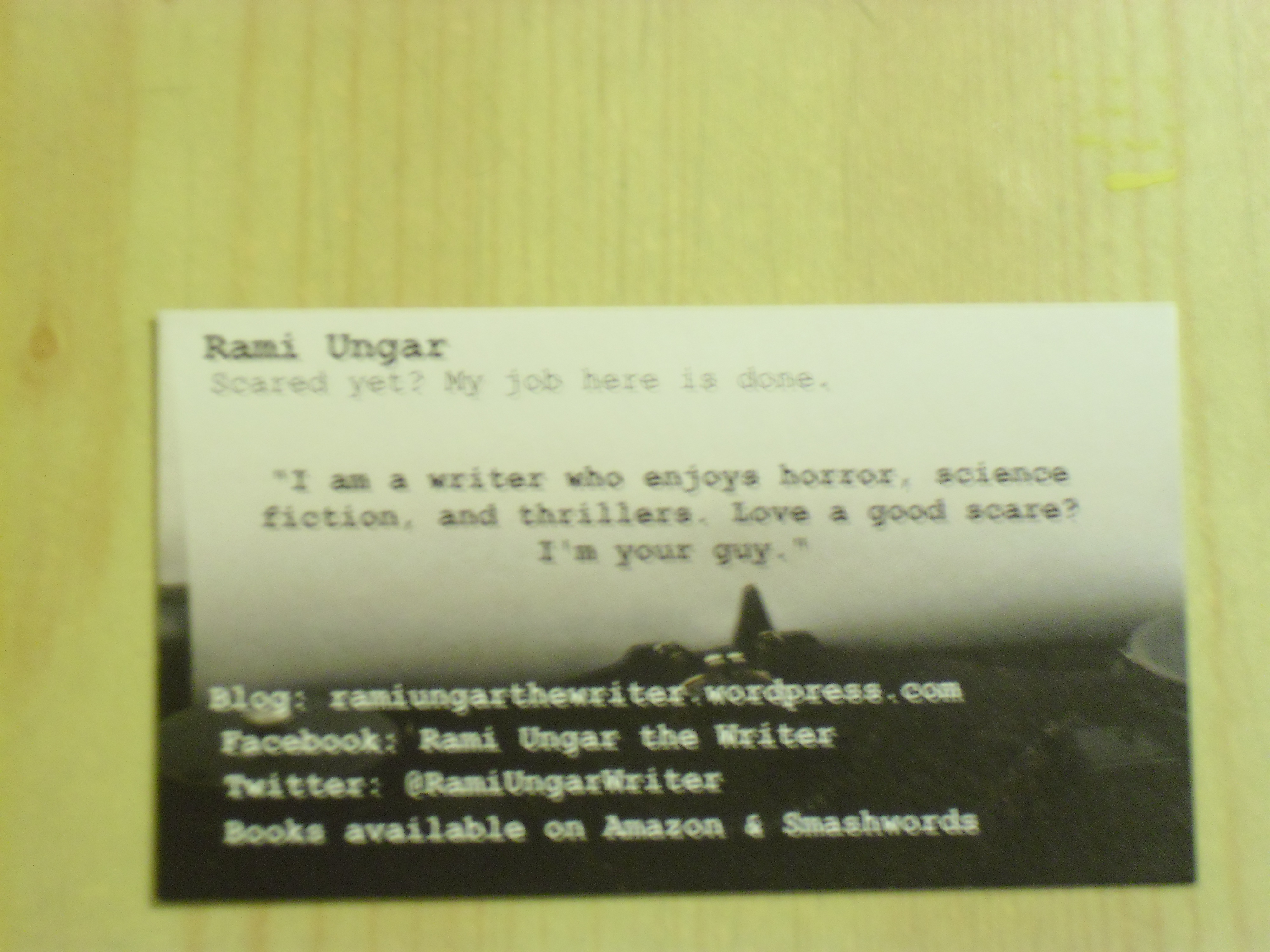
A while back my stepmother recommended that I get business cards as a possible way to help further my writing career and possibly get some new readers. I’d considered getting business cards before, but the busyness of life (among other things) had kept me from actually designing and ordering some. That very evening though, I went online, designed some cards, and ordered them. And yesterday they arrived in the mail for me, all 250 of them.

I’m sorry if these photos of them are a little blurry. I’m using my digital camera, and it’s a few years old. Anyway, here’s the front of the card.

business card 1

And here’s the back.

business card 2

Now if you couldn’t make out the writing on the card, the front has my name, the slogan of my blog (“Scared yet? My job here is done.”), a little about the stories I tend to write, and the social media sites I use, as well as where my books are available. The back has the names of my books in order of most recently published. And as you can clearly see, the design is a typewriter.

I hope that these cards will help spread word about my writing. I get a lot of people who say they want to or will read my books, but then they end up forgetting. It’s understandable, my books are not exactly top priority in the lives of the people I meet, and sometimes people forget my name, how to spell it, the names of my books, and/or how to spell those. I’m hoping these cards will act as physical reminders that will get people to actually check out my books and social media sites. They may also help me perhaps find new people to work and collaborate with and possibly open up some doors for me. I can hope, anyway.

At the very least, I’ve already given out a few to people interested in reading my work, so I guess it’s up to them now to decide whether or not to actually use the card and find my work. I’ll keep my fingers crossed and see what happens.

I plan on writing an article about business cards for Self-Published Authors Helping Other Authors when I get the chance. In the meantime though, I’ve still got a few chapters of Laura horn to get through, so I’ll work on that first. Wish me luck as I try to finish one or two chapters this evening.

What do you think of my new business cards?

Do you use business cards to help with your writing work? What are they like? Do you think they’re helpful?

snake

How far would you go for love and revenge?

It’s been two weeks since Snake was published. Still can’t believe it. Just the other day I signed my dad’s copy of it (last I checked though he hasn’t seen the message I left. Abba, please know I meant it as a compliment if you’re not sure what to make of it).

Anyway, I just wanted to remind everyone that today is the last day to purchase the e-book of Snake for only $0.99. From June 25th to July 7th the price will go up to $1.99, and from July 8th onwards it’ll be $2.99 until the next sale. So if you’re interested in reading the e-book, now’s the best time to do it.

And if you prefer print books or you don’t have an e-reader, the paperback is at last check $10.37. I’m not sure what algorithms Amazon uses to control its paperback prices, but if you would like to purchase the paperback, it just got a bit more affordable over the past couple of days.

If you want to check out Snake, you can visit its Amazon page or you can see its page here on the blog. And if you end up getting Snake and reading it, please let me know in a comment or in an Amazon review what you thought of it. Positive or negative, I always enjoy feedback, so please let me know if you liked Snake, or if you thought certain aspects could be improved, or if you were mad that there wasn’t a character who smoked in the story (apparently some people will give lower grades to books depending on minute stuff like that. I don’t know anyone like that, I’ve only heard, but apparently they’re out there).

Have a great day, everyone. I hope to have another blog post out soon. Keep an eye peeled for it, and thanks for checking Snake out. I really appreciate it.

I do a lot of female leads in my writing And for some time now, it’s been bothering me. Not the kind of bothering like “I’m a dude, I should write more male leads”, but the kind of bothering where you ask every four-year-old’s favorite question: why? Why do I feel such an affinity towards female leads? And why do they always seem to come into the story with some baggage or that they get baggage early on in the story?

I’ve been wondering about both points for some time, and I think I might finally have some answers. For why I prefer using female protagonists, I think it has a lot to do with my childhood. I grew up in a family with a lot of women in it. That has some upsides and some downsides, one of the upsides of which being that I had some very good examples of strong women right in my own home. My mother is a woman rabbi and became ordained in an era when there were very few women before her or with her in that role (there still aren’t many women rabbis, but there are certainly more than when my mother was ordained). And sometime after she divorced my dad, she became involved with another woman, who I’ve come to look up to as another mother. My mother’s partner is an accountant, and was there countless times when I was having trouble with math throughout middle school and high school. She was also one of the people who taught me to play sports during the few instances where I showed an interest in sports (rare instances, but thy exist).

Besides my family, some of my childhood heroes were actually heroines. Growing up, I was very big into shows with girls who could have normal lives one minute and kick monster ass the next. This primarily involved Sailor Moon and Buffy the Vampire Slayer, both of which I’m still huge fans of (by the way, Sailor Moon is getting an anime reboot next month. If you haven’t guessed, I’m kind of counting down the days till then). Besides sometimes having really creepy monsters and awesome battle scenes, these shows portrayed women as more than just screaming damsels in distress who need a man to help them. They show women able to fight back as well as have real character development and  growth. With all these influences, it’s no wonder as a writer I tend to write more female protagonists than male.

And I think that that’s a good thing, really. If you look at our contemporary media, you see several more men than women as leads, and generally the men are much more developed. Sure, there are women like Katniss Everdeen and Black Widow or Mystique, but the former seem very underdeveloped in Books 2 and 3 when you consider how she keeps going back to her romantic issues and how her life is mostly manipulated by powerful men, and the latter have yet to have their own solo films. Recently there’s been controversy over the new Assassin’s Creed game not having any female leads, and most video games still don’t have as many female playable characters as men, and those that do don’t always take the time to develop their leading ladies. To be sure, there are a new class of women (particularly women of color) emerging in the media who are portraying women in strong, positive, fully-developed roles, such as Olivia Pope in Scandal, the detectives from SVU, and even the women from Orange is the New Black. But there is still a long way to go, and the landscape is still very uneven.

Even though my work is only read by a small amount of people at this point, I like to think that with the large number of female protagonists I write (and hopefully received as well-written role models) is helping to correct the problem and give more girls what I was given at a young age, which was some great examples of strong women.

As for the whole thing with the baggage that a lot of my characters come with, I think that can be said for a lot of writers. Let’s face it, authors tend to have their characters come with baggage. Maybe they’re orphans, or they lost a loved one, or they have a dark past with family issues or drugs or something. I think that’s because we like our characters to be a little broken, in order to make them more identifiable and to make it easier for us to facilitate character growth. Honestly, I think it’d be more of a challenge to give a compelling story with development and growth to a character who doesn’t have anything worse than clinical depression or a tendency to pig out on junk food.

In any case, I’m happy to say I now have a better understanding of myself. I look forward to seeing what I can do and what I can write now that I have a better understanding of my process and the sort of characters I create.

Well, that’s all for now. I think I’ll sign off now and watch some TV. Have a good night, my Followers of Fear.

DSCF0005

He started out on a farm, but had to leave because people were after his life. What happened over the many years for this man, before turning to writing, involved a life with more twists and turns than a labyrinth, involving drugs and crime, camping and living in the mountains across North America, and even some interesting paranormal experiences. Today’s interview is with Timothy Louis Baker, author of Fantastic Florida Fun, Crime and Drugs on Trip City Street, and his autobiographical When North Meets South and East Meets West.

Based on the descriptions of your books, a lot of your writing seems to be based on your own personal experiences. What motivates you to write about your past and how do you come up with stories based on your life?         

Rami, I often make the comment that I write what I know and I know what I write and that holds true, through present I refer to things of my own life to write about and very little do I have to look up in another book or online somewhere. That is all because I have had such an interesting life and I’ve found that if I take those experiences I’ve had and expound upon them in fiction but along the same lines as has occurred in my own past, that my writing is just that, not only interesting but entertaining, to the ultimate degree. I’m very well-traveled and have been in a variety of locations and multitude of actual experiences, so I have no trouble in keeping a story line going about a certain person, place or thing. Whether I write fiction or non-fiction in the case of my autobiographical works, my story unfolds and continues consistently with new material and not keep repeating the same thing over again. If you examine my writing, you’ll find that the pace is fast and constantly changing, with either what the character is doing, where they are in location or what they are up to. It all varies at an incredible rate because that’s exactly how I’ve lived, continuously changing where I am, what I’m doing or whatever, there is never a dull moment. My lifestyle reflects upon the pages of my books, even the fiction works and really as a writer and an author, because of the kind of person I am, I wouldn’t have it any other way. That just goes to show you, personalities show up through our work and I think that’s the way it’s supposed to be.

Could you walk us through your writing process, from the moment you get an idea to when you publish the book? 

I started writing on pencil and paper then graduated to a typewriter and eventually by computer, but it all goes the same route. I write my story and then I edit it with my own author’s knowledge but sometimes, after submitting to a publisher, I have to crack down on myself and allow them to edit it also. My full-length autobiography Where North Meets South and East Meets West was an idea I had long ago, I mean like when I was 16 years old and hitchhiking to Florida with little or no money, I had an idea that my life was going to be long enough and full enough to write a book about it all, and more. When I was in my 20’s and living part time in the mountains of Kentucky, Tennessee, Arkansas, and the forests of Michigan and Minnesota, I came about the idea for each and every story of all my books and made that mental note in my head the exact ideas I had for them, and eventually I did write them. It was easy because I already had the created version in my head, I just had to use my imagination to add the characters, places and events that were in my head to the pages of my books and behold I am an author again. Then after submission to publisher and acceptance of my manuscript I am again a published author. With me, writing is the work, editing is minuscule comparatively and when I get that acceptance email from a publisher is truly happiness. Because I know my writing is going to be available to the public for the people to have access and that is the point of my career. It’s not how much money I might make or how famous I will become that is important, but getting my writing out there to the people who may read it. The rest all comes along with extras in between that, not just as the main point of enjoyment in my life but the fulfillment of what I’ve written as an author to be enjoyed by others.

You’ve had some very interesting life experiences. What do you do now these days? Is your life any more interesting, or has things gotten somewhat calmer?                  

Ah, but life is the same. Now that I don’t do all of the things, as much or as many times in a row, as when I was younger, doesn’t mean that I’m any less active or live a less exhilarating lifestyle anymore. I keep occupied at what a great many people may do, and I’m sure they do, by online computer and other devices. Look we have access to all of the things that people used to have to go to the library to look up or reserve a mental note to ourselves to ask a certain particular person we might know, next time we see them. Now not only that we can read books and gain all of this information or personal entertainment, right at the touch of our fingertips. Life is as exciting as ever. I fish in the creek, I ride a bike almost everywhere I go in town and at 55 I still lift weights. Lifting weights is what I used to call bodybuilding, but because I’m not a spring chicken anymore and don’t grow as rapidly nor can I do as much weight as I used to, I now just ‘lift weights’ or ‘do my weightlifting.’ As far as living a calmer life? Maybe when I’m a hundred. Never a dull moment and I always mean that in a good way when I say it. One does not have to go thousands of miles to experience adventure. That is something a person can do anywhere they are and anything they’re doing. It is something you find inside yourself, so much of the time anyway. All it usually takes is a little bit of initiative to find or discover and that can be nearby as well as far away, it just depends on the situation. I like the days when the last thing I can possibly do that night when I go to bed is drag myself off to the bed and lay down to sleep, just as much as I like those days when I am able to sit for longer periods of time and let the radio or television entertain me rather than get it by just so much activity of my own hoping that will keep me excited enough to stay up without falling asleep until I get all the work done. Mentally I’m probably more active since becoming a writer than I ever was before. If not then just as much anyway.

How did you get into writing?               

When I was 33 years old I had the idea to write down some notes about my lifetime and because my life had been so interesting up to that point I soon invested in a typewriter that ended up the forerunner of a rough draft for my autobiography. I had lived so many interesting experiences that I thought the world should know all about them. It wasn’t until a few years later that I was able to gain the ownership of a computer but before I did I set down a rule in my house: Every time I came up with an idea on something pertaining to a real experience that happened to me personally in my lifetime I would write it down on a piece of scrap paper and lay it on a pile on my kitchen table. Well after several months and when the pile was a couple of inches tall and I was sure everything I would need the time to think of before writing had already taken place, I finally found a way to get a computer and that is when the placement in chronological and geographical locations began to take shape. With the computer I could write something where I thought it should be and then if I didn’t like where it was or how it was written, I could change it and copy and move it and paste it wherever the best place for it I judged would be at. Well this was OK except that something happened, that is now included in my autobiographical works, a catastrophe and all I got away with it all were the floppy disks of some of the stories of some of my books now, but also including a printout copy of my first rough draft. Well to make a long story short, being relocated a couple of times, finally I was able to manage to procure another computer and that was the one that wrote all of the rest of my seven books that I had not already written on either the floppy disks or the paper printout version of my autobiography. This led to me achieving internet access and that brought on copyrights for all seven books and eventual publishing of them all. Basically I got into writing because I had some things happen to me that I thought were so unique that nobody else in the world had these occurrences and so I was compelled to write then and that is my full-length version autobiography Where North Meets South and East Meets West, the less graphic and condensed edition An Experience Heaven Sent and My Life’s History in Poetry and the uniqueness of those events that I’ve never heard of happening to any living man in my generation were the miracles including and especially the living, waking, physical ascension in Heaven where everyone and everything was young and beautiful and lived forever. Then I was returned to the earth by my ‘higher power’ that had caused me to thus be arisen into that afterlife, also brought me back. If that isn’t something to write about then I certainly don’t know what is of my own personal lifetime of events and trivia.

What are you currently working on?                 

I haven’t been writing any actual books lately but I’ve got one started that I began a few years ago and sometime when the workload of book marketing the seven books I’ve already published slackens and begins to give me ample opportunity to finish writing that one I will. I have to have some time for me too on a personal level to do the things I want to do with my own time on my own space but the name of this newest work of mine is Some Sing Song Way and it is a historical novel about a man that is abducted by Indians from the Oregon Trail and he discovers that living with the red men is actually compatible to his own life. He has a past with the white men and now he lives with Indians, finally on a voluntary basis and actually sort of prefers them. Later in the book he will meet up with the past in a US fort out west and after that when he is alone and in solitude the events of his lifetime will unfold before him as he will contemplate that past with his own history with Indians, while he is living out in nature without either one, or anyone, and he will decide how he really feels about it all in his own present and that will make up his mind on his decision about how, where, and with who he will live the rest of his days.

What is some advice you would give a budding writer?              

I always give the same answer to people that ask me advice through posing this question and that is – write what you like and hopefully that will be what you know and if you write what you know, you are likely to write the very best that you can write. That has so far been my answer to this question of what to tell someone that asks what they should write for a book, written by them.

If you were stuck on a desert island and could only take three books with you, which ones would you take? 

That’s easy and they are all books that I have written. The books that are the most important things that I could ever take with me to be alone. Even if I ever doubted I would ever see anyone else ever again, I would take the three autobiographical works that I have written, Where North Meets South and East Meets West, An Experience Heaven Sent and My Life’s History in Poetry. Because in them I know what I left in print in books behind me back in civilization, the most important words or any kind of works I have ever performed in life would be there to remind me of what I left behind that someday, maybe not in my own lifetime, but someday in some generation in the future perhaps, would be invaluable to the rest of the world of their, those people’s time. In other words, someday in some generation this story will come out and make that big impression upon all humanity at that time and continue for the rest of life on earth as we now know it.

If you would like to know more about Timothy Louis Baker, you can find him at Author’s Den, on the website of SPBRA, Facebook, and Twitter. And if you’re interested in checking out his books, you can find them on Amazon.

That’s all for now. Hope to have some more interviews soon. And if you want to read previous interviews, head to the Interviews page, where authors and characters will tell you about themselves and their books (and whether they write them or spring from them).
I’m going to tell everyone a midrash, a story that helps to explain aspects of Judaism, and which may or may not be true, depending on the story. This story, no matter how you look at it, is very interesting and helps to explain why I’m able to give these reinterpretations.

The story dates back to the writing of the Talmud. Several rabbis were trying to decide on an issue of kashrut, or dietary law. Eventually all the rabbis except one decided a certain way on the issue, with the remaining rabbi insisting he alone was right. This rabbi, who was apparently so learned that he could teach Harry Potter a thing or two (my own phrasing, not the story’s), said that if he was right, then the walls in the study house would cave in, a tree would move from one place to another, and that the river outside would flow backwards. Sure enough, the walls started to lean in, a tree walked across the ground, and the river started flowing backwards. With each occurrence the other rabbis would remind the rebellious rabbi that walls, trees, and rivers don’t decide matters of Jewish law (and they chided the walls for trying to bring themselves down when it wasn’t their conflict). Finally the rebellious rabbi said, “If I am right, let a heavenly voice confirm it!”

At that moment a great voice from above was heard saying, “Follow this rabbi’s opinion!” The other rabbis, instead of cowering and giving in, replied to the voice, “Matters of law are now on Earth, not in Heaven.” The heavenly voice replied, “My sons have bested me.”

What does this tale tell, besides the fact that apparently Talmudic rabbis were said to be quite powerful? Besides the teaching that a majority rule is stronger than a single zealot (and the rebellious rabbi later became a heretic and was excommunicated, interestingly enough), the story shows that once God gave the Jewish people the Torah at Mt. Sinai, it was in their hands, and therefore they had to decide how to interpret it. So basically while some may claim that LGBT people and their allies are going to hell and claim the Bible says so, I can claim just as much that that law no longer applies and that LGBT people and their allies are just as holy as anyone else. And guess what? We can both be right!

I tell this story because a lot of people’s arguments and opposition to LGBT rights are based on a singular interpretation of the Bible, so alternative interpretations of the Bible can be just as legitimate as traditional ones. I also tell this story because, while two opinions can both be right, sometimes one opinion may have more reason to be right than the other (as in the ruling of the majority in the story). For example, I can say that I believe both evolution and the Genesis story to be right. I can’t ignore that dinosaurs, the fossil record, and the distance travelled by the light of certain stars make evolution seem more right than Genesis (which I tend to view as a metaphor for the Big Bang and evolution that humanity is too stupid to understand at this point in our existence).

No denying it: gay people are born that way. It’s in their DNA.

Understanding this, let us look at what science has proven: that sexuality is a genetic trait, and that multiple genes make up sexuality, so multiple sexualities arise. Some people, like a pastor I had the displeasure of hearing speak out on the Oval at OSU this spring, claims that meant homosexuality is a genetic defect. But that would mean there would have to be a loss or impairment of quality of life for the affected. If anything, the scientific method has shown through studies that people who are open about their sexuality and accepted for it tend to live happier lives. It’s only when they try to deny, change, or hide their sexuality that there is some impairment.

Likewise, this also means that homosexuality isn’t a lifestyle, or something you can indoctrinate youth into. As I said, differing sexualities are genetic, and you can’t pray away, condition someone, or ban something so caught up in the very DNA in a person.

Now, some might ask about my previous post, where I said that homosexuality was commonplace in Greece in a ritualized form. I say that was a form of cultural homosexuality. It was done because it was part of the culture, everyone was doing it, and nobody could see any reason not to do it. Plus, having a male lover was a choice, not a requirement. You could almost compare it to video games: everyone seems to play video games these days, and most people don’t see a reason not to play them if you can. (I know that we’re talking about two very different things here, but you get the idea, right?)

In any case, I’ve said what I wanted to say about the Bible, religion, and homosexuality before Pride weekend here in Columbus. I hope you enjoyed the posts I’ve written and perhaps were given some food for thought. And if you’re in the Columbus area this weekend and are looking for some fun, come to Pride. Leave the picketing signs at home, and have a blast. I’ll see you there.

It’s been a while since I’ve done a post reflecting on the craft of writing (outside of Self-Published Authors Helping Other Authors, I mean), so I thought it’d be good to do one. And I figure a good one would be to write on things people say about writing that annoy writers to no end when they say them. You may have even heard some people say these things on writing and, whether you treat writing as a craft, a business, an art, a passion, or a calling, you’re bound to at leas give the speakers an eye-roll. Occasionally you may even call out the absurdity of what they’re saying, because to your ears it’s all so ridiculous.

And why did I decide to pursue this particular topic? Maybe because not too long ago someone said one of these to me and I just got so annoyed with it.

I want to write, but I hate reading. That’s like saying you want to be a chef but you hate eating gourmet food. It’s just not something that’s done. Writers read because it’s how we developed a love of literature, it’s where we study the work of others in order to better understand and improve our own work, and it’s just plain fun for us. So saying you hate reading is basically saying you’re not going to write because you’re not willing to do what’s absolutely essential to becoming a writer. I’d understand if you said you have trouble finding the time to read (we all do, even part-time workers like me), but hating reading is just inexcusable for any serious writer.

I’ll write when I’m retired. This is actually the one I heard recently, when I asked an acquaintance who has a very unconventional and interesting career to write about his experiences. Just because you suddenly aren’t obligated to go to work from 9 to 5 on weekdays doesn’t mean things are magically going to fall into place and you’ll have the time, energy, and will to write. If that were the case, I’d have retired right out of high school! Plus, who’s to say that in retirement you won’t just become busier? It’s happened, I’m sure.

I can write better stuff than the crap they’re publishing these days. First off, I hope you’re not including my work in that grouping. Second, you think you can write better? Pony up! And if you decide to actually try to write something better than what’s out there, be warned: while you may feel that everything you’ve written is more real and heartfelt than what you find at the library, not everyone may agree. Agents, editors, publishers, and readers can be very particular about what they think is a good story, and they may not always agree that you’re better than the other crap writers out there. Often times, what’s popular enough for you to read and decide it’s crap is popular for a reason, so just know what you’re competing against.

I have a story all in my head. Commas and all. I just have to find the time to write it. Okay, let me call the writing fairy to give you a sabbatical to write. Most writers carve out the time to write from their personal time. We don’t expect the time to find us, we actively make time. I’ve written when I could be taking a nap. One of my friends who recently published her first book wrote in notebooks on the buses to and from work. There are writers who get up an hour before everyone else in the house and stay up an hour later just so they can jot down 500 words or so and feel like they’ve made progress. So don’t expect to find the time or let it magically appear: go and make time!

Writing’s not something you can make money off of. Usually no, writing is not something you can make thousands of dollars off of. The writers who are able to write full-time are lucky. Most have day-jobs because writing alone will not pay the bills. I certainly have not made enough money off my work to take up writing full-time. However, most writers don’t get into the business for the money. We get into it because it’s a passion, something we really enjoy, and the money comes secondary to all that. Sure it’s nice, and we wouldn’t mind some income from our writing, but it’s not the main reason why we sit at our desks or on the couch punching out word after word after word. If it was, I would’ve given up writing a long time ago and would’ve gone into law.

I have this idea for a story about… I’m going to stop you write there. Normally I’m interested in hearing about other people’s stories, but I have a question: do you have any intention of writing it? If you don’t, it probably wouldn’t be good for hear it. I might just run away with it and use it for the basis of my own potential bestseller. Well, I wouldn’t, but there might be some unscrupulous fellows who would.

There are too many writers out there already. I can’t make an impression. Every writer worries about this, but most don’t let it keep them from trying. And you never know: you could end up being the next JK Rowling, F. Scott Fitzgerald, or William Shakespeare. But first you have to put yourself out there. Besides, if I was worried about impressions, I would’ve given up writing a long time ago and gone into–oh you know what I’m going to say!

I’m good, so I don’t need to edit. Even the greatest authors needed to edit! I don’t know a single author who doesn’t need to edit. We all make mistakes that others will point out, we all have flaws in our stories that will turn readers off. That’s why editors exist: they catch these problems before the book makes it to publication. Otherwise you have all that crap online that has little to no editing and that brings a bad name to self-publishers. So even if it’s sometimes a little expensive, you might want to shell out a little money for a copy-editor or a beta reader to take a look at your work, because it’ll improve your work vastly and you will benefit from it. Heck, I think the only writer out there who doesn’t need an editor is God…wait. There are some ambiguous phrases in the Bible that make no sense, and some that have garnered a lot of controversy. Plus the tobacco and marijuana plants: were they really necessary for the world? Yep, all writers need editors.

What are some things people have said to you about writing that you think si utterly ridiculous? What would you say to them?