Posts Tagged ‘novel’

It’s Friday again, so you know what that means. It’s #FirstLineFriday! Also known as “that blogging trend Rami Ungar’s trying to start with mixed results.” Here are the rules:

  1. You write a post titled #FirstLineFriday (hashtag and all)
  2. You explain the rules like I’m doing now
  3. You post the first one or two lines of a potential story, story-in-progress, or completed or published work.
  4. Finally, you ask your readers for feedback.

This week’s entry comes from another story I came up with in high school, and it has some influences from both Stephen King and some slasher movies from the 80’s. Enjoy:

She had to hide, and quickly too. Mitch was coming, and he sounded angry.

Thoughts? Comments? Let’s discuss.

That’s all for now. I’m glad the weekend is here, especially since that means Star Wars has finally arrived. I’m going to see the movie Tuesday during a matinee performance. Should be good (but if anyone spoils the film for me, I will make them regret it). Have a good weekend, my Followers of Fear!

Recently I read an article about eleven recent novels that Stephen King apparently found scary. Being the fan of His Royal Scariness that I am, I checked out the article and found this book at the top of the list. The premise sounded interesting, so the next time I had a credit for an Audible audio book, I got A Head Full of Ghosts by Paul Tremblay, which is about a young woman who tells us her memories of when her elder sister started showing symptoms of schizophrenia, but when treatment after treatment seems to fail, the family comes to the conclusion that the sister is possessed, and somehow a reality show documenting the family’s attempts to exorcise their daughter evolves.

Like I said, it sounded interesting, and it was, though I wouldn’t call it scary. I mean, there are a few moments that can be terrifying, but even imagining them as a horror movie in my head, I didn’t really feel that it was as scary as King hyped it up to be.

Still, A Head Full of Ghosts is definitely not a dull read. In fact, it’s quite entertaining. The main character and narrator, Meredith “Merry” Barrett, is one of the most enjoyable types of narrators, the unreliable kind (see my post on unreliable narrators). Eight years old at the time of the events of the novel, she tells them anew to a writer for a new book in the year 2030 (which apparently still values paperbacks and blogs. I find that reassuring). As she tells us early in the novel, she misremembers a lot of what happened, due to the passage of time and of course what everyone has told her has happened.

To a certain extent, most of the characters in this novel is unreliable to a degree. We can’t tell what’s up with the older sister: is she possessed, is she schizophrenic, is she something we don’t have a word for? The things she says and does, you get a lot of conflicting signals. I have my guesses, but you really don’t know at all, right up to the end. The father is struggling because of unemployment (I sympathize) and has recently rediscovered God and begins to see everything through a religious lens with disastrous results. The mother seems to be perpetually grumpy and wavering between trying to be in control and trying to be responsible as her life unravels. The priest from the Catholic Church seems priestly, but underneath that you get a sense that he’s milking this situation for his own reasons. It’s amazing how little you can actually trust these characters.

My favorite parts of the novel involve segues into a blog by a horror fan (a woman after my own heart) where she gives us an idea of what watching the reality show was like, as well some good ol’ scholarly examination of some of the show’s deeper meanings. And all with a snarky voice too. These segments are hilarious and fun, but they also help us as readers put the story and characters into context and prepare us for future events in the novel.

Another part I enjoyed about the novel is just seeing Merry and her family experience her sister’s illness/possession/whatever and then the craziness that is being the subject of a reality show, how fame has its downsides, how the show and the ordeal brings out the worst in her family, how her relationship with her sister becomes strained by all these events. It’s a very engrossing evolution.

One problem I do have with this novel (besides the fact that I never really found it scary) is that we never really see Merry outside of the context of her family or the show. Not even when we see her as an adult, because it’s fairly obvious that her family and the show has affected the adult she’s become. I would’ve liked to see Mary outside of the context of the family or the show, maybe in the company of friends or her soccer program. Those aspects of her life are mentioned, but they’re not really delved into, and I think she would’ve been a fuller character if we saw that her family and what’s going on around it isn’t entirely what defines her.

Oh, that and I didn’t particularly care for the audio book’s narrator. I mean she was good, especially when she was voicing the older sister, but when she does male voices, especially the father character’s voice, it sounds like every daughter’s impression of her embarrassing father or teacher. Just not convincing at all, more comical than anything.

All in all, I give A Head Full of Ghosts a 3.9 out of 5. It’s not as scary as I’d hoped it would be (or maybe I just listened to it wrong), but it’s psychological, it’s entertaining, and you want to see it through to the end. If you’re looking for a book that’s like The Exorcist with a modern twist, this might not be for you. But if you want to read something with dark subjects but you’d like to sleep at night, I think you’ll find this book fits the bill.

Smile Dog, a creepypasta character.

Recently I’ve been delving into a genre of horror that’s grown up on the Internet, and I have to say some of it is quite impressive. I’m talking, of course, about creepypastas.

Now, for those of you who’ve never heard of this and think I’m talking about a Halloween treat, a creepypasta is actually kind of like an Internet campfire ghost story, scary stories designed to shock and terrify and that originate online.  They’re sometimes accompanied with images, audio or videos, usually distorted or featuring or gore or creepy imagery, in order to intensify the effect. The name “creepypasta” comes from “copypasta”, a slang term for text that is copied and pasted around the Internet multiple times.

And even if you’re not familiar with creepypastas in general, you may have heard of some. Slender Man, whom I’ve written about on this blog before, has been the subject of numerous creepypastas in the past, to the point where some creepypasta-devoted websites no longer upload new literature about ol’ Slendy. There’s also the novel Penpal, which started out as a series of creepypastas, and Candle Cove, a story that’s reportedly being adapted to television by the Syfy channel.

Slender Man has been featured in a variety of creepypasta.

Now while the length and quality of creepypastas, like every other type of fiction, vary from one to the other, there are some ways to categorize them:

  • Anecdotes: as far as I can tell, these are the most popular of the creepypasta story form. The narrator(s), often anonymous, talks about a scary legend, a new story, or something from their past. The anecdote stories are often told in the epistolary format, or in the form of a letter or journal entry, though this being an Internet phenomena they’re more often told as blog posts or Reddit threads. They’re certainly my favorite form of the genre.
  • Rituals: As the name suggests, these are things you can do to make something terrifying happen to you or someone you know. Examples include the Midnight Game or Bloody Mary (which I’ve tried on numerous occasions, and I’ve never seen any results). Sometimes these rituals have a short backstory, but they can vary, like with the Bloody Mary game. And as you can guess, these are quite fun at parties.
  • Lost Episodes: This form has kind of fallen out of favor but it has some pretty famous creepypastas. Lost episodes usually describe a missing scene or episode from a famous TV show, usually a comedy or children’s show, that depicts a character acting very strangely and violently, usually ending in that character killing themselves or the other cast members. Often times the episodes, when they are supposedly found, feature strange or distorted audio and video, and occasionally are rumored to cause violent behavior in viewers. As you can guess from the description, these are pretty formulaic and repetitive, which is why they’ve lost popularity, though some are quite well known among creepypasta devotees.

Squidward Tentacles from Spongebob Squarepants has been the subject of a Lost Episode creepypasta. You can probably guess the rest.

As I said above, there are entire websites devoted to the creepypasta genre and droves of fans, some of whom create their own stories and upload them online. What makes this genre so popular? Well, I’m still pretty new to the genre, but I think that there are several factors that may explain this popularity. One is that creepypastas tend to be a bit more extreme than mainstream horror. They’re often accompanied by scary imagery or some other strangeness, and that adds to the creep factor. There’s also the very subject matter of creepypastas: with some stories, you can take elements from them and create your own stories. Slender Man is a character who’s been featured in a variety of media, and plenty of people have made creepypasta based on him. And then there’s the virality of creepypastas: you’re encouraged, by their very nature, to keep sending them around and around the Internet. There’s a certain power in that very concept that’s exciting, and encourages creators as well as readers.

It’s especially interesting when you consider that this is a genre born on the Internet, which has the reputation of having content geared towards people with short attention spans, and also is sometimes considered the gathering place of creators who couldn’t make it in the “real world” (eye roll please?).

Personally, I think creepypastas are quite entertaining. Some of the stories are very good, very creepy, and I enjoy listening to readings of popular creepypasta by YouTube artists. I know some people find them too extreme or that they lead to violent behavior (a subject for another time, not going into it here), but I see it as no different than enjoying a Stephen King story or going to see the latest scary movie. Just a different format with different rules that I would like to learn (though not write; by the very nature of creepypasta, I wouldn’t have as much creative control or make some side income off my work. Maybe I’ll try writing in the style though for a novel someday).

If you’d like to try some creepypasta, here are some good ones I’ve come across. If you check them out, let me know what you think:

Are you a fan of creepypasta? What is it about them that you like or dislike?

What are some creepypastas that you’d recommend trying?


I’ve been wanting to do a post like this for a while now, but I only got around to it now after a friend of mine did it on her blog and I thought to myself, “Yeah, might as well get my butt in gear and do this already.”

So anyway, if you’re unfamiliar with the Bechdel test, it’s used to measure how feminist a work of fiction, usually a film or a novel, is. It was first created by cartoonist Allison Bechdel for her comic strip Dykes to Watch Out For, and has since become used in academic circles and with critics.

Here are the criteria for passing the Bechdel test:

  1. You have two female characters (sometimes having them named is a requirement, and I’ll do that here).
  2. They actually have to talk to each other.
  3. They have to talk about something other than a guy.

On that last part, I usually take it to mean talking about a guy who is in some sense romantically linked to one or both characters. After all, a lot of stories focus solely on a woman’s quest for love or marriage, and that’s it, and I feel like that’s what this test was designed for. And what if the two women are detectives and they’re talking about a suspect who’s male and how he’s difficult to bring to justice? That should be worthy of passing the Bechdel test.

Now before I begin, I want to make one thing clear: I don’t see this test as the end-all test for how feminist a work is. While some do use the Bechdel test in that capacity, I see it more as a tool to examine various works of fiction and promote discussion, rather than as the only way to get a work to be called feminist. Heck, even film organizations who use the test when rating a movie do it mostly for collecting information on gender inequality in films and to make viewers aware of that same gender inequality more than anything else.

So without further ado, here’s how my novels (I’d do the short stories as well, but there’s a lot of those, so I’ll pass) do with the Bechdel test:

  • Reborn City/Video Rage. I place these two together because they’re part of the same series. And they do pass the Bechdel test with flying colors. There are several named female characters in RC, particularly protagonists Zahara Bakur, Ilse, and Iori. And they do talk to each other about a lot of other stuff besides men, including the gang situation in West Reborn and how being a gangster is not for the faint of heart (a problem for Zahara considering she prefers peace and harmony to violence and gun fights). Similarly in VR, there are at least four or five named female characters, including the ones I mentioned above, and they also talk a lot about things other than men, including the situation they’re stuck in or the history of the war that made the world how it is in their present (our future).
  • Snake. Um…yes, but just barely. There are three or four named characters, including the female protagonist Allison Langland. However, as so much of the book focuses on the Snake’s quest to save Allison and then to keep her safe, she doesn’t have a lot of onscreen time with other female characters. There is a scene where Allison speaks with another character about events to come, but the Snake is also part of this conversation, so I guess it depends on your point-of-view on the subject. If there’s ever a sequel to this book, I may try to do better on that front while writing the story.
  • Laura Horn. Despite still working through the second draft, I can tell you LH passes the Bechdel test. There are several named female characters, including our protagonist, and that they do talk to one another about things other than men. Especially the fact that Laura’s wanted for a crime she never committed. Yeah, heavy stuff. Guys and romance actually don’t come up that much. Yeah, romantic feelings are part of the story, but by no means are they the focus, and I expect that will be the case still when I reach the final draft (whenever that is).
  • Rose. Again, this one just barely passes, and whether it does is a matter of perspective. As I’ve mentioned, Rose is about a woman held captive in the home of a man claiming to be her lover. Rose spends a lot of time on her own or with the guy whose house she’s in. She does have conversations with another female, but this female isn’t exactly human, and a few other things about this being call into question whether or not it counts. There’s also a conversation Rose has with another girl in a flashback, but I don’t know if flashbacks count either. So again, this one’s up for debate, one that might not be settled until after the book is published (whenever that is).

So the final verdict is that one half of my novels pass the Bechdel test, and the other half are a matter of opinion. Again, this test isn’t definitive by any means, and as demonstrated in the cases of Snake and Rose,  there are shortcomings to the test. However, it does feel good to know that half my work does pass the test, and the other half might. Surprisingly about half of all films don’t pass the Bechdel test, while quite a number of movies pass what is known as the reverse Bechdel test, which focuses on men (not going to bother with that, except to say that Rose is probably the only one that doesn’t pass). I like to think it says something good about my personality or writing style.

Perhaps in a few years I’ll try applying the Bechdel test to my works again and see what happens. In the meantime, I think I’ll focus on creating good stories in general. And possibly applying other tests to the stories I write (though I’m kind of afraid of what the results might be and what they say about me as a writer). We’ll see how I feel about it.

What are your thoughts on the Bechdel test? Do your works pass it? Why or why not?

It’s Friday again, so you know what that means. It’s #FirstLineFriday. And God, am I glad the weekend’s about to start. Honestly, this week has been a little stressful. But hopefully good things will happen over the weekend and I’ll be re-energized come Monday.

Anyway, onto the rules of #FirstLineFriday:

  1. Title a post #FirstLineFriday (hashtag included)
  2. Explain the rules
  3. Share the first one or two lines of a potential work, a work-in-progress, or a completed or published story.
  4. Finally, ask your readers for feedback.

This week’s entry is from a novel idea I had all the way back in high school, and is one I think people would really enjoy reading. If they can deal with whatever the main villain is. Anyway, enjoy:

A drunk man stumbled his way out of Chinatown, unaware that he would soon be famous across all of San Francisco.

Thoughts? Problems? Tell me in the comments below.

Well, that’s all for now. I’ve got some stuff to take care of before the day is done, so I’m going to get on that. Until then, you have a great day, my Followers of Fear. I know that I will, if this afternoon goes as well as I hope.


You know what there are a lot of these days? Fictional universes where characters from a variety of diverse works are all brought together into a single work or series of works where they interact with one another in various ways. From HP Lovecraft’s Cthulhu Mythos, to the many different iterations of DC and Marvel comic book worlds and their film and television counterparts, to the shared elements of Anne Rice’s vampire and witch series and Stephen King’s interconnected multiverse and then some, there are a lot of these shared universes these days. Heck, there’s even theories from everyday people about how different works by certain creators are all secretly part of the same story (examples include this Pixar theory and this theory on the majority of Joss Whedon’s work).

So I’m wondering, what is the reason behind all of these interconnected story worlds? What makes storytellers and creators of all different mediums want to have such expansive universes where everything is secretly connected and you have to create a huge conspiracy layout on your wall with tape and string and stuff?

Well, I think some part of it is money. At the end of the day, most storytelling is a business (except for maybe some of what appears on YouTube), and if two characters in separate stories are making profits for a creator or their business, they may try to bring the characters together if it’s feasible and if the fans want to see it. Heck, that’s kind of the reason for most comic book crossovers and the movies based around those crossovers. Fans enjoy seeing Superman and Batman work together or Tony Stark mentor Spider-Man or whatever, so the companies give them what they want and get a profit back.

That’s not to say that all of it is money or that money’s the biggest motivator (unless you’re a Hollywood studio, of course). Another big part of it is the creators. They love their characters, and many would like to see those characters they’ve invested time and effort in come together in an awesome story. How would they play off each other? What sort of trouble would they get into with each other and how would they pull themselves out of it? And how would they grow after meeting each other? I think a lot of writers create these crossovers just so they can answer these questions. They may make multiple volumes to continue asking those questions, adding new characters or situations to continue creating exciting new stories and dynamics. It can be pretty enticing to do that with characters you love so much, and I bet audiences enjoy it as well.

In fact, I’ve imagined doing that with Snake and Laura Horn. Yeah, I have. I’ve mentioned before that I’ve wanted the story of the Snake to continue, and I’ve planned sequels not just for Snake, but for LH as well, including one where the two characters meet and get into a crazy adventure together. And I may be a few books and several years from that crossover, but it’s there if I want to write it, and eventually I will write it. It just sounds like too much fun to pass up.

snake front cover

I really have to get around to that sequel someday soon.

Another reason that creators may do crossover works is just because it makes things easier. Now, I hear you typing in the comments already “How the heck does a crossover or shared universe make things easier?” I know it seems counter-intuitive, but let me give an example: Anne Rice introduced in Queen of the Damned, the third book in her Vampire Chronicles, the Talamasca, an international organization of scholars interested in studying the paranormal. Now, try as I might I could not find any information on why, but when Rice wrote her Mayfair Witches trilogy, she brought in the Talamasca society. Why? Because at some point in the first book she details the entire family history of the Mayfair family and its dozen-plus matriarchs and I guess it made sense to just bring in the Talamasca as an explanation as to why there was an entire history of the family when the family itself isn’t very interested in its history. And it helped with the later books in certain ways to have the Talamasca. See? It was easier to bring in an existing fictional organization concerned with the paranormal than make up an entirely new reason for a third party to document an entire mystical family’s history.

I’ve also heard that’s why HP Lovecraft created the Cthulhu Mythos. He didn’t intend to create an entire cosmology, he just decided it might be easier to work with some familiar characteristics when creating all-powerful monsters, and from there it wasn’t too hard to make the jump to connecting Cthulhu to Yog-Sothoth and any of the other Old Ones. Now, I’m no Lovecraft expert, but I’d buy that explanation.

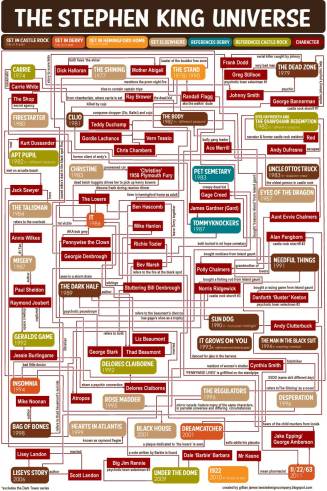
King’s references are so crazy! Check out this chart!

Of course, some authors do it because it’s fun to have a shared universe, for a variety of reasons. You can return to familiar characters and locations by doing so. You can make your readers marvel and go back to another story to say, “Hey, that matches up with so-and-so.” You can create a cosmology or a special reason why a character or characters or place or places appears in so many stories (I’ve got a character or two like that, I just haven’t been able to put them into any works yet. I tried with the human Barbie story and Evil Began in a Bar, but I couldn’t fit them into the former and I haven’t figured out how best to edit the latter yet, so…). And sometimes, it’s just fun to mess with your readers and make them wonder what the heck it all means (I’m pretty sure that’s the reason Stephen King references his other works so much, and the Dark Tower books simply grew out of a desire to create a complex story out of all that messing about).

Whatever the reason someone creates a shared universe, it’s pretty clear that there are plenty of reasons to do so, and that shared universes are here to stay. And whatever the reason behind them, as long as they’re done with love and people enjoy them, I see no reason not to keep doing them. Besides, I may have one or two I’d like to create someday.

Do you have a shared universe in your fiction? Why’d you create it? What has been the result of that?

It’s Friday again, so you know what that means. It’s #FirstLineFriday! Also known as one of the highlight of my weeks. Especially if people like what I put out.

Okay, here are the rules, as usual, for #FirstLineFriday: you write a blog post with the title #FirstLineFriday, hashtag and all, and then you repeat the rules. Then you post the first one or two lines of a possible work, a work-in-progress, or a completed or published work. Final step is to ask your readers for feedback. It’s great fun.

This week’s opening comes from a novel I had the idea for yesterday while walking home and listening to the Needful Things audio book by Stephen King (that was a trippy and creepy book, I tell you). It’s the sort of story that has a really strange mystery to it. I hope when I get around to writing it, I’ve figured out the mystery a bit more. Enjoy:

Any writer, engineer, or psychologist who’s good at their job will tell you that a story, Rube Goldberg machine, or the mind is made up many different and complex parts. Looking back, I think I was stuck in twisted versions of the first two and in danger of losing my own mind, as un-complex as that was at fourteen.

Thoughts? Too long? Suggestions? Let me know in the comments below.

That’s all for now. I’ll try to post a few posts over the weekend. I’ve got a special one planned for Saturday night, believe me.

Have a great weekend, my Followers of Fear!

RC cover

It’s been a long time in the making, and a lot of work since I announced that I was planning on turning Reborn City, my science-fiction novel, into an audio book back in August. I listened to a lot of audio samples, contacted a bunch of potential narrators, and even received a couple of auditions. But as of today, I am very pleased to announce that Reborn City has a narrator!

If you’re unfamiliar with Reborn City, it’s a dystopian science fiction novel that follows Zahara Bakur, a Muslim teenager who’s forced to join a street gang called the Hydras, and her involvement in a strange plot involving the gang’s superpowered leaders and the shadowy corporation that rules the city they live in. The novel contains themes of Islamaphobia, racism, gang violence, drug addiction and several others.

It also is a world that has much more resemblance to our own than Hunger Games or Divergent does (just look at the refugee situation these days and how some governments have responded to refugees these days) and I like to think it makes a little more sense than those books.

The audio book will be narrated by Barron Bass, an actor and voice artist based out of New York (check out his website here). I heard some of his samples on ACX, the website I’m using to produce the audio book (see my article on that site here). I liked what I heard, and I started corresponding with him. Once I heard his audition, I had a pretty good feeling I’d found my man. After some more weeks of correspondence, I sent him an offer and he accepted.

Our esteemed narrator, Barron Bass.

Now, I’m hoping we’ll have the whole thing done by early March, but I’m flexible. If Mr. Bass needs more time, I’m willing to give it to him. You can’t rush perfection, after all.

So I’m looking forward to seeing what comes next, which following the production process on ACX is that the first fifteen minutes of the book are recorded for my approval. After that, I give some feedback, and we work chapter by chapter on the book. Once it’s all done and it’s uploaded onto Amazon, Audible, and iTunes, I’m hoping a lot of people decide to check it out and take a listen. Maybe leave a few reviews while they’re at it.

And if RC does well, then maybe I’ll do Snake as well, and any other book I decide to publish from here on out. We’ll see what happens.

In the meantime, I’m going to go do my happy dance. Have a good rest of your day, my Followers of Fear. I know I am.

It’s Thanksgiving in America today, when you’re supposed to be thankful for what you have in your life. Well, you should be thankful for all that year round, but especially today, because…the government made this a national holiday with that sort of connotation.

Well, in the holiday spirit, I’m going to write about all the things I’m thankful for in my life. There are quite a few, but I think I can get keep the list down to the most important ones.

My friends and family.

Whether I met them online, through school or work, or if I’m just related to them by blood or marriage, I love my friends and family. They keep me strong and help my mood stay up. Yeah, sometimes we have our disagreements. My sisters and I can get very nasty towards each other if we spend way too much time together. But it’s the people in my life that keep me less insane and are why I get up each morning. Love you guys. I’m so thankful you’re in my life.

My stories and those reading them.

Understandably, my stories are very important to me. They’re almost like my children. I’ve put so much work into them over the many years, and I always feel so happy when I get to a new stage in their writing process or when they get published. I’m so thankful that I’m able to write these wonderful stories and to work on them. It’s my passion, and I wouldn’t give it up for anything.

I’m also thankful for my readers. Whether you’re on my blog or checking out my books, you people are important to me. Every writer is a bit of a narcissist (why do you think we’re so desperate to get our work read by others?), so you guys tuning in every time I publish a post or ordering a book off Amazon just bring the biggest smile to my face. Thanks for coming at all and coming back again and again. It means so much to me.

The experiences I’ve had.

I’ve been to Germany twice. I’ve also been to England, France, and Israel in my time. I graduated from a good school with a great sports program (Go Bucks!) and I got to study fields I love. I’ve had great work experiences, with Ohio State, the building I lived in for two years, and the US Army. There’s a good likelihood that I might get that with my next job, once I find it. I have a blog with hundreds of followers and it’s growing, slowly but steadily. And of course, I’ve published a few books and I’ll hopefully publish a few more in the coming year.

There are also a bunch of bad experiences that I’d rather not remember, but they helped me grow as a person, so I’ll acknowledge them too.

To say the least, I’ve had the pleasure to see and do a ton in my short life, and I probably will get to do much more in the future. I’m thankful for my experiences, good and bad (though I could always use less of the bad). They bring quite a bit of spice to my life.

How good I’ve had it.

There are a lot of people less fortunate than me. I’ve never been persecuted because of the color of my skin, what country or region I’m from, or my religion. No one tells me what I should do with my reproductive organs like they know better than me when they don’t. I’ve never lived in a violent neighborhood or feared for my life just by walking out the door. I went to college and I’ve been able to earn a living except for short periods here and there. And there’s a growing amount of people in the US who don’t think I’m sick in the head, unholy, or after their children just because of my sexuality. And I’ve had a bunch of people in my life supporting me and showing me right from wrong and offering me their advice when I need it. I’ve had it good.

And there are people out there who cannot say the same thing as me. Plenty of people the world over suffer because of their race, their religion, their gender, their sexual orientation, their ethnicity. They’ve been hungry, or lived in war-torn areas. They’ve experienced violence in their own homes. Some, through genetics or accident, live life without the full use of their bodies or minds.

I’m aware of how privileged my life has been, and how so many people struggle through life because of some form of unfairness or another. That puts me in the unique position to try and help them. Whether it’s raising money for charity, advocating for a certain change, attending meetings, writing blog posts, or simply weaving an issue into a story, I’m making a difference. Perhaps it’s pretty small, but it’s better than nothing, right? And just because it’s easier to let other people handle the problems of the world, doesn’t mean I should.

So I’m thankful that I’ve had a good life. And I’m thankful that I know it, and that I’m in the position to make a difference. Because if I don’t, then I’m basically contributing to the decline of the world and of humanity. And I don’t want that to happen.


I’m not exactly sure who I’m supposed to be thanking on this day (God? The Founding Fathers? Whichever President who made this holiday a thing? It’s never really discussed), but I’m thankful. I can’t take for granted anything in my life, because it could be taken away at a moment’s notice. You never know what will be thrown at you. And here today, I’m making sure people know what I’m thankful for and that I don’t forget it.

Well, that’s all for now. I’ll see you all tomorrow. It’ll be Friday, and you know what that means. Goodnight, my Followers of Fear.

What are you thankful for in your life?

About a week or two ago my friend Angela Misri posted on my Facebook timeline about a short story contest that Stephen King would be part of. Apparently people could submit short stories under four-thousand words and His Royal Scariness would pick the winner. Unfortunately the contest was only open to UK residents, which upset Angela and me a great deal (I knew I should’ve been born a British lord, but for some reason I decided that being the son of two rabbis was a better deal). However, if I could enter the contest, and it allowed short stories under six-thousand words, this probably would’ve been the short story I submitted.

After extensive editing, of course.

“The Playroom” is a very weird short story about a woman who steals from a mob boss whose casino she works in, and the terrifying results of that little action. I’d go into further detail on what those results are, but then I’d be giving away too much of the story. I will say how it came to be though: I woke up one night, a few days before I decided to take a break from Laura Horn, I think, and this little mini-movie started playing in my head. I don’t know what caused it–I’m pretty sure it didn’t have anything to do with anything I might have been dreaming prior to waking up–but there it was, fully formed in my head, and oh-so strange. I immediately wrote it down and decided to write it as soon as possible.

Which, as I said a moment ago, was when I decided to take a break from Laura Horn. How convenient that all turned out to be.

Anyway,this is definitely one of the weirder short stories I’ve written. And when I say something is weird by my standards, that’s saying something. And you definitely get that weird sense just by reading it, I think. As you go on and you feel yourself falling deeper into a rabbit hole, you definitely wonder where this is going to go. And when you actually find out where it goes…well, I wouldn’t want to give too much away. The first title of this short story gave away so much that I dare not speak it here. The second title was so cliched I couldn’t help but change it (“The Secret Room”–what horror writer doesn’t have a story titled that?). So now I’ve got “The Playroom”. Intriguing, doesn’t give away much, and somehow conveys this isn’t your average horror story.

At least, that’s what I hope is what it says. I’m biased, so what do I know?

Anyway, I think with a bit of editing, this story could actually go from just under fifty-six hundred words to under five-thousand or maybe even under four-thousand without sacrificing quality. As you know, I’ve had trouble keeping my short stories brief without sacrificing quality in the past, so I’d be very excited if I could get this one that short without any problems. There are probably a few sections that could be cut from this story. Or I might keep it as long as it is. With a bit of work, there may be a magazine or two who would like to publish this even if it is longer than what some magazines like to publish.

Before I do that though, I have a novel to finish editing. I think I’ll get right on that in the morning.

So good night, my Followers of Fear, and pleasant nightmares. I know I plan to have a few.