Posts Tagged ‘reflections’

I’ve been wanting to do a post like this for a while now, but I only got around to it now after a friend of mine did it on her blog and I thought to myself, “Yeah, might as well get my butt in gear and do this already.”

So anyway, if you’re unfamiliar with the Bechdel test, it’s used to measure how feminist a work of fiction, usually a film or a novel, is. It was first created by cartoonist Allison Bechdel for her comic strip Dykes to Watch Out For, and has since become used in academic circles and with critics.

Here are the criteria for passing the Bechdel test:

  1. You have two female characters (sometimes having them named is a requirement, and I’ll do that here).
  2. They actually have to talk to each other.
  3. They have to talk about something other than a guy.

On that last part, I usually take it to mean talking about a guy who is in some sense romantically linked to one or both characters. After all, a lot of stories focus solely on a woman’s quest for love or marriage, and that’s it, and I feel like that’s what this test was designed for. And what if the two women are detectives and they’re talking about a suspect who’s male and how he’s difficult to bring to justice? That should be worthy of passing the Bechdel test.

Now before I begin, I want to make one thing clear: I don’t see this test as the end-all test for how feminist a work is. While some do use the Bechdel test in that capacity, I see it more as a tool to examine various works of fiction and promote discussion, rather than as the only way to get a work to be called feminist. Heck, even film organizations who use the test when rating a movie do it mostly for collecting information on gender inequality in films and to make viewers aware of that same gender inequality more than anything else.

So without further ado, here’s how my novels (I’d do the short stories as well, but there’s a lot of those, so I’ll pass) do with the Bechdel test:

  • Reborn City/Video Rage. I place these two together because they’re part of the same series. And they do pass the Bechdel test with flying colors. There are several named female characters in RC, particularly protagonists Zahara Bakur, Ilse, and Iori. And they do talk to each other about a lot of other stuff besides men, including the gang situation in West Reborn and how being a gangster is not for the faint of heart (a problem for Zahara considering she prefers peace and harmony to violence and gun fights). Similarly in VR, there are at least four or five named female characters, including the ones I mentioned above, and they also talk a lot about things other than men, including the situation they’re stuck in or the history of the war that made the world how it is in their present (our future).
  • Snake. Um…yes, but just barely. There are three or four named characters, including the female protagonist Allison Langland. However, as so much of the book focuses on the Snake’s quest to save Allison and then to keep her safe, she doesn’t have a lot of onscreen time with other female characters. There is a scene where Allison speaks with another character about events to come, but the Snake is also part of this conversation, so I guess it depends on your point-of-view on the subject. If there’s ever a sequel to this book, I may try to do better on that front while writing the story.
  • Laura Horn. Despite still working through the second draft, I can tell you LH passes the Bechdel test. There are several named female characters, including our protagonist, and that they do talk to one another about things other than men. Especially the fact that Laura’s wanted for a crime she never committed. Yeah, heavy stuff. Guys and romance actually don’t come up that much. Yeah, romantic feelings are part of the story, but by no means are they the focus, and I expect that will be the case still when I reach the final draft (whenever that is).
  • Rose. Again, this one just barely passes, and whether it does is a matter of perspective. As I’ve mentioned, Rose is about a woman held captive in the home of a man claiming to be her lover. Rose spends a lot of time on her own or with the guy whose house she’s in. She does have conversations with another female, but this female isn’t exactly human, and a few other things about this being call into question whether or not it counts. There’s also a conversation Rose has with another girl in a flashback, but I don’t know if flashbacks count either. So again, this one’s up for debate, one that might not be settled until after the book is published (whenever that is).

So the final verdict is that one half of my novels pass the Bechdel test, and the other half are a matter of opinion. Again, this test isn’t definitive by any means, and as demonstrated in the cases of Snake and Rose,  there are shortcomings to the test. However, it does feel good to know that half my work does pass the test, and the other half might. Surprisingly about half of all films don’t pass the Bechdel test, while quite a number of movies pass what is known as the reverse Bechdel test, which focuses on men (not going to bother with that, except to say that Rose is probably the only one that doesn’t pass). I like to think it says something good about my personality or writing style.

Perhaps in a few years I’ll try applying the Bechdel test to my works again and see what happens. In the meantime, I think I’ll focus on creating good stories in general. And possibly applying other tests to the stories I write (though I’m kind of afraid of what the results might be and what they say about me as a writer). We’ll see how I feel about it.

What are your thoughts on the Bechdel test? Do your works pass it? Why or why not?


You know what there are a lot of these days? Fictional universes where characters from a variety of diverse works are all brought together into a single work or series of works where they interact with one another in various ways. From HP Lovecraft’s Cthulhu Mythos, to the many different iterations of DC and Marvel comic book worlds and their film and television counterparts, to the shared elements of Anne Rice’s vampire and witch series and Stephen King’s interconnected multiverse and then some, there are a lot of these shared universes these days. Heck, there’s even theories from everyday people about how different works by certain creators are all secretly part of the same story (examples include this Pixar theory and this theory on the majority of Joss Whedon’s work).

So I’m wondering, what is the reason behind all of these interconnected story worlds? What makes storytellers and creators of all different mediums want to have such expansive universes where everything is secretly connected and you have to create a huge conspiracy layout on your wall with tape and string and stuff?

Well, I think some part of it is money. At the end of the day, most storytelling is a business (except for maybe some of what appears on YouTube), and if two characters in separate stories are making profits for a creator or their business, they may try to bring the characters together if it’s feasible and if the fans want to see it. Heck, that’s kind of the reason for most comic book crossovers and the movies based around those crossovers. Fans enjoy seeing Superman and Batman work together or Tony Stark mentor Spider-Man or whatever, so the companies give them what they want and get a profit back.

That’s not to say that all of it is money or that money’s the biggest motivator (unless you’re a Hollywood studio, of course). Another big part of it is the creators. They love their characters, and many would like to see those characters they’ve invested time and effort in come together in an awesome story. How would they play off each other? What sort of trouble would they get into with each other and how would they pull themselves out of it? And how would they grow after meeting each other? I think a lot of writers create these crossovers just so they can answer these questions. They may make multiple volumes to continue asking those questions, adding new characters or situations to continue creating exciting new stories and dynamics. It can be pretty enticing to do that with characters you love so much, and I bet audiences enjoy it as well.

In fact, I’ve imagined doing that with Snake and Laura Horn. Yeah, I have. I’ve mentioned before that I’ve wanted the story of the Snake to continue, and I’ve planned sequels not just for Snake, but for LH as well, including one where the two characters meet and get into a crazy adventure together. And I may be a few books and several years from that crossover, but it’s there if I want to write it, and eventually I will write it. It just sounds like too much fun to pass up.

snake front cover

I really have to get around to that sequel someday soon.

Another reason that creators may do crossover works is just because it makes things easier. Now, I hear you typing in the comments already “How the heck does a crossover or shared universe make things easier?” I know it seems counter-intuitive, but let me give an example: Anne Rice introduced in Queen of the Damned, the third book in her Vampire Chronicles, the Talamasca, an international organization of scholars interested in studying the paranormal. Now, try as I might I could not find any information on why, but when Rice wrote her Mayfair Witches trilogy, she brought in the Talamasca society. Why? Because at some point in the first book she details the entire family history of the Mayfair family and its dozen-plus matriarchs and I guess it made sense to just bring in the Talamasca as an explanation as to why there was an entire history of the family when the family itself isn’t very interested in its history. And it helped with the later books in certain ways to have the Talamasca. See? It was easier to bring in an existing fictional organization concerned with the paranormal than make up an entirely new reason for a third party to document an entire mystical family’s history.

I’ve also heard that’s why HP Lovecraft created the Cthulhu Mythos. He didn’t intend to create an entire cosmology, he just decided it might be easier to work with some familiar characteristics when creating all-powerful monsters, and from there it wasn’t too hard to make the jump to connecting Cthulhu to Yog-Sothoth and any of the other Old Ones. Now, I’m no Lovecraft expert, but I’d buy that explanation.

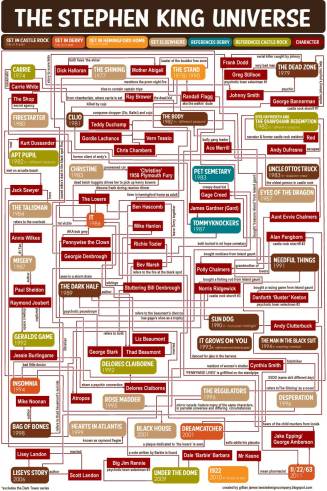
King’s references are so crazy! Check out this chart!

Of course, some authors do it because it’s fun to have a shared universe, for a variety of reasons. You can return to familiar characters and locations by doing so. You can make your readers marvel and go back to another story to say, “Hey, that matches up with so-and-so.” You can create a cosmology or a special reason why a character or characters or place or places appears in so many stories (I’ve got a character or two like that, I just haven’t been able to put them into any works yet. I tried with the human Barbie story and Evil Began in a Bar, but I couldn’t fit them into the former and I haven’t figured out how best to edit the latter yet, so…). And sometimes, it’s just fun to mess with your readers and make them wonder what the heck it all means (I’m pretty sure that’s the reason Stephen King references his other works so much, and the Dark Tower books simply grew out of a desire to create a complex story out of all that messing about).

Whatever the reason someone creates a shared universe, it’s pretty clear that there are plenty of reasons to do so, and that shared universes are here to stay. And whatever the reason behind them, as long as they’re done with love and people enjoy them, I see no reason not to keep doing them. Besides, I may have one or two I’d like to create someday.

Do you have a shared universe in your fiction? Why’d you create it? What has been the result of that?

It’s Friday again, so you know what that means. It’s #FirstLineFriday! Also known as one of the highlight of my weeks. Especially if people like what I put out.

Okay, here are the rules, as usual, for #FirstLineFriday: you write a blog post with the title #FirstLineFriday, hashtag and all, and then you repeat the rules. Then you post the first one or two lines of a possible work, a work-in-progress, or a completed or published work. Final step is to ask your readers for feedback. It’s great fun.

This week’s opening comes from a novel I had the idea for yesterday while walking home and listening to the Needful Things audio book by Stephen King (that was a trippy and creepy book, I tell you). It’s the sort of story that has a really strange mystery to it. I hope when I get around to writing it, I’ve figured out the mystery a bit more. Enjoy:

Any writer, engineer, or psychologist who’s good at their job will tell you that a story, Rube Goldberg machine, or the mind is made up many different and complex parts. Looking back, I think I was stuck in twisted versions of the first two and in danger of losing my own mind, as un-complex as that was at fourteen.

Thoughts? Too long? Suggestions? Let me know in the comments below.

That’s all for now. I’ll try to post a few posts over the weekend. I’ve got a special one planned for Saturday night, believe me.

Have a great weekend, my Followers of Fear!

My latest article from Self-Published Authors Helping Other Authors is Finding a Narrator on ACX. I gained a lot of experience in the matter over the four months it took me to find mine, so I thought I’d share that experience with a helpful article. Perhaps it’ll get noticed by the company, like the last article I wrote on them did. If so, I hope they don’t think I’m a girl again when they tweet about it. That was hilarious, but I don’t like to be mistaken for a woman when I’m not at a costume party or have some other good reason to cross-dress.

Anyway, check out the article if you have the chance. And while you’re there, check out some of the other articles on Self-Pub Authors, which is written by independent novelists and designed to help you write, edit, publish, and market on your own while saving money and maintaining quality. Believe me, it is great. I wouldn’t write for it if it wasn’t.

That’s all for now. Have a great day and I’ll see you later, my Followers of Fear. Preferably I’ll see you with good news while I’m at it.

It’s Thanksgiving in America today, when you’re supposed to be thankful for what you have in your life. Well, you should be thankful for all that year round, but especially today, because…the government made this a national holiday with that sort of connotation.

Well, in the holiday spirit, I’m going to write about all the things I’m thankful for in my life. There are quite a few, but I think I can get keep the list down to the most important ones.

My friends and family.

Whether I met them online, through school or work, or if I’m just related to them by blood or marriage, I love my friends and family. They keep me strong and help my mood stay up. Yeah, sometimes we have our disagreements. My sisters and I can get very nasty towards each other if we spend way too much time together. But it’s the people in my life that keep me less insane and are why I get up each morning. Love you guys. I’m so thankful you’re in my life.

My stories and those reading them.

Understandably, my stories are very important to me. They’re almost like my children. I’ve put so much work into them over the many years, and I always feel so happy when I get to a new stage in their writing process or when they get published. I’m so thankful that I’m able to write these wonderful stories and to work on them. It’s my passion, and I wouldn’t give it up for anything.

I’m also thankful for my readers. Whether you’re on my blog or checking out my books, you people are important to me. Every writer is a bit of a narcissist (why do you think we’re so desperate to get our work read by others?), so you guys tuning in every time I publish a post or ordering a book off Amazon just bring the biggest smile to my face. Thanks for coming at all and coming back again and again. It means so much to me.

The experiences I’ve had.

I’ve been to Germany twice. I’ve also been to England, France, and Israel in my time. I graduated from a good school with a great sports program (Go Bucks!) and I got to study fields I love. I’ve had great work experiences, with Ohio State, the building I lived in for two years, and the US Army. There’s a good likelihood that I might get that with my next job, once I find it. I have a blog with hundreds of followers and it’s growing, slowly but steadily. And of course, I’ve published a few books and I’ll hopefully publish a few more in the coming year.

There are also a bunch of bad experiences that I’d rather not remember, but they helped me grow as a person, so I’ll acknowledge them too.

To say the least, I’ve had the pleasure to see and do a ton in my short life, and I probably will get to do much more in the future. I’m thankful for my experiences, good and bad (though I could always use less of the bad). They bring quite a bit of spice to my life.

How good I’ve had it.

There are a lot of people less fortunate than me. I’ve never been persecuted because of the color of my skin, what country or region I’m from, or my religion. No one tells me what I should do with my reproductive organs like they know better than me when they don’t. I’ve never lived in a violent neighborhood or feared for my life just by walking out the door. I went to college and I’ve been able to earn a living except for short periods here and there. And there’s a growing amount of people in the US who don’t think I’m sick in the head, unholy, or after their children just because of my sexuality. And I’ve had a bunch of people in my life supporting me and showing me right from wrong and offering me their advice when I need it. I’ve had it good.

And there are people out there who cannot say the same thing as me. Plenty of people the world over suffer because of their race, their religion, their gender, their sexual orientation, their ethnicity. They’ve been hungry, or lived in war-torn areas. They’ve experienced violence in their own homes. Some, through genetics or accident, live life without the full use of their bodies or minds.

I’m aware of how privileged my life has been, and how so many people struggle through life because of some form of unfairness or another. That puts me in the unique position to try and help them. Whether it’s raising money for charity, advocating for a certain change, attending meetings, writing blog posts, or simply weaving an issue into a story, I’m making a difference. Perhaps it’s pretty small, but it’s better than nothing, right? And just because it’s easier to let other people handle the problems of the world, doesn’t mean I should.

So I’m thankful that I’ve had a good life. And I’m thankful that I know it, and that I’m in the position to make a difference. Because if I don’t, then I’m basically contributing to the decline of the world and of humanity. And I don’t want that to happen.


I’m not exactly sure who I’m supposed to be thanking on this day (God? The Founding Fathers? Whichever President who made this holiday a thing? It’s never really discussed), but I’m thankful. I can’t take for granted anything in my life, because it could be taken away at a moment’s notice. You never know what will be thrown at you. And here today, I’m making sure people know what I’m thankful for and that I don’t forget it.

Well, that’s all for now. I’ll see you all tomorrow. It’ll be Friday, and you know what that means. Goodnight, my Followers of Fear.

What are you thankful for in your life?

I’ve been meaning to write this post all week, but for a number of reasons–including my desire to wait and see how this played out–I’m only just getting around to it. But now that I am, let me start by saying this is a most unusual blog post, even for me. It has only a little to do with anything writing or horror-related, which usually means this would be a political post or about my life in general, but politics is only incidental to this story, and it doesn’t really feel like something affecting my life. It’s just amusing, like watching a cat chase a laser dot around the living room without realizing it’ll never catch that dot.

Okay, back to the beginning. If you’re at all familiar with contemporary American politics, you’ll know that we’re less than a year away from the Presidential election, and already election season is in full-swing. I’ve come out as a Hillary Clinton supporter already, and I follow her on Facebook. On one of her most recent status updates, I left a comment and that was the start of the craziness.

Now I know some people have some really intense opinions on the former Secretary of State. I get that, but I’m going to ask that you hold off on your opinions until this post is finished. Anyway, this was on Tuesday, in the wake of the Paris attacks, and already people in power were talking about limiting refugees based on religion or entirely. Secretary Clinton posted this on Facebook in response:

We’ve seen a lot of hateful rhetoric from the GOP. But the idea that we’d turn away refugees because of religion is a new low. -H

Well, that resonated with me. I’m a supporter of the refugees, and I don’t like the idea of turning them away. So here’s what I wrote as a comment:

America was built by religious refugees, as the GOP loves to point out. Turning away refugees becauseon their religion is hypocritical and goes against what America is supposed to be about.

This was one of the earliest comments on that particular post, which might explain what happened next.

Who knew supporting one candidate could lead to so much craziness?

Within half an hour, that post had over 300 likes and a growing number of comments. Some of them were supportive or in agreement. Others were…angry. Disagreeable. A few were throwing insults at my face. Others were attacking other people. Pretty quickly it degenerated into a debate between various commenters over this or that fact.

Did I say debate? I meant a mess of cobras fighting each other for superiority because they don’t like one another or their political beliefs. I’m pretty sure blood was spilled several times in the course of three or four days.

I won’t quote directly what people said, because some of what was said was just really awful and I like to keep this blog a mostly positive place despite this being the blog of a horror novelist. I will say that a few people called me names, said I knew nothing about the law or what America was about. One guy actually tried to direct message me to tell me I didn’t know anything and call me a dumbass. Thankfully, Facebook allows you to decline messages from people you don’t know, so I deleted that conversation quick as a rabbit.

My favorite insult hurled at me was some guy who had a similar name to a famous American writer’s real name told me I should go and study history. Joke’s on that guy, because one of my majors in college was History!

About an hour into this madness, I decided to comment back, the only comment I left in this crazy den of verbal Hunger Games contestants:

So I posted this comment about an hour ago. It’s got 550+ likes, 50+ comments, and a few people getting angry with one another over differences of opinion. And I’m just sitting here wondering, “Why can’t my sci-fi novel get this sort of attention? Islamaphobia and dealing with it is one of its major themes!”

If I see an opportunity to plug my books, I will. What do you want from me? It’s a hard world for indie authors, and we gotta do what we gotta do to make it in this hard, terrible world. And anyway, I was wondering why Reborn City didn’t get that much attention, especially considering the themes it explores.

In any case, this plug didn’t do me any good. That comment only got three likes, and only one person actually replied to it. They told me it must be because, like me and my original comment, my novel must be stupid because I don’t know anything.

That’s probably the only comment that actually hurt me. I put a lot of work into what I write, to make sure they leave impressions on people. Calling them stupid? I take offense at that.

At least nobody used that comment to seek me out and leave me false reviews just to hurt me. That would’ve been really dickish.

So at final tally, we’ve got 1,383 likes, 243 comments, and a whole rather nasty list of web vitriol. The activity was strong through Tuesday and Wednesday, but dropped off on Thursday, which thankfully I’m glad for. It was just nuts.

And how do I feel about being attacked? Well, I think knowing this was only temporary made it easier for me to just detach from it and not let it get to me. In fact, I felt a little bit good that I managed to stay out of the fire that I somehow managed to cause. I kind of felt like an evil villain with a set of human dominoes, just watching things play out and waiting to see what remains. Yeah, that’s callous, but it’s not as bad as what some of the people were saying in that comment thread. It was enough to make sailors blush.

Still, it was pretty amazing that I could get so many people riled up just with one comment. People really are sensitive when it comes to politics, and that sensitivity can get amplified through the anonymity of the Internet. The worst were the Donald Trump supporters (and they made themselves obvious, believe me). Those guys were the craziest of all

Oh, and people who want to comment some nastiness on this post, be careful. The more you comment, the more my profile is raised. That is all.

pray for paris

This past weekend in Paris, a city I’ve visited and which I’ve often thought about returning to, was attacked by terrorists affiliated with ISIS. They attacked six different locations throughout the City of Light, including a concert hall, the Stade de France, and two restaurants. At last count, nearly a hundred and thirty people are dead, including seven of the terrorists, and over three-hundred and fifty wounded. The terror threat is apparently still high, and the search for the remaining perpetrators are still ongoing.

And in the midst of the death and horrors, people have come together from around the world for Paris. Through the power of globalization and connection, human beings have shouted out, in tweets and status updates, in blog posts and videos, through television broadcasts and press conferences, through offers of help and condemnations of the terrorists, to stand by France as she works to bring the rest of the terrorists to justice, to take on the sickness that is ISIS, and to heal her wounds after such a horrific series of events.

Still, there’s a dark underbelly to this show of solidarity. My mother and I were discussing this underbelly in the car after dinner last night. Barely two days after the attacks, some people have been condemning Muslims and the refugees from Syria and other parts of the Middle East for the attack (despite the fact that most of the terrorists appear to be European and only one is confirmed to be from Syria). People of all sorts, from members of France’s far-right political party the National Front, including its leader Marine La Pen and US representatives, to bloggers and common people from all over the world. In the need to blame someone for this attack, some are turning to two very large, and lately very popular, scapegoats: those who follow the teachings of Muhammad, and those who left their homes with very little, if anything, just to escape violence and fear.

RC cover

My mom then turned to me and said, “Kind of reminds me of Reborn City. There are people who see a woman with a hijab and feel afraid. Zahara gave that up and even dyed her hair blond to avoid that fear.” That surprised me, but then I realized she had a point. In a small way, the world is beginning to resemble the world of Reborn City.

If you’re not familiar with RC, Islamaphobia is a big theme in the novel. The war on terror devolved into a huge, worldwide conflict, so that by the time of the story most of the world is suspicious of Muslims. Zahara Bakur and her family take measures so that they will be at the very least tolerated by a population that is suspicious of them. Still, it doesn’t always work, and there is still a lot of discrimination in that world that goes unchecked.

While the real world is not at the level that the world of RC is, there are places that have made it difficult to be a Muslim. Angola and Tajikistan actively shut down mosques all the time, and certain European countries have banned burqas and hijabs. France’s Interior Minister has discussed the possibility of shutting down mosques perceived to be preaching dangerous interpretations of Islam. Here in the States,  Donald Trump has said that if elected President he may pursue that course of action.

And because many of the Syrian refugees are Muslim and one of the terrorists was from Syria, some are reacting against refugees. Poland has already said they will not be accepting new refugees, and several US states are now refusing to take in any. Some in the US now wish to screen refugees based on a religious test.

The refugees are not the people we should be lashing out against.

You can’t judge an entire group based on the actions of a few. I don’t judge all Christians based on the actions of Westboro Baptist Church, nor do I judge all football players because a few have been charged and sometimes convicted for violent crimes. But so many people insist on judging Muslims and the Syrian refugees that way. And based on my own experience with Muslims, that isn’t right. That’s nonsensical.

Zahara’s experiences in the book reflect that. Early on she becomes aware that people don’t like her because she’s a Muslim, that they’re afraid of her for things that occurred in her parents’ and grandparents’ generations. She takes steps to be accepted by society by changing her appearance and taking part in “normal” interests and hobbies, but no matter what she tires, people see her as different. They see her as dangerous without even getting to know her. And it’s how people see her that spurs Zahara throughout RC (and its sequel, Video Rage, and probably the final book too) to show people that she is not what people think of her. To show them that she can be kind, and brave. And even good.

In the wake of Paris, we all want to fight back against the evil that caused the attacks. But the evil isn’t the refugees, nor is it Islam and its adherents. No, the evil is ISIS, al-Qaida, Boko Haram and the other terrorist organizations, wearing Islam like a Halloween costume, scary but not the real thing. The real Muslims are standing up to these fakers, standing in solidarity with Paris and showing their disdain towards these inhuman monsters hijacking a respected religion. The last thing we want to do is turn our backs on them, punish them for being who they are.

Instead, we should be thanking them for being allies we can count on for support in hard times, like Zahara is for her friends in the Hydras. Because after all, if we show them the love they deserve, they may return the favor and, like Zahara does, surprise us in all the best ways.


Raymond Esposito, a horror writer and acquaintance of mine (check out his website here), recently started a video series with romance writer SK Anthony (check out her website here), Writers After Dark. The purpose of this series (besides a fun excuse to drink, that is), is to discuss the various qualities of their respective genres. The topic of their first video was which of their genres was the more like life. Or not.

And because it’s fun to watch them just go at each other in a good-natured way. I’ve posted the video below. Enjoy:


Okay, if you didn’t have a half-hour to watch the entire video (too bad, because you’re missing out), here’s the conclusion: both of them think that their genre is the one that’s more realistic, though I think they both poke a lot of holes in each other’s arguments. And maybe spend a bit too much time on if love is real.

Anyway, after watching this video I thought I’d give my own opinion on this subject. I actually think I’m in a unique position to talk about this subject. Yes, I write and read mainly horror, but I also read a lot of romance mangas, read a book series that went from prehistorical fiction to prehistorical romance fiction in the later volumes, and watched one or two movies (10 Things I Hate About You is still considered romance, right?). Plus a lot of my stories, even ones that I haven’t written yet, have heavy romance elements. Snake is a horror-thriller with such an emphasis on romance, and my thesis/novel project Rose is a horror story about a really twisted love story (among other things). I kind of live in both worlds (though I prefer the one with deadly hotels and evil spirits and Lady Gaga in a leading role).


So which is more realistic and which is totally out there? Well, I think that’s kind of a trick question. In terms of horror, I’ve seen evidence of the supernatural and I’m well aware of the evil mankind is capable of (check out current events of the world to see what I mean). However, last I checked zombies were still a fiction and when a serial killer dies, they usually stay dead. And we still haven’t discovered any mummies that have come to life once unearthed or come across any pizzerias with killer animatronic bears.

At the same time, I’ve seen my fair share of long-lasting and happy relationships, and I’m sure you have too. Still, I’m not sure I believe in the concept of unconditional love. All relationships, especially loving ones, are built on give and take, on trust and communication. No two people ever say to each other, “I will love you no matter what and you never have to do a thing for that to continue”. All relationships take work, and romantic ones most of all. And true love? Same answer: all relationships are based on work. I don’t think you can meet a person and within minutes know they’re the one for you. Maybe after thirty years and you still care deeply for them, then maybe we have something there.


So which is real or unreal?

I think, in the end, both fear and love, the bases of horror and romance, derive from the need to survive. Horror is the result of the fight or flight response, and romance is the result of our desire to find the mate who will give us the best offspring. Neither one is truly realistic or unrealistic, because both speak to the human experience. Sure, some cliches and tropes are pretty silly and unrealistic (the virgin girl is most likely to survive, the couple overcome all and live happily ever after, etc.), but it’s the stories themselves that speak to us and keep us coming back for more, not the various elements that may or may not be realistic.

But what do you guys think? Is there one genre that’s more real than the other? Did I or the folks in the video miss something? Let’s discuss.

And let’s discuss it fast, I and six other people are being chased by a killer who died twenty years ago and we can’t seem to escape this haunted mansion no matter how hard we try! And in the meantime three of the people I’m with–one the crown princess of a kingdom of succubi, one a young woman with big dreams and a curse that’s slowly killing her, and one a very handsome young man with a dark past–have confessed their love for me at a really inconvenient time. I’m kind of attracted to all three, and I have to choose one of them before we leave this house! Strangely the killer takes five-to-ten minute breaks so that I can deliberate over my romantic predicament and let it take center-stage in my life when I should be more worried about where the killer is, how he came back when he was electrocuted in 1995, and why for the love of God there’s a convenient object in every room that could become some sort of murder weapon!

What a weird world I live in.

So for the past couple of weeks I’ve been making steady progress on my thriller Laura Horn (which I’ve been informed, based on the ages of the main characters, technically is considered YA. And so is Reborn City apparently, to which I say “Hooray! New readership!”). And like I said the last time I posted about this novel, it’s not as bad as I remember it. Yes, parts of it need work–the chapter I edited most recently will definitely need to be revisited a few more times before publication–but yeah, it’s going well.

I also haven’t had to make any drastic changes so far. I did combine three short chapters into one slightly longer prologue though. And I changed one or two characters’ last names. And I changed things around so that the first section of the novel is a bit longer than what it was in the first draft. And I’m considering moving one or two flashback chapters to later in the book. But beyond that, no giant changes to the story I’m telling. So far, editing’s been pretty smooth.

And I’m glad of that. With every story you pour your sweat and soul into, you feel like you’re bringing a child into a world. Yeah, I know it’s a pretty cliched analogy, but it works. And any parent wants their child to succeed. I worried I had to totally switch up this story in the second draft, which would’ve been like exchanging some of my kid’s body parts for others al a Frankenstein’s monster.  Knowing that the changes I have to make are more superficial, plastic even, makes me feel much better.

And I’m stopping these metaphors before they go any further and get any creepier.

Anyway, at the rate I’m going, I think I might be done with the second draft by some point in January. That would be nice. I’d be able to get to Rose soon after, and then I would have the summer to work on short stories, prepping for NaNoWriMo, maybe putting out a book or two. We’ll see what happens. In any case, my fingers are crossed for good things.

And in the meantime, I’m going to take a break to work on a short story that’s been calling to me.since I came up with it the other night. I think I could actually get this one down to under five-thousand words. Maybe even under four-thousand. Wouldn’t that be nice?

anxiety

What is the trouble with psychological horror? Actually, there’s not much trouble to it. It’s just very hard to do well.

What do I mean by this? Well, let’s look at the definition of psychological horror: “a subgenre of horror fiction, film, and video games (as a narrative) which relies on the characters’ fears and emotional instability to build tension”, according to Wikipedia (I know you’re not supposed to rely on that site for information, but I couldn’t find a better website for a definition). It’s a sub-genre that, rather than relying on a traditional monster that’s out front and center for all to see, the monster is restricted to quick glimpses and shadows. If there’s a monster at all: sometimes the true villain is a character’s own brain, their fear, distrust, paranoia, suspicion, isolation.

I’ve used psychological horror before, particularly in the stories in my collection The Quiet Game (which if you haven’t read, I wish you would) and in the short story “Buried Alive”, which was published in the Strange Portals anthology last year (again, I wish you would read it). And I’ve come to the decision that while it isn’t as difficult as physics or writing comedy, it is walking a very fine line. Almost like a tightrope. And if you fall off, you can wind up veering either into the realm of the comedic with how obvious that it’s all in the character’s head, or it’s just so confusing that you find yourself losing patience with the story.

Let me give some examples (and it’s my blog, so you have to let me give some examples): have you read “Buried Alive”? I’ll keep the spoilers to a minimum for those who haven’t, but like I said above, I use quite a lot of psychological horror in that story, and for the most part, I think that I use it well (so do most of the readers I hear from on this one). For the rest, though…it’s pretty obvious that the circumstances of the main character are taking a toll on her mental state. I don’t think it gets to the point of comedic, but it is obvious, and the point of psychological horror is to make you guess whether it’s all in their heads or if it’s real or…who knows?

Perfect Blue. Trippy, has its moments, but also has its problems.

On the opposite end of the spectrum, there’s the anime film Perfect Blue, based on a novel that I wish was available here in the States. The film is about a singer-turned-actress who starts to confuse reality and fiction when her first acting job takes a turn for the traumatic. It’s a good story, but it’s not a perfect story. There’s a good section of the movie where they spend time trying to confuse both the protagonist and the viewer, and it gets a little difficult to not only what’s going on, it gets difficult to pay attention or be patient with the movie. While I admire the visuals of the movie, and I get what they were going for by showing what the protagonist is going through mentally, and I recommend checking it out if you’re interested, psychological horror shouldn’t get so strange or trippy that the reader gets frustrated with or loses interest in the story.

A great example of a psychological horror story though, manages to toe the line very easily and keeps you guessing as to what’s real or what’s mental delusion. A good contemporary example of this is The Babadook. If you read my review of that movie last year, you’ll remember that I noted that the movie kept you guessing as to whether the film’s protagonists were dealing with an actual monster or a shared psychosis, and I eventually settled on a bit of both because…I’m mostly human, and humans need to categorize things to make sense of the world. And I still say that I don’t know for sure which it is, and that’s one mark of the film’s greatness. You’re never quite sure what’s real and what’s in the heads of the characters, it stays interesting throughout, and it never gets to the point of ridiculous or obvious. All told, it’s great psychological horror.

This movie will surely get you on so many different levels. I’m getting chills just thinking of it.

So how do you psychological horror well? How do you toe that line?

Well, I’m definitely no expert on the subject. I usually deal in traditional horror, the monster is out front and is usually either some twisted form of human or a creature not easily defined by our standards. I dabble in psychological horror, usually making it part of a bigger story. But I can try, and I think–beyond reading/viewing as much psychological horror as possible, both good and bad, and practicing like you want to get to Carnegie Hall, of course–I’d suggest trying to write a story where you’re not sure what’s really happening. Create a scenario where strange things start happening to your character or characters, and you can’t tell what’s real or what’s just in the minds of your characters. Keep it interesting, don’t get too ridiculous or obvious, and just see where the story goes. If you can do that but still be unsure for most of the story of what’s real or not, then it’s likely your reader will be the same and want to know more.

Another marker of psychological horror is that there’s usually a twist somewhere along the way, and if it’s good it’ll change how you view the entire story (a great example is the Korean film A Tale of Two Sisters and its American remake The Uninvited). Characters are also often driven or plagued by powerful internal battles: am I doing the right thing? Is this right or wrong? Are they really out to get me? It doesn’t have to be full-blown persecution belief or fear of some unknown. It can be something as simple as a growing suspicion that something’s off or that our desires are actually evil. Again, A Tale of Two Sisters is a great example of the former.

Not a fan of the movie, but even I admit it shows Jack’s breakdown very well.

And finally, psychological horror is often not the main focus of a story, but part of a bigger story. Take a look at The Shining by Stephen King. Obviously that hotel is actually haunted, and the kid and the cook are both psychic. But a good deal of the story deals with Jack Torrance trying to sort out what’s going on for himself. Is he just dealing with a powerful desire to get wasted again? Is he going insane? Is the hotel playing tricks on his mind? There are scenes where you really can’t tell, and that’s part of the terror. Part, but not the whole thing. After all, there’s all the stuff the hotel is doing to them, right?

Unless Jack, Danny, and the cook are all sharing some sort of shared delusion, or folie a trois, in which case…wow. New conspiracy theory right there.

In any case, it’s something to experiment with yourself. And for me to experiment with more often. Just try and see what happens…or does it happen? You’ll never know until you try.

How do you feel about psychological horror? Do you have any good examples in film or literature you’d recomend? What are some tips for effectively writing in the subgenre?