Posts Tagged ‘scary stuff’

Ever since I stayed overnight and experienced paranormal activity at the Lizzie Borden Bed & Breakfast back in July, I’ve kind of become a bit obsessed with the case and the hauntings that occurred because of the murders. The latest manifestation of that obsession is reading the latest fictional retelling of the events (of which there are several, believe me), See What I Have Done by Sarah Schmidt, who says she was inspired to write it after recurring dreams of Lizzie’s spirit visiting her. I first came across a review of this in Entertainment Weekly, and as soon as I saw it, I knew I had to read it.

See is a fictionalized account of the story of Lizzie Borden, who in 1892 was accused of murdering her stepmother and father with an ax and was acquitted due to lack of evidence and investigator bungling. The story is told from the perspectives of Lizzie herself, her elder sister Emma, their live-in maid Bridget, and a violent drifter named Benjamin, all of whom tell what they were up to on a hot, fateful day in August 1892 in Fall River, Massachusetts.

I have to say, See is not the usual sort of historical fiction I read when I delve into that genre.

Firstly, the four narrators are each given a unique personality and desires, so that it doesn’t entirely sound like just one person narrating four different people. Lizzie is a spoiled youngest child with a hell of a lot of quirks (to say the least); Emma is an older sister who has become constricted by her responsibility as Lizzie’s older sister and as a Borden and wants to run to a new life; Bridget is overworked, and is trying to leave for her homeland of Ireland, despite Mrs. Borden’s attempts to keep her; and Benjamin is a man who sees the whole world as his enemy, and can’t wait to take a swing at the world. Working with one first-person narrator and making them unique is hard enough, so it’s great that for a debut novel, Schmidt distinguishes them so well.

I also liked how flawlessly she manages to weave these four narratives, especially Lizzie, Bridget and Benjamin’s narratives, together on the day preceding and the day of the murders. Telling overlapping storylines, where several characters are in the same place and experiencing things at the same time, has always struck me as a monumental task which requires skills I’m not sure I have yet (if it’s actually easier than I think, let me know in the comments below). Schmidt did it like a pro, to which I applaud her.

But my favorite part is the descriptions Schmidt has her characters use. I’ve never seen descriptions like what she uses. She turns nouns like “termites” or “critters” into verbs (is there a word for that?), and…you know what, let me quote from the first page:

I breathed in kerosene air, licked the thickness from my teeth…My heart beat nightmares, gallop, gallop, as I looked at Father again…Pear skin crisped in my mouth…

How different was that? I have never heard any of these things described this way in fiction, and it’s kind of refreshing to hear. And Schmidt does this throughout the book, particularly with food. She goes all out to describe the food and the sensations of eating in a variety of ways. You really have to read it to believe it.

Now was there anything I disliked? A few things. I was kind of hoping going in that this would be a thriller of sorts that revealed an interesting take on an old theory or even better, a new scenario for the still-unsolved murders. What I got was more of a dissection of the Borden family, showing through several different eyes how grating these people have become on each other, and how it might have been a factor in the murders. And while the portrait painted is beautiful and quite telling of both the author’s vision of and what the family might’ve really been like, I thought the ending where the killer is revealed rang a bit hollow. Like I said, I wanted a new scenario or an interesting take on one of the standard theories for the case, and the way it was eventually portrayed fell a little flat for me.

And as much as I liked the unique descriptions in the book, some of them are used repetitively throughout the novel. I can’t count how many times things, especially fingers, are described as sticky, or how many times heat “itches” at someone. To quote some of my editors, variety in words and phrases throughout a story is important.

And what was up with the dislike for Lizzie and Emma’s uncle John? I get why Abby and Andrew Borden dislike him, he’s probably a bad reminder of Lizzie and Emma’s deceased mother, but why do Emma and Bridget dislike him so much but Lizzie adores him? There’s a lot there that I would’ve liked explained.

But all in all, See What I Have Done is an excellent debut for a new novelist. Putting a score on this book on a scale of 1 to 5 was difficult, but my head kept coming back to a 3.8. Engaging, atmospheric, and full of wonderful prose. Check it out, and ax yourself if you’re ready to dive into Lizzie’s madness.

And yes, I intentionally made that pun. And I stand by it. Goodnight, everybody!

I’m halfway through this series I’ve been doing of rewatching and reevaluting horror films I previously disliked to see if I missed something. And for those of you who are keeping score, I found I now love Perfect Blue, hate The Strangers more than I did the first time, don’t really have a different opinion on The Witch, and feel underwhelmed by The Texas Chainsaw Massacre. And I’ve just finished watching my fifth entry, Oculus. What did I think? Let’s find out.

WHAT’S IT ABOUT: Oculus follows Kaylie and Tim Russell, a pair of siblings who witnessed their parents murdered by the spirit in a mirror as children. They return to their childhood home ten years after those events with the mirror in tow, Kaylie determined to prove that the mirror is haunted, Tim believing he hallucinated everything he experienced as a child. Weaving between past and present, Kaylie and Tim unearth dark memories, old wounds, and eventually, must decide if they are facing they’re own insanity, or an old and intelligent evil.

WHY I DIDN’T LIKE IT: Simple: the ending. I really liked these siblings, and without going into spoilers (though I could be forgiven for them, this film has been out for four years), I didn’t like how the ending treated them. Plain and simple, it just poisoned the film for me.

WHY I REWATCHED IT: An online critic I follow on YouTube did a video a while back of the Top 11 New Halloween Classics, and Oculus got #7. That alone was enough to get me interested in a rewatch. And when I did this series, Oculus was definitely on the list.

Thoughts: How did I hate this movie? It was awesome!

Now, I won’t go into full review mode, but this movie is almost entirely flawless. The concept alone is pretty ingenious, but it’s done in a way that puts you right in there with the characters. You’re seeing their memories as they remember them, at the moment they’re remembering them. And you’re experiencing what they’re experiencing the moment they’re experiencing it. It leaves you not only wondering what is real and what isn’t, but also makes you feel the paranoia and terror of the characters, who by the way are played amazingly by their actors. Especially Karen Gilliam as Kaylie Russell (we love you, Amy Pond!).

I also like how the film isn’t afraid to use a bit of body horror. There were definitely moments where I had to look away because I was so freaked out by what I was seeing, and these moments are never excessive in terms of gore or number of uses.

Add in some great camera work, ambiguity, and CGI that really deposits itself within the uncanny valley, and you got yourself a creepy horror film.

And as for that ending, it’s been four years, and I’ve done some just like it in that time. It’s honestly a good way to close out a horror story, especially if you care about these characters. It makes the ending that much more gut-wrenching. To sum it up, I now approve of the ending.

Judgment: This is definitely a masterpiece in horror filmmaking. On a scale of 1 to 5, I’m giving Oculus a well-deserved 5. Check it out, and see the horror through the looking-glass.

That’s all for now, my Followers of Fear. The next one in this series should be entertaining, at least. And if it’s not, at least the sequels are supposed to be betterthan the original. I’m talking Evil Dead.

Until next time, Happy Holidays and pleasant nightmares one and all.

So good news, folks: as of around 6 PM today, I’ve received feedback from both of my beta readers for Rose, which means I can start the fourth draft of the novel! Why is the fourth draft so significant, you may be asking. Well, this is the last draft I plan to do until I get an agent and/or publisher! And I think that is significant enough to write a blog post (which would’ve been written earlier this evening, but I was at my dad’s for Hanukkah dinner).

Now if you have no idea what Rose is, it’s a novel I wrote as my thesis in college, which I started working on again earlier this year and finished editing back in October. The story follows a young woman with amnesia whose body starts going through incredible, magical changes. The only person she can rely on for help and information about these changes and about herself is a young man who says he’s her boyfriend, but he’s keeping things from her, and things are not at all what they seem.

Yeah, it is not a fun story. Not by a long shot. But I think it’s a good story, made even better after the most recent draft, which fixed a few issues with the story and doubled the word count (don’t less that scare you, it’s shorter than the second Harry Potter book).

Of course, before you start submitting it to publishers or agents, you want to make sure your novel is actually good. Not just good in your opinion, but in others’ opinions, and that’s where beta readers come in. They take a look at stories you write, and let you know what works, what doesn’t, and give you feedback on what can be made better.

One of my beta readers for Rose was my dear friend, Joleene Naylor.  She read the novel in about a month, and got back to me with a ton of notes, as well as plenty of feedback. Overall, she enjoyed the novel. She thought my characters and their development was deep and reminded her of anime characters, which are often complex and never completely good nor completely evil, but often a mix of both (you can now tell who inspired that post about why writers should check out anime). That made the characters within Rose not only multilayered, but often very surprising. For one particular character, Joleene hated him at first, but then she found out some things about him and actually became kind of sympathetic towards him. Then she learned some more things about that character, and her feelings changed again. It’s very hard to do that in fiction, to have your emotions about characters change that rapidly, and Joleene liked that.

However, she did have some thought about a few things, including grammar and word usage, and she thought some things could be fixed, changed, or worked around in order to make the novel that much better. Her feedback makes a lot of sense to me, so I’m going to be incorporating a lot of it into the story.

My other beta reader got back to me earlier today, and I was very glad to see his feedback. Who is this beta reader? Believe it or not, he’s my chiropractor. As many of you know, I have back problems, so I’ve been seeing Dr. Black since June to remedy them (and the progress has been amazing!). You see someone so much, you get to talking, and it turns out Dr. Black is a huge horror fan, so obviously we got to talking about Stephen King, HP Lovecraft, and my writing. When I was getting close to finishing Rose, he offered to read it as a horror fan, and I said I’d like that.

This is what a beta reader or two can lead to: a published novel.

Now, Dr. Black is not a writer, but a reader. However, it is important to have the feedback of readers, as they are who we write for. And Dr. Black did give his reader approval. He thought the novel kept his attention throughout, and that he especially enjoyed the flashbacks in the novel. I’m glad he told me that, because those were parts I actually worried about. Flashbacks are difficult to do, and different readers and writers react to them in different ways. I’m glad Dr. Black enjoyed them, and what they added to the story.

He also mentioned one issue he had in the story while reading one chapter, which I hadn’t realized was a problem, so I’ll make sure to fix that up so that the end result won’t have that same problem.

So I have both of my beta readers’ feedback, and I can start on the fourth draft. To be honest, I’m really glad I finally have all that feedback. I haven’t really been in a writing mood lately, waiting on getting that much-needed feedback. Sure, having my laptop in the shop for over a week didn’t help, but even when I had it, I just wanted to work on Rose (even if I was working on a great story in the meantime. A story I’ll have to put on hold for now, but whatever. I’ll get it done eventually). When you put this much work into a novel, and you think it has so much potential, you really want to see that potential fulfilled, I guess.

And now that I’ve gotten my feedback, I’ll put out a couple of blog posts I’ve been meaning to write for a while, and then I’ll get to work. I doubt it’ll take very long to get through this time, so hopefully that means I’ll have some good news soon.

Thanks to Joleene and Dr. Black for their valuable feedback. It means so much to me that you took the time to do this for me.

And thanks for keeping in touch with me, my Followers of Fear, and following my progress of this novel. I hope that if it comes out, that you decide to pick up a copy and that you enjoy it. Until next time, pleasant nightmares and Happy Hanukkah!

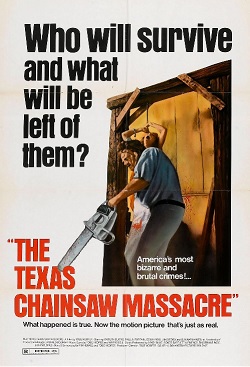
Going with a classic this time around, as well as one of the most polarizing films in horror. Some love it, some hate it. I hated it at first, but I think it’s time I see if my opinion needs to change. After all, this was one of the earliest slashers and is considered a staple of horror movies. Maybe it’ll give me a jump.

WHAT’S IT ABOUT: A pair of siblings and their friends go to the former’s ancestral home to make sure their grandfather’s grave wasn’t a victim of recent grave-robbing in Texas. They later come across a house filled with a cannibalistic family, including the chainsaw-wielding Leatherface.

WHY I DIDN’T LIKE IT: In high school, I had heard this movie hyped so much among horror fans. When I finally could get Rated R movies on my own library card, I was disappointed. I didn’t jump, or feel any atmosphere. I wasn’t scared. It just felt over-hyped.

WHY I REWATCHED IT: You learn more about its production and legacy, you see some remakes and one sequel. You wonder if you missed something. Hence a rewatch.

THOUGHTS: I didn’t care for it.

Yeah, I was more aware of the film’s importance in the horror genre, but I still didn’t find myself enjoying it. It took the film forever to actually get going and become interesting. And even then, it was cheap to the point of noticeable (I refer you to the meat hook scene), there were lots of awkward close-up shots of girls freaking out, and more shouting and screaming than was probably necessary…from the villains. When damsels in distress scream, it’s fine with me, it’s kind of expected. But villains being so loud and annoying…yeah, I don’t care for it.

Yeah, it was quite the shocker in 1974, and that was the point. The film was meant to shock the 70’s movie-going audience. And it did, which lead to it becoming so famous and getting so many sequels and remakes. But to me, who is used to more gore and shock and terror from later slashers, it just feels tame and boring.

JUDGMENT: 1.5 out of 5. Watch it to see what it did for horror, but honestly, once you’re past a certain age and seen enough horror films, you’re just not going to get scared.

Don’t kill me in the comments for hating my opinion. It is what it is.


Next time around, I’ll be taking a look at a film that has become a staple for Halloween, but I had one particular problem with it that ruined the experience for me. It’s time to rewatch Oculus.

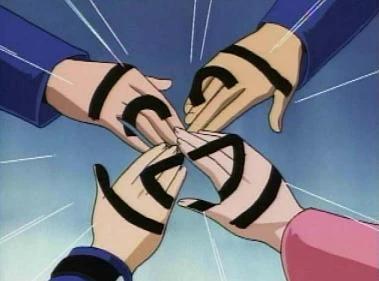
“The Power of Friendship!” as symbolized in Yu-Gi-Oh’s famous hand smiley face.

So yesterday I watched a YouTube video about a common trope in fiction (you can check it out HERE), which is (say it in your heads with a big, echo-y voice) “The Power of Friendship!” Now, if you aren’t familiar with the trope and you didn’t have time to watch the video, “The Power of Friendship” is a trope in which the bonds of friends is so powerful, it becomes a power in and of itself, capable of cosmic-like acts such as giving heroes power ups, stopping psychic mind readings, snapping people out of brainwashed states, and occasionally even defying gods. This power shows up in a ton of popular media, including a ton of anime and manga (the Fairy Tail series  practically is nicknamed “The Power of Friendship” manga).

Now the video I linked to goes into much more detail about the various intricacies of this trope (go watch it if you do have the time, the channel that produced it is awesome), but I wanted to focus on one particular aspect of “The Power of Friendship” trope that the video didn’t go into: how it surfaces in the horror genre. Or rather, how it doesn’t surface in the horror genre. At least, not all that much.

So if you didn’t watch the video (and you’re missing out!), the trope works like this: you have friends, and those friends can help you out of a bad situation, whether that be isolation or a powerful demon overlord is about to destroy the Earth and your power alone is not enough to destroy the demon’s power. It can be a metaphorical power to help a character out during a bad patch, like the former situation, or it can be a literal power and the equivalent of taking one of those mushrooms in a Mario game, like the latter situation. Thus, “The Power of Friendship!” And you can kind of see why it shows up so much: we all wish we have that power, or believe our relationships are that powerful.

But horror doesn’t feature this power as much as other genres, and there’s a reason for that. Horror is horror. It incorporates the darker aspects of the world around us and sometimes amplifies them for maximum effect. And in real life, friendships aren’t as powerful and as lovely as in fiction. In the stories, friendship is powerful and unyielding. It can overcome all sorts of obstacles, and the more you try to destroy it, the more it bounces back and kicks bad guys in the ass. But in reality, friendships grow, cool, and break all the time. It can take only a little bit to destroy a friendship, and a lot to repair it once it’s broken. Horror writers not only recognize that, but incorporate that into their stories. And it’s such a well-known fact about life, writers don’t draw attention to it, because it’s so well known among readers.

That’s not to say that “The Power of Friendship!” doesn’t show up in horror fiction at all. For example, Stephen King’s It pretty much says that the friendship of the seven main characters is what allows them to fight the malevolent entity in their town.* It just doesn’t say it as loudly as other media does, and also tells the reader that the characters’ friendship, while powerful, can be broken or is less effective if they aren’t all in sync or allow their fear to divide them. This is what leads to that one infamous scene in the novel, and is also shown in the new movie after the first fight with It.

Weirdly enough, the power of love or family is shown more than the power of friendship in horror, and I’m not quite sure why. Perhaps it’s because love and family, unlike friendship, has a more powerful evolutionary purpose, and therefore is given more power in fiction in general. If you’re willing to do more to save your perfect partner for creating offspring or the lives of your offspring, it’s going to show up more in stories than the grouping of creatures of the same species to ensure survival.** Hell, a lot more of my stories revolve around romance and family than friendship. One of my stories even involves a friendship gone bad, but that’s about it.

If “The Power of Friendship!” can be portrayed as it was in It, you can include it in horror stories more effectively.

That doesn’t mean we can’t include “The Power of Friendship” in horror stories. It can be used, but it’s more effective if used as it was in It: not overstated and a bit more realistic.  Showing a friendship form, grow, and overcome obstacles in a story, without drawing too much attention to it and showing how fragile the friendship can be under certain pressures, will work fine for the horror audience. If you go for overblown storytelling and basically say, “The Power of Friendship can overcome anything,” it will take the audience out of the story. Let the friendship’s strength demonstrate itself, rather than shoving it in through dialogue or just outright stating it. In other words, show, don’t tell.

While still not that common a trope in horror, “The Power of Friendship” can be part of horror. It may require being handled differently than in other genres, and with a bit more realism (weird for “realism” to show up in horror, but there you go), but it’s not impossible. You just need the right touch, and “The Power of Friendship” can best even shapeshifting entities that take the form of clowns.

That’s all, Followers of Fear. I’m in a bit of a blogging mood right now, so expect more posts from me soon. Until then, pleasant nightmares!

*There’s also some sort of power up thanks to a turtle from another universe, but let’s not get into it, shall we.

**Best explanation I can come up with given my aromantic nature and already jaded worldview.

Well, I’m back at this again, with an odd film for my third outing. You see, I watched this film last July, and I even wrote a review. So why am I watching it again and making it part of the Rewatch Review series? Well, here’s why:

WHAT’S IT ABOUT: A Puritan family is forced to move out into the wilderness and start a farm on the edge of a forest. There, a witch sets into motion events that will change the fate of this family, especially the teenage daughter Thomasin, forever.

WHY I DIDN’T LIKE IT: Well, I actually did like it. I gave the film a 3.8 out of 5. That’s a good score. However, I went into the film with different expectations based on the title (the titular witch is actually very peripheral to the story), and I had a hard time without subtitles understanding what anyone was saying, which affected my enjoyment of the film.

WHY I REWATCHED IT: Over the past year and however many months, I’ve thought a bit about this film, and how my enjoyment of it was skewed by the fact that I had totally different expectations going in. I wondered if maybe, f I rewatched the film knowing what it’s really about–not the witch, but the family she affects–I’d enjoy it more. So when I decided to do this series, I put this film on my list.

THOUGHTS: I guess I did enjoy it a bit more, but I wouldn’t raise that 3.8 any higher.

The Witch is a good film, and I go into detail why in my review. It’s faithful to the time period in all the best ways, the psychological aspects are handled very well for a first-time writer/director, and the actors are all good in their roles. With great setting and music, it’s a pretty damn good horror flick. And if you watch it with the subtitles and don’t get miffed by the witch only being in the film for about two or three minutes, you’ll enjoy yourself thoroughly.

I did notice this time though that sometimes the lighting makes it hard to make out what’s going on, though. Like seriously, I know you’re in the middle of the woods, but maybe still use some lights so we can see the characters? Thank you!

JUDGMENT: My opinion doesn’t change, but I’m glad I watched it the way it was meant to be watched. It’s still a good movie, and if you get the chance, check it out. Just remember: subtitles! Those thick accents will puzzle you to death if you allow them to.


Well, that’s all for this entry in the series. Honestly, it was shorter than I expected it to be. The next one will probably be a bit longer, at any rate. After all, I’m watching one of the first slashers ever. That’s right: The Texas Chainsaw Massacre. Bring it on!

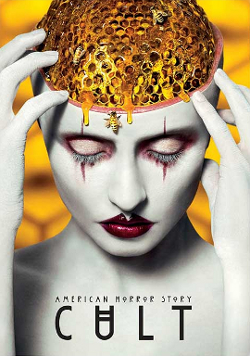
I finally watched the final episode of American Horror Story’s seventh season (one day I’ll be able to give a review right after the season premiere or finale on my own cable package), and I have to say, this has definitely been an interesting season. When people heard that the new season was going to be about the 2016 American Presidential Election, after months of speculation that it would be about either a cruise or something else ocean-related, we weren’t sure what to expect. Would it be preachy and lean towards one end of the political spectrum or the other? Would Trump, Clinton, or some other political figure be featured as a character? And would Sarah Paulson play Trump (if she did, she’d be great at it, no doubt)? And as further details came out, namely that it would be about a cult that arose in the wake of the election and focused on people who felt isolated and galvanized by the election, we got intrigued. Could this actually work as a season arc? Could this be good?

Well, before I get into that, let’s go a bit deeper into the plot. Returning to a normal mode of storytelling after the reality TV show format of Roanoke and being perhaps the most down-to-Earth season in the show’s history, Cult follows two very different people who become intertwined in ways neither would believe. The first is Allie Mayfair-Richards, a business owner and mother with liberal leanings and crippling anxiety who isn’t dealing well in the post-election climate. The other is Kai Anderson, a charismatic young man who begins to gather a group of devoted followers around him as he pursues power in local politics. As their lives start to intersect, they’ll not only make permanent impressions in each other’s lives, they’ll make impressions in the very surface of American politics.

I loved this season. Yes, the first two episodes were kind of slow and clunky, more devoted to commentary than to actually scaring the viewer, but after that the story and scares really picked up. The writers kept things very intimate, so that while this may have seemed like a big story about national politics and American political culture on the surface, it felt incredibly intimate, letting us into the lives and minds of these people. As per usual with American Horror Story, the story was twisty as heck, keeping you guessing where the story would go from one episode to the next and being unable to figure out most of the time where things would go. And after the second episode, they managed to keep the political commentary from getting too over the top. In fact, I think they managed to capture the spirit of American politics very well in this season: confused, divisive, changing from day to day and week to week. Things come up and down, change and merge and break, and become so muddled that you don’t know how it all started. All this was captured very well in this season.

And oh my God, that ending! That’s going to stay in my head for a while.

Beware this guy. He is a villain par excellence.

I also really enjoyed the characters. Obviously, the two main ones are exaggerated distillations of the stereotypes of the liberal and conservative voters, with Kai representing some of the darker views of what Donald Trump is to some Americans, but they also feel like real people whom you want to watch and see where they want to go from episode to episode. Each major character is given time to develop so that they feel real to the viewer, and you feel their struggles and/or death. I especially love Beverly Hope, played by Adina Porter (who played my favorite character last season), whose struggles within her workplace, followed by her struggles within a cult that changes drastically from the time she joins to the time she escapes. Kai is also just terrifying to watch. You know what his final goal is, but you never know what to expect from him from moment to moment. He’s like a pinball, causing something every time he touches something. He makes for a great villain. And watching Allie go from this weak, paranoid woman to this strong, somewhat devious fighter was just stunning.

Now, were there any parts I didn’t care for? Well, as I said, the first two episodes didn’t jibe with me, they were more devoted to commentary and set up than actual scares. Those could have been done better. Another issue I had was that I felt the final episode was kind of predictable. I mean, once I saw where it started, I kind of knew where it was going to go (except for maybe that last scene). I expect better from American Horror Story.

I also didn’t care for Lena Dunham playing Valerie Solanas in the seventh episode. Now, I have nothing against Lena Dunham. I think she’s a great crusader for a number of important issues, and I admire her for the success she’s had in the entertainment business. But sadly, I’ve only seen her in a couple of roles, not enough to get a gauge on whether or not I like her as an actress. And in the seventh episode, she just felt miscast. The episode was written brilliantly, the character she played was interesting, but she just didn’t fit well into the role, to the point that she was annoying (I don’t mean that in a sexist way, I just mean she didn’t fit the role and it had a negative impact. Don’t go after me in the comments).

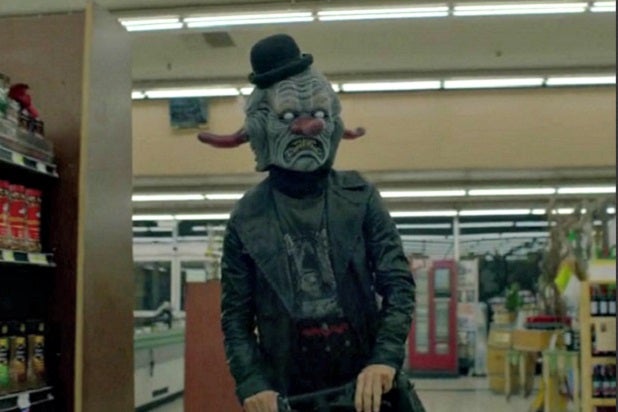
And finally, I felt like the clown costumes could’ve used an explanation. Yes, the character Meadow designed the costumes, but why clowns? Why not a minority abused by the right, or ninjas, or just people dressed in dark clothing? It’s hinted that it has something to do with Twisty the Clown, who makes a surprise guest appearance in the first episode, but we never find out why the cult decides to commit crimes in custom-made clownsuits. I would’ve loved an explanation on that, especially since clowns figured so much in the advertising for the season (speaking of which, where are the bees? They show up a lot in the ads and the opening theme, but barely in the show proper).

This needed more of an explanation.

But other than that, American Horror Story: Cult was a great entry into the series. On a scale of 1 to 5, I give this season a 4.2, as well as the designation of my second favorite season so far (Hotel‘s still the best). It’s engaging, thrilling, and different from any other season so far. Plus it does a better job of talking about oppression and women’s empowerment than Coven ever did, so good on the writers for fixing that mistake. Check it out, and see it for yourself.

Now as for Season 8, details are scarce beyond that it will come out sometime next year, and that Sarah Paulson will return for her eighth consecutive season (yay!). I’m still hoping that I’ll eventually get an Orphanage or Academy/School-themed season. I’m curious as to how, if the theory about each season being a circle of Hell is true, how those themes might apply to those circles that are left. And I’m wondering who will be coming and going for the next season (Lady Gaga! Kathy Bates! Please come back!).

Well, that’s American Horror Story for you. It leaves you wondering up until the moment something happen, and then it blows us all away.

Voice. Sometimes, I feel this can be the hardest thing to create in a story, especially when you’re writing in first person. You, as the writer, have to create this unique person, someone with a personality, desires, fears, likes, and pet peeves. And then you have to give them a unique speaking voice, including vocabulary and word choice, syntax, grammar, accent, and all that can be really difficult. A lot of us have that distinct writer’s voice* in our heads that is always arranging our sentences on the page (or on the blog post) in a way that reads like what we consider good literature.

And it’s even more hindered when you consider where our writer voices come from. You see, I have this hypothesis that every writer’s storytelling voice is born when they read a great story and the narration resonates with them on a deeper level. This could be their own voice reading their first chapter book as a child, a parent reading to them a fantasy novel by their bedside and making the story come alive, or an audio book narrator with a great speaking voice behind the words. No matter how many other stories we may read or listen to later in life with their own amazing narrative styles–the childlike humor and observations of Alice in Wonderland, Stephen King’s odd characters and descriptions, or the three women from The Help and how they each view their situation from vastly different backgrounds and dispositions–it will always be this original narrator who contributed the base DNA for your writer’s voice, and whom a part of you will always spend a good amount of time both trying to emulate in power and break away from so you don’t sound like a copycat.

For me, I always go to Jim Dale’s narration of the Harry Potter audio books. Harry Potter was a big part of my childhood, and caused me to start writing in the first place. My first attempt at writing was something like a Harry Potter gender-bend fanfiction. And Jim Dale made the text come alive, in ways the movies and the books alone couldn’t. Whenever I wrote, in the back of my mind, I was comparing and contrasting to Jim Dale’s work. And while I’ve managed to develop my own voice, it’s still a fight that goes on in the back of my head up to this day.

So basically, I’m fighting Jim Dale in my head while trying to create an original narrator’s voice on the page.It’s an image perfect for a Family Guy cutaway gag.

Struggling against this guy in my head every time I write.

So what can you do when you’re trying to create a distinct voice for your narrator or narrators? What do you do when you want to make Skeeter sound different from Abilene and Abilene from Minnie, or Cormoran Strike from Harry Potter, or Lestat from Louis? And can I come up with any other characters for comparison? The answer to the latter question is yes I can, but I’ll stick to the former if you don’t mind too much.

As many of you know, I’ve been working on a new story while I wait to hear back from my beta readers. And as I mentioned in a previous post, I’m taking a more organic approach by writing this story without much planning and seeing what evolves from that. And weirdly, that approach has allowed me to tap more fully into my narrator’s head. I’m not exactly sure why, but I think it might have something to do with the plotting vs. pantsing thing I talked about in that previous post. When I’m plotting, I think out every detail of the story, not leaving much room for change or experimentation. Thus, the narrator’s voice becomes secondary to telling the story I want to tell, in the way I want it to be told, and the narrator’s voice ends up as something close to default writer’s voice.

But while I’m pantsing it (or plantsing it, as my friend Kat Impossible informs me), that particular mental clamp isn’t in place. Thus, without having to worry about getting my story from Point A to Points B, C, D, E and F (I’m not even sure if I have a Point F at this point), I can focus more on my narrator and develop her voice. I’ve actually discovered through, just by letting my character be herself and make her observations about the world, she’s a pretty frank and kind of funny. At one point, after saying “her heart fluttered,” she says she sounds like a romance novel, which she hates reading, and her friends consider that a horror “on par with the bombing of Pearl Harbor.” I wrote that in, and I ended up laughing!

I might have to pants/plants my stories more often in the future.

But what if you already write by pantsing or plantsing, or plotting is the only style that works for you? Well, I might have a few suggestions:

  1. Write out the traits of your narrator. If your narrator is a character in the story,  then obviously they have a personality (unless this is an 80’s movie, in which case they’re bland and white). Think about them and what their role is a story. What do they want? What do they stand to lose if they fail? What’s in their past? Who do they hang out with? Figuring this out can give an insight into the character and therefore to the voice that they give.
  2. Have a conversation with the narrator. I forget where I got this, but it’s a good one to use. Grab some paper and a pen, and have a conversation with your character. Ask them questions, and then write down what you’d imagine their responses to be. It seems a little mental, but it’s pretty effective, and can be used for other issues in a story (motivation, plot holes, etc).
  3. Spend time narrating scenes in your head. I’m the kind of guy who spends a lot of time planning the story in my head before I write it (the consequence of having a full-time job and only one me to write). Consequently, there are scenes I’ve written and rewritten several times over in my head. During that time, a character’s personality, worries, beliefs, and of course their voice will emerge through several mental revisions. By the time you get the actual writing, you already have the narrator’s voice down pat.

Voice is always difficult to get right for any narrator, but there are a variety of ways to help you get that voice. Whether it’s writing something differently than usual, or having an imaginary conversation, you can discover your narrator and their voice. And from there, you can make your story that much better.

What do you think of finding a narrator’s voice? Do you have any tips for doing so?

*The writer’s voice, by the way, is very different from our speaking voices. I’m never this eloquent in real life. I actually stammer a bit, my mind racing to get the best sentence out while my mouth is already saying the words. It’s quite annoying, and sadly the only time I’m not plagued with it is probably when I’m telling a joke (usually a stupid one). Oh, wouldn’t it be nice if we could speak like we write blog posts or stories? It might make a few things easier.

My boy, HP Lovecraft

So today as I was heating up dinner, a thought passed through my head that sometimes passes through there (along with, “Oh, that would make a great story,” “I’m hungry,” and “These miserable mortals must be destroyed! Rise up and cleanse the Earth of them!”). The thought was, “I wish there were more HP Lovecraft adaptations. He’s got a lot of material to work from.” This thought was followed, rather unexpectedly, by “Why wasn’t there an HP Lovecraft cinematic universe? You’d think it’d be perfect for film studios. The stories literally take place a multiverse, possibly the very first multiverse!”

Now, if you’re wondering who HP Lovecraft is, you’re not alone. He’s criminally under-known (a word I just made, so copyright). What’s important to know is that he was a writer from the early half of the 20th century who wrote horror stories based around powerful cosmic entities and truths from beyond the stars whose exposure to humans can cause insanity, destruction and death. This is called cosmic horror, and Lovecraft practically invented it. And while you might’ve never heard of HP Lovecraft or cosmic horror (though I talk about him often enough on this blog), you’ve probably seen the wide results of his influence. Ever wonder where the ideas for the Demogorgon or the Shadow Monster and the Upside-Down from Stranger Things come from? Those all are at least partly inspired by Lovecraft’s creations. The weirder, more interdimensional aspects of the works of Stephen King, such as the last two-hundred pages of It or the Dark Tower series? Lovecraft helped inspire them, especially his Dream Cycle stories in relation to the Dark Tower books. And that thing with a mouth full of teeth coming out of my hotel room toilet? That’s actually a demon crocodile, where the hell did that come from?

Point is, Lovecraft has influenced a lot of horror fiction, and even some things not normally considered horror, such as Marvel comics villains. Now excuse me, I’ve got to take care of that demon crocodile.

Still here? Good. Well, you’d think that with such a bibliography and legacy, you’d think Lovecraft would have several adaptations, right? Maybe even a cinematic universe, considering he has one of the earliest multiverses in fiction? Wrong, actually. There are actually only a handful of direct HP Lovecraft adaptations, the most well-known being Re-Animator, and the story that’s based on is kind of in its own separate mini-universe (kind of like Deadpool in the X-Men movies). But wait. If his ideas and the works they influence are so ubiquitous that we’re getting major Netflix shows and box-office record-breaking movies based on them, why aren’t his works being made into more movies? And why isn’t there a cinematic universe, when there’s a gold mine right there for it?

Thank Lovecraft for this guy.

Well, there are a few reasons for that. One of the reasons is that movie adaptations, and especially cinematic universes, are made from properties that filmmakers feel will make them money (now there kind of’s an evil god to rival Cthulhu, am I right?). In the past, movies based off of HP Lovecraft stories have only done moderately well at the box office, mostly as cheesy B-movies, and that’s on a good day. Even Re-Animator only earned around two-million, and its budget was just about half that. So if a major film studio were to make a major adaptation of a Lovecraft story, they’d have to believe that a Lovecraft story could bring in a major profit. And if past adaptations are any indication, it’s not a risk studios are willing to make (let alone a cinematic universe*).

Another issue is that, to be frank, Lovecraft stories don’t always translate very well to cinema. They’re often centered around one person’s experience, and the events surrounding that person aren’t always told in a structure that lends well to movie storytelling. Hell, some of them don’t even work with literature storytelling (*cough* Dream-Quest of Unknown Kadath *cough*).  If you were to adapt some of these stories, you’d have to do a lot of work just to make some of them look good as a screenplay. And even when doing comic book adaptations sometimes involves tweaking entire story arcs just because of copyrights and other aspects, not everyone is willing to do that.

And finally, HP Lovecraft is under-known. Well-known properties, even if there’s no reason to think they’ll be money-makers, are more likely to be adapted than something that few people have heard of. William Shakespeare movies usually don’t make tons of money unless major stars are attached to it, but some of his plays are so well-known and loved that they have multiple adaptations and there’s a good chance more will come in the future (I’d like a Titus Andronicus adaptation, please). But if a work is lesser known, or its appeal is too esoteric, it’s likelihood to get adapted is pretty low.

And all these factors are in the way of more Lovecraft adaptations.

Great adaptation of Lovecraft’s best-known story, The Call of Cthulhu.

Still, that doesn’t mean there haven’t been Lovecraft adaptations in recent years. And not all of them have been cheesy B-films. The HP Lovecraft Historical Society (yes, that’s a thing) has previously made great adaptations of The Call of Cthulhu (which I own and reviewed HERE) and The Whisperer in Darkness that were made to look like they were filmed in Lovecraft’s time. Guillermo del Toro nearly made a big-budget adaptation of At the Mountain of Madness, one of Lovecraft’s better-known works, and there’s a chance he may try to make it again someday. And with Lovecraft’s appeal staying steady and possibly even growing, there’s a chance other studios, including independent ones, will make their own adaptations. One article I read even said that a lot of international indie studios are not only making Lovecraft films, but showing them at film studios.

And even if Lovecraft films aren’t being directly adapted, as I’ve said, his ideas are appearing all over the place. I’ve already mentioned the works of Stephen King and Stranger Things, and those are only the tip of a large iceberg. The Hellboy films all feature Lovecraftian monsters, as do a number of major video games like Amnesia: The Dark Descent and Bloodborne. And I recently saw a film heavily influenced by Lovecraft called The Void, and while I had some issues with it, it definitely had its points, including great atmosphere and practical effects. Stuff like this will only keep Lovecraft in the public consciousness and maybe someday lead to further adaptations of his work.

So maybe HP Lovecraft won’t have a cinematic universe anytime soon. But he’s clearly got staying power, and that means there’s always a chance we could see more films by him as time goes by. Some of them may even come from major studios and perhaps even be great successes. As nearly everyone says, you never know what the future holds. Maybe even an adaptation of Shunned House? Please?

What do you think of HP Lovecraft adaptations? What would you like to see adapted? Let’s discuss.

That’s all for now, my Followers of Fear. The demon crocodile (whom I’ve named Alathla) and I are off to cause terror in a major metropolis area. Until next time, pleasant nightmares!

*Though from what I hear, cinematic universes are on the way out the door, thanks to the massive mistakes studios like WB and Universal have made with the DCEU and Dark Universes. So…never mind?

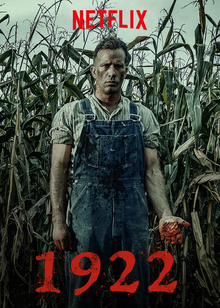
I did not expect to do a review today. I didn’t even expect to see a new movie this weekend! But then I found out that the fourth or fifth Stephen King film to come out this year (he really is in the middle of an adaptation renaissance) was out on Netflix, I was like, “I gotta watch this. I gotta watch this, and I gotta review it.” So I watched 1922. And what did I think?

Well, it was nothing like I expected. I’ll give it that much.

1922 follows a farmer who plots with his son to murder his wife after she threatens to force them to leave their farm and move to the city, and the consequences of their plans. It’s based on a novella that I’ve only read half of (I was just coming off a huge Stephen King binge, and at the end of those, I just get sick of his style), and I honestly didn’t know it was being adapted into a movie until I saw the trailer last month. I wasn’t too excited, because while the trailer was good, I felt a lot more hype for movies like It and Gerald’s Game. Who knows? Maybe it would blow me away.

Too bad I found it average.

I think the film’s biggest problem is its first half hour, in which the farmer and his son kill the wife (spoilers). They cram that whole thing into about twenty minutes or half hour, from the introduction to the main characters to the murder. Now, usually movies about murdering someone take more time to do that, introduce the characters and then get to the murder. This gives the filmmakers time to introduce us to the characters so that we, the audience, can connect and empathize with them. This time is also used to explain why the characters feel murder is necessary to accomplish their goals. Otherwise the audience won’t understand, and that takes them out of the story.

However, 1922‘s filmmakers are in such a rush to get to the actual murder, they skip over all that. Instead, they use narration and jumpy shots of the characters thinking or pacing or staring into space to try to get all that across, and it’s done poorly. There’s a phrase we writers use: “show, don’t tell,” and that applies to movies too. We only get so much interaction between the characters during this time, in favor of the jumpy shots and narration, and by the time we get to the commitment to murder, we’re just like, “Wait, I have a hundred questions and points I’d like to bring up! I seriously don’t get why this murder needs to happen!”

After that first half hour though, the film does even out, becoming a much better horror film. The pacing becomes much more even, and they dispose of the jumpy shots. It actually makes for a really well-plotted thriller, in which we really see how this murder, as well as some of the consequences–expected and otherwise–psychologically damage the farmer and his son. The actors do a good job of making their characters seem real, and the use of the supernatural in this film isn’t too over-the-top or distracting. It’s actually pretty creepy at times.

Still, there’s nothing during the time after the first half hour of the film that makes the film extraordinary. No terrifying corn chase scene, no stalking of the main characters that makes you feel a chill. It’s just average psychological thrills and family drama, and we’ve seen a lot of it before in a hundred films, books, and TV shows.

Still, it’s better than the first half hour.

On a scale of 1 to 5, I give the film 1922 a 2.5. It’s a horror film, but there’s better material out there, Stephen King or otherwise. Go watch that instead.


That’s all for now, my Followers of Fear. I’ll try to make the next blog post I put out either something about my life or about examining something in writing or horror that’s worthy of discussion. Until then, have some pleasant nightmares and a great weekend.