Posts Tagged ‘YouTube video’

I’m sure that a lot of people are going to be confused by that title, and probably find it funny. Unfortunately, this is a serious topic that requires some discussion, so I thought I’d take a couple minutes to spread the word on what’s been going on.

Recently, it’s come to light that a romance writer named Faleena Hopkins placed a trademark on the word “cocky” (as in…you know), and has allegedly been sending cease and desist letters to authors who use the word “cocky” in their book titles. Of which there are many, and according to the letters, this is a form of copyright infringement, and authors should change the names of their stories or face the consequences. From what’s been going around, most of the authors who have received these letters are not big enough to actually take on a legal battle with other authors, rather than any big names in the romance field.

This is some grade-A bull. You can’t just copyright a single word and tell people they can’t use it in their book titles. You can copyright a specific word or words using a specific font (like nobody can use the word “Potter” with the Harry Potter-title lightning bolt script or the words “Star” or “Wars” with the Star Wars script without incurring the wrath of JK Rowling or Lucasfilm’s representatives), which is normal business practice. However, you can’t just copyright a single word, no matter the font, font size, or context, and say anyone who uses it in a story’s title is committing plagiarism or copyright infringement. Which is why nobody can sue me for naming my novel Snake, or why when Rose comes out, nobody can sue me for naming it that way.

And you know who else agrees with me? Lots of other authors, apparently. When I saw this trending on Twitter, I got curious and found plenty of other writers who were willing to explain to me what was going on and point me to links which went further into detail about this issue, which has been dubbed Cockygate, and who have also made the hashtags #cockygate and #ByeFaleena (get it?) trending topics. Thanks to them, I was able to find this article from Pajiba, as well as this video from author Bianca Sommerland, one of the first to break the story open. And the consensus seems to be the same as my opinion of this situation: it’s grade-A bull, and kind of sounds like bullying or blackmail.

I mean, imagine if this was allowed to happen. We could copyright all sorts of words, and anyone using those words would owe me money. I mean, imagine if I trademarked the word “the.” So many people would owe me money, it would be ridiculous! I’d have good friends and big names who would be liable to legal action for a commonly-used word. It’s ridiculous.

And apparently the Romance Writers’ Association is getting involved now, because they’ve been consulting with an IP lawyer and are asking anyone who’s received one of these cease and desist letters to send information and screenshots to Carol Ritter, their Deputy Executive Director (carol.ritter@rwa.org). That’s how seriously this is being taken.

Hopkins herself, who in the past has also claimed that anyone who uses stock photos (so everybody, basically) after she uses them is copying her (say what?), has taken to social media to defend herself. She hasn’t denied that she’s trademarked “cocky,” but has said that she’s done it because some of her readers have downloaded ebooks with the word “cocky” in the title thinking it’s related to her Cocky Brothers series, only to find out it’s someone else’s book. She’s also called those calling her out as “bullies.” First off, you can return downloaded ebooks and purchase the right one. And I’m sure the majority of your readers are generally intelligent people. They can figure that out for themselves. And second, if you really are doing something shady, then the people who object to it aren’t bullies. They’re legitimately upset.

In a way, this reminds me of Lani Sarem, the author who tried to game the New York Times bestseller list and fell hard (you can read my articles on Self-Published Authors Helping Other Authors about that little incident by clicking here and here). She too engaged in something that rang of dishonesty in order to ensure the success of her work. People online found out and started investigating and spreading the word, leading to her book being removed from the NYT bestseller list, and her name becoming something of a joke. We’re seeing something similar here, only what Ms. Hopkins is allegedly doing is even worse, because it affects the most vulnerable authors out there by threatening them with legal action.

As this is still the early stages of this controversy, we’re bound to see further developments. And whatever happens, I hope a message is sent far and wide. We authors are usually a supportive bunch. But if we find out one of our own is doing something awful for the sake of money or fame, we will not take that sitting down. We will push back, and the offenders will not like that. After all, the pen is mightier than the sword, is it not?

Please contact Carol Ritter at carol.ritter@rwa.org if you or someone you know has received one of these cease and desist letters. You don’t have to live in fear of legal action. You can take the power back.

A portrait of King Arthur by Charles Ernest Butler. Probably not what he looked like at all.

So this is a bit outside my normal wheelhouse, but I decided to write a post about it because I’m all fired up about the subject (and really, isn’t that the reason we write anything anywhere?).

Recently, I’ve become very interested in King Arthur. Specifically, I wanted to know whether or not he was real, and how this whole story of him, Merlin, Lancelot and Guinevere, his sister/lover Morgan le Fay and his nephew/bastard son Mordred came to be. I mean, do we really believe a guy who didn’t know he was the bastard son of the previous king was taught by a magician, pulled a sword from a stone, had an idyllic kingdom stretching across Europe for a few years, only for it to be undone by his affair with his sister and his wife’s affair with one of his knights, to be gospel historical fact? I wanted to know the truth, and I wanted to know it as in-depth as possible.

This new obsession of mine started after one of the YouTube channels I follow, Overly Sarcastic Productions, produced a video about Arthur lore, and how that got built up over the past fifteen-hundred years (click here to watch the video, as well as here for their follow-up on some of Arthur’s lesser-known knights). These laid the groundwork for me to get interested in the subject, and to want to find out a bit more. From there, I downloaded a lecture  series from The Great Courses company (college level lecture series you can listen to while you work or drive. Definitely check them out, they’re very informative) on Arthur, narrated by Professor Dorsey Armstrong of Purdue University, and an expert on the subject of Arthuriana.

If you don’t have time to watch either video or to listen to Professor Armstrong’s lecture series (though you should at least spend a half hour on that first video), let me do my best to put it really simply: probably ninety-five percent of what you think you know about King Arthur is complete and utter fiction. There’s some evidence to suggest that during the late 5th and early 6th century, the invasion of the Saxons in England was stopped and in some places reversed, keeping the peace for a few generations, and that someone probably lead a war effort that caused that peace.

This figure was probably the basis of Arthur. The name Arthur, by the way, doesn’t appear until after this time period, but then becomes quite widespread among Bretons. This possibly means that the name “Arthur” wasn’t this figure’s real name, but maybe an acronym, abbreviation, or nickname based on a Celtic or Latin name. A number of figures listed in history annals from around or after that time have been pointed to as possibly the inspiration for Arthur, but documentation from that time is scarce, so no one really knows if any of these figures were Arthur or given that name as a title or nickname.

So, Arthur was possibly real. We’re not sure, because there’s only so much evidence. He could be as made up as Harry Potter, and was a folklore character adapted by the Bretons for their current predicament.

Pages from the Historia regum Britanniae, the first King Arthur bestseller ever written.

At the very least, the legend of Arthur cemented itself and grew over time. From a local warlord to king of all the Bretons, and then other elements started getting added on, such as Merlin, who was probably based on a mad bard who lived a couple of centuries after the Arthur figure. Eventually, a man by the name of Geoffrey of Monmouth wrote this huge book called Historia regum Brittaniae, a pseudo-history of Britain that dealt quite a bit with Arthur. It was spread across the European continent, where other writers from as far as Italy, Scandinavia, and Russia started adding their own spins on Arthur’s story and adding their own elements. These elements include Lancelot, who was the invention of a French writer, Excalibur and the Holy Grail, and Mordred being Arthur’s incestuous offspring. And as years passed, storytellers just kept adding elements and remixing the already-available tales until we have all the Arthur stories available today.

It’s like what might happen if, a thousand years from now, George Washington was known as Walsh; his historicity was debated; he was credited not only with defeating the British but conquering the entire continental United States; had Superman’s powers; and was taught by Mark Twain, who’s been combined with Nikola Tesla and has lightning powers.

Yeah, kind of crazy. Also a huge simplification, but it’s a blog post. What do you expect of me?

Like I said, anyone can add to the Arthur canon. Doesn’t mean it’ll be good.

Anyway, it’s just mind-blowing how great an influence one man who may or may not have existed and probably only ruled a small area of land if he did exist has had on Western society. Most likely, if you’ve lived anywhere English culture has reached, you’ve heard something about Arthur. You just probably never realized that there was so much debate around him or there’s no real canon about him, because so much about him is in flux from storyteller to storyteller.

It’s also very inspiring, in a way. You can write almost any sort of story about Arthur, and it can be considered part of the canon (whether or not it’s any good though, is left up to the storytellers and their audiences). The possibilities are kind of endless, as long as you keep an open mind. I’ve already had an idea for a short story involving the historical Arthur figure and the subsequent works written about him. I plan to write it at some point this year and then submit it to my publisher, Castrum Press, for one of their anthologies (they’re doing some anthologies, BTW. Check them out here if you’re interested. All are welcome to submit). Hopefully it gets accepted, and maybe some people will like it. We’ll see.

Whatever you know or believe about Arthur, it’s undeniable that he’s had an influence on the world. His legend is constantly growing, morphing, and mutating. And all from one man, a man we don’t even know if he was real or not. It’s definitely a mind-boggling, cool, and inspiring subject, and I’m so glad I decided to dive into it.

I hope, if anything, this post makes you curious enough to dive in too.

So that lovely and occasionally terrifying thing known as the Internet has informed me that April is Autism Awareness Month, and as someone who is on the spectrum, I felt I should contribute something.

The only question is, what should I contribute? I haven’t had any experiences like when I was asked to give advice on how to help someone’s autistic relative; I haven’t been prompted to record a video or anything like the one below, detailing a specific issue involving disability (by the way, that video recently passed the one-year anniversary of when it was uploaded, and also passed five-hundred views soon afterwards. I find that pretty cool); I haven’t had any revelations about my relationship with my autism; and no one’s asked me point-blank if I’m autistic recently. What’s there to talk about? What can I say that not only needs to be said, but I feel strongly speaking my mind about?


Well, I guess one subject I can broach is how autism affects adults, especially in terms of job searching and job security.

A lot of people associate autism with children. When they associate it with adults, I think the popular image is low-functioning adults who are being taken care of by their parents or at facilities. And while there is a segment of the adult autistic population that do need that sort of care, the popular image ignores the segment of the population who don’t require full-time care from facilities or parents, those who can and seek to live independently. And they face their own unique challenges and issues.

Now, I”m just going off my own experience and the experiences of others who have or are related to people with ASD, but the fact that we’re either experiencing or hearing about this says something.

I’ve mentioned before how, between October 2015 and about March or April 2016, I was on the worst job search I’ve ever experienced. Every day I would send out resumes and applications, only to either not hear anything back or to be passed over after being interviewed. One reason this may have happened is because I was open to my potential employers about the fact that I have ASD, and that it sometimes made social situations awkward. I have no proof, but it’s possible that knowing my diagnosis may have scared them off. People have this association with people with disabilities in general that we’re unable to do anything. And even if we’re skilled at something (sciences, writing, mathematics, painting, music, whatever), our needs are too much for them to handle as employers.

The reality, I assure you, is much different. At work, part of my job is being a disability advocate, and I can attest that people with disabilities not only do things, they do them very well. Not only that, but employers who treat disabled employees well find that not only are these employees hard-working and loyal, but several times less likely to turn over than the general population. Not only that, but accommodations for their disability usually aren’t burdensome: a quiet or obstacle-free workspace, or flexible schedules, or leave for medical appointments. And when it does cost money for accommodations, it’s usually not expensive. Seriously, I help handle accommodations at work. I rarely see the cost get anywhere near five-hundred dollars.  My own accommodations cost the organization nothing: I just listen to my iPod or audio books while I work (I pay for any new music or audio books) and I have a chair designed to ease my back pain (we already had the chair to begin with, so it didn’t cost any money to give it to me).

But still, a lot of employers are wary of employing the disabled, especially folks with ASD. They have this idea of a Rain Man-type character, someone who may excel at one very special skill, but needs all sorts of help in every other area of life and can’t do anything but certain tasks. For many autistic adults, this simply isn’t the case. Each of us may present our diagnosis differently, but it doesn’t affect each and every one of us that badly, and we are suited for a variety of tasks.

I’m lucky that I was able to get a job in an office where everyone is kind and gets that I’m not always the savviest person socially, in an organization that emphasizes disability hiring, accommodation, and inclusion. But not many people like me are that lucky. They have trouble finding jobs because employers see their disabilities as a huge barrier. I’ve heard from friends who’ve had this experience, as well as from others. And not just with jobs: I’ve heard from people who have told me that they or their relatives had had trouble finding services that help them cope with their ASD once they reach adulthood or when they’re diagnosed in adulthood. There’s plenty of help for minors, but for adults, it can be a challenge.

So this Autism Awareness Month, I’m writing a post urging people not only to support autism awareness, research, and therapy, but also to rethink how we approach adults with autism (and disabilities in general). The majority of us aren’t helpless individuals. We’re hardworking and want to be part of society. You just have to give us the opportunity, whether that be funding for programs that offer counseling, education, and job training to autistic adults, or actually giving a job to someone with autism. Quite possibly, you’ll be amazed at what you receive in return.

Thank you for reading, and have a good month of April.

Well, it’s been a year since I last had a Lovecraft binge (see Parts 1, 2, and 3 for my previous binges). And while I didn’t read any actual Lovecraft stories in the year (holy cow, that long?) since my last binge, he was certainly never far from my mind. I read a lot of fiction influenced or modeled after his work, including the Lovecraft/YA novel Awoken* (read my review here), shopped around my own Lovecraft-themed story The Red Bursts (still working on that), and wrote an article about why there’s not more adaptations or even a cinematic universe based on his work. No, surprise, after all that I was ready for another dive into his work. And boy, did I enjoy the eldritch swim.

So if you’re not familiar with HP Lovecraft (and I’d bet good money that you’re not), he was an early 20th-century author whose ideas and stories proved very influential on storytellers like Stephen King, Guillermo del Toro, and Allan Moore, among others. He’s considered the father of cosmic horror, the idea that humans are basically ants in our universe, that there are beings and truths so great and terrible that even glimpsing them can cause madness and death. It’s pretty bleak stuff, if you think about too much about it (which I have).

So this time around, I read “The Case of Charles Dexter Ward,” Lovecraft’s only finished novel, “The Colour Out of Space,” “The Dunwich Horror,” “History of the Neconomicon” and “The Whisperer in Darkness,” as well as several fragments, one letter excerpt, and one parody story, but I won’t go over those. And I got to say, these were definitely some of the most enjoyable of Lovecraft’s stories. They were consistently creepy and kept me engrossed in the story, as well as with the most accessible language (dude liked to pretend he was a contemporary of Poe, rather than a contemporary of Ernest Hemingway). Or am I just used to his style now?

The interesting thing about these highlighted stories is, they also mark Lovecraft’s shift from pure horror to science-horror. Sure, he’s done that before–“Herbert West: Reanimator” is the story of two men trying to discover the key to bringing back the dead using science, a theme also explored in “Charles Dexter Ward,” but more thriller and magical than science-fiction–but here there was definitely a more sci-fi element in his work. “The Colour Out of Space” and “The Whisperer in Darkness” both involved aliens, with the former involving a sort of alien infection and the latter involving aliens that have been visiting Earth for centuries.

Why did Lovecraft make this shift? Well, around the time these stories were written–late 1920’s and early 1930’s–was also the birth of science fiction as a proper genre. Pulp magazines like Amazing Stories and Astounding Stories were huge sellers, and since pulp rags like these were where Lovecraft normally published his work, he would’ve been aware of the young genre and its exploration of humanity’s possibilities through space exploration, technology, and aliens. It’s no surprise that he’d take elements from those stories and give them a freaky twist. And lo and behold, it led to Lovecraft writing some of my favorite works by him (especially “Colour Out of Space.” God, that was freaky, considering that what happened in that story could maybe happen in real life).

Honestly, I’m glad I decided to check out HP Lovecraft two-and-a-half years ago. Sure, his early works can be hit-and-miss, but as time went on, he got better. And by this point in his bibliography, he was very good at writing stories that stayed in your mind. It’s a shame he didn’t achieve more of a following during this time, because maybe then we’d have more works by him (sadly, he died in 1937 at barely forty years of age), and he’d be more well-known today.

And while I’m done with my latest binge, I’m looking forward to my next one, whenever that is. Especially if the stories from this point on are as good as the ones I read this time around. And seeing as At the Mountain of Madness is the next story in my collection, I’d say that’s a definite possibility.

Have you read these stories or others by Lovecraft? What are your thoughts on them?

*Funny story about Awoken: so I follow this woman named Lindsay Ellis on YouTube (check out her channel here) who does a lot of videos on our media and culture. Yesterday she uploaded a video about whether or not the hate over the Twilight franchise was warranted. During said video, she mentions she and friend/frequent collaborator Antonella “Nella” Inserra wrote Awoken as a parody of Twilight, only with Lovecraft characters instead of vampires. My mouth hit the floor. I had no idea that the novel was a parody of Twilight, let alone written by those two women under a pen name. Though now that I think about it, it explains quite a bit.

I reached out to both women on YouTube and Twitter, letting them know that I read the novel, my ignorance of its authorship, how much I actually liked it, and that I reviewed it on this blog. They asked for a link, and I sent it to them. Since then, I’ve gotten hundreds of views from their readers/viewers on that one review, and the number of reads is still growing. Wow. Didn’t expect that. Pretty cool. Probably won’t last a week, but it’s still cool.

Also, I learned about Poe’s Rule: if you write a parody of something, unless you ad a healthy dose of comedy, people will think it’s serious fiction in a particular style. Which is apparently what happened to me, as these readers are telling me. Good to know.

You know, I’ve seen a lot of YouTubers do series where they watch specific kinds of stories–sequels of great hits, weird-ass anime, the Mummy series, etc.–and I appreciate what they do, but I feel like I’m getting an idea of the horrors they have to endure just to entertain me. A lot of what they watch can be really bad or silly or painful, and they endure it just to bring me YouTube commentary and humor.

How do they do it as often as they do? They must have some serious endurance.

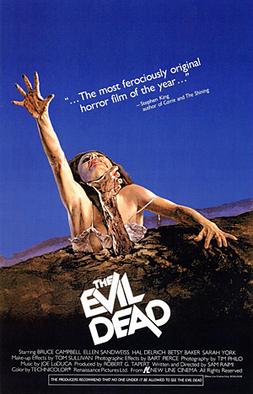
WHAT’S IT ABOUT: A bunch of friends/lovers go to a cabin in the woods for the weekend, and obviously, something horrible happens. It’s the embodiment of the cliche, if not the original that started the cliche.

WHY I DIDN’T LIKE IT: I saw it right before the remake came out, and I thought it was totally stupid. It was dated, the effects were terrible and cheap, and far from scary. I could not see how it became a phenomenon. And after I saw the remake and loved it, I was amazed that the original didn’t just get swept into the dustbin of history.

WHY I REWATCHED IT: You hear enough people talk about the influence of the original, and even do YouTube videos comparing both films (YouTube is a big part of my life, if that’s not obvious), you start to wonder if you missed something. It also started a phenomenon, as well as jump-started the careers of Sam Raimi and Bruce Campbell. Not to mention that the shooting was pretty dangerous: people were actually thrown into and had furniture fall on them. Not only that, but when the characters are fighting demonically-possessed friends with sharp knives, they’re actually fighting other actors with gunk in their eyes, completely blinded, while using actual sharp knives! Kind of makes you want to see if your opinion needs reevaluating.

THOUGHTS: Ummm…it’s better than I remember it. A little better, anyway.

There are some things about this film that are good. The camera work is always interesting, showing things from points of views I don’t normally see in horror films. At times, it feels like a drone is holding the camera: odd angles, fast movements, branches and whatnot hitting the camera. There are some really atmospheric moments, like when the characters arrive and there’s this eerie music and the porch swing is knocking against the wall.

And there are some shocking moments, like the…rape-tree scene. Yeah, if you didn’t know, that’s a thing this movie has. And it’s shocking and disgusting. Which is what the filmmakers were looking for, the most shocking horror film ever put to screen at that time, so I guess they got what they wanted.

But I have a lot of problems with this film. For one thing, the shock and awe only stays shocking as long as the audience isn’t desensitized. And I’ve been desensitized since I was nine and saw my first PG-13 movie. And when that stuff loses it power, what’s left has to hold up the rest of the film, and it doesn’t do that very well. Biggest issue I have is the effects: I know they’re going for memorable and it is, but they’re very silly at the same time, and in a horror film, even when I put aside my distaste for excessive gore, that’s just going to turn me off.

While I don’t expect the characters to be that fleshed out–not that kind of film–but they could’ve done a better job of establishing their relationships early in the film. I could not tell who was dating who, and they waited till nearly two-thirds into the film to reveal that Girl #3 was Bruce Campbell’s sister. Um…could’ve pointed that out earlier. I thought she was just a fifth wheel who went with the other four so she didn’t have to feel bad about not having a boyfriend. Which she was, but the sister part should be mentioned earlier.

And weirdly enough, for the bare-bones story, it actually gave me questions. For one thing, after the sister’s possessed and one of them is badly injured, the other characters are way too calm. Why are you so calm? Your friend’s possessed! Be a bit more freaked out and active! And why are the spirits said to be “sleeping” prior to being summoned by the incantations in the Book of the Dead, but they’re able to possess a hand or cause cars to swerve into the wrong lane? They seem pretty active to me! Are they like Cthulhu, sleeping but still able to affect the world, they’re just not at full power unless under certain circumstances? I’m so confused.

JUDGMENT: It may have caused a phenomenon and started a few careers, and you should see it for those reasons, but I wouldn’t expect to be really scared once you’re past age fourteen. On a scale of 1 to 5, I give the original Evil Dead film a 2 out of 5. That may be the unpopular opinion, but let’s face it: some classics don’t age well with time. We saw that with Texas Chainsaw Massacre, and I’m seeing that with Evil Dead. And I’m not sorry for pointing that out.

At the very least, I’ll check out the next film. I hear that and its sequel are at least a bit more enjoyable. And hopefully they will be.


That’s all for now, Followers of Fear. I’ve already reserved #7 in this series, and I think that, even if I don’t enjoy it as a film, I’ll find it interesting from an academic point of view. I’m talking Nosferatu.

Until next time, pleasant nightmares!

Aokigahara forest.

On December 31st, YouTube star Logan Paul visited Aokigahara, a forest in Japan that is visited by thousands of tourists, families, and school trips, but has a dark side. Aokigahara is a popular suicide spot, to the point that its nickname is Suicide Forest. The Japanese government has even posted signs throughout the forest encouraging visitors to choose life rather than take their own lives. While there, Paul and his friends came across a hanging body, filmed it, and posted the video on YouTube (the body’s face was blurred out). The video quickly went viral, garnering a lot of negative controversy. Within a day, Paul took down the video, and issued an apology over Twitter, but people are still very upset and there has been a lot of talk online about his actions.

Before I get into the main thrust of what I wanted to talk about with this post. Firstly, I am about to talk about a sensitive subject, and I am going to approach this with as much care and respect as possible. Still, I am an imperfect being and I make mistakes, like everyone. So if I say something that offends you or that you disagree with, please understand that is not what I intended. I’m just trying to make sense of a difficult topic in a world that doesn’t make sense that often, and sometimes I miss things that cause misunderstanding between others and myself without meaning to. So please bear with me as I try and explore a topic that a lot of people have strong opinions about.

Second, there are two things about me I would like to tell you all. One is that I have experienced depression before, and a couple of times it made me think of suicide. Those times when I considered suicide, it was because I had toxic people in my life who made me miserable. I still remember the crushing despair, the feeling that things were never going to get better, and the thought that I could just make it all better by leaving this life and falling into–I don’t know. Something better. It took the extraction of these toxic people in my life, as well as the help of a lot of good friends and family to help me find happiness and hope again.

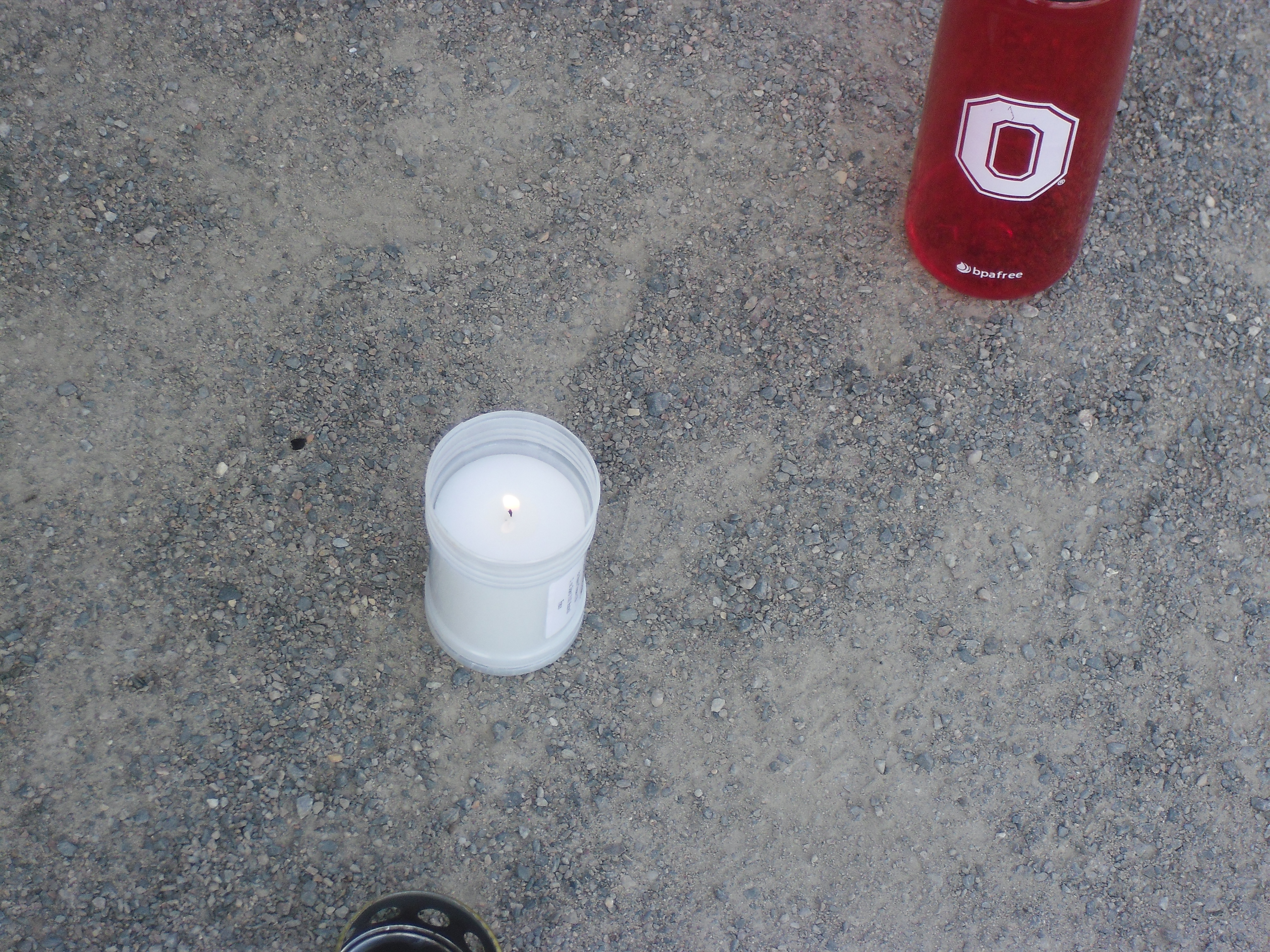
The Yahrtzeit candle I lit at Sachsenhausen.

The other thing I would like you to know is that back in 2014, I visited Sachsenhausen, a concentration camp twenty-two miles north of Berlin as part of my study-abroad trip. Around thirty-thousand people died at that camp while it was operational. When I arrived, it struck me as a very tranquil place. There was lots of grass and trees, the sun was shining, and there were only a few buildings left from when the camp was operational. But you spend enough time there, and this pall of despair settled over me. It was like the prisoners had felt over seventy years ago had seeped into my very body. An hour there, and it was just hard to even breathe there. I lit a Yahrtzeit candle, a ritual candle in Judaism for memorializing the dead, at a wall used by firing squads. And when I left, I was glad to get out of that anguish-infected place, even as I was glad to have visited a place connected to the history of my people.

Now to the point of why I’m writing this blog post. You see, a month before I went to Sachsenhausen, I wrote a blog post about haunted locations I wanted to visit, and Aokigahara was on that list (even before it became a suicide hotspot, the forest was well-known as a place for hauntings, hence why it was on the list). Given that, I feel like I have a responsibility to talk about this controversy, as well as my desire then, and now, to visit Aokigahara.

Obviously, what Logan Paul did was extremely disrespectful, the equivalent of taking a photo of the corpse at a funeral, or a selfie at Auschwitz or at the Berlin Holocaust Memorial. It shows total disregard for the deceased and their loved ones in favor of quick-lived social media attention, and should be discouraged at every opportunity.

However, there is nothing wrong with wanting to visit Aokigahara in itself (hold your comments, let me finish). As I pointed out above. Aokigahara is visited every year for totally innocent reasons. However, no matter what reason you go to visit the forest, it should be done with respect. Any death is horrible, and suicides are especially tragic. We can never know what is going through someone’s mind or what is happening in their lives, let alone someone dealing with depression and suicidal thoughts. Not unless we’ve been there ourselves, and sometimes not even then. But in every case, it is terrible, and shouldn’t be treated lightly.

With that in mind, anyone who visits the forest should do so with respect and cognizance for what has happened there, the same same way I approached visiting Sachsenhausen. Be respectful of what has happened and is happening there, understand that depression, suicide, and the forest itself has affected a lot of people in horrible ways, and if God forbid you do come across a body, leave it alone and notify the authorities. Only take photographs or footage if it is to help the authorities find the deceased, not for views or likes or whatever. Other photographs can be taken of the forest, or of the tourist attractions there such as the Narusawa Ice Cave and Fugaku Wind Cave, but definitely not of the bodies.

Remember, 1-800-273-TALK.

This is how, if I am ever lucky enough to visit Japan and I end up visiting Aokigahara, I will approach the forest. Not for ghosts, not for likes, and definitely not for suicide, but to pay respects to the dead and to draw attention to the ongoing struggle of suicide the world over. I may even bring a Yahrtzeit candle or some incense to burn, provided I can make sure it won’t cause a forest fire or injuries. Because what happens in this forest is a tragedy, and should be treated as such, no matter who you are or what your background is. Even as I enjoy the beauty of the forest and the tourist sites, I will remember these people, and hope they find rest, even as I hope others find the will to continue on and live.

And if you’re dealing with depression or suicidal thoughts, please know that things do get better. There were times when I thought my life couldn’t get better, but it did, and now, my life is great. And if you keep living, there’s always a chance your life could get better too. Every day is an opportunity for improvement. All it takes is the will to continue on. I support you, I’m there for you, and I hope you take this message to heart.

And again, if I said something wrong or caused offense, I beg your forgiveness. It is not my intention to cause any hurt feelings. I only want to make sense of something horrible and help those in troubled times. Thank you for reading.

If you’re dealing with suicidal thoughts, please also call the National Suicide Prevention Hotline at 1-800-273-8255. The counselors there will help you through this crisis, and help you find the light to fight off the darkness.

You know, I’ve written a lot about my identity on this blog. Or rather, because every person is highly multifaceted and puts themselves under several labels (even when they eschew all labels), my identities: writer; horror fan; bisexual man; autistic individual and disability advocate; total nerd; Ohio State Buckeye; feminist; liberal; possible entity from another dimension; and many more. But there’s one identity I’m only realizing now that, while I’ve mentioned it more than a few times on this blog, I’ve never really gone into detail about it in relation to my life and my writing. Not in six-plus years of blogging (believe me, I checked).

Considering that I was not only raised Jewish, but raised Jewish by two rabbi parents, went to synagogue nearly every weekend for years, went to Jewish day school from fourth grade through high school, attended youth groups and summer camps, was a frequent attendee at the Ohio State Hillel, and a whole bunch of other things than is listed in this run-on sentence, that is weird. And I’m not entirely sure why I haven’t really ever gone into detail about it. Maybe I thought I’d covered it in one of my 1300+ blog posts at some point, or maybe I just thought it wasn’t important enough to cover at any point. I have no idea.

Well, I guess better now than never (especially since this is my blog and you’re all hostages to whatever I feel like writing each day). How does Judaism affect my life and my writing?

Well for my life, it affects a lot. I’m more spiritual than religious, like many millennials, but I still practice certain rituals. I keep kosher and eat vegetarian when I’m out. I bring in Shabbat every week, and light candles on Hanukkah (you like the picture of my menorah? I’ve had it since I was a kid). I have a mezuzah on my door frame that marks my apartment as Jewish, and the only jewelry I wear is Jewish in theme (Jew-elry, if you will). I don’t attend services at my synagogue that much (I tend to sleep in on Saturdays because the week drains me. Sue me), but I pray often and keep in touch with friends through social media and hanging out. I’ve been to and support Israel, though at times the words and actions of its government concerns me. I pay attention to how my people are portrayed in the news and popular culture (I get seriously annoyed by how most Jews on TV and movies are like, “We’re like the rest of you, we just say some funny words and talk about our health issues a lot.” Seriously, we’re more diverse than that!), and get really psyched when I find stuff on it that educate people about our beliefs:

No need to post that video. I just like spreading it around. Especially since so many people know what Christmas is but so few outside the Tribe know what Hanukkah is.

So Judaism does affect my life. Does it affect my writing?

Well, yes and no. I don’t write what’s known as typical “Jewish literature,” which in my experience is usually about Jewish characters dealing with persecution from non-Jews or dealing with their Jewish faith and identities. I know my dad wished I would write those sorts of stories when I was younger, probably because he was afraid I’d be the next Ted Bundy if I kept reading and writing Stephen King-style horror, but that sort of story never interested me (thankfully, he’s come to like my fiction as is). I do feature Jewish characters in my work on occasion (my Lovecraftian short story “The Red Bursts,” which I’m trying to get published, features a gay Jewish couple who are active in their synagogue), but their religious background isn’t usually a big part of the story. Their are stories I’ve written or plan to write where Jewish characters are featured prominently, and where their background can be emphasized, but like I said, they’re not a huge focus in my fiction as a whole. I like telling a scary story first and foremost.

But my Jewish identity does feature throughout my fiction in a different way. Like every author, I insert my worldview, my morals and beliefs into my stories, and a good lot of that is shaped by Judaism, especially this phrase by one of Judaism’s greatest scholars: “Love thy neighbor. All the rest is commentary.” It’s why I like to use diverse casts in my stories, not just Jewish characters. People unlike me are my neighbors as well as those like me, so I give them all a fair shot in my stories. And this is just one of many ways I emphasize my faith in my writing (I’d go into it a bit deeper, but this article is getting long).

So yeah, my faith is still very important to me. And it even shows up a little in my stories. It may not show up overtly in my stories, but it does show up in the subtext. And for my particular style, that works pretty well. It might even get me somewhere as a writer someday. One can only hope.

That’s all for now, Followers of Fear. Until next time, pleasant nightmares.

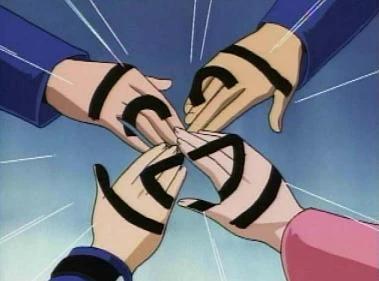
“The Power of Friendship!” as symbolized in Yu-Gi-Oh’s famous hand smiley face.

So yesterday I watched a YouTube video about a common trope in fiction (you can check it out HERE), which is (say it in your heads with a big, echo-y voice) “The Power of Friendship!” Now, if you aren’t familiar with the trope and you didn’t have time to watch the video, “The Power of Friendship” is a trope in which the bonds of friends is so powerful, it becomes a power in and of itself, capable of cosmic-like acts such as giving heroes power ups, stopping psychic mind readings, snapping people out of brainwashed states, and occasionally even defying gods. This power shows up in a ton of popular media, including a ton of anime and manga (the Fairy Tail series  practically is nicknamed “The Power of Friendship” manga).

Now the video I linked to goes into much more detail about the various intricacies of this trope (go watch it if you do have the time, the channel that produced it is awesome), but I wanted to focus on one particular aspect of “The Power of Friendship” trope that the video didn’t go into: how it surfaces in the horror genre. Or rather, how it doesn’t surface in the horror genre. At least, not all that much.

So if you didn’t watch the video (and you’re missing out!), the trope works like this: you have friends, and those friends can help you out of a bad situation, whether that be isolation or a powerful demon overlord is about to destroy the Earth and your power alone is not enough to destroy the demon’s power. It can be a metaphorical power to help a character out during a bad patch, like the former situation, or it can be a literal power and the equivalent of taking one of those mushrooms in a Mario game, like the latter situation. Thus, “The Power of Friendship!” And you can kind of see why it shows up so much: we all wish we have that power, or believe our relationships are that powerful.

But horror doesn’t feature this power as much as other genres, and there’s a reason for that. Horror is horror. It incorporates the darker aspects of the world around us and sometimes amplifies them for maximum effect. And in real life, friendships aren’t as powerful and as lovely as in fiction. In the stories, friendship is powerful and unyielding. It can overcome all sorts of obstacles, and the more you try to destroy it, the more it bounces back and kicks bad guys in the ass. But in reality, friendships grow, cool, and break all the time. It can take only a little bit to destroy a friendship, and a lot to repair it once it’s broken. Horror writers not only recognize that, but incorporate that into their stories. And it’s such a well-known fact about life, writers don’t draw attention to it, because it’s so well known among readers.

That’s not to say that “The Power of Friendship!” doesn’t show up in horror fiction at all. For example, Stephen King’s It pretty much says that the friendship of the seven main characters is what allows them to fight the malevolent entity in their town.* It just doesn’t say it as loudly as other media does, and also tells the reader that the characters’ friendship, while powerful, can be broken or is less effective if they aren’t all in sync or allow their fear to divide them. This is what leads to that one infamous scene in the novel, and is also shown in the new movie after the first fight with It.

Weirdly enough, the power of love or family is shown more than the power of friendship in horror, and I’m not quite sure why. Perhaps it’s because love and family, unlike friendship, has a more powerful evolutionary purpose, and therefore is given more power in fiction in general. If you’re willing to do more to save your perfect partner for creating offspring or the lives of your offspring, it’s going to show up more in stories than the grouping of creatures of the same species to ensure survival.** Hell, a lot more of my stories revolve around romance and family than friendship. One of my stories even involves a friendship gone bad, but that’s about it.

If “The Power of Friendship!” can be portrayed as it was in It, you can include it in horror stories more effectively.

That doesn’t mean we can’t include “The Power of Friendship” in horror stories. It can be used, but it’s more effective if used as it was in It: not overstated and a bit more realistic.  Showing a friendship form, grow, and overcome obstacles in a story, without drawing too much attention to it and showing how fragile the friendship can be under certain pressures, will work fine for the horror audience. If you go for overblown storytelling and basically say, “The Power of Friendship can overcome anything,” it will take the audience out of the story. Let the friendship’s strength demonstrate itself, rather than shoving it in through dialogue or just outright stating it. In other words, show, don’t tell.

While still not that common a trope in horror, “The Power of Friendship” can be part of horror. It may require being handled differently than in other genres, and with a bit more realism (weird for “realism” to show up in horror, but there you go), but it’s not impossible. You just need the right touch, and “The Power of Friendship” can best even shapeshifting entities that take the form of clowns.

That’s all, Followers of Fear. I’m in a bit of a blogging mood right now, so expect more posts from me soon. Until then, pleasant nightmares!

*There’s also some sort of power up thanks to a turtle from another universe, but let’s not get into it, shall we.

**Best explanation I can come up with given my aromantic nature and already jaded worldview.

Those of you who’ve followed me for a while know that I am on the autism spectrum, and that I’ve had opportunities to speak about it a couple of times, including a widely-circulated video which I posted back in March. I was able to get my job partially because of my autism, and a lot of the work I do involves working with, accommodating, and advocating for people with disabilities in the workplace, including but certainly not limited to autism. I don’t go around everywhere broadcasting my diagnosis, but it does come up on occasion.

One of those recent occasions was for my organization’s newsletter. I was asked to write a short essay, about a page long, about having a disability, about the program that helped me get a job in my organization, and what that’s been like. That article was published recently, along with a couple of other testimonials, and it’s been getting around. A lot of people have been coming up to me and thanking me for being so open with my story.

Today, I got an email from someone in my organization who had read the article, and had contacted me asking for advice. His adult nephew had been diagnosed with autism a couple of years ago, well past the point where intervention can be at its most effective. And in the  years since his diagnosis, his life has not gotten easier. I won’t go into details, but it was heartbreaking to read the man’s email and to hear about his nephew’s suffering.

At the end of the email, he asked what could be done for his nephew, and if maybe the program that helped me get my job could help his nephew.

What do you say to something like that? What sort of comfort can you give when there’s already so much pain?

I don’t know if I ever meant to be an advocate for people with disabilities. But over time, that role has kind of been molded around me. A good part of this has been because of my job. As I said, I have to advocate for people with disabilities in the workplace. To that end, I’ve learned how to market to people who are able-bodied why they should hire more people with disabilities. I can tell them that people with disabilities have a much lower turnover rate than the general population, 8% compared to 45%, that getting them accommodations rarely gets anywhere near the $500 mark, and then back all that up by talking about my own satisfaction with my position, and how the only accommodation I’ve needed for my ASD was permission to listen to my iPod or audiobooks while doing certain tasks. I’ve also been asked to do essays, like I did for the newsletter, and the video I recorded back in March. And sometimes it just comes up, like when explaining how I got my internship in Germany (yeah, my ASD played a part in that), or using it to illustrate a point in conversation, or a hundred different scenarios.

One way or another, it seems like I was meant to be an advocate, especially at this point in my life, when I’m doing so well at work, living on my own, and even as a writer.

But as a giver of advice? I’m not sure I expected that. And I get why it’s happening. Autism is a scary diagnosis for anyone to get, as well as for the loved ones of those diagnosed. It’s a disorder that varies widely from person to person, it can never be cured, the cause is still unknown,* the number of people being diagnosed with it has grown exponentially with improved diagnostic tools. Depending on what traits are present or what other disorders are present with autism can also affect everything from therapy to school choices to possibilities in adulthood. And when the diagnosis is made in adulthood, as happened with the young man whose uncle emailed me, it can be a sort of terrifying that no horror story can tap into. With all that in mind, hearing from someone who not only has the same diagnosis, but is successful in the real world, can be a soothing balm for the mind and soul.

I just wish I had all the answers. Or that I was more confident in the answers I have to give.

But if I’m going to give any sort of advice, it’s that we shouldn’t deny or try to hide our diagnoses. We shouldn’t try to be “normal,” because normal doesn’t exist, especially not for us. We process the world so differently than everyone else, but that doesn’t mean we have to be ashamed or afraid. I’m able to succeed and do the things I do every day because I process differently. So embrace your different. It may be called a disability, but it can be an asset too. Some of the greatest innovators and creators the world has ever known have been on the spectrum. And once we learn to work with the issues we have, we can learn to become those great innovators and creators.

And don’t be afraid to look for or ask for help. Even if you’re diagnosed later in life, there’s still plenty of resources for you. Many states, including my beloved Ohio, have programs that offer help and direction for people with disabilities and families, whether they be children or well into adulthood. Many schools have or are adding programs to ensure the disabled can take full advantage of their educations. More and more employers are recognizing the importance of hiring people with disabilities, and what they can contribute. We’re not being left alone like a ship in a storm. There is help.

Living my life strong, no matter what my diagnosis is.

And it’s important to be open about your diagnosis, especially with your friends, family, coworkers and teachers. Keeping it a secret has never helped anyone get by. It’s better to be open, so that those around us are better equipped to work with us, and join us on our journey as we work our way through life. I know it’s scary, and you don’t want to be any different than anyone else. But remember, there’s no normal. We’re all different, and many of us wear it on our sleeves. Might as well display this different too, if only to make life a little easier.

I hope you find this helpful. I hope the man who emailed me today found my advice helpful. And if you or someone you know has autism, I hope that no matter what, you or your loved one is able to hold their head up high and know this: you are great the way you are.

*And if you’re about to comment saying some bull about vaccines, let me tell you a story, since anti-vaxxers seem to value testimony more rather than scientific consensus: my mother has told me a few times that I was different from the day I was born, well before I received my first vaccine. I was nothing like the baby books predicted I’d be, and it wasn’t until my younger sister was born that she saw any of that stuff. I trust her word, so that means vaccines had nothing to do with the way I am. And if you still insist that vaccines had something to do with the way I am, you may be calling my mother a liar, and them’s fighting words.

If you’ve known me for any amount of time, you know I’m a huge fan of horror. I read horror novels, I write horror stories, I sometimes write articles examining various aspects of horror, I watch YouTube videos about dark and creepy subjects, I decorate my apartment with horrifying artwork and dolls and stuff, I…well, you get the idea. And of course, I watch plenty of horror films and shows.

And as every true horror fan knows, it can be hard to find good horror sometimes, particularly in the movie department. We fans watch a lot of horror movies that are really bad hoping that they may be good and even give us a few nightmares (or in my case, some good inspiration). I sometimes think of it examining piles of shit looking for gold nuggets, only you can’t tell the difference without special examination (imagine if that was the actual case. Nobody but the really desperate would ever look for good horror movies!). And I’ve seen plenty of bad horror films over the years while looking for good ones. I’ve even written about them, on occasion.

But lately there’s been something I’ve been wanting to try. You see, some of those horror films that I’ve hated, I’ve heard lots of people praising. They tell me the shit is actually gold. I’ve even seen some very thorough examinations of these films, in essays and videos, and the writers/creators of those videos have made me wonder if maybe I should rewatch some of these films, and reexamine my opinions of these films.

So now that I’ve seen It and there aren’t that many horror films coming out in the next couple months that I’m absolutely dying to see and review, I think it’s time to do what I’m going to call the Rewatch Review series. I’m going to watch ten films that I’ve hated and/or given bad reviews in the past, and see if my opinion has been changed. Some I may have watched in the wrong light, others I just think I missed something the first time around. Either way, I’m going to take a look again and then let you know if I’ve got any new thoughts to share.

And with the first film waiting for me at the library even as you read this, I should be able to start watching in earnest soon. It may take some time, depending on how quickly I can get these movies, but either way, you’re going to get something from me.

As for what these films are, I’ll list them below. When I’ve written my (hopefully changed) thoughts on each movie, I’ll post a link to this article. That way, if you want to read all my thoughts at once, you’ll have that option (though I don’t know if anyone’s THAT bored!).

Perfect Blue (1997)
The Strangers (2008)
The Witch (2015)
The Texas Chainsaw Massacre (1974)
Oculus (2013)
Evil Dead (1981)
Nosferatu (1922)
The Shining (1980)
Mama (2013)
Whispering Corridors (1998)


Why did I dislike some of these films? You’re going to have to wait till I actually write about them. Haven’t I reviewed a few of them before? Yes. Why am I reexamining them if I already reviewed them? You’ll have to wait till I watch them. And that’s all I’m saying on the subject.

That’s all for now, my Followers of Fear. I’m heading off to bed. Until I write again, pleasant nightmares.*

*And if you have any, let me know. I might write a novel based off it.