Author Archive

I looked for a cosmic horror GIF, and this was my favorite.

Cosmic horror is everywhere these days. Since HP Lovecraft first kicked off the subgenre in the early half of the 20th century, it’s spread from pulp magazines to all corners of horror literature, to table-top roleplaying games and video games. And while cosmic horror has been in the movies and on TV sporadically since the 1960s, in the past couple of years we’ve seen a glut of it on those mediums: Annihilation, Stranger Things, The Color Out of Space, Underwater, Lovecraft Country (which I’ll be watching soon now that I have HBO Max), The Endless, and most recently, The Chilling Adventures of Sabrina‘s fourth season (though not very well).

And there are more on the way. Just today, I heard about a new film called Sacrifice coming out next month that has Lovecraftian themes (click here to check out the trailer). Sometime this year, the long-awaited anime adaptation of Uzumaki by Junji Ito is supposed to air. Richard Stanley, the director of Color Out of Space, hopes to do a trilogy of films based off Lovecraft’s work.

And there’s a lot more that I probably don’t know about. Plus new games, novels and short stories, comics, manga and anime, poems and art! Cosmic horror is kinda going mainstream right now. Or as mainstream as horror can get.
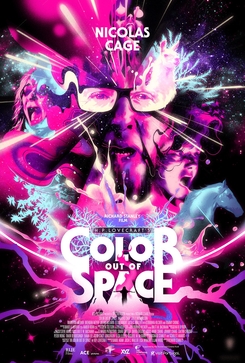
Color Out of Space was awesome. And we may have more like it in the future.

The question is, why now? Why is this particular subgenre only now just getting mainstream acceptance? Why the sudden enthusiasm?

I think there are a few reasons. One is time and a devoted fanbase. Cosmic horror, as I said, originally came from pulp magazines with very small circulation. However, the fans who enjoyed the stories of Lovecraft and those who played in his world–what would later be known as the Cthulhu Mythos–preserved and kept the stories going even after the deaths of the magazines and of Lovecraft. Through hard work and advocacy, more fans found cosmic horror and found themselves drawn to the stories. Then as now, fans would then tell other fans, or create their own work based on these stories, which has a looping effect of creating more fans through exposure. So, it may have taken time, but cosmic horror has been able to spread with patience and the love of many who follow it.

Almost sounds like cosmic horror is an eldritch deity in and of itself, doesn’t it? I find that hilariously appropriate.

Another factor at play, I believe, is that modern audiences are more receptive to that kind of horror than they have been in the past. Like I said, it’s taken time for cosmic horror to penetrate the public consciousness, and so for many people, cosmic horror may be a nice change of pace from the usual horror fare. We’ve seen plenty of haunted house stories, slashers, and sequels and ripoffs of possession or ghost stories. Those elements are not normally part of cosmic horror. In fact, it could be a breath of fresh air for audiences.

And finally, while cosmic horror normally deals with ancient, otherworldly gods and terrible secrets, it’s a great place to talk about modern issues. Granted, horror has always been a place to explore our everyday fears and anxieties, but cosmic horror, through the perspectives and interactions of its human characters against these terrors, can do it in a unique way. Lovecraft Country uses cosmic horror to explore racism, which both was part of the genre’s start and which is a current problem today.

Is it too much too hope that one of those works might be a kickass, terrifying adaptation of Hellstar Remina by Junji Ito?

And I wrote a novella, What Errour Awoke, that combined elements of cosmic horror with the current pandemic to explore the fear with the latter. And yes, I still hope to get that published.

So, with all these factors, can we expect more cosmic horror in the near future? I think so. Maybe not in huge numbers from the movie industry, as cosmic horror tends to have a spotty track record there.* But certainly in other mediums. Horror-themed TV has been booming, so we’ll likely see plenty of shows exploring those themes in the future. Comics and manga have always loved cosmic horror. And, of course, we’ll likely see many, many new books or short stories in that vein.**

So long as they’re made with lots of love, both for the subgenre and for the projects themselves, rather than for the money, I look forward to it.

Are you a fan of cosmic horror? Are you enjoying the wave of new works in the subgenre? Let’s discuss in the comments below.

*While they were well-received by critics and moviegoers, Annihilation and Underwater underperformed at the box office, and Color Out of Space only had a limited theater release.

**Hopefully, I’ll be able to add to this. I’ve a few cosmic horror ideas waiting to be written. I’d love to share them with you all someday.
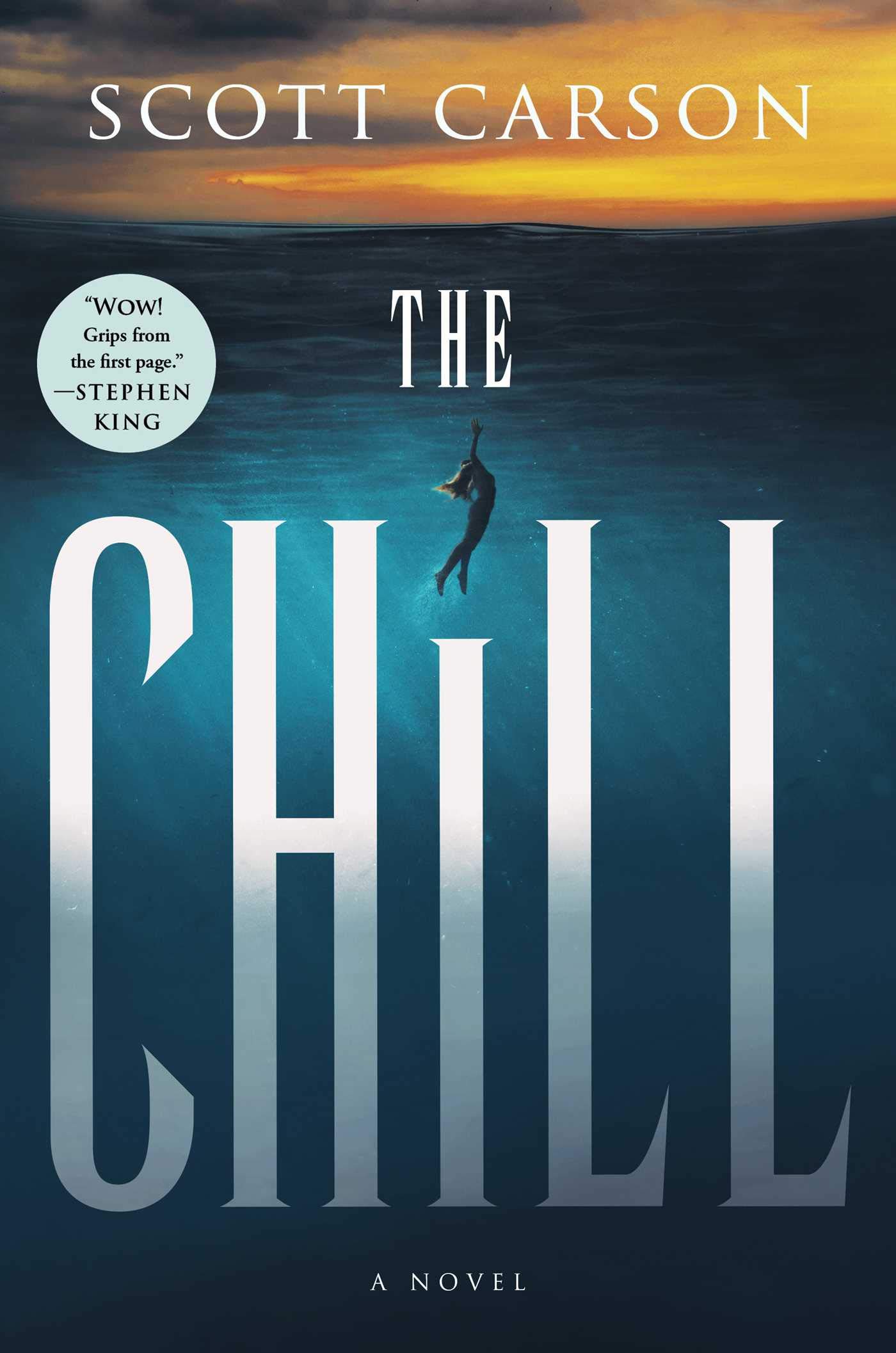
Fun fact: apparently Scott Carson is actually Michael Koryta, an award-winning author who does both crime and supernatural fiction. If what I’ve heard is true, his fanbase is pretty divided between his crime and supernatural books, so he created a pen name for the latter going forward. Everyone got that? Good. Onto the review!

The Chill takes place in the fictional Torrance County, upstate New York, home of the fictional Chillawuakee Reservoir, or “The Chill.” This reservoir was built at the loss of a small town called Galesburg, which was submerged after the dam went up. Prior to that, some of the Galesburg residents didn’t take kindly to being evicted so New York City could have another freshwater supply, and reacted violently. Even after the dam went up and many of the protesters died, some still swear revenge. Now, nearly eighty years later, the dam is old and in need of repairs, and the dead are aware of this. They’re active, they’re working behind the scenes, they do not forgive and they do not forget. And they want their revenge.

So, the concept of the story is pretty cool. It kind of reminds me of The Shining, though instead of ghosts at an old hotel, it’s ghosts by a dam and the afterlife is kind of busy and cult-like as well. You can tell the book was meticulously researched by how it goes about explaining the inner workings of dams and reservoirs, as well as (what I assume to be) the problems with maintaining them. And the prophecy in the story makes a clever twist on the trope that I like.

However, there were a lot of problems with the novel. For one thing, it seemed to take forever before it got interesting. Several times before the halfway point, I wanted to put the book down and not read anything else because of how slow it was going. We also don’t meet one of the focal characters, Gillian Mathers, until about a quarter in, and it takes even longer for us to identify with her and see her as more than just a trope in a story. I feel like Carson wanted to focus less on her until she was needed because she is a type of trope, and instead focus on another character, Aaron Ellsworth, because he’s got a much more interesting character arc.

Another issue was that, while the dams were well-researched, I had trouble visualizing certain things in my head. I’m not familiar with dams, and I don’t know many people who are beyond the fact that they hold water back. It would have been nice if a couple more paragraphs were shown to help readers like me visualize the structure, the discharge tunnel, etc.

However, past all that, it does get interesting. There are some spooky scenes, an epic disaster scene, and some excellent writing. I just wish we’d seen more of that in the first half.

On a scale of 1 to 5, I award The Chill by Scott Carson a 3 out of 5. It’s okay, but there were definite areas to improve in.

That’s all for now, my Followers of Fear. I’m still relaxing so that when I return to writing, I can be as refreshed as possible. Until next time, stay safe and pleasant nightmares!

I made a nice graphic for “The Pure World Comes.” It’ll work till I get a proper cover for the story.

My first major achievement of 2021 occurred this morning at around 2 AM (yeah, I’m not sure how I’m functioning right now, either). After a crap ton of editing and a bit of Doctor Who, I finished the second draft of The Pure World Comes.

Now if you don’t know what The Pure World Comes is, it’s a Gothic horror novel I wrote back in Spring 2020 and started editing last month. The novel, which is set in Victorian England, follows a young maid who goes to work for a mad scientist. Beyond being a fun and exciting story to work on, it was my love letter to the Victorian era and a great opportunity to showcase my theory of who Jack the Ripper was.

Yeah, I worked Jack the Ripper into the story. And I think it worked as an addition.

Now, if you remember my post about prepping to return to Victorian England, I had some specific goals with this draft. Namely, I wanted to make the story feel more authentic by improving the dialogue, explaining all the odd ideas and customs of Victorian England (*cough* mourning rituals *cough*), and adding little details like steam engines, Covent Garden, and bath tubs heated with giant metal contraptions. While I’m still iffy on the dialogue, I think I did a great job with the other stuff. I tried to give readers some explanation or context for some of the things that were common then but would be considered odd now, and I think I added enough little details to make the story feel authentic.

Of course, I’ll leave that up to the beta readers (more on them in a bit).

Also, did I mention how much this story has grown since the first draft? The first was 214 pages (8.5 x 11 inches, double spaced, 12-point Times New Roman font) and 59,333 words. The second, however, was 228 pages and 64,269 words! That’s an increase of nearly 14 pages and nearly five-thousand words! Yes, a lot of that comes from explaining some things or expanding some sections so they’re less confusing. Believe it or not, it might’ve been more, but as I got further into the draft, I ended up cutting a ton of material as well.

So, what’s next? Well, I’m going to hand the novel off to a couple of beta readers to look over. I’ve already gotten confirmations from two colleagues who are well-versed in historical fiction (as well as my work) that they’ll take a look, and I’m reaching out to a few others who are big horror fans themselves. With any luck, I’ll find out not only if The Pure World Comes is any good, but what I can do to improve it in the third draft before trying to publish it.

And while they’re looking at the second draft, I’ll be taking a break from any serious writing for a short while. Beyond any administrative work on my various projects or the occasional blog post, it’ll just be easy street for the next week or two. After that…well, I have some ideas.

I look forward to receiving feedback for the third draft.

For now though, I’m just excited to be reaching this stage in the novel’s development and hope I get to share it with you very soon.

And if, in the meantime, you’re looking for something new to read for 2021, I have a few other projects out on the market that might fit the bill. I’ll leave the links below. All I ask is that you leave a review online somewhere if you do end up reading my stories, as they help both me and other readers.

That’s all for now, my Followers of Fear. I’m off to enjoy some dinner, some classic Doctor Who, and an early bed time. Until next time, stay safe, Happy New Year, and pleasant nightmares!

Mother of the King: Amazon US, Amazon CAN, Amazon UK

Rose: Amazon US, Amazon UK, Amazon Canada, Audible

Snake: AmazonCreatespace, Barnes & Noble, iBooksSmashwords, and Kobo

The Quiet Game: Five Tales to Chill Your Bones: Amazon, Createspace, Barnes & Noble, iBooksSmashwords, and Kobo.

As many of you know by now, I’m in the middle of editing The Pure World Comes, a Gothic horror novel I wrote earlier this year. The novel follows a maid living in Victorian England who goes to work at the estate of a mad scientist (yes, that’s my elevator pitch for the story). Since a mad scientist features prominently in the story, I thought I’d take a moment to discuss the trope, as it’s extremely common in fiction, especially sci-fi and horror.

With that being said, I decided to do some research before working on The Pure World Comes. I couldn’t find many articles on the trope (and those I did were pitifully short), so I asked one of my Facebook writing groups for help. I got way more responses than I’d expected. Some of them gave me some funny responses like including wild, white hair and a funny accent, or differentiating mad scientists, who do mad experiments, to mad engineers, who build mad things. Some were not helpful at all, like imagining them as autistic overachievers (excuse me? I’m on the spectrum and an overachiever! I take offense at that).

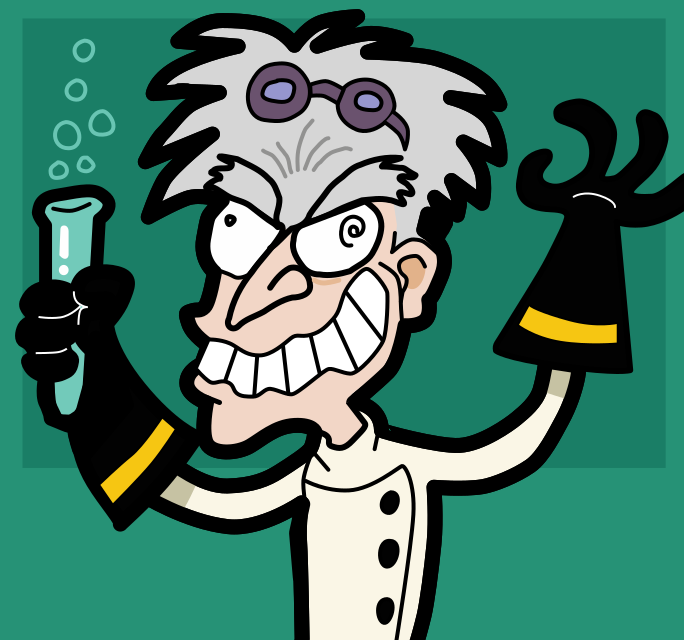
However, there was some good information given to go with the few articles I could find. To start with, the mad scientist trope is over two-hundred years old, with the prototypical mad scientist being Victor Frankenstein of the novel Frankenstein.* However, the stereotypical look of the mad scientist–wild hair, crazy eyes, and “quasi-fascist laboratory garb1“–as well as the outlook for the lab, was influenced by the character Rotwang and his lab in the German silent film Metropolis. Rotwang also had numerous traits we associate with mad scientists (more on that later). After the horrors of WWII, such as German experiments and the atom bomb, and the outbreak of the Cold War, mad scientists began to reflect the horrors and fears of that age, often working on projects that could destroy all or almost all of mankind.

Given the state of the world now, I’m expecting an influx of mad scientists interested in virology and/or social engineering.

Alongside their history, I found out mad scientists have some common subtypes:

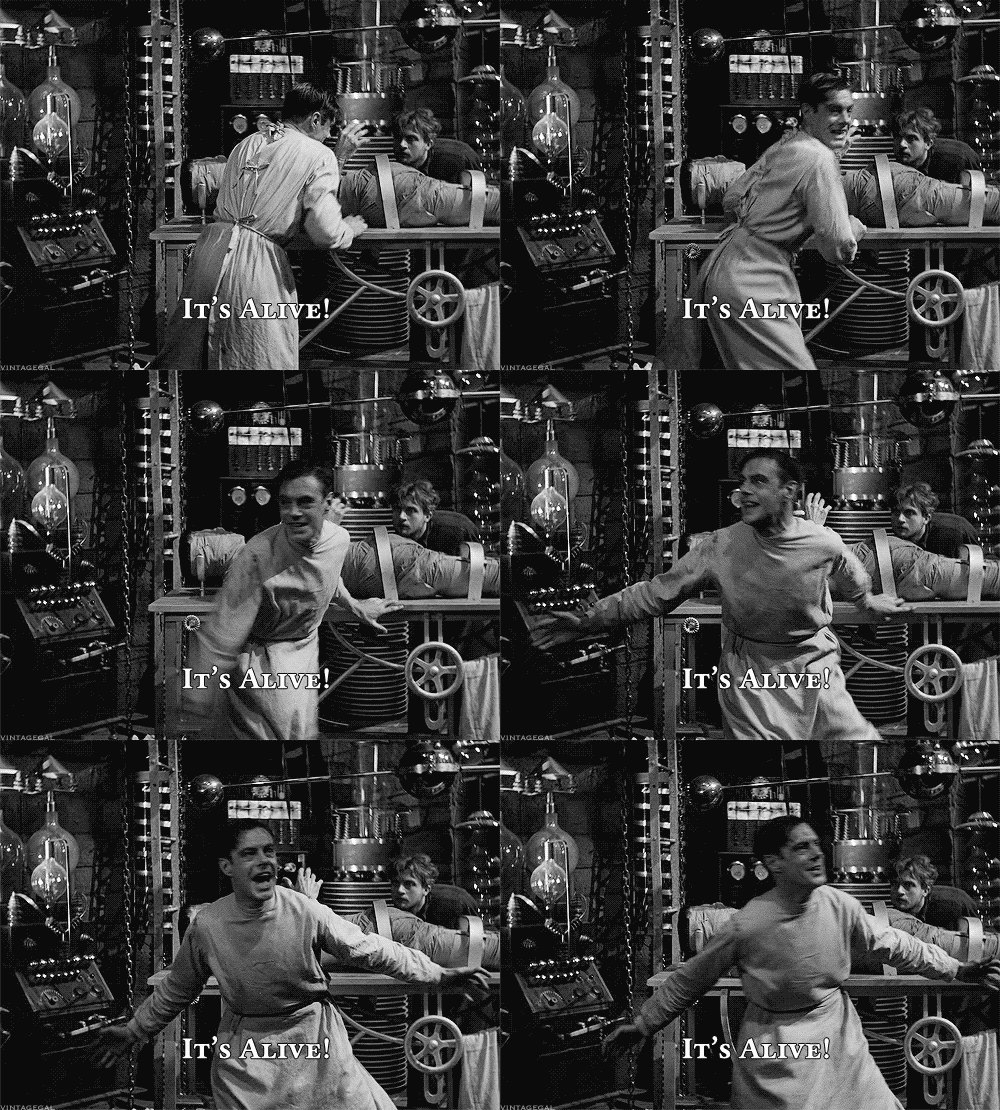
Victor Frankenstein (here renamed Henry for some reason) is a great example of an unethical mad scientist.
  • Mythical scientists. These are the mad scientists who seem to be working with godlike powers, either through unexplained, futuristic science bordering on magic or actually studying/utilizing magic items. Science-colored wizardry, as one FB commenter put it.
  • Unethical scientists. These are the scientists who are actual scientists but have dropped their ethics/morals. These types are usually based on the Nazi scientists, the Tuskegee doctors who studied on unknowing black men, and so many more (sadly), though Frankenstein technically falls into this category.
  • Cutting edge obsessive scientists. These types aren’t always so bad. They are good at their work and love it deeply, but tend to get obsessive to the point it can cause trouble for them or other characters. Often, after causing a lot of trouble, they can get a redemption arc. A good example is Entrapta from the She-Ra reboot.
  • Scientists with mental illness. These are self-explanatory, and are becoming more and more common in media these days. This can be a bit of a double-edged sword, as it can be great representation for the disabled, but it can also give a bad name to the disabled by linking their evil behavior to their mental illness.

Obviously, these types can cross over with each other. And there’s probably more than what I’m listing here.

Whatever their type, type combination, or era of creation, all the types have some commonality. For one thing, they generally deeply believe in their goals or research. They also tend to think of themselves as a protagonist in their own personal story. Even the ones who acknowledge they’re evil still believe they’re a main character on the world stage. Pride, greed, or the belief that they know better is generally what drives them, and is often what leads to their downfall.

As for how to write mad scientists, it’s less having to do with the trope and with the character itself. Because of what the mad scientist can do, they’re often used to fulfill a number of needs in stories, but unless you’re making them a satire of the trope or just including them for comical effect, you need to really think about their character. What motivates them? What are their odd ticks or quirks? Think of them like you would any other character and apply the same amount of love and development. Hopefully then you can create a great mad scientist.

Entrapta in the She-Ra reboot is a great subversion of the mad scientist trope.

You can also try going against clichés. Most mad scientists are older white males with nefarious intentions, so going against one or more of these traits and then making the character your own might be a good idea. Looking at you again, Entrapta from She-Ra! You wonderful, robot-obsessed, magic-haired princess, you!

Mad scientists are common characters in fiction and for good reason. And while there’s no sign they’re going away any time soon, there’s plenty of room to innovate and make them your own. Especially if you do your science homework before you start writing.

That’s all for now, my Followers of Fear. This will probably be the last post I make for 2020. If that’s true, I’ll catch you all next year. In the meantime, I’ll be bingeing TV, sleeping and editing The Pure World Comes (I’m currently in the chapter where I reveal who Jack the Ripper is).

Until next time, stay safe (and don’t travel), Happy New Year, and pleasant nightmares!

*Fun fact, Victor Frankenstein never actually finished college, so he’s not a doctor, though people think he is. But since the discipline of science hadn’t been formalized and all the other stuff by the early 19th century, we can still call him a mad scientist.

Unless you’ve been living under a rock for a while, you’re likely aware that 2020 ends this week. And by God, are we all glad of that! COVID-19, forest fires, horrific murders leading to massive civil unrest, false claims of election fraud that nevertheless have weakened our democracy, and did I miss anything? Probably, it’s been such a horrible year.

Yeah, on a personal level, things were good. I wrote so much, it kind of became an in-joke among my fellow writers; I got to do a lot of traveling and visit a few haunted places; I started saving for a home; and I was able to grow my audience and have my stories reach more people. Yeah, I was only able to publish one story and I didn’t get any acceptances like I’d hoped for, but I got good feedback on the stories I submitted and think I could get them into other publications or accepted by other presses.

And yeah, some things on the national and global stage were good. Even under the strains of COVID-19, we managed to get some great stuff in the entertainment realm.

But still, this was a hard year. So, unlike previous years, I won’t write a post about how 2021 will be better. And I certainly won’t post another video like I did at the beginning of 2020 speculating on what might happen this year. Yeah, remember that? I remember New Year’s 2020 clearly, which is crazy because usually time just blends together for me, but I remember December 31st, 2019 and January 1st, 2020 as clearly as if they’d just happened. And I remember the hope that I and so many others felt. 2020 was going to be so good! After 2019 was such a shit heap, we couldn’t imagine things being worse.

Boy, were we wrong!

So, I’m not going to say 2021 is going to be better. More than likely, it’s going to be a hard and continuous struggle for the first half to two-thirds of the year. We’ll need that time for the new COVID-19 vaccines to make it among the population and see how effective they are. We’ll also need that time for the new government to get to work and hopefully pass some legislation that helps the American people. And a million other things that need to occur across the world.

Making 2021 better than 2020 is going to feel like a Sisyphean task most of the time, believe me.

So, I won’t say 2021 will be better. I will say there’s room to improve the situation. And hopefully things will improve.

And hopefully some of the things I aim to accomplish this coming year will happen. I’ll hopefully continue to write and edit new stories that excite and scare people. Maybe some of them will get published (perhaps in a few publications or by a couple of presses?). I’ve a couple of other projects in the works that I hope to see pan out, and I hope to continue expanding this wonderful audience known as the Followers of Fear.

Oh, and I might go to a couple of conventions. That’s a thing.

And on a more personal level, I’ve got some things happening that I’m excited about. I’ll be moving into a bigger apartment this year and hopefully getting a cat soon after (I’ve been wanting a kitty of my own for sooo long!). I hope to get lots of reading done, and maybe even do some traveling later in the year. And maybe I’ll get to meet some of you amazing Followers of Fear in person! That certainly would be cool.

But for now, I’m approaching things cautiously. I’m living that old Arab proverb of “Trust in God, but tie your camel.” And while I would like for 2021 to be an improvement, I know it’s going to be hard to make that happen.

We can only struggle and work to make things happen, I guess. And hopefully that will have positive results.

That’s all for now, my Followers of Fear. I’ve stories to edit, chores to do and a few other things besides. Until next time, pleasant nightmares!

Are you hopeful for 2021? What are your plans for New Years? What are you hoping to accomplish next year?

As many of you know, I have a YouTube channel that I post to every now and then. Today, I had a bit of time and decided to film a quick little video. What was it about? Well, it’s about reviews. Specifically, how you should help your favorite authors by leaving reviews online for their books, as well as why.

I’m not going to lie, I’m proud of this video. It’s not very long, but I managed to make a nice thumbnail, do some fun editing tricks, and even add music and a short title card at the beginning of the video. I don’t think I’ve ever done that before. I may still be an amateur when it comes to video production and editing, but I am getting better at it.

And yes, I did mention Rose‘s audio book in the video. Can you blame me?

Anyway, as the video said, if you like an author’s book, please leave a review with your thoughts online somewhere. Even a short tweet or post on Facebook or Goodreads can be a momentous help to authors. Especially those who aren’t very well-known. Every review helps an author improve, helps other readers find the book, and lets the authors know their work is being read and hopefully appreciated.

And if you would like to support me, I’ll leave the links for my works below. Please consider checking my stories out and letting me know in a review what you think. Because…well, you know why.

And if you liked this YouTube video, please consider subscribing to my channel. I don’t post often, but when I do, it’s usually because I’m passionate about whatever I’m posting. And I would love to see you all there.

That’s all for now, my Followers of Fear. I’m off to dispose of Santa’s body before the authorities find me. Until next time, Happy Holidays and pleasant nightmares!

Mother of the King: Amazon US, Amazon CAN, Amazon UK

Rose: Amazon US, Amazon UK, Amazon Canada, Audible

Snake: AmazonCreatespace, Barnes & Noble, iBooksSmashwords, and Kobo

The Quiet Game: Five Tales to Chill Your Bones: Amazon, Createspace, Barnes & Noble, iBooksSmashwords, and Kobo.

The audiobook cover for Rose. Available from Audible and Amazon.

You know, its been six months since I last had a post focused on Rose? How crazy is that?

But to the point of this post: a year ago today, the audio book for my novel Rose was released, the first time a story of mine was ever available in an audio format. The book was narrated by the amazing Sara Parlier, who I had to pleasure to meet this past summer in South Carolina. No joke, at times her narration gave me chills! And that was both times I listened to the audio book, by the way. And I wrote the damn thing!

So if you don’t know about Rose, it was my first novel published with a publisher (Castrum Press if you’re curious). The story follows a young woman, Rose Taggert, who wakes up one day in a greenhouse with no memory of the past two years. However, before she can get a handle on that, her body undergoes a startling transformation into a human/plant hybrid! As those around her react, she realizes some are not all that they seem, leading to a desperate fight for survival.

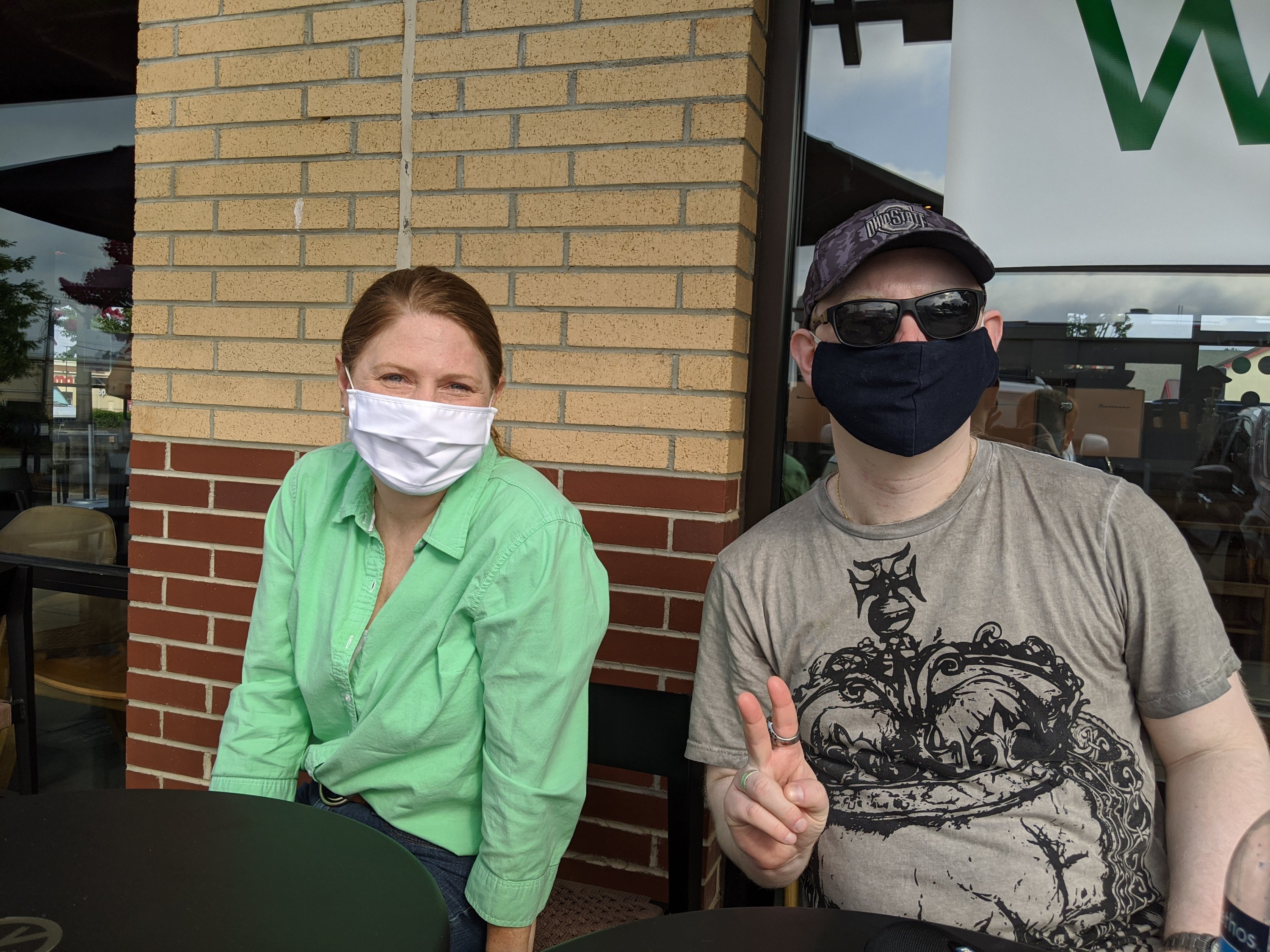
Sara Parlier, the narrator for the Rose audio book, meeting at a Starbucks in South Carolina.

And I can’t believe it’s been a full year since the audio book came out. I can believe nearly all of 2020 has passed, but the audio book being a year old? The mind boggles!

And I’m happy that the majority of reviews on the audio book, and the novel in general, have been positive. At the time I’m writing this, Rose rates a 4 out of 5 on Audible based on five ratings and four reviews, as well as a 4.6 on Amazon’s US site based on thirty ratings and twenty-nine reviews. Considering how I’m still not as well-known as other authors I could name, I consider all this feedback from readers absolutely amazing, and I hope there are more to come.

And if you’d like to check out those reviews yourself, or maybe even check out Rose, I’ll include the links below. And if you like what you read, or if you find Rose to be horrible trash, please leave a review. Not only do I appreciate all reader feedback, but it helps me out in the long run and helps other readers decide whether or not the book is for them.

One last thing: I’d like to thank everyone who’s read, reviewed and enjoyed Rose since its release in June 2019. It’s been an insane ride this past year and a half, even excluding current events, but I’m so grateful for the love and support you’ve shown me and this little novel I wrote as my college thesis project. I’ve dreamed of being an author since I was a kid, and you’ve helped make that dream a reality. So, once again, thank you so much. I hope you’ll enjoy my other stories, as well as the ones to come, just as much.

That’s all for now, my Followers of Fear. I’m off to stop that creep Santa Claus from stalking people and then breaking into their homes based on his assessment of their behavior. Until next time, Happy Holidays and pleasant nightmares!

Rose: Amazon US, Amazon UK, Amazon Canada, Audible

My copy of Remina from the library.

I’ve been looking forward to this book getting an official translation and release here in the US for quite some time. And I was so excited when it arrived at the library, I stopped by yesterday afternoon to pick it up rather than wait till Friday. As you can guess, I stayed up late reading it, hoping the story within would give me some pleasant nightmares.

Known as Hellstar Remina in Japan, Remina kicks off with the discovery of a new planet that seemingly appeared from a wormhole several lightyears away. The discovery is hailed as the greatest development in astrophysics ever, and its discoverer, Dr. Oguro, names the new planet after his beloved, beautiful but shy daughter Remina, causing her own star to rise alongside the planet bearing her name. However, planet Remina is moving through space in ways that defy physics and sense. Planets and stars disappear in its wake. And it soon becomes clear that not only is this planet headed to our solar system, but it spells doom for all on the Earth. Especially the young woman who shares a name with it.

Oh man, I don’t think I’ve loved something from Ito this much since Uzumaki!

First off, the concept is well-executed. Ito takes this idea of a planet flying through space towards us, threatening everything we found our worldviews on as well as our lives and our planet, and turns it into this strange, dread-inducing story that somehow manages to ramp up more and more with every page. The planet itself is rather terrifying. There’s so many unknowns about it, and the more you learn and see of Remina, the more questions you have and the more you learn to fear it. It really puts the “cosmic” into cosmic horror.

I was also impressed with the human characters. Remina Oguro, the planet’s namesake, is easy to like. She’s shy and humble, and really only becomes an entertainer because she’s suddenly famous, so she might as well use it to get through life more easily. Which makes the hardship she goes through later so heart wrenching. As the planet bears down on the Earth and no solution seems to work, people begin to wonder if the Oguros, particularly Remina herself, have some hand in bringing the planet to them. In their terror, many abandon reason and decide the only way to save humanity is to kill Remina Oguro herself.

It’s not only an excellent example of cosmic horror–of humans dealing/reacting to their insignificance in the universe in the only ways they know how–as well as making you feel for Remina, but it feels really relevant to our current predicaments. Whether it be COVID-19 or the national election, you see people embracing the most insane conspiracy theories rather than accept an obvious reality. That is illustrated so well in Remina, and I felt a chill reading that.

This shot encapsulates so much of what makes Remina great.

Other aspects of the story worked as well. Ito’s art is amazing, as always. Earth in this manga is portrayed as being a few decades ahead of us a la The Jetsons, flying cars included, and it’s cool to see Ito give Earth this futuristic look. The characters are well-drawn, with our protagonists given a more realistic look while those driven mad by fear or anger are hyper-exaggerated to best portray their emotions. But the best illustrations are the spreads taking two full pages. They portray that cosmic dread so well, I spent quite a bit of time looking at them.

And as for the science aspect of the story, while more pseudoscientific than based in reality, it seems plausible enough to believe in for the moment.

The one aspect I disliked was just how quickly things escalated in the first chapter. Within about thirty or forty pages, things go from excitement and new promises to gloom-and-doom and psychotic, murderous behavior. I would’ve preferred things to move a bit more gradually before getting to that level.

All in all, Remina by Junji Ito earns itself a splendid 4.5 out of 5. It’s terrifying in both its cosmic and human aspects and will be hard to put down for any reader. Pick it up, settle in for a terrifying ride, and never name anything Remina.

Also, someone please adapt this story into a movie or miniseries! Live action or animated, this would be a great spectacle to see on screens. Just lay off the CGI except when absolutely necessary and it could be awesome.

.

I think I’ve mentioned how busy I am lately. But things have kind of calmed down a bit, so unless I hear back from a beta reader, figure out how best to edit this story I’m working on, or am lucky enough to get a story accepted somewhere, I know what I’m working on next.

You may recall back in the spring, I started writing what I thought would be a novella, but ended up being a full blown novel. This novel, The Pure World Comes, follows a maid in the Victorian era who goes to work at the manor of a mysterious nobleman, only to find mysterious and terrifying events occurring there. I haven’t touched it since then, but I haven’t stopped thinking about it and how to improve it. And now feels like a good time to get to work on a second draft.

As such, I’ve been prepping to journey back to Queen Victoria’s reign. I’ve been listening to audio books and watching movies and TV shows in that era to get that flowery, polite way of speaking down. I’ve been learning new bits of information, such as etiquette and dating advice (yes, the Victorians had dating advice). And I’ve been reviewing what I already know. After all, this isn’t just Gothic horror (or is it Gothic horror/gaslamp fantasy?) I’m working on. This is historical fiction! And historical fiction requires a lot of work to make the reader feel they’re in that bygone era.

All that being said, I have a few goals with this draft. Obviously, I’ll be looking to clean it up, fix any plot holes I notice, and cut out anything extraneous. However, I have a few other goals. This includes:

Victorian fashion. It was a special kind of extravagant.
  • Improve the dialogue. I feel like when I wrote the first draft, I made my characters speak like modern-day Americans. This draft, I’m going to go through the whole book and make sure they sound like Victorians! Eloquence and flowery language, fewer contractions, a focus on politeness and how to address different classes. Not sure I’m going to mad on the expressiveness like characters in Dracula did (oh my God, even when people were dying, they had to be so wordy and full of praise for people they admire!), though. That might be too silly and melodramatic.
  • Explain the era better. One of the problems I have as a writer is that I forget that not every reader knows the same things as me. So, while I know a lot about Victorian England and can put an odd detail peculiar to the era in, knowing exactly what that means, the average reader won’t. It’s my job as the author to explain the minutiae to the reader, be it the ritual of mourning (click here for more on that), how much a pain in the ass cleaning was, or how ice cream was made back in the day (they used to use cucumbers!).
  • The little details need to be inserted. By this, I want to include more things special to the Victorian era. You write about the 1980s, you include Walkmans and big hair and the latest pop songs. You write about the 1950s, you include Cold War concerns, soda shops in pharmacies, televisions and record players, and early rockers. You write about the Victorian era, you mention steam engines, Mudie’s Lending Library, penny dreadfuls, and so much more. I want to include more of those details in the story, so that others familiar with the era can say, “Aha! That makes it feel authentic.” And trust me, there are a lot of details like that to include.

So, that’s what I’m up to lately. Or what I’m about to get up to, most likely starting this week. With any luck, I can make a damn good draft and get this story one step closer to publication. And believe me, I aim to get this story published, one way or the other. After all, this story includes both my love of the Victorian era and my theory of who Jack the Ripper is! You know I gotta get that out there!

That’s all for now, my Followers of Fear. I’m off to dream dark dreams. Possibly taking place at balls with huge dresses and polite conversation. Still dark dreams, though. Until next time, pleasant nightmares!

Audible’s audio edition of Dracula by Bram Stoker. Turns out, it was just what the Count ordered.

Everyone has heard of Dracula. Most likely, you’ve seen some version of him in a movie or a TV series .* But how many of you have ever read the original novel? Not many, surprisingly. Besides the fact that Dracula’s melted so thoroughly into pop culture, the source material is a Victorian novel written in the form of diary entries and letters. Even veteran bookworms have to steel themselves for those!

I tired once or twice in my younger years to read Dracula, but found it harder to get through than some Lovecraft stories and had to stop reading. Last month, however, Audible offered its own audio version for free as part of my subscription. I was like, “Maybe I’ll enjoy it more in audio form” and downloaded it.

Turns out, while Audible may have a dumbass exchange policy (and yes, fixing Audible and Amazon’s issues are still works in progress), the audio book was just what I needed. Great cast that brought the story to life and allowed me to get into it while driving or working out or cooking.

And let me tell you, Dracula the novel is good! It’s a slow burn Gothic story that takes its time building up an atmosphere as well as a conflict. By the time the action really gets rolling, the suspense and dread is so well-constructed that you actually feel a bit of worry with every encounter or setback the characters endure.

I also liked how a lot of my expectations were subverted while listening to the novel. Yes, his name’s on the cover, but Dracula himself doesn’t show up that much in the story past the first act. He’s mostly on the edge, only showing himself every now and then. While this may upset some readers who expect the Count to be front and center, it’s actually pretty effective. Whenever Dracula shows up, you know shit is likely to get real, and you’re waiting for that shit to happen.

Contrary to what the movies portray, Dracula is more on the edges and backgrounds than front and center.

Another surprise: while I expected Dr. Van Helsing to be an important character, Mina Harker (nee Murray) really stole the show. She’s easily smarter than most of the other characters, including the doctor, and could almost be seen as a proto-Buffy. The only reason she doesn’t do any slaying is because Victorian mores made it impossible for anyone, including Mina herself, to see her taking on a more active role against Dracula (much to their regret later). Kind of makes you wonder if Stoker was making some sort of feminist statement there. I’d love to see an adaptation where Mina’s the one kicking ass. You know, instead of falling for the Count and/or being totally helpless.

And there were some details in the story that I found fascinating, simply because they never make it into any adaptation. For example, Van Helsing hints that Dracula, for all his power and evil, has a very childlike brain when it comes to planning or deep thinking, and that hinders him when he comes to England. It’s amazing what never gets translated to the adaptations.

All that said, the novel isn’t without flaws. The character of Renfield, Dracula’s faithful madman, is pretty extraneous to the plot. He’s really just a vampire radar, and other than that, he doesn’t do much beyond be crazy and help develop Dr. Seward’s character. Then there’s Quincy Morris, a character from Texas who feels more like a parody of Texans from Western novels than a real Texan. And yeah, I would have liked to see a bit more of Dracula, as well as him being a big bad. That might just be my pop-culture image not lining up with the novel, but can you blame me?

All in all, though, I think Dracula is deserving of a 4.8 out of 5. It’s moody, well-written and worth the read if you find a format that works for you. Hell, I think I might go on a binge of Dracula-related media: some essays on the story’s deeper meaning, some adaptations, that novel co-written by Stoker’s descendant (yes, that’s a real thing). I might also write a story involving Dracula and characters in the novel. Who knows?

That’s all for now, my Followers of Fear. If you need me, I’m celebrating the first night of Hanukkah with vampires and jelly donuts (weird combination, I know). Until next time, happy holidays and pleasant nightmares!

*Speaking of which, I’m still sad that the 2014 NBC TV show was cancelled after one season. All because they didn’t give it the advertising it deserved. The fact that this might be the first you’ve ever heard of it unfortunately proves my point.