Author Archive

My, how time flies when you’re defending Britain!

No, wait. That’s what my characters are doing. I’ve been busy with a million other things. But time has flown since December began and “Mother of the King” came out. And in that time, I’ve gotten a few sales, some great feedback and reviews, and a lot of ideas on the future.

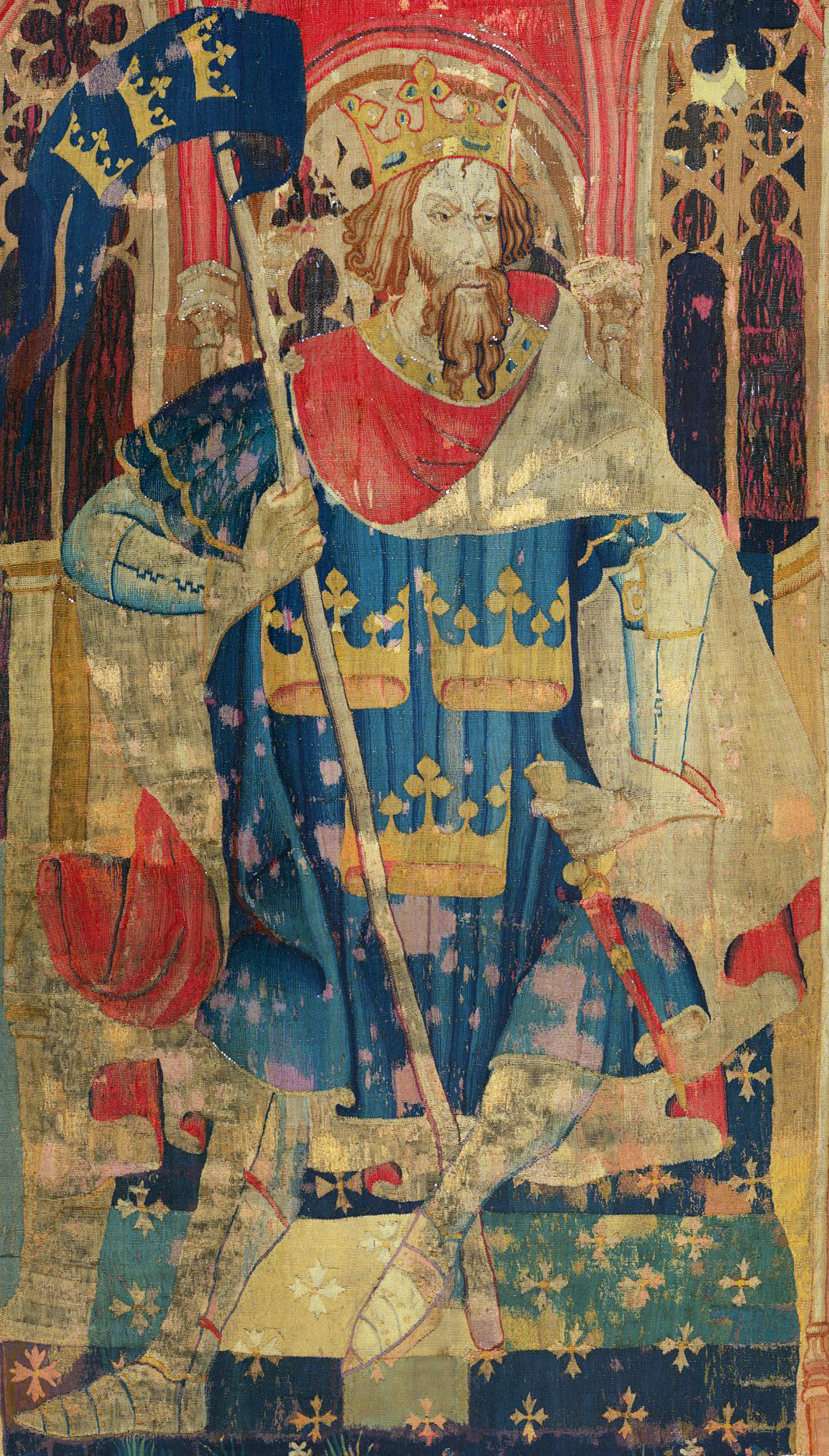
So, for those of you who don’t know, “Mother of the King” is my Arthurian fantasy story that I released as an ebook exclusive. The story centers on the fabled return of King Arthur, as told through the perspective of the woman chosen to be his mother. The story delves deep into Arthurian lore, while also showing how the legend might evolve in the near-future.

And I’ve gotten a lot of good reviews so far on Amazon, Amazon UK and Goodreads. Here’s what some people have said:

What an interesting story! Part history and part futuristic. The legend of King Arthur plays in the forefront while the post apocalyptic England is developing a scientific plan to protect the British Isles from the advancing end of the world. A present young leader Arthur is a top position of protecting the young queen, most likely the last of the royal family and hopefully launch the successful application of the Camelot System that will save them all. The story of the historic King Arthur plays over current events in an interesting way and the story is told first person by Misty Adams [sic], the mother of the king (to be).

This is a well crafted novella and I really wanted to know what eventually happed. I was yelling “No! More now!” On the last page but the story definitely perks up your imagination. Rami Ungar is absolutely one of my favorite writers and look forward to more adventures from him soon. Enjoy!

Kimberly Napolitano, Amazon US and Goodreads

I had the pleasure of reading this book before it came out, it was an amazing read for me, love the main character Misty and the mystery behind her is amazing love it Rami

Kyle Baird, Amazon UK

A short and sweet tale that is inventive, modern, and relatable of a woman and her destiny in raising a King who would rise again. Loved her characterization and witty voice. She could easily be a mother next door and the reader gets swept away in her daily love and struggles of raising her son in coming to power. One of the most down-to-earth and relatable tales about a woman, unbeknownst to her, comes to find herself grabbling with motherhood of one of the most extraordinary kings in mythology.

Leslie, Goodreads & Amazon

And my friend and colleague Allen Huntsman made a video on his channel, DeathGroundReviews, on the story. HE made it sound so amazing both narratively and thematically, and I want him to narrate a future audio version if the future is kind. Check out what he said:

Ooh, I got shivers!

Yeah, it’s been good this week. However, I’ve noticed a trend in the reviews: you guys want more. That you want to know what happens afterward, or see more from Arthur Addison’s point of view. Some were even suggesting that I was laying the basis for a new connected literary universe or sub-universe, or that I was laying groundwork for a TV pitch.

Well, I don’t think a TV show is anywhere near a possibility in my life right now. But a connected universe? That might not be a bad idea. What would I call that? The New Arthur series? The New Arthur Universe? As long as nobody gets the central character confused with my Uncle Arthur, it should be fine…

Oh, alright! Fine! It sounds fun! I’ll do it! I’ll continue the story of Field Marshal Arthur Thomas Addison, AKA the new King Arthur! Like HP Lovecraft’s Dream Cycle, a series of short stories, novelettes, and novellas (and maybe a novel, who knows). It might take time. A lot of time. I’m not going to just write a story and put it out. I have to feel like it’s a good story to add to the major story. But I’ll write further stories in this world.

And when I do, I’ll let you know.

In the meantime, if you want to check out the story, “Mother of the King” is available to download and read. I’ll post the links below if you’re interested. And if you do read the story, please give me some feedback and/or a review. Positive or negative, I love what you have to tell me, and it helps me and other readers in the long run.

That’s all for now, my Followers of Fear. I’m off to make dinner and maybe chill, maybe write. We’ll see. Until next time (which will likely be within the next few days), happy reading and pleasant nightmares!

Mother of the King: Amazon US, Amazon CAN, Amazon UK

How I’m feeling most days. Photo by Marcus Aurelius on Pexels.com

This won’t be a long post. Nor will this be a rant or a long list of complaints. It’s just to say one thing: Goddammit, I’m a busy non-human entity!

In addition to writing, editing and trying to find publishers for my stories, I’m also organizing events and meetings for the Ohio chapter of the Horror Writers Association. And I’m trying to put together an anthology with some other Ohio horror writers for writers in our state. And I’m tracking sales/reviews and making decision for “Mother of the King” (more on that in a later post). And I’m doing some research before I try to edit my Victorian Gothic novel The Pure World Comes.

Add in the work from my day job, the many tasks a responsible adult has to do to keep a roof over their heads, trying to stay healthy, finding time to relax so I don’t burn out, and a few things in my personal life that I can’t talk about yet. Oh, and let’s not forget about time to eat and sleep.

And I have to ask: when did my dance card get so full? I feel like I either need more time or another me to get all this work done!

Ooh, another Rami Ungar. There’s a scary thought. Imagine just what sort of terror we could get up to while we were out and about!

Well, with any luck, things will ease up a bit as I continue to cross things off my list. There have been hiccups along the way–kid you not, I may have double-booked myself for some stuff at work tomorrow–but I’m dealing with them. I realize that it might be easier if I took on less responsibilities, but some of them can’t be given up so easily and others I took on because this is all part of the path of the writer. You gotta take what opportunities you can sometimes.

Thank you for supporting me while i work on these stories.

Still, it’s a lot. Perhaps if I’m ever able to write full-time, it’ll get easier (especially if writing does become my day job). For now though, I just gotta keep on keeping on and hope I don’t get sick from exhaustion or something.

In the meantime, I want to thank you, my Followers of Fear. Whether I’m traveling at the speed of light or exhausted from work, you’re always there to support me. It means a lot to me that I have this growing community around me who like what I write and support me in my quest to make my dreams come true.

Also in the meantime, it’s the holiday season, so you’re probably wondering what to get your friends and family who like spooky stuff, why not consider some of my stories? Fans of horror are always looking for new scares to devour, so they would probably appreciate something they might not have found otherwise. I’ll include the links for them, as well as for “Mother of the King,” below.

That’s all for now, my Followers of Fear. I hope you’re having a good month so far. Until next time, stay safe, pleasant nightmares, and tell Santa to stay out of your chimney until he’s had his temperature checked!

The Quiet Game: Five Tales to Chill Your Bones: Amazon, Createspace, Barnes & Noble, iBooksSmashwords, and Kobo.

Snake: AmazonCreatespace, Barnes & Noble, iBooksSmashwords, and Kobo

Rose: Amazon US, Amazon UK, Amazon Canada, Audible

Mother of the King: Amazon US, Amazon CAN, Amazon UK
Yep, I’m doing this again. But I just released a story, so can you blame me?

So, if you’ve never seen me do one of these before, #FirstLineFriday is a tag that was popular for a split second among writers online for a split second, and that I still do here on the blog from time to time. On Fridays, you:

  1. Create a post on your blog titled #FirstLineFriday, hashtag and all.
  2. Explain the rules like I’m doing now.
  3. Post the first one or two lines of a potential story, a story-in-progress, or a completed/published story.
  4. Ask your readers for feedback and try to get them to try #FirstLineFriday on their own blogs (tagging is encouraged but not necessary).

The story whose lines I’m showcasing today shouldn’t be any surprise to anyone. Yes, they’re the first lines from “Mother of the King,” my Arthurian fantasy novelette which was released earlier this week. The story revolves around the fabled return of King Arthur, as told from the point of view of the woman chosen to be his mother. Enjoy:

I want to tell all this to my son. After so many years, I feel like I owe him this, the story of how he came to be.

Well, it’s not much, but it sets up the story nicely in my opinion.

Mother of the King. Available now from Amazon.

But what do you think? How would you improve this? Or is it fine as it is? Let’s discuss.

And if these opening lines got you at all curious about the story itself, “Mother of the King” is available to buy as an ebook now. It’s only been a few days, but it’s already gotten some good reviews. If you haven’t checked it out yet and would like to, I’ll include the links below. And if you read it, please let me know what you think. Positive or negative, I love reader feedback, and it helps me and other readers in the long run.

And as for who I’m tagging, I TAG YOU, READER! YES, YOU!!! I’m tagging you all, my Followers of Fear, plus any unfortunate who has come across this post by accident. You must now do the #FirstLineFriday, and tag back to me when you’re done! Mwa ha ha!

Sorry I’m so extra this morning. It’s Friday, and I just want it to be the weekend.

Well, that’s all for now, my Followers of Fear. I’ll see you all very soon (most likely to push this story a bit more). Until next time, stay safe and warm, pleasant nightmares, and don’t let Krampus down your chimney tomorrow night. I hear tomorrow night’s his night…

Mother of the King: Amazon US, Amazon CAN, Amazon UK

I’ve mentioned a few times that “Mother of the King” and any other short(er) stories I self-publish over the next year will only be available in print as chapbooks to be sold at conventions and other events. The conventions and other events part is easy to understand, but I’m sure some of you have wondered what a chapbook is. Well, as promised, I’m going to explain what those are and why authors make them.

To put it simply, a chapbook is a small pamphlet or booklet of 40 pages or less, either folded from a giant piece of paper or stapled together from several sheets of paper (fun fact: the latter is known as saddle-stitching). The practice of making and selling chapbooks began around the 16th century and were named after the men who sold them, chapmen, who were early traveling salesmen and dealers. Modern chapbooks are often made by authors using printers and staplers, or assembled in print shops and sold at events or sometimes in specialty bookstores.

So, that’s what a chapbook is. Why do we have them? Why would an author make them?

Well, chapbooks were originally printed for working class families who could read but couldn’t afford books on their own (even with the printing press, those things were expensive). They were easy to transport and helpful in disseminating ideas, information, entertainment and (often inaccurate) history into popular culture. They were also used to develop literacy, much like comic books and graphic novels help teens and people who don’t speak a nation’s native language learn and develop language and reading skills.

“The Chapbook, promotional poster” by MCAD Library is licensed with CC BY 2.0. To view a copy of this license, visit https://creativecommons.org/licenses/by/2.0/

Fast forward to today. Books are cheaper and libraries exist, but chapbooks are still around. They’ve been especially popular during the past couple of decades in certain circles thanks to copying and printing technology. For the first time, people could sell their stories and poetry directly to the people without the aid of a major publisher or someone who owned a printing press. It was kind of an early form of self-publishing, if you think about it.

With people making chapbooks and small circulation magazines from home, the chapbook has made something of a comeback. And though it’s still not as popular as the your regular hundred-plus page book, they’re still being put out every year. Authors and poets like how easy and cheap they are, and how they can make something of a profit from them while also giving potential fans something quick to enjoy and maybe get hooked on their work. Like I said, a form of self-publishing, though some presses also do chapbooks alongside regular books.

And presses and authors aren’t the only ones who have seen value in these little booklets. There are bookstores that sell chapbooks alongside regular paperbacks, events devoted to them as an artform (looking at you, NYC/CUNY Chapbook Festival), and major publishers using them as advertising tools for their catalogs. And sometimes, depending on the chapbook, who made it, the method of production, and how many exist, these babies can go for quite a bit of money. Sometimes hundreds of dollars.

Not bad for a cheap little booklet that was often recycled as toilet paper after the buyers were done with the story (yeah, that’s true. As well as strips of old newspapers. Beats a stick or a corn cob though, right?).

Anyway, I don’t expect to make hundreds of dollars off chapbooks of my work. Especially when they’ll still be available as ebooks online. But as I said above, they’d be a good way to get my work out to more people. For events out of town, they could help fund those trips. And let’s face it, they could be fun to have and to show off at my next convention. Whenever that is. Damn you, COVID-19!

Anyway, that’s a chapbook. A form of literature with a cool history and a revival in an age when people can control when stories come out. A diverse artform that takes very little time to make and enjoy. And I hope I can start making them (or going to the print shop to make them) very soon.

In the meantime, I already have one story out in a digital format, so it’s kind of like a chapbook. Yeah, you knew this was coming. My Arthurian fantasy novelette, “Mother of the King,” is out now and available as an e-book. The story is about the fabled return of King Arthur, told from the point of view of the woman chosen to be his mother. It’s been out barely two days, and it’s already garnering some great reviews! I’ll include the links below, so check it out!

That’s all for now, my Followers of Fear. I’m off with a priestess, a dragon and a Deep One to find Arthur’s casket. Until next time, good night, happy reading and pleasant nightmares!

Mother of the King: Amazon US, Amazon CAN, Amazon UK

Good morning and happy December, Followers of Fear! We’re almost done with 2020 (and I think we’re all excited about that). However, while we’re still stuck in this year, there’s still much to do and look forward to. And I hope you’re including the release of my latest story, “Mother of the King,” in your list of things to look forward to!

For those of you who don’t know, “Mother of the King” is a fantasy novelette about the return of King Arthur, told from the perspective of the woman responsible for his return. It’s being released as an e-book exclusive on Amazon, and guess what? Today’s the release date!

(And sorry for those who prefer physical copies, but those will only be available as chapbooks at events like conventions or book readings. Just got to hope you can come to a future event I’ll be attending someday. And yes, I’ll be releasing a post about what chapbooks are as soon as I can.)

A story about the return of King Arthur. Sounds cool, doesn’t it?

I’m very excited to release this story. I first got interested in Arthurian legend about two years ago, and went down a rabbit hole of research. The result was this story, which incorporates a lot of what I learned into the story while still being a (hopefully) entertaining tale.

I’ll include the links down below for anyone who’s interested. And if you do end up buying a copy and reading it, please leave a review and let me know what you think. Positive or negative, I love reader feedback. Plus, your reviews help other readers know whether or not they should check out the stories themselves.

That’s all for now, my Followers of Fear. I’ve got a busy day ahead of me. Until next time, happy reading, pleasant nightmares, and LOOK OUT FOR THE MACE TO THE HEAD!!!

Mother of the King: Amazon US, Amazon CAN, Amazon UK
So, you just finished a short story. It might be a short story or a novel. Either way, it’s finished and you love it! You think it’s great, that it has potential, that it could even get published somewhere. Hell, you even dream of it getting awards and adaptation offers and so much more! With all that in mind, what do you do with this awesome story of yours?

If you said, “Rush to get it published,” I’m only going to say that that’s not the answer I was going for. If, however, you said “I’m going to get a beta reader or two to look at the story,” then congratulations! You got the answer I was going for.

As you likely already know, beta readers are readers who look at a story somewhere along the editing process and give critiques and feedback. They may also give help with the spelling/grammar/punctuation issues of the story, depending on what they can offer. And over the past year or two, I’ve made sure to use beta readers for every one of my short stories.

Let’s face it, authors can be our own worst critics, and our own worst editors. We can see a lot, but occasionally things slip by our notice. In fact, a lot of things can slip by our notice. Typos, plot holes, inconsistencies in character development or backstory, implausible situations or things that don’t jive with reality. Beta readers point out things authors miss, or don’t want to think of as problems because they love their stories too much (it happens).

Take my recently-completed short story Afternoon Tea, the one about the cursed silent film. I found two beta readers who were willing to read the story and give me feedback. Both of them got back to me really quickly, and they said the story had a lot of potential and that they liked it. They did, however, both notice something that made no sense to them. One actually wrote quite a bit in their notes about why that plot point made no sense or was confusing.

Seeing that they both mentioned it made me realize that they had a point. That single plot point did have its issues. I had to take it out, which made me realize I needed to rewrite that section of the story. Which I was able to do with a bit of brainstorming. And I think it makes for a much better story. One of those same beta readers has already gotten back to me about the second draft and said there’s a lot of improvement, so listening to them was a good decision.

Not only that, but sometimes beta readers bring their own life experiences to help improve a story. Earlier this year I wrote a short story called Primordial Nuclear Soup, which involved a number of military characters. My beta reader happened to be a veteran, so in addition to pointing out numerous flaws with the early draft, they gave me their military experience to help with those characters and scenes.

Without the strong eye of a beta reader, you can miss much. Photo by Wallace Chuck on Pexels.com

None of this stuff I would have known or spotted without the help of my beta readers.

Of course, you do meet the occasional beta reader who turns out to not be so helpful. They send back a lot of praise for the story, but they don’t point out that much that you don’t realize needs fixing. Which can be an issue further down the line when you’re trying to get the story published. What can I say? The majority of them are human (I’m an exception).

But after a while, you do figure out how to spot a helpful beta reader from an unhelpful one. It usually shows in the notes they send back. If that happens, keep looking for more beta readers. You eventually will find someone who can give you the feedback you’re looking for. And sometimes, you even create a circle of beta readers who will gladly look at your work when you need them to and provide the feedback you need. When you do that, you know you’re in good hands.

Suffice to say, beta readers are a great help in making sure your stories are the best they can be. It may not be easy seeing all the problems in a story you’ve poured sweat and tears into, but in the end, listening to them and fixing the story based on what they said helps out immensely.

“Mother of the King.” Available Dec. 1st

Getting the stories published afterwards, however….that’s another fight altogether.

What are your experiences with beta readers like? How have they been helpful with your storytelling endeavors? Let’s discuss.

And before I forget, my Arthurian fantasy story “Mother of the King” releases day-after-tomorrow! If you haven’t preordered a copy of the ebook yet, you can check it out with the links below! Believe me, both beta readers and eARC readers have been raving about this story, so why not check it out? And if you do, let me know what you think. I’d love to hear your thoughts on the story.

Mother of the King: Amazon US, Amazon CAN, Amazon UK
Audible company logo.

If you’re not familiar with Audible and Audiobook Creation Exchange (aka ACX), let me fill you in. Audible is Amazon’s audio book wing. They distribute thousands of audio books and have just as many subscribers (I’ve been one since 2015). ACX is part of Audible: it’s a places where authors and publishers can hook up with narrators, produce audio books, and then upload them to Audible.

With me so far?

Recently, Audible and ACX have been in a bit of hot water. It’s come to the attention of several authors that Audible has a rather questionable policy on the books. Audible Premium Plus subscribers have the option to exchange an audio book they’ve bought through their subscription within 365 days of purchase! And get this: if an audio book is exchanged within that time frame, the authors or publishers get their royalties deducted for it!

You read that right: somebody can exchange any audio book they buy within a year of purchasing, and the author gets punished for it.

Most people’s reactions to the exchange policy abuse. Photo by Andrea Piacquadio on Pexels.com

And lately, this has become a huge problem. Many authors, mostly indie authors, have noticed an increase in exchanges and deducted royalties over the past several months, In fact, some have speculated that use of the exchange policy–or should I say abuse of the exchange policy?–has boomed because Audible’s been using the policy in some of their advertising to attract new members.

Spurred by reports of this, the Authors Guild, along with a whole bunch of other author organizations, have drafted a letter to Audible and ACX to get them to, among other things, change the policy and create a more reasonable exchange policy. At the time I’m writing this, the letter has over twelve thousand signatures, and it’s still growing. To quote the letter,

This policy is in clear breach of the duty of good faith and fair dealing implied in the authors’ agreements with Audible and ACX as it allows books to be purchased and listened to without paying the authors and narrators their royalties.

Authors Guild Letter to Audible and ACX

Now, I have only have Rose‘s audio book on Audible, and so far as I know, it hasn’t suffered from this exchange policy much. However, I have heard from a couple of colleagues, including some I consider good friends, who are upset by the policy and are considering pulling their works from Audible and ACX because of the policy.

And even if I didn’t know anyone affected by this policy, once I learned about it, it was hard for me to sit still. This is a terrible policy that hurts authors and publishers alike! These are the people that Amazon needs to continue selling through Audible, and yet they treat them this way?

And why is the exchange window a year long to begin with? That’s a terrible business strategy. Can you imagine if a hardware store allowed you to exchange a tool within a year, even if it’s likely been used? Or a shoe store? Or a computer business? They’d be out of business within a year with a policy like that! What the hell, Amazon?

The letter I received from Audible about the change in the exchange policy. Feel free to enlarge and read it in full.

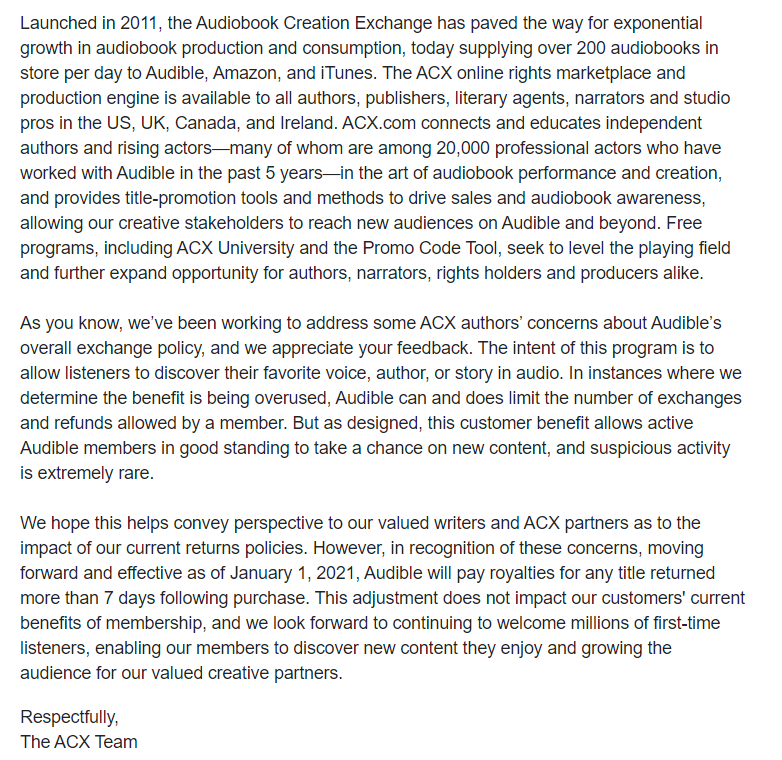
Thankfully, it seems that news of the abuse and the letter made Audible realize their mistake. While they’ve defended the policy, saying that they do monitor for abuse and that such abuse is rare, they are changing the policy effective January 1st. After that, the exchange window is limited to 7 days, and Audible will pay for any exchanges made after that timeframe. They later confirmed this in an email to ACX creators, which I got as well.

And that is good. That is a good change. It’s harder to abuse an exchange policy limited to only a week instead of a year. Still, some aren’t satisfied. In fact, the Authors Guild letter suggests shortening the window to 48 hours. And I like that idea: not only is it even harder to listen to multiple audio books over the course of two days than it is to do over a week, but it should be easier to spot abuse when an account is making multiple exchanges within a two day period.

So, what can you do? Well, you can sign the letter, which at the time of writing is only 440 signatures away from the Authors Guild’s goal. Even if Audible has changed the policy, every signature is a reminder to the company that this sort of malarkey won’t be tolerated by the very people the company needs for products if it continues.

You can also share with other authors and readers. The more people who are informed about the issue, the more people who will be weary and on the lookout for policies and abuse like this. People, and companies, are more likely to be better behaved if they know they’re being watched and kept under pressure.

And finally, if you have or plan on getting an Audible subscription, don’t be the kind of subscriber who does this sort of crap. I’ve only exchanged a book on Audible once, and that was because I thought it was one kind of story, and it turned out to be another. Otherwise, I would never rob another writer of royalties! Instead, keep the book once you buy it, and wait for your next credit. Don’t make someone else lose money just because you want more listening material!

And if Audible doesn’t address the problem, maybe consider giving up your membership. Yeah, it’ll suck to not get that credit for an audio book each month, but it’ll sure send a message to Audible.

And if you do enjoy an audio book purchased through Audible, make sure to review or at least rate it afterwards. Trust me, ratings and reviews left by readers help both new readers and the writers who put their books on the site. I speak from personal experience on that!

That’s all for now, my Followers of Fear. Thank you for reading this far and giving a damn about this problem. I hope you’ll consider helping out authors and stopping abuse of Audible’s exchange policy.

Until next time, Happy Thanksgiving and pleasant nightmares!

Time is flying by, so I’m writing a reminder to you all. As you probably know, I’m releasing my fantasy novelette “Mother of the King” on December 1st as an ebook exclusive. Which, as you’re probably aware, is a week from today.

For those of you who don’t know, “Mother of the King” is a take on Arthurian legend. It talks about the fabled return of King Arthur, told from the point of view of Arthur’s mother. It’s the result of my months of diving into Arthurian legend and history in 2018, and I’m looking forward to seeing what people think of it.

And yeah, I know it’s not horror, but I like to jump outside the box every now and then.

And apparently it wasn’t a waste of time doing so. While I haven’t gotten any full reviews yet, I’ve heard back from some of the advanced readers and they’ve apparently loved the story. I look forward to hearing what their full feedback says, as well as how many of them learned something new about Arthurian legend (trust me, when you dive as deep as I did, you learn some things that make you look at it in a whole different light).

If you would like to check out “Mother of the King,” it’s available for pre-order now. I’ll include the links below. You can also take a look at my other available work–The Quite Game, Snake and Rose–if you like. I’ll include those links as well.

And if you do decide to read my work, I hope you’ll leave a review. Not only do reviews tell me how my audiences reacted to my story, but they help me out in the long run and let people know whether or not to check the story out themselves.

Anyway, that’s all for now, my Followers of Fear. I’m sure I’ll be putting out another post soon. In the meantime though, I’m off to turn people into turkeys (I won’t say who, only that they deserve it).

Until next time, Happy Thanksgiving and pleasant nightmares!

Mother of the King: Amazon US, Amazon CAN, Amazon UK

The Quiet Game: Five Tales to Chill Your Bones: Amazon, Createspace, Barnes & Noble, iBooksSmashwords, and Kobo.

Snake: AmazonCreatespace, Barnes & Noble, iBooksSmashwords, and Kobo

Rose:  Amazon US, Amazon UK, Amazon Canada, Audible

Tell me, where would you put Godzilla in this classification system?

For a while now, I’ve been thinking of the different kinds of antagonists in horror stories. Not divided by type, but by level of threat. What do I mean by this? I mean, aren’t all antagonists in horror stories a threat? I mean, it is horror!

Well, yes. But how big that threat is can vary from story to story, and can even influence what kind of tropes and stakes we can expect in the stories. To further illustrate this, let me categorize the level of threats using Starbucks sizes: Tall, Grande, and Venti. Yes, I know they have a Short size and a Trenta size, but I don’t know anyone who uses them. In fact, I don’t think I’ve ever seen the cups for those sizes.

Also, Starbucks, please don’t sue me. I’m just using your sizes to help illustrate a point.

Getting sidetracked. Let’s start talking about the levels of threat, starting from biggest to smallest.

Venti: While all horror antagonists are a threat to the protagonist(s), the Venti-level threats are usually threats to many or all people. Cosmic entities like Cthulhu or the Devil in stories taking place during the Apocalypse usually rank this high. They’re a threat to all life or to all we hold dear, and the suffering they could induce if they succeed would be terrible.

This level can also apply to threats like Pennywise, aka IT. While he’s restricted to the town of Derry, Maine, he’s responsible for countless deaths since the 17th century. Even when he’s not active, his influence over the town of Derry is such that he controls it at all times, causes all sorts of horrors while sleeping. IT is Derry. Thank goodness his children didn’t get anywhere, am I right?

Bughuul from Sinister is a great example of a Grande-level villain

Grande: An antagonist of this size may be a threat to many people, but they’re not as all powerful or have such sweeping implications as a Venti-level threat. Still, you wouldn’t want to cross one of these guys if you ended up in their stories.

An example of a Grande-level threat would be Leland Gaunt from Needful Things. A demonic figure who looks at things from a business-like perspective, any town he comes to faces annihilation once he sets up shop. Half of Castle Rock either ended up dead or blown up because of him, after all.

Another example might be Bughuul from the movie Sinister, a Babylonian deity that eats children. Throughout the centuries, he’s manipulated children into killing their families so he could eat their souls. Anywhere he goes, you can expect blood and death to follow. He’s definitely no small potatoes, though he doesn’t warrant the same level of panic as a Venti-level threat might.

Tall: While they may be the on the lowest level of horror antagonist, that doesn’t mean you should relax. In fact, these villains tend to be much more personal than the likes of Bughuul or Cthulhu.

Tall-level villains may only be a threat to the protagonist and a few others, but they bring with them the power to destroy everything the protagonist holds dear. Demons seeking to possess a soul, vengeful ghosts, stalkers and serial killers focused on one particular victim, cursed objects, etc. They may not be seeking to end the world or blow up a town, but they will destroy the protagonist’s happiness and sanity for their own goals.

I would even include the Overlook Hotel in this category. It may be powerful and evil, but it’s only able to be so in the presence of someone with the shining, and then it only seeks to add the shining to its own power so it can be active more often. In the novel’s case, it breaks down Jack and terrorizes Danny to make them more vulnerable and ultimately to possess the former and kill the latter.

Like I said, what they’re missing in power or scope of threat, they make up for in how personal they are.


This, ladies and gentlemen, is a way to classify the threat level of horror villains.

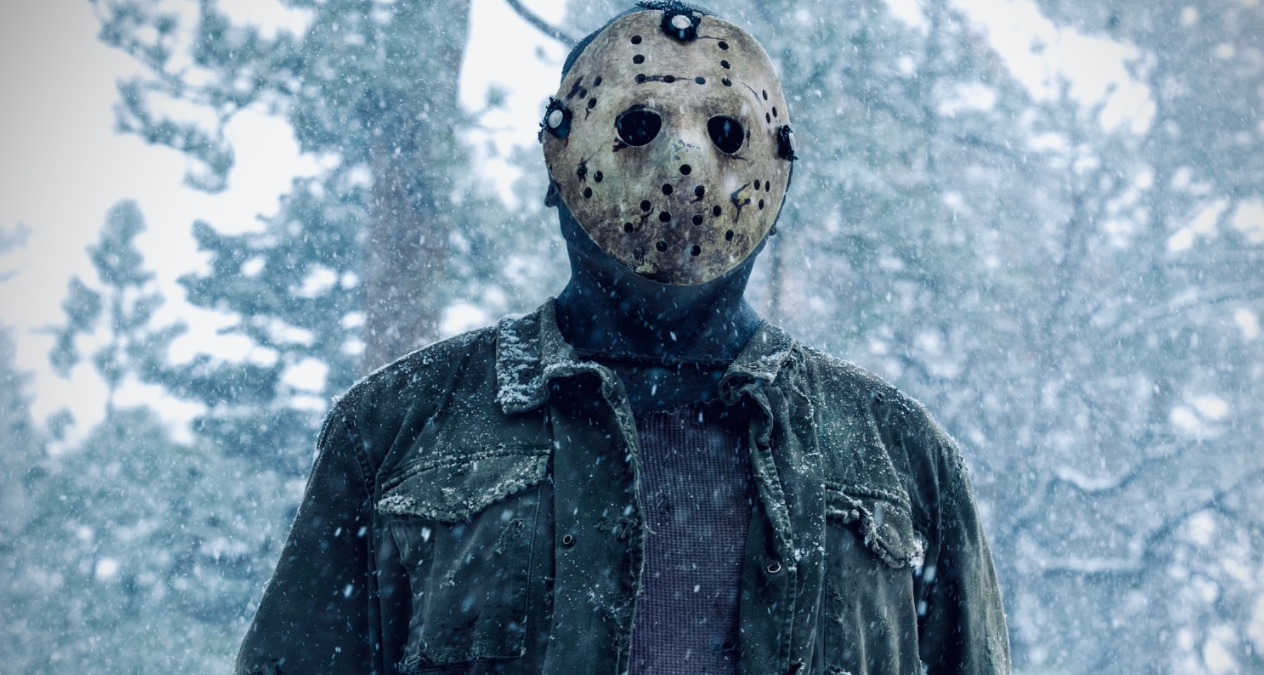
Where does Jason fit on this scale? It’s not easy to tell.

That being said, it’s not perfect. What villains belong where is entirely dependent on who’s doing the categorizing. Is a slasher villain like Jason Voorhees a Grande because he has a particular hunting area and has killed many over the decades? Or is he a Tall because he’s only a threat if you step into his territory? And this doesn’t even cover stories like Gerald’s Game, where there is no antagonist but a pair of handcuffs and the protagonist’s own psyche. Even the Space Cowboy who visits her doesn’t really threaten her. He’s more of a reflection of her own terrors who turns out to be a real person than anything else.

So why do I write all this, if it’s not a flawed system? I do it because it’s not to categorize the villains themselves, but the stories they belong to. A story with a Tall villain is much more character-focused and can often lean into the character’s mindset. A story with a Venti-sized villain often requires the story to encompass a huge cast, lots of locations, and putting an entire population at risk. A Grande may straddle the line of the other categories, while also having varying kill counts depending on what the story requires.

In a way, The Starbucks Levels of Antagonism (copyright pending), are like the Bechdel or Mako Mori tests: exercises to examine stories, the decisions made while creating them, and how you can learn from them. And given the nature of fiction writing, as well as how difficult it is to categorize fiction like a scientific system, that’s probably for the best.

Thanks for giving me a chance to air some thoughts, Followers of Fear. I’m off to figure out where on this system I belong. Until next time, pleasant nightmares!

Do any of you remember back in April, when an incident occurred near my building that the cops had to be called to take care of? And I got so inspired by it, I used it as the basis of a short story? One that I wrote in one whole evening without getting out of my chair till the story was done?

Don’t worry if you don’t. My memory has faded as well.

I bring it up because yesterday, something similar happened. No, there wasn’t an incident in my neighborhood that required the police (not that I know of, anyway). But I had a sudden flash of inspiration, and knew I had to write the story immediately. The result was six hours or so at the writing desk working on a new short story. I was done at three in the morning (I was a wreck at work today).

Anyway, onto the story, which I named Le The de l’apres-midi. Yes, I gave the story a French title. I am that pretentious. I was going to name it, “That Feeling You Can Only Say in French,” but Stephen King beat me to it, so I settled on Le The de l’apres-midi, which means “afternoon tea.”

Maybe I should just call it that.

Where was I? Oh right, the story is about a film society that gets its hands on the only extant copy of a surrealist silent short film, Le The de l’apres-midi. This film is infamous as it was considered so disturbing, its director was expelled from the surrealist movement of the 1920s. The members of the film society soon learn that not only is this reputation well-deserved, but the copy the society has may be something sinister in and of itself.

The story was inspired by Un Chien Andou, or The Andalusian Dog, a short surrealist film by Luis Burkel and Salvador Dali. A YouTuber I follow recommended it as a lesser-known disturbing piece of horror cinema, and while I didn’t find myself terrified by it, I did find some moments scary and slightly upsetting. It probably didn’t help that I was eating dinner while watching it.

Anyway, the film inspired the short story, and I started writing. At the end, it was just under thirty-eight hundred words. And next…well, I think I may give it a round of edits before I let a beta reader see it. Maybe it’s because I was up past midnight and rushing so I could get to bed, but I feel like the ending needs a few tweaks. Maybe a bit more fleshing out and a much more dramatic conclusion. We’ll see when I get to it.

Mother of the King. Releases December 1st, 2020.

For now though, I have a beer I’d like to pour, and a new project I need to get to work on. And then I’m getting some sleep so I’m not a wreck tomorrow at work. Wish me luck.

Oh, and before I forget, my fantasy story “Mother of the King,” about the woman who raises the returning King Arthur, will be released two weeks from today as an e-book exclusive. If you’re interested to check it out, click the link and you can place a preorder now. Or you can check out all my available stories on Amazon through my author page. Checking out my work not only helps me out, but it might make for a good read or for a relative/friend this holiday season. So why not?

Well, that’s all for now. Until next time, my Followers of Fear, pleasant nightmares!