Posts Tagged ‘storytelling’

I first read IT by Stephen King when I was eleven or twelve: the same age as the characters in the flashbacks. And while I had been reading The Vampire Chronicles and most of Anne Rice’s books up till that point, I didn’t exactly classify it as horror (Anne Rice herself preferred the term “Gothic saga”). So, for me, IT was my first jump into horror since outgrowing Goosebumps.

And it expanded my world. Not only did the novel terrify me, but it showed me just what great, mature horror storytelling looked like. From the terrifying and insidious nature of Pennywise and It’s many forms, to how the novel took the time to let us get to know characters both major and minor. I was entranced and enthralled, even as I was terrified, diving deep into the book every opportunity I could get and learning as much as I could.

By the time I finished the book that summer, I knew what sort of stories I wanted to write in the future.
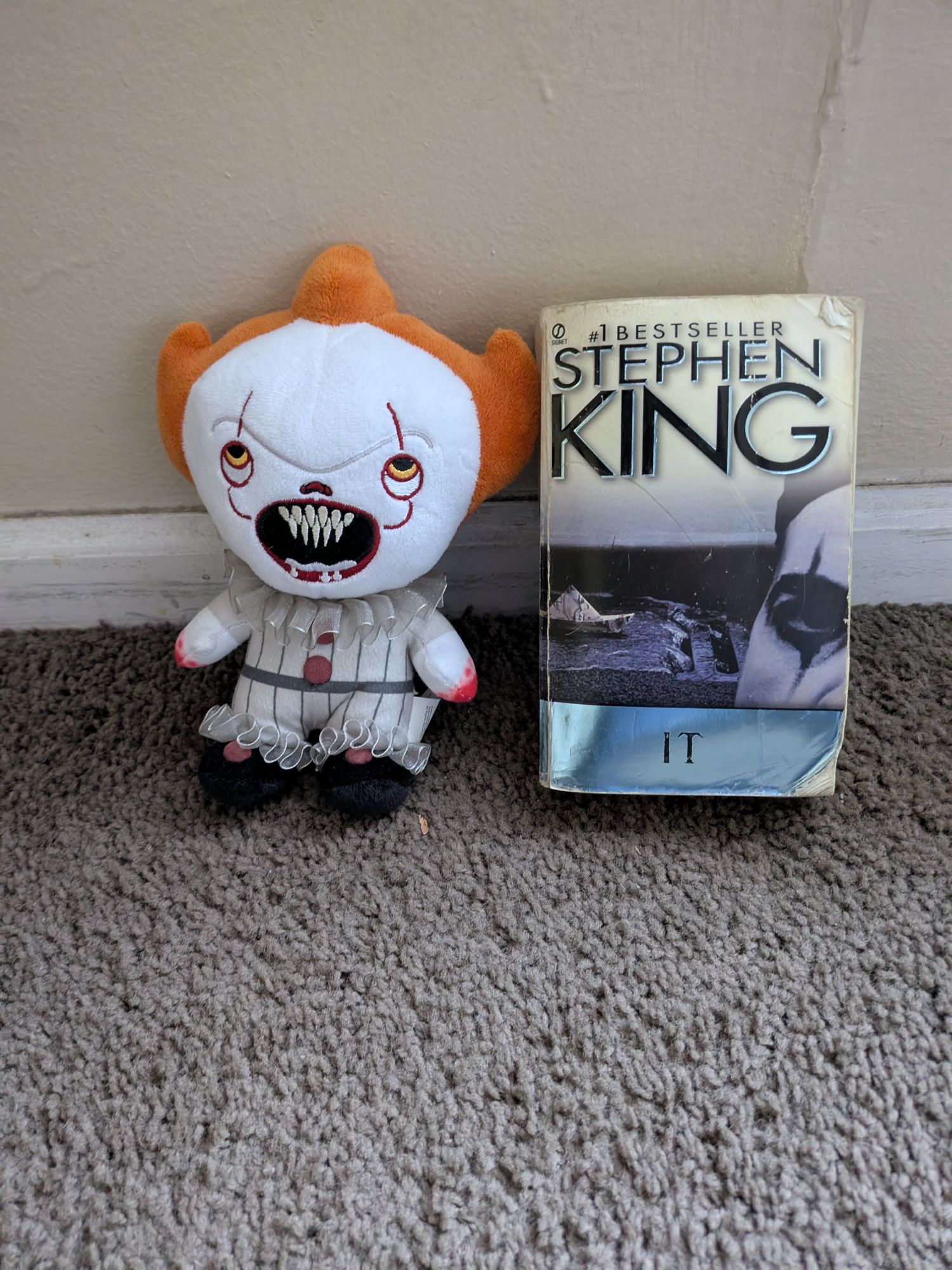
Without IT, I would not be the writer I am today. Or the person. I might not even be blogging to you right now, now that I think about it!

I bring this all up because, if you weren’t aware, there’s a TV show airing on HBO Max called Welcome to Derry. Taking place in the same universe as the movies, the show goes into events during the 1962 cycle, which was the cycle before the first movie. And unlike the movies, which focused on a core group of characters first during their early teenage years and then during their adult years, Welcome to Derry focuses on a wide variety of characters, including school kids, military personnel at the local Air Force base, and the nearby Native American population.

It’s very Stranger Things in its character development and methods of storytelling. And since the creators of Stranger Things were heavily influenced by IT, among other things, I guess it’s coming full circle?

Well, it feels full circle to me, because while watching the show, I feel like I’m getting a reintroduction to the horror genre. Just like I did when I was a preteen and dove into King’s book. It feels like I’m getting lessons in how to do creative and powerful scares, storytelling with large casts, and character development every time I sit down to watch the show.

Which, while being told through a visual medium instead of a literary one, I’m grateful for. While I’ve made strides in becoming a horror author, I still feel like I have a long way to go before I can be at the same level as the authors I admire and regularly read. And while I learn something about good storytelling every time I enjoy a good book, show, or movie, I feel I’m getting a Master Class in the subject from this show.

Hell, I think in the short story I wrote most recently, some of what I gleaned from Welcome to Derry made it into the story. I wasn’t originally going to apply what I learned, but it occurred to me while I was writing, and I was like, “Oh. That’s good. That’s very good. Let’s try it.” And while I haven’t heard back from the alpha reader yet (I only sent them the story last night, after all), I feel like adding those elements gave the story an extra bit of excitement and terror.

So, with only four episodes of the show left (I have my doubts they’ll do a second season, though I would likely welcome one), I’m looking forward to seeing what happens next. And to seeing what I can glean for use in my own storytelling.

In the meantime, I’m going to get to work on some of that storytelling. I have stories to edit and send to the beta readers, after all. Wish me luck!

And in the meantime, good night and pleasant nightmares.
Me writing and editing under the influences of good storytelling teachers.

The detective arrives at the crime scene and finds the body is nearly identical to another murder. A soldier is walking through a swamp, when they are warned by their sergeant that mines are buried underfoot. The bride leaves her groom at the altar, looking to find herself after years of being told what she should do with her life. The singer comes across Robert Johnson’s guitar, thought to be long lost, and finds there’s more than just history attached to it.

All of these could be the beginning of a story that starts in media res.

Latin for “in the middle of things,” a story that begins in media res is one that starts midway through the plot, rather than at the beginning. And believe it or not, a lot of stories start like this. Hell, you’re probably familiar with most of them. The Star Wars movies arguably all start in media res, as they all start when a conflict is well underway. The novel Gone Girl begins with the protagonist’s wife being discovered missing. Wicked, from novel to musical to movie adaptation (love those last two) always start with the Wicked Witch being a well known figure and with several events implied as having happened and being common knowledge.

That last example brings up something important: how do these stories start in the middle when there’s who knows how much backstory we’ve missed? Often, this is accomplished through dialogue, flashbacks, and exposition. Flashbacks are especially popular, with the majority of Wicked being flashbacks, and the Deadpool films using flashbacks to explain why the film starts off with Wade Wilson getting into some insane shit.

And in horror, in media res is also quite popular. From the classics like Dracula, Frankenstein and Jekyll & Hyde to modern entries like Firestarter and Nightmare on Elm Street. Many of my own stories also start this way: Rose begins with Rose Taggert waking up in a greenhouse with no memory of how she got there or of the past two years, “Queen Alice” begins with my main character Joshua Blumfield already giving his report on the urban legend, and “The Dedication of the High Priestess” begins with Annie Hummel going to a gallery after already serving as a model for three paintings.

Why do horror authors, as well as authors in other genres, begin their stories this way? Well, one thing is the immediate hook. Take Nightmare on Elm Street: it starts with Freddy crafting his claws and then chasing after a teenage girl, only to wake up right on time. We’re immediately left wondering what happened and why, and that keeps our interest.

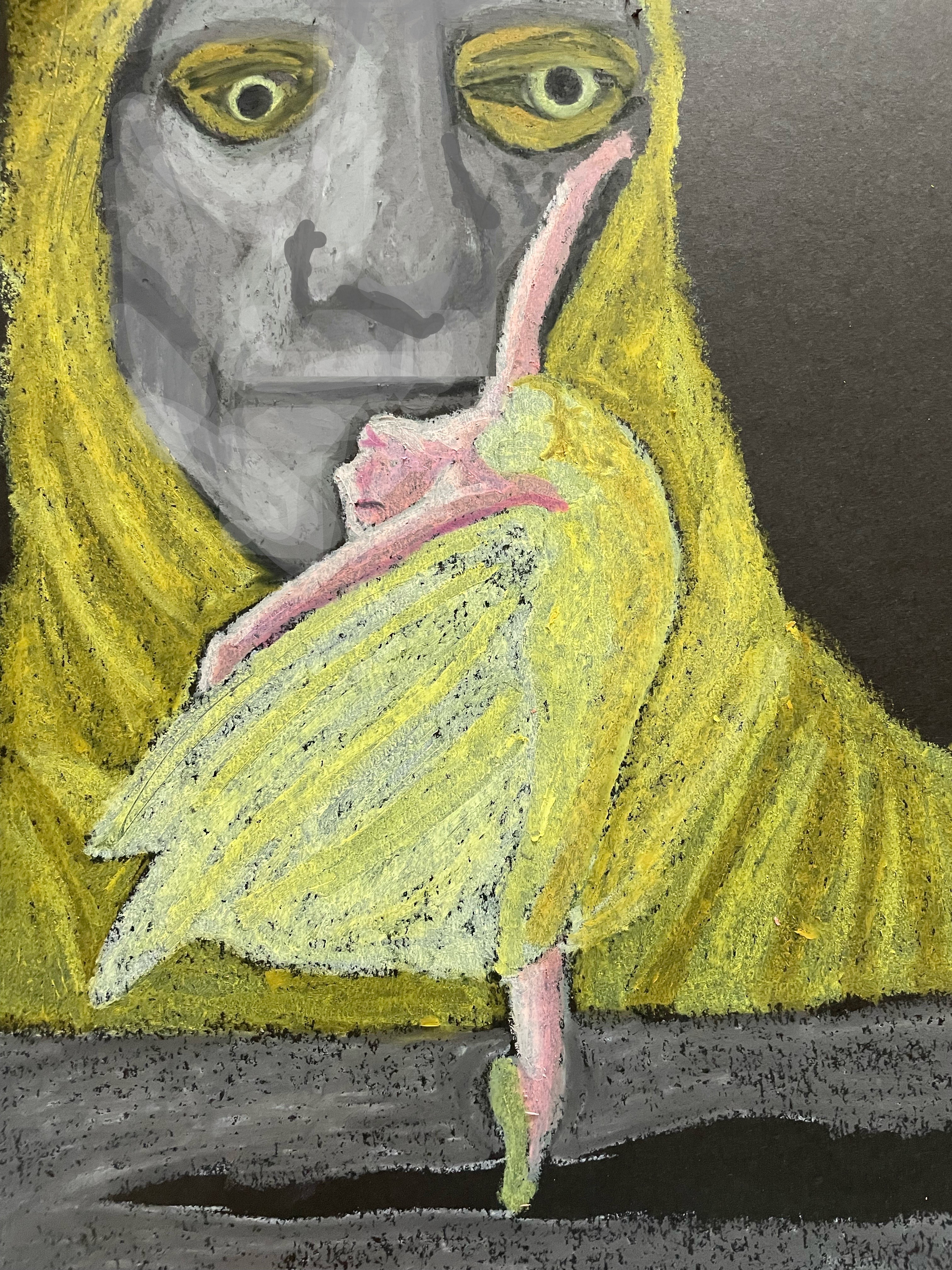
This oil painting by friend and colleague Iseult Murphy is based on “The Dedication of the High Priestess.” The story is an excellent example of a story starting in media res.

It also makes for great suspense. Take Nightmare again: we’ve already witnessed what Freddy’s capable of in the first scene, and so we wonder what else he can do. Would that have happened if we started with Freddy’s first murders and then getting killed by the parents? That opening violence builds up our expectations and keeps us enthralled.

Finally, you manage to get through a lot of exposition writing this way. Take Gone Girl, for example. Gillian Flynn could have started the story with Nick and Amy meeting, getting married, and the fracturing of their relationship before Amy’s disappearance, but would that have been as fun? It’s more interesting and suspenseful to read about the disappearance and then see how their relationship developed.

Another great example would be my story “The Dedication of the High Priestess” (spoilers for a story that came out in 2022). As I said, that story starts with my protagonist Annie already having modeled for a famous artist. She then goes through the gallery, which then causes her to be caught up in the King in Yellow’s plot to come to Earth. I could have started with Annie taking ballet classes, being scouted for the painter’s new series, doing the modeling gigs, and then going to the gallery, but that would have taken a lot of time and pages, and a lot of effort to keep readers interested. Starting with the gallery showing, using dialogue and exposition to explain how we got to this start, and then getting straight to the horror was very effective.

So, there’s a lot of reasons to use in media res to start a story, no matter the genre. It won’t work with all stories (looking at you The Hogfather, Die Hard, and Kill Creek), but if it works with your story, and you can do all the backstory parts without any issue, I see no reason not to use it. After all, I use it all the time. And look at me now!


Thanks for reading, my Followers of Fear. I’m about to start a new story, and it starts so in media res, some readers might need to read the start again. I thought about starting it from earlier in the events of the story, what I would normally reserve for flashbacks or exposition, but it felt like it would take too long and take up too much of a word count. Thinking about it and weighing my options made me want to write this blog post.

And now, if you need me, I’ll be busy writing what may be the most Halloween-y story I’ve written to date. Until next time, good night and pleasant nightmares!

My signed copy of Silver Nitrate by Silvia Moreno-Garcia.

Back in September, author Silvia Moreno-Garcia visited Columbus as part of my local library’s Carnegie Author series of events. Me and many of my fellow members of HWA Ohio went to see the event, where she talked about the influences behind her latest book, Silver Nitrate, which I later got signed by the author herself. That was a cool Sunday.

Months later, I finally cracked open the book to read it. And, as you can tell from this blog post, I’m going to review it.

Taking place in Mexico City in the 1990s, Silver Nitrate follows Montserrat, the only female sound editor in a studio dominated by chauvinistic men, and her best friend Tristan, a former soap opera star whose career was marred by tragedy and now makes a living doing voicework. Their lives change forever when they meet Abel Urueta, a film director they both once loved whose last film was never completed. After learning the history of the film, including that it was co-written by a German occultist with Nazi ties who was trying to cast a spell with the film, Urueta convinces them to help him finish the film and occultist’s spell, thereby possibly fixing a string of bad luck that has plagued the director.

What occurs next is a series of events that comes with two realizations for our two leads. One is that magic, especially magic in film, is more than just a metaphor. The other is that they have set something in motion, something big. And if they’re not careful, they’re going to lose everything from it.

The best part of this book is definitely our two leads. Montserrat and Tristan are such fully realized characters that you feel like they could step out of the pages and you’d know them. Montserrat is quite prickly but does care a lot, while Tristan is slightly narcissistic and dramatic but does care and wishes he were a better person. Their interplay throughout the book is fun to watch, as well as their reliance on one another.

Another plus of the book is the magic system. Those of you who’ve been with me for a while know that I studied Nazi occultism in preparation for my WWII study abroad trip in college. Yes, a lot of that stuff is real, though it is highly exaggerated in most depictions. In any case, I was delighted to see a lot of what I had learned mixed in with the magic system used in the novel. It made it easy for me to grasp, and gave it a sense of “realism,” so to speak, that I liked.

However, Silver Nitrate does have its flaws. So much time is spent explaining the complexities of the magic system that the slow burn of the story is too slow. Things don’t really start to get exciting to the last hundred pages or so, and by then it’s a bit too late to really bring up the book’s final score.

I also had some issues with the ending, but I won’t say what because I don’t want to spoil it.

All in all, I would give Silver Nitrate by Silvia Moreno-Garcia a 3.9 out of 5. It’s a bit too slow for my tastes, but it’s got great characters and a fully realized setting and magic system. If you’re interested, give it a read and fall down the occultism rabbit hole.

Recently, I tried to read Goblin by Josh Malerman. For those of you who don’t know, Goblin is a collection of six novellas that all take place in the small Michigan town of Goblin, where it rains sixty percent more than anywhere else in the US, the police resemble shuffling zombies, and you don’t enter the woods if you want to come out again.

I liked the idea of it and finally got around to reading it recently. And…I was unimpressed. I got through pages quickly every time I picked it up, but the stories within were just not drawing me in. By the time I got to the fourth novella (I know, I’m a trooper), I was lagging. And finally, by the first night in Marietta, I just couldn’t finish it. I put it down, never to pick it up again.

What was the issue? Well, it was the focus on the titular town. There was too much time spent on it and not enough on the stories. On the storytelling. On the horror.

Way too many words are spent on the town’s history and geography. It feels more like a history lesson at times. In fact, the second novella is focused on a former high school history teacher who knows the town history like the back of his hand. And you get that there’s a lot of interesting history there. And you can feel Malerman’s love for the fictional town.

But all that isn’t what we picked up the book for. We came for a book with six interconnected novellas centered around a single town that will hopefully scare the shit out of us. And this emphasis on worldbuilding by the author comes at the expense of the scaring the shit out of us.

Now, every story, regardless of genre, requires some degree of worldbuilding. The horror genre is no exception. You have to establish the setting, the people, the vernacular, and all that. Sometimes this can be done with having a date at the beginning of the story or just a few hints. Other times, like with stories set in historical eras, you have to do a ton of work to build the setting, bringing to life the clothes and manners and whatnot. And in the fantasy and sci-fi genres, authors will have all sorts of complicated compendiums and charts and maps to make their made up worlds feel as real as possible.

That being said, in the horror genre, the emphasis has to be on scaring readers. So, while you can spend time building those worlds, you have to remember it’s all in subservience of telling your story and scaring those readers. Look at Alma Katsu’s historical horror novels, or my own novel The Pure World Comes. We put so much research into the eras our stories take place and spend so much time building those locations, you can almost feel the winter chill killing the Donner Party, or smell the offal in the street of Victorian London.

The Hunger is a great example of a story where the worldbuilding doesn’t overwhelm the storytelling.

But neither of us forget that this is all for the story. We never think that the location, while interesting, is more important than telling the story. And it feels like with Goblin, Malerman, for all his strengths as a writer, got those priorities mixed up. And the result were six subpar novellas that might have been decent if more time was spent trying to frighten us readers.

Honestly, I wish the book had approached Goblin’s history like King approached the history of Derry in IT. In that book, the town history, which has several chapters devoted to it, doesn’t detract for the story. For one thing, most of those chapters take place in-between the action, which doesn’t detract from the story. Second, most of those history-building chapters are presented as Mike Hanlon doing research on the town and on It, so these sections are not only part of the main story, but they add context and help us realize just how ingrained It is to Derry. In Goblin, the history is rarely related to the events of any of the novellas, which only detracts from the stories.

And finally, It always has a hand in the history of the town. Whether appearing as Pennywise or causing some disaster at the end of Its active period, It is always there, making the history of Derry the history of It.

As for Goblin…the history could be cut out of most of the novellas I read and it wouldn’t matter. In fact, it might make the stories scarier. Especially since those stories I read don’t really have anything to do with Goblin history.

This is something important to keep in mind when writing horror in a location that requires extensive worldbuilding. Yes, it’s important to bring the location to life. Yes, the history can be interesting and can be talked about throughout the story. However, that must all be done as part of the story. In service to the story. Otherwise, you’re just going to get an ode to a fictional town, and not anything really scary.

Personally, I think I would rather read IT or The Hunger again and use those lessons in my own writing.


One more thing, Followers of Fear: The Solar Press Horror Anthology Volume I, which contains my story “The Dedication of the High Priestess,” is going to be released on December 1st. Not only is this an exciting short story anthology, it also contains one of my favorite short pieces, in print for the first time (before this, it was only available in audio).

If you would like to preorder a copy, you can do so using the links below. If you like in the UK and EU, order directly from the website. If you live in the US, use Orbit DVD.

That’s all for now, my Followers of Fear. Until next time, good night and pleasant nightmares!

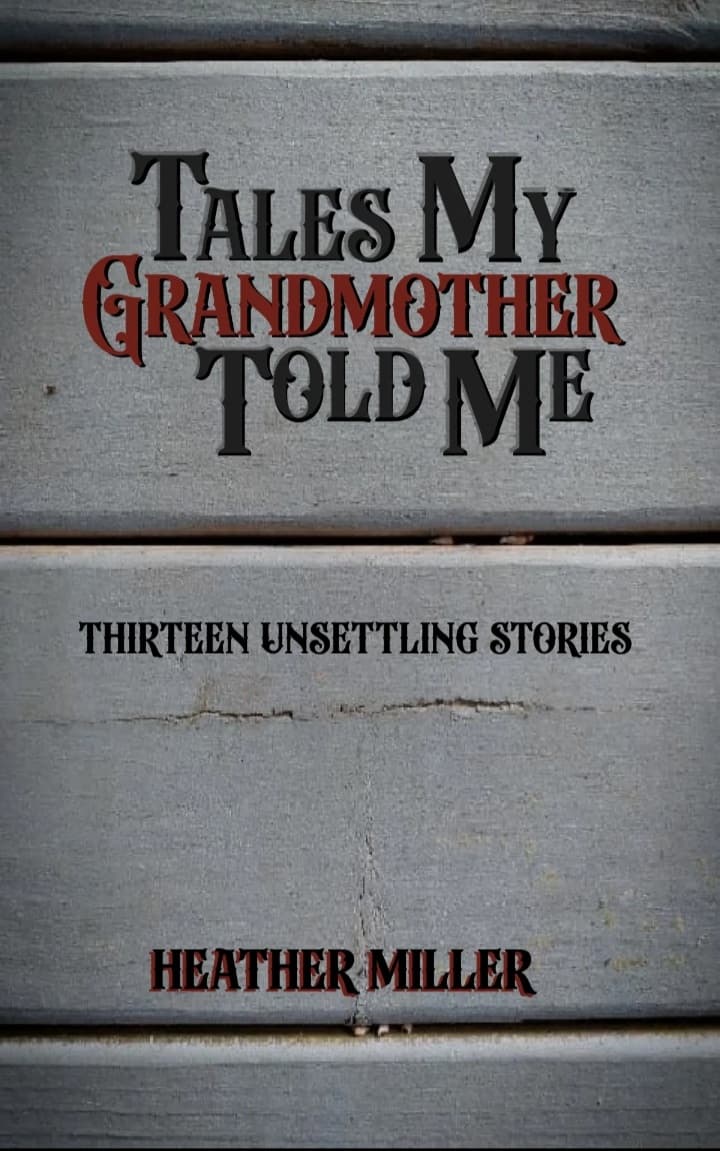
I met Heather Miller recently, and I could tell she had a passion for horror. It feels like every day, she’s posting a review of the latest horror novel she’s read and what she thought of it. So when she announced that she would be publishing a collection of short stories, the majority of which were based on tales her grandmother told her either as a ghost story or as a song, I thought I’d check it out. I got an advanced copy, and read it in about a week.

And as you can guess, here’s my review.

My impression of the thirteen stories in Tales My Grandmother Told Me is that it would make some great summer camp or around-the-campfire reading. Which, honestly, is rather fitting considering the first story is told around a campfire. They’re also quite bingeable. You can read them back-to-back pretty quickly, like I did. And I have to say, while I wasn’t terrified, I did enjoy most of the stories. My favorites were Safe House, which was a creepy Gothic horror story, and Girl’s Best Friend, which was a fun twist on an old urban legend.

I will say that this collection didn’t feel aimed at me. It felt more like it was aimed at the teenage crowd, especially teens who are just starting to ease their way into horror. Kind of like Scary Stories to Tell in the Dark was for children. If I knew any young teens who were looking to get into horror but weren’t ready to be traumatized, I would probably recommend this.

On a scale of 1 to 5, I’m going to award Tales My Grandmother Told Me by Heather Miller a 4 out of 5. If you have a teenager who wants to wade into the waters of horror, or you like that fiction, you’ll probably enjoy this collection. It’s available now from Amazon, so check it out if you like. And if you enjoy the book, be sure to leave a review so both the author and others know what you think.

Until next time, my Followers of Fear, good night and pleasant nightmares.
A handy graphic for understanding the three act structure, courtesy of Wikipedia.

The other day, I was talking with some other writers about how to write a decent short story (an eternal question among writers, including the ones who’ve gotten them published). And I noticed that, with a lot of my recent short stories, most of them fall into a decent three act structure. And then I said, “I know the existence of the three act structure is dubious, but it’s the truth.”

And, like many odd things, that little exchange has stuck in my head.

So for those of you who don’t know, the theory of the three act structure states that all stories, especially longer ones, can be divided into three separate acts or sections: the setup, the confrontation, and the resolution. The acts may then be divided into smaller scenes or subsections, but they all fit into those categories. Some examples given of stories with the three act structure are Star Wars, Die Hard, and Avengers: Endgame (though I sometimes think everything before the five-year jump is its own separate act or prologue).

While many of us are taught this structure in school, most of our teachers will let us know that not everyone believes in the three act structure, let alone say they use it. Some prefer using a five act structure. Others say storytelling is too complicated and diverse to say a story can be divided into a formulaic structure. And nearly all playwrights will agree that if it can’t be told in one act, tell it in two.

Good example of a story in three acts (supposedly).

That last one might be a joke.

I’m usually of the camp that believes storytelling is too complicated and diverse to boil down into a structure. Look at Stephen King stories. Most of his shorts, like Graveyard Shift, Night Surf or The Boogeyman, are simple one-scene stories with maybe a twist at the end, and I dare you to try to fit books like IT or Salem’s Lot into three acts. Then there are stories like Kill Creek by Scott Thomas or Interview with the Vampire by Anne Rice, which feel like they fit into four acts.

As for my own books, Snake is in multiple sections, much like the books I was reading up to and during the writing process, and I see Rose as in-the-apartment and after-leaving-the-apartment (if you read the book, you know what I mean). I can’t see the stories in The Quiet Game as anything but a progression of events. And I wouldn’t even know where to start with The Pure World Comes or the stories in Hannah.

So, is the three act structure a real thing? Well, yes and no. I feel like it’s more of a framework for people to examine fiction, both others and their own. You don’t have to use it if you feel it doesn’t work for you or if you feel a story has too much happening in it to divide the plot into three separate sections.

But if you do find it helpful, use it to your heart’s content. I’m sure many writers, especially plotters like myself, find the three act structure helpful for planning their stories. And as I said above, many of my recent short stories, including the ones that have been published, fall into three acts. Though I think of them less as acts and more like beats, scenes, settings, or occurrences. And if I’m trying to keep a story within a certain word count, I can see using this structure to my advantage.

So what is the three act structure? It’s a prism to understand some fiction stories through, as well as an actual tool for writing. It’s not perfect, and most stories don’t fit into it that well, but that doesn’t mean the idea isn’t useful. Hell, it might even help you hone your craft and get a few more short stories out there. And that is never a bad thing.

Unless you’re trying to write an award-winning musical. Then you might want to keep it to two or maybe just one act.

That’s all for now, my Followers of Fear. March has just started and it’s already looking a lot better than January and February is (world events notwithstanding). I hope I can update you on exciting developments in the near future. And until next time, pleasant nightmares.

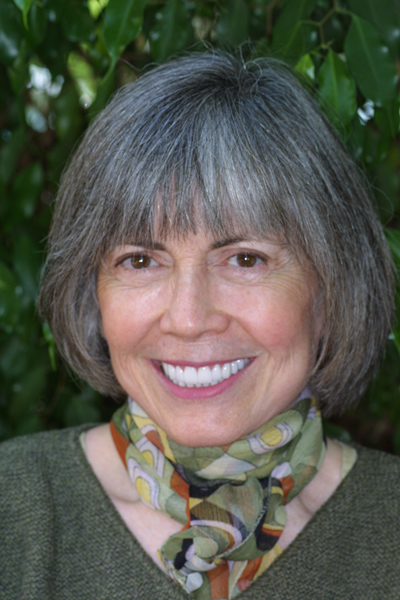
Anne Rice. She may be gone, but she is still definitely with us.

You know, I’ve actually had the opportunity to interact with Anne Rice a few times. Not in person, mind you, but over email and social media.

In high school, I sent her an email after reading her novel Angel Time (she had an email that was known to the public back then). I liked the novel for the most part, but I was upset as a Jew that one of her Jewish characters became a Catholic nun just to be closer to her father. She actually emailed me back, saying that I had a fair point and would try to be more sensitive to such matters. It was a crazy cool moment. A few years later, about a year into writing this blog, I wrote a review of The Wolf Gift (which you can read here), her first werewolf novel, where I compared her work to various kinds of food (I had just eaten lunch). Somehow she caught wind of my review and posted it on her social media. It’s still one of my most viewed posts, and it’s been nine years since then!

I had a few more interactions with her through email and social media up until 2016 or 2017, but I was happy with what I got. And as she kept writing, I hoped I would be able to actually meet her in person someday.

Yesterday, December 11th, 2021, Anne Rice passed away due to complications due to a stroke. She was 80.

Like many, I am heartbroken. I first discovered Anne Rice as a preteen with Interview with the Vampire. As I’m sure many of you can agree, it was a revelation. For me, I hadn’t read any story whose world felt as immersive as the world of Louis and Lestat since reading Harry Potter years earlier. I could almost smell New Orleans, here the sounds of 19th century Paris! The language was so beautiful too! Poetry without being poetry, filling my mind and painting extraordinary images. It made me realize just how powerful language could be, more than any other novel I had read up till then. And finally, I empathized with and grew to truly love the characters. While a lot of their emotional and philosophical turmoil went over my head at that age, I understood that they were going through a lot and felt for them.

This would only increase as I continued to read her works throughout my teens and twenties as I read her new work. Reading her works often felt like meeting old friends, and at the same time, Anne Rice, who put so much of herself in her books, began to feel like a friend and a mentor. Often, her writing would influence mine as much as Stephen King’s did, especially as I’ve gotten older. That impression deepened when I got on social media, where Rice was active with her fan community, whom she affectionately called the People of the Page.*

I may have to read this again very soon. I haven’t read it since I was 11 or 12. I wonder how it will affect me now.

It pains me, and so many others, that we won’t be able to read new stories by her or see her social media posts anymore. That next year’s Ramses the Damned novel, if it releases on time, will be her final novel. That she won’t be able to see the TV adaptations of The Vampire Chronicles or Mayfair Witches trilogy being developed at AMC when they premiere. That one of the greatest horror writers of the 20th century, as well as one of the greatest writers of the 20th century period, is now gone from this world.

Luckily, even though Ms. Rice has left the Savage Garden and is probably now getting all her spiritual, philosophical and cosmological questions answered, her works remain. She has, like many of her characters, achieved a form of immortality, but this one won’t cut her off from the world of humans. Instead, she’ll always be with us, a spiritual force beyond matter and body living in our minds and our souls. So, even though many of us will never have the chance to meet her in person, she will still be able to influence and touch us with her powerful Gothic epics.

Next year, there’s supposed to be a public memorial in New Orleans for her, one year after her family lays her to rest. I don’t know if I’ll be able to go, but if not, I’ll at least be able to raise a glass of wine to her tonight. A sweet red, which I’m sure she would have appreciated. And when those TV shows premiere, I, and probably many others, will raise a glass again and think of her. Anne Rice, the true Queen of the Vampires, and someone who will be with us long after she’s joined the spiritual plane.

What influence did Anne Rice have on you? What were your favorite books by her? Do you have any stories you want to tell about her? Let’s discuss.

*See where I got the idea to name you all the Followers of Fear?

I think I’ve been hearing buzz about this novel since it was released last year. However, I only just got around to reading it recently (or more accurately, listening to it on audio book). I had somehow managed to stay spoiler-free despite the buzz, and knew nothing beyond the fact it was a Gothic novel set in 1950s Mexico. And knowing nothing, I was going in expecting something amazing.

Mexican Gothic follows Noemi Taboada, a young high-society woman living in Mexico City in 1950. That is, until a mysterious letter from her cousin Catalina arrives at the family home. Concerned, Noemi is sent out to check on her cousin, who has been living in the countryside since her marriage to a mysterious Englishman named Virgil Doyle at his family’s estate, High Place. When she arrives, she’s not surprised to find things are not what they appear. However, the biggest surprises are yet to come. And if Noemi’s not careful, she’ll find these surprises may keep her from leaving High Place. Forever.

I can see why this novel was nominated for a Bram Stoker award, it’s excellent!

For one thing, the language this book is written in is just beautiful, like a Victorian novel without being too stuffy or overly wordy and dramatic. From the opening chapters, I felt like I was listening to the sort of writing I aspire to write (maybe someday I will). And Moreno-Garcia uses this brilliant language to not only bring the novel to life in your mind, but to bring out this strong sense of atmosphere and dread. I could almost see High Place and feel the horror that Noemi felt.

Speaking of which, I loved Noemi. She’s a very spunky young woman who refuses to compromise or let anyone tell her what to do just because she’s a woman. I loved watching her go up against the stodgy, stuffy Doyles with their rigid ways and gloomy lives, as well as how she refused to submit.

In addition, Mexican Gothic‘s story has a unique twist on the concept of a haunted house. I won’t go into details, because it’s more fun for you to read it yourself. Let me just say, it’s different than anything I’ve read and you’ll probably find it pretty clever on a number of levels.

I can’t think of any real downsides to this story. If I did, it would be nitpicking on my part. I will warn some readers that there are some things in the novel that might be triggering to them. One of the characters turns out to be…skeevy, to put it mildly. Just warning you.

In any case, Mexican Gothic by Silvia Moreno-Garcia is a wonderful addition to the Gothic horror genre. On a scale of 1 to 5, I’m giving it a 4.7. Wonderfully written, ingenious and spooky. Pick up a copy and find out for yourself why people are raving about this book. Preferably before they decide the Bram Stoker winners in May.

That’s all for now, my Followers of Fear. Until next time, happy reading and pleasant nightmares!

My copy of Remina from the library.

I’ve been looking forward to this book getting an official translation and release here in the US for quite some time. And I was so excited when it arrived at the library, I stopped by yesterday afternoon to pick it up rather than wait till Friday. As you can guess, I stayed up late reading it, hoping the story within would give me some pleasant nightmares.

Known as Hellstar Remina in Japan, Remina kicks off with the discovery of a new planet that seemingly appeared from a wormhole several lightyears away. The discovery is hailed as the greatest development in astrophysics ever, and its discoverer, Dr. Oguro, names the new planet after his beloved, beautiful but shy daughter Remina, causing her own star to rise alongside the planet bearing her name. However, planet Remina is moving through space in ways that defy physics and sense. Planets and stars disappear in its wake. And it soon becomes clear that not only is this planet headed to our solar system, but it spells doom for all on the Earth. Especially the young woman who shares a name with it.

Oh man, I don’t think I’ve loved something from Ito this much since Uzumaki!

First off, the concept is well-executed. Ito takes this idea of a planet flying through space towards us, threatening everything we found our worldviews on as well as our lives and our planet, and turns it into this strange, dread-inducing story that somehow manages to ramp up more and more with every page. The planet itself is rather terrifying. There’s so many unknowns about it, and the more you learn and see of Remina, the more questions you have and the more you learn to fear it. It really puts the “cosmic” into cosmic horror.

I was also impressed with the human characters. Remina Oguro, the planet’s namesake, is easy to like. She’s shy and humble, and really only becomes an entertainer because she’s suddenly famous, so she might as well use it to get through life more easily. Which makes the hardship she goes through later so heart wrenching. As the planet bears down on the Earth and no solution seems to work, people begin to wonder if the Oguros, particularly Remina herself, have some hand in bringing the planet to them. In their terror, many abandon reason and decide the only way to save humanity is to kill Remina Oguro herself.

It’s not only an excellent example of cosmic horror–of humans dealing/reacting to their insignificance in the universe in the only ways they know how–as well as making you feel for Remina, but it feels really relevant to our current predicaments. Whether it be COVID-19 or the national election, you see people embracing the most insane conspiracy theories rather than accept an obvious reality. That is illustrated so well in Remina, and I felt a chill reading that.

This shot encapsulates so much of what makes Remina great.

Other aspects of the story worked as well. Ito’s art is amazing, as always. Earth in this manga is portrayed as being a few decades ahead of us a la The Jetsons, flying cars included, and it’s cool to see Ito give Earth this futuristic look. The characters are well-drawn, with our protagonists given a more realistic look while those driven mad by fear or anger are hyper-exaggerated to best portray their emotions. But the best illustrations are the spreads taking two full pages. They portray that cosmic dread so well, I spent quite a bit of time looking at them.

And as for the science aspect of the story, while more pseudoscientific than based in reality, it seems plausible enough to believe in for the moment.

The one aspect I disliked was just how quickly things escalated in the first chapter. Within about thirty or forty pages, things go from excitement and new promises to gloom-and-doom and psychotic, murderous behavior. I would’ve preferred things to move a bit more gradually before getting to that level.

All in all, Remina by Junji Ito earns itself a splendid 4.5 out of 5. It’s terrifying in both its cosmic and human aspects and will be hard to put down for any reader. Pick it up, settle in for a terrifying ride, and never name anything Remina.

Also, someone please adapt this story into a movie or miniseries! Live action or animated, this would be a great spectacle to see on screens. Just lay off the CGI except when absolutely necessary and it could be awesome.

.

I think I’ve mentioned how busy I am lately. But things have kind of calmed down a bit, so unless I hear back from a beta reader, figure out how best to edit this story I’m working on, or am lucky enough to get a story accepted somewhere, I know what I’m working on next.

You may recall back in the spring, I started writing what I thought would be a novella, but ended up being a full blown novel. This novel, The Pure World Comes, follows a maid in the Victorian era who goes to work at the manor of a mysterious nobleman, only to find mysterious and terrifying events occurring there. I haven’t touched it since then, but I haven’t stopped thinking about it and how to improve it. And now feels like a good time to get to work on a second draft.

As such, I’ve been prepping to journey back to Queen Victoria’s reign. I’ve been listening to audio books and watching movies and TV shows in that era to get that flowery, polite way of speaking down. I’ve been learning new bits of information, such as etiquette and dating advice (yes, the Victorians had dating advice). And I’ve been reviewing what I already know. After all, this isn’t just Gothic horror (or is it Gothic horror/gaslamp fantasy?) I’m working on. This is historical fiction! And historical fiction requires a lot of work to make the reader feel they’re in that bygone era.

All that being said, I have a few goals with this draft. Obviously, I’ll be looking to clean it up, fix any plot holes I notice, and cut out anything extraneous. However, I have a few other goals. This includes:

Victorian fashion. It was a special kind of extravagant.
  • Improve the dialogue. I feel like when I wrote the first draft, I made my characters speak like modern-day Americans. This draft, I’m going to go through the whole book and make sure they sound like Victorians! Eloquence and flowery language, fewer contractions, a focus on politeness and how to address different classes. Not sure I’m going to mad on the expressiveness like characters in Dracula did (oh my God, even when people were dying, they had to be so wordy and full of praise for people they admire!), though. That might be too silly and melodramatic.
  • Explain the era better. One of the problems I have as a writer is that I forget that not every reader knows the same things as me. So, while I know a lot about Victorian England and can put an odd detail peculiar to the era in, knowing exactly what that means, the average reader won’t. It’s my job as the author to explain the minutiae to the reader, be it the ritual of mourning (click here for more on that), how much a pain in the ass cleaning was, or how ice cream was made back in the day (they used to use cucumbers!).
  • The little details need to be inserted. By this, I want to include more things special to the Victorian era. You write about the 1980s, you include Walkmans and big hair and the latest pop songs. You write about the 1950s, you include Cold War concerns, soda shops in pharmacies, televisions and record players, and early rockers. You write about the Victorian era, you mention steam engines, Mudie’s Lending Library, penny dreadfuls, and so much more. I want to include more of those details in the story, so that others familiar with the era can say, “Aha! That makes it feel authentic.” And trust me, there are a lot of details like that to include.

So, that’s what I’m up to lately. Or what I’m about to get up to, most likely starting this week. With any luck, I can make a damn good draft and get this story one step closer to publication. And believe me, I aim to get this story published, one way or the other. After all, this story includes both my love of the Victorian era and my theory of who Jack the Ripper is! You know I gotta get that out there!

That’s all for now, my Followers of Fear. I’m off to dream dark dreams. Possibly taking place at balls with huge dresses and polite conversation. Still dark dreams, though. Until next time, pleasant nightmares!