Posts Tagged ‘authors’

Audible’s audio edition of Dracula by Bram Stoker. Turns out, it was just what the Count ordered.

Everyone has heard of Dracula. Most likely, you’ve seen some version of him in a movie or a TV series .* But how many of you have ever read the original novel? Not many, surprisingly. Besides the fact that Dracula’s melted so thoroughly into pop culture, the source material is a Victorian novel written in the form of diary entries and letters. Even veteran bookworms have to steel themselves for those!

I tired once or twice in my younger years to read Dracula, but found it harder to get through than some Lovecraft stories and had to stop reading. Last month, however, Audible offered its own audio version for free as part of my subscription. I was like, “Maybe I’ll enjoy it more in audio form” and downloaded it.

Turns out, while Audible may have a dumbass exchange policy (and yes, fixing Audible and Amazon’s issues are still works in progress), the audio book was just what I needed. Great cast that brought the story to life and allowed me to get into it while driving or working out or cooking.

And let me tell you, Dracula the novel is good! It’s a slow burn Gothic story that takes its time building up an atmosphere as well as a conflict. By the time the action really gets rolling, the suspense and dread is so well-constructed that you actually feel a bit of worry with every encounter or setback the characters endure.

I also liked how a lot of my expectations were subverted while listening to the novel. Yes, his name’s on the cover, but Dracula himself doesn’t show up that much in the story past the first act. He’s mostly on the edge, only showing himself every now and then. While this may upset some readers who expect the Count to be front and center, it’s actually pretty effective. Whenever Dracula shows up, you know shit is likely to get real, and you’re waiting for that shit to happen.

Contrary to what the movies portray, Dracula is more on the edges and backgrounds than front and center.

Another surprise: while I expected Dr. Van Helsing to be an important character, Mina Harker (nee Murray) really stole the show. She’s easily smarter than most of the other characters, including the doctor, and could almost be seen as a proto-Buffy. The only reason she doesn’t do any slaying is because Victorian mores made it impossible for anyone, including Mina herself, to see her taking on a more active role against Dracula (much to their regret later). Kind of makes you wonder if Stoker was making some sort of feminist statement there. I’d love to see an adaptation where Mina’s the one kicking ass. You know, instead of falling for the Count and/or being totally helpless.

And there were some details in the story that I found fascinating, simply because they never make it into any adaptation. For example, Van Helsing hints that Dracula, for all his power and evil, has a very childlike brain when it comes to planning or deep thinking, and that hinders him when he comes to England. It’s amazing what never gets translated to the adaptations.

All that said, the novel isn’t without flaws. The character of Renfield, Dracula’s faithful madman, is pretty extraneous to the plot. He’s really just a vampire radar, and other than that, he doesn’t do much beyond be crazy and help develop Dr. Seward’s character. Then there’s Quincy Morris, a character from Texas who feels more like a parody of Texans from Western novels than a real Texan. And yeah, I would have liked to see a bit more of Dracula, as well as him being a big bad. That might just be my pop-culture image not lining up with the novel, but can you blame me?

All in all, though, I think Dracula is deserving of a 4.8 out of 5. It’s moody, well-written and worth the read if you find a format that works for you. Hell, I think I might go on a binge of Dracula-related media: some essays on the story’s deeper meaning, some adaptations, that novel co-written by Stoker’s descendant (yes, that’s a real thing). I might also write a story involving Dracula and characters in the novel. Who knows?

That’s all for now, my Followers of Fear. If you need me, I’m celebrating the first night of Hanukkah with vampires and jelly donuts (weird combination, I know). Until next time, happy holidays and pleasant nightmares!

*Speaking of which, I’m still sad that the 2014 NBC TV show was cancelled after one season. All because they didn’t give it the advertising it deserved. The fact that this might be the first you’ve ever heard of it unfortunately proves my point.

Yep, I’m doing this again. But I just released a story, so can you blame me?

So, if you’ve never seen me do one of these before, #FirstLineFriday is a tag that was popular for a split second among writers online for a split second, and that I still do here on the blog from time to time. On Fridays, you:

  1. Create a post on your blog titled #FirstLineFriday, hashtag and all.
  2. Explain the rules like I’m doing now.
  3. Post the first one or two lines of a potential story, a story-in-progress, or a completed/published story.
  4. Ask your readers for feedback and try to get them to try #FirstLineFriday on their own blogs (tagging is encouraged but not necessary).

The story whose lines I’m showcasing today shouldn’t be any surprise to anyone. Yes, they’re the first lines from “Mother of the King,” my Arthurian fantasy novelette which was released earlier this week. The story revolves around the fabled return of King Arthur, as told from the point of view of the woman chosen to be his mother. Enjoy:

I want to tell all this to my son. After so many years, I feel like I owe him this, the story of how he came to be.

Well, it’s not much, but it sets up the story nicely in my opinion.

Mother of the King. Available now from Amazon.

But what do you think? How would you improve this? Or is it fine as it is? Let’s discuss.

And if these opening lines got you at all curious about the story itself, “Mother of the King” is available to buy as an ebook now. It’s only been a few days, but it’s already gotten some good reviews. If you haven’t checked it out yet and would like to, I’ll include the links below. And if you read it, please let me know what you think. Positive or negative, I love reader feedback, and it helps me and other readers in the long run.

And as for who I’m tagging, I TAG YOU, READER! YES, YOU!!! I’m tagging you all, my Followers of Fear, plus any unfortunate who has come across this post by accident. You must now do the #FirstLineFriday, and tag back to me when you’re done! Mwa ha ha!

Sorry I’m so extra this morning. It’s Friday, and I just want it to be the weekend.

Well, that’s all for now, my Followers of Fear. I’ll see you all very soon (most likely to push this story a bit more). Until next time, stay safe and warm, pleasant nightmares, and don’t let Krampus down your chimney tomorrow night. I hear tomorrow night’s his night…

Mother of the King: Amazon US, Amazon CAN, Amazon UK

I’ve mentioned a few times that “Mother of the King” and any other short(er) stories I self-publish over the next year will only be available in print as chapbooks to be sold at conventions and other events. The conventions and other events part is easy to understand, but I’m sure some of you have wondered what a chapbook is. Well, as promised, I’m going to explain what those are and why authors make them.

To put it simply, a chapbook is a small pamphlet or booklet of 40 pages or less, either folded from a giant piece of paper or stapled together from several sheets of paper (fun fact: the latter is known as saddle-stitching). The practice of making and selling chapbooks began around the 16th century and were named after the men who sold them, chapmen, who were early traveling salesmen and dealers. Modern chapbooks are often made by authors using printers and staplers, or assembled in print shops and sold at events or sometimes in specialty bookstores.

So, that’s what a chapbook is. Why do we have them? Why would an author make them?

Well, chapbooks were originally printed for working class families who could read but couldn’t afford books on their own (even with the printing press, those things were expensive). They were easy to transport and helpful in disseminating ideas, information, entertainment and (often inaccurate) history into popular culture. They were also used to develop literacy, much like comic books and graphic novels help teens and people who don’t speak a nation’s native language learn and develop language and reading skills.

“The Chapbook, promotional poster” by MCAD Library is licensed with CC BY 2.0. To view a copy of this license, visit https://creativecommons.org/licenses/by/2.0/

Fast forward to today. Books are cheaper and libraries exist, but chapbooks are still around. They’ve been especially popular during the past couple of decades in certain circles thanks to copying and printing technology. For the first time, people could sell their stories and poetry directly to the people without the aid of a major publisher or someone who owned a printing press. It was kind of an early form of self-publishing, if you think about it.

With people making chapbooks and small circulation magazines from home, the chapbook has made something of a comeback. And though it’s still not as popular as the your regular hundred-plus page book, they’re still being put out every year. Authors and poets like how easy and cheap they are, and how they can make something of a profit from them while also giving potential fans something quick to enjoy and maybe get hooked on their work. Like I said, a form of self-publishing, though some presses also do chapbooks alongside regular books.

And presses and authors aren’t the only ones who have seen value in these little booklets. There are bookstores that sell chapbooks alongside regular paperbacks, events devoted to them as an artform (looking at you, NYC/CUNY Chapbook Festival), and major publishers using them as advertising tools for their catalogs. And sometimes, depending on the chapbook, who made it, the method of production, and how many exist, these babies can go for quite a bit of money. Sometimes hundreds of dollars.

Not bad for a cheap little booklet that was often recycled as toilet paper after the buyers were done with the story (yeah, that’s true. As well as strips of old newspapers. Beats a stick or a corn cob though, right?).

Anyway, I don’t expect to make hundreds of dollars off chapbooks of my work. Especially when they’ll still be available as ebooks online. But as I said above, they’d be a good way to get my work out to more people. For events out of town, they could help fund those trips. And let’s face it, they could be fun to have and to show off at my next convention. Whenever that is. Damn you, COVID-19!

Anyway, that’s a chapbook. A form of literature with a cool history and a revival in an age when people can control when stories come out. A diverse artform that takes very little time to make and enjoy. And I hope I can start making them (or going to the print shop to make them) very soon.

In the meantime, I already have one story out in a digital format, so it’s kind of like a chapbook. Yeah, you knew this was coming. My Arthurian fantasy novelette, “Mother of the King,” is out now and available as an e-book. The story is about the fabled return of King Arthur, told from the point of view of the woman chosen to be his mother. It’s been out barely two days, and it’s already garnering some great reviews! I’ll include the links below, so check it out!

That’s all for now, my Followers of Fear. I’m off with a priestess, a dragon and a Deep One to find Arthur’s casket. Until next time, good night, happy reading and pleasant nightmares!

Mother of the King: Amazon US, Amazon CAN, Amazon UK

So, you just finished a short story. It might be a short story or a novel. Either way, it’s finished and you love it! You think it’s great, that it has potential, that it could even get published somewhere. Hell, you even dream of it getting awards and adaptation offers and so much more! With all that in mind, what do you do with this awesome story of yours?

If you said, “Rush to get it published,” I’m only going to say that that’s not the answer I was going for. If, however, you said “I’m going to get a beta reader or two to look at the story,” then congratulations! You got the answer I was going for.

As you likely already know, beta readers are readers who look at a story somewhere along the editing process and give critiques and feedback. They may also give help with the spelling/grammar/punctuation issues of the story, depending on what they can offer. And over the past year or two, I’ve made sure to use beta readers for every one of my short stories.

Let’s face it, authors can be our own worst critics, and our own worst editors. We can see a lot, but occasionally things slip by our notice. In fact, a lot of things can slip by our notice. Typos, plot holes, inconsistencies in character development or backstory, implausible situations or things that don’t jive with reality. Beta readers point out things authors miss, or don’t want to think of as problems because they love their stories too much (it happens).

Take my recently-completed short story Afternoon Tea, the one about the cursed silent film. I found two beta readers who were willing to read the story and give me feedback. Both of them got back to me really quickly, and they said the story had a lot of potential and that they liked it. They did, however, both notice something that made no sense to them. One actually wrote quite a bit in their notes about why that plot point made no sense or was confusing.

Seeing that they both mentioned it made me realize that they had a point. That single plot point did have its issues. I had to take it out, which made me realize I needed to rewrite that section of the story. Which I was able to do with a bit of brainstorming. And I think it makes for a much better story. One of those same beta readers has already gotten back to me about the second draft and said there’s a lot of improvement, so listening to them was a good decision.

Not only that, but sometimes beta readers bring their own life experiences to help improve a story. Earlier this year I wrote a short story called Primordial Nuclear Soup, which involved a number of military characters. My beta reader happened to be a veteran, so in addition to pointing out numerous flaws with the early draft, they gave me their military experience to help with those characters and scenes.

Without the strong eye of a beta reader, you can miss much. Photo by Wallace Chuck on Pexels.com

None of this stuff I would have known or spotted without the help of my beta readers.

Of course, you do meet the occasional beta reader who turns out to not be so helpful. They send back a lot of praise for the story, but they don’t point out that much that you don’t realize needs fixing. Which can be an issue further down the line when you’re trying to get the story published. What can I say? The majority of them are human (I’m an exception).

But after a while, you do figure out how to spot a helpful beta reader from an unhelpful one. It usually shows in the notes they send back. If that happens, keep looking for more beta readers. You eventually will find someone who can give you the feedback you’re looking for. And sometimes, you even create a circle of beta readers who will gladly look at your work when you need them to and provide the feedback you need. When you do that, you know you’re in good hands.

Suffice to say, beta readers are a great help in making sure your stories are the best they can be. It may not be easy seeing all the problems in a story you’ve poured sweat and tears into, but in the end, listening to them and fixing the story based on what they said helps out immensely.

“Mother of the King.” Available Dec. 1st

Getting the stories published afterwards, however….that’s another fight altogether.

What are your experiences with beta readers like? How have they been helpful with your storytelling endeavors? Let’s discuss.

And before I forget, my Arthurian fantasy story “Mother of the King” releases day-after-tomorrow! If you haven’t preordered a copy of the ebook yet, you can check it out with the links below! Believe me, both beta readers and eARC readers have been raving about this story, so why not check it out? And if you do, let me know what you think. I’d love to hear your thoughts on the story.

Mother of the King: Amazon US, Amazon CAN, Amazon UK

Audible company logo.

If you’re not familiar with Audible and Audiobook Creation Exchange (aka ACX), let me fill you in. Audible is Amazon’s audio book wing. They distribute thousands of audio books and have just as many subscribers (I’ve been one since 2015). ACX is part of Audible: it’s a places where authors and publishers can hook up with narrators, produce audio books, and then upload them to Audible.

With me so far?

Recently, Audible and ACX have been in a bit of hot water. It’s come to the attention of several authors that Audible has a rather questionable policy on the books. Audible Premium Plus subscribers have the option to exchange an audio book they’ve bought through their subscription within 365 days of purchase! And get this: if an audio book is exchanged within that time frame, the authors or publishers get their royalties deducted for it!

You read that right: somebody can exchange any audio book they buy within a year of purchasing, and the author gets punished for it.

Most people’s reactions to the exchange policy abuse. Photo by Andrea Piacquadio on Pexels.com

And lately, this has become a huge problem. Many authors, mostly indie authors, have noticed an increase in exchanges and deducted royalties over the past several months, In fact, some have speculated that use of the exchange policy–or should I say abuse of the exchange policy?–has boomed because Audible’s been using the policy in some of their advertising to attract new members.

Spurred by reports of this, the Authors Guild, along with a whole bunch of other author organizations, have drafted a letter to Audible and ACX to get them to, among other things, change the policy and create a more reasonable exchange policy. At the time I’m writing this, the letter has over twelve thousand signatures, and it’s still growing. To quote the letter,

This policy is in clear breach of the duty of good faith and fair dealing implied in the authors’ agreements with Audible and ACX as it allows books to be purchased and listened to without paying the authors and narrators their royalties.

Authors Guild Letter to Audible and ACX

Now, I have only have Rose‘s audio book on Audible, and so far as I know, it hasn’t suffered from this exchange policy much. However, I have heard from a couple of colleagues, including some I consider good friends, who are upset by the policy and are considering pulling their works from Audible and ACX because of the policy.

And even if I didn’t know anyone affected by this policy, once I learned about it, it was hard for me to sit still. This is a terrible policy that hurts authors and publishers alike! These are the people that Amazon needs to continue selling through Audible, and yet they treat them this way?

And why is the exchange window a year long to begin with? That’s a terrible business strategy. Can you imagine if a hardware store allowed you to exchange a tool within a year, even if it’s likely been used? Or a shoe store? Or a computer business? They’d be out of business within a year with a policy like that! What the hell, Amazon?

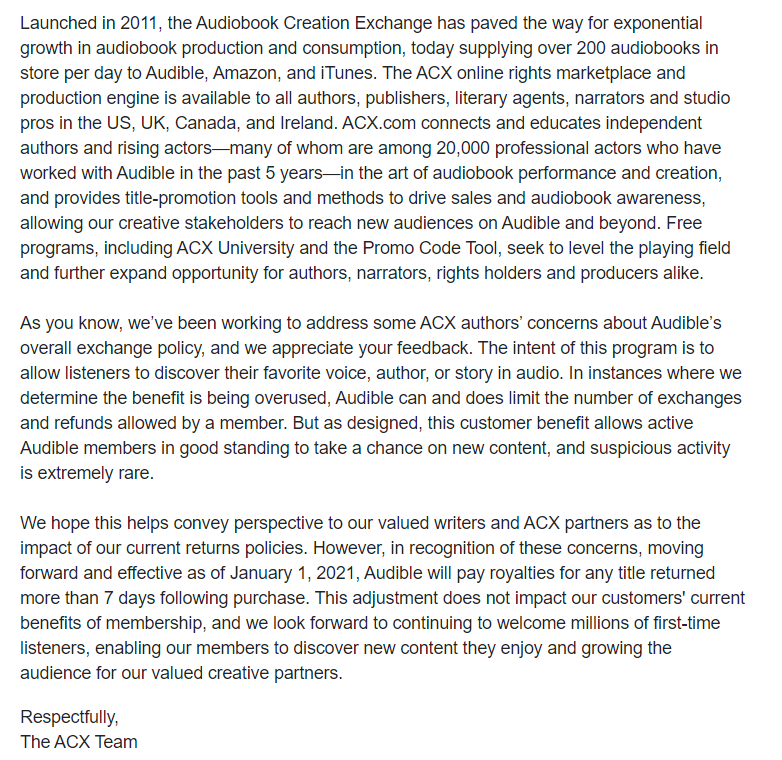
The letter I received from Audible about the change in the exchange policy. Feel free to enlarge and read it in full.

Thankfully, it seems that news of the abuse and the letter made Audible realize their mistake. While they’ve defended the policy, saying that they do monitor for abuse and that such abuse is rare, they are changing the policy effective January 1st. After that, the exchange window is limited to 7 days, and Audible will pay for any exchanges made after that timeframe. They later confirmed this in an email to ACX creators, which I got as well.

And that is good. That is a good change. It’s harder to abuse an exchange policy limited to only a week instead of a year. Still, some aren’t satisfied. In fact, the Authors Guild letter suggests shortening the window to 48 hours. And I like that idea: not only is it even harder to listen to multiple audio books over the course of two days than it is to do over a week, but it should be easier to spot abuse when an account is making multiple exchanges within a two day period.

So, what can you do? Well, you can sign the letter, which at the time of writing is only 440 signatures away from the Authors Guild’s goal. Even if Audible has changed the policy, every signature is a reminder to the company that this sort of malarkey won’t be tolerated by the very people the company needs for products if it continues.

You can also share with other authors and readers. The more people who are informed about the issue, the more people who will be weary and on the lookout for policies and abuse like this. People, and companies, are more likely to be better behaved if they know they’re being watched and kept under pressure.

And finally, if you have or plan on getting an Audible subscription, don’t be the kind of subscriber who does this sort of crap. I’ve only exchanged a book on Audible once, and that was because I thought it was one kind of story, and it turned out to be another. Otherwise, I would never rob another writer of royalties! Instead, keep the book once you buy it, and wait for your next credit. Don’t make someone else lose money just because you want more listening material!

And if Audible doesn’t address the problem, maybe consider giving up your membership. Yeah, it’ll suck to not get that credit for an audio book each month, but it’ll sure send a message to Audible.

And if you do enjoy an audio book purchased through Audible, make sure to review or at least rate it afterwards. Trust me, ratings and reviews left by readers help both new readers and the writers who put their books on the site. I speak from personal experience on that!

That’s all for now, my Followers of Fear. Thank you for reading this far and giving a damn about this problem. I hope you’ll consider helping out authors and stopping abuse of Audible’s exchange policy.

Until next time, Happy Thanksgiving and pleasant nightmares!

Photo by Dmitry Demidov on Pexels.com

I know it feels weird to interrupt the partying and celebration with discussion of writing. But after today’s news, and after a hell of a week, I feel so energized to write. With that in mind, I finished the outline of my next story today, and I’m looking forward to starting it. So, I shall take a moment of your time to talk about writing.

As I said, I just finished an outline for a new story. And, as you can guess from the title of this post, it’s going to have two protagonists. Or, to be more specific, it’s going to be told from the points-of-views of two protagonists. One is a US Army major who has had his fair share of combat experiences. The other is a thirteen-year-old runaway who just happens to be at the wrong place at the wrong time. I can’t say more than that.

Now, plenty of stories are told from multiple points-of-view. All you have to do is look at the typical bookshelf full of fiction tomes and you’ll find at least three or four books where we see events from the perspectives of two or more characters. But then there are stories where you take for granted that the story is told that way. And then there are stories where you remember how perspectives differed from character to character. Where the multiple POVs is a main feature of the story.

It’s that sort of story I’m aiming to create.

The Bartimaeus books by Jonathan Stroud. Great example of this kind of distinctive-voice storytelling.

Thankfully, I’ve had plenty of teachers over the years with this sort of storytelling. From the (sadly underrated) dark fantasy series The Bartimaeus Trilogy to the literary satirical comedy that is The Falls by George Saunders (read that short story for two separate classes at OSU, and it’s still good), the strong voices of each narrator has a profound impact on the reader. By the time the story ends, you feel like you didn’t just read a story. You read a story and got to know these characters intimately.

That’s what I hope to do. I’m going to be switching between POVs nearly every chapter, and I have to make each protagonist’s voice as distinct as possible. It’s going to be a challenge. I’ve written several stories told from the POVs of multiple characters before. Every author has at least once. But often, it reads like variations of the author’s normal writing voice.

Take IT, for example. There are multiple characters in that story, and many of them get to tell things from their POV. Plus, King narrates things for a few chapters, especially in the early parts of the book when Georgie and the young gay couple are attacked. And it’s a great book with great and memorable characters. But you wouldn’t call every narrator/POV character distinctive from the rest, would you?

Well, that’s my challenge with this story.* With any luck, I can take what I’ve learned from the stories I’ve read and apply it to this next story. Thankfully, there’s only two protagonists, so that should help. (Actually, that might be an important ingredient, having only two leads. Keeps things simpler).

But all that starts tomorrow. For now though, I’m off to shower, pour some wine, watch a scary movie, and dance to “The Touch” by Stan Bush (great song from the 1980s to listen to right now). Until next time, my Followers of Fear, party hard and pleasant nightmares.

What are your tips for creating multiple, distinct narrators? What stories do you think of that do this well? Let’s discuss.

*That, and keeping this story from becoming the length of a novel, but one problem at a time.

The Hunger, looking rather snug with my spices and seasonings.

After reading The Deep earlier this year, it was only a matter of time before I read Alma Katsu’s other book, The Hunger, which follows the Donner Party. Which, if you don’t know who that is, were a caravan of settlers who got snowed in the mountains of California in the winter of 1846-47 and had to resort to cannibalism to survive.* And this October, I made it part of my Halloween reading.

As I said above, The Hunger follows the Donner Party, a pioneering wagon train led by George Donner and his family as they head west to California. However, this isn’t a simple retelling of a horrific tale. Something’s following the wagon train, picking off members. As tensions rise and odd events pile up, it becomes clear that’s something afoot. And it could be human. It could be animal. Or it could be something man has never classified before. Whatever it is, one thing’s for sure: it is very, very hungry.

The Deep was good, but The Hunger was even better. It’s a slow burn, but what’s burning away isn’t just the plot, but the sense of ease. As you go further along in the story and more strange and terrible events occur, you start to feel this awful tension. You’re going to get to the inevitable, but it’s not going to be what you expected. And you have no idea what’s going to happen while on your way there.

Speaking of which, the twist on what the source of the terror was at the end was great. I wasn’t expecting it, which is saying something for me. And when I finally did get an idea of what it was, it left me extremely satisfied. As well as worried about what could happen if such a thing were to exist in this world, but I think that was what the author was going for.

I also liked the characters. Alma Katsu has a talent for taking these huge casts and giving the majority of them enough development to make you like them. George Stanton, trying to outrun his past; Tamsen Donner, suspected of being a witch, when all she wants is to fill a great void within her; Elitha Donner, who hears voices no one else does; Mary Graves, who wants adventure in the great wide somewhere; and Edwin Bryant, who knows so much more than he lets on. These, and others, are characters I came to care for, even as I knew what was likely to happen to them.

There were a couple of downsides to this novel. One was that there were chapters where the reader was taken to significant events in the characters’ pasts, events which likely had an effect on them joining the wagon train. Some of these were relevant to the story and fleshed things out, but a few, especially earlier chapters like this, felt unnecessary.

That, and if you’re here for the actual Donner tale, it should be obvious by now that The Hunger isn’t that. Not a downside, just a different kind of horror based on a real-life horror.

All in all, The Hunger by Alma Katsu is a deliciously terrifying novel. On a scale of 1 to 5, I’m granting it a 4.7. Grab a copy, order a steak dinner, and get ready for a slow ride across the US to the land of frights. Trust me, you won’t regret it.

*When I would describe this plot to people who asked me what I was reading, I would follow it up by going, “Om nom nom nom nom!” Totally worth the reactions I got.

I know you’re all expecting me to recount my adventure at the Bellaire House over the weekend. Believe me, I’m working on it and will have that out as soon as I can manage it. In the meantime, I’ve some other things to take care of. Including a special announcement. One I’ve been sitting on for quite some time.

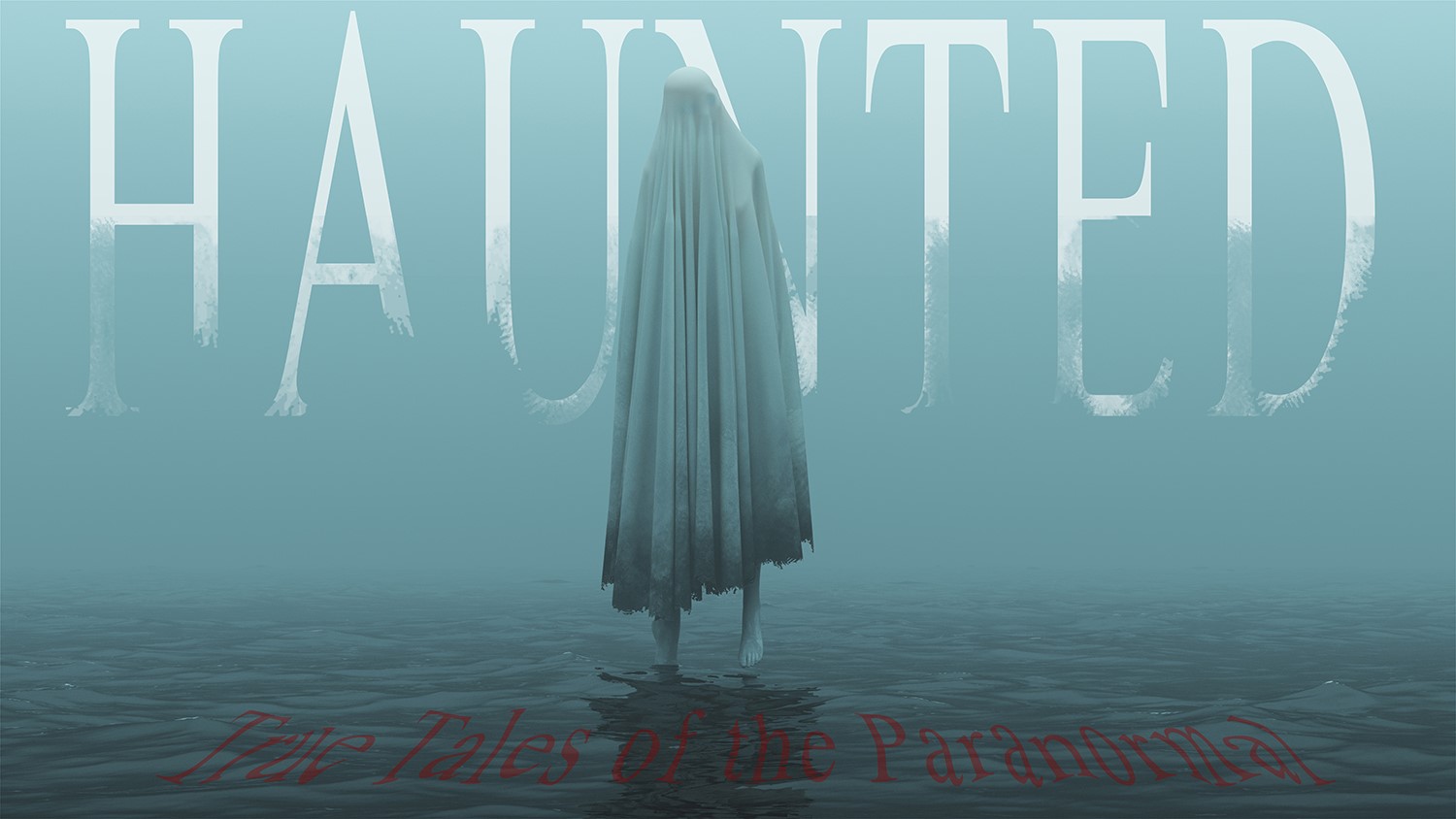
Some time ago, I was asked by Jason Stokes, owner of publisher Gestalt Media, if I wouldn’t mind taking part in a project called Haunted. The project is a collection of audio recordings of various people, quite a number of them creative types like myself, recounting their experiences with the paranormal. Given that I go to haunted locations at least once a year and I have plenty of stories to tell, I said yes.

It’s been agony keeping this in for so long. But I’m pleased to announce that Haunted, as well as its print companion guide, will be released on Thursday, October 15th, 2020. You can check out the art for the collection below.

Pretty awesome, right? And the collection will have music in the background, each track written and fitted for each story by Mombi Yuleman, a musician specializing in dark, cinematic ambient music. The track behind my section is called “Lizzie Borden.” Gee, I wonder what it could be about?

Anyway, you can expect links to both the collection and the companion guide as soon as they’re up. I hope you’ll consider checking Haunted out when it’s available, and leaving reviews so people know what you think. I’m really excited for you to hear about some of my paranormal experiences,* as well as those of these others.

I also hope you’ll check out Gestalt Media’s other works, which you can find on their website. It’s a great company devoted to putting authors first, and even did fundraising for their authors after the pandemic hit and cut into many authors’ incomes from events. They also were behind Dark Tides, a charity anthology that benefits victims of the Virginia Beach shootings and their families. I can’t think of a better reason to support a company.

Thanks for supporting, my Followers of Fear. I hope you’re as excited as I am about Haunted. I promise to share the links as soon as I have them. In the meantime, I’ll be busy uploading videos and photos, writing blog posts, writing stories, editing stories, making moves and making deals, summoning demons, raising hellhounds, and a million other things (and that’s just the writing-related stuff). I’m having a busy October!

Until next time, pleasant nightmares!

*Obviously, the Bellaire House won’t be among the ones included.

I’ll admit it: I haven’t read any of Clive Barker’s books yet. I’ve seen some of the film adaptations, especially Hellraiser, but not his books. I know, shame on me. What kind of horror fan am I? Well, I’ve downloaded the first volume of Books of Blood on audio book.

But before that, I watched a new adaptation of his famous collections of short stories, Books of Blood on Hulu, which tells three interconnected tales involving the titular book.

Now, I’m not usually one for anthology movies. Or maybe I just haven’t shown enough of an interest. But this one was really good. The first two stories are very well-written, particularly the first one, “Jenna.”* The settings look great, and the acting never feels hammy or terrible. What special effects there are, they’re done so nothing looks silly or fake.

And of course, there’s blood. Lots and lots of blood. Enough to not make a liar out of the title.

That being said, there are a couple of negatives to the film. While there’s plenty of scary imagery and tense moments, there wasn’t any point until near the very end where I felt frightened. And while the stories were well-written, you could see the twists for most of them coming and the last one, “Bennett,” had no surprises at all.

And while the stories were interconnected, I wasn’t really satisfied with how a couple of them were connected. I would have liked more emphasis on the connections and how each story could play into and influence each other.

But on the whole, Books of Blood is a decent enough adaptation of the source material. On a scale of 1 to 5, I’ll give it a 4. If you like horror anthology movies, this might be something to put onto your watchlist.

Just be careful not to watch it while drinking red wine, tea made for you by someone else, or stay at a bed and breakfast while watching it.

*Not sure if any of the stories in the film are based on stories in the books, but I think I’ll find that out if I enjoy Volume One and decide to continue with the series.

October is usually associated with Halloween, and obviously I’m doing everything I can to make sure you don’t forget that. But it is also National Disability Employment Awareness Month, when the United States recognizes how peoples with disabilities have contributed to the country and to our various industries over the years. This year especially, we are marking both the 75th anniversary of NDEAM, as it’s often abbreviated, and the 30th anniversary of the Americans with Disabilities Act (ADA) becoming a law.

And it’s good we have this month, because there are so many people with disabilities throughout the world and history who have contributed to our society. Harriet Tubman led dozens of slaves to freedom and acted as an armed scout and nurse for the Union Army, suffered from neurological issues due to a childhood traumatic brain injury; Franklin Roosevelt became President of the United States and led the US through some of its toughest crises, all while dealing with the aftereffects of polio from a childhood condition; Albert Einstein had a learning disability; and author Flannery O’Connor wrote enduring fiction while suffering from lupus.

Not to mention there’s a growing list of entertainers and athletes with disabilities inspiring us everyday. Magic Johnson, the basketball player, has dyslexia; Gaten Matarazzo and Millie Bobby Brown from Stranger Things have cleidocranial dysplasia and deafness in one ear, respectively; and Elton John has fought bulimia and epilepsy for years. And more amazing people with disabilities are emerging every day. Check out this video of a dance company, half of whose members have disabilities.

I point out all these people because, as Ms. Hamamoto points out in the video above, one in five people have a disability of some sort. Yet, despite the passage of the ADA and the many opportunities this law opened up for Americans with disabilities, this country isn’t always very inclusive. In fact, opportunities and services available for people with disabilities can vary greatly from place to place.

This astonishes me, because becoming disabled is something that can happen to anyone regardless of sex, race, nationality, class, religion, political leanings, ethnicity or age. In fact, the likelihood of getting a disability grows as you get older. It can happen because of genetics, because of an accident, a side effect of an illness, or other causes. Lately, I’ve heard of people who get over COVID-19, but have side effects such as still being unable to taste or suffering from multiple headaches a week. These can, and likely will, be considered disabilities in the years to come.

And many members of the American military come back or discharge with disabilities. These can range from physical, such as war injuries, to mental or psychological, such as PTSD.

You might not even realize that someone near you has a disability. The majority of them are invisible. You may only see their struggles, if anything.

And yet, so many people don’t want to think about the disabled. Services for the disabled can be underfunded. Many homes aren’t always built with the disabled in mind. Education in general is often not given the funding it needs, and when it comes to budget cuts, special education is often on the chopping block. And there’s so little education on disability in general, that people may hold a stigma regarding disability for years: that disability is contagious; that they’re useless; that they brought it upon themselves; that the best thing to do with disability is to ignore it or hide it away or treat it as an annoyance.

As a person with several disabilities–some congenital, others acquired in adulthood–I’m aware of how lucky I’ve been. I’m gainfully employed at an organization where close to twenty percent of the workforce has some form of disability (as well as accommodations for them). And throughout my life, I’ve been able to receive services that help me with my disabilities. So I feel it is important to not only make disability more visible, but also to advocate and help out when I can.

Which is why I’d like to close out this post with some links to help my fellow peoples with disabilities. The Department of Labor’s Office of Disability Employment Policy (ODEP) has numerous resources for the disabled, and many states have programs or offices for the disabled, such as Opportunities for Ohioans with Disabilities in my state. If you are or know a college student or recent graduate with disabilities, then might I recommend the Workforce Recruitment Program, or WRP, a great program that pairs students and graduates with disabilities with internships in the federal government, and which sometimes turn into jobs (please use Firefox when operating on the site). And the Job Accommodation Network, or JAN, has numerous listings of individual disabilities and what accommodations exist out there. My office uses this site all the time, and we find it quite helpful.

And these are just a small sample of resources for the disabled, a group that should never be discounted or forgotten. Because not only can you become disabled at any time in your life, but because no matter the disability, you matter. You contribute. You make the world a better place. And if people forget that, then it’s up to you and to the rest of us to remind them.

What resources for people with disabilities are you aware of? What has your disability experience been like?