Posts Tagged ‘Rose’

Whenever I write through the perspective of a particular character in a story, it’s never simply just using my good-ol’-Rami-Ungar-style of narration and pretending to see things through the eyes of said character. I wish it were that simple. Characters, despite being the product of an author’s imagination, tend to feel like independent entities who are telling me their stories (if any psychologists or philosophers can explain that to me, I’d love to hear your two cents). Still, transmitting the story from my head, where the story’s presented as a movie with narration mixed in, to the page requires me to figure out how that voice manifests on the page.

Sometimes that’s easy to figure out. Sometimes it’s not.

The past couple of stories I’ve worked on–Mother of the King, The Night Hitler Came to London, and this novelette I’m working on currently–have been challenging when it comes to figuring out the narrators’ voices. This probably has something to do with the fact that the POV characters in these stories have lives that are very different from mine. For the first two, the POV characters have both been British, which I am not. I’ve been relying on all the British novels, TV shows and movies I’ve consumed over the years, trying to make them seem British, rather than Americans throwing around British colloquialisms like “bloody hell” or “tosser.” And in the case of The Night Hitler Came to London, the two main characters are growing up during the London Blitz, so trying to tap into the mindset living during that particular moment of history isn’t the easiest.

Then again, my country has been at war in some way or another since 2001. So perhaps it’s a bit easier than I give it credit.

And this current story I’m working on…whoo boy! I’m back to working on a novelette I started between two previous drafts of Rose, and the main character is a young housewife from the American South during the 1960s. That’s already pretty alien to my own experience, so it’s a challenge to make her sound like a real person without resorting to a stereotypical Southern accent. I’ve made some progress on that in this latest attempt on the story and I think I’ve figured it out, but I’m sure there will be challenges in the future, I may have to work on her a bit more before I try to publish this story anywhere.

And I’m probably not the only author who struggles with this. Because of how different their lives are from ours, or just how differently their minds work, there will be characters whose heads we struggle to get into and whose voices we struggle to translate to the page. With that in mind, I have a few tips on how an author can figure this out:

  • Look at their background. While every individual is different and background doesn’t determine everything, it can have a huge influence on how a person–and a character–turns out. How they were raised, socioeconomic status, education, religion, nationality, ethnicity, language, who they hung out with, how they were treated by teachers, how they did in sports, what they saw on the Internet. All this makes us. If we can figure all out of this, it can help us get in our characters’ heads and figure out their voices.
  • How do you want them to come off? How do you want your audience to perceive your character? If funny, make sure their observations are full of jokes and witticisms. Narcissistic? Everything comes back to them and makes them look good. Do they feel persecuted? Everything and everyone they come into contact with should reinforce that belief, even if to us we see innocence in these interactions. If you know how your character should come off to readers, you’ll have an easier time writing them.
  • Have an inner dialogue. This is something I did for my character in my current WIP. I go into this in more detail in my article on Self-Published Authors Helping Other Authors, The Inner Dialogue: A Method For Figuring Out Your Stories, so I highly recommend you check it out. If you don’t have time to read it, this is just having a conversation with your inner writer. You can also do this with your character. After all, characters are independent entities after a sort, so you can learn a lot by “hearing” them “speak.”

Some characters are easier than others to understand and translate to the page. But when they are, you shouldn’t give up. There are plenty of ways to figure them out. And when you do, that’ll make all the hard work all the more gratifying.

Have you worked with characters whose voices were hard to find? What did you do figure out their voices?
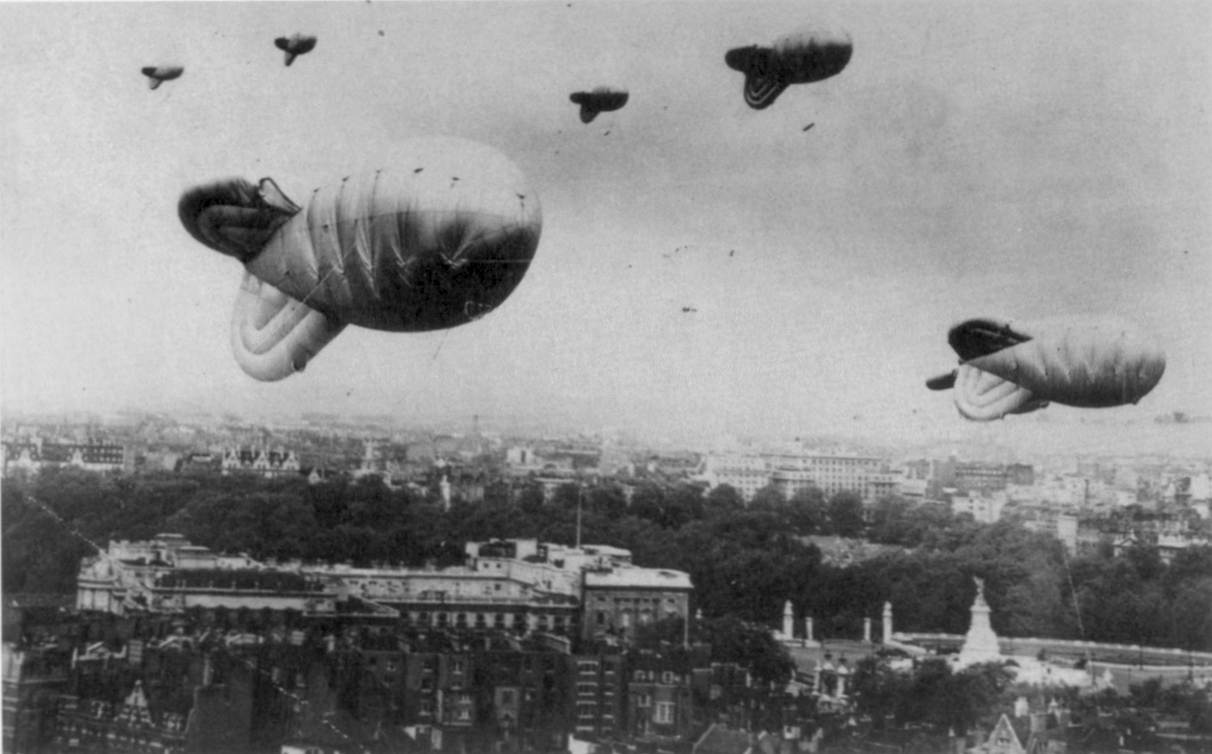
 

There are people looking at the title of this post and thinking, “What the heck did that crazy author come up with now?”

To answer that question, I just finished writing a short story taking place during the London Blitz. I first had the idea for this story over four years ago, when I went on a study-abroad trip to Europe to follow the Allies’ path through Europe. While our teacher and tour guide (or was it one of the other students giving a report based on the research they did the last semester?) was discussing the London Blitz at Bletchley Park (the site where Alan Turing cracked the Nazi Enigma code), I had this idea for a story taking place during the Blitz, involving some kids encountering something awful while trying to run from the bombs. Over time, the antagonist came to be Adolf Hitler.

Or is it him? You know me, I never write anything simple. In any case, the story reflects something about me that shouldn’t surprise anyone: I’m scared of Hitler and the Nazis. As a Jew, I know how close my people came to annihilation nearly three-quarters of a century ago. If the war had gone differently, I probably wouldn’t be here, let alone talking about my stories and my love of horror with you. This is part of why I studied the Holocaust in college, and why I still study it today (though obviously not as frequently as I did in college). But even though I studied the Holocaust and have a pretty good understanding of what occurred, knowing doesn’t make me any less afraid of the Nazis or their monster of a leader. And with such a resurgence of people saying Hitler was right or worthy of admiration, I made sure to get that fear across in the story. Hopefully I succeeded.

You know, I actually wasn’t intending to write this story. I was planning on getting back to a novelette that I’d started working on in-between drafts of Rose. However, this story started calling to me to write it, and I couldn’t resist the call to listen to it. And yes, stories can demand to be written. At least while they’re in our heads. And I only just figured out why this story wanted me to write it so badly that it grabbed my attention. You see, I went to Washington DC recently for work. It was the first time since I was thirteen or so that I’d been to DC, so obviously I was going to do the tourist thing and check out some places (see my Instagram for photos). One of the places I decided to visit was the US Holocaust Memorial Museum, so I could see it after being so much more informed about it than I was as a teen.

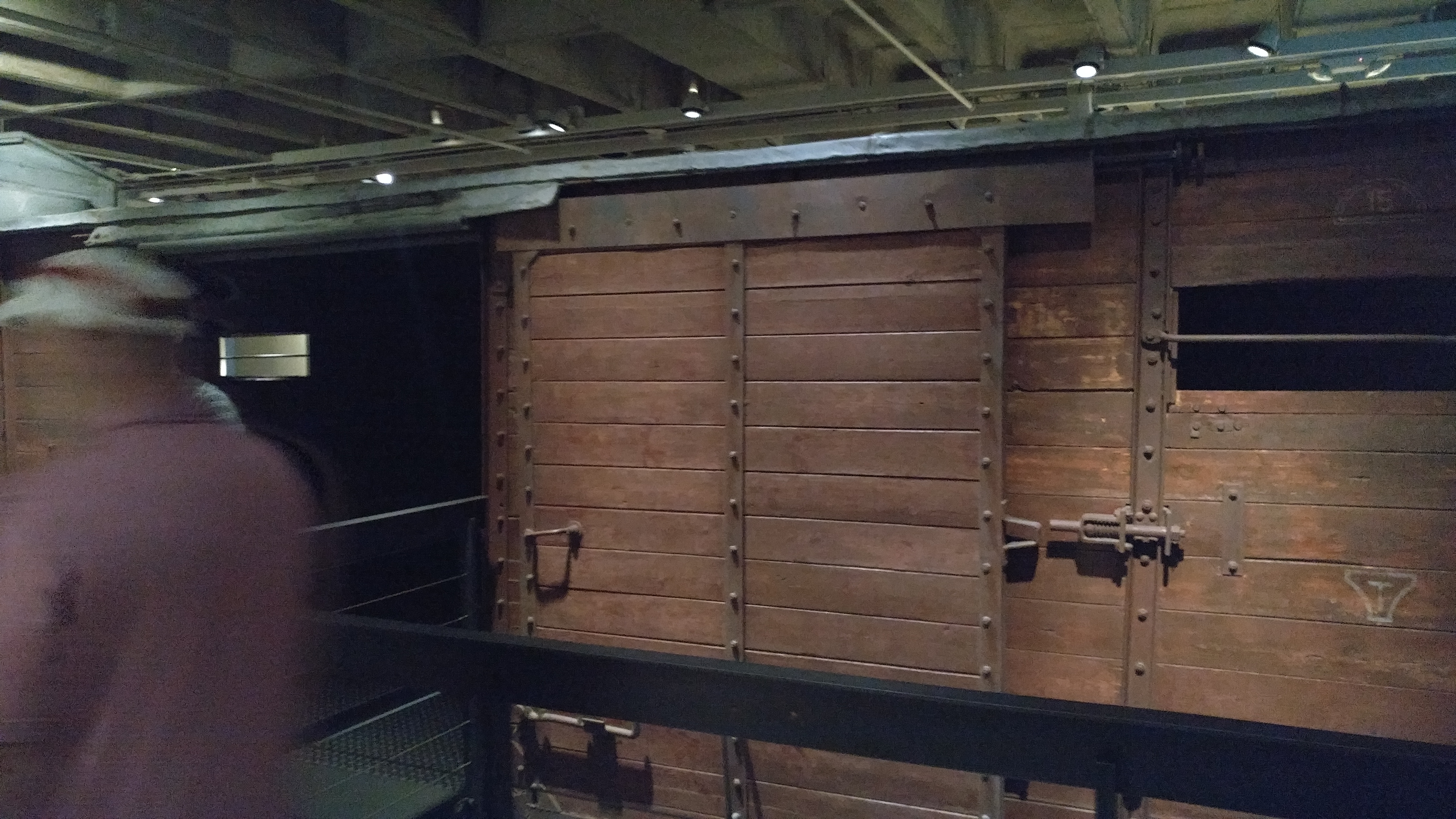
The train car at the US Holocaust Memorial Museum. There’s such a palpable energy of despair coming from it, you can’t help but be affected by it.

I guess my subconscious had me write this story because I was going to that museum. Maybe it was some form of mental preparation, or maybe I felt somewhere in my mind that it was the right thing to write. In either case, I went to the museum on Saturday, and let me tell you, their main exhibit has a palpable atmosphere. You can’t go in there without coming away affected. Seeing all these artifacts from the past–concentration camp and Nazi uniforms, newsreel footage, photographs, testimonials from survivors, even a train car that might have been used to transport Jews and other “inferior races” to concentration camps–along with the museum’s presentation of them, make you fully aware of the horror that occurred so long ago and how it still affects us today.

After I left the main exhibit, I was so glad I was writing this story. It was as if through the story, I was reminding people there’s still a reason to fear Hitler and his ideology. Especially since it’s showing a resurgence these days, long after its abominable creator committed suicide.

So what’s next for this particular story? Well obviously I’m going to have it looked over and then edited. Afterwards though…we’ll see. It’s a little over sixty-eight hundred words, so it’s not too long. I’ll see about getting it published somewhere. There’s a magazine I’ve been trying on and off to get published in, so maybe they’ll take it. Then again, the Ohio Chapter of the Horror Writers Association, of which I’m a member of, has been talking about putting together an anthology. Perhaps I’ll submit it there.

In any case, I’ll let it lie for a while before working on it again. In the meantime, let’s see if I can finish that novelette before I get the latest draft of Rose back from Castrum.

That’s all for now, my Followers of Fear. I’m going to get ready for bed. Until next time, pleasant nightmares!

Well, today has turned out eventful. Not only is it the seventh anniversary of this blog’s creation today, but I finished writing another story. And let me tell you, it turned out a lot longer than I expected, just under eleven-thousand words, making it a novelette. I have no idea if I’ll have to trim it down some later on, but I have a feeling that I’ll be doing a lot of editing before this story can be considered ready for publication.

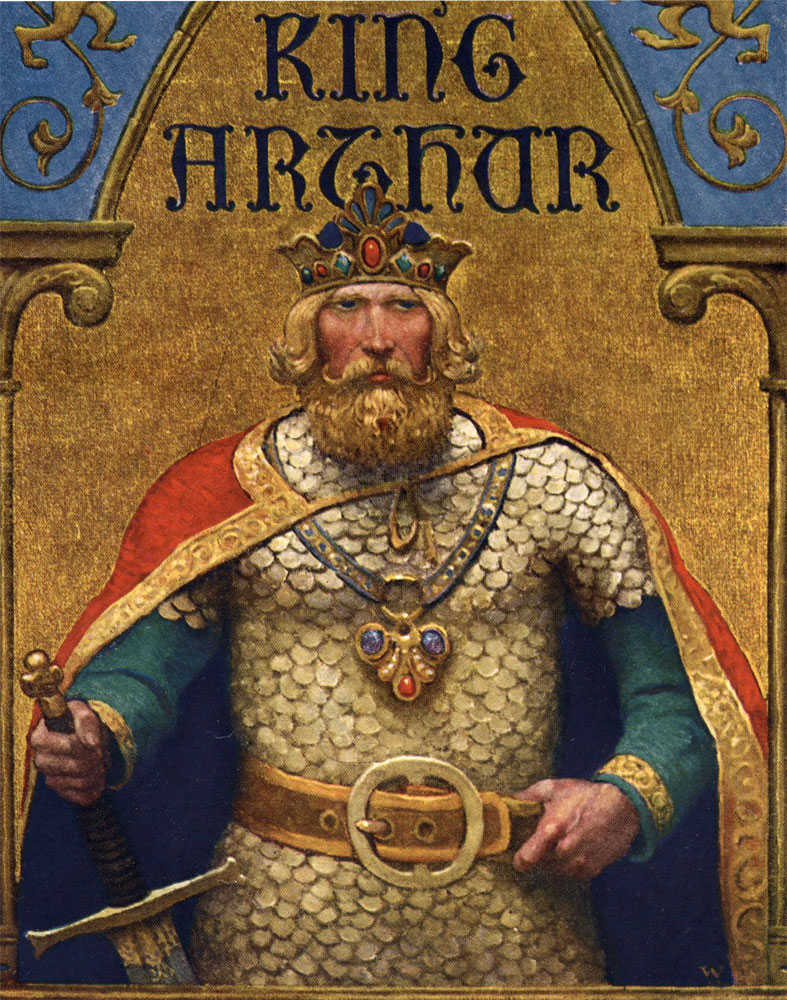
Mother of the King, as this story is called, was born from my recent interest in the legend of King Arthur. I even downloaded a whole lecture course onto my phone to listen to and find out more about this legendary figure. The result not only surprised me (read my post The Weird Truth about King Arthur to have your own mind blown), but inspired a story that I decided to write after I sent Rose back to the publisher. You know how some of the Arthur stories out there say that one day Arthur will return when England needs him the most? This idea deals with that aspect of the legend, as well as the historical Arthur figure. It’s part historical fiction, part science-fiction, part my way to play around with a famous fantasy canon and even do some teaching as well.

It would make for a great TV show on HBO or Netflix. At least, I think it would.

And the cool thing about Arthurian literature is you can literally write any story about Arthur and his knights, and it’s automatically part of Arthurian canon. Doesn’t mean that it’ll be a good addition to the canon,* but it’ll be an addition anyway. Hopefully Mother of the King, should I ever get it published, will make a decent addition to Arthurian literature.

So what happens now? Well, I had my eye on submitting this story to an anthology Castrum will be putting together in the near future, but perhaps the length of it might turn them off. In any event, I’ll probably have a few people look at it and give me feedback. I’ll use that to edit the story, and after that see about getting it published.

In the meantime, while Rose is still being looked over at Castrum, I’ll be working on finishing up a few unfinished novelettes. With any luck, I can get them done before I get the fifth draft back and have to dive back into doing edits.

That’s all for now, my Followers of Fear. It is very late for me, and I’ve got work in the morning. I’ll be seeing you again soon. Until then, pleasant nightmares, one and all!

*Looking at you, 2004’s King Arthur and 2017’s King Arthur: Legend of the Sword. You both aimed big, but in the end failed miserably. Also, Friday the 13th remake, you suck. You’re not Arthurian literature at all, but it’s been a while since I’ve mentioned how much I hate you. You stupid, pornographic excuse of a Michael Bay film.

Happy birthday to the blog,
Happy birthday to the blog.
Happy birthday to Rami Ungar the Writer,
Happy birthday to the blog.

An entire year has gone by for this blog. And it feels like so much longer for some reason. Has that ever happened to any of you? And now this blog is seven years old. It’s hard to believe that I’ve been blogging for about seven years now. This blog, along with the people I get to interact with on it, has become so apart of my life, I can’t remember what life was like before I had it and all of you. This blog is a way to share my thoughts and feel like some people are cheering me on as I work on my career.

And this past year was especially awesome, writing and blogging-wise. I not only finished a third draft of Rose, but a fourth and a fifth, the last one changing a lot of elements in the story (for the better, I like to think). Plus I somehow managed to find a publisher for Rose, which means it’ll hopefully be published before it starts to get cold again (no promises, though). I managed to write and edit some more stories, and I even got Car Chasers accepted for publication (and I may have news on another short story very soon, fingers crossed). And I was able to gain, keep, and surpass a thousand followers on this blog. These are all things I hoped would happen in my anniversary post last year, and they all happened.

Not to mention the things that happened in my personal life, which I don’t talk about that much on this blog anymore but are still worth mentioning at any rate. Work has been busy, but I’ve accomplished a lot that’s been set before me, including traveling and attending important trainings for work, and even coordinating programs that are meant to improve my organization; I saw three ballets live and one on video, leading to the discovery of my obsession with the art form (I also saw a couple of Broadway plays, and that was pretty cool); I joined the Horror Writers Association, and have been reaping the benefits since; I finally got my driver’s license, after nearly ten years of on-and-off driving practice; and so much more. It’s incredible how much I’ve been able to accomplish in such a short amount of time.

Oh, that’s why this year felt longer. I’ve been doing so much, it felt like it went on longer than it was.

But anyway, a huge reason why I’ve been able to do so much is because of you, my Followers of Fear. You’re always there, rooting for and supporting me. I’m honestly amazed sometimes at how much this blog has grown, and the friendships I’ve been able to strike up through the interactions here. I say this a lot during these posts, but there was a time when I only got a few views every couple of days, and hardly any interaction from readers. It really means a lot to me that you’re all here, reading what I have to say and responding to it. You are all so totally amazing and I can’t thank you enough for that.

So what’s going to happen in the next year? Well, I hope to keep putting out quality material on this blog. I want to get Rose out on the market so you all can read it (and maybe give me reviews for feedback?). I want to get a car, now that I finally have a license. I plan to get more stories written, edited and maybe even published. Perhaps I’ll even start a new novel. And so much more. We’ll have to check back and see what I managed to do a year from now.

In the meantime, I’ve got a lot of fun stuff coming up, including a trip to the Ohio State Reformatory for a spooky haunted tour (that’s Sunday! Here’s hoping I get some paranormal evidence on video again). I’ll make sure to update you all on that as soon as I can. So until next time, my Followers of Fear, pleasant nightmares. Lots and lots of pleasant nightmares.

I’ll admit I’m a few days late to this, so perhaps the news has already gotten around and this post is unnecessary. But for those of you who haven’t heard, it seems that the saga that has been called Cockygate has reached its resolution. And you know what? It’s really good news.

Now if you haven’t heard, Cockygate got started around late April/early May in response to the actions of Faleena Hopkins (or as I prefer to call her, Lady Voldemort). Hopkins, a romance writer who wrote the “Cocker Brothers” series, tried to get a trademark on the word “cocky” when used in book or series titles. Now this word has, not surprisingly, been used in book titles well before Hopkins applied for her trademark, but that didn’t stop her from applying for it, and then going after independent authors that can’t afford lawsuits to either take the word “cocky” out of their book titles or take them off Amazon (seriously difficult either way you look at it) or they could face legal action.

And you wonder why I call her Lady Voldemort.

Two things happened after news of this broke: several authors and companies tried to copy Hopkins, and the majority of the author community rose up against her, with the hashtags #cockygate and #ByeFaleena (get it?) going viral within days. The Romance Writers Association started looking into legal action. Kevin Kneupper, a novelist and retired lawyer, came out of retirement to fight Hopkins on this and force her and others imitating her to back down. He was joined by romance writer Tara Crescent and Jennifer Watson, a promoter for the CockTales anthology, whom Lady Voldemort had named in a lawsuit.

And so for about three months, this thing has been going on, with lots of authors wondering if, in a world where you can trademark any single word in a title, if it’s even worth it to write.* There have also been a slew of stories published with the word “cocky” in the titles in protest, and they’ve done quite well for themselves. And of course, everyone’s been watching the courts to see how this will play out.

Well, for the past few weeks, there’s been talk of both Hopkins either accepting a settlement or getting her butt handed to her by a judge. And this past week,  we got news. Hopkins agreed to an unspecified settlement and has withdrawn her trademark on the word “cocky.” If you go to the US Trademark and Patent Office’s website, it’ll say “invalidation pending” on Hopkins’s trademark.

Make no mistake, this is a victory for authors to be able to title their stories whatever they want without fear of legal repercussions. There are still plenty of imitators trying to get their own trademarks through, but Hopkins is the original, and this victory sends a message to her imitators and her opponents. So while there are still legal hurdles to get through with the former, us in the latter know that with enough people caring, we can overcome these monsters and get our stories out there without fear of being sued for using a simple word.

And as an author who could’ve easily been affected by this (seriously, type into Amazon the words “Snake” or “Rose.” If someone did this to me, I could be in trouble), I’d like to thank Mr. Kneupper and all the authors, lawyers, Twitter activists, and readers who lent their time and energy to putting up this fight against Lady Voldemort. You did the creative community a huge favor, and I hope we can always count on your love and strength when we need to fight assholery like what we’ve experienced this summer.

And to Ms. Hopkins herself, I hope she’s happy. The terms of the settlement aren’t known, but whatever they are, I hope she’s satisfied. Because this saga has led to her reputation being shredded. She set herself up as a bully and manipulative monster who went after authors without money or legal mettle. And during these three months, she’s only dug herself further into a hole, calling people who use stock photos after she does “copycats” (WTF?) and alleging people who call her fans and supporters stupid are equating them with having autism (um, excuse me?). Now she’s become a byword for a monster, a nasty character who tries to take advantage of other writers, of being greedy and willing to use underhanded tactics to get ahead.

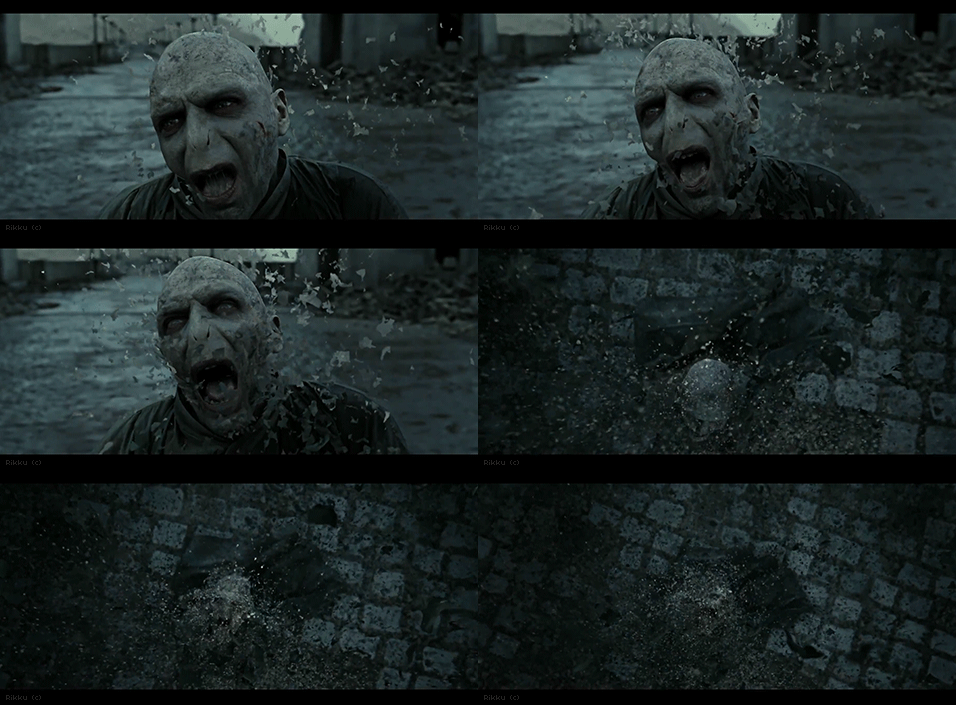
And while I try not to wish bad things upon people I disagree with, I really hope that Lady Voldemort’s writing career goes like the GIF below from now on.

Thanks for reading, Followers of Fear. Hopefully this is the last time I ever have to mention Cockygate or Lady Voldemort ever again (though if I have to, I will). In the meantime, I wish you a good weekend and warn you to expect more from me this weekend.

Until then, pleasant nightmares!

*I mean, imagine if instead of proper titles like “Harry Potter” or “Star Wars” getting trademarks, someone could trademark a word like “the.” Just “the” in any title, and it holds water. You run into all sorts of trouble from the get-go!

Well, hasn’t this been a crazy week?! First I find out”Car Chasers” is getting published, and now I’ve managed to finish the fifth draft of Rose. Wednesday’s just wrapping up as I write this, but I’d say this makes for a productive week.

So if you’re unaware, Rose is a novel I wrote for my senior thesis in college. The novel is about a young woman who becomes a plant creature (and that’s just the start of her problems!). Yeah, I wrote that zany concept, and made a full novel out of it. And you know what else? I managed to get a publisher for it, Castrum Press in Belfast, North Ireland. And I’m so excited that this latest draft is done.

This draft has been especially crazy for me, as I had to rewrite about two-thirds of the novel. You see, one-third of the novel focused on flashbacks, and Castrum pointed out some issues with so many flashbacks. I decided to toss out the flashbacks, but that meant another third of the novel that relied on the flashbacks had to go as well. So I basically had to rewrite two-thirds of the novel. Believe me, it wasn’t easy to do! I spent quite a bit of time talking to myself to figure out where the story could go to make it better without relying on flashbacks. But somehow I managed to do it, and I like where I’ve sent this story. It’s a new version that I think will surprise, entertain, and maybe even scare a few people.

So this draft is about two-hundred pages (8.5″ x 11″, double-spaced, Times New Roman, 12-point font) and a little over sixty-thousand words. Shorter than my usual novel (the last three published were all eighty-thousand or more), but I think for a first novel with a publisher, this will do nicely. It’s shorter than the first Harry Potter book by about seventeen-thousand words, anyway, so you know it’s manageable.

So what’s next for Rose? Well, I’ve already sent the latest draft to the publisher. They’ll take a look at it, and hopefully the only changes they’ll have me make are cosmetic: add a comma here, change the phrasing there, fix that little hole, etc. After that, we can talk about cover art and a release date. And then I can ramp up the marketing plan I’ve been working on in the back of my head. And then…who knows? Maybe some decent sales and a few good reviews.

In the meantime, I’m heading to bed. I’ve got a big day tomorrow, and I don’t want to sleep through it (especially since I plan to start a new short story in the evening). Until next time my Followers of Fear, pleasant nightmares. I hope to have updates for you very soon.

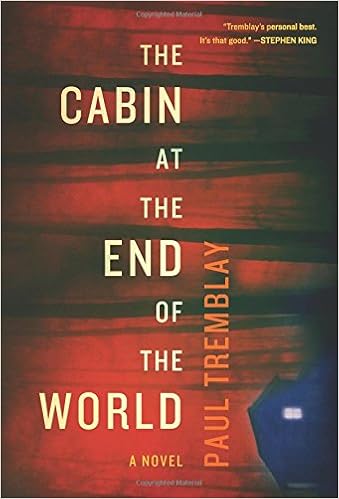
I’ve heard everyone from Stephen King to members of Facebook groups I belong to raving about this book. Heck, some of the latter were raving about it months before the book came out (how they were able to do that well before the book came out, I have no idea). I remember listening to the audio book of Tremblay’s previous book A Head Full of Ghosts a few years ago and liking it, though I didn’t find it scary (see my review for my full thoughts), so I thought this was worth a try. And I’ll agree with His Royal Scariness, this is definitely Tremblay at his best.

The Cabin at the End of the World centers on Wen, a young girl and her two dads, Andrew and Eric, who are taking a vacation off the grid in the deepest parts of New Hampshire. At the start of the novel, a man named Leonard appears before Wen and attempts to befriend her. He is soon followed by three others who claim that Wen and her family are the key to saving the world. But to do it, a price must be paid. Thus begins a tense story of belief, insanity, and violence as Wen and her dads are held captive in their own cabin and given an impossible choice.

Like I said, this is a tense book, and an intense one to boot. Like A Head Full of Ghosts, Tremblay focuses mainly on the psychological state of the characters rather than outright answering whether what we’re reading about is actually supernatural or the delusions of troubled individuals (and like the former novel, there’s an argument to be made for either one). The result is that you’re kept guessing as to which it is while getting a very personal look into these characters as they deal with the stress of the situation. It’s powerful, and makes you really connect to the characters and want to keep reading to find out how the story ends for them.

I also liked how unpredictable Cabin was. There were a couple of instances in the story that really threw me for a loop. Heck, following one of them, I kept reading for several pages sure I’d misunderstood what I’d read or that Tremblay was pulling my leg, heightening the emotional impact when this twist finally sunk in.

Add in that the novel was a great example of showing diversity in fiction without being patronizing or just showing diversity for diversity’s sake (Wen is from China and her dads are a gay married couple), and that an actual medical issue is portrayed with accuracy, rather than in 99% of other stories, and you’ve got yourself a decent novel.

I don’t have anything that I feel like saying detracted from the book. Maybe I wasn’t scared as others might be, but then again, I’ve built up a tolerance to being scared. I still found it extremely tense and emotionally powerful, and I enjoyed it for that. And that’s good enough for me.

On a scale of 1 to 5, I’m giving The Cabin at the End of the World a 4.5 out of 5. Gripping with suspense and characters you truly feel for, you’ll have a very hard time putting it down while you read. Take a look and see why it’s one of the most talked about stories this summer (I’m hoping Rose will be one for this coming fall or winter). Believe me, you won’t regret it.

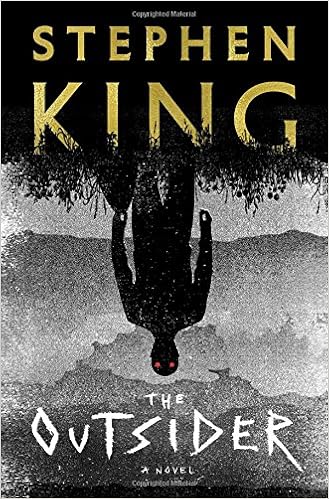
You know, I’ve never reviewed a proper Stephen King story on this blog before. I’ve reviewed plenty of adaptations of his work, but never any of his actual stories. Probably because I’ve either gotten to them too late and so much time has passed that doing a review seems silly (which is true with the vast majority of his bibliography) or I didn’t feel there was enough to talk about to actually write a decent review (such as Gwendy’s Button Box, co-written with author Richard Chizmar). So I’m glad I’m finally able to review one of his books here. And this one is something else: it’s his latest novel, The Outsider.

The Outsider follows Ralph Anderson, a detective in the small city of Flint City, Oklahoma. The novel opens with Ralph and his fellow officers arresting Terry Maitland, a local teacher and boys’ baseball coach who is beloved by Flint City, for the horrific murder of a young boy. The state’s case seems ironclad: there’s not only eyewitnesses, but a ton of physical evidence linked back to Maitland. But soon after the arrest, evidence arises to cast doubt on Maitland’s guilt, and it’s just as ironclad. The contradiction in this case leads to a domino effect as Anderson and his allies try to figure out if the beloved Coach Maitland is hiding a darker personality, or if someone else, someone darker and worse, is at large in the town.

Now before I go into my review, let me just say that this book shares a few characters in common with King’s Mr. Mercedes trilogy, and contains a few spoilers. So if you haven’t read those books yet and would like to be surprised, probably hold off on this book until you’ve read those.

So I have to say, I came away very satisfied with this story. I like how King starts out with this novel seeming like a regular thriller-mystery: he shows the arrest, switching between the action and then showing interviews and documents from the investigation. The Outsider continues in this vein for a little while, but then goes in a different direction that defies your expectations so far. From there it develops into a compelling and strange read with some great characters. I especially liked Holly Gibney, who comes from the Mr. Mercedes trilogy. She’s neuro-atypical, like myself, but is shown to be an integral part of the investigation and makes certain leaps that, without her, the other characters might never be able to. It’s a very real portrayal of someone with disabilities, and I related to Holly on a number of levels. I love those sorts of portrayals of neuro-diverse people in fiction, and I hope to see more in the future.

But probably the novel’s greatest strength is just how hard it is to put down. King takes mystery, the strange, great characters, and much more to make a read that’s hard to put down. Normally I’m able to restrain myself to reading during my lunch break or on weekends, but this novel was so good, I found myself reading it late into the evening at times (which helped me to get to this review today).

That being said, The Outsider does have its issues. One of the biggest ones is that we’ve seen a lot of the concepts used and explored in the book in other King novels, and frankly done better there. I won’t say what, but they’re pretty obvious, and every time they came up, I kept thinking to myself, “This feels like a lighter/duller version of insert-story-name-here.” That, and I felt that the climax could’ve been a bit more epic. It was decent, but I felt it was hampered by too much exposition on the parts of the characters and the story’s villain, who is humanized a little too much (that makes more sense if you’ve read the book). Which, unfortunately, lowers the terror factor with a creative villain that could be as scary as some of King’s other famous villains. I was disappointed about that.

Overall, The Outsider is an entrancing and powerful read, subverting your expectations and leaving you wanting more. On a scale of 1 to 5, I’m giving it a 4.6. Check it out, and get sent down a mine shaft full of the strange and the unsettling.

That’s all for now, my Followers of Fear. I’ve got my own novel to work on, so I’m going to get on that this evening. Until then, pleasant nightmares!

It’s a question every creator wrestles with from time to time. Writers are no exception. We wonder if anything we write is worth reading by anyone other than our family and close friends (who, most likely, will tell you they loved it because that’s what family and close friends do). We wonder if we’re just wasting our time sitting at the computer or in front of our typewriters or in our notebooks, trying to tell stories that range from the mundane to the fantastical and mundane.

In short, we ask ourselves, “Do my ideas suck?”

This may surprise you (I am Mr. Smiles and Jokes and Weird References to Demons and Monsters, after all), but I ask myself this question a lot. I often wonder if I’ll write anything that more than a few people will read in my lifetime, let alone afterwards. It’s a question I’ve been asking myself a lot more lately as I’m in the midst of rewriting a lot of Rose. Although I tell myself that I came up with these changes myself, and that both I and my publisher think they’ll do a lot to help the story and make it a better read, in the back of my head I’ve got this little voice whispering dissent and telling me that what I’m writing won’t amount to much.

And you know what? Sometimes I’m tempted to believe that voice. I mean, thousands upon thousands of novels are published every year, but very few of them gain the attention we wish them to have. Quite a few even get critically panned. It often seems like the field is too big and too difficult to really make a difference in. So why should we try?

But then there are a couple of things I keep in my mind that can, if not shut up that voice, then at least turn the volume down on it. Both of them, not surprisingly, involve Stephen King. The first has to do with his debut novel, Carrie. Did you know when King first started writing Carrie, he actually threw the first few pages into the trash because he was convinced it was trash and would come to nothing. He only kept at it because his wife fished the pages out of the trash, read over them, and said they were good and that he should keep at it. The novel was later published and as we all know, became a huge hit, inspiring two excellent movies (though I prefer the 2013 version), a meh TV movie, and a musical that I wish would get a proper revival and a North American tour. All from a story that King was ready to throw in the trash.

The second story is another King work, Thinner, which he wrote under his Richard Bachman pen name. If you were to give the story an elevator pitch (see my article on elevator pitches for more on that subject) it would probably be something along the lines of “A man is cursed to become thinner and thinner.” And just from hearing that, you might laugh. That sounds like a comedy involving some prissy housewife who thinks if she doesn’t stay a certain weight, her husband will cheat on her and then she starts magically losing weight. It doesn’t sound like a scary novel.

Thinner by Richard Bachman (aka Stephen King); silly sounding concept, great payoff.

But from what I hear (I haven’t read any of the Richard Bachman books yet, though I know I should), it’s a pretty creepy story, one that inspired a movie (quality of the movie is debatable). All from a very simple idea of what happens when weight loss goes really, really bad. It sounds stupid, but it turns into an effective horror story.

And I could come up with tons of examples of this (did you know HP Lovecraft thought The Call of Cthulhu was only so-so? And now it’s one of his most famous works). But they all boil down to one thing: our ideas don’t always suck. In fact, they may only suck in our minds. To others, they may be great, mind-blowing, or even influential. And sure, not all of our stories will turn out to be great, but the vast majority of them, with enough work and a little bit of luck, can become awesome.

And I’m reminded of that every time someone expresses interest in reading Rose. People hear what it’s about, and they want to know more, or for me to tell them as soon as the book is out. If these people really do end up reading Rose, liking it and even letting people know they like it, then who knows? I might be able to shut up that little voice once in my head, at least for a little while.

So if you’re worried that you’re only writing crap, don’t pay your little voice any attention. Just keep writing and polishing and seeing where your story goes. Who knows? You may end up putting out something really amazing, and you’ll be glad you stuck with it for so long.

I’ve got another article from Self-Published Authors Helping Other Authors for your perusal. This one is “The Elevator Pitch: Telling People About Your Book in One Sentence.” And that’s really what it’s all about: how to get people interested in reading your books with a single sentence. I learned how to use elevator pitches when I was searching for a job, and it’s actually pretty handy in a number of other situations, including book promotion. You’d be surprised how many people have shown an interest in Rose after hearing my elevator pitch for the book.

If you have a chance to check out the article, please do and let me know what you think. And if you like what you read, make sure to read the other articles on the site. Self-Published Authors Helping Other Authors is a great resource for authors looking to write, edit, publish, and market their stories efficiently and economically. I should know, I’m not just a contributor, I’m also a reader.

That’s all for now, my Followers of Fear. And I hope it’s the last post for a while. I’ve got a lot of editing to do, so I’m going to get on that. And as much as I love you guys, I really need to focus on that. Don’t worry though; I’m planning on having a new review out on Saturday at the latest.

Until next time, pleasant nightmares.