Posts Tagged ‘short story’

Remember my article on Self-Published Authors Helping Other Authors about when was the best time to publish a book? One of the recommendations I gave in that article is that during the first two weeks after Christmas, independent authors have a good chance of selling more books. One woman even claimed she was able to make enough money to write full-time by doing sales after Christmas every year.

Well, I don’t think I’ll make that much money and I know it’s been a few days after Christmas, but I think I’ll try this out and see what it gets me. From January 1st-January 14th, all my books–Snake, Reborn City, The Quiet Game–will be on sale, especially the e-books. So if you’re looking for something new to read this new year and you want a new scare or some new sci-fi in that new book, this might be your opportunity.

I look forward to enjoying your new fiction with you in two days’ time. Until then, have a good one, my Followers of Fear!

Smile Dog, a creepypasta character.

Recently I’ve been delving into a genre of horror that’s grown up on the Internet, and I have to say some of it is quite impressive. I’m talking, of course, about creepypastas.

Now, for those of you who’ve never heard of this and think I’m talking about a Halloween treat, a creepypasta is actually kind of like an Internet campfire ghost story, scary stories designed to shock and terrify and that originate online.  They’re sometimes accompanied with images, audio or videos, usually distorted or featuring or gore or creepy imagery, in order to intensify the effect. The name “creepypasta” comes from “copypasta”, a slang term for text that is copied and pasted around the Internet multiple times.

And even if you’re not familiar with creepypastas in general, you may have heard of some. Slender Man, whom I’ve written about on this blog before, has been the subject of numerous creepypastas in the past, to the point where some creepypasta-devoted websites no longer upload new literature about ol’ Slendy. There’s also the novel Penpal, which started out as a series of creepypastas, and Candle Cove, a story that’s reportedly being adapted to television by the Syfy channel.

Slender Man has been featured in a variety of creepypasta.

Now while the length and quality of creepypastas, like every other type of fiction, vary from one to the other, there are some ways to categorize them:

  • Anecdotes: as far as I can tell, these are the most popular of the creepypasta story form. The narrator(s), often anonymous, talks about a scary legend, a new story, or something from their past. The anecdote stories are often told in the epistolary format, or in the form of a letter or journal entry, though this being an Internet phenomena they’re more often told as blog posts or Reddit threads. They’re certainly my favorite form of the genre.
  • Rituals: As the name suggests, these are things you can do to make something terrifying happen to you or someone you know. Examples include the Midnight Game or Bloody Mary (which I’ve tried on numerous occasions, and I’ve never seen any results). Sometimes these rituals have a short backstory, but they can vary, like with the Bloody Mary game. And as you can guess, these are quite fun at parties.
  • Lost Episodes: This form has kind of fallen out of favor but it has some pretty famous creepypastas. Lost episodes usually describe a missing scene or episode from a famous TV show, usually a comedy or children’s show, that depicts a character acting very strangely and violently, usually ending in that character killing themselves or the other cast members. Often times the episodes, when they are supposedly found, feature strange or distorted audio and video, and occasionally are rumored to cause violent behavior in viewers. As you can guess from the description, these are pretty formulaic and repetitive, which is why they’ve lost popularity, though some are quite well known among creepypasta devotees.

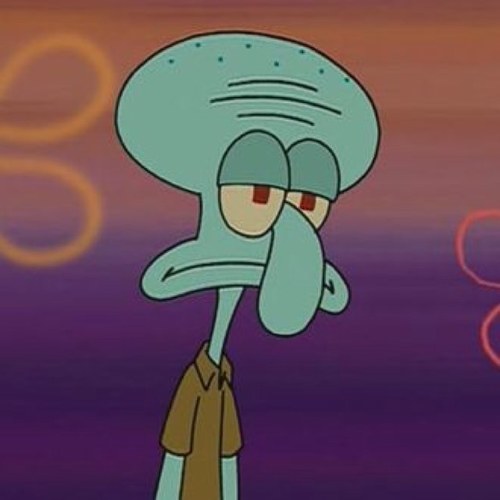
Squidward Tentacles from Spongebob Squarepants has been the subject of a Lost Episode creepypasta. You can probably guess the rest.

As I said above, there are entire websites devoted to the creepypasta genre and droves of fans, some of whom create their own stories and upload them online. What makes this genre so popular? Well, I’m still pretty new to the genre, but I think that there are several factors that may explain this popularity. One is that creepypastas tend to be a bit more extreme than mainstream horror. They’re often accompanied by scary imagery or some other strangeness, and that adds to the creep factor. There’s also the very subject matter of creepypastas: with some stories, you can take elements from them and create your own stories. Slender Man is a character who’s been featured in a variety of media, and plenty of people have made creepypasta based on him. And then there’s the virality of creepypastas: you’re encouraged, by their very nature, to keep sending them around and around the Internet. There’s a certain power in that very concept that’s exciting, and encourages creators as well as readers.

It’s especially interesting when you consider that this is a genre born on the Internet, which has the reputation of having content geared towards people with short attention spans, and also is sometimes considered the gathering place of creators who couldn’t make it in the “real world” (eye roll please?).

Personally, I think creepypastas are quite entertaining. Some of the stories are very good, very creepy, and I enjoy listening to readings of popular creepypasta by YouTube artists. I know some people find them too extreme or that they lead to violent behavior (a subject for another time, not going into it here), but I see it as no different than enjoying a Stephen King story or going to see the latest scary movie. Just a different format with different rules that I would like to learn (though not write; by the very nature of creepypasta, I wouldn’t have as much creative control or make some side income off my work. Maybe I’ll try writing in the style though for a novel someday).

If you’d like to try some creepypasta, here are some good ones I’ve come across. If you check them out, let me know what you think:

Are you a fan of creepypasta? What is it about them that you like or dislike?

What are some creepypastas that you’d recommend trying?


You know what there are a lot of these days? Fictional universes where characters from a variety of diverse works are all brought together into a single work or series of works where they interact with one another in various ways. From HP Lovecraft’s Cthulhu Mythos, to the many different iterations of DC and Marvel comic book worlds and their film and television counterparts, to the shared elements of Anne Rice’s vampire and witch series and Stephen King’s interconnected multiverse and then some, there are a lot of these shared universes these days. Heck, there’s even theories from everyday people about how different works by certain creators are all secretly part of the same story (examples include this Pixar theory and this theory on the majority of Joss Whedon’s work).

So I’m wondering, what is the reason behind all of these interconnected story worlds? What makes storytellers and creators of all different mediums want to have such expansive universes where everything is secretly connected and you have to create a huge conspiracy layout on your wall with tape and string and stuff?

Well, I think some part of it is money. At the end of the day, most storytelling is a business (except for maybe some of what appears on YouTube), and if two characters in separate stories are making profits for a creator or their business, they may try to bring the characters together if it’s feasible and if the fans want to see it. Heck, that’s kind of the reason for most comic book crossovers and the movies based around those crossovers. Fans enjoy seeing Superman and Batman work together or Tony Stark mentor Spider-Man or whatever, so the companies give them what they want and get a profit back.

That’s not to say that all of it is money or that money’s the biggest motivator (unless you’re a Hollywood studio, of course). Another big part of it is the creators. They love their characters, and many would like to see those characters they’ve invested time and effort in come together in an awesome story. How would they play off each other? What sort of trouble would they get into with each other and how would they pull themselves out of it? And how would they grow after meeting each other? I think a lot of writers create these crossovers just so they can answer these questions. They may make multiple volumes to continue asking those questions, adding new characters or situations to continue creating exciting new stories and dynamics. It can be pretty enticing to do that with characters you love so much, and I bet audiences enjoy it as well.

In fact, I’ve imagined doing that with Snake and Laura Horn. Yeah, I have. I’ve mentioned before that I’ve wanted the story of the Snake to continue, and I’ve planned sequels not just for Snake, but for LH as well, including one where the two characters meet and get into a crazy adventure together. And I may be a few books and several years from that crossover, but it’s there if I want to write it, and eventually I will write it. It just sounds like too much fun to pass up.

snake front cover

I really have to get around to that sequel someday soon.

Another reason that creators may do crossover works is just because it makes things easier. Now, I hear you typing in the comments already “How the heck does a crossover or shared universe make things easier?” I know it seems counter-intuitive, but let me give an example: Anne Rice introduced in Queen of the Damned, the third book in her Vampire Chronicles, the Talamasca, an international organization of scholars interested in studying the paranormal. Now, try as I might I could not find any information on why, but when Rice wrote her Mayfair Witches trilogy, she brought in the Talamasca society. Why? Because at some point in the first book she details the entire family history of the Mayfair family and its dozen-plus matriarchs and I guess it made sense to just bring in the Talamasca as an explanation as to why there was an entire history of the family when the family itself isn’t very interested in its history. And it helped with the later books in certain ways to have the Talamasca. See? It was easier to bring in an existing fictional organization concerned with the paranormal than make up an entirely new reason for a third party to document an entire mystical family’s history.

I’ve also heard that’s why HP Lovecraft created the Cthulhu Mythos. He didn’t intend to create an entire cosmology, he just decided it might be easier to work with some familiar characteristics when creating all-powerful monsters, and from there it wasn’t too hard to make the jump to connecting Cthulhu to Yog-Sothoth and any of the other Old Ones. Now, I’m no Lovecraft expert, but I’d buy that explanation.

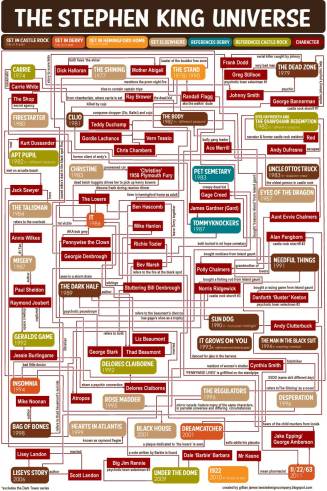
King’s references are so crazy! Check out this chart!

Of course, some authors do it because it’s fun to have a shared universe, for a variety of reasons. You can return to familiar characters and locations by doing so. You can make your readers marvel and go back to another story to say, “Hey, that matches up with so-and-so.” You can create a cosmology or a special reason why a character or characters or place or places appears in so many stories (I’ve got a character or two like that, I just haven’t been able to put them into any works yet. I tried with the human Barbie story and Evil Began in a Bar, but I couldn’t fit them into the former and I haven’t figured out how best to edit the latter yet, so…). And sometimes, it’s just fun to mess with your readers and make them wonder what the heck it all means (I’m pretty sure that’s the reason Stephen King references his other works so much, and the Dark Tower books simply grew out of a desire to create a complex story out of all that messing about).

Whatever the reason someone creates a shared universe, it’s pretty clear that there are plenty of reasons to do so, and that shared universes are here to stay. And whatever the reason behind them, as long as they’re done with love and people enjoy them, I see no reason not to keep doing them. Besides, I may have one or two I’d like to create someday.

Do you have a shared universe in your fiction? Why’d you create it? What has been the result of that?

It’s Friday again, so you know what that means. It’s #FirstLineFriday! And since yesterday a good number of Americans stuffed themselves full of turkey, I’ve got a special Thanksgiving edition for you all! Woo-hoo! I would also make it a Black Friday edition, but that’s just a horrible practice that’s unfair to both customers (apparently the sales on Black Friday are no more special than sales at any other point in the year) and to employees (you can guess why).

As always, here are the rules of #FirstLineFriday: on Friday you write up a post titled #FirstLineFriday (hashtag and all), and then you write out the rules. Then you post the first one or two lines of a potential story, story-in-progress, or a completed or published short story. Finally you ask your readers for feedback. It’s a lot of fun, and I enjoy hearing what people have to say about it.

Here’s this week’s entry. It’s from an idea I had for a bloody and very strange story that I came up with the other day. I hope I get the chance to write it out someday soon. Enjoy:

Jake scooped out three slices of pie and some whip cream. The pie and cream were the only parts of Thanksgiving dinner that hadn’t gotten blood on them.

Thoughts? Problems? Let me know in the comments below.

That’s all for now. I’m house-sitting till Wednesday while my dad and his wife are on their fifth wedding anniversary trip (congrats, you two!). I think I might throw a wild party while they’re gone. Or maybe I’ll behave myself, edit and write, and watch Doctor Who. We’ll see what I’m in the mood for.

Happy Thanksgiving and have a great weekend, my Followers of Fear!

It’s Friday again, so you know what that means. It’s #FirstLineFriday! And it’s the 25th #FirstLineFriday done here on this blog. That’s right, 25 straight, continuous weeks of #FirstLineFriday since June. Which begs the question, how many of you are just sick and tired of this thing that I’m trying to turn into a blogging craze with mixed success?

Alright, here are the rules for #FirstLineFriday: you write a post titled “#FirstLineFriday” (hashtag included), you introduce the rules, and then you post the first one or two lines of a potential story, a story-in-progress, or a completed or published story. Then you ask your readers for their feedback.

This week’s entry is from the short story I finished earlier this week, “The Playroom.” As I said, this is a strange and creepy story, but I’m not sure you get that immediately from the way it starts. Anyway, enjoy:

Gloria Breck’s lower lip trembled as Todd Bruno regarded her pleasantly from the other side of his desk. On either side of Mr. Bruno’s office, his two imposing bodyguards—though Mr. Bruno called them his “assistants”—glowered at her, their giant hands looking like they would love nothing more than to wrap themselves around her throat.

Tell me, what do you think? Strong opening? Should I get rid of anything? Let’s discuss.

Well, that’s all for now. I may have some good news soon, and if I do I plan to post about it as soon as I can get on my computer. Until then, have a great weekend, my Followers of Fear. I know I plan to.

About a week or two ago my friend Angela Misri posted on my Facebook timeline about a short story contest that Stephen King would be part of. Apparently people could submit short stories under four-thousand words and His Royal Scariness would pick the winner. Unfortunately the contest was only open to UK residents, which upset Angela and me a great deal (I knew I should’ve been born a British lord, but for some reason I decided that being the son of two rabbis was a better deal). However, if I could enter the contest, and it allowed short stories under six-thousand words, this probably would’ve been the short story I submitted.

After extensive editing, of course.

“The Playroom” is a very weird short story about a woman who steals from a mob boss whose casino she works in, and the terrifying results of that little action. I’d go into further detail on what those results are, but then I’d be giving away too much of the story. I will say how it came to be though: I woke up one night, a few days before I decided to take a break from Laura Horn, I think, and this little mini-movie started playing in my head. I don’t know what caused it–I’m pretty sure it didn’t have anything to do with anything I might have been dreaming prior to waking up–but there it was, fully formed in my head, and oh-so strange. I immediately wrote it down and decided to write it as soon as possible.

Which, as I said a moment ago, was when I decided to take a break from Laura Horn. How convenient that all turned out to be.

Anyway,this is definitely one of the weirder short stories I’ve written. And when I say something is weird by my standards, that’s saying something. And you definitely get that weird sense just by reading it, I think. As you go on and you feel yourself falling deeper into a rabbit hole, you definitely wonder where this is going to go. And when you actually find out where it goes…well, I wouldn’t want to give too much away. The first title of this short story gave away so much that I dare not speak it here. The second title was so cliched I couldn’t help but change it (“The Secret Room”–what horror writer doesn’t have a story titled that?). So now I’ve got “The Playroom”. Intriguing, doesn’t give away much, and somehow conveys this isn’t your average horror story.

At least, that’s what I hope is what it says. I’m biased, so what do I know?

Anyway, I think with a bit of editing, this story could actually go from just under fifty-six hundred words to under five-thousand or maybe even under four-thousand without sacrificing quality. As you know, I’ve had trouble keeping my short stories brief without sacrificing quality in the past, so I’d be very excited if I could get this one that short without any problems. There are probably a few sections that could be cut from this story. Or I might keep it as long as it is. With a bit of work, there may be a magazine or two who would like to publish this even if it is longer than what some magazines like to publish.

Before I do that though, I have a novel to finish editing. I think I’ll get right on that in the morning.

So good night, my Followers of Fear, and pleasant nightmares. I know I plan to have a few.

I’m telling you, I have been wanting to see this movie since I first heard of it, and it was killing me inside that I couldn’t see it when I was in Germany…or right after I got home. I was a fan of the books when I was a kid, and some of them even scared me so bad that I needed to take breaks from them. They were my King before I got into King. It really hurt me physically not to indulge in my childhood nostalgia and go see this film. But tonight my dad had some free time, and he was like, “Want to go see a movie?” So I said yes. And suffice to say, I was not at all disappointed (and neither was my dad, thankfully).

Based on the beloved series of children’s horror books by R.L. Stine (who by the way is Jewish, from the neighborhood I grew up in, and went to Ohio State. Coincidence? Probably), Goosebumps stars Jack Black as the author himself, living a reclusive lifestyle in the small town of Madison, Delaware with his teenager daughter Hannah. When Zach Cooper moves next door and becomes attracted to Hannah, he starts investigating the mysterious family next door and accidentally causes the monsters from the Goosebumps books–who are very real–to be released from their manuscripts and go on a rampage. Now Zach, Hannah, and R.L. Stine have to get the monsters back in their books before they tear Madison apart.

Let me just say, this was a movie with a lot of love and hard work put into it (unlike some other films taking advantage of people’s childhood nostalgia I could name). The story is very well written, and even has some twists in it that I didn’t see coming, and I pride myself on usually being able to see the twists in scary movies. The humor is also very good, keeping the mood of the movie light without getting too ridiculous or stupid. And the actors are just great. Jack Black plays Stine as a misanthrope who finds some way to steal every scene he’s in, while Dylan Mimette (who I’ve always liked whenever I’ve seen him in other works like Scandal or Agents of SHIELD) as Zach is funny and sarcastic and likeable, the kind of guy I’d like to hang out with.

The only characters I really had problems with are Champ, Zach’s friend, and Hannah, R.L. Stine’s daughter. Champ is comic relief, and while he’s funny as an awkward teen who just inserts himself into Zach’s life because…maybe he’s lonely and hopes the new kid is too slow to learn to avoid him? I don’t know, but the moments where the humor is a little much do come from him mostly, and he doesn’t contribute much to the story otherwise. As for Hannah…she’s just really there to be a love interest. And unlike River Song from Doctor Who, who was created for that very purpose, there’s not much to her beyond that role she plays. Her actress, Israeli Odeya Rush, is fun and gives off a snarky teen vibe, but that only does so much for the character.

Of course, I can’t forget the monsters. That’s the main attraction, the reason people who grew up with the books came to see the movies, because that’s what they remember most. Now obviously, in a movie that’s an hour and forty-five minutes and has to spend time developing characters and getting to the main conflict of the story, you can only spend so much time on each and every monster, which means a lot of them only appear in big group shots, but even in those you see a lot of work went into them. And for the monsters they focus on, they are great. Yeah, a lot of them are CGI, but even then they’re fun to watch. They make you believe they’re there and that we should be scared of them.  And Slappy the dummy, who leads the monsters, is like a little mini-Joker. He’s not the best villain I’ve seen on film, but as a talking dummy who enjoys causing chaos for chaos’s sake and to get back at Stine, he does the job well.

I could go over some other thoughts I had about the film, but I’ll leave that for the YouTube critics who around next Halloween will be putting out videos going over this movie with a fine-tooth comb. I think instead I’ll just wrap up by saying that this is a fun and wacky horror-comedy, earning a 4.1 out of 5. It may not get kids to read the Goosebumps books if they haven’t read them before, but it’s fun for the whole family and if you know the Goosebumps books already, you’ll enjoy seeing them on screen.

By the way, having the characters from my stories come to life is something of a dream of mine. I always feel like a parent to my stories and the characters within though, so I think if they did come to life I’d have a very different experience than R.L. Stine in the movie did. In fact, if I were to write a story about what that experience would be like, it might start something like this (#ExcerptSunday, anyone?):

The author heard his alarm go off and opened his eyes reluctantly. He wanted to go back to sleep, but today he really couldn’t afford to sleep in, even if he had the day off. So still feeling sleepy, he rolled out of bed, turned off his alarm, and headed to the bathroom. A few minutes later, teeth brushed and freshly shaved, he stepped into the hall, thinking about what he was going to wear and all the errands he was going to run today…when he noticed a tiger in the hallway.

The author froze. Even with his glasses still in his room, he knew what he was seeing. Tawny coat, black stripes, big face with whiskers and yellow eyes. There was no mistaking it. There was a tiger in his house. Am I dreaming? he thought. Am I still in bed?

The tiger padded towards him, its breathing heavy. Before the author could think how best to react, it stood up on its hind legs, placed both paws on either side of his head against the wall, and licked his face. The author, dumbfounded and amazed, could only laugh as the rough tongue scratched gently at his cheek. What is going on? he wondered, pinching himself to see if he was dreaming.

The tiger stepped down and rubbed its head against his stomach. And suddenly the author realized that this wasn’t a tiger, but a tigress. And even stranger, he knew this tigress. He knew her very well. After all, he was her father.

“Lizzy?” he said, hardly daring to believe. The tigress regarded him with intelligent eyes before turning around and padding down the stairs. The author wanted to call after her, but then something black streaked out of his room and past his face. He jumped as the black thing briefly stopped and formed a familiar body in the air before rushing down the stairs. Confused, the author went to his room, and saw someone had laid his clothes out for him.

For a moment, the author did nothing. Then he whispered, “Is this really happening?” Then, “Do I dare believe it?” Quickly the author threw his clothes and glasses on and rushed downstairs, where the biggest surprise of all awaited him:

The black shadow he’d seen earlier and the tigress were there. So was a wolf and a leopard. And scores of children, children he knew to be much more than they appeared. And a masked man dressed all in black, talking to a woman with green skin and pink hair. And a man with a gas mask, and a Grim Reaper, and a raven-like creature, and a hairless cat who sidled up to him and said, “Surprised?”

The author picked up the hairless cat, feeling like he’d ingested some amazing drug without realizing it, and said, “Very. How is this possible?”

The cat didn’t answer, but instead purred loudly and climbed onto the author’s shoulder. Moving through the sea of people and creatures, who all greeted the author with smiles and warm words, he made it to the kitchen, where a teenage girl in a witch’s costume made a plate with a Belgian waffle on it and a mug full of black tea float from the counter to his normal seat at the table. Sitting down, the author thanked the witch and dug in. It was delicious.

“So,” said a man in the doorway, whose face and body were half-transformed into a familiar-looking demon. “Today’s your day off, and we’re all yours till tomorrow morning. How about you blow off the errands and do something fun? Huh?”

The author thought about it as he took a sip of tea. He was aware of so many eyes on him, hopeful and expectant. And then a devilish smile came to his face. He knew just what they were going to do today.

So for the past couple of weeks I’ve been making steady progress on my thriller Laura Horn (which I’ve been informed, based on the ages of the main characters, technically is considered YA. And so is Reborn City apparently, to which I say “Hooray! New readership!”). And like I said the last time I posted about this novel, it’s not as bad as I remember it. Yes, parts of it need work–the chapter I edited most recently will definitely need to be revisited a few more times before publication–but yeah, it’s going well.

I also haven’t had to make any drastic changes so far. I did combine three short chapters into one slightly longer prologue though. And I changed one or two characters’ last names. And I changed things around so that the first section of the novel is a bit longer than what it was in the first draft. And I’m considering moving one or two flashback chapters to later in the book. But beyond that, no giant changes to the story I’m telling. So far, editing’s been pretty smooth.

And I’m glad of that. With every story you pour your sweat and soul into, you feel like you’re bringing a child into a world. Yeah, I know it’s a pretty cliched analogy, but it works. And any parent wants their child to succeed. I worried I had to totally switch up this story in the second draft, which would’ve been like exchanging some of my kid’s body parts for others al a Frankenstein’s monster.  Knowing that the changes I have to make are more superficial, plastic even, makes me feel much better.

And I’m stopping these metaphors before they go any further and get any creepier.

Anyway, at the rate I’m going, I think I might be done with the second draft by some point in January. That would be nice. I’d be able to get to Rose soon after, and then I would have the summer to work on short stories, prepping for NaNoWriMo, maybe putting out a book or two. We’ll see what happens. In any case, my fingers are crossed for good things.

And in the meantime, I’m going to take a break to work on a short story that’s been calling to me.since I came up with it the other night. I think I could actually get this one down to under five-thousand words. Maybe even under four-thousand. Wouldn’t that be nice?

anxiety

What is the trouble with psychological horror? Actually, there’s not much trouble to it. It’s just very hard to do well.

What do I mean by this? Well, let’s look at the definition of psychological horror: “a subgenre of horror fiction, film, and video games (as a narrative) which relies on the characters’ fears and emotional instability to build tension”, according to Wikipedia (I know you’re not supposed to rely on that site for information, but I couldn’t find a better website for a definition). It’s a sub-genre that, rather than relying on a traditional monster that’s out front and center for all to see, the monster is restricted to quick glimpses and shadows. If there’s a monster at all: sometimes the true villain is a character’s own brain, their fear, distrust, paranoia, suspicion, isolation.

I’ve used psychological horror before, particularly in the stories in my collection The Quiet Game (which if you haven’t read, I wish you would) and in the short story “Buried Alive”, which was published in the Strange Portals anthology last year (again, I wish you would read it). And I’ve come to the decision that while it isn’t as difficult as physics or writing comedy, it is walking a very fine line. Almost like a tightrope. And if you fall off, you can wind up veering either into the realm of the comedic with how obvious that it’s all in the character’s head, or it’s just so confusing that you find yourself losing patience with the story.

Let me give some examples (and it’s my blog, so you have to let me give some examples): have you read “Buried Alive”? I’ll keep the spoilers to a minimum for those who haven’t, but like I said above, I use quite a lot of psychological horror in that story, and for the most part, I think that I use it well (so do most of the readers I hear from on this one). For the rest, though…it’s pretty obvious that the circumstances of the main character are taking a toll on her mental state. I don’t think it gets to the point of comedic, but it is obvious, and the point of psychological horror is to make you guess whether it’s all in their heads or if it’s real or…who knows?

Perfect Blue. Trippy, has its moments, but also has its problems.

On the opposite end of the spectrum, there’s the anime film Perfect Blue, based on a novel that I wish was available here in the States. The film is about a singer-turned-actress who starts to confuse reality and fiction when her first acting job takes a turn for the traumatic. It’s a good story, but it’s not a perfect story. There’s a good section of the movie where they spend time trying to confuse both the protagonist and the viewer, and it gets a little difficult to not only what’s going on, it gets difficult to pay attention or be patient with the movie. While I admire the visuals of the movie, and I get what they were going for by showing what the protagonist is going through mentally, and I recommend checking it out if you’re interested, psychological horror shouldn’t get so strange or trippy that the reader gets frustrated with or loses interest in the story.

A great example of a psychological horror story though, manages to toe the line very easily and keeps you guessing as to what’s real or what’s mental delusion. A good contemporary example of this is The Babadook. If you read my review of that movie last year, you’ll remember that I noted that the movie kept you guessing as to whether the film’s protagonists were dealing with an actual monster or a shared psychosis, and I eventually settled on a bit of both because…I’m mostly human, and humans need to categorize things to make sense of the world. And I still say that I don’t know for sure which it is, and that’s one mark of the film’s greatness. You’re never quite sure what’s real and what’s in the heads of the characters, it stays interesting throughout, and it never gets to the point of ridiculous or obvious. All told, it’s great psychological horror.

This movie will surely get you on so many different levels. I’m getting chills just thinking of it.

So how do you psychological horror well? How do you toe that line?

Well, I’m definitely no expert on the subject. I usually deal in traditional horror, the monster is out front and is usually either some twisted form of human or a creature not easily defined by our standards. I dabble in psychological horror, usually making it part of a bigger story. But I can try, and I think–beyond reading/viewing as much psychological horror as possible, both good and bad, and practicing like you want to get to Carnegie Hall, of course–I’d suggest trying to write a story where you’re not sure what’s really happening. Create a scenario where strange things start happening to your character or characters, and you can’t tell what’s real or what’s just in the minds of your characters. Keep it interesting, don’t get too ridiculous or obvious, and just see where the story goes. If you can do that but still be unsure for most of the story of what’s real or not, then it’s likely your reader will be the same and want to know more.

Another marker of psychological horror is that there’s usually a twist somewhere along the way, and if it’s good it’ll change how you view the entire story (a great example is the Korean film A Tale of Two Sisters and its American remake The Uninvited). Characters are also often driven or plagued by powerful internal battles: am I doing the right thing? Is this right or wrong? Are they really out to get me? It doesn’t have to be full-blown persecution belief or fear of some unknown. It can be something as simple as a growing suspicion that something’s off or that our desires are actually evil. Again, A Tale of Two Sisters is a great example of the former.

Not a fan of the movie, but even I admit it shows Jack’s breakdown very well.

And finally, psychological horror is often not the main focus of a story, but part of a bigger story. Take a look at The Shining by Stephen King. Obviously that hotel is actually haunted, and the kid and the cook are both psychic. But a good deal of the story deals with Jack Torrance trying to sort out what’s going on for himself. Is he just dealing with a powerful desire to get wasted again? Is he going insane? Is the hotel playing tricks on his mind? There are scenes where you really can’t tell, and that’s part of the terror. Part, but not the whole thing. After all, there’s all the stuff the hotel is doing to them, right?

Unless Jack, Danny, and the cook are all sharing some sort of shared delusion, or folie a trois, in which case…wow. New conspiracy theory right there.

In any case, it’s something to experiment with yourself. And for me to experiment with more often. Just try and see what happens…or does it happen? You’ll never know until you try.

How do you feel about psychological horror? Do you have any good examples in film or literature you’d recomend? What are some tips for effectively writing in the subgenre?

Today’s a very special day. Two years ago, I stayed up late on Halloween night to make sure that Reborn City, my first published novel, was released in all its formats and then wrote the blog post announcing the good news for the very next day.

That’s right, two years ago today was the day Reborn City was published. A lot has happened since then, most of it having melted from my memories. But one thing has stood out to me: over these past two years, RC has definitely become my most popular published work yet (I know that’s not saying much with only three books out at the moment, but you get the idea).

If you’re not very familiar with RC yet, it follows Zahara Bakur, a young Muslim teenager living in a dystopian future who is forced to join the Hydras (not the Marvel supervillain organization), a street gang whose leaders have mysterious powers. Zahara learns to deal with her new lifestyle and friends, while at the same time she becomes unknowingly ensnared in a plot by a shadowy government interested in the Hydra leaders’ powers. The novel comprises of themes tackling Islamaphobia, racism, gang violence, drug addiction, and much more.

Over the past two years, I’ve had plenty of people read RC and a few of them have been willing to give feedback (and I think only a quarter of the people who do the latter are my family, which is good). Here’s what some of the people who have read RC have said:

This is an extremely commendable effort by a new young writer, whom I believe we will see much more of in the years ahead. Rami Ungar’s vision of a frightening dystopian future is peppered with those elements that make us all human. There are quite a few surprises in the book, and I am anxious for the next volume in the series to be released.

–Marc M. Neiwirth

As a reader who does not read books in this genre, I must admit that I could not put down the book. I attribute this to the talent of the author. I am looking forward to reading the next books published by Ungar. I recommend this book to readers who enjoy action with features of supernatural powers and sci-fi.

–ENJ

This is not a genre I typically delve into, but I took this book on vacation and couldn’t put it down. The plot had me turning pages at quite the clip. The characters were unique and interesting and the imagery had me creating my own visual of what Rami’s interpretation of the future looked like. For first time novelist, Rami Ungar, this was an outstanding showing of talent and commitment to his passion of writing. Looking forward to seeing what he comes up with next!

–Michele Kurland

If you can’t tell, I’m quite proud of some of the reviews I’ve received on this book. Considering that I started work on this book in high school and worked on it through the first two years of college, I guess I have good reason to be. It was not easy to get this book out, and I worried a lot about how it would do. I also worried that people would say I’m another white guy trying to make money off a subject that others have experienced and written about (the Kathryn Stockett criticism), but so far no one has made any fuss about RC in that way.

And what’s in store for RC in the next year? Well, I’m sure more people will read it. I know of at least one friend who bought a copy and will probably read it within the coming year, and I’m sure there are plenty more people who will find the book and discover something enjoyable in it. I might also get a few more reviews, who knows? I also think an RC audio book is likely to happen. I’ve been working hard to make that happen and I might even have a narrator soon, depending on a few factors. If and when that happens, I’ll make sure to let you all know (and to force my whole family to download copies if they want to stay on my good side. Mwa ha ha!).

And finally, I hope to get the sequel Video Rage fully edited and released by summer next year. I’m working with a professional editor this time, so I’ll let her take a look at the novel before I release it so that the story can be the best story possible. I owe it to the readers who loved RC to do that, at least.

Anyway, if you wish to check out Reborn City for yourself, you can find it both on Amazon and Smashwords. And if you do decide to read it, please write a review of it. Whether or not you love it, I appreciate the feedback, and reviews help indie authors like myself find new readers every time we get them, so you’d be doing me another solid essentially.

That’s all for now. I’ve got a lot of editing to do today, so I’m going to try to get through that. Wish me luck, my Followers of Fear, and happy anniversary!

Oh, and I may have forgotten the two-year anniversary of The Quiet Game, which came out in July of the same year. My bad. If you’d like to check that out, it’s also on Amazon and Smashwords. It’s a spooky good time, if I do say so myself. Enjoy.