Posts Tagged ‘authors’

I’ve been wanting to do a post like this for a while now, but I only got around to it now after a friend of mine did it on her blog and I thought to myself, “Yeah, might as well get my butt in gear and do this already.”

So anyway, if you’re unfamiliar with the Bechdel test, it’s used to measure how feminist a work of fiction, usually a film or a novel, is. It was first created by cartoonist Allison Bechdel for her comic strip Dykes to Watch Out For, and has since become used in academic circles and with critics.

Here are the criteria for passing the Bechdel test:

  1. You have two female characters (sometimes having them named is a requirement, and I’ll do that here).
  2. They actually have to talk to each other.
  3. They have to talk about something other than a guy.

On that last part, I usually take it to mean talking about a guy who is in some sense romantically linked to one or both characters. After all, a lot of stories focus solely on a woman’s quest for love or marriage, and that’s it, and I feel like that’s what this test was designed for. And what if the two women are detectives and they’re talking about a suspect who’s male and how he’s difficult to bring to justice? That should be worthy of passing the Bechdel test.

Now before I begin, I want to make one thing clear: I don’t see this test as the end-all test for how feminist a work is. While some do use the Bechdel test in that capacity, I see it more as a tool to examine various works of fiction and promote discussion, rather than as the only way to get a work to be called feminist. Heck, even film organizations who use the test when rating a movie do it mostly for collecting information on gender inequality in films and to make viewers aware of that same gender inequality more than anything else.

So without further ado, here’s how my novels (I’d do the short stories as well, but there’s a lot of those, so I’ll pass) do with the Bechdel test:

  • Reborn City/Video Rage. I place these two together because they’re part of the same series. And they do pass the Bechdel test with flying colors. There are several named female characters in RC, particularly protagonists Zahara Bakur, Ilse, and Iori. And they do talk to each other about a lot of other stuff besides men, including the gang situation in West Reborn and how being a gangster is not for the faint of heart (a problem for Zahara considering she prefers peace and harmony to violence and gun fights). Similarly in VR, there are at least four or five named female characters, including the ones I mentioned above, and they also talk a lot about things other than men, including the situation they’re stuck in or the history of the war that made the world how it is in their present (our future).
  • Snake. Um…yes, but just barely. There are three or four named characters, including the female protagonist Allison Langland. However, as so much of the book focuses on the Snake’s quest to save Allison and then to keep her safe, she doesn’t have a lot of onscreen time with other female characters. There is a scene where Allison speaks with another character about events to come, but the Snake is also part of this conversation, so I guess it depends on your point-of-view on the subject. If there’s ever a sequel to this book, I may try to do better on that front while writing the story.
  • Laura Horn. Despite still working through the second draft, I can tell you LH passes the Bechdel test. There are several named female characters, including our protagonist, and that they do talk to one another about things other than men. Especially the fact that Laura’s wanted for a crime she never committed. Yeah, heavy stuff. Guys and romance actually don’t come up that much. Yeah, romantic feelings are part of the story, but by no means are they the focus, and I expect that will be the case still when I reach the final draft (whenever that is).
  • Rose. Again, this one just barely passes, and whether it does is a matter of perspective. As I’ve mentioned, Rose is about a woman held captive in the home of a man claiming to be her lover. Rose spends a lot of time on her own or with the guy whose house she’s in. She does have conversations with another female, but this female isn’t exactly human, and a few other things about this being call into question whether or not it counts. There’s also a conversation Rose has with another girl in a flashback, but I don’t know if flashbacks count either. So again, this one’s up for debate, one that might not be settled until after the book is published (whenever that is).

So the final verdict is that one half of my novels pass the Bechdel test, and the other half are a matter of opinion. Again, this test isn’t definitive by any means, and as demonstrated in the cases of Snake and Rose,  there are shortcomings to the test. However, it does feel good to know that half my work does pass the test, and the other half might. Surprisingly about half of all films don’t pass the Bechdel test, while quite a number of movies pass what is known as the reverse Bechdel test, which focuses on men (not going to bother with that, except to say that Rose is probably the only one that doesn’t pass). I like to think it says something good about my personality or writing style.

Perhaps in a few years I’ll try applying the Bechdel test to my works again and see what happens. In the meantime, I think I’ll focus on creating good stories in general. And possibly applying other tests to the stories I write (though I’m kind of afraid of what the results might be and what they say about me as a writer). We’ll see how I feel about it.

What are your thoughts on the Bechdel test? Do your works pass it? Why or why not?


You know what there are a lot of these days? Fictional universes where characters from a variety of diverse works are all brought together into a single work or series of works where they interact with one another in various ways. From HP Lovecraft’s Cthulhu Mythos, to the many different iterations of DC and Marvel comic book worlds and their film and television counterparts, to the shared elements of Anne Rice’s vampire and witch series and Stephen King’s interconnected multiverse and then some, there are a lot of these shared universes these days. Heck, there’s even theories from everyday people about how different works by certain creators are all secretly part of the same story (examples include this Pixar theory and this theory on the majority of Joss Whedon’s work).

So I’m wondering, what is the reason behind all of these interconnected story worlds? What makes storytellers and creators of all different mediums want to have such expansive universes where everything is secretly connected and you have to create a huge conspiracy layout on your wall with tape and string and stuff?

Well, I think some part of it is money. At the end of the day, most storytelling is a business (except for maybe some of what appears on YouTube), and if two characters in separate stories are making profits for a creator or their business, they may try to bring the characters together if it’s feasible and if the fans want to see it. Heck, that’s kind of the reason for most comic book crossovers and the movies based around those crossovers. Fans enjoy seeing Superman and Batman work together or Tony Stark mentor Spider-Man or whatever, so the companies give them what they want and get a profit back.

That’s not to say that all of it is money or that money’s the biggest motivator (unless you’re a Hollywood studio, of course). Another big part of it is the creators. They love their characters, and many would like to see those characters they’ve invested time and effort in come together in an awesome story. How would they play off each other? What sort of trouble would they get into with each other and how would they pull themselves out of it? And how would they grow after meeting each other? I think a lot of writers create these crossovers just so they can answer these questions. They may make multiple volumes to continue asking those questions, adding new characters or situations to continue creating exciting new stories and dynamics. It can be pretty enticing to do that with characters you love so much, and I bet audiences enjoy it as well.

In fact, I’ve imagined doing that with Snake and Laura Horn. Yeah, I have. I’ve mentioned before that I’ve wanted the story of the Snake to continue, and I’ve planned sequels not just for Snake, but for LH as well, including one where the two characters meet and get into a crazy adventure together. And I may be a few books and several years from that crossover, but it’s there if I want to write it, and eventually I will write it. It just sounds like too much fun to pass up.

snake front cover

I really have to get around to that sequel someday soon.

Another reason that creators may do crossover works is just because it makes things easier. Now, I hear you typing in the comments already “How the heck does a crossover or shared universe make things easier?” I know it seems counter-intuitive, but let me give an example: Anne Rice introduced in Queen of the Damned, the third book in her Vampire Chronicles, the Talamasca, an international organization of scholars interested in studying the paranormal. Now, try as I might I could not find any information on why, but when Rice wrote her Mayfair Witches trilogy, she brought in the Talamasca society. Why? Because at some point in the first book she details the entire family history of the Mayfair family and its dozen-plus matriarchs and I guess it made sense to just bring in the Talamasca as an explanation as to why there was an entire history of the family when the family itself isn’t very interested in its history. And it helped with the later books in certain ways to have the Talamasca. See? It was easier to bring in an existing fictional organization concerned with the paranormal than make up an entirely new reason for a third party to document an entire mystical family’s history.

I’ve also heard that’s why HP Lovecraft created the Cthulhu Mythos. He didn’t intend to create an entire cosmology, he just decided it might be easier to work with some familiar characteristics when creating all-powerful monsters, and from there it wasn’t too hard to make the jump to connecting Cthulhu to Yog-Sothoth and any of the other Old Ones. Now, I’m no Lovecraft expert, but I’d buy that explanation.
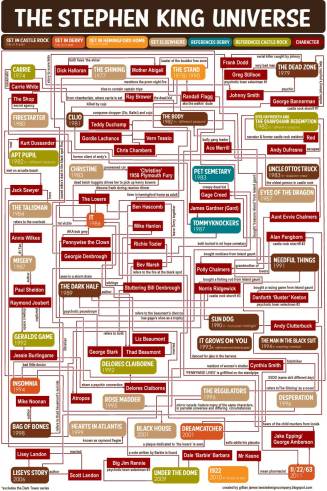
King’s references are so crazy! Check out this chart!

Of course, some authors do it because it’s fun to have a shared universe, for a variety of reasons. You can return to familiar characters and locations by doing so. You can make your readers marvel and go back to another story to say, “Hey, that matches up with so-and-so.” You can create a cosmology or a special reason why a character or characters or place or places appears in so many stories (I’ve got a character or two like that, I just haven’t been able to put them into any works yet. I tried with the human Barbie story and Evil Began in a Bar, but I couldn’t fit them into the former and I haven’t figured out how best to edit the latter yet, so…). And sometimes, it’s just fun to mess with your readers and make them wonder what the heck it all means (I’m pretty sure that’s the reason Stephen King references his other works so much, and the Dark Tower books simply grew out of a desire to create a complex story out of all that messing about).

Whatever the reason someone creates a shared universe, it’s pretty clear that there are plenty of reasons to do so, and that shared universes are here to stay. And whatever the reason behind them, as long as they’re done with love and people enjoy them, I see no reason not to keep doing them. Besides, I may have one or two I’d like to create someday.

Do you have a shared universe in your fiction? Why’d you create it? What has been the result of that?

My latest article from Self-Published Authors Helping Other Authors is Finding a Narrator on ACX. I gained a lot of experience in the matter over the four months it took me to find mine, so I thought I’d share that experience with a helpful article. Perhaps it’ll get noticed by the company, like the last article I wrote on them did. If so, I hope they don’t think I’m a girl again when they tweet about it. That was hilarious, but I don’t like to be mistaken for a woman when I’m not at a costume party or have some other good reason to cross-dress.

Anyway, check out the article if you have the chance. And while you’re there, check out some of the other articles on Self-Pub Authors, which is written by independent novelists and designed to help you write, edit, publish, and market on your own while saving money and maintaining quality. Believe me, it is great. I wouldn’t write for it if it wasn’t.

That’s all for now. Have a great day and I’ll see you later, my Followers of Fear. Preferably I’ll see you with good news while I’m at it.

About a week or two ago my friend Angela Misri posted on my Facebook timeline about a short story contest that Stephen King would be part of. Apparently people could submit short stories under four-thousand words and His Royal Scariness would pick the winner. Unfortunately the contest was only open to UK residents, which upset Angela and me a great deal (I knew I should’ve been born a British lord, but for some reason I decided that being the son of two rabbis was a better deal). However, if I could enter the contest, and it allowed short stories under six-thousand words, this probably would’ve been the short story I submitted.

After extensive editing, of course.

“The Playroom” is a very weird short story about a woman who steals from a mob boss whose casino she works in, and the terrifying results of that little action. I’d go into further detail on what those results are, but then I’d be giving away too much of the story. I will say how it came to be though: I woke up one night, a few days before I decided to take a break from Laura Horn, I think, and this little mini-movie started playing in my head. I don’t know what caused it–I’m pretty sure it didn’t have anything to do with anything I might have been dreaming prior to waking up–but there it was, fully formed in my head, and oh-so strange. I immediately wrote it down and decided to write it as soon as possible.

Which, as I said a moment ago, was when I decided to take a break from Laura Horn. How convenient that all turned out to be.

Anyway,this is definitely one of the weirder short stories I’ve written. And when I say something is weird by my standards, that’s saying something. And you definitely get that weird sense just by reading it, I think. As you go on and you feel yourself falling deeper into a rabbit hole, you definitely wonder where this is going to go. And when you actually find out where it goes…well, I wouldn’t want to give too much away. The first title of this short story gave away so much that I dare not speak it here. The second title was so cliched I couldn’t help but change it (“The Secret Room”–what horror writer doesn’t have a story titled that?). So now I’ve got “The Playroom”. Intriguing, doesn’t give away much, and somehow conveys this isn’t your average horror story.

At least, that’s what I hope is what it says. I’m biased, so what do I know?

Anyway, I think with a bit of editing, this story could actually go from just under fifty-six hundred words to under five-thousand or maybe even under four-thousand without sacrificing quality. As you know, I’ve had trouble keeping my short stories brief without sacrificing quality in the past, so I’d be very excited if I could get this one that short without any problems. There are probably a few sections that could be cut from this story. Or I might keep it as long as it is. With a bit of work, there may be a magazine or two who would like to publish this even if it is longer than what some magazines like to publish.

Before I do that though, I have a novel to finish editing. I think I’ll get right on that in the morning.

So good night, my Followers of Fear, and pleasant nightmares. I know I plan to have a few.


Raymond Esposito, a horror writer and acquaintance of mine (check out his website here), recently started a video series with romance writer SK Anthony (check out her website here), Writers After Dark. The purpose of this series (besides a fun excuse to drink, that is), is to discuss the various qualities of their respective genres. The topic of their first video was which of their genres was the more like life. Or not.

And because it’s fun to watch them just go at each other in a good-natured way. I’ve posted the video below. Enjoy:


Okay, if you didn’t have a half-hour to watch the entire video (too bad, because you’re missing out), here’s the conclusion: both of them think that their genre is the one that’s more realistic, though I think they both poke a lot of holes in each other’s arguments. And maybe spend a bit too much time on if love is real.

Anyway, after watching this video I thought I’d give my own opinion on this subject. I actually think I’m in a unique position to talk about this subject. Yes, I write and read mainly horror, but I also read a lot of romance mangas, read a book series that went from prehistorical fiction to prehistorical romance fiction in the later volumes, and watched one or two movies (10 Things I Hate About You is still considered romance, right?). Plus a lot of my stories, even ones that I haven’t written yet, have heavy romance elements. Snake is a horror-thriller with such an emphasis on romance, and my thesis/novel project Rose is a horror story about a really twisted love story (among other things). I kind of live in both worlds (though I prefer the one with deadly hotels and evil spirits and Lady Gaga in a leading role).


So which is more realistic and which is totally out there? Well, I think that’s kind of a trick question. In terms of horror, I’ve seen evidence of the supernatural and I’m well aware of the evil mankind is capable of (check out current events of the world to see what I mean). However, last I checked zombies were still a fiction and when a serial killer dies, they usually stay dead. And we still haven’t discovered any mummies that have come to life once unearthed or come across any pizzerias with killer animatronic bears.

At the same time, I’ve seen my fair share of long-lasting and happy relationships, and I’m sure you have too. Still, I’m not sure I believe in the concept of unconditional love. All relationships, especially loving ones, are built on give and take, on trust and communication. No two people ever say to each other, “I will love you no matter what and you never have to do a thing for that to continue”. All relationships take work, and romantic ones most of all. And true love? Same answer: all relationships are based on work. I don’t think you can meet a person and within minutes know they’re the one for you. Maybe after thirty years and you still care deeply for them, then maybe we have something there.


So which is real or unreal?

I think, in the end, both fear and love, the bases of horror and romance, derive from the need to survive. Horror is the result of the fight or flight response, and romance is the result of our desire to find the mate who will give us the best offspring. Neither one is truly realistic or unrealistic, because both speak to the human experience. Sure, some cliches and tropes are pretty silly and unrealistic (the virgin girl is most likely to survive, the couple overcome all and live happily ever after, etc.), but it’s the stories themselves that speak to us and keep us coming back for more, not the various elements that may or may not be realistic.

But what do you guys think? Is there one genre that’s more real than the other? Did I or the folks in the video miss something? Let’s discuss.

And let’s discuss it fast, I and six other people are being chased by a killer who died twenty years ago and we can’t seem to escape this haunted mansion no matter how hard we try! And in the meantime three of the people I’m with–one the crown princess of a kingdom of succubi, one a young woman with big dreams and a curse that’s slowly killing her, and one a very handsome young man with a dark past–have confessed their love for me at a really inconvenient time. I’m kind of attracted to all three, and I have to choose one of them before we leave this house! Strangely the killer takes five-to-ten minute breaks so that I can deliberate over my romantic predicament and let it take center-stage in my life when I should be more worried about where the killer is, how he came back when he was electrocuted in 1995, and why for the love of God there’s a convenient object in every room that could become some sort of murder weapon!

What a weird world I live in.

I’m telling you, I have been wanting to see this movie since I first heard of it, and it was killing me inside that I couldn’t see it when I was in Germany…or right after I got home. I was a fan of the books when I was a kid, and some of them even scared me so bad that I needed to take breaks from them. They were my King before I got into King. It really hurt me physically not to indulge in my childhood nostalgia and go see this film. But tonight my dad had some free time, and he was like, “Want to go see a movie?” So I said yes. And suffice to say, I was not at all disappointed (and neither was my dad, thankfully).

Based on the beloved series of children’s horror books by R.L. Stine (who by the way is Jewish, from the neighborhood I grew up in, and went to Ohio State. Coincidence? Probably), Goosebumps stars Jack Black as the author himself, living a reclusive lifestyle in the small town of Madison, Delaware with his teenager daughter Hannah. When Zach Cooper moves next door and becomes attracted to Hannah, he starts investigating the mysterious family next door and accidentally causes the monsters from the Goosebumps books–who are very real–to be released from their manuscripts and go on a rampage. Now Zach, Hannah, and R.L. Stine have to get the monsters back in their books before they tear Madison apart.

Let me just say, this was a movie with a lot of love and hard work put into it (unlike some other films taking advantage of people’s childhood nostalgia I could name). The story is very well written, and even has some twists in it that I didn’t see coming, and I pride myself on usually being able to see the twists in scary movies. The humor is also very good, keeping the mood of the movie light without getting too ridiculous or stupid. And the actors are just great. Jack Black plays Stine as a misanthrope who finds some way to steal every scene he’s in, while Dylan Mimette (who I’ve always liked whenever I’ve seen him in other works like Scandal or Agents of SHIELD) as Zach is funny and sarcastic and likeable, the kind of guy I’d like to hang out with.

The only characters I really had problems with are Champ, Zach’s friend, and Hannah, R.L. Stine’s daughter. Champ is comic relief, and while he’s funny as an awkward teen who just inserts himself into Zach’s life because…maybe he’s lonely and hopes the new kid is too slow to learn to avoid him? I don’t know, but the moments where the humor is a little much do come from him mostly, and he doesn’t contribute much to the story otherwise. As for Hannah…she’s just really there to be a love interest. And unlike River Song from Doctor Who, who was created for that very purpose, there’s not much to her beyond that role she plays. Her actress, Israeli Odeya Rush, is fun and gives off a snarky teen vibe, but that only does so much for the character.

Of course, I can’t forget the monsters. That’s the main attraction, the reason people who grew up with the books came to see the movies, because that’s what they remember most. Now obviously, in a movie that’s an hour and forty-five minutes and has to spend time developing characters and getting to the main conflict of the story, you can only spend so much time on each and every monster, which means a lot of them only appear in big group shots, but even in those you see a lot of work went into them. And for the monsters they focus on, they are great. Yeah, a lot of them are CGI, but even then they’re fun to watch. They make you believe they’re there and that we should be scared of them.  And Slappy the dummy, who leads the monsters, is like a little mini-Joker. He’s not the best villain I’ve seen on film, but as a talking dummy who enjoys causing chaos for chaos’s sake and to get back at Stine, he does the job well.

I could go over some other thoughts I had about the film, but I’ll leave that for the YouTube critics who around next Halloween will be putting out videos going over this movie with a fine-tooth comb. I think instead I’ll just wrap up by saying that this is a fun and wacky horror-comedy, earning a 4.1 out of 5. It may not get kids to read the Goosebumps books if they haven’t read them before, but it’s fun for the whole family and if you know the Goosebumps books already, you’ll enjoy seeing them on screen.

By the way, having the characters from my stories come to life is something of a dream of mine. I always feel like a parent to my stories and the characters within though, so I think if they did come to life I’d have a very different experience than R.L. Stine in the movie did. In fact, if I were to write a story about what that experience would be like, it might start something like this (#ExcerptSunday, anyone?):

The author heard his alarm go off and opened his eyes reluctantly. He wanted to go back to sleep, but today he really couldn’t afford to sleep in, even if he had the day off. So still feeling sleepy, he rolled out of bed, turned off his alarm, and headed to the bathroom. A few minutes later, teeth brushed and freshly shaved, he stepped into the hall, thinking about what he was going to wear and all the errands he was going to run today…when he noticed a tiger in the hallway.

The author froze. Even with his glasses still in his room, he knew what he was seeing. Tawny coat, black stripes, big face with whiskers and yellow eyes. There was no mistaking it. There was a tiger in his house. Am I dreaming? he thought. Am I still in bed?

The tiger padded towards him, its breathing heavy. Before the author could think how best to react, it stood up on its hind legs, placed both paws on either side of his head against the wall, and licked his face. The author, dumbfounded and amazed, could only laugh as the rough tongue scratched gently at his cheek. What is going on? he wondered, pinching himself to see if he was dreaming.

The tiger stepped down and rubbed its head against his stomach. And suddenly the author realized that this wasn’t a tiger, but a tigress. And even stranger, he knew this tigress. He knew her very well. After all, he was her father.

“Lizzy?” he said, hardly daring to believe. The tigress regarded him with intelligent eyes before turning around and padding down the stairs. The author wanted to call after her, but then something black streaked out of his room and past his face. He jumped as the black thing briefly stopped and formed a familiar body in the air before rushing down the stairs. Confused, the author went to his room, and saw someone had laid his clothes out for him.

For a moment, the author did nothing. Then he whispered, “Is this really happening?” Then, “Do I dare believe it?” Quickly the author threw his clothes and glasses on and rushed downstairs, where the biggest surprise of all awaited him:

The black shadow he’d seen earlier and the tigress were there. So was a wolf and a leopard. And scores of children, children he knew to be much more than they appeared. And a masked man dressed all in black, talking to a woman with green skin and pink hair. And a man with a gas mask, and a Grim Reaper, and a raven-like creature, and a hairless cat who sidled up to him and said, “Surprised?”

The author picked up the hairless cat, feeling like he’d ingested some amazing drug without realizing it, and said, “Very. How is this possible?”

The cat didn’t answer, but instead purred loudly and climbed onto the author’s shoulder. Moving through the sea of people and creatures, who all greeted the author with smiles and warm words, he made it to the kitchen, where a teenage girl in a witch’s costume made a plate with a Belgian waffle on it and a mug full of black tea float from the counter to his normal seat at the table. Sitting down, the author thanked the witch and dug in. It was delicious.

“So,” said a man in the doorway, whose face and body were half-transformed into a familiar-looking demon. “Today’s your day off, and we’re all yours till tomorrow morning. How about you blow off the errands and do something fun? Huh?”

The author thought about it as he took a sip of tea. He was aware of so many eyes on him, hopeful and expectant. And then a devilish smile came to his face. He knew just what they were going to do today.

anxiety

What is the trouble with psychological horror? Actually, there’s not much trouble to it. It’s just very hard to do well.

What do I mean by this? Well, let’s look at the definition of psychological horror: “a subgenre of horror fiction, film, and video games (as a narrative) which relies on the characters’ fears and emotional instability to build tension”, according to Wikipedia (I know you’re not supposed to rely on that site for information, but I couldn’t find a better website for a definition). It’s a sub-genre that, rather than relying on a traditional monster that’s out front and center for all to see, the monster is restricted to quick glimpses and shadows. If there’s a monster at all: sometimes the true villain is a character’s own brain, their fear, distrust, paranoia, suspicion, isolation.

I’ve used psychological horror before, particularly in the stories in my collection The Quiet Game (which if you haven’t read, I wish you would) and in the short story “Buried Alive”, which was published in the Strange Portals anthology last year (again, I wish you would read it). And I’ve come to the decision that while it isn’t as difficult as physics or writing comedy, it is walking a very fine line. Almost like a tightrope. And if you fall off, you can wind up veering either into the realm of the comedic with how obvious that it’s all in the character’s head, or it’s just so confusing that you find yourself losing patience with the story.

Let me give some examples (and it’s my blog, so you have to let me give some examples): have you read “Buried Alive”? I’ll keep the spoilers to a minimum for those who haven’t, but like I said above, I use quite a lot of psychological horror in that story, and for the most part, I think that I use it well (so do most of the readers I hear from on this one). For the rest, though…it’s pretty obvious that the circumstances of the main character are taking a toll on her mental state. I don’t think it gets to the point of comedic, but it is obvious, and the point of psychological horror is to make you guess whether it’s all in their heads or if it’s real or…who knows?

Perfect Blue. Trippy, has its moments, but also has its problems.

On the opposite end of the spectrum, there’s the anime film Perfect Blue, based on a novel that I wish was available here in the States. The film is about a singer-turned-actress who starts to confuse reality and fiction when her first acting job takes a turn for the traumatic. It’s a good story, but it’s not a perfect story. There’s a good section of the movie where they spend time trying to confuse both the protagonist and the viewer, and it gets a little difficult to not only what’s going on, it gets difficult to pay attention or be patient with the movie. While I admire the visuals of the movie, and I get what they were going for by showing what the protagonist is going through mentally, and I recommend checking it out if you’re interested, psychological horror shouldn’t get so strange or trippy that the reader gets frustrated with or loses interest in the story.

A great example of a psychological horror story though, manages to toe the line very easily and keeps you guessing as to what’s real or what’s mental delusion. A good contemporary example of this is The Babadook. If you read my review of that movie last year, you’ll remember that I noted that the movie kept you guessing as to whether the film’s protagonists were dealing with an actual monster or a shared psychosis, and I eventually settled on a bit of both because…I’m mostly human, and humans need to categorize things to make sense of the world. And I still say that I don’t know for sure which it is, and that’s one mark of the film’s greatness. You’re never quite sure what’s real and what’s in the heads of the characters, it stays interesting throughout, and it never gets to the point of ridiculous or obvious. All told, it’s great psychological horror.

This movie will surely get you on so many different levels. I’m getting chills just thinking of it.

So how do you psychological horror well? How do you toe that line?

Well, I’m definitely no expert on the subject. I usually deal in traditional horror, the monster is out front and is usually either some twisted form of human or a creature not easily defined by our standards. I dabble in psychological horror, usually making it part of a bigger story. But I can try, and I think–beyond reading/viewing as much psychological horror as possible, both good and bad, and practicing like you want to get to Carnegie Hall, of course–I’d suggest trying to write a story where you’re not sure what’s really happening. Create a scenario where strange things start happening to your character or characters, and you can’t tell what’s real or what’s just in the minds of your characters. Keep it interesting, don’t get too ridiculous or obvious, and just see where the story goes. If you can do that but still be unsure for most of the story of what’s real or not, then it’s likely your reader will be the same and want to know more.

Another marker of psychological horror is that there’s usually a twist somewhere along the way, and if it’s good it’ll change how you view the entire story (a great example is the Korean film A Tale of Two Sisters and its American remake The Uninvited). Characters are also often driven or plagued by powerful internal battles: am I doing the right thing? Is this right or wrong? Are they really out to get me? It doesn’t have to be full-blown persecution belief or fear of some unknown. It can be something as simple as a growing suspicion that something’s off or that our desires are actually evil. Again, A Tale of Two Sisters is a great example of the former.

Not a fan of the movie, but even I admit it shows Jack’s breakdown very well.

And finally, psychological horror is often not the main focus of a story, but part of a bigger story. Take a look at The Shining by Stephen King. Obviously that hotel is actually haunted, and the kid and the cook are both psychic. But a good deal of the story deals with Jack Torrance trying to sort out what’s going on for himself. Is he just dealing with a powerful desire to get wasted again? Is he going insane? Is the hotel playing tricks on his mind? There are scenes where you really can’t tell, and that’s part of the terror. Part, but not the whole thing. After all, there’s all the stuff the hotel is doing to them, right?

Unless Jack, Danny, and the cook are all sharing some sort of shared delusion, or folie a trois, in which case…wow. New conspiracy theory right there.

In any case, it’s something to experiment with yourself. And for me to experiment with more often. Just try and see what happens…or does it happen? You’ll never know until you try.

How do you feel about psychological horror? Do you have any good examples in film or literature you’d recomend? What are some tips for effectively writing in the subgenre?

Well, I’ve returned from Germany, my Followers of Fear. All in three pieces (don’t ask about the other two, you won’t like the answer). It’s good to be home, to say the least. A little weird after so long, but still very good. I enjoyed seeing my parents and my sister waiting for me at the airport and teaching them naughty German swear words (and my parents are rabbis, by the way. Scandalous!).

Of course, now that I’m back that doesn’t mean I can just slack off and do whatever I want. I’ve got a number of things on my to-do list today, and while I’m working to get those done, I’m taking a moment to talk about writing. Specifically, what are three qualities that writers need to actually write and get work done?

And I mean besides the actual imagination to come up with a story and the ability to transfer that story from the mind to the printed page. Not only does that go without saying, but a lot of people have very active imaginations and can write well enough that if they tried they could come up with a very good first draft. So why don’t they? What keeps people from actually acting out that writing dream?

I’ve been thinking about this a lot since yesterday, when I spoke with someone on the final leg of my journey home who had tried writing but found himself unable to do it. I found myself wondering why that is, and I think part of why some people can write and some find themselves struggling to do so may stem from three needed qualities or skill sets: confidence, focus, and perseverance.

Now by confidence I don’t mean confidence that your story is going to succeed and will make tons of money. I mean confidence that you can actually get it done, that you can write out an entire story from start to end. Never mind whether it’s any good, first drafts are notoriously terrible because that’s how they’re supposed to be. You have to have the confidence that you can get that first draft done, and then maybe we can talk about the next draft and everything else that comes from that.

Think about it: even if you prefer to only work on short stories, that fitting an entire story in a space between a thousand and ten-thousand words. Even to me, that’s a little daunting, and I’ve become much better at writing short stories over the years (though I could always be better). Imagine how it might feel for someone who wants to write a novel but then finds out that a novel is at least sixty-thousand words! You can’t just say to yourself, “I’ll try and see where it gets me” when it comes to this sort of task. You have to have some confidence in yourself and that you can get all those words out on the page.

Otherwise you may falter around three-thousand words when you realize that getting a story out is not as easy as you think and may not be able to continue from there.

Another thing writers need to get work done is focus. You have to be able to focus on a project and get the work done. The person I spoke to yesterday on my flight told me this was his problem: he tried writing a story, but in the midst of writing that story he would come up with another story and then want to work on that, and his first story would languish. Then he’d have an idea for a third story and want to work on that, and then he’d have two stories being put on the shelf for later. So the cycle went and he had projects that just never got done.

Even if you juggle multiple projects at once, like I do (three novels at various stages of the editing process, one collection of short stories on the way, working to find a narrator for an audio book, etc), you have to be able to sit down and focus on one project for an extended period of time. Maybe even months or years. And other projects may demand to be written (believe me, I’ve got lists of story ideas, and some are pretty vocal in my head about wanting to be written), but you have to get some out of the way first before you can focus on others. Better to have just a few projects at most to work on and several ideas waiting to be turned into stories than a lot of projects just lying about not even a quarter of the way finished because they all demand to be written.

And this brings us to our final quality: perseverance. It’s an understatement at the very least to say that life is not easy. Take my life, for instance: I’m trying to ensure I have a job so I don’t become a bum in my dad’s guestroom, I have bills to pay, tasks on my to-do list to do, etc. So many demands that it’s hard to find time to write or edit. And when it comes to doing either, especially at the beginning of a project, I may sometimes have trouble getting the work done. All those words can make it hard to getting it all done.

Without these qualities, writing can feel like a Sisyphean feat.

To write, you have to accept that you have to work through all those difficulties before you can get through all those stories, and then do it. It’s never easy, and life will find ways to get in the way. Even when it does, you have to be willing to get through what life throws at you and then sit down and get through all the writing and editing and everything else you have to do. If not, then those stories you feel so passionate about will languish for so long you may never pick them up.

It’s these three qualities–confidence, focus, and perseverance–that make the difference between those who want to write and those who actually go out and do it. Each of us struggles with them at times–focus in the short term can be troubling for me–but in the end I think those who can command these qualities are the ones who can at least get the stories written out and polish them enough for publication.

But what do you think? Have I got the right of it? Did I miss something? Did any of these speak to you? Let’s discuss.

In the meantime, I have to focus on the other things on my to-do list like visiting the dry-cleaner’s the barber shop, and persevere through cold and possible rains at the same time. Still I’m confident I can do it, so I’m not too worried.

Still, wish me luck. I might need it later.

Becket image

Some of you may remember my previous interview with author Becket, an indie novelist who likes vampires, was once a monk, and works for Anne Rice. Now he’s got a new book out, American Monk, a memoir about his years in a monastery growing closer to God and living in a brotherhood of similarly-minded men.

Welcome back to my blog, Becket. Happy to have you here. Now, your new book is American Monk, which chronicles your time as a monk in a Benedictine monastery. Why did you decide to write this memoir?

One day on my Facebook page I decided to make a post about my experience in the monastery. People responded well to it, so I made another one the following week. I kept up that have it for about half a year, at the end of which I decided to compile all my Facebook posts about the monastery into a memoir.

Why did you decide to become a monk in the first place? And why did you leave the monastery?

I wanted to be a monk because I want to deepen my relationship with God. The monastery was a wonderful place to do that because it was a house conducive to my personality type, an introvert and a scholar. I stayed in the monastery for five years, at the end of which time I was given the choice to make solemn vows, which is like the marriage commitment. It would’ve been for the rest of my life. The monastery was wonderful, but I also felt called elsewhere, although I did not know what that was at the time. So without any hard feelings, I left the monastery and began working for Anne Rice.

What’s a day in the life of a Benedictine monk like?

Monastic life is built around routine. We wake up early in the morning and begin our day with prayer. Our morning prayer lasts for about an hour and a half, and then we would go to breakfast. After that it was time for work. We worked most of the morning until the hour to celebrate the solemnity of the mass. After mass we had lunch. And after lunch we spent the afternoon committed to more work. Our day ended in the evening with prayer. After prayer we went to dinner, and after dinner we had a community time together, where the monks gathered together in one room and enjoyed one another’s company. Finally, we had night prayer and that it was bedtime.

American Monk

In memoirs like these, I’ve noticed that the vignettes within generally run the range from humorous to serious to tragic to inspirational and everything in between. Do you feel that this is true of yours? 

My memoir is meant to be inspirational. I hope that people read it and grow in their relationship with God, because the monastery was a place where a truly began to understand who I was in the divine plan. I am still learning the depth of my relationship with God. In many ways, the monk I was is still inside me, and perhaps he is a better monk than I used to be.

 Does Anne Rice make an appearance in American Monk at all?

She makes an appearance in the beginning and at the end, and in one chapter in between, but the memoir mostly deals with my experience with the brother monks.

What are you working on these days?

I just finished the first draft of my next music album as well as the first draft of a novel appropriately titled The Monk, about an African monk who suffers the stigmata and works as a miraculous channel of God’s love in the world.

When not writing or working with Anne Rice, what are you doing these days? And is there anything on your wish list you think you could be doing in the near future?

I spend time with God, my girlfriend, and my two cats. For the future, I have a few projects that I am working on and I am praying that God will give them success for His Glory.

Well thanks for joining us Becket. Glad to speak with you. And if you’e interested in reading American Monk and other works by Becket, you can check out his website, as well as find him on Facebook and Twitter.

And if you’d like to read more interviews with other authors and with some of my characters, you can head over to the Interviews page for those.

Hope you enjoyed reading this, my Followers of Fear. I certainly had fun putting it together.

Last year I made a list of haunted places I wanted to visit before I died and became a ghost (and yes, I plan on becoming a ghost. If you don’t buy at least one of my books and leave a review, I WILL haunt you!). Since I made that list (and visited the location I most wanted to see), I’ve come across a few more haunted places I’d like to visit. So I did what any good horror writer with a blog who believes in ghosts would do: I wrote a list and now I’m transcribing it down here.

This list isn’t in any particular order, and they span all over the United States, Mexico and even parts of Europe (parts I’m nowhere near at the moment, unfortunately). I hope you enjoy it, and that if this list or the previous one influences your travel plans in any way, shape or form, it’s in a positive way.

BOO!

1. Island of the Dolls

Location: Xochimilico, Mexico

Located in Xochimilico’s extensive canal network is La Isla de la Munecas, or the Island of the Dolls. According to the history of the place, a hermit named Julian Santana Barrera lived on one of the chinampas, or artificial islands, in the canals. One day, Barrera found the body of a girl who drowned in the canals, and was reportedly hit very hard by it (some locals believe a water spirit was responsible for the girl’s death). Not too long after that, Barrera started finding dolls around the island, and hanging them up all over the place, on tree branches and in his own hut. He said it was because the dead girl hung around, so he was giving her a whole playground of friends, and to keep evil spirits away as well (the water spirit, perhaps?). Over the years hundreds of dolls were hung up, leading to the island’s nickname. Even after Barrera died in 2001, the dolls still hang about, some of which are purported to talk or walk around on their own. The place has been investigated by ghost hunters with some interesting results.

If I ever get to Mexico, I’m heading there. Ghosts and spirits and creepy dolls? Sounds like fun.

2. The Villisca Ax Murder House

Location: Villisca, Iowa

Properly known as the Josiah B. and Sara Moore House, this charming little house was the spot of a brutal ax murder in 1912 on eight people, the Moores, their four children, and two young friends of the children. Several suspects were considered for the murder, and one was even tried and let off twice, but so far the murders remain unsolved. Since then, there have been several reported hauntings of the place, including seeing shadows of a man wielding an ax, children crying, and other freaky stuff. One family reportedly left the house screaming one night and never returned. Since 1994, the house has been a museum dedicated to its dark history, and several ghost-hunting crews, including the Ghost Adventures Crew, have investigated the house, finding some very interesting evidence. This is definitely a place I’d like to visit.

Villisca also happens to be the town where my friend and colleague Joleene Naylor lives. So Joleene, if I ever make it out to Villisca, I hope you wouldn’t mind showing me around for a day. It’ll be a spooktacular good time.

Update: This location was visited on July 13th, 2020. And yes, Joleene was in attendance. You can read the recap by clicking on these links: Part 1, Part 2.

3. Sedlec Ossuary

Location: Sedlec, Czech Republic

What looks like the Paris catacombs but is above ground and is part of a working church? The Sedlec Ossuary, located beneath the titular town’s Cemetary Church of All Saints. In the 13th century the abbot of the local monastery visited the Holy Land and brought back with him some dirt he’d picked up while over there and sprinkled it around the abbey cemetery. This made it a premiere spot to get buried and, along with the number of people dying of the Black Plague, caused the cemetery to be expanded several times. Of course, there was no way to keep up with that many bodies, and in the 16th century bodies were exhumed and their bones stacked inside the cathedral that had grown up around the spot. In the 19th century a woodcarver was hired to take the bones, roughly 40,000 to 70,000 bones’ worth of skeletons, in order, which he did, creating several macabre furnishings, decorations, and religious objects out of human remains. As you can imagine, this place has become quite the tourist destination, and ghost sightings or photos are not unheard of.

Sounds like my kind of furniture-shopping destination.

4. Leap Castle, Massy Woods, Montpelier Hill, The Stewards House, and Loftus Hall

Location: All over Ireland

I couldn’t leave these off the list, and they’re all in Ireland, so I figured, why not just group them as one big entry/tour of the nation? Leap Castle has a history of dark and mysterious deaths, almost like something out of a Shakespeare tragedy, and is also reportedly the home of an elemental spirit that hides in a pit deep in the castle. Montpelier Hill is the home of the Irish counterpart of the Hellfire Club, which supposedly did some very strange rituals, possibly Satanic ones. There’s even a story of the devil actually visiting the premises one evening.

Down the road from the Hellfire Club Lodge is the Massy Woods, which supposedly have several different kinds of spirits within, including a banshee, and the Steward’s House, which is said to be frequented by a demonic cat. If you look at a painting of the cat the wrong way, or if you hang it up wrong, you might bring something malevolent upon yourself.

And Loftus Hall is supposedly the most haunted house in all of Ireland. As the story goes, in the 18th century the Loftus family went on vacation, and the Tottenham family, consisting of a father, a mother, and a daughter, came to take care of the place. During their stay a ship broke on the coast nearby and a man from the ship came to stay at the mansion. During this time the man and the Tottenham daughter Anne became quite close. One night, during a game of cards in the aptly named Card Room, Anne dropped a card under the table. When she went to retrieve it, she discovered their guest had a cloven hoof. When she pointed this out in alarm, the man supposedly flew through the ceiling, leaving a nasty hole where he went, and was never seen from again. To this day people claim that the devil stayed at Loftus Hall, and that the hole he left through has never properly been repaired, that part of the ceiling is different from the rest.

Anne herself later went mad and was confined in the Tapestry room, where she died some time later. Years later a child’s skeleton was found in a hole in the Tapestry Room, leading to speculation that Anne had a baby while in confinement and that it was killed because it was a bastard and the possibly the devil’s spawn. Since these strange events, the house has been the site of poltergeist activity and visions of Anne walking down hallways looking for her lover. There have been several exorcisms performed on site over the years, which have only done so much to quell the spirits in this haunted place.

In any case, I’d like to make a trip to see these places!

5. Grand Canyon Caverns

Location: Peach Springs, Arizona

In the 1920’s, Walter Peck (not the actor) discovered a deep hole that went underground for quite a distance, in both depth and length, and discovered some skeletons down there while he was at it. He quickly turned the cavern into a tourist attraction, saying the bones he’d found there (and which were removed for scientific study) were of cavemen. Turns out they were Native American, but that never stopped the tourism industry.

Today, the caverns are a popular tourist spot with a restaurant, hotel, and museum. You can even tour the caverns and even stay overnight down there in an equipped hotel suite if you wish. Just be aware that you might be sharing the caverns with some Native American spirits who are upset about having their burial grounds disturbed by tourists. They may throw rocks at you.

When can I make my reservation?

6. The Bell Witch Cave

Location: Adams, Tennessee

This is one of those locations where people, even ghost hunters, are on the fence about the veracity of the reported hauntings. According to the legends, the Bell family lived in the area in the early 19th century and came under attack by a witch (though the events described sound more like a poltergeist or a malevolent spirit). Supposedly the witch did everything from tapping on walls, pinching people and other harmless stuff to full-on assaulting family members and even appearing as a creature that was half-dog, half-rabbit and all black. She makes a certain cave her home and will attack anyone who takes rocks or shows disrespect in her cave, hence the name “Bell Witch Cave.”

The thing about this legend is that all sources about the witch come several years after the Bells are supposed to have lived in the area. Even secondhand witnesses would’ve died out by the time the earliest known sources of the legend were published. Regardless, there have been reports of people being attacked by spirits after visiting and occasionally taking rocks from the cave, and there are rumors that the cave may have held some spiritual significance to local Native Americans. And a few paranomrla groups have investigated the cave with interesting results.

Whatever the case may be, this is definitely a place where I would like to visit and maybe see for myself if there’s any truth to the stories. Just as long as it doesn’t come home with me, I don’t think the witch would like Ohio winters.

7. Bannack Ghost Town

Location: Bannack, Montana

Ghost towns. There’s something about a town that’s totally been abandoned, something so…enchanting. So is the case with Bannack, which was founded in the 1860’s during a gold rush, but died out in the 1970’s. Today, the town is mostly a tourist attraction, once a year being revitalized for a festival called Bannack Days that recalls the time when it was a boom town and the seat of the county.

The rest of the year though, the town is populated by spirits. Some say that the sheriff ran a gang that killed anyone who looked at them the wrong way, making for a rather lawless town and for the events that would cause several hauntings. There is also reports of the ghost of a drowned girl being sighted, and even following people home.

Sounds like a good excuse to visit Montana, if you ask me. It even inspired a scary story I’d like to write someday. Better get some firsthand experience, right?

8. Linda Vista Hospital

Location: Los Angeles, California

Originally a hospital for railroad workers, the hospital saw a definite decline as the railroad industry and the neighborhood changed. The number of deaths increased, mainly ones associated with gang violence. With most of their patients being uninsured or under-insured, the hospital was forced to close its doors in 1991. Today, part of the hospital has been renovated into an assisted living facility, while the rest is a frequent set for movies and TV shows and a historic landmark.

However, some patients are said to have never left the building, and there have been multiple investigations into the hospital’s paranormal residents. To which I say, “Nurse, I’ve got a bad case of ghost obsession! Can I stay overnight for monitoring?”

Also influenced an idea for a story I had a while back. Hope I get to write that too.

9. Targoviste and Hundeora Castles

Location: Romania

These were the castles where Dracula lived. The former is where he impaled over two-thousand of his enemies, while the latter was where he was imprisoned for seven years of his life. It’s said at one of these that some Satanists did a ritual and ever since weird stuff has happened. Don’t know if that’s true, but it’s Dracula, so I have to check it out.

And then I will have some blood! Mwa ha ha!

10. Pere Lachaise Cemetery

Location: Paris, France

I did not know about this cemetery when I visited Paris last year, or I would have made an effort to visit it. One of Paris’s most famous cemeteries, it has flowers, graves and mausoleums that look like little houses or very interesting sculptures, and its fair share of famous folk, from Oscar Wilde to Jim Morrison. There’s actually a waiting list to be buried there, and if your family doesn’t renew the lease on your burial plot every thirty years or so, they dig you up and put someone else in your place.

Over the years, plenty of ghosts have been reported around the graveyard, including famous folks, Morrison himself, and even a few wandering lovers. As someone who visited the Paris catacombs and loved it, this seems like my sort of place. Vive le cemeteries francais!

Have you been to any of these places? What were your experiences like?