Posts Tagged ‘reflections’

“The Headless Horseman Pursuing Ichabod Crane” by John Quidor, 1858

Recently, I rewatched a movie inspired by The Legend of Sleepy Hollow that I first saw a teen. The movie was better in my memory, but it did get me interested in the original Washington Irving short story. Which, I realized, I’d never actually read. The closest I ever came was a version that had been updated for the 21st century and dumbed down for kids. As it was America’s first ghost story and I’m a horror writer from America, I figured I should correct that.

So, I read the short story. And then I did some research into the story’s background and influences, as well as some of the other adaptations (I will maintain to my death that the best version is the TV series Sleepy Hollow, and not the Disney cartoon or the Tim Burton film). And once again, following my interests has led me both down a rabbit hole and to an idea for a new story.

Still my preferred adaptation.

But first, let me tell you some things about The Legend of Sleepy Hollow that may surprise you. Turns out, there’s a lot about this story than most realize.

For instance, there really were two historical figures named Ichabod Crane and Katrina Van Tassel. Yeah, they were real people. Washington Irving liked to name characters after people he met. For Katrina Van Tassel, she was the daughter of a family Irving stayed overnight with, and was charmed enough by her to immortalize her in fiction. I wonder how she felt about her character being a flirty MacGuffin whose father’s fortunes and lands were more relevant than her appearance or lack of a personality.

As for Ichabod Crane, he was a colonel in the US Army who served for nearly five decades (yes, I believe that’s where the TV show got the idea to make him a Revolutionary soldier as well). However, his character was likely based on an actual schoolteacher, Jesse Merwin, who taught in Kinderhook, New York and came from Connecticut, like the fictional Crane did. So…yay for namesakes?

Speaking of Washington Irving, he’s buried in the real town of Sleepy Hollow. Yeah, that’s true. They even worked that into the movie I mentioned at the top of the post (though they left a lot of questions in their wake).

But the biggest surprise I found out about America’s first ghost story? It’s not a ghost story.

Now I know what you’re thinking. But hear me out: while it’s regarded as a ghost story by many, this is mostly because the Headless Horseman and his midnight chase of Crane has entered the public consciousness more than any other aspect of the story. In reality, the Horseman plays only a minor role until the story’s climax.

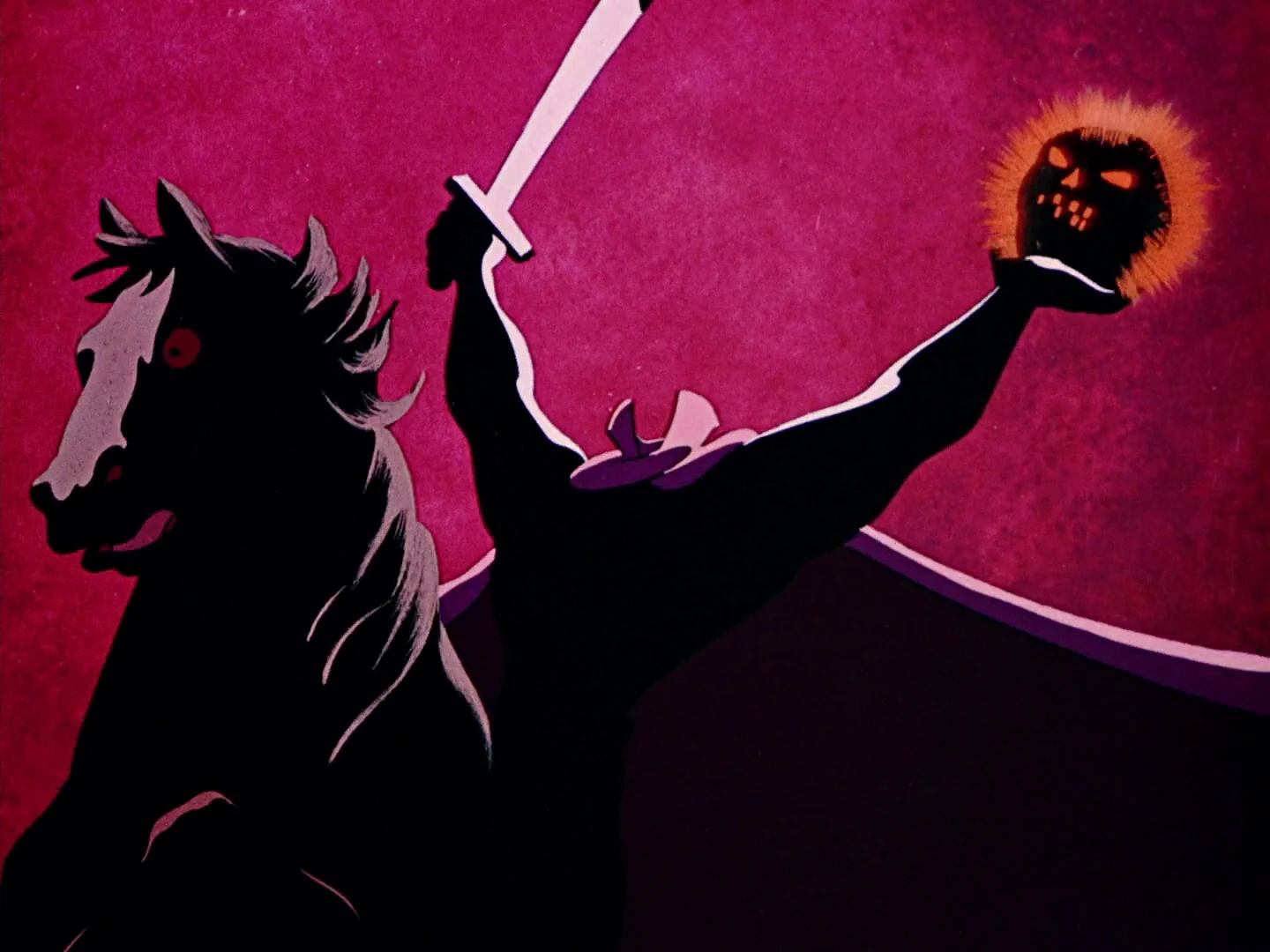
Disney’s Headless Horseman. Traumatizing children and contributing to the confusion over the story since 1949.

So what is The Legend of Sleepy Hollow, if not a ghost story? Why, it’s a somewhat comedic tale of two self-centered men vying for the hand of the local squire’s daughter and the cunning trick one uses to get ahead of the other.

In one corner, you have Ichabod Crane, the educated but superstitious outsider who uses his learning and guile to ingratiate himself into the town, feed his gluttonous appetite and maybe marry into a wealthy lifestyle. In the other, you have Abraham “Brom Bones” Van Brunt, the local tough who is more brawny than intelligent but is stubborn and cunning, and may be just as interested in Katrina Van Tassel as he is in her inheritance. Neither one is exactly likable, but it’s fun to see these two go to extremes just to marry Katrina.

And while most adaptations paint the Horseman as a supernatural entity, the original story strongly hints that Brom was dressed up as the Horseman to scare the superstitious Ichabod out of town, which is why the latter disappeared from Sleepy Hollow. In fact, the first feature film adaptation of the story, the 1922 silent film The Headless Horseman, explicitly shows Brom taking off the costume after Ichabod runs for his life for New York City.

As I said though, the Horseman, which is likely based on the Irish myth of the dullahan and other European myths of headless horsemen (trust me, there are a few, though the dullahan’s the most famous), is what made it into pop culture more than anything else, and may play a key role in why the story is still famous today. That, and the Disney cartoon, but mostly the Horseman.

In any case, all this has given me my own ideas for a sequel story to The Legend of Sleepy Hollow. And while I’m working hard on that, I thought I’d mention this all now. Because let’s face it, it’s all so fascinating. Also, I probably won’t have time to mention it in the post announcing the completion of the first draft. Might as well do it here.

But tell me, what’s your take on The Legend of Sleepy Hollow? Did you know any of this stuff? What’s your favorite adaptation? Let’s discuss.

That’s all for now. I’ll be at work on the story if you need me. Until next time, Followers of Fear, pleasant nightmares!

Robert Johnson’s studio portrait, one of the few verified photos of him.

I come across the most fascinating subjects sometimes, and when I do, I just have to learn as much as I can about them. Especially if I think I can write a story around them. Robert Johnson is one of those subjects. And if you haven’t heard of him before, that’s a damn shame. Because guess what? Robert Johnson may be the most enigmatic figure in American music history, as well as blues history.

So if you haven’t heard of Robert Johnson, let me give you the quick summary: Robert Johnson was a blues singer who traveled around the American South during the Great Depression. He recorded several songs and two albums in the two years before he died in 1938 in obscurity. However, he made a comeback in the 1960s, influencing musicians like Eric Clapton and the Rolling Stones.

There is very little knowledge about him as a person. Very few photos of Johnson exist, and everything we do know is from scant records and recollections. No one’s sure how he died, they just know that he did at the young age of 27 (my age at the moment, BTW). All this has led to a huge amount of speculation and mythology around the man. The most famous myth is that Johnson sold his soul to the Devil at a crossroads for talent.

If you’re paying attention this far down and you know me well, you can guess this was why I showed interest in Johnson in the first place.

But let me tell you, the Crossroads myth, as it’s known, only scratches the surface of this mysterious man. I’ve listened to all his music several times (which, by the way, is excellent), watched one biographical video on him, listened to one audio book biography about him and am in the middle of another (also on audio), and watched the movie Crossroads which heavily references Johnson and his legend (it was a lot better than I thought it would be). I’ve been down the rabbit hole on Johnson, and there’s so much more to him than just a myth about the Devil.

If you’ve ever wondered where the crossroads myth in Supernatural is from, Robert Johnson’s legend is an influence.

Robert Johnson was a man whose life was defined by music and impermanence. He was playing from a young age, and traveled all over the United States, and maybe even to Canada. He invented new guitar practices, some of which are still used by artists today. His relationships were often short and fleeting, and even the people closest to him, except maybe his family, weren’t entirely sure who he was. He was such an enigma, his death wasn’t officially confirmed until thirty years after the fact, when his death certificate was found by a researcher. His cause of death is listed as “Unknown Causes.” Even his gravesite is in dispute.

All this and more, from the legends around Johnson, to how he became the influence he is today, and of course his music, make him someone I want to learn more about.

And did I mention his music is wonderful? Because it is. I can put it on in the background and just zone out while I cook or work or write. Yeah, it has an older sound, but there’s something about Johnson’s playing and voice that stick with you, gets into your soul.

And I’ll keep listening to him and researching him for a while yet. I’m still learning what I can about him, and I haven’t figured out what sort of story I want to write around Johnson. I don’t want to write about the Crossroads myth, because that’s been done to death. I was going to do something set in the Cthulhu Mythos, but as much fun as playing in that sandbox is, I want to do more than play with someone else’s toys.

Well, I’m sure I’ll come up with something. May be today, may be next year, but I’ll come up with something. And in the meantime, I’ll keep writing and listening to Robert Johnson’s small but beautiful discography.

And if this makes you want to listen to and/or learn more about Johnson, I recommend the Centennial Collection, which contains the clearest sound of Johnson’s music. I also recommend Crossroads by Tom Graves and Up Jumped the Devil by Bruce Conforth and Gayle Dean Wardlow if you want in-depth biography on him. But first, you should listen to probably Johnson’s most famous song, as well as one of the songs that feeds the Crossroads myth, “Cross Road Blues:”

That’s all for now, my Followers of Fear. I hope this made you interested in learning more on Johnson. Now, if you need me, I’ll be working on Toyland while watching a debate (Evil Dead original vs. remake. It’s going to get bloody).

Until next time, pleasant nightmares!

October is usually associated with Halloween, and obviously I’m doing everything I can to make sure you don’t forget that. But it is also National Disability Employment Awareness Month, when the United States recognizes how peoples with disabilities have contributed to the country and to our various industries over the years. This year especially, we are marking both the 75th anniversary of NDEAM, as it’s often abbreviated, and the 30th anniversary of the Americans with Disabilities Act (ADA) becoming a law.

And it’s good we have this month, because there are so many people with disabilities throughout the world and history who have contributed to our society. Harriet Tubman led dozens of slaves to freedom and acted as an armed scout and nurse for the Union Army, suffered from neurological issues due to a childhood traumatic brain injury; Franklin Roosevelt became President of the United States and led the US through some of its toughest crises, all while dealing with the aftereffects of polio from a childhood condition; Albert Einstein had a learning disability; and author Flannery O’Connor wrote enduring fiction while suffering from lupus.

Not to mention there’s a growing list of entertainers and athletes with disabilities inspiring us everyday. Magic Johnson, the basketball player, has dyslexia; Gaten Matarazzo and Millie Bobby Brown from Stranger Things have cleidocranial dysplasia and deafness in one ear, respectively; and Elton John has fought bulimia and epilepsy for years. And more amazing people with disabilities are emerging every day. Check out this video of a dance company, half of whose members have disabilities.

I point out all these people because, as Ms. Hamamoto points out in the video above, one in five people have a disability of some sort. Yet, despite the passage of the ADA and the many opportunities this law opened up for Americans with disabilities, this country isn’t always very inclusive. In fact, opportunities and services available for people with disabilities can vary greatly from place to place.

This astonishes me, because becoming disabled is something that can happen to anyone regardless of sex, race, nationality, class, religion, political leanings, ethnicity or age. In fact, the likelihood of getting a disability grows as you get older. It can happen because of genetics, because of an accident, a side effect of an illness, or other causes. Lately, I’ve heard of people who get over COVID-19, but have side effects such as still being unable to taste or suffering from multiple headaches a week. These can, and likely will, be considered disabilities in the years to come.

And many members of the American military come back or discharge with disabilities. These can range from physical, such as war injuries, to mental or psychological, such as PTSD.

You might not even realize that someone near you has a disability. The majority of them are invisible. You may only see their struggles, if anything.

And yet, so many people don’t want to think about the disabled. Services for the disabled can be underfunded. Many homes aren’t always built with the disabled in mind. Education in general is often not given the funding it needs, and when it comes to budget cuts, special education is often on the chopping block. And there’s so little education on disability in general, that people may hold a stigma regarding disability for years: that disability is contagious; that they’re useless; that they brought it upon themselves; that the best thing to do with disability is to ignore it or hide it away or treat it as an annoyance.

As a person with several disabilities–some congenital, others acquired in adulthood–I’m aware of how lucky I’ve been. I’m gainfully employed at an organization where close to twenty percent of the workforce has some form of disability (as well as accommodations for them). And throughout my life, I’ve been able to receive services that help me with my disabilities. So I feel it is important to not only make disability more visible, but also to advocate and help out when I can.

Which is why I’d like to close out this post with some links to help my fellow peoples with disabilities. The Department of Labor’s Office of Disability Employment Policy (ODEP) has numerous resources for the disabled, and many states have programs or offices for the disabled, such as Opportunities for Ohioans with Disabilities in my state. If you are or know a college student or recent graduate with disabilities, then might I recommend the Workforce Recruitment Program, or WRP, a great program that pairs students and graduates with disabilities with internships in the federal government, and which sometimes turn into jobs (please use Firefox when operating on the site). And the Job Accommodation Network, or JAN, has numerous listings of individual disabilities and what accommodations exist out there. My office uses this site all the time, and we find it quite helpful.

And these are just a small sample of resources for the disabled, a group that should never be discounted or forgotten. Because not only can you become disabled at any time in your life, but because no matter the disability, you matter. You contribute. You make the world a better place. And if people forget that, then it’s up to you and to the rest of us to remind them.

What resources for people with disabilities are you aware of? What has your disability experience been like?

At the time I’m writing this, I’m in the middle of Chapter Ten of the second draft of Toyland, the Gothic horror/dark fantasy novel I finished earlier this year. And let me tell you, as I work through each chapter and make my edits, I find myself in awe.

What the hell was I thinking when I wrote some of these chapters?

Anyway, for those of you who aren’t familiar with Toyland, it takes place in an Ohio boarding school and follows students who become aware of a ghost haunting their school, one obsessed with a children’s book and that may be harming some of the students. Yeah, bonkers premise, but I make it work. At least, I’m hoping to make it work. Hence why I’m editing it rather than publishing it right here and now.

And I’m glad I am editing it. Because I cannot believe some of the shit I wrote. I mean, yeah, I was writing the early chapters during NaNoWriMo last year, so there’s a good chance I was up late and either sleep-deprived or hopped up on caffeine (or, if it was a weekend, buzzed). But still, some of these lines! What was I thinking? 

For example, in Chapter One, my protagonist Mason heads to the men’s rooms in the dorms. Here’s how I describe it:

Gabe and Mason entered, the door hinges squealing behind them. To the left were the stalls and sinks for the normal bodily functions.

“Normal bodily functions.” As opposed to what, Rami? Are there other kinds of stalls and sinks in bathrooms? Just what the fuck were you talking about?

And there are other passages like that, sprinkled here and there. Every time I come across them, I wonder what my state of mind was when I wrote them. Either that, or if I was just that desperate to make a fifty thousand word count by the end of November.

And in Chapter Ten, the one I’m working on now, I did something incredibly stupid the first time around. Mason the protagonist is about to reveal to a classmate of his about some of the strange events in the school. The story then fast-forwards to hours later, where Mason recalls the conversation in flashback. 

When I read that, I was taken out of the story for a second. I imagine potential readers will have that same experience as well. So now I’m busy rewriting Chapter Ten so that it flows better and doesn’t take the reader out of the story. It’s a pain in the ass, and I’m annoyed at myself for writing the story that way. What the hell was I thinking?

Well, that’s where the story is right now. The good news is, as I get further along, I find fewer of these problems. Hopefully that stays true for the rest of the second draft. But man, until I get to that point, I’m going to be looking back and shaking my head at those sections. 

So, that’s where I stand with Toyland, my Followers of Fear. I’ll keep working on it until probably October 1st, when I have to edit a couple of short stories for some publications that will be opening for submissions soon. But after that, barring anything else coming up, I’ll be back at work on Toyland and hopefully have it done by Halloween. Wish me luck.

Also, to my fellow Jews, tonight starts Yom Kippur, where we atone for our past transgressions and pray and fast for forgiveness. To you, I wish an easy fast and Gmar Chatimah Tovah, or “a good sealing” in the Book of Life. As well as a pizza party after the fast ends (wink).

Until next time, Followers of Fear, stay safe and pleasant nightmares.

I’ve two words for you:

Fuck 2020.

That’s how people have been reacting since around January, though it really ramped up around March or April. I’ve been among the people who’ve been saying it. Until recently, however, I thought I was dealing with it pretty well. Except for that short period back in March, I’ve been able to keep my writing flowing. Hell, some even say my output is extraordinary or something to look up to. I’ve been doing really well at work. I’m maintaining a healthy lifestyle, for the most part. I’ve been reading a lot. I haven’t fallen behind on any of my bills. I still have a roof over my head, and I keep my apartment clean (or clean enough).

But lately, it’s been a lot. COVID-19; the election and those intent on derailing it for their own benefit, before, during and after November 3rd; hurricanes; wildfires; black people getting murdered and the justice system failing to help those left behind; the deaths of people like Chadwick Boseman and Ruth Bader Ginsburg, who inspired and brought hope to so many people; science deniers and “fake news” and “alternative facts;” and so much more. Add in that September has never been my favorite month, and also happens to be a really busy time for me at work, and it’s had an effect on me.

For one thing, I was actually sick today. Yeah, I think the stress had an effect on my physical health and I had to call off work. Sucks, especially since I was supposed to give a presentation today.

And not only that, but (*gasp!*) I haven’t been able to work on stories this week.

Yeah, I know. Last night, I only managed to edit three pages of Toyland. Took over an hour to do. I was just like, “Forget it! No point at working at it if I need an hour to get three pages edited!” If I was working on a new story, I wouldn’t be surprised if I wasn’t able to make my minimum of 500 words per writing session. I’d be disappointed, but not surprised.

It’s a shame, but sometimes life gets you down and affects everything.

So, I’m taking steps to improve things. I may only have so much power to change this world,* but I have plenty of power to help myself. In fact, since I was sick today, I spent the day doing self-care. I slept in, made Japanese rice gruel (great for when you’re under the weather), watched Enola Holmes on Netflix,** did some hypnosis for stress relief, and watch cute videos of foxes and cats and dogs (thank you, YouTube).

And I’ll be doing some more self-care over the next few days. Yeah, I know there’s an emphasis in this country on being constantly productive until retirement. But you know what? Fuck productivity! What’s the point of getting all that done if I’m a wreck? Sometimes, taking care of yourself is the best thing you can do. And I wish more people realized that, rather than grinding themselves to death for…what? A possible bonus? Bragging rights? I don’t know.

So, I may not get much more done for the rest of the month. Whatever. Once I’m back in the saddle and feeling better, I’ll be pounding out words and stories at the usual crazy rate. And in the meantime, I’ll enjoy all the relaxation and self-care I can. Life’s too short and crazy not to enjoy it, after all.

That’s all for now, my Followers of Fear. Stay safe, take care of yourselves, and pleasant nightmares.

*I could use some of my dark powers to make really big changes, but that involves too much paperwork and some nasty unintended consequences. After this year, I’d like to avoid both.

**Short opinion: the mystery is a bit simplistic and obvious for a story involving a detective named Holmes, but it’s a lot of fun. Millie Bobby Brown is great, there are plenty of funny moments, and it scratches my Victorian itch. Give it a watch if you need something nice to get your mind off your problems.

It’s been a rough week, so I was looking forward to ending it with a horror movie that’s been on quite a few people’s radars since the first trailer dropped. I mean, it has the producers of Get Out and Us on board! Even if Jordan Peele wasn’t part of the project (yeah, I know, I thought that meant he was too, but he’s not), it looked like it was going to be uber-scary and tackle difficult issues that have been plaguing America for centuries. How could I not watch?

Antebellum begins in what appears to be a Civil War-era plantation, and follows a slave called Eden. Suffering from the worst brutalities from her captors, she must find some way out of the nightmare she’s in. But not all is as it seems. What does what’s happening have to do with a woman in the modern era and an almost identical face named Veronica Henley? In the answer lies an evil dating back to America’s bygone days, one built on power, race and cruelty.

I think the film’s biggest issue is that, because of the creative decisions of the filmmakers, its plot is confusing. We start out on the plantation, then it changes to the modern day without any warning, then back again. It’s like two different movies have been edited together, one a historical horror film, the other a slightly supernatural horror film involving contemporary racism. It’s confusing.

And when the big twist of the story is revealed, it took me two or three minutes to wrap my head around it. And I’m the kind of guy who can usually guess a major plot point in a horror movie or at the very least wrap my head around a difficult concept rather quickly. If I’m having trouble, imagine what the casual viewer is going to have.

That being said, the rest of the film is decent. The sections on the plantation during the first third were especially horrifying for their brutality, and the second third had an uncanny, creepy feeling that balanced psychological and supernatural horror. The climax is exciting enough, and the actors are great at portraying pain, terror, hatred, sadistic joy and grief when called upon. Props especially to star Janelle Monae as the lead. The costumes and sets are also amazing, with everything looking like it might on an actual plantation in the mid-19th century. Except for the outdoor furnace, which gave me Holocaust vibes and scared me down to the core of my Jewish soul.

And like Get Out, Antebellum explores its main theme of racism and slavery in an angle that wasn’t expected and made me think. Especially after seeing the documentary 13th and learning how the modern prison system is very much a form of slavery.

On a scale of 1 to 5, I’m giving Antebellum a 3.5. How it tells its story does bring down the score, but there’s plenty there to keep you invested in the film. And if you need some new horror right now, this will scratch the itch for you. Just don’t expect Get Out or Us levels of terror or deep-thinking.


One more thing before I sign off, my Followers of Fear. Tonight begins Rosh Hashanah, the Jewish New Year. On Rosh Hashanah, the Jewish community prays for our past sins to be forgiven, seek to forgive and be forgiven by our peers, and hopefully have a sweet new year. I have no idea what made this past year such a horror, but I’m hoping the next one will be better, and that the news of Justice Ginsburg’s death is the last in a year’s worth of horrors.

Shabbat Shalom and L’Shana Tovah (that basically means Happy New Year) to you, my Followers of Fear. May we all be inscribed in the Book of Life, and may the horrors of last year not follow us into the new one.

What a mouthful of a title. Let me explain:

Back in college (I want to say 2012), when featured blog posts were advertised to WordPress users under the feature “Freshly Pressed,” I read a blog post from a father who recently had a run-in with someone else’s spawn. I can’t remember much about the blog post in question. I can’t remember the blog or blog post’s name, the blog’s general theme, or anything of that sort. However, one detail stands out in my memory and it’s why I’m writing this blog post:

After reprimanding another person’s child for selfish (and maybe violent? I can’t remember that well) behavior at a children’s playground, the child’s mother came to apologize. And the parent described the mother’s face as “crunchy.” You read that right, crunchy. For someone’s face.

I tried pressing the author in the comments about what he meant by “crunchy.” What makes a woman’s face crunchy? But no matter how much I tried or he tried, he couldn’t describe it better than “crunchy.” I’m guessing he doesn’t spend a lot of time trying to understand the meanings of adjectives in order to mix and match them in stories and not use the same word over and over again. That’s more of a creative writer thing, not a parent blogging about their experiences kind of thing.

Anyway, I put the issue aside, but every now and then, I would come back to it and wonder how you could describe someone’s face as “crunchy.” About two weeks ago, I decided to finally search for answers and decided to discuss it with my various writers’ groups online. And I got some feedback that proved quite helpful.

Among my writer friends and colleagues, there were three main responses:

  • The author really meant “scrunchy,” not “crunchy.” This would make more sense, as it’s easier to visualize someone’s face scrunch up.
  • He meant she was a crunchy-type person, as in a sort of neo-hippie that eats granola and lots of other natural foods that are crunchy when eaten (hence the nickname).
  • The person’s face was so covered in lines, that you could almost hear those lines crunching whenever their face moved.

Honestly, given that I mainly asked horror authors for their feedback, I’m surprised that only one person made a wisecrack about cannibalism, and the woman’s face looking like a crunchy snack. Like a Cheetos snack or a Crunch bar.

And now I’m hungry. Dammit.

What people tend to think of when they hear the word “crunchy.” Not in regards to people’s faces.

Anyway, of the responses listed above, it was a variation of the last one that rang right to me. One author commented that she’d seen people whose skin texture was like cornflakes due to too much exposure to the sun and applying too much beige make-up to “make up” for it. Given my vague memories of the original blog post and the context the author used for the woman he was conversing with, this felt right. In fact, it lines up with the image I conjure in my head when I think of the woman from this blog post.

So, that’s the description I’m going with. In fact, I’ve already figured out how I could work it into a story someday, as well as which story I’d like to use it in. And perhaps which foolish person who got on my bad side and received the ultimate punishment of getting a hateful character based on them to use the description on.*

But damn, it was a crazy trip just to get to the right description. At least I finally found a description that works for me and I can work into a story someday. And I got to write a blog post that hopefully was edifying and enjoyable. Not a bad way to spend a Sunday morning, right?

That’s all for now, my Followers of Fear. I hope this post was amusing. So, until next time, what are some other weird or mystifying descriptors you’ve come across in your reading? Any that you’ve struggled to find an answer for? Let’s discuss.

And until next time, stay safe, pleasant nightmares, and no eating people’s faces off. It’s generally frowned upon in Western society.

*Don’t mess with me. My retribution is not only dangerous and eternal, but safe from lawsuits owing to that little clause in the copyright section stating it’s a work of fiction and that any connections to real persons, places or events are just coincidences.

The other day, I was scrolling through my Twitter feed and I saw a tweet from a fellow writer in the writing community (or #WritingCommunity). This was the tweet.

Now, if the tweet hasn’t loaded properly into this blog post at the time you’re reading this, it’s from writer Rey Roland using the hashtag @rrowlandwrites and goes like this:

#WritingCommunity do you think that characters have to make mistakes in a story?

I found the question stimulating, so after some back and forth between us, I decided to do a full post on the question (hope you don’t mind, Rey).

So, can and should characters make mistakes? First, let me start with can: yes, characters can make mistakes. In fact, there are plenty of stories where characters make mistakes which become integral to the plot. And yes, characters should on occasion make mistakes, though it depends heavily on the story. A character shouldn’t make a mistake just for the sake of making one when it serves no purpose to the story. Otherwise, the readers will think it’s weird.

Of course, this leads to an even bigger question: is there a benefit to having characters make mistakes? Actually, there are multiple benefits to having a character who makes mistakes.

For one thing, characters who make mistakes are easier to empathize with. Not to say characters incapable of making mistakes can’t be empathized with, but it does make a character more human and easier to identify with for the audience. The possibility of a reader continuing with a story can depend greatly on their connection to the protagonist, so showing them as being like the reader–more human–can be an advantage.

Edmund Pevensie’s mistake was a major driver of the story.

Another reason to have characters make mistakes is that it can help the story along or add to its complexity. Sometimes, it’s even the catalyst of the story. In The Lion, The Witch and The Wardrobe, Edmund makes the mistake of falling under the White Witch’s spell, and betraying his siblings adding both an extra dilemma to an already difficult situation and giving the character a redemption arc during the story. And in the manga Death Note, Light Yagami tries to eliminate suspicion of himself as the murderer Kira by killing the FBI agent following him, as well as the other FBI agents following other suspects. However, this eventually just leads to him becoming a prime suspect again, a problem which lasts the rest of the series.

Of course, it isn’t just protagonists who make major mistakes. Minor characters make mistakes all the time, and they often benefit the plot significantly. In Ania Ahlborn’s novel The Devil Crept In, the protagonist’s mother makes the mistake of not treating her son’s obvious mental issues, which has major consequences before, during and after the story. And in Harry Potter and the Order of the Phoenix, Cho Chang’s best friend Marietta Edgecombe tells Umbridge about Dumbledore’s Army, leading to the organization’s dissolution, Dumbledore’s exile and Umbridge’s assent at Hogwarts, and boils to appear on her face in the shape of the word “SNEAK.”

And villains make mistakes all the time. Often, that’s how their downfall begins. Often, these mistakes are due to the villains’ pride, ignorance, or some other character flaw. Voldemort doesn’t believe anyone will find his Horcruxes; Bane talks too much and doesn’t watch his six; Annie Wilkes is so obsessed with her Misery Chastain novels, she falls for Paul Sheldon’s trick; the White Witch doesn’t read the instructions carefully and misses the deeper magic in the Stone Table; Kaecilius also doesn’t read the instructions and misses what actually happens when you join Dormammu’s dimension; and the Wicked Witch allows water in her castle for some reason, even though she has a serious water allergy (I guess the book version thought Dorothy would never think to use water against her?).

As you can see from the above, not only can and should characters be able to make mistakes, but there are numerous benefits to doing so. Whether to include one or not depends on the author, character(s), and story in question. However, if an opportunity comes up and you think it’ll ultimately benefit the plot, I say do it. Who knows? It could be a major turning point in the story, and the moment readers talk about for years to come.

I hope you found this post edifying, my Followers of Fear. I had fun writing it. And I hope Rey Rowland (whose Twitter page you can find here) enjoys reading this. Thanks for the mental stimulation.

That’s all for now. I’ll check in with you all very soon, I’m sure. So, until next time, stay safe, pleasant nightmares, and DON’T TAKE THAT ACTION! IT’S THE KIND OF MISTAKE THAT’LL LAND YOU IN A HORROR STORY! AND NOT ONE WRITTEN BY ME.

Reborn City, Book 1 of the Reborn City series.

As many of you know, I started this blog while working on a sci-fi series, the Reborn City trilogy. It follows street gangs in a dystopian future, and focuses mainly on the Hydras, a gang whose leaders have strange powers and abilities. At the very core of the series was a theme of overcoming various prejudices, especially racial and Islamaphobic. I self-published the first two books, Reborn City and Video Rage, and started work on the final book, Full Circle.

However, trouble started around the third book. Midway through the first draft, I realized the direction of the story wasn’t epic enough for what I wanted for the series. It neither provided the action, nor the catharsis needed to end the series. So I stopped working on the story, with the hope that eventually I could finish the series.

That was 2017. It’s 2020. And I’ve realized some things about the series. Things that made me change how I feel about those books, and about selling them to people. The biggest thing being that I’m a different person than I used to be. I’m not the same person I was when I first started writing those books.

Let me explain. When I first started that series, it was 2009, I was sixteen, and I was full of the naive, optimistic hope that most teens are filled with. That hope filled Reborn City and its themes of the power of tolerance, which I hoped would do some good in the world. I thought if I could take those themes and work them into a story, I could beat back some of the horrors that were plaguing the world.

In a way, I still think it’s possible to write a story and make a difference through literature. We’ve seen it with multiple books that have withstood the test of time and build conversations around difficult topics. I just don’t think the Reborn City books can do that anymore.

It’s now 2020. Eleven years have passed, I’m twenty seven, and I’m a lot more educated, as well as a lot more jaded, about the very issues I was writing about. I think we all are. We’ve seen too much these past several years, felt too much heartbreak and harsh realities. Knowing that, I look back at the Reborn City books and realize that those stories don’t fit their purpose anymore. It’s like you try to build a better hose to put out house fires, but you find out after the fact that what’s needed is a fire hose, and you built a garden hose. And the whole house is on fire.

See where I’m going? I can’t finish the books because I know the hose I’m building is inadequate, and I don’t feel right selling the books for the same reason.

This, among other reasons, is why earlier this week, I made the decision to take both Reborn City and Video Rage off Amazon and Smashwords.

Reborn City and Video Rage. As of today, I’m not selling copies on Amazon or Smashwords.

Yeah, I can hear some of your shock. Believe me, I’m not happy about it, either. But it is what it is. I won’t sell a product (and make no mistake, that’s part of what I’m doing as a writer) that doesn’t work, and these stories just don’t work. You can maybe still find the last few paperback copies of them on Amazon, but after those are gone, that’s it.

That being said, there are a couple of bright sides. For one thing, I may revisit the world of Reborn City again someday. I still think there’s some potential with those characters and that world, I just need to write a story around them that works with what I know now. And in the meantime, I still like to put the issues I care about into the stories I write, like I did with Rose, or with River of Wrath. The latter of which, by the way, tackles some of the same issues Reborn City and Video Rage did.

Also, while those books are no longer available, my two other books that I self-published, the short story collection The Quiet Game: Five Tales to Chill Your Bones, and the horror-thriller Snake, are both still available. While those stories aren’t perfect, they’ve weathered the test of time better than the Reborn City books did, so I feel more comfortable putting them out there. I’ll include the links for them below.

I’m sorry to drop sad news on you on a Friday night, my Followers of Fear. But I thank you for reading, and for your understanding. Do know that I plan to keep putting out quality stories in the future, and I hope you’ll stick around to keep supporting me while I work on that.

That’s all for now, and I’ll be back soon. Until next time, stay safe and pleasant nightmares.


The Quiet Game: AmazonCreatespaceBarnes & NobleiBooksSmashwords, and Kobo.

Snake: AmazonCreatespace, Barnes & Noble, iBooksSmashwords, and Kobo

Rose:  Amazon US, Amazon UK, Amazon Canada, Audible

Folly Beach, the beach Ramsey and I visited, and which is the setting and inspiration for this latest story.

Two stories finished four days apart. Not sure if I’ve ever done that before.

So remember when I mentioned my buddy Ramsey and I visited a beach called Folly Beach in my Impressions of South Carolina post? Well, Ramsey is just barely able to tolerate horror. I know, odd considering he’s one of my best friends ever, but it’s true. Anyway, I decided to take advantage of this and mess with him before it was time to leave by making him think, even if just for a second, that something out of a horror situation was happening to us on that beach at that very moment. And you know what? He bought it, if only for a moment.

Obviously, it was funny, but it was also the basis for this story, Folly Beach. I basically  imagined what might happen if that situation I got Ramsey to believe in really happened, changed some names and added some events to make things more interesting. The result is Folly Beach, a new short story just under thirty-eight hundred words.

Yeah, that is pretty short for me, I know. Still, I didn’t think it would be long to begin with, and happy with the results.

So, what’s next with this story? Well, I’ve already sent it to Ramsey to read and laugh (or scream) over. And I’m looking for beta readers to take a look at it and give me some feedback. My hope is to have a second draft done by the end of September/early October, in time for a particular publication’s submission window to open. I don’t think I’ll get in, given that it’s a hard publication to get into, but when I have something that fits its word count limit and I think would be a good fit, I have to try.

And in the meantime, I’ve already figured out what I’m going to write next (though I’ll probably wait a couple of days before I start on it). Yeah, no matter what, I keep busy.

Well, that’s all for now, my Followers of Fear. I’m sure I’ll have more to say in the coming days. Maybe even as soon as tomorrow (though if I do publish a post tomorrow, I’ll be going to bed soon after! I can’t do these late nights as much as I used to).

Until next time, stay safe and pleasant nightmares!