Posts Tagged ‘novel’

My friend Kat Impossible of Life and Other Disasters tagged me (and anyone with an interest) for this Harry Potter-themed tag. Seeing as Harry Potter is the reason I became a writer, and Harry’s 38th birthday is today (that’s right, he’d be 38 years old if he were a real person. Let that sink in for a moment), I figured it only made sense to do it and spread the word. Thus, here we are.

So Alohamora, on we go. Let’s get this thing started.

What is your blood status?

On the one hand, I get why this question is here. But on the other hand, it feels so wrong to ask a question based on how “pure” your blood is. We all know that pure-blood families just destroy all records of the members who intermarry. And how are they so sure none of their relatives intermarried with Muggles prior to blood-status becoming such a thing (Salazaar Slytherin was considered an outlier in his day, after all)?

Anyway, Kat had two tests to determine this (click here and here to try them out). I got pure-blood on the first one and half-blood on the second. I flipped a coin, and got heads, which is pure-blood. I guess my theory that my mother’s side of the family is related to Moaning Myrtle wasn’t so spot on after all (yeah, that’s a thing).

What wand chose you?

According to Pottermore, my wand is ten and three-fourth inches, laurel wood, unicorn core, and very flexible and swishy. According to the site, that means my wand’s magical performance is consistent and decent, hates laziness, and very adaptable to my needs. I have to say, I kind of like that.

Did you take a cat, an owl or a toad with you?

Cat, of course. As cool as owls are, I’m not very fond of birds, and besides, the school has plenty of owls. And we all know that toads are boring and that only losers get them. So obviously, we go for cats…which in the Wizarding World, tend to be more intelligent and great judges of characters than other cats, so I guess that works very well for me.

Now what to name my magical kitty? A difficult question if ever I’ve heard one. I guess it depends on what kitty I get.

Where did the Sorting Hat put you?
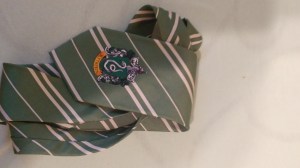
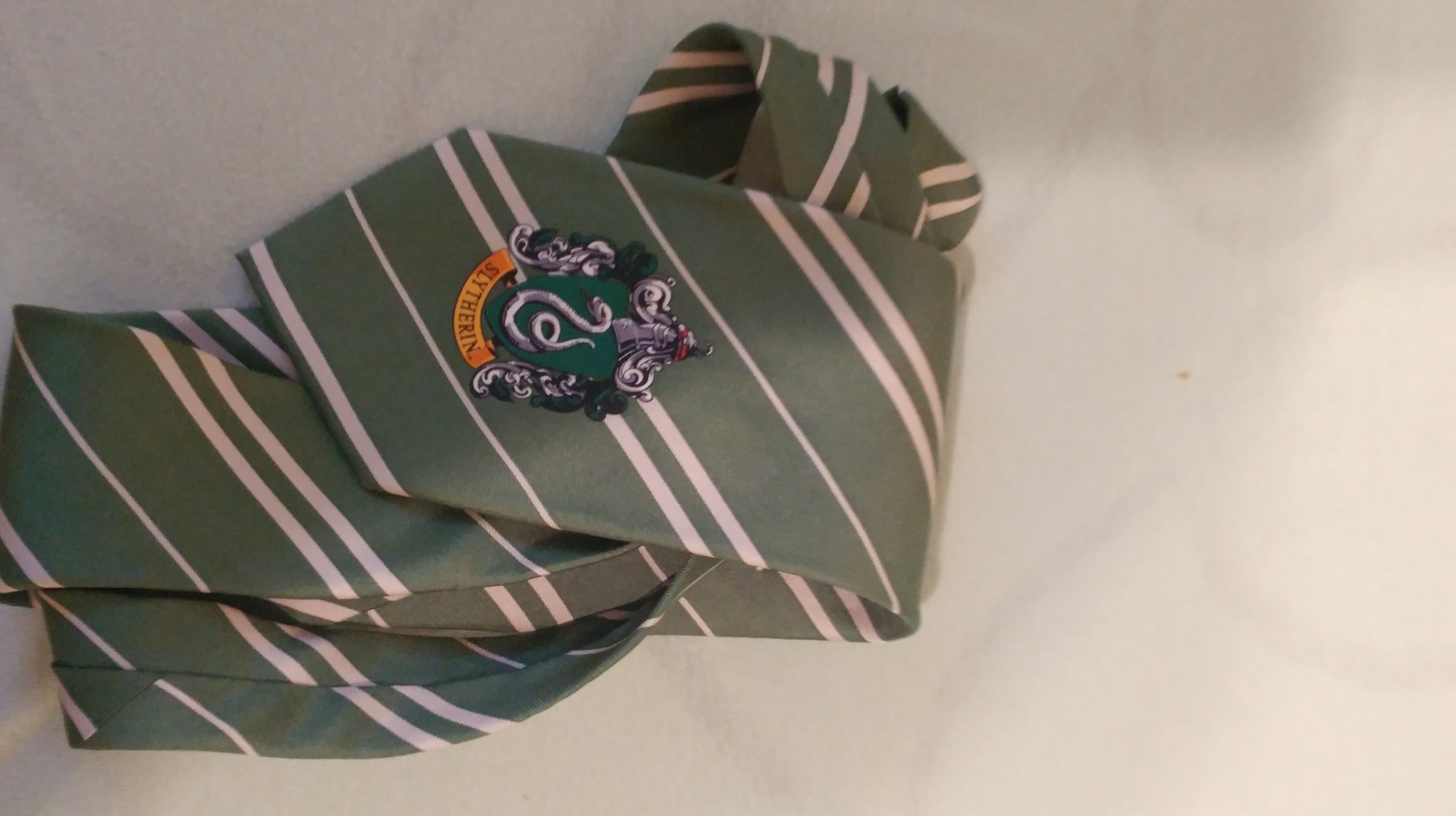
Slytherin, according to Pottermore. I was shocked when I first found out, but I guess it makes sense. I mean, one of my nicknames is the Pale Dark Lord, and I have to be at least a little bit evil and ambitious to write horror like I do. Of course, when I told my mom, who is a huge Potterhead, she nearly disowned me right there and then over the phone. And my sisters were almost afraid to associate with me. But they’ve come around since then. My mom even bought me a Slytherin shirt when she went to Harry Potter World in Florida a few years ago. It’s one of my favorite shirts ever. And last year in Boston, I bought a Slytherin tie from an HP-themed shop. I love wearing it to work and when people there notice it.

What house did you want to be put in?

Gryffindor, I think. Everyone wants to be in Harry’s house, after all. And if not that, Ravenclaw, because I read a lot and like to think of myself as intelligent. However, I’m glad I went to Slytherin in the end. Like I said, it makes a whole ton of sense. And besides, I do a great Draco Malfoy impression when I take off my glasses.

What are your favorite and least favorite lessons?


Ooh, tough choices considering I’ve only heard Harry’s experiences with his classes to judge by. Though if I had to guess, I probably would enjoy Potions the most. Unlike Chemistry, where you had to understand how molecules and acids and bases interact, Potions is very much like cooking, except without food. And to use a bad joke, I can be a wizard in the kitchen sometimes (my friend and colleague Joleene Naylor can attest to that). So I think I’d excel at that. I might even take up potion-making as a hobby.

As for least favorite, I’d have to go with Arithmancy. Math-based magic does not sound like a lot of fun, and math has never been my favorite subject to begin with. I’m actually surprised that Hermione likes it, as in both real life and in the Wizarding World, it’s used to predict the future. Then again, numbers and patterns are used by economists and college professors all the time to predict economic trends and presidential elections, so I guess Hermione likes it because it actually produces results, unlike standard Divination.
What is your Patronus?

I’m a dolphin, apparently (which also means that’s what I’d turn into if I were an Animagus). Makes sense, as I’m a very fun-loving and excitable person. Though I’m not very fond of swimming, truth be told.

What does your boggart look like?

Rejection by people I love. I have this ongoing anxiety that something I say or do might cause people to hate me and not want to associate with me. A boggart turning into people I know saying they want nothing more to do with me and pointing out all my flaws would be a nightmare. As for what I’d turn it into, I think I’d have it turn into a performance the musical The Book of Mormon. That musical is hysterical, and forcing the boggart to become that would be such fun (see this video from the Tonys a few years ago just to get an idea of how funny this boggart would be).

Either that, or Tom Ellis playing Lucifer, because I can’t be scared of that devil. I’d just melt into his arms…

I’m sorry, I was drooling for a second. What were we talking about?

Do you partake in any magical hobbies or school sports?

Probably. As I said earlier, I’d probably enjoy making Potions, so I would definitely be part of the Potions Club. I’m not much of a sports player, so I don’t think I’d be on a Quidditch team, but I might enjoy flying for fun (in fact, is there a club for that?). Surprisingly, I don’t know if I would be a writer if I were a wizard. Except for the Tales of Beedle the Bard, a comic book about a mad Muggle, and everything by Gilderoy Lockhart (burn!), there’s not much evidence of fiction existing in the Wizarding World. There are plenty of non-fiction books mentioned in the series, but very little fiction.

Perhaps I might still be a writer, though. I’d just adjust my stories to be horror stories set in the Wizarding World, possibly dealing with entities that ordinary wizards can’t handle or Dark Wizards. But again, I don’t know. I guess it would depend on what forces shape my life while I’m at Hogwarts and then what happens afterward.

Where would you spend your spare time?

The library or the Slytherin common room. I love books, after all, and the library is a great place to read and study. And who doesn’t hang out in a common room? Oh, and wherever I could go to brew a potion. I have a feeling I’ll be using my cauldron quite a bit, so I’ll need a place where I can work without having to worry about the smell of cooking magic liquids.

What would you most likely get detention for?

Given what I got detention for in high school, either having late homework assignments or being too talkative. That last one has gotten me into trouble more than once in the past, though I’m better at controlling it nowadays.

What career do you want after graduating Hogwarts?

Well, if there is a Wizarding tradition of fiction, I could see myself going into that. Though seeing as writing probably doesn’t make that much money, even in the Wizarding World, I could see myself becoming either a Ministry official, or a Potioneer. Both of those would probably suit me very well.

I TAG…

Anyone who wants to do this tag! I mean, it is a lot of fun, so why shouldn’t you? Just make sure to link back to me when you do.

Well, that’s all for now, my Followers of Fear. I hope you had as much fun reading this as I did writing this. Until next time, pleasant nightmares and GO SLYTHERIN!!!
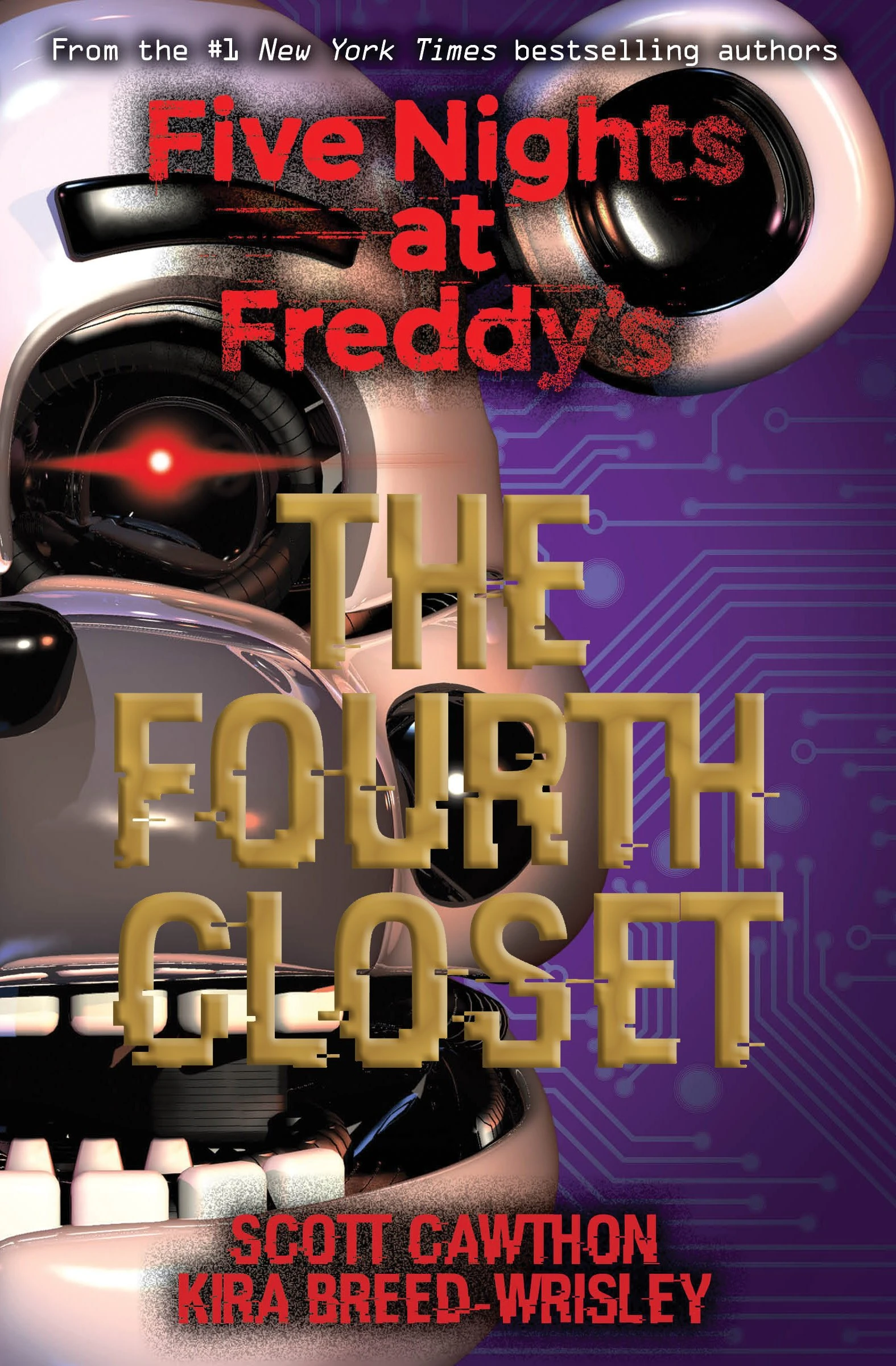
Well, here we are. The latest Five Nights at Freddy’s novel, The Fourth Closet, was released late last month. I’ve spent the past week reading it, wondering if this is the last novel, if this book contains answers to the events of the previous books and the franchise’s lore as a whole, and wondering just how this volume compares to the previous two books. Since I finished it yesterday, I’ve been dying to share my thoughts on it (and all without being shoved into an animatronic suit, I might add). So now that we’re here, let’s dive into what is likely the last FNAF novel (thought considering this novel was co-written by franchise creator Scott Cawthon, who knows if it’s truly the last?).

So for those of you who don’t know, Five Nights at Freddy’s is a video game franchise about security guards having to deal with haunted animatronics that try to kill you during your shift at a pizza place (or in the case of the fourth game, someone’s bedroom). Yeah, I know it sounds ridiculous, but it has proven immensely successful, spawning several sequels and spin-offs, three novels, a movie in development at Blumhouse Productions (which I wish would go into production already), and thousands of fan-made tribute games. Some of the reasons for the game’s success is its simple yet intense gameplay, as well as its deep and mysterious lore (supposedly the events of the game were caused by a serial killer and the ghosts of his victims, but figuring out what exactly went down and when is a challenge).

I’ve reviewed the first two books, The Silver Eyes and The Twisted Ones, and while I wouldn’t count them among my favorite horror novels, I have found them intriguing enough and similar to slasher movies in book form. And I found Twisted Ones to have improved and fixed many of the issues of Silver Eyes, making for a better novel, so I hoped The Fourth Closet would also improve. Did it? Let’s see.

Fourth Closet takes place about six months after the events of Twisted Ones, and tells the story mainly from the POV of the other main characters, especially series’ protagonist Charlie’s love interest John. At the end of Twisted Ones, Charlie had seemingly died, but in this new volume, we see Charlie returned alive two days later. Or did she? While everyone else is convinced this Charlie is their Charlie, John isn’t so sure. And when kids start disappearing in town again, like they did during the tenure of the original Freddy Fazbear’s Pizzeria, John must gather the gang together again to investigate. But will searching for the truth lead to answers, or will it lead to horrors that the characters never anticipated?

So to start, this novel does show improvement over the previous two. The story and mystery is well-told, and the violence, which there is plenty of, is written to be easy to picture in our heads. I also found a number of surprises in the course of the story that were really surprises, rather than predictable twists, and elevated the story. And of course, we got to see a number of famous animatronics from the franchise, including a few of my favorites. I never mind seeing those guys. And finally, the story ends in a way that I can be satisfied with, especially if Cawthon is intending on writing a trilogy.

Of course, this novel does have some issues, as the others did. For one, the main cast is still flat as boards. Yeah, we get some insight into their thought processes in this book, but it doesn’t really allow us to get to know them as characters. That, and there’s a big reveal about Charlie that isn’t as well-written as it could have been. So while I kind of understand what the reveal is, I’m also a little confused and could use some more information to explain things. I know, Cawthon likes to let fans guess and spin theories with this franchise, but doing the same thing in a novel can seriously backfire on you (believe me, I learned that during one of the drafts of Rose). And trust me, it backfired here.

But on the whole this novel is a decent story, and shows its writers’ desire to learn from past mistakes in order to make sure any addition to the franchise is worth it. On the whole, I’m giving Five Nights at Freddy’s: The Fourth Closet a 3.4 on a scale of 1 to 5. If you recall, I gave the first and second books ratings of 2.6 and 3, respectively, for an average of 3 out of 5 for the trilogy. Average as a whole, but considering the source material  is a video game franchise and that the creator isn’t used to writing prose fiction, average is great. After all, under other creators, it could very well turn into the literary equivalent of the Super Mario Bros. movie. And nobody wants that!

I’ll admit I’m a few days late to this, so perhaps the news has already gotten around and this post is unnecessary. But for those of you who haven’t heard, it seems that the saga that has been called Cockygate has reached its resolution. And you know what? It’s really good news.

Now if you haven’t heard, Cockygate got started around late April/early May in response to the actions of Faleena Hopkins (or as I prefer to call her, Lady Voldemort). Hopkins, a romance writer who wrote the “Cocker Brothers” series, tried to get a trademark on the word “cocky” when used in book or series titles. Now this word has, not surprisingly, been used in book titles well before Hopkins applied for her trademark, but that didn’t stop her from applying for it, and then going after independent authors that can’t afford lawsuits to either take the word “cocky” out of their book titles or take them off Amazon (seriously difficult either way you look at it) or they could face legal action.

And you wonder why I call her Lady Voldemort.

Two things happened after news of this broke: several authors and companies tried to copy Hopkins, and the majority of the author community rose up against her, with the hashtags #cockygate and #ByeFaleena (get it?) going viral within days. The Romance Writers Association started looking into legal action. Kevin Kneupper, a novelist and retired lawyer, came out of retirement to fight Hopkins on this and force her and others imitating her to back down. He was joined by romance writer Tara Crescent and Jennifer Watson, a promoter for the CockTales anthology, whom Lady Voldemort had named in a lawsuit.

And so for about three months, this thing has been going on, with lots of authors wondering if, in a world where you can trademark any single word in a title, if it’s even worth it to write.* There have also been a slew of stories published with the word “cocky” in the titles in protest, and they’ve done quite well for themselves. And of course, everyone’s been watching the courts to see how this will play out.

Well, for the past few weeks, there’s been talk of both Hopkins either accepting a settlement or getting her butt handed to her by a judge. And this past week,  we got news. Hopkins agreed to an unspecified settlement and has withdrawn her trademark on the word “cocky.” If you go to the US Trademark and Patent Office’s website, it’ll say “invalidation pending” on Hopkins’s trademark.

Make no mistake, this is a victory for authors to be able to title their stories whatever they want without fear of legal repercussions. There are still plenty of imitators trying to get their own trademarks through, but Hopkins is the original, and this victory sends a message to her imitators and her opponents. So while there are still legal hurdles to get through with the former, us in the latter know that with enough people caring, we can overcome these monsters and get our stories out there without fear of being sued for using a simple word.

And as an author who could’ve easily been affected by this (seriously, type into Amazon the words “Snake” or “Rose.” If someone did this to me, I could be in trouble), I’d like to thank Mr. Kneupper and all the authors, lawyers, Twitter activists, and readers who lent their time and energy to putting up this fight against Lady Voldemort. You did the creative community a huge favor, and I hope we can always count on your love and strength when we need to fight assholery like what we’ve experienced this summer.

And to Ms. Hopkins herself, I hope she’s happy. The terms of the settlement aren’t known, but whatever they are, I hope she’s satisfied. Because this saga has led to her reputation being shredded. She set herself up as a bully and manipulative monster who went after authors without money or legal mettle. And during these three months, she’s only dug herself further into a hole, calling people who use stock photos after she does “copycats” (WTF?) and alleging people who call her fans and supporters stupid are equating them with having autism (um, excuse me?). Now she’s become a byword for a monster, a nasty character who tries to take advantage of other writers, of being greedy and willing to use underhanded tactics to get ahead.

And while I try not to wish bad things upon people I disagree with, I really hope that Lady Voldemort’s writing career goes like the GIF below from now on.

Thanks for reading, Followers of Fear. Hopefully this is the last time I ever have to mention Cockygate or Lady Voldemort ever again (though if I have to, I will). In the meantime, I wish you a good weekend and warn you to expect more from me this weekend.

Until then, pleasant nightmares!

*I mean, imagine if instead of proper titles like “Harry Potter” or “Star Wars” getting trademarks, someone could trademark a word like “the.” Just “the” in any title, and it holds water. You run into all sorts of trouble from the get-go!

Well, hasn’t this been a crazy week?! First I find out”Car Chasers” is getting published, and now I’ve managed to finish the fifth draft of Rose. Wednesday’s just wrapping up as I write this, but I’d say this makes for a productive week.

So if you’re unaware, Rose is a novel I wrote for my senior thesis in college. The novel is about a young woman who becomes a plant creature (and that’s just the start of her problems!). Yeah, I wrote that zany concept, and made a full novel out of it. And you know what else? I managed to get a publisher for it, Castrum Press in Belfast, North Ireland. And I’m so excited that this latest draft is done.

This draft has been especially crazy for me, as I had to rewrite about two-thirds of the novel. You see, one-third of the novel focused on flashbacks, and Castrum pointed out some issues with so many flashbacks. I decided to toss out the flashbacks, but that meant another third of the novel that relied on the flashbacks had to go as well. So I basically had to rewrite two-thirds of the novel. Believe me, it wasn’t easy to do! I spent quite a bit of time talking to myself to figure out where the story could go to make it better without relying on flashbacks. But somehow I managed to do it, and I like where I’ve sent this story. It’s a new version that I think will surprise, entertain, and maybe even scare a few people.

So this draft is about two-hundred pages (8.5″ x 11″, double-spaced, Times New Roman, 12-point font) and a little over sixty-thousand words. Shorter than my usual novel (the last three published were all eighty-thousand or more), but I think for a first novel with a publisher, this will do nicely. It’s shorter than the first Harry Potter book by about seventeen-thousand words, anyway, so you know it’s manageable.

So what’s next for Rose? Well, I’ve already sent the latest draft to the publisher. They’ll take a look at it, and hopefully the only changes they’ll have me make are cosmetic: add a comma here, change the phrasing there, fix that little hole, etc. After that, we can talk about cover art and a release date. And then I can ramp up the marketing plan I’ve been working on in the back of my head. And then…who knows? Maybe some decent sales and a few good reviews.

In the meantime, I’m heading to bed. I’ve got a big day tomorrow, and I don’t want to sleep through it (especially since I plan to start a new short story in the evening). Until next time my Followers of Fear, pleasant nightmares. I hope to have updates for you very soon.

I’ve heard everyone from Stephen King to members of Facebook groups I belong to raving about this book. Heck, some of the latter were raving about it months before the book came out (how they were able to do that well before the book came out, I have no idea). I remember listening to the audio book of Tremblay’s previous book A Head Full of Ghosts a few years ago and liking it, though I didn’t find it scary (see my review for my full thoughts), so I thought this was worth a try. And I’ll agree with His Royal Scariness, this is definitely Tremblay at his best.

The Cabin at the End of the World centers on Wen, a young girl and her two dads, Andrew and Eric, who are taking a vacation off the grid in the deepest parts of New Hampshire. At the start of the novel, a man named Leonard appears before Wen and attempts to befriend her. He is soon followed by three others who claim that Wen and her family are the key to saving the world. But to do it, a price must be paid. Thus begins a tense story of belief, insanity, and violence as Wen and her dads are held captive in their own cabin and given an impossible choice.

Like I said, this is a tense book, and an intense one to boot. Like A Head Full of Ghosts, Tremblay focuses mainly on the psychological state of the characters rather than outright answering whether what we’re reading about is actually supernatural or the delusions of troubled individuals (and like the former novel, there’s an argument to be made for either one). The result is that you’re kept guessing as to which it is while getting a very personal look into these characters as they deal with the stress of the situation. It’s powerful, and makes you really connect to the characters and want to keep reading to find out how the story ends for them.

I also liked how unpredictable Cabin was. There were a couple of instances in the story that really threw me for a loop. Heck, following one of them, I kept reading for several pages sure I’d misunderstood what I’d read or that Tremblay was pulling my leg, heightening the emotional impact when this twist finally sunk in.

Add in that the novel was a great example of showing diversity in fiction without being patronizing or just showing diversity for diversity’s sake (Wen is from China and her dads are a gay married couple), and that an actual medical issue is portrayed with accuracy, rather than in 99% of other stories, and you’ve got yourself a decent novel.

I don’t have anything that I feel like saying detracted from the book. Maybe I wasn’t scared as others might be, but then again, I’ve built up a tolerance to being scared. I still found it extremely tense and emotionally powerful, and I enjoyed it for that. And that’s good enough for me.

On a scale of 1 to 5, I’m giving The Cabin at the End of the World a 4.5 out of 5. Gripping with suspense and characters you truly feel for, you’ll have a very hard time putting it down while you read. Take a look and see why it’s one of the most talked about stories this summer (I’m hoping Rose will be one for this coming fall or winter). Believe me, you won’t regret it.

Hill House is a great example of Gothic fiction and a Gothic location.

You’ve probably heard someone describe a work of fiction as being “a very Gothic work,” or describing a place they visited as “having a Gothic feel” (which now that I think about it, could be said of The Lizzie Borden Bed & Breakfast). But what actually is “Gothic horror” or “Gothic fiction?” And why does it still appeal to us after more than two-hundred and fifty years?

Surprisingly, Gothic fiction has very little to do with Gothic architecture or with Goth fashion and music (for more on that relationship, check out this brief YouTube video). And while most of the genre do take place in haunted houses, not all haunted house stories are Gothic, or vice versa. As this very helpful Tor.com article points out, “Some genres build the house. Others come along and decorate it. Gothic horror is a very decorative genre.”

So what is Gothic fiction? Well, to be honest, it’s a genre that arose out of another genre that was a response to a popular movement. In the 18th century, the Enlightenment movement emphasized discarding superstition in favor of science and reason. Some artists didn’t care for this philosophy and turned to Romanticism, which emphasized emotion and the self, as well as a veneration of the past, nature, and in some cases the supernatural. Gothic arose out of Romanticism, with artists and authors combining elements of the latter with horror, death and the supernatural, starting with The Castle of Otranto in 1764 by Horace Walpole, and followed by the works of Poe, Mary Shelley, Byron, and many others.

To put it simply, Gothic fiction could be considered the love-child of 18th and 19th century Romance stories and horror stories.

But that’s how Gothic fiction came to be. How do we identify it? Well, the horror novel Kill Creek by Scott Thomas (which I highly recommend), itself a Gothic novel, gives a great run-down of some of the common elements of the genre (I hope Mr. Thomas doesn’t mind me using them):

  • Emanation from a single location. The source of the evil is often a single location, usually a house. A great example of this is The Overlook Hotel from The Shining. It is the book’s main location, and it is the source of the evil in the story.
  • A sense of forbidden history. There’s a dark history associated with the location or something related to it. Again, a great example is The Overlook, which has been the setting for murders, suicides, and all sorts of horrid deaths and events, all of which have been swept under the rug for the sake of the hotel’s reputation, and later gets drudged up by Jack (and the hotel).
  • An atmosphere of decay or ruin. Things are rotting or falling apart, or seems to be anyway. It’s in the very air, almost. And it doesn’t have to be physical; it can be mental too. Just look at Jack’s mental state as The Shining progresses, if you need an example.
  • Corruption of the innocent. This one speaks for itself. The evil wants to destroy good and innocence and replace it with evil. Dracula, a great example of Gothic fiction, has the titular character turning good and innocent people into bloodsucking vampires. This is corruption of the innocent in its best example, and why vampire fiction is often grouped with Gothic fiction (did you expect another Shining reference?).

Dracula is another great example of Gothic literature, even if it’s not confined to a single location.

But those features aren’t universal among Gothic stories. They’re common features, but not there in every one (Dracula doesn’t just kill in one single place, after all). So what else makes a Gothic story? Well, there’s something I’ve noticed about Gothic stories: along with the atmosphere of decay, there’s also a veneration towards the darkness and to beauty. Remember, Gothic fiction rose from Romanticism, which venerates nature, emotion and beauty. So while we’re feeling an atmosphere of terror, there’s also this sense that the author has a respect and love of the darker elements along with the Romantic ones.

Of course, this is just scratching the surface of what constitutes Gothic, and I could go on for days on the subject if you let me. The best summary I can do for this post is to say that Gothic fiction are horror stories with a particular group of tropes, a veneration of darkness and horror, and Romantic appreciation for aesthetic and the fantastic world. And even that feels incomplete.

So what appeals to us about Gothic fiction, and has allowed it to survive and evolve whereas other niche genres like Westerns went out of style in less than sixty years? Well, there’s no easy answer there either. The Tor article says that the rules and expectations of the genre can be learned and make it appealing to readers. I’ve heard some people say good Gothic horror has an atmosphere unlike other genres, and that keeps them coming back. My opinion is that, in addition to those theories, Gothic can evolve because its main tropes are relevant no matter what age we’re in, especially the houses. But on a deeper level than that, most Gothic literature takes the childhood idea of home, a big place we feel safe in, and turns it inside out into a giant house of fear that is still somewhat beautiful and appealing. That is a strange inversion that can be attractive to readers, and may explain why we keep writing and reading Gothic stories over two-hundred and fifty years after Walpole started the genre.

However you define Gothic fiction or whatever its appeal is, there’s no doubt that it is a popular and influential genre that we’ve all experienced at lest once in our lives and remember. And perhaps by understanding it better, we can keep Gothic horror going for many more years to come. And I certainly wouldn’t mind that.

What elements of Gothic fiction did I miss here? What about it appeals to you?

What Gothic stories would you recommend for anyone interested in the genre?

You know, I’ve never reviewed a proper Stephen King story on this blog before. I’ve reviewed plenty of adaptations of his work, but never any of his actual stories. Probably because I’ve either gotten to them too late and so much time has passed that doing a review seems silly (which is true with the vast majority of his bibliography) or I didn’t feel there was enough to talk about to actually write a decent review (such as Gwendy’s Button Box, co-written with author Richard Chizmar). So I’m glad I’m finally able to review one of his books here. And this one is something else: it’s his latest novel, The Outsider.

The Outsider follows Ralph Anderson, a detective in the small city of Flint City, Oklahoma. The novel opens with Ralph and his fellow officers arresting Terry Maitland, a local teacher and boys’ baseball coach who is beloved by Flint City, for the horrific murder of a young boy. The state’s case seems ironclad: there’s not only eyewitnesses, but a ton of physical evidence linked back to Maitland. But soon after the arrest, evidence arises to cast doubt on Maitland’s guilt, and it’s just as ironclad. The contradiction in this case leads to a domino effect as Anderson and his allies try to figure out if the beloved Coach Maitland is hiding a darker personality, or if someone else, someone darker and worse, is at large in the town.

Now before I go into my review, let me just say that this book shares a few characters in common with King’s Mr. Mercedes trilogy, and contains a few spoilers. So if you haven’t read those books yet and would like to be surprised, probably hold off on this book until you’ve read those.

So I have to say, I came away very satisfied with this story. I like how King starts out with this novel seeming like a regular thriller-mystery: he shows the arrest, switching between the action and then showing interviews and documents from the investigation. The Outsider continues in this vein for a little while, but then goes in a different direction that defies your expectations so far. From there it develops into a compelling and strange read with some great characters. I especially liked Holly Gibney, who comes from the Mr. Mercedes trilogy. She’s neuro-atypical, like myself, but is shown to be an integral part of the investigation and makes certain leaps that, without her, the other characters might never be able to. It’s a very real portrayal of someone with disabilities, and I related to Holly on a number of levels. I love those sorts of portrayals of neuro-diverse people in fiction, and I hope to see more in the future.

But probably the novel’s greatest strength is just how hard it is to put down. King takes mystery, the strange, great characters, and much more to make a read that’s hard to put down. Normally I’m able to restrain myself to reading during my lunch break or on weekends, but this novel was so good, I found myself reading it late into the evening at times (which helped me to get to this review today).

That being said, The Outsider does have its issues. One of the biggest ones is that we’ve seen a lot of the concepts used and explored in the book in other King novels, and frankly done better there. I won’t say what, but they’re pretty obvious, and every time they came up, I kept thinking to myself, “This feels like a lighter/duller version of insert-story-name-here.” That, and I felt that the climax could’ve been a bit more epic. It was decent, but I felt it was hampered by too much exposition on the parts of the characters and the story’s villain, who is humanized a little too much (that makes more sense if you’ve read the book). Which, unfortunately, lowers the terror factor with a creative villain that could be as scary as some of King’s other famous villains. I was disappointed about that.

Overall, The Outsider is an entrancing and powerful read, subverting your expectations and leaving you wanting more. On a scale of 1 to 5, I’m giving it a 4.6. Check it out, and get sent down a mine shaft full of the strange and the unsettling.

That’s all for now, my Followers of Fear. I’ve got my own novel to work on, so I’m going to get on that this evening. Until then, pleasant nightmares!

It’s a question every creator wrestles with from time to time. Writers are no exception. We wonder if anything we write is worth reading by anyone other than our family and close friends (who, most likely, will tell you they loved it because that’s what family and close friends do). We wonder if we’re just wasting our time sitting at the computer or in front of our typewriters or in our notebooks, trying to tell stories that range from the mundane to the fantastical and mundane.

In short, we ask ourselves, “Do my ideas suck?”

This may surprise you (I am Mr. Smiles and Jokes and Weird References to Demons and Monsters, after all), but I ask myself this question a lot. I often wonder if I’ll write anything that more than a few people will read in my lifetime, let alone afterwards. It’s a question I’ve been asking myself a lot more lately as I’m in the midst of rewriting a lot of Rose. Although I tell myself that I came up with these changes myself, and that both I and my publisher think they’ll do a lot to help the story and make it a better read, in the back of my head I’ve got this little voice whispering dissent and telling me that what I’m writing won’t amount to much.

And you know what? Sometimes I’m tempted to believe that voice. I mean, thousands upon thousands of novels are published every year, but very few of them gain the attention we wish them to have. Quite a few even get critically panned. It often seems like the field is too big and too difficult to really make a difference in. So why should we try?

But then there are a couple of things I keep in my mind that can, if not shut up that voice, then at least turn the volume down on it. Both of them, not surprisingly, involve Stephen King. The first has to do with his debut novel, Carrie. Did you know when King first started writing Carrie, he actually threw the first few pages into the trash because he was convinced it was trash and would come to nothing. He only kept at it because his wife fished the pages out of the trash, read over them, and said they were good and that he should keep at it. The novel was later published and as we all know, became a huge hit, inspiring two excellent movies (though I prefer the 2013 version), a meh TV movie, and a musical that I wish would get a proper revival and a North American tour. All from a story that King was ready to throw in the trash.

The second story is another King work, Thinner, which he wrote under his Richard Bachman pen name. If you were to give the story an elevator pitch (see my article on elevator pitches for more on that subject) it would probably be something along the lines of “A man is cursed to become thinner and thinner.” And just from hearing that, you might laugh. That sounds like a comedy involving some prissy housewife who thinks if she doesn’t stay a certain weight, her husband will cheat on her and then she starts magically losing weight. It doesn’t sound like a scary novel.

Thinner by Richard Bachman (aka Stephen King); silly sounding concept, great payoff.

But from what I hear (I haven’t read any of the Richard Bachman books yet, though I know I should), it’s a pretty creepy story, one that inspired a movie (quality of the movie is debatable). All from a very simple idea of what happens when weight loss goes really, really bad. It sounds stupid, but it turns into an effective horror story.

And I could come up with tons of examples of this (did you know HP Lovecraft thought The Call of Cthulhu was only so-so? And now it’s one of his most famous works). But they all boil down to one thing: our ideas don’t always suck. In fact, they may only suck in our minds. To others, they may be great, mind-blowing, or even influential. And sure, not all of our stories will turn out to be great, but the vast majority of them, with enough work and a little bit of luck, can become awesome.

And I’m reminded of that every time someone expresses interest in reading Rose. People hear what it’s about, and they want to know more, or for me to tell them as soon as the book is out. If these people really do end up reading Rose, liking it and even letting people know they like it, then who knows? I might be able to shut up that little voice once in my head, at least for a little while.

So if you’re worried that you’re only writing crap, don’t pay your little voice any attention. Just keep writing and polishing and seeing where your story goes. Who knows? You may end up putting out something really amazing, and you’ll be glad you stuck with it for so long.

A good number of you probably remember that late last year, I did a series of posts where I reevaluated scary movies I’d previously seen and disliked called the Rewatch Series. The first of those movies was the psychological horror anime movie Perfect Blue, released in 1997. I found that my previous dislike for the film had been based on my not understanding it, and that with a few more years and a better understanding, I found it to be a really good movie.

I’d also known for a long time that the movie was based on a novel, but it wasn’t translated into English and therefore I had no hope of reading it. That is, until I found out a few months ago that Seven Seas Entertainment had licensed and translated the novel for the English-language market. Naturally, I got excited and tried to get my hands on it. And after about four months, I finally did get a copy and sit down to read it.

Boy, that’s different than the movie in more ways than one. But of course, this won’t be a book-vs.-movie comparison (at least not entirely). It’s a review, so let’s get to reviewing.

Perfect Blue: Complete Metamorphosis follows two very different people: Mima Kirigoe, a Japanese pop idol who is trying to leave behind her image as an “innocent” starlet and take on a more mature image; and the other is someone simply identified as “the man,” a man who is obsessed with Mima and her “innocent” image and resolves to keep her innocent by any means necessary. When their paths intersect, their lives will be changed forever.

So right away, I should point out that the movie took a lot of liberties with the original story. Whereas the movie was a deeply psychological story about a young woman struggling with her identity, how people saw her, and how she saw herself after a career change, the novel itself is a very basic stalker story, like what you might find in an episode of Criminal Minds.* The story is mainly told from the viewpoints of Mima, who in this version is okay and even yearns for the changes to her image so she can progress in her idol career, and “the man,” whose sanity erodes the further Mima seems to get away from her innocent image and whose plans get more drastic. There are times when the story is told from the POV of other characters, but they’re always related in some way to the lives of Mima and “the man.”

What I do like about the novel is that “the man,” who in the movie is called “Mr. Me-Mania,” is given more complexity and we see more things from his perspective, why Mima’s innocence is so important for him and some of his ideas about the world. Not only that, but in the movie Mr. Me-Mania is, while intimidating, mostly a passive character, not taking any sort of action beyond stalking until late in the film. But from the beginning of the novel, “the man” is completely active and menacing, committing a horrific crime within the first few pages of the novel. It’s very effective for setting our perceptions of “the man,” and sets things up for the more disturbing actions he takes later in the story.

Speaking of which, there are some really disturbing scenes in the novel, especially as you go later in, that utilize body horror. Now, normally I’m not that big a fan of body horror (I associate it too much with torture porn, which I’m not the biggest fan of), but here it’s done very well, especially when “the man” starts practicing for his plan to “save” Mima. This is followed by a very scary climax, which utilizes tension, body horror, and good old-fashioned chase to effectively keep the reader drawn in and wanting to find out what happens next.

While not the same as the film, the novel is still good on its own merits.

However, the novel isn’t perfect. As I said, the story is a very basic stalker tale. The novel doesn’t go as deeply as it could into who Mima is as a person, and I would’ve liked to go deeper into that, as well as into other aspects of the story (but then again, Takeuchi did say in an afterword that he was simply writing a story around the conflict between an idol’s desire to grow and a fan’s desire to hold onto the image he fell in love with. On that alone, he certainly succeeded). That, and I felt that the novel ended a little too abruptly, without really showing the aftermath of the story’s main events.

Still, t is a decent, if very simple, story of psychotic cat and mouse. And while I like the movie better, I have to say I’m glad I picked up the original novel. On a scale of 1 to 5, I’m giving Perfect Blue: Complete Metamorphosis a 3.8. A gripping story of obsession with plenty of tension and well-written body horror. Take a look and let the story get under your skin (whether you want it to or not).

*In case you’re curious about the author’s feelings about the changes made to the story for the movie version, there’s an afterword at the end of the book written just after the film came out where he seems not only okay with the changes, but also was enthusiastic about the movie itself. Always nice when an author is okay with the changes made from book to film.

It’s hard to believe that a number of things are happening today (believe me, I’m still pinching myself). But among those things, one of them is something I’d like to bring up here, and that’s today is the fourth anniversary of the publication of my second novel, Snake, the cover of which is over there.

Now if you’re unfamiliar with Snake, let me tell you about it. I was between books in the Reborn City series, and I wanted to write something a bit closer to my native horror instead of some more sci-fi. I’d had an idea a while back, partially inspired by the movie Taken and slasher films of the 1980’s, and spent about six months writing it in 2013. The result was Snake, which was published June 10th, 2014.

Here is the blurb on the back cover of the novel:

How far will you go for love and revenge? When a young man’s girlfriend is kidnapped by the powerful Camerlengo Family, he becomes the Snake, a serial killer who takes his methods from the worst of the Russian mafia. Tracking down members of the Camerlengo Family one by one for clues, the Snake will go to any lengths to see the love of his life again…even if it means becoming a worse monster than any of the monsters he is hunting.

I was pretty nervous about this novel when it came out. While it was one of the easiest for me to write, it was also one of the most violent stories I’d ever written, and I had no idea what people would think when they read it. Also,– I was still a college student, fresh off my first trip to Europe, and had only just become legally able to drink in the United States, so I was wondering if people would notice how inexperienced a person I was with the story.

To my delight though, people who read the book tended to enjoy it. At the moment, it has seven reviews on Amazon, with the average rating a very nice 4.4 out of 5. Here’s what some of them had to say:

I really enjoyed this book. When I selected “dark” for the mood, it was almost a toss up with suspenseful. You knew early on who the mafia killer was, but the question of how he was going to find his girlfriend and rescue her was suspenseful. I ended up choosing “dark” because of the level of violence our main character used in getting to the girlfriend. But he was a complex character. Even though he definitely had the dark side to him, there was a surprisingly good side to him, too. You don’t really see this until later on in the book. So early on, you might think this is an unredeemable character. But one of the most intriguing characters are those who aren’t what they initially seem, and for this reason, I enjoyed this character. The pacing was just right. It wasn’t rushed, and in no way did I ever feel it dragged, which is awesome for a book that was over 500 pages in paperback.

This book is violent, and it contains sexual situations. Some of it can be cringeworthy. So I wouldn’t suggest this for young readers. I’d recommend this only to adults. If it was a movie, it would be a strong R. There’s also swearing. These things don’t bother me as a reader, but I know it bothers some, which is why I mention it. But if you don’t mind these elements, I think you will enjoy this book. It’s a great thriller.

–Ruth Ann Nordin, author of Marriage by Contract

A very good read. The mixture of horror and suspense were on point. I now want to read more of Ramis great books.

–Sherri

Rami Ungar makes a promise to (the reader) in all his writings: he WILL scare you, and if he does “his job is done.” Snake will scare you. I am a huge Stephen King fan, so this should give you some idea of my tolerance level for gore, death and mayhem – I was scared. Rami takes you into places you would never have believed possible, and manages to pull his hero (and eventually his heroine) out of them against all odds. If you like to be scared. If you LOVE to be scared. You should read this book.

–Angela Misri, author of Jewel of the Thames

Being compared to Stephen King always makes me giddy.

Anyway, this novel still has a special place in my heart. It was a real form of experimentation for me in terms of writing with violence, writing thriller fiction, and writing a sex scene (that didn’t get cut out of the final draft), among other things. And I’m still open to returning to that story and writing a sequel someday. Maybe two, depending on a number of factors.

And if you’d lie to check out Snake and maybe see if it’s up your alley, I’ll include the links to check it out below. And if you do decide to get a copy and read it, please let me know what you think. Positive or negative, I love receiving feedback from readers, and if you leave a review on Amazon or another site, it helps me in the long run by letting other people know what you think and helping them decide whether or not to check out the book.

That’s all for now, my Followers of Fear. I have a big day ahead of me, so I’ll talk to you all later. Until next time, pleasant nightmares.

Available from AmazonCreatespace, Barnes & Noble, iBooksSmashwords, and Kobo